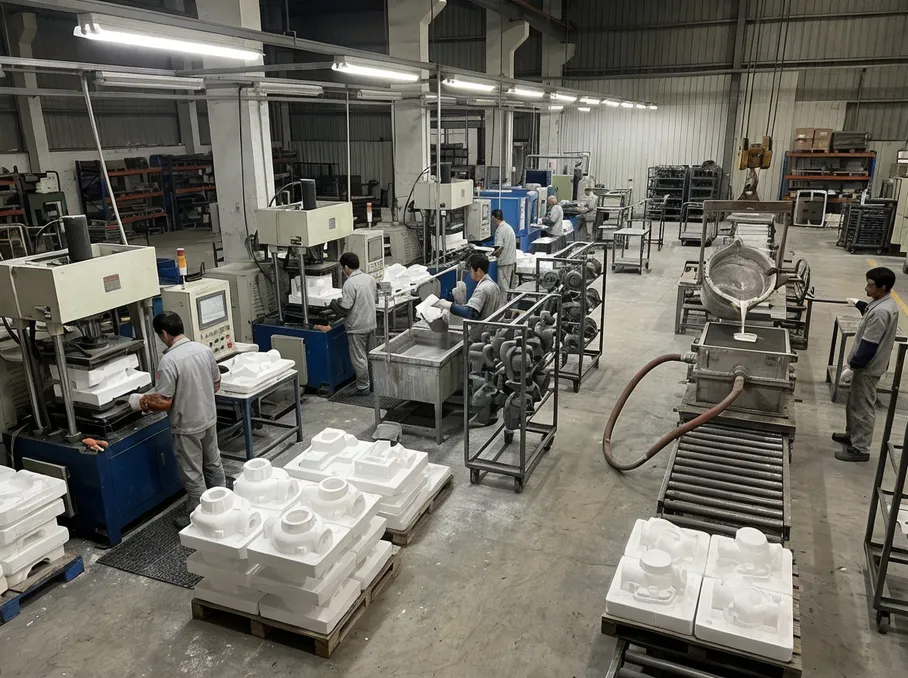
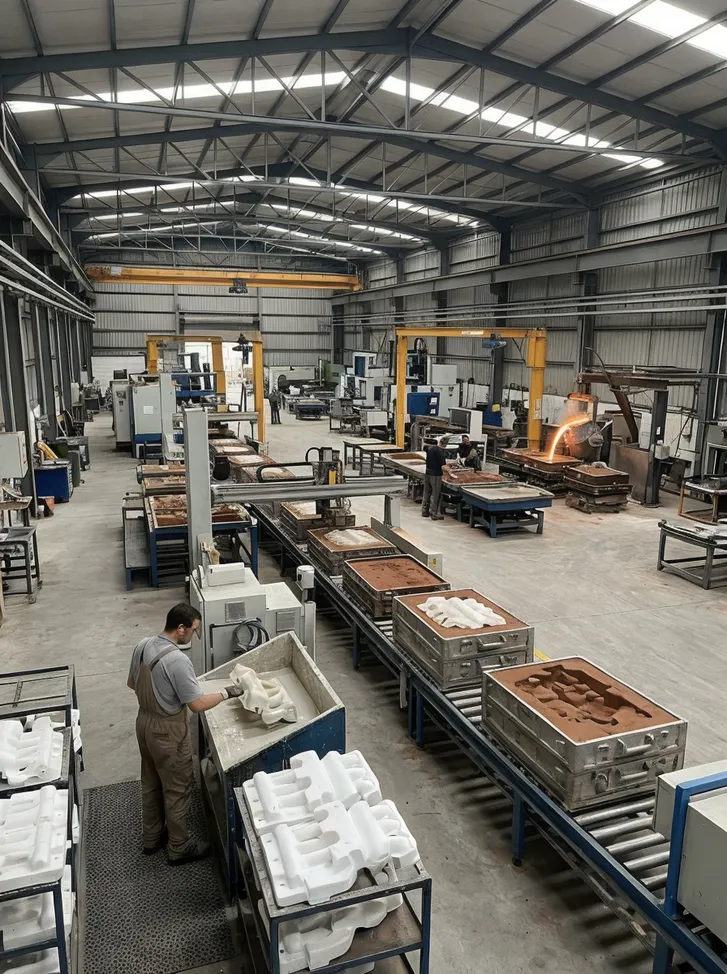
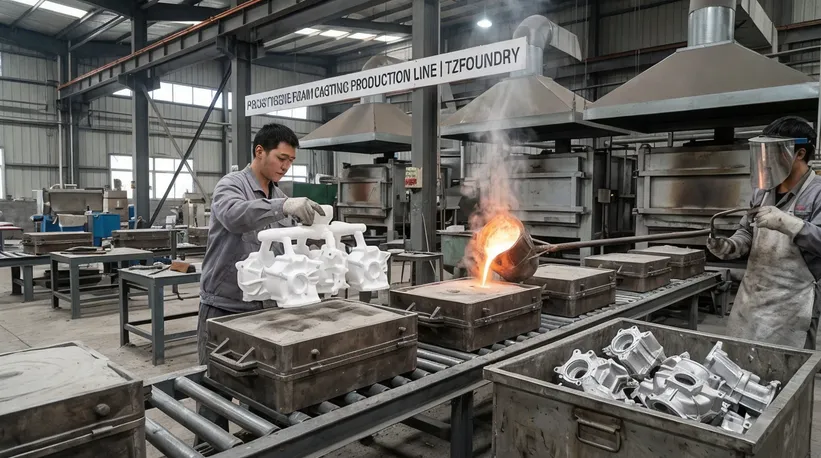
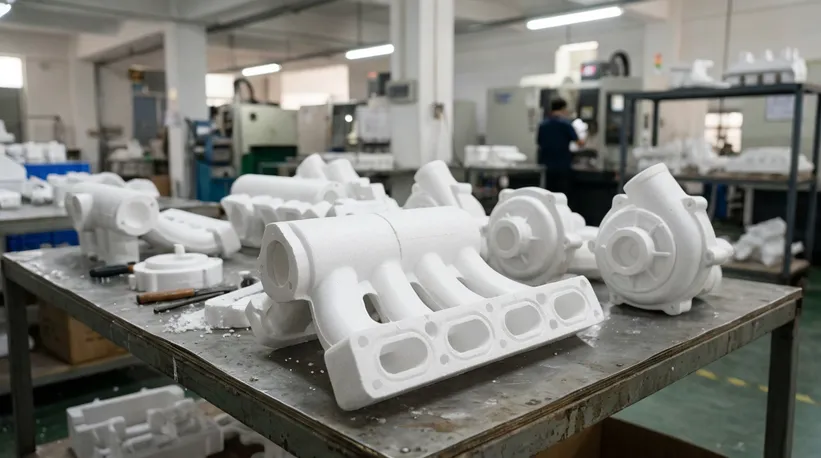
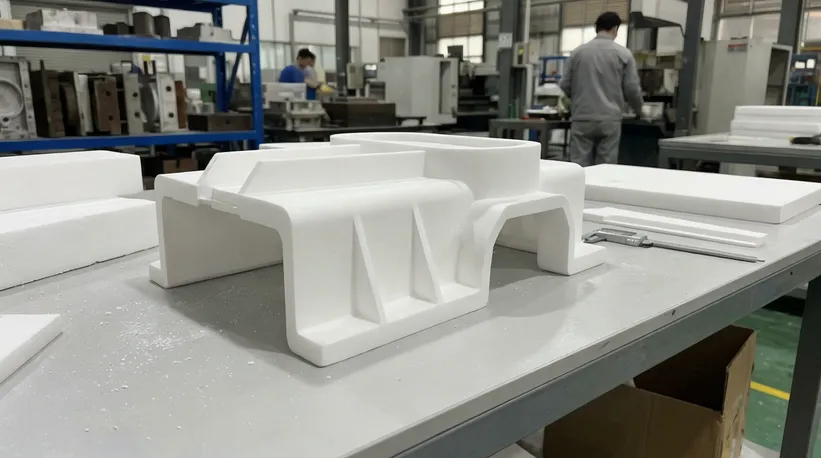
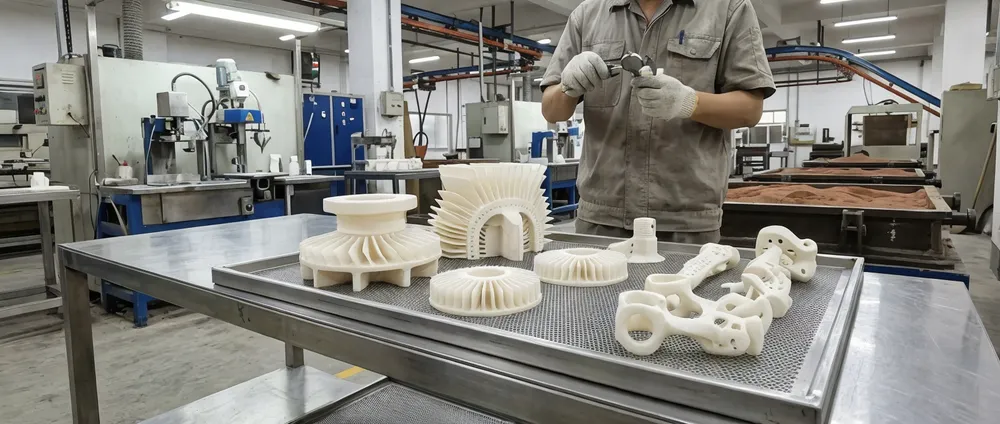
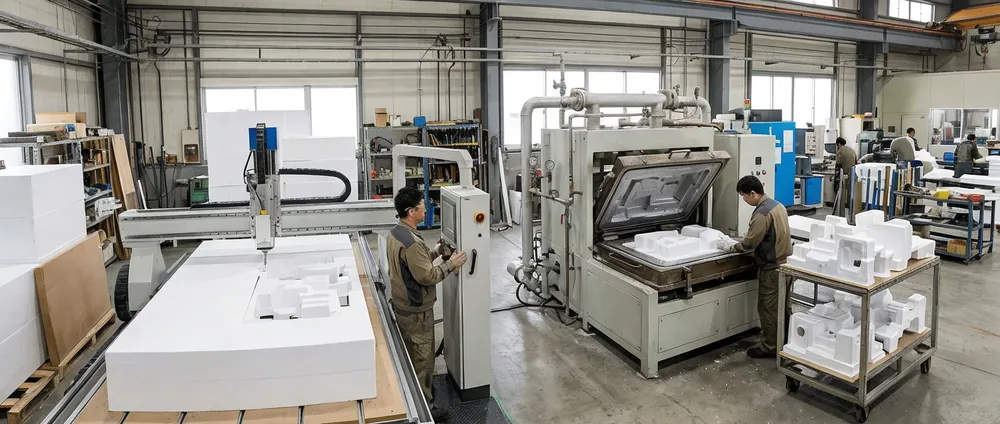
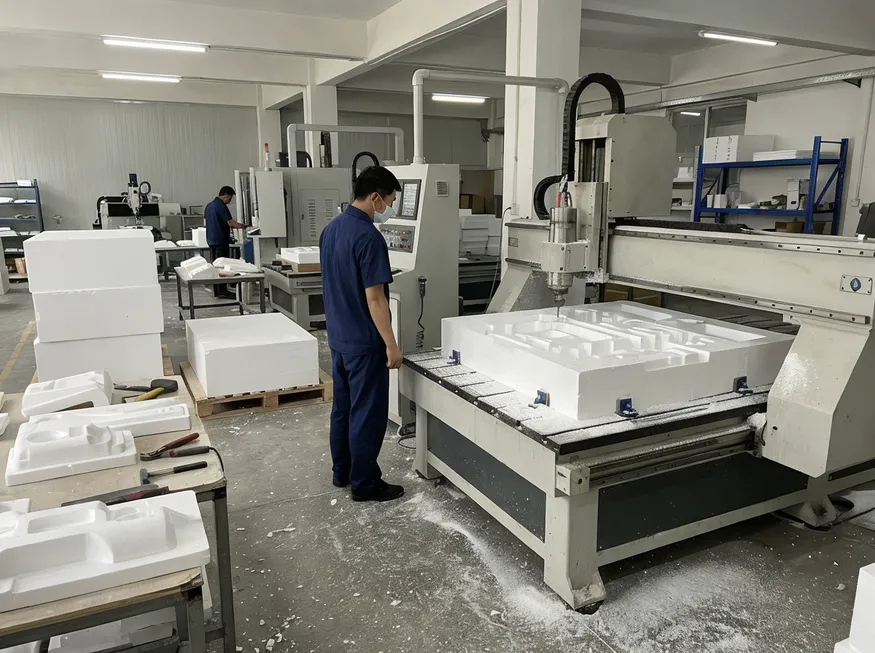
A polystyrene foam casting production line handles the complete lost foam process using standard-density EPS patterns (18–24 kg/m³) — the workhorse material for 70–80% of lost foam foundries worldwide. This density range balances pattern cost ($8–15/kg), dimensional stability (±0.5mm), and process control predictability for general-purpose aluminum and iron castings.
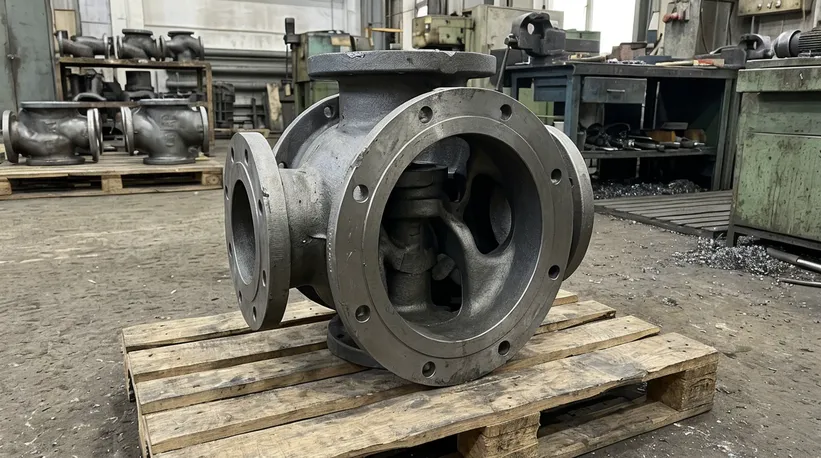
If you're producing pump housings, valve bodies, brackets, or manifolds in the 2–50 kg range at 500–5,000 units annually, polystyrene foam delivers lower per-casting costs than die casting or permanent mold without locking you into 10,000+ unit minimums.
Polystyrene's thermal decomposition characteristics drive every equipment parameter in the line. Understanding these numbers is the difference between a tuned process and trial-and-error scrap rates.
At pouring temperature (700–750°C for aluminum, 1,400–1,500°C for iron), polystyrene vaporizes completely with minimal ash residue — generating 1.2–1.5 liters of gas per gram of foam. Vacuum systems are sized specifically for this gas volume.
Coating viscosity tuned to 1.4–1.6 specific gravity and drying parameters held at 45–55°C for 6–10 hours — calibrated specifically for polystyrene's surface porosity and moisture absorption behavior.
Vacuum pressure set to 0.04–0.05 MPa for aluminum castings. PLC control stores process recipes for different polystyrene densities within the 18–24 kg/m³ range — switch patterns or suppliers without manual recalibration.
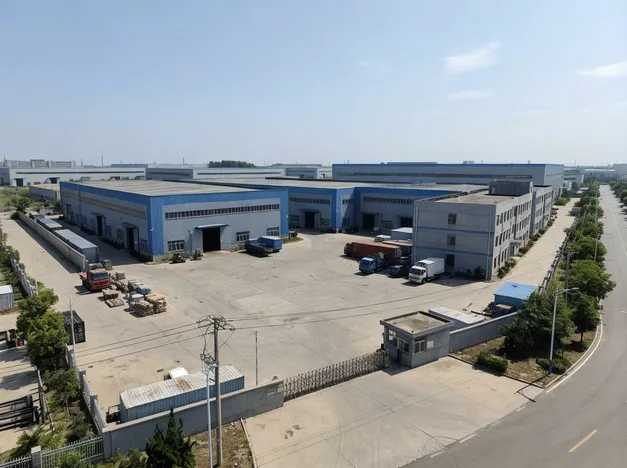
We manufacture modular polystyrene foam casting lines for foundries handling 50–500 tons monthly. Each system ships in standard containers and connects on-site in 4–6 weeks. TZFoundry operates 8 production lines across 15,000 square meters in Qingdao.
We build coating equipment, vacuum systems, molding lines, and sand reclamation plants in-house. Our in-house R&D team sizes vacuum systems based on your casting portfolio's gas evolution requirements and supports coating formulation for polystyrene's specific surface characteristics.
Qingdao Facility · 15,000 m² · 8 Production Lines
Our polystyrene foam casting production lines integrate coating, molding, vacuum, and reclamation subsystems with process parameters optimized for 18–24 kg/m³ EPS patterns. Equipment handles aluminum and iron alloys with PLC-controlled parameter adjustment for different polystyrene densities and casting geometries.
| Specification | Value |
|---|---|
| Pattern Density Range | 18–24 kg/m³ EPS |
| Coating Viscosity Control | 1.4–1.6 specific gravity |
| Coating Thickness | 0.8–1.2 mm |
| Vacuum Pressure (Aluminum) | 0.04–0.05 MPa |
| Vacuum Pressure (Iron) | 0.03–0.04 MPa |
| Drying Temperature | 45–55°C |
| Drying Time | 6–10 hours |
Vacuum pressure automatically adjusts based on polystyrene gas evolution rate (1.2–1.5 L/g), ensuring casting integrity across aluminum and iron alloys without manual intervention.
Standard polystyrene foam (18–24 kg/m³) has higher surface porosity than high-density EPS, requiring 0.8–1.2 mm coating thickness versus 0.6–0.9 mm to prevent metal penetration and gas defects.
| Specification | Value |
|---|---|
| Production Capacity | 50–500 tons/month |
| Flask Size Options | 500×500 mm to 1200×1200 mm |
| Control System | Siemens / Mitsubishi PLC |
| Power Requirements | 380V/50Hz or 480V/60Hz |
| Footprint | 200–800 m² |
Full EPS density range with automatic PLC recipe switching between patterns.
Modular capacity scaling from manual batch to fully automated continuous operation.
Siemens/Mitsubishi PLC with 4G and Ethernet connectivity for remote monitoring.
380V/50Hz or 480V/60Hz — pre-configured for your destination market requirements.
Specifications are optimized for standard-density polystyrene foam patterns. Actual parameters may vary based on your casting mix and facility requirements. Contact us for detailed engineering specifications and custom configurations.
Send us your annual tonnage, alloy types, and typical casting size range for a custom equipment configuration and factory-direct quote.
Polystyrene foam casting suits specific market segments where pattern cost, dimensional accuracy, and production volume economics align. These scenarios represent profitable opportunities for distributors, foundries, and OEMs who need flexible tooling without die casting's capital requirements.
Automotive Aftermarket & HVAC Equipment Suppliers
Castings in the 2–8 kg range, annual volumes 5,000–20,000 units. Polystyrene pattern cost runs $3–6 per casting (pattern tooling amortizes over 1,000–1,500 castings at $4,000–8,000 initial investment). Dimensional accuracy ±0.8 mm enables direct assembly without secondary machining on non-critical surfaces — bolt holes and mounting faces machine in one CNC operation, saving 15–25 minutes per part vs. green sand castings that need full-surface machining.
Suppliers serving independent repair shops and regional distributors need cost-competitive alternatives to OEM die-cast parts. Polystyrene foam tooling costs 1/10th of die casting tooling ($4,000–8,000 vs. $40,000–80,000), so you can offer replacement parts at 30–40% below OEM pricing while protecting 35–45% margin. Production flexibility matters here — you're not locked into 50,000-unit die casting minimums when actual demand is 8,000–12,000 units over a 3-year product lifecycle.
Industrial Distribution — Oil/Gas, Water Treatment, HVAC
Castings 10–30 kg with complex internal passages. Polystyrene foam eliminates core-making cost entirely — the EPS pattern includes all internal geometry, so you're pouring a single-piece mold instead of assembling cores and dealing with core gas defects. Machining reduction runs 30–40% vs. green sand because lost foam's near-net-shape accuracy puts you within 1–2 mm of final dimensions on most features.
Industrial distributors serving project contractors need reliable supply of standard valve configurations (2", 3", 4" flanged bodies in 150# and 300# ratings) with 2–4 week lead times. Polystyrene foam lines produce these in batch sizes of 50–200 units economically — you're not running 1,000-unit minimums to justify green sand line setup. Repeatable orders from the same distributor base (quarterly or semi-annual reorders) make this a margin-protection segment: once you've proven quality and delivery reliability, price competition drops because switching costs are high for distributors with established contractor relationships.
Machinery OEMs — Aluminum or Iron, 5–15 kg Castings
Polystyrene pattern tooling amortizes over 800–1,500 castings, suitable for product lifecycles of 3–7 years at 200–500 units annually. OEMs designing hydraulic manifolds, pneumatic distribution blocks, or coolant routing components need tooling that doesn't lock them into permanent mold's 10,000+ unit economics. Pattern cost per casting runs $8–12 (tooling $6,000–15,000 depending on complexity), vs. $25–40 per casting for machining from billet or $15–20 for green sand with extensive secondary operations.
Machinery manufacturers launching new equipment models face uncertain demand — initial production might be 300 units in year one, scaling to 800–1,200 units if the product succeeds. Polystyrene foam tooling carries low enough risk ($6,000–15,000) that OEMs can commit to castings during product development, then scale production without retooling. You're offering them manufacturing flexibility that protects their margin during market validation phases — if the product fails, they're out $10,000 in tooling instead of $60,000–100,000 for permanent mold dies.
Per-unit cost at 200–500 annual volume, 5–15 kg manifolds
Send us part drawings (or photos of current castings), annual volumes, and alloy types. We'll assess fit, identify which castings suit polystyrene foam vs. other processes, and provide line configuration recommendations with factory pricing.
Polystyrene's material properties — lower density means more fragile patterns, higher moisture absorption than denser foams — require specific handling protocols. These aren't generic lost foam procedures; they're calibrated for 18–24 kg/m³ EPS behavior.
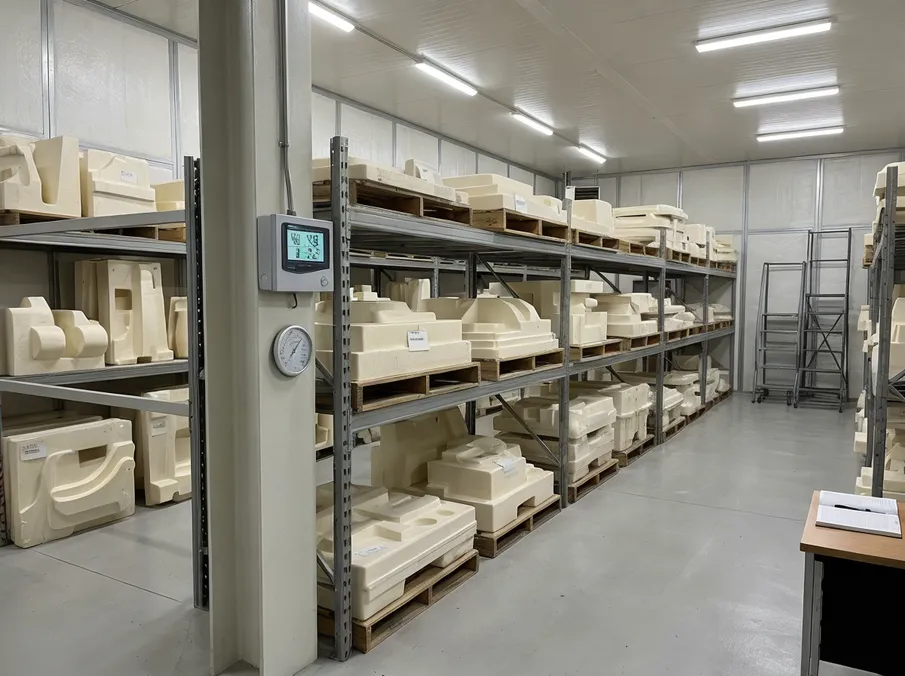
Store polystyrene patterns at 40–60% relative humidity and 15–25°C temperature. Outside this range, patterns absorb moisture (above 60% humidity) or dry out and shrink (below 40% humidity), causing dimensional changes of 0.3–0.8mm on a 300mm casting dimension. Temperature cycling compounds the problem — patterns stored in unheated warehouses that swing from 5°C overnight to 25°C during the day will warp from differential expansion.
We learned this the hard way in 2016 when a batch of polystyrene patterns for a European buyer sat in an unheated warehouse for three weeks during winter. Moisture absorption caused 15% scrap rate from gas porosity defects during pouring — the patterns looked fine visually, but internal moisture content had jumped from 1% to 4%, and that extra moisture vaporized during pouring, creating subsurface voids.
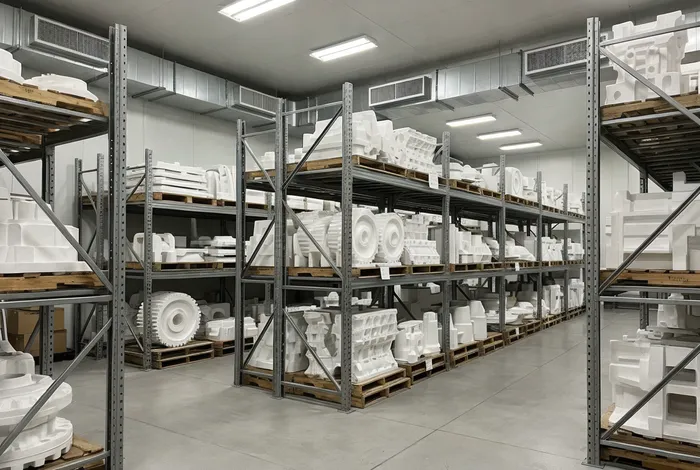
Now we specify climate-controlled pattern storage in all line installations and provide humidity monitoring equipment as standard.
Suitable for high-volume production where patterns move through assembly stations continuously. Apply adhesive at 160–180°C, press joint surfaces together for 15–30 seconds, and the bond reaches handling strength.
Best For
Simple joints — flat mating surfaces, butt joints. Works well for continuous-flow assembly stations.
Limitation
Does not allow repositioning once surfaces contact. Alignment must be correct on first placement.
Gives you adjustment time for complex joints that need precise alignment — multi-piece patterns with interlocking features, angled joints, or assemblies where dimensional stack-up matters.
Application Process
Apply thin solvent layer to both surfaces, wait 30–60 seconds for partial evaporation, then press together and hold for 2–3 minutes. The slower cure lets you shift components slightly if alignment is off.
Trade-Off
Solvent adhesives cost 2–3× more than hot-melt and require ventilation (acetone vapor is flammable and needs extraction).
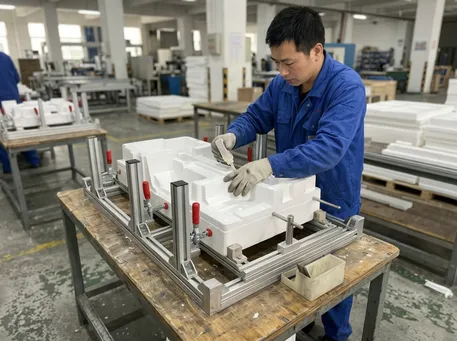
Pattern assembly fixtures position components during gluing — adjustable clamps, alignment pins, and support surfaces that hold pattern sections in correct orientation.
High-Volume Production
Dedicated fixtures designed for each casting geometry — optimized for speed and repeatability on the production floor.
Low-Volume / Prototype
Universal fixtures with adjustable positioning — flexible enough to accommodate varying pattern geometries without tooling changes.
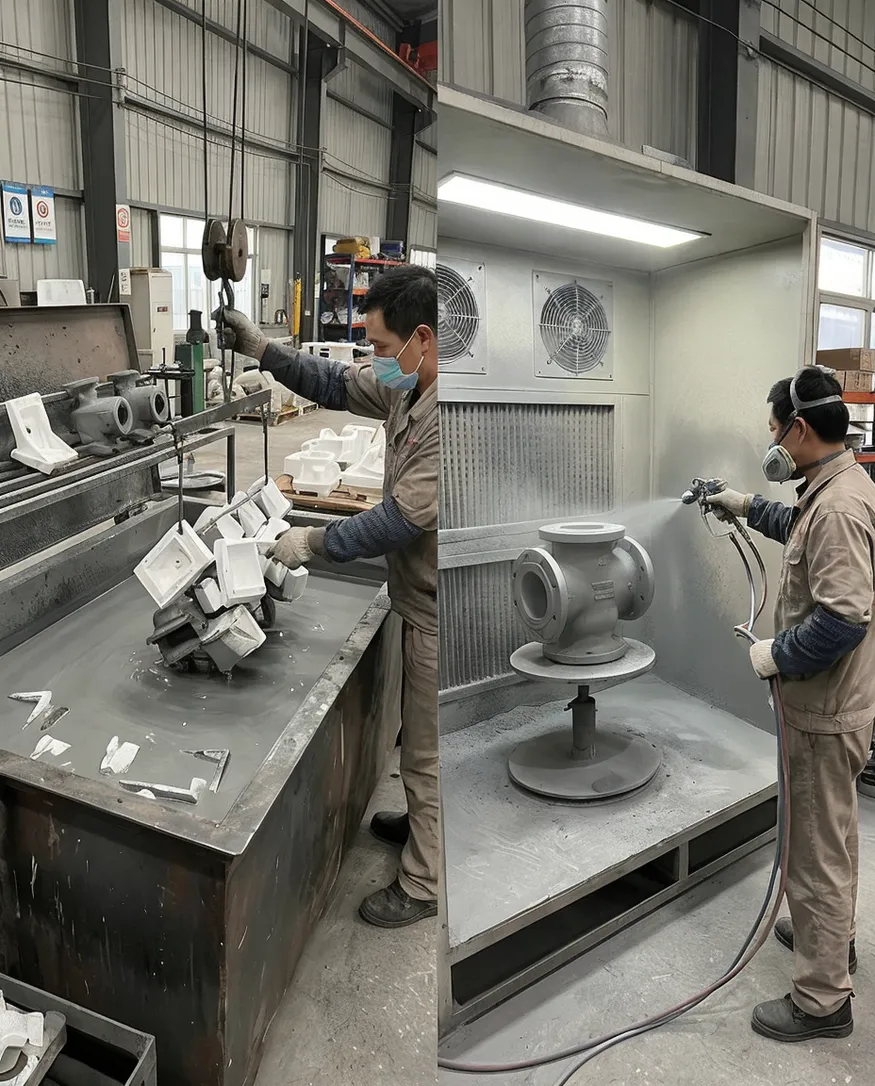
The geometry of your polystyrene pattern dictates whether dip coating or spray coating delivers the most consistent refractory layer — and choosing incorrectly leads to bare-spot defects or wasted slurry.
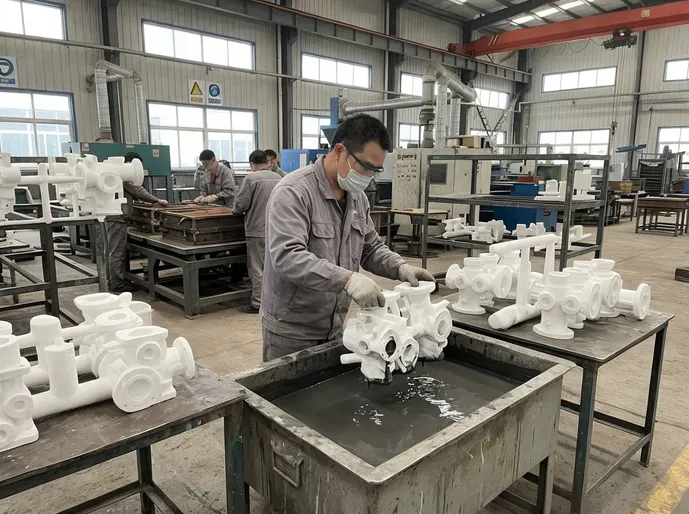
Dip tanks handle 60–70% of polystyrene patterns — simple geometries like housings, brackets, flanges, and valve bodies. Submerge pattern in refractory slurry, hold for 10–30 seconds to ensure complete coverage, then lift and drain for 2–5 minutes.
Viscosity control is critical: polystyrene's surface porosity (higher than dense foams) means slurry penetrates 0.2–0.4mm into the foam surface. If viscosity is too low (<1.4 specific gravity), you get excessive penetration and coating thickness becomes inconsistent. If viscosity is too high (>1.6 specific gravity), coating doesn't flow into surface details and you get bare spots that cause metal penetration defects.
Spray booths handle patterns too large for dip tanks or geometries with deep cavities where dip coating traps air. Automated spray guns apply coating while patterns rotate on turntables.
Spray application uses lower-viscosity slurry (1.3–1.5 specific gravity) because you're building thickness through multiple passes rather than single immersion. Equipment cost runs 40–60% higher than dip tanks, but you avoid the pattern size limitations.
Choose dip tanks for simple housings, brackets, flanges, valve bodies — any pattern that fits inside 200–800L capacity and has no deep pockets where slurry traps air.
Choose spray booths for oversized patterns, deep-cavity geometries, or when you need precise thickness control across complex profiles.
Budget note: Spray equipment costs 40–60% more upfront. Most foundries start with dip tanks (covering 60–70% of patterns) and add spray capacity when large-pattern demand justifies it.
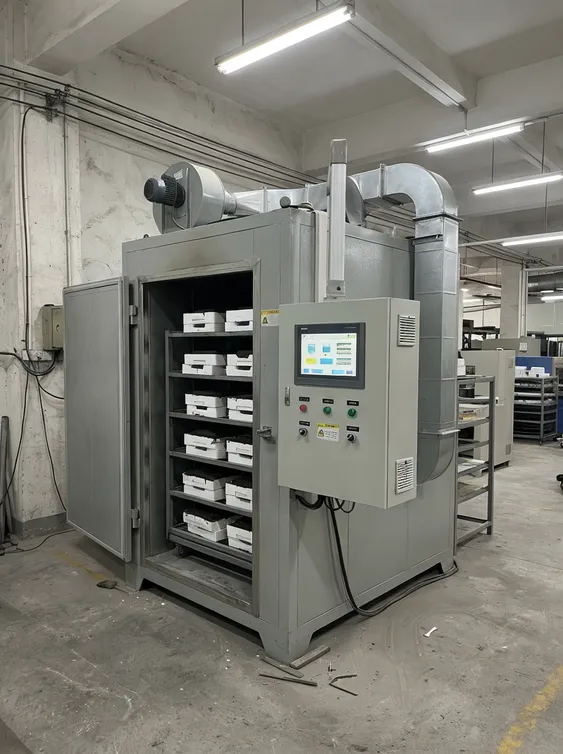
Coating drying is the critical bridge between application and pour-readiness. Temperature and humidity windows are narrow — exceed them in either direction and you introduce dimensional defects or gas porosity into your castings.
Drying window for 6–10 hours. This temperature range ensures complete moisture removal without pattern deformation.
Polystyrene glass transition: 95–105°C. Even at 60–70°C you start seeing dimensional changes on thin-wall sections or unsupported spans.
Risks pattern distortion — polystyrene's glass transition temperature is 95–105°C, but dimensional changes begin on thin-wall sections well below that threshold at 60–70°C.
Defect: dimensional inaccuracy on thin-wall and unsupported sections.
Leaves residual moisture trapped in the coating layer. That trapped moisture vaporizes during metal pouring, creating gas porosity defects in the finished casting.
Defect: gas porosity from moisture vaporization during pour.
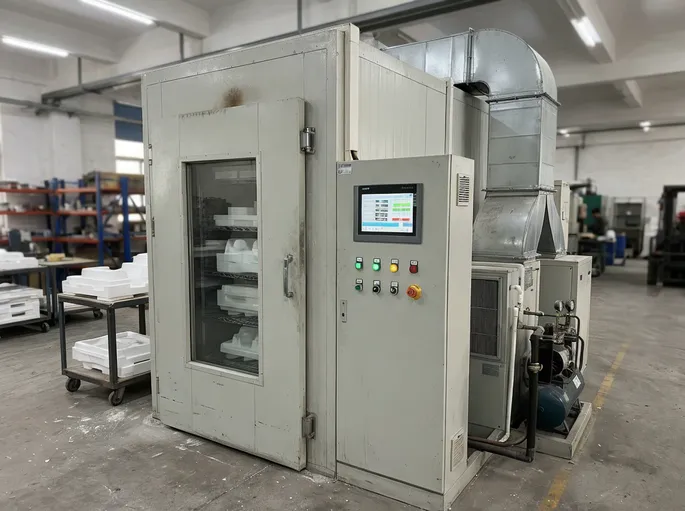
Our drying chambers use forced-air circulation with humidity monitoring. As coating dries, moisture evaporates and chamber humidity rises — if humidity exceeds 70%, drying rate slows dramatically and you need to extend drying time or increase air exchange rate.
PLC control monitors chamber humidity and adjusts fan speed or fresh air intake to maintain 40–60% humidity during the drying cycle. This closed-loop control eliminates operator guesswork and prevents the two most common drying-related defects.
For high-volume operations, size drying capacity to match daily coating throughput so patterns don't queue. The calculation is straightforward:
If you're coating 50 patterns per day and each pattern needs 8 hours drying time, you need chamber capacity for 17–20 patterns (50 patterns ÷ 3 batches per day). Under-sizing drying capacity creates a production bottleneck that idles your coating station and delays pour schedules.
Generic lost foam equipment describes what the line does. Here we explain how equipment is specifically tuned for polystyrene's thermal and physical properties — the manufacturing process depth that signals genuine factory expertise.
Polystyrene's lower density (18–24 kg/m³) vs. high-density EPS (28–32 kg/m³) means more surface porosity — the foam structure has larger voids and more interconnected air pockets. Refractory slurry penetrates 0.2–0.4 mm into polystyrene surfaces vs. 0.1–0.2 mm for denser foams. To prevent metal penetration during pouring, polystyrene patterns need slightly thicker coating: 0.8–1.2 mm vs. 0.6–0.9 mm for high-density EPS.
| Parameter | Polystyrene EPS (18–24 kg/m³) |
High-Density EPS (28–32 kg/m³) |
|---|---|---|
| Slurry Penetration Depth | 0.2–0.4 mm | 0.1–0.2 mm |
| Required Coating Thickness | 0.8–1.2 mm | 0.6–0.9 mm |
| Surface Porosity | Higher | Lower |
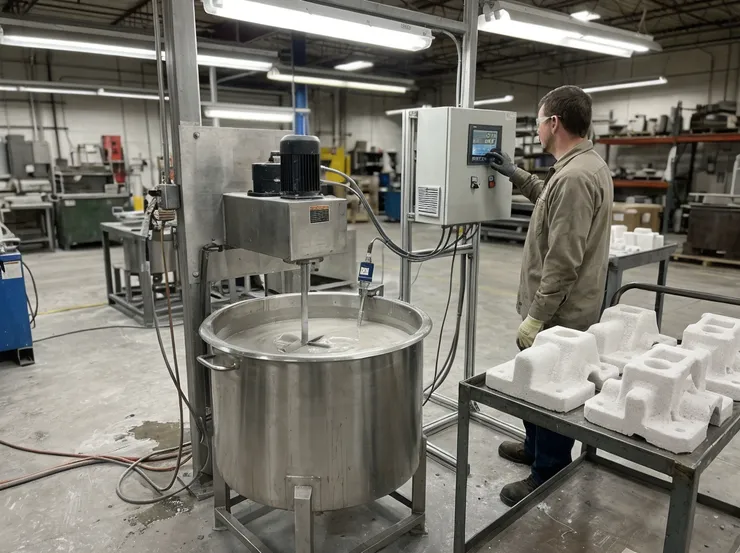
Automated viscosity monitoring ensures consistent refractory slurry application across polystyrene pattern densities.
Our coating systems store viscosity recipes for different polystyrene densities. Automated viscosity sensors measure specific gravity every 15 minutes using vibrating tube densitometers — if viscosity drifts outside the target range, the PLC alerts operators and displays whether to add refractory powder (increase viscosity) or water (decrease viscosity).
Specific gravity slurry — higher viscosity compensates for greater surface porosity and larger interconnected voids at this density.
Specific gravity slurry — denser surface structure with less porosity allows a slightly lower viscosity setting while maintaining full coverage.
Common Failure Mode Prevented
Without automated monitoring, coating viscosity gradually increases over a shift as water evaporates, leading to thick, uneven coating on later patterns. The 15-minute densitometer cycle catches this drift before it causes defects.
Coating thickness uniformity matters because thin spots cause metal penetration defects and thick spots trap gas. We calibrate coating application to achieve ±0.15 mm thickness variation across the pattern surface — measured by coating weight before and after drying, then calculating thickness from coated surface area.
Complex Geometry Adjustments
For complex geometries with deep pockets or narrow channels, we adjust application parameters to ensure uniform coverage in hard-to-reach areas:
Longer immersion time for better penetration into cavities — ensures refractory slurry fully covers recessed geometries and internal channels.
Adjusted gun angle and distance — closer spray for recessed areas to increase deposition, farther spray for exposed surfaces to prevent over-coating.
Polystyrene generates 1.2–1.5 liters of gas per gram during thermal decomposition. A 2 kg pattern produces 2,400–3,000 liters of gas during pouring — that gas needs to escape through the sand mold and coating layer, or it creates back-pressure that causes mold collapse or metal misruns. The vacuum system pulls gas away from the mold cavity as metal fills, maintaining negative pressure that keeps sand compacted against the pattern.
P = (W × G × R) ÷ (V × 1000)
Required vacuum pressure depends on pattern weight, flask volume, and alloy type. Our vacuum systems calculate required pressure using this formula to ensure consistent mold integrity across every pour cycle.
Aluminum castings need higher vacuum than iron because aluminum's lower density creates less compaction force against unbonded sand.
Density: 2.7 g/cm³ — lower metal weight means less natural sand compaction force
Density: 7.2 g/cm³ — heavier metal provides additional compaction force naturally
1.2–1.5 L
Gas per gram of polystyrene
2,400–3,000 L
Gas from a 2 kg pattern
30–90 sec
Post-fill vacuum hold time
PLC control adjusts vacuum in real-time as metal fills the mold. The process follows a precise sequence engineered to manage gas evolution at every stage of the pour:
Pre-Pour Vacuum
Initial vacuum pulls sand tight against the pattern and removes air from the mold cavity before any metal enters the system.
Active Pour — Gas Spike Management
As metal enters the mold, gas evolution spikes sharply. The PLC increases vacuum pressure automatically to handle the increased gas load, preventing back-pressure buildup that would cause mold collapse or misruns.
Post-Fill Hold — 30 to 90 Seconds
After the mold fills, vacuum holds for 30–90 seconds while the casting surface solidifies. This sustained negative pressure maintains sand compaction during the critical initial solidification window.
Controlled Release
Vacuum releases only after surface solidification is confirmed, completing the cycle.
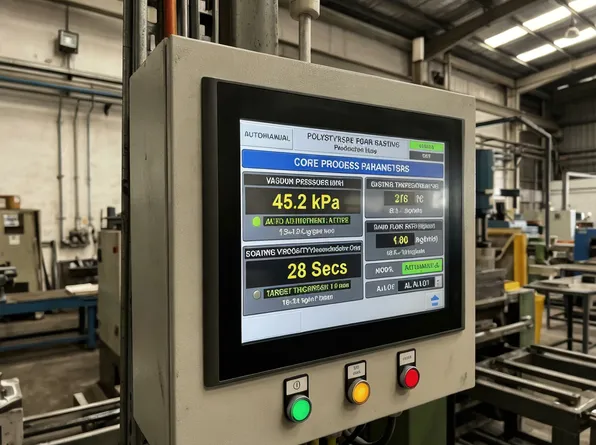
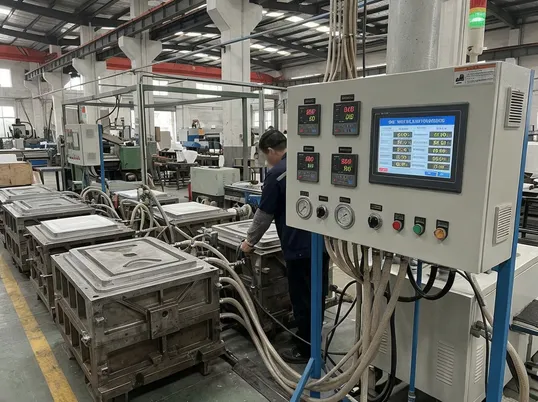
PLC vacuum control panel with real-time pressure monitoring at each molding station
Pressure sensors at each molding station log vacuum readings every second. If pressure drops below setpoint during pouring — indicating the vacuum pump cannot keep up with gas evolution — the system automatically flags that mold for inspection. Low vacuum during active pouring often correlates with mold shift or dimensional defects, making this real-time monitoring a critical quality gate in the production process.
Polystyrene absorbs 2–4% moisture by weight when exposed to humid environments above 70% relative humidity. A 2 kg pattern can absorb 40–80 grams of water during storage or handling. That moisture needs to evaporate during coating drying, or it remains in the pattern and vaporizes during pouring, causing gas porosity defects in the casting.
Our drying systems monitor coating moisture content using weight-based calculation: weigh pattern before coating, after coating (wet), and after drying. Target is <1.5% residual moisture in the dried coating.
If moisture content exceeds 1.5%, the PLC extends drying time automatically — typically adding 1–2 hours to the standard 6–8 hour cycle. For foundries in humid climates (Southeast Asia, Gulf Coast regions), we specify dehumidification equipment that maintains 40–50% humidity in the drying chamber regardless of ambient conditions.
Temperature uniformity across the drying chamber affects cure consistency. Hot spots near heating elements or air inlets can reach 60–65°C while cool spots in corners and areas with poor air circulation stay at 40–45°C — a 20°C delta that produces inconsistent coating performance.
We design drying chambers with 4–6 temperature sensors for a 2 m³ chamber, providing real-time thermal mapping across the entire drying volume to identify and correct hot and cold zones.
Variable-speed circulation fans adjust airflow dynamically to maintain ±3°C temperature variation across the full chamber — eliminating the 20°C deltas that cause inconsistent cure on coated polystyrene patterns.
Patterns rotate or reposition halfway through the drying cycle so all surfaces see equivalent thermal exposure — ensuring uniform coating cure from every angle regardless of chamber position.
From weight-based moisture tracking to multi-zone temperature equalization, our polystyrene drying chambers eliminate operator guesswork. PLC logic handles cycle extensions, fan speed adjustments, and dehumidification — keeping residual moisture below 1.5% and temperature uniformity within ±3°C across every batch.
Buyers evaluating lost foam often face the "which foam density?" decision. This guide helps you match foam type to your casting requirements and production economics.
The workhorse for 70–80% of lost foam applications.
Pattern cost varies by geometry complexity and whether sourcing from pattern shops or producing in-house. Dimensional stability ±0.5 mm over 6–12 month storage in climate-controlled conditions.
Choose standard polystyrene when producing aluminum pump housings, iron valve bodies, manifolds, and brackets — and when pattern cost is a significant factor in your per-casting economics. Polystyrene's commodity status means wide supplier availability — if your current pattern supplier has quality or delivery issues, alternative sources are readily available without process requalification.
Best suited for applications where dimensional tolerance isn't critical and production economics favor lower pattern cost.
For thin-wall and precision castings where pattern rigidity matters.
Higher density means more material per pattern and tighter manufacturing tolerances during pattern production, justifying the premium over standard polystyrene.
Choose high-density EPS when wall thickness is 2–4 mm, tolerance requirements are ±0.3 mm or tighter, pattern geometry includes thin ribs or unsupported sections that would collapse in standard polystyrene, or you're producing precision aluminum parts for aerospace, medical, or electronics applications where dimensional accuracy justifies the higher pattern cost.
Ideal for applications with tight port-to-port spacing, weight-optimized geometry, and tight tolerance requirements.
Full spectrum coverage
Across both foam grades
Application-matched precision
Best for ultra-thin walls (<2mm), extremely tight tolerances (±0.15mm), and applications where pattern cost is secondary to casting performance. Pattern cost runs $40–80/kg — EPMMA is not a commodity material and has limited supplier base. Requires specialized coating formulations and process parameters; most standard lost foam equipment needs modification to handle EPMMA.
Selecting the right foam type is fundamentally an economic decision. The table below maps production scenarios to the foam type that delivers the lowest total cost per casting.
| Production Scenario | Recommended Foam | Pattern Cost | Key Economics |
|---|---|---|---|
|
5–50 kg castings 4–10mm wall thickness 500–5,000 units/year |
Standard Polystyrene | $8–15/kg | A 2 kg pattern costs $16–30. At 1,000–1,500 castings per pattern tooling set, that's $0.01–0.03 per casting in pattern cost. Total casting cost: $8–25/kg (aluminum), $4–12/kg (iron). |
|
Thin-wall precision parts Tolerance tighter than ±0.4mm 200–1,000 units/year |
High-Density EPS | $15–25/kg | Machining cost avoidance offsets the pattern premium — tighter as-cast tolerance means less secondary operations. Economic breakpoint: ±0.4mm. Tighter than that, high-density EPS saves money; looser, standard polystyrene is more economical. |
|
Ultra-specialized Wall <2mm, tolerance ±0.15mm Aerospace/medical specs |
EPMMA | $40–80/kg | Only makes economic sense where casting performance requirements eliminate other options. If you're evaluating EPMMA, you're likely already constrained by aerospace/medical specifications or geometry impossible with standard foams. |
Standard polystyrene at $8–15/kg pattern cost delivers $0.01–0.03 per casting in pattern amortization for mid-volume production (500–5,000 units/year).
Total casting cost: $8–25/kg aluminum, $4–12/kg iron
This is the critical economic threshold. Below ±0.4mm, high-density EPS pays for itself through machining cost avoidance on secondary operations.
Pattern premium of $15–25/kg offset by fewer post-cast machining steps
At $40–80/kg and requiring equipment modifications, EPMMA is viable only when aerospace/medical specifications or impossible geometry eliminate standard options.
Justified by 3–5× pattern cost only when no alternative exists
TZFoundry engineers can evaluate your casting geometry, tolerance requirements, and production volume to recommend the optimal foam type and equipment configuration. Our polystyrene foam casting lines are calibrated for standard EPS and high-density EPS, with modification packages available for EPMMA applications.
Equipment cost is one-time; pattern supply cost is ongoing. Understanding pattern sourcing options and total cost of ownership helps you make informed decisions about in-house vs. outsourced pattern production.
Capital Investment for Volume Production
Best for simple geometries
Equipment Cost Range
Suitable Pattern Types
Simple patterns — housings, flanges, brackets — where geometry can be cut from EPS blocks using heated wire.
Pattern Cost
$6–$10/kg
EPS material $2–4/kg + machine time & labor
Tooling Life
1,000–2,000
patterns before wire guides wear & accuracy degrades
Best for complex geometries
Equipment Cost Range
Suitable Pattern Types
Complex patterns that can't be cut with hot wire — patterns with internal cavities, undercuts, or features that require molded-in detail.
Pattern Cost
$8–$12/kg
EPS beads $3–5/kg + mold amortization & labor
Tooling Life
5,000–25,000
patterns (aluminum: 5–10k; steel: 15–25k)
The economic breakpoint for in-house tooling is around 300–500 kg of patterns annually. Below that volume, capital cost doesn't amortize fast enough to beat outsourced pattern pricing. Above that volume, in-house production saves $4–8/kg vs. buying from pattern shops, so payback runs 18–30 months depending on your casting mix.
Annual Volume Threshold
300–500kg
patterns/year for in-house ROI
Payback Period
18–30 months
Pattern shops charge $12–18/kg for standard polystyrene patterns, rising to $18–25/kg for complex geometries or tight-tolerance work. Lead time runs 2–4 weeks for initial tooling and first-article samples, then 1–2 weeks for production quantities once tooling is qualified.
50–100 patterns per order
200–500 patterns where tooling cost needs to amortize
The trade-off: You're paying $12–18/kg vs. $6–10/kg for in-house production, but you avoid $50,000–$150,000 capital investment and the overhead of running pattern production equipment.
Request sample patterns before committing to production tooling — check dimensional accuracy, surface finish, and density consistency. Evaluate each shop against these critical benchmarks:
Can they hold 20 kg/m³ ±1 kg/m³? Consistent density is non-negotiable for dimensional repeatability in your castings.
±0.3mm is standard capability. ±0.2mm requires premium tooling — confirm this upfront if your casting specs demand it.
1–2 weeks is typical for repeat production runs. Faster delivery is available at a 15–25% premium — factor this into your production scheduling.
MOQs range from 50 to 500 patterns depending on geometry complexity. Confirm minimums align with your production batch sizes to avoid excess inventory.
Polystyrene patterns remain dimensionally stable for 6–12 months in climate-controlled storage (40–60% humidity, 15–25°C temperature). Beyond 12 months, dimensional drift from moisture cycling becomes significant — patterns stored for 18–24 months can show 0.5–1.0mm dimensional changes on 300mm casting dimensions. This matters for castings with tight tolerance requirements or patterns that need to mate with other components.
| Parameter | Value |
|---|---|
| Climate-controlled warehouse cost | $3–8 / m² / month |
| 500-pattern inventory footprint (avg. pattern size 300×300×200mm) |
15–20 m² rack space |
| Monthly storage cost | $45–160 / month |
| Annual storage cost | $540–1,920 / year |
| Optimal storage environment | 40–60% RH, 15–25°C |
| Dimensional stability window | 6–12 months |
Buyer note: For high-volume production, just-in-time pattern delivery from pattern shops can be more economical than maintaining large pattern inventories — eliminating both storage cost and dimensional drift risk.
Polystyrene foam is commodity material with wide supplier availability globally. If your pattern supplier has quality issues (dimensional drift, density inconsistencies) or delivery problems (lead time delays, capacity constraints), alternative pattern shops can typically qualify and start production within 4–6 weeks.
This is a significant advantage vs. EPMMA foam, which has limited supplier base and 8–12 week requalification timelines if you need to switch suppliers.
Pattern tooling ownership matters for supply chain flexibility. If you own the tooling (molds, CNC programs, design files), you can move production to a different pattern shop with minimal friction.
If the pattern shop owns the tooling, you're locked in — switching suppliers means paying for new tooling development.
Simple Patterns
$3,000–$8,000
New tooling development cost
Complex Geometries
$8,000–$20,000
New tooling development cost
| Factor | Polystyrene (EPS) | EPMMA Foam |
|---|---|---|
| Supplier Availability | Wide — commodity material, global supplier base | Limited supplier base |
| Requalification Timeline | 4–6 weeks | 8–12 weeks |
| Tooling Portability (Owner-Held) | Minimal friction — move to any qualified shop | Moderate friction — fewer qualified shops |
| Tooling Re-Development Cost | $3,000–$20,000 depending on complexity | Higher — specialized tooling required |
We'll connect you with polystyrene pattern suppliers in your region, provide cost comparisons based on your casting portfolio, and recommend the sourcing strategy that minimizes your total cost of ownership.
18–22 kg/m³ works for most aluminum parts in the 2–50 kg range with wall thickness 4–12mm. Lower density (18–20 kg/m³) reduces pattern cost by $2–4/kg but requires more careful handling because patterns are more fragile. Higher density (22–24 kg/m³) suits thin-wall castings (<4mm walls) or high-precision applications where pattern rigidity matters — the denser foam holds tighter dimensional tolerance during coating and molding operations.
The economic trade-off: a 2 kg pattern at 18 kg/m³ costs $16–20, the same pattern at 24 kg/m³ costs $24–30. If your casting tolerance is ±0.5mm or looser, the lower-density pattern saves $8–10 per casting without affecting quality. If you need ±0.3mm tolerance, the higher-density pattern justifies the cost because it reduces dimensional variation during processing.
Best for tolerance ±0.5mm or looser. Saves $8–10 per casting. Requires careful handling.
Covers most aluminum parts: 2–50 kg weight range, 4–12mm wall thickness.
For ±0.3mm tolerance, thin walls <4mm. Pattern cost $24–30 for 2 kg pattern.
Cost math: 2 kg pattern at 18 kg/m³ = $16–20 vs. 24 kg/m³ = $24–30. The $8–10 savings per casting compound across production runs.
Polystyrene vaporizes completely at 400–500°C with minimal ash residue (typically <0.5% by weight). Clean decomposition is why polystyrene dominates lost foam applications — other foams leave carbon residue that causes surface defects. Surface finish depends on coating thickness and vacuum control, not foam decomposition chemistry.
Proper coating thickness (0.8–1.2mm for polystyrene) prevents metal penetration into sand while allowing gas to escape. Too thin (<0.6mm) and molten metal penetrates the coating, creating rough surface with embedded sand particles. Too thick (>1.5mm) and gas can't escape fast enough, causing back-pressure that creates subsurface porosity. Vacuum control (0.04–0.05 MPa for aluminum) pulls decomposition gases away from the casting surface as metal fills the mold.
Vacuum Control
0.04–0.05 MPa for aluminum alloys
Polystyrene foam castings approach permanent mold quality without the tooling cost — especially after light bead blasting.
Yes, equipment handles the full 18–24 kg/m³ polystyrene range with PLC recipe adjustments. Coating viscosity changes slightly between densities, and vacuum pressure adjusts proportionally to compensate for gas-generation differences.
Coating Viscosity by Density
18 kg/m³ Patterns
1.50–1.55 specific gravity slurry — higher viscosity compensates for more surface porosity
24 kg/m³ Patterns
1.40–1.45 specific gravity slurry — lower viscosity because denser foam has less porosity
Vacuum Pressure Adjustment
Lower-density patterns generate slightly more gas per unit volume. Vacuum increases 5–10% for 18 kg/m³ vs. 24 kg/m³ patterns.
Switchover Time: 10–15 Minutes
Operator selects the appropriate process recipe on the PLC touchscreen, system adjusts coating viscosity setpoint and vacuum pressure parameters, then production continues. No mechanical changes, no equipment recalibration. This flexibility matters when sourcing patterns from multiple suppliers or running different casting types that use different foam densities.
Moisture absorption and temperature cycling are the two primary causes of pattern warping during storage.
Moisture Absorption
Polystyrene absorbs 2–4% moisture by weight when stored above 70% relative humidity. As moisture content increases, patterns swell — dimensional growth of 0.3–0.8 mm on 300 mm dimensions is typical after 2–3 weeks in uncontrolled storage.
When humidity drops, patterns shrink back, but the dimensional change isn't always reversible — internal stresses from moisture cycling can cause permanent warping.
Temperature Cycling
Polystyrene's coefficient of thermal expansion is 70–80 μm/m/°C. A pattern stored in an unheated warehouse that swings from 5°C overnight to 25°C during the day experiences 1.4–1.6 mm expansion/contraction on a 300 mm dimension.
Repeated cycling creates internal stresses that cause warping, especially on thin-wall sections or patterns with unsupported spans.
Storage Solution
Store patterns at 40–60% humidity and 15–25°C temperature. Climate-controlled storage costs $3–8/m² monthly but eliminates dimensional drift.
For foundries without climate control, seal patterns in plastic bags with desiccant packs immediately after production — this maintains stable moisture content even in uncontrolled warehouse environments.
Standard polystyrene ($8–15/kg pattern cost) suits general-purpose castings where dimensional tolerance is ±0.4 mm or looser and wall thickness exceeds 4 mm. High-density EPS ($15–25/kg) is justified only for thin-wall castings (<4 mm walls) or ultra-precise parts (±0.3 mm tolerance) where standard polystyrene can't meet requirements.
Breakpoint Calculation
If tighter pattern tolerance saves you $5–10 per casting in machining cost (fewer secondary operations, tighter as-cast dimensions), then high-density EPS pays for itself.
Standard Polystyrene
$16–30
per 2 kg pattern
High-Density EPS
$30–50
per 2 kg pattern
That's a $14–20 premium per pattern. If the pattern produces 1,000 castings, the premium is only $0.014–$0.020 per casting.
If machining cost reduction is $5–10 per casting, high-density EPS delivers 250–500× ROI on the pattern cost premium.
Bottom Line
For most aluminum and iron castings in the 2–50 kg range with ±0.5 mm tolerance requirements, standard polystyrene delivers better economics. High-density EPS is a specialty material for specialty applications — not a general replacement for standard polystyrene.
CNC Hot-Wire Tooling
Simple Geometries — Cut From EPS Blocks
Steam Chest Molds
Complex Patterns — Molded Detail
| Mold Material | Pattern Life | Initial Cost |
|---|---|---|
| Aluminum Molds | 5,000–7,000 | $3,000–8,000 |
| Steel Molds | 8,000–12,000 | $8,000–15,000 |
Pattern Tooling Cost Amortization — Example
Annual Volume
500
patterns/year
Steam Chest Mold Cost
$8,000
8,000 pattern life
Tooling Cost/Pattern
$0.50
$0.25/kg at 2 kg avg
Add EPS material cost ($3–5/kg) and labor ($2–4/kg), and total pattern cost runs $8–12/kg for in-house production. This makes in-house pattern production viable for foundries running 500+ patterns annually.
We manufacture polystyrene foam casting production lines as a specialized subset of our lost foam equipment range. Since 2010, we've built coating systems, vacuum equipment, and molding lines for foundries processing 50–500 tons monthly.
Our facility in Qingdao operates 8 production lines across 15,000 square meters — we machine vacuum pump housings, fabricate coating tanks, assemble PLC control panels, and test complete systems in-house before shipping.
Our in-house R&D team calibrates equipment specifically for polystyrene's material properties:
Add automated pattern handling and continuous coating systems as volume grows
Each module ships in standard 40ft containers and connects on-site — mechanical assembly, electrical hookup, PLC programming, and commissioning complete in 4–6 weeks.
You're buying from the manufacturer, not through regional distributors who add 25–40% margin. We configure systems for your specific casting mix — if you're producing 60% aluminum and 40% iron, we size vacuum capacity and coating formulation accordingly. If your castings range from 2–30 kg with 70% concentrated in the 5–15 kg range, we optimize flask sizes and handling equipment for that distribution.
Export experience across North America, Europe, Middle East, and Southeast Asia. Equipment ships with voltage/frequency configured for your destination market (380V/50Hz, 480V/60Hz, or custom specifications). Documentation in English, Spanish, or Arabic.
Remote diagnostics via 4G/Ethernet — our technical team can log into your PLC, review process parameters, and troubleshoot issues without site visits. Spare parts ship via DHL/FedEx with 3–5 day delivery to most international destinations.
Standard refractory slurry (alumina-silica base, 1.4–1.6 specific gravity) works for 80–90% of castings.
For specialized requirements — high-temperature iron alloys, aluminum castings with tight surface finish requirements, or patterns with complex geometry that needs modified coating flow characteristics — our materials team provides custom formulations and on-site coating trials during commissioning.
Send us your casting portfolio and we'll configure a polystyrene foam casting production line that matches your requirements and budget. We need:
Current castings or representative samples if you're starting new production
Helps us size capacity and determine automation level
Affects vacuum system sizing and coating formulation
In-house tooling, outsourced pattern shops, or evaluating options
Tons per month or castings per day
12–16 weeks production + 4–6 weeks installation and commissioning. Equipment ships in standard 40ft containers (modular design fits container dimensions without custom crating).
Installation includes mechanical assembly, electrical hookup, PLC programming, coating formulation trials, and operator training.
We typically respond within 24 hours with preliminary equipment configuration and budget pricing. Detailed quotations (with equipment specifications, layout drawings, and delivery timeline) follow within 5–7 business days after reviewing your casting portfolio.
Related production lines and equipment from TZFoundry
Complete lost foam equipment range
Vacuum-assisted casting systems
Coating systems and formulation
Pattern production and sourcing
Iron-specific lost foam production
Ductile iron casting production
Traditional sand casting systems
Full metal casting solutions