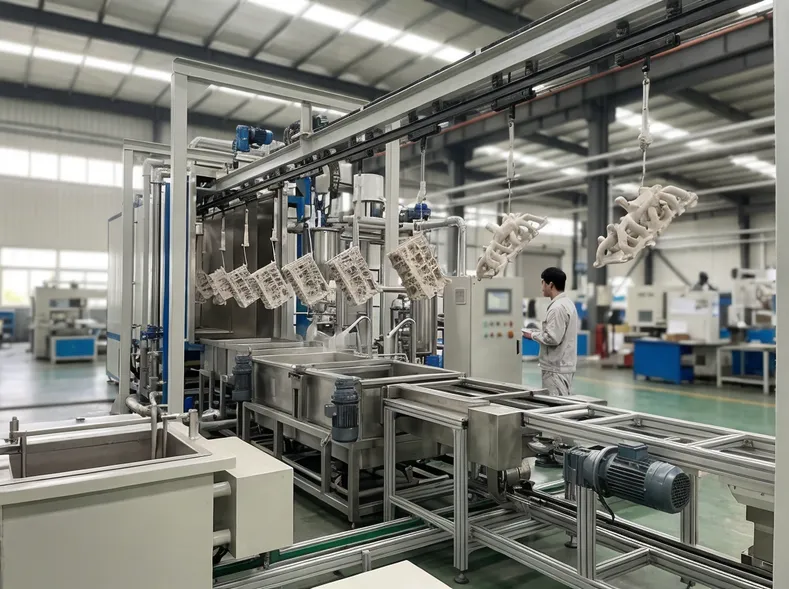
Why Coating Precision Determines Your Scrap Rate

Lost foam casting foam coating controls the refractory layer between your EPS pattern and molten metal — that 0.5–2mm barrier determines whether you get clean castings or metal penetration defects. Too thin and molten aluminum or iron penetrates the sand interface, leaving rough surfaces that add 2–4mm to your machining stock removal. Too thick and EPS decomposition gases can't escape through the coating, causing porosity and misruns that send castings to scrap.

Foundries running manual coating with inconsistent viscosity control typically see 8–12% scrap rates from coating-related defects. Tighten coating thickness to ±0.2mm through automated viscosity monitoring and PLC-controlled drying, and scrap drops to 3–5%. For a 500-ton/year aluminum foundry, that's 25–45 tons of scrap avoided annually — at $3,000/ton aluminum price, that's $75,000–135,000 in material cost saved. The coating equipment pays for itself in 12–18 months just through scrap reduction, before you count the machining time savings from better surface finish.

We build coating systems as standalone upgrades for existing lost foam casting production lines or as integrated subsystems for new installations. Each system ships with viscosity sensors, PLC integration for process data logging, and drying capacity sized to match your daily pattern volume. Since 2010, we've installed coating equipment in foundries across North America, Europe, the Middle East, and Southeast Asia — operations that needed coating precision without the distributor markup.

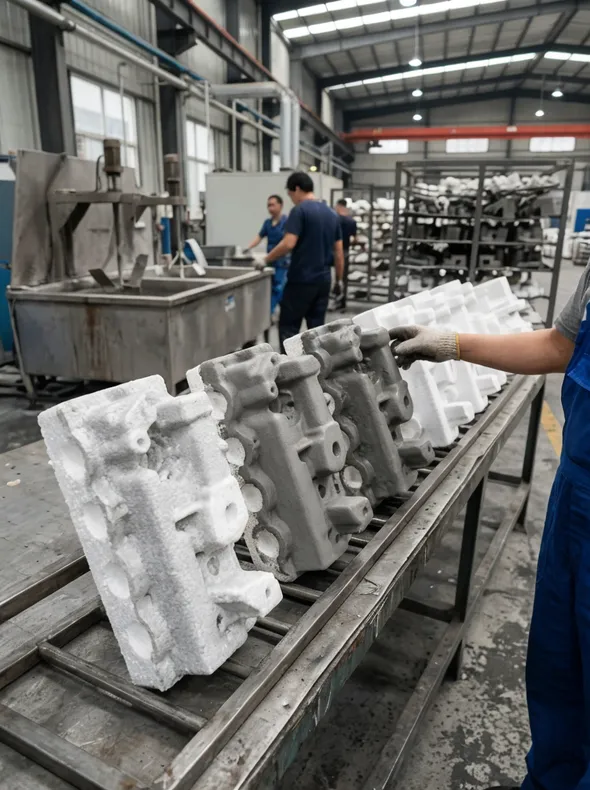
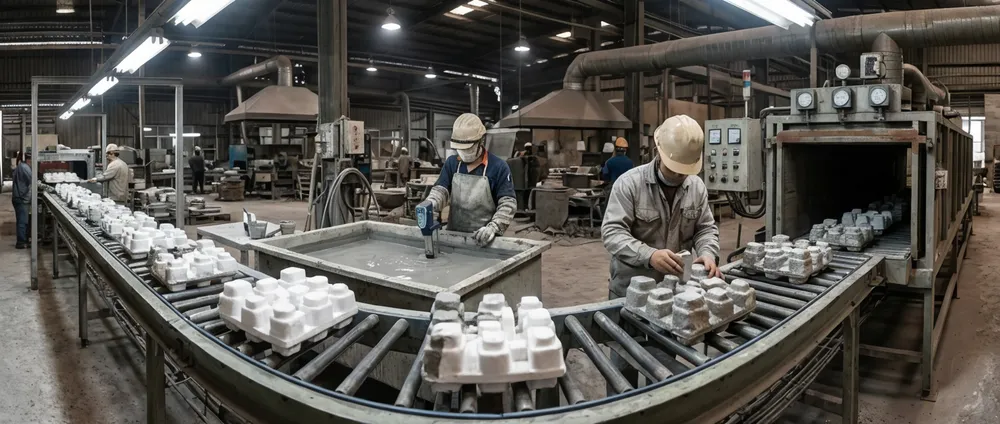
Comparison of coating thickness on EPS foam patterns showing 0.5-2mm refractory layer

0.5–2mm

Critical coating thickness range controlling casting surface quality

8–12% → 3–5%

Scrap rate reduction with automated viscosity monitoring and PLC-controlled drying

$75K–$135K

Annual material cost saved for a 500-ton/year aluminum foundry

12–18 Months

Equipment payback period through scrap reduction alone

Configure a coating system for your casting mix

Contact us with your alloy type and daily pattern volume for a tailored recommendation.

Contact Us

Coating Equipment Components — What You're Installing

A complete coating system arrives as four integrated subsystems. Here's what ships and how it controls coating quality:

Application Equipment

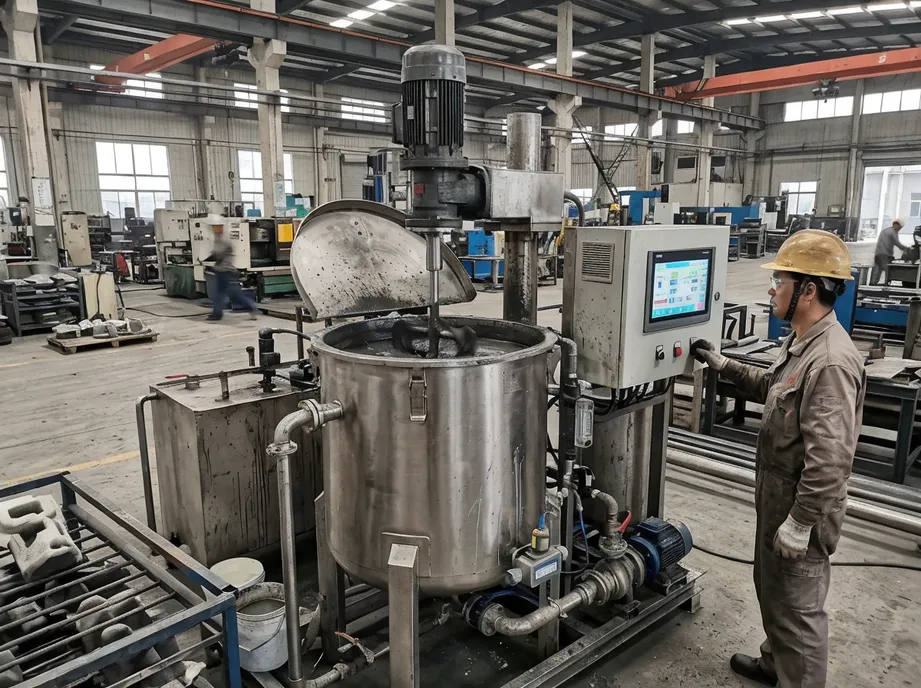
Handles pattern immersion or spray coating. Dip tanks work for 80% of applications: patterns submerge in refractory slurry, drain for 2–5 minutes while excess coating runs off, then transfer to drying. Tank capacity ranges 200–800 liters depending on your largest casting — a 400L tank handles patterns up to 600×600×800mm.

Spray booths suit patterns too large for dipping or complex cores where dip coating traps air in cavities. Automated spray guns apply coating while patterns rotate on turntables, delivering uniform thickness on intricate geometries.

We size application equipment based on your casting portfolio: if 80% of your parts are simple pump housings and brackets, dip tanks handle it. If you're producing engine blocks and manifolds with internal cores, spray booths prevent air entrapment.

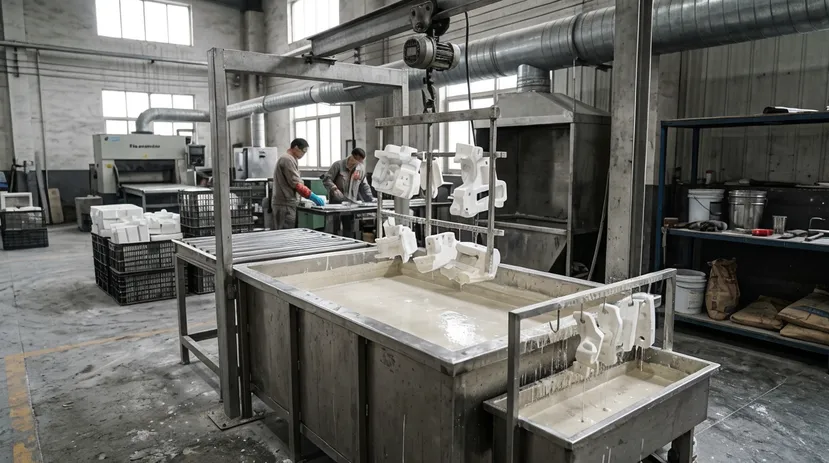
Dip tank application equipment for lost foam casting pattern coating with 200-800L capacity

Viscosity Control Systems

Maintain slurry density in the 1.4–1.8 specific gravity range. Inline sensors measure viscosity every 15 minutes and log readings to the PLC. When viscosity drifts outside target range, automated dosing pumps add refractory powder (if slurry is too thin) or water (if too thick) to bring it back to spec.

Manual coating operations check viscosity once per shift with a hydrometer — by the time you catch a drift, you've coated 20–40 patterns at the wrong thickness. Automated systems catch drift within 15 minutes, so you're correcting after 2–3 patterns instead of 40. This is where consistent coating thickness comes from.

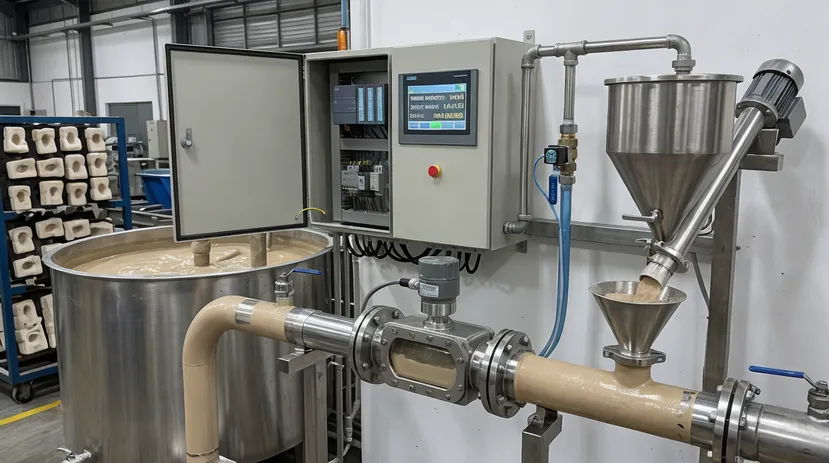
Inline viscosity sensor and PLC-controlled dosing system for refractory slurry management

Drying Chambers

Cure coating in 4–12 hours at 40–60°C, depending on coating thickness and refractory type. Gas burners or electric heating elements maintain temperature, with forced-air circulation to ensure uniform drying across all pattern surfaces.

We size drying capacity to match your daily coating volume — if you're coating 50 patterns per day and each needs 8 hours drying time, you need chamber capacity for 17 patterns (50 patterns ÷ 3 eight-hour cycles per day). Undersized drying creates pattern queuing that delays your molding schedule. Oversized drying wastes energy and floor space.

Our commissioning process maps your production schedule to drying capacity so patterns flow without bottlenecks.

Slurry Storage & Circulation

Keeps refractory suspended and prevents settling. Agitator motors run continuously in storage tanks, maintaining uniform slurry density. Circulation pumps transfer slurry from storage to application equipment and back, with inline filters removing contamination from pattern handling.

Storage capacity typically runs 2–3× your application tank volume — a 400L dip tank pairs with 800–1,200L storage to allow slurry replenishment without stopping production.

Component Specification Range Process Impact
Dip tank capacity 200–800L Determines max pattern size (up to 1000×1000×1200mm)
Spray booth dimensions 1000×1000×1500mm to 2000×2000×3000mm Handles large or complex patterns unsuitable for dipping
Viscosity sensor accuracy ±0.05 specific gravity Maintains coating thickness within ±0.2mm
Drying chamber capacity 10–60 patterns per cycle Sized to daily coating volume to prevent queuing
Drying temperature range 40–60°C (gas or electric) Alloy-specific: aluminum 40–50°C, iron 50–60°C
PLC integration Modbus/Ethernet protocol Logs viscosity, drying time, coating weight for QC tracking

The 1.4–1.8 specific gravity range is industry-standard for most refractory coatings — if you're using specialty high-permeability formulations for aluminum, target viscosity may shift to 1.3–1.6. We calibrate sensors to your specific coating supplier's spec during commissioning.

Closed-Loop Process Control

Coating Process Control — Viscosity, Thickness, Drying Time

Viscosity control is where coating thickness consistency comes from. Refractory slurry at 1.4 specific gravity deposits roughly 0.8–1.0mm coating thickness per dip. Drift to 1.6 SG and thickness increases to 1.2–1.4mm — that extra 0.4mm blocks gas permeability and causes porosity defects in aluminum castings. Drop to 1.2 SG and coating thins to 0.5–0.6mm, leaving insufficient barrier against metal penetration.

Inline Viscosity Control

±0.05 SG Precision

Our viscosity control systems use inline density sensors that measure specific gravity every 15 minutes. When readings drift ±0.1 SG outside target range, the PLC triggers automated dosing: refractory powder addition if slurry is thin, water addition if it's thick.

Dosing pumps add material in 0.5–1.0 liter increments, then the system rechecks viscosity after 5 minutes of circulation. This closed-loop control maintains ±0.05 SG precision, which translates to ±0.2mm coating thickness consistency across your entire production run.

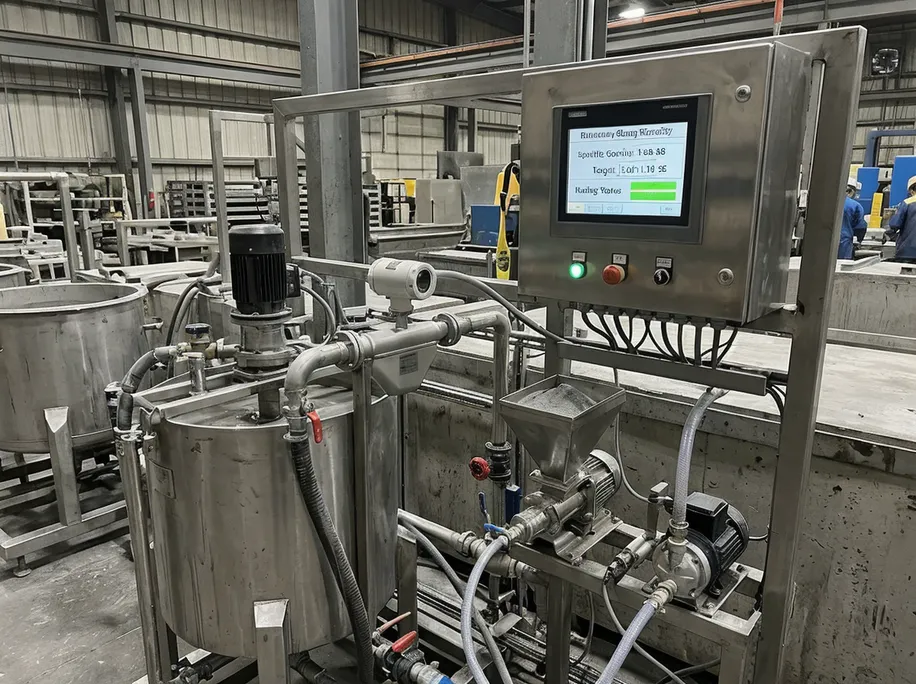
Inline density sensor and PLC-controlled dosing system for refractory slurry viscosity management

Coating Thickness Measurement

Target Range: 0.5–2mm

We use two methods depending on your QC requirements: coating weight measurement (pattern weight before coating vs. after coating and drying) or ultrasonic thickness gauges (non-destructive measurement at multiple pattern locations).

Weight measurement is simpler and works for most applications — a 5 kg EPS pattern with 1.0mm coating gains roughly 400–600 grams depending on pattern surface area and coating density. Ultrasonic gauges provide spot-check verification and help identify uneven coating from poor drainage or spray pattern issues.

Key Principle

Thickness variation matters more than absolute thickness. A casting coated consistently at 0.8mm will outperform a casting with 0.6mm in some areas and 1.2mm in others, even though the average is still 0.9mm. Viscosity control delivers that consistency.

Drying Time & Temperature Control

4–12 Hours at 40–60°C

Underdried

Coating remains soft and can crack or spall when patterns transfer to molding flasks.

Optimal

4–6 hours for thin coatings (0.5–0.8mm) with fast-cure binders. 10–12 hours for thick coatings (1.5–2mm) with colloidal silica binders.

Overdried

Coating becomes brittle and can flake off during sand filling.

Aluminum castings use lower drying temps (40–50°C) because you're optimizing for permeability — higher temps can sinter the refractory particles and reduce gas escape. Iron castings tolerate higher drying temps (50–60°C) because coating strength matters more than permeability at iron's pouring temperature.

Our drying chambers include temperature sensors at multiple locations (top, middle, bottom of chamber) to verify uniform heating. PLC programming tracks drying time per pattern batch and alerts operators if patterns transfer to molding before completing the minimum drying cycle.

PLC Data Integration & Traceability

PLC integration logs all three parameters — viscosity readings every 15 minutes, coating weight per pattern, drying time and temperature per batch. When a casting fails inspection for metal penetration or porosity, you pull the process data for that specific mold and identify which parameter drifted.

We've seen foundries cut coating-related scrap from 10% to 4% within three months of commissioning just by using data logs to tighten process control. The PLC stores 90 days of data locally and can export to your facility's MES system via Ethernet if you're running centralized production tracking.

Alloy-Specific Parameters

Coating Parameters by Alloy — Aluminum vs Iron

Aluminum Castings

Aluminum castings need thinner, higher-permeability coating than iron because aluminum's lower pouring temperature (700–750°C vs. 1400–1500°C for iron) generates less thermal stress on the coating, but aluminum's lower density (2.7 g/cm³ vs. 7.2 g/cm³ for iron) provides less natural sand compaction force.

Target coating thickness: 0.5–1.0mm using high-permeability refractory formulations — typically alumina or zircon-based with 40–50% porosity after drying. This allows EPS decomposition gases to escape through the coating during pouring, preventing gas porosity defects.

Drying temperature stays at 40–50°C to preserve permeability — higher temps can sinter refractory particles and reduce gas escape. Viscosity targets 1.3–1.5 specific gravity for aluminum coatings because you're balancing thickness (need enough barrier to prevent metal penetration) against permeability (need gas escape).

Common defect mode: Gas porosity from insufficient permeability, or surface roughness from coating too thin to prevent metal-sand contact.

Iron Castings

Iron castings use thicker, lower-permeability coating because iron's higher pouring temperature creates more thermal stress and iron's higher density naturally compacts sand during pouring.

Target thickness: 1.0–2.0mm using silica or alumina-based refractories with 30–40% porosity. The thicker coating provides thermal insulation that slows cooling rate slightly — this reduces thermal shock cracking in the casting.

Drying temperature runs 50–60°C because coating strength matters more than permeability for iron. Viscosity targets 1.5–1.8 specific gravity to achieve the thicker coating in a single dip cycle.

Common defect mode: Metal penetration if coating is too thin (iron's weight and temperature can push through inadequate coating), or coating spalling if coating is too thick and develops internal stress during drying.

Parameter Aluminum Castings Iron Castings Reason for Difference
Coating thickness 0.5–1.0mm 1.0–2.0mm Iron's higher temp needs more thermal barrier
Refractory type Alumina, zircon (high purity) Silica, alumina (standard grade) Aluminum reacts with silica; iron tolerates it
Coating porosity 40–50% (high permeability) 30–40% (moderate permeability) Aluminum needs better gas escape due to lower density
Viscosity target 1.3–1.5 SG 1.5–1.8 SG Thinner coating for aluminum, thicker for iron
Drying temperature 40–50°C 50–60°C Preserve permeability for aluminum, prioritize strength for iron
Drying time 4–8 hours 8–12 hours Thinner coating dries faster
Primary defect risk Gas porosity (insufficient permeability) Metal penetration (coating too thin) Driven by alloy density and pouring temp differences

Mixed-Alloy Foundries — Configurable Coating Systems

Mixed-alloy foundries running both aluminum and iron need configurable coating systems. We provide dual-tank setups (one tank for aluminum formulation, one for iron) or programmable viscosity control that adjusts target SG based on alloy selection in the PLC.

Drying chambers run at the higher temperature (50–60°C works for both alloys), with extended drying time for iron patterns. If you're producing aluminum automotive components and iron pipe fittings on the same line, expect to maintain two separate coating formulations and track which patterns use which coating to avoid cross-contamination.

Coating Formulation Support & Slurry Management

Coating equipment is half the system — the refractory slurry formulation is the other half. A coating system with perfect viscosity control still produces defects if your slurry formulation doesn't match your alloy and casting requirements. We provide formulation guidance during commissioning and can reformulate if your local refractory supplier's materials don't match our baseline spec.

Zircon (Zirconium Silicate)

Best performance for aluminum — chemically inert, excellent surface finish, maintains permeability at aluminum's pouring temperature.

Cost $2–4/kg (depending on purity grade)
Best For Aluminum

Alumina (Aluminum Oxide)

Works for both aluminum and iron, with good thermal stability and moderate cost. Versatile choice for mixed-alloy foundries.

Cost $1–2/kg
Best For Aluminum Iron

Silica (Silicon Dioxide)

Most economical option. Works well for iron, but reacts with aluminum at pouring temperature and causes surface defects. Not recommended for aluminum castings.

Cost $0.50–1/kg
Best For Iron

Most aluminum foundries use zircon or high-purity alumina. Iron foundries use silica or standard-grade alumina to control coating material cost.

Binder Type Selection

Binder type affects coating strength and drying time. Your choice depends on alloy, production pace, and handling requirements.

Colloidal Silica

Creates strong, rigid coatings. Requires 8–12 hours drying time. Recommended for iron castings where coating strength is the priority.

Drying 8–12 hrs

Bentonite Clay

Dries faster but produces softer coatings that can spall during pattern handling. Suitable for aluminum where lower pouring temps reduce coating stress.

Drying 4–6 hrs

Organic (Starch, Dextrin)

Fast drying and low cost, but burns out during pouring. Can contribute to gas defects if coating is too thick. Use with caution.

Drying Fastest

We typically recommend colloidal silica for iron castings (strength priority) and bentonite or hybrid binders for aluminum (faster drying, adequate strength for lower pouring temps).

Water Ratio & Slurry Working Life

Fresh slurry typically mixes at 40–50% water by weight (50–60% solids). As you coat patterns, water evaporates from the tank and viscosity increases — this is why automated viscosity control adds water periodically.

Slurry working life runs 2–4 weeks depending on contamination from pattern handling and EPS residue. When loss on ignition (LOI) exceeds 3–5%, coating performance degrades and you need to replace the slurry.

Commissioning Includes

  • Daily viscosity checks
  • Weekly LOI testing
  • Refractory top-up schedule
  • Full slurry replacement intervals
Refractory slurry management system with automated viscosity control for lost foam coating

Case Study — Regional Refractory Reformulation

We worked with a Middle Eastern foundry that couldn't source zircon locally at reasonable cost. Their available refractory was a silica-alumina blend that didn't match our standard formulation.

We reformulated using 60% local silica, 30% imported alumina, and 10% zircon (just enough to prevent aluminum reactivity), then tested samples until we hit target permeability and surface finish.

Their coating material cost dropped 40% vs. importing pure zircon, and casting quality matched our baseline spec. This kind of formulation adaptation is part of our commissioning process — we're not locked into a single coating supplier, and we'll work with whatever refractory sources make sense for your region and cost structure.

40% coating material cost reduction

Matching Coating Equipment to Your Production Volume

Small Volume

50–200 tons/year

$40,000–70,000

Manual dip tanks with batch drying. Tank capacity 200–400 liters handles patterns up to 500×500×600mm. Operators check viscosity once per shift with a handheld hydrometer and adjust slurry manually by adding refractory or water.

Drying chambers hold 10–20 patterns per batch, with gas burners or electric heaters maintaining 40–60°C. Suits prototype work or low-volume serial production where labor cost is low and coating precision requirements are moderate.

Tank 200–400L
Drying Batch (10–20)
Viscosity Manual
Scrap Rate 6–8%
Most Popular

500–1,000 tons/year

$120,000–180,000

Automated viscosity control and continuous drying to maintain throughput. Tank capacity 400–600 liters for larger casting envelopes. Inline viscosity sensors and automated dosing pumps maintain ±0.05 SG precision without operator intervention.

Drying shifts from batch chambers to conveyor systems — patterns load onto racks that move through a drying tunnel at controlled speed, with 30–50 pattern capacity. PLC integration logs coating parameters and interfaces with your molding line controller to coordinate pattern flow.

Reduces coating-related scrap to 3–5% through tighter process control. The scrap reduction alone typically pays back the automation investment in 18–24 months for foundries in this volume range.

Tank 400–600L
Drying Conveyor (30–50)
Viscosity Inline + Auto-dose
Scrap Rate 3–5%
High Volume

2,000+ tons/year

$250,000–400,000

Adds spray booths for large or complex patterns and multi-chamber drying systems for continuous operation. Spray booths handle patterns up to 2000×2000×3000mm that won't fit in dip tanks.

Automated spray guns apply coating while patterns rotate, with viscosity control on the spray system separate from the dip tank system. Drying capacity expands to 60–100 patterns with multiple chambers operating in parallel — as one chamber completes its cycle, patterns unload and the next batch loads without stopping production. Tank capacity reaches 600–800 liters.

Suits automotive, industrial equipment, or large casting foundries where coating precision directly affects your customer's machining cost and your scrap rate must stay below 3%.

Tank 600–800L
Drying Parallel (60–100)
Viscosity Dual-system
Scrap Rate 2–3%
Production Volume Equipment Configuration Tank Capacity Drying Method Viscosity Control Typical Investment Expected Scrap
50–200 tons/yr Manual dip tank, batch drying 200–400L Gas/electric batch chamber (10–20 patterns) Manual hydrometer checks $40,000–70,000 6–8%
500–1,000 tons/yr Automated dip tank, conveyor drying 400–600L Continuous conveyor tunnel (30–50 patterns) Inline sensors + auto-dosing $120,000–180,000 3–5%
2,000+ tons/yr Dip tank + spray booth, multi-chamber drying 600–800L Parallel drying chambers (60–100 patterns) Dual-system viscosity control $250,000–400,000 2–3%

Drying Capacity Sizing

Daily pattern count determines drying capacity sizing. If you're coating 80 patterns per day and each needs 8 hours drying, you need capacity for 27 patterns (80 patterns ÷ 3 eight-hour cycles per day). Add 20% buffer for production surgesand you're sizing for 32–35 pattern capacity.

We map your production schedule during the quoting process — provide your daily casting volume, average pattern size, and shift structure, and we'll calculate exact drying capacity requirements.

Get the Right Coating Configuration for Your Volume

Send us your daily casting volume and pattern size range — we'll recommend the right coating configuration and provide factory pricing.

Get Factory Quote
Defect Diagnosis & Resolution

Coating Defect Troubleshooting — Root Causes & Equipment Solutions

Metal Penetration

Rough, sand-embedded surfaces requiring extra machining

Root Cause

Coating too thin to provide an adequate barrier between molten metal and sand. If slurry has drifted below 1.3 SG, coating thickness drops to 0.4–0.6mm and metal can penetrate.

Solution

Recalibrate viscosity control to target range (1.4–1.8 SG for most applications) or increase refractory content in your slurry formulation. If viscosity is correct but penetration persists, increase target viscosity by 0.1–0.2 SG or switch to a double-dip process (coat, partial dry, coat again, full dry).

Minimum Coating Thickness

  • Iron castings: at least 1.0mm
  • Aluminum castings: at least 0.6mm

Equipment Upgrade Path

Add automated viscosity control if running manual checks, or upgrade to spray coating if dip drainage isn't achieving uniform thickness on complex geometries.

Gas Porosity

Internal voids or surface pinholes from trapped EPS decomposition gases

Root Cause

Coating too thick or insufficient permeability — gases can't escape through the coating during pouring. If patterns gain more than 600–800 grams per 5 kg pattern weight, coating is likely over 1.2mm and blocking gas escape.

Solution

Reduce viscosity by 0.1–0.2 SG or switch to a higher-permeability refractory formulation (increase alumina content, reduce silica). For aluminum castings, verify drying temperature isn't exceeding 50°C — higher temps can sinter refractory particles and reduce permeability.

Compound Factor

If porosity persists with correct coating thickness, check vacuum system pressure on your molding line — insufficient vacuum compounds the gas escape problem. See our complete lost foam production line documentation.

Equipment Upgrade Path

Upgrade refractory formulation to higher-alumina blend for improved permeability without sacrificing barrier strength.

Coating Spalling

Flaking or cracking off the pattern before molding

Root Cause

Insufficient drying or poor binder ratio. Patterns should feel dry and rigid to the touch before transferring to molding. If coating feels soft or leaves powder on your hands, drying is incomplete.

Solution

Extend drying time by 2–4 hours. Check drying chamber temperature uniformity — cold spots at the bottom of the chamber can leave patterns partially undried even if the timer has completed. Increase drying temperature by 5–10°C or add forced-air circulation.

Binder Adjustment

If spalling occurs after proper drying, your binder ratio may be too low — increase colloidal silica or bentonite content by 10–15% in your slurry formulation.

Equipment Upgrade Path

Add temperature sensors at multiple chamber locations to verify uniform heating, or upgrade to conveyor drying systems that provide more consistent thermal exposure.

Uneven Coating Thickness

Thick in some areas, thin in others

Root Cause

Inconsistent application technique or poor drainage. For dip coating, patterns must drain in a consistent orientation — if operators are hanging patterns randomly, drainage patterns vary and coating thickness becomes uneven.

Solution

Dip coating: Standardize drainage fixtures with consistent pattern orientation, or extend drainage time from 2 minutes to 4–5 minutes to allow more complete runoff.

Spray coating: Verify spray pattern overlap and adjust gun-to-pattern distance. Check spray gun positioning and pressure consistency.

Equipment Upgrade Path

Automate pattern rotation during dip drainage using motorized fixtures, or upgrade to automated spray booths with programmable gun paths that ensure uniform coverage.

Coating defect troubleshooting workflow showing viscosity control, thickness measurement, and drying parameter monitoring on a lost foam casting line

Commissioning Documentation Included

We provide this troubleshooting guide to every coating system buyer as part of commissioning documentation. Most defect issues trace back to one of these four root causes, and the solutions are straightforward once you identify which parameter drifted. PLC data logging helps — when defects appear, pull the viscosity logs, coating weight records, and drying time data for the affected batch, and you'll see which parameter was out of spec.

Retrofit & Line Integration

Integration with Existing Lost Foam Lines

Many foundries are upgrading coating equipment on existing lines rather than buying complete new systems. Coating equipment retrofit is straightforward if you address four integration points.

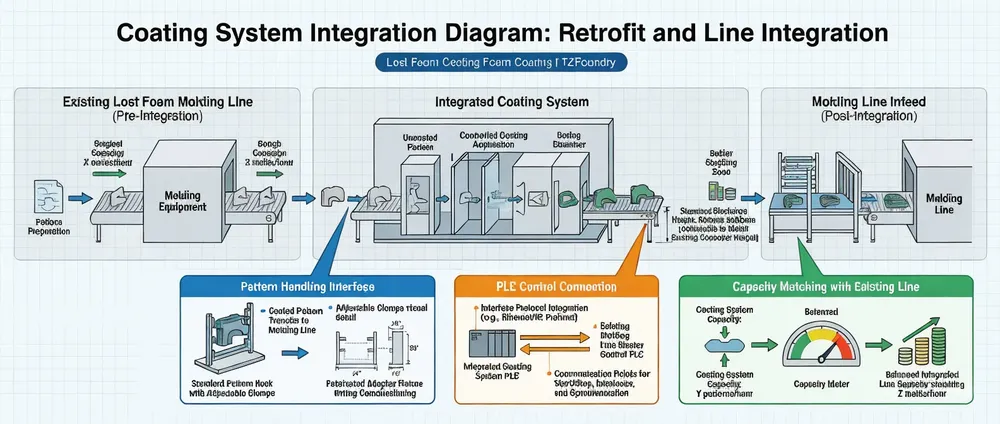
Pattern Handling Interface

Determines how coated patterns transfer from your coating system to existing molding equipment. Our coating systems use standard pattern racks with adjustable clamps — if your existing line uses different rack dimensions, we fabricate adapter fixtures during commissioning.

For automated lines with conveyor transfer, we provide mechanical interface drawings so your maintenance team can connect our coating system discharge to your molding line infeed.

Key Dimension

Standard discharge height: 900mm above floor level, adjustable ±200mm to match your existing conveyor height.

Control System Integration

Connects our coating PLC to your existing line controller for coordinated operation. Our PLCs communicate via Modbus RTU or Ethernet/IP protocol — industry-standard interfaces that connect to most molding line controllers.

Integration allows your molding line to request patterns from the coating system based on production schedule, and allows our coating system to report pattern status (coating in progress, drying, ready for molding) back to your line controller.

Standalone Option

If running a standalone coating system without line integration, our PLC operates independently with a local HMI touchscreen for operator control.

Capacity Matching

Ensures coating throughput doesn't bottleneck your molding line. We size drying chambers to match your required capacity plus 20% buffer for production surges.

Sizing Example

  • Molding line: 15 molds/hour × 2 patterns/mold = 30 patterns/hour
  • With 8-hour drying time: 240 patterns in drying queue at any time

During quoting, provide your molding line throughput (molds per hour), patterns per mold, and drying time requirements — we'll calculate whether your existing coating system can support the molding rate or whether you need additional drying capacity.

Utility Requirements

Must be verified before installation. We provide utility requirement specifications during the quoting phase so you can verify compatibility before ordering.

Utility Specification
Compressed Air 6–8 bar, 100–200 L/min (pneumatic controls & spray guns)
Electrical Power 380V or 480V three-phase, 20–60 kW (depends on drying chamber heating method)
Gas Supply Natural gas or LPG, 50,000–150,000 BTU/hour burner capacity (gas-fired drying only)

If adding a 40 kW electric drying system to a facility with limited electrical capacity, you may need a service upgrade.

Coating system integration diagram showing pattern handling interface, PLC control connection, and capacity matching with existing lost foam molding line

Integration Engineering Included

We provide integration engineering as part of every coating system project. Send us your existing line layout (photos or drawings showing pattern flow from coating to molding), molding line throughput data, and PLC communication protocol documentation. We'll design the mechanical and electrical interfaces, provide installation drawings, and support commissioning either through our own installation team or via remote video guidance if you're using local contractors.

ISO 9001:2015 · CE · SGS Certified

Why Foundries Choose TZFoundry for Coating Equipment

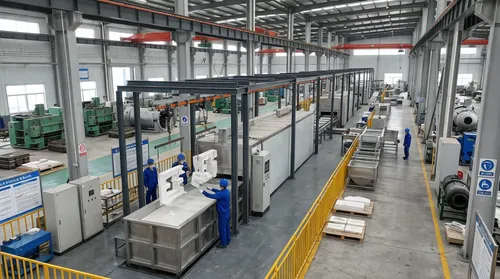
Manufacturing lost foam coating equipment since 2010 — 15,000 m² facility in Qingdao, 8 production lines, installations in 15+ countries across North America, Europe, the Middle East, and Southeast Asia.

Custom Engineering — Not Catalog Pulls

In-house engineering team handles viscosity control system design, drying capacity sizing, and coating formulation support. Send us your casting portfolio and production volume — we calculate exact drying chamber capacity, select viscosity sensor specifications, and recommend coating formulation based on your alloy mix. Custom tank sizes, spray booth dimensions, and PLC programming to match your specific pattern handling workflow are standard service, not upcharge options.

Remote Diagnostics on All PLC Systems

Our technical team accesses your system via Ethernet or 4G to review alarm logs, check sensor readings, and adjust process parameters without site visits. We've resolved viscosity control calibration issues, drying temperature problems, and PLC communication faults remotely for foundries in Ontario, Germany, and Saudi Arabia — usually within 4–8 hours of receiving the support request.

Spare Parts — 3–5 Day International Shipping

Critical wear components in stock at Qingdao: coating pumps, viscosity sensors, heating elements, circulation motors. Lead time for a replacement viscosity sensor is 3–5 days vs. 4–6 weeks manufacturing on demand. For foundries running continuous production, that difference determines whether a sensor failure costs you 1 week of downtime or 6 weeks.

Direct Factory Pricing — Save $25K–$40K

You're paying our manufacturing cost plus margin — not manufacturer + distributor + local agent margins stacked on top of each other. For a $150,000 coating system, that typically saves $25,000–40,000 vs. buying through distribution channels. Flexible MOQ for custom configurations — we build a single coating system to your specifications without forcing standard packages or minimum order quantities.

Complete In-House Manufacturing — Coating Systems, Molding Lines, Vacuum Equipment & Sand Reclamation

8 production lines across 15,000 m² produce coating systems alongside molding lines, vacuum equipment, and sand reclamation plants — all manufactured in-house. ISO 9001:2015, CE, and SGS certified. This means your coating equipment integrates seamlessly with our other foundry systems, and one engineering team coordinates the entire line rather than multiple vendors pointing fingers at each other during commissioning.

TZFoundry manufacturing facility in Qingdao — 15,000 m² with 8 production lines for lost foam coating equipment

Our complete foundry equipment product line means your coating system is designed, manufactured, and commissioned by the same team that builds the rest of your lost foam line. One point of contact, one engineering team, one warranty structure.

Manufacturing Capabilities & Certifications
Technical Reference

FAQ — Coating Equipment Selection & Process Questions

What coating thickness is best for aluminum castings?

Target 0.5–1.0 mm for aluminum. Thinner coating (0.5–0.7 mm) works for simple geometries and small castings under 5 kg where gas escape is easier. Thicker coating (0.8–1.0 mm) suits complex cores and larger castings where you need more thermal barrier.

The key is permeability — aluminum coating must allow EPS decomposition gases to escape, so use high-porosity refractory formulations (alumina or zircon-based) and keep drying temperature at 40–50 °C to preserve permeability. If you're seeing gas porosity defects, your coating is likely too thick or drying temperature is too high.

How to prevent metal penetration in lost foam casting?

Metal penetration happens when coating is too thin to provide an adequate barrier between molten metal and sand. Solution is tighter viscosity control and thicker coating.

Iron Castings

Target 1.0–2.0 mm coating thickness, slurry viscosity at 1.5–1.8 SG

Aluminum Castings

Target 0.6–1.0 mm at 1.3–1.5 SG

Install automated viscosity monitoring if you're currently checking manually — viscosity drift is the most common cause of penetration defects. If viscosity is correct but penetration persists, switch to double-dip coating (coat, partial dry, coat again, full dry) to build up thickness, or verify your refractory formulation has adequate refractoriness for your pouring temperature.

What is the difference between dip coating and spray coating?

Dip Coating

Submerges the entire pattern in refractory slurry, then drains excess by gravity. Works well for simple geometries and solid patterns where drainage is uniform. Lower cost (dip tanks are simpler than spray booths) and coating thickness is easier to control through viscosity.

Spray Coating

Automated spray guns apply coating while patterns rotate on turntables. Suits complex cores, large patterns that won't fit in dip tanks, or geometries with internal cavities where dip coating traps air. Better coverage on intricate shapes but requires more operator skill for uniform thickness.

Most foundries use dip coating for 70–80% of their patterns and spray coating for the complex 20–30%.

How often should coating slurry be replaced?

Replace slurry every 2–4 weeks depending on contamination level. Test loss on ignition (LOI) weekly — when LOI exceeds 3–5%, coating performance degrades from EPS residue and pattern handling contamination. You'll see this as inconsistent coating thickness, poor adhesion, or increased gas defects.

Between full replacements, top up refractory powder daily to compensate for coating material that leaves the tank on patterns. A 400 L tank coating 50 patterns per day loses roughly 10–15 kg of refractory daily (assuming 200–300 g coating per pattern). Add refractory to maintain target viscosity — automated dosing handles this in closed-loop systems, but manual operations need daily refractory additions.

Can coating equipment be added to an existing lost foam line?

Yes, coating equipment retrofits to existing lines in most cases. Key integration points:

  • Pattern handling interface — we fabricate adapter fixtures to match your existing rack dimensions
  • Control system integration — our PLCs communicate via Modbus or Ethernet/IP to coordinate with your molding line controller
  • Capacity matching — we size drying chambers to match your molding throughput
  • Utility requirements — verify your compressed air, electrical, and gas supply can support the coating system loads

Send us your existing line layout and molding throughput data — we'll design the mechanical and electrical interfaces and provide installation drawings. Most retrofits complete in 2–3 weeks including commissioning.

What causes coating to crack on EPS patterns?

Coating cracks from insufficient drying or thermal shock during pattern handling.

If coating feels soft or leaves powder residue when touched, extend drying time by 2–4 hours or increase drying temperature by 5–10 °C. Check drying chamber temperature uniformity — cold spots leave patterns partially undried even after the full drying cycle.

If coating is fully dried but still cracks during handling, your binder ratio may be too low (coating is brittle) or too high (coating develops internal stress). Adjust colloidal silica or bentonite content by ±10% and test.

Thermal shock cracks happen when patterns move from hot drying chambers (50–60 °C) directly into cold molding areas (15–20 °C) — allow 30–60 minutes cooling time before transferring patterns to molding.

Get Your Custom Configuration

Get a Coating System Quote — Next Steps

Send us your casting portfolio and we'll configure a coating system that matches your line capacity. We need four pieces of information to provide accurate equipment recommendations and factory pricing:

  1. 1
    Alloy Type

    Aluminum, iron, or both — determines coating thickness targets, refractory formulation, and drying parameters

  2. 2
    Largest Pattern Dimensions

    Length × width × height in mm — determines tank capacity or spray booth size

  3. 3
    Daily Coating Volume

    Number of patterns per day or per shift — determines drying chamber capacity sizing

  4. 4
    Current Coating Method

    Manual dip, automated dip, spray, or no coating equipment yet — helps us understand your upgrade path

We'll respond within 24–48 hours with equipment configuration recommendations, capacity calculations showing how drying throughput matches your molding line, coating formulation suggestions for your alloy mix, and factory pricing including shipping to your location. If you're retrofitting to an existing line, include photos or drawings of your current pattern handling system and we'll design the mechanical interface.

TZFoundry coating system engineering consultation and equipment configuration

Contact Information

Explore More Casting Production Lines