0.02-0.04
MPa Vacuum Precision
1.5-2mm
Coating Thickness
30-60 min
Cooling Cycles
50-500
Tons/Month Capacity
Lower than aluminum (0.04-0.06 MPa) — iron's density provides natural compaction
Thermal resistance for 1400-1500°C pouring without sacrificing gas permeability
Sized for ductile iron solidification with adjustable speed control
Prevents iron contamination in sand reclamation that causes surface defects
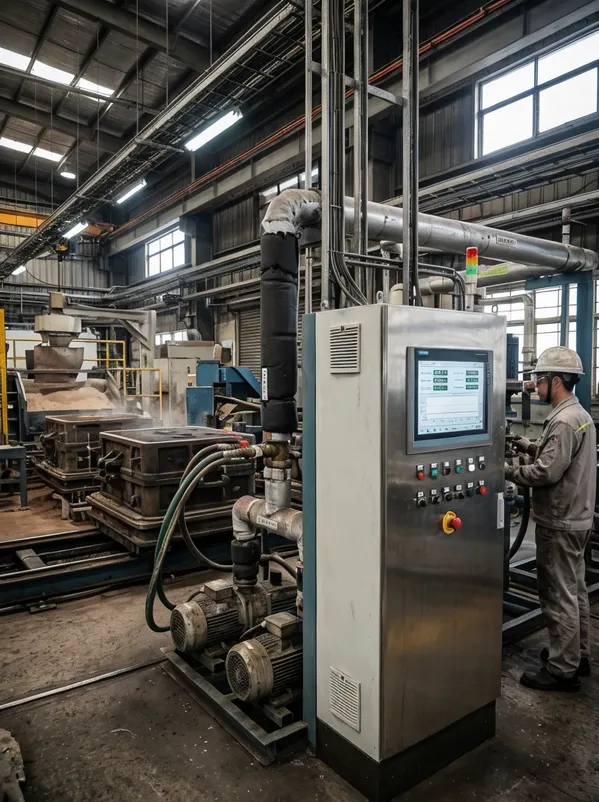
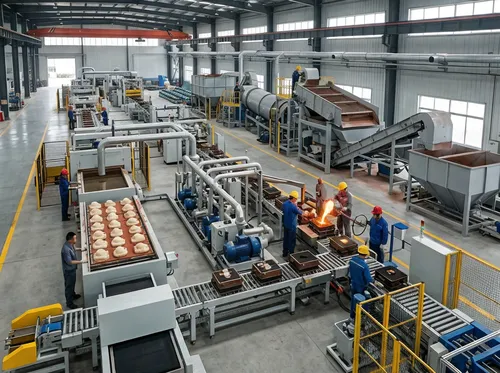
We build ductile iron lost foam lines with vacuum systems calibrated to 0.02-0.04 MPa, coating formulations using 60-70% alumina content for thermal resistance, cooling conveyors sized for 30-60 minute solidification cycles, and magnetic separation in sand reclamation to prevent iron contamination. Each line ships as a modular system configured to your casting portfolio — flask sizes from 600x600mm to 1200x1200mm, capacity range 50-500 tons/month, automation level from manual coating to fully automated continuous molding.
TZFoundry has installed ductile iron lost foam lines in automotive foundries across three continents. Our engineering team sizes vacuum and coating systems based on your specific nodularity targets (GGG-40, GGG-50, GGG-60 have different gas evolution profiles) and casting mix. Since 2010, we've manufactured foundry equipment in our 15,000-square-meter facility in Qingdao — 8 production lines, ISO 9001:2015 certified, with in-house R&D for custom configurations. You work directly with the factory: no distributor markup, flexible MOQ, remote diagnostics via PLC access.
These specifications reflect the ductile-iron-specific requirements that differentiate this line from aluminum or gray iron configurations. Vacuum pressure runs lower because ductile iron's density (7.1 g/cm³) provides natural sand compaction that aluminum (2.7 g/cm³) lacks. Coating thickness increases to handle pouring temperatures 700°C higher than aluminum. Cooling time extends because ductile iron's solidification window is 4-6 times longer.
| Parameter | Specification |
|---|---|
| Vacuum Pressure Range | 0.02-0.04 MPa |
| Coating Thickness | 1.5-2.0 mm |
| Pouring Temperature Capability | 1400-1500°C |
| Cooling Conveyor Cycle Time | 30-60 minutes |
| Magnetic Separation Capacity | >95% ferrous removal |
| Flask Size Options | 600x600mm to 1200x1200mm |
| Production Capacity Range | 50-500 tons/month |
| Sand Reclamation Rate | 92-96% |
| Control System | Siemens/Mitsubishi PLC |
Specification Notes
Note: Specifications shown are typical for ductile iron lost foam lines. Actual configuration customized to your casting portfolio — send us your part drawings and annual volumes for exact system sizing.
Get a detailed spec sheet and quote for your casting mixNodular graphite formation in ductile iron is sensitive to three process variables: vacuum pressure during pouring, coating permeability for gas escape, and solidification rate. Generic lost foam lines don't control these variables tightly enough — you'll cast parts that look fine externally but fail nodularity testing at 40-60% instead of the target 80-90%.
The metallurgical mechanism: EPS decomposition releases styrene and other hydrocarbons that interact with molten iron during solidification. If vacuum pressure is too high, you get graphite flotation and nodularity loss in the top section of castings. If coating permeability is too low, gases can't escape and you get porosity plus nodularity degradation. If cooling is too fast, you don't get proper graphitization.
Our vacuum systems use PLC-controlled pressure regulators that maintain 0.02-0.04 MPa throughout the pour. This range is counterintuitive — aluminum needs higher vacuum because it's lighter and won't compact sand naturally, but ductile iron's 7.1 g/cm³ density provides mechanical compaction, so lower vacuum prevents graphite flotation while still maintaining mold rigidity.
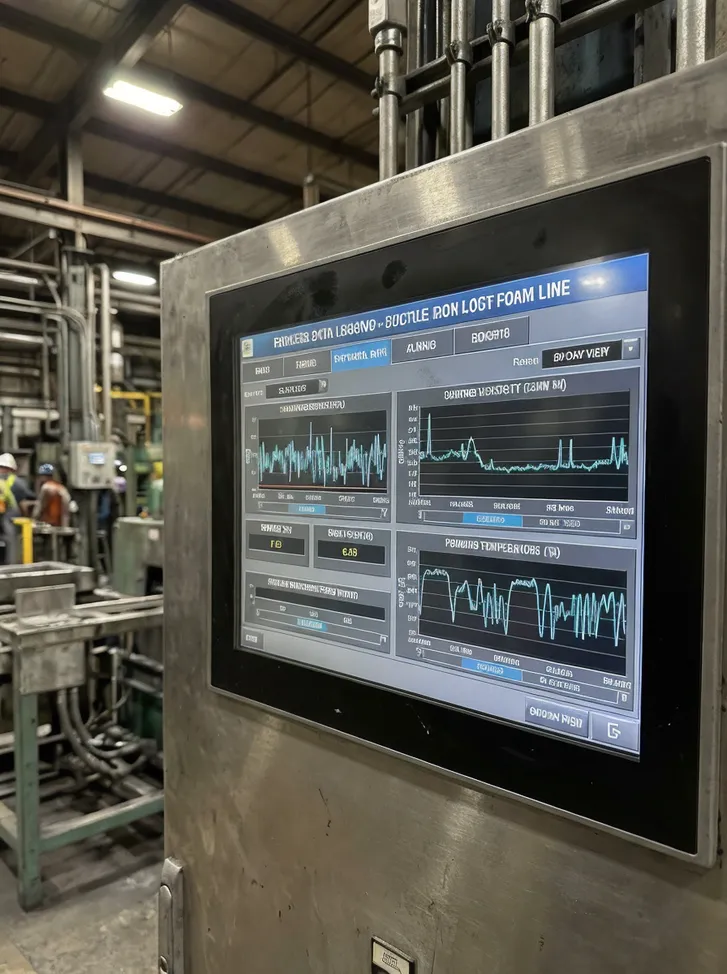
Pressure sensors at each molding station log readings every second. If pressure drifts outside the ±0.002 MPa tolerance window, the system holds the pour until vacuum recovers.
We've seen foundries lose 15-20% of their ductile iron castings to nodularity failures before they realized their vacuum was calibrated for aluminum.
Ductile iron coatings need 1.5-2mm thickness to handle 1400-1500°C pouring temperatures without thermal shock, but that thickness must maintain gas permeability or you trap EPS decomposition gases in the mold. We formulate coatings with 60-70% alumina content (vs. 40-50% for aluminum lines) for thermal resistance, then control particle size distribution to maintain permeability.
Viscosity monitoring runs continuously — slurry specific gravity stays at 1.5-1.7 for ductile iron coatings (slightly higher than aluminum's 1.4-1.6 because of the higher refractory loading). Automated viscosity sensors measure every 15 minutes and adjust water or powder addition to maintain target thickness.
Ductile iron pours slower than aluminum — a 50 kg casting takes 20-30 seconds to fill (vs. 8-12 seconds for aluminum at the same weight) because faster pouring creates turbulence that entrains gases and disrupts nodular graphite formation. Our pouring systems use tilt rate control or stopper rod mechanisms calibrated to casting weight and geometry.
Pyrometers measure ladle temperature before each pour — ductile iron typically pours at 1420-1480°C depending on section thickness and inoculant package. Temperature below 1400°C causes cold shuts; above 1500°C increases shrinkage and can degrade nodularity through excessive superheat.
Ductile iron solidifies in 20-60 minutes depending on section thickness (vs. 5-15 minutes for aluminum), and proper graphitization requires controlled cooling through the eutectoid transformation at 870°C. Our cooling conveyors are sized for 30-60 minute cycles with adjustable speed control.
Castings that cool too fast form carbides instead of nodular graphite — you get hard spots that break cutting tools during machining. The PLC stores cooling profiles for different casting weights so operators can switch between products without manual calculation.
Our systems store 90 days of process data: vacuum pressure traces, coating viscosity, pouring temperature, sand LOI, cooling conveyor speed. When a batch fails nodularity testing, you pull the logs for those specific molds and identify which parameter drifted.
A Midwestern automotive foundry cut their ductile iron scrap rate from 12% to 4% within four months of commissioning just by using vacuum pressure logs to identify a faulty pressure sensor that was reading 0.03 MPa but actually delivering 0.05 MPa.
Need help configuring vacuum and coating parameters for your ductile iron grades?
We'll review your nodularity targets and casting portfolio to size the control systems.
Ductile iron lost foam casting serves four primary market segments, each with distinct order patterns and margin characteristics. Understanding these segments helps you size line capacity and automation level to match your business model.
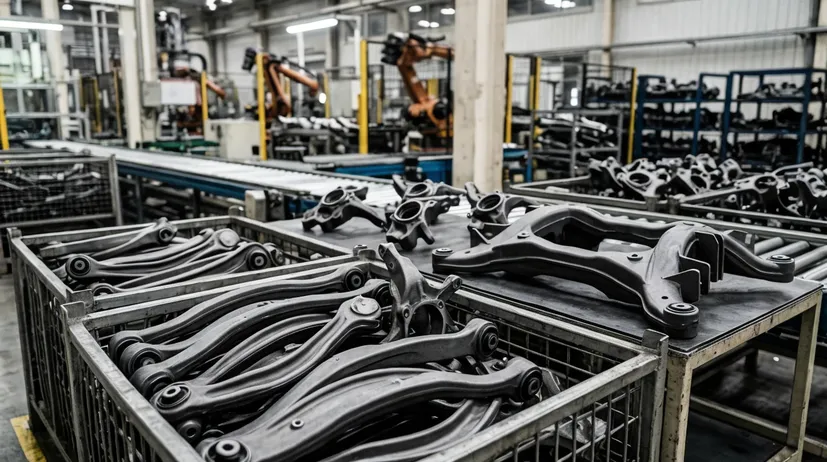
Control arms, steering knuckles, suspension brackets, and subframe components — OEM suppliers typically order 500–2,000 units per part number with 6–12 month supply contracts. Lost foam's near-net-shape capability matters here because these parts have complex geometries (hollow sections, integrated bosses, curved profiles) that would require expensive core tooling in conventional sand casting.
Machining Cost Avoidance
A control arm that needs 45 minutes of CNC machining from a green sand casting drops to 18 minutes from a lost foam casting — removing 2–3mm of stock instead of 6–8mm. At $80–120/hour machine rates, that's $35–55 per part in machining cost avoidance. For a 10,000-unit annual contract: $350,000–$550,000 in downstream cost savings.
Line Requirements
Automated coating and continuous molding to hold ±0.5mm tolerances on critical dimensions and consistent nodularity (minimum 80% for GGG-50 grade) across multi-thousand-unit runs. Target capacity: 200–300 tons/month.
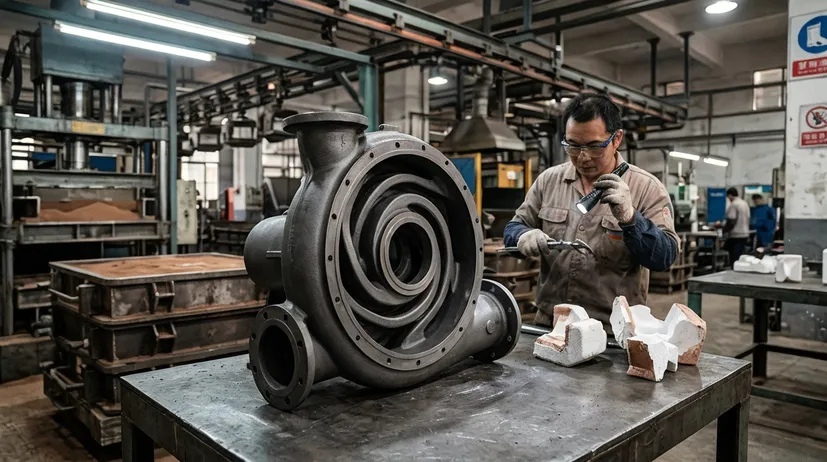
Municipal water pumps, chemical processing pumps, oil & gas transfer pumps — these castings range from 20–150 kg with complex internal passages that are difficult to core in conventional molding. Order quantities run 50–200 units per design, but unit prices are 2–3x higher than automotive parts because of the complexity and material requirements (often GGG-60 or higher for pressure rating).
Core Elimination Advantage
A chemical pump housing with six internal flow passages would need six sand cores in conventional casting, each requiring a core box, core shooter, and assembly fixturing. Lost foam produces the same casting with a single EPS pattern and no core handling. The coating controls the metal-to-mold interface.
Line Configuration
Larger flask sizes (800×1000mm or 1000×1200mm), manual or semi-automated coating (batch sizes don't justify full automation), and extended cooling conveyors — thick sections take 45–60 minutes to solidify. Target capacity: 50–100 tons/month.
These are precision castings serving industrial controls and fluid handling markets — typically 10–80 kg casting weight, order quantities 100–500 units, and premium pricing because dimensional accuracy directly affects product performance. Lost foam's ±0.5–1mm tolerance capability means valve bodies often need only finish grinding on sealing surfaces rather than full CNC machining of the body profile.
Lead Time Advantage
A lost foam line can produce valve bodies in 3–4 weeks from pattern approval to finished casting vs. 6–8 weeks for conventional sand casting (which requires pattern making, core box fabrication, and process qualification). Your buyer wins contracts by promising faster delivery, and you capture that value through premium pricing.
Line Configuration
Medium flask sizes (600×800mm), spray coating for complex internal geometries, and quality control emphasis on dimensional inspection (CMM verification of critical dimensions).
Hub castings, bearing housings, and structural components — these parts range from 50–200 kg, often with integrated mounting features and complex load paths. Order volumes are lower (20–100 units per design) but contracts run 2–5 years because wind farm developers need consistent supply for maintenance and expansion.
Material Cost Savings
A 150 kg hub casting might need 180 kg of metal poured in conventional casting (20% riser loss), but lost foam reduces that to 160 kg (7% gating loss) — that's 20 kg of ductile iron saved per casting, worth $30–40 at current scrap prices. Multiply by 500 castings over a contract term: $15,000–$20,000 in material cost savings alone.
Line Configuration
Large flask sizes (1000×1200mm or custom), overhead crane integration (5-ton capacity minimum), extended cooling conveyors (60+ minute cycles for thick sections), and magnetic separation in sand reclamation (critical for preventing iron contamination in long production runs).
Automotive needs throughput (200–300 tons/month). Pumps and valves need flexibility (50–100 tons/month with quick changeover). Wind energy needs heavy-duty equipment (large flasks, overhead cranes, extended cooling).
Ductile iron lost foam lines scale from 50 tons/month manual operations to 500 tons/month fully automated systems. The configuration decision comes down to three variables: casting weight range, production volume, and alloy flexibility. Getting this wrong means either buying excess capacity you'll never use (capital waste) or hitting throughput limits within 18 months (lost revenue while you retrofit).
2–20 kg casting weight
Automotive brackets, valve bodies, small pump housings. These castings mold in 600×600mm or 600×800mm flasks with 80–150 kg sand fill per flask.
Manual coating — operators dip patterns in coating tanks, drain for 3–5 minutes, then transfer to drying chambers
Batch molding — vibration tables with manual flask handling; one operator fills flasks, another manages pouring, a third runs shakeout
Best for: Foundries entering ductile iron lost foam or serving low-to-medium volume markets (industrial pumps, valve manufacturers, aftermarket automotive). Below 50 tons/month, outsourcing is more economical; above 100 tons/month, manual coating becomes the bottleneck.
20–100 kg casting weight
Automotive suspension components, industrial pump housings, large valve bodies. These need 800×800mm or 800×1000mm flasks with 300–500 kg sand fill.
Semi-automated coating — spray booths with automated pattern rotation and programmable spray guns for uniform coating thickness
Continuous molding — conveyor systems move flasks through filling, compaction, pouring, cooling, and shakeout without manual transfer
Payback in 18–24 months through labor savings (3 operators per shift vs. 5–6 for manual lines at equivalent tonnage) and quality consistency (automated coating eliminates thickness variation from manual dipping). Features: PLC-controlled vacuum pressure, coating viscosity monitoring, pyrometer-controlled pouring, magnetic separation in sand reclamation.
100–300 kg casting weight
Wind turbine components, large pump housings, heavy industrial castings. These require 1000×1000mm or 1000×1200mm flasks with 600–1000 kg sand fill, and overhead cranes (3–5 ton capacity) for flask handling.
Automated coating — spray booths with multi-axis pattern rotation and programmable coating thickness profiles (thicker on heavy sections, thinner on thin walls)
Continuous molding with crane integration — overhead crane moves flasks through the production sequence; cooling conveyors extend to 60+ minute cycles
Best for: High-value markets where casting complexity justifies the capital — wind energy, large industrial equipment, heavy-duty automotive (truck suspension, drivetrain). ROI comes from winning contracts competitors can't handle: castings too complex for conventional sand casting, too large for permanent mold, or requiring tolerances shell molding can't hold.
Ductile + Gray Iron — adds $80,000–$120,000 to any configuration
Many foundries produce both ductile and gray iron castings, and running them on the same line improves asset utilization. A foundry producing 200 tons/month of ductile iron and 100 tons/month of gray iron can run both on a single 300-ton line instead of maintaining two separate 150-ton lines.
Vacuum pressure switching: ductile iron runs 0.02–0.04 MPa, gray iron runs 0.03–0.05 MPa
Separate coating formulations: ductile needs higher alumina content
PLC process profiles: different pouring temperatures, cooling times, sand reclamation settings stored and recalled per alloy
The payback: reduced capital cost (one line vs. two), lower overhead (one set of operators, one maintenance schedule), and faster response to demand shifts — if ductile orders spike, you reallocate capacity without adding equipment.
How we design every line — start small, scale with demand
Start with core equipment sized for today's volume, then add capacity modules as production grows. The modular approach reduces capital risk when you're entering lost foam or testing new markets, and it matches capacity additions to actual demand growth rather than forecasted growth.
Example Expansion Timeline
Start: Manual line — $280,000
80 tons/month capacity
+18 months: Add automated coating — $120,000
Now running 150 tons/month
+42 months: Upgrade to continuous molding — $180,000
Now at 250 tons/month
Total investment: $580,000 spread over 42 months vs. $650,000 upfront for a fully automated line you wouldn't fully utilize for three years. Modular expansion matches capacity to actual demand growth rather than forecasted growth.
As a ductile cast iron lost foam casting production line manufacturer, we size equipment based on your casting portfolio and 3-year growth plan. Send us your current production mix — casting weights, annual volumes, nodularity requirements — and we'll configure a line that starts at the right capacity and expands without replacing core equipment.
Include your casting drawings or photos so we can size flasks and coating equipment accurately.
We've installed ductile iron lost foam lines in automotive foundries across North America, Europe, and Asia — the engineering lessons from those installations are built into every system we ship. Three areas separate our ductile iron lines from generic lost foam equipment: coating formulation, vacuum system calibration, and sand reclamation design.
Our coatings use 60–70% alumina content vs. 40–50% for aluminum lines. The reason: ductile iron pours at 1400–1500°C (700°C hotter than aluminum), and standard coatings break down at these temperatures — you get metal penetration into sand, rough surface finish, and coating spalling that contaminates the casting surface.
High-alumina coatings handle the thermal load, but alumina is expensive and increases coating viscosity. We balance the formulation with particle size distribution: coarser alumina particles (80–120 mesh) provide thermal resistance, finer particles (200–325 mesh) fill voids and control permeability.
The result: 1.5–2mm coating thickness that survives 1450°C pouring without sacrificing the gas permeability needed for EPS decomposition.
We work with your local refractory supplier to source materials — if they can't match our spec, we'll reformulate using their available grades and test samples until we hit target performance.
Field example: A Middle Eastern foundry whose local supplier didn't stock high-purity alumina — we reformulated with a bauxite-based refractory and added silica flour to control permeability. Took three iterations but the final coating passed 500-hour production trials.
This is where most generic lost foam suppliers get ductile iron wrong. They assume higher vacuum is always better, so they run ductile iron at 0.04–0.06 MPa (the aluminum setting) and wonder why castings have graphite flotation in the cope section.
The metallurgy: ductile iron's 7.1 g/cm³ density provides natural sand compaction that aluminum's 2.7 g/cm³ doesn't. High vacuum pulls sand too tight and restricts gas escape, causing porosity and nodularity loss.
Our vacuum systems use PLC-controlled pressure regulators calibrated to your specific ductile iron grade:
Higher-strength grades have more alloying elements that affect gas evolution, so vacuum drops slightly.
Pressure sensors at each molding station log readings every second with ±0.002 MPa precision. The PLC stores vacuum profiles for different casting weights — small castings (<10 kg) use the high end of the range for better sand compaction, large castings (>50 kg) use the low end to ensure gas escape from deep mold cavities.
This isn't guesswork — we commission every line with vacuum calibration tests using your actual casting designs and measure nodularity on production samples before sign-off.
Ductile iron shakeout releases fine iron particles (from casting flash, gate breakage, and sand abrasion) that mix with reclaimed sand. If these particles aren't removed, they cause surface defects on subsequent castings — you get iron inclusions that look like sand burn-in but are actually metallic contamination.
Our sand reclamation systems integrate magnetic drum separators (5,000–8,000 gauss field strength) that remove >95% of ferrous particles. The separator runs continuously during shakeout — sand passes over the magnetic drum, iron particles stick to the drum surface, a scraper blade removes them into a collection bin.
We size magnetic separation capacity to match your daily sand throughput so contamination doesn't accumulate.
Result: An automotive foundry in Eastern Europe was seeing 8% scrap rates from surface defects before they added magnetic separation — dropped to 2% within two weeks of commissioning the separator. The iron particles they were removing: 15–20 kg per day on a 150-ton/month line.
Aluminum solidifies in 5–15 minutes and can go straight to shakeout. Ductile iron takes 20–60 minutes depending on section thickness, and rushing it causes two problems: castings are too hot to handle safely (1000°C surface temperature vs. 400°C for aluminum), and rapid cooling through the eutectoid transformation forms carbides instead of nodular graphite.
Our cooling conveyors are sized for 30–60 minute cycles with variable speed control. Castings move through three zones:
Temperature monitoring at each zone lets operators adjust conveyor speed based on casting mass and section thickness. The PLC stores cooling profiles — a 20 kg casting with 15mm average section runs 30 minutes, a 100 kg casting with 50mm sections runs 60 minutes.
We manufacture all four subsystems in-house at our Qingdao facility — coating equipment, vacuum systems, molding lines, and sand reclamation plants. That integration matters when you're commissioning a ductile iron line because the subsystems interact: coating permeability affects vacuum requirements, vacuum pressure affects sand reclamation load, sand quality affects coating adhesion.
Having one engineering team responsible for the complete system means you're not troubleshooting interface problems between equipment from three different suppliers.
Learn about our manufacturing capabilities — 15,000 m² facility, 8 production lines, ISO 9001:2015 certified
Ductile iron lost foam lines take longer to commission than aluminum lines because nodularity control requires process parameter optimization that aluminum doesn't. Total timeline from order confirmation to first production casting: 18–24 weeks (12–16 weeks equipment production, 4–6 weeks on-site commissioning, 2 weeks process optimization).
Equipment fabrication, PLC programming, factory testing, and export documentation. We build the complete system in Qingdao: pattern handling equipment, coating tanks and drying chambers, molding line with vacuum system, pouring station, shakeout equipment, sand reclamation plant, and control system.
Factory testing includes:
Equipment ships in standard 20ft or 40ft containers — a 150-ton/month line fits in 6–8 containers depending on flask size and automation level.
Mechanical assembly, electrical hookup, vacuum system testing, and process parameter calibration. Our installation team or certified local partners handle the work.
Optimization is critical for ductile iron because nodularity targets vary by grade and application: automotive suspension needs 80–90%, pump housings 70–85%, structural components 60–80%. We document final parameters in process sheets for your operators.
Operator Training:
Pattern handling procedures, coating application and viscosity monitoring, molding line operation, pouring safety and temperature control, shakeout procedures, sand quality testing.
Maintenance Training:
Preventive maintenance schedules (vacuum pump oil changes, vibration motor bearing inspection, coating pump seal replacement), wear component identification, spare parts inventory management.
Process Training:
How vacuum pressure affects nodularity, how coating thickness affects surface finish, how pouring temperature affects shrinkage, how to use data logs for troubleshooting.
Operation manuals and process parameter guides provided in English; other languages available on request (adds 2–3 weeks to delivery schedule).
Our technical team connects to your control system via Ethernet or 4G, reviews alarm logs, checks sensor readings, and identifies root causes without site visits.
We've resolved 60–70% of technical issues remotely: PLC parameter adjustments, sensor calibration, process recipe modifications, alarm threshold tuning. The remaining 30% need physical inspection or component replacement, but remote diagnostics tells us exactly which parts to bring before we travel.
24–48 hours remote · 5–7 days on-site
Inventory covers the top 30 wear components: vacuum pump seals and oil, vibration motor bearings, coating pump seals, proximity sensors, solenoid valves, PLC I/O modules, conveyor belts, magnetic separator scrapers.
Stock maintained in Qingdao with 3–5 day international shipping (DHL/FedEx). Critical components (vacuum pumps, PLC modules) ship with 2-day expedited service if you're down.
6–12 months consumables kit
Warranty covers manufacturing defects in materials and workmanship from commissioning date. Wear items (pump seals, conveyor belts, vibration isolators) aren't covered because failure rate depends on your operating conditions.
Service terms: 24–48 hour response for remote diagnostics, 5–7 days for on-site visits during warranty period, travel costs covered by TZFoundry for warranty repairs.
Request a detailed commissioning timeline and support terms — we'll provide a project schedule based on your facility readiness and installation support requirements.
Ductile iron runs at 0.02–0.04 MPa vacuum pressure, lower than aluminum's 0.04–0.06 MPa. The reason: ductile iron's density (7.1 g/cm³) provides natural sand compaction that aluminum (2.7 g/cm³) lacks. Higher vacuum causes graphite flotation in the cope section of castings and restricts gas escape, leading to porosity and nodularity loss.
Specific grades need different pressures:
Our vacuum systems use PLC-controlled pressure regulators with ±0.002 MPa precision to maintain these tight windows.
Ductile iron coatings need 1.5–2mm thickness (vs. 0.5–1mm for aluminum) to handle 1400–1500°C pouring temperatures without thermal breakdown. Thicker coatings provide thermal resistance and prevent metal penetration into sand, but they must maintain gas permeability or EPS decomposition gases get trapped in the mold.
We formulate coatings with 60–70% alumina content for thermal resistance and control particle size distribution:
Coating too thin causes rough surface finish and metal penetration. Coating too thick or impermeable causes gas porosity and nodularity degradation.
Yes, with vacuum pressure switching and separate coating formulations. Ductile iron runs 0.02–0.04 MPa vacuum, gray iron runs 0.03–0.05 MPa (gray iron doesn't require nodularity control, so higher vacuum improves mold rigidity without metallurgical consequences).
The PLC stores process profiles for each alloy — operators select the alloy type and the system automatically adjusts vacuum pressure, pouring temperature setpoints, and cooling conveyor speed.
Coating formulations differ slightly:
Dual-alloy capability adds $80,000–120,000 to line cost but improves asset utilization if you produce both alloy types.
Three primary causes:
1. Excessive Vacuum Pressure
Causes graphite flotation. Excessive vacuum (>0.04 MPa for most ductile grades) pulls graphite particles toward the cope surface where they float and form non-nodular structures.
2. Improper Coating Permeability
Traps EPS gases that interact with molten iron during solidification. Coating permeability below 15–20 Blaine units traps styrene and hydrocarbon gases from EPS decomposition — these gases dissolve in molten iron and interfere with nodular graphite formation during solidification.
3. Incorrect Pouring Temperature
Too hot (>1500°C) increases superheat and gas solubility; too cold (<1400°C) causes incomplete pattern gasification and cold shuts.
Our lines control all three variables: PLC-regulated vacuum pressure, viscosity-monitored coating formulation, and pyrometer-controlled pouring temperature.
20–60 minutes depending on section thickness, 4–6 times longer than aluminum (5–15 minutes).
The extended time is necessary for proper graphitization — ductile iron must cool slowly through the eutectoid transformation at 870°C to form nodular graphite instead of carbides. Rapid cooling creates hard spots that break cutting tools during machining.
Our cooling conveyors are sized for these cycles with variable speed control — the PLC stores cooling profiles for different casting weights so operators don't have to calculate cycle times manually.
Key differences across three parameters:
| Parameter | Ductile Iron | Gray Iron |
|---|---|---|
| Vacuum Pressure | 0.02–0.04 MPa | 0.03–0.05 MPa |
| Coating Alumina | 60–70% | 50–60% |
| Cooling Cycle | 30–60 min | 20–40 min |
The metallurgical reason: ductile iron's nodular graphite structure requires tighter process control than gray iron's flake graphite. Vacuum pressure affects nodularity (too high causes graphite flotation), coating must protect nodular formation during solidification, and cooling rate controls graphitization.
Gray iron is more forgiving — flake graphite forms across a wider process window. Many foundries run both alloys on the same line with PLC-controlled process switching, but the line must be designed for ductile iron's stricter requirements.
If you're producing gray iron castings that don't require nodularity control, this line offers a more economical configuration. Gray iron runs at slightly higher vacuum pressure (0.03–0.05 MPa) and uses standard refractory coatings (50–60% alumina content vs. 60–70% for ductile iron), reducing coating material costs by 15–20%. The process window is wider because flake graphite formation isn't as sensitive to gas interaction as nodular graphite. If your casting portfolio is primarily gray iron with occasional ductile iron runs, the gray iron line with dual-alloy capability provides better economics than a ductile-optimized line.
View Gray Iron LineFor foundries running multiple alloy types beyond ductile and gray iron — aluminum, bronze, or steel castings — explore our multi-alloy vacuum casting line. It uses modular vacuum systems and interchangeable coating equipment to handle alloys with different density, pouring temperature, and solidification characteristics. The trade-off: more complex process management (operators must track which coating formulation and vacuum profile to use for each alloy) but higher asset utilization if you serve diverse markets.
View Multi-Alloy LineNew to lost foam casting? Our complete category overview covers pattern handling, coating processes, molding systems, and sand reclamation — the foundational lost foam concepts that apply across all alloy types. This product page focuses on ductile iron's specific requirements, while the overview gives you the broader process context to evaluate your full production needs.
Read Full OverviewSend us your ductile iron casting portfolio and we'll configure a line that matches your production capacity and quality targets. We need:
That information lets us size flask dimensions, select coating equipment, configure vacuum system capacity, and determine cooling conveyor length.
12–16 weeks for equipment production plus 4–6 weeks for on-site commissioning and process optimization.
We ship complete systems: pattern handling equipment, coating application and drying, molding line with vacuum system, pouring station, shakeout equipment, sand reclamation with magnetic separation, and PLC control with remote diagnostics.
Start with manual coating and batch molding at 50–80 tons/month, then add automation modules as production grows. Flexible scale-up path — no need to commit to full automation on day one.
No distributor markup, flexible MOQ, custom configurations for your casting mix. ISO 9001:2015 certified manufacturer with 15+ years in foundry equipment.
Installed ductile iron lost foam lines in automotive foundries, pump manufacturers, and industrial casting operations across North America, Europe, Middle East, and Southeast Asia.
Include your casting drawings, annual volumes, and nodularity targets in your inquiry — we'll respond within 24 hours with preliminary configuration recommendations and lead time estimates.