Reusable Mold Systems for Volume Foundries

Sand Casting Production Lines Direct From Factory

Sand casting production lines use reusable sand molds with permanent patterns to produce castings in the 500–50,000 units/year range. Unlike lost foam casting systems that consume expendable EPS patterns, sand casting recycles the mold material after each pour — you're managing sand properties and pattern tooling, not coating formulation and vacuum systems.

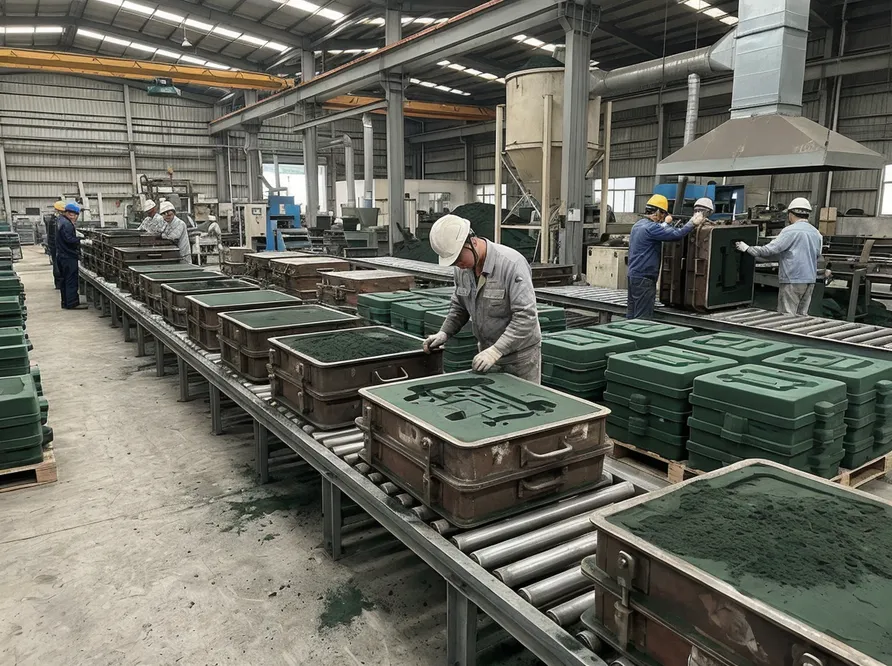
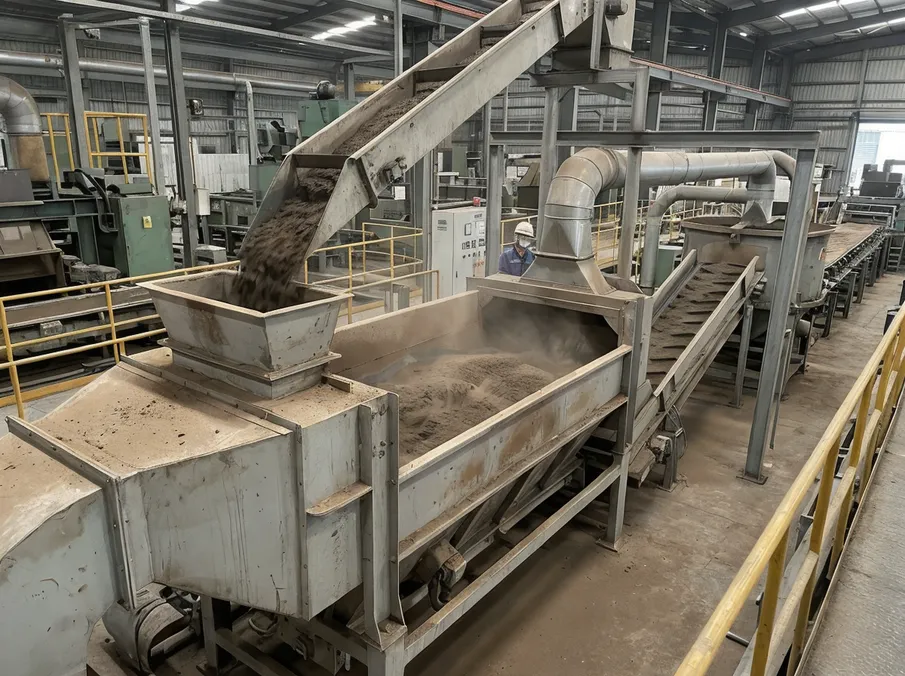
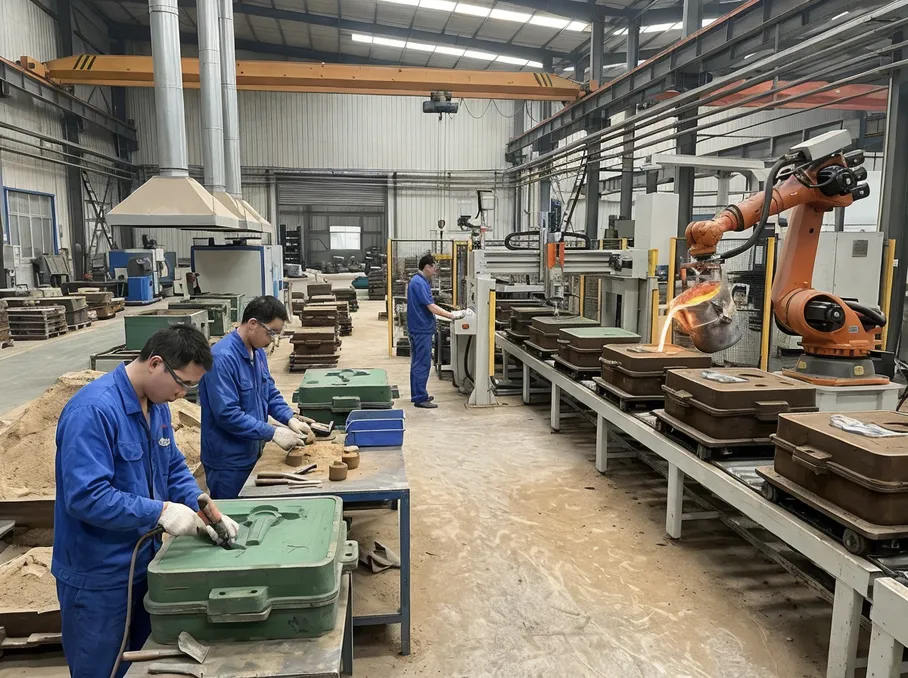
Sand casting production line — modular reusable mold system for volume foundries
Process Overview

Medium-to-High Volume Casting — Simpler Geometry, Lower Per-Unit Costs

This process suits medium-to-high volume production where casting geometry is simple to moderate complexity. Pattern cost amortizes over thousands of units, cycle times run faster than lost foam for straightforward shapes, and process control focuses on sand moisture and compaction rather than vacuum pressure.

Automotive Components

Repeatable batches of engine housings, brackets, and structural parts at foundry-scale volumes.

Industrial Machinery Housings

Robust housings and enclosures where pattern reuse drives down per-unit cost over thousands of pours.

Agricultural Equipment

Castings for agricultural equipment in repeatable batches — lower per-unit costs than permanent mold with more geometry flexibility than die casting.

500–50K
Units / Year Range
50–5,000
Tons Annual Capacity
4–6 Wk
On-Site Connection
2 Types
Green Sand & Resin Sand
Since 2010
Global Installations
System Architecture

Modular Lines, Containerized Shipping, Global Reach

We build modular sand casting lines for foundries handling 50–5,000 tons annually. Each system ships in standard containers and connects on-site in 4–6 weeks. Our lines handle both green sand (lower capital cost, faster setup) and resin sand (tighter tolerances, better surface finish) configurations, with PLC integration for process parameter logging.

Since 2010, we've installed foundry equipment across North America, Europe, the Middle East, and Southeast Asia — buyers who needed factory pricing, custom capacity configurations, and reliable delivery schedules.

Green Sand

Lower capital cost, faster mold setup, ideal for high-throughput simple geometry.

Resin Sand

Tighter tolerances, better surface finish, suited for higher-precision castings.

PLC Integration

Process parameter logging for consistent sand moisture and compaction control.

Container Shipping

Standard container modules ship worldwide and connect on-site in 4–6 weeks.

Compare Sand Casting to Other Processes?

Explore related production lines to match casting method with your part geometry, volume, and tolerance requirements.

Production Economics

How Sand Casting Lines Reduce Per-Unit Production Costs

Pattern tooling is where sand casting's volume economics show up. A wooden or metal pattern for a 15 kg pump housing costs $1,200–2,000 and lasts 5,000–10,000 castings with proper maintenance. That's $0.12–0.40 per casting in pattern cost.

Compare that to lost foam EPS patterns at $2–4 per casting or permanent mold tooling at $15,000–30,000 that only makes economic sense above 50,000 units. For the 2,000–20,000 unit production range, sand casting pattern economics beat both alternatives.

Pattern Cost Per Casting

Sand Casting $0.12–0.40
Lost Foam EPS $2–4
Permanent Mold $0.30–0.60*

*Permanent mold per-unit at 50,000+ volume; tooling $15K–30K upfront

Labor Efficiency Through Automation

A manual molding operation producing 80 tons/month needs 6–8 operators per shift: pattern handling, mold assembly, core setting, pouring, shakeout, and finishing. An automated sand casting line at the same tonnage runs with 3–4 operators: one managing the molding line, one handling pouring, one running shakeout and reclamation, one on finishing.

At $18–25/hour labor cost in most export markets, that's $75,000–120,000 annual savings on a two-shift operation. The payback math works when you're above 500 tons/year — below that, manual molding is cheaper; above that, automation pays for itself in 18–30 months.

Manual vs. Automated Staffing

Manual Molding — 80 tons/month

Pattern
Mold Assembly
Core Setting
Pouring
Shakeout
Finishing
+1–2 more

6–8 operators per shift

Automated Line — 80 tons/month

Molding Line
Pouring
Shakeout & Reclaim
Finishing

3–4 operators per shift

Annual savings: $75,000–120,000 on a two-shift operation at $18–25/hr labor cost. Payback in 18–30 months above 500 tons/year.

Sand Reclamation & Material Cost Impact

Green sand systems recycle 85–95% of sand after shakeout through mechanical reclamation (crushing, screening, cooling). You're replacing 5–15% of sand volume per cycle to maintain properties, not buying fresh sand for every mold.

A 100-ton/month line consumes 8–12 tons of makeup sand monthly instead of 150–200 tons without reclamation. At $40–80/ton for foundry-grade silica sand, reclamation saves $5,000–15,000 monthly in material cost alone.

Resin sand reclamation is more complex (thermal treatment to burn off binder) but still recovers 70–85% of sand, and the tighter tolerances justify the added reclamation equipment cost.

Green Sand Recovery

85–95%

Mechanical reclamation

Resin Sand Recovery

70–85%

Thermal reclamation

Monthly Savings (100 t/mo)

$5K–15K

Material cost reduction

Cycle Time Advantages

Sand molds assemble faster than lost foam coating and drying cycles — a simple bracket or housing molds in 2–5 minutes vs. 4–12 hours for lost foam coating cure time.

For high-volume production of simple geometries, sand casting throughput is 3–5× higher than lost foam at equivalent equipment investment.

Where lost foam wins: Complex geometries with internal passages where sand cores would be difficult to place and remove — that's where its near-net-shape advantage justifies the slower cycle time.

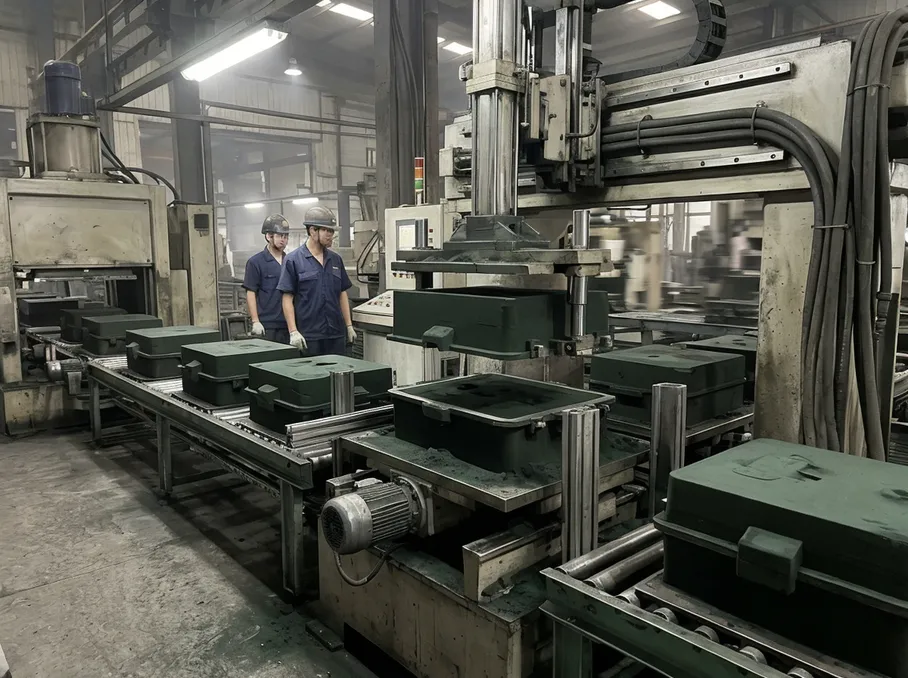
Sand mold assembly during automated production cycle showing rapid mold formation

Sand Casting

2–5 min

Lost Foam

4–12 hrs

Scrap Rate: Automated vs. Manual Sand Prep

Manual Sand Preparation 8–15% scrap
Automated Sand Mixing 3–6% scrap

Moisture content held within ±0.3%

Compactability within ±2%

Scrap Rate Control Through Process Consistency

Automated sand mixing maintains moisture content within ±0.3% and compactability within ±2% — that consistency translates to 3–6% scrap rates vs. 8–15% for manual sand preparation.

On a 1,000-ton/year operation, reducing scrap from 10% to 4% saves 60 tons of metal annually. At current aluminum prices ($2,400–2,800/ton) or iron prices ($450–600/ton), that's $27,000–168,000 in material cost avoidance depending on alloy mix.

Customer Result

600-ton/year Iron Foundry — Poland Agricultural Equipment Castings

Switched from manual green sand molding to an automated line. Per-ton cost dropped from $920 to $780 — a $140/ton savings driven by 45% labor reduction, 8% scrap rate improvement, and 90% sand reclamation vs. their previous 60% recovery rate. Line payback was 22 months. They've since expanded capacity to 850 tons/year on the same equipment by adding a second shift.

$140

Saved per ton

45%

Labor reduction

90%

Sand reclamation

22 mo

Line payback

System Architecture

Production Line Components — Molding, Sand Systems, and Material Handling

Six Integrated Subsystems, Containerized for Global Shipping

A complete sand casting line arrives as six integrated subsystems. Each ships in standard 20 ft or 40 ft containers and connects on-site through mechanical interfaces and PLC wiring.

Pattern Equipment

Pattern equipment stores and positions patterns for mold making. Pattern plates mount to the molding machine's squeeze board or match plate carriers.

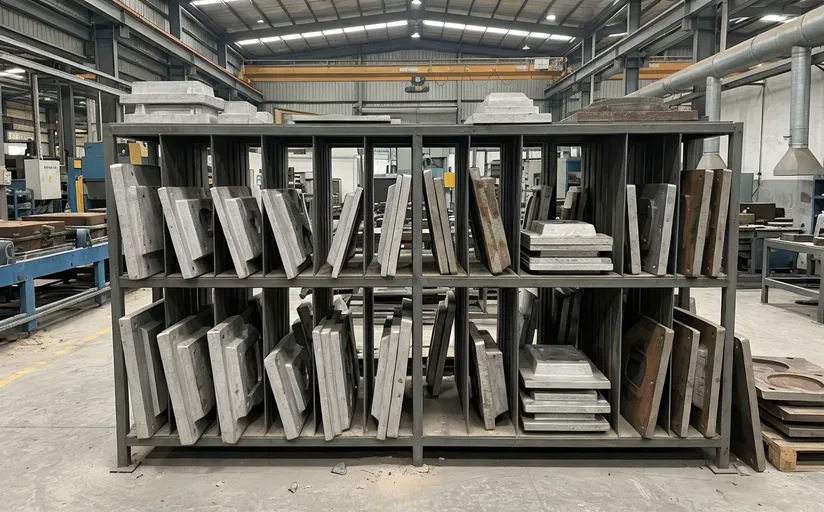
Pattern equipment storage rack with aluminum and steel pattern plates organized for quick changeover in a foundry production line

Wooden Patterns — Low Volume

For green sand molding, wooden patterns work for low-volume production — under 500 units/year per design. Cost-effective entry point for short-run casting portfolios.

Aluminum & Steel Patterns — Production Grade

Aluminum or steel patterns are standard for higher volumes because they hold dimensional accuracy over 5,000+ cycles. Required for any sustained production program.

Storage & Changeover

Pattern storage racks organize your casting portfolio — a typical 100-ton/month foundry runs 15–40 active casting designs and needs accessible storage for pattern changeovers. Automated lines use quick-change pattern mounting systems that swap patterns in 3–5 minutes without manual bolting.

Molding Line

The molding line forms sand molds in flasks and compacts to target density. This is the production-rate bottleneck — your line configuration choice here determines throughput ceiling.

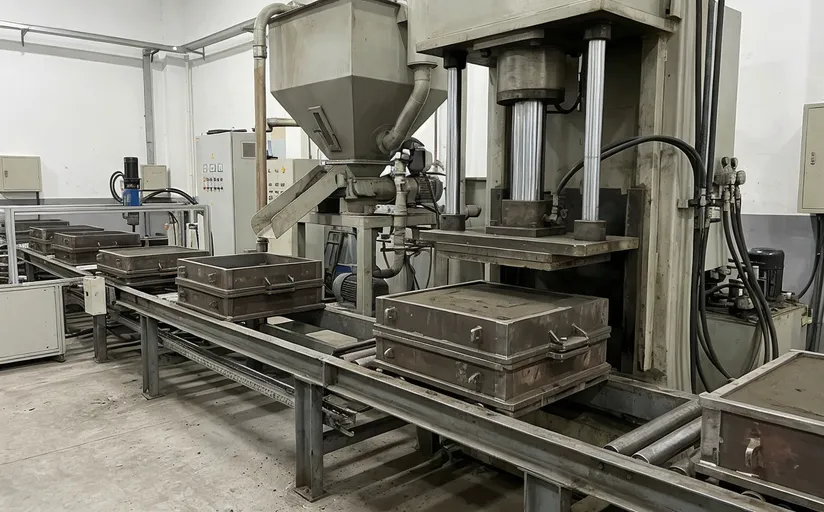
Automated molding line with hydraulic squeeze compaction forming green sand molds in cope-and-drag flasks
Vertical Flaskless Horizontal Flask
Cycle Rate 100–300 molds/hour 20–80 molds/hour
Flask Frame None — mold halves clamp directly Traditional cope-and-drag
Sand Use Lower — no flask wall thickness Higher per mold
Best For High-volume production Varying casting sizes, flexibility

Compaction Parameters

Squeeze pressure ranges from 0.3–0.8 MPa depending on sand type and casting complexity. Green sand molds compact through hydraulic squeeze; resin sand molds cure chemically and need less compaction force.

Flask Handling & Automation

Flask handling conveyors move filled molds to pouring stations, through cooling zones, and to shakeout. Automated lines eliminate manual flask transfer and the back injuries that come with moving 50–150 kg molds all shift.

Sand Preparation

Sand Preparation System

Mixes sand, binder, and water to target properties. The preparation stage directly controls mold quality — inconsistent sand means inconsistent castings.

Green Sand Mixers

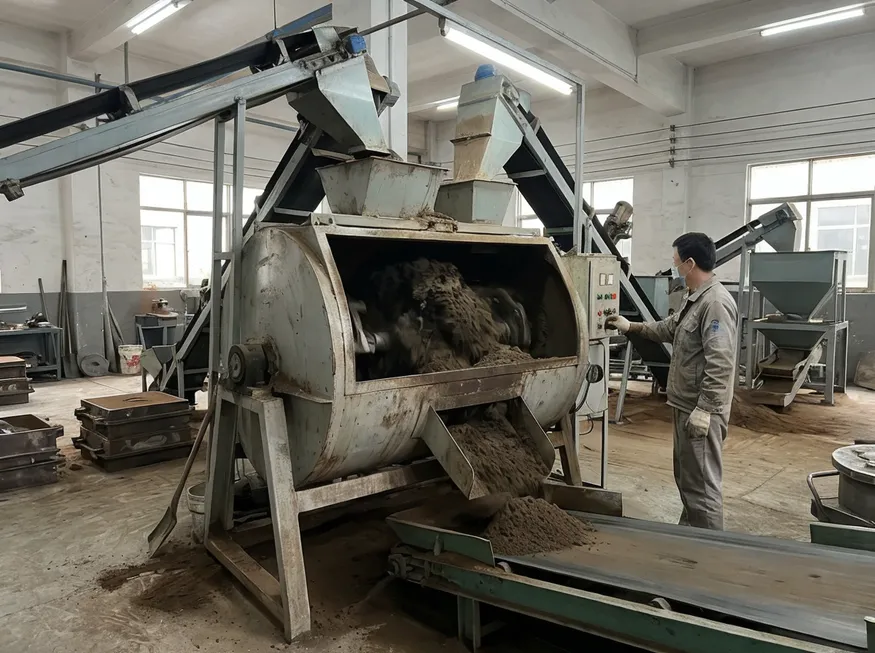
Continuous-feed units that blend reclaimed sand with fresh makeup sand, bentonite clay (6–10% by weight), water (2–4%), and coal dust or other additives. Mixing time is 3–5 minutes to achieve uniform moisture distribution.

Bentonite Clay

6–10%

by weight

Water Content

2–4%

of mix

Mix Time

3–5 min

per cycle

Feed Type

Continuous

operation

Resin Sand Mixers

Batch units that blend sand with liquid resin and catalyst just before molding. Pot life is 5–15 minutes depending on resin chemistry, so you're mixing in small batches matched to molding line consumption.

Pot Life Constraint: 5–15 Minutes

Resin chemistry dictates how fast you must mold after mixing. Batch sizing must match your molding line's consumption rate — overshoot and the sand sets before use.

Industrial sand preparation mixer blending reclaimed sand with bentonite clay and water for green sand casting production

Sand Testing & Quality Control

Sand testing equipment — moisture meters, compactability testers, permeability analyzers — monitors properties every 30–60 minutes during production.

Automated systems adjust water or binder addition based on real-time test results — tighter property windows, less operator dependency.

Manual operations rely on operator experience and see wider property variation batch to batch.

Metal Delivery

Pouring System

Delivers molten metal at controlled temperature and rate. Pour speed is a critical variable — too fast and you erode the mold cavity or trap air; too slow and the metal freezes before filling completes.

Low Volume

Manual Ladles

For operations producing under 200 tons/year. Lowest capital cost, highest dependence on operator skill for consistent pour rate.

Throughput

< 200 tons/year

Mid Volume

Overhead Cranes / Monorail

For 200–1,000 tons/year. Balances capital investment against throughput gains. Reduces operator fatigue and improves safety on longer production runs.

Throughput

200–1,000 tons/year

High Volume

Automated Ladle Cars

For high-volume lines exceeding 1,000 tons/year. Programmable transfer paths, repeatable positioning, and integration with automated pouring stations.

Throughput

> 1,000 tons/year

Pour Rate Control Methods

Tilt-Pour Ladles

Use mechanical or hydraulic tilt control to regulate molten metal flow. Simpler mechanism, lower maintenance burden, well-suited for operations that don't require extremely tight pour repeatability.

Stopper-Rod Systems

Common on automated lines. A refractory rod lifts to start the pour and lowers to stop — more precise than tilt control but requires more maintenance. The rod is a wear item that needs periodic replacement.

Pouring Temperature Ranges

Pyrometers measure ladle temperature before each pour. Temperature control is non-negotiable — pour too hot and you get gas porosity and sand burn-on; too cold and you get misruns and cold shuts.

Metal Pour Temperature
Aluminum 680–730°C
Gray Iron 1,380–1,450°C
Ductile Iron 1,340–1,400°C
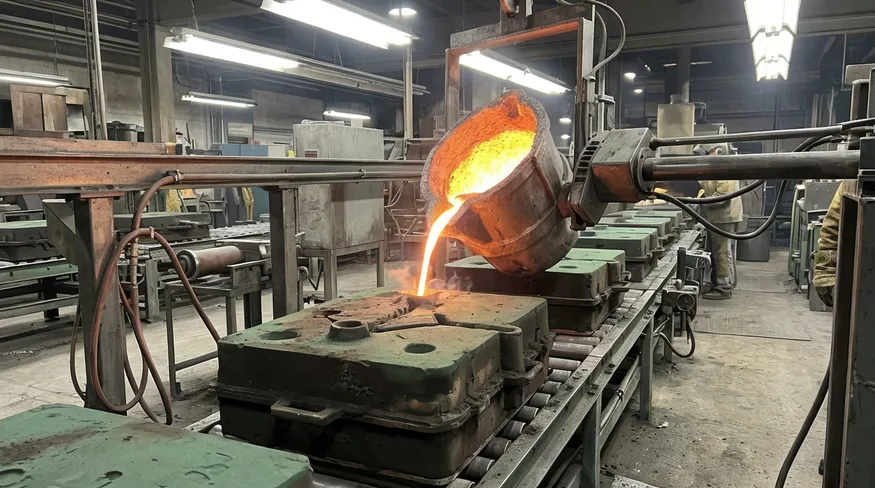
Automated ladle pouring molten iron into sand mold on a sand casting production line

Shakeout and Cooling

Shakeout and cooling separates castings from sand after solidification. Cooling conveyors allow molds to cool to safe handling temperature — 20–40 minutes for aluminum castings under 20 kg, 40–90 minutes for iron castings or heavier aluminum parts.

Shakeout Equipment

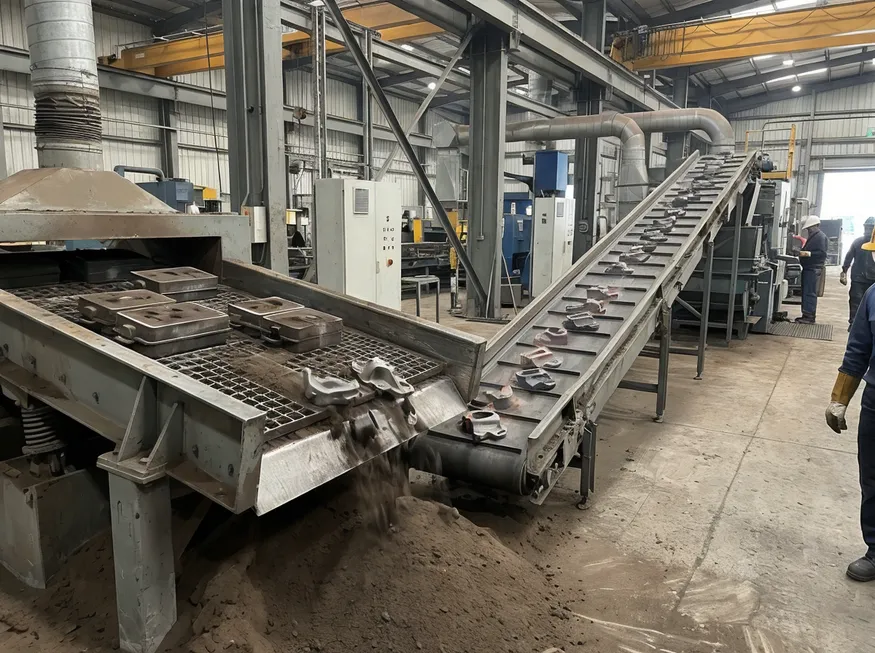
  • Vibrating shakeout grids operate at 25–50 Hz and separate castings from sand through screen decks
  • Rotary drum shakeouts tumble molds to break up sand and discharge castings at the drum exit — these handle higher tonnages but are noisier and generate more dust
  • Magnetic separators remove tramp iron from reclaimed sand — critical for iron foundries to prevent mold defects from metallic contamination
  • Dust collection systems capture airborne silica during shakeout — baghouse filters sized for 8,000–20,000 m³/hour airflow depending on line capacity

25–50 Hz

Vibrating Grid Frequency

8K–20K

m³/hr Dust Collection

Industrial shakeout and cooling conveyor system separating castings from sand molds in a foundry production line

Cooling Time Reference

Aluminum Castings (under 20 kg)

20–40 min

Iron Castings / Heavy Aluminum

40–90 min

Sand Reclamation

Sand reclamation processes used sand for reuse, reducing raw material costs and waste output. The reclamation method depends on your binder system — green sand and resin sand require fundamentally different approaches.

Mechanical Reclamation

Green Sand Systems

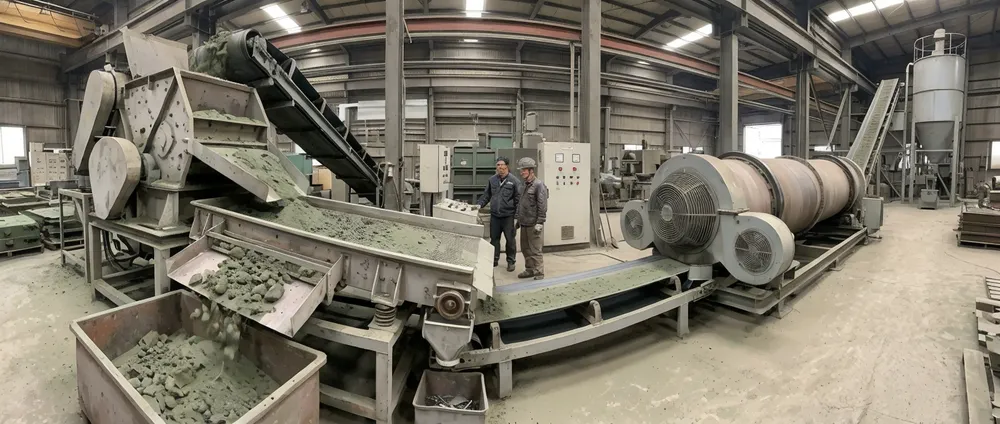
Mechanical reclamation for green sand involves a multi-stage process that restores sand properties for reuse in the mixer:

  1. 1 Crushers break up lumps from the spent mold
  2. 2 Vibrating screens remove oversized particles and casting debris
  3. 3 Cooling drums bring sand temperature down to 40–60°C
  4. 4 Magnetic separators pull out metal particles

Reclaimed sand returns to the mixer where fresh makeup sand, bentonite, and water restore properties.

Thermal Reclamation

Resin Sand Systems

Thermal reclamation for resin sand burns off organic binder residue through high-temperature processing:

  1. 1 Rotary kilns or fluidized bed units heat sand to 500–700°C to burn off organic binder residue
  2. 2 Attrition mills mechanically scrub sand grains to remove coating films

Resin sand reclamation is more energy-intensive than green sand but necessary to maintain sand quality — without reclamation, resin sand degrades after 3–5 cycles and you're buying fresh sand continuously.

Sand reclamation system with crushers, vibrating screens, and cooling drums processing used foundry sand for reuse

Control System Integration

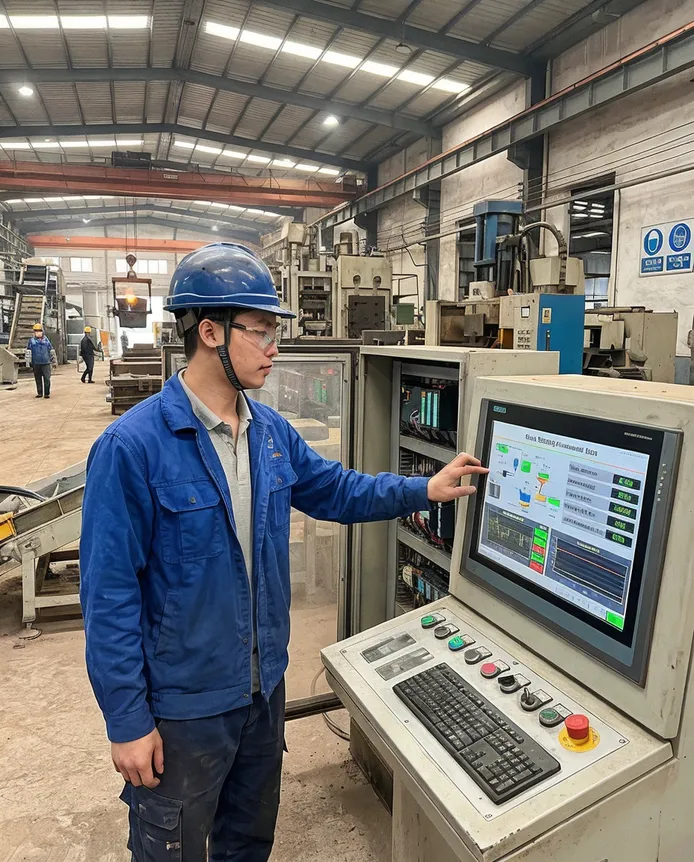
The control system integrates all subsystems through PLC programming. Process parameter logging tracks sand moisture, compactability, pouring temperature, mold cycle time, and reclamation throughput. Alarm systems notify operators when parameters drift out of spec — moisture too high, compactability too low, pouring temperature below target.

Remote Diagnostics Capability

Our technical team can access your system via Ethernet or 4G connection to troubleshoot PLC faults, adjust process parameters, and update control logic without site visits.

Centralized Monitoring

For multi-line facilities, centralized monitoring allows one supervisor to oversee multiple production lines from a single HMI station.

Monitored Parameters

Sand

Moisture

Sand

Compactability

Metal

Pouring Temp

Cycle

Mold Cycle Time

Sand

Reclamation Rate

PLC control system with HMI station for sand casting production line monitoring

Modular Scalability — Start Small, Expand On Demand

Our modular design means you can start with a basic manual molding line and batch sand mixer, then add automated molding, continuous sand preparation, and thermal reclamation as production volume grows.

Starter

50 Ton/Month Line

  • Manual molding with batch sand mixer
  • Fits in two 40ft containers
  • Upgradeable to automated molding and continuous sand prep

Shipping

2 × 40ft Containers

Full Scale

500 Ton/Month Automated Line

  • Automated molding with continuous sand preparation
  • Thermal reclamation system included
  • PLC integration with centralized HMI monitoring

Shipping

8 × 40ft Containers

On-site assembly takes 4–6 weeks with our installation team or certified local partners. Both line configurations ship fully pre-assembled in sub-modules for faster field integration.

Process Control

Process Control — Sand Properties and Mold Quality Consistency

Sand Moisture Content

Sand moisture content determines mold strength and dimensional stability. Green sand targets 2.5–4.0% moisture by weight — below 2.5% and the mold is too friable (crumbles during handling), above 4.0% and you get steam-related defects during pouring.

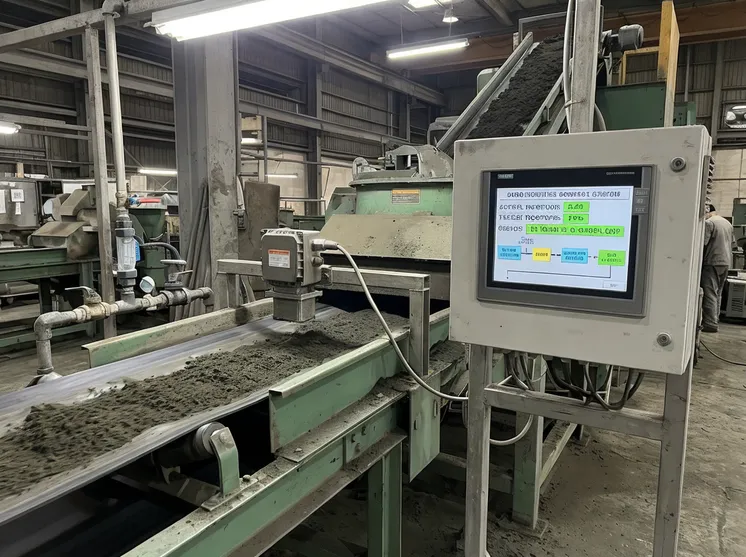
Automated moisture sensors measure sand continuously using microwave or infrared technology and adjust water addition in real time. Manual operations test moisture every 30–60 minutes using oven-dry samples or moisture meters.

A 0.5% moisture variation across a production shift translates to 15–25% variation in mold hardness, which shows up as dimensional inconsistency in finished castings. Our sand preparation systems hold moisture within ±0.3% through closed-loop control — the PLC monitors moisture readings and modulates water flow to the mixer based on deviation from setpoint.

Automated closed-loop moisture control system on a green sand preparation line, showing PLC panel and microwave moisture sensor

TZFoundry Moisture Tolerance

Our systems hold moisture within ±0.3% via PLC-driven closed-loop water modulation — eliminating the 15–25% mold hardness swings caused by manual control.

Moisture Impact at a Glance

Moisture Level Condition Effect on Casting
< 2.5% Too friable Mold crumbles during handling; sand erosion defects
2.5–4.0% Optimal range Consistent mold strength and dimensional stability
> 4.0% Excess moisture Steam-related porosity and blow defects during pouring

Compactability

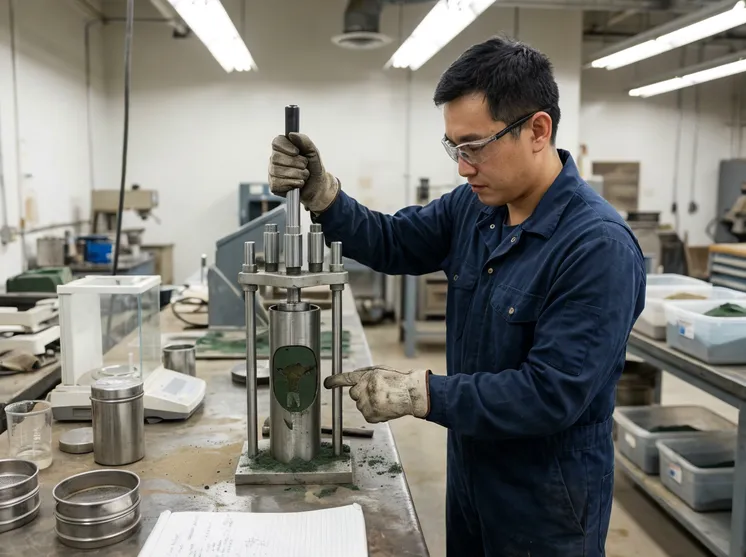
Compactability measures how well sand packs under pressure — this correlates directly to mold hardness and resistance to metal penetration. Target compactability for green sand is 40–50% (measured by standard AFS compactability test). Below 40% and molds are too soft; above 50% and sand becomes difficult to strip from patterns and doesn't shake out cleanly.

Compactability depends on clay content, moisture level, and sand grain distribution. Fresh bentonite clay addition maintains compactability as reclaimed sand cycles through the system — typical makeup rate is 0.5–1.5% bentonite per cycle.

We calibrate compactability targets during commissioning based on your casting portfolio and adjust clay addition rates to maintain consistency.

AFS compactability test being performed on green sand sample in foundry laboratory

Below 40%

Molds too soft — metal penetration defects and poor dimensional accuracy due to insufficient compaction resistance.

TARGET

40–50%

Optimal compactability — consistent mold hardness, clean pattern stripping, and good shake-out performance across production.

Above 50%

Sand too packed — difficult to strip from patterns, poor shake-out, and increased risk of pattern damage during extraction.

Permeability

Permeability controls how gases escape from the mold cavity during pouring. Too low and trapped gases cause porosity defects; too high and the mold doesn't have enough strength. Green sand permeability targets 80–150 AFS permeability units for most applications.

Fine sand (70–140 mesh) gives lower permeability and better surface finish; coarse sand (40–70 mesh) gives higher permeability and faster gas escape. Sand grain size distribution shifts over time as grains break down through thermal cycling and mechanical handling — you're adding fresh makeup sand (typically 5–15% per cycle) to maintain grain size distribution and permeability.

Permeability testing happens daily or weekly depending on production volume; automated systems log permeability data and alert operators when values drift outside target range.

Sand Grain Size vs. Performance

Fine Sand (70–140 mesh) Lower Permeability

Better surface finish on castings. Ideal for precision parts where cosmetic quality matters more than gas escape speed.

Coarse Sand (40–70 mesh) Higher Permeability

Faster gas escape during pouring. Preferred for thick-section castings where trapped gas and porosity are the primary risk.

5–15% fresh makeup sand per cycle maintains grain distribution as grains break down through thermal cycling and mechanical handling.

Mold Hardness Verification

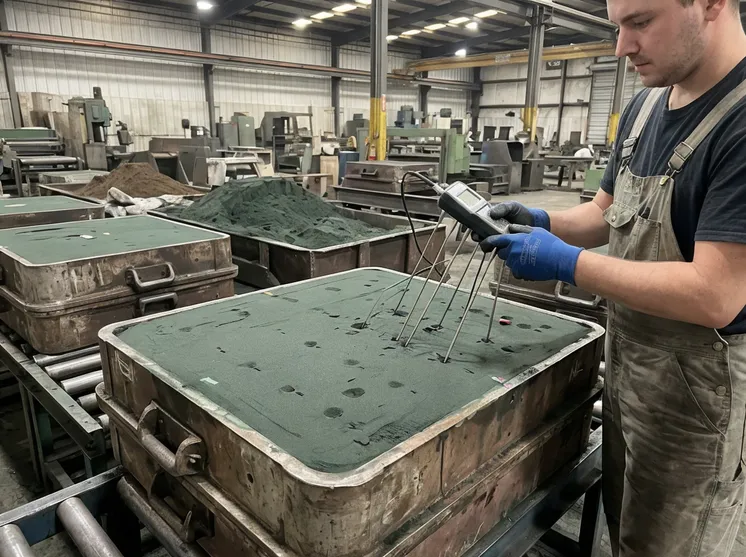
Mold hardness verification ensures consistent compaction across the molding line. Hardness testers measure surface hardness at multiple points on each mold — target is ±10% variation across the mold face. Uneven hardness indicates problems with squeeze pressure distribution, pattern plate levelness, or sand flow during filling.

Our molding machines use pressure sensors at multiple squeeze points to monitor compaction uniformity and adjust hydraulic pressure to compensate for pattern height variations. This matters most for large molds (over 800×800mm) where squeeze pressure can vary 15–20% from center to edges without active compensation.

Multi-point mold hardness testing on a large green sand mold, showing pressure sensor locations across the mold face

Active Pressure Compensation

Multi-point pressure sensors adjust hydraulic squeeze force in real time — critical for molds over 800×800mm where center-to-edge pressure variance can reach 15–20% without active control.

Temperature Management & Sand Properties

Temperature management affects sand properties and casting quality. Sand temperature rises during reclamation and returns to the mixer at 60–90°C (green sand) or 40–60°C after cooling. High sand temperature reduces moisture retention and accelerates bentonite breakdown.

Cooling drums or fluidized bed coolers bring sand temperature down to 35–50°C before remixing.

High-Volume Threshold

For high-volume lines (over 300 tons/month), active cooling is necessary to maintain sand properties — without it, sand temperature climbs 5–10°C per hour during continuous operation and moisture content becomes unstable.

Fluidized bed cooler reducing reclaimed sand temperature before remixing in a high-volume foundry sand casting line

Data Logging for Root-Cause Defect Analysis

Data logging enables root-cause analysis when defect rates spike. Our PLC systems store 90 days of process data: sand moisture, compactability, permeability, mold hardness, pouring temperature, and cycle time.

When a batch of castings fails inspection, you pull the data logs for those specific molds and identify which parameter drifted.

Sand Moisture

Compactability

Permeability

Mold Hardness

Pour Temp

Cycle Time

Proven Scrap Rate Reduction

We've seen foundries cut scrap rates from 9–14% down to 4–6% within four months of commissioning — just by using data logs to tighten process control and identify operator practices that caused parameter drift.

Line Selection Guide

Matching Line Configuration to Your Foundry Requirements

Production Volume Determines Automation Level

Production volume determines automation level and equipment capacity. The economic breakpoint is around 400 tons/year: below that, labor cost savings don't justify automation investment; above that, automation pays back in 20–30 months through reduced labor and higher throughput.

Prototype & Low-Volume

50–300 tons/year

Manual molding with hand-poured ladles. Complete line includes sand mixer, molding machine, shakeout, and basic reclamation.

Capital cost: $120,000–$200,000

Serial Production

500–2,000 tons/year

Semi-automated molding lines with conveyor systems and mechanical ladle handling.

Capital cost: $400,000–$800,000

High-Volume Automated

Over 2,000 tons/year

Fully automated lines with robotic pouring, continuous sand preparation, and thermal reclamation.

Capital cost: $1,200,000–$2,500,000
Sand casting production line automation levels ranging from manual molding to fully robotic pouring systems

Economic Breakpoint

At approximately 400 tons/year, automation investment crosses the payback threshold. Below that volume, labor cost savings don't justify the capital outlay. Above it, automation pays back in 20–30 months through reduced labor and higher throughput.

Casting Size Range Determines Flask Dimensions

Casting size range determines flask dimensions and handling equipment. Flask size also affects sand consumption directly — larger flasks require proportionally more sand per mold cycle.

Casting Weight Flask Size Handling Method Sand per Mold
Under 5 kg 400×400 mm – 500×500 mm Manual or light-duty conveyors
5–50 kg 600×600 mm – 800×800 mm Roller conveyors, chain conveyors, or overhead cranes 80–150 kg (600×600 flask)
Over 50 kg 1000×1000 mm or larger Heavy-duty cranes for mold transfer 300–600 kg (1000×1000 flask)

Mid-Range Portfolio (3–30 kg)

Configured with 600×600 mm standard flasks and 3-ton overhead crane capacity. This covers the majority of general-purpose foundry castings with efficient sand utilization.

Heavy Casting Portfolio (40–150 kg)

Flasks scale to 1000×1000 mm and crane capacity increases to 5–10 tons. Heavier molds require robust transfer systems and proportionally higher sand volumes per cycle.

Sand Type Selection — Green Sand vs. Resin Sand

Sand type selection depends on tolerance requirements and production volume. Some foundries run hybrid systems: green sand for mold bodies, resin sand for cores that need dimensional precision.

Green Sand

Bentonite-Bonded

  • Lower operating cost — bentonite at $200–$400/ton
  • Faster cycle times and simpler reclamation
  • Tolerances of ±2–3 mm with moderate surface finish

Best for: Foundries where 80% of castings are simple geometries with standard tolerances. The economical choice for general-purpose production.

Resin Sand

Chemically Bonded

  • Tighter tolerances of ±0.5–1.5 mm
  • Better surface finish and more complex core capability
  • Resin cost $800–$1,500/ton — thermal reclamation adds energy cost

Best for: Precision components for automotive or aerospace applications. Justifies added cost through reduced machining and higher yield rates.

Hybrid Configuration: Some foundries run both sand types on the same line — green sand for mold bodies where standard tolerances are acceptable, and resin sand for cores that require dimensional precision. TZFoundry configures dual-sand systems to optimize cost and quality across your casting portfolio.

Aluminum Casting Lines

Solidification time: 8–25 minutes for most geometries

Pouring temperature: 680–730°C

Cooling conveyors: Sized for 25-minute cycles — shorter footprint, lower capital cost

Ladle lining: Alumina-silica refractory — longer service life at lower temperatures

Iron Casting Lines

Solidification time: 25–70 minutes depending on geometry

Pouring temperature: 1,340–1,450°C

Cooling conveyors: Extended to 70-minute cycles — larger cooling zones required

Ladle lining: High-alumina refractory rated for 1,500°C — more frequent maintenance cycles

Mixed-Alloy Foundries

Mixed-alloy foundries get longer cooling conveyors sized for the slowest-cooling alloy and maintain separate ladle sets for aluminum and iron to avoid cross-contamination. This configuration handles both alloy families on the same line without compromising cycle time or metallurgical integrity.

How Our Line Audit Process Works

Our line audit process starts with your current or projected casting portfolio: part drawings, annual volumes per design, alloy types, and tolerance requirements. We analyze which castings suit sand casting vs. which should stay on other processes — lost foam for complex geometries, permanent mold for very high volumes.

Then we map your 3-year growth plan — if you're adding new product lines or expanding into new markets, we size the equipment for future capacity without forcing you to buy excess capacity upfront.

Modular Expansion Path

Start with core equipment that handles today's volume, then add molding stations, sand preparation capacity, or reclamation throughput as production grows. No upfront over-investment, no bottleneck when demand ramps.

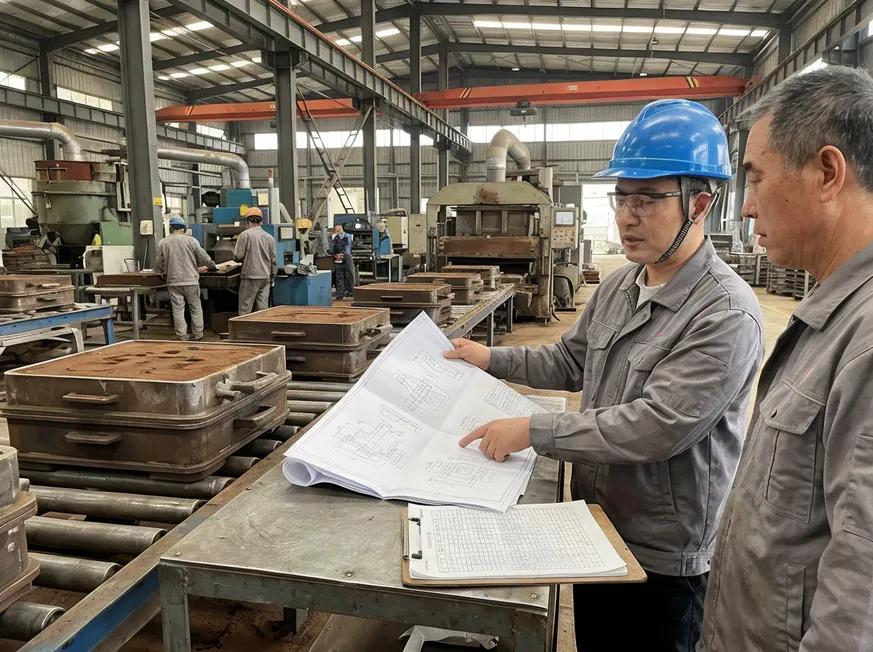
TZFoundry engineer reviewing casting portfolio drawings and production data during a sand casting line audit

Line audits evaluate part drawings, annual volumes, alloy types, and tolerance requirements to determine optimal configuration.

1

Portfolio Analysis

Submit part drawings, volumes, alloy types, and tolerances. We identify which castings fit sand casting.

2

Process Mapping

We determine sand casting vs. alternative processes — lost foam for complex geometries, permanent mold for very high volumes.

3

Growth Planning

Map your 3-year expansion plan to size equipment for future capacity without excess upfront spend.

4

Modular Config

Core equipment for today's volume, with expansion modules — molding stations, sand prep, and reclamation — added as production grows.

Get a Quote for Your Sand Casting Line Configuration

Send us your casting portfolio and production targets, and we'll configure a system that matches your requirements and budget.

Get Factory Quote
Buyer's Evaluation Guide

What to Evaluate When Sourcing Sand Casting Equipment

Lead Time & Installation Support

Lead time and installation support determine when your line starts producing revenue. Our production schedule runs 10–14 weeks from order confirmation to container loading — that includes equipment fabrication, PLC programming, factory testing, and export documentation.

On-site commissioning takes 4–6 weeks: mechanical assembly, electrical hookup, sand system testing, process parameter calibration, and operator training. Total timeline from order to first production casting is 16–22 weeks.

Verify your equipment manufacturer has installation teams or certified partners in your region — if they're shipping equipment without installation support, you're hiring local contractors who don't know the process specifics and commissioning stretches to 10–14 weeks while they learn through trial and error.

Order-to-Production Timeline

Order Confirmation

Equipment fabrication, PLC programming, factory testing & export documentation

10–14 Weeks
On-Site Commissioning

Mechanical assembly, electrical hookup, sand system testing, calibration & training

4–6 Weeks
First Production Casting

Line fully operational with trained operators

Total: 16–22 Weeks

Without manufacturer installation support: Commissioning by unfamiliar local contractors can stretch to 10–14 weeks as they learn through trial and error.

Spare Parts Availability

Spare parts availability directly impacts your downtime cost. Critical wear components fail predictably — the difference between a responsive supplier and one manufacturing parts on demand can be the difference between 1–2 days and a full month of lost production.

Squeeze Cylinders

Molding machine

24–36 months

Mixer Paddles

Sand mixer

18–24 months

Conveyor Chains

Material handling

12–18 months

PLC I/O Modules

Control system

Rare / No Warning

Stocked Parts — Ships in 3–5 Days

A mixer paddle failure costs you 1–2 days of downtime. The supplier maintains inventory of critical wear components and ships within days of your order.

On-Demand Manufacturing — 4–8 Weeks

That same mixer paddle failure costs you a month of lost production. The supplier manufactures parts only after you order — they're selling new lines, not supporting installed equipment.

Ask about inventory policy and shipping speed for the top 20 wear components — that tells you whether they're supporting installed equipment or just selling new lines and moving on.

Remote Diagnostics Capability

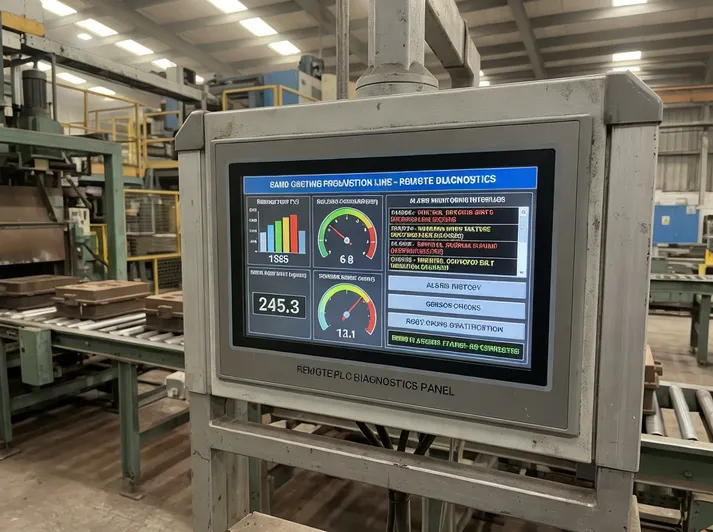
Remote diagnostics capability reduces troubleshooting time from days to hours. Modern PLC systems connect via Ethernet or 4G and allow remote access to control logic, parameter settings, and alarm logs.

When your line faults, our technical team logs into your PLC, reviews the alarm history, checks sensor readings, and identifies the root cause — usually within 2–4 hours. Without remote access, you're describing symptoms over email, we're guessing at causes, and you're swapping components until something works.

We've resolved 65–75% of technical issues remotely without site visits. The remaining 25–35% need physical inspection or component replacement, but remote diagnostics tells us exactly which parts to bring and eliminates the diagnostic trip.

Issue Resolution Breakdown

Resolved Remotely 65–75%

No site visit required

Requires On-Site Visit 25–35%

Parts identified remotely before dispatch

Remote PLC access via Ethernet or 4G enables alarm history review, sensor checks, and root-cause identification in 2–4 hours instead of days.

Remote PLC diagnostics panel for sand casting production line showing real-time sensor data and alarm monitoring interface

Training & Documentation Quality

Training and documentation quality determines how fast your team becomes self-sufficient. This is the knowledge transfer that lets your team optimize the line for new casting designs without calling us every time.

Operator Training

4–6 Days On-Site During Commissioning
  • Equipment operation procedures
  • Sand property testing methods
  • Process parameter adjustment
  • Routine maintenance execution
  • Basic troubleshooting workflows

Documentation Package

Comprehensive Technical Manuals
  • Mechanical drawings & hydraulic schematics
  • Electrical diagrams & PLC ladder logic
  • Spare parts lists with part numbers
  • Preventive maintenance schedules
  • Process parameter guides for casting quality optimization

Process Parameter Guides

Explains how moisture content, compactability, and squeeze pressure affect casting quality — the knowledge transfer that lets your team optimize the line for new casting designs without calling us every time.

Language Availability

Documentation provided in English as standard. Other languages available on request — add 2–3 weeks to delivery schedule for translation of full technical package.

Warranty and Service Terms

Warranty and service terms define who pays when equipment fails. Standard warranty is 12–18 months from commissioning date, covering manufacturing defects in materials and workmanship.

What's Typically Covered

Mechanical Components — 18-Month Warranty

Frames, cylinders, conveyors — structural and mechanical assemblies covered against manufacturing defects.

Electrical Components — 12-Month Warranty

Motors, sensors, PLC modules — shorter coverage window reflects component lifecycle characteristics.

Wear Items — Usually Not Covered

Mixer paddles, conveyor belts, hydraulic seals — failure rate depends on your operating conditions and maintenance practices, so these are typically excluded from standard warranty.

Service Response Benchmarks

24–48 hrs Remote Diagnostics
5–7 days On-Site Visits (Major Markets)

Clarify travel cost responsibility for warranty repairs up front — some suppliers absorb travel for the first year, then charge separately.

Payment and Shipping Terms

Payment and shipping terms affect your cash flow and landed cost. Understanding the difference between FOB and CIF pricing is essential for controlling total project expenditure.

FOB Qingdao Pricing

You arrange ocean freight, customs clearance, and inland transport. You control logistics but assume all shipping risk. Typically the lower-cost option for buyers with established freight forwarding relationships.

CIF Pricing

Includes ocean freight and insurance to your destination port. Simpler for you but typically 8–12% higher than FOB. Best suited for first-time importers or when freight volumes don't justify a separate logistics contract.

Container Loading Supervision

Proper loading supervision protects equipment during 25–40 day ocean transit. Key safeguards include:

  • Photography of equipment positioning within the container
  • Verification of secure tie-down points to prevent shifting
  • Desiccant placement confirmation to prevent moisture damage

Export Documentation Requirements

Export documentation must match your customs requirements exactly. Missing or incorrect documents delay clearance by 1–3 weeks and incur demurrage charges at the destination port.

Commercial Invoice
Packing List
Certificate of Origin
CE Certificates
Customs Forms
ISO 9001:2015 · CE · SGS Certified

TZFoundry — Sourcing Confidence Built In

When you're evaluating sand casting equipment suppliers, certifications and post-sale support infrastructure are as important as machine specifications. Here's what TZFoundry brings to every project:

English-Speaking Support

Email and WhatsApp response within 24 hours. No language barriers, no delayed translations.

Video Commissioning

Remote video-guided installation assistance for commissioning when on-site visits aren't practical.

Qingdao Spare Parts Warehouse

Top 25 wear components for sand casting lines in stock. International shipping in 3–5 days.

Remote Diagnostics

Standard on all PLC-controlled equipment. Troubleshoot issues without waiting for on-site technicians.

Warranty Coverage Summary

Mechanical Components 18 Months
Electrical Systems 12 Months
Remote Diagnostics Included
Spare Parts Shipping 3–5 Days Intl.
Get Factory Quote
Factory-Direct Partnership

Why Foundries Choose TZFoundry for Sand Casting Lines

We've been manufacturing foundry equipment since 2010 — started with individual molding machines for domestic foundries, shifted to complete production line systems when export orders demanded integrated solutions. Our facility in Qingdao runs 8 production lines across 15,000 square meters, producing 500,000 units annually.

8
Production Lines
15,000
Sq. Meters Facility
500K
Units Annually

We build clay sand processing lines, lost foam casting systems, and resin sand production equipment — all three categories manufactured in-house, which means we understand the process trade-offs between different casting methods and can advise honestly on which approach suits your casting portfolio.

Modular Design — Scale Without Replacing Core Equipment

Our modular design philosophy means lines ship in standard containers and expand without replacing core equipment. Modular expansion reduces capital risk when you're entering sand casting or testing new markets — you're not betting the full automation investment until you've proven the volume.

Real-World Expansion Case — Texas Foundry

1
2019 — 120 ton/month manual green sand line
2
2021 — Added automated molding equipment
3
2024 — Upgraded to continuous sand preparation
Current Output
380 tons/month
Total Investment
$350,000
$190K initial + $160K upgrades

Equivalent new automated line purchased all at once: $580,000 — modular path saved $230,000 in upfront capital.

In-House R&D — Custom Engineering, Not Catalog Modifications

In-house R&D team handles custom line configurations, sand system sizing, and process parameter optimization. These aren't catalog modifications — they're engineering responses to specific buyer situations that we can execute because we manufacture the equipment in-house rather than assembling purchased components.

Middle East — Dual-Alloy Line

Foundry needed to run both aluminum and gray iron on the same line. We designed a dual-sand system with separate mixers and automatic sand type switching based on alloy selection.

Europe — Low-Ceiling Retrofit

Buyer's facility had 5.2-meter ceiling height (our standard design assumes 6.5 meters). We reconfigured the sand storage silos and dust collection ductwork to fit their building constraints.

Direct Factory Pricing

Direct factory pricing eliminates distributor markup. You're paying manufacturing cost plus our margin, not manufacturer's margin plus distributor's margin plus local agent's commission.

For a $350,000 sand casting line:
$50,000–$85,000 savings
vs. buying through distribution channels

Flexible MOQ for custom configurations — we'll build a single line to your specifications without forcing you into standard packages or minimum order quantities. Most equipment manufacturers require 2–3 unit minimum orders for custom work; we configure one-off systems because export buyers need equipment that fits their specific casting mix, facility layout, and budget constraints.

Export Experience — 18+ Countries

We've installed lines in North America, Europe, the Middle East, and Southeast Asia — we understand customs documentation requirements, voltage standards, and safety code differences. We can advise on duty rates, required certifications, and customs clearance procedures before you place the order.

CE certification for European buyers
UL-recognized components for North American installations
Voltage conversion options for any market (50/60 Hz, 380V/480V)
18+ country import regulation experience

Get Your Sand Casting Line Configured

Provide your casting portfolio — part drawings or photos, annual volumes, alloy types, tolerance requirements — and we'll configure a sand casting line that matches your production requirements and budget.

Production
10–14 weeks
Installation
4–6 weeks
Communication
Factory-Direct

We work directly with foundry owners and procurement managers — no distributor layers, no sales quotas, just factory-to-buyer communication.