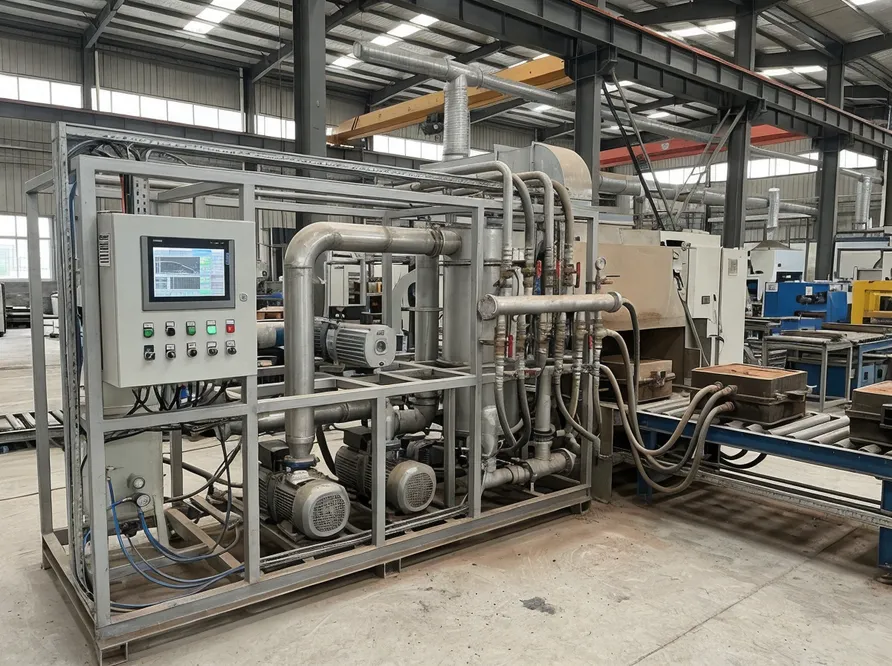
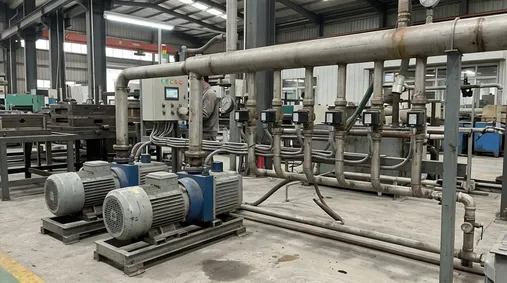
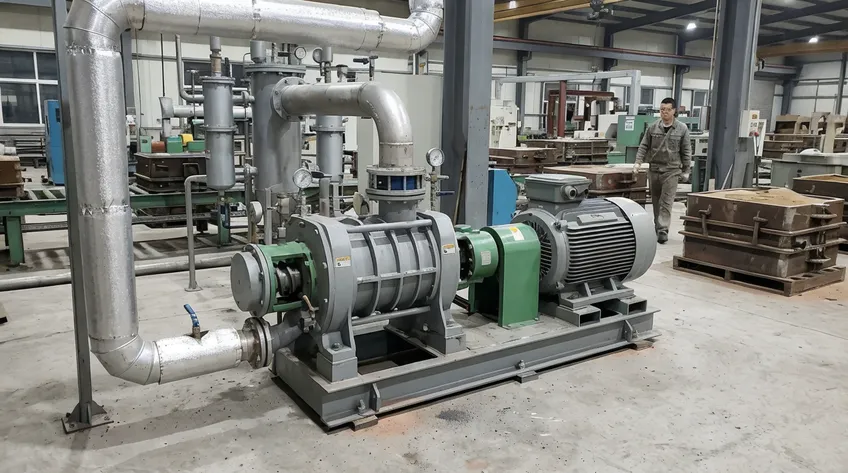
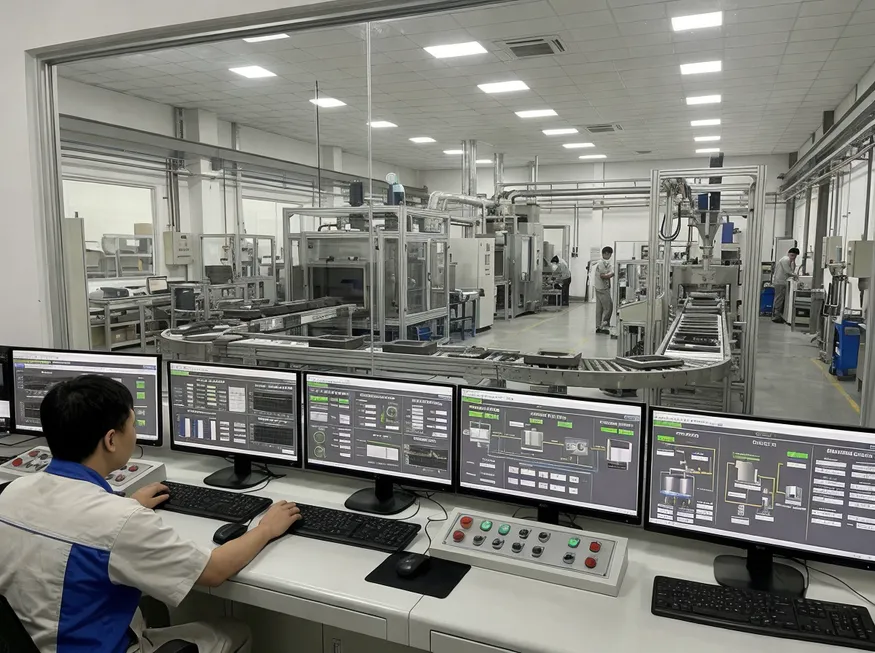
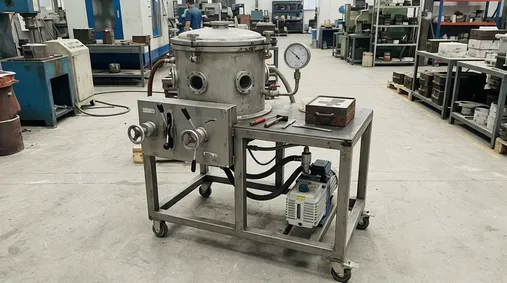
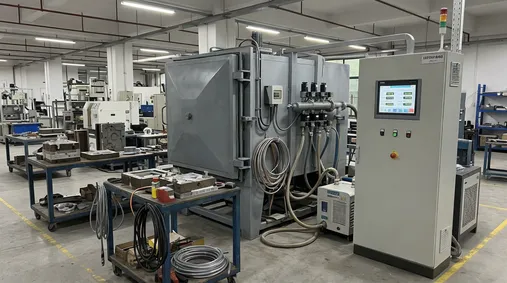
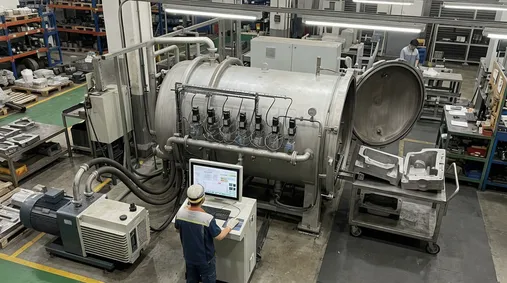
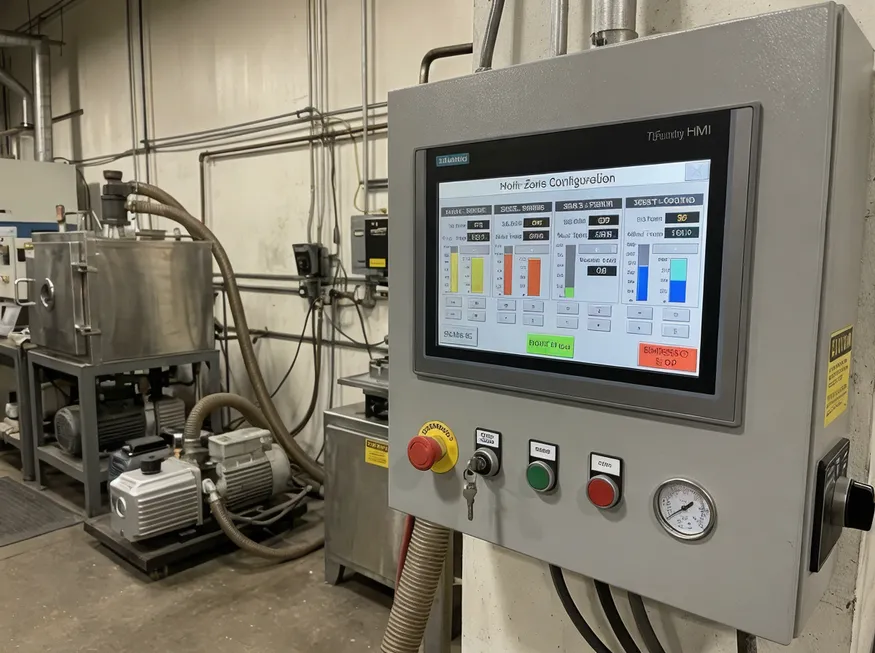
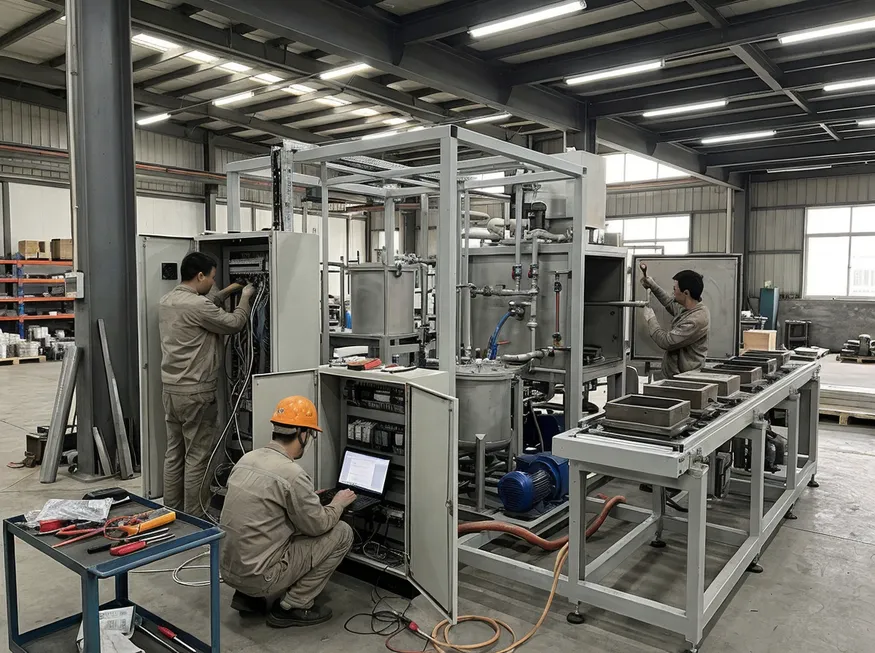
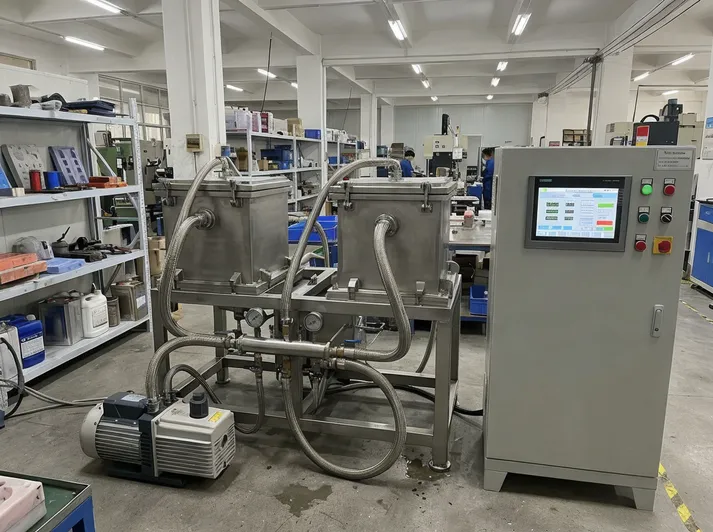
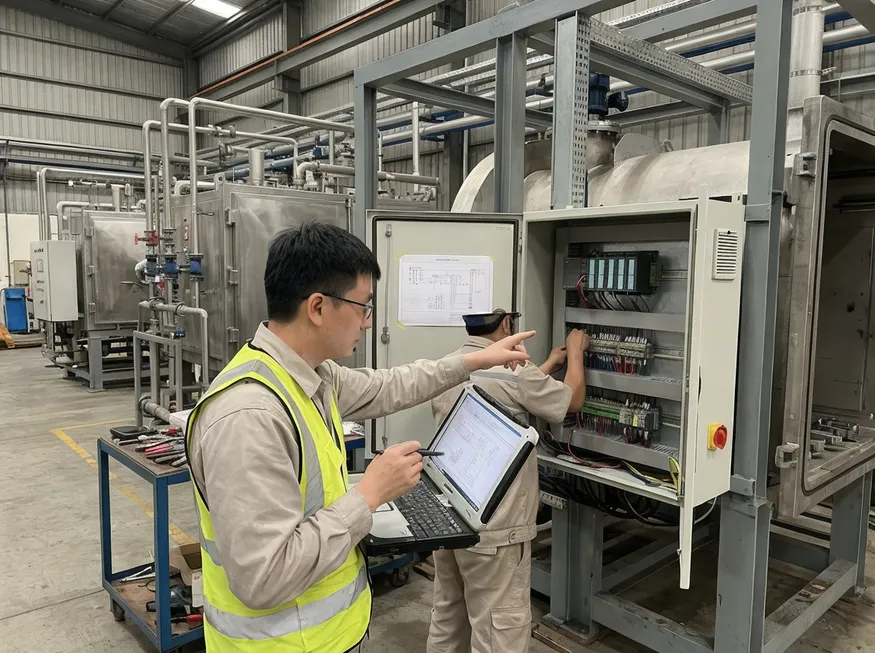
Controls the negative-pressure environment during lost foam casting — pulling sand tight against EPS patterns as they vaporize, preventing mold collapse and maintaining dimensional accuracy.
Vacuum level precision directly affects gas porosity, surface finish, and dimensional tolerance. The difference between 3 % scrap rates and 12 % scrap rates often traces back to vacuum system design.
We build modular vacuum casting systems for foundries producing 50–5,000 tons annually. Each system ships in standard containers and integrates with your existing coating, molding, and shakeout equipment.
Our vacuum lines handle aluminum castings (0.04–0.06 MPa vacuum range) and iron castings (0.02–0.04 MPa range), with PLC-controlled pressure profiling and real-time monitoring.
Since 2010, we've installed vacuum systems in North America, Europe, the Middle East, and Southeast Asia — foundries that needed factory pricing, custom pump configurations, and reliable technical support.
Vacuum range: 0.04–0.06 MPa
Optimized negative pressure for EPS pattern vaporization in aluminum alloys, controlling gas porosity and surface finish in thin-wall and complex-geometry parts.
Vacuum range: 0.02–0.04 MPa
Lower vacuum threshold for iron castings with higher pouring temperatures, maintaining sand compaction and dimensional accuracy during pattern decomposition.
Complete equipment packages for lost foam foundry operations.
EPS pattern production and foam casting integration.
Sand processing and molding lines for high-volume casting.
High-pressure die casting systems for precision metal parts.
Refractory coating systems for EPS pattern preparation.
Full-line metal casting systems for ferrous and non-ferrous alloys.
Core vacuum casting equipment consists of four integrated subsystems. Understanding each subsystem's specifications lets you size a line that matches your throughput targets and casting alloy without over-investing in pump capacity or under-specifying manifold design.
Negative pressure generation
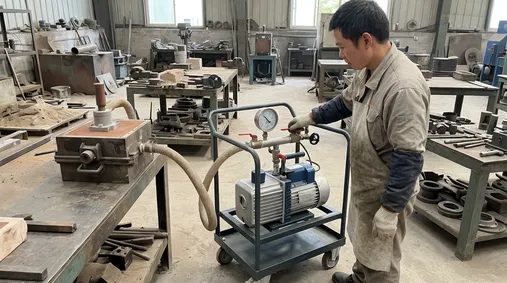
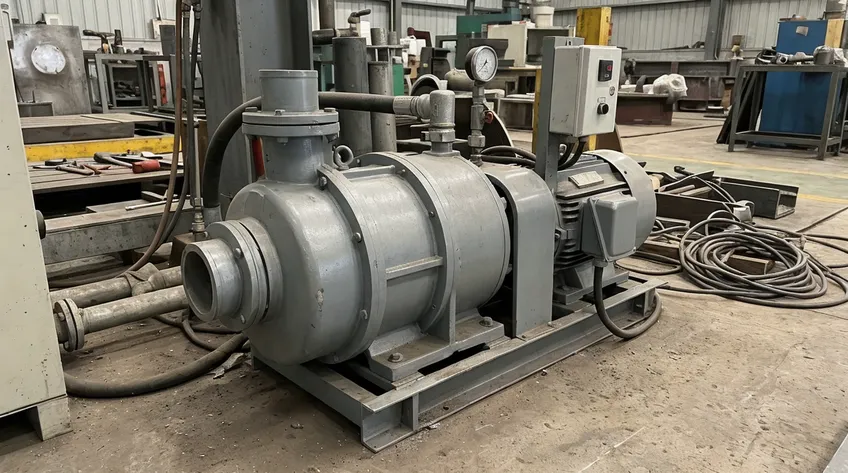
Vacuum pumps generate the negative pressure that holds unbonded sand in place during pattern vaporization and metal pour. Two pump families dominate foundry vacuum casting:
Rotary Vane Pumps
50–150 m³/hr displacement. Best suited to smaller operations and standalone molding stations where chamber volumes are modest.
Dry Screw Pumps
200–600 m³/hr displacement. Designed for high-volume production lines handling larger chambers or faster cycle demands.
Pump selection depends on chamber volume and target evacuation time. A 2 m³ chamber reaching 0.05 MPa vacuum in 45 seconds needs roughly 160 m³/hr pump capacity. Always size pumps with 20–30% overhead capacity because sand permeability and pattern geometry affect actual evacuation rates.
Multi-station vacuum distribution
Manifold systems distribute vacuum across multiple molding stations. The configuration depends on line complexity and operator count:
Single-Chamber Operations
Direct pump-to-chamber connections with manual ball valves. Simple, low cost, minimal failure modes.
Multi-Station Lines
Manifold headers (typically 100–150 mm diameter pipe) with branch lines to each molding position.
Valve sequencing matters for multi-station setups. Running 6 molding stations on one pump requires automated solenoid valves that cycle vacuum between stations so each mold gets full pump capacity during its critical evacuation window. Manual valve systems work for low-volume operations, but operators forget to close valves and vacuum leaks across idle stations.
Vacuum level monitoring
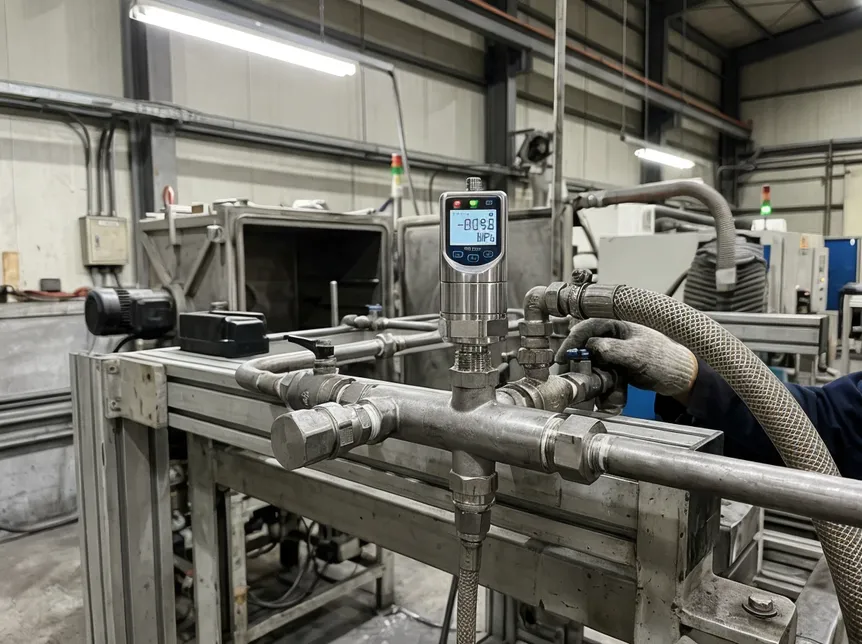
Pressure sensors monitor vacuum level at each molding station. Two instrumentation classes serve different automation tiers:
Analog Gauges
0–0.1 MPa range. Provide visual feedback for operators on manual and semi-automated lines.
Digital Pressure Transducers
±0.001 MPa accuracy. Feed data to PLC systems for automated control and data logging.
Sensor placement affects reading accuracy. Mount sensors within 500 mm of the mold chamber, not at the pump outlet, because pressure drops occur across piping and valves. Poorly designed manifold systems can show 0.01–0.015 MPa pressure loss — your pump is working but molds aren't getting adequate vacuum.
Timing and pressure profiling
Control valves regulate vacuum application timing and pressure profiling. Three tiers of valve automation serve different production demands:
Manual Ball Valves
Operator opens when pattern is positioned, closes after metal solidifies. Lowest cost, operator-dependent quality.
PLC-Controlled Solenoid Valves
Open/close based on cycle timers or pressure setpoints. Eliminates operator timing errors.
Proportional Control Valves
Enable staged vacuum application: start at 0.02 MPa for 10 seconds (gentle evacuation prevents pattern collapse), ramp to 0.05 MPa for pouring (maximum sand compaction). Reduces pattern damage on complex geometries with thin walls or intricate cores.
Three parameters determine whether a vacuum system matches your production requirements: ultimate vacuum level, evacuation time, and recovery time between cycles.
How deep the system pulls. Determines sand compaction force and casting surface quality for a given alloy density.
How fast the system reaches target vacuum. Directly limits cycle throughput and line speed.
How quickly vacuum rebuilds between cycles. Critical for multi-station lines sharing a single pump system.
| Parameter | Aluminum Castings | Iron Castings |
|---|---|---|
| Ultimate Vacuum | 0.04–0.06 MPa | 0.02–0.04 MPa |
| Evacuation Time | 1 m³ chamber, 200 m³/hr pump → 30–40 sec ideal; add 10–20 sec for real-world factors | |
| Cycle Fit | 3-min cycle → 50 sec OK | 90-sec cycle → 400+ m³/hr pump or smaller chamber | |
Integration scope determines system complexity and cost. The choice affects not only upfront investment but also long-term defect rates tied to operator timing errors.
Standalone Vacuum Systems
Connect to existing molding equipment — you're adding vacuum capability to manual or automated molding lines already in place. Lower upfront cost, faster installation, but rely on operators for sequencing.
Integrated Systems
Combine vacuum control with molding line automation: pattern placement triggers vacuum valve opening, pressure sensor confirms target vacuum before allowing metal pour, solidification timer closes vacuum valve and advances mold to shakeout.
Integrated systems cost 30–40% more than standalone vacuum units but eliminate operator timing errors that cause defects. For high-volume lines running tight cycle times, the defect reduction typically pays back the integration premium within 12–18 months.
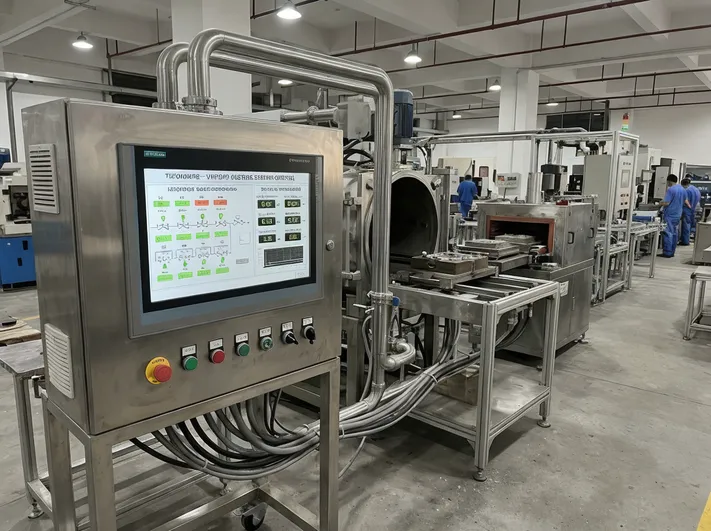
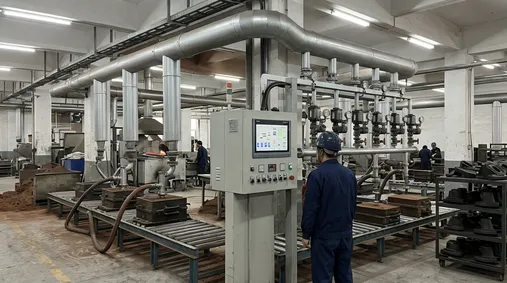
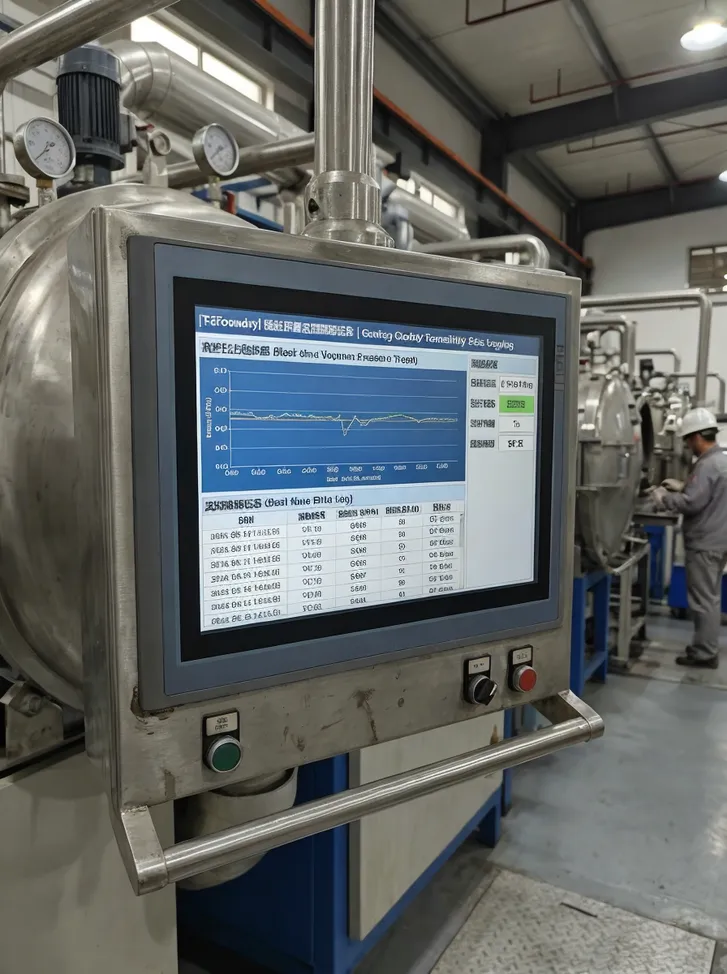
Integrated PLC control panel orchestrating vacuum valve sequencing, pressure confirmation, and cycle advancement across multi-station molding line.
Share your chamber volume, target cycle time, and casting alloy. Our engineers will recommend pump capacity, manifold configuration, and control tier matched to your production targets.
Cycle time breaks into five sequential phases: pattern placement (15–60 seconds depending on automation level), vacuum pull-down (30–60 seconds to reach target pressure), metal pouring (5–30 seconds based on casting size), holding time under vacuum (30–120 seconds for initial solidification), and mold transfer to cooling (10–20 seconds). Total cycle time ranges from 90 seconds for small automated aluminum lines to 4–5 minutes for large manual iron casting operations.
Position casting pattern in flask with precision alignment
15–60 secEvacuate chamber to target negative pressure
30–60 secControlled pour into mold cavity under vacuum
5–30 secMaintain vacuum during initial solidification
30–120 secMove completed mold to cooling station
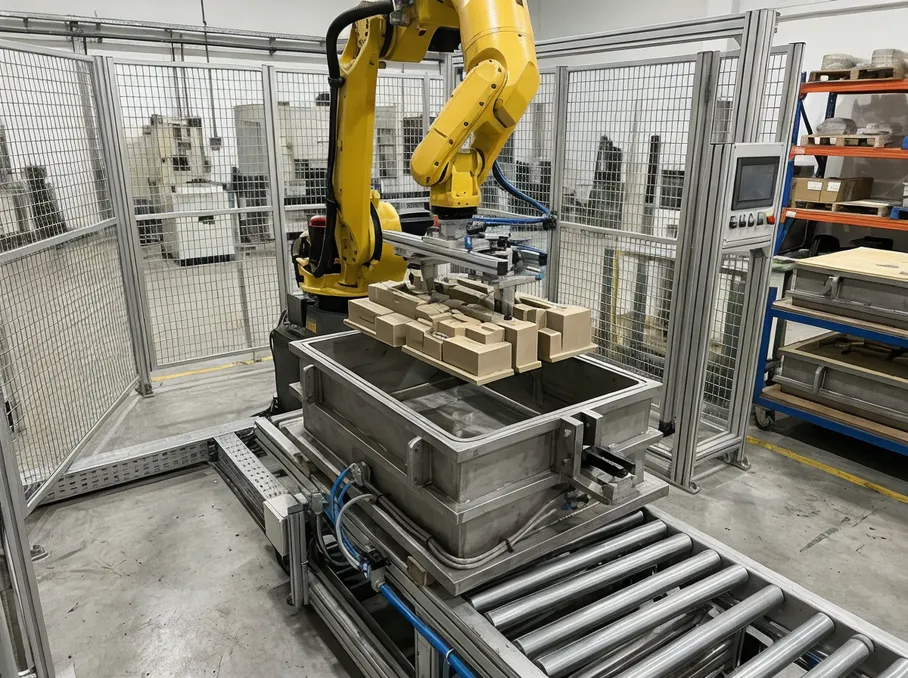
10–20 secPattern placement speed depends on casting complexity and handling method. Simple geometries like pump housings or brackets use single-piece patterns that operators place manually in 15–30 seconds. Complex assemblies like engine blocks require multi-piece patterns with precise alignment — manual placement takes 45–90 seconds, robotic placement systems reduce this to 20–30 seconds but add $80,000–150,000 to line cost.
The economic breakpoint for robotic placement is around 150–200 molds per day — below that volume, labor cost savings don't justify automation investment.
| Handling Method | Time Range | Best For |
|---|---|---|
| Manual — Simple | 15–30 sec | Pump housings, brackets |
| Manual — Complex | 45–90 sec | Engine blocks, multi-piece patterns |
| Robotic Placement | 20–30 sec | High-volume (>150 molds/day) |
Robotic systems add $80,000–$150,000 to line cost. Economic breakpoint: ~150–200 molds/day.
At 150–200 molds per day, robotic pattern placement reaches its economic breakpoint. Below that volume, the $80,000–$150,000 investment doesn't recover through labor savings. Above it, the 20–30 second robotic cycle versus 45–90 second manual handling for complex patterns compounds into significant throughput gains across full production shifts.
Vacuum pull-down duration determines maximum throughput. If evacuation takes 50 seconds and you're running single-chamber batch molding, that's 50 seconds of non-productive time per cycle. Multi-chamber systems overlap evacuation and pouring — while chamber 1 evacuates, chamber 2 pours, chamber 3 cools.
A 3-chamber rotary system with 50-second evacuation can achieve 60-second effective cycle time because evacuation happens in parallel with other operations. This is why high-volume foundries (200+ molds/day) use multi-chamber configurations despite higher capital cost.
Batch process — one mold through complete cycle at a time
Parallel operations — evacuate, pour, cool simultaneously
High-volume foundries (200+ molds/day) justify multi-chamber capital cost
Pouring window affects defect rates and cycle efficiency. Pour too slowly and metal temperature drops, causing cold shuts and misruns. Pour too fast and you erode the mold or trap air. Small aluminum castings (<5 kg) pour in 3–8 seconds. Large iron castings (>50 kg) need 15–30 seconds to fill without mold damage.
Ladle positioning accuracy matters — we use mechanical stops or servo-controlled ladle positioners to maintain consistent pour height (typically 50–100mm above sprue) and angle (15–30° tilt for controlled flow).
Holding time under vacuum prevents mold collapse during initial solidification. Aluminum castings solidify faster (5–15 minutes for most geometries) but need vacuum maintained for 30–60 seconds after pouring to keep sand compacted while the casting skin forms. Iron castings solidify slower (20–60 minutes) but only need 60–120 seconds vacuum hold time because iron's weight provides mechanical compaction once the pour is complete.
Releasing vacuum too early causes mold slumping and dimensional distortion — 2–5mm dimensional errors have been observed from premature vacuum release on thin-wall aluminum castings. This is a critical process control point that directly impacts casting dimensional accuracy.
| Parameter | Aluminum | Iron |
|---|---|---|
| Solidification time | 5–15 minutes | 20–60 minutes |
| Vacuum hold required | 30–60 seconds | 60–120 seconds |
| Compaction mechanism | Vacuum pressure | Metal weight + vacuum |
| Early release risk | 2–5mm distortion | Lower risk (weight helps) |
Throughput constraints come from the slowest process step. If your vacuum system evacuates in 40 seconds but pattern placement takes 90 seconds, your bottleneck is pattern handling, not vacuum capacity. If evacuation takes 70 seconds and everything else runs in 50 seconds, upgrading pump capacity or reducing chamber volume improves throughput. We map your complete cycle time during system design to identify the limiting factor and size equipment accordingly.
When vacuum evacuates in 40 sec but pattern placement takes 90 sec, the bottleneck is handling — not vacuum capacity.
Solution path
Robotic pattern placement or pre-staging workflow
When evacuation takes 70 sec and other operations run in 50 sec, pump capacity or chamber volume is the constraint.
Solution path
Upgrade pump capacity or reduce chamber volume
System configuration scales with your daily mold volume. Each tier balances capital cost against cycle time efficiency, with multi-station configurations unlocking parallel operations that dramatically reduce effective cycle time.
20–80 molds/day
One mold at a time through the complete cycle. Ideal for prototype and low-volume foundries where capital investment needs to stay minimal.
Sequential processing — all phases run in series
80–150 molds/day
Overlapped evacuation and cooling — while one chamber evacuates, the other cools and unloads. Significant throughput gain over single-chamber setups.
Partial parallel overlap — evacuation + cooling run simultaneously
150–400 molds/day
Multi-zone vacuum distribution with 4–8 molding stations, each at a different cycle phase. Full parallel operation across all stations.
Full parallel — centralized vacuum system, multi-station workflow
A European automotive foundry runs 280 aluminum suspension component molds per day on a 6-station continuous line with centralized 500 m³/hr vacuum system. This configuration demonstrates how multi-station continuous lines with centralized vacuum infrastructure deliver high daily throughput for automotive-grade production volumes.
Share your target molds/day and casting specs — we'll map cycle phases and identify your throughput bottleneck.
Vacuum infrastructure must match your production volume, casting complexity, and growth trajectory. The right architecture eliminates bottlenecks while controlling capital expenditure at every scale.
Ideal for job shops and prototype foundries where casting mix changes frequently and automation investment doesn't pay back. Operators manually open the vacuum valve when the pattern is positioned, monitor the analog gauge until pressure reaches target, then proceed with pouring.
Centralized vacuum stations with automated valve sequencing. Manifold design becomes critical at this scale — 100mm diameter headers with 50mm branch lines to each station minimize pressure drop across multiple simultaneous operations. Dual-pump configurations provide redundancy: if one pump fails, the second maintains production at reduced capacity until repairs complete.
Multi-zone vacuum distribution with continuous monitoring. Automated pressure profiling adjusts vacuum level based on alloy type and casting size — aluminum castings automatically receive 0.05 MPa, iron castings receive 0.03 MPa. Valve sequencing coordinates with molding line conveyors: pattern arrival sensor triggers vacuum valve opening, pressure confirmation enables pour station, solidification timer releases vacuum and advances mold to shakeout.
Sensor detects pattern position on conveyor and triggers vacuum valve opening automatically.
PLC applies vacuum at alloy-specific pressure — 0.05 MPa for aluminum, 0.03 MPa for iron castings.
Confirmation sensor verifies target vacuum reached, enabling pour station for metal delivery.
Solidification timer releases vacuum and advances completed mold to shakeout station.
Part complexity directly impacts how vacuum must be applied. Incorrect evacuation speed is a primary cause of pattern damage in complex geometries.
Flat plates, basic housings, brackets — tolerate rapid evacuation with full pump capacity applied immediately. Target vacuum reached in 30–40 seconds.
Single-stage pull • Full capacityManifolds with internal passages, engine blocks with water jackets, complex valve bodies — require staged vacuum pull to prevent pattern collapse.
Two-stage pull • PLC-controlled30–40% pump capacity for 15–20 seconds. Allows EPS to compress gradually without pattern damage.
100% pump capacity for final 20–30 seconds. Maximum sand compaction achieved before pouring.
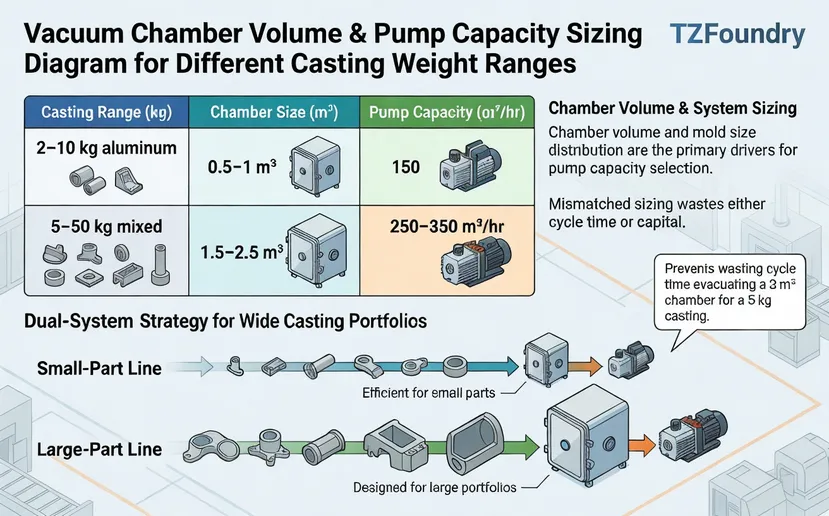
Chamber volume and mold size distribution are the primary drivers for pump capacity selection. Mismatched sizing wastes either cycle time or capital.
| Casting Range | Chamber Size | Pump Capacity |
|---|---|---|
| 2–10 kg aluminum | 0.5–1 m³ | 150 m³/hr |
| 5–50 kg mixed | 1.5–2.5 m³ | 250–350 m³/hr |
Foundries with wide casting portfolios often run dual systems — a small-part line with compact chambers and moderate pump capacity alongside a large-part line with oversized chambers and high-capacity pumps. This prevents wasting cycle time evacuating a 3 m³ chamber for a 5 kg casting.
Pump technology selection directly affects operating cost, maintenance burden, and uptime over the system's service life. The decision hinges on production volume and tolerance for scheduled downtime.
TZFoundry recommendation: Dry screw pumps for high-volume operations exceeding 150 molds/day where downtime cost justifies the upfront investment. Rotary vane remains cost-effective for operations below this threshold or where dedicated maintenance staff can handle the shorter service intervals.
Pump sizing calculation starts with chamber volume, target vacuum level, and acceptable evacuation time. The basic formula provides a reliable starting point for specification.
Core Formula
Required pump displacement (m³/hr) = Chamber volume (m³) × 3600 ÷ Evacuation time (seconds) × Pressure ratio factor
Worked Example
For a 2 m³ chamber reaching 0.05 MPa (0.5 bar absolute, 50% atmospheric pressure) in 45 seconds:
Theoretical Requirement
320 m³/hr
2 × 3600 ÷ 45 × 2
Overhead Factor
+20–30%
Sand permeability, leaks, valve drop
Specified Pump Size
400 m³/hr
Production-ready specification
Small-to-Mid Volume Operations
Vacuum Performance
Single-Stage
0.02–0.03 MPa
Adequate for iron castings
Two-Stage
0.001–0.005 MPa
Exceeds aluminum lost foam needs
Capital Cost Range
Operating Costs
High-Volume Continuous Operations
Key Advantages
No oil contamination risk — safe if pump exhaust recirculates into foundry (common in cold climates for heat recovery)
Superior contaminant tolerance — handles sand dust and moisture better than vane pumps, critical in lost foam where EPS decomposition creates styrene vapor and combustion byproducts
Capital Cost Range
Operating Costs
Energy consumption depends on pump capacity and operating hours. Based on 8 hours/day, 250 days/year (2,000 hours annually) at $0.12/kWh industrial rate:
Rotary Vane — 300 m³/hr
Power draw
7–9 kW
Rotary Vane — Annual
Electricity cost
$1,680–2,160
Dry Screw — 300 m³/hr
Power draw
9–11 kW
Dry Screw — Annual
Electricity cost
$2,160–2,640
Energy cost difference is $400–500 annually — negligible compared to the maintenance cost difference ($1,500–2,500 annual savings favoring dry screw). The dry screw pump draws slightly more power due to its non-contact screw design, but lower service frequency more than compensates.
Undersized pumps extend evacuation time, reducing daily mold capacity. The productivity math makes a compelling case for proper pump sizing.
Upgrade Scenario: 2 m³ Chamber to 0.05 MPa
150 m³/hr
300 m³/hr
Time saved per cycle: ~35 seconds
At 150 Molds/Day
87 min
recovered daily
At $80/hr Overhead
$116/day
productivity gain
Annual Value
$29,000/yr
justifies ~$10K pump upgrade
Spare parts availability determines downtime cost. The difference between local stock and overseas sourcing can mean days versus months of lost production.
Critical Wear Components
Local/Regional Stock
Parts ship within 3–5 days → seal failure costs 1–2 days downtime
Overseas-Only Sourcing
Parts ship in 4–6 weeks → same failure costs a month of lost production
We maintain inventory of top 15 wear components for both rotary vane and dry screw pumps in our Qingdao warehouse, with 3–5 day international shipping to most export markets.
Maintenance intervals and service requirements affect total cost of ownership. Below is a detailed comparison of service schedules and labor requirements for both pump types.
| Service Task | Rotary Vane | Dry Screw |
|---|---|---|
| Oil changes | Every 500–1,000 hrs 15–30 min labor, $50–80 oil |
N/A — oil-free design |
| Inlet filter changes | — | Every 500 hrs 10 min labor, $30–50 parts |
| Vane inspection | Every 1,000 hrs 1 hour labor |
N/A |
| Major service | Vane replacement every 2,000–3,000 hrs 4–6 hrs labor, $800–1,500 parts |
Bearing & seal service every 3,000–5,000 hrs 6–8 hrs labor, $2,000–4,000 parts |
| 10,000-hr total maintenance | $15,000–22,000 | $12,000–18,000 |
Dry screw saves $3,000–4,000 over 10,000 operating hours despite higher per-service parts cost. The savings come from half the service frequency — maintenance intervals of 3,000–5,000 hours versus 2,000–3,000 hours for rotary vane.
Share your chamber volume, target vacuum level, and cycle time requirements. Our engineers will specify the optimal pump type and capacity for your production needs.
Get Pump Sizing RecommendationReal-time pressure tracking, automated interlocks, and data-driven diagnostics that transform vacuum casting from operator-dependent guesswork into repeatable, auditable production.
Immediate visual feedback for operators — see pressure rising during evacuation and confirm target vacuum before pouring. Essential for quick on-floor verification at every molding station.
4-20mA output or Modbus protocol transducers feed PLC systems for automated control and continuous data logging. The backbone of any traceable, auditable vacuum monitoring architecture.
Systems store 90 days of pressure data — vacuum level every second during evacuation, hold time duration, and release timing — enabling precise root-cause analysis when defect rates spike.
Sensor precision requirements differ significantly between aluminum and iron casting lines. Selecting the right transducer accuracy prevents both over-specification costs and quality failures.
| Parameter | Aluminum Lines | Iron Lines |
|---|---|---|
| Transducer Accuracy | ±0.001 MPa | ±0.005 MPa |
| Sensitivity Reason | 0.01 MPa variation affects defect rates | Iron's weight provides more forgiving sand compaction |
| Sensor Cost Profile | Higher-precision (higher cost) | Lower-cost sensors acceptable |
PLC programming sets minimum acceptable vacuum thresholds. If pressure doesn't reach the setpoint within programmed evacuation time, the system triggers an alarm and physically prevents metal pouring.
Aluminum Minimum
0.04 MPa
Iron Minimum
0.02 MPa
Scrap Before
8–12%
Scrap After
3–5%
These interlocks catch vacuum leaks, pump failures, or blocked manifold lines before they cause scrap. Operators cannot override the system and pour with inadequate vacuum — eliminating the single largest source of operator-induced defects in vacuum casting.
When a batch of castings fails inspection — gas porosity, dimensional errors — you pull the data logs for those specific molds and identify which parameter drifted. PLC systems store vacuum level every second during evacuation, hold time duration, and release timing across a 90-day rolling window.
Field Case — Middle Eastern Foundry
Data logs revealed that the night shift was consistently releasing vacuum 20 seconds early to speed up cycle time. Pressure at pour time registered 0.015 MPa instead of the target 0.05 MPa.
Before Correction
9% scrap
After Correction
4% scrap
Correcting this single operator behavior — identified purely through data log review — cut scrap rate by more than half. Without timestamped pressure records, the root cause would have remained invisible.
Pressure decay testing checks system integrity: evacuate the chamber to target vacuum, close all valves, and monitor pressure for 60 seconds.
Acceptable Leak Rate
<0.005 MPa pressure rise per minute
Faster pressure rise indicates leaks in chamber seals, manifold connections, or valve seats.
Helium leak detection pinpoints leak locations for critical applications — spray helium around suspected leak points while monitoring with a helium sniffer. This finds leaks too small for pressure decay testing to detect but large enough to affect casting quality on precision parts.
For multi-cavity or multi-station systems (e.g., 4 molding stations on one manifold), pressure should be within ±0.005 MPa across all stations.
Larger variation indicates manifold design problems — undersized branch lines, excessive pressure drop — or valve sequencing issues where one station steals vacuum from others.
TZFoundry Manifold Design Approach
Defect correlation connects vacuum parameters to casting quality. Understanding these relationships allows your QC team to identify root causes faster and implement corrective action before scrap rates climb.
Pressure doesn't reach setpoint — EPS decomposition gases can't escape through sand, so they get trapped in the casting. This is the most common vacuum-related defect in lost foam production.
Pressure varies across the mold — areas with lower vacuum experience more mold shift during pouring, producing castings that fall outside dimensional tolerances.
Valve closes before casting skin solidifies — causes surface defects and mold slumping. Timing coordination between vacuum hold and solidification rate is critical for clean surfaces.
We provide defect troubleshooting guides that map casting defects to specific vacuum parameter deviations, helping your QC team identify root causes faster.
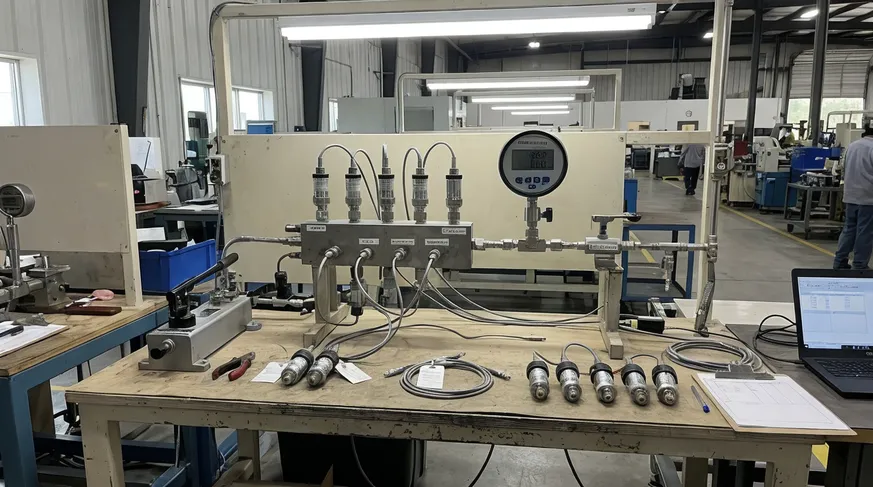
Sensor calibration maintains measurement accuracy. Pressure transducers drift over time, and uncalibrated sensors lead to false confidence — your gauge reads one pressure but actual conditions differ, producing defective castings without visible warning.
Request detailed specifications for our vacuum monitoring and QC integration packages — includes sensor datasheets, calibration protocols, and defect correlation guides.
Vacuum system performance depends on upstream coating output, pattern drying capacity, and downstream mold transport — a bottleneck at any stage idles the entire line.
Coating equipment output requirements affect vacuum system performance directly. Patterns must be fully dry before entering the vacuum chamber — moisture in the coating contaminates vacuum pumps as water vapor condenses in pump oil, reducing lubrication effectiveness. Wet patterns also degrade casting quality because steam generation during pouring causes porosity defects.
Drying Parameters
Bottleneck example: If your coating line outputs 50 patterns/day but drying capacity is only 30 patterns/day, your bottleneck is coating — not vacuum system capacity.
Pattern drying time determines buffer inventory requirements. If coating dries in 8 hours and you're running two 8-hour production shifts, you need 16 hours of pattern inventory — roughly 100–150 patterns for a 200 molds/day operation — to maintain continuous vacuum line operation.
Space Requirement
This buffer translates to approximately 15–25 square meters of drying rack space dedicated to in-process pattern inventory.
Foundries trying to minimize floor space often undersize drying capacity, then discover their vacuum line sits idle waiting for dry patterns. We map your complete process flow during system design to identify these bottlenecks before equipment is specified.
Pattern handling coordination affects cycle time significantly. The choice between manual and automated loading determines throughput ceiling and defect rates.
Operator retrieves dried pattern from rack, positions it in the molding chamber, and initiates the vacuum cycle. Suited for low-volume operations.
Placement Time
30–60 seconds
Varies with pattern size and complexity
Automated systems reduce placement time and eliminate positioning errors. Pattern misalignment causes dimensional defects — robots remove this variable entirely.
Placement Time
15–25 seconds
Consistent regardless of pattern complexity
Integration Cost
$80K–$150K
Payback Period
18–24 months
ROI realized on lines running >150 molds/day through labor savings and reduced scrap
Cycle time synchronization prevents equipment conflicts across the production line. When individual process steps operate at different speeds, the result is either wasted capacity or queuing bottlenecks.
Process Step Timing Example
Pattern Coating
3 min
per pattern
Drying
8 hrs
batch process
Vacuum Molding
2 min
per mold
When your vacuum line can process patterns faster than coating can supply them, you face a choice: slow down the vacuum line (wasting capacity) or run multiple coating stations feeding one vacuum line. We model your complete line balance during the design phase, ensuring each process step has adequate capacity to support target daily output without creating bottlenecks or idle equipment.
Mold transport systems move filled flasks from vacuum stations to pouring, then onward to cooling and shakeout. Transport system capacity must match vacuum line throughput — if your vacuum line produces 150 molds/day but conveyor capacity is 100 molds/day, molds queue at the vacuum station and cycle time extends.
Operator manually pushes flasks between stations. Practical and cost-effective for small operations with short transfer distances.
Low VolumeAutomated transfer for mid-volume lines with PLC-controlled indexing that advances flasks on timed intervals. Eliminates manual push effort and ensures consistent pacing.
Mid VolumeAGVs transport flasks from molding to pouring — covering 50–100 meters in large foundries — without manual handling. Best suited for high-volume operations with long distances between process areas.
High VolumeControl system integration determines the automation level of your vacuum casting production line. The choice between standalone and centralized control directly impacts coordination accuracy, data visibility, and long-term operational efficiency.
Basic Automation
Controls just the vacuum system — the operator manually coordinates with coating, molding, and pouring equipment. Suitable for smaller operations or facilities where individual process steps are managed independently.
Full-Line Automation
Integrates all process steps into a unified control architecture. SCADA eliminates operator coordination errors and enables data collection across the complete production line.
Automated Sequence Logic
Coating completion signal triggers pattern transfer to molding station
Pattern arrival sensor initiates vacuum cycle automatically
Pressure confirmation enables pour station for metal delivery
Solidification timer releases vacuum and advances mold to shakeout
$30,000
Min. Additional Cost
$60,000
Max. Additional Cost
SCADA systems cost $30,000–60,000 more than standalone PLCs but eliminate operator coordination errors and enable comprehensive data collection across the complete production line. The ROI accelerates in high-volume operations where even small coordination delays compound into significant throughput losses.
Communication protocols affect integration complexity when connecting vacuum systems with existing foundry equipment. Protocol compatibility between new and existing equipment determines both installation timeline and ongoing reliability.
Preferred
Older Equipment
Bridge Solutions
Protocol conversion is possible but adds cost and complexity to the installation.
If you're integrating our vacuum system with existing coating and molding equipment, we need to know what communication protocols your current equipment supports. We provide PLC programming that interfaces with most common foundry equipment brands. Protocol conversion is available where needed.
Standard configurations cover most foundry applications. Select the system tier that matches your daily mold volume, maximum casting weight, and automation requirements.
Chamber volume affects pump sizing and evacuation time. We match chamber capacity to your actual casting size distribution rather than oversizing "just in case."
| Chamber Volume | Max Casting Weight | Typical Flask Size | Application Notes |
|---|---|---|---|
| 1 m³ | Up to 15 kg | 500 × 500 × 400 mm | Small aluminum or iron castings, low-volume foundries |
| 2 m³ | 15–40 kg | 600 × 600 × 550 mm | Mid-range castings, general foundry work |
| 4 m³ | 40–100 kg | 800 × 800 × 650 mm | Large castings, high-volume automotive applications |
| 8 m³ (Custom) | 200+ kg | Custom-engineered | Built for large aluminum engine blocks; custom-engineered to order |
Pump capacity options range from 50 m³/hr portable units for prototype foundries and research facilities to 600 m³/hr centralized stations for high-volume automotive suppliers.
Available in both rotary vane and dry screw configurations.
Custom capacities are available for specialized applications. For example, a European foundry required 750 m³/hr capacity for rapid-cycle aluminum wheel production — we configured dual 400 m³/hr pumps with automatic load sharing.
Case: European Wheel Foundry
Required 750 m³/hr for rapid-cycle aluminum wheel production. Solution: dual 400 m³/hr pumps with automatic load sharing — exceeding target capacity with built-in redundancy.
Control system selection depends on production volume and labor cost. Manual control works fine for 30 molds/day operations, but 200 molds/day lines need automation to maintain consistency and reduce operator workload.
≤30 molds/day, low-labor-cost regions
60–150 molds/day, balanced cost-to-control ratio
150–350 molds/day, high-volume automotive lines
Customization parameters address specific foundry requirements across layout, vacuum profiling, equipment integration, and electrical specifications.
Independent vacuum zones for different alloy types — aluminum and iron on the same line with different pressure setpoints.
Staged evacuation programs for complex geometries, with pressure ramp rates adjustable by casting ID.
Custom PLC programming to interface with your current molding, coating, or pouring systems.
Explosion-proof electrical components available for facilities with styrene vapor concentration concerns.
Systems are manufactured to match your facility's electrical infrastructure across global standards.
| Standard | Voltage | Region |
|---|---|---|
| Standard | 380V / 50Hz | International default |
| North America | 480V / 60Hz | US, Canada, Mexico |
| UK / Australia | 415V / 50Hz | UK, Australia, NZ |
8–10 weeks manufacturing followed by 2–3 weeks of factory testing and export documentation.
10–13 weeks2–3 weeks ocean freight to major ports. Small-batch systems fit in one 20ft container; high-volume systems require one 40ft container.
2–3 weeks1–2 weeks for standard systems. Our installation team or certified local partners handle full setup and integration.
1–2 weeksTotal lead time: 12–16 weeks from order confirmation to operational system at your facility.
Equipment ships in standard 20ft or 40ft containers. Each shipment includes the complete system package:
Complete pump unit ready for installation
Distribution manifolds with isolation valves
Calibrated transducers and visual gauges
Pre-programmed PLC with HMI interface
Mounting hardware, gaskets, and fittings
Filters, seals, oil — startup essentials
Our installation team (or certified local partners) handles the complete commissioning process over 1–2 weeks for standard systems:
Mechanical assembly and piping connections
Electrical hookup and PLC programming verification
Vacuum leak testing and pressure calibration
Integration with existing molding equipment
Operator training (2–3 days) covering equipment operation, routine maintenance, and basic troubleshooting
Remote diagnostics standard on all PLC-controlled systems — Ethernet or 4G connection allows our technical team to access your system, review alarm logs, adjust parameters, and troubleshoot issues without site visits.
We stock critical components for all standard configurations to ensure minimal downtime. Parts ship from our Qingdao warehouse within 3–5 days to most international destinations.
Pump vanes and seals
Screw bearings and shaft seals
Solenoid valve coils and diaphragms
Pressure transducers
PLC I/O modules
Inlet filters and exhaust separators
We provide recommended spare parts lists with each system. The initial spares package covers 2–3 years of routine maintenance, plus access to our parts inventory for emergency replacements.
Specify your alloy types, throughput targets, voltage requirements, and integration needs. Our engineering team will deliver a detailed configuration proposal with pricing.
Request Custom Configuration QuoteTransparent capital and operating cost breakdowns for mid-volume vacuum casting systems, with real-world payback scenarios based on defect reduction, throughput gains, and labor savings.
Capital cost breakdown for a typical mid-volume vacuum casting system (2 m³ chamber, 300 m³/hr pump, PLC control, dual-station manifold):
Core vacuum generation hardware including pump unit, motor, and coupling assembly
PLC controller, pressure transducers, HMI panel, and sensor integration
Vacuum chambers, manifold piping, valves, and structural framework
On-site installation, system integration, testing, and operator training
Total System Cost
$74,000–$94,000 FOB Qingdao
Ocean freight to major ports
+ $3,000–$5,000
Customs & inland transport varies by destination
Energy Consumption
7–11 kW pump draw × 8 hrs/day × 250 days/yr = 14,000–22,000 kWh at $0.12/kWh industrial rate
Pump Maintenance
Oil changes, filter replacements, seal & vane/bearing replacements. Rotary vane: $3,000–$5,000. Dry screw: $2,000–$3,500
Sensor Calibration
Annual pressure transducer recalibration
Spare Parts Inventory
Consumables: filters, seals, oil
Total Annual Operating Cost
$5,500–$9,500Payback depends on three primary value drivers: defect reduction, throughput increase, and labor savings. Below are real-world calculations based on typical mid-volume production parameters.
$45,000/year
50,000 castings/year with 10% scrap rate = 5,000 defective castings.
Vacuum system reduces scrap to 4% = 2,000 defective castings.
3,000 saved castings × $15 average cost per casting = $45,000 annual savings.
$109,000/year
Vacuum automation reduces cycle time from 4 minutes to 2.5 minutes.
Daily capacity increases from 120 molds to 190 molds (58% increase).
At $25 margin per casting, additional daily revenue of $1,750 = $109,000 annually.
$40,000/year
Automated vacuum control eliminates one operator position.
No longer requires manual monitoring of vacuum gauges or manual valve operation.
$35,000–$45,000 annually in labor cost savings.
Simple Payback Calculation
$85,000 ÷ $194,000 = 0.44 years (5.3 months). Assumes greenfield implementation — upgrading from no vacuum or inadequate vacuum capacity.
Upgrade Scenario Note
If you're upgrading from a functional but undersized system, benefits are smaller — incremental improvement rather than step-change. In upgrade scenarios, expect an extended payback period of 18–30 months.
Actual results vary based on your casting mix, operator skill, and maintenance practices. We provide detailed ROI projections using your actual production data during the quotation phase.
30%
Deposit at order confirmation to initiate production
60%
Upon factory acceptance testing, before shipment
10%
After on-site commissioning and buyer acceptance
Accepted for orders exceeding $100,000. Equipment leasing available through third-party finance partners in North America and Europe — typically 36–60 month terms at 6–9% annual rate.
5-Year Net Benefit
$825,500–$849,500
Representing a 10:1 return on investment over the system lifecycle.
These numbers assume consistent production volume and stable scrap rates — actual results vary based on your casting mix, operator skill, and maintenance practices.
From initial inquiry through detailed engineering documentation, our pre-sale process ensures your vacuum casting system is precisely sized and configured before you commit to purchase.
Providing complete production parameters upfront ensures we deliver a precise, no-surprise quotation. The following data points allow our engineering team to size every subsystem — pump capacity, chamber volume, manifold routing, and electrical load — to your exact requirements.
Smallest and largest castings you produce, with weights and approximate dimensions. This determines chamber volume and flask sizing requirements.
Molds per day, days per year. These targets drive pump displacement calculations, manifold station count, and total system throughput design.
Molding line brand/model, coating system capacity, pouring method. Integration specifications ensure seamless PLC communication and I/O compatibility.
Available floor space, electrical supply voltage and capacity, compressed air availability if using pneumatic valves. These determine equipment placement feasibility.
Photos or layout drawings of your current foundry help us design optimal equipment placement and material flow. We overlay our equipment on your existing floor plan to verify clearances, maintenance access, and operator workspace before finalizing the proposal.
We provide detailed engineering documentation during the quotation phase at no charge — you get complete technical specifications before committing to purchase.
Pump capacity based on your chamber volume and target cycle time
Required chamber volume based on largest casting plus flask dimensions
Pump displacement based on chamber volume and evacuation time target
Manifold sizing — header diameter and branch line sizing for multi-station systems
Electrical load — pump motor power, control system power, total connected load
A North American distributor provided their casting portfolio: 15–35 kg aluminum parts, 180 molds/day target. We sized a 2.5 m³ chamber with 400 m³/hr pump, 4-station manifold, achieving 38-second evacuation time and 2.2-minute total cycle time.
Equipment footprint, manifold routing, electrical and compressed air connection points
Top-view and side-view drawings with dimensions
Equipment footprint and clearance requirements — maintenance access and operator workspace
Manifold routing from pump to molding stations
Electrical connection points — voltage, phase, amperage
Compressed air requirements if using pneumatic valves — CFM and pressure specifications
These drawings integrate with your existing foundry layout — you send us a floor plan, we overlay our equipment and show how it fits with your current molding, coating, and pouring equipment.
kWh per mold based on your production volume — plan electrical infrastructure and operating costs
Pump motor power draw at full load
Control system power consumption
Total connected load
Estimated annual kWh consumption based on your production schedule
If your facility has limited electrical capacity, we identify whether service upgrades are needed before installation — avoiding unexpected infrastructure costs.
A European foundry had 200 kVA available capacity. Our 300 m³/hr system required only 11 kW (14.5 kVA at 0.8 power factor) — well within their existing service capacity, avoiding costly electrical upgrades.
All pre-sale engineering documentation includes PLC communication protocols and I/O requirements for interfacing with your existing equipment. We specify exact protocol compatibility so your controls integrator can plan the interconnection before our equipment arrives on site.
Post-sale support begins with installation supervision. Our commissioning engineer (or certified local partner) spends 1–2 weeks on-site covering every critical milestone:
Mechanical assembly verification and electrical hookup with PLC programming
Vacuum leak testing — pressure decay testing on all chambers and manifold sections
Pressure calibration — sensor accuracy verified against reference gauge
Integration testing with your existing molding equipment
Operator training covering equipment operation, routine maintenance, and troubleshooting
You receive operation manuals, maintenance schedules, spare parts lists, and PLC program documentation as standard deliverables at commissioning close-out.
Training is hands-on — operators run actual production cycles under supervision, perform simulated maintenance tasks, and practice troubleshooting scenarios. Materials available in English, Spanish, or Chinese, with translated control panel labels and alarm messages on request.
Remote troubleshooting capability is standard on all PLC-controlled systems. An Ethernet or 4G modem connection allows our technical team to:
Access PLC program and review current parameters
View alarm history and identify fault patterns
Adjust pressure setpoints or cycle timers remotely
Monitor real-time pressure data during production
A Middle Eastern foundry experienced intermittent vacuum loss. Our team logged in remotely, reviewed 48 hours of pressure data, and identified a solenoid valve with delayed closing — pressure dropped 0.008 MPa during a 2-second delay. Diagnosis: a failing valve coil. The foundry replaced the coil (a stocked spare part, 15-minute job) and eliminated the problem entirely without requiring a site visit.
Once you've run production for 2–4 weeks after initial commissioning, we review data logs and identify optimization opportunities across three key areas:
Can evacuation time be shortened without affecting casting quality? We analyze actual pressure curves against minimum thresholds to find safe reductions.
Can pump capacity be reduced during low-demand periods? We map energy draw against production schedules to identify savings without affecting throughput.
Are filter changes needed more or less frequently than standard intervals? Oil analysis and wear data guide schedule adjustments to cut cost without risking reliability.
A Southeast Asian foundry was changing pump oil every 500 hours per our standard recommendation. Oil analysis showed minimal degradation, so we extended the interval to 750 hours — reducing annual maintenance cost by $800 without affecting pump reliability.
sales@tzfoundry.com — for technical inquiries and quotation requests
+86 13335029477 — quick questions or photo-based troubleshooting
Available for Chinese-speaking customers
Quotations
Technical support inquiries
Emergency troubleshooting during China business hours (UTC+8)
For time-sensitive issues outside China business hours, our remote diagnostics system allows you to grant access and leave detailed problem descriptions — our team reviews overnight and provides solutions by your next shift.
TZFoundry manufactures complete production lines for a range of casting processes. Find the configuration that matches your foundry's requirements: