ISO 9001:2015 Certified Manufacturer

Lost Foam Casting Equipment Modular Components for Foundry Operations

Lost foam casting equipment includes the individual machines and subsystems that make up a complete production line: pattern handling systems, coating equipment, molding lines, vacuum systems, and shakeout units. You can purchase these as integrated packages or modular components that expand as your production grows.

If you're running a foundry that needs to add lost foam capacity, upgrade existing equipment, or build a complete line from scratch, understanding equipment-level specifications and configuration logic helps you match capital investment to your actual casting portfolio.

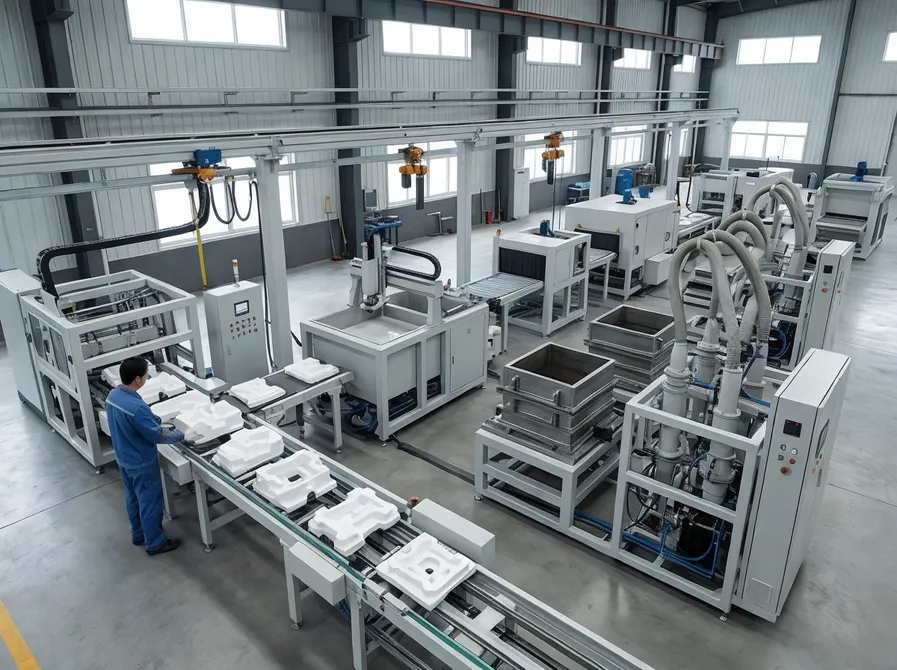
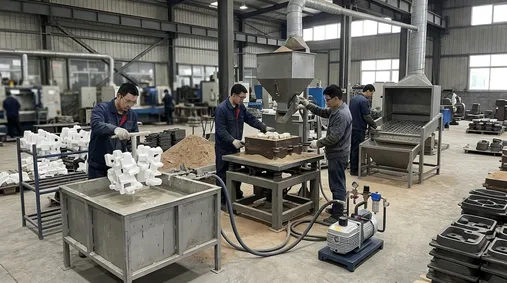
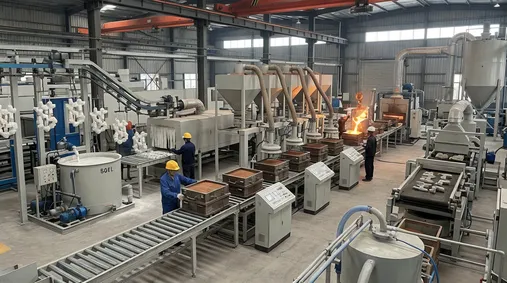
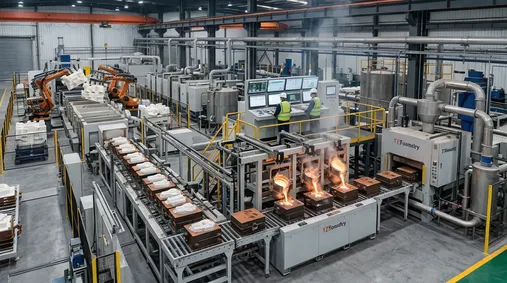
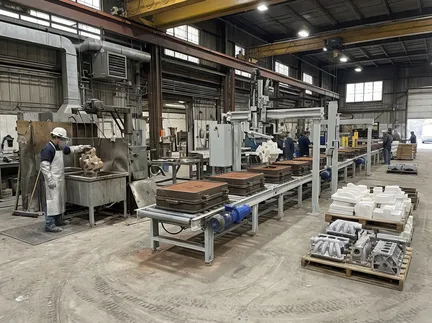
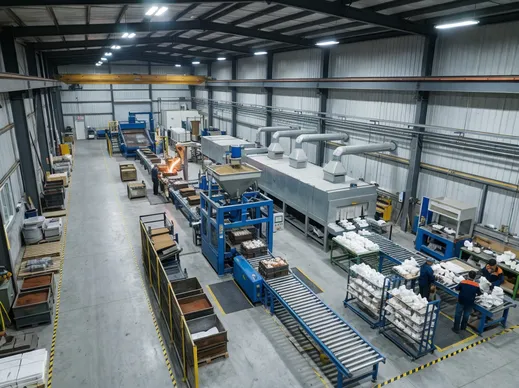
Lost foam casting equipment — modular production line components at TZFoundry manufacturing facility
15,000 m²
Qingdao Manufacturing Facility
8 Lines
In-House Production Lines
50–2000
Tons/Month Capacity Range
60–70%
Issues Resolved Remotely

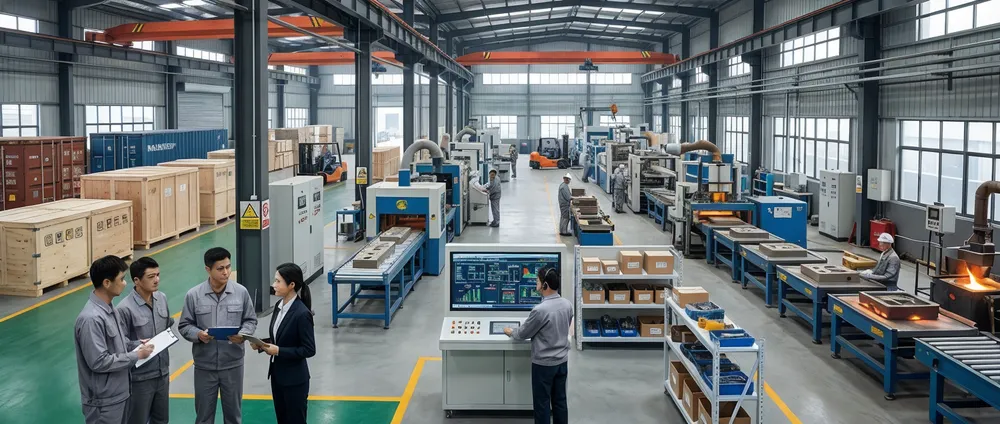
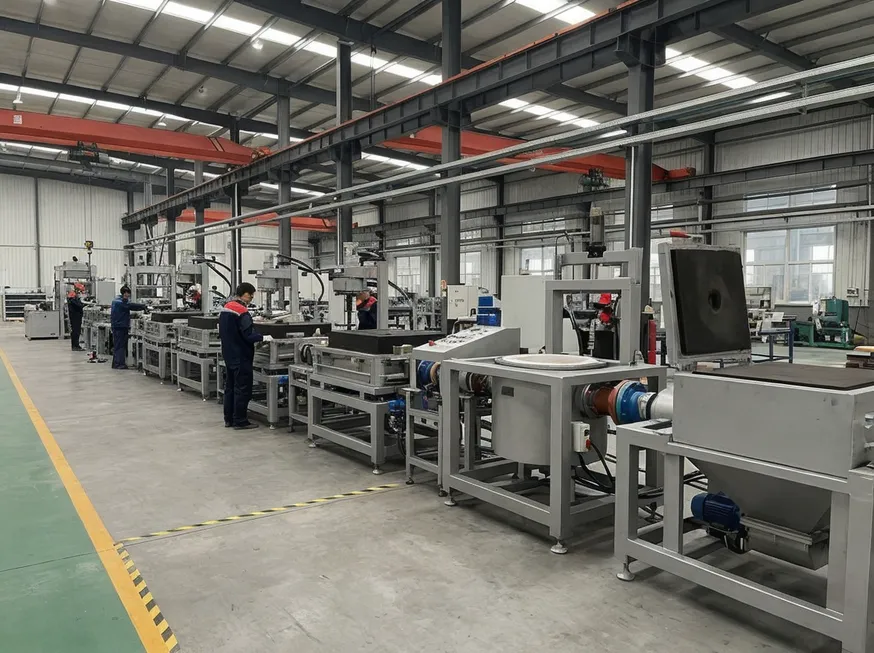
We manufacture all lost foam equipment categories in-house at our Qingdao facility — 8 production lines across 15,000 square meters, ISO 9001:2015 certified. Pattern handling racks, coating tanks (200–800L capacity), molding equipment with PLC-controlled vibration, vacuum systems (0.02–0.06 MPa range), and sand reclamation plants all ship from the same factory. This means guaranteed compatibility when you're mixing equipment from different subsystems, and a single point of contact for technical support and spare parts.

Our modular design approach lets you start with core equipment for 50–100 tons/month, then add automated coating lines or continuous molding conveyors as volume increases. A foundry in Ontario started with manual coating and batch molding in 2018 ($280,000), added automated coating in 2020 ($95,000), and upgraded to continuous molding in 2023 ($85,000) — same base equipment, incremental capacity additions to 350 tons/month. Compare that to buying a new automated line at $650,000 upfront when you're still testing the market.

Equipment Categories & Configuration Options

Lost foam casting equipment breaks down into five major categories. Each handles a specific process step, and your configuration choices in each category determine overall line capacity, automation level, and casting quality consistency.

Pattern Handling Systems

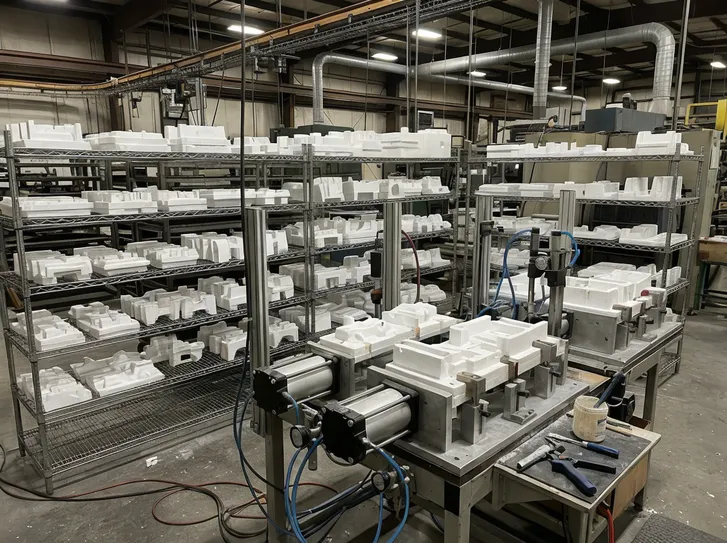
Pattern handling systems manage EPS pattern storage, gluing, and assembly before coating. Storage racks hold 500–2,000 patterns depending on your casting size range — small automotive parts need high-density vertical racks, large industrial castings use floor-level horizontal storage.

Gluing stations bond pattern sections using hot-melt adhesives (30–60 second cycle time, better for high-volume production) or solvent adhesives (90–120 second cycle, lower equipment cost).

Assembly fixtures position patterns for coating with adjustable clamps — manual fixtures work for low-mix production, pneumatic fixtures speed changeovers when you're running 10+ different casting designs per week.

Automated pattern feeders stage patterns into coating equipment without manual handling — economic breakpoint is around 200 patterns/day where labor cost savings justify the $15,000–25,000 feeder investment.

EPS pattern handling system with storage racks and pneumatic assembly fixtures

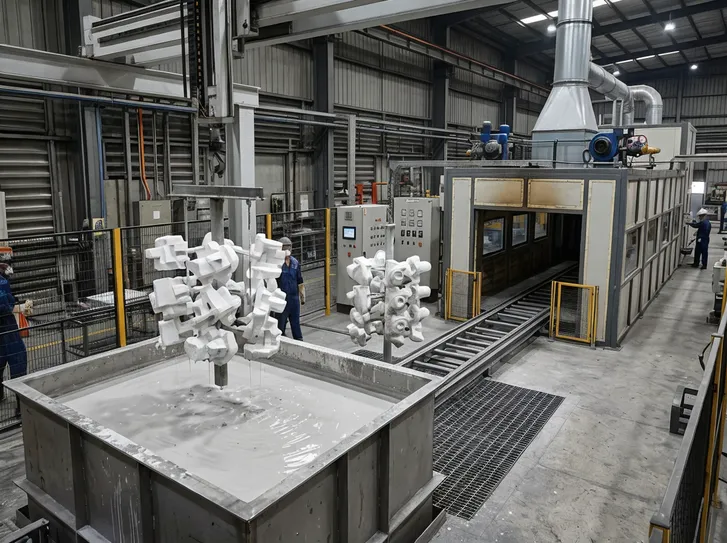
Refractory coating dip tank and automated drying chamber for lost foam casting

Coating Equipment

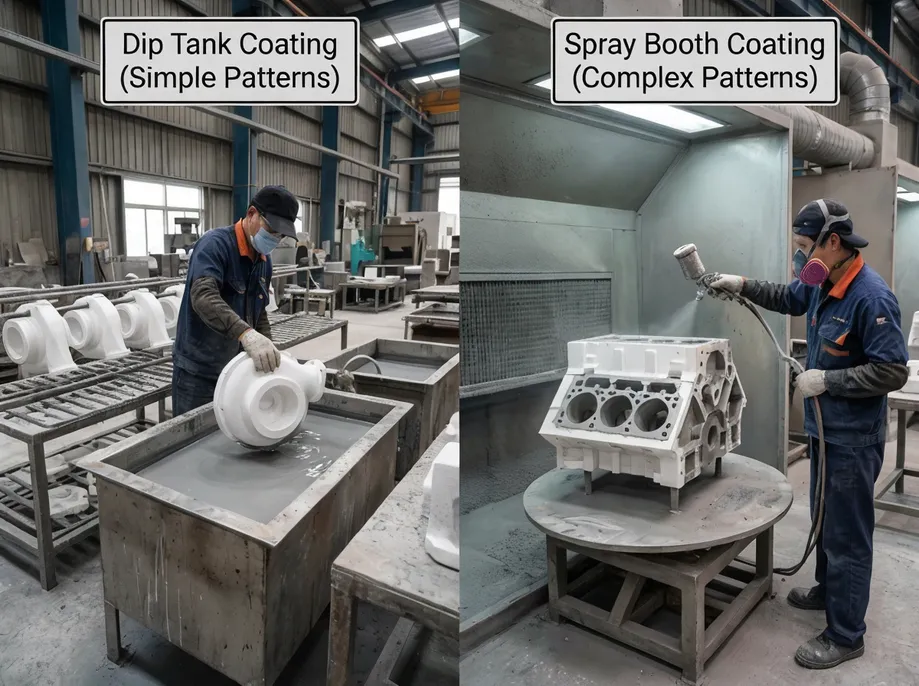
Coating equipment applies refractory slurry to pattern surfaces. Dip tanks work for most applications: patterns submerge in slurry, drain for 2–5 minutes, then move to drying. Tank capacity sizing: 200L handles castings up to 5 kg, 400L for 5–20 kg castings, 800L for 20–50 kg castings.

Spray booths handle patterns too large for dipping (>50 kg) or geometries with deep cavities where dip coating traps air — automated spray guns apply uniform thickness while patterns rotate on turntables.

Viscosity control systems monitor slurry density (target 1.4–1.8 specific gravity) and add water or refractory powder automatically — manual monitoring works for small operations, but automated systems pay back in 6–8 months through reduced coating defects and material waste.

Drying chambers cure coating in 4–12 hours at 40–60°C using gas burners (lower operating cost, $0.15–0.25 per kg dried) or electric heating (simpler installation, $0.30–0.45 per kg). We size drying capacity to match your daily coating volume so patterns don't queue — a 100-ton/month line typically needs 8–12 cubic meters of drying chamber space.


Molding Equipment

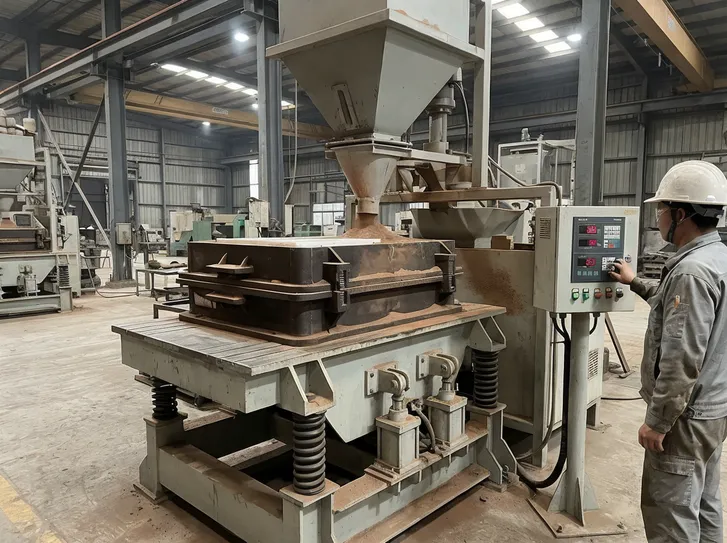
Molding equipment fills flasks with sand around coated patterns and compacts to target density. Vibration tables operate at 50–100 Hz frequency, 0.5–2mm amplitude — settings tuned to your sand type and flask size. Coarse sand (40–70 mesh) needs higher amplitude and lower frequency; fine sand (70–140 mesh) uses lower amplitude and higher frequency.

Flask handling equipment positions empty flasks, transfers filled flasks to pouring stations, and returns empties after shakeout — manual handling works up to 500×500mm flasks, overhead cranes or automated conveyors needed for 800×800mm and larger.

Sand filling systems meter sand flow to prevent pattern damage during filling — critical for thin-wall patterns where excessive sand weight crushes the EPS before you start vibrating.

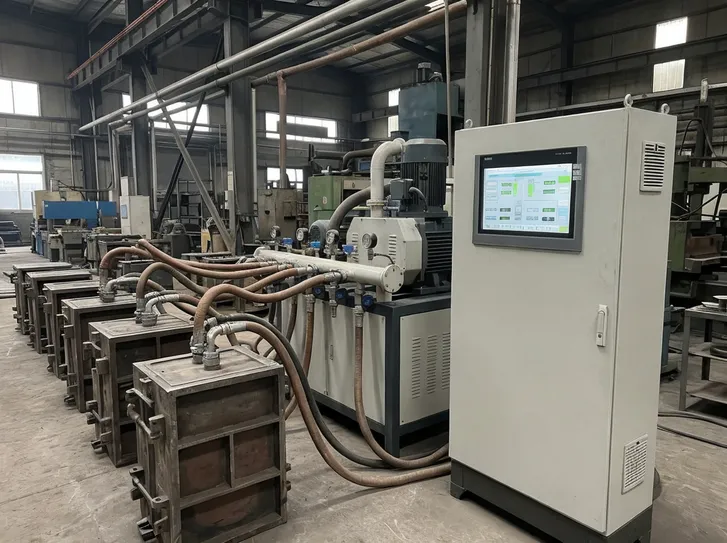
Compaction control monitors vibration time and sand settlement to ensure consistent mold rigidity — PLC-controlled systems log compaction data for each mold so you can correlate defects back to process parameters.

PLC-controlled vibration molding table with sand filling system for lost foam casting

Multi-station vacuum system with PLC-controlled pressure regulation for lost foam casting

Vacuum Systems

Vacuum systems pull negative pressure during pouring to compact sand as EPS vaporizes. Pump capacity ranges: 0.02–0.04 MPa for iron castings (iron's weight naturally compacts sand), 0.04–0.06 MPa for aluminum castings (aluminum's lower density needs more vacuum assist).

Single-station systems serve one molding position — suitable for batch production up to 100 tons/month. Multi-station configurations distribute vacuum to 2–6 molding positions simultaneously — needed for continuous molding lines above 200 tons/month.

PLC-controlled pressure regulation adjusts vacuum level based on alloy type and casting size, with per-station sensors logging pressure every second. If vacuum drops below setpoint, the system holds the pour until pressure recovers — prevents mold collapse and dimensional errors.


Shakeout & Reclamation Equipment

Shakeout and reclamation equipment separates castings from sand after solidification. Cooling conveyors allow castings to cool to handling temperature — 15–30 minutes for aluminum (depending on section thickness), 30–60 minutes for iron.

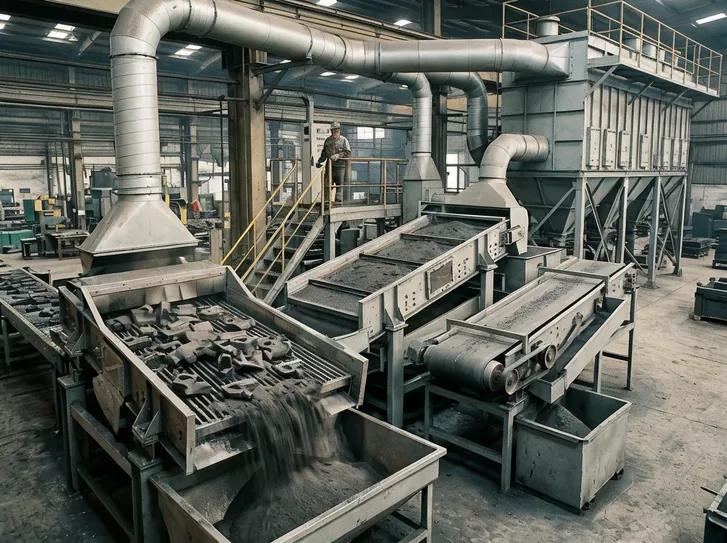
Shakeout equipment uses vibration or tumbling to release castings and break up sand — vibration shakeout works for most applications, tumble shakeout handles fragile castings that can't take vibration impact.

Sand separation screens remove casting debris and pattern residue using 10–20 mesh screens. Magnetic separators pull iron particles from sand — critical for iron foundries to prevent contamination (even 0.5% iron content in sand causes gas defects in subsequent castings).

Dust collection systems capture fine particles during shakeout — baghouse filters sized for 5,000–15,000 m³/hour airflow depending on shakeout equipment capacity. We've seen foundries cut sand replacement cost by 40–60% just by adding proper reclamation equipment — sand reuse rate goes from 3–5 cycles to 8–12 cycles before properties degrade.

Sand shakeout and reclamation system with magnetic separator and dust collection

Control Systems

Control systems integrate all subsystems through PLC programming. Siemens and Mitsubishi PLC options available — Siemens more common in European installations, Mitsubishi in Asian markets.

Process parameter logging tracks coating thickness, vacuum pressure, pouring temperature, and sand quality metrics with 90-day data storage.

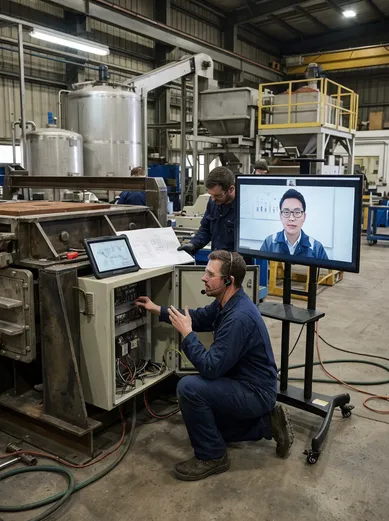
Remote diagnostics capability via Ethernet or 4G connection lets our technical team access your system for troubleshooting — we've resolved 60–70% of technical issues remotely without site visits.

Alarm systems notify operators when parameters drift out of spec.

Multilingual HMI interfaces available (English, Spanish, Arabic, Russian) — specify during order.

Equipment Investment Overview

Equipment Category Capacity Range Automation Options Typical Investment
Pattern Handling 500–2,000 patterns Manual / Semi-auto / Fully automated $8,000–45,000
Coating Equipment 200–800L tanks Manual viscosity / Auto control + drying $25,000–120,000
Molding Line 500–1,000mm flasks Batch / Continuous conveyor $60,000–280,000
Vacuum System 0.02–0.06 MPa Single-station / Multi-station PLC $15,000–65,000
Shakeout & Reclamation 50–500 tons/month Vibration / Magnetic / Dust collection $35,000–150,000

Custom Equipment Configuration

As a lost foam casting equipment manufacturer, we configure systems based on your specific casting mix rather than selling fixed packages. Send your casting portfolio (part drawings or photos, annual volumes, alloy types) — we'll recommend equipment configurations with capacity calculations and budget estimates.

sales@tzfoundry.com +86 13335029477
Configuration Guide

Matching Equipment Configuration to Your Casting Portfolio

Casting Complexity & Coating Method

Casting complexity determines your coating method selection. Simple geometries like pump housings, brackets, and flanges use straightforward EPS patterns with minimal gluing — these coat well in dip tanks because there are no deep cavities to trap air. Dip coating cycle time is 8–12 minutes (submerge, drain, transfer to drying), so a 400L tank handles 40–60 patterns per 8-hour shift.

Intricate cores like engine blocks, manifolds, and valve bodies require multi-piece patterns with precise glue joints — spray coating works better because you can control coating thickness on complex surfaces and avoid air traps in internal cavities. Spray booth cycle time is 15–25 minutes per pattern (setup, spray, rotation, cleanup), so throughput is lower but quality is more consistent for complex geometries.

Decision rule: If 80% of your castings are simple shapes under 10 kg, configure with dip tanks. If you're producing complex cores or castings above 30 kg, spray booths become necessary.

Comparison of dip tank coating and spray booth coating methods for lost foam casting patterns

Production Volume & Automation Breakpoints

Production volume determines automation level and economic breakpoints. The decision between manual and automated lines comes down to annual tonnage and labor cost recovery.

Manual Line
50–200 tons/year
  • One operator handles pattern coating and drying, another manages molding and pouring
  • Total labor cost: $60,000–80,000 annually (two-shift operation)
  • Equipment investment: $150,000–250,000
Automated Line
500–2,000 tons/year
  • Automated viscosity control, conveyor-fed drying chambers, continuous molding
  • Reduced to 2–3 operators per shift (vs. 5–6 for manual at equivalent tonnage)
  • Equipment investment: $600,000–900,000
  • Labor savings: $80,000–120,000 annually
Economic Breakpoint
~300 tons/yr

Below 300 tons/year, labor cost savings don't justify automation investment. Above that, automation pays back in 18–24 months.

Alloy Type & Vacuum System Sizing

Alloy type affects vacuum system sizing and cooling time requirements. Aluminum castings solidify in 5–15 minutes for most geometries and need higher vacuum (0.04–0.06 MPa) because aluminum's lower density creates less natural compaction force. Iron castings take 20–60 minutes to solidify and use lower vacuum (0.02–0.04 MPa) because iron's weight naturally compacts sand around the pattern.

Parameter Aluminum Iron
Solidification time 5–15 min 20–60 min
Vacuum pressure 0.04–0.06 MPa 0.02–0.04 MPa
Pump flow rate 30–50 m³/hr 20–35 m³/hr
Cooling conveyor cycle 15 min 60 min

Mixed-alloy foundries get configurable vacuum control with alloy-based setpoint adjustment — operator selects alloy type on the HMI, PLC automatically adjusts target vacuum pressure.

Casting Size & Material Handling

Casting size range determines flask dimensions, crane capacity, and sand handling throughput.

Small Parts Under 5 kg

500×500mm flasks, 50–100 kg sand fill. Manual or light-duty conveyors ($8,000–15,000 for conveyor systems).

Medium Castings 5–50 kg

600×800mm flasks, 200–400 kg sand fill. Overhead cranes or gantry systems required — 2-ton capacity, $12,000–25,000.

Large Castings Above 50 kg

1000×1000mm or custom flasks, 500–1,000 kg sand fill. 5-ton overhead cranes and heavy-duty shakeout equipment — $35,000–60,000 for material handling.

Wide-range portfolio (2–50 kg): Configure with 600×800mm standard flasks and 2-ton crane — handles 90% of your volume, with manual handling for the occasional oversized casting.

Equipment Audit & Modular Expansion Path

Our equipment audit process starts with portfolio analysis: you send current casting designs, annual volumes by part number, alloy types, and quality requirements. We identify which castings suit lost foam (complex geometries, tight tolerances, low-to-medium volume) vs. which should stay on green sand or permanent mold lines.

Then we map your 3-year growth plan — if you're adding new product lines or expanding into new markets, we size equipment for future capacity without forcing you to buy excess capacity upfront. The output is a modular expansion path: core equipment that handles today's volume, plus a roadmap for adding coating capacity, molding stations, or reclamation throughput as production grows. You're not locked into a system that can't scale, and you're not paying for capacity you won't use for three years.

Request a Casting Portfolio Consultation

We'll analyze your current production and recommend equipment configurations with capacity calculations, budget estimates, and expansion options.

PLC & Sensor Integration

Process Control & Equipment Integration

Coating Thickness Control

Coating thickness control determines surface finish and gas permeability. Target range is 0.5–2mm depending on alloy and casting complexity — too thin and you get metal penetration into sand, too thick and gases can't escape during pouring.

Aluminum Castings

Thinner coatings: 0.5–1mm. Lower pouring temperature (700–750°C) generates less gas.

Iron Castings

Thicker coatings: 1–2mm. Higher thermal load (1,400–1,500°C pouring temperature).

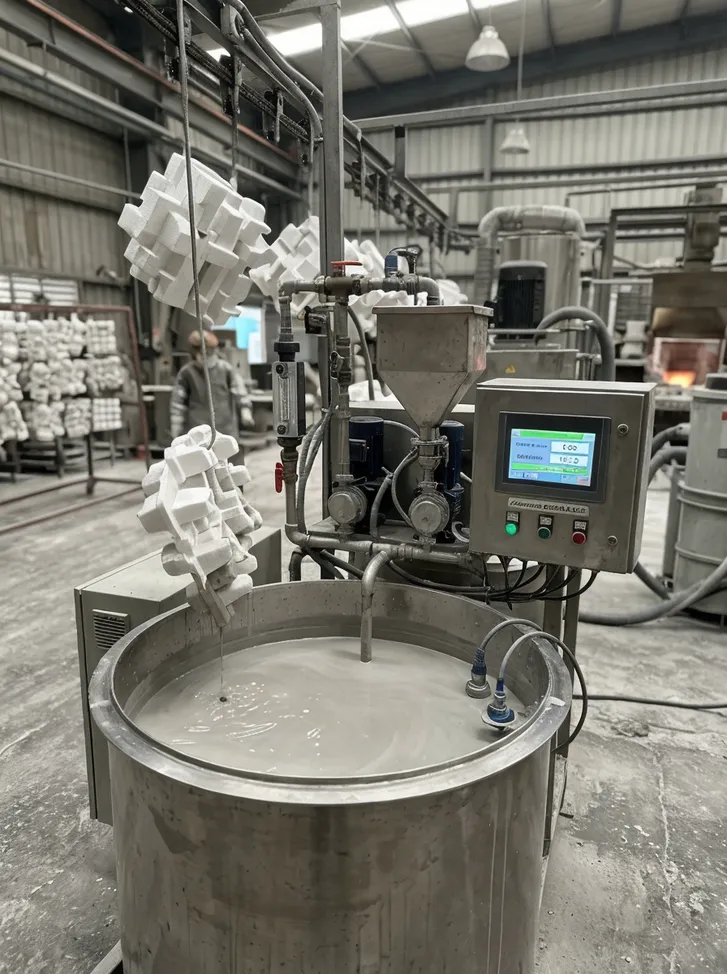
Our coating systems monitor slurry viscosity continuously using density sensors — target specific gravity is 1.4–1.8, measured every 15 minutes. When viscosity drifts outside range, automated dosing systems add refractory powder (if too thin) or water (if too thick) to bring it back to spec.

Manual vs. automated: Manual systems require operator testing every 2–4 hours using viscosity cups — works for low-volume operations, but coating thickness variation increases to ±0.3mm vs. ±0.1mm with automated control.

Automated coating viscosity control system with density sensors and dosing unit for lost foam casting

Vacuum System Precision

Lost foam requires negative pressure to pull sand tight against the pattern as EPS vaporizes — this prevents mold collapse and maintains dimensional accuracy. Our vacuum systems use PLC-controlled pressure regulators that adjust vacuum level based on alloy type and casting size.

Aluminum
0.04–0.06 MPa
Iron
0.02–0.04 MPa

Pressure sensors at each molding station log vacuum readings every second — if pressure drops below setpoint (common cause: vacuum line leak or pump wear), the system holds the pour and alerts the operator.

Proven impact: Foundries reduce scrap from dimensional errors by 40–50% by tightening vacuum control from ±0.01 MPa to ±0.005 MPa.

Sand Compaction & Vibration Control

Vibration tables operate at specific frequency and amplitude combinations tuned to your sand type. Target density: 1.55–1.65 g/cm³ with ±2% variation across the mold.

Sand Type Amplitude Frequency
Coarse (40–70 mesh) 1.5–2mm 50–60 Hz
Fine (70–140 mesh) 0.5–1mm 80–100 Hz

We calibrate vibration parameters during commissioning using density measurements at multiple flask locations. PLC programming stores vibration recipes for different casting sizes so operators can switch between products without manual tuning.

Note: Vibration settings are the most common cause of inconsistent casting quality when foundries run multiple sand types on the same equipment. If you're switching sand suppliers, plan for 2–3 days of recalibration.

Data Logging & Root-Cause Analysis

Our PLC systems store 90 days of process data: coating viscosity, vacuum pressure, pouring temperature, sand loss on ignition (LOI), vibration parameters. When a batch of castings fails inspection, you pull the data logs for those specific molds and identify which parameter drifted.

Real-World Example

A European foundry saw porosity defects increase from 3% to 12% over two weeks. Data logs showed coating viscosity had drifted from 1.6 to 1.9 specific gravity because the automated dosing pump was failing. They replaced the pump ($800 part), recalibrated the system, and porosity dropped back to 3% within three shifts. Without data logging, they would have spent weeks testing different variables.

Remote Diagnostics

Modern PLC systems connect via Ethernet or 4G and allow remote access to control logic, parameter settings, and alarm logs. When your line faults, our technical team logs into your PLC, reviews the alarm history, checks sensor readings, and identifies the root cause — usually within 2–4 hours.

60–70%
Resolved Remotely
30%
Need Site Visit

Issues resolved remotely include PLC parameter drift, sensor calibration errors, and control logic bugs. For the remaining 30% needing physical inspection or component replacement, remote diagnostics tells us exactly which parts to bring before we book the site visit. Remote access requires your IT team to configure firewall rules — we provide network security documentation during commissioning.

Scalable Investment Planning

Modular Equipment Investment & Expansion Strategy

Match capital investment to actual revenue growth. Three configuration tiers let you enter lost foam casting at the right scale and expand without replacing core equipment.

Starter Configuration

50–100 tons/month

$150,000–250,000

Starter lost foam casting configuration with manual coating dip tank and batch molding station
  • Manual coating with dip tank (400L capacity)
  • Batch molding with vibration table (600x600mm flasks)
  • Single-station vacuum system (0.02–0.06 MPa adjustable)
  • Manual shakeout, basic sand screening
  • 3–4 operators per shift
Operating cost$18–25/ton
Lead time12–14 wks + 3–4 wks install

Best for prototype foundries, job shops, or established foundries adding lost foam capacity for specific product lines.

Most Common
Mid-Scale Configuration

200–500 tons/month

$400,000–700,000

Mid-scale lost foam casting line with automated coating and PLC-controlled vibration molding
  • Automated coating line with viscosity control, conveyor-fed drying (800L tank)
  • Continuous molding with PLC-controlled vibration and flask conveyors
  • Multi-station vacuum system (3–4 positions)
  • Automated shakeout with magnetic separation
  • Sand reclamation with dust collection
  • 2–3 operators per shift
Operating cost$12–16/ton
Lead time14–16 wks + 5–6 wks install
Breakpoint vs. starter~300 tons/year

Labor cost drops significantly with automation; energy and maintenance costs increase. Economic breakpoint vs. starter: around 300 tons/year where labor savings justify automation investment.

High-Volume Configuration

500–2,000 tons/month

$800,000–1,500,000

High-volume fully automated lost foam casting production line with robotic pattern handling
  • Fully automated coating with robotic pattern handling
  • Continuous molding with multi-station pouring (4–6 positions)
  • Centralized vacuum system with redundant pumps
  • Automated shakeout with thermal sand reclamation
  • PLC integration with centralized monitoring
  • 2–3 operators per shift (same as mid-scale, 3–4x throughput)
Operating cost$8–12/ton
Lead time16–18 wks + 6–8 wks install

Only makes sense for foundries with confirmed long-term volume — buying this capacity for speculative growth ties up capital that could fund working inventory or market development.

Real Expansion Path: Ontario Foundry Case

An Ontario foundry started with manual coating and batch molding in 2018 for 100 tons/month aluminum automotive parts ($280,000 initial investment).

In 2020, they added an automated coating line with viscosity control ($95,000) because coating defects were their #1 scrap cause — defect rate dropped from 8% to 3%, paying back the investment in 11 months through scrap reduction alone.

In 2023, they upgraded to continuous molding with flask conveyors ($85,000) because labor cost had increased 30% and they were struggling to find skilled molding operators.

They're now running 350 tons/month on equipment that cost $460,000 total vs. $650,000 for a new automated line purchased in 2018. The modular approach let them match capital investment to actual revenue growth rather than betting on projected volume.

Ontario foundry modular expansion from manual to automated lost foam casting line

Modular Design Advantage

Expand capacity without replacing core equipment. When you add automated coating to a manual line, the dip tank, drying chambers, and pattern handling racks stay in place — you're adding viscosity control sensors, automated dosing pumps, and conveyor systems.

When you upgrade from batch to continuous molding, the vibration tables and vacuum system stay — you're adding flask conveyors and PLC integration. This reduces capital risk for market entry and testing.

Margin Protection Strategy

Incremental investment matches revenue growth. Buying excess capacity upfront means capital tied up in equipment that's not generating revenue. Buying too little capacity means turning away orders or running excessive overtime — which increases defect rates and equipment wear.

Modular expansion lets you add capacity in 100–200 ton/month increments as order books fill — you're always running equipment at 70–85% capacity (the sweet spot for efficiency and flexibility) rather than 40% capacity (wasting fixed costs) or 95% capacity (no buffer for quality issues or maintenance).

If lost foam doesn't work for your casting mix, you've invested $200,000 in equipment you can repurpose or resell — not $800,000 in a fully automated line with limited secondary market.

Need help sizing your first configuration?

Facility Planning

Equipment Installation & Facility Requirements

Floor loading, utility specs, space planning, and installation timelines — the facility details that determine whether your equipment runs on schedule or stalls at commissioning.

Floor Loading Requirements

Coating Tanks

2–3 t/m²

400L tank weighs 800–1,000 kg when full (slurry density 1.6–1.8 g/cm³), concentrated in a 1.5×1.5 m footprint. Most industrial floors are rated for 1.5–2 t/m² distributed load — verify your floor can handle concentrated loads before ordering. May need reinforcement.

Molding Lines

500–800 kg/m²

600×800mm flask with 300 kg sand plus vibration table and conveyor equipment spreads load across a 3×5 m footprint — within standard industrial floor capacity. Distributed load pattern is less demanding than coating tanks.

Shakeout Equipment

Dynamic Loads

Generates dynamic loads from vibration. Mount on isolated concrete pads (300–500mm thick) to prevent vibration transmission to adjacent equipment. Standard floor ratings don't account for dynamic loading.

Utility Specifications

Utility Specification Notes
Compressed Air 6–8 bar pressure, 200–500 L/min flow Higher flow for automated pattern feeders. Verify your compressor has spare capacity — most foundries already have compressed air for other equipment.
Electrical 380V 3-phase 50 Hz or 480V 60 Hz (North America) Specify during order. Power consumption: 50–100 kW (starter), 150–300 kW (mid-scale), 300–600 kW (high-volume).
Cooling Water Closed-loop, 5–10 L/min, 15–25°C inlet For vacuum pumps. Prevents pump overheating and extends seal life from 12–18 months to 24–36 months.

Space Planning & Layout

Starter

200–300 m²

Pattern storage, coating, molding, shakeout, sand storage

Mid-Scale

400–600 m²

High-Volume

800–1,200 m²

Layout principle: Linear flow from pattern handling → coating → drying → molding → pouring → shakeout minimizes material handling and reduces cycle time.

Ceiling height: 4–5 meters minimum for overhead cranes (if using cranes for flask handling).

Maintenance clearances: 1–1.5 meters around all equipment for access to motors, pumps, and control panels. Inadequate clearance increases maintenance time by 30–50%.

Lost foam casting facility layout showing linear flow from pattern handling through shakeout

Installation Timeline: Four Phases

1

Mechanical Assembly

2–3 weeks

Equipment arrives in containers. Riggers position machines, technicians bolt frames and connect mechanical interfaces.

2

Electrical Hookup

1–2 weeks

Electricians wire motors, sensors, and control panels to PLC. Test circuits and verify safety interlocks.

3

Vacuum System Testing

3–5 days

Pressure test all vacuum lines, calibrate sensors, verify pump capacity.

4

Calibration & Training

1–2 weeks

Run test castings, adjust coating viscosity and vibration settings, train operators on equipment operation and basic troubleshooting.

Total Timeline: 4–6 weeks

From container arrival to first production casting. Plan facility preparation (floor reinforcement, utility connections, crane installation) in parallel with equipment manufacturing to avoid adding 4–8 weeks to your project schedule.

Remote Commissioning Option

We provide video-guided installation support: your local team (requires hydraulic and electrical skills) handles mechanical assembly and electrical hookup following our video instructions and technical drawings. Our engineers join via video call for vacuum testing, PLC programming verification, and process parameter calibration.

Savings

$8,000–15,000

In travel and accommodation costs

On-Site Time Reduced

2 weeks → 3–5 days

For TZFoundry engineer presence

Trade-off to consider:

Installation takes 1–2 weeks longer because your local team is learning as they go, and troubleshooting is slower via video vs. hands-on. Remote commissioning works well for buyers with experienced maintenance teams; first-time lost foam installations benefit from on-site support.

TZFoundry remote commissioning via video-guided installation support for lost foam casting equipment
Now I have all the content. Let me render the HTML chunk.
Buyer's Evaluation Framework

Equipment Selection Evaluation Criteria

Seven decision factors that separate a productive equipment investment from an expensive troubleshooting project. Evaluate each before signing a purchase order.

Lead Time & Installation Support

Lead time determines when your equipment starts generating revenue. Our production schedule runs 12–16 weeks from order confirmation to container loading — includes equipment fabrication, PLC programming, factory testing, and export documentation. On-site commissioning takes 4–6 weeks. Total timeline: 18–24 weeks from order to first production casting.

Verify your equipment manufacturer has installation teams or certified partners in your region. If they're shipping equipment without installation support, you're hiring local contractors who don't know the process — commissioning stretches to 8–12 weeks and you're troubleshooting process issues without factory backup.

Ask for references from buyers in your region who can confirm installation support quality.

Spare Parts Availability

Spare parts availability directly impacts downtime cost. Critical wear components fail predictably:

  • Vacuum pumps: 18–24 months (rotary vane), 24–36 months (liquid ring)
  • Vibration motors: 24–36 months
  • Coating pumps: 12–18 months (slurry service)
  • PLC I/O modules: rare failures, no advance warning

Cost comparison: Supplier stocks parts, ships in 3–5 days → vacuum pump failure costs 1–2 days downtime ($3,000–6,000 lost revenue for a 100-ton/month line). Supplier manufactures on demand, 4–6 week lead → same failure costs a month of lost production ($60,000–100,000 revenue impact).

Ask about inventory policy and shipping speed for the top 20 wear components — that tells you whether they're supporting installed equipment or just selling new lines.

Remote Diagnostics Capability

Remote diagnostics reduces troubleshooting time from days to hours. When your line faults, our technical team logs into your PLC via Ethernet or 4G, reviews alarm history, checks sensor readings, and identifies root cause — usually within 2–4 hours.

Without remote access, you're describing symptoms over email, we're guessing at causes, and you're swapping components until something works. We've resolved 60–70% of technical issues remotely: PLC parameter drift, sensor calibration errors, control logic bugs. The remaining 30% need physical inspection or component replacement, but remote diagnostics tells us exactly which parts to bring.

Remote access requires firewall configuration by your IT team — we provide network security documentation.

Training & Documentation Quality

Training and documentation quality determines how fast your team becomes self-sufficient. Operator training covers equipment operation, process parameter adjustment, routine maintenance, and basic troubleshooting — typically 3–5 days on-site during commissioning.

Maintenance manuals include:

  • Mechanical drawings — assembly views, part numbers, torque specs
  • Electrical schematics — wiring diagrams, sensor locations, PLC I/O mapping
  • PLC ladder logic — control sequences, alarm conditions, parameter ranges
  • Spare parts lists and preventive maintenance schedules

Process parameter guides explain how coating viscosity, vacuum pressure, and vibration settings affect casting quality — this is the knowledge transfer that lets your team optimize the line for new casting designs without calling the factory every time.

Warranty Terms

Warranty terms define who pays when equipment fails. Standard warranty:

Mechanical Components

18 Months

Frames, conveyors, tanks

Electrical Components

12 Months

Motors, sensors, PLC modules

Starting from commissioning date. Clarify what's excluded: wear items (pump seals, vibration isolators, conveyor belts) typically aren't covered because failure rate depends on your operating conditions.

Service terms should specify response time for technical support (24–48 hours for remote diagnostics, 5–7 days for on-site visits) and travel cost responsibility for warranty repairs.

Some manufacturers offer extended warranties (24–36 months) for 8–12% additional cost — worth it if you're in a remote location where downtime is expensive.

Payment & Shipping Terms

Payment and shipping terms affect cash flow and landed cost.

FOB Qingdao

You arrange ocean freight, customs clearance, and inland transport. You control logistics but assume all shipping risk.

  • + $3,000–8,000 ocean freight
  • + 0–15% customs duties
  • + $500–2,000 inland transport

CIF (Your Port)

Includes ocean freight and insurance to your destination port — simpler for you but typically 8–12% higher than FOB.

Container loading supervision matters: we photograph equipment positioning, secure tie-down points, and verify desiccant placement to prevent moisture damage during 30–45 day ocean transit.

Export documentation (commercial invoice, packing list, certificate of origin, CE/SGS certificates) must match your customs requirements — missing or incorrect documents delay clearance by 1–2 weeks.

TZFoundry Service Model — What You Get

English-Speaking Support

Email and WhatsApp, response within 24 hours

Video Commissioning

Remote installation assistance for distant sites

Spare Parts Warehouse

Qingdao-based, 3–5 day international shipping (DHL/FedEx urgent, sea freight routine). Top 30 wear components in stock: vacuum pump rebuild kits, vibration motors, coating pump impellers, PLC I/O modules, pressure sensors.

Remote Diagnostics

Standard on all PLC-controlled equipment

Installation Support Regions

  • North America, Europe, Middle East — TZFoundry team, $8,000–15,000 for 2-week commissioning
  • Southeast Asia, South America — Certified local partners, lower travel cost (verify partner experience with lost foam equipment)
Lost foam casting equipment evaluation criteria — lead time, spare parts, remote diagnostics, training, warranty, and shipping considerations for foundry buyers
Technical Q&A

FAQ — Equipment Selection & Specification Questions

Detailed answers to the sizing, specification, and configuration questions foundry engineers ask most when evaluating lost foam casting equipment.

What vacuum pump capacity do I need for lost foam casting equipment?

Vacuum pump capacity depends on flask size and alloy type. Calculate required flow rate: flask volume (length × width × height in meters) × 60 = minimum pump flow rate in m³/hour.

Sizing Example

600×600×400mm flask = 0.6 × 0.6 × 0.4 = 0.144 m³ volume × 60 = 8.6 m³/hour minimum flow. Add 30–50% safety margin for vacuum line losses and future expansion — specify 12–15 m³/hour pump for this flask size.

Aluminum castings need higher vacuum (0.04–0.06 MPa) — use rotary vane pumps or liquid ring pumps rated for this pressure range. Iron castings use lower vacuum (0.02–0.04 MPa) — standard rotary vane pumps work.

Multi-station systems: multiply single-station flow rate by number of stations, then add 20% for simultaneous operation (not all stations pour at the same time, but you need capacity for peak demand).

Coating dip tank vs. spray booth: which is better for complex castings?

Dip Tank

  • Best for: Simple external geometries — pump housings, brackets, flanges, simple manifolds
  • Thickness uniformity: ±0.1–0.2mm
  • Cycle time: 8–12 minutes
  • Equipment cost: $25,000–45,000 (400L system)

Spray Booth

  • Best for: Complex geometries with internal cavities, cores, thin walls — engine blocks, valve bodies, large castings above 30 kg
  • Thickness uniformity: ±0.2–0.3mm
  • Cycle time: 15–25 minutes
  • Equipment cost: $60,000–120,000 (automated system)

Decision threshold: If more than 30% of your castings have internal cavities deeper than 50mm or wall thickness under 5mm, spray booths become necessary. If your portfolio is mostly simple shapes, dip tanks are more economical.

How to size drying chamber capacity for my production volume?

Drying chamber capacity must match your daily coating volume to prevent queue buildup. Calculate required capacity:

Sizing Formula

Daily coating volume (patterns/day) × average pattern volume (m³) × drying time (hours) ÷ 24 hours = minimum chamber volume in m³.

Example: 100 patterns/day, average 0.05 m³ per pattern, 8-hour drying time = 100 × 0.05 × 8 ÷ 24 = 1.67 m³ minimum. Add 30–40% buffer for batch loading efficiency and maintenance downtime — specify 2.2–2.5 m³ drying chamber.

Gas-Fired Chambers

$0.15–0.25 per kg dried. Lower operating cost but needs gas supply and ventilation.

Electric Chambers

$0.30–0.45 per kg dried. Simpler to install but higher operating cost.

Size for your actual drying time requirement — aluminum patterns dry in 4–6 hours, iron patterns need 8–12 hours because coating is thicker.

What causes coating thickness variation in lost foam equipment?

Coating thickness variation comes from three main sources:

1. Slurry Viscosity Drift

As water evaporates from the coating tank, viscosity increases and coating gets thicker. Manual systems where operators add water based on visual inspection see ±0.3–0.5mm thickness variation. Automated viscosity control with density sensors and dosing pumps reduces this to ±0.1–0.2mm.

2. Pattern Drainage Time Inconsistency

If operators move patterns to drying too quickly, excess slurry drains off and coating is thin; if they wait too long, slurry starts setting and coating is thick. Standardize drainage time (3–5 minutes for most applications) and use timers or automated conveyors to enforce consistency.

3. Slurry Temperature Variation

Coating viscosity changes 5–10% per 10°C temperature change. Foundries without climate control see coating thickness vary between morning (cold slurry, thicker coating) and afternoon (warm slurry, thinner coating). Solution: insulated coating tanks or temperature-controlled mixing systems maintain 20–25°C slurry temperature.

Can I add automation to manual lost foam casting equipment later?

Yes, if the base equipment was designed for modular expansion. Our manual systems use the same mechanical frames, tanks, and conveyors as automated systems — you're adding sensors, PLC controls, and automated dosing/feeding equipment rather than replacing the base machines.

Typical Upgrade Path

Coating Equipment

  • 1. Start with manual coating (operator monitors viscosity with cup tests, adds water/powder manually)
  • 2. Add automated viscosity control — $8,000–15,000 for sensors and dosing pumps
  • 3. Add conveyor-fed drying — $12,000–25,000

Molding Equipment

  • 1. Start with manual flask handling and operator-controlled vibration
  • 2. Add PLC-controlled vibration with parameter recipes — $5,000–8,000
  • 3. Add flask conveyors — $25,000–45,000

Compatibility requirement: verify your equipment manufacturer designed for modular upgrades — some low-cost manual systems use different frame dimensions and control interfaces that can't accept automation components.

What floor loading do I need for lost foam molding equipment?

Molding equipment creates two types of loads:

Concentrated Loads — Coating Tanks

400L tank with slurry weighs 800–1000 kg in a 1.5×1.5 meter footprint = 2–3 tons/m² concentrated load. Most industrial floors are rated for 1.5–2 tons/m² distributed load but need reinforcement for concentrated loads — add steel-reinforced concrete pads (300–400mm thick) under coating tanks.

Distributed Loads — Molding Lines

600×800mm flask with 300 kg sand plus vibration table and conveyor equipment spreads 500–800 kg/m² across a 3×5 meter footprint = within standard industrial floor capacity.

Dynamic Loads — Shakeout Vibration

Mount shakeout equipment on isolated concrete pads (400–500mm thick) with vibration isolators to prevent transmission to adjacent equipment.

Have a structural engineer assess your floor before ordering — floor reinforcement costs $3,000–8,000 per concentrated load point, much cheaper than repairing floor damage after installation.

Need specifications for your casting portfolio?

Send us your casting drawings and production targets. We'll provide equipment specifications, layout drawings, and a detailed quotation within 5 business days.

Explore Production Lines
Single-Source Foundry Equipment Manufacturer

Why Foundries Choose TZFoundry Equipment

Manufacturing foundry equipment since 2010 — from individual molding machines for domestic foundries to complete production line systems for export buyers across 15+ countries.

Single-Factory Integration

15,000 m² Facility in Qingdao

Lost foam casting equipment is one of three main product categories we build — clay sand processing lines, lost foam systems, and resin sand production lines all ship from the same facility. Pattern handling racks, coating tanks, molding equipment, vacuum systems, and shakeout units all come from the same factory with guaranteed compatibility.

When you're mixing equipment from different subsystems or adding capacity to an existing line, you're not troubleshooting interface mismatches between suppliers.

In-House Manufacturing

Full Vertical Control

We fabricate steel frames and tanks in our welding shop, assemble hydraulic and pneumatic systems in the mechanical assembly area, program and test PLCs in the electrical workshop, and run complete system tests before shipping.

This eliminates the coordination problems that happen when you're buying coating equipment from one supplier, molding lines from another, and vacuum systems from a third — each blames the others when integration fails. Our technical team knows every component because we built it, so troubleshooting is faster and more accurate.

Modular Design — Expand Without Replacing Core Equipment

Our equipment uses standardized interfaces — coating tanks accept automated viscosity control retrofits, batch molding tables integrate with flask conveyors, single-station vacuum systems expand to multi-station configurations. You're adding capacity as revenue grows rather than betting on projected volume.

Ontario Foundry Case Study

  • 2018 Manual coating — $280,000 initial investment
  • 2020 Automated coating upgrade
  • 2023 Continuous molding upgrade — $180,000 total upgrades over 5 years
TZFoundry modular lost foam casting line showing standardized equipment interfaces for phased expansion
Modular path total $460,000
New automated line upfront $650,000

Now running 350 tons/month on the modular path

Custom Engineering for Your Casting Portfolio

Standard vacuum systems operate at fixed pressure ranges, but if you're running both aluminum and iron castings, we configure with alloy-based setpoint adjustment — operator selects alloy type, PLC automatically adjusts target vacuum.

Standard coating tanks use single-viscosity control, but if you're running multiple coating formulations (different refractories for different alloys), we add multi-recipe storage with automated changeover.

Dual-alloy configurations need separate cooling conveyors because aluminum solidifies in 15 minutes while iron takes 60 minutes — we size conveyor length for your specific alloy mix rather than forcing you to buy excess cooling capacity.

Direct Factory Pricing

When you're buying through distributors, you're paying 30–50% markup on equipment cost — a $400,000 line becomes $520,000–600,000 at distributor pricing. We work directly with overseas buyers, so you're paying factory cost plus shipping and export documentation.

Typical Savings by Configuration

Mid-scale configuration $60,000–100,000 saved
$800K high-volume line $240,000–400,000 saved

Savings vs. distributor pricing — funds redirected to working capital or market development

Export Experience — 15+ Countries

CE Certification

European installations

UL Compliance

North American buyers

Voltage Options

380V/480V · 50Hz/60Hz

Multilingual HMI

Localized interfaces

Shipping & Logistics

Our shipping team photographs container loading, verifies tie-down points, and adds desiccant packs to prevent moisture damage during 30–45 day ocean transit. We handle customs documentation — commercial invoice, packing list, certificate of origin, test reports.

Customs Clearance

We've navigated customs clearance in 15+ countries and know which documentation each market requires. Missing or incorrect documents delay clearance by 1–2 weeks and cost you storage fees at the port.

North America Europe Middle East Southeast Asia

Get Your Equipment Configuration Analysis

Send your casting portfolio — include part drawings or photos, annual volumes by part number, alloy types, and current production methods. We'll analyze which castings suit lost foam, recommend equipment configurations with capacity calculations, provide budget estimates with FOB and CIF pricing options, and map a modular expansion path for 3-year growth.

24–48 hrs initial recommendations 5–7 days detailed technical proposals