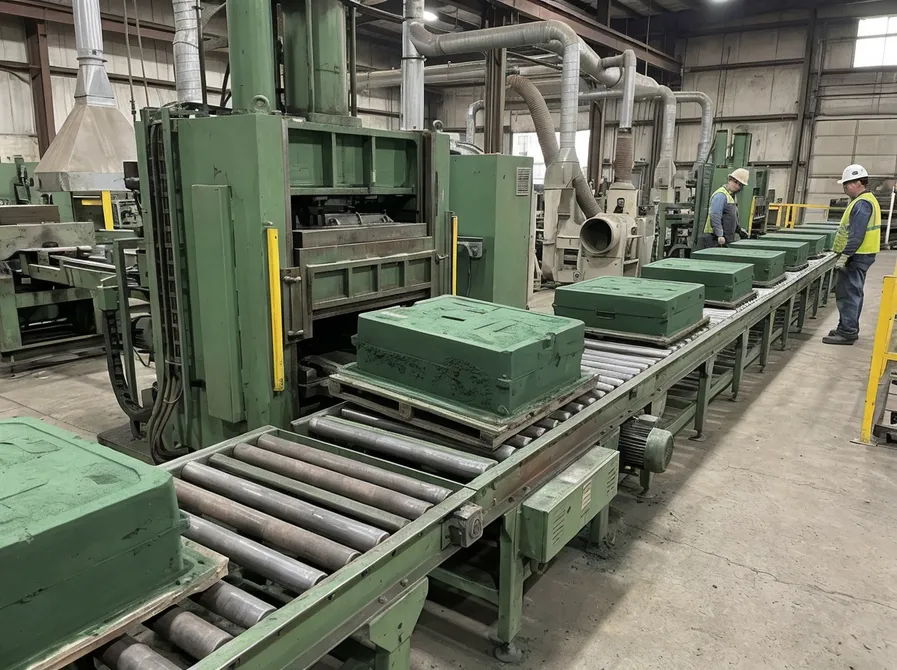
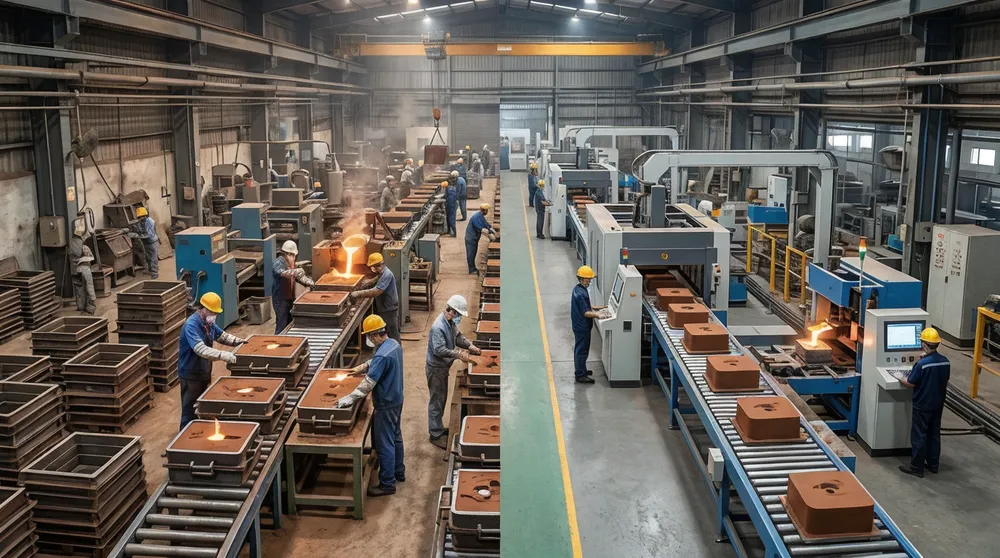
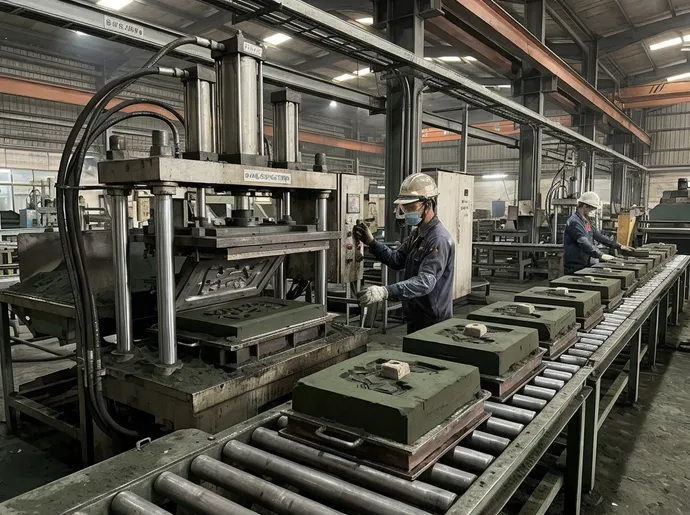
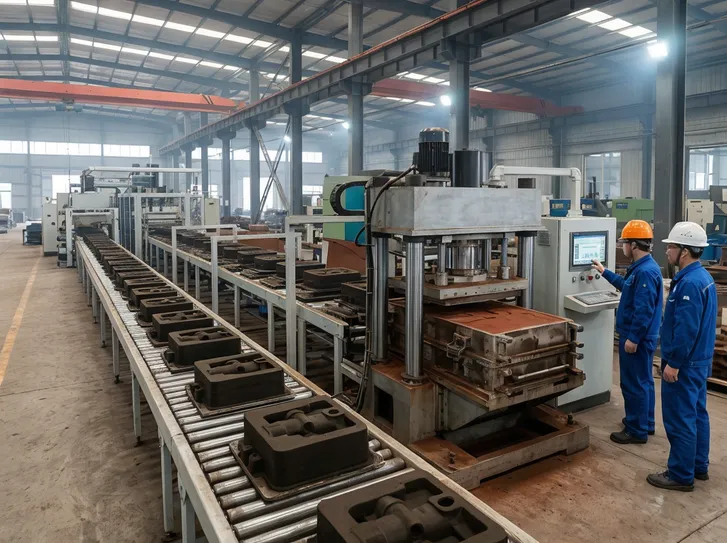
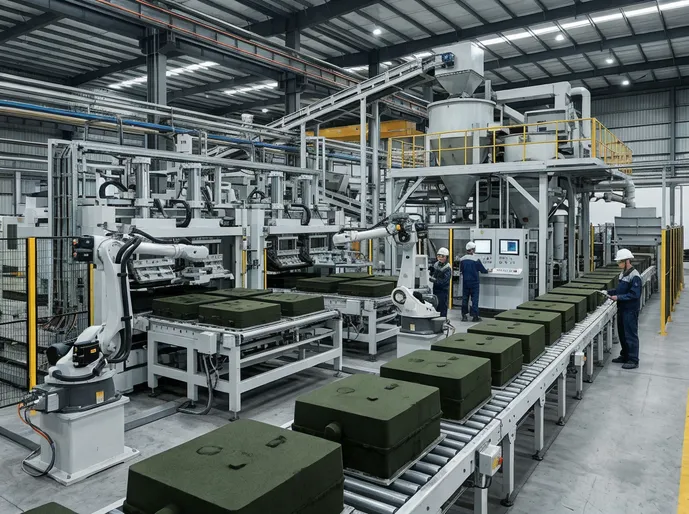
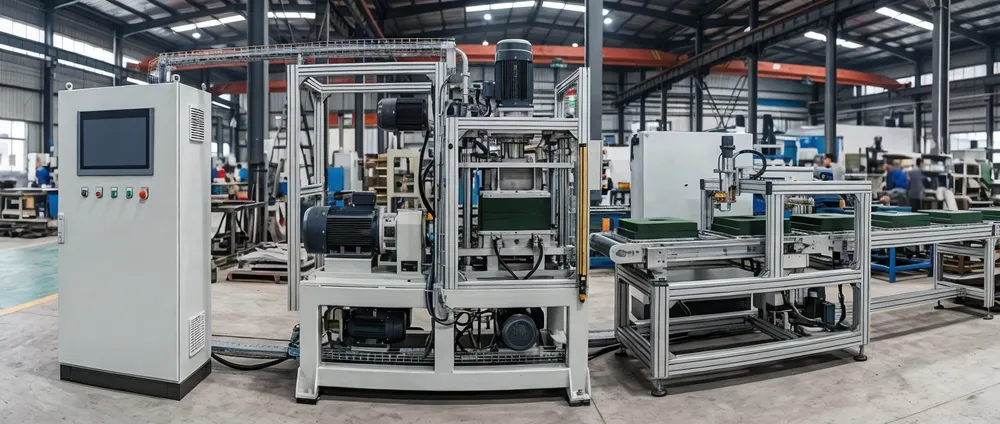
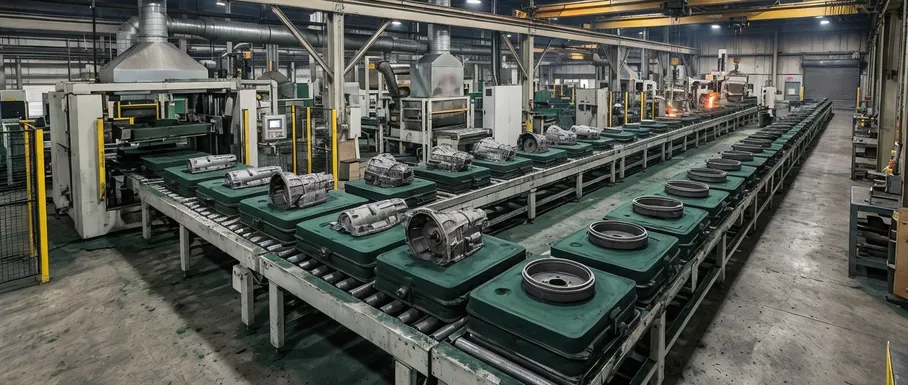
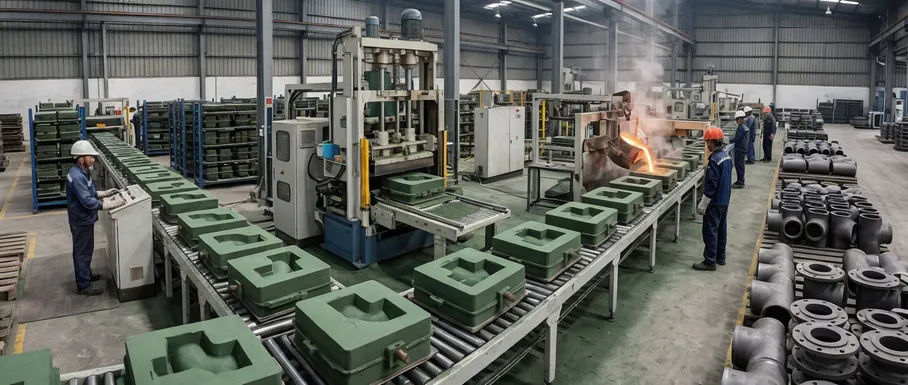
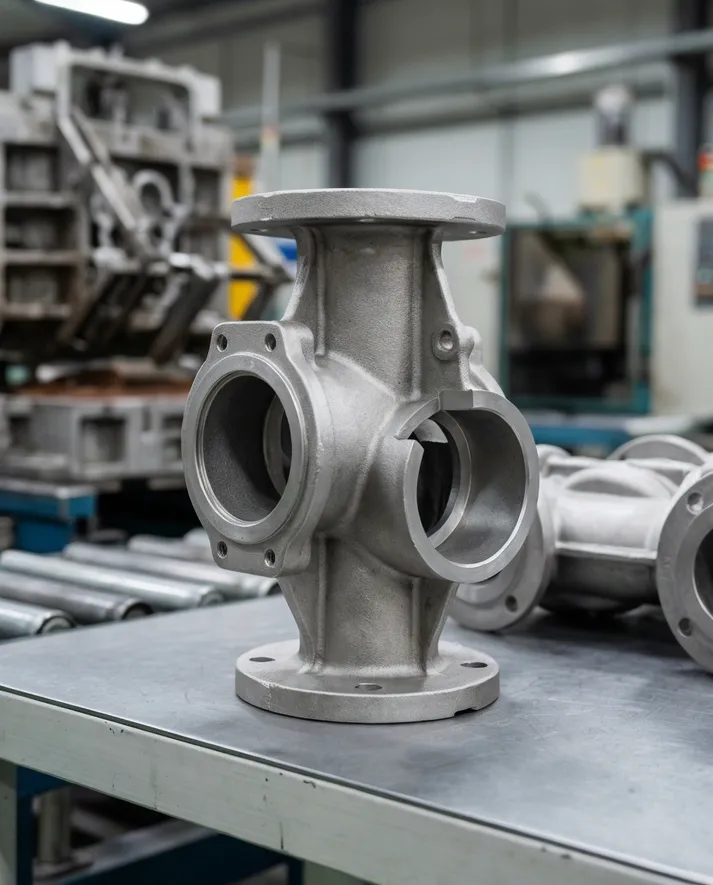
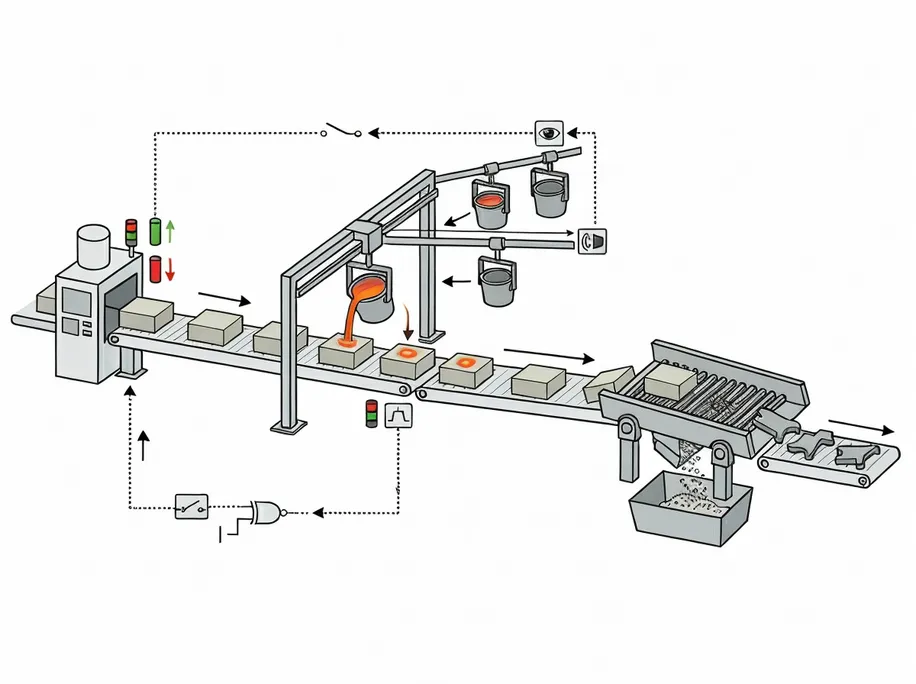
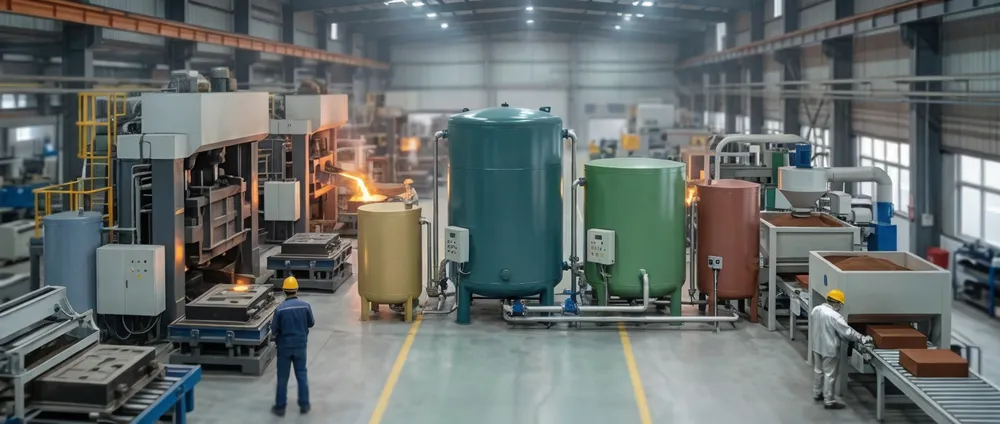
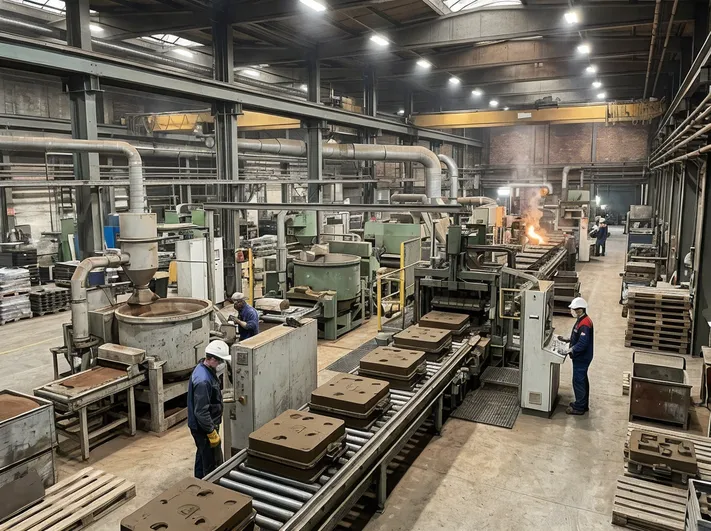
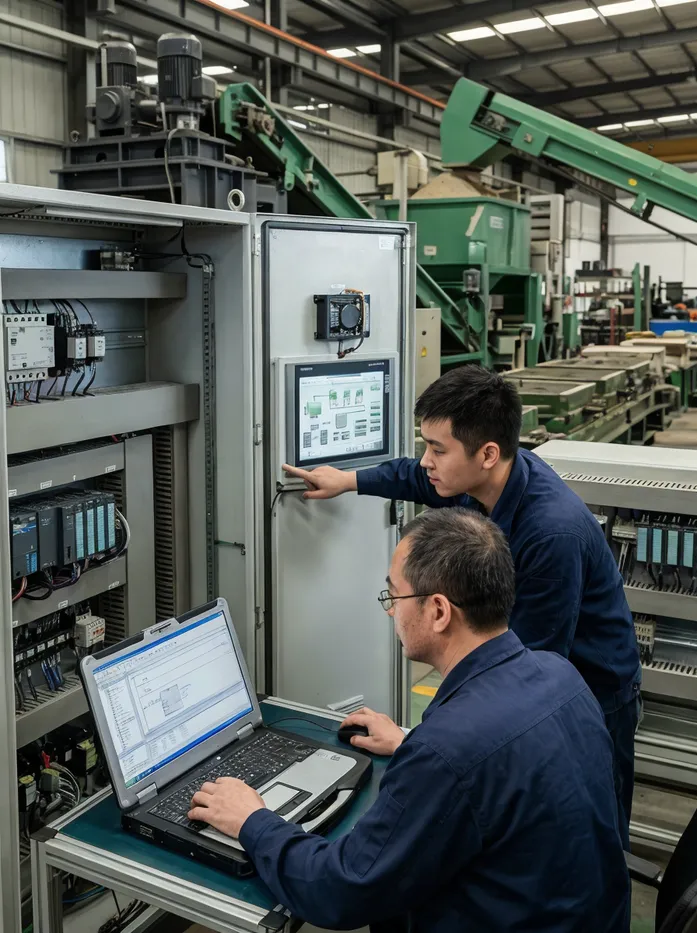
A flaskless clay sand processing line eliminates the metal flask entirely. Instead of compacting sand inside reusable metal frames that you handle, store, and maintain, the system forms molds directly on a pattern plate, ejects them automatically, and moves them to your pouring station on conveyors.
The operational difference: no flask inventory to manage, no flask handling labor between molding and pouring, and continuous automated production flow that runs with minimal operator intervention.
Every flaskless line ships as a modular system designed to bolt together on your factory floor. Here's what you're getting.
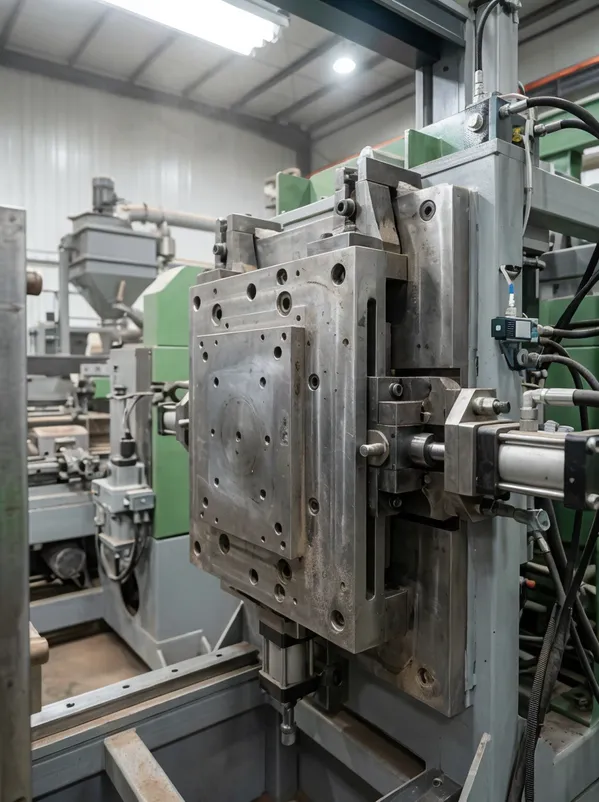
Sand compacts against the pattern plate — the core forming step where molds take shape without metal flasks.
Pneumatic or hydraulic rams push finished molds onto transport conveyors. No manual handling between molding and pouring.
Move molds through cooling, pouring, and shakeout stations. Integrated with your sand reclamation system.
Standard on mid-volume and above. Coordinates mold ejection timing with downstream pouring equipment and logs production data for ISO 9001 traceability.
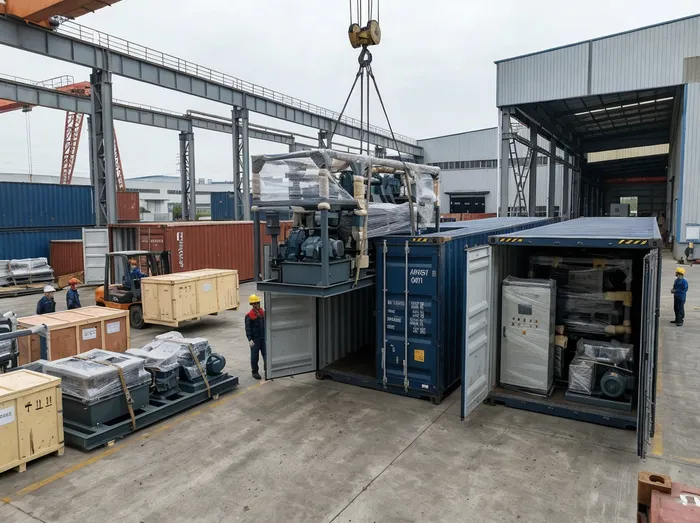
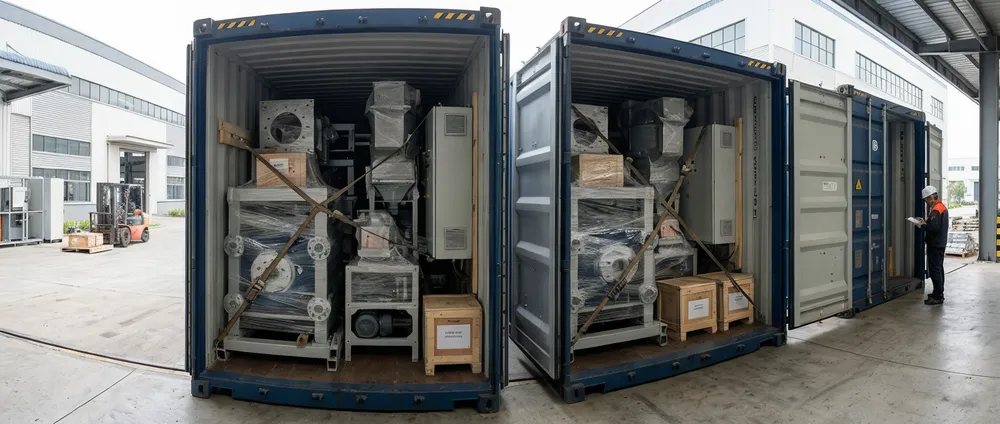
Every line is designed to ship in standard containers — equipment frames break down into modules that clear container door dimensions, then bolt together on your factory floor.
2
40-foot containers for a typical mid-capacity line (100–150 molds/hr)
5–7
Days for assembly with our commissioning team on-site
3–4
Additional days for calibration & operator training (automation setup takes longer than flask-based systems)
Lead time: 45–60 days from deposit to factory departure.
Eliminating flask handling changes both your capital structure and your daily throughput. Here are the numbers.
15–25% cycle time reduction
Compared to traditional flask molding — no flask handling between molding and pouring.
Eliminated flask inventory capital
A 150-mold-per-hour operation typically runs 300–500 flasks at $80–150 per flask — that's $24,000–$75,000 in flask inventory you no longer need.
18–24 month payback
Through labor savings and throughput gains for high-volume, narrow product-mix operations (3–5 core mold designs).
30–40% higher upfront cost
Compared to equivalent flask-based lines. The automation components add to the initial investment.
Less flexible for frequent pattern changes
If you're running job-shop work with 10+ pattern changes per shift, traditional flask molding remains more economical.
Longer commissioning timeline
Automation components require more setup time during installation than conventional flask-based systems.
High-volume, narrow mix (3–5 core designs)? Flaskless pays back in 18–24 months through labor savings and throughput gains. Job-shop with 10+ pattern changes per shift? Traditional flask molding remains more economical.
Our engineers can match a flaskless line to your production volume, product mix, and factory layout. No obligation — just the technical details you need to decide.
The decision between flaskless and flask-based molding comes down to three factors: production volume, product mix complexity, and labor cost structure. Flaskless technology makes commercial sense when you're running continuous production (80+ molds per hour, 2–3 shifts daily) with limited product variety (fewer than 5 pattern changes per shift). Flask-based molding remains more economical for job-shop operations with frequent changeovers or low-volume batch production.
At 100 molds per hour running two shifts (1,600 molds daily), flaskless technology saves roughly $180–220 per day in labor cost compared to flask-based molding (one fewer operator at $22–28/hour fully loaded). Over a year of continuous operation, that's $45,000–55,000 in labor savings.
The typical price premium for a flaskless system at this capacity is $80,000–100,000, so payback happens in 18–22 months. Below 80 molds per hour or with irregular production schedules, payback extends beyond 36 months — at which point flask-based molding makes more financial sense.
| Parameter | Flaskless Molding | Flask-Based Molding |
|---|---|---|
| Cycle Time | 18–25 sec / mold | 30–40 sec / mold |
| Flask Capital Cost | $0 (no flasks required) | $24,000–75,000 |
| Operators / Shift (150 MPH) | 2 operators | 3 operators |
| Pattern Change Time | 60 sec (pneumatic) / 8–12 min (manual) | Faster flask swap |
| Upfront Premium | 30–40% higher | Baseline |
| Best For | Continuous, high-volume, <5 changes/shift | Job-shop, frequent changeover, batch runs |
| 24/7 Unmanned Operation | Supported | Not practical |
If you're running fewer than 50 molds per hour, or if you're making more than 10 pattern changes per shift, traditional flask molding will be more economical. Flaskless technology is an automation investment that pays off through volume and consistency, not through flexibility.
We've built both types of systems for 15 years — we'll recommend flask-based molding when it fits your operation better, because a system that doesn't match your production model wastes your capital regardless of the technology.
Send us your current output rate and product mix — we'll recommend the most cost-effective configuration.
Flaskless systems scale across three capacity ranges, and the differences go beyond speed — they're about automation level, control precision, and operator skill requirements. Selecting the right tier determines your capital outlay, staffing model, and the casting tolerances you can hold in production.
50–100
molds / hour
100–200
molds / hour
200+
molds / hour
Manual pattern change · Automated mold ejection & conveyor transport
| Parameter | Value |
|---|---|
| Compaction type | Hydraulic — 0.6–0.7 MPa pressure |
| Cycle time (incl. ejection) | 45–60 seconds |
| Pattern changeover | Manual — 8–12 minutes per changeover |
| Mold ejection & transport | Automatic — pneumatic rams & roller conveyors |
| Footprint | 14 m × 10 m |
| Power requirement | 55 kW |
| Operators per shift | 2 — one at molding station, one coordinating pouring & exceptions |
| Cycle consistency | ±5% across shift (hydraulic pressure varies slightly with temperature) |
Cycle time consistency of ±5% is driven by hydraulic pressure variation as oil temperature changes across a shift. This is acceptable for most gray iron and ductile iron castings but not tight enough for precision aluminum work.
Manual pattern changeover at 8–12 minutes per swap means this configuration penalizes high-mix operations. If you're running more than 8 designs per week, evaluate the PLC-controlled 100–200 molds/hour tier for faster changeover and tighter process control.
Servo-driven compaction with PLC control, pneumatic quick-change pattern system, and automated mold handling. The PLC coordinates compaction pressure (±2% consistency), mold ejection timing, and conveyor speed to maintain continuous flow to your pouring station. Pattern changes happen via pneumatic quick-release clamps — 60-second swap time — and the PLC stores up to 20 mold recipes with programmable compaction curves for each design.
Footprint
20m × 12m
Power Demand
95 kW
Operators / Shift
2
Exception handling role
Cycle Time
30–35 sec/mold
The PLC logs every mold's compaction pressure, ejection timing, and pattern ID automatically. This satisfies ISO 9001 traceability requirements and customer audit documentation — critical for foundries supplying export markets in North America and Europe.
The servo system holds ±0.5mm dimensional accuracy across 12-hour shifts, which matters for valve bodies, pump housings, and other precision castings. Compaction pressure consistency stays within ±2% throughout the run.
This configuration suits foundries running 2–3 shifts with a consistent product mix (3–5 core mold designs). Operators shift from manual line control to exception handling, freeing skilled labor for downstream processes.
Upgrade cost from semi-automatic to PLC-controlled runs about 65% more than the base system, but the operational payoff is faster: cycle time drops to 30–35 seconds per mold, dimensional consistency improves, and your per-mold labor cost falls 25–30% because operators handle exceptions rather than running the line manually.
Most buyers targeting export markets (North America, Europe) choose this configuration because the PLC's data logging satisfies customer audit requirements without additional quality-system overhead.
Per-Mold Labor Cost Reduction
25–30%
vs. semi-automatic operation
Pattern Recipes Stored
20
programmable compaction curves
Robotic pattern handling, parallel molding stations, and predictive maintenance sensors. This setup runs 24/7 with three operators per shift — one per molding station, one overseeing quality and coordinating with upstream melting.
Investment context: This configuration costs roughly 2.8× the semi-automatic system, but it's the only option that maintains ±0.3mm mold tolerance across continuous production. It's built for foundries that cannot afford tolerance drift or unplanned downtime.
Field-proven: We built one of these for a European automotive component foundry in 2019 — it's still running at 215 molds per hour with 97% uptime, producing transmission housings that require minimal post-casting machining.
Retrofit PLC control and pneumatic quick-change tooling without replacing the core molding equipment.
The structural differences — parallel stations, robotic handling — require a ground-up rebuild. Upgrading a PLC-controlled line to fully automated specs is not economically viable as a retrofit.
If your production volume demands full automation from the start, the purpose-built automatic line avoids costly retrofits entirely.
Side-by-side specification comparison across all three flaskless clay sand processing line tiers — mold sizes, cycle times, accuracy tolerances, and power requirements for your procurement evaluation.
| Parameter |
Tier 1
Semi-Automatic (50–100 molds/hr) |
Tier 2
PLC-Controlled (100–200 molds/hr) |
Tier 3
Fully Automated (200+ molds/hr) |
|---|---|---|---|
| Mold size range | 400×300mm to 600×450mm | 500×400mm to 700×550mm | 600×500mm to 800×600mm |
| Production capacity | 50–100 molds/hour | 100–200 molds/hour | 200–250 molds/hour |
| Compaction pressure | 0.6–0.7 MPa (hydraulic) | 0.7–0.8 MPa (servo-driven) | 0.7–0.8 MPa (servo-driven, dual stations) |
| Cycle time per mold | 45–60 seconds | 30–35 seconds | 18–22 seconds |
| Pattern change time | 8–12 minutes (manual) | 60 seconds (pneumatic quick-change) | 30 seconds (robotic) |
| Dimensional accuracy | ±0.7mm | ±0.5mm | ±0.3mm |
| Compaction consistency | ±5% pressure variation | ±2% pressure variation | ±2% pressure variation |
| Power consumption | 55 kW | 95 kW | 180 kW |
| Footprint (L×W) | 14m × 10m | 20m × 12m | 28m × 16m |
| Operators per shift | 2 | 2 | 3 |
| Control system | Manual with automated ejection | PLC with touchscreen HMI | PLC with robotic coordination |
| Sand reclamation rate | 75–80% (external system) | 80–85% (integrated system) | 85–90% (closed-loop system) |
Dimensional accuracy assumes proper pattern plate maintenance and calibrated compaction pressure. Cycle time includes sand filling, compaction, and mold ejection — but not pattern changes, which add 8–12 minutes per changeover for semi-automatic systems.
Sand reclamation rates depend on your casting alloy and sand temperature management. High-carbon alloys and temperatures above 200°C reduce reclamation efficiency by 5–10 percentage points.
Specifications shown are industry-standard ranges for flaskless molding systems. Exact specs depend on configuration and customization. Contact us for detailed technical data sheets tailored to your application.
Email sales@tzfoundry.com with your mold size requirements and target capacity — we'll send detailed technical documentation within 24 hours.
Not every foundry benefits equally from flaskless molding. The scenarios below map specific production profiles to measurable returns — use them to qualify whether a flaskless clay sand processing line fits your operation or your customer's.
Production Profile
150–250
molds/hour
3–5
core designs
24/7
operation
Typical casting types include transmission housings, brake drums, and suspension components. These foundries run 24/7 operations where flask handling becomes a bottleneck at higher speeds. Flaskless technology eliminates that bottleneck and enables continuous automated flow from molding through pouring.
Typical order pattern: 5,000–15,000 units per casting design, with reorders every 4–6 weeks. The dimensional consistency (±0.3 mm to ±0.5 mm depending on configuration) reduces post-casting machining time, which protects your margin when selling into automotive supply chains that demand tight tolerances.
Commercial Value for Distributors
Automotive foundries prioritize uptime and consistency over unit price. A flaskless line that delivers 97%+ uptime and holds tolerance across 12-hour shifts commands premium pricing because it reduces their total cost per casting — fewer rejects, less machining, predictable delivery schedules. If you're positioning yourself as a tier-2 automotive supplier, this equipment category differentiates you from job-shop competitors.
97%+
uptime target
±0.3 mm
best tolerance
4–6 wk
reorder cycle
Production Profile
3,000–8,000
fittings/day
5–8
standard SKUs
2–3
shifts/day
Repetitive production of standard fittings — elbows, tees, flanges — with consistent mold geometry. These operations run 2–3 shifts producing 3,000–8,000 fittings daily, and the product mix rarely changes (80% of volume comes from 5–8 standard SKUs). Flaskless molding reduces labor cost per unit by 30–40% compared to flask-based systems because you eliminate flask handling between molding and pouring. The automated mold transport also integrates cleanly with automated pouring systems, so you can run the entire molding-to-solidification process with minimal operator intervention.
Order volume pattern: Distributors and contractors order 500–2,000 units per fitting size, with monthly reorders.
Margin Opportunity
Pipe fittings are price-sensitive commodities, so your profitability depends on production efficiency. A flaskless line that cuts labor cost by 35% lets you price competitively while maintaining margin, or undercut competitors and gain market share. Most of our buyers in this segment recover the flaskless premium within 20–24 months through labor savings alone.
30–40%
labor cost cut
20–24 mo
payback period
80%
volume from top SKUs
Dimensional accuracy requirements of ±0.3mm to ±0.5mm and batch traceability via PLC logging define this segment. Valve bodies for industrial applications — oil & gas, chemical processing, water treatment — require consistent wall thickness and sealing surface flatness. Variations beyond ±0.5mm cause leakage or premature wear.
Flaskless systems with servo-driven compaction and PLC control hold these tolerances across continuous production. The PLC logs every mold's compaction pressure and pattern ID for ISO 9001 compliance.
The B2B Value for Regulated Industries
Valve manufacturers selling into regulated industries — petrochemical, pharmaceutical, food processing — face customer audits that require production traceability. A flaskless line with PLC data logging provides that documentation automatically. Every casting traces back to specific process parameters.
This capability lets you charge premium pricing to buyers who need audit-ready documentation, and it reduces your risk of batch recalls. If a casting fails in service, you can pull the exact process data and prove whether the issue originated in molding or downstream.
±0.3mm
Tightest Tolerance Range
100%
PLC Mold Traceability
ISO 9001
Audit-Ready Logging
Valve body castings achieving ±0.3mm tolerances with servo-driven flaskless compaction
Targeting one of these segments?
Tell us your production volume and product mix — we'll configure a flaskless line that protects your margin.
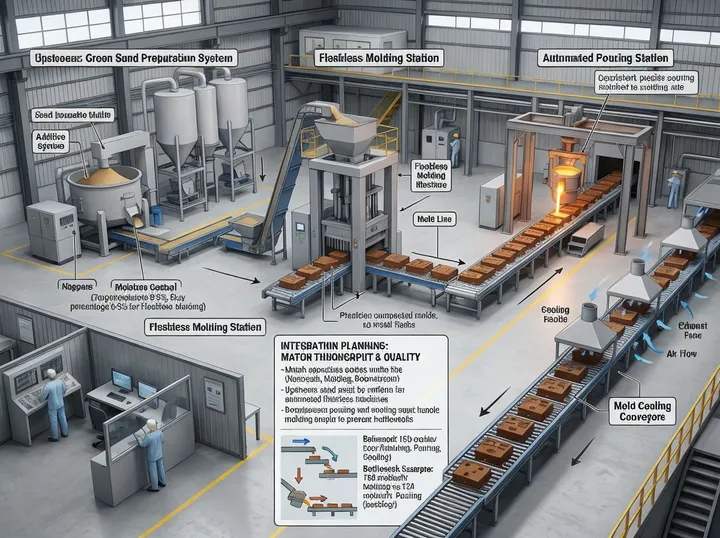
A flaskless molding line is one component in your complete production workflow. Understanding how it connects upstream and downstream prevents bottlenecks and ensures you get the throughput you're paying for.
Upstream, you need a sand preparation system that delivers consistent moisture content (3–5% by weight) and clay percentage (6–9% by weight) — the flaskless molding station can't compensate for inconsistent sand chemistry the way manual flask molding can. Downstream, you need automated pouring stations and mold cooling conveyors that match your molding line's output rate.
Bottleneck example: If your molding line produces 150 molds/hour but your pouring capacity tops out at 120 molds/hour, you'll build up a backlog of unmolded sand or have to slow down the molding station. Match every stage to your target throughput.
Your sand mixing system needs automated moisture control (typically a paddle mixer with inline moisture sensors and water injection valves), a clay addition system (screw feeders or pneumatic conveyors that dose fresh bentonite into the reclaimed sand stream), and pattern plate inventory with quick-change mounting interfaces. For PLC-controlled and fully automated systems, the sand preparation equipment should also connect to the molding line's PLC so moisture and clay adjustments happen automatically based on real-time sensor feedback.
Paddle mixer with inline moisture sensors and water injection valves. Maintains 3–5% moisture by weight for consistent mold compaction.
Screw feeders or pneumatic conveyors that dose fresh bentonite into the reclaimed sand stream. Target range: 6–9% clay by weight.
Sand preparation equipment connects to the molding line's PLC so moisture and clay adjustments happen automatically based on real-time sensor feedback.
Pattern plate inventory matters more for flaskless systems than for flask molding because pattern changes take longer — you're swapping the entire plate assembly, not just dropping a new pattern into an existing flask. Most buyers maintain 8–12 pattern plates for a mid-volume line, enough to cover their core product mix plus 2–3 plates for seasonal or custom orders.
| Item | Range | Notes |
|---|---|---|
| Per-plate cost | $800 – $1,500 | Depends on size & complexity |
| Recommended set size | 8 – 12 plates | Core mix + 2–3 seasonal/custom |
| Total plate budget | $10,000 – $18,000 | Complete set for mid-volume line |
Quick-change pattern plate mounting interface — reduces changeover downtime on flaskless lines.
Downstream integration connects your flaskless molding output to the rest of the casting workflow. Three systems must synchronize with the flaskless clay sand processing line:
Ladle transfer systems or automatic pourers that fill molds at consistent rates. Pouring precision directly affects casting quality and scrap rates.
Roller or chain conveyors that transport molds through a cooling zone before shakeout. Cooling time depends on casting weight and alloy — undersized cooling lines create bottlenecks.
Vibrating tables or drum shakeouts that separate castings from sand. Shakeout capacity must match or exceed the molding line's peak output to prevent queuing.
Mold ejection timing from the flaskless line must synchronize with pouring station availability. PLC-controlled systems handle this coordination automatically — the molding line pauses mold ejection if the pouring station isn't ready, preventing mold backlog on the transport conveyor.
For foundries running multiple molding technologies (clay sand, lost foam, resin sand), you can share sand reclamation equipment across lines if you install dual-filter modules that handle mixed sand types. This cuts your floor space and capital cost by 20–30% compared to dedicated reclamation for each line.
Explore sand reclamation & washing systemsfloor space & capital cost savings with shared reclamation
PLC-controlled flaskless lines can connect to your facility's SCADA system or MES (manufacturing execution system) for real-time production monitoring. The PLC exposes standard industrial protocols that integrate directly with your central monitoring infrastructure.
Widely supported across legacy and modern SCADA platforms. Direct register-level access to molding parameters and counters.
Platform-independent, secure protocol for modern MES environments. Structured data models for complex production analytics.
Real-time production data lets you pull mold counts, downtime events, and compaction pressure trends into your central monitoring dashboard. For multi-line facilities where production managers need to balance output across different molding stations, this data enables shifting orders to lines with available capacity — reducing idle time and maximizing throughput across your entire foundry floor.
The flaskless molding unit typically represents 40–50% of your total line cost. Budget the remaining 50–60% across four key subsystem categories to avoid scope gaps during procurement.
Sand Preparation
15–20%
Mullers, mixers, moisture control, and sand delivery systems sized to match your mold-per-hour target.
Pouring & Cooling
20–25%
Pouring stations, cooling conveyors, and heat extraction equipment to maintain cycle throughput.
Shakeout & Reclamation
10–15%
Vibratory shakeout decks, magnetic separators, and sand return loops for closed-circuit operation.
Installation & Commissioning
5–10%
Foundation work, mechanical assembly, electrical hookup, PLC integration, and startup tuning.
Complete Mid-Volume Line (100–150 molds/hr)
$280,000 – $380,000
Integrated sand preparation and reclamation included. Final cost varies by automation level and customization scope.
Related Systems for Complete Line Planning
How molds move from molding station to pouring line — and how quickly you can swap patterns — directly determines your effective throughput on mixed-product runs.
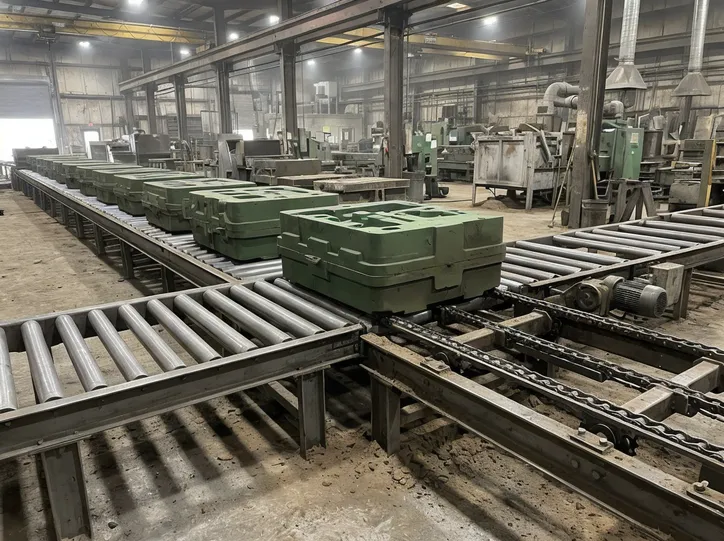
After ejection, molds move on roller or chain conveyors to your pouring station. The choice depends on mold weight, casting wall thickness, and foundry floor conditions.
| Parameter | Roller Conveyor | Chain Conveyor |
|---|---|---|
| Mold Weight Capacity | Under 50 kg | 50–150 kg |
| Transport Smoothness | Smoother, less vibration | More robust, tolerates impact |
| Best Application | Thin-wall castings (mold damage during transport causes defects) | Heavier molds in harsh environments (high temps, sand contamination, occasional impact) |
| Environment Tolerance | Clean-to-moderate conditions | High temperature, sand debris, tool/casting drops |
Common Mid-Volume Line Layout
Most mid-volume flaskless lines use roller conveyors for the first 3–5 meters (where molds are still fragile immediately after ejection), then transition to chain conveyors for the remaining transport to pouring and cooling zones. This hybrid approach balances mold protection with durability where conditions get harsher.
Pattern changeover speed is the hidden throughput multiplier on mixed-product runs. Three tiers exist — each with distinct cost, speed, and operator-involvement profiles.
Baseline
$12,000–$18,000
$45,000–$65,000
Faster pattern changes cost more upfront, but they reduce downtime on mixed-product runs. The math works when your pattern change frequency and hourly output value cross a specific threshold.
If you're changing patterns 3–4 times per shift, the time savings from pneumatic quick-change (8 minutes saved per change × 3 changes = 24 minutes per shift) adds up to 2–3 extra hours of production per week. Over a year, that's 100–150 additional production hours — enough to justify the quick-change investment if your hourly output value exceeds $120–$150/hour.
Quick-Change ROI Snapshot
Flaskless pattern plates need standardized mounting interfaces — bolt hole patterns, alignment pins, and clamping surfaces — that match your molding station's specifications. Most systems use ISO-standard mounting patterns:
| Mold Size Class | Mounting Grid | Typical Use |
|---|---|---|
| Small molds | 400mm × 300mm grid | Compact castings, valve bodies, fittings |
| Mid-size molds | 600mm × 500mm grid | Housings, brackets, medium structural parts |
| Specialized geometries | Custom mounting interfaces | Non-standard profiles, deep-draw patterns |
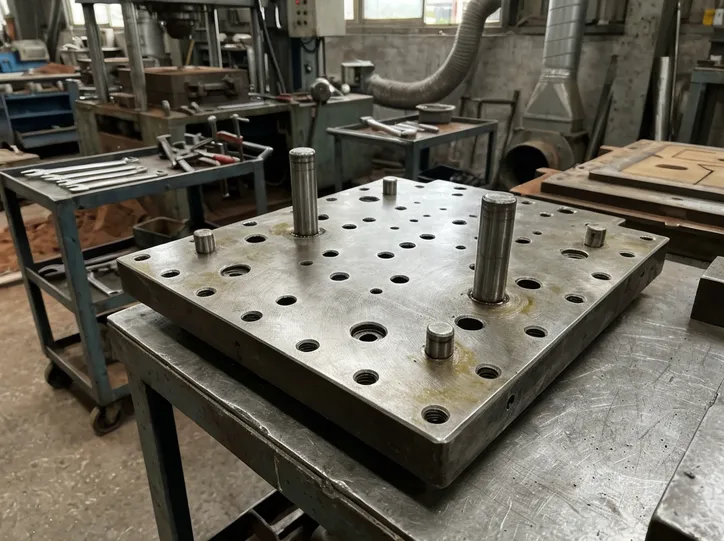
Pattern plates should be machined from wear-resistant materials matched to your production volume: cast aluminum for prototype and low-volume work, hardened steel for high-volume production. The compaction pressure (0.6–0.8 MPa) gradually wears the pattern surface over thousands of cycles — material selection directly affects pattern plate service life and per-mold cost.
Pattern plate with standardized mounting interface and hardened alignment pins
Alignment pin systems ensure the pattern plate seats in exactly the same position every time — critical for maintaining dimensional accuracy across pattern changes. The pins must be hardened steel with tight tolerances to prevent play during compaction.
Pin Hardness
HRC 58–62
Hardened steel requirement
Pin Clearance
±0.05mm
Tight tolerance to prevent play
Drift Risk
±1–2mm
With soft pins / loose tolerances
Cost-Cutting Caution
We've seen buyers try to save cost by using softer pins or looser tolerances — the result is ±1–2mm dimensional drift across a production run, which shows up as casting defects and customer complaints. The alignment pin system is not the place to cut corners. Hardened steel pins at ±0.05mm clearance are the minimum for repeatable flaskless mold quality.
From foundation prep to first production mold — what the deployment timeline actually looks like, and what your facility needs to have ready.
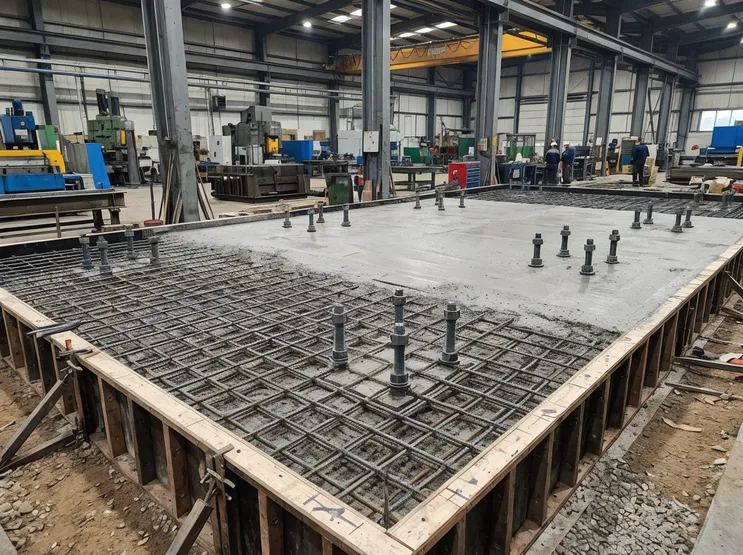
Foundation requirements start with a reinforced concrete slab at least 200mm thick with rebar reinforcement (12mm rebar on 200mm centers, both directions). Flaskless molding lines generate vibration from compaction rams and mold ejection mechanisms, so the foundation needs to absorb dynamic loads without cracking or settling.
Upper-Floor Installations
If you're installing on an upper floor, check your building's load rating — a mid-volume flaskless system weighs 10–14 tons fully loaded with sand and molds, and dynamic loads during compaction can spike to 1.8× static weight.
TZFoundry provides foundation drawings with anchor bolt locations and load distribution maps as part of the pre-shipment documentation package.
Valve bodies, pump housings, aerospace components — install vibration isolation pads under the molding station's mounting feet. Pads (typically neoprene or spring-isolated mounts) prevent vibration from propagating through the foundation and affecting adjacent equipment.
Cost: $800–1,200 for isolation pad set
For standard industrial castings, isolation pads aren't necessary — the concrete slab absorbs enough vibration on its own. Save the $800–1,200 and allocate it elsewhere in your installation budget.
This is longer than flask-based systems (which typically commission in 7–10 days) because the automation components require more setup and testing.
Total: Equipment Arrival → First Production Mold
Includes mechanical, electrical, and calibration phases
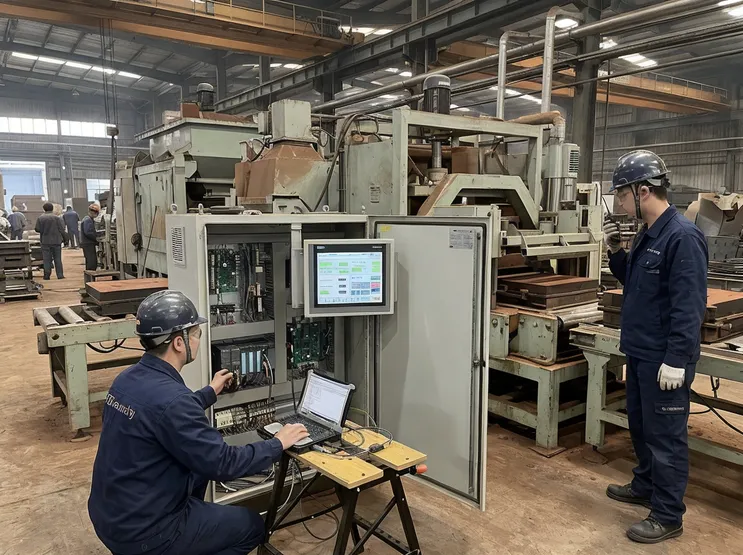
TZFoundry sends two technicians for commissioning — one mechanical specialist and one electrical/controls specialist. They stay on-site until your first production shift runs at target output rate with acceptable mold quality.
After commissioning, remote diagnostics handle most troubleshooting. PLC systems connect via VPN so TZFoundry engineers can log in, review process data, and diagnose issues without flying a technician to your facility.
China Business Hours (UTC+8)
4–8 hr response
Outside Business Hours
12–24 hr response
Operator training runs 3–5 days of hands-on instruction, structured around four core competency blocks. Training is entirely hands-on — your operators run the equipment under our technician's direct supervision until they're comfortable with all normal and exception scenarios.
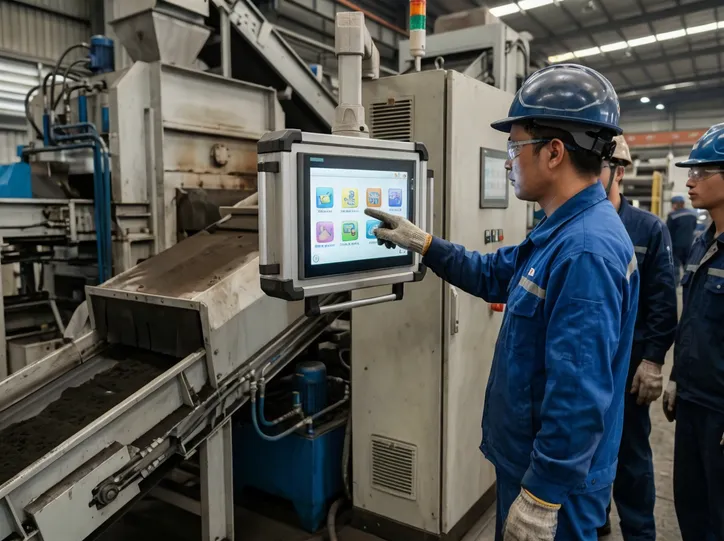
PLC interface navigation takes 1–2 days to learn for operators with basic computer skills. The touchscreen HMI uses icon-based menus — not text-heavy screens — so language barriers are minimal. Operators don't need to understand ladder logic or PLC programming; they just need to navigate menus, read alarm codes, and adjust setpoints within pre-defined ranges.
For buyers concerned about operator skill requirements: if your team can operate a smartphone, they can operate the HMI. The learning curve is shorter than traditional flask molding because the automation handles most of the decision-making that previously required experienced operators.
Flaskless HMI vs. traditional flask molding operator requirements
Icon-based HMI touchscreen — operators navigate menus without PLC programming knowledge.
Send us your facility layout and floor loading specs — we'll provide foundation drawings and a detailed installation timeline within 3 business days.
sales@tzfoundry.com — Foundation drawings returned in 3 business days
Multiple flaskless variants exist under our clay sand processing line category, and the choice depends on your automation needs and mold geometry. Here's how to navigate the options.
The Automatic Flaskless Clay Sand Processing Line includes robotic pattern change arms, parallel molding stations for 200+ molds per hour, and predictive maintenance sensors.
It's the right choice for 24/7 operations with narrow product mix (1–3 core mold designs) where labor cost per unit is your primary concern.
Typical Buyers
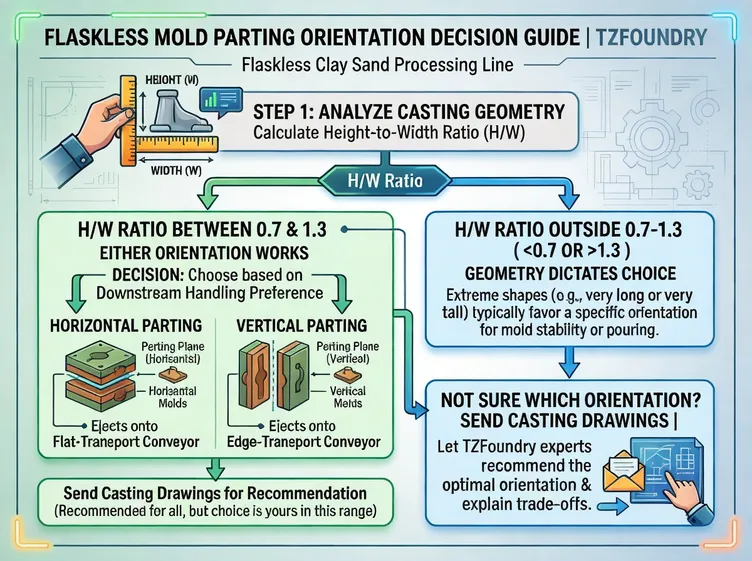
The Vertical Flaskless Clay Sand Processing Line works better for tall molds (height exceeds width by 1.5× or more) because the compaction force applies perpendicular to the parting plane, reducing the risk of mold distortion during ejection.
Common Applications
The Horizontal Flaskless Clay Sand Processing Line suits wide, flat molds (width exceeds height by 2× or more) because the mold's weight distributes evenly across the pattern plate during compaction.
Common Applications
If your casting's height-to-width ratio is between 0.7 and 1.3, either orientation works — choose based on your downstream handling preference:
Ejects molds onto edge-transport conveyors
Ejects molds onto flat-transport conveyors
If the ratio is outside that range, the geometry dictates the choice. Send us your casting drawings or current mold dimensions — we'll recommend the optimal parting orientation and explain the trade-offs.
The page you're reading covers the general flaskless concept and helps you understand the technology. The sibling product pages above focus on specific automation levels (Automatic) or parting orientations (Vertical, Horizontal).
Still Deciding?
If you're still choosing between semi-automatic, PLC-controlled, and fully automated configurations, stay on this page and review the Capacity Configurations section above.
Already Decided?
If you've already decided on automation level and need to specify parting orientation, navigate to the Vertical or Horizontal pages.
Concrete cost math, capacity thresholds, and operational trade-offs to help you decide whether a flaskless clay sand processing line fits your foundry.
80–100 molds per hour running at least two shifts daily (1,600–2,000 molds per day). Below that threshold, the labor savings from eliminating flask handling don't justify the 30–40% price premium over flask-based systems.
Labor Saved
~1 Operator
per shift eliminated
Fully Loaded Cost
$22–28/hr
per operator
Daily Savings (2 Shifts)
$176–224
per operating day
Annual Savings
$44K–56K
labor cost reduction
Typical flaskless price premium at 100 molds/hour capacity is $80,000–$100,000. With $44K–$56K annual labor savings, payback happens in 18–22 months.
Below 80 molds per hour or single-shift operation, payback extends beyond 36 months — at which point flask-based molding makes more financial sense.
Yes, but with limitations. Flaskless technology works best for production runs with fewer than 5 pattern changes per shift. If you're running job-shop work with 10+ pattern changes per shift, the cumulative downtime from pattern swaps — even with pneumatic quick-change — erodes the cycle time advantage that flaskless provides.
| Change Method | Change Time | Added System Cost |
|---|---|---|
| Manual (semi-automatic systems) | 8–12 min | Base cost |
| Pneumatic quick-change | 60 sec | +$12,000–$65,000 |
| Robotic pattern change | 30 sec | +$65,000+ |
| Flask-based (drop-in patterns) — reference | 3–5 min | N/A |
Real-world note: TZFoundry has built flaskless lines for buyers with frequent changeovers, but they typically invest in pneumatic or robotic pattern change systems to minimize downtime — which adds $12,000–$65,000 to system cost depending on automation level. For job shops with 10+ daily changeovers, discuss your pattern mix with our engineers to model the true cost-benefit before specifying a system.
Flaskless systems have fewer wear parts — no flask handling mechanisms, no flask alignment guides, no flask storage racks — but the automation components (sensors, pneumatic cylinders, PLC modules) require more skilled maintenance.
$8,000–12,000 /year
Annual maintenance for a mid-volume flaskless line includes:
Requires
Technicians with PLC troubleshooting skills and pneumatic/hydraulic experience
$6,000–9,000 /year
Annual maintenance for an equivalent flask-based system includes:
Requires
General foundry mechanics — no specialized automation skills needed
The Key Difference
If your facility already has automation maintenance capability (for other PLC-controlled equipment), flaskless maintenance integrates easily into existing workflows. If you're running mostly manual equipment, budget for training or outsourced maintenance support — this is a real cost factor that affects your first-year ROI calculation.
400×300mm to 800×600mm is the typical range for standard flaskless configurations. Outside this window, the economics shift significantly.
Smaller molds don't justify flaskless technology — the cycle time advantage disappears because mold handling time becomes negligible, and flask-based molding is more economical at this scale.
The sweet spot for standard flaskless configurations. Best balance of cycle time advantage, system cost, and mold quality. Most production castings in this size range benefit directly from flaskless technology.
Larger molds require custom engineering because the compaction force needed to achieve uniform density increases exponentially with mold area. TZFoundry has built flaskless systems for 1000×800mm molds, but they require:
Cost impact: Adds 40–60% to system cost and extends lead time by 2–3 weeks for engineering and fabrication. Discuss your requirements with our engineering team to determine if flaskless is the right approach for oversize molds.
PLC interface training is required (3–5 days of hands-on instruction), but daily operation is simpler than traditional flask molding once trained. Operators need to understand PLC touchscreen navigation — menu selection, setpoint adjustment, alarm code interpretation — but they don't need programming skills or advanced technical knowledge.
HMI Interface Design
The HMI uses icon-based menus and color-coded status indicators, making the interface intuitive even for operators with limited computer experience:
Skill Gap: Flask-Based vs. Flaskless
Flask-based molding relies on operator judgment:
Flaskless molding automates those decisions via PLC control:
Operators shift from hands-on control to exception handling — intervening only when the PLC flags an out-of-spec condition (moisture too high, compaction pressure insufficient, mold ejection timing error). This actually reduces the skill requirement for routine operation but increases the need for troubleshooting skills when exceptions occur.
Training outcome: We provide 3–5 days of training that covers both normal operation and exception scenarios. Most operators are comfortable running the line independently by the end of the training period.
Have a question not covered here?
Contact our engineering team for technical consultation on flaskless clay sand processing line specifications, integration requirements, or ROI analysis for your specific production scenario.
We've been building clay sand processing equipment since 2010, and the shift to flaskless technology happened because export buyers needed higher throughput with consistent quality — manual flask handling couldn't scale beyond 120–150 molds per hour without adding operators. Our first complete flaskless line shipped to a European buyer in 2017 for automotive component production (transmission housings, 180 molds per hour, ±0.5 mm tolerance requirement).
That line is still running in their facility with the same core equipment, producing 195 molds per hour with 96% uptime. What we learned from that project: flaskless technology pays off when buyers prioritize throughput and consistency over flexibility, and the automation needs to be robust enough to run 24/7 without constant intervention.
European automotive foundry installation — running since 2017 with original core equipment.
Since 2010
Clay sand processing equipment manufacturing experience
195 molds/hr
Proven throughput on a 2017-installed European line still in operation
96% Uptime
Long-term operational reliability on 24/7 production schedules
Our in-house engineering team handles custom capacity configurations and control system programming without outsourcing design work. When you need non-standard mold sizes, different parting plane orientations, or integration with unusual upstream equipment (custom sand mixers, specialized pouring systems, legacy reclamation equipment), we're modifying our own designs — not coordinating between multiple vendors who each have their own lead times and compatibility issues.
This matters most when you're adapting a flaskless line to fit an existing foundry layout with space constraints or utility limitations. We've built systems that fit 16 m × 10 m floor spaces (normally we'd spec 20 m × 12 m for that capacity) and systems that run on 380V three-phase power instead of our standard 415V (because that's what the buyer's facility provided).
Non-Standard Mold Sizes
Custom parting plane orientations
Compact Floor Plans
16m × 10m fitted layouts for tight facilities
Voltage Adaptation
380V, 415V, or site-specific power standards
Legacy Integration
Custom mixers, pouring & reclamation hookups
ISO 9001:2015, CE, and SGS certifications mean our manufacturing process gets audited annually by third-party inspectors who verify material sourcing, fabrication procedures, assembly quality, and testing protocols. The certifications themselves don't make the equipment better, but they create a paper trail that satisfies your own quality audits and customer requirements.
If you're selling castings to automotive or aerospace buyers who require supplier traceability, you'll need to show that your foundry equipment came from a certified manufacturer. We provide the documentation package (material certs, test reports, calibration records, PLC program backups) with every system shipment.
Material Certificates
Full traceability for steel, castings, and critical components
Test Reports
Factory acceptance testing and performance verification data
Calibration Records
Instrument and sensor calibration documentation
PLC Program Backups
Complete control system software for maintenance and recovery
Our 15,000-square-meter facility runs 8 production lines producing 500,000 units annually. That capacity determines our lead time stability — we're not a job shop that gets backlogged when a large order comes in.
A typical flaskless line order (mid-volume PLC-controlled configuration) consumes about 4–5 weeks of production time across multiple lines (frame fabrication, machining, electrical assembly, PLC programming, factory testing). We can run 4–6 systems in parallel, so even with a queue of orders, your lead time stays in the 45–60 day range.
Smaller manufacturers often quote shorter lead times but then push your delivery when they get a bigger order — we've seen buyers wait 90–120 days after being promised 30.
Every flaskless line ships in standard 20-foot or 40-foot containers without requiring custom crating or oversized freight. Equipment frames break down into modules that clear container door dimensions (2.3 m width, 2.4 m height), then bolt together on your factory floor using standard hand tools.
A mid-volume flaskless line fits in two 40-foot containers with room for spare parts kits and tooling.
Standard container shipping costs 40–60% less than break-bulk or oversized freight. Customs clearance is faster — standard containers clear in 3–5 days, while oversized shipments can take 10–15 days depending on port regulations.
No special permits, no wide-load escorts, no port surcharges.
VPN access to your PLC lets us review process data and diagnose 70–80% of issues without a site visit. Most problems are resolved within hours, not days.
Parts stocked at our Qingdao facility with 5–7 day DHL/FedEx shipping to most export markets. No waiting for custom-machined replacements.
Available if remote support doesn't resolve the issue — you cover travel costs, we cover labor. Typically needed only for major component replacement or capacity modifications, not routine troubleshooting.
Most buyers never need an on-site visit after initial commissioning. The combination of operator training, detailed documentation, and remote diagnostics handles the majority of issues. When we do send a technician, it's usually for compaction cylinder rebuilds, PLC module swaps, conveyor system upgrades, or capacity modifications — not routine troubleshooting.
ISO 9001:2015 Certified Manufacturer
Email sales@tzfoundry.com or WhatsApp +86 13335029477 with your production requirements:
We'll respond within 24 hours with preliminary configuration recommendations and pricing, followed by a detailed proposal within 3–5 business days after clarifying technical questions.
Browse related systems from the Clay Sand Processing Line category.
Fully automated flaskless molding with integrated controls.
Vertical parting flaskless technology for high-speed production.
Horizontal parting for larger mold dimensions and flexibility.
Complete clay sand molding systems for diverse casting needs.
Recover and recycle used clay sand to reduce raw material costs.
End-to-end casting line solutions with integrated pouring and cooling.