ISO 9001:2015 Certified Manufacturer

Clay Sand Molding Line — The Production Rate Engine

A clay sand molding line is the mold-making station within your clay sand processing system — the component where prepared sand gets compacted into mold shapes. It's not a complete processing line (that includes reclamation and washing), but it's the rate-determining piece of equipment in your foundry.

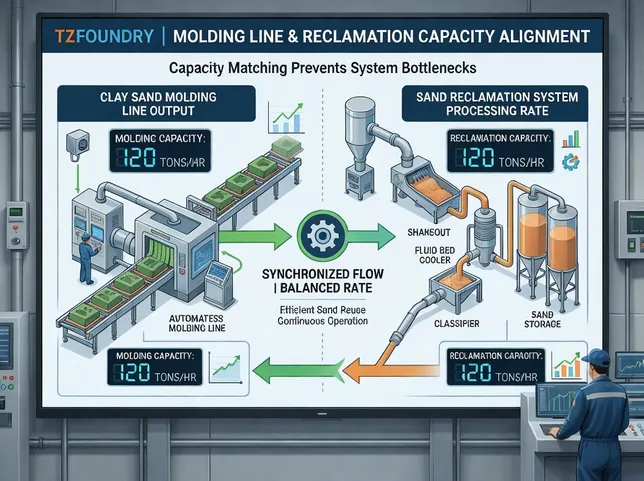
If your molding line produces 150 molds per hour but your reclamation system only processes 120 molds' worth of sand, you'll either build up a backlog of used sand or slow down molding to match reclamation capacity.

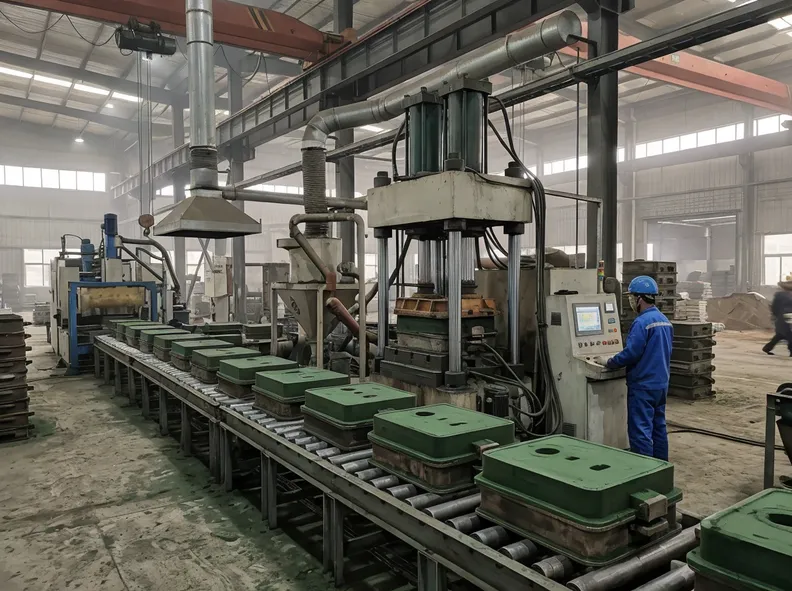
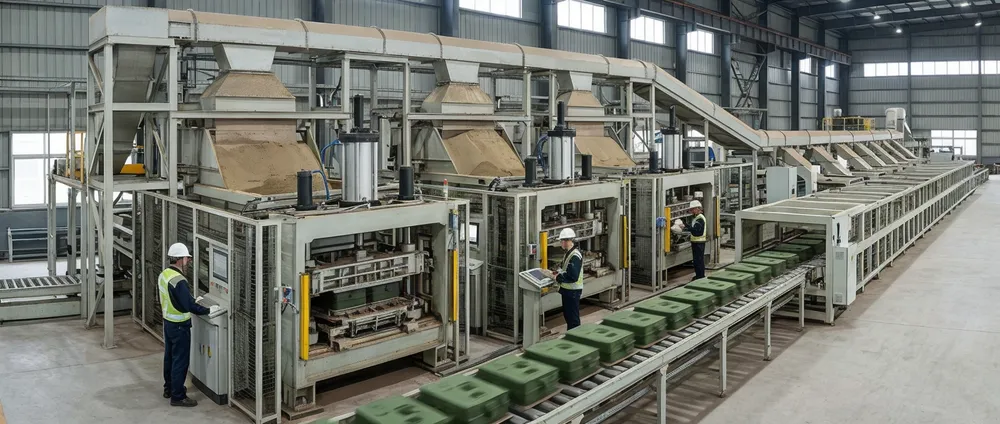
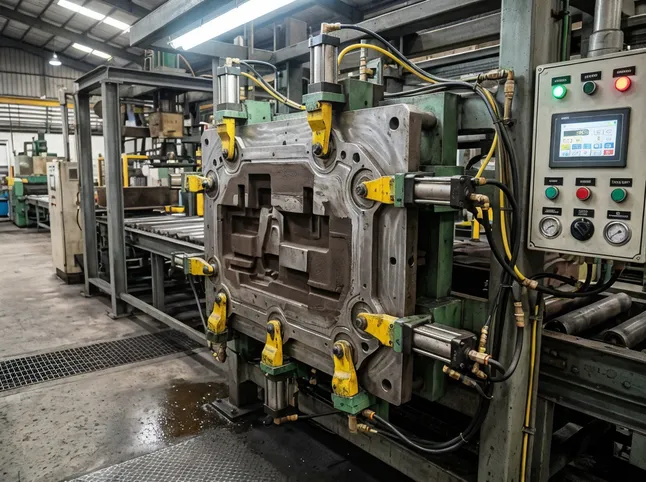
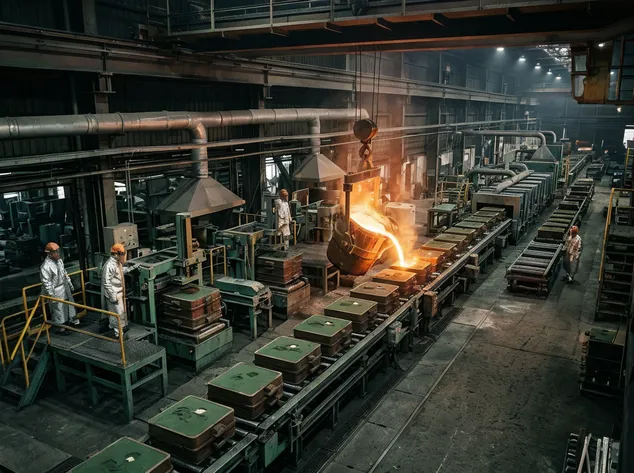
TZFoundry clay sand molding line — hydraulic compaction system with PLC automation, producing precision molds at 50–200+ molds per hour

Three Connected Decisions When Specifying a Molding Line

When you're specifying a molding line, you're making three connected decisions that determine your cycle time, mold quality consistency, floor space requirements, and operator skill needs.

Production Capacity

How many molds per hour — from 50 molds/hr for small-batch work to 200+ molds/hr for high-volume production.

Compaction Method

Hydraulic, servo, or pneumatic — each with different tolerance profiles, maintenance characteristics, and capital costs.

Automation Level

Manual control, PLC, or full automation — determining whether your operators run the equipment or monitor it.

Cost vs. Performance Trade-Off

A 50-mold-per-hour hydraulic system with manual controls costs about 40% of what a 200-mold-per-hour pneumatic system with full PLC automation costs — but the cheaper system won't hold ±0.5mm tolerance across a 12-hour shift, and it needs operators who can adjust compaction pressure by feel rather than by reading a touchscreen.

Three Capacity Tiers — Not Just Speed Differences

We build molding lines in three capacity ranges. The equipment differences between these tiers aren't just about speed — they're about control precision, pattern changeover time, and whether your operators are running the equipment or monitoring it.

Small-Batch

50–100 Molds/Hour

  • Manual or basic PLC control
  • Lower capital investment entry point
  • Requires skilled operators for pressure adjustment
Most Popular
Mid-Volume

100–200 Molds/Hour

  • PLC-controlled operation
  • Balances capital cost against operational flexibility
  • Most export buyers start here
High-Volume

200+ Molds/Hour

  • Full automation — operators monitor, not run
  • Highest control precision and consistency
  • Add capacity when order volumes justify it

Most export buyers start with mid-volume configurations because they balance capital cost against operational flexibility, then add capacity later if order volumes justify it.

System Sizing & Downstream Compatibility

Your molding line's output rate must match your downstream reclamation capacity and your upstream sand preparation throughput. We size complete systems so reclamation runs at 110–120% of molding output (buffer capacity for peak periods), and sand preparation delivers consistent moisture and clay content to keep molding cycle times stable.

If you're buying just the molding line to integrate with existing equipment, send us your reclamation capacity and sand prep specs so we can verify compatibility before we finalize the configuration.

Send Specs for Compatibility Check

Matching Principle

1

Sand Preparation (Upstream)

Delivers consistent moisture & clay content for stable cycle times

2

Molding Line (This Equipment)

Your production rate baseline — 50 to 200+ molds/hour

3

Reclamation (Downstream)

Must run at 110–120% of molding output for peak-period buffer

Capacity Planning

Capacity Configurations — Matching Throughput to Your Production Needs

Clay sand molding lines scale across three capacity ranges, and the right choice depends on your order volume patterns, shift structure, and product mix. Undersizing creates bottlenecks that force you to run overtime or turn down orders. Oversizing wastes capital on equipment that sits idle and burns energy even when you're not producing. The capacity decision also locks in your compaction method and automation level — you can't get 200 molds per hour from a hydraulic system, and you can't justify PLC control if you're only running 60 molds per hour.

Small-Batch Configuration

50–100 Molds / Hour

45 kW
12m × 8m
2 Operators

This setup uses hydraulic compaction with manual sand feeding and single-operator control. The molding station handles pattern changes manually, so you can switch mold designs in 8–12 minutes depending on pattern complexity. Compaction pressure is set via a hydraulic valve — your operator adjusts it based on mold size and sand moisture, then monitors output quality and tweaks as needed.

Cycle time runs 45–60 seconds per mold for a 500mm × 400mm flask (pattern insertion, sand filling, compaction, mold ejection).

This configuration makes sense when you're running 1–2 shifts with frequent product changeovers — job shops, prototype foundries, or contract manufacturers serving multiple clients with different mold geometries.

Trade-off — Compaction Consistency: Pressure varies ±5% across a shift (operator adjustment plus hydraulic system drift), which translates to ±0.7mm dimensional variation in finished molds. If your castings tolerate that range, you're fine. If not, step up to servo compaction.
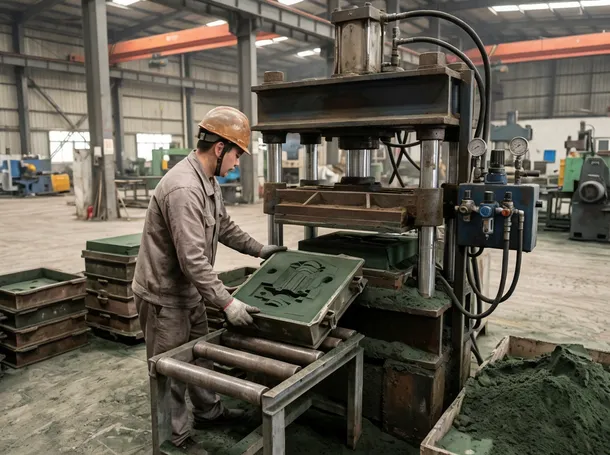
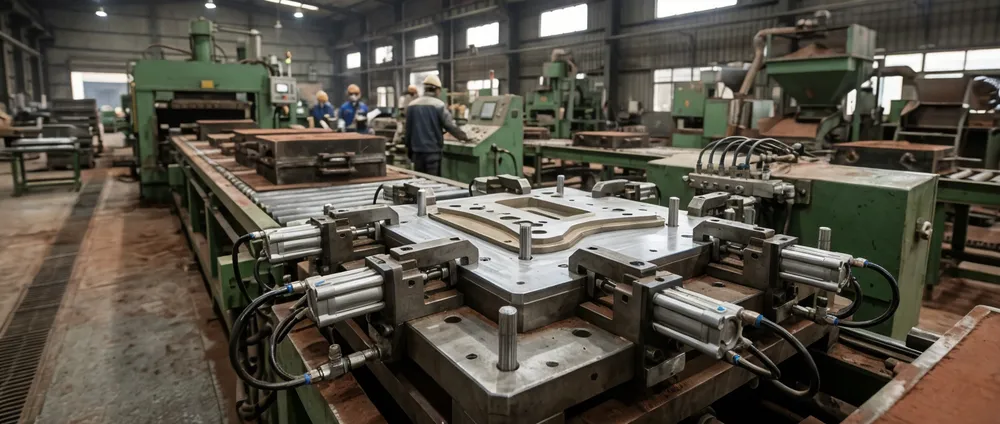
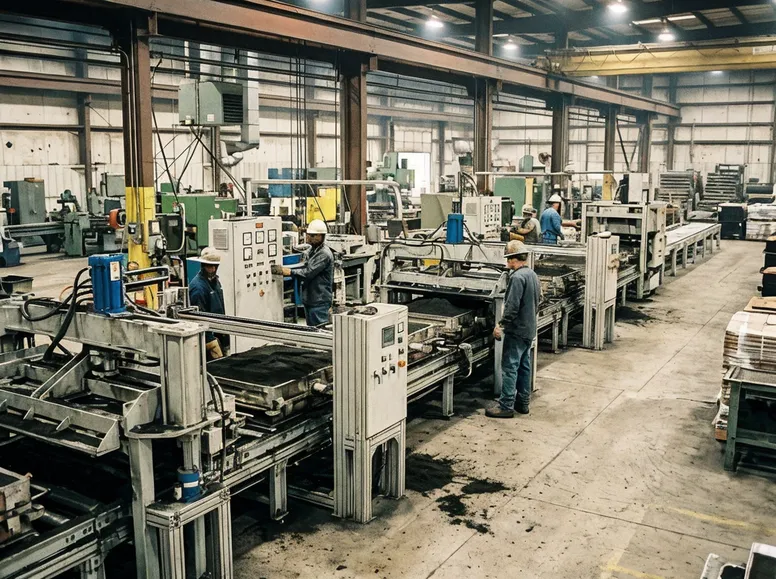
Small-batch hydraulic clay sand molding station — 50 to 100 molds per hour configuration with manual pattern changeover

Floor Space Requirements

The 12m × 8m footprint includes the molding station, pattern storage racks (holds 6–8 pattern sets), and mold output conveyor. You'll need an additional 3–4 meters of clearance on the operator side for pattern handling and maintenance access. Ceiling height requirement is 3.5 meters minimum (the compaction ram extends 2.8 meters at full stroke, plus overhead clearance for lifting patterns in and out).

Smallest footprint of the three tiers — ideal for retrofitting into existing foundries with limited room.

Energy Cost per Mold

Energy cost per mold runs about $0.08–$0.10 at typical industrial electricity rates ($0.12/kWh), which includes compaction, sand feeding, and conveyor operation.

Over a single-shift day producing 400 molds, that's $32–$40 in electricity.

Labor Cost Comparison

Labor cost is higher relative to output than mid-volume systems because you're running two operators for 50–100 molds/hour instead of the same headcount for 100–200 molds/hour.

At $15/hour per operator, you're spending $0.30–$0.60 per mold on direct labor (versus $0.15–$0.30 for mid-volume configurations).

Maintenance Intervals

Daily

Lubrication of the compaction ram and pattern guide rails — 15 minutes.

Weekly

Hydraulic fluid level checks and belt tension inspection — 1 hour.

Quarterly

Hydraulic filter replacement and ram seal inspection — 4 hours with production shutdown.

The hydraulic system is the highest-maintenance component — seals wear from repeated cycling, and hydraulic fluid degrades from heat and contamination.

Annual Consumables Budget

Hydraulic consumables (fluid, filters, seals) $800–1,200
Conveyor belts & drive components $400–600
Total annual consumables $1,200–1,800

Upgrade Path — PLC Retrofit

You can retrofit PLC control to this system later without replacing the core hydraulic compaction equipment. The upgrade adds:

  • Touchscreen HMI
  • Automated sand feeding
  • Pressure data logging
Cost $15,000–18,000
Downtime 5–7 days
Important Limitation

You cannot upgrade to servo or pneumatic compaction without replacing the entire molding station — different frame structure, different actuator mounting. If you think you'll need faster cycle times or tighter tolerance control within 3–5 years, start with mid-volume instead of planning to upgrade.

Mid-Volume

100–200 Molds/Hour Configuration

PLC-controlled servo compaction for precision casting production.

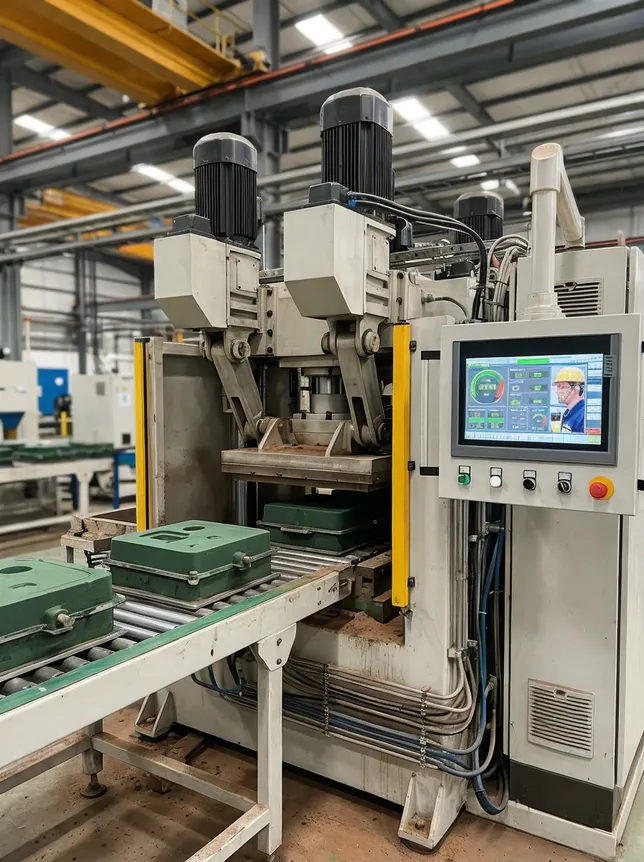
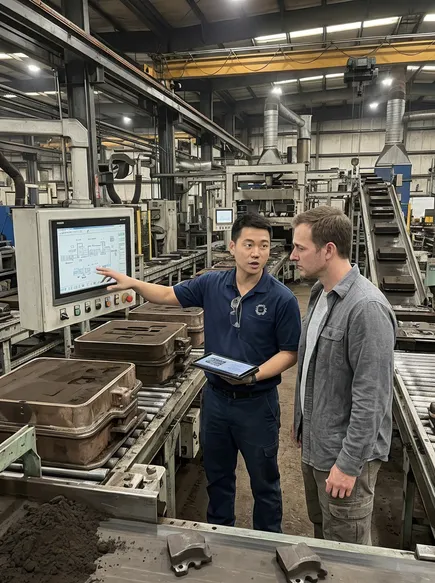
Mid-volume clay sand molding station with servo-driven compaction and PLC control panel, producing 100-200 molds per hour

PLC control enters at this tier, which means automated sand feeding, real-time pressure monitoring, and programmable compaction cycles. The molding station uses servo-driven compaction instead of hydraulic — the servo motor responds in milliseconds to pressure feedback, so it holds compaction force at ±2% of setpoint across an entire shift.

That translates to ±0.3mm dimensional variation in finished molds, which is tight enough for most precision casting work — pump housings, valve bodies, automotive components.

±0.3mm Mold Tolerance
30–40s Cycle Time
85 kW Power Demand
18×12m Footprint

Faster Cycle Times

Cycle time drops to 30–40 seconds per mold because the servo system ramps pressure faster than hydraulic cylinders and doesn't need manual operator adjustment between cycles.

20-Recipe PLC Storage

The PLC stores up to 20 mold recipes — pattern size, compaction pressure, dwell time, ejection speed — so switching between products is a touchscreen tap instead of a 10-minute manual setup. Pattern changes still happen manually, but the PLC guides the operator through the sequence and won't start the next cycle until sensors confirm the new pattern is seated correctly.

Operator Role Shift

You'll still run two operators per shift, but their role shifts from manual control to exception handling — they intervene only when the PLC flags an out-of-spec condition: sand moisture too high, compaction pressure not reaching target, pattern misalignment. This frees them to handle secondary tasks like quality sampling, pattern maintenance, and coordination with upstream sand prep and downstream pouring operations.

Energy Efficiency

Power demand hits 85 kW — servo motors draw more peak power than hydraulic pumps, but they're more efficient over a full shift because they only consume energy during active compaction. The 18m × 12m footprint accommodates the additional PLC cabinet, servo drive enclosures, and automated sand feed conveyors.

PLC Data Logging & ISO 9001 Traceability

Quality System Integration

The PLC's data logging integrates with ISO 9001 quality systems — critical if you're exporting castings to buyers who audit your production records. Every mold gets a timestamp, batch number, and process parameter record (compaction pressure, cycle time, sand moisture at time of molding). If a casting fails in service and the buyer wants traceability, you can pull up the exact conditions under which that mold was made.

12 months

Internal data storage (~2 GB)

CSV / PDF

Export formats for archival

Per-mold

Granular parameter records

Best-Fit Profile: Mid-Volume Configuration

This configuration suits foundries running 2–3 shifts with moderate product variety (5–10 core mold designs that rotate based on order schedules). It's the most common choice for export buyers because it balances capital cost against operational flexibility.

Upgrade Economics
  • Upgrade cost from small-batch to mid-volume: ~60% more than base system price
  • Energy cost per mold drops 20–25% — servo system optimizes compaction cycles, no wasted energy holding pressure
  • Mold rejection rate drops from 3–5% to under 1% — tighter tolerance control means fewer molds break during handling
ROI Payback Math
At 1,200 molds/day, rejection drop from 4% → 1% saves 36 molds/day
At $8–12 per mold (material + labor): $288–432 daily savings, or $8,640–12,960/month

Price premium over small-batch: $40,000–50,000 — payback in 4–6 months from quality improvement alone, before energy savings and faster cycle times.

Most buyers recover the premium within 18–24 months of continuous operation when factoring all savings combined.

Remote Diagnostics — Standard on Mid-Volume Systems

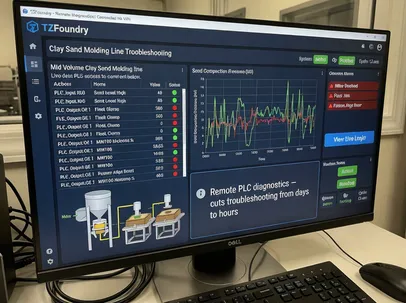
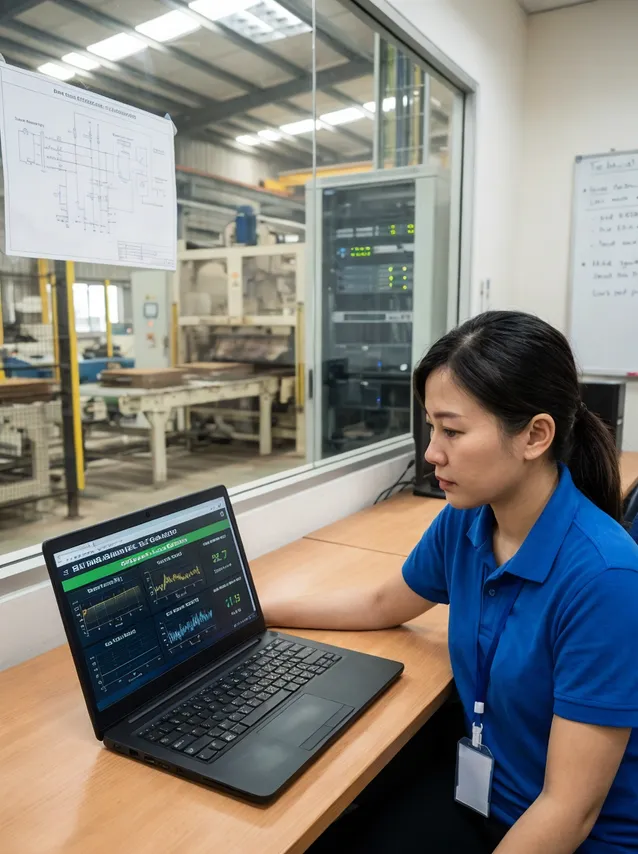
Our technicians can log into your PLC via VPN and see the same data your operators see on the factory floor — real-time pressure curves, cycle time trends, alarm history, sensor status. When you report a problem (say, inconsistent mold strength or longer-than-normal cycle times), we can review the last 48 hours of process data, identify the parameter drift, and walk your team through the fix over a phone call.

Common example:

Sand moisture creeping up due to a partially clogged water valve in your upstream sand preparation system. Remote review catches the drift pattern — your team fixes the valve, line runs clean within hours instead of waiting days for a site visit.

TZFoundry remote diagnostics interface showing real-time PLC data access via VPN for mid-volume clay sand molding line troubleshooting

Remote PLC diagnostics — cuts troubleshooting from days to hours

High-Volume Configuration (200+ Molds/Hour)

Full automation — sand moves through the system on enclosed conveyors, molding stations run in parallel (typically 2–3 stations), and pattern changes happen pneumatically in under 60 seconds. This setup is for foundries running 24/7 production with narrow product ranges (1–3 mold designs that rarely change). The system includes predictive maintenance sensors on all rotating equipment (vibration monitors on motors, temperature sensors on bearings, pressure transducers on pneumatic lines), so you get 48-hour advance warning before a component fails.

Cycle Time

18–25 seconds

Including pattern insertion & mold ejection

Footprint

25m × 15m

Three-station configuration

Power Demand

150 kW

Full system including conveyors

Operators Per Shift

3

One per station — pattern changes & quality checks

TZFoundry high-volume clay sand molding line — three-station parallel configuration producing 200+ molds per hour with enclosed conveyor system

Pneumatic Compaction

Compaction uses pneumatic actuators instead of servo motors — faster response time (18–25 second cycle including pattern insertion and mold ejection) and simpler maintenance (no gearboxes or drive electronics to service).

The trade-off: pneumatic systems need a reliable compressed air supply at 0.8–1.0 MPa and 4–6 cubic meters per minute. If your facility doesn't already have that capacity, you'll need to install a dedicated air compressor (adds $12,000–15,000 to the system cost).

Multi-Station PLC Coordination

The PLC coordinates all three stations to maintain consistent output even when one unit pauses for pattern swaps — if Station 1 stops for a pattern change, Stations 2 and 3 temporarily increase their cycle speed to keep total output stable.

Three operators per shift: one per molding station overseeing pattern changes and quality checks, plus coordination with upstream sand prep and downstream pouring.

Proven Reliability

±0.5mm Mold Tolerance Across 12-Hour Shifts at 200+ Molds/Hour

This configuration costs roughly 2.5× the small-batch system, but it's the only option that holds ±0.5mm mold tolerance across 12-hour shifts at 200+ molds per hour. The closed-loop automation eliminates operator variability — every cycle runs at exactly the same parameters.

The predictive maintenance system catches bearing wear, belt degradation, and pneumatic seal leaks before they cause unplanned downtime. We built one of these for a European buyer in 2015 — it's still running at their facility, producing 220 molds per hour with 98% uptime.

220

Molds/Hour

98%

Uptime

±0.5mm

Tolerance

48hr

Failure Warning

Per-Unit Economics at High Volume

Cost Component Per Mold Notes
Energy $0.05–0.06 Fixed loads (PLC, conveyors, lighting) amortized across higher output
Labor $0.10–0.15 3 operators producing 1,600–2,000 molds per shift

Payback Calculation vs. Mid-Volume Configuration

If you're producing 5,000 molds per day, the $0.15–0.20 per-mold savings versus mid-volume configuration adds up to $750–1,000 daily, or $22,500–30,000 monthly.

$80,000–100,000

Price premium over mid-volume

3–4 Months

Payback period at 5,000 molds/day

Maintenance Requirements Scale with Complexity

Multi-station configurations require proportionally more servicing attention

Maintenance requirements increase with complexity — you're servicing three molding stations instead of one, plus the coordination PLC and inter-station conveyor systems.

30–40 min Daily Checks Lubrication, sensor calibration, pneumatic line inspection across all stations
4–5 hours Weekly Inspections Full system review and component wear assessment
16–20 hours Quarterly Overhauls Schedule during planned maintenance windows

Recommended Spare Parts Inventory

A single component failure can idle one-third of your production capacity. We recommend keeping these on-site to eliminate the risk of a 2–3 week production loss waiting for parts to ship and clear customs:

  • 1× spare pneumatic actuator
  • 1× spare PLC module
  • 1× spare conveyor drive motor

Total inventory cost: $8,000–$10,000 — a fraction of the production loss risk it eliminates.

Capacity Matching with Reclamation

Your molding line's output rate must align with your reclamation system's processing capacity. If you're producing 150 molds per hour and each mold uses 25 kg of sand, you're generating 3,750 kg of used sand per hour. Your reclamation system needs to process at least 3,750 kg/hour to keep pace.

We recommend sizing your reclamation system at 110–120% of molding output (4,100–4,500 kg/hour in this example) to maintain buffer capacity during peak periods or when reclamation efficiency drops slightly due to high sand contamination.

Quick Sizing Formula

Molds/hr × Sand per mold (kg) = Minimum reclamation capacity
Min. capacity × 1.1 to 1.2 = Recommended reclamation capacity
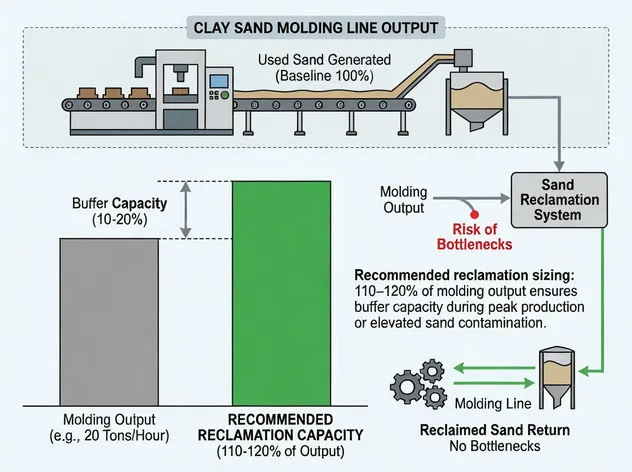
Diagram showing molding line output capacity aligned with reclamation system processing rate

Molding-to-reclamation capacity alignment prevents system bottlenecks

Need to match with existing reclamation equipment?

Send us your reclamation unit's rated capacity so we can verify it won't become a bottleneck when paired with your new molding line.

View Reclamation Lines
Compaction Technology

Compaction Methods — Hydraulic, Servo, or Pneumatic

The compaction method determines your cycle time, mold quality consistency, and maintenance requirements. Hydraulic systems are the simplest and cheapest but require operator skill to maintain consistent output. Servo systems add precision and automation at moderate cost increase. Pneumatic systems are the fastest but need compressed air infrastructure and are only cost-effective at high production volumes.

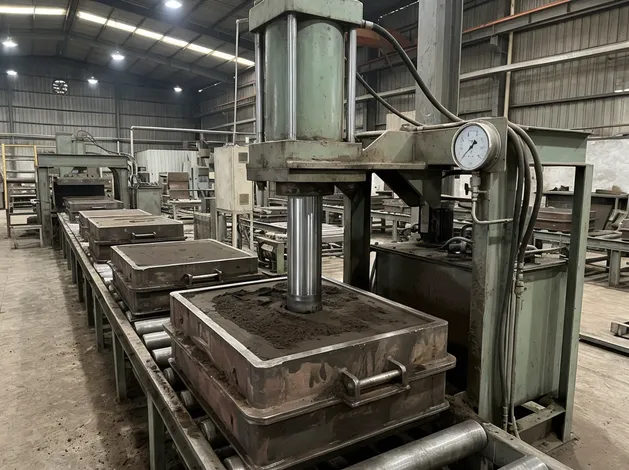
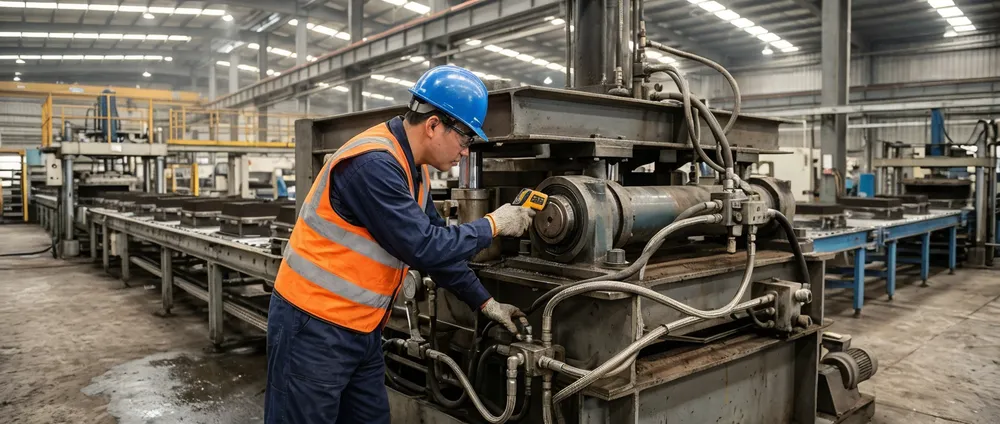
Hydraulic compaction system on a clay sand molding line showing the hydraulic cylinder, compaction ram, and pressure gauge

Hydraulic — Quick Specs

Cycle Time
45–60 sec/mold
Pressure Variation
±5%
Dimensional Tolerance
±0.7 mm
Annual Maintenance
$1,200–$1,800
Fluid Replacement
Every 18–24 months

Hydraulic Compaction

Hydraulic compaction uses a hydraulic cylinder to drive the compaction ram. The operator sets target pressure via a manual valve, and a pressure gauge shows real-time force during the compaction stroke. Cycle time is 45–60 seconds per mold because hydraulic fluid flow rate limits how fast the ram can extend and retract. Compaction pressure varies ±5% across a shift due to hydraulic fluid temperature changes (viscosity drops as fluid heats up, which affects flow rate and pressure response), operator adjustment between cycles, and gradual seal wear that causes minor pressure leaks.

What ±5% Pressure Variation Means for Your Castings

That ±5% pressure variation translates to ±0.7 mm dimensional variation in finished molds. For most gray iron and ductile iron castings, that's acceptable — the machining allowance on raw castings is typically 2–3 mm, so ±0.7 mm mold variation doesn't affect final part dimensions after machining. For precision work (thin-wall castings, aluminum or bronze parts where surface finish drives pricing, aerospace components with tight tolerances), hydraulic compaction won't meet your quality requirements.

Maintenance Schedule & Costs

Daily

Check fluid level and ram seal condition — look for oil leaks around the cylinder.

Weekly

Inspect hydraulic hoses and fittings. Replace any showing cracking or seepage.

Quarterly

Hydraulic filter replacement — costs $80–$120 per filter.

Annual

Ram seal replacement — $300–$400 in parts plus 4–6 hours labor.

Hydraulic fluid full replacement every 18–24 months — approximately 60–80 liters per system, costing $200–$300 for quality hydraulic oil. Total annual maintenance cost: $1,200–$1,800.

The Simplicity Advantage

Hydraulic systems have fewer electronic components to fail, and most foundry maintenance teams already know how to service hydraulic equipment — it's the same technology used in melting furnaces, ladle handling systems, and mold handling cranes. If you're in a region where PLC technicians are scarce or expensive, hydraulic compaction reduces your dependency on specialized service providers.

Servo Compaction — Precision Through Real-Time Motor Control

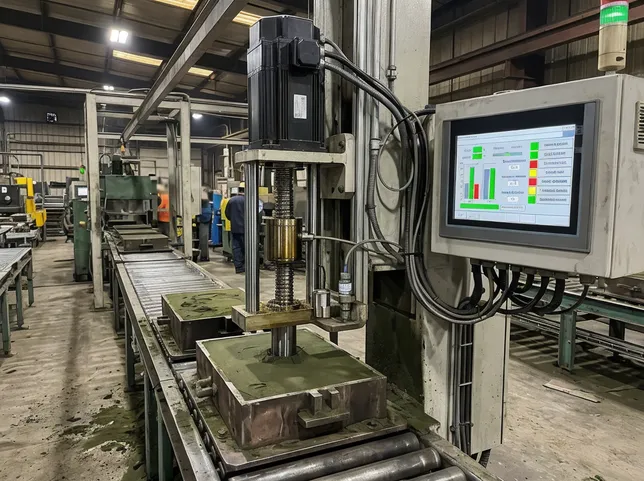
Servo compaction uses an electric servo motor driving a ball screw or rack-and-pinion mechanism to move the compaction ram. The PLC controls motor speed and torque in real time based on pressure sensor feedback, adjusting compaction force within milliseconds if sand density varies or pattern geometry creates uneven loading. Compaction pressure holds at ±2% of setpoint across an entire shift — translating directly to ±0.3 mm dimensional variation in finished molds.

Cycle time drops to 30–40 seconds per mold because servo motors accelerate faster than hydraulic cylinders and the PLC optimizes the motion profile: fast approach to the sand surface, controlled compaction stroke, fast retraction. The PLC also eliminates wasted dwell time — hydraulic systems typically hold pressure for 3–5 seconds to ensure full compaction, but servo systems monitor pressure in real time and release as soon as the target is reached (often 1–2 seconds), shaving 2–3 seconds off every cycle.

Servo motor and ball screw compaction mechanism on a clay sand molding line, showing PLC controller and pressure sensor feedback loop

Servo-driven ball screw compaction ram with PLC real-time feedback loop

PLC Recipe Management — Changeover in Under 2 Minutes

The PLC stores mold recipes that include compaction pressure, ram speed, dwell time, and ejection parameters. Switching between products is a touchscreen tap — the operator selects the recipe and the PLC automatically adjusts all parameters. This eliminates setup errors (operator forgetting to change a setting) and reduces changeover time from 8–12 minutes on hydraulic systems (where the operator manually adjusts valves and checks output quality) to under 2 minutes on servo systems, where the PLC handles all adjustments and runs a test cycle to verify correct operation.

Servo Compaction — Maintenance Profile & Annual Cost

Daily

Lubrication of ball screw or rack-and-pinion drive — 5 minutes.

Weekly

Inspection of motor coupling and drive belt tension — 30 minutes.

Quarterly

Gearbox oil change (if servo uses a gearbox reducer) — $60–80 in oil.

Annual

Servo motor bearing inspection — usually doesn't require replacement unless running 24/7 production.

Total annual maintenance cost for servo compaction runs $600–900 — lower than hydraulic systems because there are no seals to replace and no hydraulic fluid to change.

Trade-Off: Dependency on PLC & Servo Drive Electronics

If the servo drive fails, the line is down until a replacement arrives — lead time is typically 3–5 days for common brands (Siemens, Mitsubishi, Delta). Hydraulic systems can often limp along with degraded performance (slightly lower pressure, slower cycle time) until replacement parts arrive, but servo systems are binary: they either work at full spec or they don't work at all.

TZFoundry recommendation: Keep one spare servo drive on-site if downtime risk is a major concern — costs approximately $2,000–3,000 but eliminates the risk of a week-long production shutdown.

Pneumatic Compaction

How It Works

Pneumatic compaction uses compressed air cylinders to drive the compaction ram. It delivers the fastest cycle time of the three methods — 18–25 seconds per mold — because pneumatic actuators have the highest acceleration and retraction speeds. Compaction pressure is controlled by a pneumatic regulator and monitored by the PLC, which adjusts air pressure in real time to maintain ±2% consistency (the same tolerance as servo systems).

Pneumatic systems are simpler mechanically than servo systems — no ball screws, gearboxes, or motor couplings to maintain — but they require a reliable compressed air supply.

Key Specifications
  • Cycle time: 18–25 sec/mold
  • Consistency: ±2% pressure control
  • Supply pressure: 0.8–1.0 MPa
  • Air flow: 4–6 m³/min per station
Best suited for

200+ molds/hour production lines

Compressed Air Infrastructure Requirements

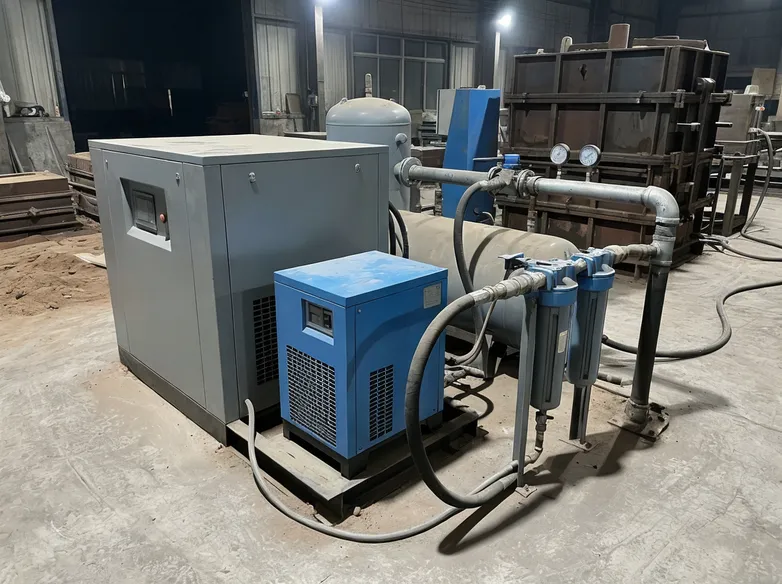
You'll need 0.8–1.0 MPa supply pressure at 4–6 cubic meters per minute for a single molding station. If your facility doesn't already have that capacity, you'll need to install a dedicated air compressor.

Screw Compressor Investment

$12,000 – $15,000

Includes air dryer and filtration system. Moisture and oil contamination in compressed air will damage pneumatic seals and cause erratic pressure control.

Pneumatic compaction compressed air supply system with screw compressor, air dryer, and filtration for a clay sand molding line

Maintenance Schedule & Costs

Maintenance focuses on pneumatic components. The total annual maintenance cost for pneumatic compaction runs $800–$1,200 — between hydraulic and servo systems.

Daily
Condensate Drain

Drain condensate from air receiver tanks and filter bowls.

~2 minutes

Weekly
Hose & Fitting Inspection

Inspect pneumatic hoses and fittings. Replace any that show wear or air leaks.

Quarterly
Cylinder Lubrication

Lubricate pneumatic cylinders with pneumatic oil.

$40–$60 per quarter

Annual
Seal Replacement

Replace seals in compaction cylinders.

$200–$300 parts + 2–3 hrs labor

When Does Pneumatic Compaction Make Economic Sense?

Pneumatic compaction only makes economic sense at high production volumes (200+ molds per hour) where the faster cycle time justifies the compressed air infrastructure cost. At lower volumes, the capital cost of the air compressor plus the ongoing energy cost of running it outweighs the cycle time benefit.

Compressed Air Energy Cost

$0.02–$0.03 per cubic meter

When factoring in compressor power consumption. This cost adds up significantly at sub-200 molds/hour volumes where the per-mold air cost isn't offset by throughput gains.

TZFoundry typically recommends pneumatic compaction only for high-volume configurations with multiple molding stations running in parallel, where the air compressor serves all stations and the per-station infrastructure cost is reasonable.

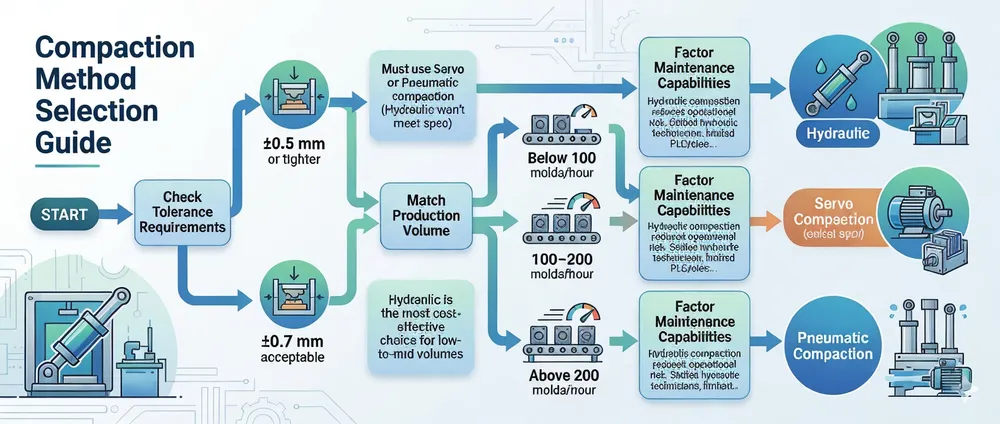
Compaction Method Selection Guide

Start with your tolerance requirements, then layer in production volume and maintenance capabilities to identify the right compaction method for your operation.

1

Check Tolerance Requirements

±0.5 mm or tighter — You must use servo or pneumatic compaction. Hydraulic won't meet spec.

±0.7 mm acceptable — Hydraulic is the most cost-effective choice for low-to-mid volumes.

2

Match Production Volume

Below 100 molds/hour — Hydraulic makes sense. Lower capital, adequate performance.

100–200 molds/hour — Servo is the sweet spot. Better quality than hydraulic, lower infrastructure cost than pneumatic.

Above 200 molds/hour — Pneumatic becomes cost-effective because the cycle time advantage compounds across thousands of molds per day.

3

Factor Maintenance Capabilities

Skilled hydraulic technicians, limited PLC/electrical support — Hydraulic compaction reduces operational risk.

Strong electrical maintenance, want to minimize consumables — Servo is the better choice. Eliminates hydraulic fluid and seal replacement costs.

24/7 production, existing compressed air infrastructure — Pneumatic compaction leverages that existing investment across multiple equipment lines.

Decision flow for selecting between hydraulic, servo, and pneumatic compaction methods based on tolerance, volume, and maintenance requirements
Production Flexibility

Pattern Handling & Changeover Systems

Pattern changes determine how quickly you can switch between different mold designs, which directly affects your production flexibility. Foundries running high-mix production (many different products in small batches) need fast changeover systems. Foundries running dedicated production (one or two products in large volumes) optimize for cycle time instead and accept longer changeover intervals.

Manual Pattern Changes (Small-Batch Systems)

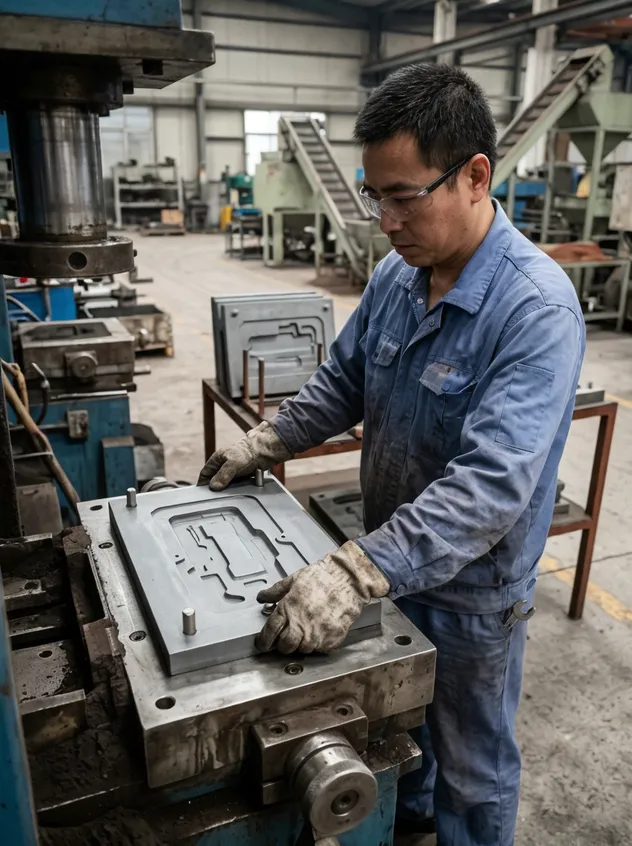
The operator removes the current pattern plate from the molding station, stores it on a nearby rack, retrieves the next pattern plate, and installs it in the molding station. The pattern plate bolts to the compaction ram's mounting surface with 4–6 fasteners, and the operator must align it precisely (typically using dowel pins or alignment keys) to ensure the mold cavity is centered correctly. Changeover time is 8–12 minutes depending on pattern weight and complexity.

15–40 kg Typical pattern plate weight
4–6 Fasteners per mount
8–12 min Mechanical changeover

Pattern plates for small-batch systems typically weigh 15–40 kg (depending on mold size), so one operator can handle them without lifting equipment. Larger patterns (40+ kg) require two operators or an overhead crane. If you're planning frequent pattern changes with heavy patterns, tell us during the quotation phase so we can include a jib crane or pattern cart system in the configuration (adds $3,000–5,000 but cuts changeover time in half and reduces operator fatigue).

Planning Tip — Heavy Patterns (40+ kg)

Mention heavy pattern requirements during the quotation phase. A jib crane or pattern cart add-on ($3,000–5,000) cuts changeover time in half and significantly reduces operator fatigue on multi-shift operations.

Operator performing manual pattern plate changeover at a clay sand molding station, showing dowel pin alignment and fastener mounting

Post-Change Verification Cycle

Required after every pattern change

The molding station needs to run a test cycle after every pattern change to verify correct compaction pressure and mold ejection. The operator makes a test mold, inspects it for dimensional accuracy and surface quality, and adjusts compaction pressure if needed (usually ±5–10% from the previous setting, depending on how the new pattern's geometry affects sand distribution). This test-and-adjust process adds 3–5 minutes to the changeover time, so total downtime per pattern change is 11–17 minutes.

1

Test Mold

Run a single cycle with the new pattern to produce a sample mold

2

Inspect

Check dimensional accuracy and surface quality against specifications

3

Adjust & Confirm

Fine-tune compaction pressure ±5–10% based on new pattern geometry

Mechanical swap: 8–12 min
Test & adjust: 3–5 min
Total downtime: 11–17 min

When Manual Changeover Works — and When It Doesn't

Manageable: 5–10 Products/Week

If you're changing patterns twice per shift, you're losing 22–34 minutes of production time, which is 5–7% of an 8-hour shift. For most foundries at this product mix level, that downtime is acceptable and doesn't justify the cost of automated changeover systems.

Changes/shift: 2
Lost time/shift: 22–34 min
Shift utilization loss: 5–7%
Verdict: Acceptable

Bottleneck: 20+ Products/Week

For foundries running 20+ products per week with multiple daily changeovers, manual pattern changes become a significant bottleneck. Consider mid-volume systems with programmable recipes or invest in quick-change pattern mounting systems.

Recommended upgrade: Quick-change pattern mounting with pneumatic clamps instead of bolted connections — cuts mechanical changeover time from 8–12 minutes to 2–3 minutes. Available as an add-on option at $6,000–8,000.

Bolted vs. Pneumatic Clamp Changeover — At a Glance

Parameter Bolted (Standard) Pneumatic Clamp (Upgrade)
Mechanical changeover 8–12 minutes 2–3 minutes
Total with test cycle 11–17 minutes 5–8 minutes
Fastener type 4–6 bolts, manual torque Pneumatic clamps, push-button
Operators required 1 (under 40 kg) / 2 (over 40 kg) 1
Add-on cost Included (baseline) $6,000–8,000

Programmable Recipes — PLC-Driven Changeover for Mid-Volume Systems

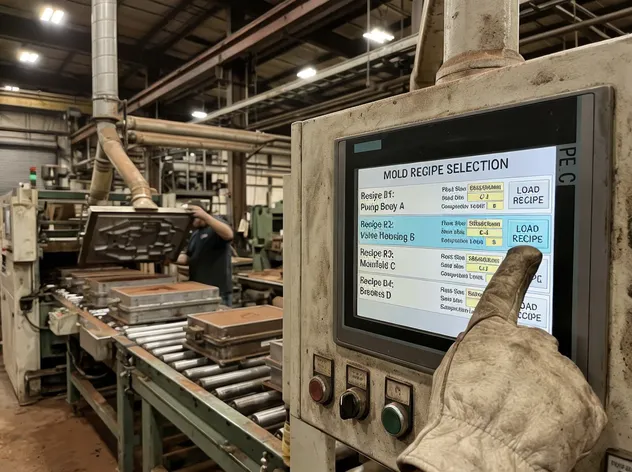
The PLC stores up to 20 mold recipes, each containing compaction pressure, ram speed, dwell time, and ejection parameters for a specific pattern. When you change patterns, the operator still handles the mechanical swap — remove old pattern, install new pattern, bolt it down — but the PLC automatically adjusts all process parameters as soon as the operator selects the new recipe on the touchscreen.

This eliminates the test-and-adjust phase. The PLC recalls the exact settings that produced good molds the last time you ran this pattern, so the first production mold after changeover is already at target quality. Changeover time drops to 5–8 minutes (mechanical swap only, no test cycles needed).

PLC touchscreen displaying mold recipe selection interface during pattern changeover on a clay sand molding line

PLC recipe selection interface — operators choose from stored profiles to eliminate manual parameter adjustment.

Guided Changeover Sequence

The PLC guides the operator through the changeover sequence with on-screen prompts and won't start the next production cycle until sensors verify the pattern is correctly installed:

1

Remove pattern

2

Install new pattern

3

Tighten bolts

Confirm seated

Cross-Shift Consistency — Eliminating Operator-Dependent Variation

Manual Systems

Different operators often run the same pattern at slightly different settings based on their experience and preferences. This creates batch-to-batch variation — even when the pattern, sand, and equipment are identical. Shift handovers become a quality risk, especially in high-mix production.

PLC Recipe Systems

Every operator runs the same pattern at identical settings, stored and enforced by the PLC. Mold quality stays consistent regardless of who's on shift — no variation from personal preferences, no drift from undocumented adjustments. Recipe lock ensures repeatability across all production runs.

Production History Tracking — Data-Driven Recipe Optimization

The PLC's recipe system tracks production history for every pattern — giving you the data to continuously refine your changeover and molding parameters rather than relying on operator intuition alone.

Mold Count per Pattern

Total molds produced with each pattern — supports tooling wear tracking and replacement scheduling.

Average Cycle Time

Per-pattern cycle time averages reveal bottlenecks — if Pattern A consistently runs 10% slower than target, investigate whether compaction pressure is too conservative.

Rejection Rate

Pattern-level reject tracking isolates quality issues to specific tooling or recipe settings rather than blaming general process variation.

Parameter Adjustments

Logs any parameter changes made during a run — helping you decide whether to update the stored recipe or revert to the original baseline.

Optimization example: If a pattern consistently runs 10% slower than its target cycle time, the production history data lets you investigate whether the compaction pressure setting is too conservative and could be reduced without affecting mold quality — turning guesswork into an evidence-based adjustment.

Pneumatic Quick-Change Systems (High-Volume Configurations)

Pattern plates mount to the compaction ram via pneumatic clamps instead of bolted connections. The operator positions the new pattern plate on the mounting surface, presses a button on the control panel, and pneumatic cylinders engage the clamps in under 5 seconds. Total changeover time drops to under 60 seconds — remove old pattern, install new pattern, engage clamps, PLC auto-loads recipe and runs verification cycle.

Cost-Benefit Analysis

This system adds $15,000–$20,000 to the system price. If you're changing patterns once per shift or less, the time savings don't offset the investment. If you're changing patterns 5–10 times per shift — common in contract foundries serving multiple clients with urgent orders — the quick-change system pays back in 6–12 months through reduced downtime.

Alignment Advantage

Pneumatic clamps engage with equal force on all mounting points simultaneously, delivering pattern alignment repeatable within ±0.1mm — versus ±0.3–0.5mm for manual bolting. Manual bolting introduces slight misalignment if the operator doesn't torque bolts evenly or if bolt holes have worn over time. This precision matters for casting work where mold cavity position directly affects final part dimensions.

Pneumatic quick-change pattern plate system on clay sand molding line showing clamp engagement points and control panel

Pneumatic clamps engage all mounting points simultaneously for ±0.1mm repeatability

Skip Quick-Change If…

You change patterns once per shift or less. The $15,000–$20,000 premium won't pay back at that changeover frequency.

Invest in Quick-Change If…

You change patterns 5–10 times per shift (contract foundries). Payback in 6–12 months through reduced downtime alone.

Pattern Storage & Organization

Storage requirements scale directly with your pattern library size and production volume tier:

Small-Batch Systems

Pattern storage racks holding 6–8 pattern sets within arm's reach of the molding station. Sufficient for job shops with limited product variety.

Mid- & High-Volume Systems

Larger pattern libraries of 15–20+ patterns stored on mobile carts or wall-mounted racks nearby. Supports diversified production schedules.

20+ Pattern Libraries

Dedicated pattern storage area with inventory tracking — from a simple whiteboard with pattern names and locations, to a barcode scanning system integrated with your production scheduling software.

Pattern Maintenance & Lifespan

Pattern maintenance affects changeover time indirectly — worn or damaged patterns produce poor-quality molds, which forces operators to adjust compaction settings or reject molds, slowing down production. Weekly inspection is essential.

Weekly Inspection Checklist

  • Check cavity surfaces for erosion from sand contact
  • Inspect thin sections for cracks or stress fractures
  • Verify all mounting hardware is tight and undamaged
  • Measure critical dimensions against pattern drawing tolerances

Pattern Lifespan & Refurbishment Costs

Aluminum Patterns 5,000–10,000 molds
Steel Patterns 10,000–20,000 molds

Refurbishment budget: $200–$500 per pattern (welding, machining, surface treatment) every 1–2 years of continuous use. Lifespan depends on sand abrasiveness and production volume.

System Integration

Integration with Your Clay Sand Processing System

How the molding line connects to upstream preparation, downstream reclamation, and your complete sand circuit — with the practical tolerances and control points that determine system-wide quality.

The Molding Line in Your Complete Sand Circuit

A molding line doesn't operate standalone — it's one component in a complete clay sand processing system that includes sand preparation (mixing, moisture control), molding (compaction into mold shapes), reclamation (processing used sand), and washing (removing contaminants). The molding line's performance depends on receiving consistent sand quality from upstream preparation and matching its output rate to downstream reclamation capacity.

Processing Stages

1

Sand Preparation

Mixing & moisture control

2

Molding Line

Compaction into mold shapes

3

Reclamation

Processing used sand

4

Washing

Removing contaminants

Sand Preparation Integration

The molding line receives prepared sand from your mixing system, which should deliver consistent moisture content (3–5% by weight) and clay content (6–10% by weight, depending on your mold strength requirements).

If moisture varies by more than ±1%, compaction behavior changes — too dry and the sand won't bind properly (molds crumble during handling), too wet and the sand sticks to the pattern (molds tear during ejection). The PLC on mid-volume and high-volume systems can compensate for minor moisture variation by adjusting compaction pressure (increase pressure slightly for drier sand, decrease for wetter sand), but it can't fix large swings — ±2–3% moisture variation will produce inconsistent molds regardless of compaction adjustments.

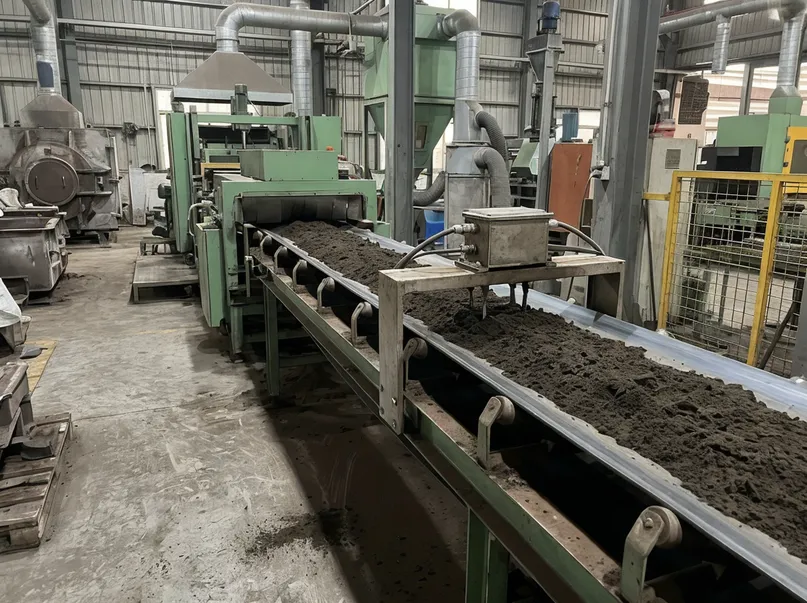
Sand preparation conveyor feeding into clay sand molding line with moisture sensor installed on belt

Critical Sand Parameters

Moisture Content 3–5% by weight
Clay Content 6–10% by weight
Acceptable Moisture Drift ±1% (PLC-compensable)
Failure Threshold ±2–3% (unrecoverable)
Integration Recommendation

Inline Moisture Sensor on Sand Feed Conveyor

We recommend installing a moisture sensor on the sand feed conveyor between your mixer and the molding line. The sensor costs about $2,000–3,000 and gives real-time feedback to your mixing system's PLC, which can adjust water injection to keep moisture stable.

This closed-loop control eliminates the most common cause of mold quality variation (inconsistent sand moisture) and reduces your mold rejection rate by 30–50% compared to open-loop systems where the mixer runs at fixed settings and hopes the sand stays consistent.

Investment

$2,000–3,000

Rejection Rate Reduction

30–50%

Control Type

Closed-Loop PLC

Clay Content — Mold Strength vs. Permeability

Clay content affects mold strength and permeability. Too little clay (below 6%) and molds are weak — they break during handling or collapse under the weight of molten metal during pouring. Too much clay (above 10%) and molds are impermeable — gas can't escape during solidification, which causes porosity defects in castings.

The molding line itself doesn't control clay content — that's determined by your mixing system — but the PLC can track mold strength indirectly by monitoring compaction pressure and ejection force. If ejection force increases over time (molds are sticking to the pattern more than usual), it often indicates clay content is creeping up, and you should check your mixer's clay addition rate.

Clay Too Low (<6%)

  • Molds break during handling
  • Collapse under molten metal weight during pouring
  • High scrap rate from structural failure

PLC indicator: Low compaction pressure needed, weak ejection resistance

Clay Too High (>10%)

  • Molds become impermeable to gas
  • Porosity defects in finished castings
  • Molds stick to patterns — increased ejection force

PLC indicator: Rising ejection force trend — check mixer clay addition rate

Reclamation Capacity Matching

Your molding line produces used sand at the same rate it produces molds. If you're making 150 molds per hour and each mold uses 25 kg of sand, you're generating 3,750 kg of used sand per hour. Your reclamation system must process at least that volume per hour to avoid building up a backlog.

We recommend sizing reclamation at 110–120% of molding output — in this example, 4,100–4,500 kg/hour — to maintain buffer capacity during peak periods or when reclamation efficiency drops slightly due to high sand contamination.

Diagram showing reclamation capacity sizing at 110-120% of clay sand molding line output to prevent bottlenecks

Recommended reclamation sizing: 110–120% of molding output ensures buffer capacity during peak production or elevated sand contamination.

When Reclamation Can't Keep Pace — Three Options

If your reclamation system can't keep pace with molding output, you face three options — each with distinct cost and capacity trade-offs:

Slow Down the Molding Line

Match molding speed to reclamation capacity. This wastes the molding line capacity you've already paid for — effectively under-utilizing your highest-value asset.

Dump Excess & Replace with Fresh Sand

Dispose of surplus used sand and substitute with new material. Expensive — fresh sand costs $30–50 per ton, and waste disposal adds another $20–30 per ton.

Upgrade Your Reclamation System

Increase reclamation capacity to match your molding line's throughput. Typical cost: $20,000–$40,000 depending on how much additional capacity you need.

Most Common Integration Mistake

Buyers specify a high-capacity molding line (150–200 molds per hour) but pair it with undersized reclamation (100–120 molds per hour worth of sand processing). The result: the molding line runs at full speed for the first 2–3 hours of a shift, then slows progressively as used sand accumulates with nowhere to go. By the end of the shift, the molding line is running at 60–70% of rated capacity because it's waiting for reclamation to catch up.

Our recommendation: If you're buying a molding line to integrate with existing reclamation equipment, send us your reclamation unit's rated capacity (tons per hour or molds-per-hour equivalent) so we can verify it won't become a bottleneck.

Not sure if your reclamation system can keep pace?

Share your current reclamation specs and target mold rate — our engineering team will confirm compatibility or recommend the right upgrade path.

Verify System Compatibility

Related: Clay Sand Reclamation Line — full specifications for reclamation systems designed to match TZFoundry molding line capacities.

Mold Output & Pouring Station Interface

The molding line's output conveyor delivers finished molds to your pouring station — where molten metal gets poured into the mold cavity. The conveyor needs to match your pouring station's layout: height, width, and speed. Standard output conveyor height is 800 mm above floor level, but TZFoundry can adjust it to 600 mm or 1,000 mm if your pouring station requires it (no additional cost for height adjustment within ±200 mm of standard). Conveyor width is typically 600 mm to accommodate flask sizes up to 500 mm × 400 mm — if you're running larger molds, we'll widen the conveyor accordingly.

Conveyor speed should match your pouring cycle time. If your pouring station takes 90 seconds per mold (position mold, pour metal, move to cooling area), the molding line's output conveyor should deliver one mold every 90 seconds. For faster molding lines (30–40 second cycle time) paired with slower pouring operations, you'll need a mold accumulation conveyor between the molding line and pouring station — essentially a buffer zone that holds 5–10 molds so the molding line can run at full speed without waiting for pouring to catch up.

Accumulation Conveyor Cost

The accumulation conveyor adds $4,000–$6,000 to the system cost but prevents molding line downtime caused by pouring-speed mismatches. A worthwhile investment when your molding cycle is 2–3× faster than your pouring cycle.

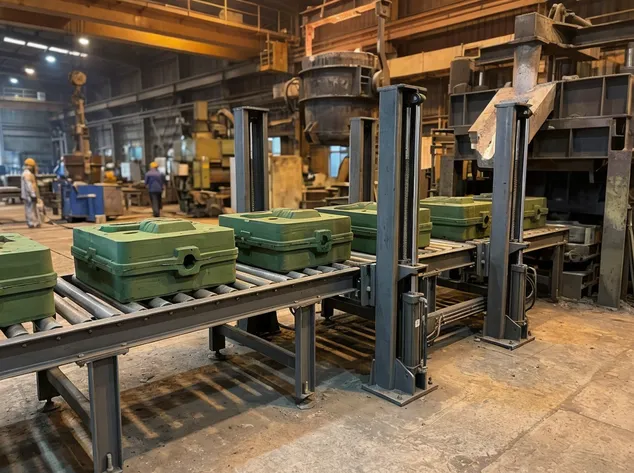
Mold output conveyor interfacing with pouring station — height-adjustable design, 600mm standard width

Output conveyor delivering finished molds to the pouring station. Height adjustable within ±200 mm of the 800 mm standard.

Standard Height

800mm

Adjustable 600–1,000 mm at no extra cost

Standard Width

600mm

Accommodates flasks up to 500 × 400 mm

Buffer Capacity

5–10molds

Accumulation conveyor prevents line downtime

Multi-Station Configuration

Single Molding Line → Multiple Pouring Stations

Some foundries run multiple pouring stations fed by a single molding line. In that configuration, the output conveyor branches into two or three paths using diverter gates controlled by the PLC, and each pouring station receives a steady stream of molds.

This works well when you're casting different alloys simultaneously — one pouring station for gray iron, one for ductile iron — or when you're running high-volume production that exceeds a single pouring station's capacity.

Typical Use Cases

  • Multi-alloy casting — gray iron & ductile iron on separate stations
  • High-volume production — throughput exceeds single-station capacity
  • PLC-controlled diverter gates — automated path selection for each mold

Automated vs. Manual Mold Transfer

Manual Mold Transfer

Small-batch and mid-volume systems typically use manual mold transfer — the molding line's output conveyor delivers molds to a staging area, and operators manually move them to the pouring station using carts or hand trucks.

  • Suitable for production rates up to 100–120 molds per hour — one operator can handle that transfer rate without creating bottlenecks
  • Manual transfer typically breaks 1–2% of molds during handling

Automated Mold Transfer

Above 120 molds per hour, the output conveyor extends directly to the pouring station, and molds move continuously without operator handling. Recommended for high-volume lines where throughput consistency is critical.

  • Adds $8,000–12,000 to the system cost
  • Eliminates one labor position entirely
  • Reduces mold breakage to under 0.5% (vs. 1–2% with manual transfer)

Decision threshold: If your target production rate exceeds 120 molds/hour, automated transfer pays for itself quickly through reduced labor costs and lower mold breakage. The $8,000–12,000 investment typically recovers within months of continuous high-volume operation.

System-Level Control Integration

Buying a Complete System from TZFoundry

If you're purchasing a complete clay sand processing system from us — molding + reclamation + washing — the entire system runs on a single PLC with coordinated control.

The molding line's PLC communicates with the reclamation system's PLC to balance production rates — if reclamation falls behind (say, due to higher-than-normal sand contamination that slows processing), the molding line automatically reduces its cycle speed to match. This prevents used sand accumulation and keeps the system running smoothly without operator intervention.

Integrating with Existing Equipment

If you're buying just the molding line to integrate with existing equipment from other manufacturers, we provide standard communication protocols so your existing PLC can monitor the molding line's status and coordinate production rates.

Modbus TCP Profinet EtherNet/IP

Verify compatibility during the quotation phase — most industrial PLCs support these standard protocols, but if your existing equipment uses a proprietary protocol, a protocol converter may be needed (additional $1,500–2,500).

PLC control integration panel showing coordinated communication between molding and reclamation systems on a TZFoundry clay sand processing line

Coordinated PLC control panel for integrated clay sand processing

Precision & Repeatability

Mold Quality & Dimensional Control

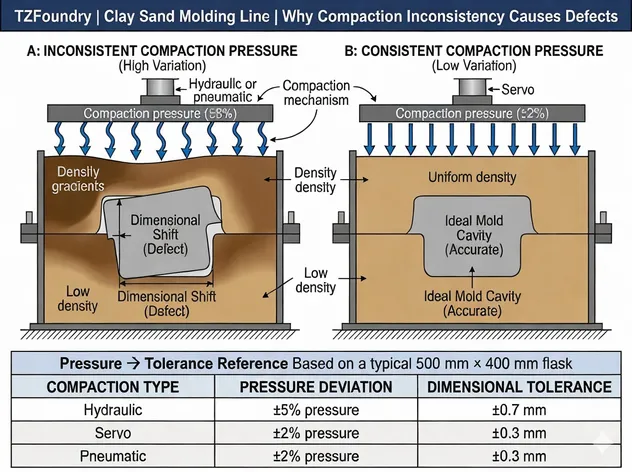
Compaction pressure consistency determines mold dimensional accuracy, which directly affects casting quality. Inconsistent compaction creates density variations in the sand mold — some areas are tightly packed, others are loose.

Why Compaction Inconsistency Causes Defects

When you pour molten metal into an inconsistently compacted mold, the loose areas compress under the metal's weight, which shifts the mold cavity dimensions and produces out-of-spec castings.

Sand is compressible — when you apply more pressure, sand grains pack tighter and the mold cavity shrinks slightly. When you apply less pressure, sand grains pack looser and the mold cavity expands slightly. A 5% pressure swing (say, from 2.85 MPa to 3.15 MPa on a system targeting 3.0 MPa) changes sand density by about 3–4%, which translates to 0.6–0.8 mm dimensional change in a 500 mm mold cavity.

Bottom line: For most castings, ±0.7 mm mold variation is acceptable because you're adding 2–3 mm machining allowance to the raw casting dimensions anyway. The machining operation removes that allowance and brings the part to final dimensions, so mold variation gets absorbed in the machining stock. For precision castings where you're trying to minimize machining — thin-wall parts, near-net-shape castings, components with complex internal geometries that are expensive to machine — ±0.7 mm mold variation is too much. You need servo or pneumatic compaction to hit ±0.3 mm.

Cross-section diagram showing how compaction pressure variation creates density differences in a sand mold, leading to dimensional shifts in the mold cavity

Pressure → Tolerance Reference

Based on a typical 500 mm × 400 mm flask

Hydraulic (±5% pressure) ±0.7 mm
Servo (±2% pressure) ±0.3 mm
Pneumatic (±2% pressure) ±0.3 mm

Standard Castings — ±0.7 mm Acceptable

If your parts carry 2–3 mm machining allowance, hydraulic compaction at ±5% pressure variation is sufficient. The machining operation absorbs the ±0.7 mm mold variation, so your final part dimensions are still in spec. This covers the majority of automotive, agricultural, and general industrial castings.

Precision Castings — ±0.3 mm Required

Thin-wall parts, near-net-shape castings, and components with complex internal geometries that are expensive to machine need tighter mold control. Servo or pneumatic compaction at ±2% pressure variation delivers ±0.3 mm dimensional accuracy, reducing machining stock and saving secondary-operation costs.

Real-Time Pressure Monitoring

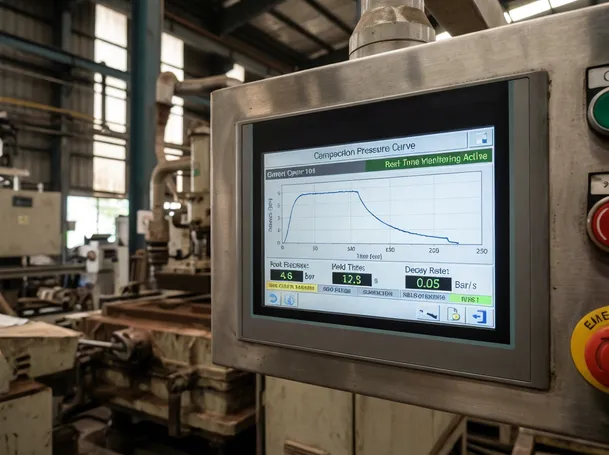
Mid-volume and high-volume systems include pressure transducers on the compaction ram that measure force in real time during every cycle. The PLC logs peak pressure, hold time, and pressure decay rate for each mold. This data serves two purposes: immediate quality control — flagging molds that didn't reach target pressure — and predictive maintenance, where gradual pressure decay over weeks indicates seal wear or hydraulic fluid contamination in hydraulic systems, or ball screw wear in servo systems.

The system auto-rejects any mold that falls more than 5% below target pressure — it gets shunted to a reject conveyor instead of moving to the pouring station. Rejected molds are broken up and the sand goes back through reclamation. This prevents bad molds from reaching the pouring stage, where they'd waste molten metal and create scrap castings.

PLC display showing real-time compaction pressure curves, peak pressure, hold time, and decay rate for each mold cycle

PLC pressure logging captures peak force, hold time, and decay rate per cycle.

Typical Rejection Rates by Compaction Type

< 1%

Servo Systems

Closed-loop force control delivers the most consistent compaction.

< 1%

Pneumatic Systems

Regulated air pressure provides repeatable force on every stroke.

2–3%

Hydraulic Systems

Higher rate due to less consistent manual pressure control.

Pressure Data as a Diagnostic Tool

The PLC's pressure logging also helps troubleshoot casting quality issues. If you start seeing dimensional variation, surface roughness, or mold breakage during pouring, you can review the pressure data from the affected molds and look for patterns. Often you'll find that pressure was drifting low due to a worn seal or a partially clogged hydraulic valve — fixing that component resolves the casting quality issue. Without pressure logging, you'd be guessing at root causes and potentially making unnecessary adjustments to other process parameters.

Pattern Fit & Alignment

Mold dimensional accuracy also depends on pattern fit — if the pattern isn't seated correctly in the molding station, the mold cavity will be misaligned even if compaction pressure is perfect. Manual pattern mounting (bolted connections) can introduce ±0.3–0.5 mm alignment variation if the operator doesn't torque bolts evenly or if bolt holes have worn over time. Pneumatic quick-change systems (high-volume configurations) reduce alignment variation to ±0.1 mm because the clamps engage with equal force on all mounting points simultaneously.

We include alignment pins or keys on all pattern mounting surfaces to prevent gross misalignment (pattern rotated or shifted by several millimeters), but fine alignment (within ±0.5 mm) depends on the mounting system's mechanical precision. If you're doing precision casting work and need better than ±0.5 mm pattern alignment, specify pneumatic quick-change mounting during the quotation phase — it's available as an option on mid-volume systems and is standard on high-volume systems.

Mounting Method Comparison

M Manual Bolted
  • ±0.3–0.5 mm alignment variation
  • Operator-dependent torque consistency
  • Bolt-hole wear degrades over time
P Pneumatic Quick-Change
  • ±0.1 mm alignment variation
  • Equal clamping force on all mounting points
  • Standard on high-volume; option on mid-volume

Precision Upgrade Path

For precision casting work requiring better than ±0.5 mm pattern alignment, pneumatic quick-change mounting is available as an add-on for mid-volume systems at $8,000–10,000. Specify during the quotation phase.

Pneumatic quick-change pattern mounting system on a TZFoundry clay sand molding line, showing alignment pins and clamping mechanism

Ejection Force Monitoring

The PLC also monitors ejection force — how much force is required to push the finished mold off the pattern after compaction. Ejection force should be consistent within ±10% across molds of the same design. If ejection force increases over time, it usually indicates one of three problems:

Excess Clay Content

Clay content in the sand is too high — molds stick to the pattern during ejection. Check your clay sand preparation line's clay addition rate.

Pattern Surface Degradation

Pattern surface is degrading — rust, erosion, or coating wear that increases friction between the pattern face and compacted sand. Inspect the pattern for visible surface damage.

High Sand Moisture

Sand moisture is too high — wet sand sticks more than properly conditioned sand. Review moisture control on your sand preparation system.

Trend Tracking Prevents Production Losses

By tracking ejection force trends, you can catch these problems early before they cause mold breakage or production downtime. If ejection force increases 20–30% over a week, check your sand preparation system's clay addition rate and moisture control, and inspect the pattern for surface damage.

If you wait until molds start tearing during ejection — which happens when ejection force exceeds the mold's green strength — you'll have already produced dozens or hundreds of bad molds. Early detection through PLC-tracked ejection force data is the difference between a scheduled maintenance check and an unplanned line stop.

Dimensional Inspection and Validation

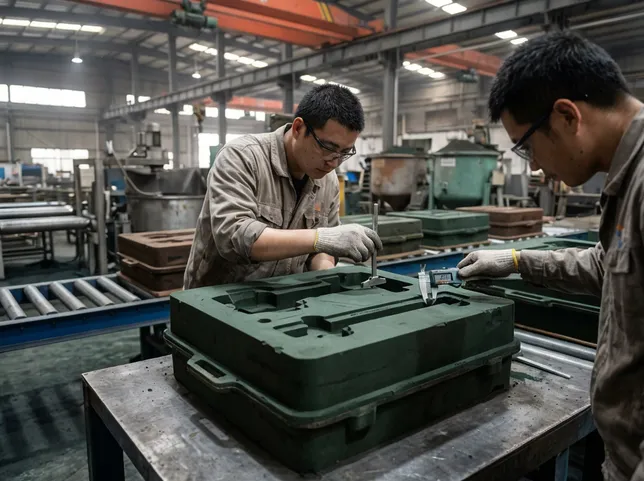
We recommend checking mold dimensions at the start of every shift and after every pattern change. Use a caliper or depth gauge to measure critical cavity dimensions — length, width, depth — and compare against your target dimensions. If you're within tolerance (typically ±1mm for rough castings, ±0.5mm for precision work), proceed with production. If you're out of tolerance, check compaction pressure settings, pattern alignment, and sand moisture before making more molds.

Mold dimensional inspection using caliper and depth gauge at the molding station

Out-of-Tolerance Troubleshooting Sequence

If mold dimensions fall outside your target range, investigate in this order before continuing production:

  1. Compaction pressure settings — verify hydraulic/servo/pneumatic pressure matches recipe
  2. Pattern alignment — check for shift or wear on pattern plates
  3. Sand moisture — confirm moisture is within the optimal range for your clay sand mix

Automated Dimensional Inspection for High-Volume Production

For high-volume production, consider automated dimensional inspection — a laser scanner or vision system that measures every mold as it exits the molding station and flags any that are out of spec. These systems cost $15,000–$25,000 but eliminate the need for manual sampling and catch dimensional drift in real time, versus catching it hours later when you inspect a sample mold.

When Does Automated Inspection Make Sense?

Volume Threshold

1,000+

molds per day

System Investment

$15K–$25K

laser scanner or vision system

Bad Batch Risk

50–100

molds lost per undetected drift event

Automated inspection makes financial sense when the cost of a single bad batch — 50 to 100 molds produced with incorrect dimensions — exceeds the inspection system's cost. At 1,000+ molds per day, manual sampling simply cannot catch dimensional drift fast enough to prevent scrap runs.

Total Cost of Ownership

Operational Cost & Labor Requirements

Real energy, labor, and efficiency numbers across compaction methods and automation levels — so you can model true per-mold cost before committing to a configuration.

Energy Consumption per Mold by Compaction Method

Hydraulic

0.8–1.0 kWh/mold

Includes compaction, sand feeding, and conveyor operation. Continuous hydraulic pump draw makes this the highest energy consumer of the three methods.

Cost per mold $0.10–0.12
Most Efficient

Servo

0.6–0.8 kWh/mold

More efficient because the servo motor only draws power during active compaction — not during idle time between cycles. No wasted energy on standby.

Cost per mold $0.07–0.10

Pneumatic

0.65–0.90 kWh/mold

Base draw of 0.5–0.7 kWh/mold plus compressed air energy (approximately 0.15–0.20 kWh/mold for air compressor operation). Total lands between hydraulic and servo.

Cost per mold $0.08–0.11

Energy Cost at Scale — The Math That Matters

At typical industrial electricity rates ($0.12/kWh), energy cost per mold runs $0.06–0.12 depending on system configuration. Over a single-shift day producing 800 molds, that's $48–96 in electricity. Over a month (20 working days), that's $960–1,920.

Energy cost is a small fraction of total operational cost — labor and consumables are larger — but it's worth optimizing for high-volume production. A 20% energy efficiency improvement saves $200–400 monthly, which compounds to $2,400–4,800 annually.

Labor Requirements by Automation Level

2

Small-Batch Systems

~60 molds/hr

Two operators per shift — one managing the molding station (pattern changes, compaction adjustments, quality checks) and one handling sand feeding and mold output (moving finished molds to the pouring area, breaking up rejected molds, coordinating with upstream sand prep).

Labor cost per mold $0.50–0.60

Based on $15/hour per operator → $30/hour total labor ÷ 60 molds/hour

2

Mid-Volume Systems

120–150 molds/hr

Same two-operator headcount, but producing 120–150 molds per hour. The operators' role shifts from manual control to exception handling — they intervene only when the PLC flags an issue (sand moisture out of spec, compaction pressure not reaching target, pattern misalignment).

This frees them to handle secondary tasks like quality sampling, pattern maintenance, and coordination with downstream pouring operations.

Labor cost per mold $0.20–0.25
Lowest Per-Mold Cost
3

High-Volume Systems

200–240 molds/hr

Three operators per shift (one per molding station in a three-station configuration), producing 200–240 molds per hour. The third operator coordinates between stations and manages mold output to multiple pouring stations or accumulation conveyors.

Labor cost per mold $0.15–0.20
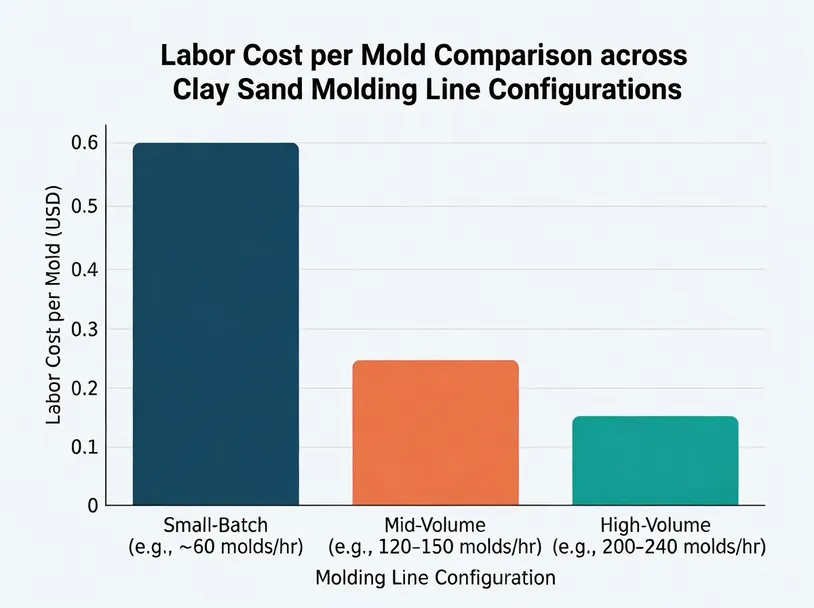
Labor cost per mold comparison chart across small-batch, mid-volume, and high-volume clay sand molding line configurations

Labor Cost Trend

Small-batch (60/hr)
$0.50–0.60
Mid-volume (120–150/hr)
$0.20–0.25
High-volume (200–240/hr)
$0.15–0.20

Maintenance Intervals and Costs

Maintenance on a clay sand molding line isn't complicated, but it is non-negotiable. Skipping intervals accelerates wear on high-value components and leads to unplanned downtime that costs far more than the scheduled maintenance itself. Here's what each interval looks like in practice.

Daily Tasks

15–20 minutes

  • Lubrication of compaction ram guide rails, pattern mounting surfaces, and conveyor drive chains
  • Visual inspection of hydraulic hoses — look for leaks or cracks
  • Pneumatic lines — listen for air leaks
  • Electrical connections — check for loose terminals or damaged cables

Can be handled by production operators as part of shift startup procedures.

Weekly Inspections

2–3 hours

  • Bearing temperature checks — use an infrared thermometer to scan motor, conveyor roller, and compaction ram bearings. Anything above 70°C indicates potential problems.
  • Motor vibration checks — handheld vibration meter to detect bearing wear or shaft misalignment
  • Hydraulic fluid level checks
  • Belt tension inspection — conveyor and drive belts should have 10–15mm deflection under thumb pressure. Too loose: slipping. Too tight: premature bearing wear.

Requires a maintenance technician.

Quarterly Overhauls

8–12 hours (shutdown)

  • Gearbox oil changes (if your system uses gearbox reducers on conveyor drives or servo motors)
  • Hydraulic filter replacement
  • Conveyor chain replacement — chains stretch over time, replace every 6–12 months depending on production volume
  • PLC battery backup replacement — maintains memory during power outages, replace every 2–3 years

Schedule during low-volume periods or between shifts to minimize production impact.

Maintenance technician performing scheduled inspection on a clay sand molding line compaction unit

Annual Maintenance Cost Breakdown

Annual maintenance costs are predictable and manageable when you follow the schedule. Here's what to budget based on real operating data across TZFoundry installations:

Cost Category Includes Annual Range
Consumables Hydraulic fluid, filters, lubricants, conveyor belts $800 – $1,500
Wear Parts Seals, bearings, chains $600 – $1,200
Preventive Replacements Sensors, electrical components, pneumatic valves $400 – $800
Total Annual Maintenance $1,800 – $3,500

Cost-per-Mold Perspective

High-volume systems cost more to maintain in absolute terms — more components, faster wear cycles. But the per-mold maintenance cost is significantly lower because you're amortizing that $1,800–$3,500 across a much larger number of units. A line producing 150 molds/hour over two shifts amortizes annual maintenance at roughly $0.01–$0.02 per mold — negligible compared to sand, labor, and energy costs.

Operator Skill Level Requirements

Staffing a clay sand molding line doesn't require hiring specialists with advanced degrees. The skill requirements scale with system complexity, and TZFoundry provides commissioning support to get your team up to speed regardless of the configuration you choose.

Small-Batch Systems

Requires foundry experience but no specialized training. TZFoundry provides 2–3 days of on-site instruction during commissioning.

Operators need to understand:

  • Sand properties — how moisture and clay content affect mold quality
  • Common defects — mold crumbling, tearing during ejection, surface roughness
  • Basic adjustments — compaction pressure, cycle timing
Mid-Volume Systems

Operators need to read PLC alarm codes and navigate touchscreen interfaces — not advanced programming, just practical interface literacy.

Typical operator tasks:

  • Interpret alarm messages (e.g., "Sand moisture high — check mixer water valve")
  • Take appropriate corrective action based on PLC guidance
  • Navigate touchscreen menus for parameter adjustments
High-Volume Systems

Benefits from having one shift supervisor with mechanical or electrical trade certification, but it's not mandatory if you have responsive maintenance support.

Recommended staffing:

  • One trade-certified shift supervisor per shift (recommended, not required)
  • Responsive maintenance support access as backup
  • All foundry-experience prerequisites from small-batch level still apply

Spare Parts Inventory — Protecting Against Unplanned Downtime

Keeping high-wear components on-site minimizes downtime when parts fail. The cost of maintaining a critical spares inventory is modest compared to the production losses from waiting 1–2 weeks for replacement parts to ship from China and clear customs.

Small-Batch Systems
$650–$900

Total recommended spares investment

  • 1 set compaction ram seals — $300–$400
  • 1 conveyor belt — $200–$300
  • 1 set hydraulic hoses — $150–$200
Mid-Volume Systems
$3,650–$5,300

Includes all small-batch spares plus:

  • 1 servo drive — $2,000–$3,000
  • 1 PLC module — $800–$1,200
High-Volume Systems
$6,650–$8,800

Includes all mid-volume spares plus:

  • 1 pneumatic actuator — $1,500–$2,000
  • 1 additional servo drive (multiple stations) — $2,000–$3,000

The Math on Spare Parts ROI

These spare parts sit on your shelf unused most of the time — but they eliminate the risk of a 1–2 week production shutdown waiting for parts to ship from China and clear customs. If downtime costs your foundry $2,000–$5,000 per day in lost production (typical for mid-to-high volume foundries), the spare parts investment pays for itself the first time you avoid a week-long shutdown.

A single avoided shutdown saves $10,000–$25,000+ in lost production — far exceeding even the highest spare parts investment of $8,800.

Automation & Control

Control Systems & Automation Levels

Control system sophistication determines how much operator intervention your molding line needs and what data you can collect for quality management. The right choice depends on your production volume, traceability requirements, and workforce capabilities.

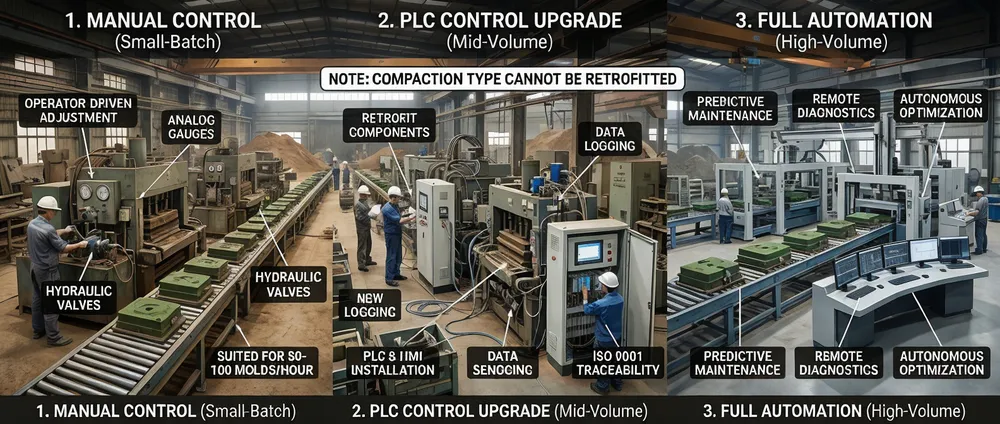
Manual Control

Small-batch systems

Operator-driven parameter adjustment. Suited for 50–100 molds/hour where labor cost is small relative to equipment cost.

PLC Control

Mid-volume systems

Automated parameter adjustment with data logging. Required for ISO 9001 traceability and export-market documentation.

Full Automation

High-volume systems

Predictive maintenance, remote diagnostics, and autonomous process optimization for maximum throughput.

Manual Control (Small-Batch Systems)

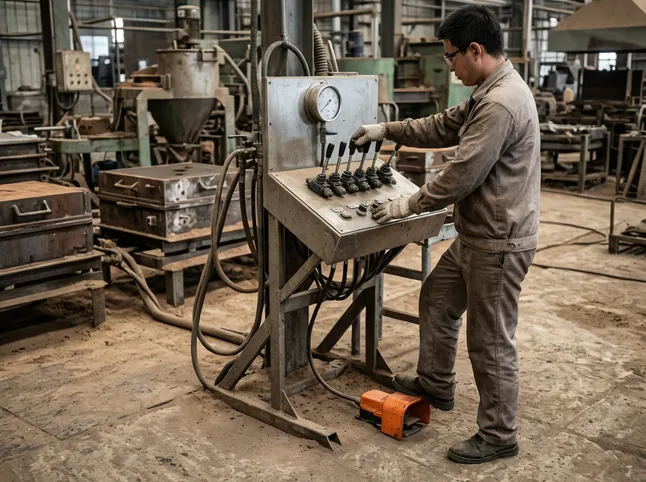
The operator sets compaction pressure via a hydraulic valve or pressure regulator, monitors a pressure gauge during each cycle, and adjusts as needed based on mold quality. Sand feeding is manual or semi-automatic — the operator triggers each sand feed cycle with a foot pedal or button press. Pattern changes are fully manual: unbolt the old pattern, install the new pattern, run test cycles, and adjust pressure. Cycle timing is controlled by the operator; they initiate each cycle when the previous mold has been removed and the next pattern is ready.

This approach works for low-volume production (50–100 molds per hour) where operator labor cost is small relative to equipment cost. The trade-off: output quality depends on operator skill and attention. An experienced operator can maintain consistent mold quality across a shift by making small pressure adjustments as sand moisture drifts or as the hydraulic system warms up. An inexperienced operator will produce more variable output until they develop that intuition — typically takes 2–4 weeks of daily operation.

Operator Ramp-Up Time

Inexperienced operators typically need 2–4 weeks of daily operation to develop the intuition for consistent manual pressure adjustment. Factor this training period into your workforce planning.

Manual control station on a clay sand molding line showing hydraulic valve, pressure gauge, and operator foot pedal

Manual control station — hydraulic valve with pressure gauge and operator-initiated cycle controls.

The Traceability Question

Manual systems don't provide data logging, so you have no permanent record of process parameters for each mold. If a casting fails in service and the buyer wants traceability, you can't pull up the exact compaction pressure and sand moisture from the day that mold was made.

For buyers who don't need ISO 9001 traceability or who aren't exporting to markets with strict quality documentation requirements, this isn't a problem. For buyers who do need traceability, PLC control is mandatory.

Manual is sufficient when:
  • No ISO 9001 traceability requirements
  • Domestic market without strict quality documentation
  • Low-volume production under 100 molds/hour
  • Experienced operators already on staff
Upgrade to PLC when:
  • Buyer or market requires casting traceability
  • ISO 9001 or equivalent quality system in place
  • Exporting to regulated markets (EU, NA, Japan)
  • Need permanent records of process parameters per mold

PLC Control with Touchscreen HMI (Mid-Volume Systems)

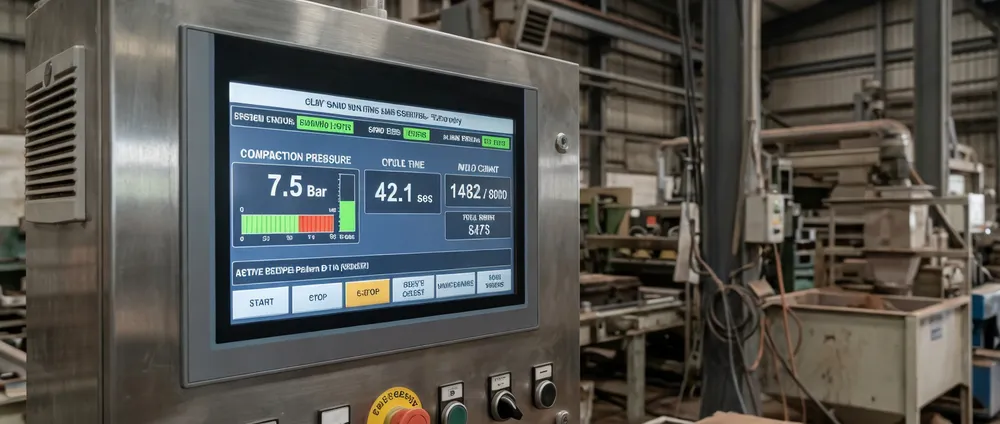
The PLC automates compaction pressure control (servo or pneumatic actuators respond to pressure sensor feedback in real time), sand feeding (triggered automatically at the start of each cycle), and cycle sequencing (the system runs continuously without operator initiation once production starts). The touchscreen HMI displays real-time process data — compaction pressure, cycle time, mold count, alarm status — and allows operators to adjust setpoints, select mold recipes, and view historical trends.

PLC touchscreen HMI interface showing real-time compaction pressure, cycle time, and mold count data on a clay sand molding line control panel

Recipe Storage — Up to 20 Mold Recipes

Each recipe stores compaction pressure, ram speed, dwell time, and ejection parameters for a specific pattern. When changing patterns, the operator selects the corresponding recipe on the touchscreen, and the PLC automatically loads all parameters — eliminating setup errors entirely.

Faster Pattern Changeover

Changeover time drops from 8–12 minutes (manual systems) to 5–8 minutes with PLC recipe selection. Mechanical pattern swap is still required, but all process parameters load instantly — no manual dial-in, no trial molds to verify settings.

Prioritized Alarm Management

The system monitors dozens of parameters — compaction pressure, sand level in hopper, conveyor speed, motor temperature, hydraulic fluid level — and flags any drift outside acceptable ranges. Prevents operators from running equipment in degraded conditions that cause damage or produce bad molds.

Alarm Priority Levels

Priority System Response Operator Action Required
Critical Stops production immediately Must resolve before restart
Warning Notifies operator; production continues Address at next scheduled stop
Informational Logs the event; no interruption Review in maintenance reports
Data Logging & ISO 9001 Traceability

12 Months of On-Board Process Data

Data logging creates a permanent record of every mold's process parameters, timestamped and linked to your production order numbers. The PLC stores 12 months of data internally (approximately 2 GB of storage), with export to CSV or PDF for long-term archival.

This satisfies ISO 9001 traceability requirements and provides forensic data when you need to investigate quality issues. If you start seeing casting defects, you can review the process data from affected molds and look for parameter drift — often sand moisture creeping up or compaction pressure drifting low due to equipment wear.

~2 GB
Internal storage capacity
12 Mo
Continuous data retention
CSV / PDF
Export formats for archival

Continuously Monitored Parameters

Compaction Pressure
Sand Level in Hopper
Conveyor Speed
Motor Temperature
Hydraulic Fluid Level
Cycle Time

Full Automation with Predictive Maintenance (High-Volume Systems)

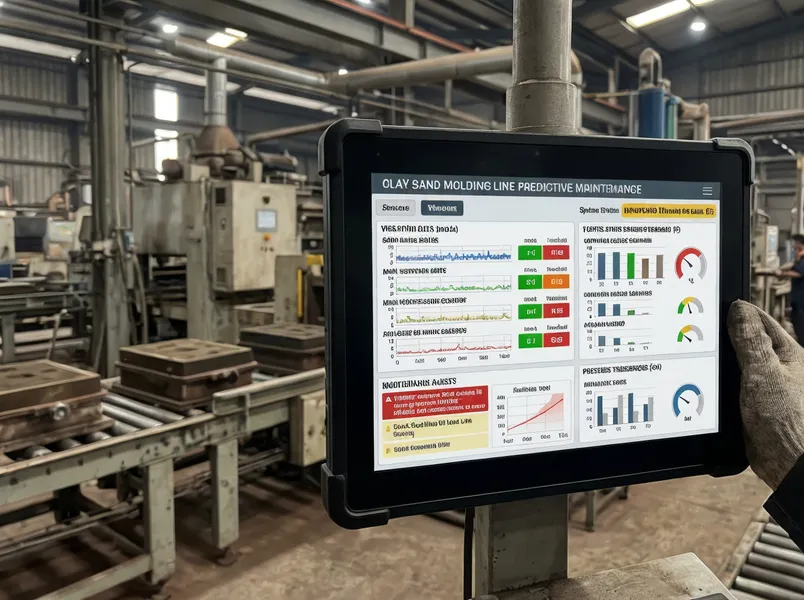
Full automation adds vibration sensors on all rotating equipment — motors, gearboxes, conveyor rollers — along with temperature sensors on bearings and hydraulic components, and pressure transducers on pneumatic lines. The PLC analyzes sensor data in real time and predicts component failures 24–48 hours before they occur.

A bearing that's starting to fail will show gradually increasing vibration and temperature over several days before it seizes. The PLC detects that trend and flags a maintenance alert:

"Conveyor roller bearing #3 showing elevated vibration — schedule replacement within 48 hours."

This allows you to schedule maintenance during planned downtime — shift changes, weekends, low-volume periods — instead of dealing with unplanned breakdowns during production.

PLC predictive maintenance dashboard showing vibration, temperature, and pressure sensor data for clay sand molding line rotating equipment

60–80%

Reduction in unplanned downtime compared to reactive maintenance (fix it when it breaks)

$10K–20K

Annual savings in avoided lost production for high-volume foundries running 24/7

24–48 hr

Advance warning before component failure — enough time to plan replacement during scheduled downtime

Remote Diagnostics via Secure VPN

Remote diagnostics capability is standard on PLC-controlled systems. TZFoundry technicians can log into your PLC via VPN and see the same data your operators see on the factory floor — real-time pressure curves, cycle time trends, alarm history, sensor status.

When you report a problem — say, inconsistent mold strength or longer-than-normal cycle times — our team can review the last 48 hours of process data, identify the parameter drift (often sand moisture creeping up due to a partially clogged water valve in your upstream sand prep system), and walk your team through the fix over a phone call. This cuts troubleshooting time from days (waiting for a technician to fly to your facility) to hours.

Access Level Capabilities Usage
Read-Only (Default) View data, download logs — cannot change setpoints or control equipment Sufficient for 90% of troubleshooting scenarios; preferred by most buyers for security
Temporary Write Access Adjust PLC parameters, test specific functions remotely Remaining 10% of cases — coordinated with your team; no one near equipment during changes
Technician performing remote VPN diagnostics on clay sand molding line PLC system showing real-time pressure and cycle data

Security by Default

VPN connection is read-only by default. Write access requires your explicit grant and coordination — no remote changes happen without your team present and aware.

Without Remote Diagnostics

Report problem → wait for technician travel → on-site inspection → days of downtime before resolution

With Remote Diagnostics

Report problem → TZFoundry reviews 48-hour data remotely → identifies root cause → phone walkthrough fix → hours to resolution

Upgrade Path — Manual to PLC Automation

If you start with a small-batch system with manual control and later need PLC automation, you can retrofit it without replacing the core molding equipment. The upgrade is modular — each component is added to your existing frame and actuator assembly, not swapped wholesale.

The retrofit takes 5–7 days of downtime: remove old controls, install the new PLC and sensors, wire everything, program the PLC, then test and commission. TZFoundry sends a technician to handle the installation and provides operator training on the new system. After the upgrade, your molding line has the same automation capabilities as a factory-new PLC system — recipe storage, data logging, alarm management, and remote diagnostics.

Retrofit Cost Breakdown

PLC & Touchscreen HMI $8,000 – $10,000
Pressure Sensors & Automated Control Valves $3,000 – $4,000
Automated Sand Feeding System $2,000 – $3,000
Installation & Commissioning $2,000 – $3,000
Total Retrofit Cost $15,000 – $20,000

That's roughly 40–50% of buying a new mid-volume system with PLC from the start — a significant saving if your production volume grows beyond the original manual setup.

Compaction Type Cannot Be Retrofitted

You cannot upgrade from hydraulic to servo or pneumatic compaction without replacing the entire molding station — the frame structure, actuator mounting, and power requirements are fundamentally different. If you anticipate needing faster cycle times or tighter tolerance control within 3–5 years, start with a mid-volume servo configuration instead of planning to upgrade from hydraulic later.

Visual overview of the manual-to-PLC automation upgrade path for clay sand molding lines, showing the retrofit components and installation process
Manufacturer Commitment

Why TZFoundry Molding Lines

From Standalone Machines to Integrated Production Lines — Since 2010

We've been building clay sand molding equipment since 2010, and the shift from standalone machines to integrated production lines happened because export buyers needed systems that worked together, not collections of components they had to figure out themselves.

Our first complete line went to a European foundry in 2015 — they needed 200 molds per hour with ±0.5mm tolerance across 12-hour shifts, and manual systems couldn't hold that spec. That line is still running in their facility, same core equipment, same output.

TZFoundry molding line production facility — integrated clay sand molding systems manufactured since 2010

In-House R&D — No Outsourced Design Work

Our in-house R&D team handles custom configurations without outsourcing design work to third-party engineering firms. When you need a non-standard mold size, a different compaction method, or integration with unusual upstream equipment, we're modifying our own designs — not coordinating between multiple vendors who each have their own lead times and compatibility issues.

This matters most when you're adapting a molding line to fit an existing foundry layout with space constraints or utility limitations. We've built systems that fit 10m × 8m floor spaces (normally we'd spec 12m × 10m) and systems that run on 380V three-phase power instead of our standard 415V (because that's what the buyer's facility provided).

Certifications That Support Your Own Audits

ISO 9001:2015, CE, and SGS certifications mean our manufacturing process gets audited annually by third-party inspectors who verify that we're following documented procedures for material sourcing, fabrication, assembly, and testing.

The certifications themselves don't make the equipment better, but they create a paper trail that satisfies your own quality audits and customer requirements. If you're selling castings to automotive or aerospace buyers who require supplier traceability, you'll need to show that your foundry equipment came from a certified manufacturer.

Complete Documentation Package

We provide the full documentation package with every system shipment — material certs, test reports, and calibration records. This supports supplier traceability requirements your automotive or aerospace casting customers may impose on your foundry.

Production Capacity & Lead Time Stability

8
Production Lines
15,000
m² Facility
500K
Units Annually
45–60
Day Lead Time

That capacity matters because it determines our lead time stability — we're not a job shop that gets backlogged when a large order comes in. A typical molding line order (mid-volume configuration) consumes about 3–4 weeks of production time across multiple lines (frame fabrication, machining, electrical assembly, testing).

We can run 4–6 systems in parallel, so even if we have a queue of orders, your lead time stays in the 45–60 day range.

Flexible MOQ & Customization Services

We don't have a minimum order quantity for complete systems — some manufacturers won't quote unless you're buying 3+ lines. We'll modify standard designs without charging engineering fees unless the changes require new tooling or outside components.

No Extra Cost
  • Different motor voltages
  • Metric-to-imperial fastener conversions
  • PLC interface language changes
  • Custom paint colors
Additional Cost
  • Non-standard mold sizes (new pattern plates & frame modifications)
  • Special materials for corrosive environments (stainless steel instead of carbon steel)
  • Third-party component integration (specific PLC or sensor brands we don't normally stock)
TZFoundry customized clay sand molding line configured to client specifications on the factory floor

After-Sales Support Structure

Remote Troubleshooting

VPN access to your PLC lets us diagnose 70–80% of issues without a site visit. We review recent process data, identify root causes, and provide step-by-step troubleshooting guidance or arrange spare parts shipment.

Resolves the majority of production issues remotely

Spare Parts Supply

Parts stocked at our Qingdao facility with 5–7 day shipping to most export markets via DHL or FedEx. Critical components are kept in inventory so you're not waiting on manufacturing lead times.

Qingdao facility → global delivery in under a week

On-Site Service

Available when remote support doesn't resolve the problem. You cover travel costs, we cover labor. Typically reserved for major component replacement (motor swap, gearbox rebuild) or capacity upgrades — not routine troubleshooting.

Most buyers never need on-site after commissioning

Most buyers never need an on-site visit after initial commissioning. The combination of operator training, detailed documentation, and remote diagnostics handles the majority of issues. When we do send a technician, it's usually for major component replacement or capacity upgrades — not routine troubleshooting.

Urgent Production Issue?

For issues affecting production, contact our technical team directly via WhatsApp at +86 13335029477 — this reaches our engineers directly, not a general customer service queue.

China Business Hours (UTC+8) 4–8 hour response
Outside Business Hours 12–24 hour response

We'll log into your PLC, review recent process data, and provide troubleshooting guidance or arrange spare parts shipment.

Buyer Decision Guide

Selecting the Right Molding Line Configuration

A systematic approach to sizing, specifying, and ordering your clay sand molding line — from throughput targets to final quotation.

1

Size Your Target Mold Output

Start with your target mold output rate — how many molds per hour do you need to meet your current order volumes? Add 20–30% buffer capacity to handle growth and peak periods.

Example: If you need 100 molds/hour today, spec a system rated for 120–130 molds/hour. This prevents running at 100% capacity continuously, which accelerates equipment wear and leaves no margin for maintenance downtime or order spikes.

2

Match Capacity Tier to Production Pattern

Small-Batch: 50–100 molds/hour

1–2 shifts with frequent product changeovers.

Mid-Volume: 100–200 molds/hour

2–3 shifts with moderate product variety.

High-Volume: 200+ molds/hour

24/7 operation with narrow product range — best per-unit economics.

3

Choose Compaction Method by Tolerance

Your dimensional tolerance requirement determines which compaction technology is viable.

±0.5mm or tighter: You must use servo or pneumatic — hydraulic won't meet spec.

±0.7mm acceptable: Hydraulic is the most cost-effective choice for low-to-mid volumes.

100–200 molds/hr: Servo is the sweet spot — better quality than hydraulic, lower infrastructure cost than pneumatic.

200+ molds/hr: Pneumatic becomes cost-effective because the cycle time advantage compounds across thousands of molds per day.

Verify Integration with Your Reclamation Capacity

Your molding line's output rate must align with your reclamation system's processing capacity. We recommend sizing reclamation at 110–120% of molding output to maintain buffer capacity.

If you're buying a molding line to integrate with existing reclamation equipment, send us your reclamation unit's rated capacity (tons per hour or molds per hour equivalent) so we can verify it won't become a bottleneck.

Request a Quotation

Ready to Configure Your Molding Line?

Contact us at sales@tzfoundry.com with your production requirements. Include the following for the fastest, most accurate proposal:

Target molds per hour
Mold size range (flask dimensions)
Available floor space
Electrical supply specs (voltage, phase, amperage)
New installation or integrating with existing equipment
Photos of existing foundry layout (if integrating)

Photos of your existing foundry layout help us spot potential installation issues before we finalize the quotation. We'll respond within 24 hours with preliminary specs and pricing, followed by a detailed proposal within 3–5 business days after we've clarified any technical questions.