
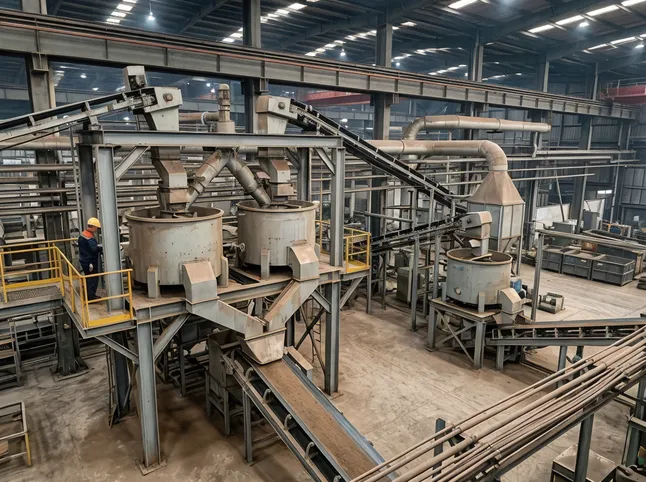
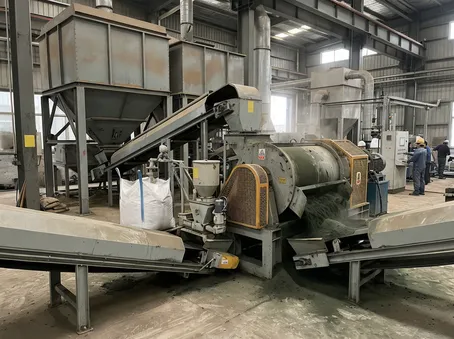
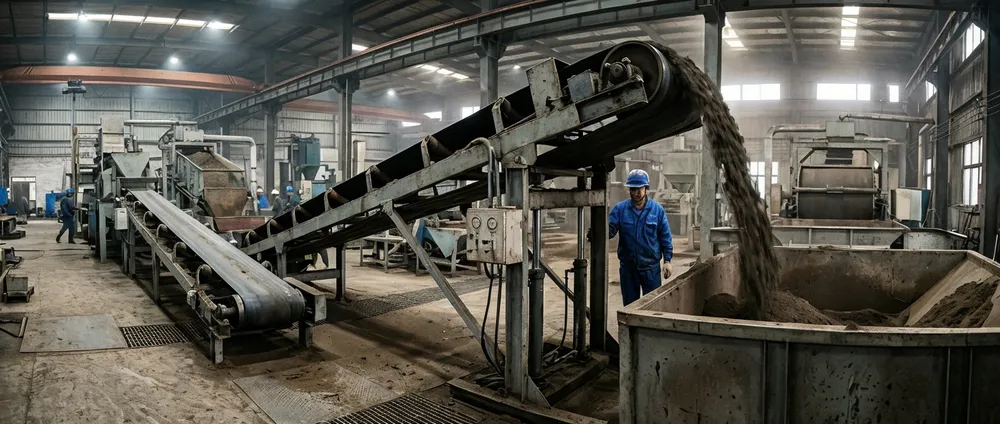
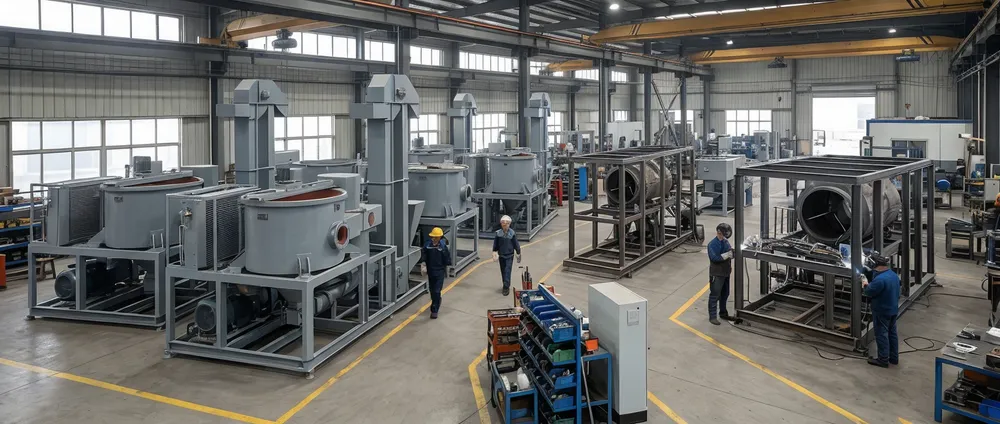
Maintenance & Consumables
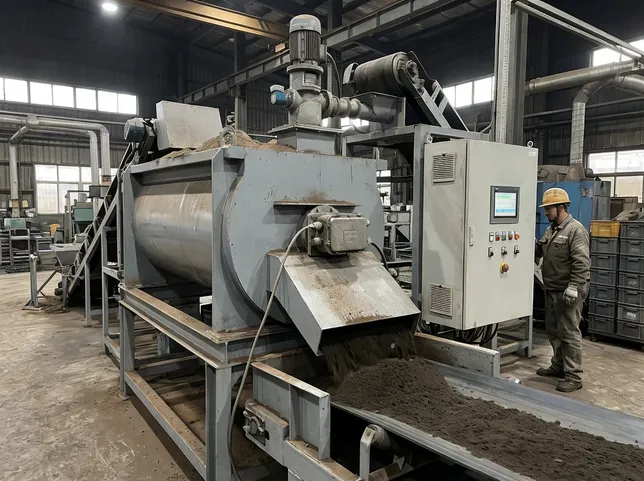
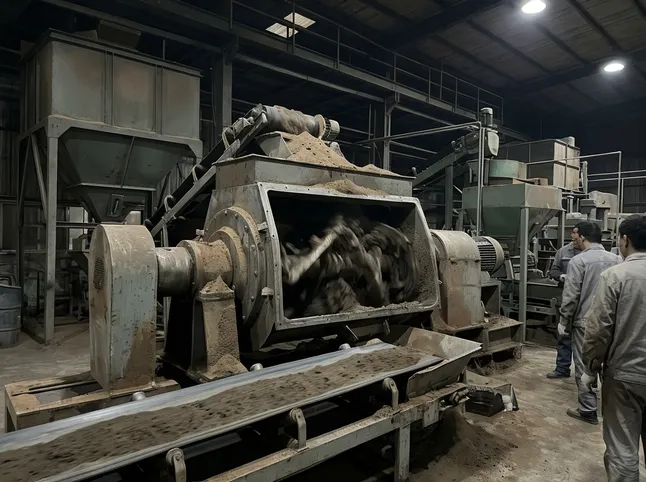
Routine maintenance follows a tiered schedule: daily checks (5–10 minutes), weekly inspections (30–45 minutes), monthly servicing (2–3 hours), and quarterly overhauls (4–6 hours). Daily tasks can be handled by production operators with basic mechanical aptitude. Weekly and monthly tasks need a maintenance technician. Quarterly overhauls benefit from having our remote support available via video call, but most buyers handle them in-house after the first year of operation.
Daily
5–10 min / shift
Production operators with basic mechanical aptitude
Weekly
30–45 min
Maintenance technician required
Monthly
2–3 hours
Maintenance technician required
Quarterly
4–6 hours
Remote video call support available; most buyers self-handle after year one
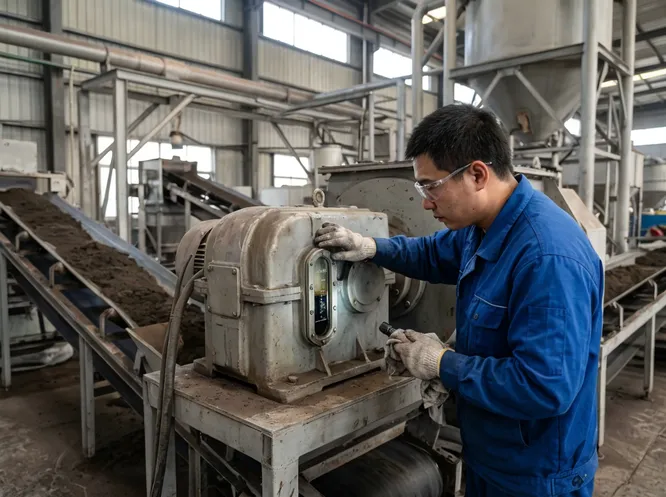
Daily Maintenance (5–10 minutes per shift)
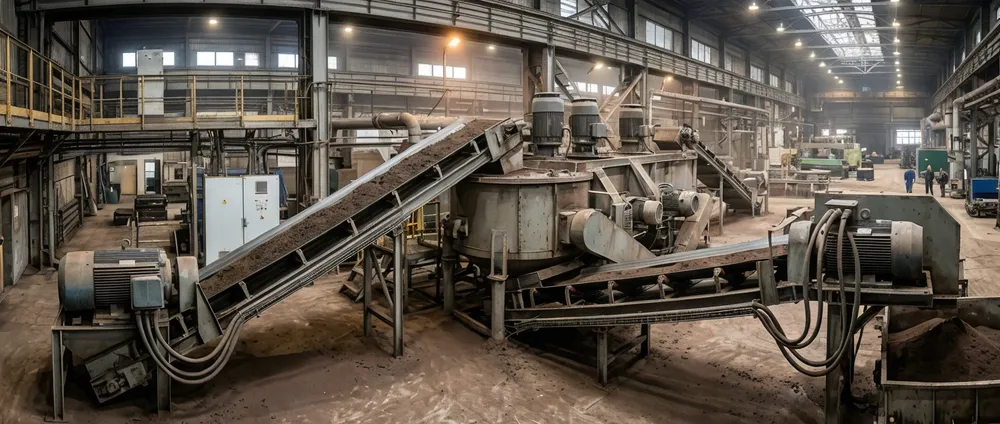
Check mixer gearbox oil level
Sight glass on gearbox housing — oil should be between min/max marks. A dry gearbox seizes within 2–4 hours of operation.
Lubricate conveyor roller bearings
Grease fittings at each roller — 2–3 pumps of grease per fitting.
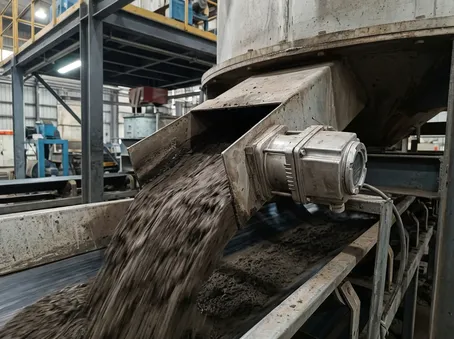
Inspect conveyor belts for damage or misalignment
Look for frayed edges, belt tracking off-center. A misaligned belt can tear and halt production mid-shift.
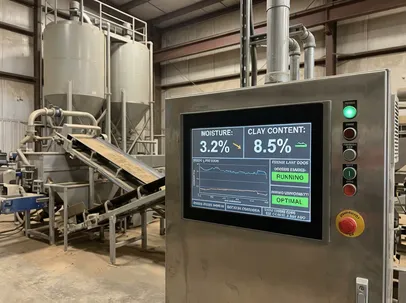
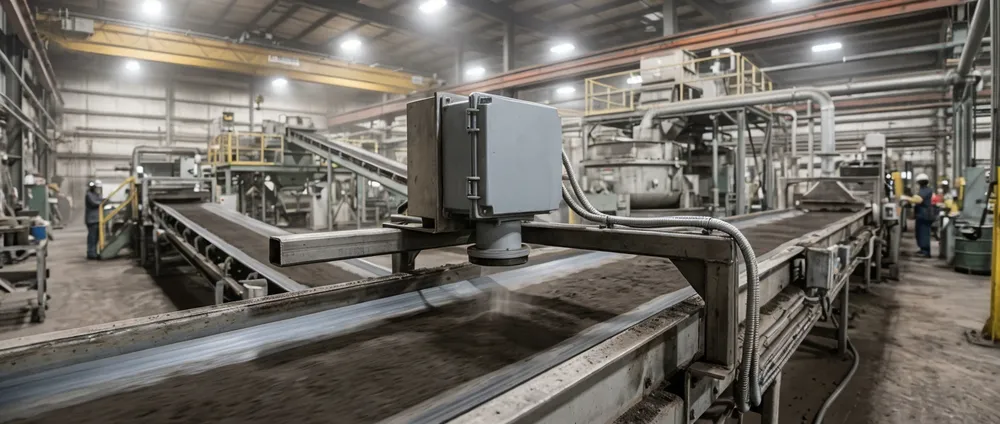
Verify moisture sensor is clean
Wipe sensor face with dry cloth if sand buildup is visible.
80% of unplanned downtime is preventable with these daily checks. A dry gearbox seizes within 2–4 hours, and a misaligned belt can tear and halt production mid-shift.
Weekly Maintenance (30–45 minutes)
Inspect Mixer Paddles for Wear
Measure paddle thickness at three points — replace when thickness drops below 80% of original. This catches wear before it causes failures or degrades mix quality.
Check Belt Tension on All Conveyors
Press belt midway between rollers — deflection should be 10–15mm under moderate finger pressure. Proper tension prevents slippage and premature wear.
Verify Clay Feeder Screw Is Clear
Remove inspection cover, check for bridging or caked material. Blockages in the clay feeder disrupt mix ratios and create inconsistent sand quality.
Test Moisture Sensor Calibration
Run a known-moisture sand sample through the system, compare sensor reading to lab test result — recalibrate if difference exceeds 0.5%. Weekly calibration verification keeps moisture control within the ±1.5% specification.
Monthly Maintenance Protocol — 2–3 Hours
Monthly servicing maintains system performance and prevents gradual degradation. Plan for 2–3 hours of technician time on each task set below.
Mixer Gearbox Oil Change
- Drain via bottom plug, refill with ISO VG 320 gear oil
- Capacity: 8–12 liters depending on mixer size
- Interval: every 3 months — cost $80–120 per change (oil + labor)
Moisture Sensor Calibration
- Use calibration kit with three reference samples (low / mid / high moisture levels)
- Full calibration: monthly check, annual recalibration (1–2 hours labor, no parts cost)
- Sensor replacement every 3–5 years — cost $300–500 per unit
Electrical Connection Inspection
- Check for loose terminals, signs of overheating
- Inspect for damaged insulation and discolored wiring
- Prevents unplanned downtime from electrical faults
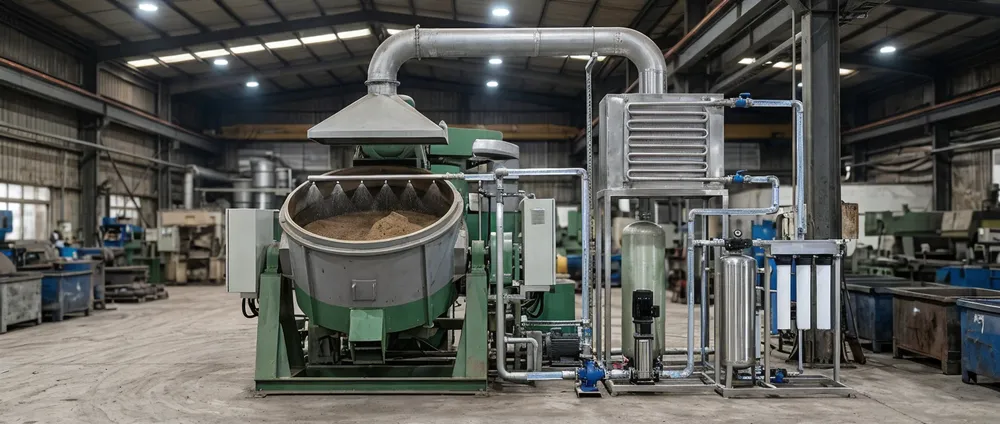
Dust Collector Filter Cleaning
- Remove cartridges, shake out accumulated dust, reinstall
- Replace if fabric is torn or clogged beyond cleaning
- Filter cartridge set: $100–150 — lasts 12–18 months with monthly cleaning
Quarterly Maintenance Protocol — 4–6 Hours, Production Shutdown
Quarterly overhauls are scheduled during low-volume periods or between shifts to minimize production impact. Requires a planned production shutdown of 4–6 hours.
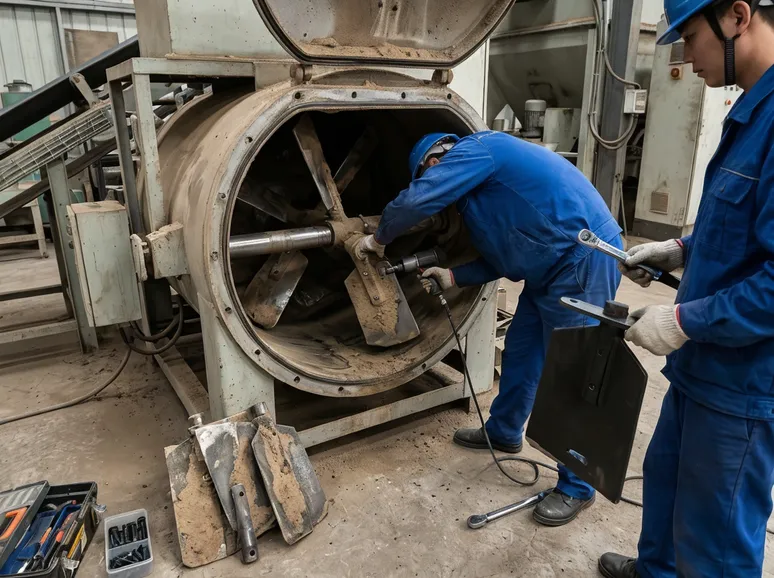
Replace Mixer Paddles (If Wear > 20%)
Unbolt worn paddles, bolt on new set. 8–12 paddles per mixer depending on size. Inspect paddle mounting bolts for thread damage during replacement.
Conveyor Belt Tracking Adjustment
Loosen belt tension, adjust roller alignment, retighten. Belt should run centered on rollers with no edge contact. Misaligned belts accelerate edge wear and can cause material spillage.
Clay Feeder Seal Replacement
Screw feeder shaft seals prevent clay dust from entering bearings. Seals last 6–12 months depending on clay abrasiveness — shorter life with fine-grind clay that generates more dust.
Full PLC Backup
Export program and data logs to USB drive for archival. Ensures recipe configurations and tuning parameters are recoverable after any controller failure.
Consumable Costs & Replacement Intervals
Mixer paddles are the highest-wear component in any clay sand preparation line. Choosing the right paddle material directly controls your annual consumable spend and shutdown frequency.
| Paddle Material | Service Life | Cost per Set (8–12 paddles) | Best For |
|---|---|---|---|
| Standard Carbon Steel | 6–12 months | $200–400 | Silica sand service — most common choice, replaced annually during planned shutdown |
| Hardened Steel | 12–18 months | $350–600 | Abrasive sands — chromite, zircon, and other specialty casting sands |
| Ceramic-Coated | 18–24 months | $500–800 | Extreme abrasion resistance — longest life, lowest shutdown frequency |
Other Key Consumables
Replace every 3–5 years
$300–500 per unit
Replace every 6–12 months
$50–100 per set
More frequent with fine-grind clay
Replace every 2–3 years
$150–300 each
Replace every 12–18 months
$100–150 per set
Replace sooner if processing very dusty sand or filters get wet
Total Annual Consumable Cost (Mid-Scale System)
$800–$1,500 depending on usage intensity and sand abrasiveness
Includes paddles, seals, filters, belts, oil, and sensor maintenance. Excludes labor.
Spare Parts Availability
We stock high-wear components — mixer paddles, conveyor belts, moisture sensors, clay feeder seals — at our Qingdao facility and ship via DHL or FedEx for 5–7 day delivery to most export markets.
For longer-lead items (mixer gearboxes, motors, PLC controllers), we recommend keeping one spare on-site if downtime risk is critical to your operation. The cost is 5–8% of original equipment price, but it eliminates the risk of a 2–3 week production shutdown waiting for a replacement part to clear customs and ship.
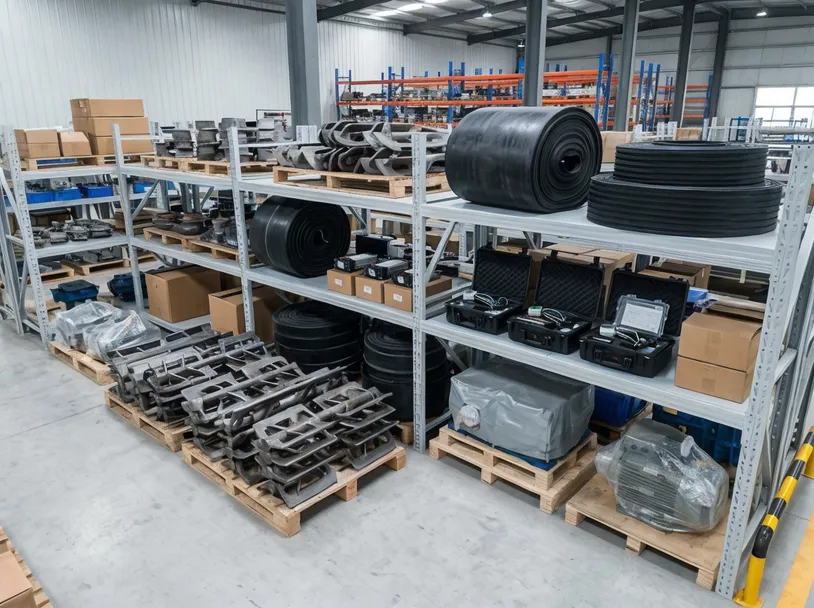
Recommended On-Site Spare Parts Kit
These parts cover 90% of unplanned maintenance scenarios and can be installed by your maintenance team without waiting for factory support.
| Component | Qty | Estimated Cost |
|---|---|---|
| Mixer paddles | 1 set | $200–400 |
| Moisture sensor | 1 unit | $300–500 |
| Clay feeder seals | 2 sets | $100–200 total |
| Conveyor belt (per conveyor) | 1 each | $150–300 each |
| Total Kit Investment (mid-scale system) | $750–1,400 | |
Remote Diagnostics & Support
Our PLC systems include VPN capability for remote troubleshooting. When you report a problem — inconsistent moisture, clay dosing errors, sensor faults — we log into your PLC via secure connection and review the last 48–72 hours of process data, identify parameter drifts or equipment faults, and walk your team through the fix over a phone or video call. This cuts troubleshooting time from days (waiting for a technician to travel to your facility) to hours.
You Report the Issue
Describe the symptom — moisture drift, dosing error, sensor fault — via phone, email, or WeChat.
Secure VPN Diagnostic
We access your PLC in read-only mode by default — viewing data and downloading logs without changing setpoints or controlling equipment unless you grant write access.
Guided Resolution
Your technician makes the physical repairs or adjustments while we provide real-time diagnostic support via video call.
Response Times
China business hours (UTC+8): 4–8 hours remote support response
Outside business hours: 12–24 hours for inquiries submitted outside that window
On-Site Service Fallback
If remote support doesn't resolve the problem, we dispatch a technician for on-site service. Cost structure:
- Travel costs (airfare, accommodation) — covered by buyer
- Labor — covered by TZFoundry
On-site service is rare after the first year of operation — most buyers need it 0–1 times per year for major component replacements or capacity upgrades.
Why TZFoundry Clay Sand Preparation Lines
Building Clay Sand Preparation Equipment Since 2010
We've been building clay sand preparation equipment since 2010, starting with standalone mixers for domestic foundries and moving to integrated preparation lines when export buyers needed systems that connected to their existing molding equipment without custom engineering on their end.
The shift happened because overseas buyers don't want to coordinate between multiple equipment suppliers — they need one manufacturer who understands the full integration picture and delivers a system that works with what they already own.
In-House R&D — No Outsourced Design Work
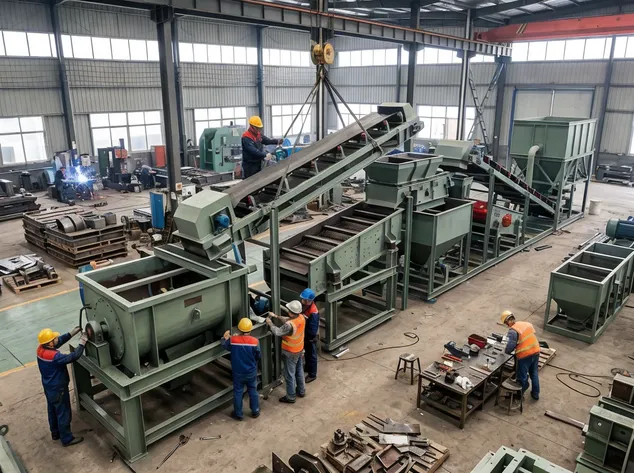
Our in-house R&D team handles custom configurations without outsourcing design work to third-party engineering firms. When you need a non-standard mixer capacity, a different control system, or integration with unusual upstream/downstream equipment, we're modifying our own designs — not coordinating between multiple vendors who each have their own lead times and compatibility issues.
This matters most when you're adapting a preparation line to fit an existing foundry layout with space constraints or utility limitations.
Real Custom Engineering Examples
Compact Floor Space Adaptation
Built systems that fit 8m × 3m floor spaces where the standard spec calls for 10m × 3.5m — a layout-driven redesign, not just component rearrangement.
Non-Standard Voltage Configuration
Systems running on 380V three-phase power instead of the standard 415V — because that's what the buyer's facility provided.
Certifications & Quality Audit Trail
ISO 9001:2015
Annual third-party audits verifying documented procedures for material sourcing, fabrication, assembly, and testing.
CE Certified
Conformity with European health, safety, and environmental protection standards for equipment export.
SGS Certified
Independent inspection and verification from a globally recognized testing authority.
Why This Matters for Your Supply Chain
The certifications themselves don't make the equipment better, but they create a paper trail that satisfies your own quality audits and customer requirements. If you're selling castings to automotive or aerospace buyers who require supplier traceability, you'll need to show that your foundry equipment came from a certified manufacturer. We provide the complete documentation package — material certs, test reports, calibration records — with every system shipment.
Production Capacity & Lead Time Stability
Our facility runs 8 production lines across 15,000 square meters, producing 500,000 units annually. That capacity matters because it determines lead time stability — we're not a job shop that gets backlogged when a large order comes in.
A typical clay sand preparation line order (mid-scale configuration) consumes about 2–3 weeks of production time across multiple lines (frame fabrication, machining, electrical assembly, testing). We can run 4–6 systems in parallel, so even if we have a queue of orders, your lead time stays in the 45–60 day range.
8
Production Lines
15,000
Sq. Meters Facility
4–6
Parallel Systems
45–60
Day Lead Time
Flexible MOQ & Customization Services
We don't have a minimum order quantity for complete systems, and we'll modify standard designs without charging engineering fees — unless the changes require new tooling or outside components.
- Different motor voltages
- PLC interface language changes
- Custom paint colors
- Conveyor height adjustments under 500 mm
- Non-standard mixer capacities (custom paddle fabrication)
- Special materials for corrosive environments (stainless steel instead of carbon steel)
- Third-party component integration (specific brand of PLC or sensor not normally stocked)
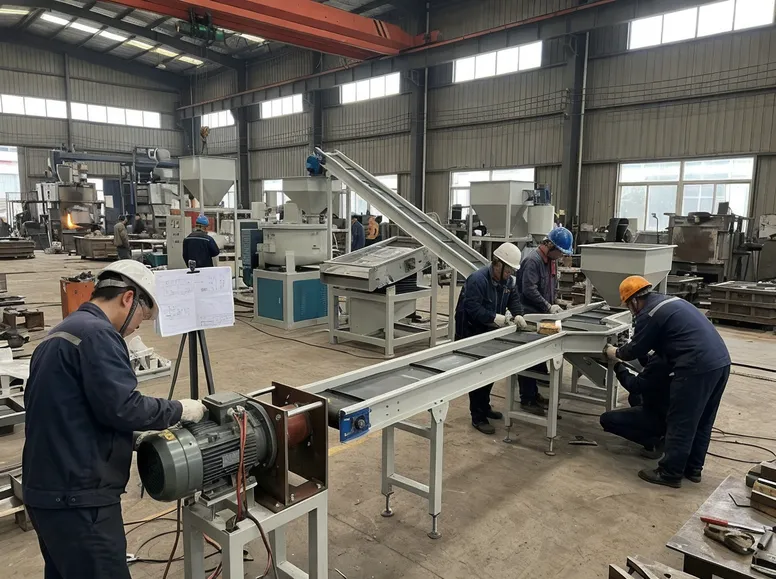
Professional Export Experience
We handle documentation, shipping logistics, and customs coordination as part of the standard service. We've shipped to 40+ countries and know which markets require specific certifications, what information customs officials need on commercial invoices, and how to pack equipment to survive ocean freight without damage.
Standard Documentation (Every System)
- English-language operations manual
- Electrical schematics
- Spare parts list
- Maintenance schedule
Additional Language Translation
Adds 1–2 weeks to delivery. Available for any language — we arrange professional technical translation of the full documentation package.
FAQ — Technical Decision Questions
Practical answers to the engineering and operational questions foundry teams ask most when evaluating clay sand preparation line investments.
What causes inconsistent sand moisture in clay sand preparation lines?
Three common causes:
Manual valves that operators adjust by hand drift over time as valve seats wear, causing unpredictable water delivery to the mixer.
Reduced mixing intensity means water doesn't distribute evenly through the sand mass, creating wet and dry pockets in the batch.
Sand absorbs or releases moisture between the mixer and molding line if storage time is long, shifting the prepared moisture level.
Targeted Solutions
- PLC control with inline moisture sensors solves the first problem — the system measures actual moisture at the mixer discharge and adjusts water injection automatically, compensating for valve wear and flow variations.
- Replacing worn paddles (when thickness drops below 80% of original) solves the second problem, restoring full mixing intensity.
- Reducing storage time between preparation and molding (use smaller buffer hoppers, increase preparation frequency) solves the third problem.
Still seeing moisture variation despite PLC control and good paddle condition?
Check your water supply pressure — if facility water pressure fluctuates (common in facilities with multiple high-demand users on the same supply line), the PLC's flow control valve can't maintain consistent water injection even with correct control signals. Install a pressure regulator on the water supply line to the preparation system (costs $300–500, maintains constant pressure regardless of facility demand).
How often should clay sand preparation equipment be calibrated?
| Component | Frequency | Procedure & Notes |
|---|---|---|
| Moisture Sensors | Every 3–6 months | More often if switching between different sand types or clay formulations. Takes 1–2 hours using reference sand samples at known moisture levels — calibration kit provided with each system. |
| Clay Feeders | Every 6–12 months | Run the feeder at a set speed for 5 minutes, weigh the discharged clay, compare to expected weight based on feeder specifications. Adjust the PLC's calibration factor if the difference exceeds 5%. |
| Mixer Speed (RPM) | Annually | Verify using a tachometer — if actual speed differs from setpoint by more than 3%, check for belt slippage or motor controller issues. |
| Belt Scales | Every 3 months | Requires certified test weights. Most buyers outsource to industrial weighing service companies ($200–300 per visit) because it requires traceable calibration weights and documentation for quality system compliance. |
Screw conveyors and volumetric feeders used for clay delivery follow the same 6–12 month calibration cycle. The 5-minute discharge-and-weigh test is a straightforward procedure your maintenance team can perform in-house without specialized equipment.
Paddle mixer vs. high-shear mixer for clay sand preparation: which is better?
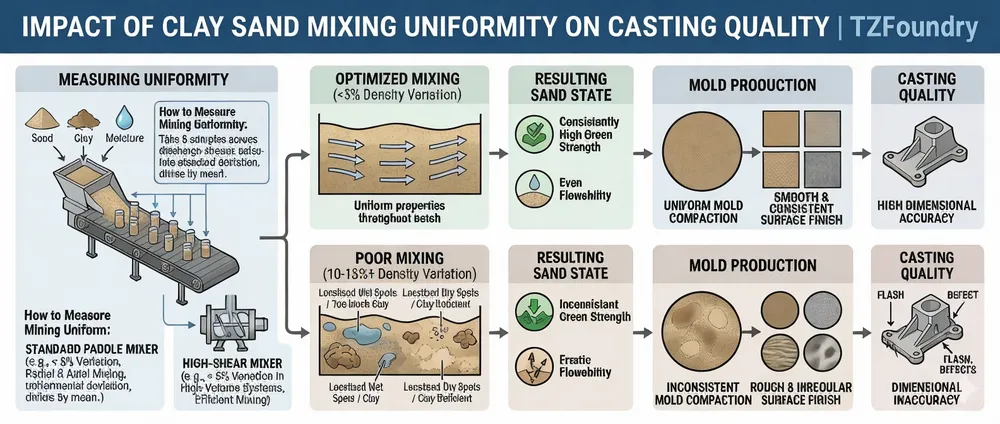
Paddle mixers work for standard clay content (6–10%) and moderate uniformity requirements (under 5% density variation). They run at 45 RPM, consume less power (30–45 kW for mid-scale systems), and cost less ($40,000–60,000 for a complete mid-scale system). High-shear mixers are for low clay content (under 5%, where clay activation is critical) or tight uniformity requirements (under 2% density variation for precision casting work). They run at 60–80 RPM, consume more power (50–70 kW for equivalent capacity), and cost more ($55,000–80,000 for a complete mid-scale system).
| Parameter | Paddle Mixer | High-Shear Mixer |
|---|---|---|
| Clay Content Range | 6–10% (standard) | Under 5% (activation-critical) |
| Density Variation | Under 5% | Under 2% |
| Speed | 45 RPM | 60–80 RPM |
| Power Consumption | 30–45 kW (mid-scale) | 50–70 kW (mid-scale) |
| System Cost (Mid-Scale) | $40,000–60,000 | $55,000–80,000 |
Operational trade-off: High-shear mixers produce 10–15% stronger molds at the same clay content (better clay activation means better bonding), which lets you either reduce clay content (saves on clay purchasing cost) or maintain the same clay content and get stronger molds (reduces breakage during handling and pouring). If your casting defect rate is high due to mold strength issues, the high-shear mixer's cost premium pays back through reduced scrap. If your molds are already meeting strength requirements with paddle mixing, there's no operational benefit to upgrading.
Can a clay sand preparation line handle both fresh and reclaimed sand?
Yes, dual-input systems mix fresh and reclaimed sand in controlled ratios. The typical configuration uses two input conveyors (one from fresh sand storage, one from the reclamation system) that merge onto a common belt scale before entering the mixer. The PLC controls the feed rate from each conveyor to maintain your target blend ratio — common split is 70% reclaimed, 30% fresh for most gray iron and ductile iron work. The mixer treats the blended sand as a single input stream and adds clay and water based on total throughput.
Clay Addition Calculation
Reclaimed sand typically has 2–4% residual clay content (clay that survived the reclamation process), so your fresh clay addition rate needs to account for that. If you're targeting 8% final clay content and your reclaimed sand has 3% residual clay, you're adding 5% fresh clay to the blend (not 8%). The PLC calculates this automatically if you input the reclaimed sand's residual clay percentage as a parameter.
Caution — variable reclaimed sand quality: If your reclaimed sand quality varies significantly batch-to-batch (residual clay content swings by 2–3%), you'll see corresponding variation in final prepared sand quality unless you add an inline clay analyzer (measures actual clay content in the prepared sand and adjusts fresh clay dosing to compensate). The analyzer costs $8,000 but eliminates the guesswork when working with variable-quality reclaimed sand.
What is the minimum production scale for automated clay sand preparation?
8–10 tons per hour is the practical threshold where PLC automation becomes cost-effective. Below that, the equipment cost premium for PLC control — about $15,000–$20,000 over manual systems — takes too long to pay back through labor savings and quality improvements.
ROI Payback by Production Scale
5 t/h
40 tons/day · 10,000 tons/year
10% defect reduction at $2,000/ton casting value = $2,000/year savings
8–10 year payback
Exceeds most buyers' ROI requirements
10 t/h
80 tons/day · 20,000 tons/year
10% defect reduction at $2,000/ton = $4,000/year savings
4–5 year payback
Acceptable for most operations
15 t/h
120 tons/day · 30,000 tons/year
Proportionally higher savings on scrap and rework
Under 3 year payback
Clear automation ROI
The crossover point where automation makes financial sense depends on your casting value and current defect rate, but 8–10 tons per hour is where most buyers see clear ROI.
Below 8 tons per hour?
Stick with manual control and invest in operator training and good maintenance practices — keep paddles sharp, calibrate moisture sensors regularly, maintain consistent water pressure. You'll get 80–85% of the quality benefit at 40–50% of the equipment cost.
Getting Started — From Inquiry to Commissioning
What we need from you to deliver an accurate quotation, and what your site needs before installation day.
Information We Need for an Accurate Quotation
Production & Integration Details
- Target production capacity (tons per hour of prepared sand)
- Existing equipment you're integrating with — molding line brand and model, conveyor types and dimensions, control system details
- If replacing an older preparation system, tell us what's not working with your current setup — that helps us avoid specifying the same bottlenecks
Site & Electrical Specs
- Available floor space — length × width, plus ceiling height if you have overhead cranes or vertical conveyors
- Electrical supply specs — voltage, phase, available amperage
Target Sand Formulation
- Clay type and content, moisture range, any specialty additives
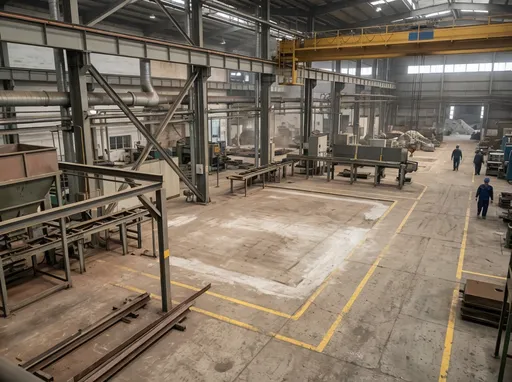
Photos of Your Existing Foundry Layout
Photos help us spot potential installation issues before we finalize the quotation. Phone photos are sufficient — we're looking for spatial context, not engineering-grade documentation.
Installation area — to verify floor space and access for equipment delivery
Molding line feed hopper — to confirm conveyor interface requirements
Raw material storage — to plan input conveyor routing
Site Preparation Requirements
Foundation
Reinforced Concrete Slab
Clay sand preparation lines need a reinforced concrete foundation at least 150mm thick — less than molding lines or reclamation systems because preparation equipment generates less vibration.
Mixer weight: 1,500–3,000 kg depending on capacity. Dynamic loads during operation are modest — paddle mixers don't create the impact forces that molding presses do.
Upper floor installations: Check your building's load rating — a mid-scale system weighs 4–6 tons fully loaded with sand, which is within the capacity of most industrial building floors.
Electrical Service
| Small-scale | 15–22 kW |
| Mid-scale | 30–45 kW |
| High-volume | 60–85 kW |
Add +20% overhead for startup surge current. Most buyers install a dedicated circuit breaker for the preparation line rather than tapping into existing foundry power — it simplifies troubleshooting and prevents voltage sags from affecting other equipment.
Compressed Air
Required if using pneumatic actuators for gates or valves.
Water Supply
For moisture addition to the sand mix.
Shipping & Installation Timeline
Total elapsed time from order to first production batch: 65–100 days. Here's how that breaks down stage by stage.
Production
Manufacturing from deposit confirmation
45–60 daysOcean Freight
Shipping time varies by destination port
15–30 daysCustoms & Transport
Clearance and inland delivery to your site
3–5 daysOn-Site Assembly
Module bolt-up, alignment, and connection
2–4 daysCommissioning & Training
Final checks and operator certification
1–2 daysNeed Faster Delivery?
Air freight is available for small-scale systems — cuts shipping time from 15–30 days down to 5–7 days, but costs 4–5× more than ocean freight. Contact our logistics team to evaluate whether air freight makes sense for your timeline and budget.
Shipping Configuration by System Size
Small-Scale
Ships in one 20-foot container. Compact footprint, single-crate logistics.
Mid-Scale
Ships in one 40-foot container. Standard intermodal sizing for global logistics.
High-Volume
Ships in one 40-foot high-cube container. Extra height accommodates taller mixer assemblies.
Equipment frames break down into modules that clear container door dimensions, then bolt together on your factory floor. We provide assembly drawings and a parts list with each shipment, and our commissioning technician supervises the assembly process to ensure correct alignment and bolt torque.
Training & Documentation
On-Site Operator Training
1–2 days during commissioning
2–3 days for mid-scale and high-volume systems
Training Covers
- Startup procedures and normal operation
- Parameter adjustment — moisture targets, clay content targets, mixer speed, conveyor speeds
- Routine maintenance — lubrication, inspection, cleaning
- Basic troubleshooting — sensor faults, conveyor jams, out-of-spec alarms
Training is hands-on — your operators run the equipment under our technician's supervision until they're comfortable with all normal and exception scenarios.
Documentation Package
Every clay sand preparation line ships with a complete documentation set for operations, maintenance, and long-term support.
Operations Manual
60–100 pages depending on system complexity
Electrical Schematics
Full wiring diagrams for all system components
PLC Program Backup
Delivered on USB drive for disaster recovery
Spare Parts Catalog
Part numbers and supplier contacts included
Maintenance Schedule
Preventive maintenance intervals and checklists
All documents ship in English. Other languages available on request for an additional $500–800 depending on language and document length.
After-Sales Support
Remote Diagnostics
VPN-based remote access — our engineers can log directly into your PLC and review process data when you report an issue, enabling fast root-cause identification without travel delays.
Spare Parts Ordering
Order via email or WhatsApp. We quote price and lead time within 24 hours. On-site service dispatched if remote support doesn't resolve the problem.
Response Times
- China business hours (UTC+8): 4–8 hours remote support
- Outside business hours: 12–24 hours for inquiries
- Urgent production issues: WhatsApp +86 13335029477 — reaches our technical team directly
Ready to Specify Your Clay Sand Preparation Line?
Contact us at sales@tzfoundry.com with your capacity requirements and integration details. Include photos of your existing foundry layout if you're integrating the preparation line with current equipment — that helps us provide accurate specifications and avoid surprises during installation.
Explore Related Clay Sand Equipment
Complete your clay sand processing system with complementary lines and machines from TZFoundry.
Clay Sand Reclamation Line
Recover and recondition spent sand for reuse in your molding process.
Clay Sand Molding Line
Automated molding lines that integrate directly with preparation systems.
Clay Sand Casting Line
End-to-end casting systems for high-volume foundry production.
Clay Sand Regeneration Line
Thermal and mechanical sand regeneration for extended material life.
Clay Sand Vibrating Screen
Screening equipment for particle size control in sand conditioning.
View All Clay Sand Processing Lines