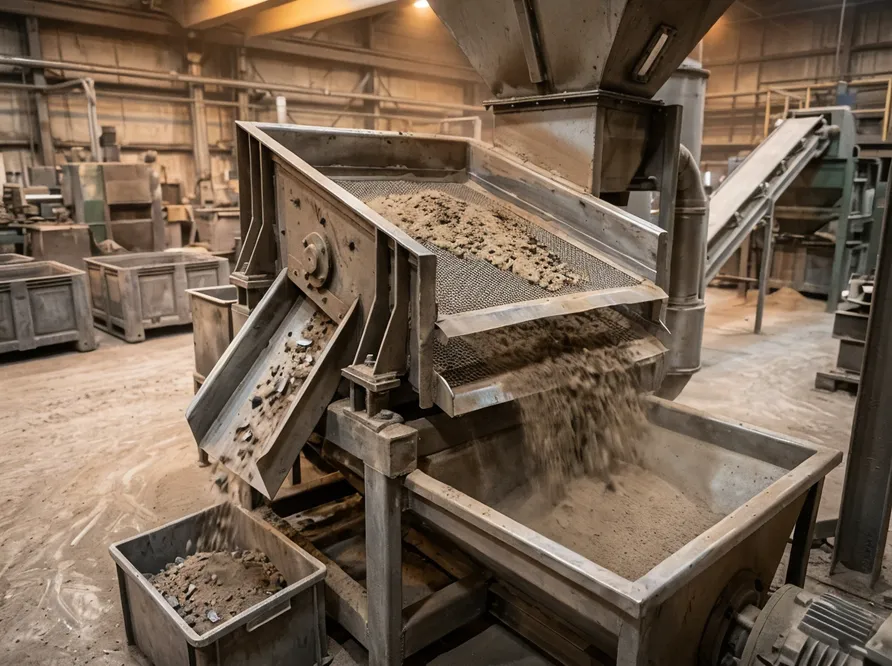
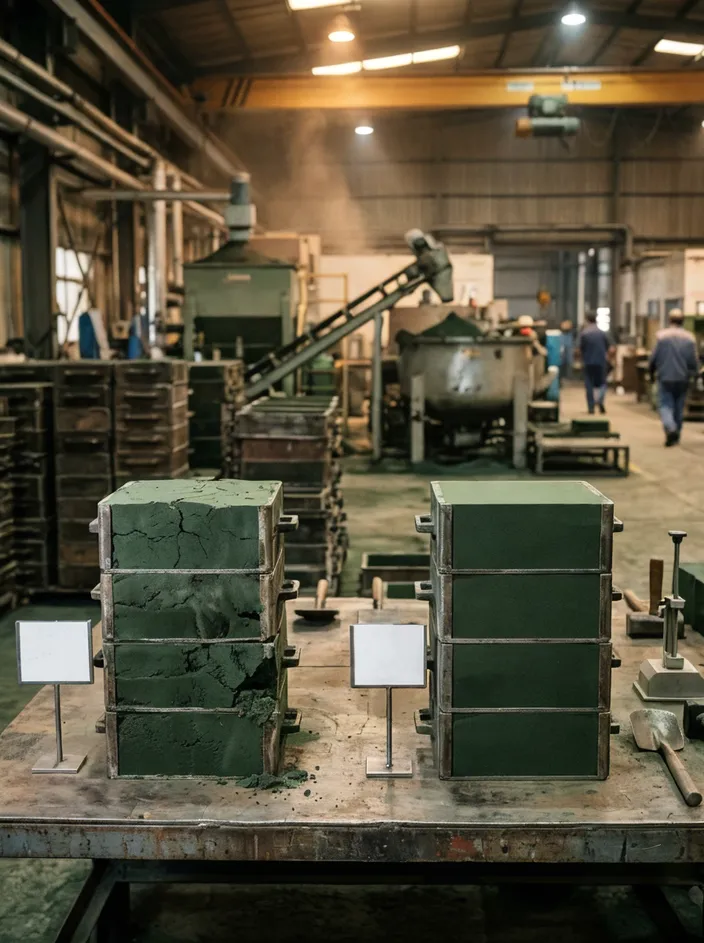
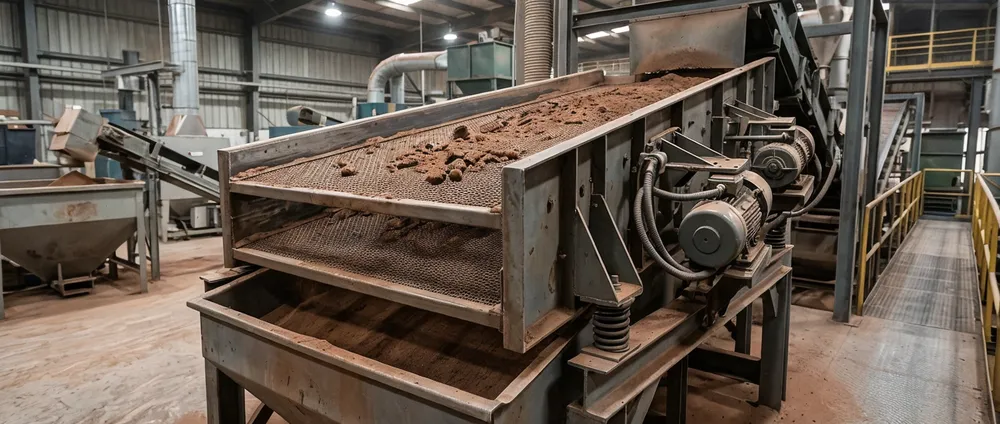
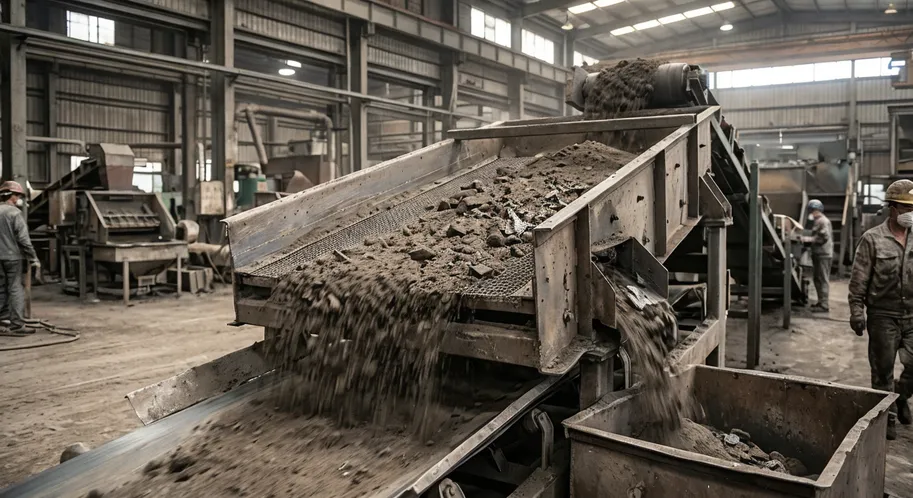
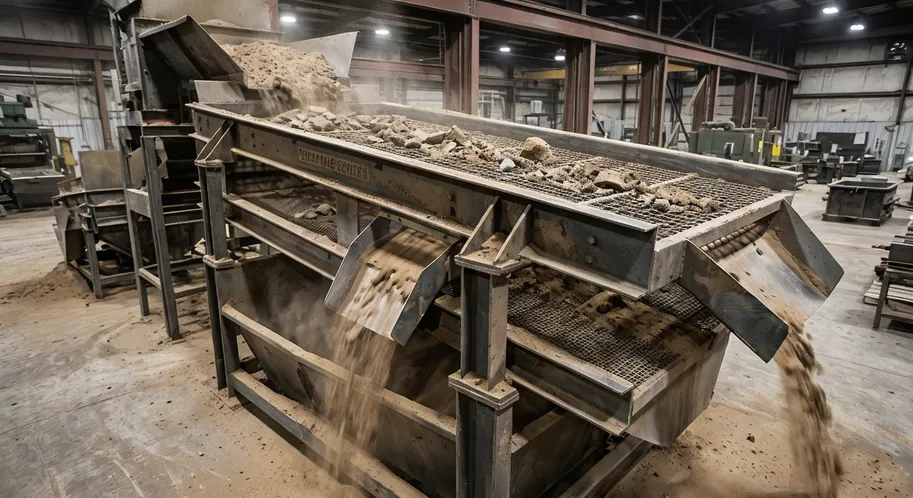
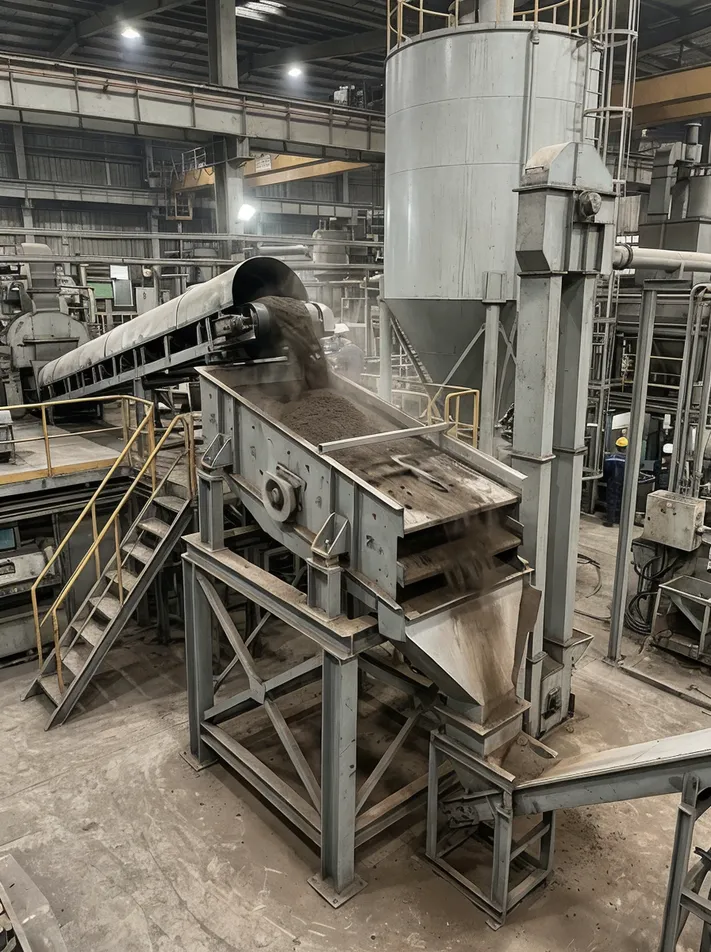
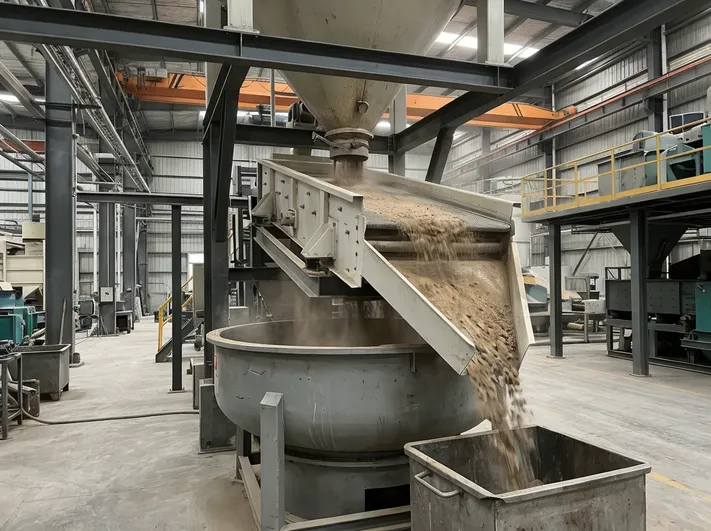
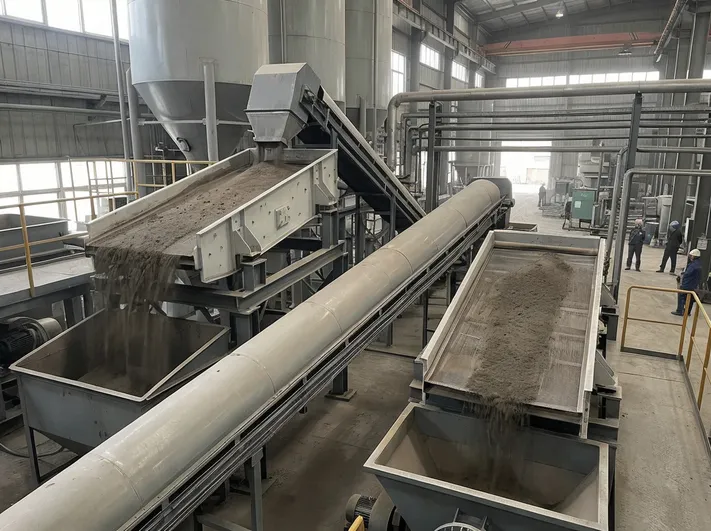
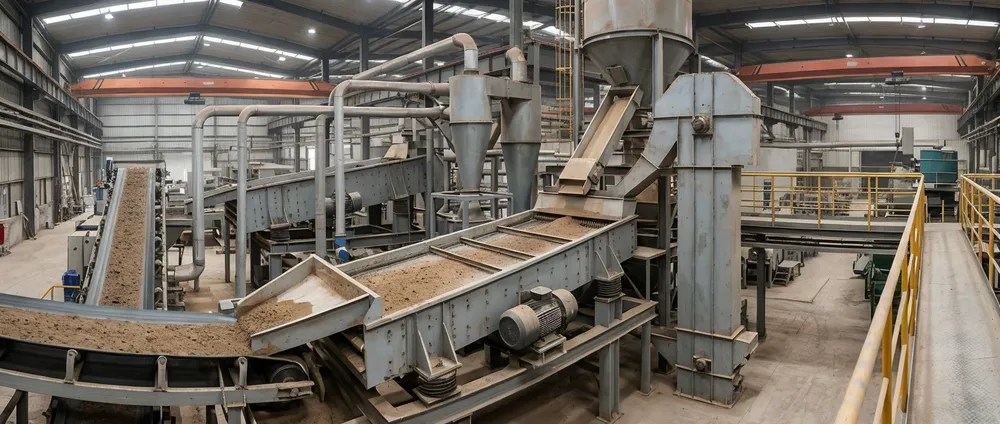
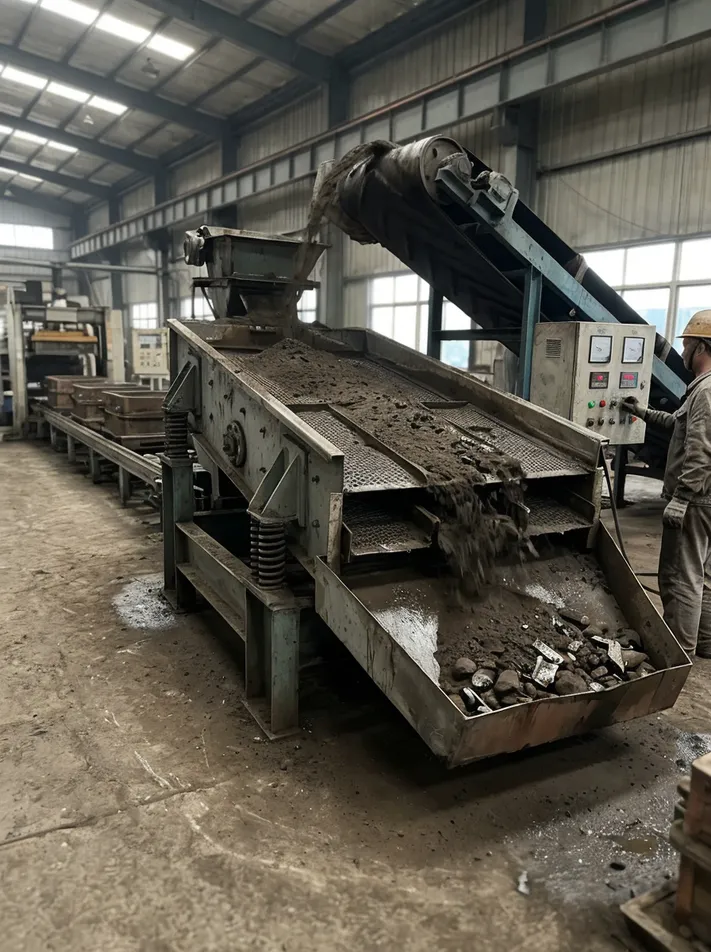
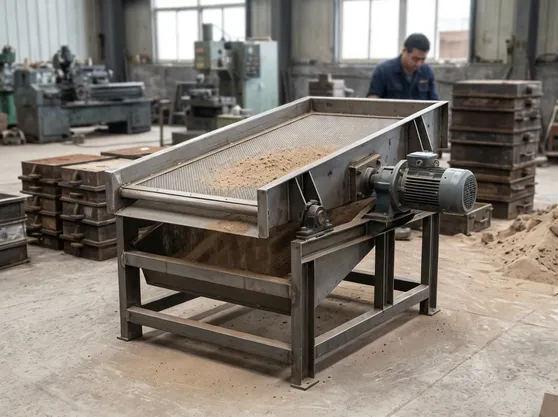
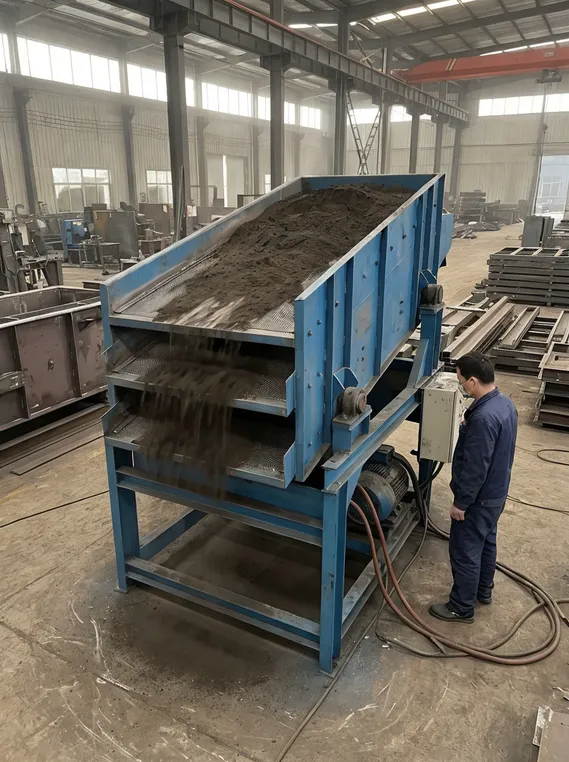
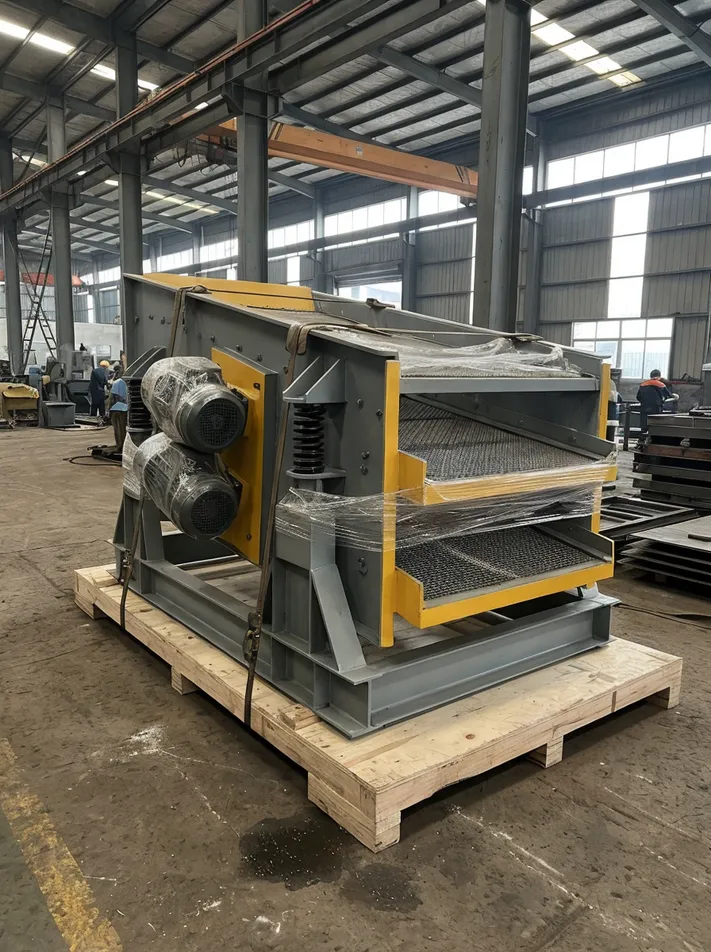
A clay sand vibrating screen sits between your reclamation unit and your mixing station, removing three types of material that wreck mold consistency: metal splash and debris larger than 2mm, clay fines smaller than 0.2mm that waste binder, and sand grains outside the 0.2–0.6mm range that clay bonding requires.
This isn't a general-purpose industrial screen adapted for foundries — it's designed for continuous operation in high-dust environments with sand throughput rates that match molding line capacity.
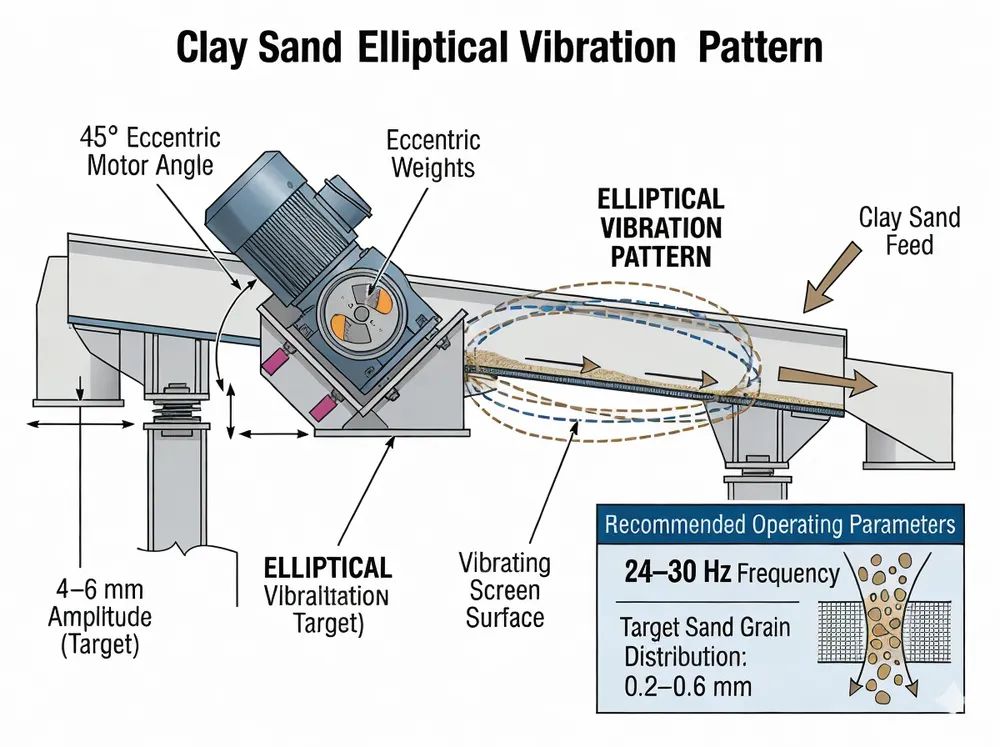
An eccentric motor generates circular vibration that stratifies sand by particle size. Material separates into three distinct streams across the deck:
Oversized material travels upward along the deck and exits at the discharge end — metal splash, debris, and particles larger than 2mm are removed before they enter your mixer.
Sand within the target grain range passes through the mesh into a collection hopper — this is the screened feedstock that goes to your mixer with consistent, bondable grain distribution.
Particles smaller than 0.2mm — clay fines that contribute nothing to mold strength — fall through to a separate waste outlet, preventing binder waste downstream.
Most buyers install screens in one of two positions — and some foundries run dual-stage screening at both when casting tolerances demand tighter sand grading control:
Removes contaminants before sand enters storage silos. Prevents contaminated sand from accumulating in your buffer inventory and protects downstream equipment.
Final quality check before clay addition. Ensures your mixer receives sand with consistent grain distribution so the PLC's binder calculation matches actual usable grain surface area.
Your mixer receives inconsistent feedstock — some batches with 15% fines, others with 8%, and your PLC's clay addition algorithm can't compensate because it's calculating based on total sand weight, not usable grain surface area.
Mold strength varies by 20–30% batch to batch, which shows up as random breakage during handling and pouring. You're also feeding oversized particles into your mixer, which accelerates paddle wear and creates density variations in the finished mold.
A mid-volume foundry processing 50 tons of sand daily without screening typically wastes 8–12% of clay binder on fines that contribute nothing to mold strength — that's $400–600 monthly in wasted material, plus the scrap casting cost from inconsistent molds.
Inconsistent feedstock from skipped screening leads to 20–30% mold strength variation and random breakage.
Clay sand vibrating screens for foundry applications typically use 20–80 mesh sizing (mesh number indicates openings per linear inch — 20 mesh has larger openings than 80 mesh). Primary screening for oversize removal runs 20–40 mesh, which passes sand grains in the 0.4–0.85 mm range and rejects larger contaminants. Fine separation for undersize extraction uses 60–80 mesh, which retains grains above 0.18–0.25 mm and removes clay fines. Most foundries start with a single-deck 30-mesh screen for basic quality control, then add a second deck or a separate fine screen if their casting work demands tighter particle distribution.
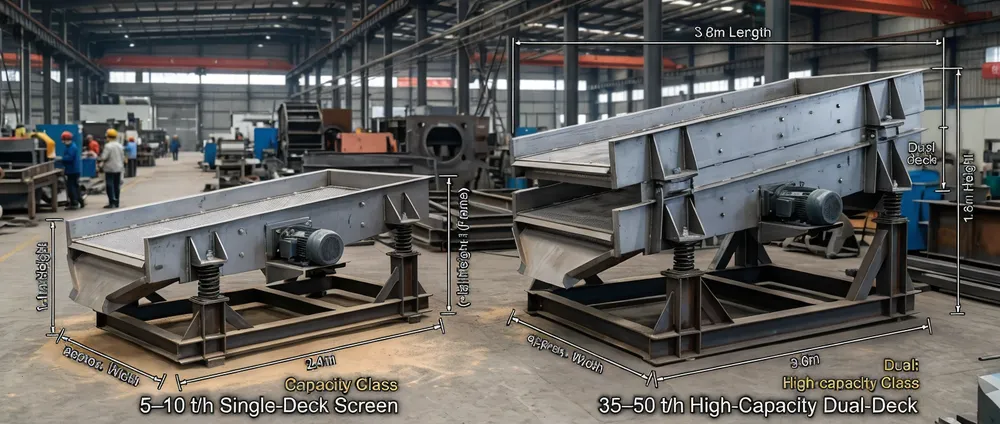
5–10 t/h
Single-deck screen capacity
Supports a molding line producing 50–80 molds/hour (assuming 15–20 kg sand per mold).
15–20 t/h
Single-deck screen capacity
Supports 100–130 mold/hour molding lines.
35–50 t/h
Dual-deck configuration
For operations running 200+ molds/hour.
Moisture matters: These capacity figures assume dry or low-moisture sand (under 5% moisture content). Screening efficiency drops significantly above 6–8% moisture because wet fines blind the mesh. Factor in your sand moisture levels when sizing your screen.
Performs one separation — either oversize removal or undersize extraction, not both simultaneously.
Best for
Foundries that only need oversize removal — the most common scenario in clay sand screening.
Stacks two mesh layers with different openings — top deck removes oversize, bottom deck extracts fines, and usable sand exits between the two.
Best for
Also extracting fines to reduce clay waste, or processing reclaimed sand with high contamination levels.
Dual-deck units cost 40–50% more than single-deck but eliminate the need for two separate screens in series.
All listed dimensions include motor mount and discharge chutes but not the support frame or vibration isolation mounts — add 200–300 mm to height for those. Floor space requirement is roughly 1.5× the screen footprint to allow access for mesh replacement and routine maintenance.
Dimensional comparison across capacity classes — single-deck through high-capacity dual-deck configurations.
Most foundry applications run 4–6 mm amplitude as a compromise between capacity and screening efficiency. This range delivers the best balance of throughput and separation accuracy for maintaining the 0.2–0.6 mm sand grain distribution that clay sand molding demands.
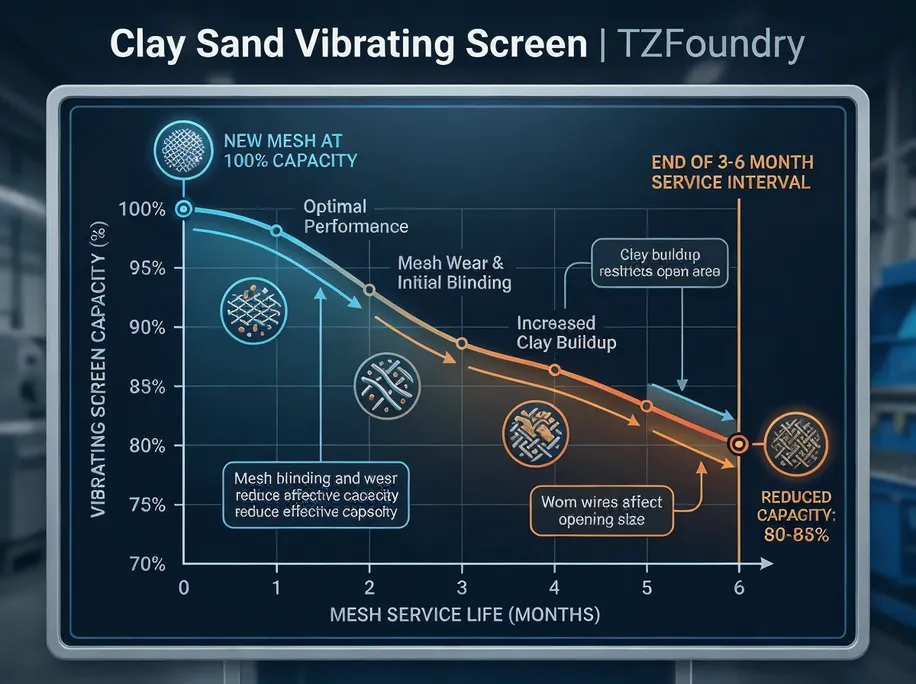
We size screens to 120% of your calculated throughput requirement, not 100%, because mesh blinding and wear gradually reduce capacity over the 3–6 month mesh life. If your molding line consumes 18 tons of sand per hour at peak production, we recommend a 22–25 ton/hour screen so you maintain adequate capacity even when the mesh is 80% through its service life.
Undersizing a screen to save on initial cost creates a bottleneck that forces you to either slow down molding or bypass screening during high-volume periods — both options cost more than the price difference between screen sizes.
Consistent sand grading determines whether your molds hold together during handling and pouring. When grading varies batch to batch, the same clay addition produces wildly different mold strengths — and that variation costs you scrap, rework, and schedule delays.
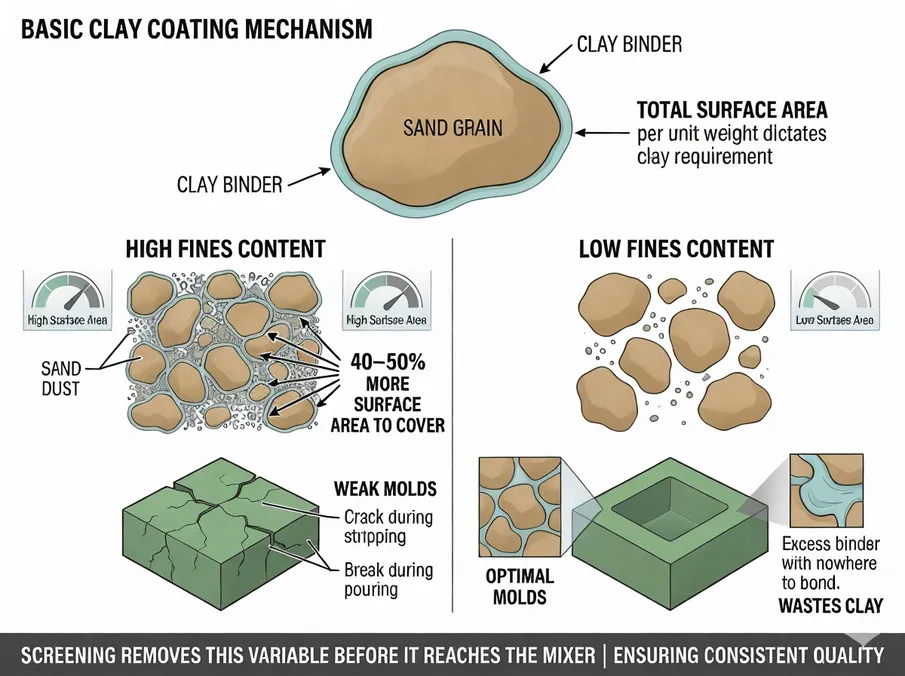
Clay binder works by coating sand grain surfaces — the total surface area per unit weight of sand dictates how much clay you need to achieve target mold strength. When sand grading varies (one batch with 20% fines, the next with 8%), your mixer adds the same weight of clay to both batches, but the high-fines batch has 40–50% more surface area to cover.
Result: the high-fines batch produces weak molds that crack during stripping or break during pouring, while the low-fines batch wastes clay because there's excess binder with nowhere to bond. Screening removes this variable before it reaches the mixer.
Oversized particles create voids in the mold surface that telegraph through to the casting as rough patches or dimensional inconsistencies. A 1.5 mm metal fragment embedded in a mold face leaves a 1.5 mm protrusion on the casting surface — minor for rough castings, but unacceptable for machined parts where you're holding ±0.5 mm tolerances.
Oversized sand grains also reduce mold permeability because they create uneven packing density, which traps gas during metal pouring and causes porosity defects in the finished casting.
Defects Caused
Undersized fines have surface area-to-weight ratios 3–4× higher than properly sized sand grains. If 15% of your sand by weight is fines, those fines consume 35–40% of your clay binder. You're paying for clay that's coating particles too small to contribute structural strength to the mold.
Fines also reduce mold permeability because they fill the interstitial spaces between larger grains, creating a denser, less breathable mold that's prone to gas-related casting defects.
Defects Caused
We've measured the impact of screening on mold strength consistency in our test facility. Here's what the data shows when the same reclaimed sand is processed with and without vibrating screen classification.
| Metric | Unscreened Sand | After Screening |
|---|---|---|
| Grading variation (outside 0.2–0.6 mm) | ±25% | ±10% |
| Green strength range | 18–32 MPa (44% range) | 24–28 MPa (15% range) |
| Handling breakage rate | 15–20% | <5% |
A 44% strength range forces you to either overdesign molds (wasting clay) or accept a 15–20% breakage rate during handling. After screening, the 15% range is manageable with standard clay addition rates.
A foundry producing 150 molds per shift with an 18% breakage rate loses 27 molds daily to handling damage. At 15 kg sand per mold and $40 per ton sand cost (including clay, processing, and disposal), that's $16 per broken mold in material cost alone — plus the labor cost of remaking the mold and the schedule delay.
Over a month (22 working days), that's 594 broken molds costing $9,500 in direct material waste. Screening that reduces breakage to 5% saves $7,800 monthly — enough to pay back a $12,000 screen investment in under two months.
Calculate Your SavingsMonthly Mold Breakage (Unscreened)
594 molds
27 molds/day × 22 working days
Monthly Material Waste
$9,500
At $16/mold (sand + clay + disposal)
Monthly Savings After Screening
$7,800
Payback on $12,000 screen: <2 months
Most buyers retrofit vibrating screens to existing sand processing systems rather than installing them as part of a new line, so integration flexibility matters more than standalone performance specs. We've configured screens for three common installation positions, each with different mounting and control requirements.
After the attrition mill, before storage silos
This position removes contaminants while sand is still hot from reclamation friction heat (typically 40–60°C). The screen mounts on a structural steel frame that bolts to your factory floor, with the inlet chute positioned to receive sand from the reclamation unit's discharge conveyor. Discharge from the screen feeds into your storage silo via a bucket elevator or pneumatic conveyor.
Control integration is simple — the screen motor starts when the reclamation unit starts and stops on a 2–3 minute delay timer to clear residual sand from the deck. This position catches metal splash, burnt clay chunks, and other contaminants before they enter your clean sand inventory, which reduces downstream mixer wear and improves batch consistency.
Attrition Mill
Discharge conveyor
Vibrating Screen
40–60°C sand intake
Storage Silo
Via elevator / pneumatic
Hot sand (above 50°C) can warp mesh screens made from standard spring steel wire, reducing mesh life from 6 months to 3–4 months.
If you're screening immediately after reclamation, you have two options:
Adds about 30% to mesh replacement cost but doubles service life in high-temperature applications.
Install between reclamation and screening to drop sand temperature below 40°C before it hits the screen.
Pre-mixing screening (after storage, before clay addition) provides a final quality check on sand that has been sitting in silos where it may have picked up dust, condensation moisture, or contamination from facility air. The screen mounts directly above your mixer inlet — often suspended from overhead structural steel rather than floor-mounted — to take advantage of gravity flow from the storage silo.
Sand falls through the screen into the mixer hopper, oversize material discharges to a waste bin, and fines (if you are running dual-deck) exit to a separate collection point.
Control integration at the pre-mixing position is tighter than post-reclamation screening. The screen must interlock with your mixer's PLC so sand only flows when the mixer is ready to receive it. TZFoundry typically wires the screen motor to start 10 seconds before the mixer (to build up material flow) and stop simultaneously with the mixer.
If you are running a PLC-controlled mixing system with batch recipes, the screen's throughput rate needs to match your mixer's sand consumption rate. A mismatch creates one of two problems:
A backlog of sand waiting to be screened accumulates above the screen, potentially overloading the deck and reducing separation efficiency.
The screen outruns the silo discharge rate, starving the mixer of sand and causing batch inconsistencies or cycle delays.
Pre-mixing screening works well for foundries that store reclaimed sand for extended periods (days or weeks) before reuse, or for operations that blend reclaimed and fresh sand and need to ensure consistent grading in the final mix.
Trade-Off to Consider
You are screening the full volume of sand every time it cycles through the system, which means higher mesh wear and energy consumption compared to post-reclamation screening where you only screen once per reclamation cycle. Factor this into your operating cost calculation when deciding between screen placement positions.
Related equipment for this integration point: Clay Sand Preparation Line · Clay Sand Reclamation Line
Dual-stage screening — running screens at both post-reclamation and pre-mixing positions — is the configuration for high-precision casting operations producing aerospace components, pump housings, and valve bodies. The post-reclamation screen removes gross contaminants and stabilizes sand quality entering storage. The pre-mixing screen catches any degradation that occurred during storage and provides a final verification before clay addition. Together, these two screening positions achieve ±5% grading consistency across continuous production when working with reclaimed sand that has variable contamination levels.
This configuration doubles your screening equipment cost and energy consumption — but it's the only proven method to hold sub-1% clay content variation across production when your reclaimed sand has inconsistent contamination. For foundries running standard automotive or general-purpose castings, a single-stage screen is typically sufficient. Dual-stage is justified when your reject rate from sand-related defects is costing more than the additional screening investment.
TZFoundry has built dual-stage systems for buyers who blend multiple sand sources — reclaimed sand from different casting alloys, fresh sand from different suppliers — and need to homogenize the mix before it reaches the molding station. The first screen classifies incoming material into three streams: oversize waste, usable sand, and undersize fines. The usable sand goes to storage, and the second screen re-verifies grading after the blending process.
This investment eliminates batch-to-batch variation that causes random casting defects in precision work — the kind of intermittent quality failures that are hardest to diagnose because they don't correlate with any single process parameter.
Where you mount the vibrating screen affects installation cost, maintenance access, and material flow design. Both configurations are available from TZFoundry — the right choice depends on your plant layout and which integration point (post-reclamation or pre-mixing) you're installing the screen.
The dynamic load during operation is 1.5–2× the static weight of the screen plus the sand load on the deck. Before specifying a suspended installation, verify that your building's roof trusses or mezzanine framing can handle that load without excessive deflection. TZFoundry provides dynamic load data for all screen models to support your structural engineer's analysis.
Belt conveyors discharge directly onto the screen deck via a chute that spreads material across the full width of the screen. Uneven feeding reduces screening efficiency — the chute geometry matters as much as the belt speed.
Pneumatic conveyors need a cyclone separator or filter receiver to drop sand onto the screen at atmospheric pressure. You can't discharge pressurized air directly onto a vibrating surface — the air blast disrupts the sand bed and defeats the screening action.
Bucket elevators work well for feeding screens from below — common in post-reclamation setups where the reclamation unit sits at floor level and the screen feeds an elevated storage silo.
Gravity chutes from overhead silos are the simplest interface for pre-mixing screens, but you need a slide gate or rotary valve to control flow rate and prevent overloading the screen deck.
The most common question we get: "Can I add a screen to my current system without major modifications?" The answer depends on three factors:
Available floor space — or overhead clearance if you're considering a suspended mount.
Whether you have a convenient tie-in point for the screen's inlet and discharge connections.
Whether your electrical panel has capacity for the screen motor (typically 1.5–3 kW).
Mechanical Installation
Set the screen, connect inlet/discharge chutes, install vibration isolation mounts.
Electrical Hookup
Half-day for motor wiring, VFD connection (if applicable), and control panel integration.
Commissioning & Flow Rate Adjustment
Run test batches, calibrate vibration amplitude, set feed rate to match your molding line throughput.
If you need structural steel for a suspended mount or must run new electrical conduit across your facility, add 2–3 days to the base timeline. TZFoundry's project engineers provide GA drawings and conduit routing plans before installation begins.
Start with your molding line's output in molds per hour, then work backward to calculate required screening capacity.
A 500mm × 400mm flask holds roughly 15–18 kg of sand (depends on mold depth and whether you're making cope and drag or just cope). A 600mm × 500mm flask uses 22–26 kg. Multiply molds per hour by sand weight per mold to get your hourly sand consumption, then add 20% buffer capacity to account for mesh wear and peak production periods.
500mm × 400mm Flask
15–18 kg per mold
600mm × 500mm Flask
22–26 kg per mold
Step-by-step sizing for a 120 molds/hour line
Sand Consumption
120 molds/hr × 17 kg
= 2,040 kg/hr
≈ 2 tons/hour using 500mm × 400mm flasks
Add 20% Buffer
2 tons × 1.2
= 2.4 tons/hr
Minimum screening capacity required
Recommended Screen
3.7 kW · 1.5m × 3.0m deck
15–20 tons/hr rated
6–8× overcapacity — intentional
Mesh efficiency drops to 70–80% of rated capacity as it wears over its service life.
Overtime and seasonal spikes push molding output 30–40% above normal operating rates.
Post-maintenance catch-up — if the screen goes down for mesh replacement, you want to recover quickly rather than running behind for days.
50–100 molds per hour
Sand consumption runs 0.75–1.8 tons/hour depending on flask size. A 2.2 kW motor with a 1.2m × 2.4m single-deck screen handles this range comfortably. This configuration works for job shops and prototype foundries where production volume doesn't justify larger equipment, but you still need consistent sand quality for dimensional accuracy.
Motor
2.2 kW
Deck Size
1.2 × 2.4m
Deck Config
Single
Equipment Cost
$6,000–8,000
Price includes motor, frame, and one spare mesh set.
1.5–4.5 tons/hr
Standard throughput range for foundries running 2–3 shifts with moderate product variety.
3.7 kW motor with a 1.5m × 3.0m screen deck
Optional dual-deck configuration available if you're extracting fines alongside oversize removal.
This is the most common size range we sell — it fits foundries running 2–3 shifts with moderate product variety where sand quality directly affects scrap rates and rework costs.
>4.5 tons/hr
Can reach 8–10 tons/hour for large-flask work. At this production scale, screening isn't optional.
5.5–7.5 kW motor with a 2.0m × 3.6m dual-deck screen
Equipment cost: $20,000–$28,000
$8,000 add-on
Real-time feedback on screening efficiency. Catches mesh wear before it affects mold quality. Most high-volume buyers add this option.
The volume of sand cycling through your system at 200+ molds/hour means even small grading inconsistencies multiply into significant material waste and casting defects. Dual-deck screening with real-time monitoring is the standard configuration at this scale.
The Core Problem
Mesh blinding and wear reduce effective capacity over the mesh's 3–6 month service life. A screen rated for 20 tons/hour when new might only deliver 16–17 tons/hour when the mesh is 80% through its life and starting to show wear spots and clay buildup.
Real-World Example
Peak demand of 18 tons/hr on a 20-ton screen → bottleneck for the last 4–6 weeks before mesh replacement.
Same demand on a 25-ton screen → adequate capacity throughout the mesh life cycle, for only 15–20% more cost.
Changing a screen mesh takes 2–3 hours — unbolt the old mesh, clean the frame, tension and secure the new mesh, run test batches to verify screening efficiency.
Running at 95% Capacity
You can't afford mesh-change downtime during a shift. Must schedule during maintenance windows or between shifts — limits flexibility.
Running at 70–75% Capacity
Enough buffer to take the screen offline for an hour or two without idling the molding line. Mesh changes can happen on your schedule.
Screen mesh replacement is the largest recurring cost. A single-deck mesh set for a 1.5 m × 3.0 m screen costs $300–450 depending on wire diameter and mesh opening size (finer mesh uses thinner wire and costs more). Mesh life runs 3–6 months in typical foundry environments — shorter if you're processing highly abrasive sand (silica sand with sharp grain edges) or if your reclaimed sand contains metal fragments that cut the mesh, longer if you're screening washed sand with rounded grains and low contamination.
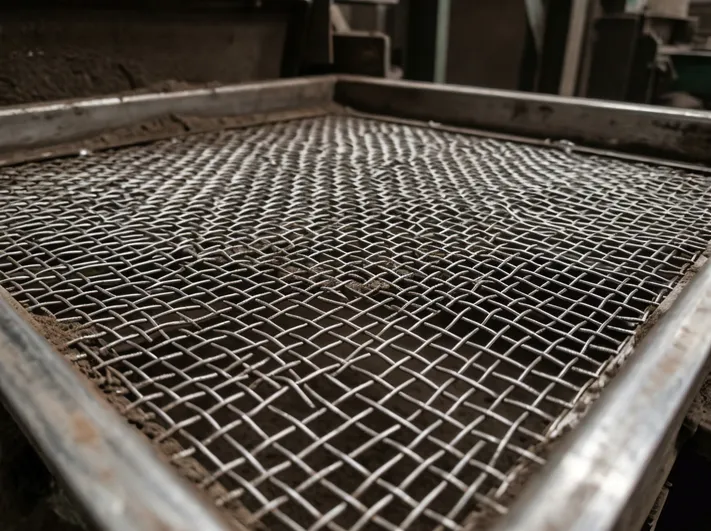
Mesh blinding (clay fines clogging the openings) reduces screening efficiency before the mesh physically wears out. You'll notice this as a gradual increase in oversize discharge volume — material that should pass through the mesh is riding over the top and exiting with the rejects. A mesh that's 40–50% blinded needs cleaning (high-pressure air or water wash) or replacement even if the wire isn't broken. Most foundries replace mesh on a fixed schedule (every 4 months for mid-volume operations) rather than waiting for failure, because the cost of running with degraded screening efficiency — wasted clay, inconsistent molds — exceeds the cost of premature mesh replacement.
Energy consumption depends on motor size and operating hours. These numbers are small compared to your molding line's energy draw (compaction systems and mixers pull 10–20× more power), but they add up over a year.
| Parameter | Mid-Volume 3.7 kW · 2 shifts |
High-Volume 7.5 kW · 3 shifts |
|---|---|---|
| Daily operating hours | 16 hrs | 24 hrs |
| Daily energy consumption | 59 kWh | 180 kWh |
| Daily electricity cost | $7 | $21.60 |
| Monthly electricity cost | $154 | $648 |
| Annual electricity cost | $1,850 | $7,800 |
Based on $0.12 per kWh — typical industrial electricity rate in export markets.
The energy cost of NOT screening is harder to quantify but substantially larger. For a 50-ton-per-day operation, the avoidable losses compound fast:
Wasted clay binder absorbed by undersized fines that should have been screened out.
Scrap castings from inconsistent mold strength — material and labor waste from uncontrolled sand distribution.
Premature mixer wear from oversized particles — paddle life drops from 18 months to 12 months (paddle set replacement plus downtime).
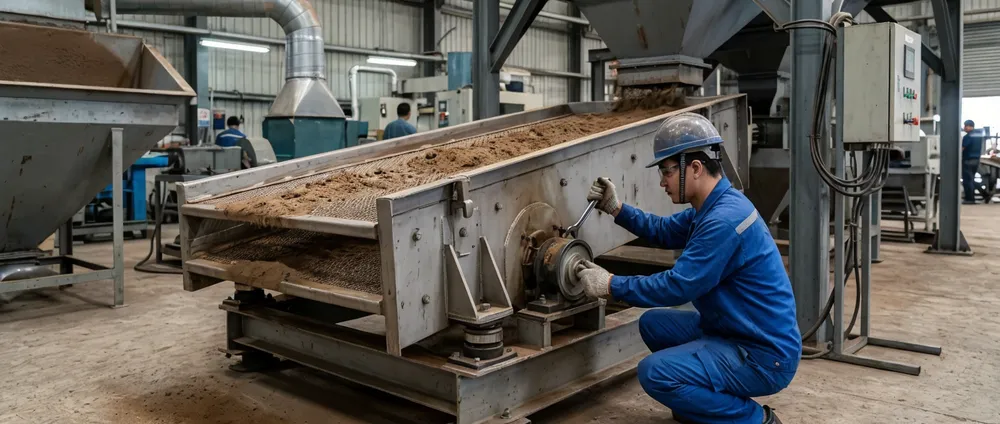
The eccentric motor has two bearings that need greasing every 500–800 operating hours — roughly monthly for a two-shift operation, every 2–3 weeks for three-shift. Each lubrication cycle takes 10–15 minutes and uses standard lithium-based grease (any industrial bearing grease works — no special formulation required).
Over-greasing warning: Excess grease migrates into the motor housing and causes overheating. Follow the motor manufacturer's specified quantity — typically 20–30 grams per bearing. Over-greasing is worse than under-greasing.
Motor life expectancy is 8–12 years in foundry environments if kept clean and not overloaded.
Replacement cost: 3.7 kW motor — $400–600 | 7.5 kW motor — $800–1,200
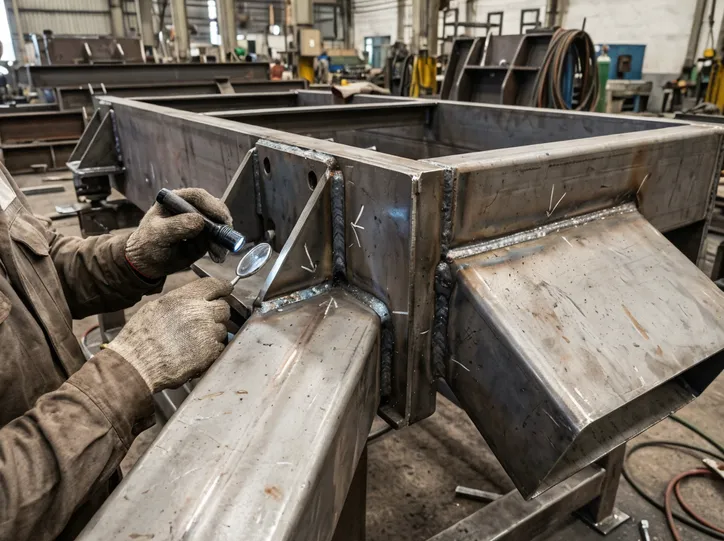
Check for cracks in screen frame welds every 6 months — vibration fatigue can crack welds over time, especially at motor mount points and discharge chute connections.
Inspect the deck surface for wear: the sand's abrasive action gradually thins the deck plate under the mesh. If it wears through, you lose structural support for the mesh, causing premature mesh failure and uneven screening.
Deck plate replacement (if needed): $200–400 for material plus 4–6 hours labor to remove the old plate, weld in a new one, and re-tension the mesh.
Weld inspection focus areas: motor mounts and discharge chute joints.
Rubber pads or spring isolators compress over time and need replacement every 2–3 years. A complete set costs $100–200.
How to tell they need replacement:
85+ dB requires hearing protection for nearby workers.
| Cost Category | Annual Range | Monthly Equiv. |
|---|---|---|
| Mesh replacement | $900 – $1,350 | $75 – $113 |
| Bearing grease & minor consumables | $50 – $80 | $4 – $7 |
| Periodic inspections & adjustments | $100 – $150 | $8 – $13 |
| Maintenance subtotal | $1,050 – $1,580 | $88 – $132 |
| Electricity (3.7 kW motor, two shifts) | $1,848 | $154 |
| All-in monthly operating cost | $242 – $286 /month | |
The cost of not screening — wasted clay, scrap castings, accelerated mixer wear — runs $3,600–$6,100 per month. At $242–286/month all-in operating cost, a clay sand vibrating screen delivers a clear, measurable ROI that justifies the investment within weeks of commissioning.
Cost of Not Screening
$3,600 – $6,100
per month in avoidable losses
Foundation design, vibration isolation, and structural loading — the engineering details you need before the screen arrives on site.
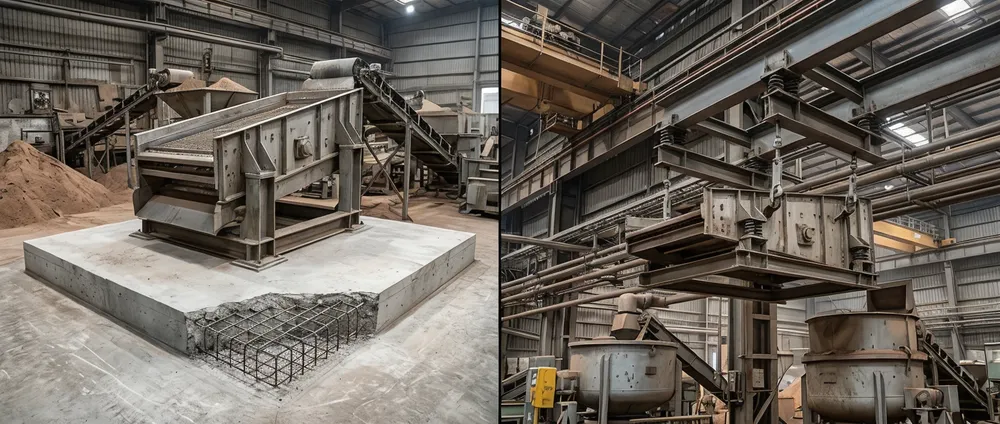
Floor-mounted installations need a reinforced concrete slab at least 150 mm thick with rebar reinforcement — typically 10 mm rebar on 200 mm centers in both directions. The slab must extend 300–400 mm beyond the screen frame on all sides to distribute dynamic loads.
Existing slabs: If your slab is thinner than 150 mm or shows cracks, add a reinforced pad on top rather than anchoring directly to weak concrete — vibration will eventually break out the anchor bolts.
For pre-mixing screens above mixers, the screen hangs from overhead structural steel using four spring isolators or wire rope isolators. The support structure must handle the screen's weight plus dynamic loads without deflecting more than 5 mm under full load — excessive deflection changes vibration characteristics and reduces screening efficiency.
Included with every suspended-mount screen: mounting bracket drawings and load calculations so your structural engineer can verify adequacy before installation.
If existing roof trusses or mezzanine framing isn't adequate, supplemental steel beams are needed — typically $2,000–$4,000 for materials and installation.
Vibration isolation pads sit between the screen frame and the foundation. The right choice depends on what's nearby and how your building is constructed.
Additional cost: $400–$600 over standard rubber pads — eliminates vibration-induced problems with adjacent equipment.
For a typical 1.5 m × 3.0 m screen, here's how the load breaks down — essential for structural verification on upper floors and mezzanines.
| Load Component | Mass (kg) | Notes |
|---|---|---|
| Screen (empty) | 1,400–1,800 | Frame, motor, deck |
| Sand on deck (operating) | 200–400 | Live load during screening |
| Total static load | 1,600–2,200 | — |
| Design dynamic load (1.5×) | 2,400–3,300 (24–33 kN) | Vibration force multiplier |
Spread over the screen's 4.5 m² footprint: 5.3–7.3 kN/m² — well within the capacity of any standard industrial-grade concrete slab.
Verify that your building's structural framing can support this load. Older buildings with timber joists or light steel framing may need reinforcement before installing the screen.
Three-phase power at the motor's rated voltage — typically 380V, 400V, or 415V depending on your region. TZFoundry can supply motors for any standard industrial voltage. The screen motor draws 1.2–1.5× its rated power during startup, so size your circuit breaker and wire accordingly.
Safety recommendation: Most buyers install a local disconnect switch within sight of the screen for safety during maintenance. This allows operators to lock out power at the machine rather than walking back to the main panel.
How you wire the screen into your plant's control architecture depends on your level of automation — from simple standalone operation to full PLC-coordinated sequencing with your reclamation or preparation line.
Simple on/off switch or contactor controlled by your facility's main power panel. No additional control wiring required — suitable for small foundries or screens used independently of a larger processing line.
Requires a relay output from your sand processing line's PLC to start/stop the screen motor in coordination with upstream and downstream equipment. TZFoundry provides a terminal strip on the motor starter for control wiring — you'll need to run two wires from your PLC (start signal and common) to the screen's control panel.
If you're integrating with a reclamation or mixing line that has complex sequencing, TZFoundry can supply the screen with a PLC-ready control panel that accepts Modbus or Profibus communication.
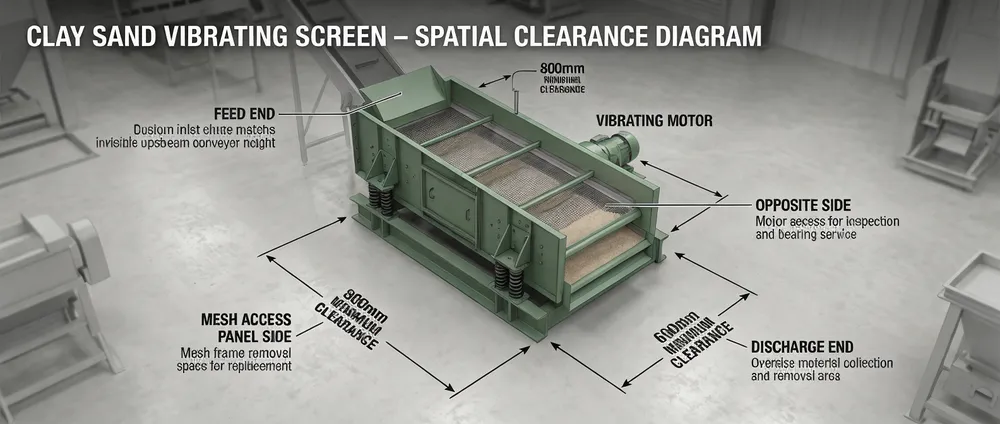
Plan your floor space around the screen's maintenance and material flow needs. These are minimum clearance dimensions — more space makes service faster and safer.
Mesh access panel side — room to slide mesh frame out during replacement
Opposite side — motor access for inspection and bearing service
Discharge end — oversize material collection and removal
Inlet chute — matched to your upstream conveyor height during design phase
Commissioning follows a specific sequence — each step depends on the prior one being correct. Skipping or rushing any stage creates downstream problems that are harder to diagnose once the screen is running under production load.
The screen must be level within ±2mm across its length and width. If the frame is out of level, material flow becomes uneven — one side of the deck processes more sand than the other, overloading the mesh on that side and causing premature wear.
Method: Precision level at each mounting point, shimming until the frame reads true in both axes.
The mesh must be tight enough that it doesn't sag under sand load, but not so tight that it deforms the frame. Getting this balance right directly affects screening life and separation quality.
Clear ringing sound when tapped with a wrench
Dull sound — mesh sags under load, reduces efficiency
Sharp metallic sound — risks frame deformation
The motor has adjustable eccentric weights that control vibration amplitude. For foundry sand applications, the target amplitude is 4–6mm, measured at the discharge end of the deck with a dial indicator while the screen is running empty.
After setting amplitude, test batches of your actual sand are run and screening efficiency is measured against three acceptance criteria:
Usable sand passing through mesh
Usable sand lost in oversize discharge
Fines remaining in screened product
A clay sand vibrating screen can go from crate to production in two working days under standard conditions. Here is the realistic breakdown:
Duration: 1 full day
Duration: Half day
Duration: Half day
This two-day timeline assumes a floor-mounted installation with existing conveyors already aligned to the screen's inlet and outlet heights.
Commissioning includes leveling, mesh tensioning, amplitude adjustment, and test runs before production handoff.
We've been building foundry equipment since 2010, and vibrating screens are one of the components where application engineering matters more than the hardware itself — the screen is simple (a motor, a frame, and a mesh), but sizing it correctly and integrating it into your sand processing workflow requires understanding how foundries actually operate.
A clay sand vibrating screen manufacturer who primarily serves aggregate or chemical processing industries will spec a screen based on generic throughput numbers. We spec based on your molding line's capacity, your sand's moisture content and contamination level, and whether you're screening post-reclamation (hot sand, high contamination) or pre-mixing (cool sand, final quality check).
Post-Reclamation Screening
Hot sand, high contamination — we size for thermal expansion and abrasive wear
Pre-Mixing Quality Check
Cool sand, final quality gate — we size for precision grain distribution
Our in-house engineering team handles custom configurations without outsourcing design work. Common modifications fall into two categories: standard adjustments included at no additional charge, and specialty upgrades that carry a cost premium.
Adjusting inlet and discharge chute heights to match your existing conveyors
Changing motor voltage to match your facility's electrical supply
Providing mounting brackets for suspended installation
Modifying the frame width to fit tight floor spaces
Non-standard mesh sizes outside the 20–80 mesh range we stock
Stainless steel construction for corrosive environments — adds 40–50% to base price
Explosion-proof motors for facilities with combustible dust hazards — adds $1,200–1,800
ISO 9001:2015 manufacturing certification means our fabrication process follows documented procedures for material sourcing, welding, assembly, and testing. Every screen gets a test run at our facility before shipment — we load it with sand, run it for 2–4 hours, and verify that vibration amplitude, material flow, and screening efficiency meet spec.
The test report ships with your equipment and provides baseline data you can reference if you ever need to troubleshoot performance issues. CE and SGS certifications cover electrical safety and structural integrity, which matters if you're exporting castings to buyers who audit your facility's equipment compliance.
We stock screen mesh in all standard sizes (20, 30, 40, 60, 80 mesh) at our Qingdao facility and ship via DHL or FedEx for 5–7 day delivery to most export markets. Mesh sets ship as complete assemblies (mesh already mounted in a tensioning frame) so you can swap them in 30–45 minutes without specialized tools.
5 Standard Sizes
20, 30, 40, 60, 80 mesh stocked
5–7 Day Delivery
DHL / FedEx to most export markets
30–45 Min Swap
Pre-mounted tensioning frame, no special tools
Motors, bearings, and vibration isolators are standard industrial components available from local suppliers in most countries, but we can supply OEM replacements if you prefer to source everything from us.
Common issues (reduced screening efficiency, excessive vibration, uneven
The most common vibrating screen problems — uneven material distribution, premature mesh wear, reduced throughput, and abnormal material flow — have predictable causes that we can diagnose over email or WhatsApp. Send us a short video of the screen running and describe the problem — we'll usually identify the issue (mesh blinding, worn isolation mounts, incorrect amplitude setting) and walk you through the fix within 24 hours.
For mechanical failures (cracked frame, failed motor, broken mesh), we'll quote replacement parts and lead time same-day.
sales@tzfoundry.com — technical questions or parts orders
+86 13335029477 — same channels for technical and parts support
China Business Hours (UTC+8)
4–8 hour response time
Outside Business Hours
12–24 hour response time
Direct engineering access: We don't route technical questions through a customer service queue — they go directly to our engineering team who designed and built your equipment.
Practical answers to the mesh selection and configuration decisions foundry engineers face when specifying vibrating screens for clay sand systems.
Start with 30-mesh (0.6 mm openings) for primary screening if you're mainly removing oversize contaminants — metal splash, burnt clay chunks, agglomerated sand lumps. This passes sand grains in the 0.2–0.6 mm range that clay bonding requires and rejects anything larger.
If you're also extracting fines to reduce clay waste, add a 60-mesh (0.25 mm openings) second deck or a separate fine screen downstream. The 60-mesh retains usable sand and removes clay particles and degraded fines that have excessive surface area. Don't go finer than 80-mesh (0.18 mm openings) unless you're doing precision casting work — finer mesh blinds quickly with clay buildup and requires more frequent cleaning or replacement.
Mesh selection also depends on your sand source. Silica sand with angular grains needs slightly larger mesh openings than rounded sand because angular particles bridge across openings and reduce effective screening.
If you're processing reclaimed sand with variable contamination, start with 30-mesh and monitor your screening efficiency for 2–3 weeks:
| Mesh Size | Opening | Use Case | Watch For |
|---|---|---|---|
| 20-mesh | ~0.85 mm | Coarse pre-screening, high-throughput reclaim lines | More fines pass through |
| 30-mesh | 0.6 mm | Standard primary screening — removes oversize contaminants | Best starting point for most foundries |
| 40-mesh | ~0.4 mm | Tighter grading when 30-mesh passes too many fines | Slightly reduced throughput |
| 60-mesh | 0.25 mm | Fines extraction on second deck or downstream screen | Higher maintenance frequency |
| 80-mesh | 0.18 mm | Precision casting only | Blinds quickly with clay buildup |
Performs one separation — either oversize removal or undersize extraction, not both. This is the most common configuration because it's simpler, costs less, and handles the primary quality control function that most foundries need.
Performance
A single-deck 30-mesh screen removes 95%+ of material larger than 0.6 mm, which eliminates the casting defects and mixer wear that oversized particles cause.
Choose single-deck when:
Performs two separations simultaneously — the top deck removes oversize, the bottom deck extracts fines, and usable sand exits between the two decks. The only way to achieve both oversize removal and fines extraction in a single piece of equipment.
Cost Trade-off
Costs 40–50% more than single-deck and requires more maintenance (two mesh layers to replace instead of one).
Choose dual-deck when:
Decision summary
Most foundries start with a single-deck 30-mesh screen for contaminant removal. If sand quality audits show excessive fines in your mix or you're seeing high clay consumption relative to throughput, upgrading to dual-deck provides measurable payback through reduced binder costs and more consistent mold properties.
The decision often comes down to clay cost in your market. If bentonite clay is cheap ($150–200 per ton), the cost of fines carrying over into your mixer is small, and single-deck screening is adequate. If clay is expensive ($300–400 per ton) or if you're in a region with supply constraints, dual-deck screening pays for itself by reducing clay consumption 15–20%.
Expect 3–6 months in typical foundry environments. Mesh life depends on three factors:
Silica sand with sharp edges wears mesh faster than rounded sand.
A screen running 16 hours per day wears faster than one running 8 hours.
Metal fragments cut mesh; burnt clay causes localized wear spots.
You'll know mesh needs replacement when you see any of these indicators:
Most foundries replace mesh on a fixed schedule rather than waiting for failure — every 4 months for mid-volume operations, every 3 months for high-volume. The reason is straightforward:
$300–$450
Cost of one mesh set
$400–$600
Material waste from one extra month at 70% efficiency
Running with degraded mesh means wasted clay, inconsistent molds, and increased casting scrap. The cost of premature replacement is always less than the cost of running past the efficiency threshold.
Don't wait for shipping when the installed mesh fails. Having a spare on hand eliminates the choice between running without screening (which defeats the purpose of the equipment) or idling your molding line until a replacement arrives.
Mesh Replacement Procedure — 2–3 Hours
Schedule during a maintenance window or between shifts to avoid production interruption.
Screening efficiency drops significantly above 6–8% moisture content because wet fines stick to the mesh and blind the openings. If you're screening immediately after a washing system where sand exits at 10–15% moisture, you'll see throughput drop to 50–60% of rated capacity within the first hour of operation, and you'll need to stop and clean the mesh every 2–3 hours. Not practical for continuous production.
Two Solutions
Option A — Drying Conveyor (Recommended)
Install a drying or cooling conveyor between the washing system and the screen to drop moisture below 6%. Preserves screening accuracy and eliminates the moisture variable that affects downstream mixing.
Option B — Larger Mesh Openings
Use 20-mesh instead of 30-mesh openings that are less prone to blinding. Maintains throughput with wet sand, but reduces screening precision — some oversized particles that a 30-mesh would catch will pass through.
Most foundries that screen post-washing choose the drying conveyor option because it preserves screening accuracy and eliminates the moisture variable that affects downstream mixing.
Pre-mixing screening note: If you're screening after storage silos where sand has had time to air-dry, moisture is rarely an issue unless you're in a very humid climate or your storage silos have condensation problems. In those cases, add ventilation to your silos or install a dehumidification system in your sand storage area.
Mesh Blinding
The most common cause — clay fines and dust accumulate in the mesh openings and reduce the effective open area. You'll notice this as a gradual increase in oversize discharge volume (material that should pass through is riding over the top) and a decrease in throughput.
Cleaning Method
Clean blinded mesh with compressed air (blow from the underside of the deck upward to push material out of the openings) or with a stiff brush. If blinding returns within a few hours after cleaning, the mesh is worn and needs replacement.
Bearing Wear in Eccentric Motor
Bearing wear reduces vibration amplitude, which slows material flow across the deck and reduces stratification efficiency. Check bearing condition by listening for rough or grinding sounds when the motor is running, or by measuring vibration amplitude with a dial indicator — if amplitude has dropped from the original 4–6 mm setting to 2–3 mm, the bearings are worn and need replacement.
Bearing Cost
$80–150
per set
Replacement Time
2–3 hours
motor disassembly required
Normal Amplitude
4–6 mm
replace at 2–3 mm
Replacement requires removing the motor from the screen frame, disassembling the motor housing, pressing out old bearings, pressing in new bearings, and reassembling.
Worn Vibration Isolation Mounts
Rubber isolation pads compress over time and lose their damping properties, which allows more vibration to transmit to the building structure and less to remain in the screen deck where it's doing useful work. This changes the screen's vibration characteristics and reduces efficiency.
Replacement interval: Every 2–3 years, or when you notice increased floor vibration around the screen.
Frame cracks — usually at weld joints near the motor mount or discharge chute — change the structural stiffness of the screen and alter vibration patterns. This is not a cosmetic issue: a small crack propagates under continued vibration and will eventually cause catastrophic failure if left unaddressed.
Inspection & Repair Protocol
Early Weld Repair
$200–$400
Catch cracks while small
Frame Replacement
$2,000–$3,000
Deferred until frame breaks
Early detection turns a $200–$400 weld repair into a routine maintenance item. Ignoring cracks until the frame breaks means $2,000–$3,000 for a full replacement — plus unplanned downtime while you wait for the part.
Tell us your molding line capacity in molds per hour and your typical flask size — we'll calculate required screening capacity and recommend the right motor size and deck configuration. If you know your sand type (reclaimed, fresh, or blended) and moisture content, include that too — it affects mesh selection and helps us avoid specifying equipment that won't work with your actual material conditions.
Include your available floor space (length × width) and ceiling height if you're considering a suspended mount. Mention your electrical supply specs (voltage, phase, available amperage) so we can provide a motor that matches your facility's power. If you're retrofitting to an existing reclamation or preparation line, send photos of your current equipment layout — that helps us identify the best integration point and spot potential installation issues before we finalize the design.
We offer sample testing for buyers who want to verify mesh selection before ordering. Send us 5–10 kg of your sand (reclaimed or fresh, whatever you'll be screening in production) and we'll run it through our test screens at different mesh sizes and throughput rates. We'll measure screening efficiency, check for blinding issues, and recommend the optimal configuration for your material.
$200–300
Testing Cost
3–5 Days
Turnaround Time
5–10 kg
Sample Required
Contact us at sales@tzfoundry.com or WhatsApp +86 13335029477. We'll respond within 24 hours with preliminary specs and pricing, followed by a detailed proposal within 3–5 business days after we've clarified any technical questions.
Within 24 Hours
Preliminary specs & pricing
3–5 Business Days
Detailed proposal after Q&A
30–45 Days
Production & ocean freight delivery
Plus 2–3 days for installation and commissioning at your facility.
Clay Sand Reclamation Line
Reclaim and recycle used clay sand for reuse in your molding line.
Clay Sand Preparation Line
Prepare and condition clay sand to precise specifications before molding.
Clay Sand Molding Line
Complete molding solutions for high-volume clay sand casting production.
Clay Sand Washing Line
Remove clay and fines through wet processing for cleaner sand reuse.
Clay Sand Jaw Crusher
Break down sand lumps and oversized material before screening and reuse.
All Clay Sand Processing Equipment
Browse the full range of clay sand processing lines and components.