Precision casting equipment for foundries evaluating investment casting vs. lost foam processes. We manufacture lost foam production lines and help buyers match casting processes to their tolerance, volume, and cost requirements.
15+ years foundry equipment experience. Installations in 15+ countries. Direct factory pricing.
The term "investment casting machine" creates confusion because it describes two fundamentally different manufacturing processes that buyers often conflate.
Uses wax patterns that melt out of ceramic shells. You inject wax, build a ceramic shell around it, dewax in an autoclave, then pour metal into the hollow shell.
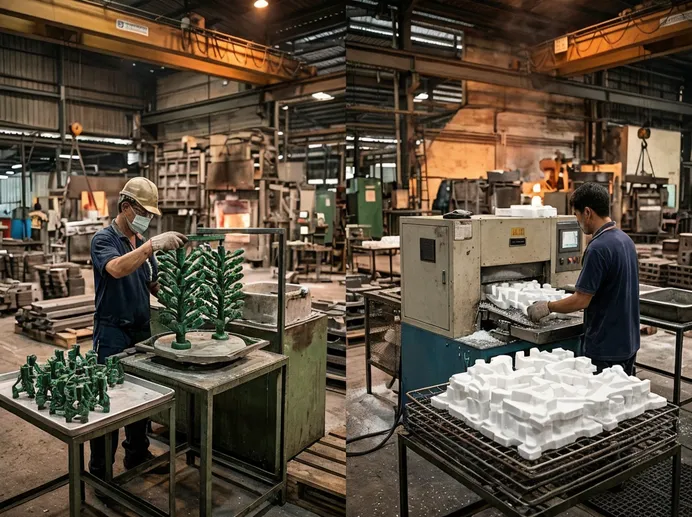
Uses expandable polystyrene (EPS) patterns that vaporize during pouring. You coat the EPS pattern, embed it in sand, and pour molten metal directly onto the pattern, which gasifies and is replaced by metal.
Both processes eliminate traditional cores and deliver complex geometries that would be difficult or impossible with conventional sand casting. Buyers searching for "investment casting machine" often need lost foam equipment but don't realize the terminology distinction.
We've worked with foundries in North America and Europe who initially requested investment casting equipment, then switched to lost foam after we mapped their actual casting requirements — tolerance needs, production volumes, and alloy types — to the appropriate process.
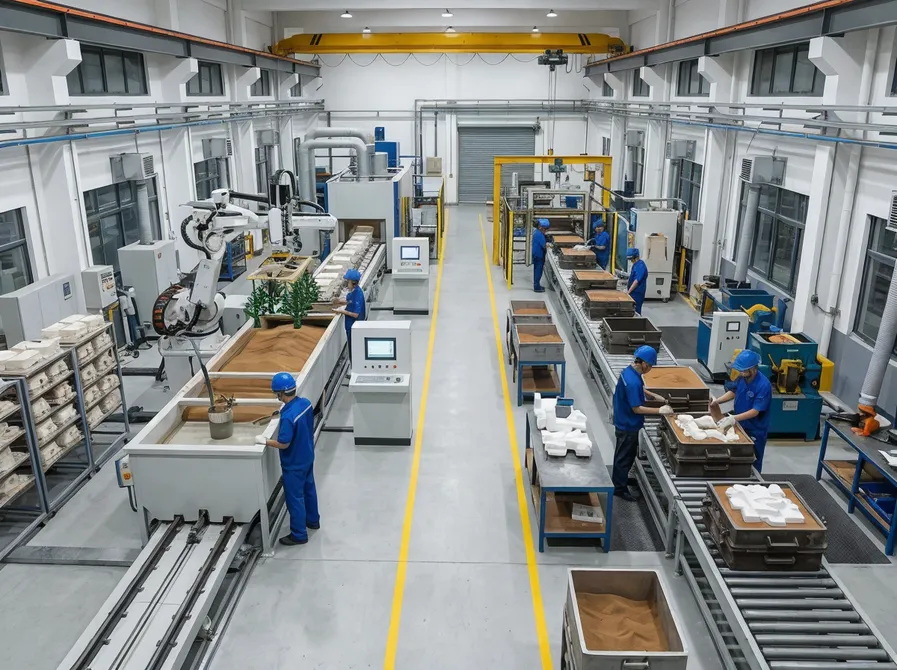
TZFoundry manufactures complete lost foam casting production lines — pattern handling systems, coating equipment, vacuum molding lines, shakeout, and sand reclamation.
We don't manufacture traditional investment casting machinery (wax injection presses, ceramic shell systems, dewaxing autoclaves), but we help buyers evaluate which process matches their casting portfolio.
If your parts genuinely need sub-0.3 mm tolerance and you're producing low volumes of high-value components, investment casting is the right choice and we'll tell you that. If your parts can work within ±0.5–1 mm tolerance and you're producing medium-to-high volumes, lost foam delivers comparable results at lower total cost.
Here's how investment casting and lost foam casting compare across the parameters that affect your equipment selection and per-part economics.
| Parameter | Investment Casting | Lost Foam Casting |
|---|---|---|
| Dimensional Tolerance | ±0.1–0.3 mm on most features | ±0.5–1 mm on most features |
| Surface Finish | Ra 1.6–3.2 μm (as-cast) | Ra 6.3–12.5 μm (as-cast) |
| Pattern Material | Wax (melts out, reusable wax) | EPS foam (vaporizes, single-use) |
| Pattern Cost | $500–3,000 per pattern (metal tooling) | $200–1,500 per pattern (aluminum tooling) |
| Tooling Life | 5,000–50,000 wax shots per tool | 1,000–5,000 foam patterns per tool |
| Cycle Time | 3–7 days (shell building + dewax + pour) | 4–12 hours (coating + drying + pour) |
| Economic Volume | 10–5,000 units (low-medium volume) | 100–50,000 units (medium-high volume) |
| Suitable Alloys | All castable alloys (steel, stainless, aluminum, titanium, superalloys) | Aluminum, iron, steel (not titanium or superalloys) |
| Typical Applications | Turbine blades, medical implants, jewelry, aerospace fittings | Automotive components, pump housings, manifolds, engine blocks |
| Equipment Capital Cost | $300,000–2,000,000+ (wax room + shell room + furnaces) | $150,000–1,200,000 (coating + molding + reclamation) |
If your casting requires machining to final dimensions anyway, the tighter as-cast tolerance of investment casting may not justify the cost premium.
A lost foam aluminum manifold casting at ±0.8 mm tolerance still needs CNC machining on sealing surfaces and threaded holes — you're removing 1–2 mm of stock either way. The investment casting version at ±0.2 mm tolerance removes slightly less stock, but the pattern tooling costs 2–3x more and cycle time is 10x longer.
Investment casting's higher pattern tooling cost amortizes over more units, so it works for low-volume production (10–500 units) where lost foam's per-pattern cost would be prohibitive.
Lost foam's lower tooling cost and faster cycle time make it economical for medium-high volume (500+ units) where investment casting's slow throughput becomes the bottleneck.
We've seen foundries run investment casting for prototype and pre-production (50–200 units), then switch to lost foam for serial production once volumes exceed 500 units annually.
Lost foam casting achieves results comparable to investment casting in specific scenarios — and at significantly lower total cost. If your casting requirements fall within these parameters, lost foam equipment delivers the precision you need without investment casting's capital cost and cycle time penalties.
Aluminum's lower pouring temperature (700–750 °C vs. 1,400–1,500 °C for iron) generates less thermal expansion in the mold, so dimensional accuracy stays tighter. Our lost foam lines hold ±0.5 mm on aluminum castings under 20 kg and ±0.8 mm on castings 20–100 kg.
That's sufficient for most automotive, aerospace secondary structure, and industrial equipment applications where you're machining critical surfaces anyway.
Cost Comparison — Aluminum Gearbox Housing
If your print allows ±0.5 mm, you're paying 2.5× more for precision you don't need.
Both processes eliminate traditional sand cores, but lost foam does it at lower pattern cost. An aluminum intake manifold with internal passages requires $8,000–12,000 in investment casting pattern tooling (wax injection tool with complex slides and cores).
The same part in lost foam uses $3,000–5,000 in EPS pattern tooling — simpler aluminum mold, no slides needed because foam compresses during ejection.
Tooling Savings — 2,000-Unit Run
Meets application requirements for bolt-on components at a fraction of the tooling investment.
Lost foam's 4–12 hour cycle time vs. investment casting's 3–7 day cycle time means you're producing 10–15× more castings per month with the same floor space.
A lost foam line producing 100 tons/month of aluminum castings fits in 200–300 m² and runs with 2–3 operators per shift. An investment casting facility producing the same tonnage needs 800–1,200 m² and 8–12 operators per shift.
Facility & Labor Comparison
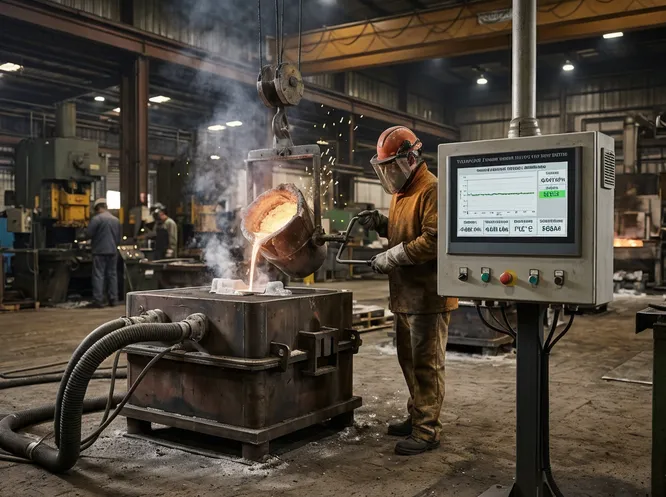
TZFoundry's lost foam production lines use vacuum control systems that maintain ±0.02 MPa pressure stability during pouring — that's the precision that keeps dimensional tolerance consistent across your production run.
Coating thickness control monitors slurry viscosity every 15 minutes and adjusts refractory powder addition to hold 0.5–2 mm coating thickness (aluminum uses thinner coatings, iron uses thicker).
PLC process logging tracks every pour: vacuum pressure, metal temperature, sand compaction density, coating batch number. When a casting fails inspection, you pull the data logs and identify which parameter drifted.
We've installed lines in automotive foundries producing 500–2,000 tons/year of aluminum suspension components — they're holding ±0.6–0.9 mm tolerance on parts that previously required investment casting, saving $180–240 per casting in total manufacturing cost.
We manufacture complete lost foam casting production lines — not traditional investment casting equipment. Our product range covers pattern handling systems, refractory coating equipment, vacuum molding lines, shakeout systems, and sand reclamation plants.
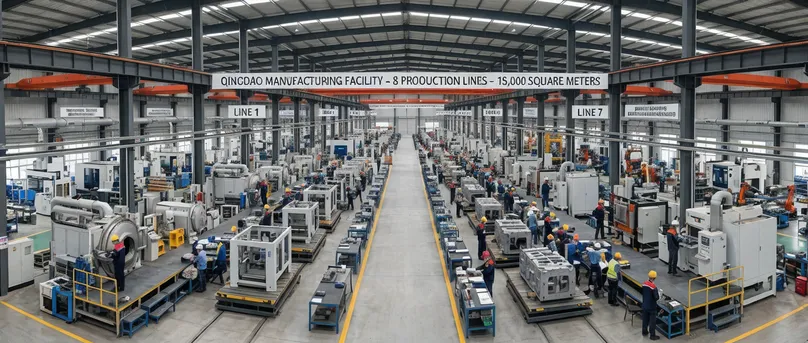
Since 2010, we've built foundry equipment for buyers in North America, Europe, the Middle East, and Southeast Asia — foundries that needed factory pricing, custom configurations, and reliable delivery schedules.
Vacuum systems, PLC controls, coating tanks, molding conveyors, and reclamation equipment — all manufactured in-house with our own R&D team handling custom configurations.
Vacuum System Sizing
Custom-engineered for your casting portfolio
Coating Formulation
Refractory coating support for your alloys
Process Optimization
Parameter tuning for your specific parts
Custom Configurations
Modular layouts for your floor plan
If you're producing turbine blades, medical implants, or jewelry — applications where ±0.1–0.3 mm tolerance is mandatory and production volumes are low — you need investment casting equipment and we're not the right supplier.
If you're producing automotive components, pump housings, manifolds, or general industrial castings where ±0.5–1 mm tolerance meets requirements and volumes exceed 500 units annually, our lost foam lines deliver the precision you need at lower total cost.
We position ourselves as an investment casting machine manufacturer in the sense that we manufacture precision casting equipment — but our specialization is lost foam process technology, not wax-and-shell investment casting. The terminology overlap creates buyer confusion, which is why we wrote this page: to help you match your actual casting requirements (tolerance, volume, alloy, geometry complexity) to the appropriate process and equipment type.
Free Application Review
Our engineering team reviews casting drawings, discusses tolerance requirements and production volumes, and recommends whether lost foam suits your application — or whether you should pursue traditional investment casting equipment from a specialized supplier.
Explore Our Production LinesMatch your casting requirements to the process that delivers the precision you need without paying for precision you don't. Here's the decision framework we use when buyers send us casting drawings and ask which equipment type suits their production plan.
Sub-0.3mm tolerance · Low volume (10–500 units) · Complex thin walls
Applications like turbine blades (wall thickness 0.8–2mm, tolerance ±0.15mm), medical implants (complex geometries, biocompatible alloys, tight tolerance), aerospace fittings (high-strength alloys, critical dimensions) — these justify investment casting's higher tooling cost and longer cycle time because the as-cast precision eliminates most machining.
You're producing high-value components in low volumes where per-unit cost is less critical than dimensional accuracy and material properties.
0.5–1mm tolerance · Medium-high volume (500+ units) · Material cost savings
Applications like aluminum automotive suspension components (tolerance ±0.6–0.8mm, volumes 2,000–10,000 units/year), pump housings (complex internal passages, tolerance ±0.8mm), engine blocks and cylinder heads (medium-volume production, machining on sealing surfaces anyway) — these benefit from lost foam's lower pattern tooling cost ($3,000–5,000 vs. $8,000–12,000), faster cycle time (4–12 hours vs. 3–7 days), and 15–25% material savings from eliminated risers and gates.
You're producing components where the as-cast tolerance is sufficient for non-critical features and you're machining critical surfaces to final dimensions regardless of casting process.
High volume (10,000+ units) · Simple geometries · Tight tolerance on all features
Die casting delivers ±0.1mm tolerance at cycle times measured in seconds, not hours or days. Permanent mold casting (gravity or low-pressure) delivers ±0.3–0.5mm tolerance with reusable metal molds that last 50,000–100,000 cycles.
Both processes have higher tooling cost than lost foam ($25,000–80,000 for die casting tooling, $15,000–40,000 for permanent mold tooling) but amortize over high volumes where per-unit cost drops below $5–15.
Lost foam and investment casting are both sand-based processes suited for low-to-medium volume production where metal tooling cost doesn't justify the volume.
Material compatibility drives process selection
Investment casting handles all castable alloys including titanium, superalloys (Inconel, Hastelloy), and high-carbon steels. Lost foam works well for aluminum, iron, and low-carbon steel but struggles with titanium (reactive metal, high pouring temperature) and superalloys (extreme temperatures damage EPS coating).
If your casting requires exotic alloys, investment casting is often the only sand-based option. If you're working with aluminum or iron — the two most common foundry alloys — lost foam delivers comparable results at lower cost.
We've guided buyers through this decision process hundreds of times. A distributor in Texas initially requested investment casting equipment for aluminum automotive brackets (tolerance ±0.5mm, volume 3,000 units/year). We reviewed the drawings and recommended lost foam instead — the tolerance requirement didn't justify investment casting's cost premium, and the production volume made lost foam's faster cycle time economically advantageous.
They installed a lost foam line, hit ±0.6mm tolerance on production castings, and reduced per-unit manufacturing cost by $85–110 vs. their investment casting quotes.
Investment casting uses wax patterns that melt out of ceramic shells before pouring — you build a ceramic shell around the wax, dewax in an autoclave, then pour metal into the hollow shell. Lost foam casting uses EPS foam patterns that vaporize during pouring — you coat the foam, embed it in sand, and pour molten metal directly onto the pattern, which gasifies and is replaced by metal.
Investment Casting
Lost Foam Casting
Both eliminate traditional cores and produce complex geometries, but they serve different volume and precision requirements.
Lost foam typically holds ±0.5–1mm tolerance on most features — tighter than conventional sand casting (±1.5–3mm) but looser than investment casting (±0.1–0.3mm). For aluminum castings under 20 kg with controlled process parameters (vacuum pressure ±0.02 MPa, coating thickness 0.5–1mm, sand compaction uniformity ±2%), we've seen foundries achieve ±0.5mm on non-critical features.
That's sufficient for applications where you're machining critical surfaces to final dimensions anyway — bolt holes, sealing surfaces, bearing bores. If your print specifies ±0.2mm or tighter on as-cast features, investment casting is the appropriate process. If your print allows ±0.5mm and you're machining critical features regardless, lost foam delivers the precision at lower cost.
Depends on tolerance requirements and production volume. For low-volume aluminum parts (10–500 units) requiring ±0.1–0.3mm tolerance — aerospace fittings, medical components, high-precision housings — investment casting justifies the higher tooling cost and longer cycle time. For medium-high volume aluminum parts (500+ units) where ±0.5–1mm tolerance meets requirements — automotive components, pump housings, manifolds, brackets — lost foam delivers comparable results at lower total cost.
Aluminum's lower pouring temperature (700–750°C) works well in both processes. Lost foam's advantage for aluminum: 15–25% material savings from eliminated risers and gates, faster cycle time (4–12 hours vs. 3–7 days), and lower pattern tooling cost ($3,000–5,000 vs. $8,000–12,000 for complex geometries). Investment casting's advantage: tighter as-cast tolerance reduces machining time on precision components.
Investment casting equipment (wax injection systems, ceramic shell tanks, dewaxing autoclaves, shell removal equipment) typically costs $300,000–2,000,000+ for a complete facility depending on capacity and automation level. Lost foam equipment (pattern handling, coating systems, vacuum molding lines, shakeout, reclamation) costs $150,000–1,200,000 for equivalent casting tonnage.
The 40–60% capital cost difference reflects process complexity: investment casting requires separate wax room, shell building room, dewaxing area, and shell removal systems. Lost foam consolidates coating, molding, and pouring in a more compact footprint.
Operating cost also differs: investment casting uses 8–12 operators per shift for 100 tons/month capacity, lost foam uses 2–3 operators for the same tonnage. Total cost of ownership (equipment + labor + materials + floor space) typically runs 30–50% lower for lost foam at equivalent production volumes, assuming your tolerance requirements allow ±0.5–1mm.
We manufacture lost foam casting production lines, not traditional investment casting equipment (wax injection presses, ceramic shell systems, dewaxing autoclaves). Our specialization is EPS pattern-based casting technology — pattern handling, refractory coating systems, vacuum-assisted sand molding, and thermal sand reclamation.
We position ourselves as precision casting equipment manufacturers because our lost foam lines deliver near-net-shape accuracy (±0.5–1mm tolerance) for medium-high volume production. If your casting requirements genuinely need investment casting's sub-0.3mm tolerance and you're producing low volumes of high-value components, we'll refer you to investment casting equipment specialists.
If your parts work within ±0.5–1mm tolerance and you're producing 500+ units annually, our lost foam production lines deliver the precision you need at lower capital cost, faster cycle time, and reduced operating cost. Contact us with your casting drawings and production requirements — we'll recommend the appropriate process and equipment type for your application.
Send us your casting drawings (or photos of current parts), target annual volumes, tolerance requirements, and alloy type. Our engineering team reviews the geometry complexity, wall thickness, tolerance callouts, and production volume to recommend whether lost foam, investment casting, or another process (die casting, permanent mold) suits your application.
The Decision Factors
We've guided hundreds of buyers through this evaluation — the consultation is free and we'll tell you honestly whether our equipment suits your application or whether you should pursue a different process.
Check these parameters first
If these parameters match, view our complete Lost Foam Casting Production Line systems. We manufacture modular lines sized for 50–5,000 tons/year capacity, with vacuum control ±0.02 MPa, PLC process logging, and coating systems that hold 0.5–2 mm thickness consistency.
Equipment Ships
Standard containers, on-site in 4–6 weeks
Remote Diagnostics
Included for ongoing technical support
Certifications
ISO 9001:2015, CE, and SGS certified
Factory-Direct Savings
Typically $60,000–$100,000 vs. distribution
Free engineering consultation
Contact our engineering team or WhatsApp +86 13335029477. Send us:
We'll review your application and recommend whether lost foam equipment suits your needs — or whether you should pursue investment casting or another process. The consultation is free and we'll be honest about whether our equipment matches your requirements. We'd rather refer you to the right solution than sell you equipment that doesn't fit your casting portfolio.
We've installed lost foam lines in North America, Europe, the Middle East, and Southeast Asia — foundries producing automotive components, pump housings, manifolds, and industrial castings where ±0.5–1 mm tolerance meets application requirements and medium-high volumes justify the equipment investment.
Lead Time
12–16 weeks production + 4–6 weeks installation
Sales Model
Factory-to-buyer, no distributor layers, flexible MOQ
Lost Foam Casting Equipment
Core equipment for lost foam casting operations
Vacuum Casting Production Line
Precision vacuum-assisted casting systems
Die Casting Production Line
High-volume die casting line solutions
Sand Casting Production Line
Traditional sand casting production systems
Metal Casting Production Line
Complete metal casting line configurations
Lost Foam Casting Machinery
Individual machinery and components