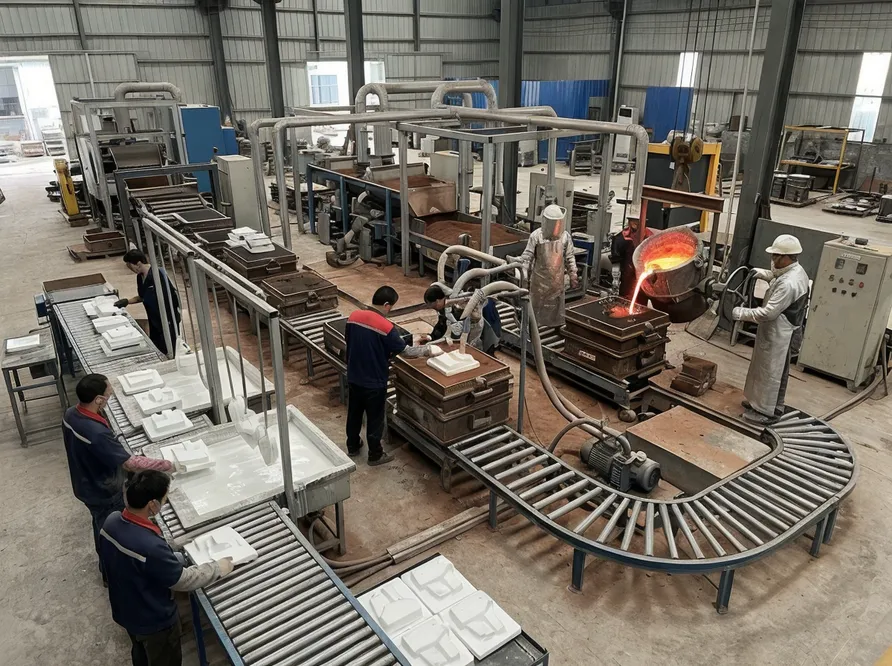
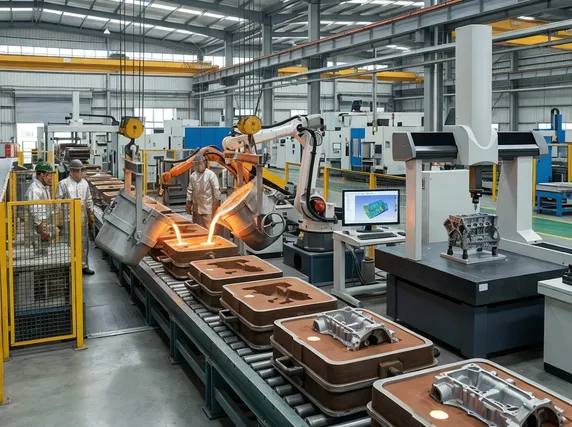
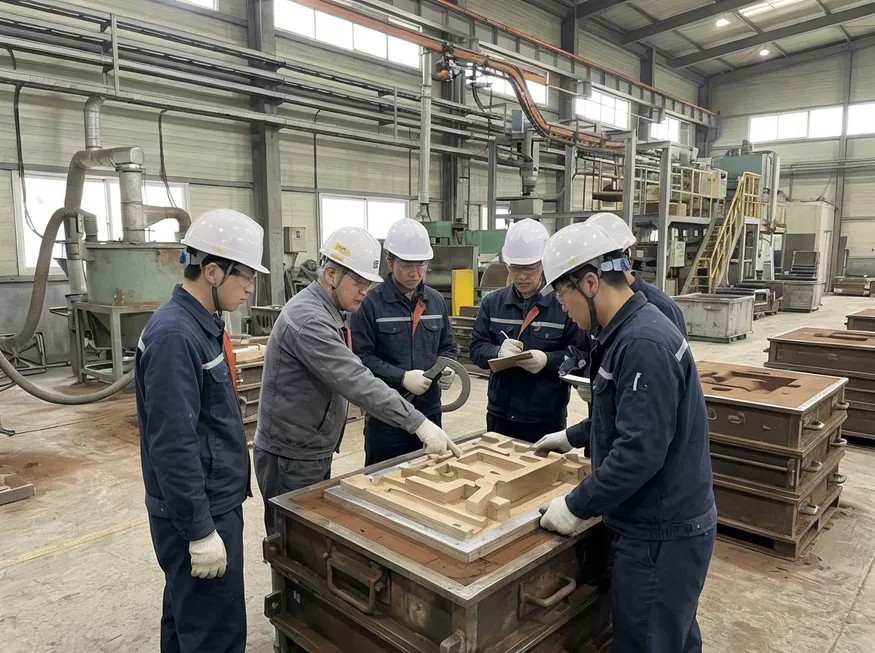
A metal casting production line integrates pattern handling, molding, pouring, and reclamation into a single automated system. The decision comes down to part complexity and tolerance requirements.
50–5,000 t/yr
Capacity Range
Lowest tooling cost with the widest tolerance range. Best suited for simple geometries and low-volume runs where tooling economics dominate.
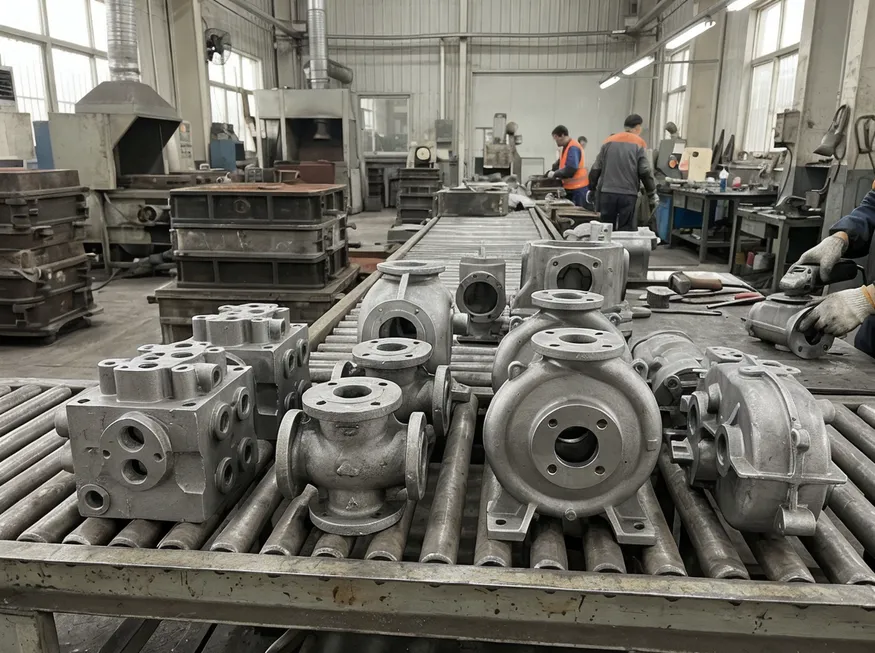
Complex geometries with the tightest tolerances. Ideal for engine blocks, manifolds, and pump housings with internal passages at ±0.5 mm dimensional accuracy.
Highest volume throughput but limited to non-ferrous alloys. Best for simple, thin-walled parts where cycle time matters more than alloy flexibility.
If you're casting engine blocks, manifolds, or pump housings with internal passages and ±0.5 mm dimensional requirements, lost foam delivers better economics than sand casting because you eliminate most secondary machining.
A sand-cast aluminum manifold with internal coolant passages requires core assembly, mold closing, and post-casting machining to hit final dimensions. The same part in lost foam uses a single EPS pattern with pre-formed passages, no cores, and dimensional accuracy that often eliminates machining steps. Your material cost per part drops because you're not paying for machining time, and your scrap rate drops because dimensional consistency improves.
For buyers supplying automotive or industrial machinery markets, that margin improvement matters more than the initial equipment cost difference.
Sand Cast Manifold
Lost Foam Manifold
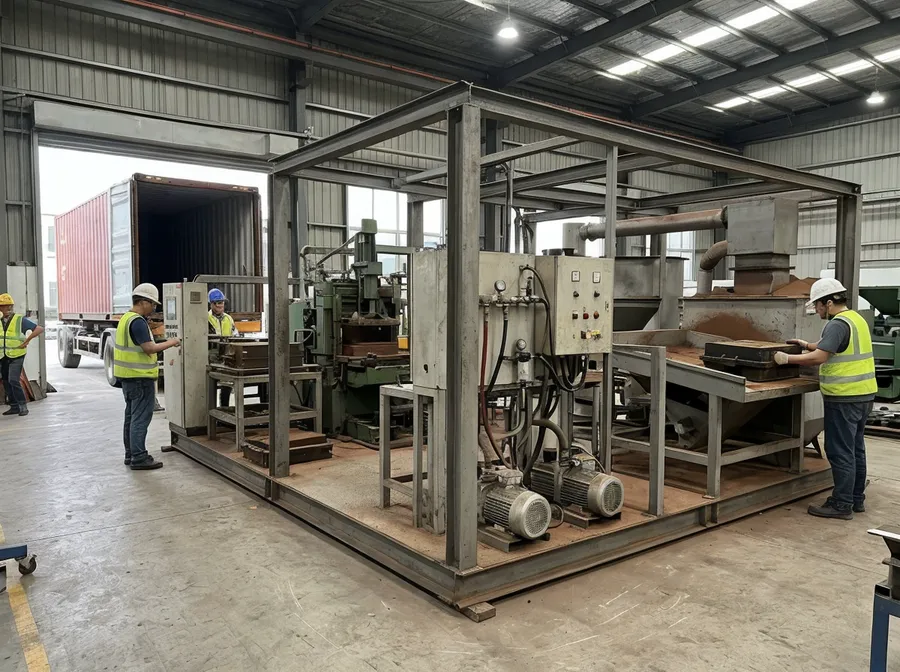
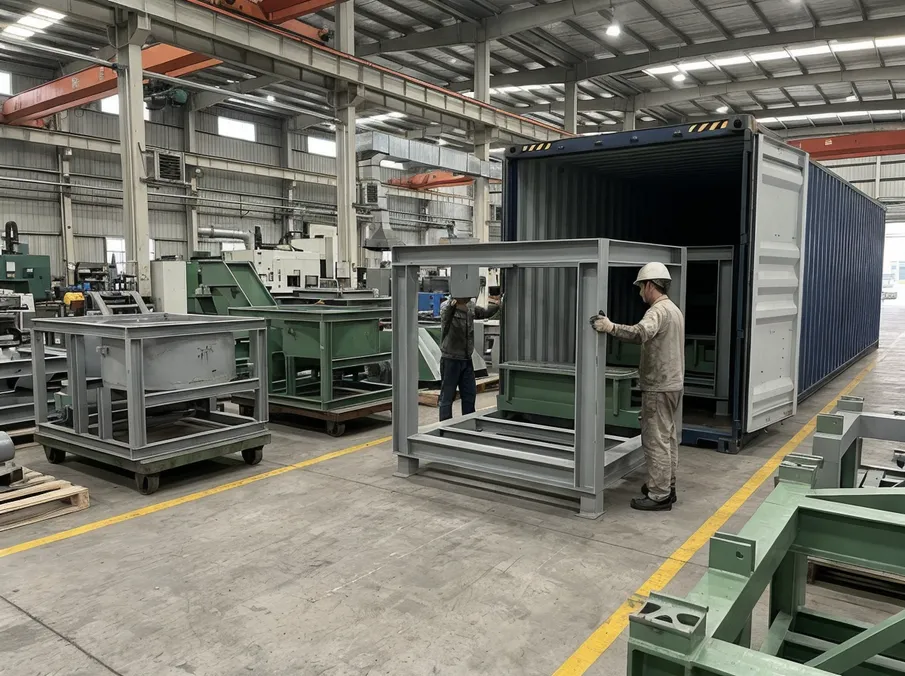
Each line ships as a modular system — all sized to fit standard 40-foot containers.
EPS pattern production and handling systems for consistent, repeatable foam patterns.
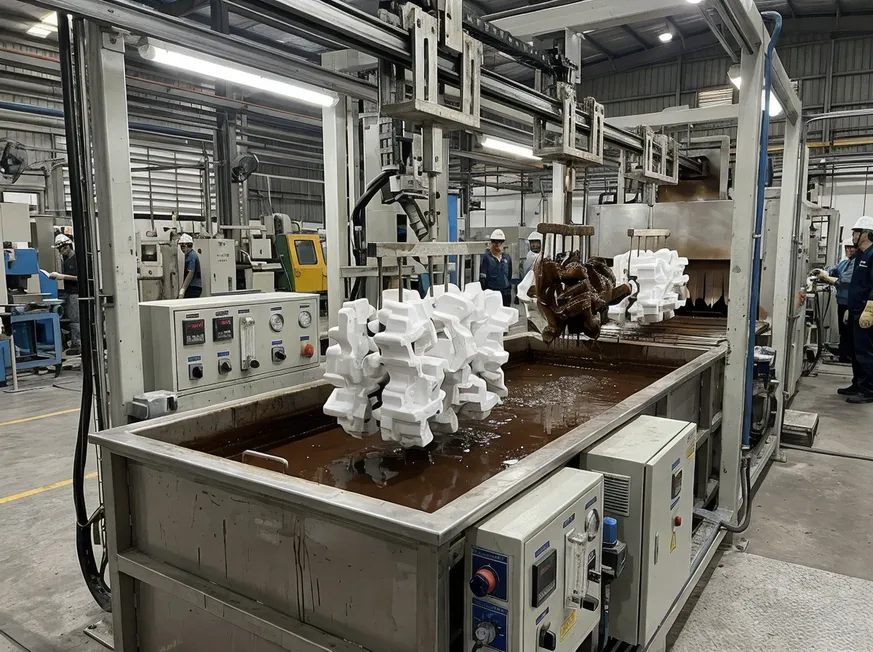
Automated refractory coating application with controlled drying for uniform shell thickness.
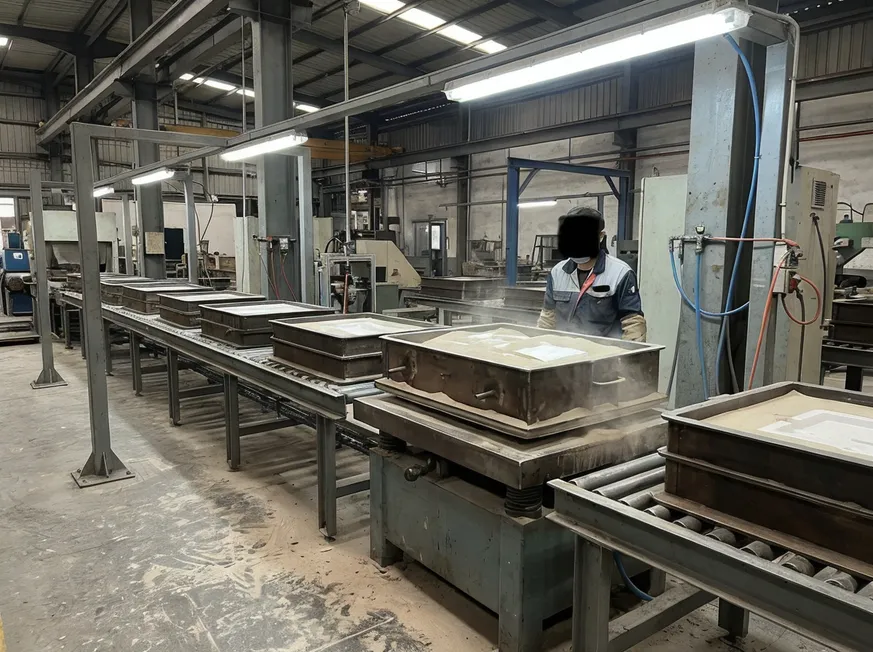
Sand compaction and flask handling stations optimized for lost foam pattern embedding.
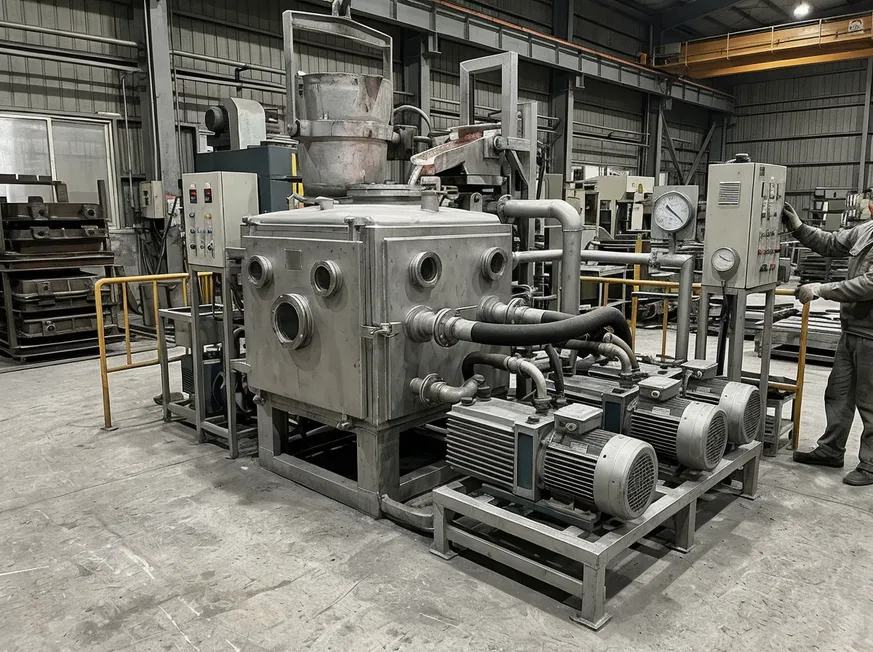
Negative-pressure pouring for defect-free castings. Reconfigurable for aluminum and iron alloys.
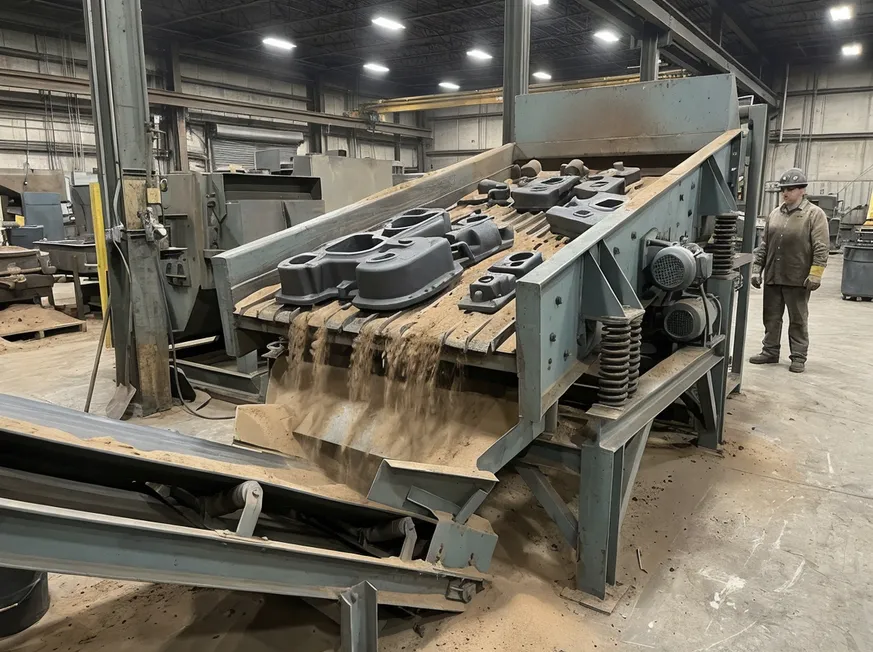
Casting separation and sand recovery with controlled vibration for part integrity.
Closed-loop sand processing system to minimize waste and reduce raw material consumption.
The system handles aluminum alloys (A356, A380, ADC12) and iron alloys (gray iron, ductile iron) in the same line with vacuum system reconfiguration. Capacity ranges from 50 tons/year for prototype foundries to 5,000 tons/year for high-volume operations.
The typical buyer operates a 200–500 ton/year foundry serving regional automotive suppliers or industrial equipment manufacturers. They need equipment that handles mixed-alloy production — aluminum one week, iron the next — ships in containers without specialized freight, and includes remote diagnostics so our engineers can troubleshoot vacuum system issues without site visits.
6
Alloys Supported
A356, A380, ADC12, Gray Iron, Ductile Iron + custom
40 ft
Container-Shippable
All modules sized for standard containers
3
Continents Served
North America, Europe, Southeast Asia
24/7
Remote Diagnostics
Vacuum system troubleshooting without site visits
Tell us your alloy mix, target capacity, and part complexity — we'll spec the right configuration.
Sizing a metal casting production line starts with three numbers: annual tonnage, average casting weight, and tolerance requirements. A 200-ton/year foundry producing 50kg aluminum manifolds needs different equipment than a 2,000-ton/year operation casting 5kg pump housings.
Annual Tonnage
Determines your molding capacity — molds per hour throughput.
Casting Weight
Determines flask size and vacuum pump capacity requirements.
Tolerance Spec
Determines whether you need automated coating control or can run manual dip coating.
50–200 tons/year
Manual Line
Manual coating line with batch molding. Dip-coating EPS patterns by hand, filling flasks manually, and running a single vacuum pouring station. This configuration works for prototype foundries, custom job shops, or operations testing lost foam before scaling up.
Cycle Time
8–12 molds/hr
Floor Space
400–600 m²
Crew Size
4–6 per shift
Pour Stations
1 vacuum
200–800 tons/year
Semi-Automated
Semi-automated coating with continuous molding. Coating line uses conveyor-fed dip tanks with automated drip time control. Molding runs on a continuous belt system — filling, vibrating, and indexing flasks without manual handling.
Coating accuracy upgrade: thickness consistency improves from ±0.3mm (manual) to ±0.1mm (automated drip time control).
Molding
Continuous belt
Floor Space
800–1,200 m²
Crew Size
6–8 per shift
Pour Stations
2–3 vacuum
800–5,000 tons/year
Fully Automated
Fully automated coating and molding with multi-station pouring. Robotic pattern handling, viscosity-controlled dip tanks, and forced-air drying chambers. Molding runs on a closed-loop conveyor with PLC-controlled sand fill, vibration timing, and flask indexing.
This is the configuration for foundries supplying OEM automotive contracts or high-volume industrial component markets. Most labor shifts to quality control and pattern preparation rather than manual molding.
Control
PLC closed-loop
Floor Space
2,000–3,500 m²
Crew Size
10–15 per shift
Pour Stations
4–6 simultaneous
A356 · A380 · ADC12
Pouring Temperature
700–750°C — lower thermal load on tooling and vacuum systems.
Vacuum Control Precision
±0.04–0.06 MPa control precision required. Wider tolerance window simplifies system tuning.
Flask Sizing Advantage
Aluminum's lower density means you can run larger castings in the same flask size compared to iron — more volume per pour cycle.
Cooling Time
15–25 minutes average depending on section thickness. Faster cycle turnover than iron.
Sand Reclamation
Simpler recovery — aluminum doesn't bond to silica sand as aggressively as iron. Mechanical attrition reclamation handles 85–90% of sand recovery without thermal treatment.
Gray Iron · Ductile Iron
Pouring Temperature
1,350–1,450°C — nearly double aluminum, demanding higher refractory ratings across the entire line.
Vacuum Control Precision
±0.02 MPa — tighter control required to prevent gas porosity at elevated temperatures.
Flask Sizing — Density Factor
Iron's higher density means flask sizing becomes critical. A 50 kg iron casting needs the same flask volume as a 75 kg aluminum casting — plan flask capacity accordingly.
Cooling Time
35–50 minutes — roughly double the aluminum cycle. Factor this into throughput calculations when sizing your line.
Sand Reclamation
Requires thermal treatment (sand reaches 800–900°C during iron pouring) followed by mechanical attrition. Budget for higher energy cost per ton on iron production.
If you're running both aluminum and iron in the same facility, your vacuum system needs dual-range capability. TZFoundry configures these lines with adjustable vacuum pumps and separate pressure regulation circuits for each alloy family.
Switching from aluminum to iron production takes 2–3 hours:
Drain and refill coating tanks — iron requires higher refractory content in the coating.
Adjust vacuum setpoints in the PLC for the target alloy's pressure tolerance band.
Swap pouring ladles to match the alloy's thermal and capacity requirements.
The alternative — running two separate lines — doubles your floor space and capital cost.
Buyer Insight
Most buyers in the 500–2,000 ton/year range choose the mixed-alloy configuration because it protects against market shifts.
If automotive aluminum demand drops, you can pivot to industrial iron casting without purchasing new equipment — your existing line handles both alloy families with the changeover procedure above.
700–1,450°C
Combined pouring range
±0.02 MPa
Tightest vacuum tolerance
2–3 hrs
Alloy changeover time
85–90%
Sand recovery (aluminum)
Dimensional tolerance drives every downstream decision — coating method, inspection equipment, and line automation level. Match your tolerance band to the right process configuration before specifying equipment.
Coating method: Manual coating and batch molding — relies on operator skill for coating consistency and visual inspection for pattern quality.
Quality control: Visual inspection is sufficient at this tolerance band. No coordinate measuring equipment required at the pattern stage.
Best for: Agricultural equipment castings, structural components, or any application where post-casting machining is already planned into the workflow.
Coating method: Semi-automated coating with continuous molding. Coating thickness control becomes critical — automated dip tanks with timer-controlled drip cycles deliver the consistency required at this band.
Quality control: Add coordinate measuring machine (CMM) inspection at the pattern stage to catch dimensional drift before pouring. This prevents scrap accumulation across a production run.
Best for: Automotive non-critical components and industrial machinery housings — the standard tolerance band for volume production where machining allowances need to stay predictable.
Coating method: Fully automated coating with robotic handling, plus in-line dimensional inspection at every stage.
Quality control: Pattern dimensions measured with laser scanners before coating. Coating thickness checked with ultrasonic gauges. CMM inspection run on first-article castings from each production batch.
Best for: Engine blocks, transmission housings, or any casting where machining allowance needs to stay under 1mm. This level of control is non-negotiable for powertrain and precision mechanical components.
At ±0.3mm and tighter, the quality control equipment — laser scanners, ultrasonic gauges, CMM stations — adds 15–20% to total line cost. That investment eliminates the scrap cost of discovering dimensional problems after pouring 50 castings. For high-value components like engine blocks and transmission housings, one scrapped batch can exceed the entire QC equipment budget.
Side-by-side specs across three production tiers — so you can match line capacity, footprint, and crew requirements to your actual throughput targets.
| Specification |
Starter
50–200 ton/year
|
Mid-Range
200–800 ton/year
|
High Volume
800–5,000 ton/year
|
|---|---|---|---|
|
Molding Capacity
|
8–12 molds/hour | 15–25 molds/hour | 30–50 molds/hour |
|
Flask Dimensions
|
600×800×400mm to 1,000×1,200×600mm |
800×1,000×500mm to 1,200×1,500×800mm |
1,000×1,200×600mm to 1,500×2,000×1,000mm |
|
Vacuum Control Precision
|
±0.06 MPa (aluminum) ±0.03 MPa (iron) |
±0.04 MPa (aluminum) ±0.02 MPa (iron) |
|
Coating Thickness Range
|
0.5–2.0mm (manual control) |
0.5–1.5mm (±0.1mm automated) |
0.5–1.2mm (±0.05mm automated) |
|
Sand Reclamation Rate
|
80–85% mechanical |
85–90% mechanical + thermal |
90–95% mech. + thermal + magnetic |
|
Power Requirement
|
120–180 kW | 250–400 kW | 500–800 kW |
|
Compressed Air
|
0.6–0.8 MPa 3–5 m³/min |
0.6–0.8 MPa 8–12 m³/min |
0.6–0.8 MPa 15–25 m³/min |
|
Floor Space
|
400–600 m² | 800–1,200 m² | 2,000–3,500 m² |
|
Crew Size (per shift)
|
4–6 operators | 6–8 operators | 10–15 operators |
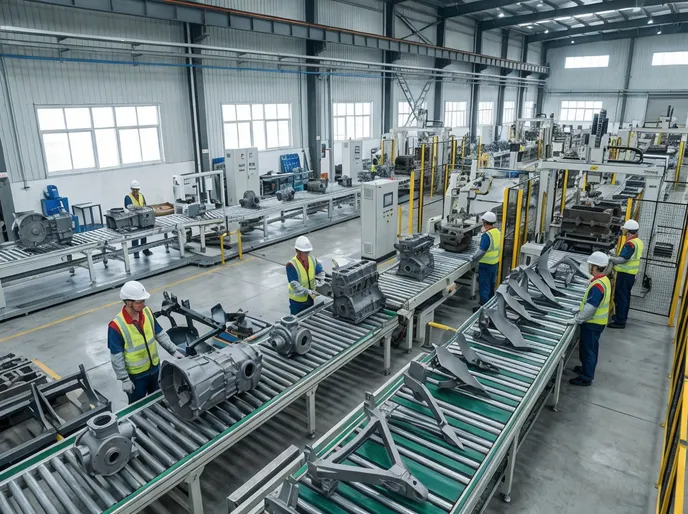
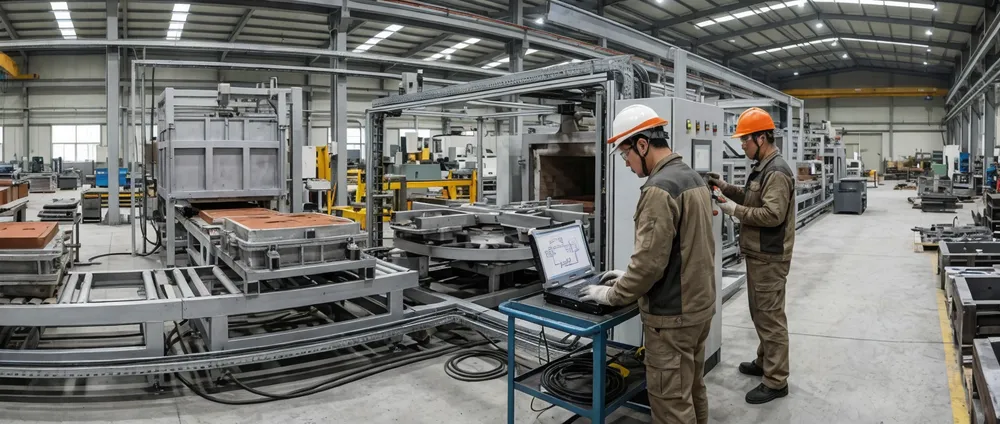
A metal casting production line integrates six subsystems. Each subsystem ships as a modular unit — you're not assembling individual components, you're connecting pre-tested modules with standardized interfaces.
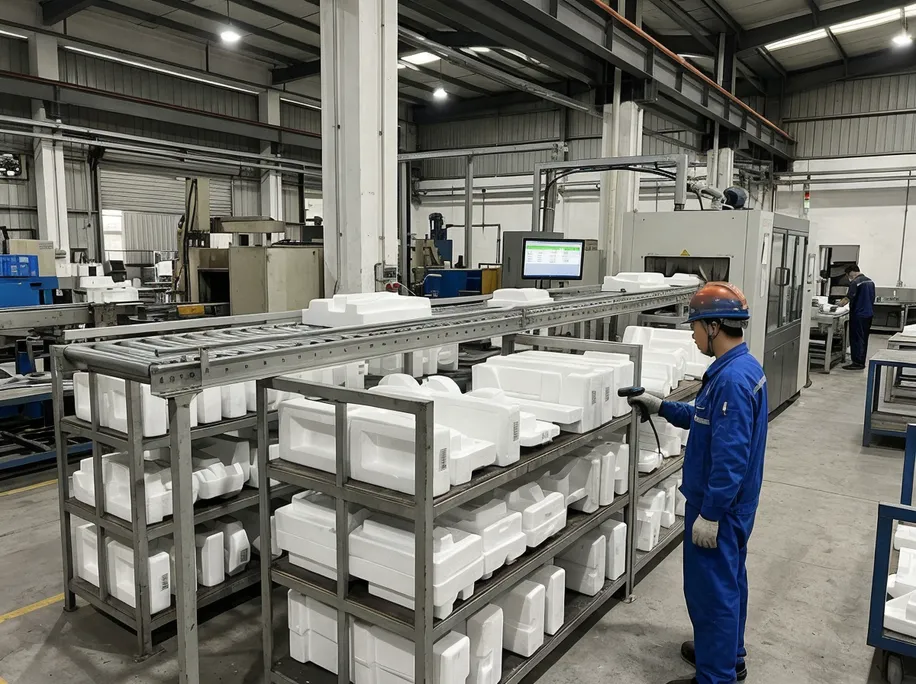
EPS pattern storage racks, pattern inspection stations, and conveyor feed to the coating line. Manual systems use rolling carts and visual inspection. Automated systems include barcode tracking (so you know which pattern batch produced which casting lot) and dimensional pre-screening with laser measurement.
Capacity matching rule: Pattern handling capacity needs to match your molding capacity. If you're running 25 molds per hour, you need pattern staging for at least 50 patterns (two hours of buffer) to avoid production stalls when pattern delivery from your EPS supplier runs behind schedule.
Dip tanks filled with refractory coating (alumina-silica slurry for aluminum, zircon-based for iron), drip stations for excess coating removal, and drying chambers.
Open tanks with overhead hoists — operators dip patterns, hang them for 3–5 minutes of drip time, then move them to ambient air drying (8–12 hours).
Adds conveyor feed, timer-controlled drip cycles, and forced-air drying — reduces drying time to 2–4 hours.
Includes viscosity sensors in the dip tanks (coating consistency affects final thickness), robotic pattern handling, and closed-loop drying chambers with humidity control.
Dimensional Impact
Coating thickness directly affects dimensional accuracy — every 0.1 mm of coating variation translates to 0.2 mm of final casting dimension variation (coating builds up on both sides of the pattern).
| Parameter | Manual | Semi-Auto | Full Auto |
|---|---|---|---|
| Drip Time | 3–5 min | Timer-controlled | Sensor-controlled |
| Drying Time | 8–12 hrs | 2–4 hrs | Closed-loop |
| Viscosity Control | — | — | |
| Humidity Control | — | — |
Too loose and the sand collapses during pouring. Too dense and gas evacuation slows down.
Flask filling stations, vibration tables for sand compaction, and flask indexing conveyors. The coated EPS pattern sits in the flask, you fill around it with loose silica sand, then vibrate the flask to achieve 1.5–1.6 g/cm³ sand density.
Uses stationary vibration tables — operators position the flask, start the vibration cycle, monitor sand level, and manually transfer the filled flask to the pouring area.
Runs on a belt conveyor with automated sand fill hoppers and PLC-controlled vibration timing.
PLC Control — Dimensional Consistency
The PLC monitors vibration amplitude, frequency, and duration to maintain consistent sand density across all flasks — critical for dimensional consistency across production runs.
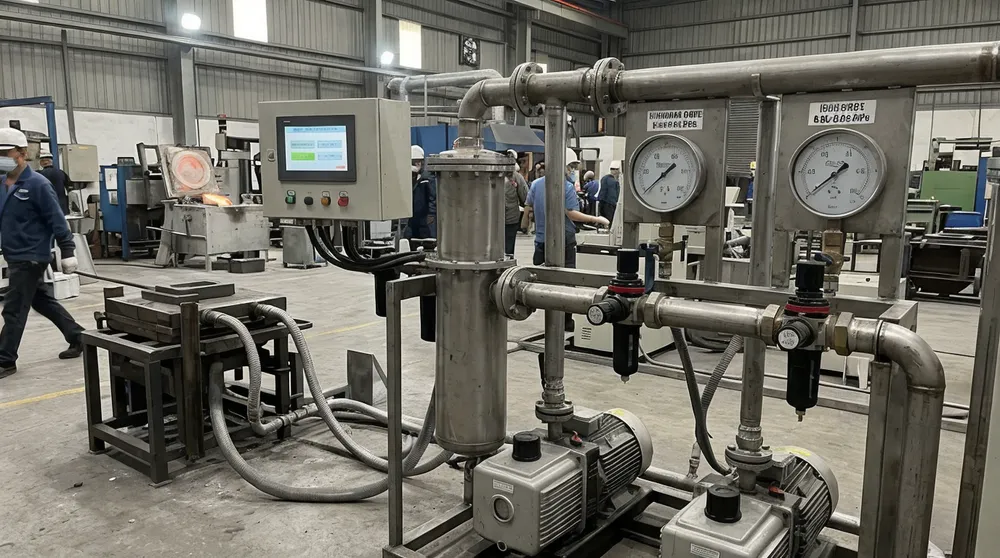
Vacuum chambers, pressure regulation valves, vacuum pumps, and pouring ladles. The filled flask enters a sealed chamber, vacuum pulls the chamber down to 0.04–0.06 MPa (aluminum) or 0.02–0.04 MPa (iron), then you pour molten metal into the flask.
The vacuum serves two purposes: it evacuates the gas generated when molten metal vaporizes the EPS pattern, and it pulls metal into fine details and thin sections that wouldn't fill under atmospheric pressure. Vacuum control precision matters because pressure variation affects fill completeness — a 0.02 MPa pressure swing can mean the difference between a fully filled casting and a cold shut in a thin-wall section.
Why Rotary Vane Pumps
We use rotary vane vacuum pumps (not liquid ring pumps) because they maintain pressure more consistently under the thermal load of casting operations. Each pouring station connects to dedicated vacuum pumps sized for the chamber volume and expected gas generation rate.
Iron vs. Aluminum — Gas Generation
For iron casting, gas generation runs 3–4× higher than aluminum (because iron's higher pouring temperature vaporizes the EPS pattern faster), so pump capacity scales accordingly.
0.04–0.06
MPa — Aluminum
0.02–0.04
MPa — Iron
Cooling conveyors, shakeout stations for separating castings from sand, and sand reclamation equipment. After pouring, the flask sits on a cooling conveyor for 15–50 minutes depending on alloy and casting mass. Once cooled below 200°C, the flask dumps into a shakeout station — vibrating screens separate the casting from loose sand, and the sand flows into the reclamation system.
Sand reclamation runs in two stages: mechanical attrition (rotating drums with internal baffles break up sand clumps and remove coating residue) followed by screening to remove oversized particles. For iron casting, add a thermal treatment stage before mechanical attrition — the sand reaches 800–900°C during pouring and needs cooling plus burn-off of organic binder residue.
Sand Reclamation Economics
85%
Reclamation Rate
85% reclamation means you're adding 15 kg of fresh sand for every 100 kg of sand circulating through the system.
15–20
Tons Fresh Sand / Year
At 500 tons/year production, annual fresh sand consumption falls to 15–20 tons. Sand cost is minor, but disposal cost for waste sand can exceed $50/ton depending on local regulations.
2-Stage
Reclamation Process
Mechanical attrition first (rotating drums with baffles), then screening to remove oversized particles. Iron casting adds a thermal stage for burn-off of organic binder residue.
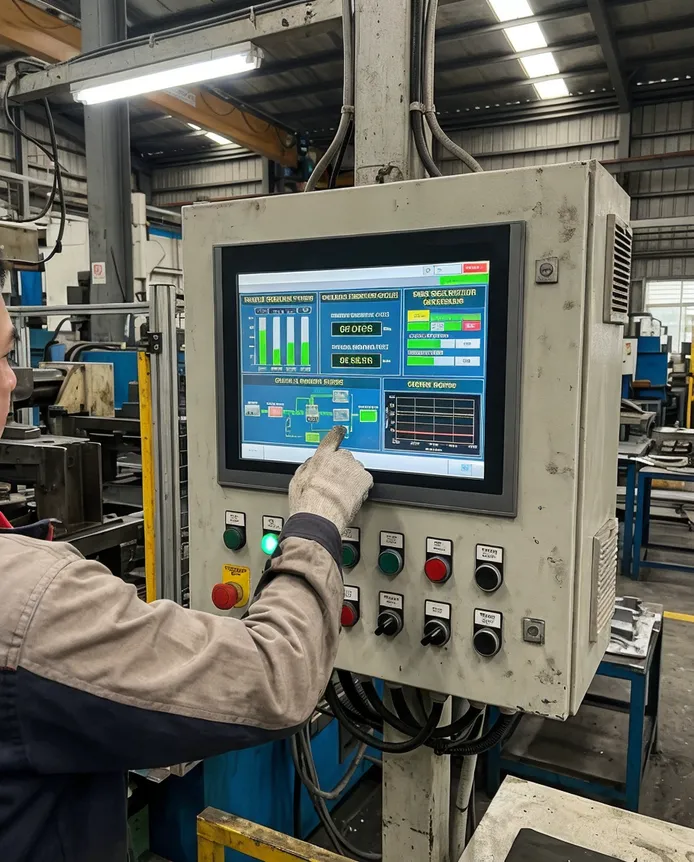
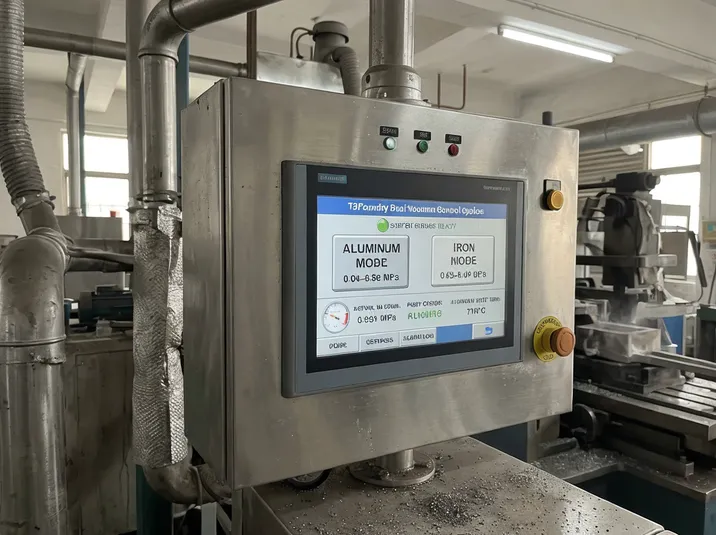
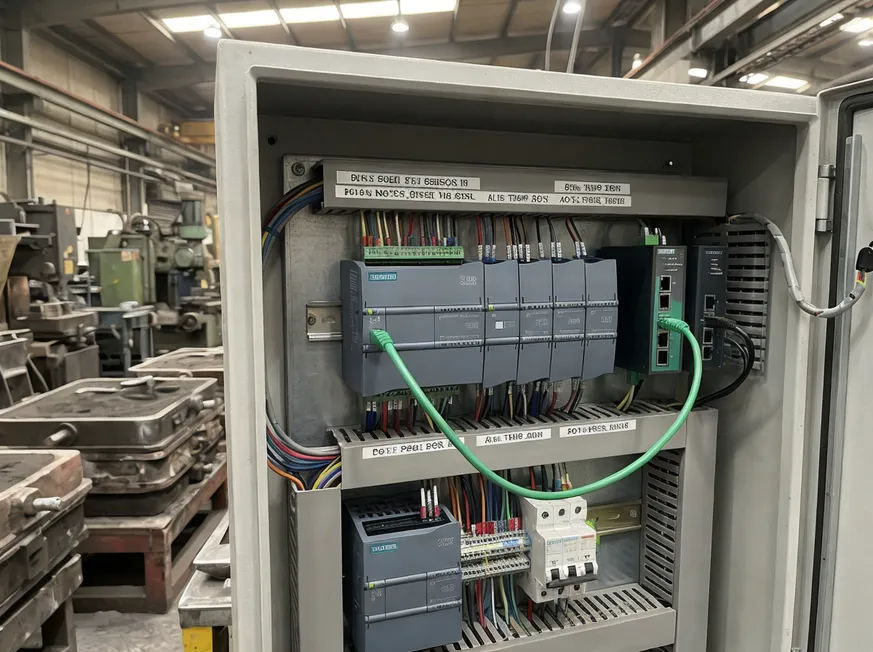
PLC-based control panels, HMI touchscreens at each workstation, and remote diagnostics via 4G connectivity. The PLC manages vacuum pressure regulation, coating line timing, molding vibration cycles, and sand reclamation equipment sequencing. Operators interact through HMI screens — setting production parameters, monitoring real-time status, and viewing alarm logs when equipment faults occur.
Centralized logic for vacuum pressure, coating timing, vibration cycles, and sand reclamation sequencing.
Operator interfaces at each workstation for parameter setting, real-time monitoring, and alarm log review.
Secure VPN access for TZFoundry engineers to diagnose faults remotely — no site visit required.
48-hour pressure trend pulls to pinpoint pump seal leaks, sensor calibration drift, or valve actuator faults.
The specification that outweighs every equipment spec on the datasheet.
Remote diagnostics let our engineers access the PLC over a secure VPN connection. When a buyer in Poland reports vacuum pressure instability, we log into their system, pull the pressure trend data from the last 48 hours, and identify whether it's a pump seal leak, a pressure sensor calibration drift, or a valve actuator problem — all without a site visit.
That diagnostic capability cuts your downtime from "waiting for a service technician to fly in" to "implement the fix our engineer identified remotely." For export buyers, this matters more than any equipment specification because your production schedule doesn't stop for international travel logistics.
Each casting line configuration serves distinct market segments with specific volume requirements, tolerance demands, and commercial dynamics. Understanding where your production capacity fits determines your competitive positioning and margin structure.
Engine blocks, cylinder heads, intake manifolds, exhaust manifolds, transmission housings, suspension components. Order volumes run 500–2,000 units per part number for Tier 2 suppliers, 5,000–20,000 units for Tier 1 suppliers serving OEM assembly plants. Reorder frequency is high — once you're qualified as a supplier, you're running the same part numbers for 3–5 year model cycles. Margin sits in the 15–25% range for complex castings (engine blocks, transmission housings) where your dimensional control eliminates machining steps for the buyer.
Automotive buyers need suppliers who can hold ±0.5mm tolerances across production runs, deliver on JIT schedules, and provide traceability documentation — casting lot numbers tied to pattern batches and pour dates. A metal casting production line configured for automotive work includes automated coating for dimensional consistency, multi-station pouring for throughput capacity, and integrated quality control (CMM inspection, X-ray porosity checking for critical castings).
Your competitive advantage comes from process capability — if you can deliver 10,000 manifolds with 99.5% first-pass yield, you're protecting the buyer's assembly line uptime.
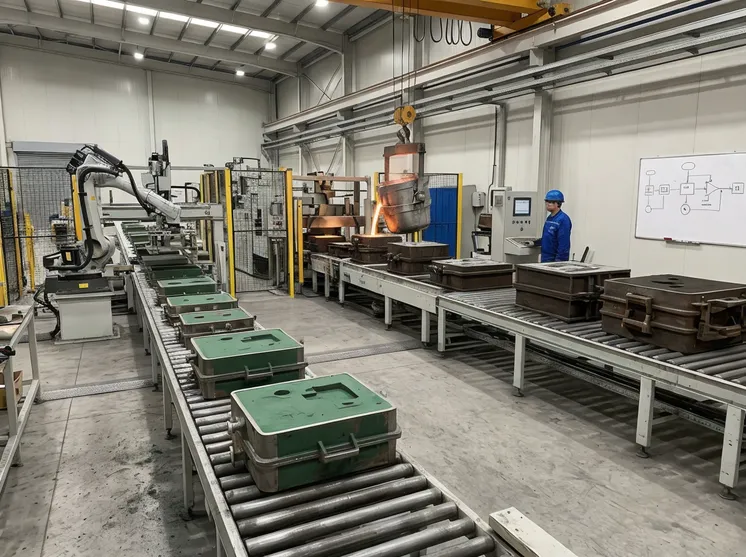
Automotive-configured casting line with multi-station pouring and integrated CMM inspection for Tier 1 supplier volumes.
Applications: Intake manifolds, cylinder heads
Weight range: 5–25 kg
Wall thickness: 3–8 mm
Applications: Transmission housings
Weight range: 15–40 kg
Wall thickness: 3–8 mm
Applications: Exhaust manifolds, suspension components
Weight range: 8–30 kg
Wall thickness: 5–12 mm
| Feature Type | Tolerance | Notes |
|---|---|---|
| Non-critical features | ±0.5 mm | Standard as-cast surfaces |
| Machined surfaces | ±0.3 mm | Reduces stock removal for buyer |
| Bearing bores & sealing surfaces | ±0.1 mm | Achieved through post-casting machining; casting tolerance determines material removal required |
Pump housings, valve bodies, gearbox components, hydraulic manifolds, compressor housings. Order volumes are project-based: 50–500 units for custom industrial equipment, 1,000–5,000 units for standardized pump models or valve series. Reorder patterns vary — some part numbers run for decades (replacement parts for installed equipment), others are one-time project orders. Margin opportunity sits in custom configurations: a buyer needs a pump housing modified for a specific installation, you're charging 30–40% margin because you're solving an engineering problem, not just supplying a commodity casting.
Industrial machinery buyers value flexibility over volume. They need a foundry that can handle mixed-alloy production (aluminum pump housings one month, iron valve bodies the next), accommodate design iterations without tooling penalties (EPS pattern changes cost $500–2,000 vs. $10,000–50,000 for permanent mold tooling changes), and deliver in 4–8 week lead times.
A metal casting production line configured for industrial work prioritizes quick changeover capability over maximum throughput — you're running smaller batches across more part numbers, so your coating line needs fast draining and refilling, your molding system needs adjustable flask sizing, and your quality control focuses on first-article inspection rather than high-volume statistical process control.
Pump Housings & Compressor Components
Weight range: 10–80 kg per casting. Ideal for applications requiring lightweight construction with strong corrosion resistance.
Valve Bodies & Gearbox Housings
Weight range: 15–120 kg per casting. Provides excellent vibration damping and machinability for static structural components.
Hydraulic Manifolds & High-Pressure Parts
Weight range: 20–100 kg per casting. Superior tensile strength and pressure resistance for demanding hydraulic system applications.
6–15 mm
Wall Thickness
Thicker than automotive — industrial equipment prioritizes durability over weight reduction
±0.8 mm
General Features
Standard dimensional tolerance for non-critical cast surfaces
±0.5 mm
Machined Surfaces
Tighter tolerance for post-machining interface surfaces
±0.2 mm
Sealing Faces & Threaded Ports
Precision tolerance for leak-proof sealing and threaded connections
Quick changeover capability, adjustable flask sizing, fast coating line draining/refilling, and first-article inspection focus — configured for smaller batches across more part numbers rather than maximum single-SKU throughput.
Tractor components (engine blocks, transmission housings, axle housings), implement castings (plow frames, cultivator arms, planter components), irrigation equipment (pump housings, valve bodies). Order volumes follow seasonal patterns: 2,000–8,000 units for OEM tractor parts (production concentrates in Q4–Q1 ahead of spring planting season), 500–3,000 units for implement components (spread across the year as dealers restock).
Margin runs 12–20% for standard components, 25–35% for custom implement castings where you're working directly with equipment manufacturers on design-for-casting optimization.
The Commercial Opportunity
Agricultural equipment buyers need suppliers who understand seasonal demand cycles and can handle volume surges without quality degradation. A metal casting production line configured for agricultural work needs capacity headroom — if your baseline production runs 300 tons/year, size the equipment for 500–600 tons/year so you can handle Q4–Q1 volume spikes without adding shifts or compromising dimensional control.
Your Competitive Advantage: Supply Chain Reliability
When a tractor manufacturer needs 5,000 transmission housings delivered in 8 weeks for spring production, you're the foundry that says yes — because your equipment capacity and sand reclamation rate can support the volume.
Typical Casting Specifications
Gray Iron
Engine Blocks & Transmission Housings
Weight range: 40–200 kg
Ductile Iron
Axle Housings & High-Stress Implements
Weight range: 30–150 kg
Aluminum A356
Lightweight Tractor & Irrigation Parts
Weight range: 15–80 kg
| Parameter | Specification | Notes |
|---|---|---|
| Wall Thickness | 8–20 mm | Agricultural equipment prioritizes durability and repairability over weight optimization |
| General Feature Tolerance | ±1.0 mm | Agricultural equipment typically includes generous machining allowances |
| Bearing & Mounting Surfaces | ±0.5 mm | Tighter tolerance for bearing surfaces and mounting faces |
Need a Metal Casting Line Sized for Your Target Market?
Whether you're entering automotive, valve & pump, or agricultural equipment casting — TZFoundry configures production lines to match your market's volume cycles, alloy requirements, and dimensional tolerances.
Every production line we build is engineered for container shipping and modular expansion — a constraint that drives smarter design, predictable logistics costs, and a protected growth path for your facility.
We design metal casting production lines for container shipping and modular expansion. Every component — coating tanks, molding conveyors, vacuum chambers, sand reclamation drums — sizes to fit inside a 40-foot container (12.03m length × 2.35m width × 2.39m height internal dimensions). That constraint forces design decisions that benefit the buyer: no single component exceeds 2.2m in any dimension, so you're not paying for specialized freight or dealing with port handling restrictions.
Your landed cost stays predictable because container freight rates are stable and transparent — unlike breakbulk or ro-ro freight where every shipment gets custom quoted.
No component exceeds 2.2m in any dimension — eliminating specialized freight, oversize permits, and port handling surcharges.
The modular design protects your expansion path. Start small, scale when your volume justifies it — without replacing the original system.
Manual coating line and batch molding system for initial production capacity.
3 containers
$180,000–240,000 FOB
100–150 tons/year
Automated coating equipment connects through standardized conveyor interfaces — augmenting, not replacing your original system.
+2 containers
$80,000–120,000 additional
Typically added at year 2–3
Buyers frequently grow from starter capacity to 400–600 tons/year over 3–5 years as they add customers.
5 containers total
400–600 tons/year
Standardized conveyor interfaces
Most foundries run either aluminum or iron, not both. But if you're supplying both automotive (aluminum-heavy) and industrial machinery (iron-heavy) markets, you need equipment that handles both alloys without compromising dimensional control. We configure these lines with dual-range vacuum systems: two sets of pressure regulation valves, two vacuum pump banks, and PLC programming that switches between aluminum mode (0.04–0.06 MPa) and iron mode (0.02–0.04 MPa) based on the alloy selection in the HMI.
Switching from aluminum to iron production takes 2–3 hours: drain the coating tanks (iron requires zircon-based coating instead of alumina-silica), swap the pouring ladles, and select iron mode in the PLC. Your crew doesn't need retraining, your floor space doesn't change, and your production schedule can flex with market demand.
We learned this configuration requirement from a buyer in Michigan who started with automotive aluminum manifolds, then won a contract for industrial iron valve bodies. They called us six months after installation asking if we could retrofit dual-vacuum capability. We could — but it required shipping new pressure regulation valves and vacuum pumps from China, plus a week of on-site commissioning to integrate the new components with the existing PLC. Now we offer dual-vacuum as a standard option during initial line configuration. It costs less to build it in from the start than to retrofit it later.
PLC-controlled dual-vacuum system — one-touch switchover between aluminum mode (0.04–0.06 MPa) and iron mode (0.02–0.04 MPa).
| Decision Factor | Separate Al + Fe Lines | Dual-Vacuum Single Line |
|---|---|---|
| Floor Space (400 t/yr) | 1,600 m² | 800 m² |
| Capital Cost | ~$600,000 | ~$345,000–$360,000 |
| Cost Premium | 2× base (100% more) | 15–20% over single-alloy line |
| Alloy Switchover Time | N/A — parallel operation | 2–3 hours |
| Vacuum — Aluminum Mode | 0.04–0.06 MPa (dedicated) | 0.04–0.06 MPa (PLC-selected) |
| Vacuum — Iron Mode | 0.02–0.04 MPa (dedicated) | 0.02–0.04 MPa (PLC-selected) |
| Crew Requirements | Two trained crews or cross-training | Same crew — no retraining |
| Retrofit Cost Risk | N/A | Avoided — built-in from start |
800 m² instead of 1,600 m² for the same 400 t/yr alloy-flexible output — critical for constrained plant layouts.
$345K–$360K versus $600K for separate lines. The 15–20% dual-vacuum premium pays for itself by eliminating the second line entirely.
Drain coatings, swap ladles, select iron or aluminum mode on the HMI. Same crew, same floor, full production flexibility.
The PLC system runs on Siemens S7-1200 series controllers (not proprietary controllers) because Siemens has global service networks and standardized programming tools. If you need PLC troubleshooting five years from now, any industrial automation technician with Siemens training can access the system — you're not locked into calling us for every software issue.
We provide the complete PLC program source code with the equipment delivery, so your maintenance team can modify ladder logic if you want to adjust vibration timing or vacuum pressure setpoints.
Remote diagnostics run through a 4G industrial router with VPN access. The router connects to the PLC's Ethernet port and establishes an encrypted tunnel back to our engineering office in Qingdao.
Whether it's vacuum pressure that won't stabilize, coating line timing that's off, or sand reclamation throughput that dropped — we log into your PLC and pull the last 72 hours of trend data:
Most issues resolve through parameter adjustment or valve calibration — done remotely, no site visit needed.
Pump seal leak, sensor drift, motor bearing wear — we identify the specific component and ship the replacement part while you're still on the diagnostic call.
Bottom Line: Days of Downtime Become Hours
Remote diagnostics cut your downtime from days to hours. The infrastructure pays for itself the first time you avoid a multi-day production stop waiting for on-site service coordination.
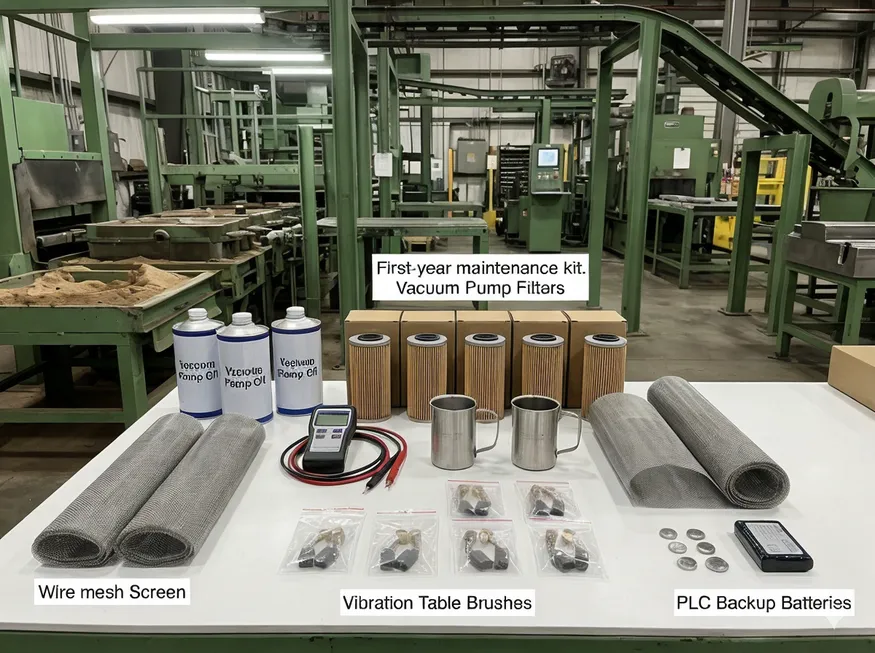
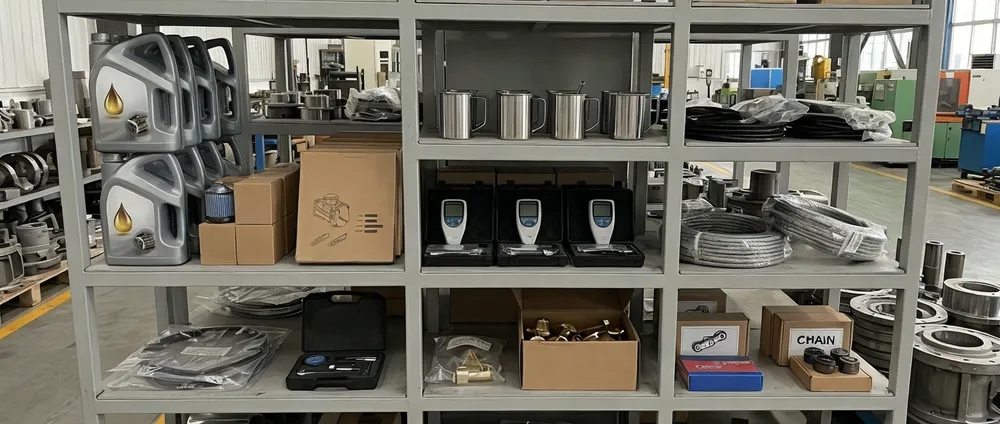
Every production line ships with a first-year maintenance kit: vacuum pump oil and filters (three changes), pressure sensor calibration tools, coating tank viscosity cups, vibration table motor brushes, sand screen mesh (two replacements), and PLC backup batteries. These are the components that wear during the first year of operation. Including them with the initial shipment eliminates the "we need a $50 part but international shipping costs $200 and takes three weeks" problem that stalls production on new equipment.
We maintain a spare parts inventory in our Qingdao warehouse for every production line we've shipped in the last ten years. Vacuum pump rebuild kits, pressure regulation valves, HMI touchscreens, motor contactors, conveyor drive chains — all cataloged by line serial number and available for immediate shipment.
When a buyer needs a replacement part, they reference their line serial number (stamped on the main control panel), we pull the parts list for that specific configuration, and ship the correct component. No guessing about valve sizes or motor specifications, no "send us a photo so we can identify the part" delays.
10 Years Coverage
Parts stocked for every line shipped in the last decade
Serial-Indexed
Parts cataloged by your line's unique serial number
Same-Day Ship
Immediate dispatch from Qingdao warehouse
Stocked Component Categories
A foundry in Texas had a vacuum pump seal failure at 18 months of operation — a normal wear item, not a defect. Here's how the timeline played out:
Customer called to report seal failure
Seal kit shipped via DHL from Qingdao warehouse
Part arrived at foundry
Seal installed, production resumed
3 Days Total Downtime
Two of those days were shipping transit time — the part was in stock and shipped same-day.
Buying a production line from a supplier who doesn't maintain parts inventory means a fundamentally different experience when components wear:
Contact supplier, describe failure, send photos for part identification
Wait for parts to be manufactured to order
Shipping and customs clearance
Part arrives, installation and restart
4–6 Weeks Downtime
Production stopped the entire time while parts are manufactured and shipped — plus delays from incorrect part identification.
Capacity scaling runs from 50 tons/year to 5,000 tons/year through three configuration variables — you're not buying a fixed-capacity system, you're buying a modular platform that scales with your production volume.
Molds per hour — the primary driver of annual tonnage capacity across all line configurations.
Determines maximum casting weight per cycle, directly affecting the part range your line can produce.
Manual, semi-automated, or fully automated coating and molding — matched to your labor strategy and volume targets.
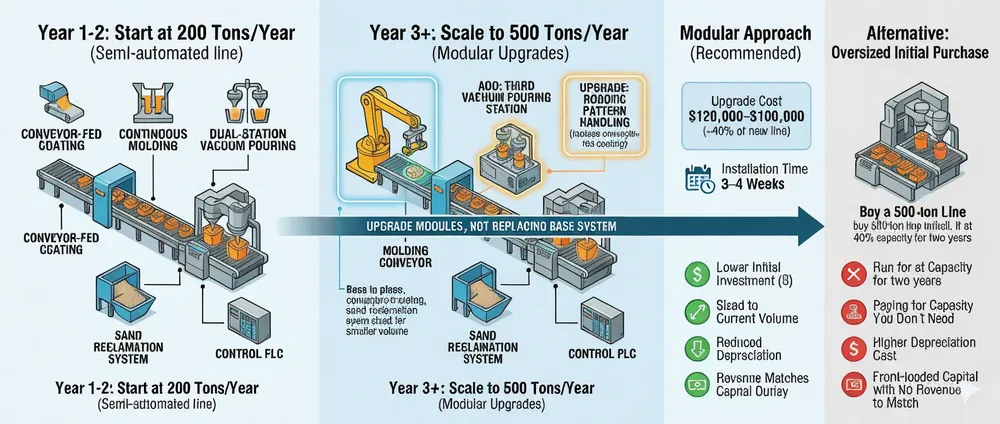
Year 1–2: Start at 200 tons/year
Semi-automated line with conveyor-fed coating, continuous molding, and dual-station vacuum pouring. Sized to your current volume.
Year 3+: Scale to 500 tons/year
Add a third vacuum pouring station and upgrade coating line to robotic pattern handling. The existing molding conveyor, sand reclamation system, and control PLC stay in place — you're adding capacity modules, not replacing the base system.
Upgrade Cost
$120,000–$160,000
~40% of a new 500 ton/yr line
Installation Time
3–4 Weeks
vs. 6–8 weeks for a complete new line
Buy a 500-ton/year line from the start and run it at 40% capacity for the first two years.
Paying for capacity you don't need yet
Higher depreciation cost against lower production volume
Capital outlay front-loaded with no revenue to match
The modular approach lets you match capital investment to revenue growth — scaling capacity only when production demand justifies the spend.
Vacuum Pressure Range
0.04–0.06 MPa
Lower gas generation rate allows optimized pump sizing, reducing power consumption by 15–20% compared to a dual-range system oversized for iron.
Vacuum Pressure Range
0.02–0.04 MPa
Higher gas load during iron pouring demands lower vacuum pressure and larger pump capacity to maintain casting integrity.
For operations running both aluminum and iron alloys. The vacuum system includes separate pressure regulation circuits for aluminum and iron modes, plus PLC programming that switches between modes based on operator selection in the HMI.
Added Cost
$25,000–$35,000
~8–10% premium on a 400-ton/year system
Eliminates the need for separate aluminum and iron production lines — one system handles both alloy families.
If you're only casting aluminum, we configure the vacuum system for 0.04–0.06 MPa operation and optimize pump sizing for aluminum's lower gas generation rate.
Saves $25,000–$35,000 in equipment cost
Reduces power consumption by 15–20%
Trade-off: If you want to add iron casting capability later, you'll need to retrofit the vacuum system — which costs more than building dual-range capability from the start. Factor your 3–5 year alloy roadmap into the initial configuration decision.
Standard molding conveyor height runs 1,200mm (working height for operators). If your facility has a 3.5m ceiling height and you need overhead crane access for ladle handling, we can lower the conveyor to 900mm and adjust the sand hopper feed angles.
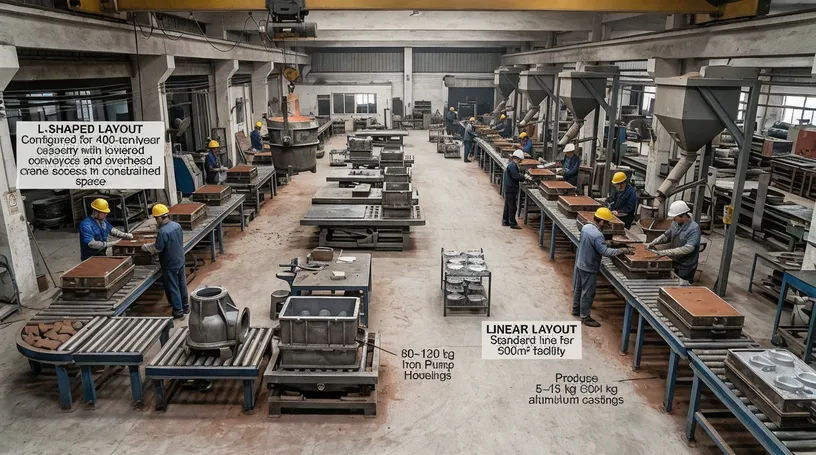
If your floor space is constrained to 600m² but you need 400-ton/year capacity, we can configure the line in an L-shape layout instead of the standard linear layout — adds 10–15% to installation complexity but fits the space.
5–15 kg Aluminum Castings
Standard 800 × 1,000 × 500mm flasks
80–120 kg Iron Pump Housings
1,200 × 1,500 × 800mm flasks — requires larger vibration tables, higher-capacity vacuum chambers, and longer cooling conveyors
We size equipment based on your largest casting, then provide flask adapters for smaller castings — so you're not running a 5kg casting in a flask sized for 100kg. That wastes sand and cooling time.
Minimum order quantity: one complete production line. We don't sell individual components (coating tanks, vacuum chambers, sand reclamation drums) separately because the value is in the integrated system, not the individual machines.
If you need replacement components for an existing line, we supply them as spare parts — but we're not building one-off coating tanks for buyers trying to assemble a production line from multiple suppliers.
2 Weeks
Engineering review & PLC programming customization
10–14 Weeks
Equipment fabrication & assembly
2 Weeks
Factory testing & container loading
200-ton/yr
Semi-Automated
500-ton/yr
Semi-Automated
800-ton/yr
Fully Automated
These ship faster because we maintain component inventory for these common sizes.
Rush Orders
20% premium with 10–12 week lead time — available for standard configurations only. Custom configurations can't be rushed because engineering review and PLC programming can't be compressed without quality risk. We don't ship equipment that hasn't been factory-tested.
Need a Custom Line Configuration?
Share your facility dimensions, casting portfolio, and target capacity — our engineering team will spec the right layout, flask sizing, and automation level for your operation.
Facility layout drawing review, power supply specification confirmation, and PLC programming finalization for any custom features.
Complete equipment fabrication, module assembly, and integration of all production line subsystems at our Qingdao facility.
Running the complete production line with actual EPS patterns and molten aluminum to verify vacuum pressure control, coating thickness consistency, and sand reclamation throughput before disassembly for shipping.
From order confirmation to container loading at Qingdao port. This includes engineering review, equipment fabrication and assembly, and full factory testing with your production materials before disassembly for shipping.
4–5 Weeks
Los Angeles, Houston, New York
5–6 Weeks
Rotterdam, Hamburg, Gdansk
3–4 Weeks
Jebel Ali, Dammam
2–3 Weeks
Singapore, Bangkok, Ho Chi Minh City
Add 1–2 weeks for customs clearance and inland transport to your facility.
Our commissioning team — two engineers and one PLC technician — arrives at your facility after the equipment clears customs. Commissioning runs 4–6 weeks and follows a fixed sequence:
Uncrate the equipment, position modules according to the facility layout drawing, connect conveyor sections, install vacuum chambers on their foundations, and route compressed air lines.
Your Facility Requirements
3–4 workers with overhead crane or forklift access working alongside our team.
Connect the main power supply (380V three-phase for most configurations, 480V for North American installations), wire motor starters and control panels, install the HMI touchscreens at each workstation, and connect the PLC to the 4G router for remote diagnostics.
Your Facility Requirements
A licensed electrician from your facility to verify local code compliance.
Pressure-test all vacuum chambers and piping (checking for leaks that would prevent reaching target vacuum levels), calibrate pressure sensors and regulation valves, run the vacuum pumps under load, and verify that the PLC maintains ±0.02 MPa control precision.
Testing Note
This phase uses compressed air for testing — no molten metal yet.
Run test castings with your actual EPS patterns and molten metal. Adjusting coating dip times, vibration table frequency and amplitude, vacuum pressure setpoints, and cooling conveyor speed to achieve dimensional accuracy and surface finish targets.
Material Consumption
Aluminum
200–400 kg
Material cost: $800–1,200
Iron
150–250 kg
Material cost: $300–500
Expect to produce 15–25 test castings before the line is dialed in.
Train your crew on pattern handling procedures, coating thickness inspection, molding quality checks, vacuum system operation, and sand reclamation monitoring. Run production castings under supervision — we're verifying that your operators can maintain dimensional consistency without our team present.
By the end of week 6, your crew should be running the line independently at 70-80% of rated capacity.
Equipment production at factory
Shipping & logistics
On-site commissioning & training
18-24 Weeks Total
That's the realistic timeline for a complete metal casting production line installation. Buyers who need faster startup should consider used equipment or rental options — new equipment can't be compressed below 16 weeks without quality risk.
For buyers who want to reduce commissioning cost, we offer remote commissioning: we ship the equipment with detailed assembly manuals and video guides, your crew handles mechanical assembly and electrical hookup following our documentation, then our engineers commission the system remotely via video call and PLC access. This works if you have experienced maintenance staff (millwrights, electricians, PLC technicians) who can follow technical drawings and troubleshoot mechanical issues independently.
Eliminates international travel costs for commissioning engineers
No waiting for visa processing and international flights
Video call commissioning sessions scheduled around your crew's availability
If your crew encounters assembly problems they can't resolve, we're troubleshooting through video calls instead of hands-on inspection — which extends the timeline
Recommended only for buyers who have installed industrial equipment before or have maintenance staff with foundry equipment experience
Recommended for: Buyers with experienced millwrights, electricians, and PLC technicians on staff who can follow technical drawings and troubleshoot mechanical issues independently.
3
40-ft Containers
200-ton/year line
8
40-ft Containers
800-ton/year line
12
40-ft Containers
2,000-ton/year line
Each container loads to 24–26 tons, staying under the 28-ton maximum gross weight for road transport in most countries. We optimize container packing to minimize freight cost — coating tanks nest inside each other, conveyor sections bundle together, and small components (valves, sensors, motors) fill void spaces around larger equipment.
Container 1
Controls & Electronics
Control panels, PLC cabinets, HMI touchscreens, vacuum pumps, pressure regulation valves, electrical components. This is the high-value, fragile equipment that needs careful handling.
We crate these components in plywood boxes with foam padding and load them last — so they're first off during unloading. You want the control equipment in your facility before the heavy mechanical components arrive.
Containers 2–6
Core Mechanical Equipment
Coating tanks, molding conveyors, vacuum chambers, vibration tables, sand reclamation drums. These are the large mechanical components that define the container count.
We knock down the conveyor frames and vacuum chambers into flat-pack sections to maximize container cube utilization — a fully assembled 8-meter molding conveyor won't fit in a 12-meter container (because you need space for the vacuum chambers and coating tanks), but a knocked-down conveyor that reassembles on-site fits efficiently.
Final Container(s)
Auxiliaries & Spares
Sand screens, shakeout equipment, spare parts kits, assembly tools, and documentation (assembly manuals, electrical schematics, PLC program backups on USB drives).
First-Year Maintenance Kit Included
Every shipment includes a complete documentation package prepared in both English and Chinese, plus translated versions for buyers in non-English markets — Spanish for Latin America, Arabic for Middle East, French for West Africa.
Equipment value for customs declaration. Declares equipment value at FOB Qingdao price with accurate valuations — no under-declaration.
Container-by-container inventory with weights and dimensions for every item in the shipment.
Required for preferential tariff treatment under free trade agreements between China and your country.
Full CE documentation for European Union buyers, ensuring compliance with EU safety and performance standards.
Third-party verification of equipment specifications by SGS, providing independent confirmation before shipment release.
Some buyers ask us to under-declare equipment value to reduce import duties. We don't do that — and here's why it protects you:
Every production line ships with a first-year maintenance kit sized for 2,000–3,000 operating hours — typical annual runtime for a foundry running single-shift, five days per week.
Why this matters: This kit eliminates the "we need a $30 part but international shipping costs $150 and takes three weeks" problem that stops production on new equipment. When you need a replacement part during the first year, you pull it from the kit and order a replenishment from us — so your production doesn't wait for shipping.
We quote FOB Qingdao — Free On Board. We deliver the containers to Qingdao port and load them on the vessel. You arrange ocean freight and handle import customs on your end.
FOB pricing gives you control over freight forwarder selection and shipping schedule. If you have an existing freight relationship or volume discounts with a shipping line, you save money.
Recommended for Experienced ImportersIf you don't have freight experience, we can arrange CIF (Cost, Insurance, Freight) pricing — we book the ocean freight and insurance, and you pay a single landed price.
CIF simplifies your logistics by bundling equipment cost, ocean freight, and cargo insurance into one quoted figure. No need to coordinate separately with freight forwarders or insurance brokers.
Ideal for First-Time Equipment Importers| Destination Region | Freight Range (USD) | Notes |
|---|---|---|
| North American Ports | $2,500 – $3,500 | US East/West Coast, Canadian ports |
| European Ports | $3,000 – $4,000 | Rotterdam, Hamburg, Antwerp, etc. |
| Middle Eastern Ports | $1,500 – $2,500 | Jebel Ali, Dammam, Jeddah |
| Southeast Asian Ports | $800 – $1,500 | Bangkok, Ho Chi Minh, Jakarta |
These are 2026 rates for standard container shipping — rates fluctuate with fuel costs and seasonal demand. Confirm current pricing when you're ready to ship.
0 – 5%
Under HTS code 8454 (foundry equipment)
0 – 3%
Varies by member state
5 – 10%
Varies by country and trade agreements
0 – 8%
Under ASEAN trade agreements
Your customs broker can provide exact duty calculations based on your country's tariff schedule and the equipment's declared value.
Total landed cost includes equipment price + ocean freight + import duties + customs clearance fees. Use these multipliers to convert FOB pricing into realistic budget figures for your region.
North America & Europe
115 – 125%
of FOB price
Middle East
110 – 118%
of FOB price
Southeast Asia
105 – 112%
of FOB price
Example Calculation
$300,000 FOB
→ $345,000 – $375,000
landed (destination dependent)
Budget accordingly when comparing supplier quotes — always convert FOB prices to landed cost for apples-to-apples comparison across different suppliers and incoterms.
Concrete guidance on capacity planning, process selection, and cost math to help you specify the right production line for your foundry operation.
A 300-ton/year operation needs a semi-automated line with 15–20 molds per hour capacity. That breaks down to: conveyor-fed coating line with automated drip time control, continuous molding system with PLC-controlled vibration, dual-station vacuum pouring, and mechanical sand reclamation. Floor space requirement: 800–1,000 square meters. Crew size: 6–8 operators per shift. Equipment cost: $280,000–340,000 FOB depending on automation level and alloy configuration (single-alloy or dual-range vacuum system).
Running a single 8-hour shift at 15 molds per hour gives you 120 molds per day — providing 2:1 capacity headroom for maintenance downtime, pattern changeovers, and quality holds.
If you're running two shifts, you can handle 300 tons/year with a smaller line (12–15 molds per hour capacity), but most buyers prefer single-shift operation with capacity headroom over multi-shift operation at maximum throughput.
Lost foam delivers better economics for aluminum parts with internal passages, thin walls (under 5mm), or tight tolerances (±0.5mm or better). Sand casting works better for simple geometries, thick sections (over 15mm), and loose tolerances (±1.5mm). The decision point is secondary machining cost: if your part needs extensive machining to achieve final dimensions, lost foam's tighter as-cast tolerance saves you money even though the equipment cost is higher.
Best For
Equipment Cost
$280,000–340,000
Best For
Equipment Cost
$180,000–240,000
Per-casting processing cost breakdown
| Cost Element | Sand Casting | Lost Foam |
|---|---|---|
| Core assembly | $8–12 | — |
| Pattern / Mold prep | $5–8 | $3–5 (EPS pattern) |
| Post-casting machining | $15–25 | $5–10 (critical features only) |
| Total per casting | $28–45 | $8–15 |
Floor space scales with capacity. The figures below include the production line footprint plus material staging areas (EPS pattern storage, sand storage, finished casting storage) and maintenance access — you need 2–3 meters of clearance around major equipment for service access.
Coating line → molding → pouring → cooling → shakeout arranged in a straight line.
Best for long, narrow buildings
Coating and molding on one leg, pouring and reclamation on the perpendicular leg.
Fits square buildings or facilities with column spacing that blocks a straight-line arrangement
We provide facility layout drawings during the engineering review phase — send us your building dimensions and column locations, and we'll optimize the equipment arrangement for your space.
Overhead clearance is needed for three critical systems:
Low-ceiling alternative: If your building has lower ceilings, we can modify the coating line to horizontal drying (patterns lay flat instead of hanging vertically), but that increases floor space requirement by 20–30%.
ROI depends on your margin per casting and production volume. Typical payback runs 18–36 months for foundries operating at 60–80% of line capacity.
Equipment Investment
Annual Production Revenue
Optimistic Payback (Full Capacity from Day 1)
$360,000 ÷ $500,000 = 0.72 years (8.6 months)
The optimistic calculation assumes full capacity from day one. Realistic payback accounts for the ramp-up period as you qualify customers and build order backlog:
First 6 Months
40–50%
Capacity during customer qualification & order backlog build-up
Months 7–12
60–70%
Growing utilization as repeat orders stabilize
Year Two
80–90%
Steady-state production with established customer base
Adjusted Payback: 24–30 Months
Accounting for gradual ramp-up to full production capacity over the first 12–18 months of operation.
ROI improves significantly if you're replacing an existing casting process with higher operating cost. The savings capture both the supplier's margin and reduced internal processing cost.
Real-World Case — Aluminum Manifold Castings (Texas Buyer)
Before — Outsourced Sand Casting
After — In-House Lost Foam Line
Savings Per Casting
$35
Annual Savings
$525,000
15,000 castings × $35
Payback Period
8.7 Months
$380,000 investment
This payback timeline was faster than the margin-based calculation because the buyer captured the supplier's margin plus reduced their own processing cost by bringing production in-house.
Yes, with dual-range vacuum system configuration. The line needs separate pressure regulation circuits for aluminum (0.04–0.06 MPa) and iron (0.02–0.04 MPa), plus PLC programming that switches between alloy modes. Switching from aluminum to iron production takes 2–3 hours: drain and refill the coating tanks (iron requires zircon-based coating instead of alumina-silica), swap pouring ladles, and select iron mode in the PLC.
15–20%
Equipment cost increase ($45,000–60,000 on a $300,000 base line)
400–1,000
Tons/year range — most buyers choose dual-range capability
2–3 hrs
Aluminum to iron changeover including coating tank drain & refill
The dual-range configuration eliminates the need for separate aluminum and iron lines. Most buyers in the 400–1,000 ton/year range choose dual-range capability because it protects against market shifts — if automotive aluminum demand drops, you can pivot to industrial iron casting without new equipment.
Limitation: No Simultaneous Production
You can't run aluminum and iron simultaneously — you're switching between alloys, not running them in parallel. If you need true parallel production, you need two separate lines. But most foundries batch their production by alloy — run aluminum for two weeks, switch to iron for two weeks — so the dual-range configuration handles their needs without doubling floor space and capital cost.
15–20 minutes per shift
Operator-level — no specialized tools required
2–3 hours
Requires maintenance technician with basic mechanical/electrical skills
4–6 hours
Preventive maintenance — catch wear before it causes failures
2–3 days
Major maintenance — typically during planned production shutdown (holiday break or annual facility maintenance week)
3–5%
Of equipment value annually
$9,000–$15,000
Per year for a $300,000 line (in-house maintenance staff)
+$15,000–$25,000
Additional annual cost if contracting maintenance to outside technicians
Includes consumables (pump oil, filters, screen mesh, gaskets), replacement parts (motor brushes, conveyor chains, sensors), and labor.
We've built metal casting production lines since 2010 — first for domestic Chinese foundries, then for export buyers in North America, Europe, the Middle East, and Southeast Asia starting in 2015. Our facility in Qingdao runs 8 production lines across 15,000 square meters, producing 500,000 units of foundry equipment annually. We're ISO 9001:2015, CE, and SGS certified, which matters for buyers who need equipment documentation for facility permitting or customer audits.
Since 2010
Building metal casting production lines for domestic and international foundries
15,000 m²
Qingdao facility running 8 production lines with full in-house fabrication
500,000
Units of foundry equipment produced annually across all product categories
15+ Countries
Export experience with full documentation and customs clearance for every major market
The manufacturing advantage: we build complete production lines in-house, not assembled from outsourced components. Coating tanks, vacuum chambers, molding conveyors, sand reclamation drums — all fabricated in our facility using our welding procedures and quality control processes.
Lead time control — we're not waiting for subcontractors to deliver components on their schedule
Customization capability — we can modify designs without negotiating with component suppliers
Spare parts availability — we maintain inventory for every component we've ever built
Our engineering team includes 15 foundry equipment specialists with 10–20 years of experience each. When you need a custom configuration, we're doing the engineering work internally, not outsourcing it to a design consultant.
Custom Engineering Examples
$8K–15K
Internal engineering cost for most modifications
$25K–50K
Typical cost with external engineers
2–3 Weeks
Internal engineering review timeline
4–6 Weeks
Timeline with external consultants
We sell directly to overseas buyers — no distributors, no sales agents, no middlemen adding markup. Your purchase price is our factory cost plus margin, not factory cost plus distributor margin plus agent commission. That typically saves you 20–30% compared to buying through a distributor.
The trade-off: you're working directly with our engineering and sales team in China, which means communication happens over email and video calls rather than face-to-face meetings with a local representative. Most buyers prefer the cost savings over local hand-holding, especially for capital equipment where the technical specifications matter more than sales relationship.
We've shipped production lines to 15+ countries and handled export documentation, container optimization, and customs clearance procedures for every major market. We know which certifications matter (CE for EU, UL for US electrical components, GOST for Russia), which documentation formats customs officials expect (commercial invoice formats vary by country), and which shipping routes minimize transit time and freight cost. That export experience eliminates the "we've never shipped to your country before, so we're not sure what documents you need" problems that delay first-time imports.
Direct Pricing Advantage
Certifications We Handle
Communication Channels
Send us your casting portfolio: part drawings (or photos of existing castings), annual production volume, alloy types, and tolerance requirements. We'll configure a metal casting production line that matches your capacity needs and budget, then provide factory pricing with detailed equipment specifications, container count, and lead time.
Include your facility dimensions and ceiling height if you have space constraints — we'll provide a layout drawing showing how the equipment fits your building.
Explore More Casting Production Lines