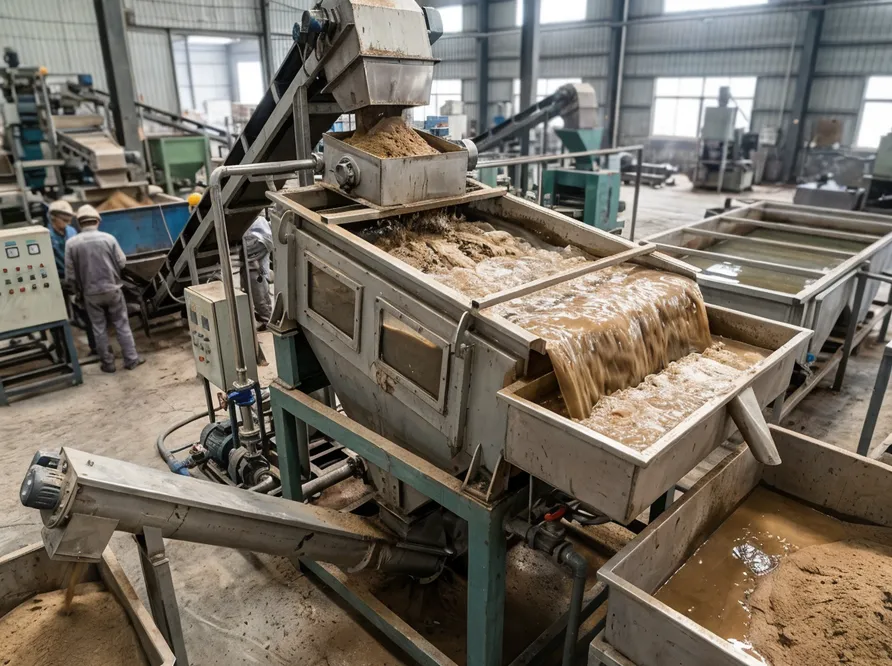
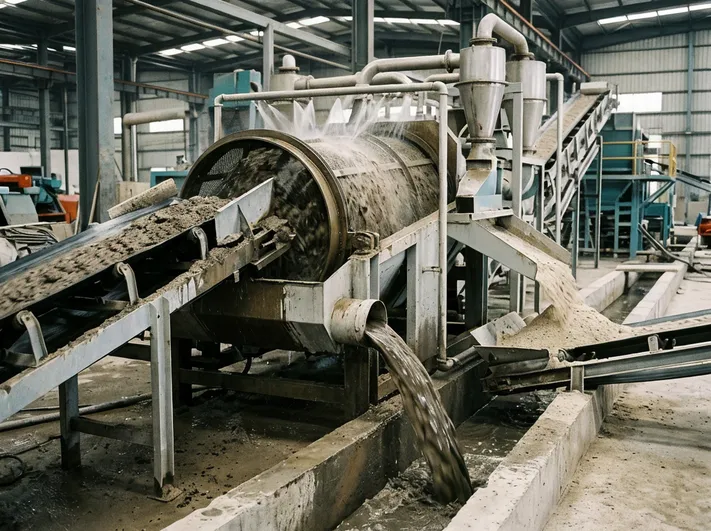
A clay sand washing line removes clay fines and contaminants from reclaimed or raw sand using water separation. This isn't the same as reclamation (which uses mechanical attrition to strip binders) or preparation (which mixes clean sand with fresh clay). Washing is the quality control step that restores grain size distribution and surface cleanliness after mechanical processing or before molding.
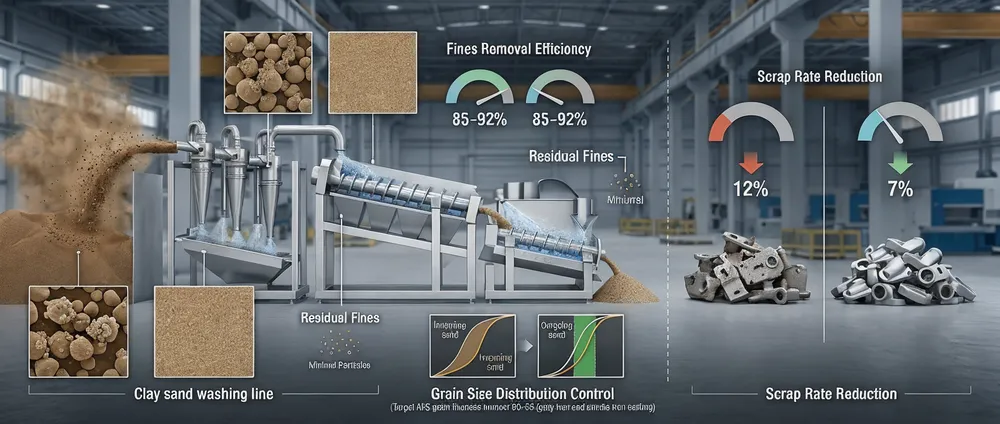
The process works by suspending sand in water flow — clay particles and fine contaminants stay suspended and wash away, while heavier sand grains settle and get recovered. Fines removal efficiency runs 85–92% in properly configured systems, meaning you're extracting that percentage of sub-75-micron particles that would otherwise compromise mold permeability and casting surface finish.
Mold permeability directly affects gas escape during metal pouring. Excess clay fines clog the spaces between sand grains, trapping gases that cause porosity defects in your castings. A washing line that holds fines content at 3–5% (down from 8–12% in unwashed reclaimed sand) cuts your scrap rate on thin-wall castings by 15–25%.
For a foundry producing 500 tons of castings monthly with a 10% scrap rate, that's 37–62 tons of additional saleable product — the washing system pays for itself in 8–14 months through scrap reduction alone.
85–92%
Fines removal efficiency (sub-75 µm particles)
3–5% fines content
Post-wash target, down from 8–12% in unwashed reclaimed sand
15–25%
Scrap rate reduction on thin-wall castings
8–14 months
System payback period via scrap reduction alone
You'll see washing lines configured two ways depending on your sand sourcing and system architecture.
For foundries buying pre-reclaimed sand or processing raw sand from contaminated sources. The washing line becomes your quality gate that normalizes input material before it reaches your molding station.
Best for: Multiple sand suppliers with inconsistent quality — the washing step standardizes grain distribution regardless of incoming material variation.
Sits downstream of mechanical reclamation in a closed-loop sand circuit. This configuration works when you're running a complete clay sand processing line and need consistent sand quality across 2–3 shift operations.
Best for: Continuous multi-shift foundries with in-house reclamation that need process-level consistency without manual quality checks between stages.
Most buyers in automotive and aerospace casting segments add washing to their sand loop because surface finish requirements are tight enough that clay fines become the limiting factor on first-pass yield.
If you're casting pump housings, valve bodies, or engine components where machining stock is measured in millimeters, the cost of washing (water, energy, sludge disposal) is negligible compared to the cost of scrapping a casting that's 0.5 mm oversize due to mold erosion from poor sand quality.
Two fundamental configurations exist for clay sand washing — each matched to different foundry scales, automation levels, and integration requirements. Here's what separates them in practice.
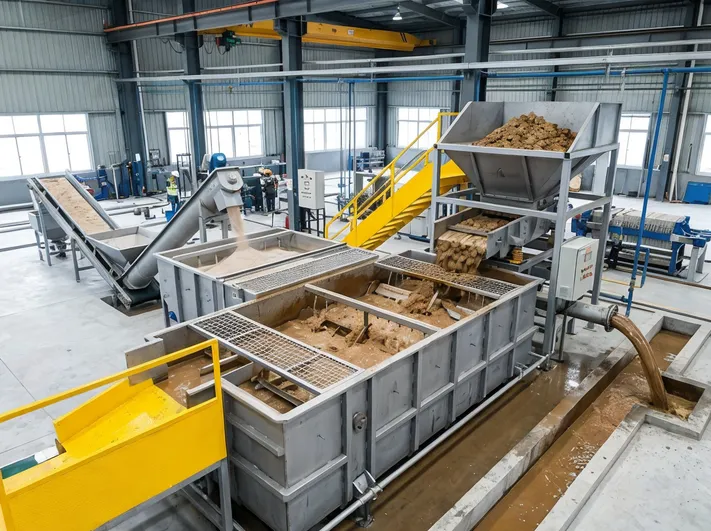
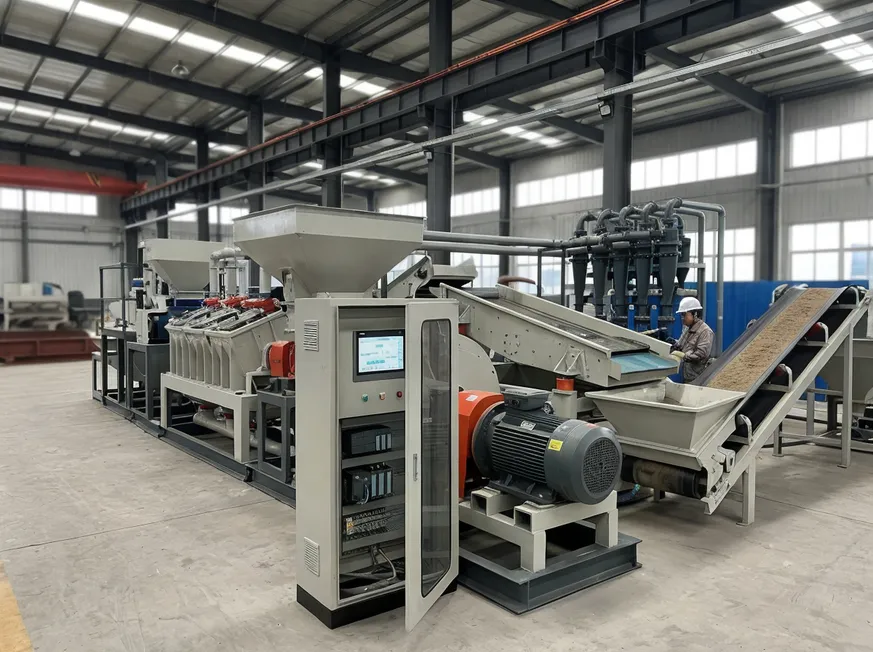
Standalone washing systems handle 10–30 tons of sand per hour and occupy roughly 8 m × 6 m of floor space. The core components are a feed hopper (where sand enters the system), a washing tank with agitation paddles (where water and sand mix), a settling zone (where clean sand drops out), and a sludge discharge system (where contaminated water exits).
This configuration works when you're buying reclaimed sand from outside suppliers and need to verify quality before use, or when you're processing raw sand from quarries that have high clay content — common in regions where sand washing isn't done at the source. TZFoundry has shipped standalone systems to foundries in the Middle East and Southeast Asia where local sand sources run 10–15% clay content — the washing line drops that to 3–5%, making the sand usable for precision casting work.
Standalone systems don't integrate with your molding line's control system, so sand quality monitoring is manual — pull samples every 2–4 hours, run sieve analysis, adjust water flow if needed. For low-volume operations or foundries with experienced sand technicians, that's acceptable. For higher volumes or facilities running lights-out shifts, the integrated configuration is the better path.
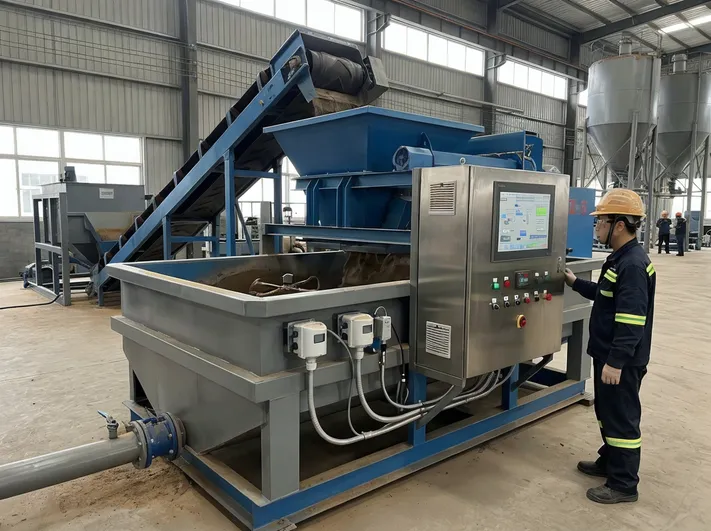
Integrated washing systems connect directly to your reclamation unit's discharge conveyor and feed into your sand storage silos or molding station. Throughput scales from 20–50 tons per hour depending on your molding line's capacity. The washing tank is larger (to handle surge flow when reclamation output spikes), and the system includes PLC integration so wash water flow, agitation speed, and settling time adjust automatically based on incoming sand quality.
The PLC monitors turbidity in the wash water discharge — when turbidity drops below a setpoint (indicating fines removal is complete), the system advances the batch to the settling zone and starts the next wash cycle. This prevents:
Data logging captures every batch's wash time, water consumption, and turbidity readings — providing full traceability for ISO 9001 audits.
Integrated systems cost 40–50% more than standalone units — the PLC hardware, sensors, and control panel integration add $8,000–12,000 to the base price. However, they cut labor cost by eliminating manual sampling and adjustment.
Needs a dedicated operator checking sand quality every few hours
Runs unattended except for sludge removal (once per shift) and routine maintenance
Over a year of 2-shift operation, the labor savings cover most of the equipment premium.
Footprint for integrated systems runs 12 m × 8 m including the settling tanks and sludge collection area. Power demand is 25–35 kW — higher than standalone because of the larger agitators and additional pumps for automated sludge handling. Water consumption is the same per ton of sand processed, but integrated systems typically include closed-loop recycling because the higher throughput makes water cost a significant operating expense.
If you have an existing reclamation line and want to add washing, the integration is straightforward as long as you have 8–10 meters of floor space downstream of the reclamation discharge and access to water and drainage.
3–4 days including commissioning — can be completed during a scheduled maintenance shutdown without extending your downtime.
Fines removal efficiency measures the percentage of sub-75-micron particles extracted from the sand during washing. Our clay sand washing lines achieve 85–92% removal in typical foundry sand applications. That means if your incoming sand contains 10% fines by weight, the washed sand exits with 0.8–1.5% fines. The remaining fines are particles that are too close to the target grain size to separate efficiently without losing usable sand.
Grain size distribution control holds the sand's particle size profile within ±5% of your target specification. If you're targeting AFS grain fineness number 50–55 (common for gray iron and ductile iron casting), the washing process maintains that range across continuous operation.
Grain size drift happens when washing is too aggressive (fine sand grains get carried away with the fines) or too gentle (fines remain in the sand). The PLC's turbidity monitoring prevents both failure modes by adjusting wash water flow in real time.
Common for gray iron & ductile iron casting
Maintained via real-time PLC turbidity monitoring
Prevents over-washing and under-washing automatically
Water consumption without recycling runs 50–80 liters per ton of sand processed. That's the volume needed to suspend clay fines and flush them out of the washing tank. A 30-ton-per-hour system uses 1,500–2,400 liters per hour, or 12,000–19,200 liters per 8-hour shift. With closed-loop recycling (described in the next section), consumption drops to 5–10 liters per ton — only makeup water to replace evaporation and moisture carried away with the sludge.
Without water recycling — full fresh water supply required for each wash cycle
With recycling — makeup water only for evaporation and sludge moisture loss
Per 8-hour shift at open-loop rates — closed-loop cuts this to 1,200–2,400 L
Throughput capacity scales with washing tank size and agitation power. Small systems (10–20 tons/hour) use a single 2-cubic-meter tank with one agitator. Mid-range systems (20–40 tons/hour) use dual 3-cubic-meter tanks operating in parallel. High-capacity systems (40–60 tons/hour) run three tanks with staggered batch cycles so one tank is always discharging clean sand while the others are washing or settling.
| Parameter | Small System | Mid-Range System | High-Capacity System |
|---|---|---|---|
| Throughput | 10–20 tons/hour | 20–40 tons/hour | 40–60 tons/hour |
| Fines removal efficiency | 85–88% | 88–90% | 90–92% |
| Water consumption (open-loop) | 50–70 L/ton | 60–75 L/ton | 70–80 L/ton |
| Water consumption (closed-loop) | 5–8 L/ton | 6–9 L/ton | 8–10 L/ton |
| Power requirement | 15–20 kW | 25–30 kW | 35–45 kW |
| Footprint | 8m × 6m | 10m × 7m | 12m × 8m |
| Wash cycle time | 8–12 minutes | 6–10 minutes | 5–8 minutes |
| Sludge output | 1.5–3 tons/day | 3–6 tons/day | 6–10 tons/day |
Specifications shown are industry-standard values for this product type. Actual specifications may vary based on sand characteristics and water quality. Contact us for detailed performance data.
The connection between these specs and your casting quality is direct and measurable. Each washing parameter controls a specific quality outcome in the final casting:
Fines removal efficiency directly affects mold permeability, which controls gas escape during pouring. Insufficient permeability causes gas porosity — trapped bubbles in the casting that compromise structural integrity and surface appearance.
Grain size distribution affects mold surface finish — inconsistent grain size creates rough mold surfaces that telegraph through to the casting. Uniform grain distribution from proper washing delivers smoother mold faces and better casting surfaces.
Water consumption affects your ongoing operating cost. Systems with integrated recycling dramatically cut fresh water requirements while maintaining consistent wash quality across production shifts.
Throughput capacity determines whether the washing line keeps pace with your molding output or becomes a bottleneck. Undersized washing capacity forces production compromises — either reduced molding speed or reduced wash quality.
We've seen foundries cut their scrap rate from 12% to 7% by adding a washing line to an existing reclamation system. The full 5-percentage-point improvement came entirely from better mold permeability and surface finish.
Monthly Output
400 tons/mo
Additional Saleable Product
20 tons/mo
Revenue Recovery
$40k–80k
depending on casting type
System cost: $35,000–$55,000 depending on capacity. Payback period: 6–10 months.
Send us your target sand quality parameters — grain size distribution, maximum allowable fines content, current sand source characteristics — and we'll spec the washing system configuration that delivers those results. Include your daily sand throughput so we can size the system to match your molding line's capacity.
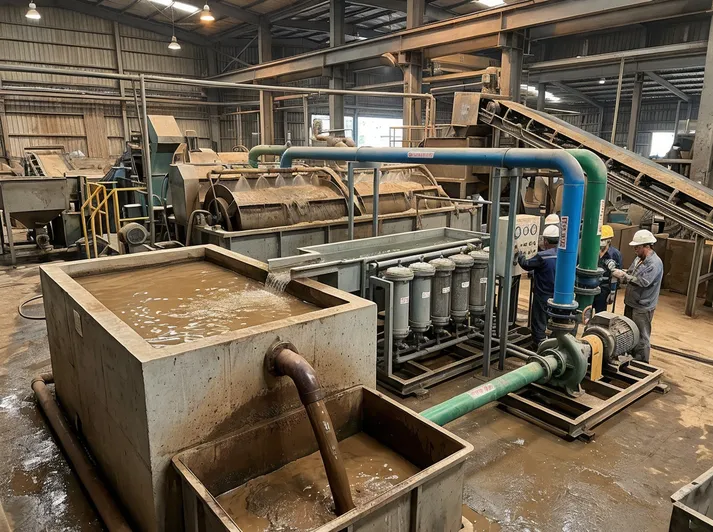
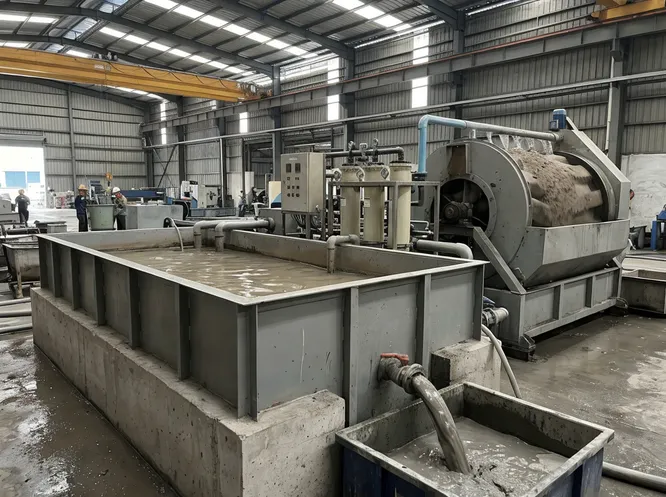
Closed-loop water recycling captures wash water after it exits the washing tank, removes suspended solids, and returns clean water to the system — reducing makeup water to just 5–10 liters per ton of sand processed.
The recycling module includes three components: a settling tank (where heavy solids drop out), a filtration stage (which removes remaining suspended particles), and a return pump (which feeds clean water back to the washing tank).
Together these stages achieve 85% or greater reduction in water consumption compared to open-loop washing systems, while concentrating sludge for efficient disposal.
Two filter options depending on your water quality requirements and budget:
Sand Filters (Lower Cost)
Cartridge Filters (Higher Quality)
Total Makeup Water Requirement
5–10 liters per ton of sand processed, compared to 50–80 liters per ton for open-loop systems.
Scenario: 30-ton-per-hour system running 16 hours per day — 480 tons of sand processed daily.
Open-Loop System
24,000–38,400
liters per day
Closed-Loop System
2,400–4,800
liters per day
Daily Water Saved
21,600–33,600
liters per day
Cost savings from closed-loop water recycling break down into three categories: water purchase, water heating (cold-climate operations), and sludge disposal.
Industrial water rate: $0.50 per cubic meter (typical)
Daily savings: 21.6–33.6 m³ saved = $10.80–$16.80/day
Annual savings: $3,240–$5,040/year
Open-loop: 8–12 m³ liquid sludge daily (the wash water being dumped)
Closed-loop: 1–2 m³ concentrated sludge daily (settled solids only)
Disposal cost: $50–$100 per m³ depending on local regulations and waste classification
Annual savings: $12,000–$36,000/year
Applicable if you're in a cold climate and need to prevent freezing in the washing system.
Closed-loop dramatically reduces the volume of water that needs heating — only 5–10 L/ton makeup vs. 50–80 L/ton in open-loop systems.
Heating savings are site-specific and depend on ambient temperatures and energy costs.
Combined annual savings (water + sludge disposal): $15,240–$41,040 per year for a 30-ton/hour system running 16 hours daily — before accounting for any cold-climate heating reductions.
$12,000 – $18,000
Varies by system capacity and filtration method. Sand filters are the lower-cost option; cartridge filters cost more but produce cleaner recycled water.
12 – 18 Months
Single-shift or low-volume operations recover the recycling module investment within 12–18 months through reduced water purchase and disposal costs.
8 – 12 Months
Foundries running 2–3 shifts see faster payback — higher throughput means greater per-cycle water savings and quicker cost recovery on the module.
Many regions now prohibit direct discharge of foundry wash water into municipal sewers or surface water without treatment — suspended clay and metal particles exceed allowable limits. A closed-loop water recycling system eliminates discharge entirely, so you avoid permitting hassles and potential fines for non-compliance.
The only waste stream is concentrated sludge, which goes to licensed disposal. This is a far simpler regulatory path than managing continuous treated-water discharge permits.
Water quality in the recycling loop degrades slowly over time as dissolved salts and fine particles accumulate. A controlled bleed-off strategy keeps recycled water within usable quality parameters without excessive fresh-water consumption.
Discard 10–20% of recycled water each cycle and replace with fresh water to prevent dissolved-salt and fine-particle buildup. This maintains consistent washing performance without the cost of full water replacement.
Bleed-off water is cleaner than raw wash water — most solids have already settled out. Some foundries repurpose it for dust suppression in other parts of the facility rather than sending it to disposal, extracting additional value from the waste stream.
Because bleed-off water has already passed through settling and filtration, its solids load is significantly lower than raw wash water. This reduces treatment costs if you're required to treat before off-site disposal or surface discharge.
A lower bleed-off rate saves more water but risks degrading wash performance. A higher rate uses more fresh water but keeps the loop cleaner. The 10–20% range balances both for most clay sand washing applications.
Total maintenance time runs 30–40 minutes per shift — less than the time saved by not having to manage continuous sludge disposal from an open-loop system.
| Task | Frequency | Duration / Method | Notes |
|---|---|---|---|
| Settling tank sludge removal | Once per shift | 15–20 minutes with automated rake system | Sludge goes to licensed disposal |
| Filter backwashing | Every 4–6 hours | Automatic — no operator intervention | Fully automated cycle; monitor indicator lights only |
| Cartridge filter replacement | Every 2–3 months | Manual swap — 10–15 minutes | Only if using cartridge filtration method; sand filters do not require replacement |
Tell us your throughput, shift pattern, and local water costs — we'll model the payback for your specific operation.
Real numbers for planning your clay sand washing line budget — energy draw, water economics, sludge disposal, and filter maintenance broken down per ton, per shift, and per month.
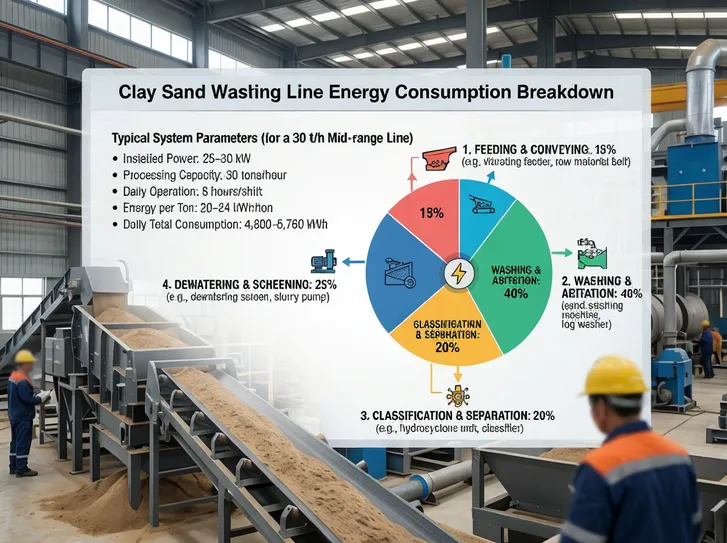
Energy consumption for a mid-range clay sand washing line (25–30 kW installed power) runs 20–24 kWh per ton of sand processed. A system processing 30 tons per hour over an 8-hour shift consumes 4,800–5,760 kWh daily.
The load distributes across four subsystems, each drawing a predictable share of total installed power:
Largest single load — drives the clay separation process
Circulation and recycling loop pressure
Material transport between wash stages
Process automation and monitoring instrumentation
Energy cost per ton of washed sand: $2.40–$2.88. At $0.12 per kWh (typical industrial electricity rate in export markets), the per-ton energy cost is a small fraction of the value created by improved casting quality.
If washing improves your first-pass yield by 3 percentage points on castings worth $200 per ton, you gain $6 per ton of casting output. A foundry producing 500 tons of castings monthly (requiring roughly 1,500 tons of sand) spends $3,600–$4,320 on washing energy but gains $3,000 in reduced scrap — the net cost is minimal, and that's before accounting for the quality improvement's effect on customer satisfaction and repeat orders.
Water cost depends on whether you're running open-loop or closed-loop. The difference in monthly spend is dramatic — and often the deciding factor in system configuration.
| Metric | Open-Loop | Closed-Loop |
|---|---|---|
| Water per ton of sand | 60 L/ton (50–80 range) | 7 L/ton (5–10 range) |
| Daily consumption (30 t/h × 8 h) | 432,000 L/day | 50,400 L/day |
| Daily water cost @ $0.50/m³ | $216 | $25.20 |
| Monthly water cost | $6,480 | $756 |
| Monthly savings with closed-loop | — | $5,724/month saved |
Closed-loop saves $5,724 per month in water costs alone.
At $0.50 per cubic meter, closed-loop systems consume just 50,400 liters daily compared to 432,000 liters for open-loop — an 88% reduction in raw water demand. This is in addition to reduced wastewater permitting requirements.
Open-loop systems generate liquid sludge continuously — the wash water you're discharging either goes to a settling pond (if you have space and permits) or gets hauled away by a waste service. Closed-loop systems generate concentrated sludge in the settling tank that needs removal once per shift.
Cost varies by local regulation — inert waste classification is cheaper; industrial waste classification is more expensive.
Concentrated sludge only — dramatically lower volume and hauling frequency versus open-loop.
If you're using the closed-loop recycling option, filter maintenance becomes a recurring line item. Two approaches are available, and most buyers choose the lower-cost option.
Lower operating cost over time. Slightly coarser filtration, but produces water clean enough for reuse — the difference doesn't affect washing performance.
Finer 10-micron filtration, but higher ongoing cost due to frequent element changes. The added precision doesn't measurably improve washing results — both methods produce reuse-grade water.
Annualized filter cost comparison: Sand filters at $800–$1,200 per 2–3 years work out to roughly $27–$50/month. Cartridge filters at $150–$250 every 2–3 months come to $50–$125/month. Most buyers choose sand filters for the lower operating cost, accepting the slightly coarser filtration — both methods produce water clean enough for effective clay sand washing.
Every 12–18 months
Replacement interval depends on sand abrasiveness and operating hours. Cost per belt: $400–600.
Every 18–24 months
Sand abrasion drives wear. Replacement cost per set: $300–500.
Every 12–18 months
Most systems run 2–3 pumps. Replacement cost per pump: $200–400.
Mid-range system
Combined annual consumables cost: $1,500–2,500.
One operator monitors sand quality and adjusts water flow as part of their broader foundry duties — not a dedicated role. Operators handle manual sampling and adjustment throughout each shift.
Run unattended except for two routine tasks per shift:
Automation payback: The labor savings — roughly 2–3 hours per shift that an operator would otherwise spend on manual sampling and adjustment — offsets the higher equipment cost within 18–24 months.
Mid-range system · Closed-loop recycling · 2-shift operation
| Cost Component | Range per Ton |
|---|---|
| Energy | $2.40 – $2.88 |
| Water | $0.15 – $0.20 |
| Sludge Disposal | $0.30 – $0.50 |
| Consumables | $0.10 – $0.15 |
| Total per Ton | $2.95 – $3.73 |
For a foundry processing 15,000 tons of sand monthly, the operating cost falls between $44,250 and $55,950 per month.
A 3-percentage-point improvement in first-pass yield on 500 tons of monthly casting output worth $200/ton generates $3,000 in additional revenue. More importantly, it protects your margin on the other 97% of castings by ensuring consistent quality that keeps customers reordering.
Send us your daily sand throughput, local utility rates (electricity and water cost per unit), and whether you have space for a settling pond or need sludge hauling service.
We'll calculate your monthly operating cost for both open-loop and closed-loop configurations so you can make an informed capital investment decision.
Automated sensor arrays and PLC-driven logic replace guesswork with measurable, auditable process control — from turbidity-based wash cycle management to sludge-level triggers and optional laser diffraction grain analysis.
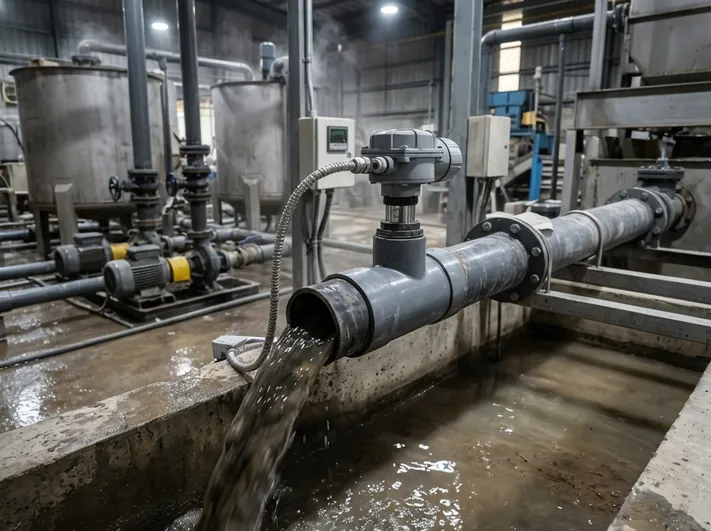
Turbidity sensors in the wash water discharge measure suspended solids concentration in real time. The sensor uses optical transmission — a light beam passes through the water, and the amount of light that reaches the detector indicates how much particulate matter is suspended. High turbidity (cloudy water) means fines are still being removed. Low turbidity (clear water) means fines removal is complete and the wash cycle can advance to settling.
The PLC uses turbidity readings to control wash cycle duration. If turbidity drops below the setpoint (typically 50–100 NTU depending on your sand type) within 6 minutes, the system knows the sand is clean and moves to the settling phase. If turbidity stays high after 10 minutes, the PLC extends the wash cycle or increases water flow. This prevents under-washing (which leaves excess fines in the sand) and over-washing (which wastes water and energy without improving sand quality).
Turbidity below 50–100 NTU within 6 min triggers transition to settling phase automatically.
If turbidity stays high after 10 min, PLC extends cycle duration or increases water flow to prevent under-washing.
Automated sludge level sensors in the settling tank trigger cleaning cycles when accumulated sludge reaches a preset depth. The sensor uses ultrasonic measurement — it bounces a sound wave off the sludge surface and calculates depth from the return time.
When sludge depth hits 300–400 mm (typical trigger point for a mid-range system), the PLC activates the rake system to push sludge toward the discharge port. This prevents sludge buildup from reducing the settling tank's effective volume, which would shorten residence time and allow more fines to carry over into the recycled water.
Optional grain size analyzers use laser diffraction to measure particle size distribution in real time as sand exits the washing system. The analyzer costs $15,000–20,000 and provides continuous feedback on whether the washing process is maintaining your target grain size profile.
Most buyers skip this option unless they're doing precision casting work (aerospace components, medical devices) where grain size variation directly affects dimensional tolerance and surface finish. For standard gray iron and ductile iron casting, periodic manual sieve analysis (once per shift) is sufficient.
Decision guide: If your castings require surface finish ≤ 6.3 µm Ra or dimensional tolerances tighter than CT6 (ISO 8062), the $15,000–20,000 laser diffraction analyzer pays for itself in reduced scrap. For general-purpose iron casting, manual sieve analysis once per shift gives you the data you need without the capital outlay.
PLC data logging captures every batch's process parameters: wash cycle start time, wash duration, water flow rate, turbidity readings, sludge removal events, and any operator interventions. The data gets timestamped and stored in the PLC's internal memory (12 months of data, about 2 GB), and you can export to CSV or PDF for long-term archival.
This traceability matters for ISO 9001 compliance — when an auditor asks "how do you verify sand quality consistency," you pull up the PLC logs showing that every batch met your turbidity and cycle time targets.
Wash cycles that run too long waste water and energy without improving sand quality. Once fines are removed, additional washing provides zero benefit — you're just burning through consumables.
How the System Prevents It
The turbidity sensor detects when fines removal is complete and automatically stops the cycle — no operator intervention required.
Cycles that are too short leave excess fines in the sand, degrading mold quality and increasing casting defect rates downstream.
How the System Prevents It
The PLC flags any batch where turbidity didn't drop below the setpoint, so you can rework that sand or adjust system parameters before it reaches your molding line.
Calibration for turbidity sensors happens every 6 months using reference standards — water samples with known suspended solids concentrations. The calibration kit ships with the system, so there's nothing extra to source or order.
Calibration Kit Contents
Low, medium, and high turbidity standards for full-range validation
Step-by-step instructions for adjusting the sensor's output to match known values
Our technicians can log into your system via VPN and review process data when you report a problem. If you're seeing inconsistent sand quality, we pull up the last 48 hours of turbidity readings, wash cycle times, and water flow rates to identify the issue.
48 hrs
Process Data Available for Review
70–80%
Issues Resolved Without On-Site Visit
Phone + VPN
Walk-Through Fix with Your Team
Your maintenance team receives guided instructions over a phone call — no need to wait for a service visit to get back to production.
How clay sand washing lines connect to reclamation units, molding lines, and preparation systems — with the piping specs, control logic, and retrofit requirements you need to plan installation.
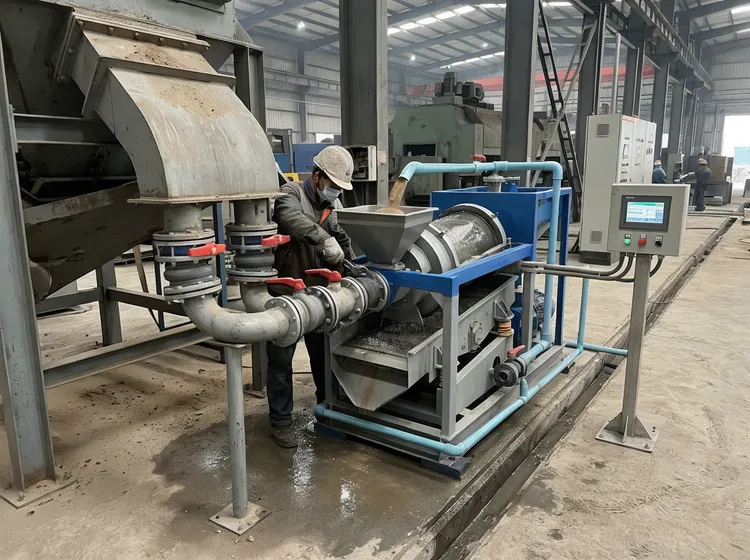
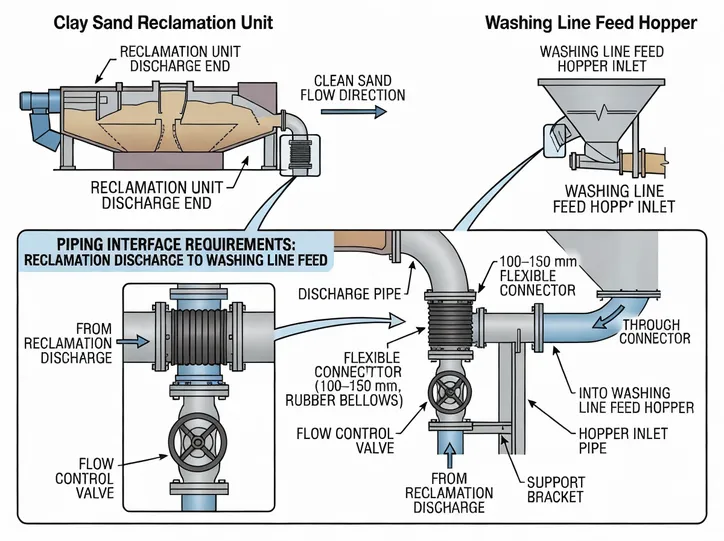
Clay sand washing lines connect to reclamation units at the discharge conveyor — sand exits the reclamation system's attrition mill, travels along a conveyor to the washing line's feed hopper, gets washed, and then moves to your sand storage silo or molding station.
Reclamation discharge to washing line feed interface — 100–150 mm flexible connector detail.
Washed sand discharges from the settling tank onto a conveyor that feeds your silo, where it mixes with any fresh sand additions before moving to the molding station.
Sequencing with preparation lines: If you're running a clay sand preparation line (which adds fresh clay and water to create molding sand), the washing line sits upstream — you wash first to remove contaminants, then prepare to add binders.
Reclamation Discharge
Sand exits attrition mill
Washing Line
Remove clay fines & contaminants
Storage Silo
Mix with fresh sand additions
Molding Station
Clean sand ready for use
Operate independently with their own start/stop controls. Your operator manually starts the washing line when there's sand to process and stops it when the batch is complete.
Best for: batch processing, lower volumes, or facilities without centralized PLC infrastructure.
Tie into your existing PLC network so the washing line starts automatically when the reclamation unit's discharge conveyor activates, and stops when sand flow ceases.
Best for: continuous production, high-volume foundries with centralized control.
Communication requirement: Ethernet or Profibus cable (depending on your PLC brand) plus programming to link the two systems' control logic.
Commissioning-phase service, no separate quote required
Our technician connects to your existing control panel, adds the washing line's I/O points to your PLC's configuration, and writes the interlock logic. Programming takes 4–6 hours and happens during the commissioning phase.
Interlock Example
Washing line won't start unless reclamation is running
Safety Logic
Washing line stops if sand feed stops for more than 2 minutes
Timeline
4–6 hours during commissioning phase
If you have an existing clay sand reclamation line and want to add washing, you need three things:
8–12 meters downstream of the reclamation discharge, depending on washing system capacity.
Forklift or crane access to position the washing tank and settling tanks during installation.
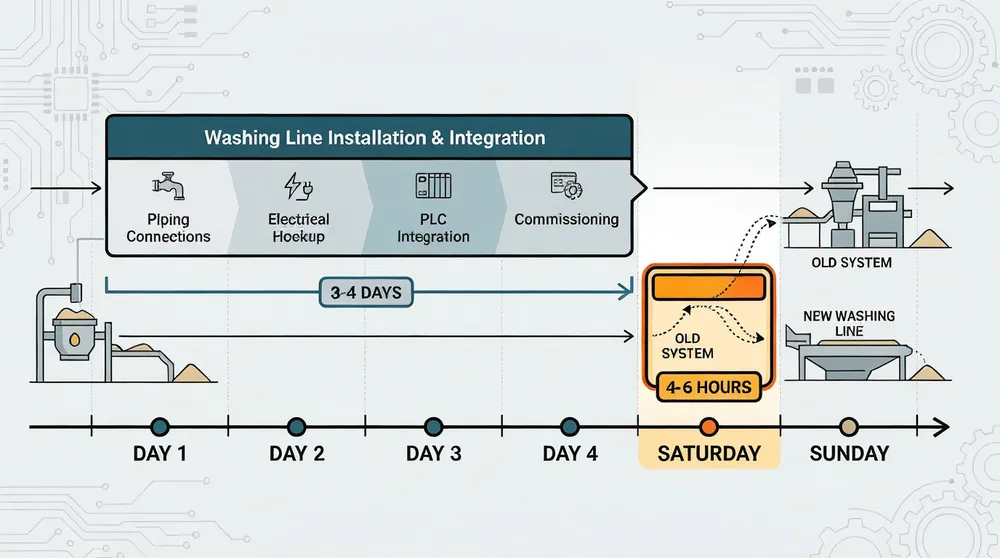
Most foundries have the space and utilities — the constraint is usually the installation window. Washing line installation takes 3–4 days including piping connections, electrical hookup, PLC integration, and commissioning. You can schedule this during a planned maintenance shutdown (most foundries shut down for 5–7 days annually for major maintenance), or install the washing line in parallel with your existing system and then cut over during a weekend. The cutover itself — disconnecting the old sand flow path and connecting the new one — takes 4–6 hours.
From reclamation to washing and from washing to storage, using either belt or screw conveyors depending on layout.
Belt conveyors are cheaper but require more floor space. Screw conveyors fit in tighter spaces and handle inclines up to 30°.
50–75 mm diameter PVC or steel pipe from your facility's water main to the washing line inlet.
Requires a shutoff valve, pressure gauge, and flow meter for water consumption cost accounting. Cost varies with distance from water main to washing line location.
Drainage routing depends on whether you run open-loop or closed-loop water circulation.
Open-loop requires a settling pond or sewer connection — check local regulations, as many jurisdictions prohibit direct discharge of foundry wash water. Closed-loop routes to a filter press, drying bed, or waste collection point. Cost depends on distance and whether floor cutting is needed.
Yes, if you have the floor space and utilities. The washing line is a modular add-on that doesn't require changes to your reclamation or molding equipment. TZFoundry has retrofitted washing lines to foundries running 10-year-old reclamation systems — the interface is straightforward because sand conveyors and piping use standard dimensions across manufacturers.
Each line handles a different stage of sand processing. Understanding what each one does — and what it doesn't — determines whether your system delivers clean molding sand or compounds existing contamination.
Uses mechanical attrition — crushing, grinding, and screening — to strip binders and break up lumps in used sand. The output is sand with most of the clay and resin removed, but it still contains fine particles and contaminants.
Role: First step in sand reuse. Handles the heavy work of breaking down mold material into reusable grains.
Uses water flow to separate clay fines and contaminants from sand grains. The output is sand with controlled grain size distribution and low fines content. Washing is the quality control step that happens after reclamation (or on raw sand from contaminated sources).
Role: Doesn't remove binders — that's reclamation's job. It removes the fine particles that reclamation leaves behind.
Mixes clean sand with fresh clay and water to create molding sand with the right moisture content and clay percentage for compaction. Preparation is the final step before sand enters the molding station.
Role: Assumes you're starting with clean sand — if your sand has excess fines or contaminants, preparation won't fix that. You need to wash first.
Most foundries running continuous production need all three in sequence. The order matters because each step assumes the previous step has done its job.
Strip binders from used sand
Remove fines and restore grain quality
Add fresh clay and moisture for molding
If you skip washing and go straight from reclamation to preparation, you're mixing fresh clay with contaminated sand, and your mold quality suffers.
You're buying pre-reclaimed sand from a supplier and want to verify quality before use, or you're processing raw sand from a quarry that has high clay content but no binders to remove.
Standalone washing handles this scenario.
You're running a foundry with a closed-loop sand system where used molds get broken down and reused. The reclamation line strips binders, the washing line removes fines, and the clean sand goes back to molding (either directly or through a preparation step if you're adding fresh clay).
Closed-loop continuous production.
You're buying clean sand from a supplier but need to add clay and moisture to create molding sand. Less common — most foundries buying sand also buy pre-mixed molding sand ready to use. But if you're in a region where only raw sand is available, washing + preparation gives you control over the final molding sand properties.
Regional raw sand sourcing.
Related product lines:
Reclamation breaks down used sand lumps, removes binder residues, and restores grain shape through crushers, mills, and screens.
Washing removes the clay fines that mechanical reclamation cannot separate, restoring grain quality for reuse.
Preparation lines mix reclaimed sand with fresh clay, additives, and water to produce ready-to-mold sand — mostly mixers and conveyors.
Most foundries answer yes to all three questions — which is why integrated clay sand processing line systems include all three functions: reclamation, washing, and preparation in a single coordinated loop.
$35k–55k
20–30 tons/hour capacity
Removes clay fines that mechanical reclamation misses. The system covered on this page.
$80k–120k
Similar capacity range
More complex equipment — crushers, mills, and screens. Higher investment due to mechanical processing stages.
$25k–40k
Comparable capacity
Simpler equipment — mostly mixers and conveyors. Lowest investment of the three systems.
$140k–215k
All three systems combined
Full reclamation + washing + preparation for a closed-loop sand cycle built from scratch.
If you already have a working reclamation line and just need to add the washing stage, your investment is $35,000–$55,000 plus installation. This is the most common upgrade path for foundries finding that mechanical reclamation alone cannot keep fines content below their quality threshold.
We've been manufacturing foundry equipment since 2010, and clay sand washing lines became part of our product range in 2013 when export buyers started asking for quality control systems to complement their reclamation lines. The shift happened because foundries in automotive and aerospace casting segments needed tighter sand quality control than reclamation alone could provide — washing became the differentiator between acceptable and premium casting surface finish.
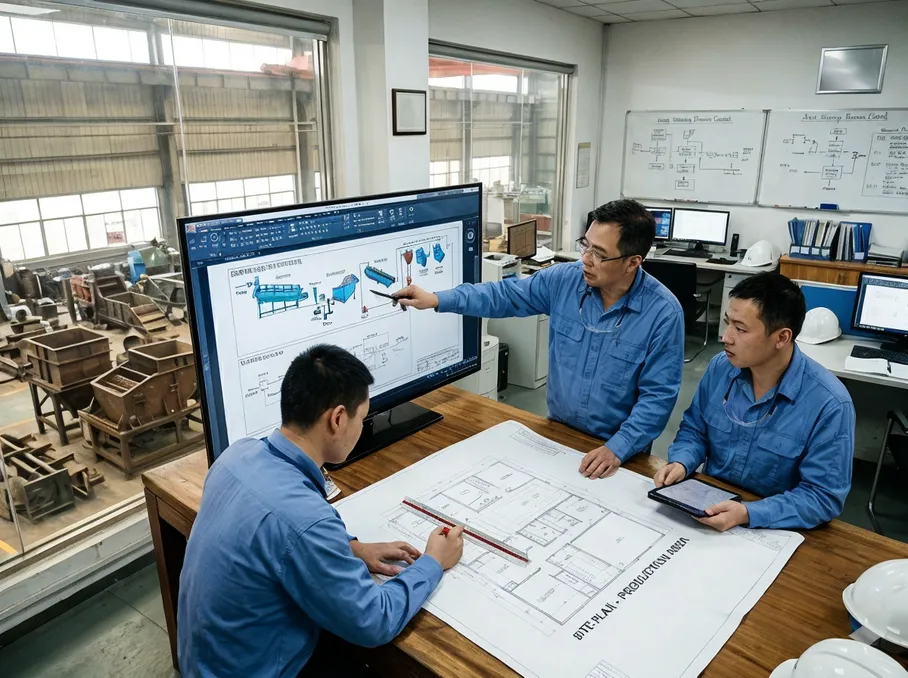
Our in-house engineering team handles custom configurations without outsourcing design work. When you need a washing line that fits a non-standard floor space — we've built systems for 6m × 5m footprints where our standard design assumes 8m × 6m — or integration with unusual upstream equipment (one buyer had a 30-year-old reclamation line with metric conveyor dimensions that didn't match our standard interface), we're modifying our own designs.
This matters because washing line performance depends on matching the system's throughput and settling time to your specific sand characteristics — not every sand washes the same way, and custom tuning makes the difference between 85% fines removal and 92% fines removal. That gap often comes down to wash cycle tuning for your specific sand type.
Custom Tuning Impact
The difference between 85% and 92% fines removal often comes down to wash cycle tuning for your specific sand type — something only possible when the engineering team designing your system also manufactures the equipment.
ISO 9001:2015, CE, and SGS certifications cover our manufacturing process — material sourcing, fabrication, assembly, and testing all follow documented procedures that get audited annually by third-party inspectors. The certifications don't make the washing equipment perform better, but they create the paper trail that satisfies your own quality audits and customer requirements.
If you're selling castings to buyers who require supplier traceability, you'll need documentation showing your foundry equipment came from a certified manufacturer. We provide the full package — material certificates, test reports, calibration records — with every system shipment.
ISO 9001:2015
Full quality management system, annually audited by third-party inspectors
CE Certified
Equipment meets European safety and environmental protection standards
SGS Verified
Independent inspection covering materials, fabrication, and final testing
Our Qingdao facility runs 8 production lines across 15,000 square meters, producing 500,000 units annually. That capacity determines our lead time stability — we're not a job shop that gets backlogged when a large order arrives.
A typical washing line order consumes 2–3 weeks of production time (tank fabrication, pump assembly, conveyor construction, electrical panel wiring, testing). We can run multiple orders in parallel, so even with a queue, your lead time stays in the 45–60 day range from deposit to factory departure.
8
Production Lines
15K
m² Facility
500K
Units / Year
45–60
Day Lead Time
We don't have a minimum order quantity for washing lines — some manufacturers won't quote unless you're buying a complete processing line. We'll modify standard designs without charging engineering fees unless the changes require new tooling or outside components.
We handle documentation, shipping logistics, and customs coordination as standard service. We've shipped washing lines to 40+ countries and know which markets require specific certifications, what customs officials need on commercial invoices, and how to pack equipment to survive ocean freight.
Full CE certification for European market compliance
GOST certification for Russian and CIS market entry
SASO certification for Saudi and Gulf region markets
Operations manual, electrical schematics, spare parts list & maintenance schedule in English
Other languages available on request — adds 1–2 weeks to delivery, costs $500–800 depending on language and document length.
VPN access to your PLC lets us diagnose 70–80% of issues without a site visit. Most buyers never need an on-site visit after initial commissioning.
The combination of operator training, detailed documentation, and remote diagnostics handles the majority of issues.
If remote support doesn't resolve the problem: you cover travel costs, we cover labor.
When we send a technician, it's usually for major component replacement (pump overhaul, tank repair) or capacity upgrades — not routine troubleshooting.
High-wear components stocked and shipped within 24–48 hours via DHL/FedEx to most export markets.
Stocked items: conveyor belts, agitator paddles, pump seals, turbidity sensors.
For longer-lead items (motors, gearboxes, PLC controllers), we recommend keeping one spare on-site. The cost is 5–8% of the original equipment price, but it eliminates the risk of a 2–3 week production shutdown waiting for a replacement part to clear customs.
Shipping delays can idle your production — a modest spare parts inventory is the most cost-effective insurance against unplanned downtime.
To size your clay sand washing line correctly and provide a firm price, we need the following from your team:
Tons of sand per hour your washing line needs to process. This drives tank sizing, pump selection, and water system capacity.
Grain size distribution, fines content, and clay percentage if known. These parameters determine agitation intensity and wash cycle duration.
Maximum allowable fines content and target grain size range after washing — the quality benchmarks your washed sand must meet.
Length × width dimensions, plus any height restrictions. Washing lines have a moderate footprint but require clearance above for maintenance access.
Whether you're installing a standalone washing line or integrating with existing reclamation equipment — this affects controls, conveyors, and layout.
If you're adding washing to an existing system, tell us what you're currently running — reclamation line capacity, molding line output, any quality issues you're trying to solve (high scrap rates, inconsistent mold strength, surface finish problems). That helps us size the washing line to match your production flow and address the specific quality gaps you're experiencing.
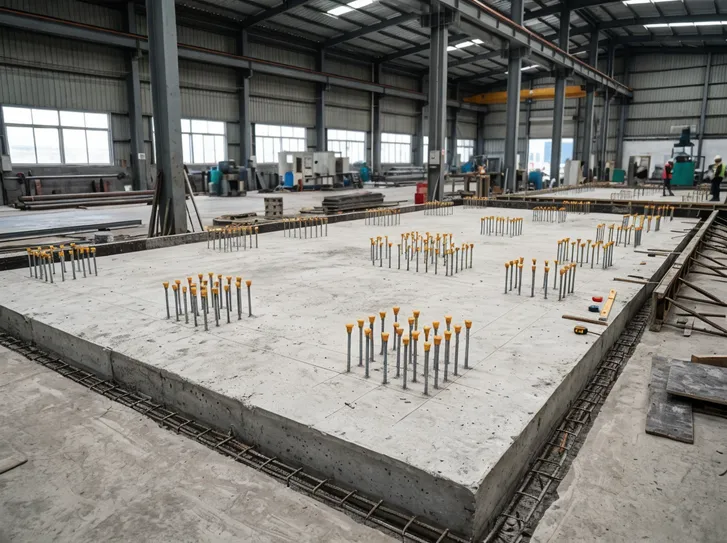
Site preparation starts with the foundation. Washing lines don't generate significant vibration (unlike compaction equipment), so a standard industrial floor slab is usually sufficient — 150mm reinforced concrete with rebar. If you're installing on an upper floor, check your building's load rating.
A mid-range washing system weighs 6–8 tons fully loaded with sand and water, plus dynamic loads from the agitators and pumps. We provide foundation drawings with anchor bolt locations and load distribution maps as part of the pre-shipment documentation.
Floor Slab
150mm Reinforced Concrete
Standard rebar — no special piling required
System Weight (Loaded)
6–8 Tons
Includes sand, water, and dynamic loads
Ventilation isn't critical for washing lines (unlike reclamation equipment which generates dust), but you'll want general factory ventilation to handle humidity from the washing process. Plan for 500–800 cubic meters per hour of exhaust airflow to keep moisture levels comfortable for operators.
From deposit to first washed sand, expect 65–100 days total elapsed time. Here is how that breaks down across production, logistics, and on-site work.
45–60 days
From deposit to factory departure.
15–30 days
Depends on destination port.
3–5 days
Clearance and transport to your facility.
2–3 days
Mechanical and electrical installation.
1–2 days
Testing and operator training.
Air freight option: For small systems, air shipping cuts transit to 5–7 days but costs 4–5× more than ocean freight. Best suited for urgent replacement units or compact standalone washers.
Our commissioning team — two technicians — arrives at your facility with the equipment. Here is the day-by-day sequence for a typical clay sand washing line installation.
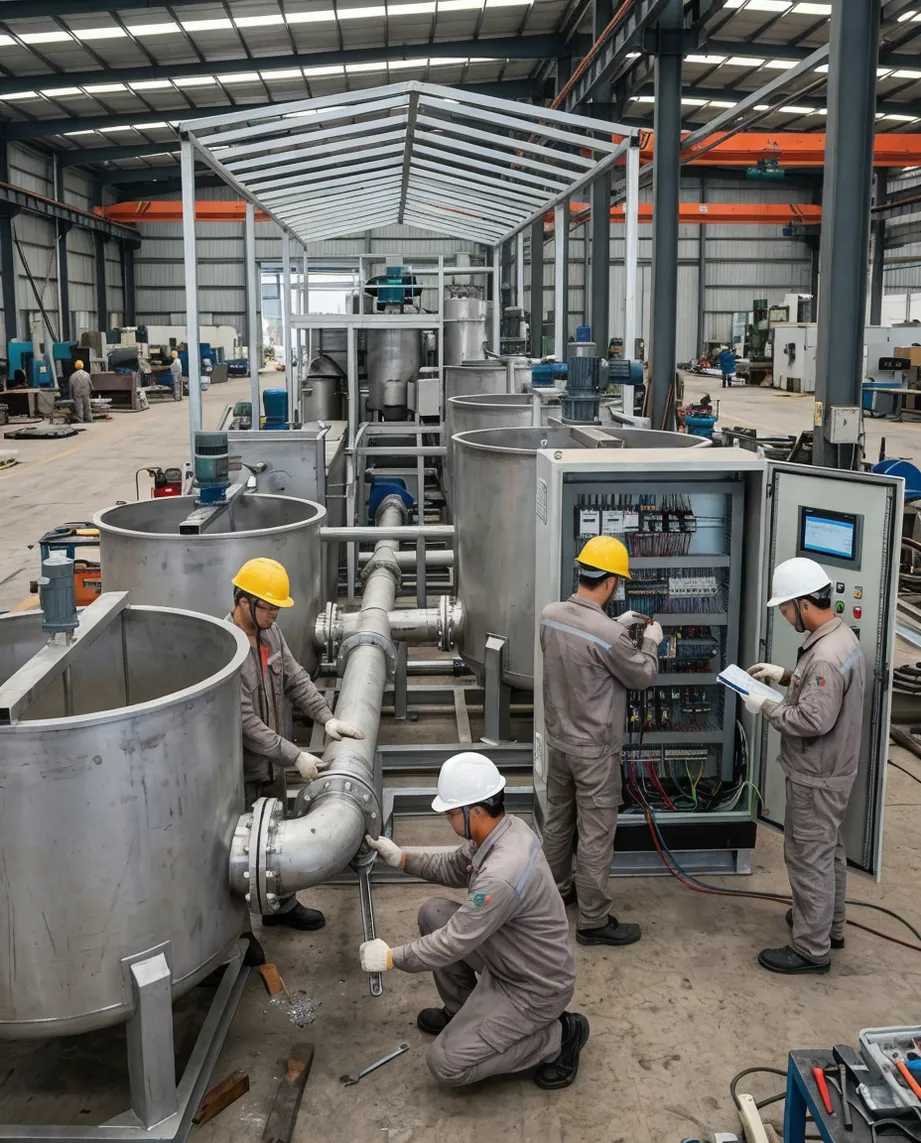
Position washing tank and settling tanks using your forklift or crane. Bolt units to the foundation. Connect piping between tanks.
Install pumps and motors. Run electrical conduit from your power supply to the control panel. Wire all components.
Connect water supply and drainage. Fill the system. Run functional tests — pump operation, agitator rotation, sensor calibration.
Run test batches of your sand. Adjust wash cycle parameters to hit your target fines removal rate. Train your operators on startup, normal operation, sludge removal, and basic troubleshooting.
Training runs during Days 4–5 of commissioning and covers six operational areas. Your operators leave with hands-on experience on the actual installed system — not a classroom simulation.
Valve positions, pump priming, PLC initialization sequence.
Loading sand, monitoring turbidity, advancing wash cycles.
Wash time, water flow rate, settling time — tuned to your sand characteristics.
Rake system operation, discharge valve control, disposal procedures.
Lubrication points, belt tension checks, sensor cleaning schedules.
Common alarms, interpreting PLC error codes, when to call for remote support.
Every clay sand washing line ships with a complete documentation set. All documents are in English; other languages are available on request.
| Document | Details |
|---|---|
| Operations Manual | 80–120 pages covering all procedures — startup, operation, shutdown, maintenance, and troubleshooting. |
| Electrical Schematics | Single-line diagrams, control panel layouts, wire routing documentation. |
| PLC Program Backup | Delivered on USB drive — restore the controller if it fails without waiting for remote support. |
| Spare Parts Catalog | Part numbers, supplier contacts, recommended stock quantities for wear items. |
| Maintenance Schedule | Daily checks, weekly inspections, monthly tasks, and annual overhaul procedures. |
Support does not end at commissioning. TZFoundry provides ongoing remote and on-site technical assistance for the life of your equipment.
We log into your PLC and review process data when you report an issue. Most problems are diagnosed and resolved without an on-site visit.
Response Time
4–8 hours during China business hours (UTC+8)
12–24 hours outside that window
Order through email or WhatsApp. We quote price and lead time within 24 hours of your request.
Quote Turnaround
Within 24 hours — price, lead time, and shipping options
If remote support does not resolve the problem, our technicians travel to your facility for hands-on diagnosis and repair.
Escalation Path
Remote diagnosis first → on-site dispatch if needed
Urgent Production-Affecting Issues?
For critical problems affecting production, contact our technical team directly via WhatsApp at +86 13335029477. This number reaches our engineering support team — not a call center.
30% Deposit
Starts production. Lead time clock begins when we receive the deposit and your final technical specifications — throughput, floor space constraints, any custom requirements.
70% Before Shipment
Balance due before equipment ships from our facility.
Accepted Methods
Wire transfer (T/T), Letter of Credit (L/C), and for established customers, payment against documents (D/P).
Covered — 12 / 18 Month Term
12 months from commissioning date or 18 months from shipment date, whichever comes first. Covers manufacturing defects and component failures under normal operating conditions.
Not Covered
The warranty does not cover wear items or damage from improper operation:
Contact us at sales@tzfoundry.com with your sand throughput requirements and current sand quality data — grain size distribution, fines content, and any lab test results you have.
Include photos of your existing foundry layout if you're integrating the washing line with current equipment — that helps us spot potential installation issues before we finalize the quotation.
What to Include in Your Inquiry
Direct answers to the engineering and procurement questions foundries ask most about clay sand washing systems.
Reclamation uses mechanical attrition — crushers, mills, and screens — to strip binders and break up lumps in used sand. It's the heavy-duty step that converts mold material back into reusable sand grains.
Washing uses water flow to separate clay fines and contaminants from sand grains. It's the quality control step that removes the fine particles reclamation leaves behind.
Mechanical attrition to strip binders and break lumps. Converts mold material back into reusable grains.
Water flow to separate fines and contaminants. Removes the fine particles reclamation leaves behind.
Most foundries need both: reclamation first to strip binders, then washing to remove fines and restore grain quality. If you're buying pre-reclaimed sand from a supplier, you might only need washing. If you're processing used molds from your own foundry, you need reclamation + washing in sequence.
Decision guide: Buying pre-reclaimed sand from a supplier → washing only may suffice. Processing used molds in-house → plan for reclamation + washing in sequence.
No water recycling. A 30-ton/hour system running 8 hours daily consumes 12,000–19,200 liters per shift.
Best when water is cheap and plentiful. Lower equipment cost.
Closed-loop with water recycling. Only makeup water for evaporation and moisture carried away with sludge.
Best for water-scarce regions or high water costs.
Recycling module investment: $12,000–$18,000 upfront. Payback in 12–18 months through water cost savings and reduced sludge disposal costs.
If you're in a water-scarce region or facing high water costs, closed-loop is the better investment. If water is cheap and plentiful, open-loop keeps the equipment cost lower.
Yes, if you have the floor space, utilities, and an installation window. Here's what's required:
8–12 meters downstream of your reclamation discharge.
3–4 days including piping, electrical hookup, and commissioning.
The washing line connects to your reclamation unit's discharge conveyor via a flexible connector and flow control valve. If you have PLC control on your reclamation line, we can integrate the washing line into your existing control system so it starts and stops automatically.
Installation can happen during a scheduled maintenance shutdown, or we can install in parallel and cut over during a weekend. Most foundries have the space and utilities — the constraint is usually the installation timing.
PLC integration available: If your reclamation line already has PLC control, the washing line can be tied into the same system for fully automatic start/stop sequencing — no separate operator interface needed.
85–92% fines removal is typical for foundry sand applications. That means if your incoming sand contains 10% fines (sub-75-micron particles), the washed sand exits with 0.8–1.5% fines. The remaining fines are particles too close to the target grain size to separate efficiently without losing usable sand.
Key tuning variables
We tune these parameters during commissioning to hit your target fines content. Higher efficiency is possible (up to 95%) with longer wash cycles, but the marginal gain doesn't justify the extra water and energy cost for most applications.
Practical benchmark: 10% incoming fines → 0.8–1.5% post-wash fines. Pushing to 95% removal requires longer cycles with diminishing returns on water and energy spend.
The recycling loop runs continuously without full water replacement — you're only adding makeup water to replace evaporation (about 5% of flow) and moisture carried away with sludge (another 5–10%).
~5%
Evaporation loss
5–10%
Sludge moisture loss
10–20%
Recommended daily bleed-off rate
We recommend a 10–20% bleed-off rate — discard that percentage of recycled water daily and replace with fresh water — to prevent dissolved salts and fine particles from accumulating.
Worked example
If your system circulates 5,000 liters per hour, you'd bleed off 500–1,000 liters per hour and add the same amount of fresh water. The bleed-off water is cleaner than raw wash water (most solids have settled out), so it's easier to dispose of or reuse for dust suppression elsewhere in your facility.
Full system drain & refill happens only during annual maintenance shutdowns — not during normal operation.
Routine maintenance is structured by frequency — most tasks fit within existing foundry maintenance workflows:
Performed during scheduled maintenance shutdown:
Total Maintenance Commitment
30–40 minutes per shift for routine tasks, plus 8–12 hours annually for major overhaul. Most foundries assign these tasks to existing maintenance staff rather than hiring dedicated personnel for the washing line.
Browse related lines and components within the Clay Sand Processing Line category.
Reclaim and restore used clay sand for reuse in your foundry process.
Complete preparation systems for mixing, conditioning, and delivery of clay sand.
Thermal and mechanical regeneration to extend sand lifecycle and reduce disposal.
Integrated casting line systems for high-volume clay sand foundry production.
Automated and semi-automated molding lines for consistent clay sand mold production.
Screening equipment for grading and classifying clay sand grain sizes.
Share your throughput requirements and current sand quality challenges. TZFoundry engineers will recommend the right washing line configuration — standalone or integrated ��� for your foundry.