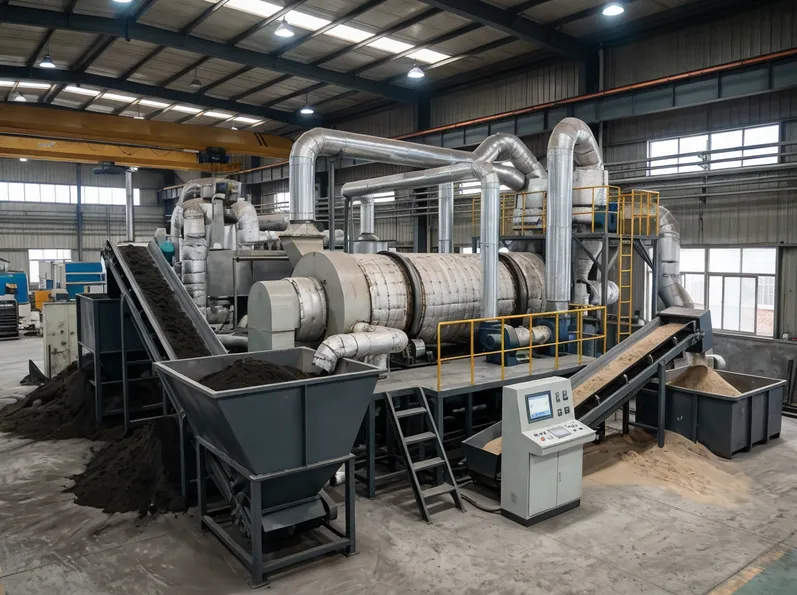
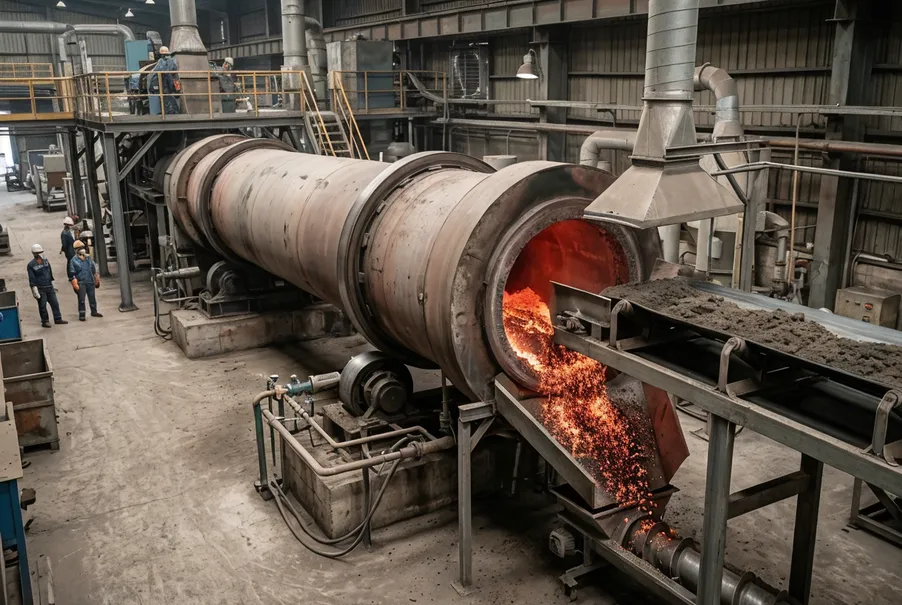
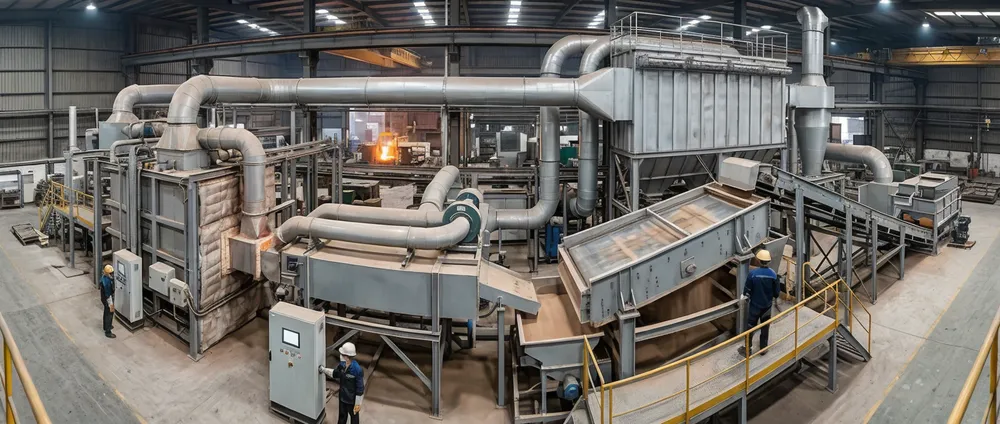
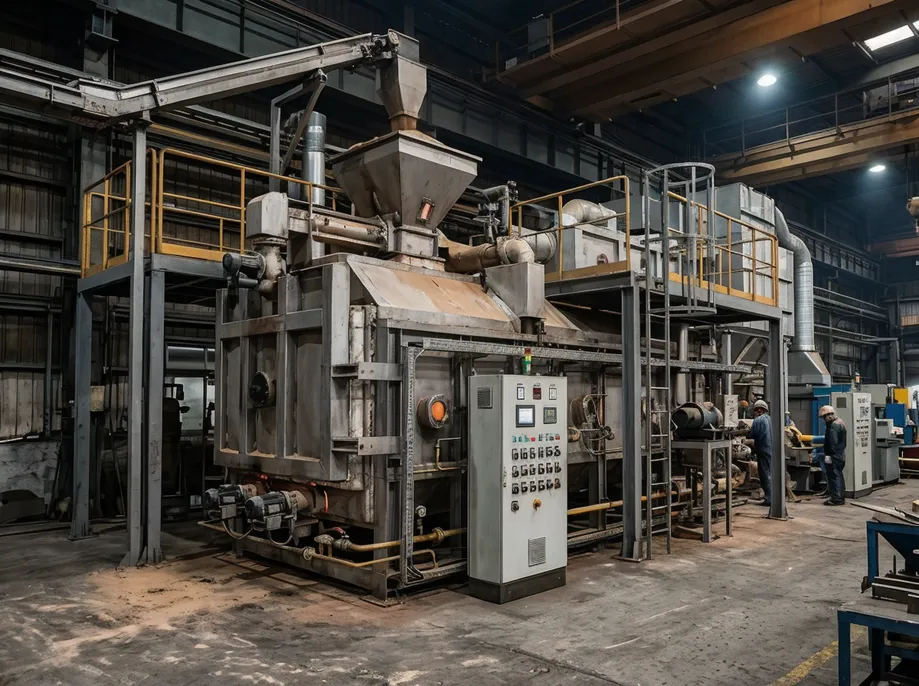
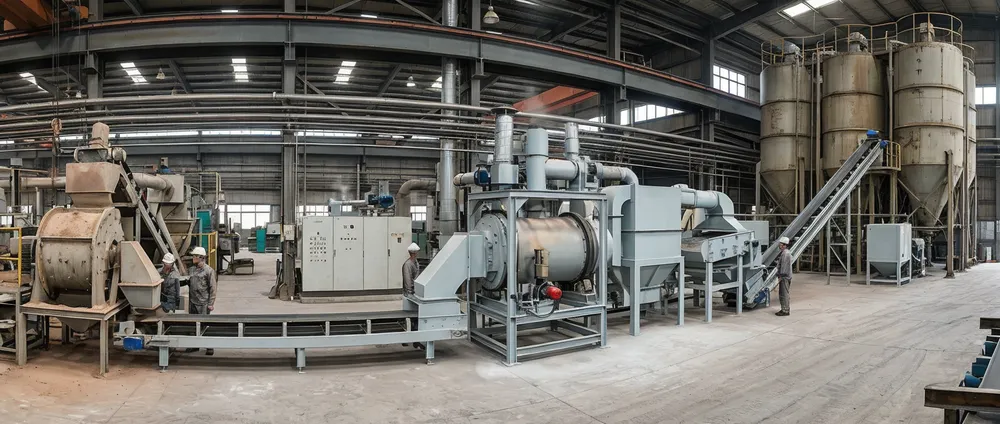
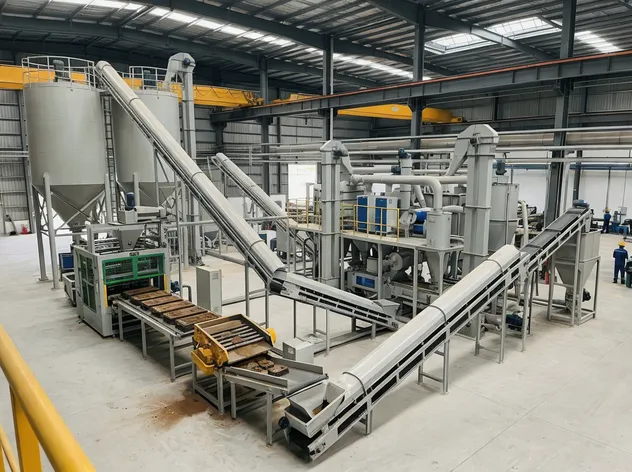
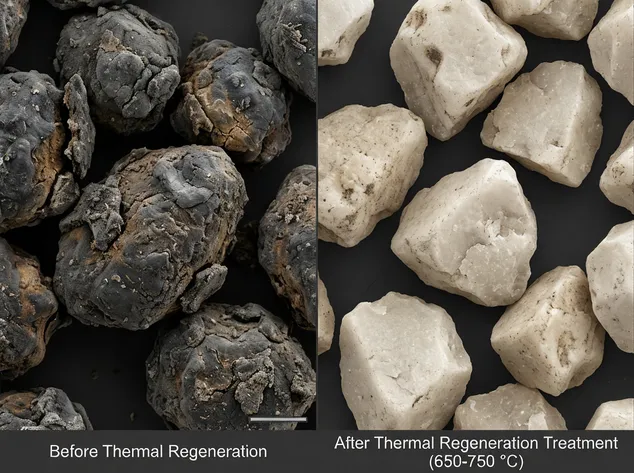
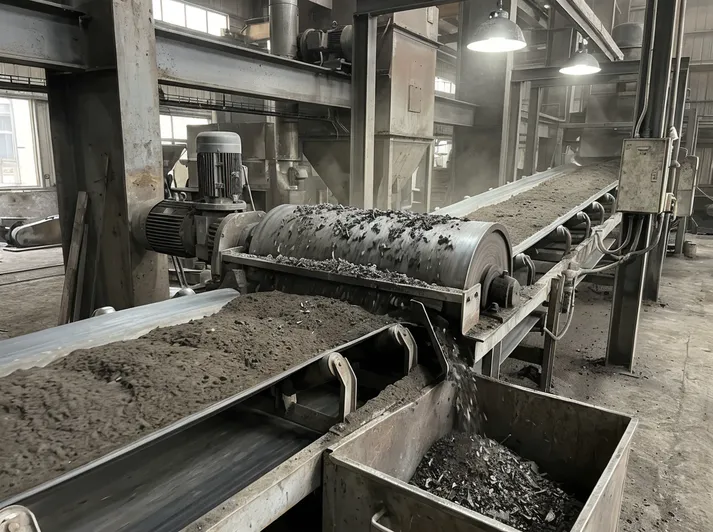
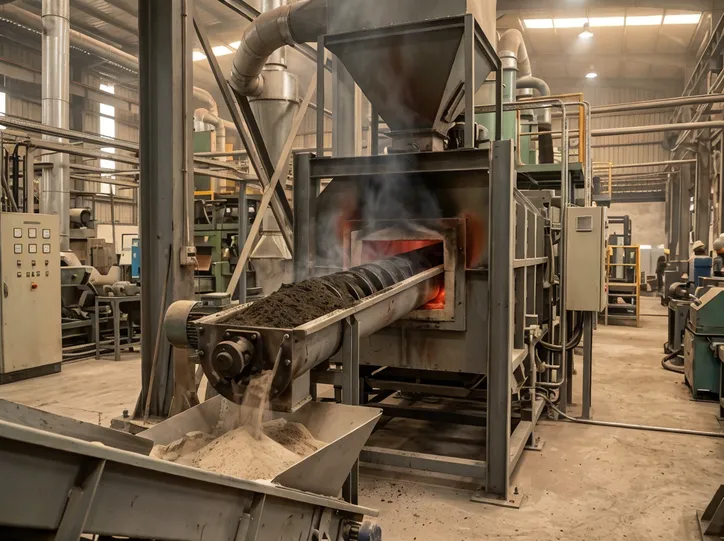
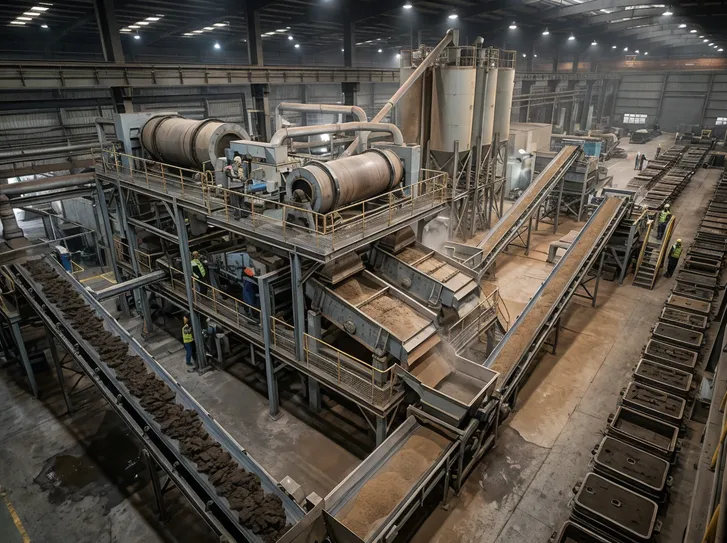
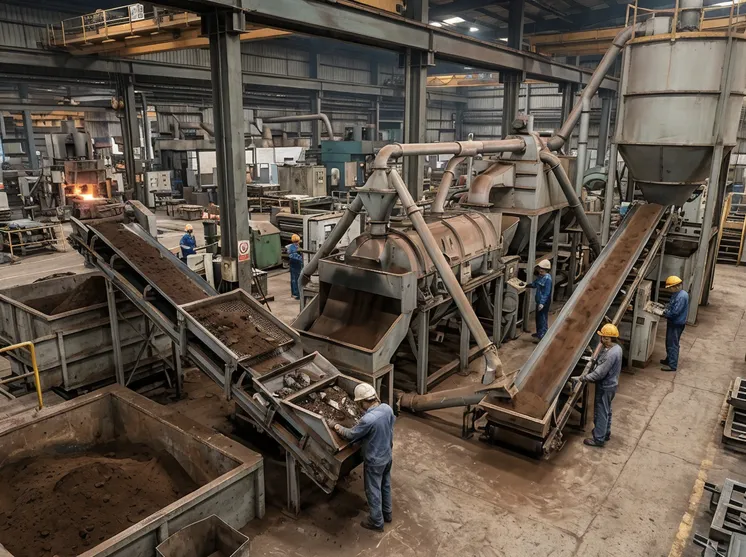
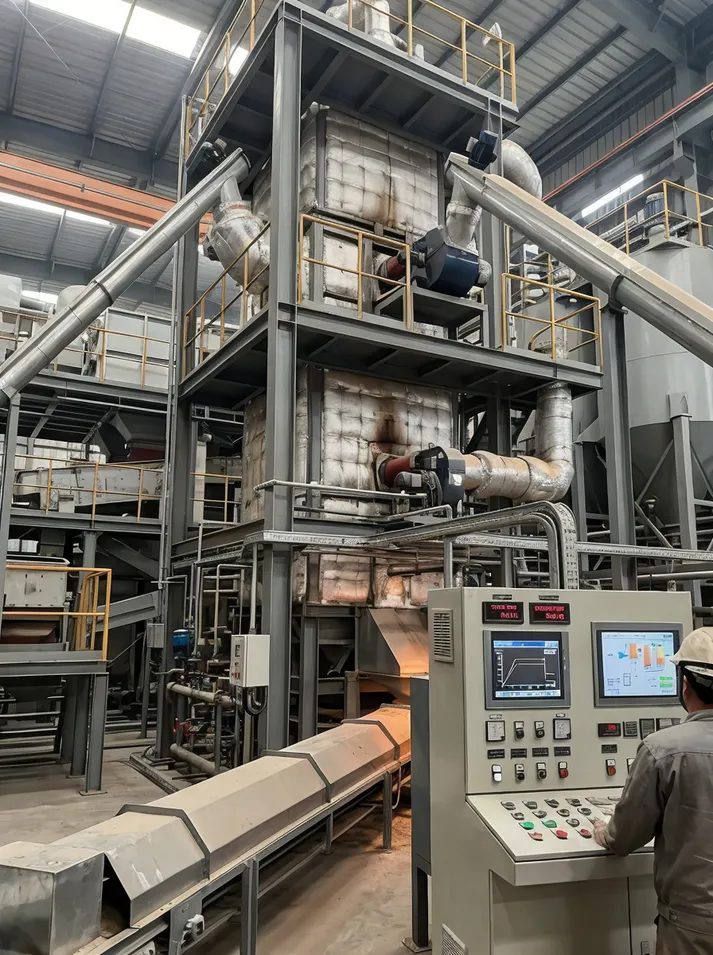
Unlike basic reclamation (80-85% reuse), regeneration thermally strips bonded contaminants and reactivates sand grains. Achieves 92-95% reuse rates.
Cuts fresh sand purchasing 40-60%, pays back in 2-4 years for mid-volume foundries. Capacity range: 5-50 t/h.
A clay sand regeneration line isn't the same as reclamation, though buyers often confuse the two. Reclamation uses mechanical cleaning — attrition mills and washing systems that remove loose clay fines and surface contaminants. Regeneration adds thermal treatment to that process, heating sand to 650-850°C to burn off bonded impurities (burnt clay, degraded binders, organic residues) and thermally reactivate the sand grain surface.
The result: 92-95% of your used sand returns to near-virgin condition, versus 80-85% with reclamation alone.
That 10-15 percentage point difference translates directly to your raw material costs. A foundry processing 50 tons of sand daily at 80% reclamation buys 10 tons of fresh sand weekly. At 92% regeneration, that drops to 4 tons weekly — a 60% reduction in sand purchasing and an equivalent cut in waste disposal volume. For foundries spending $100k+ annually on fresh sand, regeneration systems typically pay back in 2-4 years.
| Metric | Reclamation | Regeneration |
|---|---|---|
| Sand Reuse Rate | 80-85% | 92-95% |
| Treatment Method | Mechanical only | Thermal + Mechanical |
| Fresh Sand Reduction | ~20% | 40-60% |
| Clay Content (Output) | 1-3% | <0.5% |
| LOI (Output) | 3-5% | <2% |
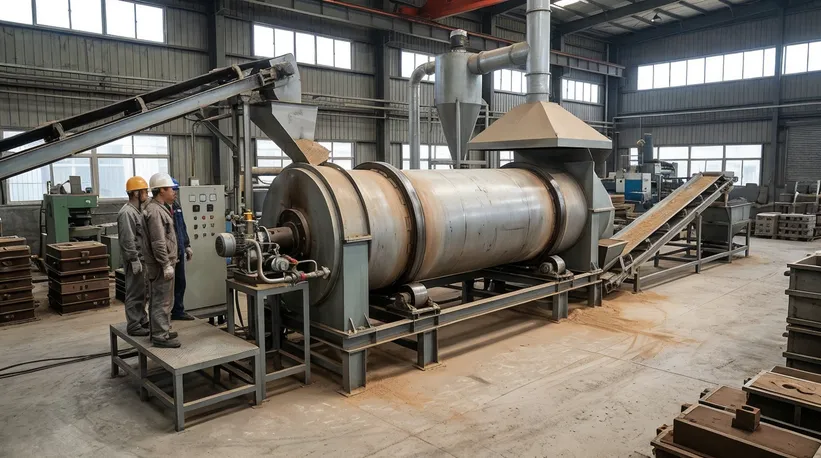
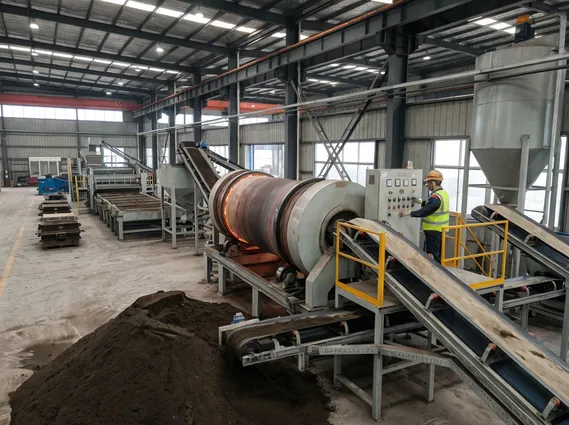
The thermal process exposes sand grains to controlled heat in a rotary kiln or fluidized bed furnace. Contaminants are removed in staged temperature zones:
400-600°C — Organic Combustion
Organic contaminants combust and volatilize
650-750°C — Clay Decomposition
Burnt clay decomposes and releases from grain surfaces
750-850°C — Binder Volatilization
Residual binders volatilize, fully restoring grain surface chemistry
After thermal treatment, the sand passes through cooling screws (temperature drops from 800°C to 50-80°C), then vibrating screens remove sintered lumps or oversize particles. Output: clay content under 0.5%, loss on ignition (LOI) under 2%, and AFS grain fineness within ±5 of virgin sand.
We position regeneration as a cost-reduction investment, not just equipment. Most buyers already run clay sand molding and reclamation lines — they're evaluating regeneration as a retrofit to improve sand economics. The system sits downstream of your existing mechanical reclamation, upstream of sand storage silos.
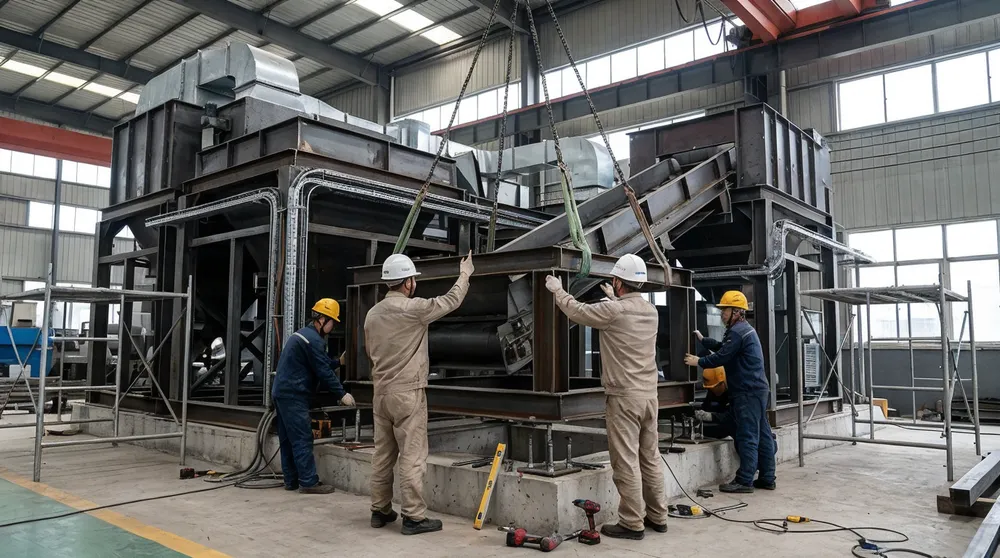
Installation takes 5-7 days for assembly plus 3-5 days for thermal commissioning (our technicians handle furnace calibration and airflow balancing). Downtime during retrofit is typically one production weekend if you schedule it right.
View our complete clay sand processing line systemsAssembly on-site
Thermal commissioning
Typical production downtime
Fresh sand purchasing and waste disposal are ongoing costs that regeneration directly reduces. Here's the calculation framework: take your current weekly fresh sand volume, multiply by 52 weeks and your delivered sand cost per ton, then compare that to the regeneration system cost.
350 tons weekly sand circulation
Same 350 tons weekly circulation
Annual Savings
System Cost (15-20 t/h)
Payback Period
Delivered Fresh Sand Cost
Ranges $150-300/ton depending on region and sand type. Higher cost = faster payback.
Waste Disposal Cost
Ranges $100-250/ton depending on local regulations. Stricter environmental zones push this higher.
Current Reclamation Efficiency
If you're already at 85%, the incremental gain from regeneration is smaller than moving from 80%.
Production Volume
Regeneration economics improve at higher throughput — the system's fixed cost spreads across more tons.
Thermal treatment consumes 25-35 kWh per ton of processed sand (versus 18-22 kWh for mechanical reclamation alone). At $0.12/kWh industrial rate:
Per ton electricity cost
Monthly energy (50 t/day)
On a 50-ton-per-day operation, that's $150-210 daily or $4,500-6,300 monthly — still far below the $9,100/month saved on fresh sand purchases in the example above.
Regeneration makes economic sense when your annual fresh sand cost exceeds $80,000-100,000. Below that volume, the system cost takes too long to recover.
Above that threshold, payback accelerates — a foundry spending $200k annually on fresh sand sees payback in under 12 months.
The calculations above assume silica sand at typical market pricing. Specialty sands — chromite, zircon, olivine — cost 3-10× more per ton, which dramatically improves regeneration ROI. If you're using chromite at $800/ton, regeneration pays back in under a year even at moderate volumes.
Share your sand volumes and current costs — we'll build a custom ROI projection.
Clay sand regeneration line specifications vary by capacity tier, but the core performance metrics remain consistent: thermal treatment temperature, sand quality output, and energy consumption per ton processed.
| Parameter | Small Capacity 5–15 t/h | Mid Capacity 15–30 t/h | High Capacity 30–50 t/h |
|---|---|---|---|
| Processing capacity | 5–15 tons/hour | 15–30 tons/hour | 30–50 tons/hour |
| Thermal treatment temp | 650–850°C (adjustable) | 650–850°C (adjustable) | 650–850°C (adjustable) |
| Residence time in furnace | 15–25 minutes | 12–20 minutes | 10–18 minutes |
| Sand reuse rate achieved | 90–93% | 92–95% | 92–95% |
| Power consumption | 80–100 kW | 120–150 kW | 180–220 kW |
| Energy per ton processed | 30–35 kWh/ton | 25–30 kWh/ton | 22–28 kWh/ton |
| Footprint (L × W × H) | 18m × 8m × 6m | 25m × 10m × 8m | 35m × 12m × 10m |
| Output sand LOI | <2.0% | <1.5% | <1.5% |
| Output residual clay | <0.5% | <0.3% | <0.3% |
| AFS grain fineness retention | ±5 of virgin sand | ±3 of virgin sand | ±3 of virgin sand |
5–15 t/h
15–30 t/h
30–50 t/h
Specifications shown are industry-standard ranges for clay sand regeneration systems. Actual specifications depend on your sand type (silica/chromite/zircon), contamination level, and casting alloy. Contact us for exact specs based on your production requirements.
Thermal treatment temperature adjusts based on contamination profile. The alloy you cast determines the deposit chemistry and the temperature your regeneration system needs.
Lower carbon content — typically need 650–750°C. Standard thermal regeneration profile.
Generate heavier burnt clay deposits — require 750–850°C. Higher thermal load on the furnace module.
Produce less thermal degradation but more metal splash contamination — these benefit from magnetic separation pre-treatment before thermal regeneration.
Energy consumption per ton decreases at higher capacities because continuous operation is more efficient than batch processing. A small system running intermittently (matching a 1-shift molding operation) consumes 30–35 kWh/ton. A high-capacity system running 24/7 drops to 22–28 kWh/ton because the furnace maintains stable temperature without repeated heating cycles.
Small System
18m × 8m × 6m
Mid System
25m × 10m × 8m
High System
35m × 12m × 10m
Footprint dimensions include the complete system: thermal furnace module, sand cooling section, vibrating screen, dust collection, and control cabinet.
Foundation requirements: reinforced concrete pad rated for thermal equipment (furnace generates localized heat load of 150–200 kW).
Ceiling height matters — exhaust stack extends 2–3 meters above the furnace roof, so plan for 8–10 meter clearance in your facility.
Send us your current sand circulation rate and casting alloy — we'll recommend the right capacity and thermal treatment configuration.
Clay sand regeneration lines scale across three capacity ranges, and the configuration differences go beyond throughput — they involve different furnace technologies and control systems that affect both capital cost and operational flexibility.
Batch-Style Rotary Kiln
This configuration uses a rotating drum furnace that processes sand in semi-continuous batches. Sand enters one end, tumbles through the heated drum over 15–25 minutes, and exits the other end. The rotary motion ensures even heat exposure, but throughput is limited by drum volume and rotation speed.
Works for foundries running 1–2 shifts with sand circulation under 100 tons daily. Typical buyer profile: job shops casting gray iron or ductile iron parts with frequent product changeovers. The rotary kiln handles variable feed rates well — you can dial production up or down by adjusting drum rotation speed and burner intensity.
Continuous Fluidized Bed Furnace
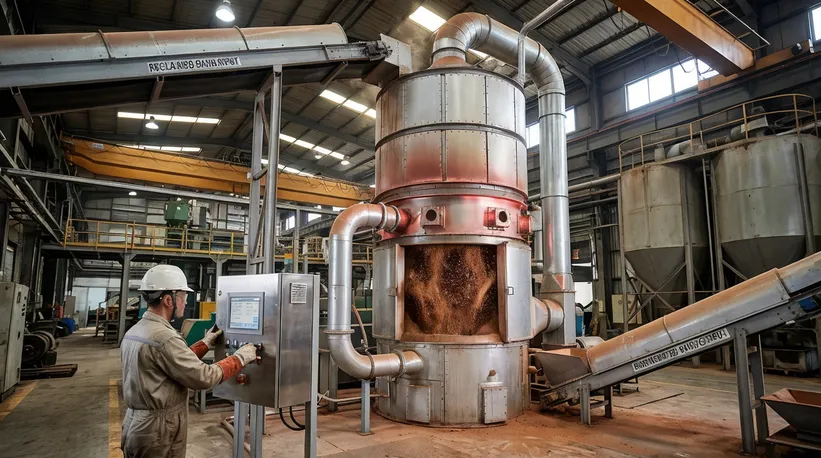
This configuration uses a fluidized bed where sand particles suspend in an upward airflow while heated. The fluidization creates turbulent mixing that exposes every grain to consistent temperature, and sand flows continuously through the bed rather than in batches. Residence time drops to 12–20 minutes because heat transfer is more efficient than rotary drum contact.
Suits foundries running 2–3 shifts with 150–250 tons daily sand circulation. Typical buyer profile: production foundries casting steel or high-volume ductile iron with moderate product variety. The continuous feed matches well with automated molding lines — sand flows from reclamation through regeneration to storage silos without manual handling.
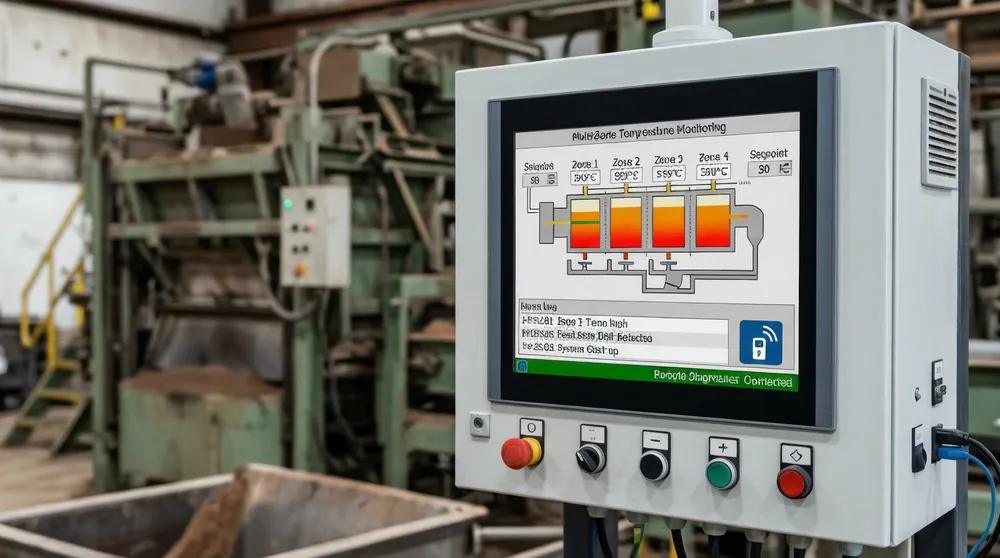
Fluidized bed systems include PLC control as standard — automated temperature monitoring, airflow adjustment, and feed rate regulation. The PLC logs process data (temperature curves, throughput rates, energy consumption) for ISO 9001 traceability.
Power consumption is 120–150 kW, but energy per ton processed drops to 25–30 kWh because continuous operation eliminates batch heating cycles.
Capital cost: $200,000–$280,000. Operating cost: $2.80–$3.50 per ton — better energy efficiency plus longer refractory life in fluidized beds compared to rotary kilns. At 200 tons daily throughput, that translates to $560–$700 daily or $16,800–$21,000 monthly in operating expenditure. The higher capital cost recovers through lower operating cost and higher sand reuse rates — 92–95% vs. 90–93% for rotary kilns.
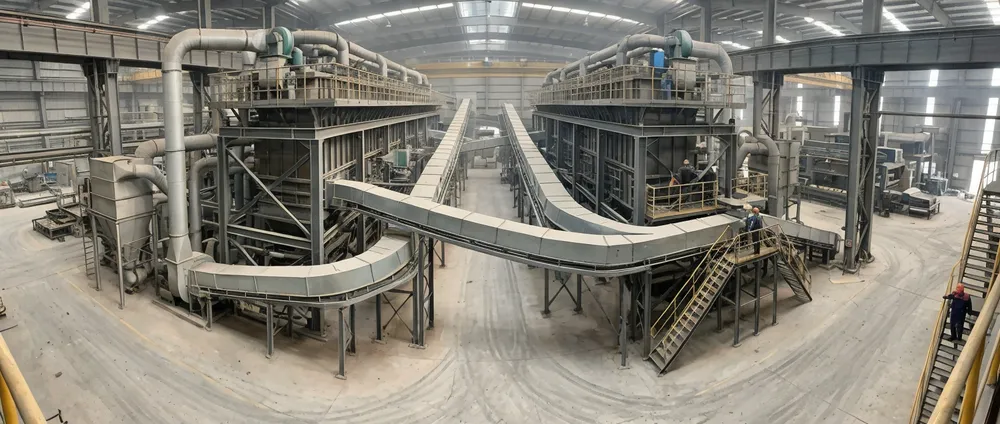
At this scale, you're either running two mid-capacity fluidized beds in parallel or a single large-chamber system with multiple burner zones. Each configuration carries distinct operational trade-offs that affect uptime, maintenance scheduling, and floor-space planning.
Power Consumption
180–220 kW
Energy Per Ton
22–28 kWh
24/7 continuous operation maximizes thermal efficiency
Predictive Maintenance
Refractory temperature monitoring, burner flame detection, airflow pressure tracking — flags issues 24–48 hours before failure
Remote diagnostics via VPN — TZFoundry technicians can monitor your system and troubleshoot without site visits, reducing downtime for diagnostic delays.
This configuration is built for foundries running 24/7 with 400+ tons daily sand circulation. Typical buyer profile: large production foundries casting steel, high-volume automotive components, or continuous-run gray iron operations.
Full Automation Integration
Enclosed conveyors from molding through reclamation, regeneration, and back to molding — zero manual intervention
Footprint Requirement
35m × 12m — overhead crane access required for refractory maintenance
Capital Cost
$350,000–$500,000
Operating Cost
$2.20–$3.00 /ton
Daily at 400 Tons
$880–$1,200
$26,400–$36,000 monthly
The payback math: At this volume, you're saving $15,000–$25,000 monthly on fresh sand purchases alone. Payback period is 18–24 months even at the high end of the capital cost range.
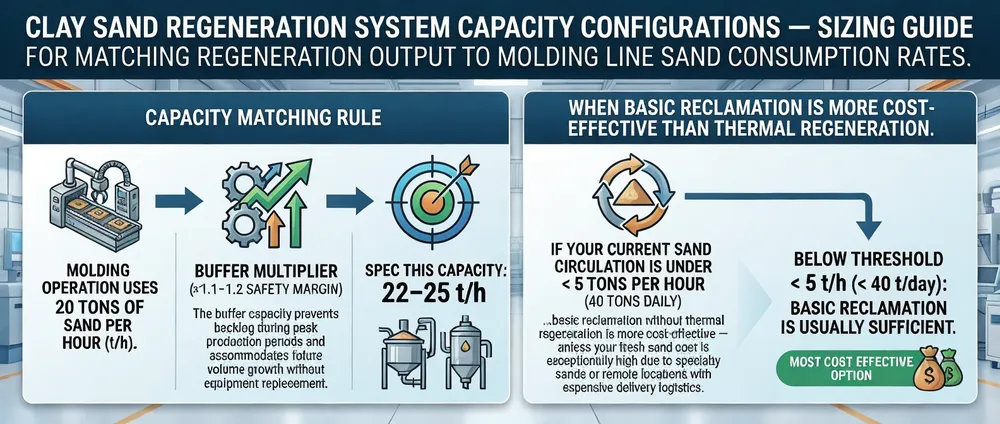
Size your regeneration system to 110–120% of your molding line's sand consumption rate. If your molding operation uses 20 tons of sand per hour, spec a 22–25 t/h regeneration system.
The buffer capacity prevents backlog during peak production periods and accommodates future volume growth without equipment replacement.
Molding Line Rate
20 t/h
Your sand consumption
Buffer Multiplier
×1.1–1.2
Safety margin
Target System Size
22–25 t/h
Spec this capacity
If your current sand circulation is under 5 tons per hour (40 tons daily), basic reclamation without thermal regeneration is more cost-effective — unless your fresh sand cost is exceptionally high due to specialty sands or remote locations with expensive delivery logistics.
Below Threshold
< 5 t/h (< 40 t/day)
Basic reclamation is usually sufficient. Lower capital cost, simpler maintenance.
Exception Cases
High Fresh Sand Cost
Specialty sands or remote-location delivery may justify thermal regeneration even at lower volumes.
Not sure whether regeneration makes sense at your scale? We'll evaluate your specific volume and cost profile.
Most buyers evaluating clay sand regeneration lines already run molding and reclamation equipment — they're adding regeneration to improve sand economics, not building a complete system from scratch. The retrofit scenario is more common than greenfield, so we'll address that first.
The regeneration system sits downstream of your current mechanical reclamation (attrition mill and washing system), upstream of your sand storage silos.
Sand Flow — Retrofit Process Path
Molding
Mechanical Reclamation
Removes loose fines & surface contaminants
Regeneration
Thermal treatment for bonded impurities
Cooling
Screening
Storage Silos
Back to molding
You need a sand feed conveyor from your reclamation discharge to the regeneration system inlet — typically 15–25 meters depending on your layout — and a return conveyor from regeneration discharge to your sand silos.
Plan for 18–35 meters of linear floor space (depending on capacity tier) adjacent to your existing reclamation area. The system doesn't need to sit directly next to reclamation — sand can convey 50+ meters if your floor layout requires separation.
Vertical clearance is the bigger constraint: you need 8–10 meters for the furnace and exhaust stack. If your facility has low ceilings, we can route the exhaust horizontally to an exterior wall, but that adds ductwork cost and reduces thermal efficiency slightly.
Electrical Service
Deliver the regeneration system's rated power (80–220 kW depending on capacity) plus 20% overhead for startup surge. Most buyers install a dedicated transformer and circuit breaker rather than tapping existing foundry power — it simplifies troubleshooting and prevents voltage sags.
Exhaust Ventilation
Requires 3,000–5,000 m³/h of airflow to handle combustion gases and dust from the thermal process. If your facility already has foundry exhaust systems, we can tie into that ductwork; otherwise, plan for a standalone exhaust fan and stack.
Option A — Planned Shutdown
Schedule the retrofit during a planned maintenance shutdown or low-volume period.
Option B — Staged Installation
Can't afford continuous downtime? We stage the installation to minimize production impact.
If you're building a clay sand system from scratch, regeneration integrates as a single continuous loop: molding → sand reclamation → regeneration → storage → molding. The advantage of greenfield design is optimized material flow — we position equipment to minimize conveyor distances and elevation changes, which cuts energy consumption and reduces maintenance on material handling components.
In greenfield layouts, we typically combine mechanical reclamation and regeneration into a shared control system (single PLC managing both processes). This enables closed-loop sand quality control — the PLC monitors sand chemistry at multiple points (post-reclamation, post-regeneration, pre-molding) and adjusts reclamation intensity and regeneration temperature to maintain target parameters. That level of integration isn't practical in retrofit scenarios where you're connecting to existing equipment with different control systems.
Greenfield layout: single continuous loop minimizes material handling distances.
One unified dust collection system serves both reclamation and regeneration — versus separate systems required in retrofit installations.
Capture waste heat from regeneration to preheat reclamation wash water, reducing overall thermal energy requirements.
Storage silos sized for the complete system's buffer requirements, eliminating redundant capacity found in piecemeal installations.
Clay sand regeneration systems work with most molding line types — horizontal or vertical molding machines, flask or flaskless systems, manual or automated pattern changes. The regeneration process is agnostic to mold geometry — it only cares about sand chemistry and contamination level.
If you're running multiple sand types (clay sand for some products, resin sand for others), regeneration handles clay sand only. Resin sand requires different thermal treatment parameters and typically uses separate regeneration equipment.
| Molding Line Type | Compatible | Notes |
|---|---|---|
| Horizontal molding machines | Standard integration, most common configuration | |
| Vertical molding machines | Standard integration | |
| Flask systems | Compatible regardless of flask size | |
| Flaskless systems | Compatible with automated and manual variants | |
| Manual pattern changes | Regeneration is agnostic to pattern change method | |
| Automated pattern changes | Regeneration is agnostic to pattern change method | |
| Resin sand lines | Requires separate regeneration equipment with different thermal treatment parameters |
See the Full Integration Picture
View our complete clay sand processing line systems to see how molding, reclamation, and regeneration integrate in a full production line.
Used foundry sand accumulates three main contamination types, and thermal regeneration addresses each through different mechanisms. Understanding what your specific casting process generates helps you specify the right regeneration temperature and pre-treatment modules.
When molten metal contacts the mold, localized temperatures spike to 1,200–1,500 °C. The bentonite clay binder in the sand layer closest to the casting surface degrades into a glassy, non-reactive form that no longer functions as a binder. This burnt clay coats sand grains and reduces their ability to bond with fresh clay in subsequent molding cycles.
Mechanical reclamation (attrition and washing) removes loose burnt clay particles but cannot strip the bonded layer.
Thermal regeneration burns off bonded burnt clay at 650–750 °C. At this temperature, the degraded clay decomposes and volatilizes, leaving clean sand grain surfaces.
High-carbon steel castings generate heavier burnt clay deposits than gray iron or ductile iron because the higher pouring temperature (1,500–1,600 °C vs. 1,350–1,450 °C) creates a deeper heat-affected zone in the mold. If you're casting high-carbon steel, specify 750–850 °C regeneration temperature to ensure complete burnt clay removal.
Burnt clay coating on sand grains — thermal regeneration at 650–750 °C strips the bonded layer that mechanical methods cannot remove.
Gray / Ductile Iron
1,350–1,450 °C
Pouring temp — moderate burnt clay
650–750 °C regen
High-Carbon Steel
1,500–1,600 °C
Pouring temp — heavy burnt clay
750–850 °C regen
Mechanism
Decomposition & Volatilization
Degraded clay breaks down at treatment temp, leaving clean grain surfaces
Metal contamination removal — magnetic separation for ferrous alloys, thermal oxidation for non-ferrous particles.
During pouring, metal can splash onto mold surfaces or penetrate into sand voids, especially in turbulent pour areas (gates, runners, risers). After shakeout, this metal remains embedded in the sand as fine particles or thin films coating sand grains.
Ferrous metal (iron, steel) is magnetic and can be removed with magnetic separators. Non-ferrous metal (aluminum, bronze, brass) isn't magnetic and requires thermal treatment to oxidize and volatilize.
Add a magnetic separator upstream of the regeneration furnace. The separator pulls out 80–90% of metal contamination before thermal treatment, which:
Thermal regeneration at 750–850 °C oxidizes aluminum and bronze particles into oxides that either volatilize or become friable enough to remove in post-regeneration screening. Aluminum oxidizes at 660 °C (its melting point), so 750 °C treatment is sufficient. Bronze requires 800–850 °C because copper oxidizes at higher temperature.
Aluminum Contamination
Melting / oxidation point: 660 °C
750 °C treatment sufficient
Bronze Contamination
Copper oxidizes at higher temperature
800–850 °C treatment required
Resin contamination from mixed sand systems: If your foundry runs both clay sand and resin sand lines, cross-contamination happens — resin-coated sand grains end up in the clay sand stream during shakeout or sand handling. Resin binders (furan, phenolic, alkaline phenolic) don't wash off in mechanical reclamation and will contaminate your clay sand batches if not removed.
Thermal regeneration combusts organic binders at 400–600 °C. The binders burn off as CO₂ and water vapor, leaving clean sand. This is the lowest temperature requirement among the three contamination types, so if resin contamination is your primary concern (and you have minimal burnt clay or metal splash), you can run regeneration at 600–700 °C and save energy compared to 800 °C+ operation.
Organic binders combust at the lowest thermal threshold — 400–600 °C — enabling energy-efficient regeneration for mixed-system foundries.
Each metric below ties directly to mold quality. Drifting outside these targets is the earliest warning that your regeneration parameters need adjustment.
Should stay within ±5 of virgin sand. If your virgin sand is AFS 55, regenerated sand should measure AFS 50–60. Larger deviation indicates excessive grain fracture during thermal treatment (temperature too high or residence time too long) or incomplete screening of sintered lumps.
LOI measures residual organic content and carbonaceous material. Target <2.0 % for standard applications, <1.5 % for precision casting. Higher LOI indicates incomplete combustion of binders or burnt clay — either raise temperature or extend residence time.
Target <0.5 % for regenerated sand before remixing with fresh clay. Residual clay above 0.5 % means burnt clay removal was incomplete — increase regeneration temperature by 50–100 °C or add a secondary washing stage post-regeneration.
Regenerated sand exits at 0.1–0.3 % moisture (nearly bone-dry after 800 °C treatment and cooling). You'll add moisture back during remixing with fresh clay to reach your target 3–5 % molding moisture.
We provide sand quality testing during commissioning — our technicians pull samples at virgin sand input, post-reclamation, post-regeneration, and final remixed sand, then run AFS grain fineness, LOI, clay content, and moisture tests to verify the system is hitting target parameters.
Clay sand regeneration isn't universally cost-effective — it depends on your production volume, fresh sand cost, and waste disposal expenses. Here's how to evaluate whether regeneration fits your operation, framed as production volume thresholds rather than industry categories.
Annual Savings Potential
$455K–$600K
per year after regeneration system payback
50+ tons sand/day • 24/7 operation
Regeneration is essential for cost control at this scale. You're circulating 350+ tons of sand weekly, and even at 85% reclamation efficiency, you're buying 50+ tons of fresh sand weekly.
Without Regeneration
With Regeneration (92–95% reuse)
System Investment
$350K–$500K
Payback Period
7–13 months
Post-Payback Savings
$500K+/year
After the first year, that $500K+ annual savings flows directly to your bottom line. At this volume, not having regeneration means you're leaving half a million dollars on the table every year.
Typical Operations in This Category
These operations run 24/7 with narrow product ranges (1–3 core mold designs) and can't afford the raw material cost of sub-90% sand reuse.
Regeneration pays back in 2–4 years, which is acceptable for most foundries' capital equipment ROI thresholds. At this volume you're circulating 140–350 tons weekly, buying 20–50 tons of fresh sand weekly at current 80–85% reclamation rates.
This is the volume range where regeneration shifts from "nice to have" to strong ROI. If you're at the lower end (20–30 tons/day), payback stretches toward 3–4 years, which may not meet your capital approval threshold. If you're at the upper end (40–50 tons/day), payback is under 2 years — a straightforward investment decision.
These operations have enough volume to justify regeneration but not so much volume that they can't occasionally absorb higher sand costs during equipment downtime.
Basic reclamation without regeneration is more cost-effective at this volume unless you face exceptional circumstances.
At under 20 tons/day, you're circulating under 140 tons weekly, buying under 20 tons of fresh sand weekly. Annual fresh sand cost: under $200,000. Annual waste disposal: under $150,000. Total: under $350,000.
Regeneration would cut this to $140,000–$175,000 annually — savings of $175,000–$210,000. But a small-capacity regeneration system costs $120,000–$160,000, giving you a 2.5–3.5 year payback. That's marginal ROI, and it doesn't account for the operational complexity of running thermal equipment (refractory maintenance, burner calibration, exhaust system upkeep) at low utilization rates.
If you're using high-value sand instead of standard silica ($200/ton), the sand cost multiplier changes the ROI calculation dramatically.
| Sand Type | Cost/Ton |
|---|---|
| Silica (baseline) | $200 |
| Olivine | $600 |
| Chromite | $800 |
| Zircon | $1,200 |
Example: At $800/ton chromite, your annual sand cost is $800,000 even at 20 tons/day volume. Regeneration saves $400,000+ annually, giving you a 6–9 month payback even on a small system.
If you're in a region where fresh sand delivery costs $400–$500/ton, regeneration pays back faster because you're saving on inflated delivered cost, not just commodity sand pricing.
Delivered cost at $400–500/ton more than doubles the savings compared to regions with $200/ton commodity pricing — accelerating payback below 18 months even at low volumes.
Three conditions can justify regeneration even below the 15 t/h threshold:
Chromite, zircon, or olivine base sands costing $800–1,200/ton. The reclaimed sand value per ton makes thermal regeneration profitable even at 5–8 t/h throughput.
Operations where fresh sand delivery adds $150–300/ton in freight costs. Regeneration becomes competitive on logistics savings alone, independent of base sand price.
Jurisdictions classifying used foundry sand as hazardous waste, with disposal costs reaching $300–500/ton. At 2–3× typical disposal rates, regeneration's waste reduction benefit outweighs low volume.
If none of these exceptions apply, stick with mechanical reclamation and accept the 80–85% reuse rate. You can always add regeneration later if your volume grows — the retrofit integration path exists, and you won't have wasted capital on underutilized thermal equipment in the meantime.
Send us your current sand purchasing volume (tons/month), delivered sand cost ($/ton), waste disposal cost ($/ton), and production schedule (shifts/day). We'll run the ROI calculation for your specific situation and recommend whether regeneration makes sense now — or if you should wait until volume increases.
Clay sand regeneration systems aren't one-size-fits-all — the thermal treatment intensity, pre-treatment modules, and cooling method adjust based on your sand type, casting alloy, and facility conditions. Here's what you can configure and what the limitations are.
Temperature Range & Residence Time
Standard regeneration runs 650–850 °C with 12–25 minutes residence time in the furnace. The right set-point depends on what you're casting:
Moderate Contamination
Heavy Burnt-Clay Deposits
The Trade-Off
Higher temperature and longer residence time improve sand quality (lower LOI, lower residual clay content) but increase energy consumption and refractory wear.
Energy Impact
Every 100 °C increase in operating temperature adds roughly 3–5 kWh per ton processed.
Refractory Wear
Every 100 °C increase reduces refractory lining life by 15–20 %.
If your casting quality tolerates slightly higher residual clay content (0.5 % vs. 0.3 %), running at the lower end of the temperature range saves operational cost.
Factory Configuration vs. Field Adjustment
We configure the burner system and furnace insulation during manufacturing based on your specified temperature range. After installation, you can adjust temperature ±50 °C via the control system, but larger changes require burner recalibration or refractory modification — not a field adjustment.
Magnetic Separation & Screening
Upstream of furnace — ferrous alloy casting
If you're casting ferrous alloys (iron, steel), add a magnetic separator upstream of the furnace to remove metal contamination before thermal treatment. The separator uses permanent magnets or electromagnets to pull ferrous particles from the sand stream as it conveys into the regeneration system. Removes 80–90 % of metal splash, which reduces furnace wear and cuts energy consumption — you're not heating metal that doesn't need treatment.
Permanent Magnets
Cheaper upfront but lose strength over time
Electromagnets
Cost more but maintain consistent pull force
Upstream of furnace — oversize lump removal
If your sand contains oversize lumps (sintered clay, agglomerated sand from previous thermal exposure, foreign debris), add a scalping screen upstream of the furnace. The screen removes +20 mesh particles before they enter thermal treatment, which prevents furnace blockages and reduces wear on the fluidized bed distributor plate or rotary kiln flights.
Removes Before Furnace Entry
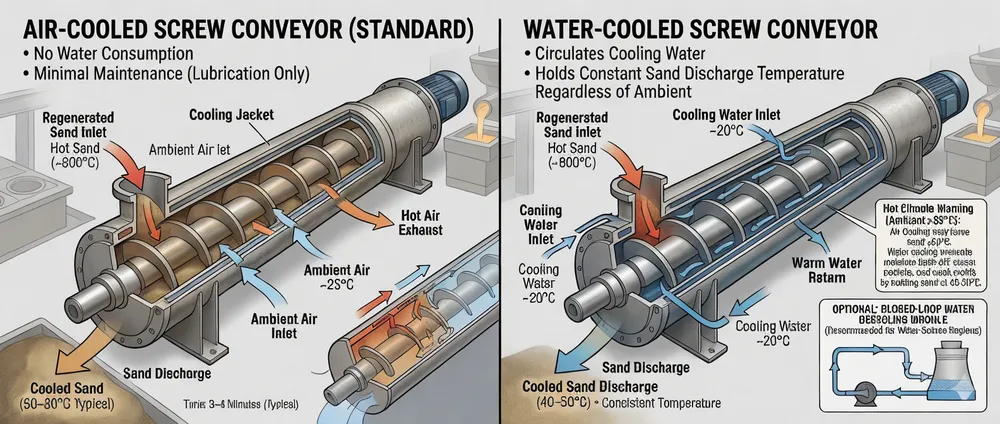
Standard regeneration systems use air-cooled screw conveyors to drop sand temperature from 800°C to 50–80°C over 3–4 minutes. The cooling screw is a jacketed auger with ambient air flowing through the jacket — no water consumption, minimal maintenance (just motor and bearing lubrication).
Hot Climate Warning (35°C+ Ambient)
If you're in a hot climate (35°C+ ambient temperature), air cooling may not drop sand temperature low enough before it reaches your storage silos. Hot sand (above 60°C) causes moisture flash-off when you remix it with fresh clay, which creates steam pockets and weakens mold strength. In hot climates, specify water-cooled screw conveyors — they circulate cooling water through the jacket to hold sand discharge temperature at 40–50°C regardless of ambient conditions.
Best for: Temperate climates, facilities with controlled ambient temperature
Best for: Hot climates (35°C+), foundries requiring consistent mold quality year-round
If you're on municipal water, the 10–15 liters/min consumption is negligible cost. If you're in a water-scarce region, the closed-loop water recycling option captures 85–90% of cooling water, filters it, and recirculates — cutting makeup water to just 1–2 liters per minute (only replacing evaporation losses).
Your control system choice directly affects operator skill requirements, energy efficiency, and traceability compliance. Here's how the two options compare across the capacity range.
| Parameter | Manual Controls | PLC-Automated |
|---|---|---|
| Typical capacity range | 5–15 t/h (small systems) | Mid and high capacity (standard) |
| Temperature regulation | Operator adjusts burner via dial; analog gauges | Automated — monitors 3–5 furnace zones, maintains setpoint ±10°C |
| Feed rate control | Variable-speed drive, manually set | Auto-adjusts based on throughput demand |
| Drift response | Requires skilled operator intervention | Auto-corrects within ±30°C; alarms beyond ±30°C (indicates burner malfunction or refractory failure) |
| Data logging | None — manual records only | Full alarm logging + process data for ISO 9001 traceability |
| Remote diagnostics | Not available | Included — remote access for troubleshooting |
| Operator requirement | Skilled operators who understand thermal process behavior | Operators monitor exceptions rather than actively controlling the process |
| System cost impact | Base cost: $120,000–140,000 range | Adds $15,000–25,000 to base cost |
PLC systems add $15,000–25,000 to base cost but reduce operator skill requirements (monitoring exceptions rather than actively controlling the process) and improve energy efficiency. Tighter temperature control means less overshoot, which means lower fuel consumption. For operations running two or more shifts, the fuel savings and reduced labor skill premium typically recover the PLC investment within 12–18 months.
Below 5 t/h, batch processing in a small rotary kiln becomes inefficient — you spend more time heating and cooling the furnace than actually processing sand.
If your volume is under 5 t/h (~40 tons daily): Mechanical reclamation without thermal regeneration is more cost-effective. We can advise on the right approach — see our Clay Sand Reclamation Line.
Volumes exceeding 50 t/h require parallel units — for example, two 30 t/h systems rather than one 60 t/h system.
Parallel configuration trade-off: Costs 15–20% more than a single large unit, but provides operational redundancy — one system runs while the other undergoes maintenance, so you never lose regeneration capability completely.
Thermal regeneration equipment requires permanent foundation installation, utility connections (electrical, exhaust, cooling water), and refractory curing time of 3–5 days after installation before first firing.
Multi-facility operations: If you need regeneration at multiple locations, each facility requires its own dedicated system. We provide multi-site engineering coordination to standardize specifications across plants.
Send us your sand analysis report — we'll recommend the right thermal profile, capacity range, and configuration within 48 hours. If regeneration isn't the right fit, we'll tell you that too.
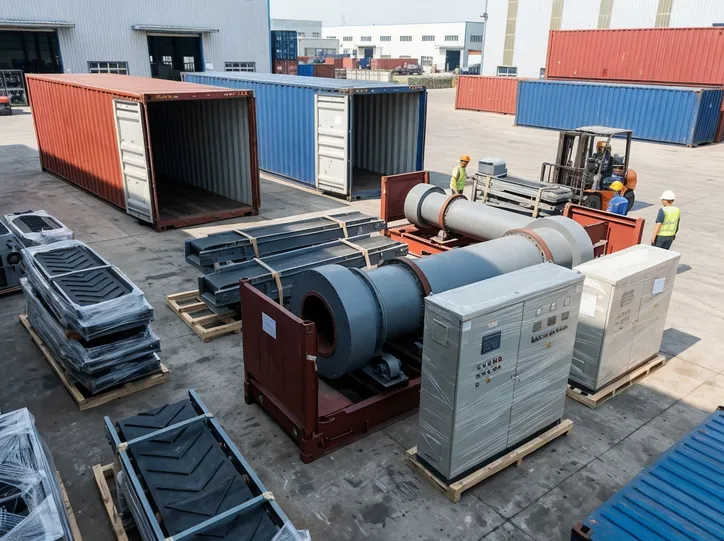
Clay sand regeneration systems are modular-shipped in standard containers, with every frame engineered to clear container door dimensions for worldwide delivery.
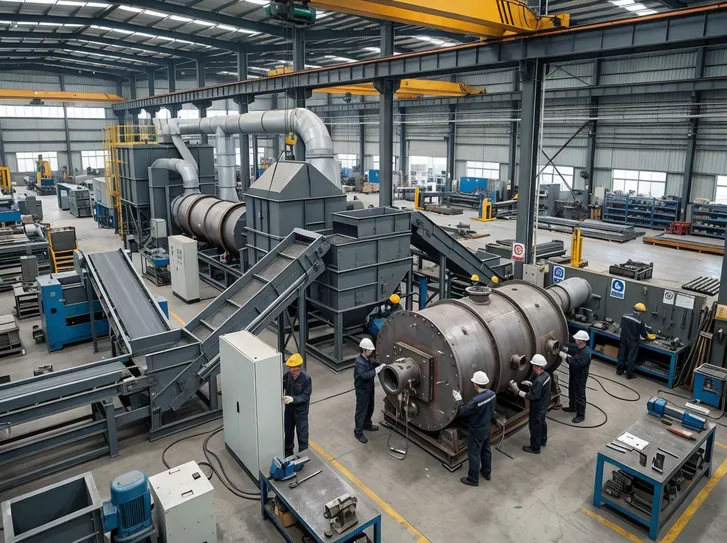
Clay sand regeneration systems ship in 2–4 standard containers depending on capacity tier. The thermal furnace module — rotary kiln or fluidized bed chamber — is the largest single component and determines container count:
2× 40-foot containers — furnace plus ancillary equipment fit within two standard units.
3× 40-foot containers — additional container for larger furnace sections and conveyors.
4× 40-foot containers plus additional shipment for the control cabinet and auxiliary equipment.
Equipment frames are designed to break down into modules that clear container door dimensions (2.3 m width × 2.4 m height for standard 40-foot containers), then bolt together on your factory floor. The furnace shell ships as 2–3 sections with flanged connections. Cooling screws, vibrating screens, and conveyors ship as complete assemblies. Refractory lining ships separately — pre-formed bricks or castable refractory, depending on furnace type — and gets installed during on-site assembly.
Regeneration systems need reinforced concrete pads rated for thermal equipment. The furnace generates a localized heat load of 150–200 kW, and even with insulation, the foundation sees elevated temperatures (40–60 °C at the mounting surface).
Standard foundry floor slabs (200 mm concrete with rebar) are usually sufficient, but you need to verify load rating — a mid-capacity system weighs 12–18 tons fully loaded, and dynamic loads during operation (vibrating screen, rotating furnace drum) can spike to 1.3× static weight.
150–200 kW localized heat generation; mounting surface temperature 40–60 °C even with insulation layer.
12–18 tons static (mid-capacity); dynamic loads during operation spike to 1.3× static weight from vibrating screen and rotating furnace drum.
200 mm reinforced concrete with rebar — standard foundry floor slabs are usually sufficient. Verify load rating for your specific facility.
We provide foundation drawings with anchor bolt locations, load distribution maps, and thermal insulation requirements as part of the pre-shipment documentation package. Your civil contractor can use these drawings to prepare the pad before equipment arrives.
If you're retrofitting into an existing facility with unknown foundation specs, we can send a technician to assess the site and recommend reinforcement if needed.
$2,000 – $3,000
Depending on location — includes assessment report and reinforcement recommendations
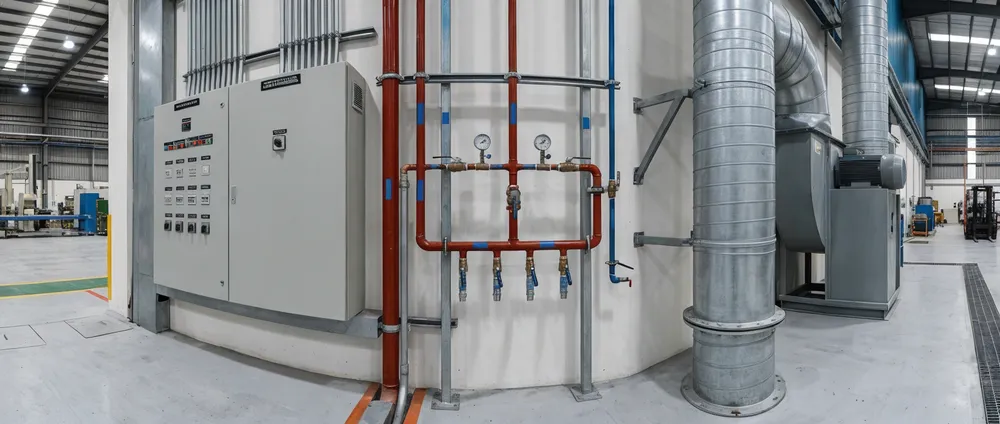
Before your regeneration line arrives, utility infrastructure needs to be in place. These are the three service connections your facility must provide — all are standard in foundry environments, but sizing matters.
Best practice: Most buyers install a dedicated transformer and circuit breaker for the regeneration system rather than tapping existing foundry power — simplifies troubleshooting and prevents voltage sags from affecting other equipment.
For pneumatic controls & actuators
If your facility lacks compressed air, a small rotary screw compressor ($3,000–5,000) handles the regeneration system's full air demand.
Important: Ductwork must be insulated steel or refractory-lined. Standard HVAC ductwork will fail at these exhaust temperatures. You may need to extend ductwork to reach an exterior wall or roof penetration depending on facility layout.
Typical utility connection layout for a 20 t/h clay sand regeneration installation showing dedicated transformer, air supply manifold, and insulated exhaust ductwork routing.
The full timeline from order shipment to first sand output breaks into three phases: ocean freight, on-site assembly, and commissioning. Here's what each phase looks like in practice.
Transit times to major global ports, plus 3–5 days for customs clearance and inland transport to your facility.
West Coast NA
15–18
days
East Coast NA
25–30
days
Europe
20–25
days
Middle East
12–18
days
SE Asia
8–12
days
5–7 days · Crew of 3–4 technicians (2 from TZFoundry + 1–2 local helpers)
Your local helpers handle rigging and material handling while our technicians manage the technical assembly sequence:
Position and level equipment modules on prepared foundations
Bolt frames together and install refractory lining
Connect conveyors and ductwork between modules
Wire electrical and control systems to facility power
Install instrumentation — thermocouples, pressure sensors, flow meters
3–5 days after assembly completion
Gradual heating to 400°C over 24 hours, then to 600°C over another 24 hours. This controlled ramp drives off moisture and prevents thermal shock cracking — skipping or rushing this step risks refractory failure and expensive rework.
Adjust fuel/air ratio for target temperature and flame characteristics. Ensures consistent thermal treatment across the full sand bed.
Sand is run through the system at increasing feed rates to verify throughput and temperature stability. At each stage, samples are pulled and tested for:
Total elapsed time from equipment arrival at your facility to first production-quality regenerated sand: 10–14 days. If you can't afford that much continuous downtime, we can stage the installation — assemble equipment adjacent to your production area over 2–3 weeks (no production impact), then do the final connection and commissioning over a single weekend (2–3 days downtime).
2–3 days during commissioning
Comprehensive technical documentation shipped with every system
120–180 pages covering system description, operating procedures, maintenance schedules, troubleshooting guides
Single-line diagrams, control panel layouts, motor connection details
Ladder logic printout or program file on USB drive
Inspection intervals, repair procedures, replacement part numbers
Complete catalog with supplier contacts for all wear and replacement components
All documents ship in English. Other languages available on request — $600–$1,000 depending on language and document length, adds 1–2 weeks to delivery timeline.
Standard Installation
10–14 days continuous, equipment arrival to first production-quality regenerated sand
Staged Installation
2–3 weeks assembly (no production impact) + 2–3 day weekend cutover for final connection and commissioning
We've been building clay sand processing equipment since 2010, and regeneration systems became part of our product line in 2018 when export buyers started asking for higher sand reuse rates than mechanical reclamation alone could deliver. The shift happened because environmental regulations in North America and Europe made waste sand disposal more expensive — foundries needed to cut disposal volume, and regeneration was the only technology that could push reuse rates above 90%.
Our thermal system integration experience covers gray iron, ductile iron, and steel casting foundries — we've built regeneration lines for operations processing 10–40 tons per hour with contamination profiles ranging from light (gray iron with minimal burnt clay) to heavy (high-carbon steel with severe thermal degradation).
What we learned from 6+ years of thermal regeneration deployments
Regeneration temperature and residence time need to match your specific casting alloy and pouring temperature, not just follow generic industry specs. A 750°C setting that works for ductile iron will underperform on high-carbon steel, and an 850°C setting that cleans steel sand will waste energy on gray iron. We configure each system to the alloy family and contamination severity of your actual production mix.
Our PLC systems log furnace temperature (5 zones), burner fuel consumption, exhaust gas temperature, and sand throughput rate every 30 seconds. When you report an issue — inconsistent sand quality, high energy consumption, temperature control problems — we can VPN into your PLC, review the last 48–72 hours of process data, and identify the root cause.
Often the problem is a gradual drift in burner air/fuel ratio or refractory degradation that's not obvious from the control panel display.
Troubleshooting Time Reduction
From days (waiting for a technician to fly to your facility) to hours (remote diagnosis + phone guidance for your maintenance team).
| Component | Service Life | Failure Mode |
|---|---|---|
| Refractory linings | 12–18 months | Thermal cycling → cracking & spalling |
| Burner nozzles | 6–12 months | Carbon buildup & thermal stress → orifice degradation |
| Cooling screw flights | 18–24 months | Abrasion from hot sand → auger edge wear |
We stock these components at our Qingdao facility and ship via DHL or FedEx for 5–7 day delivery to most export markets.
Critical Spares Recommendation
For longer-lead items (furnace shell sections, fluidized bed distributor plates, PLC controllers), we recommend keeping one spare on-site if your operation can't tolerate extended downtime. The cost is 8–12% of the original equipment price, but it eliminates the risk of a 3–4 week production shutdown waiting for a replacement part to clear customs and ship.
ISO 9001:2015 certified manufacturing means our production process gets audited annually by third-party inspectors who verify material sourcing, fabrication procedures, assembly quality, and testing protocols. For thermal equipment, this includes pressure testing of furnace shells, calibration of temperature sensors against NIST-traceable standards, and burner performance testing before shipment.
The certification documentation — material certs, test reports, calibration records — ships with every system and satisfies most buyers' supplier quality requirements.
Material Sourcing
Verified material certs for every refractory, steel, and alloy component
Furnace Shell Testing
Pressure-tested shells with documented results before shipment
Sensor Calibration
Temperature sensors calibrated against NIST-traceable standards
Burner Performance
Full burner performance verification completed pre-shipment
We build regeneration systems to order, not from stock, because thermal treatment configuration — temperature range, furnace type, refractory selection — varies by your casting alloy and contamination profile. Lead time runs 45–60 days from deposit to factory departure.
Deposit & Engineering
Custom thermal configuration begins — temperature range, furnace type, and refractory selected for your alloy and contamination profile.
Factory Build & Testing
45–60 day manufacturing cycle including ISO-documented pressure testing, calibration, and burner verification before shipment.
On-Site Commissioning
Two technicians on-site for 10–14 days. They stay until your first production shift runs at target sand quality: 92–95% reuse rate, LOI <2%, residual clay <0.5%.
Commissioning Performance Guarantee
Our technicians don't leave until your system hits target metrics — 92–95% sand reuse rate, LOI <2%, and residual clay <0.5% on your first production shift. Not a benchmark test — actual production output.
15,000 square meters production facility, 8 production lines, 15+ years experience in clay sand processing systems.
Answers to the engineering and financial questions that drive regeneration system decisions — with the numbers you need for internal justification.
Reclamation uses mechanical cleaning — attrition mills and washing systems that remove loose clay fines and surface contaminants from used sand. Achieves 80–85% sand reuse.
Regeneration adds thermal treatment (650–850 °C) to mechanical reclamation, burning off bonded impurities (burnt clay, degraded binders, organic residues) and thermally reactivating sand grain surfaces. Achieves 92–95% sand reuse.
Regeneration is the next level up from reclamation — you need both processes in sequence: mechanical first to remove loose material, thermal second to strip bonded contamination.
| Parameter | Reclamation | Regeneration |
|---|---|---|
| Method | Mechanical cleaning | Mechanical + thermal (650–850 °C) |
| Sand reuse rate | 80–85% | 92–95% |
| Removes | Loose clay fines, surface contaminants | Bonded impurities, burnt clay, degraded binders, organic residues |
| Process sequence | Standalone | Mechanical first → thermal second |
Depends on your current reclamation efficiency and production volume. Here's a typical scenario:
Plus equivalent savings on waste disposal costs
The full ROI calculation framework is in the "How Regeneration Cuts Your Sand Costs" section above.
Yes — retrofit integration is the most common scenario. The regeneration system sits downstream of your current mechanical reclamation, upstream of your sand storage silos.
18–35 m
Linear, capacity-dependent
8–10 m
Furnace + exhaust stack
80–220 kW
Service upgrade required
3,000–5,000 m³/hr
Dedicated exhaust line
We provide connection interfaces that match your existing conveyor system — belt, bucket elevator, or pneumatic.
See the "Integration with Existing Clay Sand Systems" section for detailed retrofit requirements.
Depends on your casting alloy and contamination profile. The required thermal treatment temperature and hold time vary by application:
Moderate contamination
650–750°C
Hold time: 15–20 minutes
Heavy burnt clay deposits
750–850°C
Hold time: 18–25 minutes
Metal splash contamination
750–850°C
With magnetic pre-treatment for ferrous splash
From mixed sand systems
600–700°C
Sufficient to combust organic binders
Configuration note: We configure the burner system and furnace insulation during manufacturing based on your specified temperature range. After installation, you can adjust ±50°C via controls, but larger changes require burner recalibration.
Regenerated sand can cycle through molding → reclamation → regeneration indefinitely as long as you maintain target quality parameters:
AFS Grain Fineness
±5
of virgin sand
Loss on Ignition (LOI)
<2%
maximum threshold
Residual Clay
<0.5%
maximum threshold
In practice, you lose 5–8% of sand per cycle to waste fines and disposal, so you're continuously adding fresh sand to replace losses. The sand that stays in circulation doesn't "wear out" from regeneration — thermal treatment restores grain surface chemistry to near-virgin condition.
What actually limits sand life: Mechanical attrition (grain fracture from repeated handling and compaction) — not thermal degradation. Typical sand replacement rate is 5–8% per cycle regardless of whether you're using reclamation alone or reclamation + regeneration.
Economic threshold is roughly 20–25 tons sand per day (140–175 tons weekly circulation). Below this, payback period stretches beyond 3–4 years, which is marginal ROI for most foundries. Above 50 tons daily, payback drops under 2 years, making regeneration a straightforward investment.
Exceptions That Shift the Economics Lower
See the Application Scenarios section above for detailed volume-based ROI analysis.
No minimum order quantity — TZFoundry builds single complete systems without requiring multi-unit orders.
45–60 days
Production
(from deposit to factory departure)
15–30 days
Ocean freight
(varies by destination port)
3–5 days
Customs clearance
& inland transport
10–14 days
Installation
& commissioning
Total elapsed time from order to equipment on-site: 65–95 days. Need faster delivery? Air freight is available for small-capacity systems (5–15 t/h only) — cuts shipping to 5–7 days but costs 4–5× more than ocean freight.
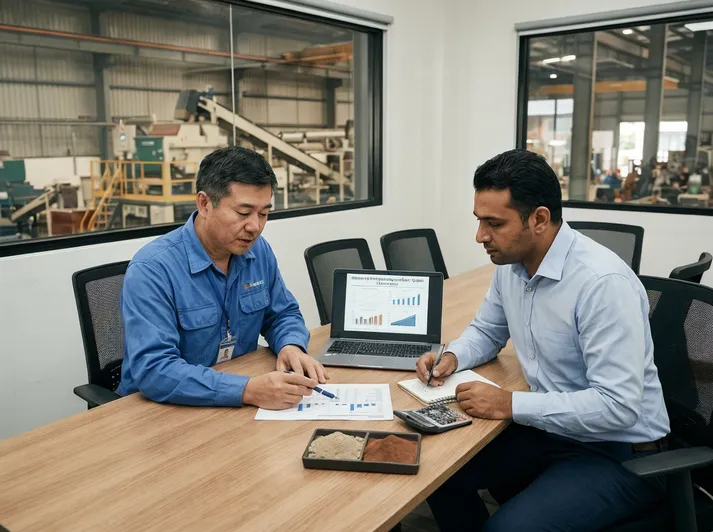
Send us your current sand purchasing volume (tons/month), disposal costs ($/ton), and production schedule (shifts/day). We'll calculate your potential savings and recommend the right regeneration system capacity for your operation. The ROI calculation takes 24–48 hours — we'll send you a preliminary analysis showing annual savings, system cost, and payback period based on your specific numbers.
Tip: If you're replacing an older regeneration system or upgrading from reclamation-only, tell us what's not working with your current setup — that helps us avoid specifying the same bottlenecks.
Production
45–60 days
Ocean Freight
15–30 days
depends on destination port
Customs & Transport
3–5 days
Install & Commission
8–12 days
5–7 assembly + 3–5 commissioning
Total project timeline: Order to first production-quality regenerated sand — 70–100 days
Remote Diagnostics via VPN
We can log into your PLC and review process data when you report an issue — no waiting for a field visit to identify the problem.
Spare Parts Ordering
Order through email or WhatsApp. We'll quote price and lead time within 24 hours.
On-Site Service
Available if remote support doesn't resolve the problem. We come to your facility.
Response Time (China Business Hours UTC+8)
4–8 hours
Outside Business Hours
12–24 hours
Urgent production issues: Contact us via WhatsApp at +86 13335029477 — that number reaches our technical team directly, not a general customer service queue.
Contact us at sales@tzfoundry.com with your sand volume and cost data. Include photos of your existing foundry layout if you're retrofitting — that helps us spot potential installation issues before we finalize the quotation.
We'll respond within 24 hours with preliminary ROI analysis and system recommendations.