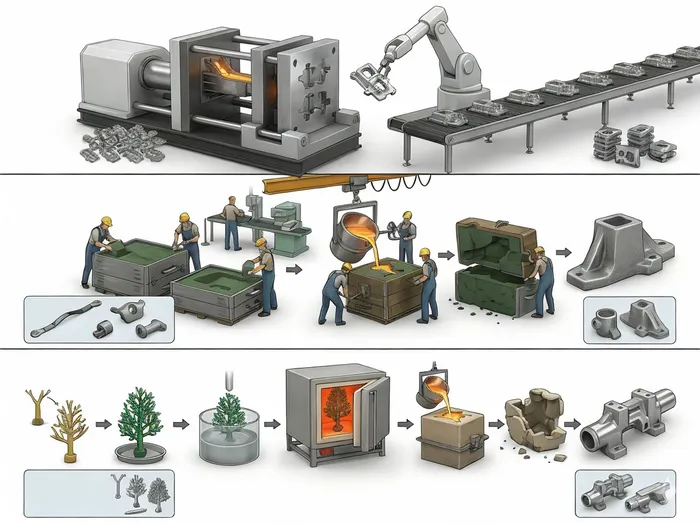
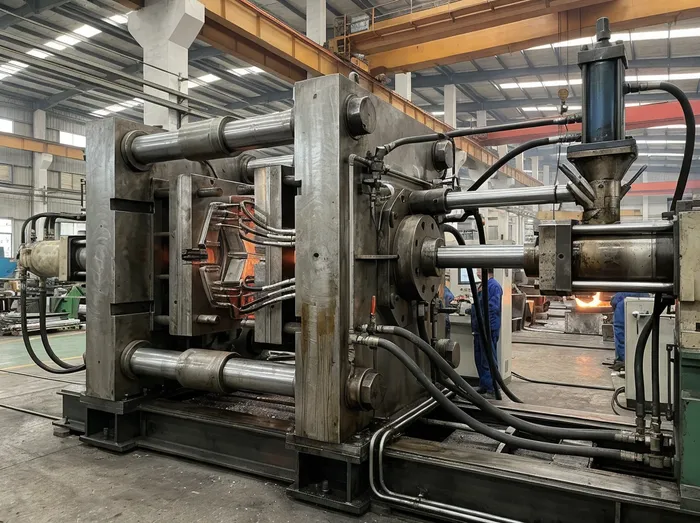
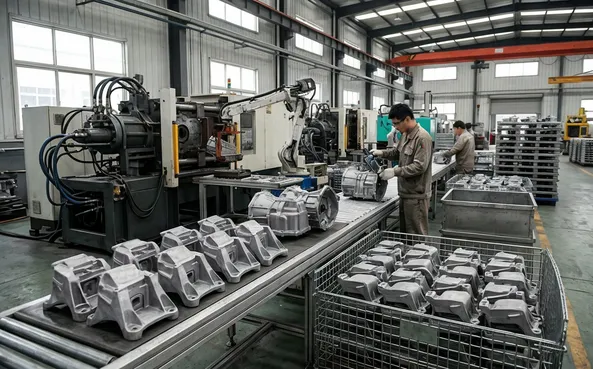
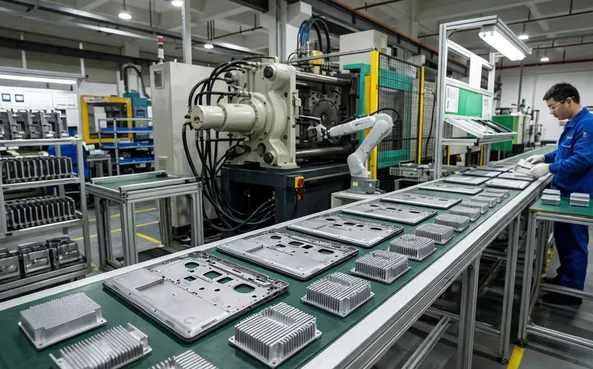
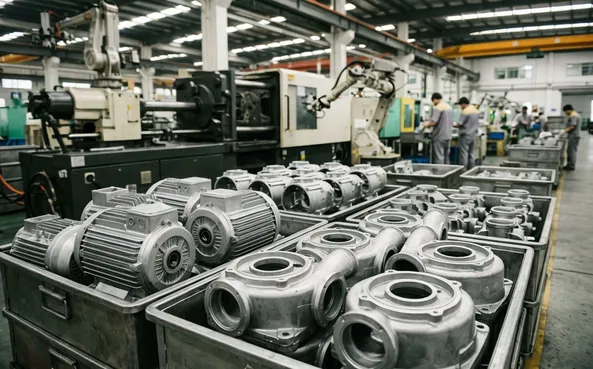
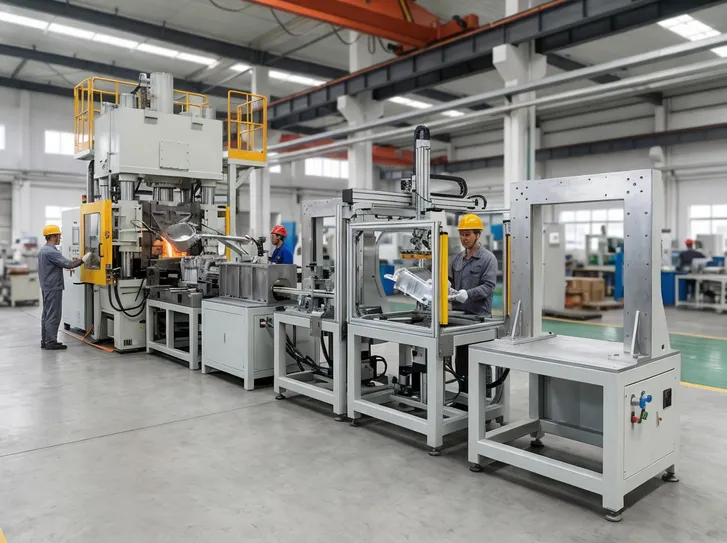
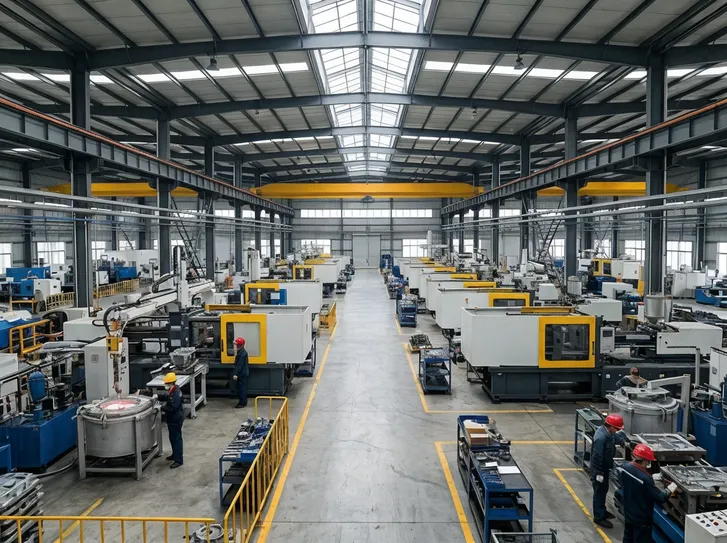
Die casting production lines inject molten metal under high pressure (40–120 MPa) into steel dies, producing parts with tight tolerances and smooth surface finishes in cycle times measured in seconds, not minutes. This is the casting method for high-volume repeat production — automotive transmission housings, laptop chassis, motor end caps, valve bodies — where tooling investment pays back through speed and consistency. We're talking 50,000 to 500,000 parts per year from a single die, with dimensional repeatability that lets you skip machining operations your sand-cast competitors still need.
The economics work when you're producing the same part geometry in volume. Below 10,000 units annually, die tooling cost ($8,000–50,000 per die depending on part complexity) makes sand casting or lost foam methods more sensible. Above that threshold, die casting's per-part cost drops fast — 30-second cycle times mean one operator runs multiple machines, and the as-cast surface finish often ships without secondary operations. We've built lines for buyers producing 200,000 aluminum heat sinks per year at $1.80 per part, where sand casting would have cost $3.20 after machining. That $1.40 difference funds the die tooling in the first 15,000 parts.
Die casting handles aluminum, zinc, and magnesium alloys — metals with melting points below 700°C. Iron and steel require sand casting or investment casting methods because die steel can't survive repeated contact with 1500°C molten iron. If your part is aluminum and your volume justifies tooling investment, die casting delivers the tightest tolerances and fastest throughput in the foundry equipment category. View all casting methods to compare process capabilities.
Die casting isn't always the right answer. It trades tooling flexibility for speed and precision, which means it shines in specific production profiles and struggles in others. Here's how to decide whether die casting protects your margin better than sand casting, lost foam, or investment casting for your particular part and volume.
| Dimension | Die Casting | Sand Casting | Lost Foam Casting | Investment Casting |
|---|---|---|---|---|
| Volume threshold | Economical at 10,000+ units/year | Economical at 50+ units/year | Economical at 500+ units/year | Economical at 100+ units/year |
| Tooling cost | $8,000–50,000 per die | $500–5,000 per pattern | $2,000–15,000 per pattern set | $3,000–20,000 per wax tooling |
| Per-part cost (at volume) | $0.80–8.00 | $3.00–25.00 | $2.00–18.00 | $5.00–40.00 |
| Dimensional tolerance | ±0.1–0.3mm | ±0.5–2.0mm | ±0.3–1.0mm | ±0.1–0.5mm |
| Alloy compatibility | Aluminum, zinc, magnesium only | All ferrous and non-ferrous | All ferrous and non-ferrous | All ferrous and non-ferrous |
| Cycle time | 30–180 seconds | 5–30 minutes | 3–15 minutes | 10–60 minutes |
| Surface finish | 1.6–3.2 Ra (often ships as-cast) | 6.3–12.5 Ra (requires machining) | 3.2–6.3 Ra (light finishing) | 0.8–3.2 Ra (minimal finishing) |
| Design flexibility | Limited (die must open in 2 directions) | High (complex cores possible) | Very high (foam burns out) | Very high (wax melts out) |
If you're producing aluminum parts in volume above 10,000 units per year and the geometry allows two-part die construction, die casting delivers the lowest per-part cost. If your part is iron, die casting isn't an option — move to sand casting production line. If your volume is below 5,000 units or the part has internal passages that can't be formed with sliding cores, lost foam casting equipment or investment casting machine makes more sense.
We've seen buyers switch from sand casting to die casting when their annual volume crossed 15,000 units and the per-part machining cost ($2.40) exceeded the amortized die cost ($0.60). At that crossover point, die casting's speed and as-cast finish quality make the tooling investment pay for itself within the first production run.
We've also seen buyers stick with sand casting at 30,000 units per year because the part had internal cooling passages that would have required complex die slides, pushing die cost to $85,000 — sand casting's $1.80 higher per-part cost was still cheaper over the die's 100,000-cycle life.
The method selection isn't about which process is "better" — it's about which process protects your margin for this specific part geometry, material, and production volume. If you're not sure, send us your part drawing and annual volume estimate. We'll run the economics and tell you which method makes sense, even if it's not die casting.
Die casting machines are sized by clamping force — the tonnage required to keep the die closed against injection pressure. Larger parts need more clamping force, heavier shots need larger injection systems, and cycle time depends on part wall thickness and cooling channel design. Here's the specification range for industrial die casting equipment:
| Specification | Small Machines | Medium Machines | Large Machines |
|---|---|---|---|
| Clamping force | 150–400 tons | 500–1,200 tons | 1,500–3,000 tons |
| Shot capacity | 0.5–3 kg | 3–15 kg | 15–50 kg |
| Injection pressure | 40–80 MPa | 60–100 MPa | 80–120 MPa |
| Cycle time | 30–90 seconds | 60–150 seconds | 90–180 seconds |
| Platen size | 400×400 – 600×600 mm | 700×700 – 1,000×1,000 mm | 1,200×1,200 – 1,500×1,500 mm |
| Dry cycle rate | 20–30 cycles/hour | 15–25 cycles/hour | 12–20 cycles/hour |
| Hydraulic power | 15–30 kW | 40–75 kW | 90–150 kW |
You need 4–8 tons of clamping force per square inch of projected part area (the part's shadow when viewed from the die opening direction). A part with 50 square inches of projected area needs 200–400 tons. Under-sized clamping force causes flash (metal leaking at the die parting line); over-sized clamping force wastes energy and increases machine cost.
Must exceed your part weight plus runner and overflow system weight by 20–30%. A 2 kg part typically needs 2.5–3 kg shot capacity because the runner system (the metal delivery channels) adds weight. If you're running a multi-cavity die (multiple parts per shot), multiply part weight by cavity count.
Injection takes 0.5–2 seconds, cooling takes 20–120 seconds (depending on part wall thickness), die opening and part ejection takes 5–10 seconds, die closing and locking takes 3–5 seconds. Thin-wall parts (2–3mm) cool faster than thick sections (8–10mm). You can't speed up cooling without risking porosity from premature ejection.
Specifications shown are industry-standard ranges for die casting production lines. Exact machine configuration depends on your part size, wall thickness, and production volume — a 5 kg aluminum transmission housing needs different equipment than 500 grams of zinc door hardware. Contact us with your part drawing and annual volume; we'll size the machine and provide factory pricing. Lead time is 12–16 weeks from order to shipment.
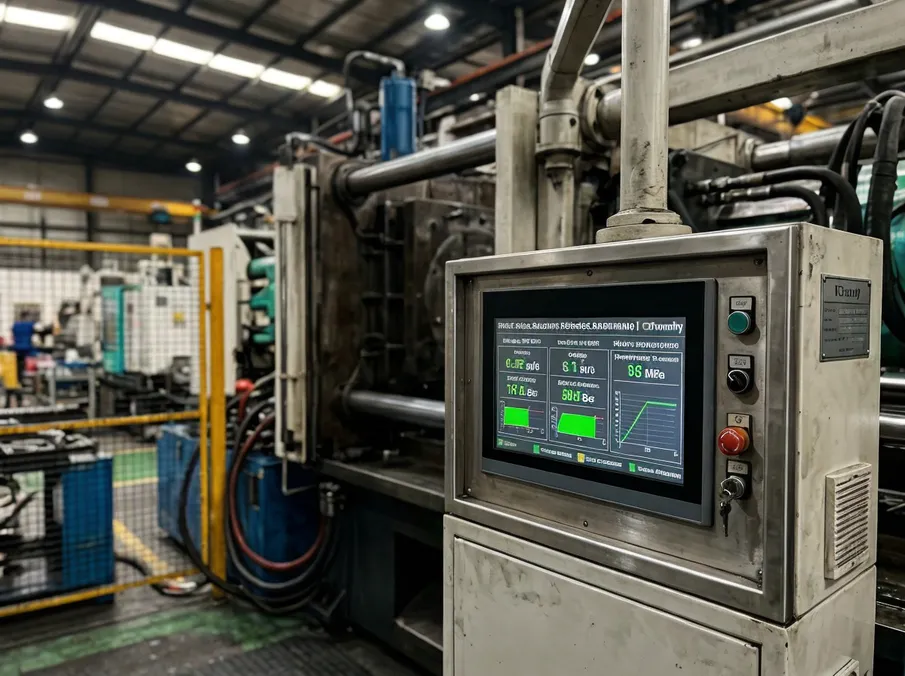
Get Machine Sizing & Factory PricingDie casting's commercial value is repeatability — part 1 and part 50,000 come out within ±0.15mm of each other, which means your customer's assembly line doesn't need to sort or rework castings. That consistency comes from PLC-based control systems that monitor and adjust injection parameters in real time, not from operator skill.
±2 MPa tolerance, monitored and adjusted every cycle by the PLC
±5°C tolerance, ensuring consistent alloy fluidity and fill behavior
Thermal imaging at 8–12 points across the die surface every cycle
±1 second consistency, eliminating operator-dependent variation
Injection pressure control prevents the two most common die casting defects: cold shuts (incomplete fill caused by low pressure) and flash (metal leaking at parting line caused by excessive pressure). The system ramps injection pressure in three stages, each with independent pressure and velocity setpoints adjusted based on part geometry:
Slow Shot — 0.3–0.5 m/s
Fills the runner system without turbulence, preventing air entrapment before metal reaches the cavity.
Fast Shot — 3–6 m/s
Fills the cavity before the metal starts solidifying, ensuring complete fill on thin-wall sections.
Intensification — 80–120 MPa
Packs the cavity as the metal shrinks during cooling, eliminating shrinkage porosity in thick sections.
If one section of the die runs 15°C cooler than another, the metal solidifies unevenly — the cold section freezes first, creating internal stress that causes warping after ejection. This is the difference between castings that ship as-is and castings that need straightening operations.
Thermal imaging cameras scan the die surface every cycle, and the PLC adjusts cooling water flow to individual circuits to maintain ±3°C uniformity across the entire die. When die temperature climbs 8°C above setpoint in one quadrant, the system flags a blocked cooling channel — fix it now, before that hot spot causes porosity in the next 200 parts.
The PLC compares each cycle against the programmed setpoint and flags deviations before they produce scrap parts. When injection pressure drops 5 MPa below setpoint, the system alerts the operator that the hydraulic accumulator needs recharging.
Remote diagnostics: We can log into your machine's PLC via VPN and review the last 1,000 cycles of pressure, temperature, and timing data when you're troubleshooting a quality issue. We've diagnosed blocked cooling channels, worn shot sleeve seals, and contaminated melt chemistry without sending a technician to site — the data shows what happened. (Your facility network must allow VPN access; some buyers prefer air-gapped systems for security reasons, which means phone-guided troubleshooting instead.)
The control system doesn't eliminate operator skill — someone still needs to recognize when a gradual pressure drift indicates die wear vs. hydraulic system degradation — but it does eliminate the cycle-to-cycle variation that comes from manual operation. Your 50,000th part matches your 1st part because the machine executes the same pressure/temperature/timing sequence every time, regardless of which operator is running the shift.
Die tooling is the largest upfront cost in die casting, and die lifespan determines your per-part amortization. Understanding these economics helps you decide whether die casting makes sense for your production volume and how to budget for die replacement.
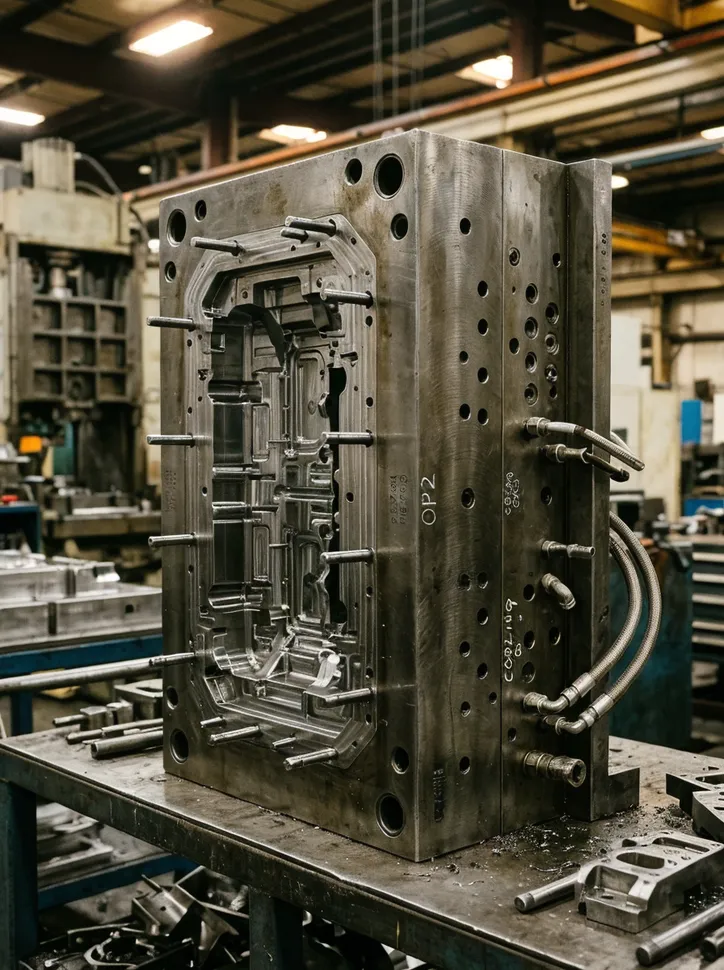
A die casting die is two blocks of H13 tool steel (the industry standard for aluminum and zinc die casting) machined to form the part cavity, with cooling channels drilled through the steel and ejector pins to push the part out after solidification. Die cost scales with part size, cavity count (single-cavity vs. multi-cavity), and geometric complexity (number of side actions required).
| Die Complexity | Example Parts | Cost Range |
|---|---|---|
| Simple | Door handles, electrical housings | $8,000–$15,000 |
| Complex | Automotive structural components, multi-slide/core | $30,000–$50,000 |
H13 tool steel dies last 50,000–150,000 shots depending on alloy and operating conditions. Alloy chemistry and melt temperature directly determine how fast the die erodes.
Aluminum
100K–150K
Cycles
Melt temperature 660–720°C. Easiest on dies — lower chemical aggression at operating temperature.
Zinc
50K–80K
Cycles
Melt temperature 420–450°C but more chemically aggressive, causing faster die erosion despite lower heat.
Magnesium
40K–60K
Cycles
Melt temperature 650–680°C, highly reactive. Hardest on dies — expect the shortest cycle life before replacement.
Divide die cost by expected cycle count to get per-part tooling cost. This amortized cost gets added to your per-part production cost (metal, labor, energy, overhead) to calculate total cost. Die casting becomes economical when the per-part savings from faster cycle times and reduced machining exceed the amortized die cost.
Example A — Simple Die
$0.15
per part
$15,000 die ÷ 100,000 cycles = $0.15 per part amortized tooling cost
Example B — Complex Die
$0.50
per part
$40,000 die ÷ 80,000 cycles = $0.50 per part amortized tooling cost
Every 10,000–15,000 shots, the die comes out for inspection and refurbishment. This maintenance takes 2–4 days and costs $800–$2,000 depending on die size. Tasks include:
Skipping maintenance shortens die life. A die that could have lasted 120,000 cycles might fail at 60,000 if cooling channels clog and cause thermal stress cracking.
Premium die coatings add $2,000–$5,000 to die cost but can extend life by 30–50% by reducing thermal fatigue and metal soldering (aluminum sticking to the die surface).
For high-volume production (100,000+ parts/year), coatings pay back in 12–18 months through reduced die replacement frequency.
If your part is small enough, you can run 2, 4, or even 8 cavities in a single die — one shot produces multiple parts. A 4-cavity die costs 2–2.5× what a single-cavity die costs, but it produces 4 parts per cycle, cutting your per-part cycle time by 75%.
The trade-off: multi-cavity dies are harder to balance (all cavities must fill evenly) and any die damage takes all cavities offline. We typically recommend multi-cavity dies when part weight is under 500 grams and annual volume exceeds 50,000 units.
Die Casting Makes Sense
Producing 20,000 parts/year. Die casting saves $1.20/part in machining cost vs. sand casting. Amortized die cost is $0.40/part. Net savings: $0.80/part — $16,000/year. The die pays for itself in year one; years 2–5 are pure margin improvement.
Die Casting Doesn't Pay Off
Producing 3,000 parts/year. That same $15,000 die costs $5.00/part amortized over its life. At this volume, die casting doesn't make economic sense — consider sand casting or investment casting instead.
Die casting serves three primary B2B market segments, each with distinct volume patterns, margin structures, and quality requirements. Understanding which segment your production fits helps you configure the right equipment and automation level.
Engine brackets, transmission housings, structural nodes
Buyers supplying Tier 1 and Tier 2 automotive manufacturers need die casting's dimensional consistency because parts go directly into automated assembly lines with no sorting or rework. A transmission housing that's 0.8mm out of spec jams the assembly robot and stops the line — your customer's $12,000 per minute downtime cost. Die casting's ±0.15mm repeatability means every part fits the first time.
Volume Profile
50,000–500,000 units/year per part number, with 3–5 year production runs. Monthly releases of 4,000–8,000 parts with 4–6 week lead times. Margin protected by tight tolerance — customers pay a 15–20% premium over sand castings because die cast parts eliminate incoming inspection and rework costs.
Typical Parts
Wall thickness 3–6mm · Surface finish 3.2 Ra or better · Pressure testing required for fluid-sealing parts
Laptop chassis, smartphone frames, heat sinks
Buyers serving electronics OEMs need die casting's surface finish quality and thin-wall capability. Laptop chassis are 1.5–2.5mm wall thickness with cosmetic surface requirements — any die marks or porosity shows through the anodized finish. Heat sinks need precise fin geometry (0.8–1.2mm fin thickness, 2–3mm fin spacing) that sand casting can't hold.
Volume Profile
100,000–1,000,000 units/year per part number, with 12–18 month production runs before generation changes. Orders are lumpy — 20,000-unit monthly shipments during ramp, 50,000–80,000 units/month at peak, then declining at EOL. Margin protected by surface finish — die cast parts ship with light bead blasting and anodizing, while sand cast alternatives need machining and polishing that adds $1.80–3.20 per part.
Typical Parts
Wall thickness 1.5–3mm · Surface finish 1.6–2.5 Ra · Cosmetic inspection under 500 lux lighting
Motor housings, pump bodies, valve components
Buyers serving equipment manufacturers need die casting's pressure-tight casting capability and dimensional accuracy for machined interfaces. A motor housing that leaks through porosity fails IP65 rating and gets rejected. A pump body with 0.5mm bore misalignment causes bearing failure in 6 months instead of 10 years.
Volume Profile
10,000–100,000 units/year per part number, with 5–10 year production runs. Steady orders of 800–2,000 parts/month with 6–8 week lead times. Margin protected by pressure-tight casting — die cast parts pass helium leak testing at 1×10⁻⁶ mbar·l/s, eliminating impregnation (vacuum resin sealing) that sand castings need, saving $2.50–4.00 per part.
Typical Parts
Wall thickness 4–8mm · Pressure testing 10–25 bar · Machined bore tolerances ±0.05mm
Automotive
Typically needs fully automated lines — robotic part extraction, automated trimming, in-line CMM inspection. Labor cost at 500,000 units/year overwhelms the automation investment.
Electronics
Often runs semi-automated — robotic extraction, manual trimming and inspection. Cosmetic defects require human judgment that vision systems can't fully replicate.
Industrial Equipment
Frequently runs manual operations because 10,000 units/year doesn't justify automation payback. Volume growth triggers staged automation upgrades.
Die casting's commercial advantage over sand casting is labor efficiency — one operator runs multiple machines because cycle times are measured in seconds and the process is mechanized. The question is how much automation to install upfront vs. adding later as volume grows.
2 operators per machine
Operator 1
Monitors the casting cycle, lubricates the die (spray release agent after each shot), and handles quality checks.
Operator 2
Extracts the part from the die using tongs, places it in a trim press to remove runner and overflow metal, and inspects for visual defects.
Works for production up to 15,000–20,000 parts/year per machine.
$18/hr × 2 operators × 2,000 hrs/yr
1 operator per 2 machines
Robotic arm extracts the part from the die immediately after ejection and places it on a conveyor. Operator monitors 2 machines simultaneously, handles die lubrication (some systems automate this with spray nozzles), performs manual trimming, and conducts visual inspection.
Works for production up to 40,000–50,000 parts/year per machine.
Equipment Add-On
Robotic extraction system adds $45,000–65,000 to machine cost, paying back in 18–24 months through labor savings.
Per machine per year
1 operator per 4 machines
Robotic extraction, automated die lubrication, robotic trimming (part moves from extraction robot to trim press automatically), and vision inspection system (camera checks for flash, porosity, and dimensional errors). Operator monitors 4 machines from a central station, responds to alarms, and handles die changes.
Works for production above 80,000 parts/year per machine.
Equipment Add-On
Full automation adds $120,000–180,000 to machine cost, paying back in 24–36 months at high-volume production.
Per machine per year
Based on $18/hour labor cost and 2,000 production hours per year
| Configuration | Labor/Year | Automation Amortized | Total/Year | Annual Savings | Payback |
|---|---|---|---|---|---|
| Manual (baseline) | $72,000 | — | $72,000 | — | — |
| Semi-automated | $36,000 | $10,000/yr | $46,000 | $26,000 | 1.9 years |
| Fully automated (1 shift) | $18,000 | $30,000/yr | $48,000 | $24,000 | 6.3 years |
| Fully automated (2+ shifts) | $18,000 | $30,000/yr | $48,000 | $48,000+ | 3.1 years |
Full automation only makes sense when you're running 2+ shifts (4,000+ hours/year), which doubles the labor savings and cuts payback to 3.1 years.
We design die casting lines with automation mounting points built in, so you can start manual and add robots later without rebuilding the machine base. A buyer producing 12,000 parts per year starts manual, and when volume hits 35,000 parts in year 3, they add the extraction robot.
This avoids paying for automation capacity you're not using yet, and it spreads capital investment across multiple budget cycles.
Decision Depends On
Most die casting buyers aren't building greenfield foundries — they're adding capacity to existing operations or replacing aging equipment. Die casting lines need to connect to your melting and holding furnaces, material handling systems, and downstream finishing equipment without requiring a complete facility rebuild.
Die casting machines draw metal from a holding furnace (also called a dosing furnace) positioned next to the machine. The holding furnace maintains metal at casting temperature and feeds the shot sleeve via ladle transfer (manual or robotic) or automated dosing system (pump or electromagnetic transfer).
Temperature Ranges
680–720°C
420–450°C
±5°C
Your holding furnace capacity must match shot volume × cycle rate — a machine shooting 5 kg every 90 seconds needs a holding furnace that can supply 200 kg per hour with ±5°C temperature stability.
Running multiple die casting machines? You can feed them from a central melting furnace (reverberatory or induction) that supplies multiple holding furnaces, or run independent melting/holding systems per machine. Central melting is more energy-efficient at 3+ machines; independent systems give you flexibility to run different alloys simultaneously. We size the furnace configuration during line design based on your alloy mix and production schedule.
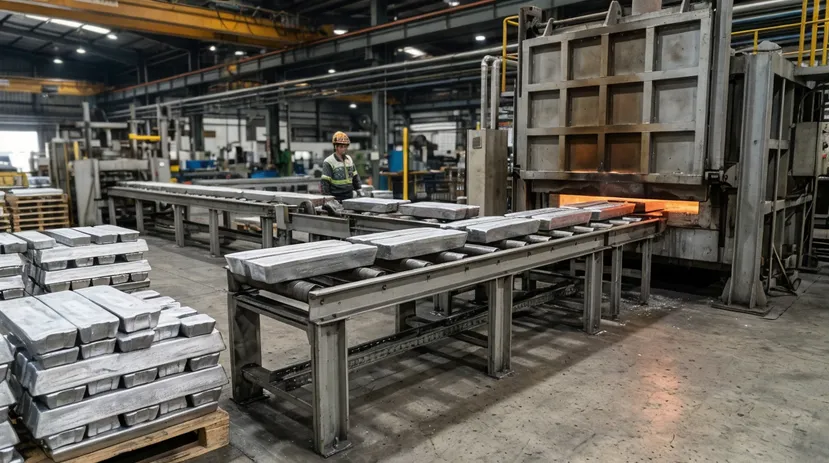
Die casting consumes 50–200 kg of metal per hour depending on machine size and cycle rate. You need a system to move ingots from storage to the melting furnace without interrupting production.
Handling Options
The practical constraint is floor space — a 500 kg melting furnace with 4 hours of buffer capacity needs 2,000 kg of ingot storage within 10 meters, which is 80–100 ingots stacked on pallets.
Die cast parts come off the machine with runners and overflows attached (the metal delivery system that gets trimmed off). You need a trim press (10–50 ton hydraulic press depending on part size) positioned within 2–3 meters of the die casting machine so parts move from extraction to trimming without cooling below 150°C — hot trimming is easier than cold trimming because the metal is still slightly ductile.
Post-Trim Process Flow
Deburring
Vibratory tumbling or manual filing
Finishing
Machining, powder coating, anodizing
Assembly
Based on your product requirements
Die casting machines need three utilities. Most industrial facilities already have these; the question is whether your existing capacity handles the additional load.
Electrical Power
15–150 kW depending on machine size, 380–480V three-phase
Cooling Water
5–20 liters/min at 15–25°C for hydraulic oil cooling and die temperature control
Compressed Air
6–8 bar at 100–200 liters/min for die lubrication and part ejection
Example load: A 650-ton die casting machine adds 55 kW to your electrical demand and 12 liters/min to your cooling water demand — check your transformer and cooling tower capacity before ordering.
Die casting machines are heavy — 8 to 60 tons depending on clamping force — and they generate vibration during die closing and locking.
Standard industrial floors (200 mm reinforced concrete)
Dedicated foundations (400–600 mm concrete pad with rebar, isolated from building floor to prevent vibration transmission)
Floor space requirement is machine footprint plus 3–4 meters on the operator side for part handling and 2 meters on the back side for maintenance access.
650-Ton Machine Example
≈ 6m × 4m including clearances
Our engineering team handles integration planning during the quotation phase. Send us your facility layout, existing furnace capacity, and utility specifications; we'll confirm compatibility and flag any upgrades needed before installation. We've integrated die casting lines into 40-year-old foundries running sand casting and into brand-new facilities — the key is planning the material flow and utility connections before the machine ships, not discovering conflicts during installation.
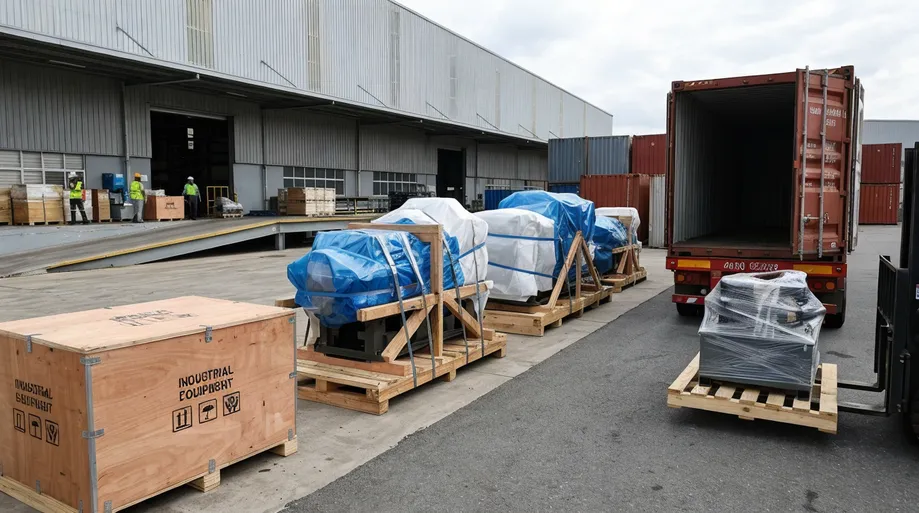
Die casting machines ship knocked down into modules to fit standard shipping containers and to allow installation through standard industrial doorways. Understanding the shipping and installation process helps you budget for landed cost and plan your production timeline.
| Machine Class | Clamping Force | Modules | Total Weight | Containers |
|---|---|---|---|---|
| Small | 150–400 ton | 4–6 modules | 8–15 tons | 1 × 40HQ |
| Medium | 500–1,200 ton | 6–8 modules | 20–35 tons | 1 × 40HQ + 1 × 20GP |
| Large | 1,500–3,000 ton | 10–12 modules | 45–70 tons | 2–3 × 40HQ |
Modules are designed to fit through 2.4m × 2.4m doorways (standard industrial door size) and to lift with overhead crane or forklift. The heaviest single module is typically the main frame base, which weighs 3–8 tons depending on machine size. If your facility has crane capacity limitations, we can split modules further — a 6-ton base can break into two 3-ton sections bolted together on site.
Ocean freight from Qingdao to major ports (Los Angeles, Hamburg, Dubai, Singapore) takes 18–35 days depending on route and transshipment. Customs clearance adds 3–7 days.
Uncrate modules, position main frame on foundation, level and anchor base. Machine must be level within 0.1 mm per meter or die alignment suffers.
Install injection system, connect hydraulic lines, mount electrical cabinet, wire power and control circuits.
Install die height adjustment, connect cooling water lines, install lubrication system, fill hydraulic oil (200–800 liters depending on machine size).
PLC commissioning, test cycles without die, install die and run first-part trials, adjust injection parameters, train operators.
We provide installation documentation (assembly drawings, hydraulic schematics, electrical diagrams, PLC parameter lists) with every machine.
Small Machines — Remote Video Guidance
Your maintenance team handles mechanical assembly and electrical hookup. We guide PLC commissioning via video call.
Medium & Large Machines — On-Site Support
Our technician travels to your facility for 1–2 weeks to supervise installation and conduct operator training.
$8,000–$12,000
30–40%
Before the machine ships, confirm the following items are in place. Missing any of these adds 1–2 weeks to installation timeline.
Total timeline from order to first production part is typically 12–18 weeks — 8–12 weeks manufacturing, 3–5 weeks shipping and customs, 1–4 weeks installation depending on machine size and whether you use on-site support. We provide a detailed Gantt chart with your quotation so you can coordinate foundation work, utility installation, and operator hiring in parallel with machine manufacturing.
You need 4–8 tons of clamping force per square inch of projected part area. Projected area is the part's shadow when viewed from the die opening direction — the area the injection pressure is pushing against. Calculate it by multiplying part length × width (ignoring depth features).
Worked Example
A part measuring 8 in × 6 in = 48 sq in of projected area → requires 192–384 tons of clamping force. Use the lower end (4 tons/sq in) for simple geometries with uniform wall thickness, and the higher end (8 tons/sq in) for complex parts with thick sections that need high intensification pressure.
If you under-size clamping force, injection pressure forces the die open slightly during the shot, causing flash (thin metal fins at the parting line). Flash adds secondary trimming operations and wastes metal. If you over-size clamping force, you're paying for machine capacity you don't need — a 1,200-ton machine costs $180,000 while an 800-ton machine costs $135,000, so right-sizing matters.
Aluminum delivers better strength-to-weight ratio and heat resistance; zinc delivers better dimensional accuracy and lower tooling wear.
Choose Aluminum
Alloys A380, A383, ADC12
Choose Zinc
Alloys Zamak 3, Zamak 5
Zinc's lower melting point (420°C vs. 660°C for aluminum) means less thermal stress on dies, extending die life by 40–60%. Zinc's higher density (6.7 g/cm³) means parts are 2.5× heavier than aluminum for the same volume — acceptable for small parts, problematic for large components where weight matters. Magnesium (density 1.8 g/cm³) is the lightest option but more expensive and requires special handling due to flammability risk.
50,000–150,000 cycles depending on alloy, die maintenance, and operating conditions.
100K–150K
Aluminum Dies
660°C melt temp — moderate thermal fatigue
50K–80K
Zinc Dies
420°C melt — chemically aggressive, causes erosion
40K–60K
Magnesium Dies
High reactivity reduces lifespan
Die life depends heavily on maintenance. Dies inspected and refurbished every 10,000–15,000 shots (polishing, cooling channel cleaning, ejector pin replacement) reach their full cycle potential. Dies run without maintenance fail at 50–60% of expected life due to thermal cracking from clogged cooling channels or die surface erosion from metal buildup.
Premium die coatings (PVD chrome, nitriding) extend life by 30–50% by reducing thermal fatigue and metal soldering, adding $2,000–5,000 to die cost but paying back through reduced replacement frequency.
Porosity (internal voids) comes from three sources:
Trapped Air
Injection speed too fast creates turbulence, folding air bubbles into the metal stream.
Fix: Optimize slow-shot and fast-shot velocity transition.
Gas Porosity
Hydrogen dissolves in the melt from moisture or contaminated ingots.
Fix: Degas the melt (nitrogen or argon purging) and use clean, dry ingots.
Shrinkage
Thick sections solidify from outside in, trapping liquid metal that shrinks as it cools.
Fix: Proper gating design (multiple gates for thick sections) and adequate intensification pressure.
Vacuum-assisted die casting systems pull air out of the die cavity before injection, eliminating trapped air porosity and allowing higher injection speeds. This adds $25,000–40,000 to machine cost but produces parts with 30–50% less porosity, which matters for pressure-tight applications (motor housings, valve bodies, pump components that must pass leak testing).
No. Die casting is limited to low-melting-point alloys — aluminum (660°C), zinc (420°C), magnesium (650°C), and copper alloys (950–1,100°C for specialized applications). Iron and steel melt at 1,500–1,600°C, which exceeds the thermal limits of H13 tool steel dies. Repeated contact with 1,500°C molten iron causes die surface melting and thermal shock cracking — dies would last 500–1,000 shots instead of 50,000+, making the process economically unviable.
Recommended alternatives for iron and steel parts:
Die casting becomes economical at 10,000+ units per year due to tooling cost. A $15,000 die amortized over 10,000 parts costs $1.50 per part; amortized over 100,000 parts costs $0.15 per part. Below 5,000 units annually, the amortized die cost exceeds the per-part savings from die casting's faster cycle times and reduced machining, making sand casting or investment casting more cost-effective.
Break-Even Calculation
High machining savings ($2.50/part)
Die cost: $18,000 → break even at 7,200 parts
Economical at 10,000+ units/year
Low machining savings ($0.80/part)
Die cost: $18,000 → break even at 22,500 parts
Economical only at 25,000+ units/year
Volume-to-method guide:
We've built foundry equipment since 2010, running 8 production lines across 15,000 square meters in Qingdao. Our die casting lines ship to buyers in North America, Europe, the Middle East, and Southeast Asia — foundries producing automotive components, consumer electronics housings, and industrial equipment parts. ISO 9001:2015, CE, and SGS certified.
Our die casting machines use modular design — start with manual operation and add robotic extraction or automated trimming later when your volume justifies the automation investment. The machine base includes mounting points and control system provisions for future automation, so you're not rebuilding the platform when you upgrade. A buyer producing 12,000 parts per year starts manual ($135,000 machine cost), and when volume hits 40,000 parts in year 3, they add the extraction robot ($55,000) without replacing the base machine.
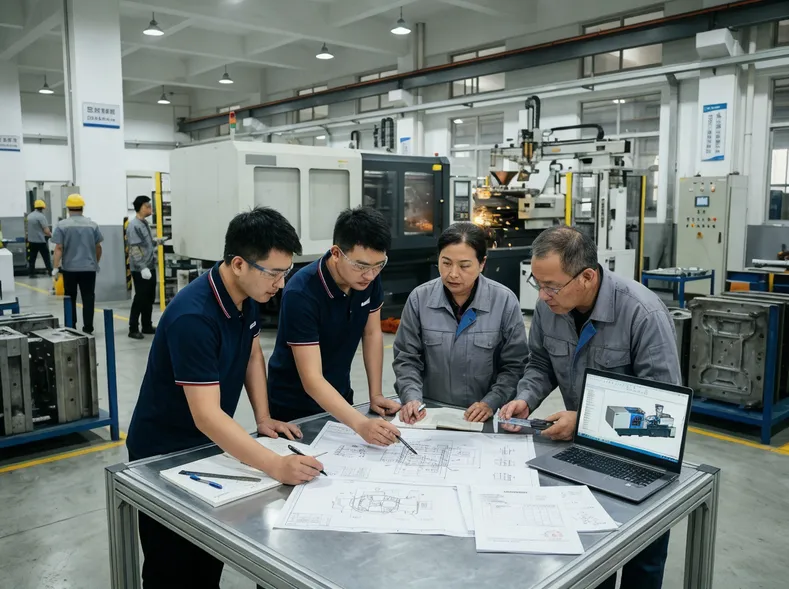
In-house engineering team sizes equipment to your part geometry and production volume. Send us your part drawing (or photos of current castings), annual volume requirement, and alloy type — we'll recommend clamping force, shot capacity, and automation level, then provide factory pricing. We've sized lines for 0.3 kg smartphone frames running 500,000 units per year (400-ton machine, fully automated) and for 8 kg pump housings running 15,000 units per year (650-ton machine, manual operation). The configuration depends on your specific production profile, not a one-size-fits-all spec sheet.
Remote Diagnostics
PLC access via VPN to review pressure, temperature, and cycle data. We've diagnosed blocked cooling channels, hydraulic seal wear, and melt temperature drift without site visits.
Modular Upgrades
Start manual, add automation later. Mounting points and control provisions built into every base machine — no platform rebuild when you scale.
Factory Direct Pricing
No distributor markup. 12–16 weeks production + 3–5 weeks shipping. Stock 400-ton and 650-ton machines ship in 4–6 weeks.
Security Options
VPN-based remote support standard. Air-gapped systems available for buyers who prefer isolated networks — phone-guided troubleshooting instead.
Send us your part drawings (or photos of current castings), annual volume requirements, and alloy type — our engineering team will recommend the right machine configuration and provide factory pricing within 48 hours. We need to see part geometry to size clamping force correctly and to identify any features that require die slides or special tooling.
We'll review your part geometry, calculate projected area and required clamping force, recommend machine size and automation level, estimate cycle time and production capacity, and provide factory pricing including machine cost, die cost estimate (if you need us to source dies), and shipping cost to your port.
We typically respond within 24 hours. If you're evaluating multiple casting methods and not sure whether die casting fits your production profile, tell us — we'll run the economics comparison against sand casting and lost foam methods and recommend the process that protects your margin, even if it's not die casting.