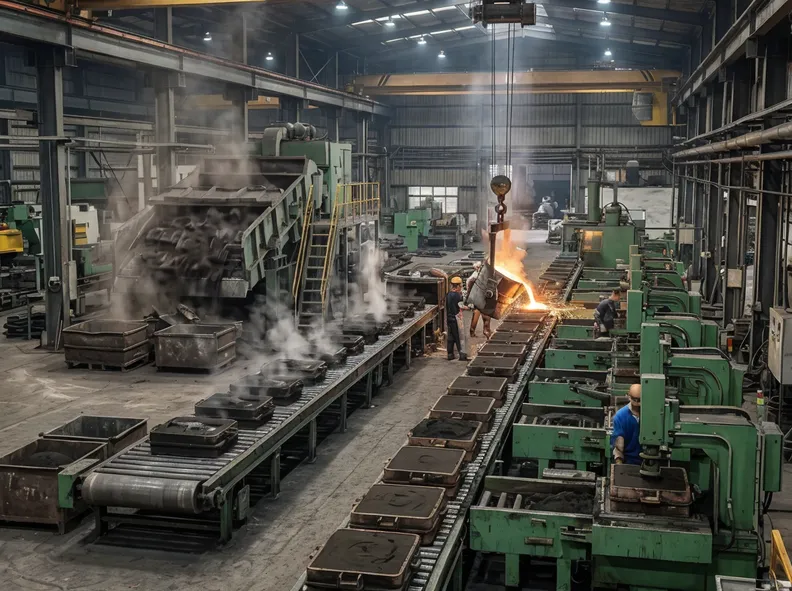
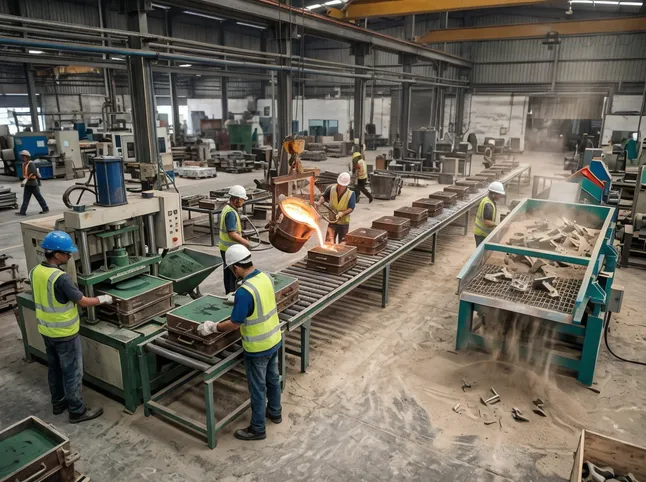
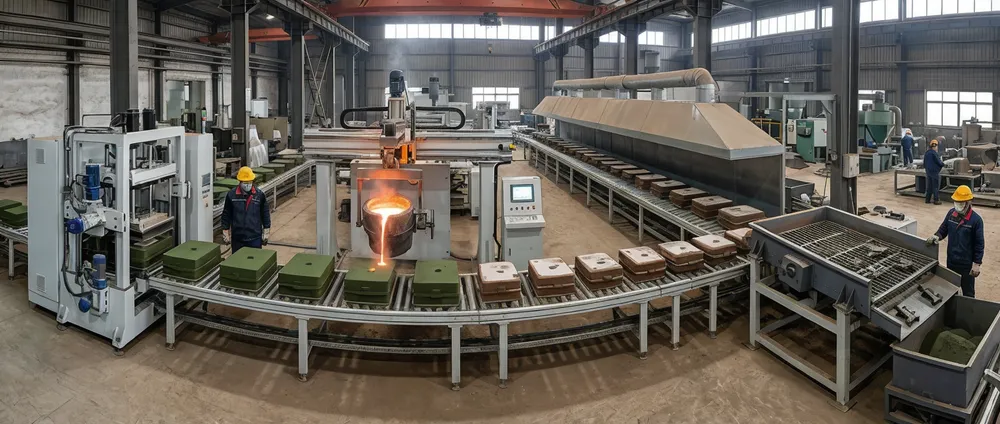
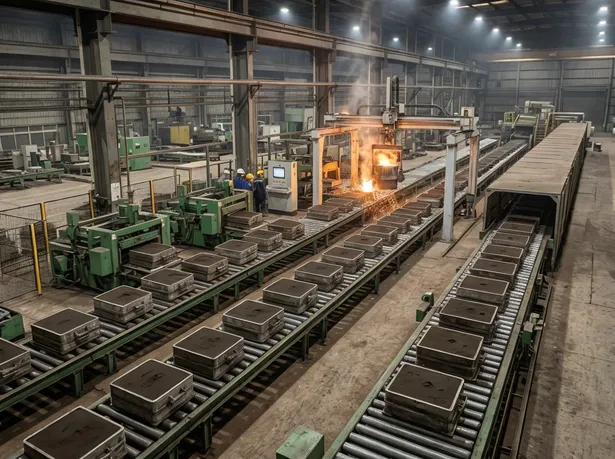
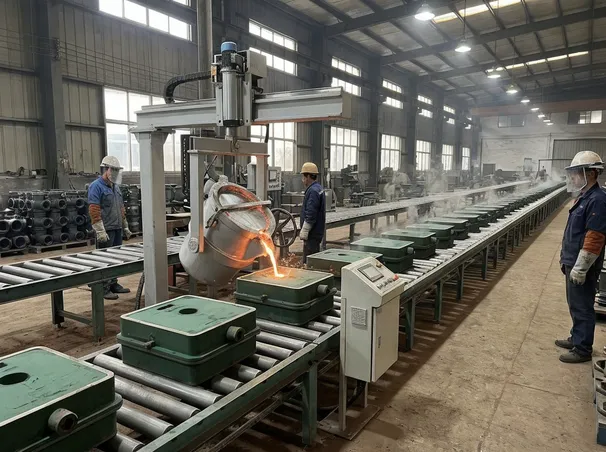
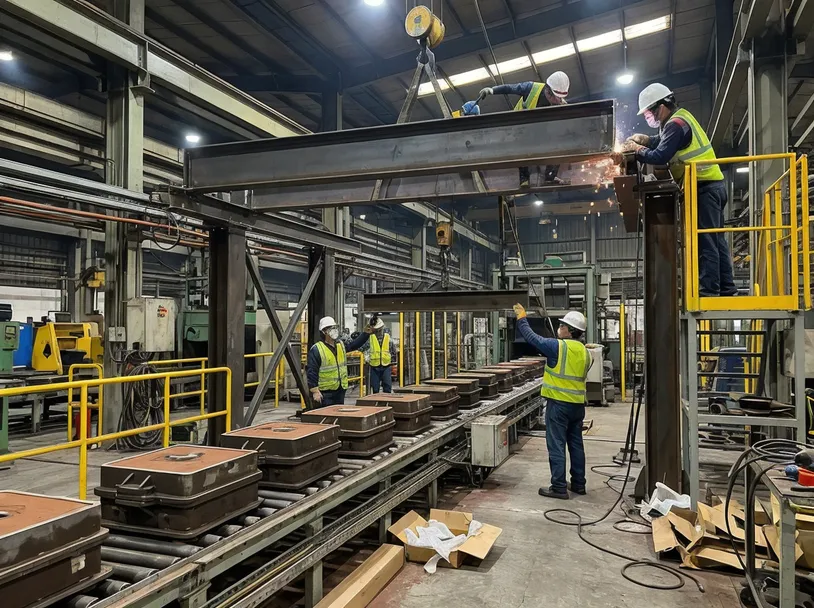
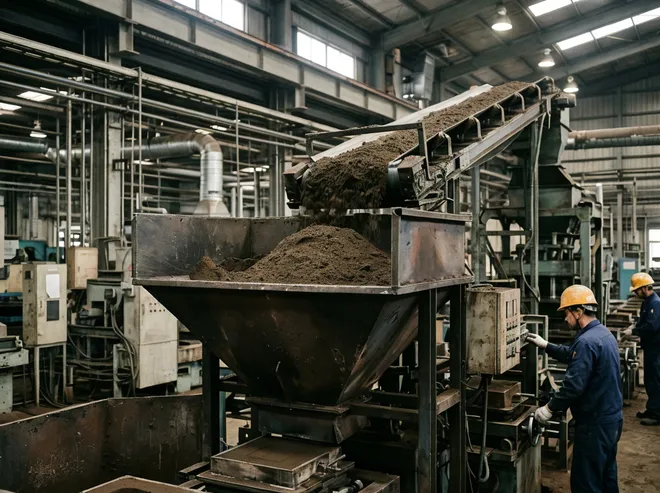
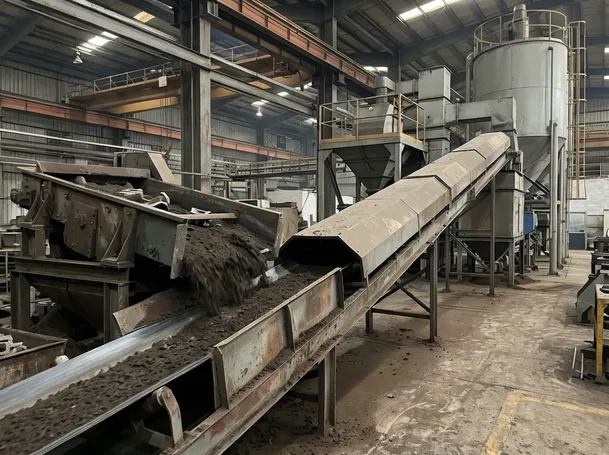
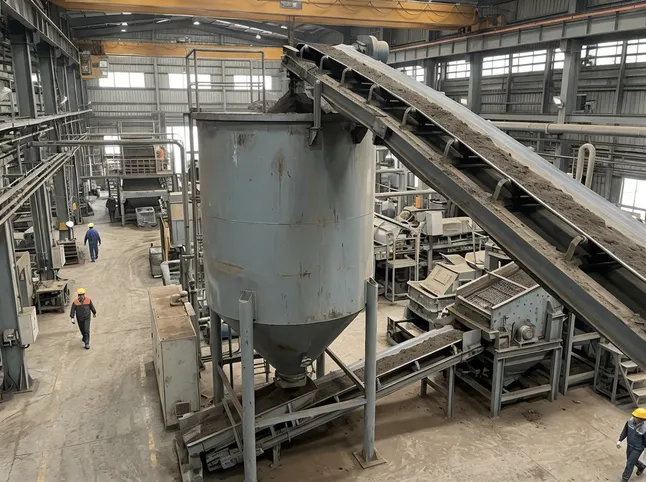
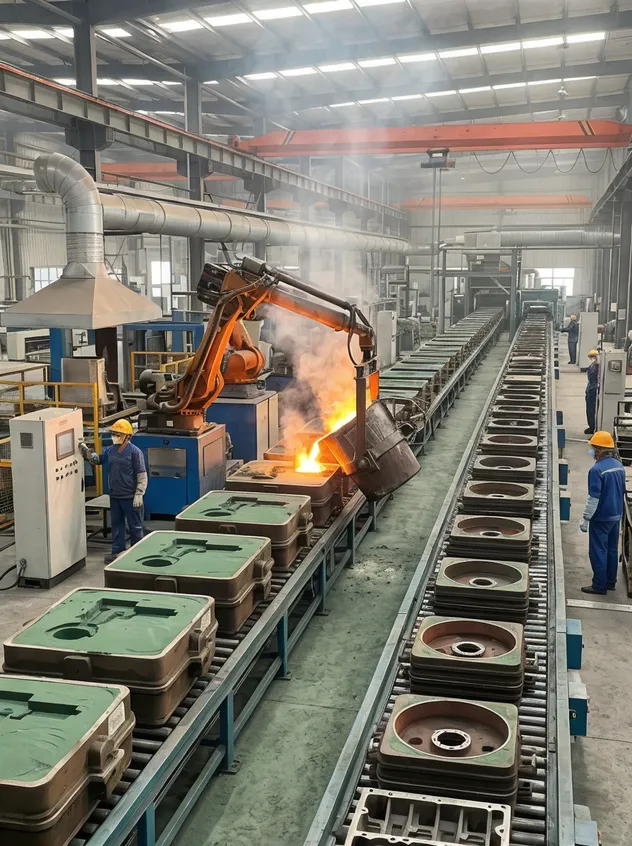
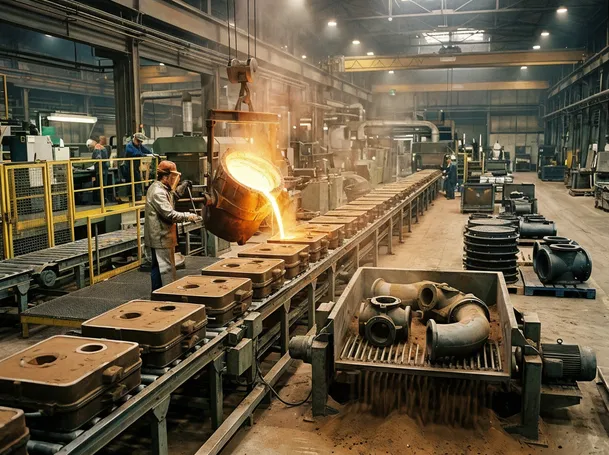
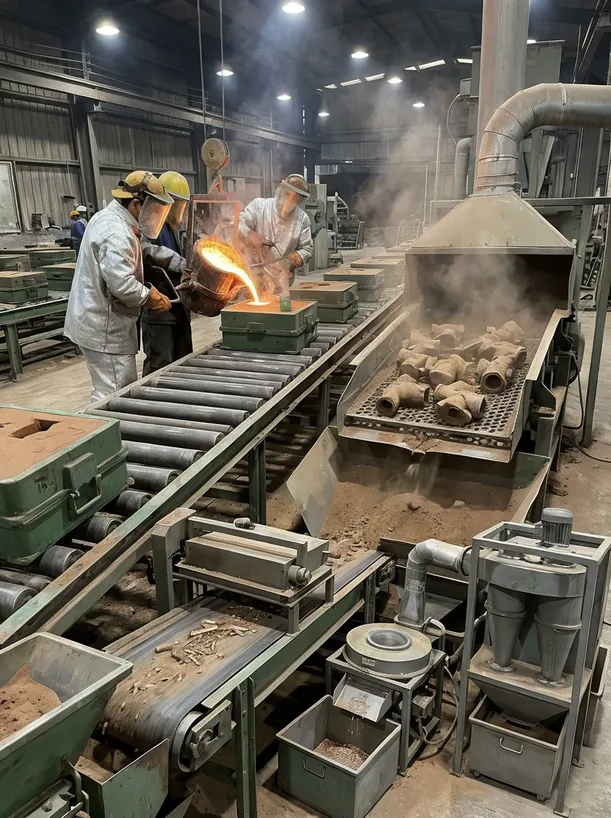
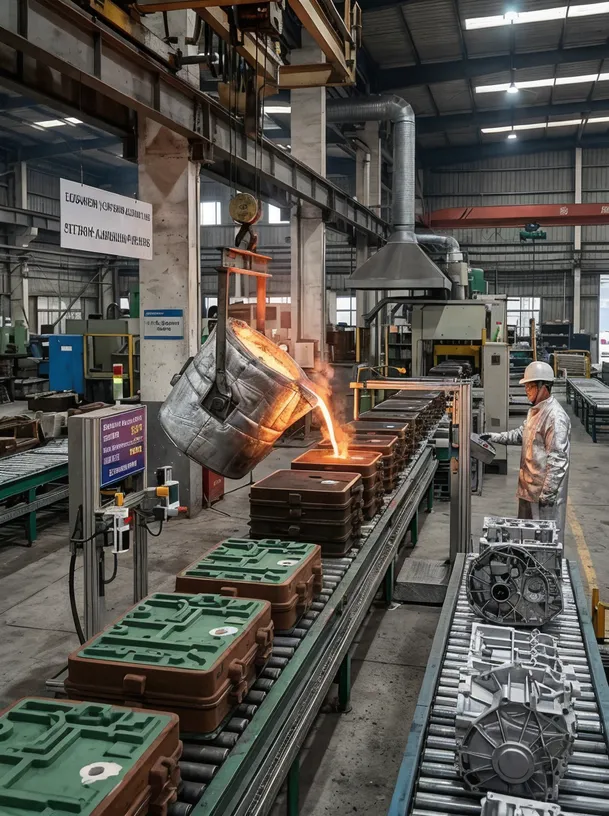
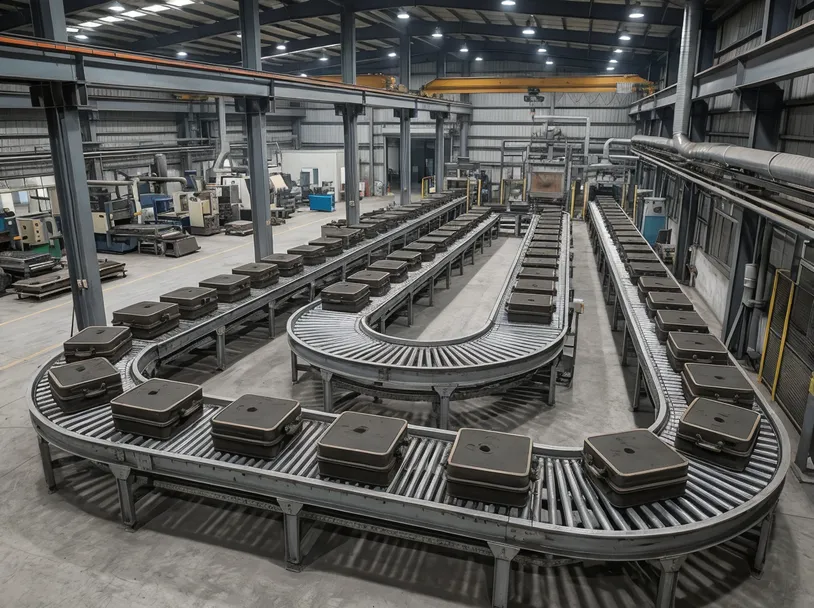
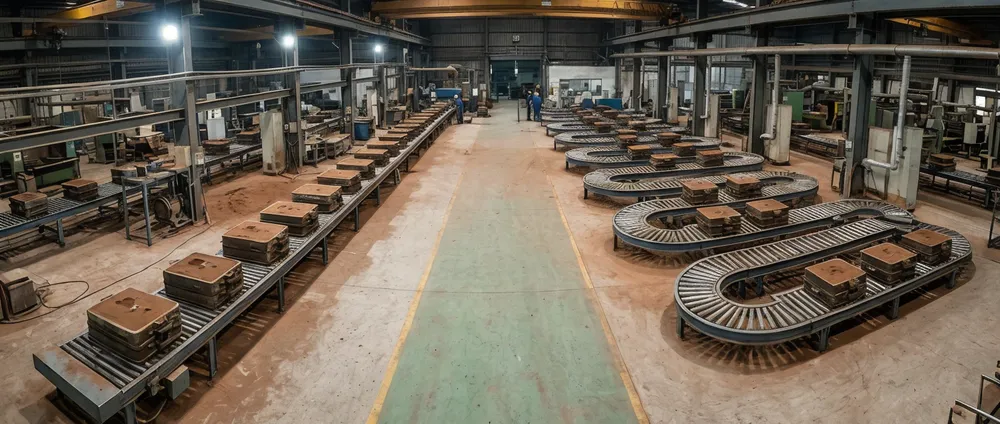
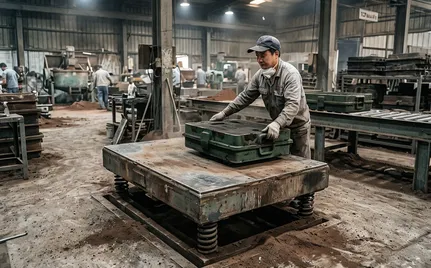
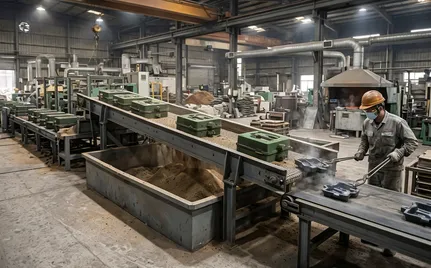
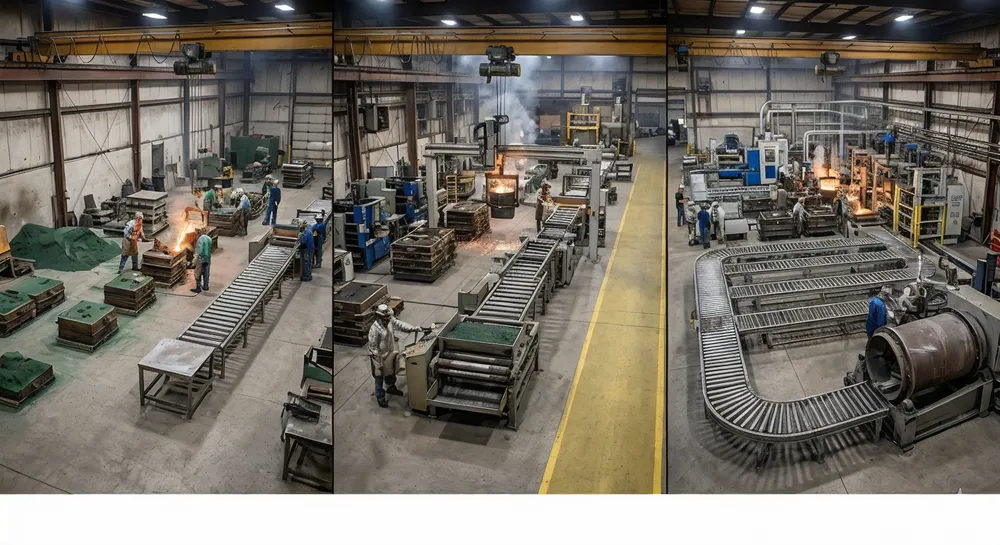
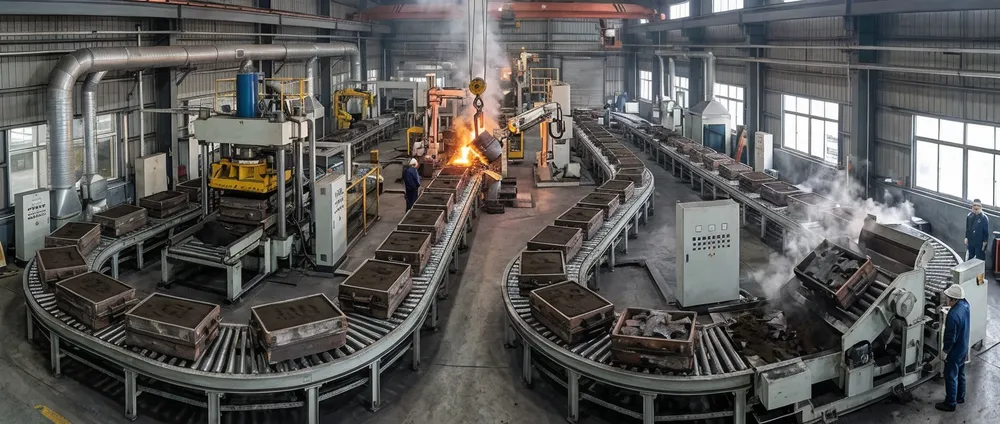
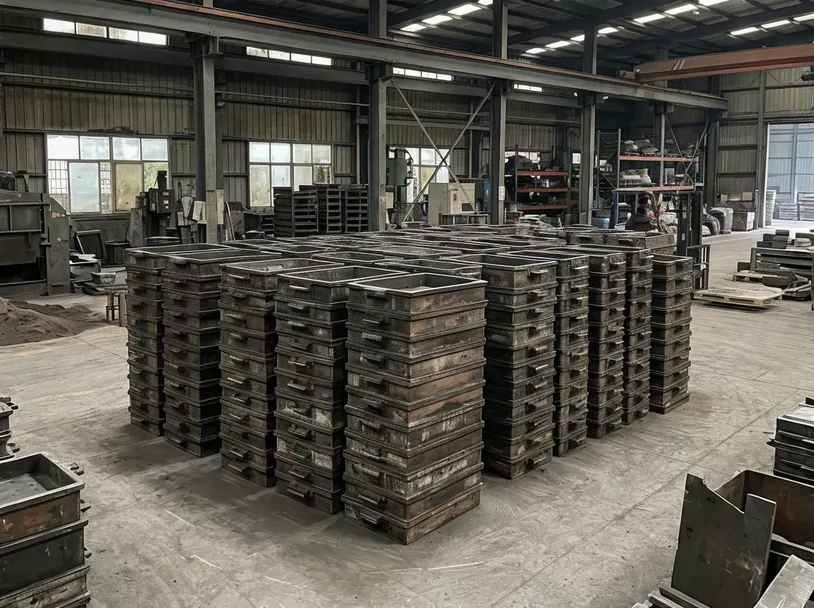
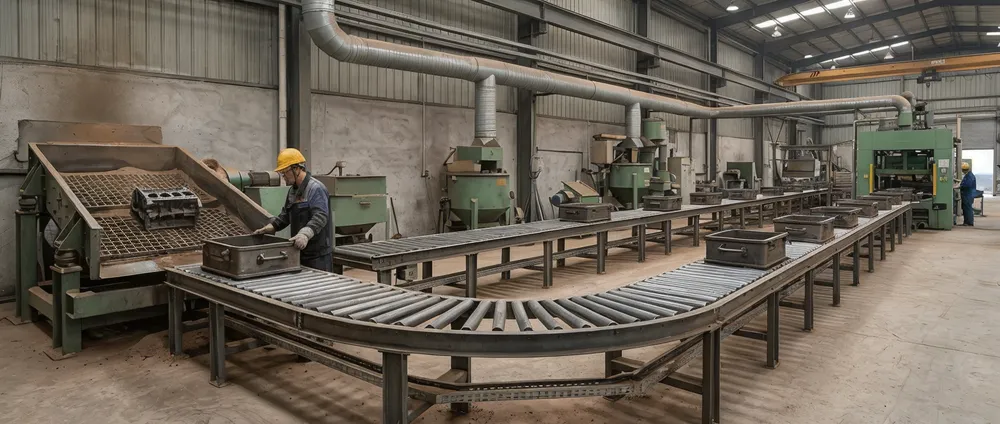
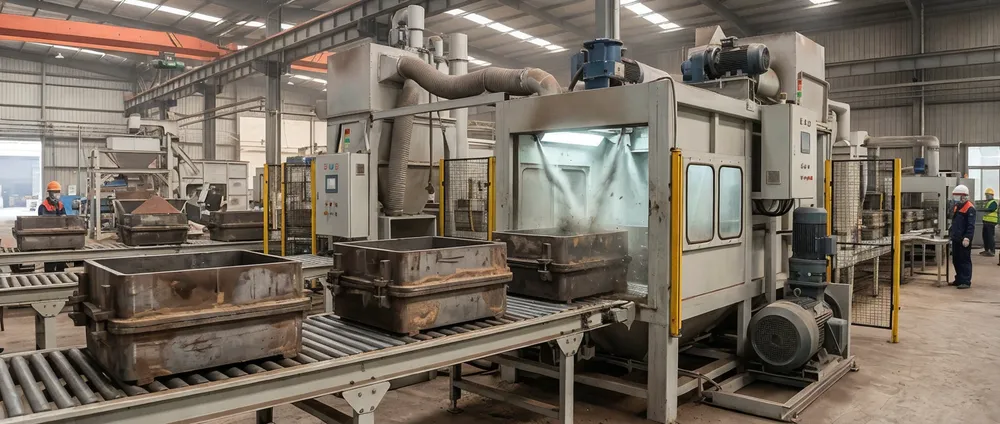
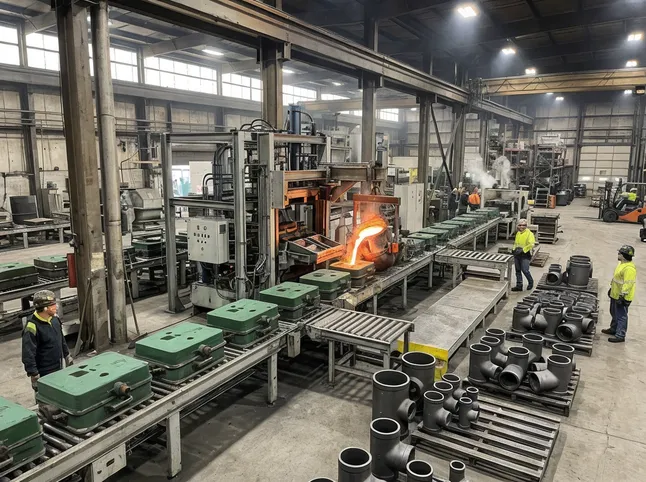
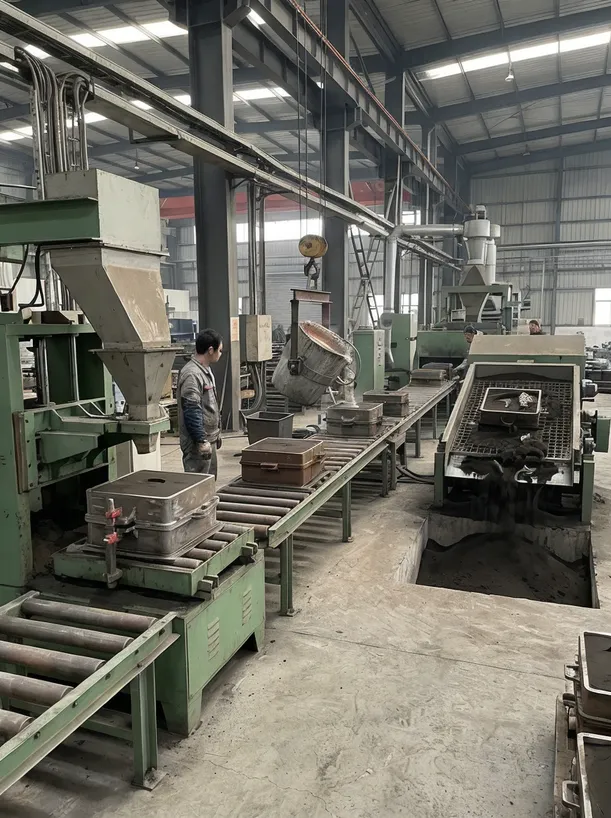
A clay sand casting line handles the entire production sequence from empty flask to finished casting — molding, pouring, cooling, and shakeout. This is distinct from a clay sand processing line, which prepares and reclaims the sand itself. You need both systems to run a foundry, but they solve different operational problems. The processing line delivers consistent sand quality; the casting line converts that sand into castings at your target throughput rate.
Our casting lines ship as modular systems: a molding station, a pouring system, a cooling conveyor, and shakeout equipment. Most buyers configure all four modules together because bottlenecks in any single stage idle the entire line.
Where prepared sand forms into molds. Sets the upstream pace — a station producing 50 molds/hour defines capacity for every downstream module.
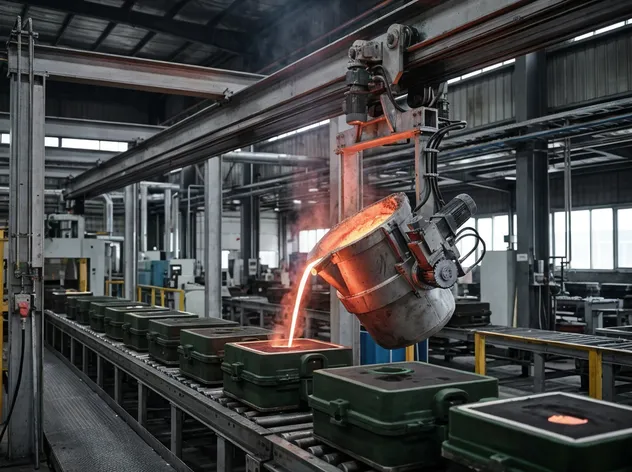
Manual ladle or automated pouring. Configured to accommodate ladle transfer from induction furnaces, cupola furnaces, or holding furnaces.
Where castings solidify. Conveyor length must match molding rate — 50 molds/hour needs enough conveyor to handle 50 molds' worth of cooling time.
Separates castings from used sand. Must process 50 molds' worth of used sand per hour — otherwise molds stack up waiting for downstream to catch up.
Bottleneck Warning
A molding station that produces 50 molds per hour needs a cooling conveyor long enough to handle 50 molds' worth of cooling time, plus shakeout capacity to process 50 molds' worth of used sand — otherwise molds stack up waiting for downstream stages to catch up. Configure all four modules to the same throughput target.
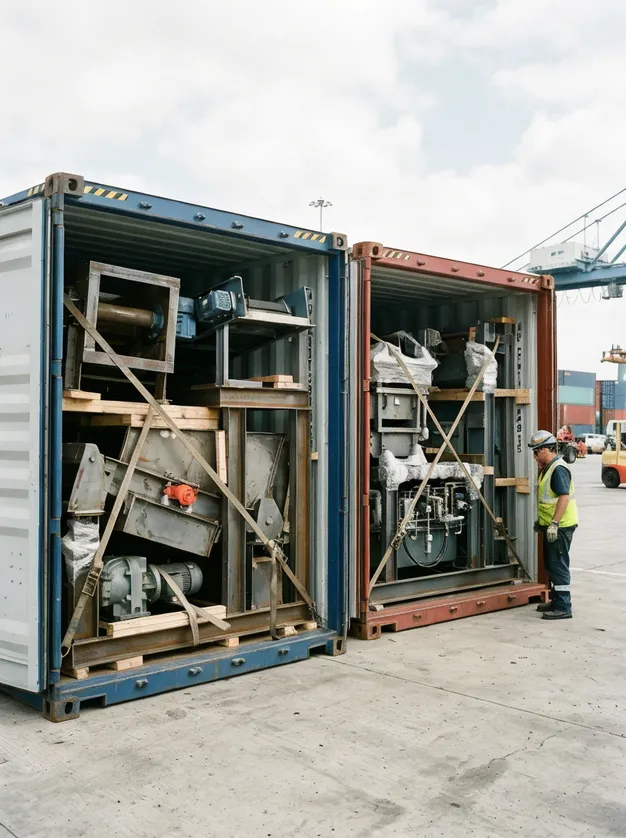
We design every module to ship in standard containers and bolt together on your factory floor. A typical 50 molds-per-hour system fits in three 40-foot containers. Assembly takes 4–6 days with our commissioning team on-site, plus another 2–3 days for calibration and operator training.
The modular approach means you can start with a basic configuration (manual pouring, shorter cooling conveyor) and add automation or capacity later without replacing the core molding equipment.
3
40 ft containers
(50 molds/hr system)
4–6
Days assembly
+ 2–3 days calibration
∞
Scalable
Add modules later
Integration with your existing sand system and melting furnace matters more than the casting line's standalone specs. Our systems connect to most clay sand processing lines via standard conveyor interfaces.
Prepared sand feeds into the molding station's hopper; used sand returns to your reclamation system after shakeout. Standard conveyor interfaces fit most existing clay sand processing lines.
Capacity Example
A mid-volume sand processing line at 100 tons/day supports 2–3 casting lines at 50 molds/hour each (assuming 400–500 kg of sand per mold).
Pouring systems accommodate ladle transfer from induction furnaces, cupola furnaces, or holding furnaces. We configure the pouring station height and flask positioning to match your melting equipment's ladle handling system.
What We Match
Pouring station height, flask positioning, and ladle transfer path — all configured to your melting equipment.
Lead time runs 50–65 days from deposit to factory departure. Commissioning happens within 10 days of equipment arrival at your facility.
Contact us with your target casting output (molds per hour), mold size range, and alloy types — we'll specify a casting line configuration that integrates with your current sand and melting systems.
Deposit
Project kickoff & engineering confirmation
50–65 Days Manufacturing
Factory production & pre-delivery testing
Shipping & Arrival
Container freight to your facility
≤10 Days Commissioning
Assembly, calibration & operator training
On This Page
Clay sand casting lines scale across three capacity ranges, and the differences aren't just about speed — they're about automation level, labor requirements, and operational flexibility. A 20–50 molds-per-hour system uses manual pouring and basic flask handling. A 50–100 molds-per-hour line adds automated pouring and PLC-controlled cooling. A 100+ molds-per-hour system runs full automation with parallel molding stations and zero-operator mold handling.
Small-Scale
Manual pouring, basic flask handling. Suited for 1–2 shift foundries with varied product mixes.
Mid-Scale
Automated pouring, PLC-controlled cooling. Balanced throughput with moderate labor.
High-Scale
Full automation, parallel molding stations, zero-operator mold handling for continuous production.
This setup works for foundries running 1–2 shifts with varied product mixes. The molding station uses hydraulic compaction with manual pattern changes — you can swap mold designs in under 15 minutes. Pouring happens via manual ladle: your operators transfer molten metal from the furnace to each mold using a two-person ladle team. The cooling conveyor runs 8–12 meters, providing 10–15 minutes of cooling time before shakeout. Shakeout uses a vibrating table that separates castings from sand — one operator feeds molds onto the table, another removes castings and routes used sand back to reclamation.
This configuration makes sense when your order volumes don't justify continuous production, or when you're casting multiple alloys that require different pouring temperatures and cooling times. Manual pouring gives you flexibility — you can switch from gray iron to bronze mid-shift without reconfiguring automated equipment.
20m × 10m
Footprint
55 kW
Total Power
4
Operators/Shift
<15 min
Pattern Swap
Labor cost per casting is higher — four operators for 20–50 castings per hour — and pouring consistency depends on operator skill. If your ladle team pours too fast, you get turbulence and oxide inclusions. Too slow, and the metal starts solidifying before the mold fills completely.
We provide 3 days of pouring technique training during commissioning, but expect a 2–3 week learning curve before your team hits consistent fill rates.
Automated pouring enters at this tier, delivering consistent fill rates, reduced labor dependency, and measurably better casting quality. The pouring system uses a servo-controlled ladle that tilts at programmable rates — you can store 10+ pouring recipes in the controller (pour rate, tilt angle, hold time) and recall them with a touchscreen tap. The system weighs each pour and logs the data to the PLC, giving you full traceability for every casting produced.
Cycle time drops to 25–30 seconds per mold versus 40–50 seconds for hydraulic systems — a direct throughput multiplier without increasing footprint.
Conveyor extends to 15–20 meters, providing 18–25 minutes of cooling time — sufficient for most ferrous alloy casting geometries at this production rate.
Molds enter one end; castings and separated sand exit the other — no manual handling required. The shakeout conveyor feeds directly into your sand reclamation system's return conveyor, closing the loop.
Manages the molding station, handles pattern swaps, and monitors compaction quality.
Loads the ladle from the melting furnace, monitors pour quality via PLC data, and handles exceptions when sensor thresholds are breached.
Removes castings from the shakeout conveyor, checks for surface defects, and routes rejects for rework or scrap.
The automated pouring system's recipe storage makes product changeovers significantly faster. Switching from one casting to another takes 5–10 minutes (pattern change plus pouring recipe recall) instead of 20–30 minutes with manual systems. This configuration suits foundries running 2–3 shifts with moderate product variety (3–8 core casting designs).
Full automation — parallel molding stations, automated flask circulation, enclosed cooling conveyors, and continuous shakeout. This setup is for foundries running 24/7 production with narrow product ranges (1–3 casting designs that rarely change).
The system includes two molding stations running in parallel, each producing 50–60 molds per hour. The PLC coordinates both stations to maintain consistent output even when one unit pauses for pattern changes. This dual-station architecture is critical — it means a pattern changeover on one line doesn't halt your entire operation.
Flasks move through the system on powered conveyors — from molding to pouring to cooling to shakeout and back to molding — with zero manual handling. The system tracks each flask's position via RFID tags, so the PLC knows which mold is ready for pouring, which is cooling, and which is ready for shakeout.
Pouring happens at two stations (one per molding line), each with its own automated ladle system. The cooling conveyor runs 25–35 meters in a serpentine layout (saves floor space vs. a straight line), providing 30–40 minutes of cooling time — sufficient for most ductile iron and gray iron castings without forced-air supplementation.
100+
Molds / Hour
40m × 18m
Footprint
180 kW
Power Demand
5
Operators / Shift
Molding Station A
Pattern monitoring & quality
Molding Station B
Pattern monitoring & quality
Pouring Oversight
Loading ladles, pour quality across both stations
Shakeout QC
Quality inspection & defect routing
Flask Circulation
Coordinating flow & maintenance alerts
This configuration costs roughly 2.8× the small-scale system, but it's the only option that holds ±0.5mm mold tolerance and consistent casting quality across 12-hour shifts at 100+ molds per hour. The cost premium pays for itself in reduced scrap, eliminated manual handling errors, and the ability to run extended shifts without quality degradation.
±0.5mm mold tolerance maintained consistently — even across extended production runs. Automated flask tracking and PLC-coordinated molding eliminate the drift that plagues manually operated lines after 6–8 hours of continuous production.
We built one of these for a North American buyer in 2018 — they're producing ductile iron pipe fittings at 110 molds per hour with 97% uptime. The key to that reliability: the automated flask circulation system eliminates manual handling damage (dropped flasks, misaligned patterns), and the dual molding stations provide redundancy — if one station goes down for maintenance, the other keeps running at 50–60 molds per hour instead of idling the entire line.
110
Molds/Hr
97%
Uptime
Extending a small-scale clay sand casting line with automated pouring and a longer cooling conveyor — typical 3-week upgrade scope.
If you start with a small-scale system and later need more capacity, you can add automated pouring and extend the cooling conveyor without replacing the core molding equipment. The upgrade takes about three weeks of downtime and costs 50–60% of a new mid-volume system.
Mid-Volume → High-Volume: Not Recommended
We don't recommend trying to upgrade a mid-volume line to high-volume specs. The structural differences — parallel molding stations, automated flask circulation, RFID tracking — require a ground-up rebuild. Better to add a second mid-volume line if you need incremental capacity growth beyond 100 molds per hour.
| Scenario | Feasibility | Downtime | Cost vs. New System |
|---|---|---|---|
| Small → Mid-Volume | Recommended | ~3 weeks | 50–60% |
| Mid → High-Volume | Not viable | Ground-up rebuild | Add 2nd line instead |
Key structural barriers to mid→high-volume conversion: parallel molding stations require wider bay spacing, automated flask circulation needs dedicated rail infrastructure, and RFID tracking integration demands PLC-level rewiring across the full line.
Pouring system selection affects labor cost, casting quality consistency, and operational flexibility more than any other configuration decision. Manual ladle pouring costs less upfront but requires skilled operators and produces variable fill rates. Automated pouring costs more but delivers consistent results and reduces labor. The right choice depends on your product mix, production volume, and labor availability.
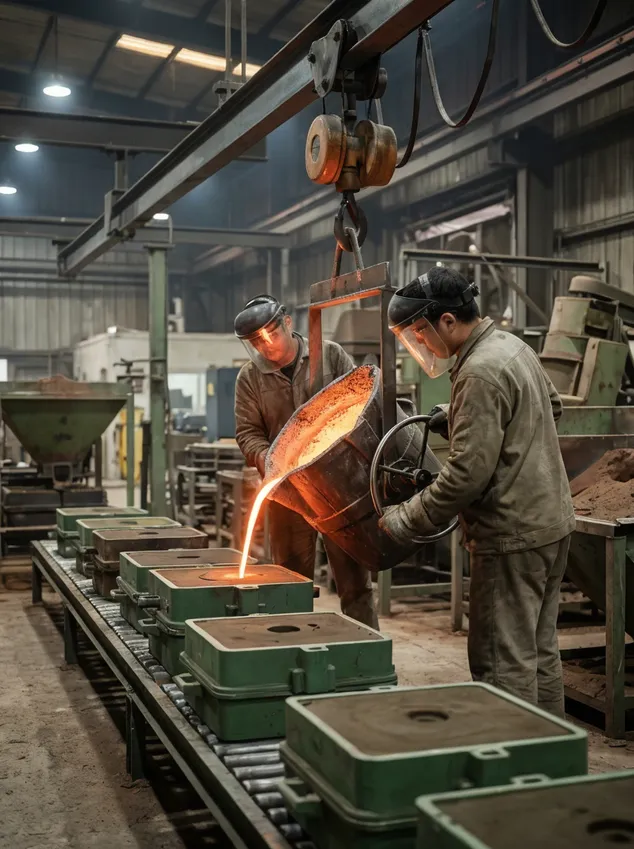
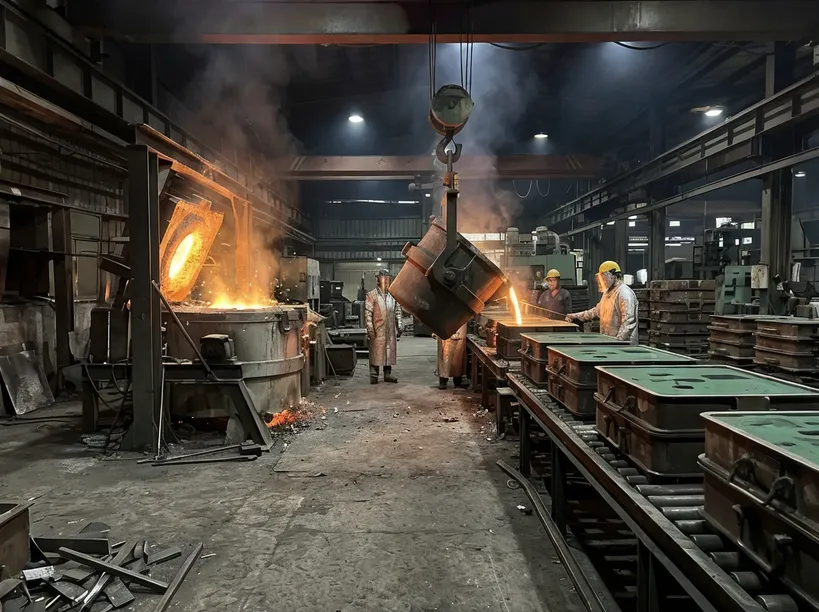
Two operators handle a refractory-lined ladle (50–200 kg capacity depending on your casting size) and transfer molten metal from your melting furnace to each mold. The ladle team controls pour rate by tilting speed and angle — faster tilt for large molds with wide gates, slower tilt for thin-wall castings that need controlled fill.
This method works well for foundries casting multiple alloys (gray iron, ductile iron, bronze, aluminum) because you can switch alloys mid-shift without reconfiguring equipment. Just empty the ladle, let it cool, reline if needed, and start pouring the next alloy.
Ladle Capacity
50–200 kg
Sized to casting weight
Operators Required
2 per station
Dedicated ladle team
Alloy Flexibility
Multi-alloy
Switch mid-shift
Manual ladle pouring — operators control fill rate via tilt angle and speed.
The core economics of manual pouring systems
Two operators dedicated to pouring means higher cost per casting, and their skill level directly affects quality. The variation in pour rate between experienced and inexperienced teams has measurable impact on defect rates.
±5–8% pour rate variation
Consistent casting density, minimal cold shuts, controlled turbulence. Requires 4–6 weeks of daily practice beyond initial training to reach this level.
±15–20% pour rate variation
Shows up as inconsistent casting density, cold shuts (metal solidifying before the mold fills), or turbulence defects. Quality variance is the primary cost risk.
TZFoundry commissioning support: We provide 3 days of pouring technique training during commissioning, covering tilt angles, pour rates for different alloy viscosities, and ladle maintenance. Real proficiency takes 4–6 weeks of daily practice after this initial training.
PPE and environmental controls for manual pouring operations
Manual pouring exposes operators to molten metal splash risk and radiant heat. Your team needs full PPE and you'll need ventilation to handle fume exposure.
Aluminized Suits
Face Shields
Heat-Resistant Gloves
Steel-Toed Boots
Budget $2,000–3,000 per operator for proper PPE, plus annual replacement of heat-damaged gear.
Manual pouring is the right configuration choice when your operation meets these conditions:
Varied Product Mix
5+ different castings per week with frequent changeovers
Multiple Alloys
Gray iron, ductile iron, bronze, aluminum — switch mid-shift
Lower Volume
Under 50 molds/hour where automated capex doesn't pay back quickly
Favorable Labor Economics
Low labor costs and high equipment import duties favor manual systems
A servo-controlled ladle mounted on a gantry or rail system moves along your cooling conveyor, stopping at each mold to pour a programmed amount of metal at a controlled rate. The system uses load cells to weigh the ladle before and after each pour, so you know exactly how much metal went into each mold. Pour rate, tilt angle, and hold time are programmable — you can store recipes for different casting designs and recall them instantly.
Consistency is the main advantage. Automated systems hold ±2–3% variation in pour rate across entire shifts, regardless of operator fatigue or skill level. That translates to tighter casting weight tolerances — important if you're selling by weight or machining to final dimensions — and fewer defects from inconsistent fill. The system also logs every pour to the PLC: metal weight, pour duration, any alarms or exceptions. This gives you traceability for quality audits.
Pour rate variation across full shifts — independent of operator skill or fatigue
Typical payback period at 50–100 molds/hour mid-volume production rates
Oversees the entire automated pour station vs. two operators for manual ladles
One operator oversees the automated pouring system instead of two operators handling manual ladles. That operator's job is loading the ladle from your melting furnace (via a transfer ladle or direct tap), monitoring pour quality on the touchscreen, and handling exceptions — skipped molds, low metal level alerts, equipment faults.
The labor savings typically pay back the automated system's premium in 18–30 months at mid-volume production rates (50–100 molds per hour).
Automated pouring requires consistent flask positioning and mold sizing. If your molds vary in height or gate location, you'll need to reconfigure the pouring station for each product — adjust gantry height, reposition the pour point — which takes 15–20 minutes per changeover. Manual ladle teams adapt to mold variations on the fly.
Automated systems lock you into specific alloy types. Switching from gray iron to bronze requires cleaning the ladle, adjusting pour parameters, and running test pours to verify the new recipe. That's a 2–3 hour process vs. 30–45 minutes for manual systems.
Automated pouring is the right investment when your operation meets these criteria:
Some buyers start with manual pouring and add automation later as volumes grow. We can retrofit an automated pouring system onto an existing casting line if you've left space in your initial layout.
Clearance Required
3–4 meters
Above the cooling conveyor for the gantry system
Retrofit Downtime
2–3 weeks
Working around existing equipment
Retrofit Cost
~60%
Of a new automated system's price — higher because of working around existing equipment
Plan-Ahead Savings
30–40%
Reduction in retrofit cost & downtime with pre-designed mounting points
Planning to automate within 3–5 years?
Tell us during the initial quotation phase. We'll design the molding station and cooling conveyor with automation-ready mounting points and electrical provisions — cutting future retrofit cost and downtime by 30–40%.
A clay sand casting line consumes prepared sand from your processing system and returns used sand after shakeout — the two systems form a closed loop. Integration points matter because mismatches in capacity, conveyor interfaces, or sand buffer storage create bottlenecks that idle equipment and waste labor.
Clay + moisture mixed to spec
Molding → Pouring → Cooling → Shakeout
Used sand back to processing
Prepared sand (mixed with clay and moisture to your target specs) feeds into the casting line's molding station via a conveyor or pneumatic transport system. The molding station needs a hopper that holds 15–30 minutes of sand inventory — enough buffer to keep molding running if your sand processing line pauses for maintenance or batch adjustments.
For a 50 molds-per-hour casting line using 400 kg of sand per mold, that's 5,000–10,000 kg of hopper capacity (roughly 3–6 cubic meters depending on sand bulk density).
50 molds/hr × 400 kg/mold = 20,000 kg/hr sand consumption. A 15–30 min buffer requires 5,000–10,000 kg hopper capacity (≈ 3–6 m³ depending on bulk density).
Sand feed hopper at the molding station intake point
Our molding stations include a 5-cubic-meter hopper as standard. If you're running higher volumes or want more buffer capacity, we can upsize to 8–10 cubic meters (adds about 10% to the molding station cost).
The hopper includes a level sensor that alerts your sand processing line's PLC when inventory drops below 30% — this gives your mixing system time to prepare the next batch before the casting line runs out of sand.
5 m³
~15 min buffer at 50 molds/hr
8–10 m³
~25–30 min buffer at 50 molds/hr
Level Sensor — PLC Alert
Triggers at 30% inventory, signals your sand mixer to prepare next batch
Most sand processing lines discharge prepared sand onto a belt conveyor running at 0.3–0.5 m/s. Our molding station hoppers accept sand from conveyors at heights between 2.5–4 meters (adjustable mounting brackets let you match your existing conveyor discharge height).
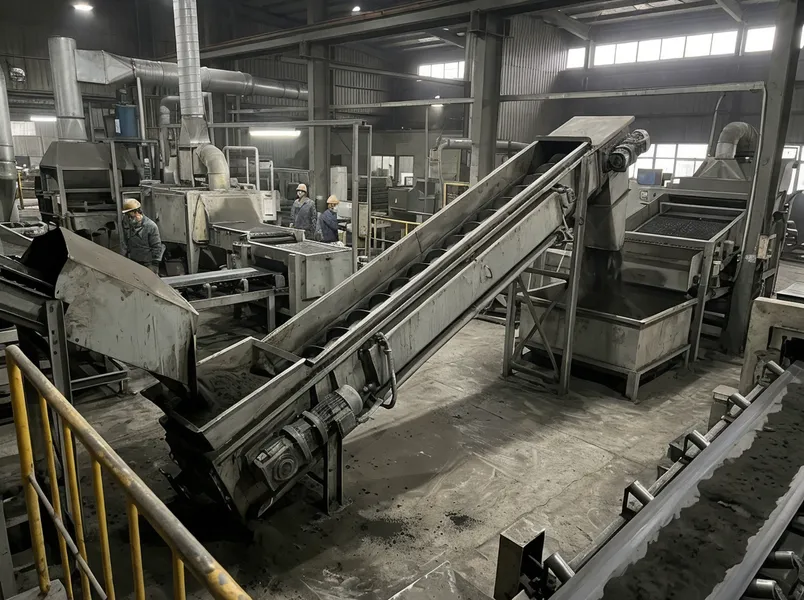
After shakeout separates castings from sand, the used sand needs to return to your clay sand processing line's reclamation system. Used sand is contaminated with metal splash, burnt clay, and core material (if you're using cores), so it can't go directly back into molding — it must pass through reclamation (attrition milling, washing, screening) before remixing with fresh clay.
Our shakeout systems discharge used sand onto a return conveyor that connects to your reclamation system's inlet. The return conveyor runs at 0.4–0.6 m/s and can elevate sand up to 3 meters if your reclamation equipment sits above floor level. For a 50 molds-per-hour casting line, used sand return rate is roughly 20 tons per hour (assuming 400 kg per mold). Your reclamation system needs to process at least that rate to avoid building up a backlog of used sand.
Return conveyor transfers used sand from shakeout to reclamation at 0.4–0.6 m/s
If you're running our mid-volume sand processing line (100 tons per day reclamation capacity, which is roughly 4 tons per hour in continuous operation), you can support one 50 molds-per-hour casting line (20 tons per hour used sand return) if you oversize the reclamation system to 25–30 tons per hour. The extra capacity provides buffer for peak production periods and maintenance downtime.
20 t/hr
Used sand return rate
(50 molds/hr line)
25–30 t/hr
Recommended reclamation
capacity with buffer
3 m
Max conveyor
elevation lift
If you're planning to run multiple casting lines off one sand processing system, tell us during the quotation phase — we'll size the reclamation unit accordingly and configure multiple return conveyor inlets.
Some buyers add a used sand storage bin between shakeout and reclamation — this decouples the two systems so the casting line can keep running even if reclamation goes down for maintenance. A 20-cubic-meter storage bin holds about 30 tons of used sand, which gives you 60–90 minutes of buffer time at a 20 tons-per-hour return rate.
The bin costs $8,000–12,000 depending on size and discharge mechanism (gravity flow vs. screw conveyor), and it's worth considering if you're running 24/7 production where any downtime costs thousands per hour in lost output.
Discharge options: gravity flow or screw conveyor. Recommended for 24/7 production lines where unplanned reclamation downtime carries high per-hour costs.
A 20 m³ used sand buffer bin decouples the casting line from the reclamation system, preventing costly downtime during maintenance windows.
If you already have a sand processing line (ours or another manufacturer's) and you're adding a casting line, we'll need specs on your sand system's output capacity, conveyor discharge height, and reclamation inlet configuration. Send us photos of your current sand system layout and a simple sketch showing where you want to position the casting line — we'll design the conveyor interfaces and hopper mounting to match your existing equipment.
Most integrations are straightforward (standard belt conveyors and hopper inlets), but occasionally we encounter non-standard configurations — overhead pneumatic systems, below-grade reclamation pits — that require custom interface designs. Those add 2–3 weeks to engineering time and 10–15% to equipment cost, but they're necessary to make the systems work together reliably.
Custom interface designs are sometimes required for:
If you're building a complete foundry from scratch (no existing sand or casting equipment), we'll quote the sand processing line and casting line together as an integrated system — that lets us optimize the layout, size the reclamation capacity correctly, and pre-configure all conveyor interfaces at the factory.
Integrated systems ship with pre-wired electrical connections and pre-aligned conveyor mounting brackets, which cuts on-site installation time by 30–40% compared to integrating separate systems in the field.
Faster on-site installation vs. field-integrated separate systems
Casting line configuration depends on what you're pouring — gray iron, ductile iron, and bronze have different pouring temperatures, cooling times, and shakeout requirements. Matching your equipment to your alloy type prevents bottlenecks and quality problems.
Gray iron pours at 1350–1400°C and solidifies relatively quickly (8–15 minutes for typical section thicknesses of 10–25mm). This is the most common alloy for clay sand casting lines because it's forgiving — wide pouring temperature window, good fluidity, minimal shrinkage defects. Typical applications include engine blocks, brake drums, pump housings, and machinery bases.
Conveyor Length
12–15m
Conveyor Speed
0.8–1.0m/min
Cooling Time
12–15min
At 50 molds/hour with a 10-minute cooling requirement, a 12–15 meter cooling conveyor at 0.8–1.0 m/min provides 12–15 minutes of cooling time before shakeout.
Gray iron castings separate cleanly from sand with moderate vibration — a standard vibrating table or conveyor handles this without special configuration. Used sand return rate is predictable because gray iron doesn't generate much burnt sand or metal penetration into the mold surface.
Gray iron castings are high-volume, price-competitive products. Your margin comes from operational efficiency — low labor cost per casting, high equipment uptime, minimal scrap rate. Buyers in this segment typically want mid-volume casting lines (50–100 molds/hour) with automated pouring to keep labor costs down.
Automotive Tier-2/Tier-3 Requirements
Ductile iron pours at 1400–1450 °C and requires longer cooling times — 15–25 minutes for section thicknesses of 15–40 mm — because the graphite nodularization process needs controlled solidification rates. Typical applications include pipe fittings, valve bodies, manhole covers, and structural castings for infrastructure projects.
For ductile iron at 50 molds per hour with a 20-minute cooling time, you need an 18–22 meter cooling conveyor. Shakeout requires more aggressive vibration than gray iron because ductile iron's higher strength makes castings stick to sand more firmly.
1400–1450 °C
Higher than gray iron — accelerates clay binder degradation
18–22 m
At 50 molds/hr with 20-min cooling time
5–8 mm
vs. 3–5 mm for gray iron — higher strength demands more force
45–60 sec
vs. 30–40 sec for gray iron
Used sand return includes more burnt sand — ductile iron's higher pouring temperature degrades clay binders faster than gray iron. Your reclamation system needs higher attrition milling capacity to strip the burnt clay from sand grains, maintaining sand quality and mold consistency across production runs.
| Parameter | Gray Iron | Ductile Iron |
|---|---|---|
| Pouring temperature | 1350–1400 °C | 1400–1450 °C |
| Cooling time (15–40 mm sections) | 10–15 min | 15–25 min |
| Shakeout vibrator amplitude | 3–5 mm | 5–8 mm |
| Shakeout dwell time | 30–40 sec | 45–60 sec |
| Sand reclamation load | Standard attrition milling | Higher attrition milling capacity |
Ductile iron castings serve infrastructure and industrial markets with longer project cycles and higher per-unit values than gray iron. Your margin comes from quality consistency — meeting mechanical property specs and dimensional tolerances — and delivery reliability, since infrastructure projects have penalty clauses for late delivery.
Buyers in this segment often want mid-volume casting lines with automated pouring (for consistent nodularization results) and extended cooling conveyors (to ensure complete solidification before shakeout). If you're supplying municipal water/sewer projects or industrial valve manufacturers, expect quality audits and material certifications — your casting line needs data logging and traceability features to satisfy those requirements.
Bronze alloys (typically 85% copper, 5% tin, 5% zinc, 5% lead) pour at 1100–1150°C and cool quickly — 5 to 10 minutes for section thicknesses of 8–20 mm. Bronze is significantly more expensive than iron ($8–12 per kg vs. $1–2 per kg for iron), so casting volumes are lower and the product mix is wider. Typical applications include valve bodies, pump impellers, marine hardware, and decorative architectural castings.
Cooling Conveyor Sizing
For bronze work at 20–30 molds per hour with an 8-minute cooling time, you need a 10–12 meter cooling conveyor. Shakeout is easier than iron — bronze doesn't bond strongly to clay sand, so castings separate with light vibration.
Metal Recovery — Every Gram Counts
Bronze's high per-kg value means you must capture every gram of metal splash and gate/riser material for remelting. TZFoundry shakeout systems for bronze work include a magnetic separation stage (removes iron contamination from previous iron pours) and a fines collection system (captures small bronze particles that would otherwise mix into used sand and get lost in reclamation).
Bronze casting line setup — shorter cooling zone, magnetic separation, and fines collection for maximum metal yield.
Bronze castings are lower-volume, higher-margin products. Your profit comes from three factors: material yield (minimizing metal loss in gates, risers, and splash), product mix flexibility (switching between different valve designs quickly), and quality (bronze buyers pay premium prices and expect zero-defect delivery).
Line Scale
20–50 molds/hour — small-scale lines optimized for wide product mix, not high throughput.
Pouring Method
Manual pouring preferred — provides flexibility across different bronze alloys and casting sizes without automated reprogramming.
Cooling Zone
Shorter conveyors — bronze's fast solidification doesn't require long cooling zones. 10–12 m is typical.
Pattern Changeover
Under 15 minutes — critical for marine equipment and architectural bronze work with frequent product changes and small batches (50–200 castings per order).
Typical Buyer Profile
Foundries supplying marine equipment manufacturers or architectural bronze fabricators. Expect frequent product changes and small batch sizes (50–200 castings per order). These operations need fast pattern changeover capability far more than they need high-speed automation.
Aluminum alloys pour at 700–750 °C and solidify very quickly — 3–6 minutes for section thicknesses of 5–15 mm. Aluminum's low density (2.7 g/cm³ vs. 7.2 g/cm³ for iron) means castings are lighter and easier to handle, but the low pouring temperature creates a specific challenge for clay sand systems: aluminum doesn't superheat the mold surface enough to burn off moisture, so you get more gas-related defects (porosity, blowholes) if your sand moisture content isn't tightly controlled.
Aluminum castings serve automotive lightweighting and aerospace markets with strict quality requirements and high per-unit values. Your margin comes from two things:
Aluminum buyers have zero tolerance for porosity or inclusions. Consistent quality is your competitive moat.
Automotive programs have tight launch schedules. Quick response time wins long-term contracts.
Buyers in this segment want mid-volume casting lines with automated pouring (for consistent fill rates that minimize turbulence) and integrated quality monitoring (moisture sensors, pour weight logging). If you're supplying automotive OEMs or aerospace tier-2 suppliers, expect PPAP documentation requirements and first-article inspections — your casting line needs full traceability and process control features.
Automated aluminum pouring station with inline moisture control — critical for automotive-grade porosity specs.
Unlike iron castings that tolerate 3.5–5% sand moisture, aluminum work demands a much tighter 2.5–3.5% window. Because aluminum pours at only 700–750 °C — far below iron's 1,350–1,500 °C — there isn't enough superheat to burn off excess mold moisture. Any overshoot directly produces gas porosity and blowholes. Your sand preparation line must include inline moisture sensors and PLC-controlled water addition to maintain spec consistency across every cycle.
Most buyers focus on molding speed when specifying a casting line, but cooling time and shakeout capacity determine your actual throughput. A molding station that produces 60 molds per hour is useless if your cooling conveyor only has space for 40 molds or your shakeout system can only process 45 molds per hour — the excess molds stack up waiting for downstream stages, and eventually you have to slow down molding to match the bottleneck.
Shaking out a casting that's still partially molten damages the casting surface and creates safety hazards — molten metal spilling from broken molds.
400–500°C
Safe Shakeout Temp
Castings must cool below this range before shakeout (varies by alloy & section thickness)
3 Factors
Drive Cooling Time
Alloy type, section thickness, and mold size together determine required duration
20–30%
Typical Underestimate
Most buyers calculate solidification time, not safe handling temperature
1 min/mm
Per mm of section thickness
Example: 15mm wall thickness → 15 minutes cooling time
1.2–1.5 min/mm
Slower solidification due to nodularization
Note: Plan 20–50% more conveyor length vs. gray iron
0.6–0.8 min/mm
Faster cooling — higher thermal conductivity
Vs. gray iron: ~40% shorter cooling cycle
0.4–0.6 min/mm
Very fast cooling, but mold still needs safe handling temp
Caution: Don't skip cooling — mold temperature matters for safe handling
Cooling Time × Conveyor Speed = Required Length
15 min cooling time at 1.0 m/min conveyor speed = 15 meters required conveyor length
At 50 molds/hour with each mold occupying 0.8 m (flask + spacing) → 50 molds on conveyor at any time during continuous operation
That's 40 meters of mold length, which fits on a 15-meter serpentine conveyor — three parallel runs of 5 m each, connected by 180° turns
Serpentine conveyor layout — maximizes cooling path within compact floor space
Most buyers underestimate required cooling length by 20–30% because they calculate based on solidification time (when the metal is fully solid) instead of safe handling temperature (when the mold is cool enough for shakeout).
Real Example
A foundry tried to run 50 molds/hour on a 10-meter cooling conveyor (should have been 15 m for their alloy and section thickness). They had to slow the conveyor to 0.65 m/min to get enough cooling time — dropping actual throughput to 35 molds/hour. The molding station sat idle 30% of the time waiting for conveyor space to open up.
The simplest configuration — one continuous run from the pouring station to shakeout. Straightforward engineering, fewer drive motors, and lower mechanical complexity.
Floor Space Requirement
A 20-meter straight conveyor needs 22–25 meters of floor length (including equipment clearances on both ends).
Best for: Foundries with long, open bays and no floor-space constraints.
Folds the cooling path into multiple parallel runs connected by 180-degree turns — dramatically reducing floor space requirements while maintaining the same effective cooling length.
Floor Space Requirement
A 20-meter serpentine conveyor fits in just 8–10 meters of floor length — roughly 60% less space than a straight-line equivalent.
Cost premium: 15–20% higher than straight-line (more complex conveyor structure, additional drive motors for the 180° turns).
Engineering note: Requires careful design to prevent molds from tipping during the turns — particularly important for tall or narrow flask geometries.
Straight-line vs. serpentine conveyor layout: same 20 m cooling path, different floor-space footprints.
Sheet metal covers contain heat and fumes throughout the cooling run. Relevant for foundries operating under strict air quality regulations or in cold climates where heat retention improves cooling uniformity.
No covers — lower cost, easier access for inspection and maintenance. The default choice for most buyers unless local regulations specifically require fume containment at the cooling stage.
Some high-value castings — aerospace components, precision valve bodies, safety-critical parts — require controlled cooling rates to achieve specific metallurgical properties. Uncontrolled cooling can produce inconsistent grain structures and mechanical properties that fail certification testing.
Zone-Controlled Fans
Independent fan zones along the conveyor length allow variable air flow for staged cooling profiles.
Water Mist Systems
Fine mist sprays accelerate cooling in specific zones where faster heat extraction is required.
IR Sensor Feedback
Infrared temperature sensors monitor casting surface temperature in real time, adjusting fan/mist output automatically.
Cost Impact
Adds 25–35% to cooling conveyor cost — significant but justified for applications where repeatable mechanical properties determine part acceptance or rejection.
Why It Matters
Essential if your buyers require certified material test reports — controlled cooling delivers repeatable mechanical properties in every batch, not just the test samples.
Shakeout separates castings from used sand by vibrating the mold until the sand breaks apart and falls through a screen, leaving the casting behind. Required vibration intensity and dwell time depend on alloy type, mold size, and sand condition.
Molds are manually placed on a vibrating table (typically 1.5 m × 2 m), vibrated for 30–60 seconds until sand separates, then castings are manually removed. One operator handles the entire shakeout process — place mold, start vibration cycle, remove casting, route used sand to return conveyor, repeat.
Molds are automatically fed onto a vibrating conveyor (3–5 meters long), vibrated continuously as they move along the conveyor, and castings exit at the discharge end while used sand falls through the conveyor screen into a collection hopper below. One operator oversees the process — remove castings from the discharge end, check for defects, handle any molds that don't fully separate (occasionally a mold needs extra vibration or manual breakup).
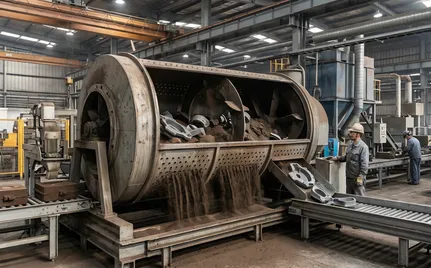
Molds are fed into a rotating drum (2–3 meters diameter, 4–6 meters long) with internal lifters that tumble the molds as the drum rotates. Sand separates and falls through perforations in the drum wall, castings exit at the discharge end. Works for high-volume operations with robust castings — gray iron and ductile iron work well; thin-wall bronze or aluminum castings can be damaged by tumbling.
Shakeout capacity must exceed molding capacity by 10–15% to provide buffer for maintenance and operational variations. If your molding station produces 50 molds per hour, your shakeout system should handle 55–60 molds per hour. Otherwise you'll build up a backlog of cooled molds waiting for shakeout, which eventually forces you to slow down or stop molding entirely.
Used sand exits the shakeout system at 150–250°C — still hot from the casting — and needs to cool before returning to your sand processing line's reclamation system. Most reclamation equipment operates best with sand below 80°C.
Some buyers add a cooling screw conveyor or fluidized bed cooler between shakeout and reclamation — this drops sand temperature to 60–80°C over a 5–10 minute residence time. The cooler costs $15,000–25,000 depending on capacity, and it's worth considering if your reclamation system is sensitive to temperature — some PLC-controlled moisture sensors give false readings when sand temperature exceeds 100°C.
Temperature Threshold
If your reclamation system uses PLC-controlled moisture sensors, sand above 100°C can cause false readings. A cooling stage between shakeout and reclamation eliminates this issue and protects downstream equipment.
Gates, risers, and metal splash separate from the casting during shakeout and mix with used sand. The recovery method depends on the alloy family you're casting.
Iron & Steel Castings
Simple overhead magnet pulls ferrous metal pieces from the sand stream
Recovers 85–90% of ferrous metal for remelting
Bronze & Aluminum Castings
Automated eddy-current separation for non-ferrous metals — or manual sorting for lower volumes
Recovers 70–80% of non-ferrous metal automatically
Downstream integration: After metal recovery, cleaned used sand routes into your clay sand reclamation line for moisture correction and rebonding before returning to the molding station.
The table below shows typical specifications for our clay sand casting line configurations. Actual specs depend on your mold size, alloy type, and site constraints — contact us for a detailed quotation based on your specific requirements.
| Specification | Small-Scale (20–50 molds/hr) | Mid-Volume (50–100 molds/hr) | High-Volume (100+ molds/hr) |
|---|---|---|---|
| Molding capacity | 20–50 molds/hour | 50–100 molds/hour | 100–120 molds/hour |
| Mold size range | 300×300mm to 600×500mm | 400×400mm to 700×600mm | 500×500mm to 800×600mm |
| Molding cycle time | 40–50 seconds | 25–30 seconds | 18–22 seconds |
| Pouring system | Manual ladle | Automated servo ladle | Dual automated stations |
| Pouring capacity | 500–2,000 kg/hour | 2,000–5,000 kg/hour | 5,000–8,000 kg/hour |
| Cooling conveyor length | 8–12 meters | 15–20 meters | 25–35 meters (serpentine) |
| Shakeout type | Vibrating table | Vibrating conveyor | Rotary drum |
| Power requirement | 55 kW | 95 kW | 180 kW |
| Footprint | 20m × 10m | 28m × 12m | 40m × 18m |
| Operators per shift | 4 | 3 | 5 |
| Compressed air (if pneumatic) | 0.6 MPa, 1.5 m³/min | 0.8 MPa, 2.5 m³/min | 1.0 MPa, 4.0 m³/min |
| Flask circulation | Manual | Semi-automated | Fully automated with RFID |
Specifications shown are typical configurations for gray iron and ductile iron casting. Bronze and aluminum applications may use different cooling conveyor lengths and cycle times. Mold size range can be customized — contact us if your castings fall outside the standard ranges shown above.
From entry-level 40–50 second cycles to high-output 18–22 second production rates across all three line scales.
Compact 20m×10m layouts for job shops up to 40m×18m serpentine configurations for continuous high-volume production.
Scalable power draws matched to line capacity — from 55 kW small-scale to 180 kW high-volume with pneumatic air support up to 4.0 m³/min.
Tell us your mold size, alloy type, and target output — we'll provide a detailed technical datasheet with exact parameters for your casting line.
Most casting line installations happen in operating foundries that already have melting furnaces, sand systems, and established floor layouts. Retrofitting a new casting line into an existing facility requires careful integration planning — you're working around structural columns, overhead cranes, utility runs, and adjacent equipment that can't be moved.
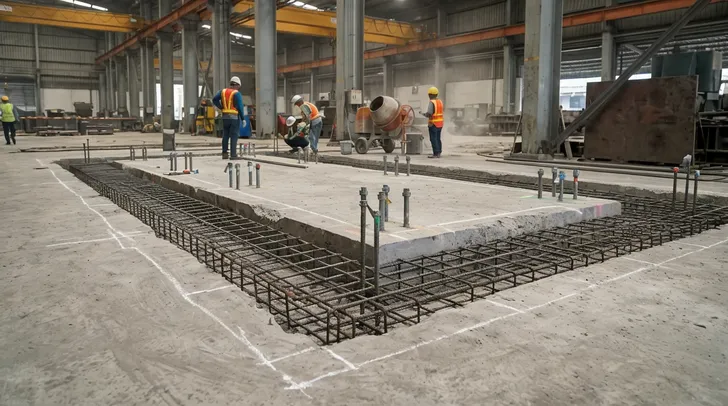
Clay sand casting lines generate dynamic loads from compaction rams (hydraulic or pneumatic cylinders that compress sand into molds) and shakeout vibration. Your floor slab needs to support 800–1,200 kg/m² static load plus 1.5× that value during peak dynamic loads.
Most industrial floors built in the last 20 years meet this spec, but older facilities (pre-1990 construction) sometimes have thinner slabs (150 mm vs. 200 mm) that need reinforcement.
We provide foundation drawings showing load distribution and anchor bolt locations as part of the pre-shipment documentation package.
If your floor is marginal, two options:
Pour a 200 mm thick, rebar-reinforced concrete pad under the molding station and shakeout equipment.
Install isolation mounts under equipment — reduces transmitted loads by 40–50%. Ideal for upper-floor installations where structural capacity is limited.
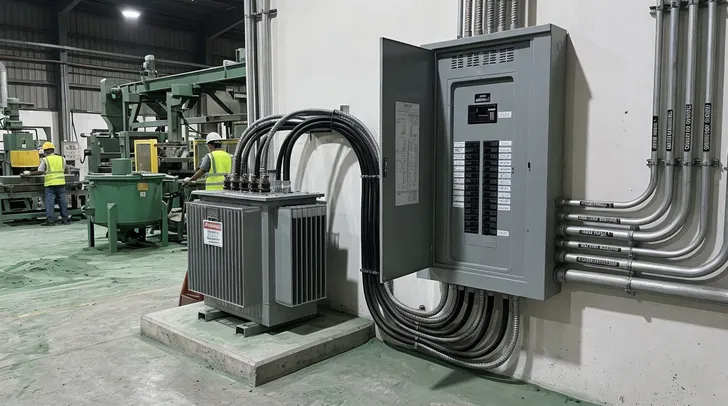
Casting lines need dedicated electrical service because startup surge current (when multiple motors start simultaneously) can trip breakers or cause voltage sags that affect other equipment.
Mid-volume system (95 kW rated power)
120–130 kW Service Capacity
25–30% overhead for surge current
Most buyers install a dedicated transformer and breaker panel for the casting line rather than tapping into existing foundry power distribution.
Our standard equipment runs on 380V or 415V three-phase power (50 or 60 Hz). If your facility uses different voltage (440V, 480V, 575V), we can configure motors and control systems to match — this adds 1–2 weeks to production lead time but doesn't significantly affect cost (motor suppliers stock multiple voltage options).
Tip: Tell us your electrical specs during the quotation phase so we can configure correctly from the start.
If you're running other foundry equipment (melting furnaces, sand processing lines) on a supervisory control system, our casting line's PLC can communicate via:
This lets you monitor casting line status (current production rate, equipment alarms, maintenance alerts) from your central control room and coordinate operations across multiple systems.
PLC Integration Cost
$3,000–$5,000
For programming and commissioning. Worth considering if you're running automated production where one operator oversees multiple equipment lines.
Pouring systems need to receive molten metal from your melting furnace at the right height and position for efficient ladle transfer. Manual ladle pouring works with any furnace type (induction, cupola, holding furnace) — your ladle team carries metal from the furnace tap to the casting line. Automated pouring requires a transfer ladle or direct tap positioned within 3–5 meters of the pouring station (closer is better to minimize metal temperature loss during transfer).
You'll need a transfer solution to bridge the gap
If your furnace is more than 5 meters from the planned casting line location, you'll need either a transfer ladle system or a heated trough.
A smaller ladle that shuttles metal from furnace to pouring station. Offers full repositioning flexibility — you can move the casting line later without rebuilding fixed infrastructure.
$8,000 – $15,000 depending on capacity
A refractory-lined channel that conveys metal from furnace to pouring station via gravity flow. Available with gas burner or electric resistance heating.
$20,000 – $40,000 depending on length and heating method
Buyer insight: Most buyers choose transfer ladles for flexibility — you can reposition the casting line later without rebuilding fixed trough infrastructure.
Manual ladle pouring works with any furnace type. Automated pouring requires furnace or transfer ladle within 3–5 m of pouring station.
Casting lines need periodic crane access for maintenance — lifting motors, replacing conveyor sections, moving heavy castings during setup. If your facility has an overhead crane, make sure the casting line layout leaves clearance for the crane hook to reach all major equipment modules. TZFoundry typically specifies 4–5 meters of overhead clearance above the molding station and shakeout equipment.
Verify your crane bay covers the planned casting line location. Ensure the crane hook can reach all major equipment modules — especially the molding station and shakeout area.
Clearance Required
4–5 m overhead
If your crane bay doesn't cover the planned casting line location, a jib crane provides localized lifting coverage with a rotating arm mounted to a column or wall.
Capacity
2-ton
Cost
$15,000 – $25,000
A portable alternative for facilities without overhead crane coverage. Rolls on floor-mounted rails or casters — ideal for smaller casting lines or temporary setups.
Capacity
1-ton
Cost
$8,000 – $12,000
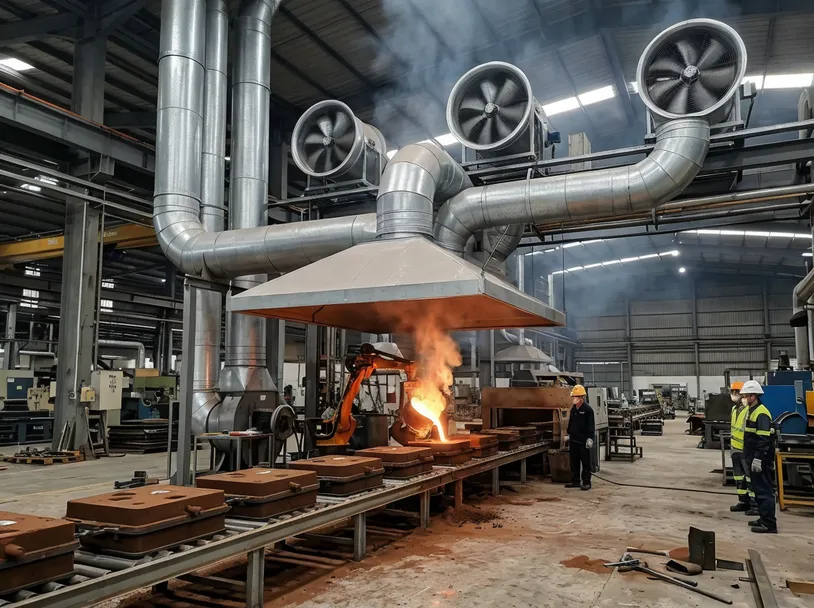
Pouring molten metal generates fumes — metal oxides, burnt sand binders, moisture vapor — that need ventilation to maintain air quality. The extraction requirements differ significantly between manual and automated pouring setups:
Produces intermittent fumes — only during the pour itself, roughly 10–20 seconds per mold. Lower continuous extraction demand.
Produces continuous fumes because the system pours non-stop. Requires higher-capacity, always-on extraction systems.
Mid-Volume Baseline
Plan for 3,000–5,000 m³/hour of exhaust airflow for mid-volume casting lines. This typically requires 2–3 roof-mounted exhaust fans plus ductwork to capture fumes at the pouring station.
Local Regulations Vary
Some jurisdictions require enclosed pouring stations with negative-pressure ventilation (fume hood setup). Others allow open pouring with general facility ventilation. Check your local environmental regulations before finalizing the casting line layout — adding fume control equipment after installation costs 2–3× more than designing it in from the start.
If you're integrating a casting line into an existing facility, we recommend a site survey before finalizing the quotation. Send us photos of your current foundry layout showing:
Include a simple sketch with dimensions — doesn't need to be CAD, a hand-drawn floor plan with measurements is fine. We'll use that information to design a casting line layout that fits your space and integrates with your existing equipment.
For complex integrations — tight floor space, multiple equipment interfaces, unusual utility configurations — we can send an engineer to your facility for an on-site survey.
Worth considering if you're investing $150,000+ in casting line equipment — better to identify integration issues during planning than during installation when equipment is already on-site and your production schedule is waiting.
Send us your floor plan, photos, and production goals. Our engineering team will design a casting line layout that integrates with your existing melting, sand processing, and material handling systems.
Flask inventory and circulation logistics affect your casting line's operational efficiency more than most buyers realize. Flasks — the metal frames that hold sand molds — need to circulate continuously through the system: from molding to pouring to cooling to shakeout and back to molding. If you don't have enough flasks in circulation, your molding station sits idle waiting for flasks to return from shakeout. If your flask return path is inefficient, you waste labor moving flasks manually.
Flask filled & compacted with sand mold
Molten metal poured into flask mold
Conveyor cooling — 15+ min typical dwell
Sand separated, empty flask returns to molding
You need enough flasks to fill the entire cooling conveyor plus a buffer for the molding station and pouring station. Here's the math for a 50 molds-per-hour line with 15 minutes of cooling time:
Cooling Conveyor
50 molds/hr ÷ 60 min/hr × 15 min = 12–13 molds on conveyor at any time
Molding Station Buffer
2–3 flasks — one being filled, one compacted, one transferring to pouring
Pouring Station Buffer
1–2 flasks — one being poured, one waiting
Total In Circulation
15–18 flasks required for continuous operation at rated capacity
Planning note: This calculation gives you the minimum working set. Add a maintenance spare buffer of 2–3 flasks to avoid downtime during welding repairs or pattern plate swaps.
We learned this the hard way: buyers who undersize their flask inventory end up with molding stations sitting idle 20–30% of the time waiting for flasks to return from shakeout. The molding equipment is capable of 50 molds per hour, but actual output drops to 35–40 molds per hour because of flask shortages.
5–10
Extra flasks needed to eliminate the bottleneck
$500–800
Cost per flask depending on size — a one-time investment
Adding 5–10 extra flasks eliminates the bottleneck entirely and gets you back to rated capacity. This is the single highest-ROI line item most buyers overlook.
Flask cost is working capital, not operating expense — you buy flasks once and they last 5–10 years with proper maintenance (occasional welding repairs, pattern plate replacement).
Complete flask set for a mid-volume casting line (15–20 flasks at $500–800 each)
Small fraction of total casting line investment — non-negotiable for continuous operation
Durable metal frames with occasional welding repairs and pattern plate replacement as the only maintenance
After shakeout, empty flasks need to return to the molding station. Three common approaches serve different production scales and budget constraints.
Operators carry flasks from shakeout back to molding. Works for low-volume operations under 30 molds per hour where labor cost isn't critical. One operator can handle flask return as a secondary task between other duties.
Flasks ride on a gravity or powered roller conveyor from shakeout back to molding. One operator loads flasks onto the return conveyor at shakeout; they arrive automatically at the molding station.
Flasks hang from trolleys on an overhead monorail track that loops from molding → pouring → cooling → shakeout → back to molding. Ideal for facilities with limited floor space or multi-level layouts — the monorail runs overhead, doesn't consume floor area, and can climb/descend between floors.
Most mid-volume buyers choose roller conveyor return — it's the sweet spot between manual labor (too slow, ergonomic issues) and overhead monorail (too expensive for moderate volumes). The conveyor pays for itself in 12–18 months through reduced labor cost and faster flask circulation.
Flasks accumulate sand residue, metal splash, and burnt clay after repeated use. Dirty flasks cause mold defects — sand contamination, poor pattern fit, air gaps that create casting defects. Plan for flask cleaning every 50–100 cycles (weekly for high-volume operations, monthly for low-volume).
Wire brush and compressed air — 5–10 minutes per flask. Suitable for low-volume operations cleaning 5–10 flasks per week. No equipment cost beyond basic hand tools.
Flasks pass through a shot-blast cabinet or high-pressure water wash station. Sand and metal residue removed automatically without manual labor.
| Automated Method | Equipment Cost | Throughput | When It Makes Sense |
|---|---|---|---|
| Shot-blast cabinet | $25,000–$40,000 | 20–30 flasks/hour | High-volume operations (80+ molds/hr) where manual cleaning can't keep pace |
| High-pressure water wash | $15,000–$25,000 | 15��20 flasks/hour | High-volume operations needing lower-cost automated option |
Routine Flask Maintenance
Welding repairs and pattern plate replacement happen every 6–12 months depending on usage intensity. Budget 2–3 hours of maintenance labor per flask per year. Most foundries handle this in-house with their regular maintenance crew — flasks are simple welded steel structures, no specialized skills required.
Each casting design requires a pattern plate — the shaped insert that creates the mold cavity. Pattern plates mount to the molding station's compaction table, and changing patterns takes 10–20 minutes depending on pattern size and mounting method (bolted vs. quick-change clamps).
For foundries running varied product mixes (5+ different castings per week), pattern storage and changeover logistics matter. Pattern plates are heavy (50–200 kg depending on mold size) and bulky (same footprint as your flask size). You need storage racks near the molding station — within 5–10 meters so operators don't waste time walking back and forth — and a lifting device (hoist, jib crane, or manual lift table) to move patterns safely.
We've seen foundries lose 30–40 minutes per pattern change because patterns are stored 30 meters away in a separate building, and operators must use a forklift to retrieve them. That's 30–40 minutes of molding downtime per changeover.
Moving pattern storage closer to the molding station ($2,000–$4,000 for storage racks plus $5,000–$8,000 for a jib crane) cuts changeover time to 10–15 minutes and pays for itself in a few months through reduced downtime.
Pneumatic clamps that lock/release patterns in 30–60 seconds instead of 10–15 minutes for bolted mounting. Cost: $8,000–$15,000 depending on pattern size.
Worth considering if you're changing patterns multiple times per shift — the time savings add up quickly at high changeover frequencies.
Detailed answers to the technical questions foundry engineers and procurement teams ask most often when specifying a clay sand casting line.
Our casting lines handle pouring temperatures from 700°C (aluminum alloys) to 1550°C (high-carbon steel and some specialty alloys). The limiting factors are the refractory materials in your ladle and pouring system, not the casting line itself.
| Alloy | Pouring Temp | Notes |
|---|---|---|
| Gray Iron | 1350–1450°C | Most common application |
| Ductile Iron | 1350–1450°C | Most common application |
| Bronze | 1100–1150°C | Standard equipment |
| Aluminum | 700–750°C | Standard equipment |
| High-Carbon Steel | Above 1500°C | Requires specification at quotation |
Steel above 1500°C: Inform us during the quotation phase — we'll specify higher-grade refractory linings for the pouring system and configure the cooling conveyor for longer cooling times (steel castings take 1.5–2× longer to cool than iron at equivalent section thickness).
Core Formula
Cooling Time (min) × Conveyor Speed (m/min) = Required Conveyor Length (m)
Cooling time depends on alloy type and section thickness. Use these reference rates:
1 minute per mm of section thickness
1.2–1.5 minutes per mm of section thickness
0.6–0.8 minutes per mm of section thickness
0.4–0.6 minutes per mm of section thickness
Worked Example — Gray Iron
Add 20–30% buffer to account for variations in section thickness and ambient temperature. If floor space is limited, use a serpentine layout (multiple parallel conveyor runs connected by turns) to fit the required length in less floor space.
Yes, but with some operational considerations. The feasibility depends heavily on your pouring system type and changeover frequency.
Key point: The cooling conveyor and shakeout equipment handle all alloys without reconfiguration — only the pouring system needs adjustment. If you're switching alloys daily, manual pouring is more practical. If each alloy runs for a week or longer, automated pouring works fine.
A molding line produces molds — sand formed into the shape of your casting, ready to receive molten metal. A casting line includes molding plus pouring, cooling, and shakeout — the complete workflow from empty flask to finished casting.
Covers mold production only:
Full workflow — empty flask to finished casting:
Most buyers choose a complete casting line because the integrated design ensures all components are sized correctly and work together without bottlenecks.
If you already have pouring and shakeout equipment and you're just adding molding capacity, a standalone molding line makes sense. Otherwise, specify a complete casting line.
Calculate: (molds on cooling conveyor) + (molds at molding station) + (molds at pouring station) + 20% buffer.
Worked Example — 50 Molds/Hour Line with 15 Min Cooling
Subtotal: 15–18 flasks in active circulation + 3–4 buffer flasks for maintenance and operational flexibility.
Budget Guidance
Flasks cost $500–800 each depending on size — budget $9,000–18,000 for a complete flask set at this capacity level.
Common mistake: Buyers try to save $3,000–5,000 on flasks and end up losing 20–30% of their molding capacity because flasks aren't circulating fast enough. Undersizing flask inventory is one of the most frequent — and most costly — errors in casting line commissioning.
Plan for 28m × 12m (336 m²) for the equipment footprint, plus 3–4 meters of clearance on all sides for maintenance access, material handling, and operator movement. Total recommended: roughly 35m × 16m (560 m²). This assumes a serpentine cooling conveyor layout.
Serpentine Layout
Straight-Line Layout
Constrained Floor Space? Compact Options Available
If floor space is very constrained, TZFoundry can design compact layouts with overhead flask return systems or vertical cooling towers (castings cool on multi-level racks instead of horizontal conveyors). These configurations cost 20–30% more but fit in 40–50% less floor space — a viable trade-off for foundries operating in tight industrial zones or retrofitting existing buildings.
We've been building foundry equipment since 2010, and the shift from standalone machines to integrated casting lines happened because export buyers needed systems that worked together out of the box.
A North American foundry ordered our first complete casting line in 2018 — they needed 60 molds per hour for ductile iron pipe fittings with consistent wall thickness (±2 mm tolerance) across 12-hour shifts.
That line is still running in their facility, same core equipment, producing 110 molds per hour after a capacity upgrade in 2022.
What we learned: overseas buyers need integration engineering — making sure molding, pouring, cooling, and shakeout are sized correctly and interface cleanly — not just equipment catalogs.
Our in-house engineering team handles custom configurations without outsourcing to third-party design firms. When you need a non-standard mold size, a specific pouring system integration, or a casting line that fits an unusual floor layout, we're modifying our own designs — not coordinating between multiple vendors.
This matters most when you're retrofitting a casting line into an existing foundry with space constraints, overhead crane limitations, or utility capacity restrictions.
Built systems for 25 m × 10 m floor spaces (normally spec'd at 28 m × 12 m)
Systems running on 440V power instead of standard 415V to match buyer's facility
ISO 9001:2015, CE, and SGS certifications mean our manufacturing process gets audited annually by third-party inspectors who verify material sourcing, fabrication procedures, assembly quality, and testing protocols.
The certifications don't make the equipment better, but they create documentation that satisfies your quality audits and customer requirements.
If you're supplying castings to automotive or infrastructure buyers who require supplier traceability, you'll need to show that your foundry equipment came from a certified manufacturer.
We provide the full documentation package — material certs, test reports, calibration records — with every system shipment.
We don't have minimum order quantities for complete casting lines (some manufacturers won't quote unless you're buying multiple lines), and we'll modify standard designs without charging engineering fees unless the changes require new tooling or outside components.
We'll scope your integration engineering, provide a documentation package outline, and confirm which customizations apply to your facility.
What we need from you, what you need to prepare on-site, and how the process unfolds from first contact to production-ready casting line.
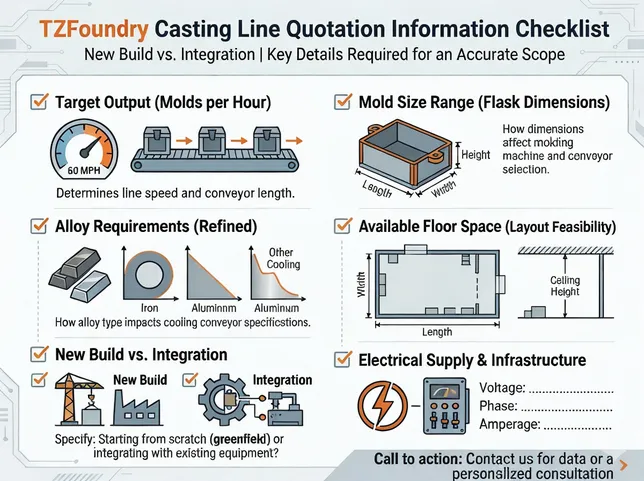
To scope your casting line accurately, we need the following details upfront:
Molds per hour — determines line speed, conveyor length, and compaction station count.
Flask dimensions dictate molding machine selection, conveyor width, and shakeout grate sizing.
Affects cooling conveyor length and pouring system specs — different alloys have different cooling profiles.
Length × width, plus ceiling height if you have overhead cranes — critical for layout feasibility.
Voltage, phase, available amperage — ensures the system matches your facility's power infrastructure.
Whether you're starting from scratch or integrating with existing equipment — melting furnace, sand processing line, overhead cranes.
Send photos of your current layout showing the melting furnace location, sand system position, available floor space, and utility connection points. Include a simple sketch with dimensions — doesn't need to be CAD; a hand-drawn floor plan with measurements works fine.
That helps us design a casting line layout that fits your space and integrates with your existing equipment without requiring major facility modifications.
We provide foundation drawings with anchor bolt locations and load distribution maps as part of pre-shipment documentation.
Rated Power by Scale
Add 25–30% overhead for startup surge current.
Most buyers install a dedicated circuit breaker and transformer for the casting line rather than tapping into existing foundry power — simplifies troubleshooting and prevents voltage sags from affecting other equipment.
Compressed Air
For pneumatic compaction or automated pouring: 0.6–1.0 MPa supply pressure at 1.5–4.0 m³/min depending on system size.
Ventilation
Plan for 3,000–5,000 m³/hour of exhaust airflow to handle fumes from pouring operations.
Cold climate tip: Consider heat recovery from the exhaust stream — the pouring station and cooling conveyor generate enough waste heat to preheat incoming ventilation air, cutting facility heating costs during winter months.
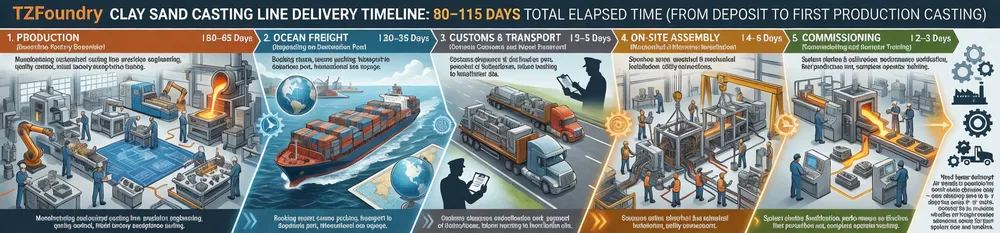
From deposit to first production casting, expect 80–115 days total elapsed time. Here's how that breaks down across each phase:
50–65 days from deposit to factory departure
20–35 days depending on destination port
3–5 days for customs clearance and inland transport
4–6 days for mechanical and electrical installation
2–3 days for commissioning and operator training
Need faster delivery?
Air freight is possible for small-scale systems only — cuts shipping time to 5–7 days but costs 4–5× more than ocean freight. Contact us to evaluate whether air freight makes economic sense for your system size and timeline.
We provide 2–3 days of hands-on training during commissioning. Your operators run the equipment under our technician's supervision until they're comfortable with all normal and exception scenarios.
Training covers:
Every system ships with a comprehensive documentation package covering all installed modules.
Operations Manual
120–180 pages covering all system modules
Electrical Schematics
Full wiring diagrams for all electrical subsystems
PLC Program Backup
Full controller program for disaster recovery
Spare Parts Catalog
Part numbers and supplier contacts included
Maintenance Schedule
Preventive maintenance intervals for all components
All documents ship in English. Other languages available on request — adds 1–2 weeks to delivery, costs $600–$1,000 depending on language and document length.
Our support model is built for production environments where downtime has real cost. Three tiers of support ensure you're never stuck waiting for answers.
We can log into your PLC via VPN and review process data when you report an issue — available for all PLC-equipped systems.
Response: 4–8 hours during China business hours (UTC+8)
Off-hours: 12–24 hours for inquiries outside that window
Order spare parts through email or WhatsApp. We'll quote price and lead time within 24 hours.
Email and WhatsApp channels available
Quote turnaround: within 24 hours
If remote support doesn't resolve the problem, we'll send a technician. You cover travel costs, we cover labor.
Major component replacement and capacity upgrades
Most issues resolved remotely first
For urgent issues affecting production, contact us via WhatsApp at +86 13335029477 — that number reaches our technical team directly, not a general customer service queue. Most issues get resolved remotely through PLC parameter adjustments, sensor calibration, or troubleshooting pouring system problems.
Email us at sales@tzfoundry.com with your casting requirements — target output rate (molds per hour), mold size range, alloy types, and photos of your existing foundry layout if you're integrating with current equipment.
Preliminary Response
Within 24 hours with preliminary specs and pricing
Detailed Proposal
Within 3–5 business days after technical clarifications
Factory Tour Available
Visit our Qingdao facility to see casting lines in production — molding, pouring, and shakeout on our test line
What to Include
Molds/hour target, mold size range, alloy types, existing layout photos
Other clay sand processing lines and equipment from TZFoundry.
Dedicated molding systems for high-output flask and flaskless configurations.
Sand reclamation and recycling systems to reduce material waste and cost.
Complete sand preparation with mixing, screening, and conditioning stages.
Post-casting surface cleaning and finishing with abrasive blasting equipment.
Sand washing systems for impurity removal and quality improvement.
Thermal and mechanical regeneration for spent clay sand recovery.