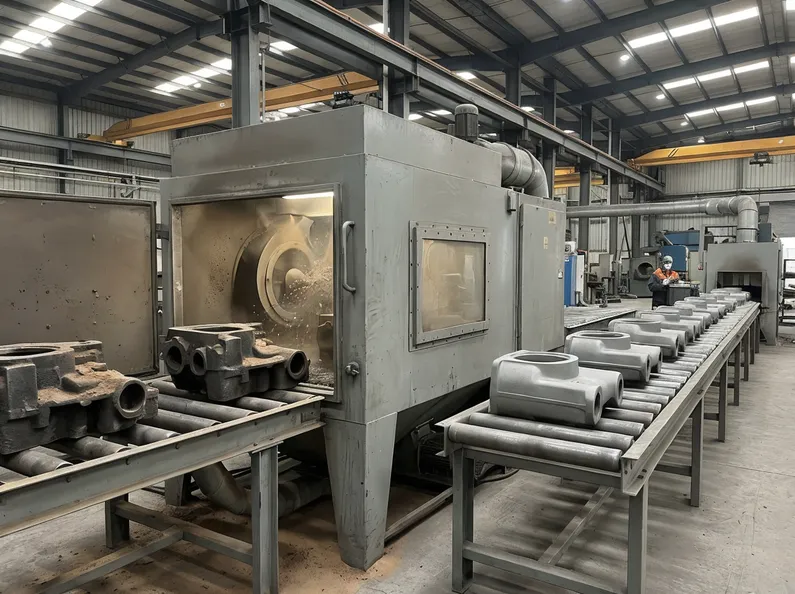
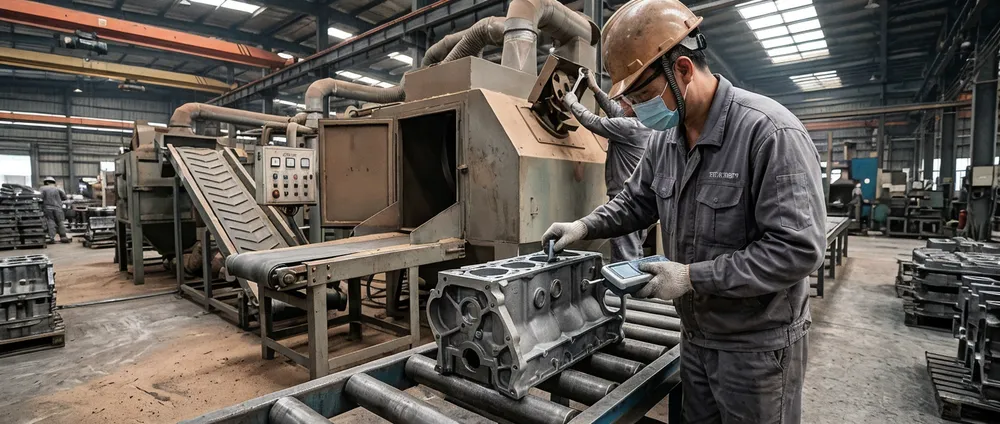
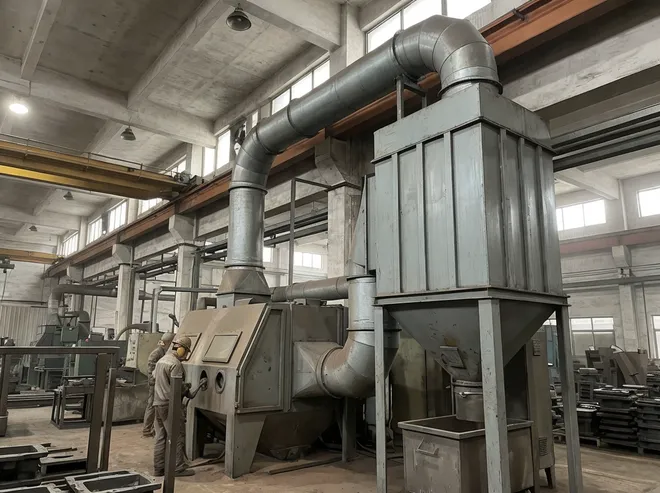
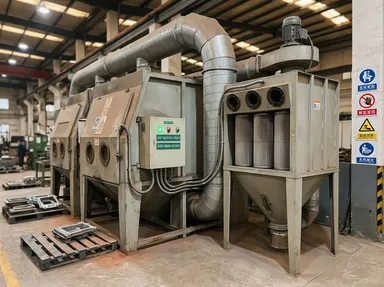
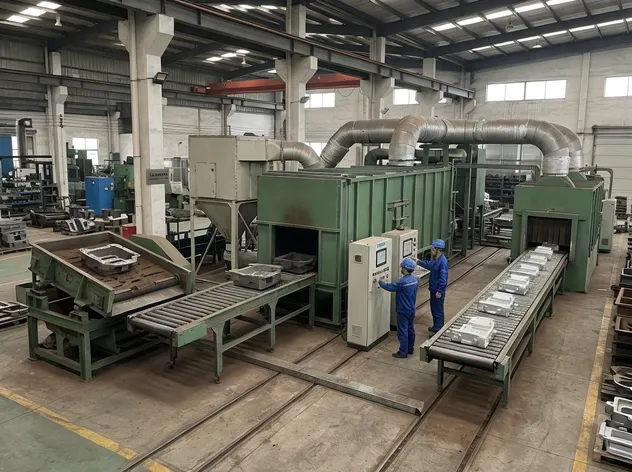
A clay sand blasting line sits between shakeout and shipping in your foundry workflow. After you've poured the casting and separated it from the mold, residual sand, scale, and oxide layers remain on the metal surface. Blasting removes these contaminants and delivers a clean surface that meets your customers' machining specifications.
This isn't cosmetic work — surface quality at this stage determines whether your buyer's machine shop can hold tolerances without excessive tool wear, and whether you're fielding warranty claims six months later.
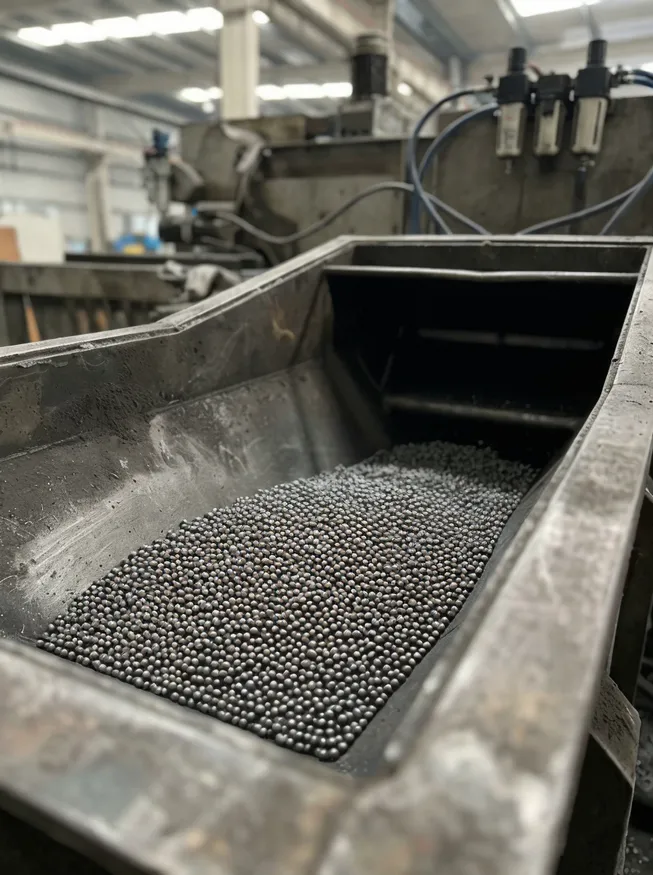
Most clay sand foundries use shot blasting (steel media propelled by centrifugal wheels) rather than compressed-air sand blasting. Shot blasting delivers consistent impact energy across the entire casting surface, recycles the abrasive media in a closed loop, and generates less airborne dust than open-blast systems.
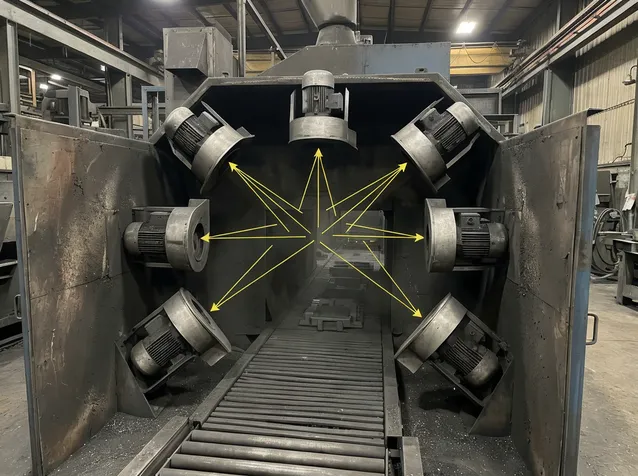
The equipment we build uses 4–8 blast wheels arranged around a chamber — castings either tumble through the blast zone (batch systems) or move through on a conveyor (continuous systems). Wheel speed, abrasive size, and exposure time are the three variables you adjust to match casting type and surface finish requirements.
Controls impact energy delivered to the casting surface.
Determines roughness profile and scale removal rate.
Balances cycle throughput against final surface finish.
Surface finish affects your downstream customers' costs more than most foundries realize. A casting with 200μm surface roughness (Ra) requires 30–40% more machining time than one with 50μm roughness — your buyer's machine shop either absorbs that cost or passes the complaint back to you.
We configure systems based on what your customers actually specify, not what sounds impressive in a brochure. Blasting parameters directly control final roughness — the right balance between grit type, shot size, and cycle time is set during commissioning and validated against your buyers' Ra requirements.
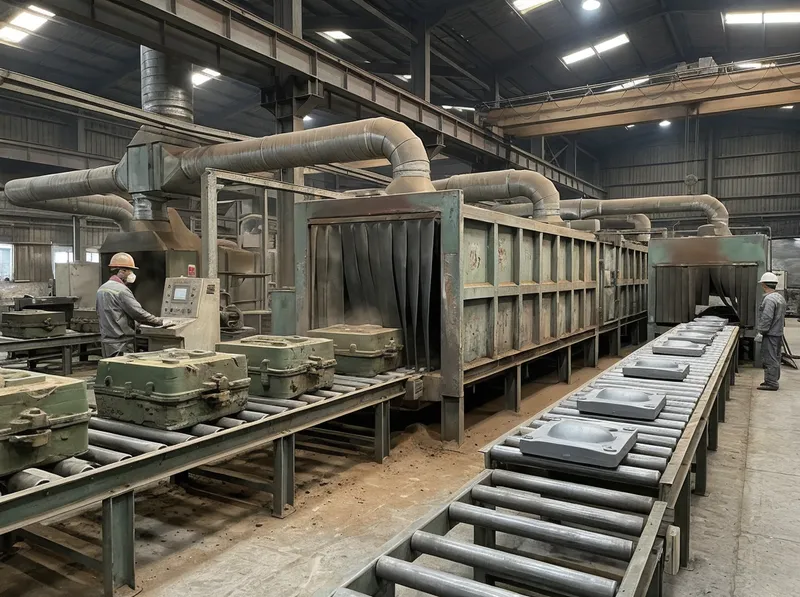
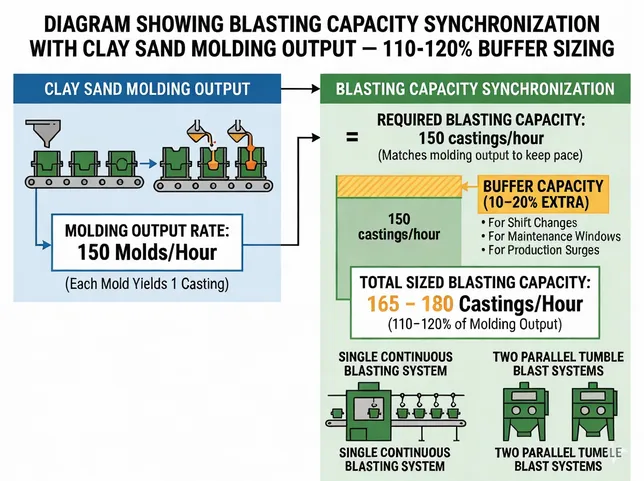
Integration with your existing clay sand processing line workflow matters because blasting cycle time needs to match molding output.
If your molding line produces 150 molds per hour but your blasting system only processes 100 castings per hour, you're building a backlog that eventually forces you to slow down upstream operations or skip blasting entirely on some parts.
We size blasting capacity at 110–120% of your molding throughput to maintain buffer capacity during peak shifts. No bottlenecks, no skipped parts.
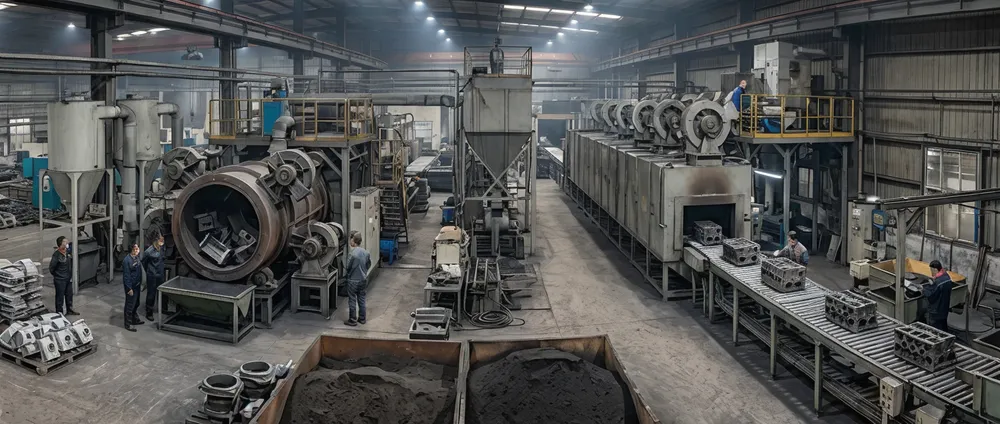
Blasting systems scale across two main configurations, and the difference isn't just throughput — it's about batch flexibility versus continuous automation. A tumble blast system processes castings in batches (load the chamber, run the cycle, unload), which works when you're casting multiple part types with different blasting requirements. A continuous system moves castings through the blast zone on a conveyor without stopping, which maximizes throughput but requires consistent part geometry and blasting parameters across your production run.
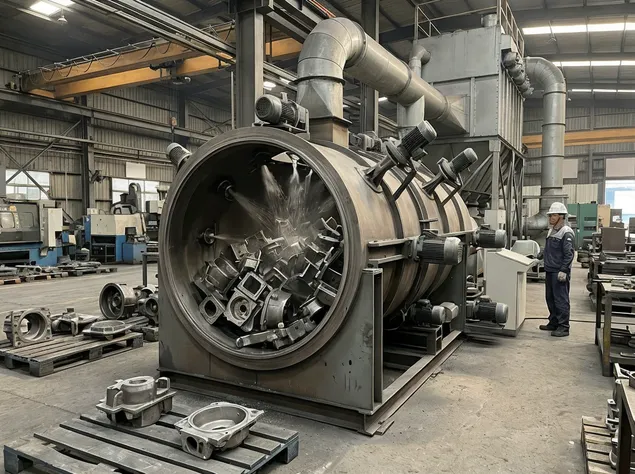
Castings load into a rotating drum chamber surrounded by 4–6 blast wheels. The drum rotates at 3–8 RPM while the wheels throw steel shot at the tumbling parts — every surface gets exposed to the blast stream as parts roll through the chamber. Cycle time runs 5–15 minutes depending on casting size and required cleanliness level. This setup handles mixed part sizes in the same batch (as long as they're within the same weight class), so you can blast a full shakeout batch without sorting by part number.
1.2–1.8m ⌀ × 2–3m
Working capacity: 500–2,000 kg/batch
22–37 kW total
4–6 wheels at 5.5–7.5 kW each
8,000–12,000 m³/hr
Captures airborne fines during blasting
6m × 4m
Including abrasive reclaim & dust collector
Staffing & Cycle
One operator per shift to load/unload the chamber and monitor cycle completion — the actual blasting runs automatically once you close the door and start the cycle.
Best Fit
This configuration makes sense when you're running 3–10 different casting designs per shift and need the flexibility to adjust blasting intensity between batches.
The Trade-Off
Manual loading and unloading creates gaps between cycles (typically 3–5 minutes per changeover), so your effective throughput is lower than the rated capacity. If you're processing 2 tons per hour in 500 kg batches, you're spending 20–25% of your time loading and unloading rather than blasting.
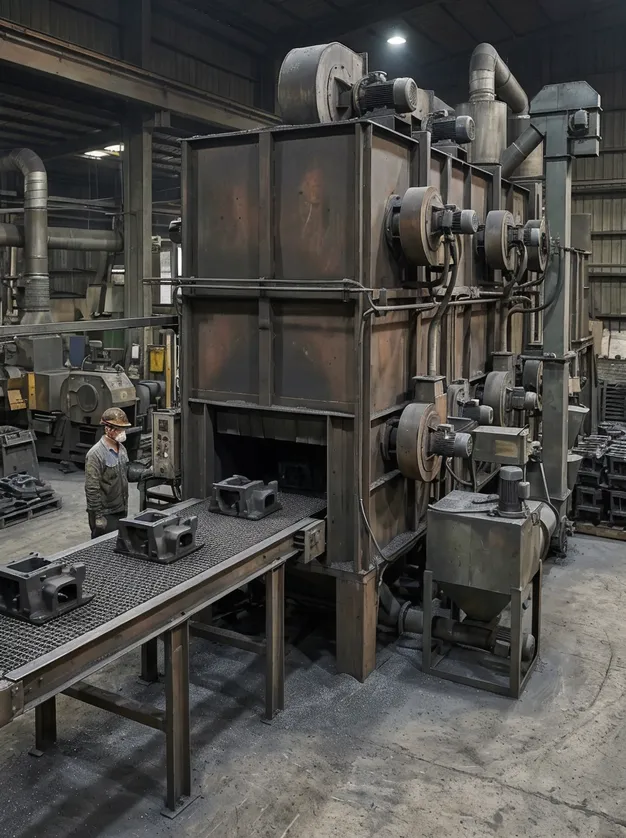
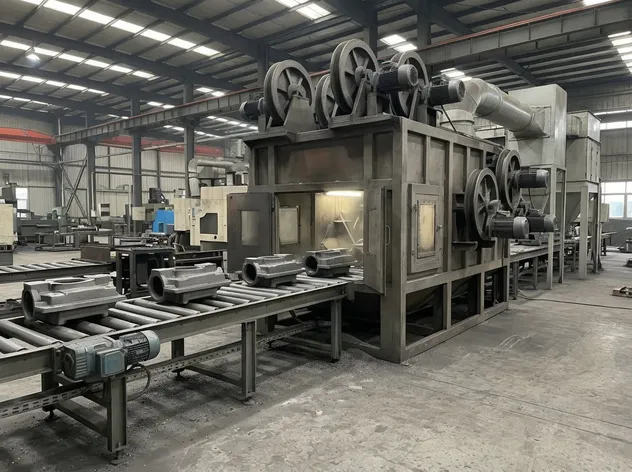
Castings enter the blast chamber on a roller conveyor or mesh belt, pass through a blast zone with 6–8 wheels arranged overhead and on the sides, then exit to a cooling/inspection station. No manual loading — the conveyor feeds directly from your shakeout system, and castings move through at a controlled speed (typically 0.5–2 meters per minute depending on part size and required exposure time). This setup is for foundries running 1–3 core casting designs in high volume, where blasting parameters stay consistent across the entire shift.
Chamber length runs 4–8 meters (longer chambers allow slower conveyor speeds and more exposure time without reducing throughput), with blast wheels positioned to cover all surfaces as parts move through. Total motor power hits 45–75 kW (6–8 wheels plus conveyor drives), and dust collection capacity scales to 15,000–25,000 m³/hour. Footprint expands to 12 m × 6 m including infeed/outfeed conveyors and the reclaim system. You'll need one operator monitoring the system and handling any jams or rejects, but the actual part handling is fully automated.
Continuous blast chamber with 6–8 wheel arrangement and integrated conveyor system.
Continuous systems deliver 40–50% higher effective throughput than tumble systems at the same rated capacity because there's no loading downtime — castings flow through without stopping. The limitation: if you need to change blasting parameters for a different part type, you're either running a mixed batch at compromise settings (which means some parts get over-blasted and others get under-blasted), or you're stopping the line to adjust wheel speeds and conveyor timing.
Most buyers running continuous systems dedicate the line to one or two high-volume casting families and use a separate tumble system for low-volume specialty parts. If your production mix includes frequent part changeovers, a continuous line at compromise settings will over-blast some parts and under-blast others — degrading surface quality and increasing abrasive consumption. Evaluate your casting family count before committing to a continuous configuration.
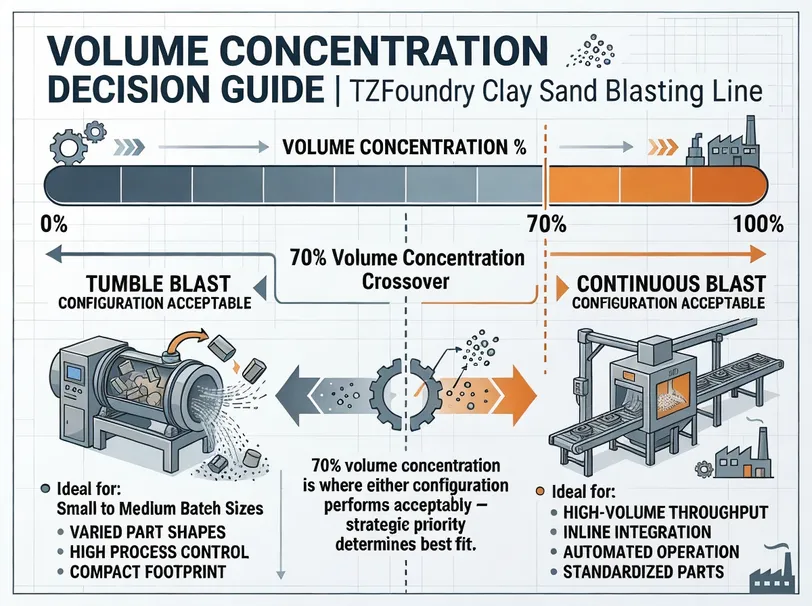
If your top 3 casting designs represent less than 60% of your total volume, you need tumble blast flexibility. If your top 3 designs represent more than 80% of volume, continuous blast economics make sense.
High product mix diversity — parameter flexibility outweighs throughput optimization.
Crossover zone — decision comes down to whether you value flexibility (tumble) or maximum throughput (continuous).
Concentrated volume — continuous line economics deliver lower per-casting cost at scale.
The 70% volume concentration crossover is where either configuration performs acceptably — your strategic priority determines the best fit.
TZFoundry builds hybrid systems for foundries that need both — a continuous line handling the high-volume core products, plus a smaller tumble system for everything else.
This eliminates the throughput penalty of stopping the main line for parameter changes. It makes sense when your high-volume products justify continuous automation, but you can't afford to lose the flexibility to serve smaller accounts with specialty castings.
1.6–1.8× the cost of a single continuous system
Eliminates main-line stoppages for parameter changes while retaining full flexibility for low-volume specialty work
Foundries with concentrated high-volume core products and ongoing specialty casting commitments
Clay sand blasting line specifications determine three operational outcomes: how fast you can process castings (throughput), how much abrasive media you're buying every month (consumption rate), and how often you're replacing wear components (maintenance intervals). The table below shows typical specs for our standard configurations — actual values vary based on casting type and required surface finish.
| Specification | Tumble Blast (1–5 t/h) | Continuous Blast (5–20 t/h) |
|---|---|---|
| Blast wheel count | 4–6 wheels | 6–8 wheels |
| Wheel motor power | 5.5–7.5 kW each | 7.5–11 kW each |
| Wheel speed | 2,200–2,800 RPM | 2,400–3,000 RPM |
| Chamber dimensions | Ø1.2–1.8m × 2–3m length | 4–8m length × 1.5–2.5m width |
| Throughput capacity | 1–5 tons/hour | 5–20+ tons/hour |
| Abrasive consumption | 0.8–1.5 kg per ton of castings | 0.5–1.0 kg per ton of castings |
| Dust collection airflow | 8,000–12,000 m³/h | 15,000–25,000 m³/h |
| Total power consumption | 30–50 kW | 60–100 kW |
| Footprint | 6m × 4m | 12m × 6m |
| Operator requirement | 1 per shift | 1 per shift |
Specifications shown are industry-standard values for this product type. Actual specifications may vary based on casting characteristics and surface finish requirements. Contact us for detailed system specifications.
Blast wheel configuration affects coverage uniformity and cycle time. Four wheels arranged in a square pattern around a tumble chamber provide adequate coverage for simple geometries (blocks, plates, cylindrical parts), but complex castings with deep pockets or internal cavities need six wheels to ensure all surfaces get exposed to the blast stream.
Continuous systems typically run 6–8 wheels because castings pass through the chamber only once — there's no tumbling action to rotate parts and expose hidden surfaces, so you need more wheels positioned at different angles to achieve complete coverage.
Wheel speed determines impact energy and cleaning aggressiveness. Higher speeds (2,800–3,000 RPM) throw abrasive media faster, which removes heavy scale and burnt-on sand more effectively but also increases the risk of dimensional distortion on thin-wall castings (anything under 5mm wall thickness).
Lower speeds (2,200–2,400 RPM) are gentler and better suited for aluminum castings or precision parts where you need to preserve tight tolerances. We set wheel speed based on your casting material and wall thickness — it's not a "more is better" situation.
Abrasive consumption rate is the largest variable operating cost after energy. Tumble systems consume more abrasive per ton (0.8–1.5 kg/ton) than continuous systems (0.5–1.0 kg/ton) because the tumbling action causes more abrasive breakdown — media particles collide with each other in addition to hitting the castings, which generates fines that get pulled into the dust collector and lost from the reclaim loop.
Steel shot costs $800–1,200 per ton depending on grade and order volume. On a system processing 50 tons of castings per week, the difference between 0.5 kg/ton and 1.5 kg/ton consumption is $1,000–3,000 per year in abrasive purchases alone. This cost differential is a key factor when selecting between tumble and continuous configurations.
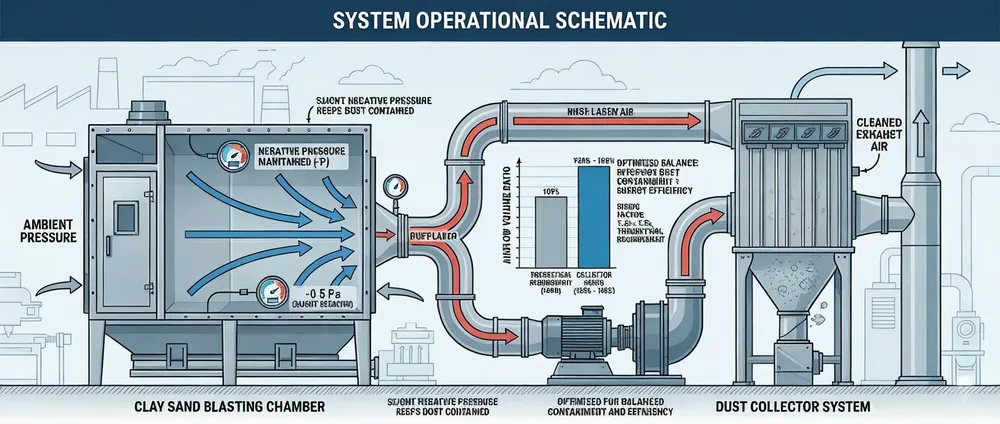
Dust collection capacity needs to match chamber volume and blast intensity. Getting this wrong in either direction creates measurable operational problems.
Creates positive pressure in the blast chamber, which pushes dust out through door seals and loading ports. Result: a layer of fine dust coating everything within 10 meters of the machine. Unsafe working conditions and accelerated wear on surrounding equipment.
Wastes energy pulling more airflow than necessary. The fan motor draws power proportional to volume moved — oversizing means you're paying for airflow capacity that provides no additional dust containment benefit.
We size dust collectors at 1.2–1.5× the theoretical airflow requirement to maintain slight negative pressure in the chamber (which keeps dust contained) without over-sizing the fan motor. This balances dust containment with energy efficiency.
Properly sized dust collection maintains slight negative pressure, preventing dust escape through seals and ports.
Throughput bottlenecks usually appear in the abrasive reclaim system, not the blast chamber itself. After media hits the castings, it falls to the chamber floor and gets conveyed back to the blast wheels through a bucket elevator and separator system. If the reclaim system can't keep up with the rate at which wheels are throwing media, the wheels start running partially starved — not enough media feeding into the impeller — which reduces cleaning effectiveness and forces you to slow down the process.
We size reclaim capacity at 120–130% of wheel consumption rate to prevent this bottleneck. The additional headroom ensures that even at peak blast intensity, the bucket elevator and separator system return media to the wheels faster than they can throw it — maintaining full blast coverage without process slowdowns.
Blast Wheels
Throw media at castings
Chamber Floor
Spent media collects
Bucket Elevator
Conveys media upward
Separator
Cleans & returns to wheels
Why this matters for your line layout: If you're evaluating a blasting line and the reclaim system is sized at only 100% of wheel capacity, any variation in media flow — a momentary surge, a slight conveyor hesitation — will starve the wheels. The 120–130% margin we build in eliminates this sensitivity and keeps your throughput consistent shift after shift.
Blasting parameters and equipment configuration need to match casting material and geometry, because what works for gray iron automotive parts will over-blast aluminum valve bodies and under-blast ductile iron pipe fittings. The scenarios below connect casting types to specific blasting approaches and explain why your customers care about the surface finish you deliver.
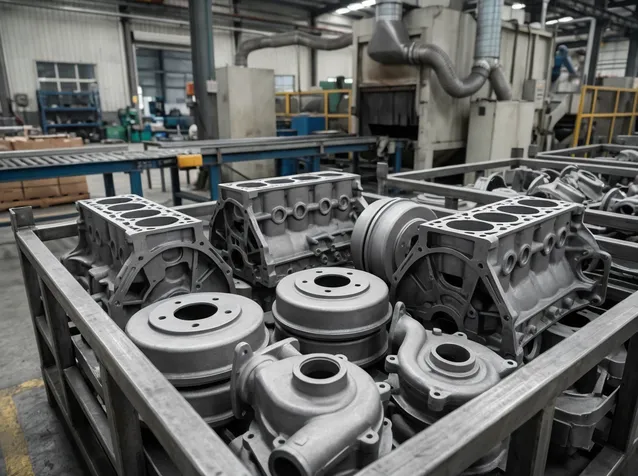
Gray iron is the most forgiving material for blasting — it tolerates aggressive parameters without dimensional distortion, and the graphite flakes in the microstructure actually help break up surface scale during blasting. Typical parts include engine blocks, brake drums, pump housings, and gearbox cases. These castings usually come out of the mold with 2–4 mm of burnt-on sand and heavy oxide scale, especially around gates and risers where metal temperature was highest.
Adequate for most machining operations — your customers' machine shops can hold ±0.1 mm tolerances on this surface finish without pre-machining cleanup passes.
Gray iron castings are high-volume, repeat-order products. Automotive suppliers typically order 5,000–20,000 units per run with monthly reorders, and machinery OEMs run 500–2,000 unit batches quarterly.
Consistent surface finish across the entire batch is what keeps these orders coming back — if 5% of castings in a batch need secondary cleaning or have rough patches that cause machining tool breakage, your buyer starts looking for a more reliable supplier. Blasting is your quality control checkpoint that prevents those complaints.
Ductile iron has higher tensile strength than gray iron, which means it's more resistant to surface deformation during blasting but also harder to clean — the oxide scale bonds more tightly to the base metal. Common parts include valve bodies, pipe flanges, suspension components, and hydraulic manifolds. These castings often have complex internal passages and threaded ports that need to be completely free of sand residue — any sand left in a threaded hole will damage the mating part during assembly.
Why Rounded Shot Is Critical for Ductile Iron
The rounded shot profile is critical — angular grit can embed in ductile iron's surface and create stress concentration points that reduce fatigue life. For parts serving pressure vessels, load-bearing components, and safety-rated applications, embedded grit is a rejection-level defect.
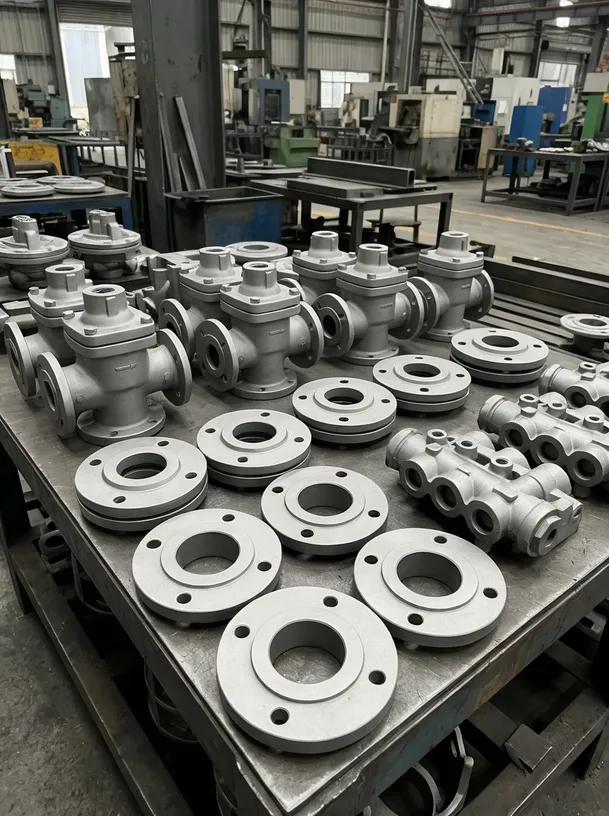
Ductile iron valve bodies and hydraulic manifolds after precision blasting with S230–S280 steel shot.
Ductile iron buyers are often serving critical applications — pressure vessels, load-bearing components, safety-rated parts — where surface defects can cause field failures. These buyers pay 10–20% more per casting than gray iron buyers, but they also have zero tolerance for quality issues.
Proper blasting that removes all sand and scale without causing surface damage is what justifies your premium pricing. If you're delivering ductile iron castings with embedded grit or rough patches, you're leaving money on the table — your buyer will either reject the batch or negotiate your price down to gray iron levels.
Aluminum is the most challenging material for blasting because it's soft enough to distort under aggressive blast conditions, but it also forms a tenacious oxide layer that requires sufficient impact energy to remove. Typical parts include transmission cases, engine components, electronic enclosures, and HVAC manifolds. Wall thickness often runs 3–6 mm, and dimensional tolerances are tighter than ferrous castings — ±0.05 mm is common for machined surfaces.
2,200–2,500 RPM
Lower than ferrous metals to prevent distortion
Steel Shot S170–S230
Fine, rounded media for gentle treatment
6–10 minutes
Extended dwell for oxide layer removal
2.0–3.0 m/min
Slower conveyor = gentler treatment
Glass bead alternative: Some aluminum foundries use glass bead media instead of steel shot for the final pass to achieve a uniform matte finish without any risk of ferrous contamination — critical for aerospace and food-grade applications.
40–80 μm Ra
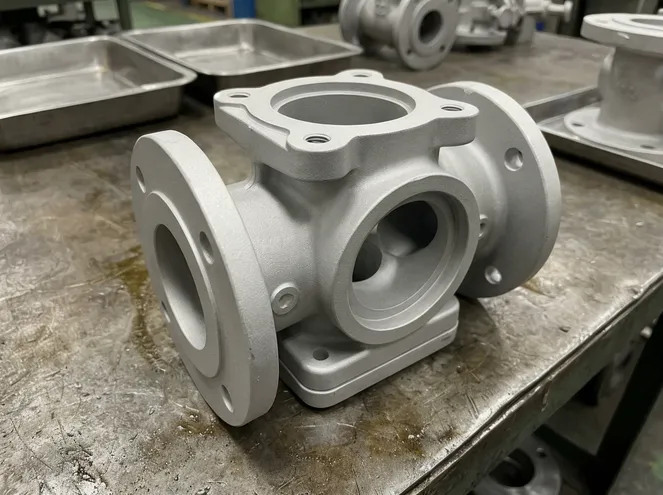
Aluminum valve body after tumble blasting at reduced wheel speed — uniform oxide removal without dimensional distortion.
Aluminum castings command the highest per-unit prices in the clay sand casting market, but they also have the highest rejection rates if surface quality isn't controlled. Your buyers are often serving automotive lightweighting programs or electronics thermal management applications where appearance and dimensional accuracy both matter.
A properly blasted aluminum casting with uniform surface finish and no distortion can sell for 2–3× the price of a gray iron casting of similar size. The blasting system configuration that protects those tight tolerances is what enables you to serve this premium market segment.
2–3×
price premium vs. gray iron
with proper blasting
Blasting equipment operating costs break down into four categories: abrasive media consumption, wear component replacement, energy consumption, and dust filter maintenance. Understanding these costs helps you calculate ROI and compare supplier quotes on an apples-to-apples basis.
Largest variable cost — steel shot consumption & breakdown rates
Replacement parts for blast wheels, liners & guards
Electrical draw from blast wheels, conveyors & dust systems
Filter media replacement & compressed-air upkeep
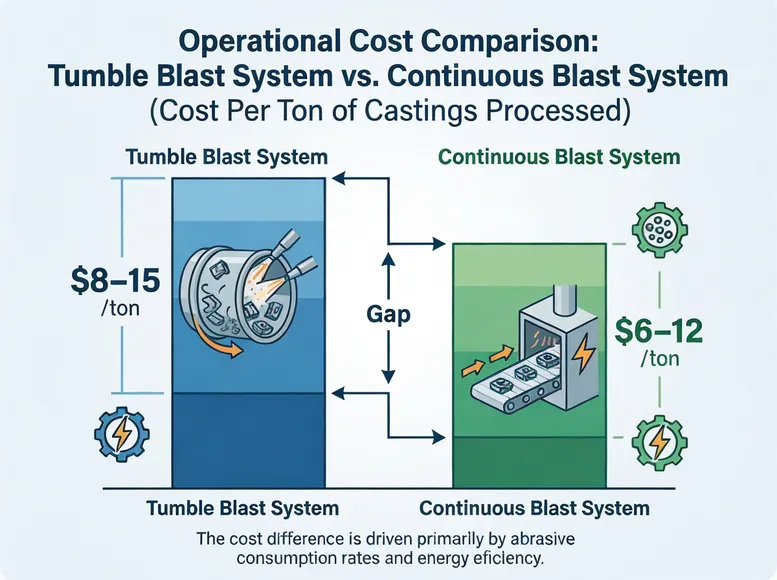
The total cost per ton of castings processed runs $8–15 for tumble systems and $6–12 for continuous systems, with the difference driven primarily by abrasive consumption rates and energy efficiency.
Abrasive media consumption is the largest variable cost. Steel shot consumption runs 0.5–1.5 kg per ton of castings processed, depending on system configuration and casting type. At $1,000 per ton of abrasive media (typical price for S230 steel shot in bulk orders), a foundry processing 50 tons of castings per week consumes $25–75 worth of shot weekly, or $1,300–3,900 annually.
The consumption rate depends on three factors:
How fast media particles fracture into fines too small to reuse. Higher wheel speeds and harder casting surfaces accelerate breakdown.
How much media gets pulled into the filter versus staying in the reclaim loop. Poorly calibrated airflow pulls usable media out of circulation.
Heavily scaled castings consume more media because particles break on impact with hard oxide layers.
Based on 50 tons/week throughput at $1,000/ton S230 steel shot:
0.5–1.5 kg/ton consumption range
You can reduce consumption by running the system at lower wheel speeds (less impact energy = less media breakdown) and by maintaining the dust collector's air-to-cloth ratio to prevent excessive suction that pulls usable media into the filter.
We've seen foundries cut consumption from 1.2 kg/ton to 0.7 kg/ton just by adjusting the dust collector dampers to reduce airflow by 15% — the blast chamber stayed clean, but less media got lost to the filter.
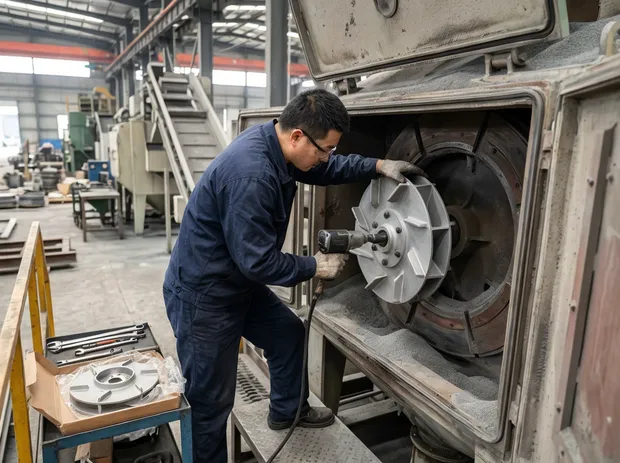
Blast wheel and liner replacement intervals depend on abrasive type and casting volume. Blast wheel impellers — the rotating component that throws the media — wear from constant abrasive impact and typically need replacement every 2,000–3,000 operating hours for steel shot, or 1,500–2,500 hours for steel grit (angular media is more abrasive to the equipment itself). Each impeller costs $400–600, and a 6-wheel system needs $2,400–3,600 in impeller replacements annually at 4,000 operating hours per year.
Chamber liners (manganese steel plates that protect the chamber walls from abrasive impact) last 3,000–5,000 hours and cost $1,500–2,500 per set depending on chamber size.
Replacement is straightforward — impellers bolt onto the wheel hub and swap in 30–45 minutes per wheel, and liners bolt to the chamber walls with access through the loading door. Most foundries keep one spare impeller set on-site so a worn impeller doesn't idle the entire blasting system while waiting for parts to ship.
Energy consumption runs 15–25 kWh per ton of castings processed. The per-ton energy cost depends on system type, throughput, and local electricity rates. Below is a direct comparison at $0.12/kWh (typical industrial rate in export markets):
| Parameter | Tumble System | Continuous System |
|---|---|---|
| Throughput | 3 tons/hour | 10 tons/hour |
| Hourly Consumption | 45–75 kWh/hr | 150–250 kWh/hr |
| Total Connected Load | 30–50 kW | 60–100 kW |
| Energy Cost per Ton | $1.80–3.00 | $1.80–2.50 |
| Load Includes | Blast wheels, drum rotation motor, dust collector fan, abrasive reclaim conveyors | Blast wheels, conveyor drive, dust collector fan, abrasive reclaim conveyors |
Continuous systems are more energy-efficient per ton because the fixed loads (dust collector, reclaim system) are amortized across higher throughput.
Blast Wheel Motors
Primary energy draw — drives the impellers that accelerate abrasive media to blast velocity.
Dust Collector Fan
Largest single-component energy consumer — maintains negative pressure and captures airborne particulate.
Conveyors & Auxiliary
Abrasive reclaim conveyors, drum/table rotation, bucket elevators, and control systems.
Dust filter replacement intervals run quarterly to annually depending on casting cleanliness and filter type. Cartridge filters (the most common type for blasting systems) cost $800–1,200 per set and last 6–12 months in typical foundry environments. Heavily scaled castings or burnt-on sand generate more airborne fines, which loads the filters faster and shortens replacement intervals to 3–6 months. Each filter replacement takes 2–3 hours of downtime (shut down the system, remove the old cartridges, install new ones, restart and verify airflow).
You can extend filter life by running a pulse-jet cleaning system that blows compressed air back through the filters every 30–60 seconds to dislodge accumulated dust. This is standard on our systems — the pulse-jet controller runs automatically, and you only need to replace filters when the pressure drop across the filter bank exceeds the fan's capacity (indicated by a pressure gauge on the dust collector housing). Some foundries try to stretch filter life by ignoring the pressure gauge and running with clogged filters, but this just transfers the problem to the blast chamber — insufficient airflow means dust escapes through door seals and you end up cleaning the entire facility instead of just changing filters.
A continuous blast system processing 50 tons of castings per week (2,500 tons annually) at 0.7 kg/ton abrasive consumption, $0.12/kWh energy cost, and typical wear component replacement intervals runs approximately:
Abrasive Media
$1,750/yr
Impeller Replacement
$2,800/yr
6 wheels, 4,000 hrs/yr
Liner Replacement
$2,000/yr
Energy
$15,000/yr
2.0 kWh/ton × 2,500 t × $0.12
Filter Replacement
$1,200/yr
Total Annual Operating Cost
$22,750/year
$9.10
per ton processed
This cost structure helps you evaluate supplier quotes — if a competitor's equipment has a 20% lower purchase price but runs at 1.2 kg/ton abrasive consumption instead of 0.7 kg/ton, you're paying an extra $1,250 annually in media costs, which erases the capital savings within 3–4 years of operation.
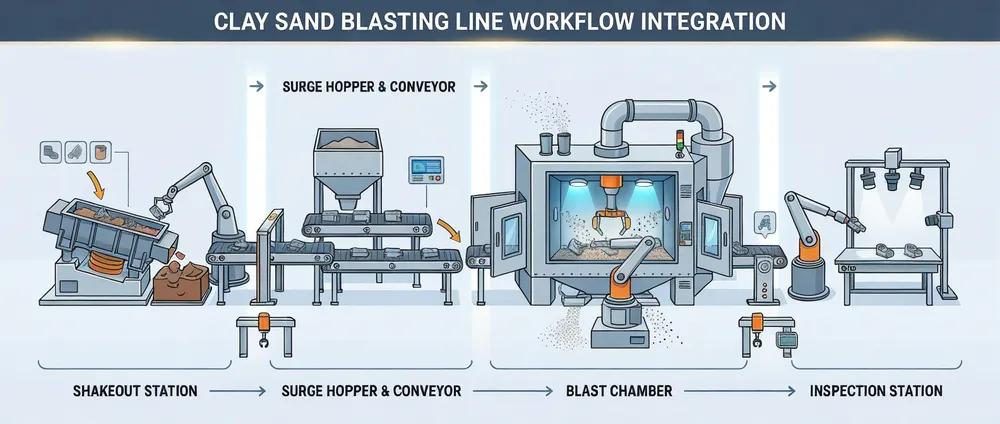
Blasting equipment connects to your upstream shakeout system and downstream inspection station, and the interface design determines whether castings flow smoothly through your facility or pile up in staging areas waiting for manual handling.
The two critical integration points are part transfer — how castings move from shakeout to blasting to inspection — and workflow timing — ensuring blasting capacity matches molding output so you're not creating bottlenecks. Getting these right determines whether your blasting line adds value or becomes a constraint on overall foundry throughput.
Operators load castings into bins, forklift the bins to the blasting system, and manually load the blast chamber. This approach requires more labor and staging space but offers maximum flexibility for changing part mixes.
Castings accumulate in a surge hopper after shakeout, and an operator uses a hoist or manipulator to load batches into the blast chamber. This approach costs 40–50% less than full automation but eliminates the forklift traffic and staging area clutter of fully manual systems.
TZFoundry recommendation for most export buyers: you're not paying for conveyors you don't need, but you're also not tying up two operators per shift just moving castings around.
Castings drop from the shakeout conveyor onto a transfer conveyor that feeds directly into the blast chamber. This provides the highest throughput consistency and eliminates manual handling entirely, but requires the greatest capital investment.
Part transfer flow: shakeout → surge hopper / conveyor → blast chamber → inspection station. Interface design at each transfer point determines overall line throughput.
< 20 t/day
Manual transfer practical — labor cost is low and part mix changes frequently
20–50 t/day
Semi-automated sweet spot — surge hopper plus hoist/manipulator loading, 40–50% less capital than full automation
> 50 t/day
Fully automated justified — labor savings and throughput consistency offset conveyor investment
Workflow timing matters because blasting cycle time needs to stay synchronized with molding output. If your clay sand molding line produces 150 molds per hour and each mold yields one casting, your blasting system needs to process at least 150 castings per hour to keep pace. We size blasting capacity at 110–120% of molding output to provide buffer capacity during shift changes, maintenance windows, and production surges.
A 150 molds/hour molding line pairs with a 165–180 castings/hour blasting system — typically a continuous configuration or two parallel tumble systems.
The buffer capacity prevents upstream bottlenecks — if blasting falls behind molding output, castings start accumulating in the staging area between shakeout and blasting. Once you've got 2–3 hours of backlog, you're either slowing down the molding line (wasting capacity you've already paid for) or skipping blasting on some castings and shipping them with rough surfaces — which generates customer complaints.
The 10–20% buffer capacity costs about 8–12% more in equipment capital but eliminates these operational headaches entirely.
Post-blasting quality control checkpoints include visual inspection, dimensional verification, and surface roughness measurement. Inspection scope scales with part complexity and customer requirements.
Checking for remaining sand adhesion or scale on casting surfaces.
100% of castings
Confirming that blasting didn't distort thin-wall sections or critical dimensions.
Sample basis — every 10th or 20th casting
Frequency depends on part complexity & customer requirements
For precision castings where Ra values are specified in customer drawings.
First-article & periodic audits
100% verification required for aerospace & medical device customers
Position the inspection station 2–3 meters downstream of the blast chamber exit
Adequate lighting required: 1,000+ lux at the inspection surface
Reject conveyor or bin for castings that don't pass inspection
Routed back through the blasting system for a second pass
Scrapped — not recoverable through re-blasting
< 2%
On a properly configured system
Seeing 5%+ rejects? Either the blasting parameters are wrong for your casting type or there's a problem with upstream mold quality causing excessive sand burn-on.
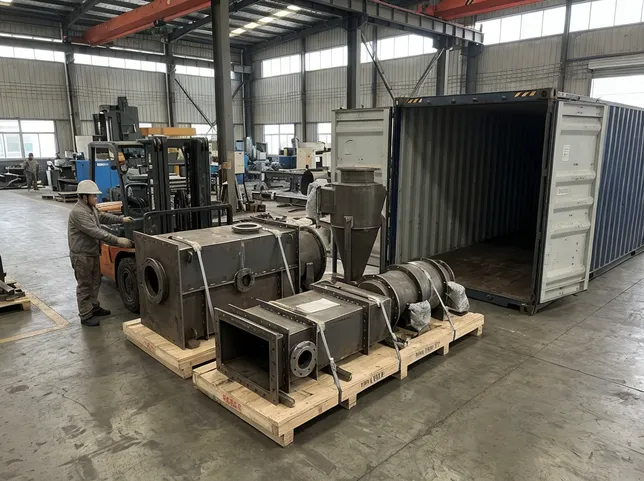
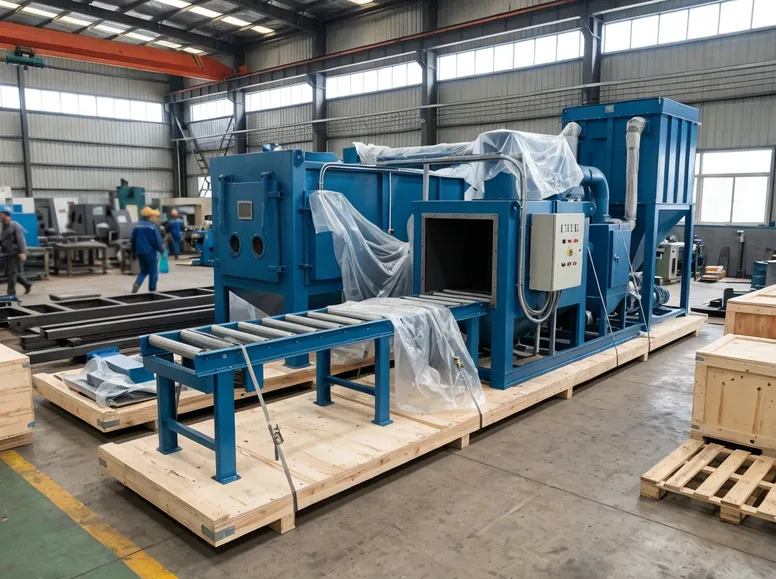
The blast chamber, dust collector, and abrasive reclaim system break down into sections that fit through standard container doors — 2.3 m width × 2.4 m height for a 40-foot container. A typical tumble blast system ships in one 40-foot container, while a continuous system ships in two containers.
TZFoundry provides assembly drawings and bolt-together connections so you can reassemble the system on your factory floor without welding or custom fabrication. Assembly takes 3–5 days with basic hand tools and a forklift or crane for positioning the larger components.
Ships in 1 × 40-ft container. Blast chamber + dust collector + abrasive reclaim as bolt-together modules.
Ships in 2 × 40-ft containers. Larger conveyor sections and expanded dust-collection modules require the additional container volume.
3–5 days with basic hand tools + forklift/crane. No welding or custom fabrication required. Full assembly drawings included.
Full Foundry Integration
Explore the full clay sand processing line — from molding and reclamation to washing and sand preparation — and understand exactly where the blasting stage connects to upstream and downstream equipment.
Blasting parameters — wheel speed, abrasive type and size, exposure time — directly control three surface outcomes: roughness (Ra value in microns), cleanliness (percentage of surface free from sand and scale), and dimensional accuracy (whether blasting has distorted the casting). These outcomes aren't independent — increasing wheel speed improves cleanliness but increases roughness and distortion risk. Parameter optimization means finding the settings that meet your customers' surface specifications without over-processing the castings.
Wheel speed determines impact energy and cleaning aggressiveness. Each 200 RPM increase in wheel speed raises impact energy by approximately 15%, which translates to faster scale removal but also higher risk of surface peening (plastic deformation of the casting surface).
For gray iron castings with 2–4 mm burnt-on sand, we typically start at 2,600 RPM and adjust based on results. If castings exit with remaining scale in deep pockets, we increase to 2,800 RPM. If we're seeing surface peening or dimensional distortion, we drop to 2,400 RPM and extend exposure time instead.
Baseline Start — 2,600 RPM
Standard starting point for gray iron with 2–4 mm burnt-on sand.
Scale Remaining in Deep Pockets → Increase to 2,800 RPM
Higher impact energy clears stubborn residual scale in recessed geometry.
Surface Peening / Distortion → Drop to 2,400 RPM + Extend Exposure
Reduces plastic deformation risk while maintaining cleanliness through longer cycle time.
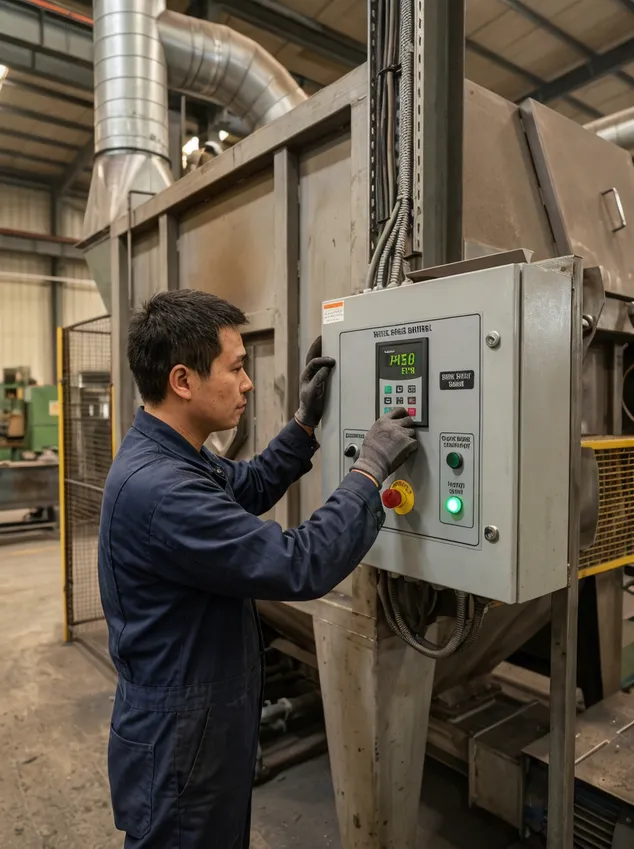
Wheel speed is tuned in 50 RPM increments via VFD — no pulley or belt changes required.
| Casting Material | Recommended RPM Range | Key Considerations |
|---|---|---|
| Gray Iron | 2,400–2,800 RPM | Start at 2,600 RPM. Increase for deep-pocket scale; decrease + extend time if peening occurs. |
| Ductile Iron | 2,500–2,700 RPM | Harder than gray iron — needs more impact energy to remove scale. More prone to grit embedment if run too aggressively. |
| Aluminum | 2,200–2,500 RPM | Softer material distorts more easily under high-energy impact. Requires lower wheel speeds. |
VFD Precision: The wheel speed range on our systems adjusts via VFD (variable frequency drive) on each blast wheel motor, so you can tune speeds in 50 RPM increments without changing pulleys or belts.
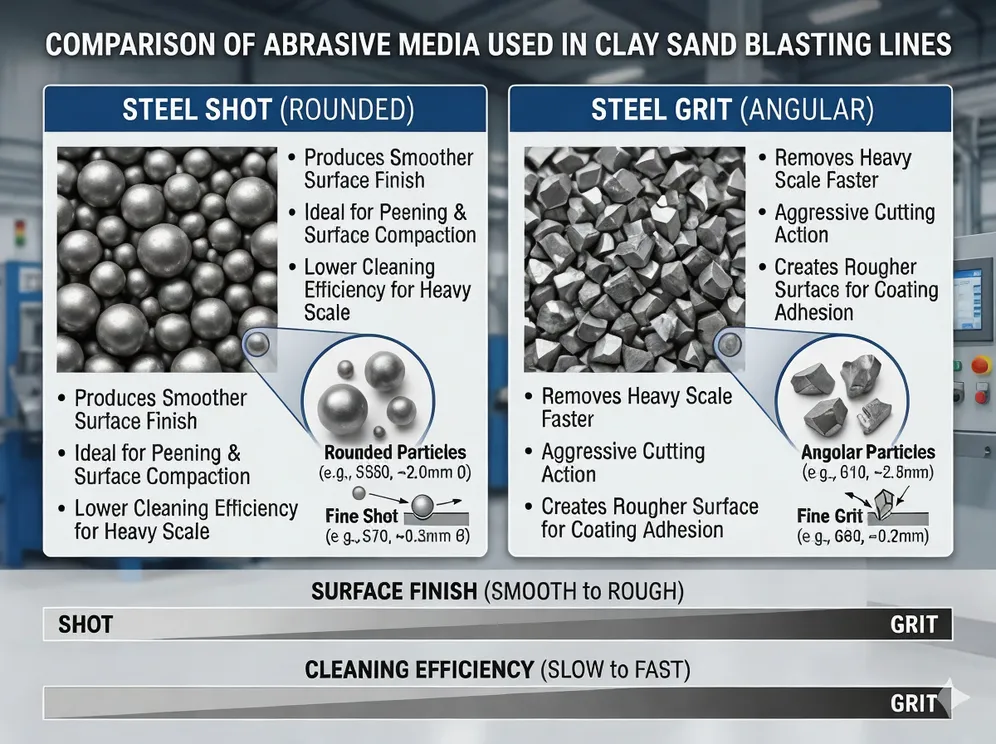
Abrasive size and type affect surface finish and cleaning efficiency. Steel shot (rounded particles) produces smoother surfaces than steel grit (angular particles) at the same impact energy, but grit removes heavy scale faster because the sharp edges cut into oxide layers more effectively.
Shot sizes range from S70 (large, 2.0 mm diameter) to S550 (fine, 0.3 mm diameter), and grit sizes range from G10 (coarse, 2.5 mm) to G80 (fine, 0.2 mm).
For most clay sand casting applications, start with S230 steel shot (0.6 mm diameter) — it's fine enough to produce 80–120 μm Ra surface finish but coarse enough to remove typical sand and scale in reasonable cycle times.
Mixing shot and grit in the same system is possible but not recommended. Shot and grit have different breakdown rates and reclaim characteristics, so you end up with an unpredictable blend ratio that changes over time as you add makeup media.
If you need both aggressive cleaning and smooth finish, run two separate blasting passes (grit first, then shot) or install a two-stage system with separate chambers for each media type.
Exposure time is the total duration castings spend in the blast zone. In tumble systems, this is the cycle time you set on the controller (typically 5–15 minutes). In continuous systems, it's determined by chamber length and conveyor speed — a 6-meter chamber with a 2 m/min conveyor speed gives 3 minutes of exposure time.
Longer exposure removes more material and produces cleaner surfaces, but it also increases abrasive consumption and reduces throughput.
70–80%
of surface contaminants removed
15–20%
additional contaminants removed
< 5%
diminishing returns — extra time yields minimal improvement
We've seen foundries running 15-minute tumble cycles when 8 minutes would achieve the same cleanliness level, simply because "that's how we've always done it." Cutting cycle time from 15 to 8 minutes delivers measurable gains:
+45%
Throughput increase
30–35%
Lower abrasive consumption
Zero
Impact on surface quality
Pump Housings · Gearbox Cases · Structural Components
Target Ra: 100–150 μm
Achievable with standard blasting parameters using a straightforward single-pass process. No special abrasive selection or multi-stage treatment required.
Wheel Speed: 2,600 RPM
Abrasive Media: S230 shot
Exposure Time: 8–10 minutes
Hydraulic Manifolds · Valve Bodies · Transmission Cases
Target Ra: 50–80 μm
Requires finer abrasive media and reduced wheel speeds. Often demands a two-stage process — aggressive blast first to remove scale, then a fine-finishing pass for the target surface profile.
Wheel Speed: 2,200–2,400 RPM
Abrasive Media: S170 shot (finer grade)
Process: Two-stage (coarse removal + fine finishing)
Surface roughness measurement requires a portable profilometer (costs $2,000–$4,000 for a basic unit). You cannot reliably judge Ra values by visual inspection or feel alone.
Recommended Measurement Protocol
Measure roughness on first-article castings when setting up parameters for a new part number.
Spot-check every 50–100 castings during production runs to verify consistency.
If roughness drifts outside specification, it usually indicates worn blast wheel impellers or contaminated abrasive media (too many fines in the reclaim loop).
Blasting removes 0.05–0.15 mm of material from the casting surface through a combination of scale removal and slight surface peening. The impact on your tolerances depends entirely on the casting specification:
±0.5 mm Tolerances
Blast removal is negligible — no special compensation needed. Standard blasting parameters apply without adjustment.
±0.1 mm Tolerances
You need to account for blast removal in your pattern design — add 0.1 mm to pattern dimensions so the finished casting lands on target after blasting.
Critical for castings with walls under 5 mm, large flat surfaces, or thin ribs
Distortion risk is highest on castings with wall thickness under 5 mm, large flat surfaces (which can warp under uneven blast pressure), or complex geometries with thin ribs.
Reduce Wheel Speed
Lower by 200–400 RPM from standard settings
Extend Exposure
Compensate for lower impact energy with longer cycle time
Fixture Clamping
Clamp to rigid backing plate (geometry-dependent)
Practical note: Fixturing thin-wall castings during blasting (clamping to a rigid backing plate) prevents distortion but adds handling time and only works for specific geometries. Evaluate the trade-off between added labour cost and scrap reduction on a per-part-number basis.
Surface roughness verification using a portable profilometer during production-run spot checks.
Blasting generates 2–5% of processed casting weight as airborne dust — a system processing 50 tons of castings per week produces 1–2.5 tons of dust annually. Without adequate dust collection, this material coats your facility, creates respiratory hazards for workers, and eventually triggers environmental compliance issues.
The dust collector is not an accessory — it's a core component of the blasting system that determines whether you can operate legally and safely.
Dust generation rates depend on casting surface condition and abrasive type. Heavily scaled castings with burnt-on sand generate more dust than clean castings because the blast impact pulverizes the scale and sand into fine particles. Steel grit produces more dust than steel shot because the angular particles fracture more easily on impact, creating additional fines.
Standard operating conditions for tumble blast systems processing gray iron castings with moderate surface scale. Lower abrasive fracture rate when using steel shot media.
Heavily scaled ductile iron castings with burnt-on sand generate significantly more airborne particles. Steel grit media further increases fines due to angular particle fracture on impact.
Dust particle size distribution matters for filter selection. Blasting dust contains particles ranging from 0.5 μm (respirable fines that penetrate deep into lungs) to 100 μm (coarse particles that settle quickly). The dangerous fraction is under 10 μm — these particles stay airborne for hours and bypass the body's natural filtration mechanisms.
| Parameter | Cartridge Filters | Baghouse Filters |
|---|---|---|
| Filtration Efficiency | 0.5 μm | 10 μm |
| Respirable Dust Capture | 99%+ of particles <10 μm | Fine fraction passes through |
| Worker Safety Impact | Meets strict occupational exposure limits | May not satisfy PM2.5/PM10 standards |
| Relative Cost | Higher initial investment | Lower upfront cost |
The critical health hazard is particles under 10 μm. These stay airborne for hours and bypass the body's natural filtration mechanisms, penetrating deep into lung tissue.
Smallest particles generated — classified as respirable fines. Only high-efficiency cartridge filters capture this fraction reliably.
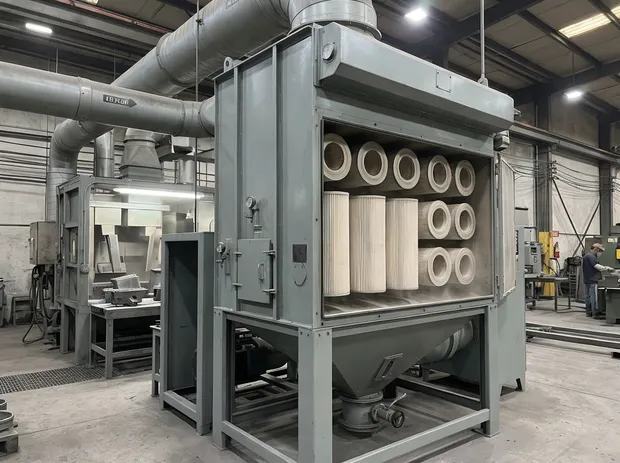
Blasting-line dust collectors use cartridge-style filters with pleated media that provides high surface area in a compact housing. A typical dust collector for a 4–6 wheel tumble system uses 12–16 filter cartridges, each 325 mm diameter × 660 mm height, providing 180–240 m² of total filter area. The dust collector fan pulls 8,000–12,000 m³/hour of airflow, creating 1,200–1,500 Pa of negative pressure in the blast chamber — enough to contain dust without pulling excessive abrasive media into the filter.
Filter media material is typically polyester or cellulose with a surface coating that prevents dust from embedding in the fibers. The right choice depends on your shift pattern and total-cost-of-ownership target — see the comparison below.
Cartridge dust collector — 12–16 cartridges provide 180–240 m² filter area
Pulse-jet cleaning extends filter life by blowing compressed air back through the cartridges every 30–60 seconds to dislodge accumulated dust. The dust falls into a collection hopper below the filters, and you empty the hopper weekly or monthly depending on casting volume.
Without pulse-jet cleaning, filters would clog within days and require constant replacement. The pulse-jet system adds $2,000–3,000 to the dust collector cost but is mandatory for any production blasting operation.
Added System Cost
$2–3K
Mandatory for production lines — prevents daily filter clogging
Dust collector maintenance follows a predictable pattern. Tracking pressure drop is the single most reliable indicator of filter health — replace when airflow degrades, not on a fixed calendar.
Common mistake to avoid: Some foundries try to extend filter life by increasing pulse-jet frequency or boosting fan speed, but this just wastes compressed air and energy. Once filters are loaded, they need replacement — there is no workaround.
Disposal requirements for collected dust vary by local regulations. In most jurisdictions, foundry dust is classified as industrial waste (not hazardous waste) and can go to standard industrial landfills.
The dust composition is primarily iron oxide, silica (from sand), and clay particles — no toxic metals or organic compounds unless you're casting specialty alloys. Check your local environmental regulations before assuming landfill disposal is acceptable, especially if you're in the EU where waste classification rules are stricter than most other markets.
Typical cost: $50–150 per ton depending on location — for most export foundries, landfill disposal is the simpler and more practical path.
Some foundries recycle collected dust back into their sand system or sell it to cement manufacturers as a raw material additive. This only works if:
For most export foundries, the logistics of finding a consistent dust buyer don't justify the effort unless volumes are high enough to be commercially attractive.
Environmental compliance for blasting operations typically focuses on three areas. Properly sized dust collection handles the first two — if your system maintains negative pressure in the blast chamber and filters capture 99%+ of particles, you're meeting air quality and emissions requirements in most jurisdictions.
Keeping respirable dust below occupational exposure limits. Negative-pressure blast chambers combined with high-efficiency filtration (99%+ particle capture) satisfy requirements in most jurisdictions.
Preventing dust from escaping the building. Integrated dust collection with negative-pressure chambers and properly sealed ductwork ensures particulate matter stays contained within the filtration system.
Blast wheels and dust collector fans generate 85–95 dB. Requires either acoustic enclosures or operator hearing protection within 5 meters of equipment.
Sound-dampening enclosures around the blast chamber reduce noise at source. Adds $3,000–5,000 to system cost.
Higher upfront cost · Better long-term protectionMost foundries use hearing protection rather than acoustic enclosures — it's simpler and workers already need hearing protection for other foundry operations (melting, shakeout, grinding).
Most common approachWe include dust collection as an integrated component of every blasting system we build — it's not an optional add-on. The dust collector is sized to match blast chamber volume and wheel configuration.
The controls are interlocked so the blast wheels won't start unless the dust collector is running. This prevents operators from bypassing the dust collector to "save energy" or "speed up the process," which would create immediate air quality and housekeeping problems.
From integrated workflow design to certified manufacturing and stable lead times — the operational reasons behind the choice.
We've been building foundry equipment since 2010, and blasting systems became part of our product line in 2015 when export buyers started requesting complete post-casting processing solutions rather than just molding equipment. The shift happened because overseas foundries needed suppliers who understood the entire workflow — not just how to build a blast chamber, but how to integrate it with upstream shakeout systems and size it to match molding line throughput.
A European buyer ordered our first integrated clay sand line with blasting in 2016, and that project taught us what matters: equipment that arrives ready to connect, parameters that work for the buyer's specific casting types, and support that doesn't require flying a technician across an ocean for every adjustment.
Our in-house R&D team configures blasting systems based on your casting specifications and production volume, not from a fixed catalog of standard models. When you tell us you're casting ductile iron valve bodies with 4–8 mm wall thickness and need 100–150 μm Ra surface finish, we're selecting wheel speeds, abrasive types, and exposure times that deliver those results — not handing you a generic spec sheet and leaving you to figure out the parameters yourself.
This matters most when you're serving customers with tight surface finish requirements or when you're processing multiple casting types that need different blasting approaches.
ISO 9001:2015, CE, and SGS certifications mean our manufacturing process gets audited annually by third-party inspectors who verify material sourcing, fabrication procedures, and testing protocols. The certifications create a documentation trail that satisfies your own quality audits and customer requirements.
If you're selling castings to automotive or industrial equipment buyers who require supplier traceability, you'll need to show that your foundry equipment came from a certified manufacturer. We provide the material certificates, test reports, and calibration records with every system shipment.
Manufacturing scale that keeps your project timeline predictable
Our facility runs 8 production lines across 15,000 square meters, producing 500,000 units annually. That capacity determines lead time stability — we're not a job shop that gets backlogged when a large order arrives.
A typical clay sand blasting line order (tumble or continuous configuration) consumes 3–4 weeks of production time across multiple lines — frame fabrication, blast wheel assembly, electrical integration, and testing. We can run 4–6 systems in parallel, so even with a queue of orders, your lead time stays in the 45–60 day range from deposit to factory departure.
We don't impose a minimum order quantity for complete systems, and we modify standard designs for different motor voltages, chamber dimensions, or abrasive handling configurations without charging engineering fees — unless the changes require new tooling or outside components.
Shipped to 40+ countries — we handle documentation, shipping logistics, and customs coordination as part of standard service.
We know which markets require specific certifications — CE for Europe, GOST for Russia — and prepare accordingly.
Commercial invoices prepared with the exact information customs officials need. No delays from incomplete paperwork.
Equipment packed to survive ocean freight — proper crating, moisture barriers, and securing for container transport.
English-language operations manual, electrical schematics, spare parts list, and maintenance schedule ship with every system. Translation available in other languages (adds 1–2 weeks, $500–800 depending on language and document length).
Phone and email support — we can diagnose 60–70% of issues by reviewing photos and discussing symptoms with your operators.
Resolves most issuesParts stocked at our Qingdao facility with 5–7 day shipping to most export markets via DHL or FedEx.
Fast global deliveryAvailable if remote support doesn't resolve the problem. You cover travel costs, we cover labor. Usually needed only for major component replacement (blast wheel motor swap, dust collector fan rebuild) or capacity upgrades — not routine troubleshooting.
Rarely requiredMost buyers never need an on-site visit after initial commissioning — the combination of operator training, detailed documentation, and remote support handles the majority of issues.
Practical answers to the media selection, dimensional control, and process comparison questions foundries ask most when specifying clay sand blasting lines.
Steel shot S230–S280 (0.5–0.6 mm diameter, rounded particles) works best for ductile iron because it removes oxide scale without embedding in the surface. Angular grit cleans faster but can lodge in the ductile iron's microstructure and create stress concentration points that reduce fatigue life.
If you're seeing embedded grit after blasting, switch from grit to shot and increase exposure time by 20–30 % to compensate for the gentler cleaning action.
Two-stage process for heavily scaled ductile iron: Run G25 grit for initial scale removal, followed by S230 shot for surface finishing. This sequence balances aggressive cleaning with final surface quality.
Reduce wheel speed by 200–400 RPM and extend exposure time to maintain cleaning effectiveness at lower impact energy. Distortion risk is highest on castings with wall thickness under 5 mm or large flat surfaces.
For critical precision parts, fixture the casting during blasting — clamp it to a rigid backing plate to resist blast pressure.
Threshold check: Check dimensional accuracy on first-article castings after parameter changes — if you're seeing 0.1 mm+ distortion, you're running too aggressively for that casting geometry.
Shot blasting (steel media propelled by centrifugal wheels) is better for production foundries because it recycles the abrasive media in a closed loop, delivers consistent impact energy, and generates less airborne dust than compressed-air sand blasting.
Sand blasting (compressed air propelling silica or aluminum oxide) is cheaper for low-volume operations but consumes abrasive media continuously (no reclaim system) and requires higher air compressor capacity.
| Factor | Shot Blasting | Sand Blasting |
|---|---|---|
| Media Reclaim | Closed-loop recycle | Continuous consumption |
| Impact Consistency | Consistent (centrifugal wheel) | Variable (air pressure dependent) |
| Dust Generation | Lower | Higher (airborne silica risk) |
| Initial Cost | Higher capital investment | Lower upfront cost |
| Best For | > 5 tons/week production | Low-volume / occasional use |
Bottom line: For any foundry processing more than 5 tons of castings per week, shot blasting delivers lower operating costs and better surface finish consistency.
Blast wheel impellers last 2,000–3,000 operating hours with steel shot, or 1,500–2,500 hours with steel grit. At 8 hours per day, 5 days per week, that translates to 12–18 months for shot or 9–15 months for grit.
Signs of Impeller Wear
$400–600
per impeller replacement cost
30–45 min
replacement time per impeller
Keep one spare set on-site so a worn impeller doesn't idle your entire blasting system while waiting for parts to ship.
Dust collector airflow should be 1.2–1.5× the blast chamber volume (in cubic meters) × 60, expressed in m³/hour.
Sizing Example — Tumble Blast Chamber
Chamber dimensions: 1.5 m diameter × 2.5 m length
Chamber volume: ≈ 4.4 m³
Required airflow: 4.4 × 60 × 1.3 = 340 m³/min ≈ 20,000 m³/hour
Undersized Collector
Dust escapes through door seals — workplace contamination and compliance issues
Oversized Collector
Wastes energy and pulls excessive abrasive media into the filters
TZFoundry sizes dust collectors as part of the system design, so you don't need to calculate this yourself — but if you're evaluating a competitor's quote, check that their dust collector airflow matches this formula.
Production
45–60 days
Deposit to factory departure
Shipping
15–30 days
Ocean freight + customs + inland transport (3–5 days)
Installation
5–8 days
Assembly (3–5 days) + testing & training (2–3 days)
Total elapsed time: 65–95 days
From order placement to equipment operational at your facility.
Need faster delivery? Air freight is available for smaller tumble systems — cuts shipping time to 5–7 days but costs 4–5× more than ocean freight.
Information we need for an accurate quotation: casting type and weight range (gray iron automotive parts 5–15 kg each, ductile iron valve bodies 2–8 kg each, etc.), target throughput (tons per hour or castings per hour), available floor space (length × width, plus ceiling height if you have overhead cranes), electrical supply specifications (voltage, phase, available amperage), and whether you're integrating with existing shakeout equipment or starting from scratch. If you're replacing an older blasting system, tell us what's not working with your current setup — that helps us avoid specifying the same bottlenecks.
Type, alloy, weight range, and typical batch sizes you process
Tons per hour or castings per hour — your production target
Length × width, plus ceiling height and crane availability
Voltage, phase, and available amperage at your facility
Casting samples or photos help us recommend the right blasting parameters. If you can send photos showing typical surface condition after shakeout (how much burnt-on sand, scale thickness, any areas that are particularly difficult to clean), we can configure wheel speeds and abrasive types that work for your specific castings rather than providing generic settings. For precision castings with tight surface finish requirements, include your target Ra value and dimensional tolerances so we can verify our system will meet those specs.
Site preparation requirements start with the foundation. Blasting equipment generates vibration from rotating blast wheels and tumbling chambers, so you need a reinforced concrete slab at least 150 mm thick. If you're installing on an upper floor, check your building's load rating — a tumble blast system weighs 4–6 tons fully loaded, and a continuous system weighs 8–12 tons. We provide foundation drawings with anchor bolt locations and load distribution maps as part of the pre-shipment documentation package.
Electrical service needs to deliver the system's rated power (30–50 kW for tumble systems, 60–100 kW for continuous systems) plus 20% overhead for startup surge current. Most buyers install a dedicated circuit breaker for the blasting line rather than tapping into existing foundry power — it simplifies troubleshooting and prevents voltage sags from affecting other equipment. Compressed air (for pulse-jet filter cleaning) requires 0.6–0.8 MPa supply pressure at 0.5–1.0 cubic meters per minute. No water supply is needed unless you're adding an optional wash station after blasting.
| Utility | Tumble System | Continuous System | Notes |
|---|---|---|---|
| Electrical Power | 30–50 kW | 60–100 kW | +20% overhead for startup surge |
| Compressed Air Pressure | 0.6–0.8 MPa | For pulse-jet filter cleaning | |
| Compressed Air Flow | 0.5–1.0 m³/min | Continuous supply required | |
| Water Supply | Not required | Unless adding optional wash station | |
Recommendation: Most buyers install a dedicated circuit breaker for the blasting line rather than tapping into existing foundry power — it simplifies troubleshooting and prevents voltage sags from affecting other equipment.
The blast chamber is sealed and vented through the dust collector, but you'll need general facility ventilation to handle heat from the blast wheel motors and dust collector fan. Plan for 1,000–1,500 cubic meters per hour of exhaust airflow in the area around the blasting system to keep ambient temperature within 5°C of outdoor temperature.
1,000–1,500 m³/hr
General facility ventilation around the blasting system area — keeps ambient temperature within 5°C of outdoor temperature, handling heat from blast wheel motors and dust collector fan.
45–60 days from deposit to factory departure. System manufactured, assembled, and tested at our facility before crating.
15–30 days depending on destination port and shipping schedule.
3–5 days for customs clearance and inland transport to your factory site.
3–5 days. Systems ship as modular sections that bolt together — no welding or custom fabrication required, just basic hand tools and a forklift or crane for positioning larger components.
2–3 days for commissioning and operator training.
Total elapsed time from order to first production casting: 70–100 days. We ship systems as modular sections that bolt together on your factory floor — no welding or custom fabrication required.
Training is hands-on — your operators run the equipment under our technician's supervision until they're comfortable with all normal and exception scenarios. Training covers:
Complete documentation ships with every system:
All documents ship in English. Other languages available on request for additional cost.
Phone and email support — send us photos of problem castings or describe symptoms, and we'll guide you through parameter adjustments. Response time: 4–8 hours during China business hours (UTC+8), 12–24 hours outside that window.
Order through email or WhatsApp. We quote price and lead time within 24 hours. Parts shipped from our facility with tracking provided.
If remote support doesn't resolve the issue, we arrange on-site service visits. For urgent production-affecting issues, contact us directly via WhatsApp at +86 13335029477 — that number reaches our technical team directly.
Contact us at sales@tzfoundry.com with your casting specifications and throughput requirements. Include photos of your castings after shakeout if possible — that helps us configure the system for your specific surface conditions.
We'll respond within 24 hours with preliminary specifications and pricing, followed by a detailed proposal within 3–5 business days after we've clarified any technical questions.
Get a Quote for Clay Sand Blasting EquipmentSand recovery and reuse systems
Sand cleaning and conditioning systems
Automated molding systems
Complete casting production lines
Sand mixing and preparation equipment
Sand regeneration and recycling systems