ISO 9001:2015 Certified · Factory-Direct

Clay Sand Jaw Crusher — Primary Crushing in Reclamation Systems

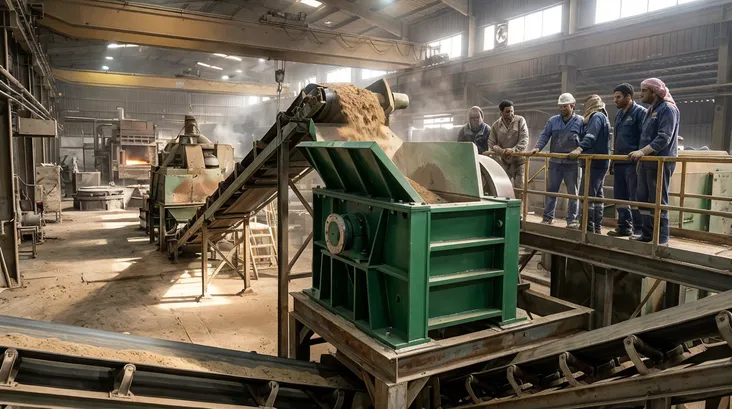
A clay sand jaw crusher sits at the front end of your reclamation system, breaking down agglomerated sand lumps and removing oversized contaminants before material enters screening or attrition equipment. This isn't a general-purpose rock crusher — it's sized and configured specifically for foundry sand processing, where you're handling returned sand mixed with metal fragments, core pieces, and compacted clay lumps that would damage downstream mills if they passed through uncrushed.

  • Manganese steel jaw plates (Mn13Cr2)
  • 250mm / 400mm / 600mm jaw openings
  • 5–80 t/h throughput capacity
  • Custom configurations available
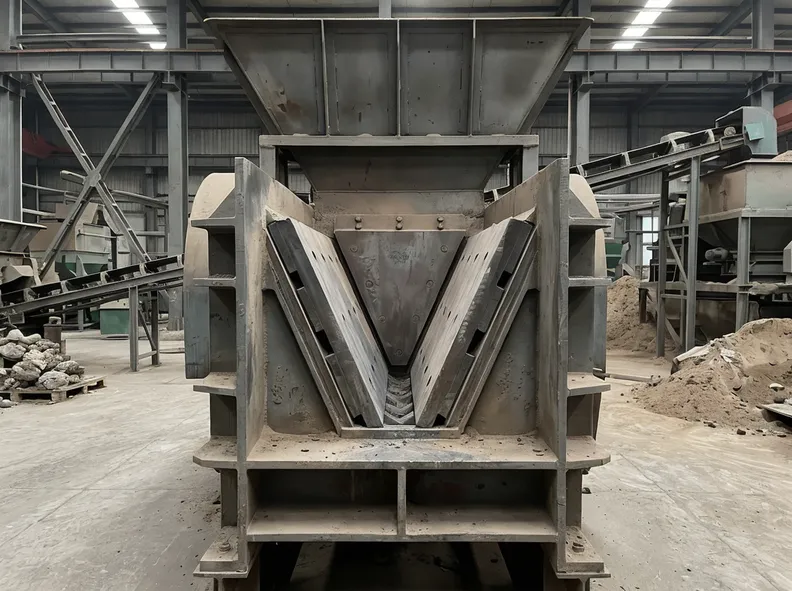
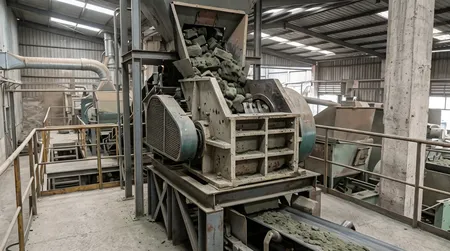
Clay sand jaw crusher for foundry sand reclamation — front view showing jaw opening and feed inlet

We build these crushers to handle the specific material characteristics of used foundry sand: sticky clay binders, irregular lump sizes, and embedded metal contaminants. The jaw plates use manganese steel that resists abrasive wear from silica sand while maintaining crushing force through thousands of operating hours. Feed opening dimensions match standard sand return conveyor widths, and discharge sizing aligns with typical vibrating screen mesh specifications, so the crusher integrates into your existing material flow without custom transition chutes.

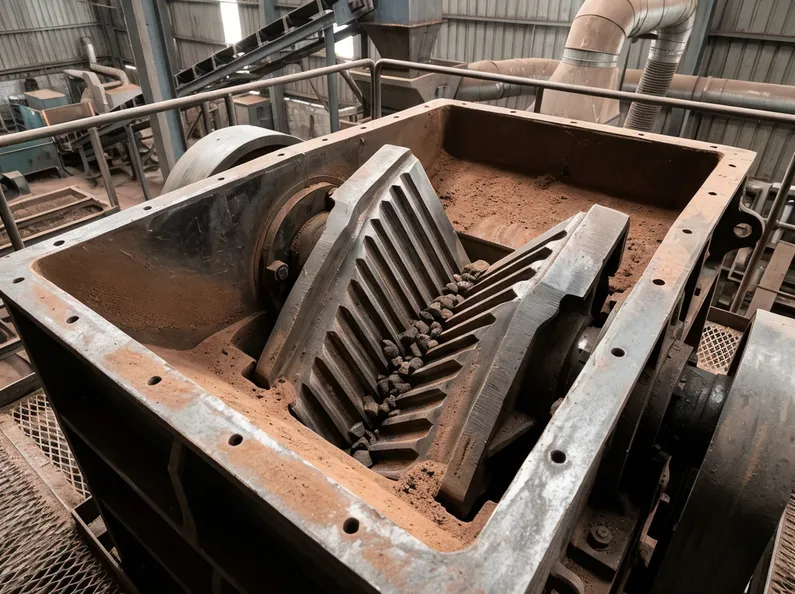
The crushing chamber geometry matters more in foundry applications than in aggregate crushing. Sand lumps compress and deform under pressure rather than fracturing cleanly like rock, so we use a steeper nip angle (22-24° versus the 18-20° common in mining crushers) to prevent material from bouncing out of the crushing zone. This keeps throughput consistent even when processing sand with high moisture content or excessive clay binder.

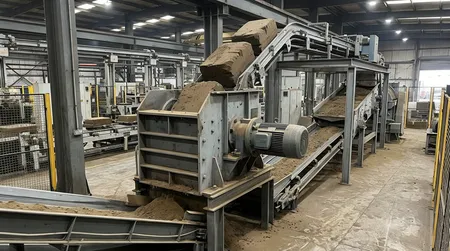
Clay sand jaw crusher crushing chamber showing steeper 22-24 degree nip angle designed for foundry sand

Downstream Equipment Protection

Your reclamation system's economics depend on protecting downstream equipment from oversized material. A jaw crusher that removes 95%+ of +20mm lumps before sand reaches your attrition mill extends mill liner life by 40-60% based on our customers' maintenance records. That's the commercial logic: spending on primary crushing reduces your cost per ton of reclaimed sand by cutting wear part consumption in more expensive equipment downstream.

Engineering Data

Technical Specifications & Performance Parameters

Parameter Specification Range
Jaw Opening Width 250mm / 400mm / 600mm
Jaw Opening Depth 200mm / 350mm / 500mm
Max Feed Size 200mm / 350mm / 500mm
Discharge Size Range 10-80mm (adjustable)
Throughput Capacity 5-15 t/h / 15-40 t/h / 40-80 t/h
Reduction Ratio 3:1 to 6:1
Motor Power 15kW / 30kW / 55kW
Jaw Plate Material Manganese steel (Mn13Cr2)
Operating Speed 250-300 cycles/min
Weight 1,800kg / 4,200kg / 8,500kg
Footprint (L×W×H) 1,200×800×1,100mm / 1,600×1,200×1,400mm / 2,200×1,600×1,800mm
Power Supply 380V 3-phase 50Hz (customizable)
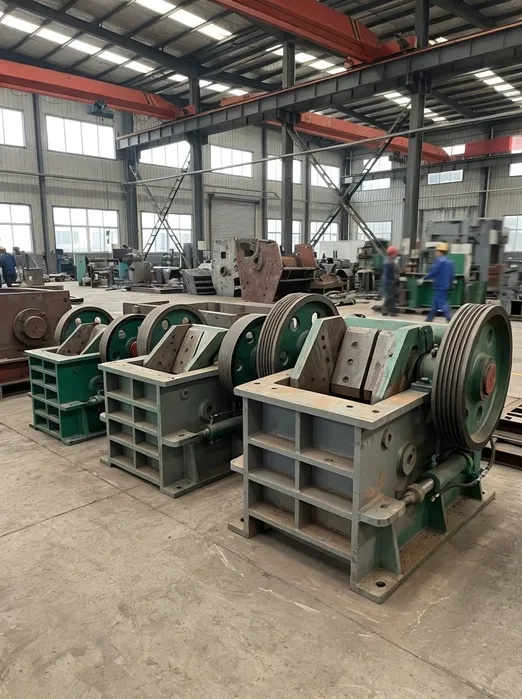
Three clay sand jaw crusher model sizes — 250mm, 400mm, and 600mm jaw opening configurations

Capacity Assumptions

10-15% moisture, 8-12% clay content, bulk density 1.4-1.6 t/m³. Drier sand or lower clay content increases throughput by 15-20%.

Foundry sand throughput capacity visualization showing material flow through jaw crusher

Throughput & Sand Circulation

Throughput capacity correlates directly to your foundry's sand circulation rate. A facility producing 100 molds per hour with 50kg of sand per mold generates roughly 5 tons of returned sand per hour, which the 250mm jaw opening model handles comfortably. The capacity ranges listed above assume typical foundry sand characteristics (10-15% moisture, 8-12% clay content, bulk density 1.4-1.6 t/m³). Drier sand or lower clay content increases throughput by 15-20%; wetter material or higher binder levels reduces it proportionally.

Shim plate adjustment mechanism for jaw crusher discharge sizing

Discharge Size Adjustment

Discharge size adjustment uses shim plates behind the fixed jaw — adding or removing shims changes the crushing chamber outlet dimension in 5mm increments. Most reclamation systems run with 25-40mm discharge settings, which produces material that passes through 50mm screen mesh while removing the oversized lumps that cause screen blinding and mill damage.

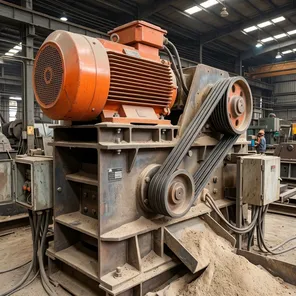
Oversized motor on clay sand jaw crusher for handling peak torque loads

Motor Power Sizing

Motor power sizing accounts for peak load conditions, not average operation. The crusher draws maximum power when processing compacted sand blocks or crushing embedded metal fragments, which can spike torque requirements 2-3× above steady-state levels. We oversize motors by 20-30% compared to aggregate crusher equivalents to handle these transient loads without thermal overload trips.

Selection Guide

Sizing Selection — Matching Crusher Capacity to Your Reclamation System

Choose jaw opening dimensions based on three factors: your foundry's hourly sand circulation rate, the typical lump size distribution in returned sand, and your downstream equipment's processing capacity. Undersizing the crusher creates a bottleneck that forces you to run reclamation in batch mode instead of continuous flow; oversizing wastes motor power and increases wear part costs without improving system throughput.

250mm jaw opening clay sand jaw crusher installed in small-batch foundry reclamation system

Small-Batch Foundries (30-80 molds/hour)

If you're processing 2-5 tons of sand per hour, the 250mm jaw opening model matches your flow rate. This configuration suits manual molding operations or small automated lines where sand returns in batches rather than continuous streams. The 15kW motor runs efficiently at 60-80% load during normal operation, which keeps power consumption reasonable and extends bearing life. Pair this with a 1.2m² vibrating screen and a 500kg/batch attrition mill for a balanced reclamation system.

250mm Jaw 15kW Motor 2-5 t/h
Most Common
400mm jaw opening clay sand jaw crusher integrated in mid-volume automated foundry line

Mid-Volume Automated Lines (80-180 molds/hour)

Processing 5-12 tons per hour requires the 400mm jaw opening model. This is the most common configuration for export buyers running automated molding lines with continuous sand return conveyors. The 30kW motor handles peak loads when crushing compacted sand blocks without frequent overload events. Downstream equipment should include a 2.5m² double-deck screen and a 1,500kg/batch attrition mill to maintain flow balance. One European buyer runs this configuration 16 hours daily processing gray iron molding sand — they've maintained 8-10 t/h average throughput for three years with two jaw plate replacements.

400mm Jaw 30kW Motor 5-12 t/h
600mm jaw opening clay sand jaw crusher in high-volume continuous centralized reclamation system

High-Volume Continuous Systems (180+ molds/hour)

Above 12 tons per hour, specify the 600mm jaw opening model. This handles the sand circulation rates from large automated foundries running multiple molding lines into a centralized reclamation system. The 55kW motor and heavy-duty frame construction support continuous operation at 70-85% capacity utilization. You'll need proportionally sized downstream equipment: 4-5m² screening area and 3,000kg+ attrition mill capacity. A North American ductile iron foundry processes 18-22 t/h through this configuration, feeding three molding lines from a single reclamation system.

600mm Jaw 55kW Motor 12+ t/h

Lump Size Distribution vs. Throughput

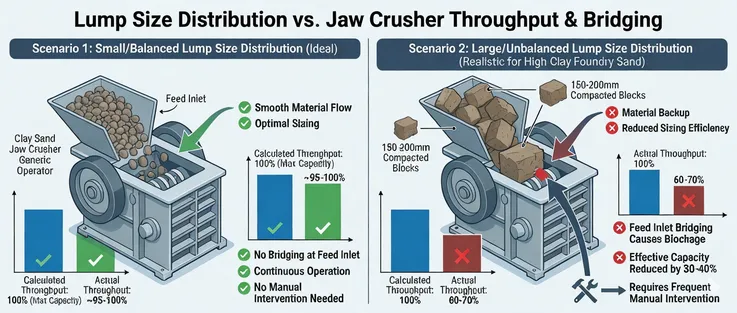
Diagram showing lump size distribution impact on jaw crusher feed bridging and capacity

Lump size distribution affects sizing as much as total throughput. If your returned sand contains frequent 150-200mm compacted blocks (common in flask molding with high clay content), you need the next size up from what throughput alone would suggest. The larger jaw opening prevents bridging at the feed inlet, which causes material backup and forces manual intervention. We've seen buyers undersize based purely on tons-per-hour calculations, then struggle with feed blockages that cut effective capacity by 30-40%.

Downstream Capacity Matching

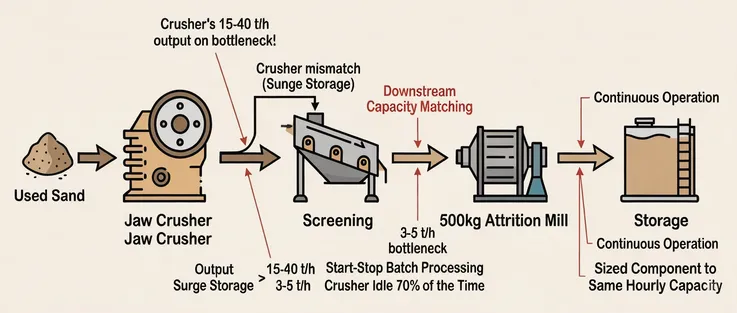
Reclamation system flow diagram showing crushing, screening, attrition, and storage capacity alignment

Downstream capacity matching matters more than buyers expect. Installing a 400mm crusher ahead of a 500kg attrition mill creates a mismatch — the crusher can feed 15-40 t/h but the mill only processes 3-5 t/h, so you need surge storage between stages or the crusher sits idle 70% of the time. Map your entire reclamation flow (crushing → screening → attrition → storage) and size each component to the same hourly capacity. That's how you get continuous operation instead of start-stop batch processing.

System Integration

Integration & Retrofit Compatibility

Mounting & Base Frame

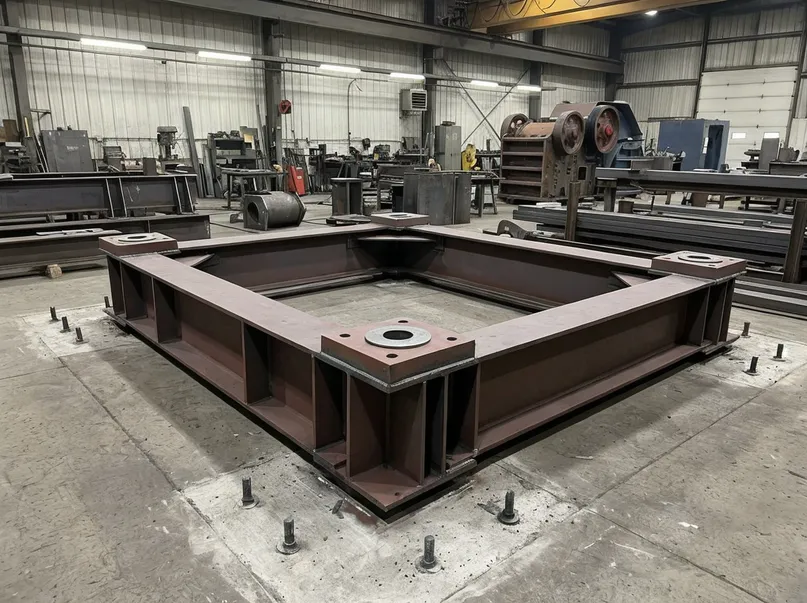
The crusher mounts on a structural steel base frame with four anchor bolt positions. Bolt hole spacing follows standard patterns: 600mm × 400mm for the 250mm model, 900mm × 600mm for the 400mm model, 1,200mm × 800mm for the 600mm model. If you're retrofitting into an existing system, measure your available floor space and overhead clearance — the crusher needs 300mm clearance on all sides for maintenance access and 500mm above the feed opening for material drop from your return conveyor.

Structural steel base frame with anchor bolt positions for clay sand jaw crusher installation

Feed Inlet Connection

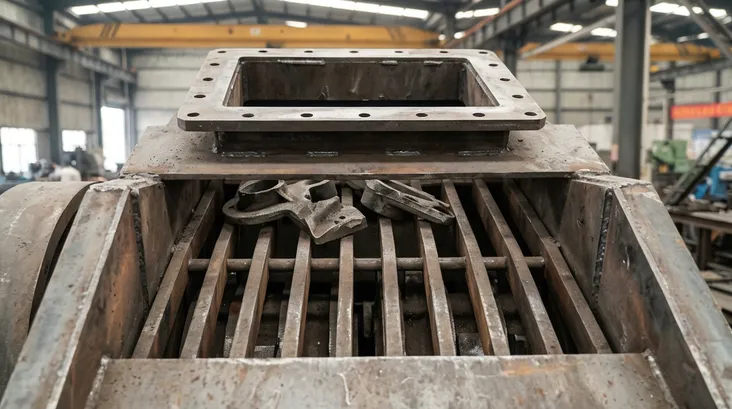
Feed inlet with flanged connection and grizzly bar screen protecting jaw plates from oversized metal castings

Feed inlet connects to your sand return conveyor via a transition chute. We provide a flanged inlet (200mm × 300mm / 350mm × 450mm / 500mm × 600mm depending on model size) that bolts to standard conveyor discharge chutes. If your existing conveyor uses different dimensions, we fabricate custom transition pieces — send us your conveyor width and discharge height, and we'll match it. The inlet includes a grizzly bar screen (50mm / 80mm / 120mm bar spacing) that prevents oversized metal castings from entering the crushing chamber, which protects jaw plates from impact damage.

Discharge Outlet

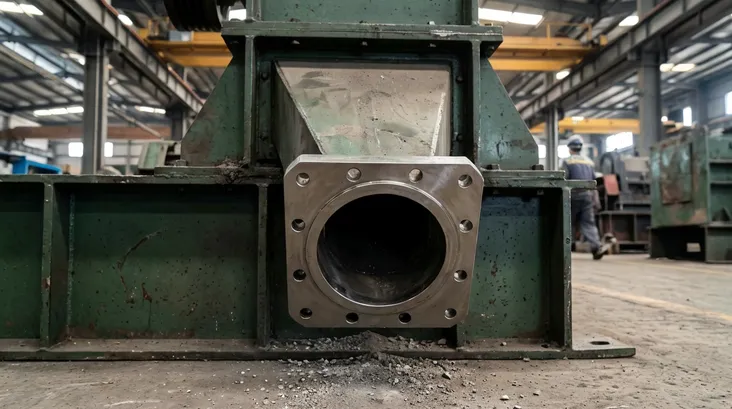
Discharge outlet with ISO standard flanged connection for vibrating screen or surge hopper integration

Discharge outlet uses a flanged connection (300mm × 400mm / 450mm × 550mm / 600mm × 700mm) that mates with vibrating screen feed boxes or surge hopper inlets. The flange bolt pattern matches ISO standard dimensions, so integration with most European and North American screening equipment requires no custom fabrication. For Asian-market screens with different bolt patterns, we supply adapter flanges at no additional cost.

Electrical Integration

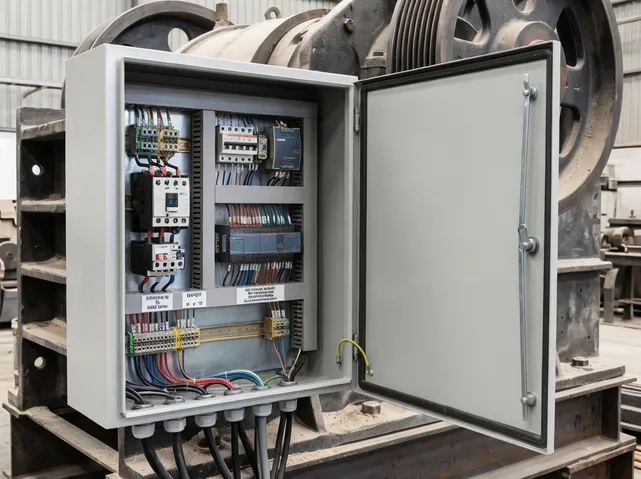
Electrical integration requires three-phase power at your specified voltage (380V 50Hz standard, 440V 60Hz and 220V configurations available). The motor uses a direct-on-line starter with thermal overload protection — no VFD or soft-start required for these motor sizes, which simplifies electrical installation and reduces component cost. Control interface provides three signals: run/stop command input, running status output, and overload fault output. These integrate with standard PLC control systems using 24VDC logic levels.

Electrical panel with PLC control integration for clay sand jaw crusher — DOL starter and 24VDC signal outputs

Retrofit Installation Timeline

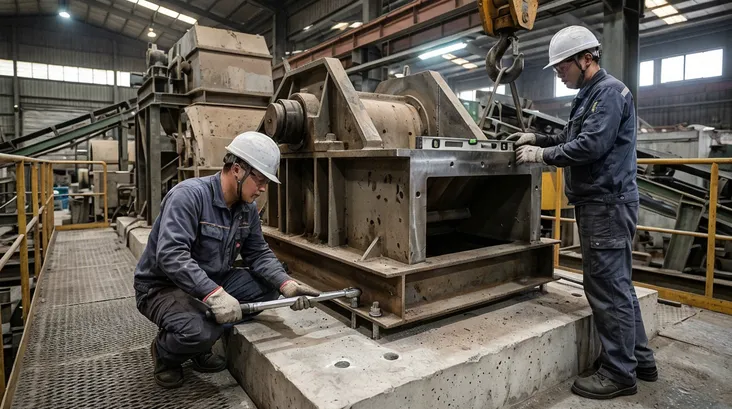
Retrofit installation of clay sand jaw crusher showing positioning, leveling, and anchor bolt torquing

Retrofit installations typically take 1-2 days depending on site preparation. If your floor already has anchor bolt embedments and the crusher replaces an existing unit with similar dimensions, installation is 6-8 hours (positioning, leveling, anchor bolt torquing, electrical connection, test run). New installations where we're adding a crusher to a previously manual reclamation system take longer — you need concrete foundation work (1 day cure time), structural steel base frame installation, conveyor modifications for feed/discharge connections, and electrical panel updates. We provide installation drawings that show anchor bolt locations, utility connection points, and clearance requirements so your maintenance team can prepare the site before the crusher ships.

Buyer Case: Middle East Retrofit

Successful Middle Eastern foundry retrofit — old 400mm jaw crusher replaced with new unit in under 8 hours

One Middle Eastern buyer replaced a worn 400mm crusher in their reclamation line last year. They had the old unit unbolted and removed in 3 hours, positioned and leveled the new crusher in 4 hours, and ran production sand through it the next morning. The key was pre-measuring all connection points and fabricating adapter flanges before the old crusher came out, so no field modifications were needed during installation.

Maintenance & TCO

Wear Parts Economics & Maintenance

Jaw Plate Lifespan & Material

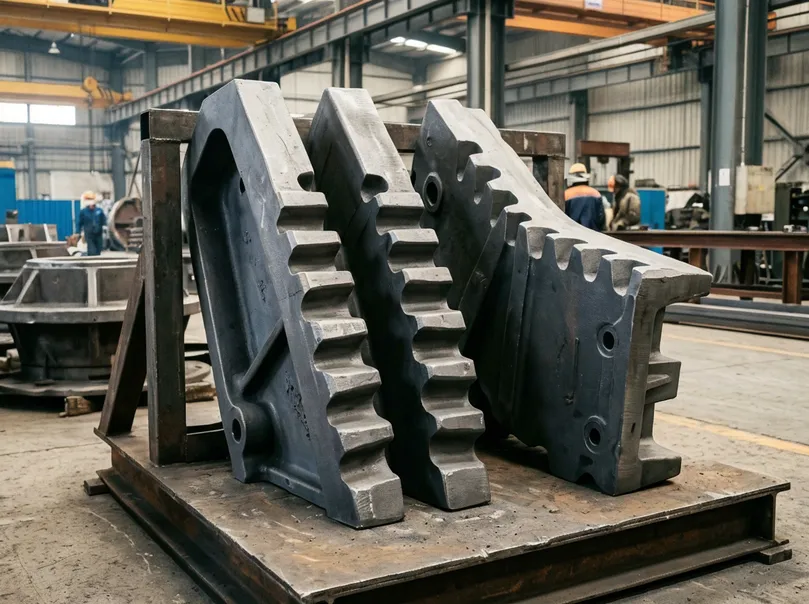
Jaw plates are the primary wear component. We use manganese steel (Mn13Cr2, 18-22% manganese content) that work-hardens under impact, which extends service life in abrasive foundry sand applications. Typical lifespan is 8,000-12,000 operating hours or 60,000-100,000 tons of processed sand, whichever comes first. Actual wear rate depends on sand silica content (higher silica = faster wear), clay binder type (bentonite is less abrasive than fire clay), and the frequency of metal contaminants passing through the crusher.

Replacement procedure takes 2-4 hours and requires no specialized tools. Unbolt the jaw plate mounting hardware (8-12 bolts depending on model size), slide out the worn plate, position the new plate, and torque mounting bolts to specification (180 N⋅m for 250mm model, 280 N⋅m for 400mm model, 420 N⋅m for 600mm model). We ship jaw plates as matched sets (fixed jaw + moving jaw) because uneven wear between plates reduces crushing efficiency and increases vibration. Replacing both plates simultaneously maintains optimal crushing geometry.

Manganese steel Mn13Cr2 jaw plate set showing fixed jaw and moving jaw — matched pair for optimal crushing geometry
180 N⋅m
250mm Torque
280 N⋅m
400mm Torque
420 N⋅m
600mm Torque
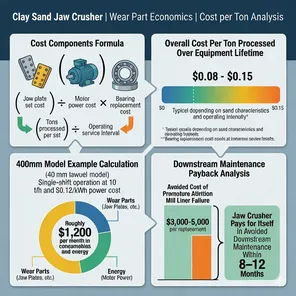
Cost per ton analysis visualization for clay sand jaw crusher wear part economics

Cost Per Ton Over Equipment Lifetime

Cost per ton processed over equipment lifetime runs $0.08-0.15 depending on your sand characteristics and operating intensity. Calculate it as: (jaw plate set cost ÷ tons processed per set) + (motor power cost × operating hours) + (bearing replacement cost ÷ bearing service interval). For the 400mm model processing 10 t/h at $0.12/kWh power cost, that works out to roughly $1,200 per month in consumables and energy for a single-shift operation.

Compare that to the cost of premature attrition mill liner failure ($3,000-5,000 per replacement) caused by inadequate primary crushing, and the jaw crusher pays for itself in avoided downstream maintenance within 8-12 months.

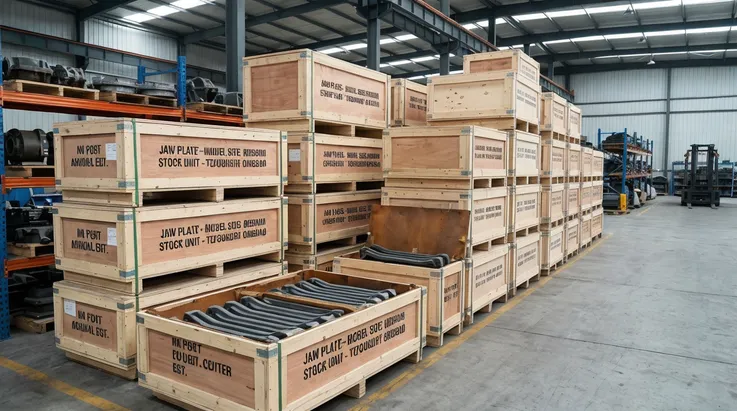
Jaw plate spare parts stocked at TZFoundry Qingdao facility in anti-corrosion wooden crates

Spare Parts Logistics

We stock replacement jaw plates at our Qingdao facility for all three model sizes. Standard shipping to North American ports is 5-7 days via air freight, 25-30 days via ocean container. European and Middle Eastern deliveries are 4-6 days air, 20-25 days ocean. Most buyers keep one spare jaw plate set on-site so they can replace worn plates during scheduled maintenance without waiting for parts shipment. The plates ship in wooden crates with anti-corrosion coating — they'll sit in your spare parts storage for years without degradation.

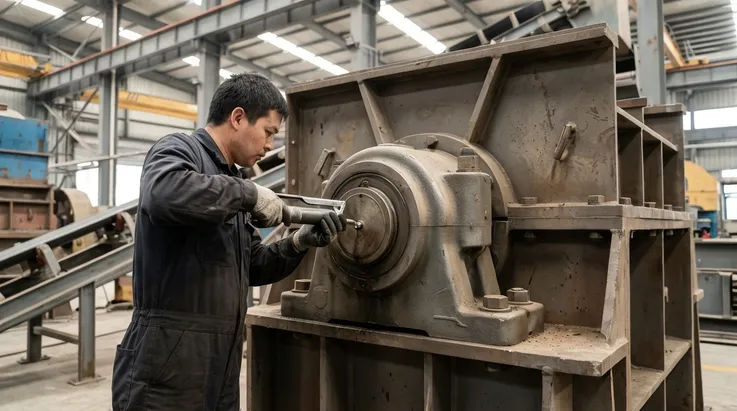
Bearing lubrication service via zerk fittings on clay sand jaw crusher — routine 10-minute maintenance

Bearing Maintenance Intervals

Bearing maintenance intervals are 2,000 operating hours for lubrication (grease gun service through zerk fittings, takes 10 minutes) and 8,000-10,000 hours for bearing replacement. We use sealed spherical roller bearings that tolerate the shock loads and misalignment inherent in jaw crusher operation. Bearing replacement requires removing the flywheel and eccentric shaft, which is a 6-8 hour job best done during annual shutdown maintenance. One Southeast Asian buyer runs their 250mm crusher 12 hours daily, six days per week — they're at 18,000 operating hours with one bearing replacement and three jaw plate changes, which tracks with our expected service intervals.

Manufacturer Advantage

Why Source Clay Sand Jaw Crushers from TZFoundry

We've built foundry sand processing equipment since 2010, starting with manual molding machines and expanding into complete reclamation systems as export buyers needed integrated solutions. That 15-year manufacturing history means we understand the specific material handling challenges in foundry sand crushing — the sticky clay binders, the embedded metal fragments, the moisture content variations — that don't exist in aggregate or mining applications. Our jaw crushers use design details (steeper nip angles, oversized motors, manganese steel jaw plates) that reflect actual foundry operating conditions, not generic crushing theory.

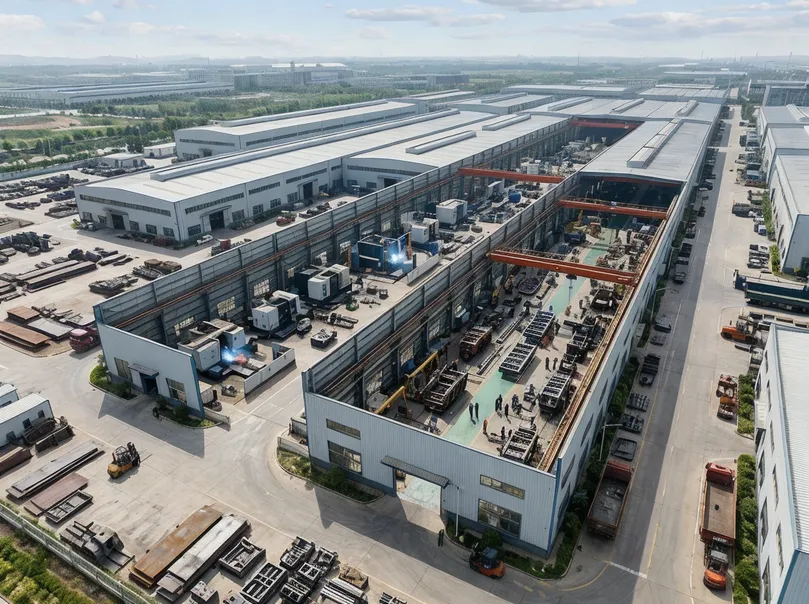
Our 15,000-square-meter facility in Qingdao runs 8 production lines with in-house machining, welding, and assembly capabilities. We fabricate crusher frames, machine eccentric shafts, and cast jaw plates in our own facility, which gives us control over lead times and quality consistency. ISO 9001:2015 certification covers our manufacturing processes; CE and SGS certifications cover product safety and performance standards for export markets. When you need custom configurations — non-standard jaw opening dimensions, special voltage motors, modified inlet/outlet flanges — our engineering team handles it without outsourcing to third-party fabricators.

TZFoundry 15,000 square meter Qingdao facility with 8 production lines — in-house machining, welding, and assembly
ISO 9001:2015
CE Certified
SGS Verified
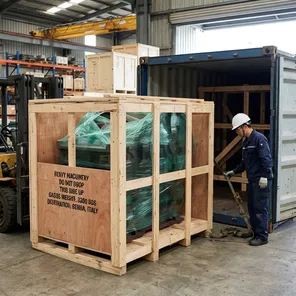
Clay sand jaw crusher packaged for ocean container transport — anti-corrosion treatment and wooden crate construction

Global Export Experience

We ship jaw crushers to foundries in North America, Europe, the Middle East, and Southeast Asia. That export experience means we know how to package equipment for ocean container transport (anti-corrosion treatment, wooden crate construction, tie-down point placement), how to provide documentation for customs clearance (commercial invoices, packing lists, certificates of origin), and how to size equipment dimensions to fit standard 20ft and 40ft containers without wasted space. The 250mm and 400mm models fit in 20ft containers; the 600mm model requires a 40ft container but we can combine it with screening equipment or spare parts to maximize container utilization.

Ready to Size Your Jaw Crusher?

Send us your current system specifications and throughput requirements — tell us your hourly sand circulation rate, typical lump sizes in returned sand, and downstream equipment capacity. We'll recommend the jaw crusher configuration that matches your reclamation system capacity and provide factory-direct pricing with delivery timeline.

sales@tzfoundry.com
+86 13335029477
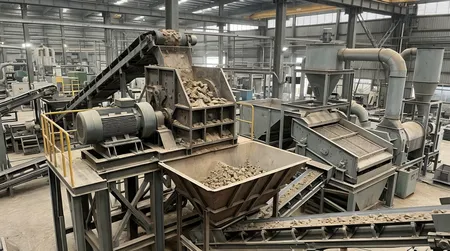
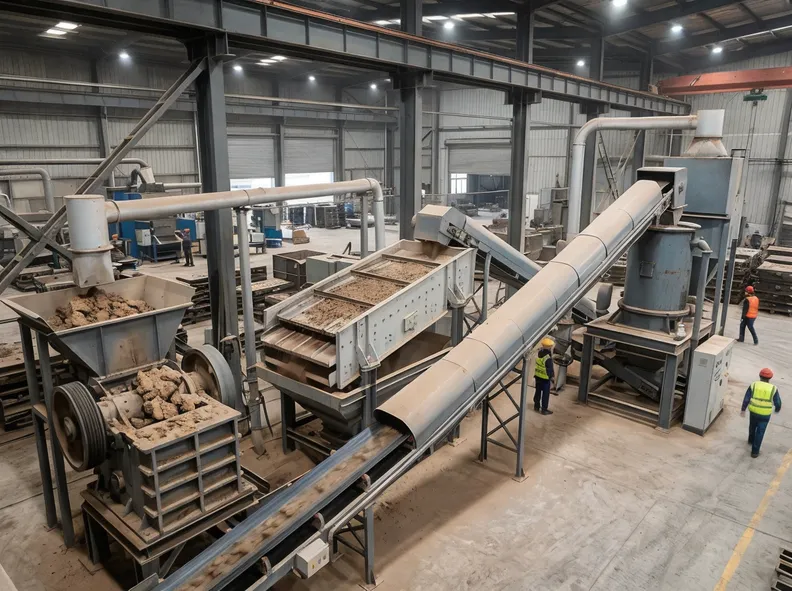
Complete clay sand reclamation system with jaw crusher, vibrating screen, and attrition mill integrated in foundry
Related Equipment

Explore More Clay Sand Processing Equipment

Other equipment in the Clay Sand Processing Line range