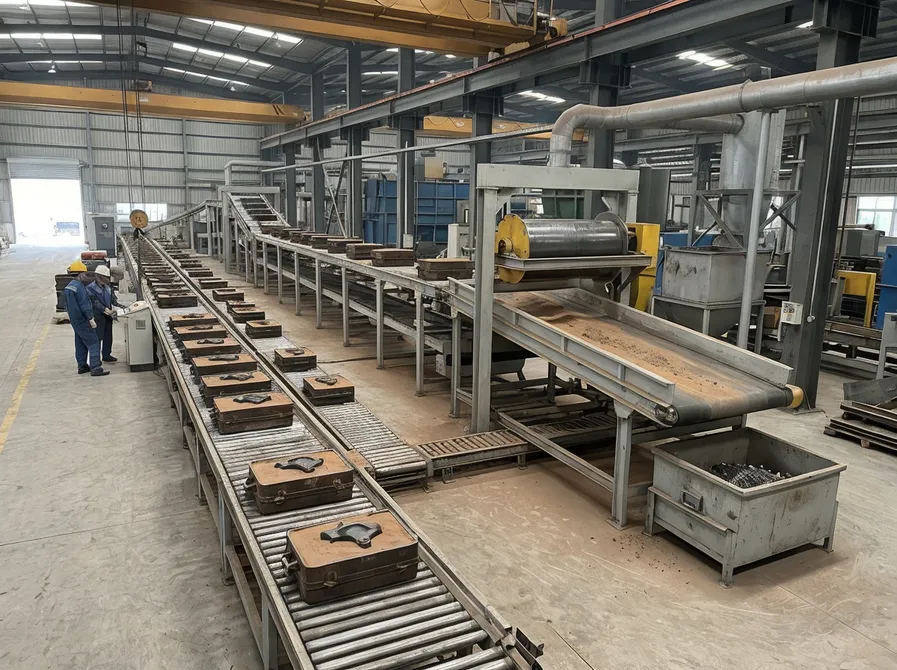
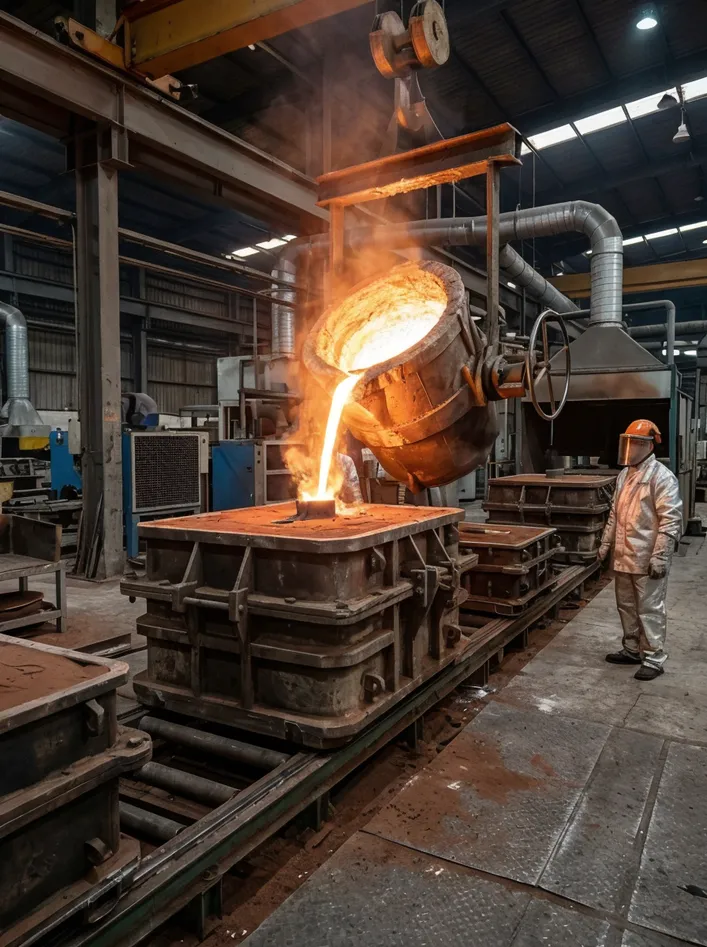
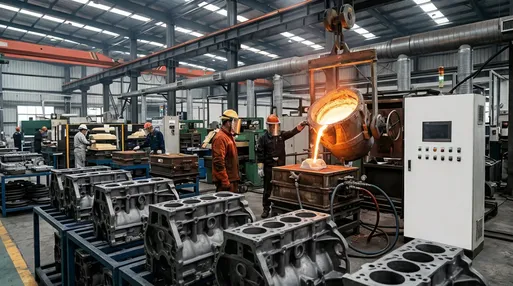
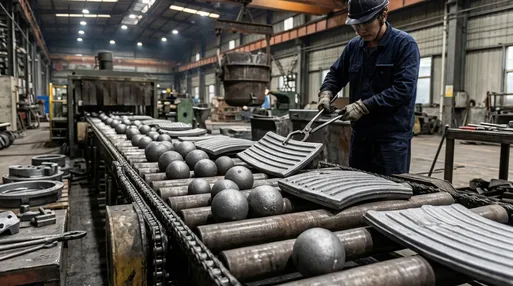
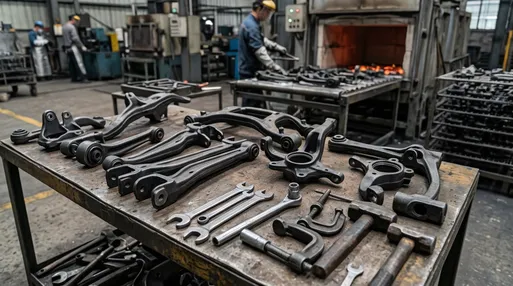
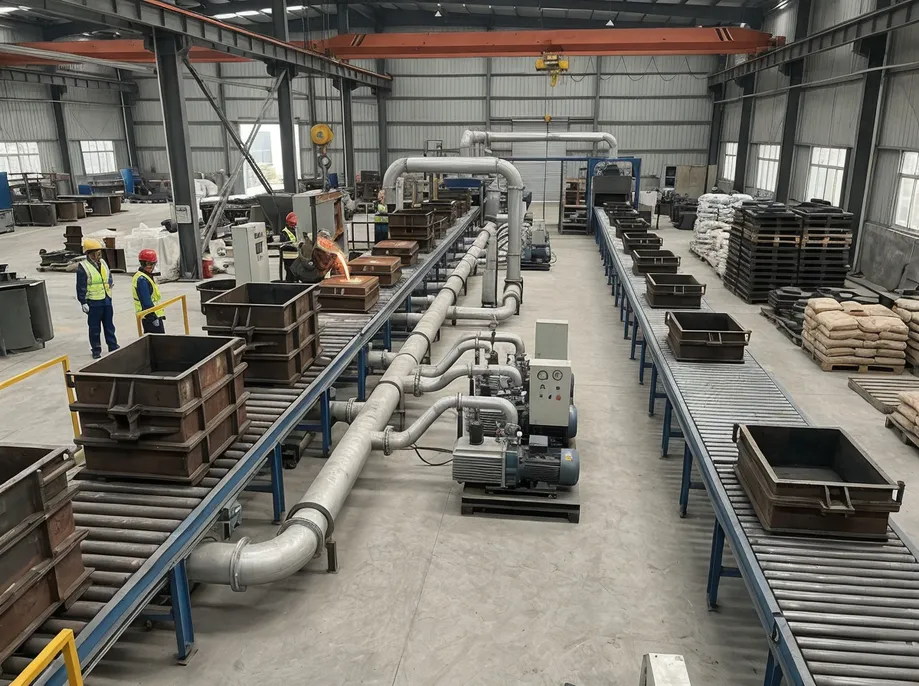
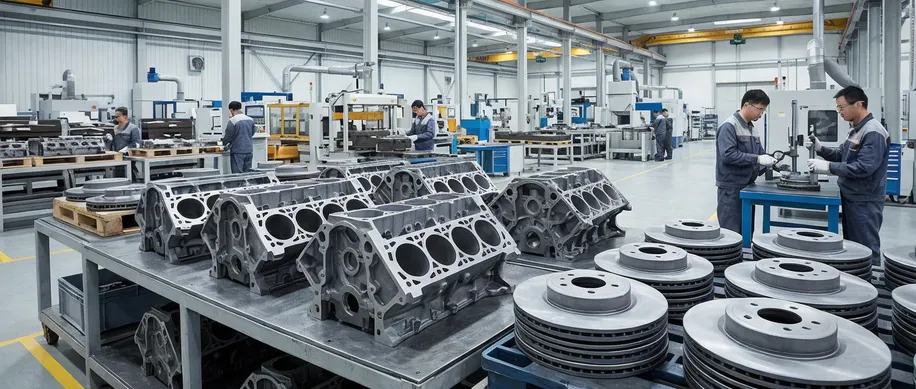
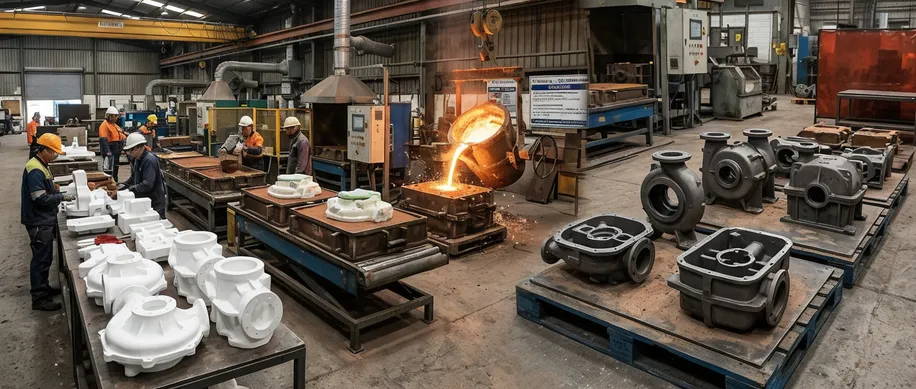
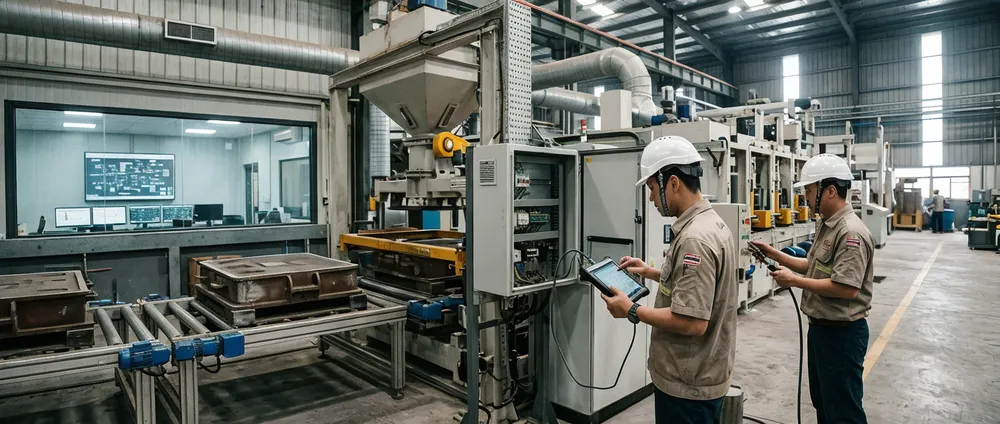
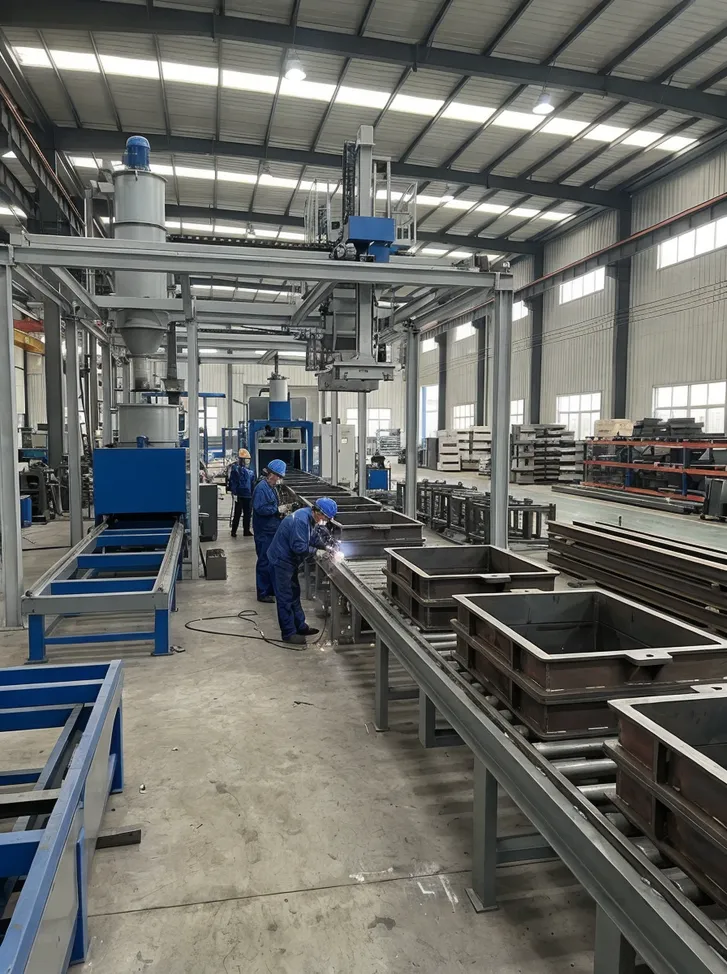
Complete production systems engineered for ferrous casting thermal loads — 1400-1500°C pouring, magnetic sand separation, extended cooling cycles.
Gray iron, white iron, and malleable iron configurations with iron-specific vacuum control, refractory coating systems, and 20-60 minute cooling conveyors.
A cast iron lost foam casting production line handles the thermal and structural demands that aluminum equipment can't — 1400-1500°C pouring temperatures, 3-5x longer solidification times, and mandatory magnetic separation to prevent iron contamination in your sand reclamation cycle. If you're running an iron foundry and evaluating lost foam adoption, or you're expanding from aluminum into ferrous casting, this equipment is sized for iron's weight, heat, and process requirements from the start.
We build complete cast iron lost foam lines for foundries producing 50-5000 tons annually. Each system ships as modular components in standard containers: pattern handling equipment, refractory coating systems rated for iron temperatures, heavy-duty flask handling for 500-2000 kg mold weights, extended cooling conveyors (18-25 meters for 100-ton/month capacity), and magnetic separation integrated into sand reclamation. Our lines handle gray iron, white iron, and malleable iron with configurable vacuum pressure and coating thickness parameters for each alloy type.
TZFoundry manufactures foundry equipment in Qingdao — 8 production lines across 15,000 square meters, producing clay sand systems, lost foam lines, and resin sand equipment since 2010. We've installed iron casting lines in North America, Europe, and the Middle East for foundries that needed factory pricing, iron-specific engineering, and equipment that scales as production grows. ISO 9001:2015, CE, and SGS certified. You work directly with the factory — no distributor markup, flexible configurations for your casting portfolio.
Cast iron pours at 1400-1500°C, nearly double aluminum's 700-750°C. That temperature difference drives every equipment specification: refractory coating formulations, flask structural ratings, cooling conveyor length, and fume extraction capacity. A lost foam line configured for aluminum will fail in iron service — coating systems can't handle the thermal shock, flasks warp under sustained heat exposure, and cooling conveyors sized for 15-minute aluminum cycles create production bottlenecks when iron castings need 45-60 minutes to reach handling temperature.
Iron castings weigh 2-3x more than aluminum equivalents due to density (7.2 g/cm³ for iron vs. 2.7 g/cm³ for aluminum). A 500x500mm flask filled with sand and a 20 kg aluminum casting weighs 180-220 kg total. The same flask with a 50 kg iron casting weighs 280-320 kg. Flask handling equipment, conveyor duty ratings, and overhead crane capacity must account for this weight difference. We size flask frames with 1.5-2x safety margin on structural load and specify conveyor motors with torque ratings that handle continuous operation at maximum flask weight.
Magnetic contamination is the third iron-specific challenge. During pouring and solidification, microscopic iron particles migrate into the sand. If you recycle that sand without magnetic separation, those particles create surface defects and inclusions in subsequent castings. Aluminum foundries can run without magnetic separators because aluminum is non-ferrous — iron foundries cannot. We integrate magnetic separation as a standard component in iron line configurations, not an optional add-on.
1400-1500°C for iron vs. 700-750°C for aluminum — nearly 2x the thermal load on every component.
280-320 kg per iron flask vs. 180-220 kg aluminum. 1.5-2x safety margin on structural load ratings.
Standard on all iron lines — prevents iron particle contamination in reclaimed sand and subsequent casting defects.
45-60 minutes to handling temperature vs. 15 minutes for aluminum. Extended conveyors prevent bottlenecks.
Equipment duty cycle matters when you're running iron continuously. Aluminum's lower pouring temperature and faster cooling mean less sustained thermal stress on equipment. Iron lines operate at higher temperatures for longer periods, so we specify components with higher thermal ratings: refractory-lined coating tanks, heat-resistant conveyor belts rated for 200°C continuous exposure, and vacuum pump seals that tolerate higher operating temperatures.
Component selection directly affects your maintenance cost — using aluminum-rated components in iron service means replacing pumps, motors, and seals 2-3x more frequently.
Our cast iron lost foam casting production line configurations start with your alloy mix and annual tonnage. Gray iron (the most common ferrous casting alloy) needs different vacuum pressure and coating thickness than white iron or malleable iron. A 200-ton/year job shop running mixed iron grades gets configurable vacuum control and manual coating systems. A 2000-ton/year serial production foundry running gray iron exclusively gets automated coating lines and fixed vacuum settings optimized for that specific alloy.
The equipment matches your production reality, not a generic "iron casting" template.
View our complete lost foam casting production line overview for general process fundamentals
Gray iron dominates ferrous casting volume — 2.5-4% carbon content, graphite flakes in the microstructure, good machinability and vibration damping. Most automotive components (engine blocks, brake rotors), industrial pump housings, and municipal infrastructure castings use gray iron.
White iron contains the same carbon content as gray iron, but rapid cooling keeps carbon in combined form (iron carbide) rather than graphite. The result is extremely hard, wear-resistant castings used for grinding balls, crusher liners, and high-abrasion applications.
Pours slightly hotter than gray iron to ensure fluidity before rapid solidification. Higher density provides more natural sand compaction, so vacuum pressure drops. Coating thickness increases because the higher pouring temperature generates more gas volume from EPS decomposition. White iron solidifies faster than gray iron (15-30 minutes) due to the rapid cooling requirement, but castings stay hotter longer, so cooling conveyor time doesn't decrease proportionally.
Malleable iron starts as white iron castings, then undergoes heat treatment (annealing at 900-950°C for 20-60 hours) to convert iron carbide into graphite nodules. The process creates ductile, shock-resistant castings for automotive suspension components, hand tools, and agricultural equipment.
From a lost foam production perspective, malleable iron uses white iron pouring parameters, but the heat treatment step happens after shakeout in separate annealing furnaces. If you're producing malleable iron, your lost foam line handles the casting phase; you need additional heat treatment equipment that we can source but don't manufacture in-house.
Ductile iron (also called nodular iron or spheroidal graphite iron) requires magnesium or cerium treatment during melting to form spherical graphite instead of flakes. The process control and inoculation requirements differ enough from standard cast iron that we offer a separate product line for ductile iron applications — that system includes ladle treatment stations and modified vacuum control for nodular graphite formation.
View Ductile Cast Iron Lost Foam LineOur iron alloy configuration process starts with your casting portfolio. Send us part drawings or photos showing section thickness, complexity, and annual volume by alloy type. We'll specify vacuum pressure ranges, coating thickness targets, and cooling conveyor length based on your actual production mix.
If you're running multiple iron grades, we configure the line with adjustable vacuum control so you can switch between gray and white iron without equipment changes — just PLC parameter adjustment and coating formulation swap.
| Parameter | Gray Iron | White Iron | Malleable Iron |
|---|---|---|---|
| Carbon Content | 2.5-4% | 2.5-4% | 2.5-4% (cast as white) |
| Pouring Temperature | 1380-1450°C | 1400-1480°C | 1400-1480°C |
| Vacuum Pressure | 0.04-0.05 MPa | 0.03-0.04 MPa | 0.03-0.04 MPa |
| Coating Thickness | 1.2-1.8mm | 1.5-2.0mm | 1.5-2.0mm |
| Solidification Time | 25-45 min | 15-30 min | 15-30 min (cast as white) |
| Post-Cast Treatment | None required | None required | Anneal 900-950°C / 20-60 hours |
| Typical Applications | Engine blocks, brake rotors, pump housings | Grinding balls, crusher liners | Suspension parts, hand tools, agricultural equipment |
Send us your part drawings or photos showing section thickness, complexity, and annual volume by alloy type. We'll specify vacuum pressure ranges, coating thickness targets, and cooling conveyor length based on your actual production mix.
Flask handling equipment for iron lines uses heavier structural components and higher-capacity transfer mechanisms than aluminum configurations. Standard aluminum flasks use 6–8mm steel plate frames; iron flasks use 10–12mm plate to prevent warping under sustained thermal load. Flask sizes for iron casting typically run 600×600mm to 1000×1000mm depending on your casting size range.
A 600×600mm iron flask filled with sand and a 30 kg casting weighs 250–300 kg; a 1000×1000mm flask with a 150 kg casting weighs 800–1000 kg. We size overhead cranes or gantry systems accordingly — 2-ton capacity for small-to-medium iron foundries, 5-ton capacity for large casting production.
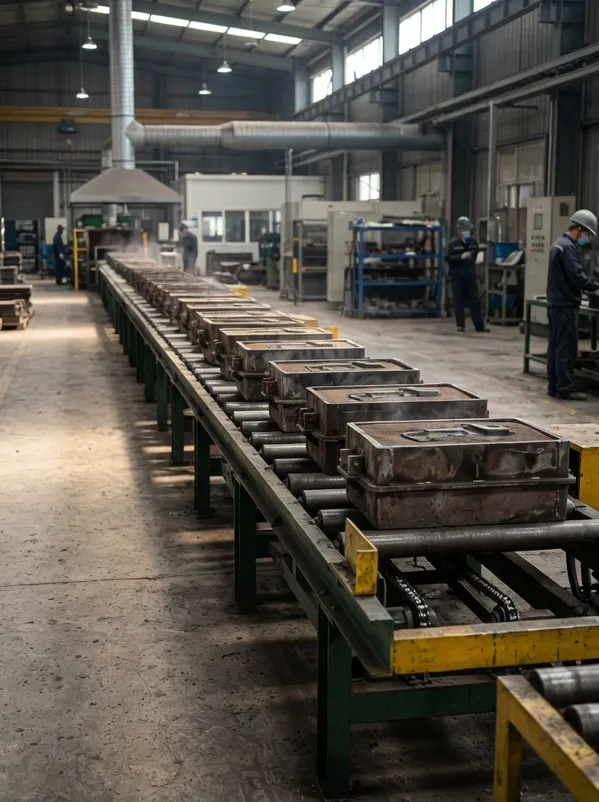
Cooling conveyors for iron extend 2–3× longer than aluminum equivalents at the same monthly tonnage. Aluminum castings cool to handling temperature (60–80°C) in 5–15 minutes; iron castings need 20–60 minutes depending on section thickness and casting mass. A 100-ton/month aluminum line needs 8–12 meters of cooling conveyor; a 100-ton/month iron line needs 18–25 meters.
This directly affects your facility space requirements — verify you have the floor length before ordering the equipment. We've had buyers discover mid-installation that their building can't accommodate the full cooling conveyor length, forcing them to add a return loop that doubles back — adds cost and complicates material flow.
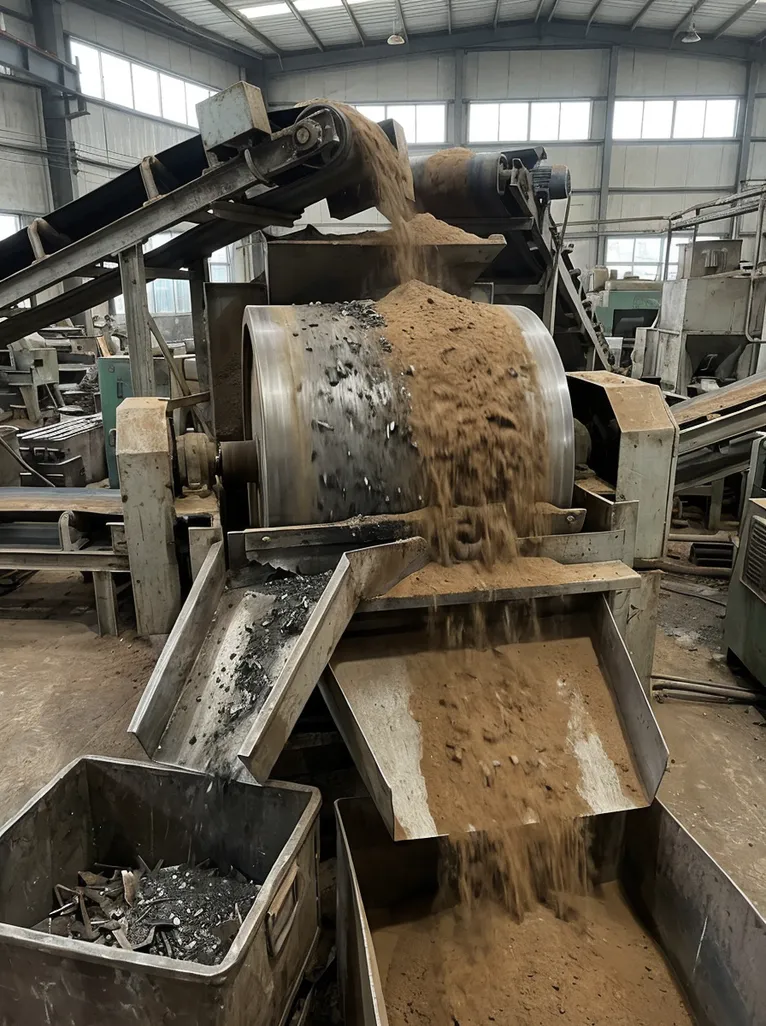
Magnetic separators in iron sand reclamation systems remove ferrous particles that contaminate sand during pouring and shakeout. For a 100-ton/month iron foundry, we specify 8,000–12,000 gauss magnetic drums processing 3–5 tons of sand per hour. Higher gauss ratings pull finer iron particles but cost more; the economic breakpoint is around 10,000 gauss for most commercial iron casting operations.
Magnetic separation happens after shakeout screening and before sand storage — contaminated sand goes through the magnetic drum, clean sand returns to the molding line, and iron particles collect in a waste bin for scrap recycling.
Iron coatings use alcohol-based or hybrid binders that cure at 50–70°C and provide better high-temperature stability than aluminum's water-based binders (40–50°C). Coating tanks for iron hold 400–1,000 liters depending on your largest casting size — larger than aluminum tanks because iron coatings apply thicker (1.2–2.0mm vs. 0.5–1.0mm for aluminum).
Drying chambers for iron coatings run hotter and longer: 8–16 hours at 50–70°C vs. 4–8 hours at 40–50°C for aluminum. We size drying chamber capacity so you're coating one batch while the previous batch dries — no production queuing.
Vacuum systems for iron casting use the same pump technology as aluminum lines (rotary vane or liquid ring vacuum pumps) but with different pressure setpoints and higher thermal ratings. Iron requires lower vacuum pressure (0.03–0.05 MPa) than aluminum (0.04–0.06 MPa) because iron's higher density naturally compacts sand more effectively.
Pump capacity sizing depends on flask volume and cycle time — a 600×600mm flask needs 15–25 m³/hour pump capacity, a 1000×1000mm flask needs 40–60 m³/hour. We configure PLC-controlled pressure regulators that adjust vacuum based on alloy selection — operators input "gray iron" or "white iron" on the HMI, and the system automatically sets target pressure.
| Component | Aluminum Line | Cast Iron Line | Difference Driver |
|---|---|---|---|
| Flask frame thickness | 6–8mm steel plate | 10–12mm steel plate | Thermal load and weight |
| Cooling conveyor length | 8–12 meters | 18–25 meters | Solidification time |
| Magnetic separator | Optional | Mandatory (10,000 gauss) | Ferrous contamination |
| Coating tank capacity | 200–400 liters | 400–800 liters | Thicker coating application |
| Coating cure time | 4–8 hrs at 40–50°C | 8–16 hrs at 50–70°C | High-temp binder chemistry |
| Vacuum pressure | 0.04–0.06 MPa | 0.03–0.05 MPa | Alloy density difference |
| Overhead crane capacity | 1–2 tons | 2–5 tons | Flask + casting weight |
Our equipment configuration process maps your casting portfolio to specific component sizing. We need part drawings or photos, annual volume by alloy type, and your facility dimensions (especially available floor length for cooling conveyors). Then we specify flask sizes, crane capacity, magnetic separator throughput, coating tank volume, and vacuum pump capacity that match your production requirements without over-sizing equipment you won't use.
Iron particles in reclaimed sand cause three defect types: surface roughness (particles embed in the mold surface and transfer to the casting), inclusions (particles trapped in molten metal create internal voids), and dimensional variation (contaminated sand has inconsistent permeability, affecting how gases escape during pouring).
A 200-ton/year iron foundry running without magnetic separation typically sees 8–12% scrap rates from sand contamination defects. Add magnetic separation and scrap drops to 3–5% — that's 10–14 tons of scrap prevention annually, worth $15,000–25,000 at current iron prices.
Magnetic separator design uses rotating drums with permanent magnets or electromagnetic coils. Sand flows over the drum surface; ferrous particles stick to the magnetic field while clean sand falls through. Separator efficiency depends on three parameters:
Magnetic Field Strength (Gauss Rating)
We specify 8,000–12,000 gauss for iron foundry applications — lower ratings miss fine particles, higher ratings pull non-ferrous materials and reduce throughput.
Drum Rotation Speed (RPM)
Runs 15–25 RPM; faster speeds reduce particle capture efficiency, slower speeds limit throughput.
Sand Feed Rate (Tons/Hour)
Must match your daily reclamation volume — a 100-ton/month foundry reclaims 150–200 tons of sand monthly, so the separator needs 3–5 tons/hour capacity to process a full day's sand in one 8-hour shift.
Sand passes through rotary kilns at 600–800°C to burn off organics. Achieves 1–2% LOI — the tightest contamination control available.
Costs more in energy but reduces defect rates enough to justify the expense. Most iron foundries choose thermal treatment because the tighter LOI control reduces defect rates enough to justify the energy cost.
High-speed mills break up coating particles and EPS residue. Achieves 2–3% LOI — effective for foundries with moderate quality requirements.
Cheaper to operate than thermal treatment but requires more frequent equipment maintenance. Best suited for operations where energy cost is a primary concern.
Sand LOI measures organic contamination from EPS residue and coating binder. Iron foundries target below 3% LOI because higher contamination reduces sand permeability and causes gas defects during pouring. Aluminum foundries can tolerate 4–5% LOI because lower pouring temperatures generate less gas volume.
85–90%
Sand Recycled with Magnetic Separation + Thermal Reclamation
$3,600–$10,800
Annual Sand Cost Savings (100 ton/month foundry)
4–7 Years
Equipment Payback on Sand Savings Alone
Sand costs $30–60 per ton depending on grade and region. A 100-ton/month iron foundry uses 150–200 tons of sand monthly if you're buying new sand continuously. With magnetic separation and thermal reclamation, new sand purchases drop to 15–30 tons/month. Equipment adds $40,000–80,000 to line capital cost. The real ROI comes from scrap reduction: preventing 10–14 tons of scrap annually is worth more than the sand cost savings.
Permeability Meters
Measure how easily gases escape through sand — critical for preventing gas porosity defects during iron pouring.
LOI Analyzers
Measure organic contamination levels. Target below 3% for iron casting — adjust reclamation parameters if LOI rises above threshold.
Moisture Content Testers
Excess moisture causes steam defects during pouring. Shift-by-shift testing catches degradation before it creates scrap.
Your QC team tests sand every shift — takes 15–20 minutes per test cycle. If permeability drops below spec or LOI rises above 3%, you adjust reclamation parameters (kiln temperature, attrition mill speed, magnetic separator feed rate) before the next batch of castings. This shift-by-shift monitoring is how foundries maintain consistent quality — you catch sand degradation before it creates scrap.
We size magnetic separation and reclamation capacity to match your daily sand consumption, not your monthly average. Iron foundries often run uneven production schedules (high-volume weeks followed by low-volume weeks), so reclamation equipment must handle peak daily sand volume without queuing. Tell us your maximum daily casting tonnage and we'll specify separator throughput and kiln capacity that processes that volume in one shift.
Iron castings solidify slower than aluminum due to higher latent heat of fusion and lower thermal conductivity. A 20 kg aluminum casting reaches handling temperature (60–80°C) in 8–12 minutes after pouring. A 50 kg iron casting needs 35–50 minutes. This difference drives cooling conveyor length and facility space requirements — you can't compress iron's cooling time without forced air or water cooling, which adds equipment cost and complexity most foundries don't need.
Cooling conveyor length calculation: conveyor speed × cooling time = required length. Most lost foam lines run cooling conveyors at 0.3–0.5 meters/minute to allow smooth flask transfer without jarring castings. For a 45-minute iron cooling cycle at 0.4 m/min conveyor speed, you need 18 meters of conveyor length. Add 2–3 meters for loading and unloading zones, and total floor space requirement is 20–21 meters in a straight line. If your facility can't accommodate that length, we configure return-loop conveyors that double back (castings travel 10 meters forward, then 10 meters back on a parallel track), but this adds $15,000–25,000 to equipment cost and complicates material flow.
Total linear floor space: 36–51 meters if you're arranging equipment in a straight production flow. Most foundries use L-shaped or U-shaped layouts to fit within existing building dimensions — cooling conveyors run along one wall, molding and pouring occupy the perpendicular section. We provide facility layout drawings during the quotation phase so you can verify equipment fits your building before ordering.
18–25 m
Cooling conveyors
8–12 m
Pattern coating & drying
6–8 m
Molding & pouring stations
4–6 m
Shakeout & sand reclamation
Forced cooling systems (air blast or water spray) can reduce iron cooling time by 30–40%, cutting conveyor length from 18–25 meters to 12–16 meters. But forced cooling adds equipment cost and creates thermal shock risk — rapid cooling can crack thin-wall castings or create residual stress in complex geometries.
$25,000–40,000
Air blast systems
$40,000–60,000
Water spray systems
We recommend forced cooling only when facility space is severely constrained and your casting portfolio consists of simple, thick-section parts that tolerate rapid cooling. For most iron foundries, natural air cooling on extended conveyors is the more reliable approach.
If your casting portfolio spans a wide mass range, we size cooling conveyors for your largest/heaviest castings — smaller castings exit the conveyor early and queue at the shakeout station. This prevents production bottlenecks where large castings block the line while waiting to cool.
Small castings
<10 kg
Medium castings
10–50 kg
Large castings
>50 kg
Ambient temperature affects cooling time by 10–15%. A foundry in a hot climate (35–40°C ambient) sees longer cooling times than a foundry in a temperate climate (20–25°C ambient). If you're installing in the Middle East, Southeast Asia, or other hot regions, we add 2–3 meters to cooling conveyor length to compensate. Cold-climate foundries (Northern Europe, Canada) can sometimes reduce conveyor length slightly, but we don't recommend aggressive sizing — better to have excess cooling capacity than create a production bottleneck.
Ready to plan your facility layout?
Send us your facility floor plan (even a rough sketch with dimensions) along with your casting portfolio. We'll configure cooling conveyor length and layout that fits your building and handles your longest cooling cycle without forced cooling systems.
Four primary segments drive demand for cast iron lost foam castings. Each has distinct volume profiles, margin structures, and quality requirements that influence line configuration.
Engine blocks, cylinder heads, brake rotors, transmission housings, suspension components. These parts demand tight tolerances (±0.5–1.5mm on critical dimensions), consistent metallurgical properties, and high production volumes (5,000–50,000 units annually per part number).
Lost foam works well for automotive iron castings because near-net-shape accuracy reduces machining time by 40–60% — a cylinder head that needs 45 minutes of CNC time from a conventional sand casting needs only 18–25 minutes from a lost foam casting. For your business, automotive is a high-volume, repeatable segment with long production runs and stable pricing once you're qualified into a supply chain.
Pump housings, valve bodies, gearbox components, hydraulic manifolds, and compressor parts. These are medium-volume applications (500–5,000 units annually) with more design variation than automotive — buyers need custom configurations for different fluid types, pressure ratings, and mounting interfaces.
Lost foam's tooling flexibility suits this segment: EPS pattern tooling costs $2,000–5,000 per design and supports 1,000–2,000 castings before replacement, so you can economically produce custom variants without the $15,000–30,000 permanent mold tooling cost. Industrial machinery buyers value technical capability and delivery reliability over lowest unit price — if you can produce a complex valve body in 6 weeks with ±1mm tolerance, you'll win orders even at 10–15% premium over commodity foundries.
Tractor components (engine blocks, transmission housings, axle housings), implement parts (plow shares, cultivator frames, planter components), and irrigation system components. This segment has seasonal demand patterns — orders concentrate in Q4 and Q1 (Northern Hemisphere planting season preparation), with slower periods in Q2–Q3.
Production volumes are lower than automotive (200–2,000 units annually per part) but part sizes are larger (20–150 kg castings common). Agricultural buyers prioritize durability and corrosion resistance over tight tolerances — these parts operate in soil, moisture, and fertilizer exposure. Lost foam's coating flexibility lets you optimize surface finish and corrosion protection without secondary treatments.
Manhole covers, grates, utility access boxes, street furniture, and drainage components. This is a project-based segment — cities and utilities order in batches of 100–1,000 units when replacing aging infrastructure or building new developments.
Compliance requirements dominate: load ratings (AASHTO H-20 or HS-20 for vehicular traffic), dimensional standards (ASTM, EN, or local municipal specs), and material certifications (test reports for tensile strength, hardness, and chemical composition). Lost foam produces castings that meet these specs with less machining than green sand, but you need QC documentation and traceability — buyers want material certs and dimensional inspection reports with every shipment.
| Segment | Volume | Net Margin | Payment Terms | Quality Profile |
|---|---|---|---|---|
| Automotive | High (5K–50K/yr) | 8–12% | 60–90 days | PPM defect rates, SPC documentation |
| Industrial Machinery | Medium (500–5K/yr) | 15–20% | 30–45 days | Tolerant of minor cosmetic defects |
| Agricultural | Low–Med (200–2K/yr) | 12–18% | Seasonal | Highest tolerance for surface finish variation |
| Municipal | Project-based (100–1K) | 10–15% | Project-based | Material certs, dimensional inspection per shipment |
Which markets are you targeting?
Tell us your target segments and we'll configure equipment that matches those quality requirements and production volumes — automotive needs automated coating and continuous molding for volume, industrial machinery needs flexible pattern handling for design variation, agricultural needs robust equipment for large castings, municipal needs QC documentation systems for compliance.
Green sand casting dominates iron foundry volume worldwide — it's the incumbent process, with proven reliability and low tooling cost for simple geometries. Lost foam makes sense when casting complexity, tolerance requirements, or production volume create economic advantages that offset higher pattern tooling cost. Here's the decision framework:
Green sand requires cores for internal cavities — each core adds labor (core making, core setting, core removal) and quality risk (core shift, core breakage, gas defects from core binders). Lost foam eliminates cores because the EPS pattern includes all internal features.
For a pump housing with 6 internal passages, green sand needs 6 cores (each made separately, set into the mold, and removed after casting). Lost foam uses one EPS pattern with passages molded in — no core labor, no core-related defects.
Economic breakpoint: if your casting needs 3+ cores, lost foam's labor savings typically justify the higher pattern cost within 500–1,000 castings.
Green sand tooling (wooden patterns, core boxes) costs $800–3,000 per casting design and lasts 200–500 castings before wear requires replacement. Lost foam tooling (EPS pattern molds) costs $2,000–8,000 per design but lasts 1,000–2,000 castings.
Low volume (50–200/yr): Green sand's lower tooling cost wins.
Medium volume (500–2,000/yr): Lost foam's longer tool life and reduced labor create lower per-part cost.
High volume (>5,000/yr): Permanent mold or die casting usually beats both processes.
Lost foam's sweet spot: 300–3,000 castings annually per design.
Green sand castings typically hold ±2–3mm tolerance on most dimensions due to mold parting lines, core shift, and sand expansion. Lost foam holds ±0.5–1.5mm because there's no parting line and no cores to shift.
If your customer's print specifies tight tolerances, you have two choices: cast with green sand and machine more material (adds CNC time and scrap cost), or cast with lost foam and machine less. For a gearbox housing with 20 machined surfaces, lost foam saves 15–25 minutes of CNC time per casting — at $80–120/hour machine rates, that's $20–50 per part in machining cost avoidance.
Over a 1,000-unit production run, that's $20,000–50,000 in savings that pays for lost foam tooling and equipment.
Green sand requires risers and gates to feed shrinkage during solidification — you're pouring 15–30% more metal than the finished casting weight. Lost foam uses smaller gates and often eliminates risers because the sand's rigidity and vacuum pressure control shrinkage more effectively.
70–85%
Green Sand Yield
85–95%
Lost Foam Yield
At current iron prices ($800–1,200/ton), that 10–15% material savings is worth $80–180 per ton. For a 500-ton/year foundry: $40,000–90,000 annual material cost reduction.
Green sand lines need more floor space (sand mixers, core ovens, mold handling equipment) and more operators (core makers, molders, shakeout crew). Lost foam lines are more compact (no core equipment) and run with fewer operators.
5–7
Green Sand Operators/Shift
2–3
Lost Foam Operators/Shift
If you're building a new foundry or expanding into a space-constrained facility, lost foam's smaller footprint and lower labor requirement create operational advantages beyond per-part cost.
| Casting Characteristic | Green Sand Better | Lost Foam Better | Reasoning |
|---|---|---|---|
| Geometry complexity | 0–2 cores | 3+ cores | Core labor and defect risk |
| Annual volume per design | <300 units | 300–3,000 units | Tooling amortization |
| Tolerance requirement | ±2–3mm acceptable | ±0.5–1.5mm needed | Machining cost avoidance |
| Production run length | Very high volume (>5,000) | Medium volume (500–3,000) | Process economics |
| Facility space | Ample space available | Space-constrained | Equipment footprint |
Most iron foundries don't switch entirely from green sand to lost foam — they run both processes and route castings based on geometry and volume. Complex, medium-volume parts go to lost foam; simple, high-volume parts stay on green sand. Our modular line design supports this hybrid approach: start with a small lost foam line for your complex castings, keep your green sand line running for simple parts, then expand lost foam capacity as you prove the process economics with your own cost data.
Iron foundry production volumes range from 50 tons/year (prototype and job shop work) to 5,000+ tons/year (serial production for automotive or industrial OEMs). We configure three standard capacity tiers, each with different automation levels and capital cost:
50–200 tons/year
Pattern coating by dip tank with manual handling, batch molding with vibration tables, hand-poured ladles, manual shakeout, and batch sand reclamation. Operators handle pattern transfer, flask positioning, and casting removal manually.
This configuration suits job shops, prototype foundries, and low-volume custom casting producers.
Equipment List
FOB Qingdao
200–800 tons/year
Automated coating line with conveyor-fed dip tanks, continuous molding with flask transfer conveyors, overhead crane ladle handling, automated shakeout with vibration screens, and continuous sand reclamation. Operators supervise equipment and handle quality checks; material transfer is mechanized.
This configuration suits serial production foundries with stable order books and multiple casting designs.
Equipment List
FOB Qingdao
800+ tons/year
Robotic pattern handling, automated coating with spray booths, continuous molding with PLC-controlled vacuum and vibration, automated pouring systems, continuous cooling and shakeout, and integrated sand reclamation with real-time quality monitoring. Operators monitor HMI screens and perform periodic quality checks; the line runs with minimal manual intervention.
This configuration suits high-volume foundries producing automotive components, industrial machinery parts, or other serial production applications.
Equipment List
FOB Qingdao
These figures assume gray iron castings in the 10–50 kg range with moderate complexity — larger castings or white iron require longer cycle times and reduce annual capacity by 15–25%.
| Configuration | 1 Shift (8 hr) | 2 Shifts |
|---|---|---|
| Manual | 50–80 tons/year | 100–160 tons/year |
| Semi-Automated | 200–400 tons/year | 400–800 tons/year |
| Fully Automated | 400–600 tons/year | 800–1,200 tons/year |
We adjust equipment within each tier based on your specific casting portfolio:
Small castings (<20 kg): reduced flask sizes and shorter cooling conveyor length.
White iron exclusively: upgraded coating systems and increased drying capacity.
Limited floor space: return-loop cooling conveyors or vertical drying chambers.
Send us your casting drawings, annual volume targets, and facility constraints — we'll specify equipment that matches your production requirements without paying for capacity you won't use.
Our modular design lets you start with manual or semi-automated configuration and add automation later as volume grows. A foundry starting at 150 tons/year with manual equipment can add automated coating, continuous molding, or robotic handling when production reaches 300–400 tons/year.
We design electrical panels, control systems, and floor layouts with expansion in mind — adding modules doesn't require rebuilding the base system.
Most foundries start conservative (manual or semi-automated) and expand after 12–18 months once they've proven lost foam economics with their own cost data.
Share your casting drawings, annual tonnage targets, and facility layout — we'll recommend the right capacity tier and equipment list for your iron foundry.
Iron lines exceed aluminum specifications due to heavier flask weights and larger equipment. Verify your facility's floor slab thickness and load rating before installation.
Most industrial buildings support 500–800 kg/m² floor loading, handling small-to-medium iron lines. Large automated lines may need 1,000–1,500 kg/m² in the cooling conveyor zone. Undersized slabs require reinforced pads — adds $8,000–15,000 and 2–3 weeks to schedule.
Iron pours at 1400–1500°C generate more EPS decomposition gases and more intense combustion than aluminum's 700–750°C. Extraction systems must be sized accordingly.
Iron Casting
2,500–4,000 m³/hour airflow per pouring station
Aluminum (comparison)
1,500–2,500 m³/hour airflow per pouring station
Extraction fans connect to your facility's existing ventilation or we supply standalone units. Check regional air quality standards — local regulations may require particulate filters or scrubbers on exhaust.
Coating drying chambers and sand reclamation kilns are the largest power consumers. Three-phase 380–480V power is standard; we configure for your local voltage during manufacturing.
Verify panel capacity and transformer rating before installation.
Iron lines require 5–7 weeks (vs. 4–6 weeks for aluminum) due to thermal testing requirements. We send 2–3 technicians who stay on-site until you're producing acceptable castings consistently.
Week 1
Mechanical installation and alignment
Week 2
Electrical hookup and control system programming
Week 3
Vacuum system testing and coating trial runs
Weeks 4–7
First iron pours, vacuum pressure and coating thickness adjustment, production trials with your casting designs, quality inspection, and operator training
Training runs during commissioning and covers iron-specific process control. We provide operation manuals in English with process parameter tables, troubleshooting guides, and maintenance schedules.
Starter kit ships with each line — covers 6–12 months of normal operation:
Consumables ship from Qingdao via DHL/FedEx: 5–7 days to North America/Europe, 3–5 days to Middle East/Southeast Asia. Critical components (vacuum pumps, PLC modules, motors) have 2–3 week lead times.
PLC systems support VPN connection for troubleshooting. Our engineers log into your control system remotely, review parameter logs, and adjust settings — reducing downtime from days to hours for most issues.
Case Example
A European foundry experienced vacuum pressure instability. Our engineer logged in remotely, identified a faulty pressure sensor, and recalibrated the backup sensor within 2 hours. The foundry stayed in production while we shipped a replacement sensor.
TZFoundry commissioning team on-site during iron line installation and operator training
We've built foundry equipment since 2010 — clay sand lines, lost foam systems, and resin sand plants for foundries in 40+ countries. Our engineering team has configured iron casting lines for automotive component producers in Europe, industrial machinery foundries in North America, and agricultural equipment manufacturers in the Middle East.
These installations taught us what iron foundries actually need: equipment sized for ferrous thermal loads from the start, magnetic separation integrated as standard (not an afterthought), and cooling conveyors long enough to handle iron's solidification time without forced cooling complexity.
8 production lines producing molding machines, vacuum systems, coating equipment, and material handling components. We manufacture 70% of line components in-house — flask frames, conveyor structures, coating tanks, control panels — and source specialized components (vacuum pumps, motors, sensors) from industrial suppliers.
Vertical integration means we control lead times and customize equipment without waiting on subcontractors.
We don't adapt aluminum equipment for iron service. Flask frames use heavier plate, cooling conveyors extend to match iron solidification times, magnetic separators size for your daily sand volume, and coating systems use refractory formulations rated for 1500°C.
When you send us your casting portfolio, we calculate exact equipment specifications — flask sizes based on your largest casting, cooling conveyor length based on your heaviest casting's solidification time, magnetic separator throughput based on your daily sand reclamation volume. Not generic "iron casting equipment."
Start with the capacity you need now and add automation or throughput later. A foundry at 200 tons/year with semi-automated equipment can add robotic pattern handling, automated pouring, or additional molding stations when production grows to 500–800 tons/year. Control systems and floor layouts designed with expansion in mind.
You work with the manufacturer, not a distributor. No markup layers, no regional exclusivity restrictions. We quote FOB Qingdao with transparent equipment lists and lead times.
30%
Deposit
60%
Before shipping
10%
After commissioning
Most buyers use L/C for the 60% payment — we work with Bank of China and can accommodate your bank's L/C requirements.
Send us your current iron casting portfolio and we'll configure a production line with exact equipment sizing, factory pricing, and delivery schedule: