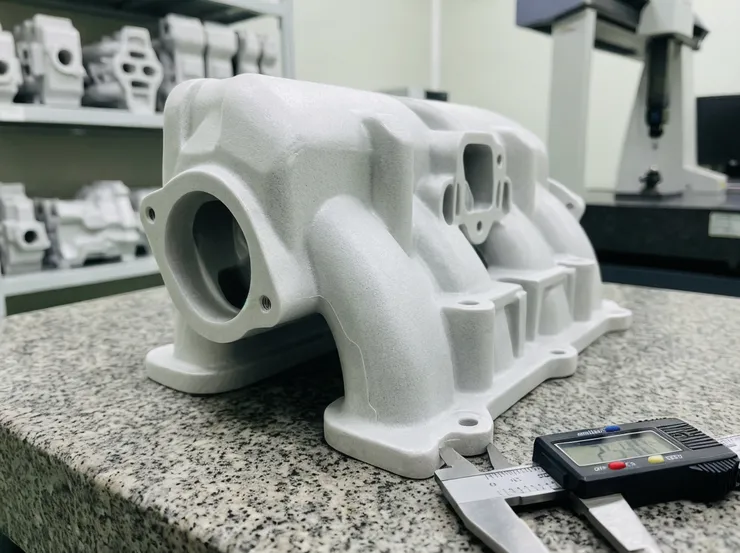
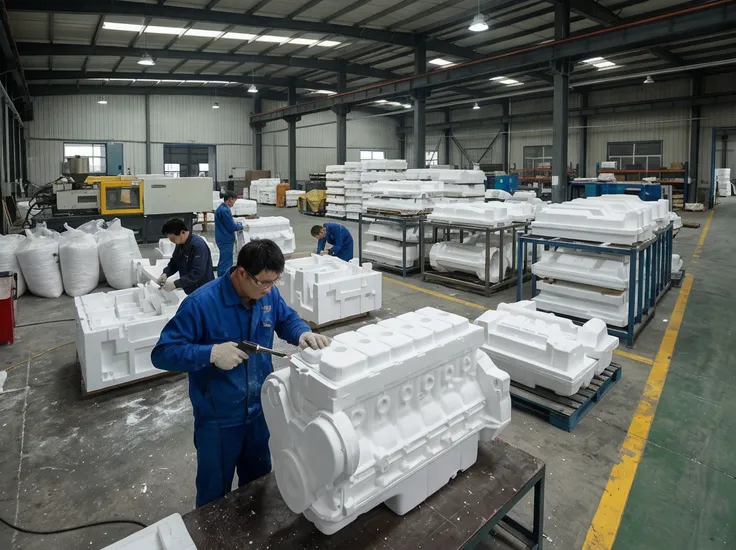
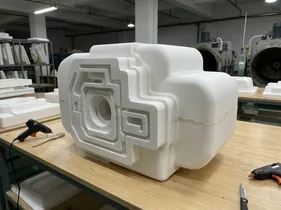
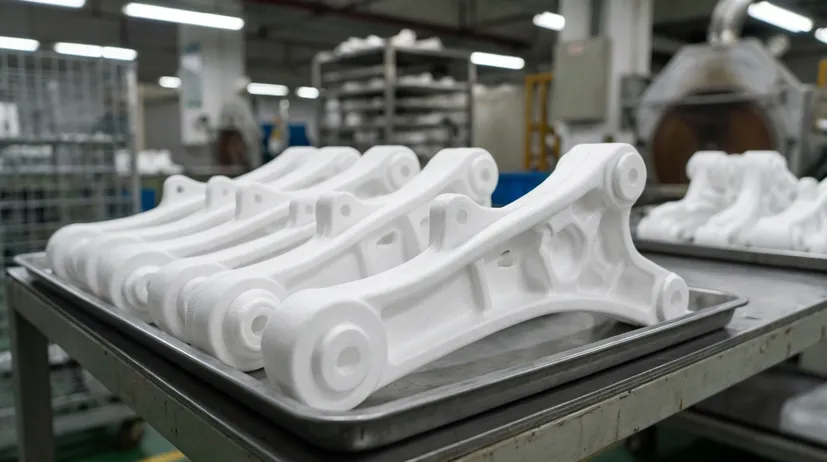
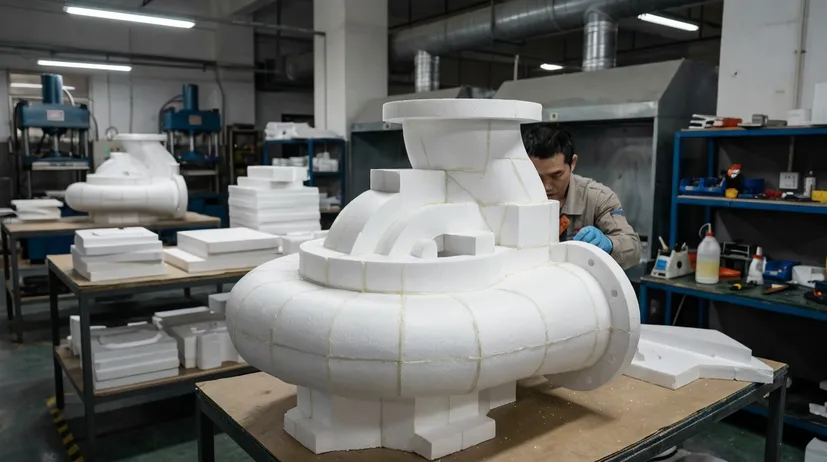
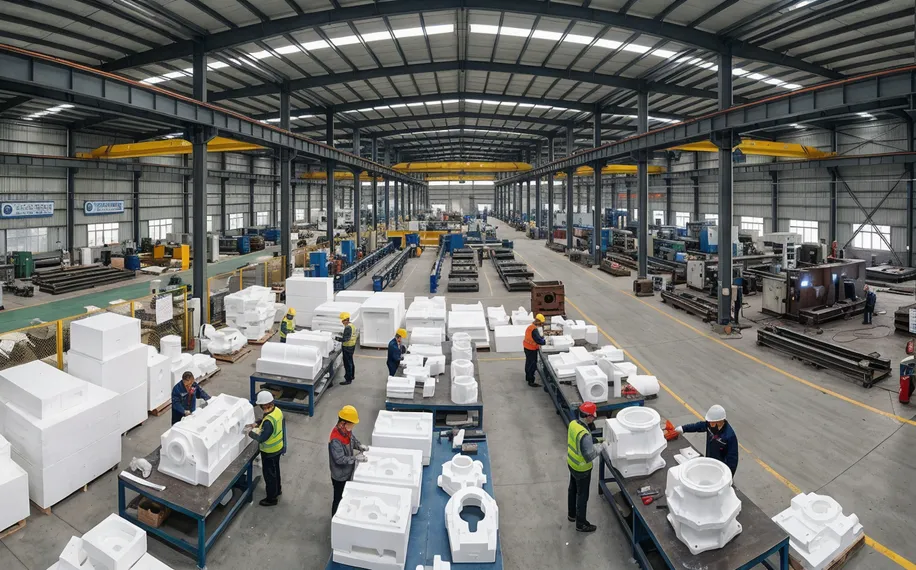
Lost foam casting foam patterns are the EPS (expanded polystyrene) replicas that vaporize during metal pouring, leaving behind the casting cavity. Pattern quality — density uniformity, dimensional tolerance, surface finish — directly determines whether your casting comes out right or becomes scrap.
A ±0.5mm pattern tolerance compounds through coating and molding to become ±1mm casting tolerance, so pattern precision is where dimensional control starts.
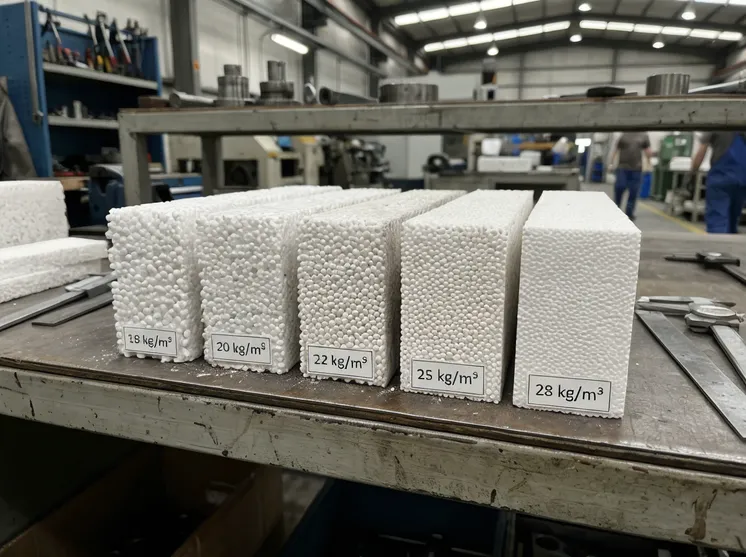
We supply foam patterns for foundries and pattern production equipment for manufacturers building in-house capability. Our pattern production facility in Qingdao handles custom tooling design, EPS density range 18–28 kg/m³, dimensional tolerance ±0.3mm, with CMM inspection reports included.
Since 2010, we've supported foundries in North America, Europe, the Middle East, and Southeast Asia — buyers who need factory pricing, technical support for pattern-to-casting troubleshooting, and reliable delivery schedules.
TZFoundry manufactures complete lost foam casting production lines including pattern handling equipment, coating systems, molding lines, and vacuum systems. ISO 9001:2015, CE, and SGS certified. Our in-house R&D team handles pattern tooling design, material selection guidance, and quality control protocol development.
No distributor markup. Flexible MOQ for custom pattern orders. You work directly with our engineering team for tooling design, material selection, and production scheduling.
Every upstream pattern decision — density, tolerance, surface finish, handling rigidity, coating adhesion — compounds through the casting process. Here's exactly how each variable affects your final part quality and per-unit cost.
Pattern density affects gas evacuation speed during pouring. Lower density EPS (18–20 kg/m³) vaporizes faster, generating less back-pressure against incoming metal — this prevents misruns in thin-wall aluminum castings where metal flow is already marginal. Higher density EPS (24–28 kg/m³) provides better handling strength for complex patterns but generates more decomposition gas, requiring stronger vacuum systems and longer gas evacuation time.
Foundries using 26 kg/m³ patterns (chosen for handling durability) with vacuum systems sized for 20 kg/m³ — result is incomplete fills and gas porosity in heavy sections.
Dimensional tolerance compounds through every process step. A ±0.5mm pattern tolerance becomes ±0.7mm after coating (coating thickness variation adds ±0.2mm), then ±1mm after casting (metal shrinkage and sand movement add another ±0.3mm). If your finished casting spec is ±1.5mm, you need pattern tolerance under ±0.4mm to stay in spec after process variation.
We hold ±0.3mm on critical dimensions through CNC machining or precision steam molding — tighter than the ±0.5mm industry standard because we've seen how tolerance stacks up in production.
Surface finish impacts metal penetration and final casting texture. Rough pattern surfaces (visible bead structure, tool marks) create pathways for molten metal to penetrate the refractory coating, causing surface defects that require grinding. Smooth patterns (fine bead EPS, post-machining surface treatment) seal better under coating, producing castings that need minimal finishing.
For aluminum automotive components where surface finish directly affects painting quality, we specify 0.3–0.5mm bead size EPS and light sanding on visible surfaces — adds $2–4 per pattern in production cost but eliminates $15–25 per casting in grinding labor.
Thin-wall patterns (<3mm section thickness) can compress or distort under their own weight during coating dip and drying cycles. We've seen 8mm diameter cores compress to 7.6mm after coating because the pattern wasn't rigid enough to maintain shape when saturated with slurry.
Use 22 kg/m³ instead of 18 kg/m³ for sections under 3mm to resist compression during coating.
Supports burn out during pouring — no effect on final casting geometry.
If your pattern geometry includes thin walls or long unsupported spans, flag it during tooling review. This is a design-stage decision — not something to discover at production.
Coating adhesion depends on pattern surface energy and cleanliness. EPS releases mold release agents during steam molding, leaving a film that prevents coating from wetting the surface properly. Poor adhesion shows up as coating spalling during sand filling or pouring — bare EPS contacts molten metal and you get catastrophic gas generation.
Mold release film prevents coating adhesion. Spalling risk during sand fill and pour.
No mold release issue. Static electricity attracts dust that can interfere with adhesion.
Coating spalling exposes bare EPS to molten metal, causing catastrophic gas generation. Surface preparation before coating is non-negotiable regardless of pattern manufacturing method.
Pattern density, tolerance, surface finish, and coating prep must be engineered as a system — not selected in isolation. Share your casting geometry and alloy requirements, and our engineering team will specify the pattern parameters that keep your process in spec.
EPS density selection balances handling strength against gas generation. The physics: lower density means more air voids in the foam structure, so less polymer mass to vaporize per unit volume. An 18 kg/m³ pattern generates 40% less decomposition gas than a 28 kg/m³ pattern of the same size.
Pouring temperature 700–750°C. Gas evacuation is easier because lower metal temperature means slower vaporization rate — use 18–22 kg/m³ density and still get clean fills.
Pouring temperature 1400–1500°C. Rapid vaporization creates high gas pressure that can lift sand or cause mold expansion — need stronger vacuum systems, but use 22–28 kg/m³ density because the higher pouring temperature vaporizes even dense foam quickly.
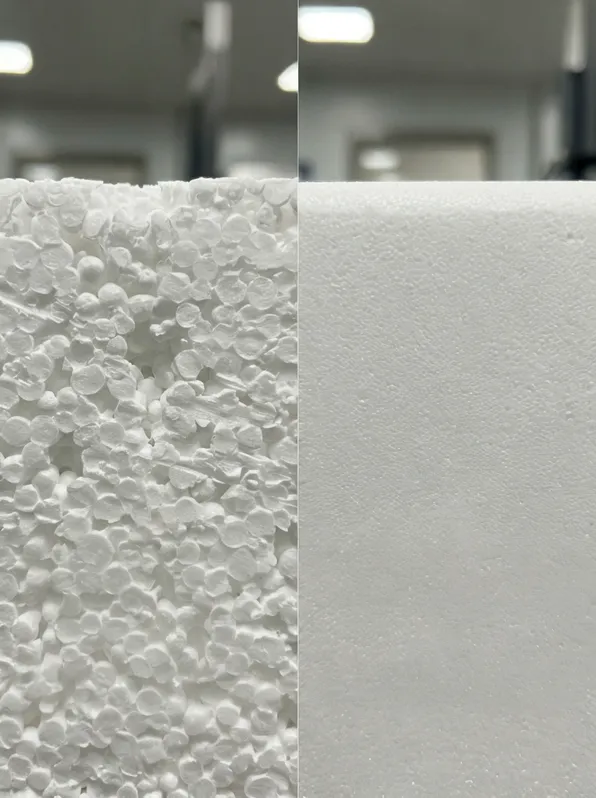
Fine-bead vs. coarse-bead EPS cross-sections at production density ranges.
| Application | EPS Density (kg/m³) | Bead Size (mm) | Typical Casting Alloy | Reasoning |
|---|---|---|---|---|
| Aluminum automotive components | 18–20 | 0.3–0.5 | A356, A380 | Thin walls, high surface finish requirements, lower pouring temperature allows fast vaporization |
| Aluminum pump housings | 20–22 | 0.5–0.8 | A356, ZL104 | Moderate complexity, balance between handling strength and gas generation |
| Iron pump housings | 24–26 | 0.8–1.2 | Ductile iron, gray iron | Thicker sections, higher pouring temperature compensates for denser foam |
| Iron engine blocks | 26–28 | 1.0–1.5 | Gray iron, compacted graphite iron | Complex internal cores, need maximum handling strength during assembly |
| Prototype castings (any alloy) | 20–24 | 0.5–1.0 | Various | Mid-range density for reasonable handling without over-investing in vacuum capacity |
Bead size affects surface finish and coating penetration. Fine bead EPS (0.3–0.5 mm) produces smooth pattern surfaces that require minimal post-processing, but the smaller bead structure is more fragile — patterns crack easily during handling.
Coarse bead EPS (1.0–1.5 mm) is more durable but leaves visible texture that telegraphs through coating to the final casting surface.
Decision rule: For castings that will be machined all over, coarse bead is fine — you're removing 2–5 mm of stock anyway. For castings with as-cast cosmetic surfaces (architectural components, visible pump housings), specify fine bead and accept the extra handling care.
Material grade selection depends on dimensional stability requirements. Virgin EPS (100% new polystyrene) has consistent density and minimal contamination — dimensional variation under ±0.2% across a production batch.
Recycled-content EPS (20–40% recycled material) costs 15–25% less but shows higher dimensional variation (±0.5%) because recycled bead size distribution is less uniform.
±1 mm
Tight tolerance → Virgin EPS
±2 mm
General tolerance → Recycled OK
For high-precision castings (±1 mm tolerance or tighter), virgin EPS is worth the cost premium. For general industrial castings (±2 mm tolerance), recycled-content EPS works fine and reduces your pattern cost by $1–3 per kg.
EPS is hygroscopic — it absorbs 0.5–1.5% moisture by weight in humid environments, causing dimensional growth and density reduction. A 500 mm long pattern can grow 0.5–1.5 mm after 48 hours in 80% humidity.
We store patterns in climate-controlled areas (40–60% RH, 18–25°C) and ship in sealed plastic bags with desiccant packs.
For humid climates (Southeast Asia, Gulf Coast): plan for pattern storage in dehumidified space or accept that patterns need 24-hour re-stabilization in your facility before coating.
Humidity
40–60% RH
Temperature
18–25°C
Packaging
Sealed bags + desiccant packs
Re-stabilization
24 hours before coating
CNC machining cuts patterns from EPS blocks using multi-axis mills or hot-wire systems. Geometry changes are just software updates — no tooling investment required.
Prototype work (1–20 patterns), complex geometries requiring expensive multi-cavity molds, or low-volume production where tooling amortization doesn't work out.
Steam molding uses aluminum molds filled with pre-expanded EPS beads, then steam-fused into solid patterns. Cycle times are dramatically faster than CNC.
Production runs over 100 units where tooling cost amortizes to under $30–50 per pattern.
Typical 5 kg aluminum pump housing pattern — comparing total cost across production volumes.
Breakeven Point: ~180–220 Patterns
Below that volume, CNC is cheaper. Above that, steam molding wins. The calculation shifts if you need multiple patterns per year — tooling lasts 2,000–5,000 cycles, so a $5,000 mold investment supports 3–5 years of production for many buyers.
Multi-cavity tooling reduces per-pattern cost further for high-volume work. A four-cavity mold costs $12,000–$18,000 (not 4× single-cavity cost because you're sharing mold base and steam distribution), produces four patterns per 5-minute cycle, and drops per-pattern cost to $1.50–$2.50 at volume.
We've built eight-cavity molds for small automotive brackets — $28,000 tooling investment, but per-pattern cost under $1 at 10,000+ annual volume.
The trade-off: multi-cavity molds lock you into that specific pattern geometry, so only commit to this if you have confirmed long-term volume.
4-Cavity Mold
$12,000–$18,000 tooling
$1.50–$2.50
per pattern
8-Cavity Mold
$28,000 tooling
<$1.00
at 10k+/year
Cycle Output
Per 5-minute cycle (4-cavity)
4 patterns
simultaneous
CNC-machine intricate cores or thin-wall sections where steam mold draft angles don't work, then steam-mold the main body sections. Glue the components together into final pattern assemblies.
Real-World Example: Cylinder Head Pattern
CNC-cut water jacket cores (too complex for molding) glued into a steam-molded outer shell. This balances tooling cost against production speed — you're only paying for expensive CNC time on the 20% of the pattern that truly needs it.
Pattern tolerance compounds through coating, molding, and casting. Understanding where variation accumulates — and controlling it at the source — separates scrap-rate problems from reliable production.
Start with a ±0.5mm pattern, add ±0.2mm coating thickness variation, add ±0.3mm sand movement during pouring, add ±0.4mm metal shrinkage (aluminum shrinks 1.2–1.6%, iron shrinks 1.0–1.3%), and you're at ±1.4mm on the finished casting. If your casting spec is ±1.5mm, you have 0.1mm margin for error — any process variation and you're scrapping parts.
Pattern
±0.5mm
Coating
±0.2mm
Sand Movement
±0.3mm
Metal Shrinkage
±0.4mm
Total Stack
±1.4mm
Target: ±0.3mm pattern tolerance
Hole locations, wall thicknesses, mating surfaces, and any feature with tight casting specs. By holding ±0.3mm at the pattern stage, you leave room for downstream coating, sand, and shrinkage variation without exceeding your finished part tolerance.
Allowable: ±0.8mm pattern tolerance
Surfaces that will be machined, internal cavities with clearance requirements, and features where material is being removed anyway. Wider tolerance here reduces pattern cost without affecting finished part quality.
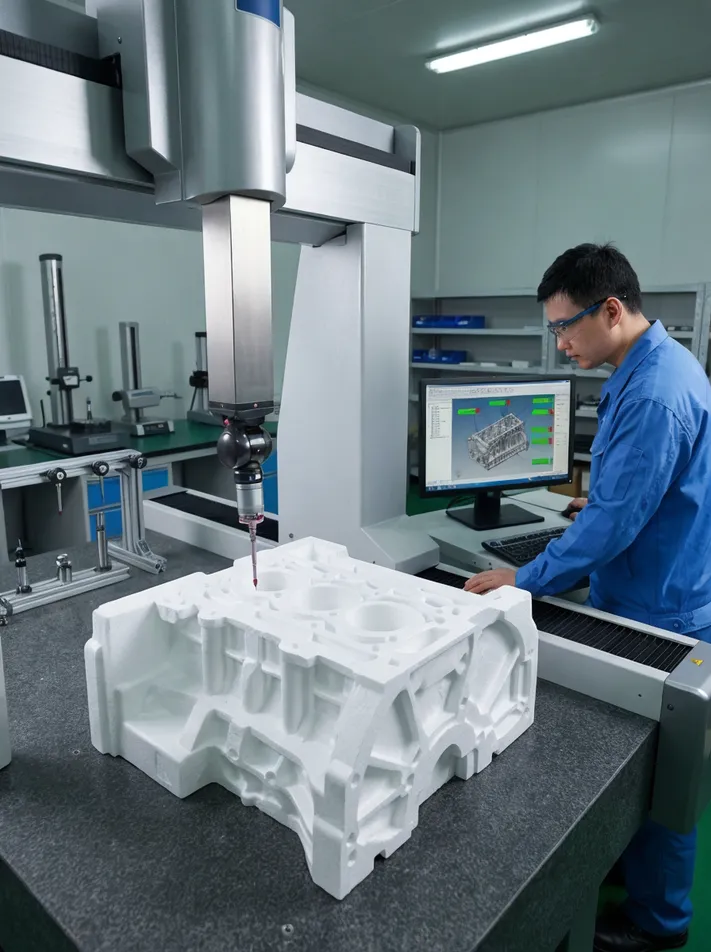
Coordinate measuring machines probe critical features — hole locations, wall thickness, overall length — and compare against CAD nominal values. For production patterns, we inspect first-article (first pattern off new tooling), then sample 1-in-20 for ongoing production.
Inspection reports document actual dimensions, deviation from nominal, and pass/fail against tolerance spec. These reports travel with pattern shipments so your QC team knows what they're receiving.
Why we document measurement method: We started doing this after a customer rejected a pattern shipment because their receiving inspection used different datum references than our production inspection. Now we document the measurement method so there's no ambiguity.
| Inspection Stage | Frequency | What's Checked |
|---|---|---|
| First Article | First pattern off new tooling | All critical features vs. CAD nominal |
| Production Sample | 1-in-20 patterns | Critical dimensions, deviation tracking |
| Shipment Report | Every shipment | Dimensions, deviation, pass/fail, measurement method |
CMM inspection of foam pattern critical features against CAD nominal values prior to coating application.
Uses water displacement or direct weighing. Cut a 50×50×50mm sample from the pattern, weigh it, measure volume, calculate density. Target density ±1 kg/m³ from specification.
Density variation within a single pattern matters more than absolute density — a pattern with 20 kg/m³ in thick sections and 18 kg/m³ in thin sections will vaporize unevenly, causing gas pressure imbalance that can shift the casting dimensionally.
Density Uniformity Comparison
Better uniformity — consistent bead fusion
Block manufacturing can have density gradients
Catches surface defects that cause coating adhesion failures. Trained inspectors evaluate every pattern surface before it enters the coating line.
What Inspectors Look For
Bead pull-out — Missing chunks of foam that create surface voids
Mold release residue — Shiny patches on steam-molded patterns that prevent coating adhesion
Contamination — Dust, oil, fingerprints on pattern surfaces
Mechanical damage — Dents, cracks, compression from handling
Reject Criteria
Minor defects on surfaces that will be machined are acceptable — you're removing that material anyway.
EPS compresses under sustained load. Stack patterns no more than 3–4 high — stacking more crushes bottom layers and ruins dimensional accuracy.
Compartmented crates with foam padding between layers. Multi-point support prevents thin-section damage during transit.
Storage racks should support patterns at multiple points — never hang patterns from thin sections where they can deform under their own weight.
A pattern going from 5°C shipping container to 30°C factory floor will expand 0.3–0.5mm per meter. Let patterns stabilize to room temperature for 12–24 hours before coating.
Every casting application imposes different demands on foam pattern density, bead size, dimensional tolerance, and tooling method. Matching pattern specifications to your end-use requirements prevents defects and controls per-part cost.
Suspension arms, steering knuckles, transmission housings
Aluminum automotive components demand tight tolerances and high surface finish. Suspension arms, steering knuckles, and transmission housings typically spec ±1mm dimensional tolerance and Ra 6.3μm surface finish (equivalent to 120-grit machined surface).
Pattern Specifications
Tooling: CNC machining for prototype and low-volume (under 200 units/year), steam molding for production volume (500+ units/year).
This segment orders in batches of 50–500 patterns per casting design, with 2–4 design iterations per year as vehicle programs evolve. Pattern cost is 2–4% of finished casting cost, so buyers focus on dimensional consistency over absolute price.
Centrifugal pump bodies, valve housings, gear pump casings
Iron pump housings prioritize durability and moderate precision. Centrifugal pump bodies, valve housings, and gear pump casings typically spec ±2mm dimensional tolerance and as-cast surface finish (machining only on mating faces and seal surfaces).
Pattern Specifications
Tooling: Steam molding is standard because production volumes are 200–2,000 units/year per design, and pattern designs are stable — pump housings don't change frequently.
This segment values pattern durability — patterns need to survive coating, drying, and handling without damage. Per-pattern cost target is $5–15 depending on size, with tooling amortization over 1,000–2,000 patterns.
Product development & pre-production validation
Engineering teams need 5–50 castings to test fit, function, and performance before committing to production tooling. Pattern requirements: flexible geometry (design changes are expected), fast turnaround (2–4 weeks from CAD to patterns), and cost-effective at low volume.
Why CNC Exclusively
Pattern cost is $30–80 per unit depending on complexity, but buyers accept this because they're avoiding $5,000–15,000 steam mold tooling investment for a design that will change.
We've worked with automotive Tier 1 suppliers who CNC 20–30 pattern iterations over 12–18 months of development, then switch to steam molding once the design freezes for production.
Decorative panels, sculptures, ornamental components
Decorative panels, sculptures, and ornamental components often have undercuts, fine detail, and organic shapes that challenge traditional pattern-making. Typically one-off or very low volume (1–10 castings).
Key Requirements
Solution involves CNC machining with 5-axis capability or hot-wire cutting for organic shapes, followed by hand finishing (sanding, detail carving, surface sealing).
Pattern cost is $100–500+ per unit, but these are typically high-value castings where pattern cost is 5–10% of finished product value. This segment cares about artistic fidelity, not production efficiency.
Share your casting alloy, target tolerance, and annual volume — our engineers will recommend the right EPS density, bead size, and tooling method for your production requirements.
EPS patterns are single-use by design — they vaporize during casting. But between manufacturing and pour, improper storage and handling can degrade dimensional accuracy and coating adhesion. These protocols protect your pattern investment.
Foam compresses permanently under 0.5 MPa pressure (equivalent to 50 kg load on a 100 cm² area), so stacking patterns or dropping them causes dimensional distortion. Thin-wall sections (<5mm) are especially vulnerable — a 3mm wall can compress to 2.7mm from rough handling, and it won't recover.
Best Practice
Ship patterns in compartmented crates with individual foam padding. Your receiving team should transfer patterns to storage racks immediately — don't leave them stacked in shipping crates where bottom layers compress under the weight of upper layers.
Direct sunlight exposure breaks down polystyrene molecular chains, causing surface chalking and strength loss. A pattern left in sunlight for 2–3 days will show visible surface degradation (yellowing, powdery texture) and lose 20–30% of its compressive strength.
Best Practice
Store patterns indoors, away from windows. If your coating area has skylights or large windows, add UV-blocking film or keep patterns covered until immediately before coating.
EPS absorbs 0.5–1.5% moisture by weight in high-humidity environments (>70% RH), causing dimensional growth and density reduction. A 500mm long pattern can grow 1–1.5mm after 48 hours in 80% humidity.
The moisture also affects coating adhesion — wet foam surfaces don't accept refractory slurry uniformly, leading to thin spots and coating failures.
Best Practice
Store patterns in climate-controlled space (40–60% RH, 18–25°C) or use dehumidifiers in your pattern storage area. If you're in a humid climate and can't control storage environment, plan for 24-hour stabilization in your coating area before applying slurry.
EPS expands ~0.06mm per meter per °C temperature increase. A pattern that ships in a 5°C container and arrives at your 30°C facility will expand 1.5mm per meter of length.
Let patterns stabilize to coating area temperature for 12–24 hours before use. We've seen foundries coat patterns immediately after unpacking from cold storage, then watch dimensions drift as patterns warmed up during drying — coating cracked because the substrate expanded underneath it.
Best Practice
Allow 12–24 hours of temperature stabilization in your coating area before applying refractory slurry. Never coat patterns immediately after unpacking from cold transport.
Patterns are single-use by design — they vaporize during casting. But tooling lifespan determines your long-term pattern cost.
CNC Programs
Permanent
Stored digitally — you can produce additional patterns anytime without reinvestment. Geometry changes are software updates with zero tooling cost.
Aluminum Steam Molds
2,000–5,000 cycles
A $5,000 aluminum mold producing 2,000 patterns over 3–4 years adds $2.50 per pattern in amortized tooling cost. Aluminum molds wear faster than steel but cost less upfront.
Steel Steam Molds
5,000+ cycles
A $12,000 steel mold producing 5,000 patterns over 5–7 years adds $2.40 per pattern — similar amortized cost but handles higher-volume production without mid-life refurbishment.
Mold lifespan depends on mold material and pattern complexity — intricate cores wear mold surfaces faster than simple shapes. Steel molds handle higher-volume production without mid-life refurbishment, making them the preferred choice for 3,000+ unit annual production runs.
Sourcing patterns from external suppliers makes sense for low-volume foundries (<200 tons/year casting output) or prototype work.
Pattern cost typically runs 3–8% of finished casting value when sourcing externally.
In-house pattern production suits high-volume foundries (>500 tons/year) or operations with stable casting portfolios.
For a foundry producing 100 tons/month of aluminum castings (assume 5 kg average casting weight = 20,000 castings/year, with 1:1 pattern-to-casting ratio):
$430,000
5-year savings
$86,000/yr
Annual savings
16 mo
Payback period
The breakeven shifts based on your casting volume and pattern complexity — simple patterns have lower sourcing cost (maybe $4–5 each), complex patterns cost more ($15–30 each), so run the calculation with your actual pattern mix.
For foundries in the transition zone (200–500 tons/year): source complex patterns externally (where CNC machining is required and your in-house equipment can't match the precision), produce simple patterns in-house (where steam molding or basic CNC work is sufficient). This minimizes capital investment while capturing cost savings on high-volume simple patterns.
Simple geometries handled by a basic CNC hot-wire system. Invest ~$60,000 in entry-level equipment to capture significant per-pattern savings on your highest-volume shapes.
Complex cores and intricate details from specialized pattern suppliers. Leverage their multi-axis CNC capability and precision expertise without the capital investment.
Entry Level
$30,000–50,000
Mid-Range
$80,000–150,000
High Volume
$60,000–120,000
Add $10,000–20,000 for quality control equipment (CMM or optical scanner, density testing tools, environmental controls). We supply pattern production equipment as part of complete lost foam casting production lines or as standalone systems for foundries adding in-house pattern capability.
We've manufactured foundry equipment since 2010 — started with molding machines, expanded to complete production line systems, and added pattern production capability when export customers needed integrated solutions. Our facility in Qingdao runs 8 production lines across 15,000 square meters, producing equipment and patterns for foundries in North America, Europe, the Middle East, and Southeast Asia.
Not an outsourced service
We build clay sand processing lines, lost foam casting systems, and resin sand production equipment — pattern production is part of our core manufacturing capability, not an outsourced service. ISO 9001:2015, CE, and SGS certified across all production lines.
We engineer steam molds or CNC programs from your CAD files — send STEP or IGES format and we handle the rest.
We stock multiple bead sizes and can blend densities for specific applications, matching material properties to your alloy and geometry requirements.
Dimensional tolerance ±0.3mm on critical features, verified by CMM inspection. CMM inspection reports ship with every pattern order documenting actual dimensions against your specification.
Surface finish appropriate to your casting requirements — fine bead for cosmetic surfaces, standard bead for machined surfaces.
Lead time for CNC patterns
No tooling required
Lead time for steam-molded patterns
Includes tooling fabrication for new designs
We size equipment to your casting portfolio and production volume — you're not buying excess capacity, but you're not locked into a system that can't scale. Our modular design means you can start with basic CNC capability and add steam molding or multi-axis machining as volume grows.
| Equipment Type | Price Range | Application |
|---|---|---|
| CNC Hot-Wire Systems | $35,000–$60,000 | 2–3 axis machines suitable for symmetrical patterns |
| CNC Milling Systems | $90,000–$180,000 | 3–5 axis machines handling complex geometries |
| Steam Molding Systems | $70,000–$140,000 | Including pre-expander and steam generation |
| Complete Pattern Production Lines | $150,000–$250,000 | Material handling, quality control, and environmental controls integrated |
When castings fail — dimensional drift, surface defects, gas porosity — root cause often traces back to pattern quality or coating interaction. Our engineering team reviews your casting defects, pattern specifications, and process parameters to identify whether the issue is pattern density, dimensional tolerance, surface finish, or coating adhesion.
We've worked with foundries to reformulate coating recipes for better adhesion to specific EPS grades, adjust pattern density for improved gas evacuation, and modify tooling to eliminate thin-wall sections that compress during handling. This isn't just pattern supply — it's process engineering support that helps you achieve target yield rates.
Coating Optimization
Reformulate coating recipes for better adhesion to specific EPS grades
Density Adjustment
Adjust pattern density for improved gas evacuation during casting
Tooling Modification
Eliminate thin-wall sections that compress during handling
Direct factory pricing eliminates distributor markup. You're paying manufacturing cost plus our margin, not manufacturer's margin plus distributor's margin plus local agent's commission.
Example: $5,000 pattern tooling order
We'll produce 20 patterns to your custom specification without forcing you into 100-unit minimums. Most pattern suppliers require volume commitments for custom work; we handle one-off orders and prototype quantities because export buyers need flexibility during product development.
One-off orders and prototype quantities accepted
Contact us at sales@tzfoundry.com or WhatsApp +86 13335029477. We'll provide tooling cost, per-pattern pricing, and lead time within 48 hours.
Send us:
We'll provide tooling cost (if steam molding is appropriate), per-pattern pricing, and lead time within 48 hours.
Describe your casting portfolio:
We'll configure a system that matches your production requirements and budget. Lead time is 12–16 weeks for equipment plus 2–3 weeks installation and commissioning.
Coating solutions engineered for EPS pattern adhesion and casting surface quality.
Complete equipment packages for lost foam casting production.
Full production line systems for polystyrene-based foam casting processes.
Clay sand and resin sand processing systems for high-volume foundry operations.
Vacuum-assisted casting systems for improved fill and reduced porosity.
Browse our full range of lost foam casting production line equipment.