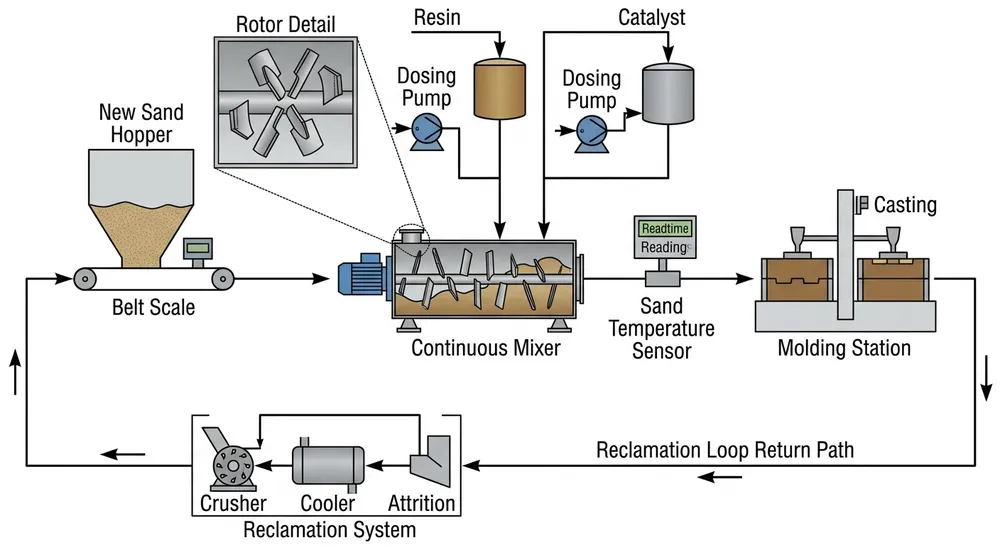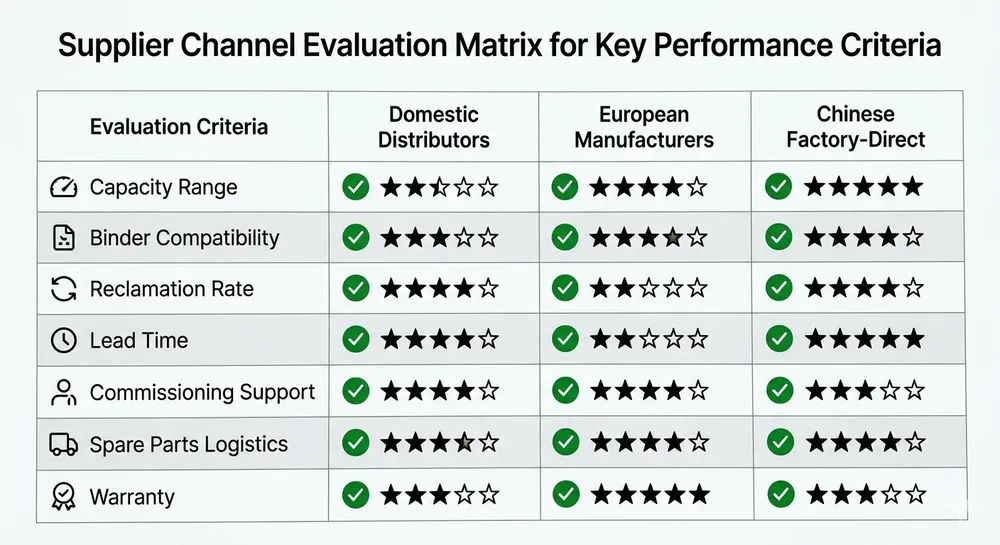
You're screening resin sand production line suppliers because your current clay sand system can't hold the dimensional tolerances your customers need, or you're expanding capacity and resin sand gives you faster cycle times with better surface finish. The US market offers three supplier channels: domestic distributors who stock components and provide local service, European manufacturers with US sales offices, and Chinese factory-direct suppliers who ship complete modular lines at 30-40% lower landed cost.
The decision isn't just about price. Lead time matters when you're racing a production deadline. Commissioning support matters when your maintenance team hasn't worked with continuous resin mixers before. Spare parts logistics matter when a failed solenoid valve on your binder dosing system stops your entire molding line. This article breaks down 10 suppliers across all three channels, explains what each model does well, and shows you how to evaluate the trade-offs for your specific situation.
How to Evaluate Resin Sand Line Suppliers
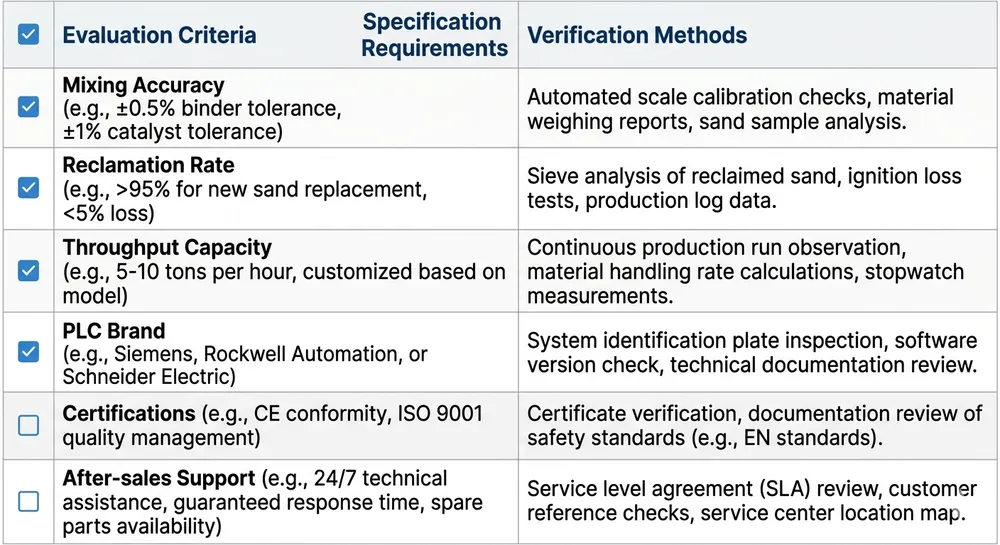
Before comparing suppliers, understand what actually matters for your operation. Binder cost is the number everyone watches — but it's the mixing accuracy that decides whether you're wasting resin or wasting castings.
Capacity range and scalability — Does the supplier offer lines from 5 tons/hour (small job shop) to 50+ tons/hour (high-volume automotive foundry)? Can you add a second mixer or reclamation module later without replacing the entire system?
Binder system compatibility — Furan, phenolic, sodium silicate, and alkaline phenolic all require different mixer designs and curing parameters. If you're running multiple binder types, you need a supplier who understands the cross-contamination risks and can configure separate dosing systems.
Reclamation rate and sand quality — Mechanical reclamation (attrition mills, pneumatic systems) typically recovers 85-92% of sand. Thermal reclamation (fluidized bed, rotary kiln) hits 95-98% but costs more upfront. The recovered sand's LOI (loss on ignition) and AFS grain fineness number determine whether you can reuse it without adding fresh sand every cycle.
Lead time and delivery reliability — Domestic distributors often quote 8-12 weeks for standard configurations because they're assembling components from multiple manufacturers. European suppliers run 16-24 weeks for custom-engineered lines. Chinese manufacturers typically ship in 12-16 weeks, but you need to add 4-6 weeks for ocean freight and customs clearance.
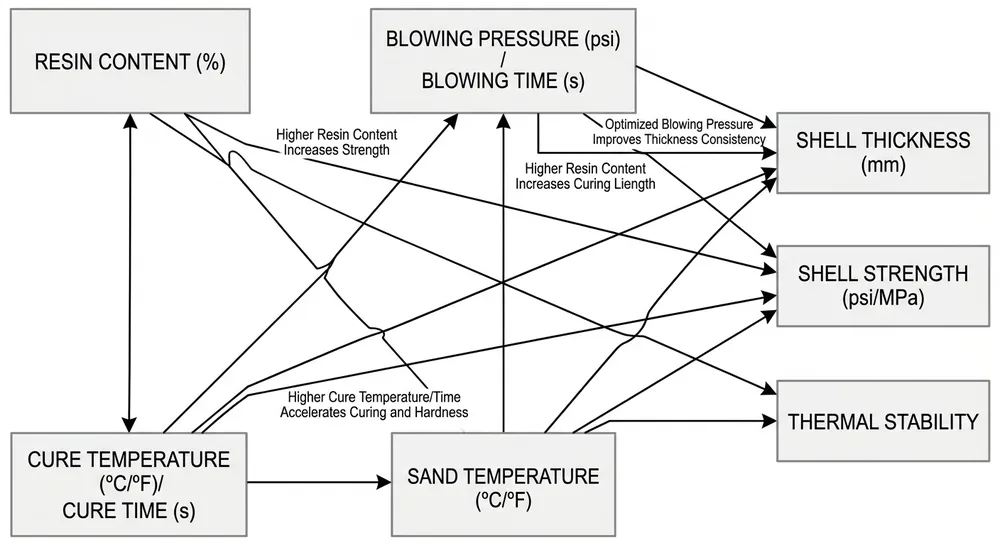
Commissioning and training support — A resin sand mixer with improper binder-to-catalyst ratios will produce molds that crack during pouring or don't develop full strength. Does the supplier send a technician to your facility for startup? Do they offer remote diagnostics? What does that cost?
Spare parts availability — Hydraulic seals, proximity sensors, solenoid valves, and PLC I/O modules are consumables. If your supplier stocks parts in the US, you get overnight shipping. If parts ship from Europe or China, you're looking at 2-4 weeks and your line sits idle.
Warranty and after-sales support — Standard warranties run 12-18 months from commissioning. What's covered? Mechanical components only, or does it include electrical systems and hydraulic units? Who pays for technician travel if something fails during the warranty period?

10 Resin Sand Production Line Suppliers Serving the US Market
This list covers the three main supplier channels. We're not ranking them 1-10 because the "best" supplier depends on your order size, timeline, and whether you value local service over landed cost. Instead, we're grouping them by business model so you can match the supplier type to your procurement situation.
Domestic Distributors and Service Providers
1. Roberts Sinto Corporation
Roberts Sinto operates as the North American arm of Sintokogio Group (Japan) and represents one of the largest foundry equipment distributors in the US. They supply complete resin sand systems including mixers, sand handling, and reclamation equipment, with service centers in multiple states.
Strengths: Established US service network, local spare parts inventory, experienced field technicians who can commission systems and train your operators. If you need emergency support, they can get someone on-site within 24-48 hours in most regions.
Limitations: Pricing includes distributor markup and US labor costs. A complete 20-ton/hour furan resin sand line typically runs $450,000-$650,000 depending on automation level and reclamation configuration.
Best for: Foundries that prioritize local support and can't afford extended downtime. If your production schedule is tight and you need guaranteed commissioning dates, the premium for domestic service makes sense.
2. Palmer Manufacturing & Supply
Palmer operates as a foundry equipment distributor and service provider, offering resin sand mixers, sand handling systems, and related equipment from multiple manufacturers. They focus on the Midwest and Southeast US markets.
Strengths: Flexible sourcing — they can assemble a system from different component manufacturers to match your budget and space constraints. Good for retrofit projects where you're adding resin sand capability to an existing clay sand facility.
Limitations: Lead times vary depending on component availability. If they're sourcing mixers from one supplier and reclamation equipment from another, coordination delays can push delivery out to 14-18 weeks.
Best for: Mid-size foundries looking for customized configurations without committing to a single manufacturer's complete system.
3. Simpson Technologies
Simpson provides foundry equipment and consumables, including resin sand systems, with a focus on complete turnkey installations. They handle engineering, installation, and ongoing technical support.
Strengths: Turnkey project management — they'll design the layout, handle rigging and installation, integrate with your existing equipment, and train your team. Good if you don't have in-house engineering resources to manage the project.
Limitations: Higher total project cost due to full-service model. Budget $550,000-$750,000 for a complete 20-ton/hour system including installation and commissioning.
Best for: Foundries expanding into resin sand for the first time who need end-to-end project support.
European Manufacturers with US Presence
4. Loramendi (Eibar Group)
Spanish manufacturer specializing in molding and sand preparation equipment, with US sales and service through regional representatives. Known for flaskless molding lines and continuous resin sand mixers.
Strengths: Advanced continuous mixer technology with precise binder dosing control (±1% accuracy). Their systems are designed for high-volume automotive and industrial casting operations running 30+ tons/hour.
Limitations: Premium pricing tier — expect $600,000-$900,000 for a complete high-capacity system. Lead times run 20-26 weeks for custom-engineered lines. US service network is thinner than domestic distributors.
Best for: High-volume foundries casting ductile iron or aluminum where mixing accuracy directly impacts scrap rates and binder costs.
5. Küttner Group
German engineering company providing complete foundry systems including resin sand preparation, molding, and thermal reclamation plants. They focus on large-scale installations for steel and iron foundries.
Strengths: Thermal reclamation expertise — their fluidized bed systems achieve 96-98% sand recovery with LOI below 0.3%, meaning you can run longer cycles before adding fresh sand. Strong engineering support for complex installations.
Limitations: High capital investment ($800,000+ for complete systems with thermal reclamation). Long lead times (24-30 weeks) due to custom engineering. Best suited for large foundries with high sand throughput.
Best for: Large foundries running 50+ tons/hour where sand reclamation quality justifies the premium investment.
6. Heinrich Wagner Sinto (HWS)
German-Japanese joint venture combining Wagner's molding technology with Sinto's sand systems. They supply complete resin sand lines with integrated molding equipment.
Strengths: Integrated system design — the sand preparation line is engineered to work seamlessly with their molding machines, reducing interface problems. Good technical documentation and training programs.
Limitations: Pricing in the $500,000-$800,000 range for complete systems. US service requires coordination with European headquarters for complex technical issues.
Best for: Foundries planning to upgrade both sand preparation and molding equipment simultaneously.
Chinese Factory-Direct Manufacturers
7. Qingdao Sanzhuji Equipment Manufacturing Co., Ltd.
Chinese manufacturer exporting complete resin sand production lines to North America, Europe, and Southeast Asia. They offer furan, phenolic, and coated sand systems with capacities from 5 to 40 tons/hour.
Strengths: Factory-direct pricing — a 20-ton/hour complete system typically lands in the US for $180,000-$280,000 including ocean freight. Modular design fits standard 40HQ containers, reducing shipping costs.
Limitations: Remote commissioning via video call (on-site technician visits cost extra). Spare parts ship from China with 2-4 week lead times. English documentation quality varies.
Best for: Cost-sensitive projects where you have in-house maintenance capability and can manage remote commissioning.
8. Qingdao Bestech Machinery Co., Ltd.
Chinese foundry equipment manufacturer specializing in sand processing systems, including resin sand mixers, sand coolers, and mechanical reclamation plants.
Strengths: Competitive pricing ($160,000-$260,000 for complete 20-ton/hour systems). They've shipped to US foundries and can provide reference installations. Standard lead time is 12-14 weeks to port.
Limitations: After-sales support relies on email and video calls. If you need on-site troubleshooting, you're either flying someone from China or working with a local industrial equipment technician who may not be familiar with their specific control systems.
Best for: Foundries with experienced maintenance teams who can handle PLC programming and hydraulic troubleshooting independently.
9. TZFoundry (Qingdao Tianzhuang Casting Machine Industry and Trade Co., Ltd.)
We manufacture complete resin sand production lines including continuous mixers, sand coolers, pneumatic conveying systems, and mechanical reclamation plants. Our 15,000 m² facility runs 8 production lines producing foundry equipment for export markets since 2010.
Strengths: Factory-direct pricing eliminates distributor markup — complete 20-ton/hour furan resin sand lines land in US ports for $170,000-$250,000 depending on automation level and reclamation configuration. Modular container-optimized design (complete systems ship in 2-3 x 40HQ containers). In-house engineering team provides custom layout design and PLC programming for your specific floor space and existing equipment interfaces. Remote commissioning via video call proven across 14 countries — your maintenance team follows our engineer's instructions to connect hydraulic lines, wire control panels, and run initial test cycles. First-year spare parts kit included (hydraulic seals, proximity sensors, solenoid valves, PLC I/O modules). ISO 9001:2015 + CE certified with SGS pre-shipment inspection available.
Limitations: Remote commissioning requires your team to have basic hydraulic and electrical troubleshooting skills. On-site commissioning available but adds $8,000-$12,000 for technician travel and accommodation. Spare parts ship from China (2-3 weeks via air freight, 4-6 weeks ocean).
Best for: Foundries looking to minimize capital investment while maintaining quality standards. Works well if you're adding capacity and need to protect margin, or if you're a distributor sourcing equipment to resell in your market.
10. Omega Foundry Machinery
US-based equipment supplier representing multiple Asian manufacturers, providing resin sand systems with local coordination and support.
Strengths: Hybrid model — factory-direct pricing from Asian manufacturers with US-based project coordination. They handle customs clearance, freight forwarding, and can arrange installation contractors. Pricing typically $200,000-$320,000 for complete systems.
Limitations: Support quality depends on which manufacturer they're sourcing from. Lead times can extend if there are communication gaps between the US office and overseas factory.
Best for: Buyers who want factory-direct economics but prefer working with a US-based company for project coordination.
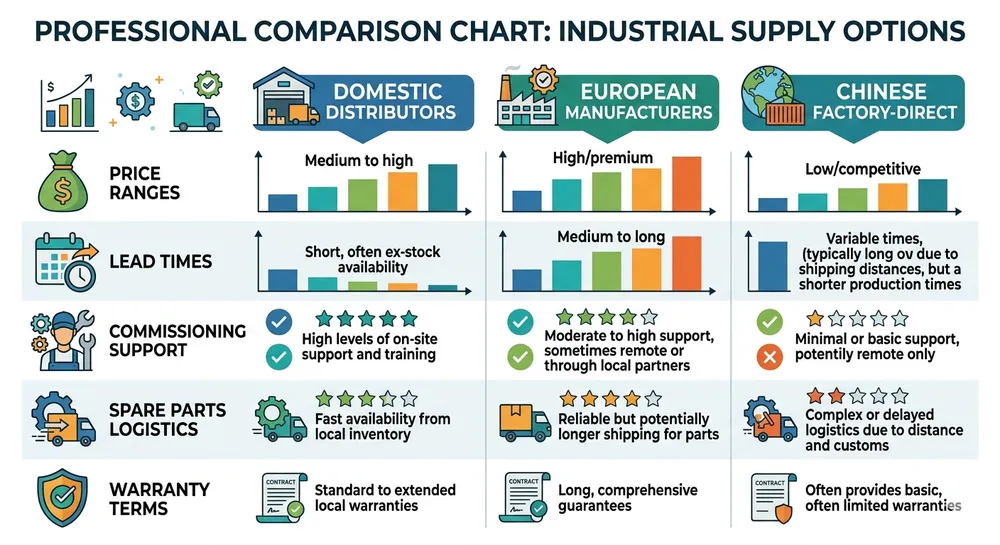
Domestic vs Import: The Real Cost Comparison
The sticker price difference is obvious — Chinese factory-direct systems cost 50-65% less than domestic distributors for equivalent capacity. But landed cost includes more than the equipment invoice.
Total acquisition cost breakdown for a 20-ton/hour furan resin sand line:
Domestic distributor route:
- Equipment: $450,000-$650,000
- Installation and commissioning: Included or $15,000-$25,000
- Training: Included
- First-year spare parts: $8,000-$12,000
- Total: $473,000-$687,000
European manufacturer route:
- Equipment: $500,000-$800,000
- Ocean freight and customs: $18,000-$28,000
- Installation and commissioning: $20,000-$35,000
- Training: Included
- First-year spare parts: $10,000-$15,000
- Total: $548,000-$878,000
Chinese factory-direct route:
- Equipment: $170,000-$250,000
- Ocean freight and customs: $15,000-$22,000
- Installation (local contractor): $12,000-$18,000
- Remote commissioning: Included (on-site adds $8,000-$12,000)
- First-year spare parts: Included
- Total: $197,000-$290,000 (remote) or $217,000-$314,000 (on-site)
The savings are real, but so are the trade-offs. Domestic suppliers get you running faster (8-12 weeks vs 16-22 weeks total time from order to production). Local service means same-day or next-day response for breakdowns. Spare parts ship overnight instead of waiting 2-4 weeks.
When does local supply make sense? Urgent capacity additions where production delays cost more than the equipment premium. First-time resin sand installations where you need hands-on training and commissioning support. Foundries without experienced maintenance staff who can troubleshoot PLC and hydraulic issues independently.
When does factory-direct import make sense? Planned capacity expansions where you have 4-6 months lead time. Foundries with skilled maintenance teams who can handle remote commissioning. Cost-sensitive projects where equipment budget directly impacts project viability. Distributors and equipment resellers who need competitive pricing to serve their own markets.
(We've commissioned resin sand lines remotely in 14 countries. It works when your team can read hydraulic schematics, use a multimeter, and follow video call instructions. If your maintenance supervisor has 10+ years in foundry equipment, remote commissioning is straightforward. If your team is new to automated sand systems, budget for on-site support.)
How to Vet an Overseas Resin Sand Line Manufacturer
If you're considering factory-direct import, don't rely on website claims alone. Here's what actually matters:
Factory audit and certifications — ISO 9001:2015 certification means they have documented quality procedures. CE certification (required for European exports) means the equipment meets machinery safety directives. SGS or TÜV inspection reports provide third-party verification. Ask for copies of current certificates, not just logos on the website.
Reference installations in your region — A manufacturer who's shipped to North America before understands container optimization, voltage requirements (480V 3-phase 60Hz vs 380V 3-phase 50Hz), and English documentation standards. Ask for contact information for 2-3 customers in the US or Canada who are running similar capacity systems.
Test run data and commissioning reports — Serious manufacturers test every system before shipment. Ask for the commissioning report from a recent similar system showing actual measured performance: mixing cycle time, binder dosing accuracy, sand temperature after cooling, reclamation recovery rate. If they can't provide test data, they're not testing.
Control system and spare parts clarity — What PLC brand do they use (Siemens, Mitsubishi, Allen-Bradley)? Can your electricians program it, or do you need their proprietary software? Are spare parts standard industrial components you can source locally, or proprietary parts that must ship from China?
Container loading optimization — A well-designed modular system ships in standard 40HQ containers without wasted space. Ask for container loading drawings showing how the equipment breaks down. If they're quoting 5 containers for a system that should fit in 3, you're paying extra freight for poor design.
Communication and technical response time — Send a technical question about binder dosing accuracy or sand reclamation LOI targets. How long does it take to get a detailed answer? Is the response technically competent, or generic sales language? This tells you what after-sales support will look like.
Factory-Direct Alternative: TZFoundry's Approach to US Market Supply
We ship complete modular resin sand production lines to US foundries, with systems running in Pennsylvania, Ohio, and Texas. Our engineering team designs each line for your specific floor space, ceiling height, and existing equipment interfaces — not off-the-shelf configurations.
Modular container-optimized design — A complete 20-ton/hour system (continuous mixer, sand cooler, pneumatic conveying, mechanical reclamation) ships in 2-3 x 40HQ containers. We design structural frames and equipment modules to fit container dimensions without wasted space, reducing your freight cost by 20-30% compared to poorly optimized designs.
Custom layout and PLC programming — If you're adding a resin sand reclamation plant to an existing facility, our engineers calculate floor loading requirements, design material flow paths, and program the control system to interface with your current molding line. We use Siemens or Mitsubishi PLCs (your choice) with English HMI interfaces.
Remote commissioning with video support — Your maintenance team connects hydraulic lines, wires control panels, and runs initial test cycles following our engineer's video call instructions. We've commissioned systems in 14 countries this way. It requires your team to have basic hydraulic and electrical skills, but it eliminates $8,000-$12,000 in travel costs.
First-year spare parts kit included — Every system ships with hydraulic seals, proximity sensors, solenoid valves, and PLC I/O modules — the consumables you'll need for the first year. After that, most components are standard industrial parts you can source locally. Proprietary parts (mixer blades, sand cooler tubes) ship from China via air freight (2-3 weeks).
Binder dosing calibration protocol — We developed an internal calibration procedure that reduced resin consumption by 12% across furan and phenolic lines without weakening mold strength. Your system ships with dosing pumps pre-calibrated to ±1.5% accuracy, and we provide the calibration procedure so your team can verify and adjust as needed.
Quality verification before shipment — Every line runs through our in-house sand reclamation testing lab. If you're buying a system rated for 95% sand recovery, we'll show you the test data from your specific unit — not a generic spec sheet. SGS pre-shipment inspection available if you need third-party verification.
Our typical US customer is either a foundry adding capacity where equipment cost directly impacts project ROI, or a distributor sourcing equipment to resell in their market. The factory-direct model works when you have 4-6 months lead time and maintenance staff who can handle remote commissioning.
Frequently Asked Questions
What capacity resin sand line do I need for a foundry producing 500 tons of castings per month?
Sand-to-metal ratio varies by casting type, but a typical range is 3:1 to 5:1 for resin sand molding. At 4:1 ratio, 500 tons of castings requires 2,000 tons of sand per month. Running 22 days per month at 8 hours per day gives you 176 production hours, so you need roughly 11-12 tons/hour sand processing capacity. Specify a 15-ton/hour line to provide buffer capacity for peak production periods and maintenance downtime.
Can I run both furan and phenolic binder systems on the same resin sand line?
Technically yes, but it requires thorough cleaning between binder changes and separate dosing systems. Furan resin residue will contaminate phenolic molds and cause curing problems. Most foundries running multiple binder types either dedicate separate mixers to each system or batch-produce with 2-3 hour changeover procedures including mixer flushing and dosing line purging. If you're running both regularly, budget for dual dosing systems ($15,000-$25,000 additional cost).
How long does it take to train operators on a new resin sand production line?
For experienced foundry workers familiar with sand systems, 2-3 days covers operation, routine maintenance, and basic troubleshooting. For operators new to automated sand systems, plan 5-7 days including hands-on practice with startup/shutdown procedures, binder ratio adjustments, and common fault diagnosis. The control system's HMI interface matters — intuitive touchscreen controls with clear error messages reduce training time significantly.
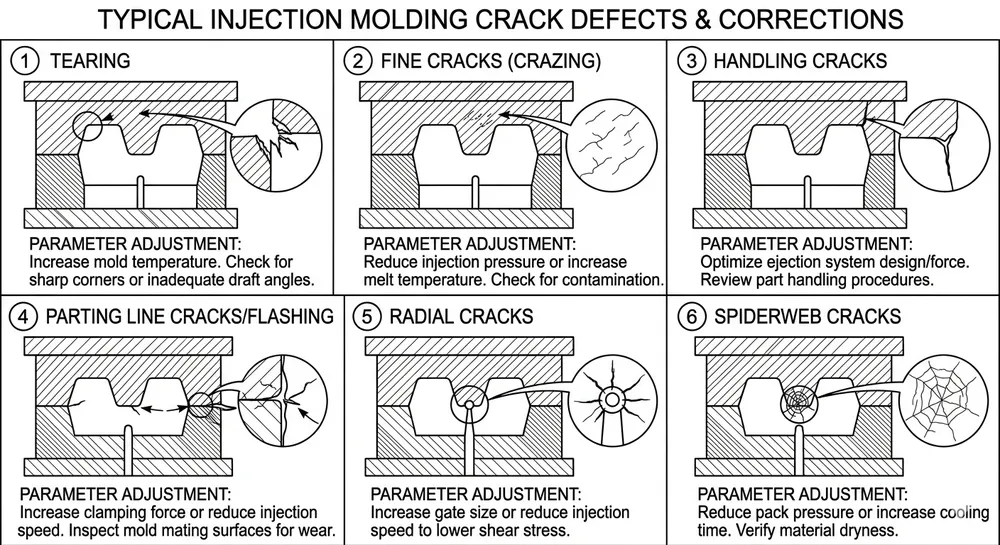
What causes resin sand molds to crack during pouring, and how do I prevent it?
Three main causes: insufficient binder content (mold doesn't develop full strength), incorrect catalyst ratio (incomplete curing), or pouring temperature too high for the binder system. Furan resin sand typically handles iron pours up to 1450°C, but steel pours above 1550°C may require phenolic binder or higher resin content (1.8-2.2% vs standard 1.2-1.5%). Check your mixer's binder dosing accuracy first — if it's drifting outside ±2%, you'll get inconsistent mold strength across batches.
Do I need thermal or mechanical reclamation for my resin sand line?
Mechanical reclamation (attrition mills, pneumatic systems) costs $80,000-$150,000 and recovers 85-92% of sand with LOI around 0.5-1.0%. Thermal reclamation (fluidized bed, rotary kiln) costs $200,000-$400,000 but recovers 95-98% with LOI below 0.3%. The decision depends on your sand cost and disposal cost. If you're paying $40-$60 per ton for new sand and $80-$120 per ton for waste sand disposal, thermal reclamation pays back in 18-30 months at 20+ tons/hour throughput. Below 15 tons/hour, mechanical reclamation usually makes more economic sense.
What's the typical lead time for a complete resin sand production line from order to production?
Domestic distributors: 8-12 weeks for standard configurations, 14-18 weeks for custom systems. European manufacturers: 16-24 weeks for engineered lines. Chinese factory-direct: 12-16 weeks manufacturing plus 4-6 weeks ocean freight and customs clearance, total 16-22 weeks. Add 2-4 weeks for installation and commissioning regardless of supplier. If you need faster delivery, some domestic distributors stock standard mixer and cooler modules that can ship in 4-6 weeks, but you'll pay a premium.
How do I handle spare parts logistics for an imported resin sand line?
Stock critical consumables locally: hydraulic seals, proximity sensors, solenoid valves, PLC I/O modules, mixer blade sets. These are the parts that fail most frequently and stop production. Most are standard industrial components you can source from local suppliers (Parker hydraulic seals, Omron sensors, Festo valves). Proprietary parts (custom mixer blades, sand cooler tubes, specialized wear plates) should be ordered in advance and kept in your maintenance inventory. Budget $8,000-$15,000 for a two-year spare parts inventory when you order the system.
—
If you're evaluating resin sand production line suppliers and need help comparing configurations, send us your casting type, target output rate, and available floor space. Our engineering team will provide a line layout, factory pricing, and container shipping plan within 48 hours — no obligation, just clear information to support your sourcing decision.

Liu Haoran is the Resin Sand Production Line Technical Manager at TZFoundry. Over 11 years of hands-on work with furan, phenolic, and coated sand systems, he has commissioned 40+ resin sand lines for export buyers and developed binder dosing protocols...