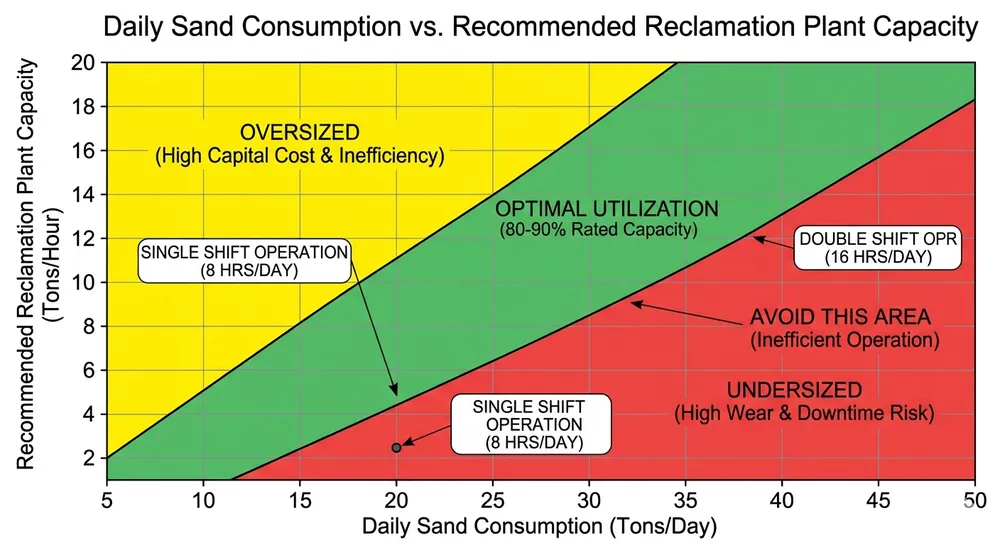
Most foundries size their reclamation plant by guessing. They look at daily sand consumption, pick a capacity tier that sounds close, and hope it works. Then they discover the plant can't keep up during peak shifts, or it sits idle 60% of the time because they oversized it.
The real problem: reclamation throughput must match your mixer's input demand, not just your daily average. If your mixer needs 8 tons/hour during production runs but your reclamation plant only delivers 5 tons/hour, you're buying virgin sand to fill the gap. If you bought a 20 ton/hour plant for a 6 ton/hour mixer, you paid for capacity you'll never use.
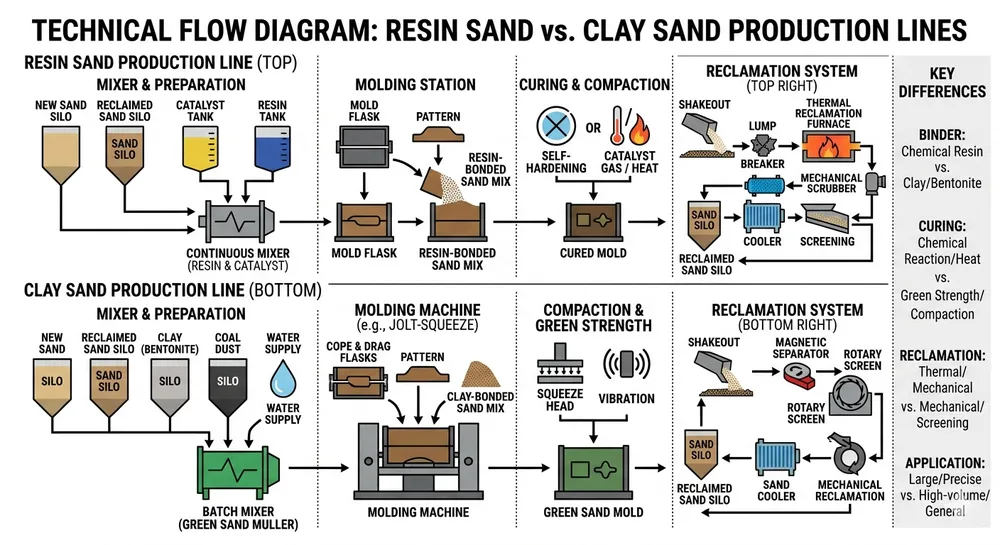
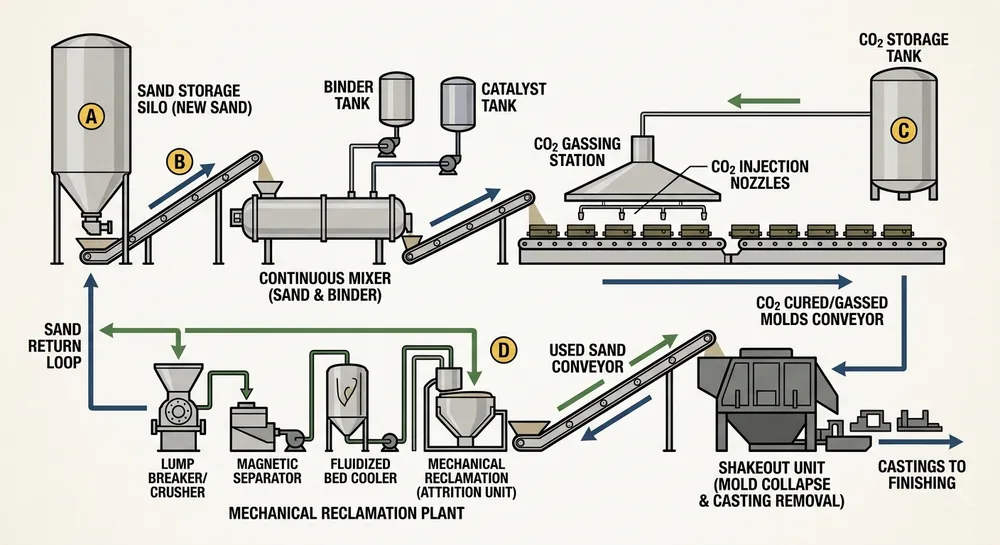
Resin sand reclamation plant sizing starts with daily sand consumption, converts it to hourly throughput, then matches that throughput to your existing mixer capacity using the 80-90% rule. This article walks through the calculation method, capacity tier selection, and the floor space and electrical requirements buyers need before they request a quote.
Daily Consumption to Hourly Throughput: The Base Calculation
Your daily sand consumption number is useful, but reclamation plants don't run 24 hours straight. They run during production shifts, and they need to deliver reclaimed sand at the rate your mixer consumes it.
Step 1: Identify your actual production hours per day
Most foundries run one or two shifts. A single 8-hour shift means your reclamation plant has 8 hours to process the day's sand. A two-shift operation (16 hours) spreads the load differently.
Step 2: Calculate required hourly throughput
The formula:
Required throughput (tons/hour) = Daily sand consumption (tons) ÷ Production hours per day
Example scenarios:
| Daily Consumption | Production Hours | Required Throughput |
|---|---|---|
| 10 tons/day | 8 hours (1 shift) | 1.25 tons/hour |
| 20 tons/day | 8 hours (1 shift) | 2.5 tons/hour |
| 20 tons/day | 16 hours (2 shifts) | 1.25 tons/hour |
| 40 tons/day | 16 hours (2 shifts) | 2.5 tons/hour |
This is your baseline. But it's not your final sizing number.
The 80-90% Mixer-Matching Rule
Here's what most buyers miss: your reclamation plant's rated capacity should run at 80-90% utilization during normal production. Not 100%, not 50%.
Why not 100%?
Running a mechanical reclamation plant at full rated capacity all shift long accelerates wear on the rotor, screen mesh, and pneumatic conveying system. You'll replace screens every 3 months instead of every 6. The pneumatic blower runs hotter. Maintenance intervals shrink.
We've seen buyers spec a 5 ton/hour plant for a 5 ton/hour demand, then call us six months later asking why the screen mesh keeps tearing. The plant was never designed to run at 100% for 8-hour stretches.
Why not 50%?
Undersizing sounds safe until your production schedule changes. If you add a second mold line, or your customer orders double the usual volume, your reclamation plant becomes the bottleneck. You either buy virgin sand to supplement (expensive) or you run overtime shifts on the reclamation plant alone (inefficient).
The 80-90% target
If your required throughput is 2.5 tons/hour, size your plant for 2.8-3.1 tons/hour rated capacity. This gives you:
- headroom for peak demand days
- lower wear rates during normal operation
- flexibility if production scales up 10-20% in the next two years
In practice, this means:
- 1.25 tons/hour demand → 5 ton/hour plant (running at 25%, too oversized)
- 2.5 tons/hour demand → 3 ton/hour plant (running at 83%, correct)
- 4 tons/hour demand → 5 ton/hour plant (running at 80%, correct)

Capacity Tier Mapping: Standard Plant Sizes
Reclamation plants come in standard capacity tiers. You can't order a 3.7 ton/hour plant — you pick the nearest standard size and adjust your production plan accordingly.
Standard mechanical reclamation plant tiers:
| Rated Capacity | Typical Daily Consumption Range (8-hour shift) | Typical Daily Consumption Range (16-hour shift) | Floor Space Required | Power Draw |
|---|---|---|---|---|
| 3 tons/hour | 6-10 tons/day | 12-20 tons/day | 8m × 4m | 22 kW |
| 5 tons/hour | 10-16 tons/day | 20-32 tons/day | 10m × 5m | 37 kW |
| 8 tons/hour | 16-26 tons/day | 32-52 tons/day | 12m × 6m | 55 kW |
| 10 tons/hour | 26-32 tons/day | 52-64 tons/day | 14m × 7m | 75 kW |
| 15 tons/hour | 38-48 tons/day | 76-96 tons/day | 16m × 8m | 110 kW |
| 20 tons/hour | 50-64 tons/day | 100-128 tons/day | 18m × 9m | 132 kW |
These ranges assume 80-90% utilization. If your daily consumption falls between two tiers, round up — undersizing costs more in the long run than the price difference between tiers.
Worked Sizing Examples
Example 1: Small Foundry, Single Shift
Given:
- Daily sand consumption: 10 tons/day
- Production schedule: 8 hours/day, 5 days/week
- Existing mixer capacity: 3 tons/hour continuous mixer
Calculation:
- Required throughput: 10 tons ÷ 8 hours = 1.25 tons/hour
- Target plant capacity (80-90% rule): 1.25 ÷ 0.85 = 1.47 tons/hour
- Nearest standard tier: 3 tons/hour mechanical reclamation plant
- Actual utilization: 1.25 ÷ 3 = 42%
Assessment: This looks oversized at 42% utilization, but the 3 ton/hour tier is the smallest standard mechanical plant. The alternative is a 1-2 ton/hour batch-style reclamation system, which works for this scale but requires manual hopper loading. For continuous operation feeding a 3 ton/hour mixer, the 3 ton/hour plant is the correct choice.
Floor space: 8m × 4m Power requirement: 22 kW (verify your facility has 3-phase 380V supply)
Example 2: Mid-Size Foundry, Two Shifts
Given:
- Daily sand consumption: 40 tons/day
- Production schedule: 16 hours/day (two 8-hour shifts), 6 days/week
- Existing mixer capacity: 5 tons/hour continuous mixer
Calculation:
- Required throughput: 40 tons ÷ 16 hours = 2.5 tons/hour
- Target plant capacity (80-90% rule): 2.5 ÷ 0.85 = 2.94 tons/hour
- Nearest standard tier: 3 tons/hour or 5 tons/hour
- If 3 tons/hour: actual utilization = 2.5 ÷ 3 = 83% ✓
- If 5 tons/hour: actual utilization = 2.5 ÷ 5 = 50% (oversized)
Assessment: The 3 ton/hour plant hits the 80-90% target perfectly. But check your mixer capacity: if your 5 ton/hour mixer ever runs at full capacity during peak orders, the 3 ton/hour reclamation plant becomes a bottleneck. In that case, the 5 ton/hour plant is the safer choice — you'll run it at 50% normally, but you have headroom when production scales up.
Floor space (3 ton/hour): 8m × 4m Floor space (5 ton/hour): 10m × 5m Power requirement (3 ton/hour): 22 kW Power requirement (5 ton/hour): 37 kW
Example 3: High-Volume Foundry, Continuous Operation
Given:
- Daily sand consumption: 80 tons/day
- Production schedule: 20 hours/day (two 10-hour shifts with 4-hour maintenance window)
- Existing mixer capacity: 8 tons/hour continuous mixer
Calculation:
- Required throughput: 80 tons ÷ 20 hours = 4 tons/hour
- Target plant capacity (80-90% rule): 4 ÷ 0.85 = 4.7 tons/hour
- Nearest standard tier: 5 tons/hour mechanical reclamation plant
- Actual utilization: 4 ÷ 5 = 80% ✓
Assessment: The 5 ton/hour plant matches perfectly. But verify your mixer's actual peak demand — if it occasionally runs at 6-7 tons/hour during high-volume casting days, consider the 8 ton/hour plant instead. The price difference between 5 and 8 ton/hour tiers is smaller than the cost of supplementing with virgin sand for six months while you wait for a plant upgrade.
Floor space (5 ton/hour): 10m × 5m Floor space (8 ton/hour): 12m × 6m Power requirement (5 ton/hour): 37 kW Power requirement (8 ton/hour): 55 kW
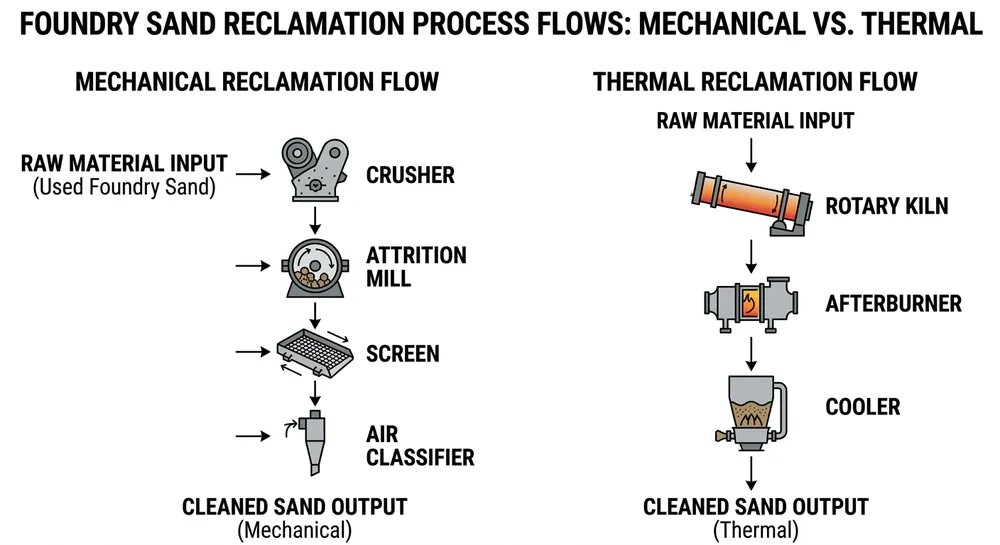
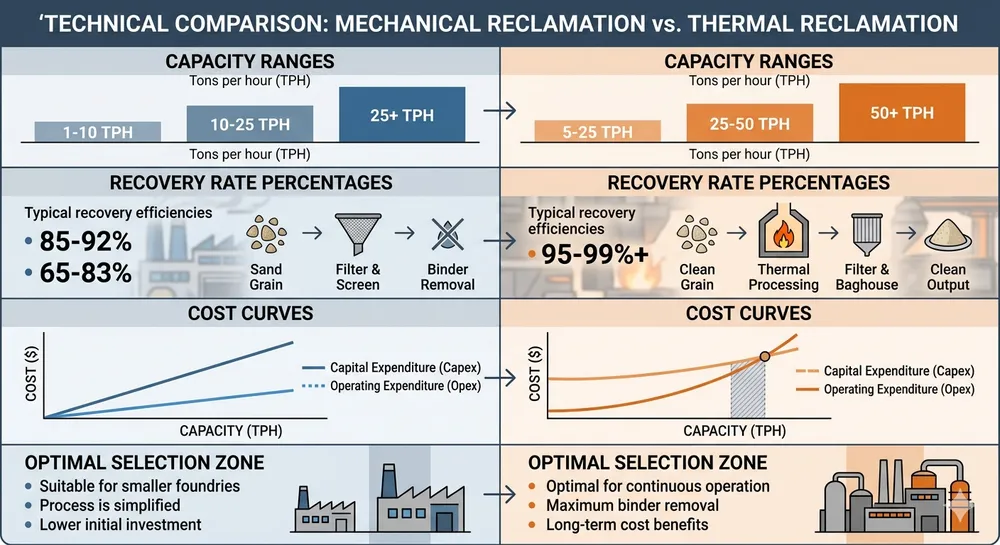
Mechanical vs Thermal Reclamation: Capacity Decision Point
The sizing method above applies to mechanical reclamation plants. Thermal reclamation plants (using fluidized bed or rotary kiln systems) follow the same throughput calculation, but the break-even point shifts at higher capacities.
Mechanical reclamation:
- Best for: 3-10 tons/hour capacity range
- Recovery rate: 85-92% (furan and phenolic binders)
- Residual resin film: 0.3-0.5% remains on sand grains
- Capital cost: lower
- Operating cost: lower power consumption, higher screen replacement frequency
Thermal reclamation:
- Best for: 8-20+ tons/hour capacity range
- Recovery rate: 95-98% (complete binder burnoff)
- Residual resin film: <0.1%
- Capital cost: higher (30-40% more than mechanical at same capacity)
- Operating cost: higher energy consumption (natural gas or electric heating), lower maintenance
The decision rule:
If your required capacity is below 8 tons/hour, mechanical reclamation is almost always the better ROI. The capital cost difference doesn't justify the marginal improvement in sand quality for most casting applications.
If your required capacity is 10 tons/hour or higher, and you're casting high-precision parts (aerospace, automotive engine blocks) where residual resin film affects surface finish, thermal reclamation starts making sense. The higher recovery rate also means you're buying less virgin sand over the plant's 10-year lifespan.
For resin sand production line buyers planning a complete system from scratch, we usually recommend sizing the reclamation plant and mixer together during the initial engineering phase — it's easier to match capacities before installation than to retrofit later.
Brownfield Sizing Adjustments: Buffer Hoppers and Peak Demand
The calculations above assume greenfield installations where you're designing the entire sand system from scratch. Brownfield installations — adding a reclamation plant to an existing foundry — require three additional considerations.
1. Existing buffer hopper capacity
If your current sand system has a 5-ton buffer hopper between the reclamation plant and mixer, you have temporary storage that smooths out throughput mismatches. This means you can size the reclamation plant slightly smaller (70-80% utilization instead of 80-90%) because the hopper absorbs short-term demand spikes.
Without a buffer hopper, the reclamation plant must deliver sand at exactly the rate the mixer consumes it. Any mismatch causes either mixer starvation (production stops) or reclaimed sand spillage (manual handling required).
2. Peak vs average demand
Your daily consumption average hides peak demand periods. If you cast 60% of your daily volume in the first 4 hours of the shift (common in batch-casting operations), your reclamation plant needs to handle that peak rate, not the 8-hour average.
Recalculate using peak hours instead of total shift hours:
- Daily consumption: 20 tons/day
- Peak casting period: 4 hours
- Peak throughput: 20 tons × 0.6 = 12 tons in 4 hours = 3 tons/hour peak demand
In this case, size for 3 tons/hour, not the 2.5 tons/hour average.
3. Shift pattern changes
If you're currently running one shift but plan to add a second shift within two years, size for the two-shift scenario now. Upgrading a reclamation plant later means:
- 4-6 week lead time for the new plant
- complete system shutdown during installation
- re-commissioning and sand quality re-validation
The cost difference between a 3 ton/hour and 5 ton/hour plant is smaller than the cost of a production shutdown and retrofit.
Floor Space and Electrical Pre-Qualification
Before you request a quote, verify your facility can accommodate the plant. We've had buyers select a plant, receive drawings, then discover their floor space or electrical supply can't support it.
Floor space requirements (mechanical reclamation plants):
The footprint numbers in the capacity table above are for the reclamation unit only. Add:
- 2m clearance on the discharge side for pneumatic conveying connection
- 1.5m clearance on the feed side for hopper access
- 2m overhead clearance for dust collection ductwork
Example: a 5 ton/hour plant listed as 10m × 5m actually needs 13m × 7.5m of usable floor space when you include access and connections.
Electrical requirements:
All standard reclamation plants require 3-phase 380V supply (or 3-phase 415V for export markets). Verify:
- your facility's transformer capacity can handle the additional load
- you have available circuit breaker capacity
- the installation location is within 50m of the main distribution panel (longer cable runs require voltage drop calculations)
For plants above 10 tons/hour (75 kW and higher), some facilities need to upgrade their transformer or add a dedicated sub-panel. This adds 2-4 weeks to the installation timeline and $3,000-8,000 to the project cost.
Sand Recovery Rate and Virgin Sand Makeup
No reclamation plant recovers 100% of your sand. Mechanical systems lose 8-15% of the sand volume to dust collection, fines removal, and pneumatic conveying losses. Thermal systems lose 2-5%.
What this means for sizing:
If you consume 20 tons/day of sand in your molds, and your reclamation plant has a 90% recovery rate, you're only getting 18 tons/day of reclaimed sand back. You need to add 2 tons/day of virgin sand to maintain your sand system inventory.
This doesn't change your reclamation plant sizing — you still size based on the 20 tons/day total consumption. But it does affect your virgin sand purchasing budget and your sand silo capacity planning.
Recovery rate by binder type:
| Binder System | Mechanical Reclamation Recovery | Thermal Reclamation Recovery |
|---|---|---|
| Furan (furfuryl alcohol) | 88-92% | 96-98% |
| Phenolic urethane | 85-90% | 95-97% |
| Alkaline phenolic | 82-88% | 94-96% |
Sodium silicate (inorganic) binder systems require wet reclamation, not mechanical or thermal — the sizing method is completely different and outside the scope of this article.
Common Sizing Mistakes and How to Avoid Them
Mistake 1: Sizing based on annual consumption instead of hourly throughput
A buyer tells us "we use 5,000 tons of sand per year" and asks for a plant recommendation. That's 20 tons/day if you run 250 days/year, but it tells us nothing about shift patterns or peak demand. We need daily consumption and production hours to size correctly.
Mistake 2: Ignoring mixer capacity
A foundry buys a 10 ton/hour reclamation plant because their daily consumption math says they need 8 tons/hour. Then they discover their existing mixer can only accept 5 tons/hour input. The reclamation plant sits idle 50% of the time because the mixer is the bottleneck, not the reclamation capacity.
Always check your mixer's rated input capacity before sizing the reclamation plant. If the mixer is undersized, you need to upgrade both systems together.
Mistake 3: Forgetting about future capacity
Sizing for today's production volume is fine if you're certain production won't grow. But most foundries add capacity within 3-5 years. The cost difference between a 5 ton/hour and 8 ton/hour plant is 15-20%, but retrofitting later costs 40-50% more than buying the larger plant initially (because you're paying for removal, disposal, and re-installation labor).
If there's any chance you'll add a second mold line or increase shift hours in the next 3 years, size one tier higher than your current calculation suggests.
When to Request Engineering Support
The sizing method in this article works for standard installations where:
- you have consistent daily production
- you run regular shift patterns
- your sand system has typical buffer hopper capacity
- you're using furan or phenolic binders
You should request engineering support from the equipment supplier if:
- your production is highly variable (some days 10 tons, some days 40 tons)
- you're running 3-shift continuous operation with no maintenance windows
- you're planning to switch binder systems in the next 2 years
- you're installing in a facility with unusual floor loading limits or overhead clearance restrictions
- you're integrating the reclamation plant with an existing automated sand handling system
We run sand system capacity modeling for buyers in these situations — it's a 2-3 day engineering review that maps your actual production data to equipment specifications and catches sizing problems before you order. For a $50,000-150,000 equipment purchase, the engineering review is worth the time.
If you're evaluating reclamation plant options and want capacity verification based on your specific production data, contact our resin sand technical team — send us your daily consumption numbers, shift schedule, and existing mixer specs, and we'll recommend the correct capacity tier with floor space and electrical requirements included.
FAQ
What happens if I undersize my reclamation plant?
You'll supplement with virgin sand to keep your mixer fed, which increases your per-ton sand cost by 30-50%. Worse, your reclamation plant will run at 100% capacity all shift, which accelerates wear on screens, rotors, and pneumatic components. Maintenance intervals shrink from 6 months to 3 months, and unplanned downtime increases.
Can I oversize the plant to handle future growth?
Yes, but only one capacity tier above your current need. Oversizing by two tiers (e.g., buying a 10 ton/hour plant when you need 3 tons/hour) means you're running at 30% utilization, which causes its own problems: pneumatic conveying systems don't work efficiently at very low flow rates, and dust collection systems sized for higher volumes pull too much vacuum at low throughput. One tier up is safe. Two tiers up creates operational issues.
How do I know if my mixer capacity is the bottleneck?
Check your mixer's nameplate rating or technical datasheet. If your mixer is rated for 3 tons/hour continuous input and your reclamation plant calculation says you need 5 tons/hour throughput, the mixer is the bottleneck. You'll need to upgrade the mixer first, or accept that your reclamation plant will only run at 60% capacity (which is fine if you're planning a mixer upgrade within 12-18 months).
Does the 80-90% rule apply to thermal reclamation plants too?
Yes. Thermal reclamation plants have the same utilization logic — running at 100% capacity all shift accelerates refractory lining wear and increases natural gas consumption. The 80-90% target gives you operational headroom and extends maintenance intervals.
What if my daily consumption varies significantly week to week?
Size based on your average high-production week, not your peak week. If you normally run 20 tons/day but occasionally hit 30 tons/day during peak order periods, size for 20 tons/day and plan to supplement with virgin sand during those peak weeks. Sizing for the absolute peak means you're oversized 90% of the time.

Liu Haoran is the Resin Sand Production Line Technical Manager at TZFoundry. Over 11 years of hands-on work with furan, phenolic, and coated sand systems, he has commissioned 40+ resin sand lines for export buyers and developed binder dosing protocols...