You're comparing two sand systems because your casting tolerance spec, batch economics, or alloy type pushed you past the point where either system works equally well. One will cost you less per ton of good castings — but the answer depends on whether you're running 50-unit batches of ductile iron valve bodies or 5,000-unit runs of gray iron manhole covers.
We manufacture both Resin Sand Production Line and Clay Sand Processing Line systems at TZFoundry, so we don't upsell one over the other. What we do is help you match the line economics to your actual casting portfolio. Here's the commercial breakdown.
Quick Verdict: Match the System to Your Tolerance and Volume Profile
Choose resin sand when your castings demand ±0.3-0.5mm dimensional tolerance, Ra 6.3-12.5μm surface finish, or complex thin-wall geometries. The binder cost is 3-4× higher than bentonite, but you eliminate most secondary machining and reduce scrap on precision work.
Choose clay sand when you're running medium-to-high volume production (500+ molds/day) of castings with ±1.0-2.0mm tolerance windows and simpler geometries. Your consumable cost drops to $8-12 per ton of sand vs $35-50 for resin systems, and reclamation becomes cheaper at scale.
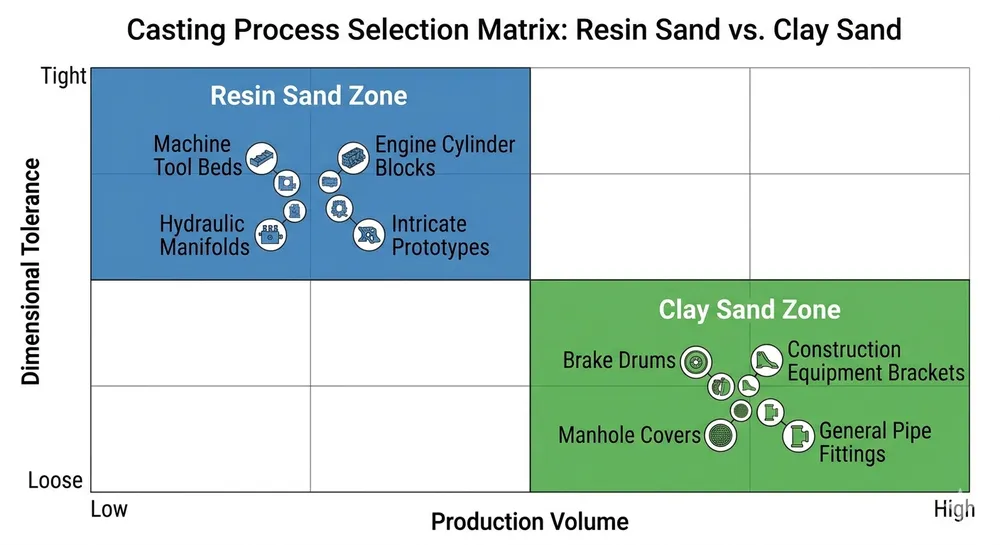
Run both lines if your product mix includes both precision components (pump housings, valve bodies, engine blocks) and high-volume commodity castings (counterweights, manhole covers, agricultural parts). We've shipped hybrid configurations to foundries in North America and Europe where the precision work justifies dedicated resin capacity while clay sand handles the volume base load.
System Definitions: Binder Chemistry and Equipment Architecture
Resin Sand Production Lines
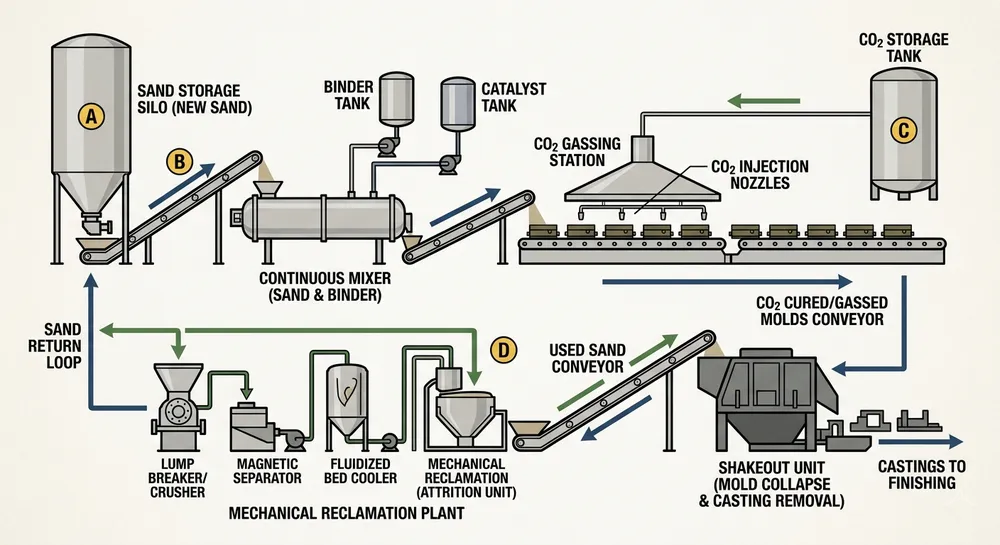
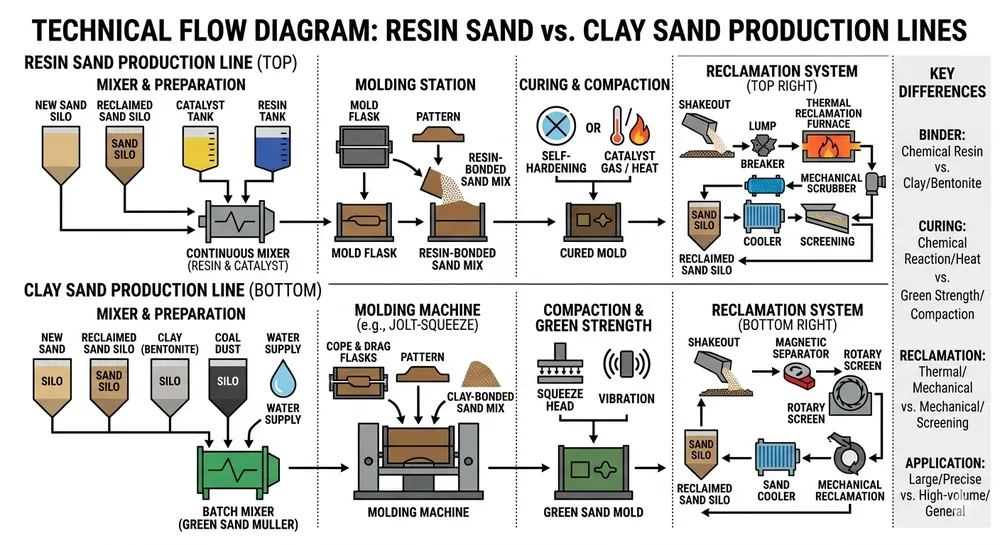
Resin sand systems use organic binders (furan, phenolic, or sodium silicate) that cure through chemical reaction or heat. The sand grains are coated with resin and catalyst, mixed to precise ratios, then molded and cured to form rigid molds with high dimensional stability.
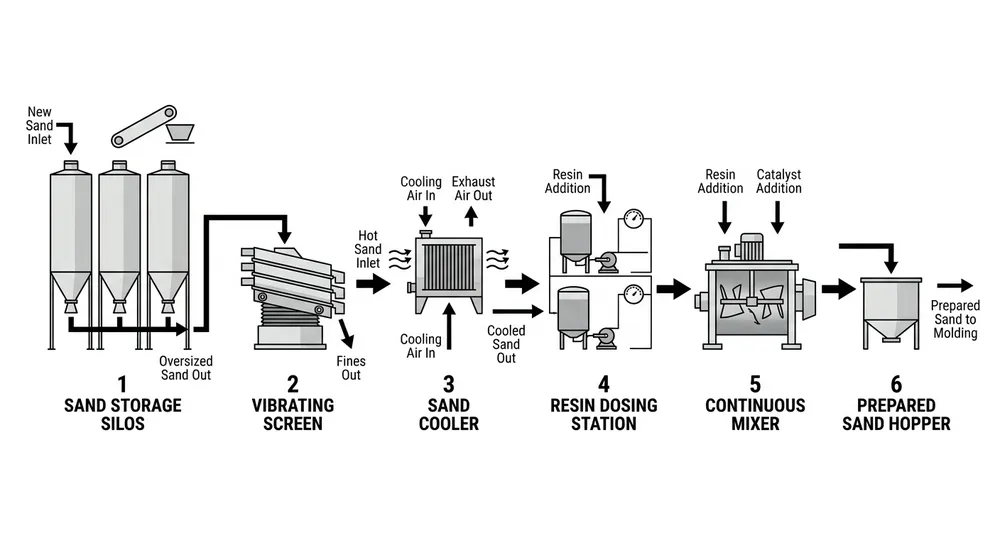
A complete Resin Sand Production Line includes:
- Continuous or batch Resin Sand Mixer with PLC-controlled binder dosing (±1% accuracy)
- Core shooter or molding machine with heated tooling (150-250°C for hot-box process)
- Curing station (ambient cure for furan, thermal cure for phenolic)
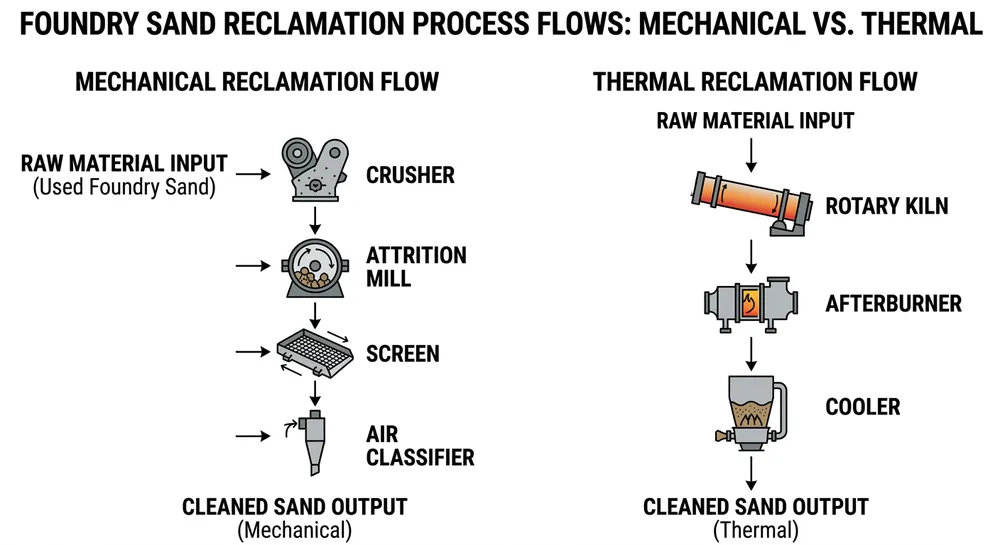
- Resin Sand Reclamation Plant — mechanical attrition or thermal regeneration to recover 90-95% of base sand
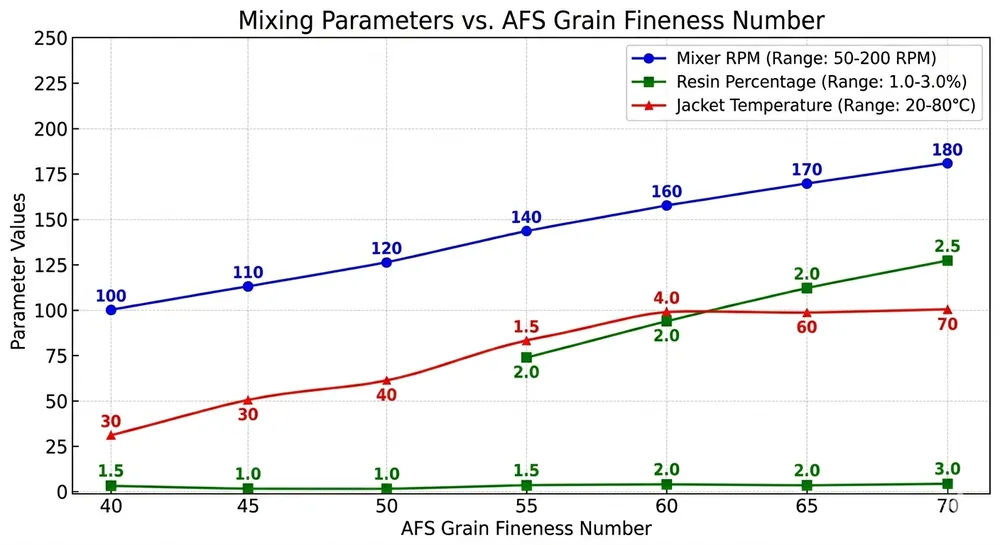
The key engineering challenge is binder dosing accuracy. A 0.5% deviation in resin-to-sand ratio either wastes expensive binder or produces weak molds that crack during metal pouring. We calibrate every TZFoundry mixer to ±1% before shipment and validate it with actual batch samples in our testing lab.
Clay Sand (Green Sand) Production Lines
Clay sand systems use bentonite clay and water as the binder. The sand remains "green" (uncured) throughout the molding process, relying on mechanical compaction to achieve mold strength. After casting, the sand is thermally reclaimed and re-tempered for reuse.
A complete Clay Sand Processing Line includes:
- Sand mixer with water and bentonite dosing
- Molding machine (squeeze, jolt-squeeze, or high-pressure molding)
- Sand cooler to remove heat from returned sand
- Magnetic separator and screening system
- Continuous muller for re-tempering reclaimed sand
Clay sand lines are mechanically simpler — no chemical dosing precision required, no curing time, no resin storage. The trade-off is lower dimensional accuracy and higher draft angles required for pattern removal.

Head-to-Head Performance and Cost Comparison
| Metric | Resin Sand Production Line | Clay Sand Production Line |
|---|---|---|
| Dimensional Tolerance | ±0.3-0.5mm (precision castings) | ±1.0-2.0mm (standard castings) |
| Surface Finish (Ra) | 6.3-12.5μm | 25-50μm |
| Sand-to-Metal Ratio | 3:1 to 5:1 | 6:1 to 10:1 |
| Mold Strength (compression) | 2.5-4.0 MPa | 0.08-0.15 MPa |
| Mold Output Rate | 60-120 molds/hour (depends on cure time) | 150-300 molds/hour (no cure delay) |
| Sand Reclamation Rate | 90-95% (mechanical or thermal) | 95-98% (thermal reclamation) |
| Floor Space (500 ton/day capacity) | 800-1,200 m² | 1,200-1,800 m² |
| Binder Consumable Cost | $35-50 per ton of sand | $8-12 per ton of sand |
| Energy Consumption | 45-65 kWh per ton of castings | 30-45 kWh per ton of castings |
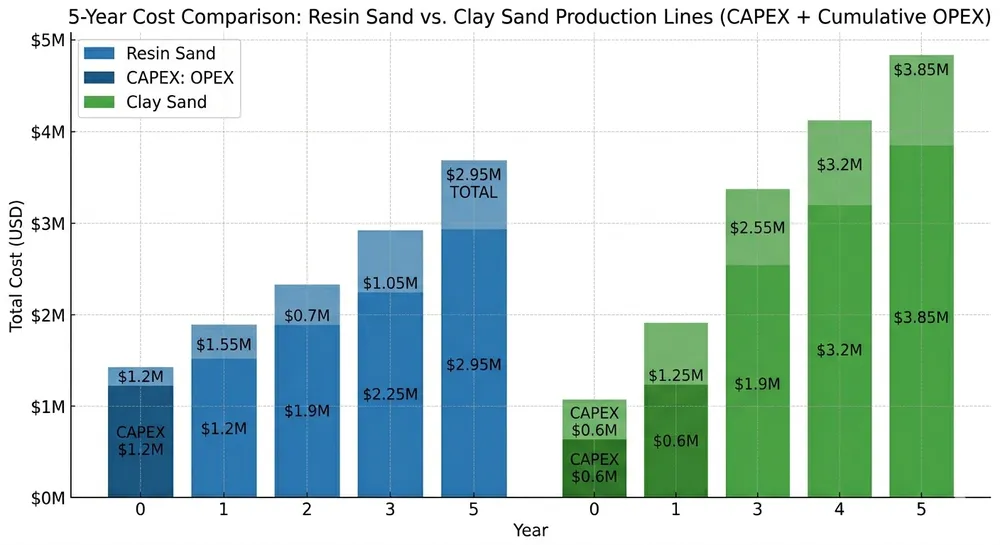
| Typical CAPEX (complete line) | $280,000-450,000 | $180,000-320,000 |
The tolerance difference is the primary decision driver. If your casting print specifies ±0.5mm or tighter, clay sand won't hold it consistently across a production run. If your tolerance window is ±1.5mm or wider, resin sand's precision advantage doesn't justify the consumable cost premium.
CAPEX vs OPEX Breakdown: Where the Real Cost Difference Lives
Initial Line Investment (CAPEX)
For a mid-scale foundry producing 500 tons of castings per month:
Resin Sand Production Line: $280,000-450,000
- Continuous resin mixer with PLC dosing: $65,000-95,000
- Core shooter or molding machine: $120,000-180,000
- Mechanical reclamation plant: $80,000-140,000
- Auxiliary equipment (conveyors, silos, dust collection): $15,000-35,000
Clay Sand Processing Line: $180,000-320,000
- Batch or continuous mixer: $45,000-75,000
- High-pressure molding machine: $85,000-150,000
- Thermal sand reclamation system: $40,000-80,000
- Auxiliary equipment: $10,000-15,000
The resin line costs 35-50% more upfront, primarily due to precision dosing equipment and more complex reclamation requirements.
Operating Cost (OPEX) — The Hidden Difference
This is where most buyers underestimate the gap. We track actual consumable usage from our customers' production data:
Resin Sand Consumables (per ton of castings):
- Resin binder: $25-35
- Catalyst/hardener: $8-12
- New sand makeup (5-10% loss): $3-5
- Total consumable cost: $36-52 per ton of castings
Clay Sand Consumables (per ton of castings):
- Bentonite clay: $6-9
- Water and additives: $1-2
- New sand makeup (2-5% loss): $2-3
- Total consumable cost: $9-14 per ton of castings
At 500 tons of castings per month, that's $18,000-26,000/month for resin sand vs $4,500-7,000/month for clay sand — a $13,500-19,000 monthly consumable cost difference.
Energy consumption also favors clay sand for high-volume operations. Resin sand lines consume 45-65 kWh per ton of castings (mostly in reclamation and curing), while clay sand lines run at 30-45 kWh per ton. At $0.12/kWh industrial rates, that's $1.80-4.20 per ton energy cost difference.
Payback calculation: If you're producing 6,000 tons of castings annually, the resin line's higher CAPEX ($100,000-130,000 premium) gets offset by consumable savings only if your scrap reduction and machining elimination exceed $160,000-230,000 per year. That math works for precision castings with tight tolerances — it doesn't work for commodity gray iron parts.
Sand Reclamation Economics: Recovery Rates and Disposal Costs
Sand reclamation is where operating cost discipline separates profitable foundries from struggling ones. Both systems reclaim sand, but the economics differ significantly.
Resin Sand Reclamation
Resin-coated sand requires mechanical attrition or thermal regeneration to remove the cured binder film from sand grains. Our Foundry Sand Reclamation Production Line systems achieve:
- Mechanical reclamation: 90-93% recovery rate, $12-18 per ton processing cost
- Thermal reclamation: 93-95% recovery rate, $18-25 per ton processing cost (higher energy cost, better sand quality)
The 5-10% sand loss means you're adding $3-5 per ton in new sand makeup cost. More importantly, the unreclaimed sand contains cured resin and must be disposed of as industrial waste in most jurisdictions — $40-80 per ton disposal cost depending on local regulations.
We validate reclamation rates in our testing lab before shipping any system. A poorly calibrated reclamation plant that drops from 93% to 87% recovery costs you an extra $8,000-12,000 per year in sand makeup and disposal fees at 500 tons/month production.
Clay Sand Reclamation
Clay sand reclamation is thermally simpler because bentonite doesn't form a cured film. Thermal reclamation systems achieve:
- Recovery rate: 95-98%
- Processing cost: $8-14 per ton (lower energy requirement than resin thermal reclamation)
The higher recovery rate and lower processing cost give clay sand a structural advantage in high-volume operations. At 1,000+ tons of castings per month, the reclamation cost difference alone justifies clay sand for any casting that doesn't require resin sand's dimensional precision.
Application Showdown: Which System Wins for Your Casting Type
Scenario 1: Ductile Iron Valve Bodies (DN50-DN300, ±0.4mm Tolerance)
Winner: Resin Sand
Valve bodies demand tight dimensional control on sealing surfaces and bolt-hole patterns. A ±0.4mm tolerance spec eliminates clay sand immediately — you'd be running 15-25% scrap rates trying to hold that window with green sand molding.
Resin sand delivers:
- Consistent ±0.3-0.5mm dimensional accuracy across the production run
- Ra 6.3-12.5μm surface finish reduces machining time by 30-40%
- Complex core geometries for internal passages without core shift
Your consumable cost is $40-48 per ton of castings, but you eliminate $60-90 per ton in secondary machining and scrap rework. The net savings is $12-42 per ton, and your customers get parts that meet print on the first inspection.
Scenario 2: Gray Iron Manhole Covers (Class B125-D400, ±2.0mm Tolerance)
Winner: Clay Sand
Manhole covers are high-volume, price-sensitive castings with wide tolerance windows. The ±2.0mm spec is easily achievable with high-pressure clay sand molding, and the surface finish requirement (Ra 50μm or rougher) doesn't justify resin sand's precision.
Clay sand delivers:
- 200-300 molds per hour throughput (no cure time delay)
- $9-14 per ton consumable cost vs $36-52 for resin sand
- 95-98% sand reclamation rate at lower processing cost
At 1,000 tons of manhole covers per month, switching from resin to clay sand saves you $27,000-38,000 monthly in consumables alone. That's $324,000-456,000 annually — enough to pay for the entire clay sand line in 8-12 months.
Scenario 3: Aluminum Engine Blocks (Complex Geometry, ±0.6mm Tolerance)
Winner: Resin Sand
Aluminum engine blocks combine tight tolerances with complex internal geometries (water jackets, oil galleries, cylinder bores). Clay sand can't hold the dimensional stability required for multi-core assemblies, and the lower mold strength risks core shift during aluminum pouring.
Resin sand delivers:
- High mold rigidity (2.5-4.0 MPa compression strength) prevents core movement
- Sodium silicate or phenolic binders handle aluminum's thermal shock better than bentonite
- Dimensional stability across the entire casting allows for minimal machining stock
The consumable cost premium is justified because you're eliminating $80-120 per casting in machining corrections and scrap. For a 50,000 engine blocks per year production volume, that's $4-6 million in downstream cost avoidance.
Scenario 4: Gray Iron Counterweights (Simple Geometry, ±3.0mm Tolerance)
Winner: Clay Sand
Counterweights are the textbook case for clay sand economics. Simple geometry, wide tolerances, high volume, price-driven market. Resin sand's precision capabilities are completely wasted here.
Clay sand delivers:
- Lowest possible consumable cost ($9-14 per ton)
- Highest throughput (250-300 molds/hour)
- Simplest reclamation and lowest maintenance cost
If you're running counterweights on a resin sand line, you're spending $27-38 per ton more in consumables than necessary with zero quality benefit. That's pure margin loss.
When to Run Both Lines: The Hybrid Foundry Strategy
If your casting portfolio spans both precision work and high-volume commodity parts, running parallel resin and clay sand lines makes commercial sense. We've shipped hybrid configurations to foundries in Germany, Poland, and the U.S. where the product mix justifies dedicated capacity for each process.
Typical hybrid foundry profile:
- 30-40% of revenue from precision castings (valves, pump housings, machinery components) → resin sand line
- 60-70% of revenue from volume castings (construction parts, agricultural components, general gray iron) → clay sand line
The capital investment is higher (you're buying two complete systems), but the operating cost optimization pays back within 18-24 months if your volume is sufficient. The key is routing discipline — don't let precision castings drift onto the clay sand line just because capacity is available. The scrap cost and customer complaints will erase any short-term efficiency gain.
We design both systems with modular layouts that fit standard 40-foot container dimensions, so you can install them in phases as your casting portfolio grows. Start with whichever system matches your current majority product type, then add the second line when your precision or volume work reaches 200-300 tons per month.
Decision Checklist for Procurement Engineers
Use this checklist to determine which system fits your foundry's commercial reality:
Choose Resin Sand if:
- Your casting prints specify ±0.5mm or tighter dimensional tolerances
- Surface finish requirements are Ra 12.5μm or smoother
- You're casting complex thin-wall geometries or multi-core assemblies
- Your alloy is aluminum, ductile iron, or high-strength steel (where mold rigidity matters)
- Your customers pay a premium for precision castings that justify higher consumable costs
- Your production volume is 50-500 tons of castings per month (where batch economics work)
Choose Clay Sand if:
- Your casting tolerances are ±1.0mm or wider
- Surface finish requirements are Ra 25μm or rougher
- You're running high-volume production (500+ tons of castings per month)
- Your product mix is dominated by gray iron or simple ductile iron geometries
- Your market is price-sensitive and won't pay for precision you don't need
- Your floor space can accommodate larger sand circulation systems
Run Both Lines if:
- Your casting portfolio includes both precision and commodity work
- Your precision casting volume exceeds 200 tons/month (justifies dedicated resin capacity)
- Your total production volume exceeds 800 tons/month (justifies the dual-system capital investment)
- You serve multiple market segments with different quality-price profiles
TZFoundry Advantage: One Supplier for Both Systems
Most foundry equipment suppliers specialize in one sand system or the other, which creates an incentive to upsell their preferred technology regardless of your actual application fit. We manufacture both Resin Sand Production Line and Clay Sand Processing Line systems in the same facility, so our engineering team's recommendation is based on your casting portfolio economics, not our product line bias.
What this means for your sourcing process:
- Neutral technical consultation: Send us your casting prints, tolerance specs, and production volume targets. Our engineers will calculate the total cost of ownership for both systems and recommend the option that delivers better ROI for your specific mix. We've talked buyers out of resin sand lines when their tolerance specs didn't justify the consumable cost, and we've talked buyers out of clay sand lines when their precision requirements would have driven scrap rates above 15%.
- In-house reclamation testing: Before we ship any sand reclamation system, we run it with your actual sand type and binder chemistry in our testing lab. We validate the recovery rate, measure residual binder content, and adjust mechanical parameters to hit the 90-95% reclamation target. You receive test reports with the equipment, not promises.
- Modular container-optimized design: Both our resin and clay sand lines ship as modular systems that fit standard 40-foot containers. This reduces your freight cost by 20-30% compared to oversized equipment that requires break-bulk shipping. Installation time drops to 3-5 days for mechanical assembly plus 2-3 days for commissioning and calibration.
- PLC control compatibility: Our resin sand mixers use Siemens or Mitsubishi PLCs with ±1% binder dosing accuracy. If you're running a hybrid foundry with both sand systems, we can integrate both lines into a single SCADA interface for centralized production monitoring.
- Spare parts availability: We maintain inventory for both resin and clay sand line components at our Qingdao facility. Standard wear parts (mixer blades, dosing pumps, screen meshes) ship within 48 hours. Critical components (PLC modules, hydraulic valves) ship within 5-7 days with DHL or FedEx express.
Frequently Asked Questions
What is the typical lead time difference between resin sand and clay sand production lines?
Both systems have similar manufacturing lead times at TZFoundry: 45-60 days for standard configurations, 60-75 days for custom capacity or automation requirements. The difference is in commissioning complexity — resin sand lines require 3-4 days of binder dosing calibration and test batches, while clay sand lines commission in 2-3 days. Total project timeline from PO to production-ready is 55-70 days for resin sand, 50-65 days for clay sand.
Can I switch between furan and phenolic binders on the same resin sand line?
Yes, but it requires a complete system flush and recalibration. Furan and phenolic binders have different viscosities and cure characteristics, so the dosing pump settings and mixer residence time must be adjusted. We recommend dedicating a line to one binder chemistry unless you're running very large batches (500+ tons) that justify the 4-6 hour changeover cost. Most foundries running multiple binder types install separate mixing stations rather than switching a single line.
How do I prevent resin sand mold cracking during storage before pouring?
Mold cracking in resin sand is usually caused by incomplete cure, excessive moisture, or thermal shock. Three fixes: (1) Extend the curing time by 20-30% if you're storing molds more than 4 hours before pouring — furan molds continue curing for 6-8 hours after demolding. (2) Control ambient humidity below 60% in the mold storage area — moisture absorption weakens the resin bond. (3) Preheat molds to 40-60°C before pouring if your metal temperature exceeds 1400°C — this reduces thermal shock at the mold face. We've seen crack rates drop from 8-12% to under 2% after implementing these three changes at a ductile iron foundry in Ohio.
What causes clay sand molds to lose strength during high-volume production runs?
The most common cause is sand temperature creep. Returned sand from shakeout comes back at 80-120°C, and if your cooling capacity can't bring it down to 35-45°C before re-tempering, the bentonite loses its binding effectiveness. Install a fluidized bed cooler or rotary drum cooler with sufficient capacity to handle your peak return rate. The second cause is moisture loss — clay sand needs 3.0-3.5% moisture content for optimal strength, and high-temperature operations evaporate moisture faster than your mixer can replace it. Add a continuous moisture monitoring system and adjust water dosing in real time.
Which sand system is better for ductile iron castings with inoculation requirements?
Both systems work, but resin sand gives you better control over inoculation fade time. Ductile iron requires precise inoculation timing (typically 3-8 minutes from inoculation to solidification start), and resin sand molds can be pre-positioned at the pouring station without strength loss. Clay sand molds lose 10-15% compressive strength if they sit more than 15-20 minutes after molding, which tightens your inoculation-to-pour window. For high-volume ductile iron work (500+ molds/day), clay sand works fine if your pouring line keeps pace. For batch production or complex geometries where pouring time varies, resin sand gives you more scheduling flexibility.
What is the minimum production volume where clay sand becomes more economical than resin sand?
The crossover point is around 400-500 tons of castings per month, assuming your tolerance specs allow clay sand (±1.0mm or wider). Below 400 tons/month, the resin sand line's higher CAPEX doesn't get offset by consumable savings fast enough — you're looking at 4-5 year payback. Above 500 tons/month, clay sand's lower consumable cost ($27-38 per ton savings) generates $13,500-19,000 monthly savings, which pays back the CAPEX difference in 18-24 months. The calculation flips if your castings require resin sand's precision — then volume doesn't matter, because clay sand can't meet the quality spec.
How do I validate sand reclamation rates when evaluating supplier quotes?
Demand test reports, not datasheet claims. A reputable supplier will run your sand sample through their reclamation equipment and provide measured data: (1) Input sand binder content (LOI test), (2) Output sand binder content after reclamation, (3) Grain size distribution before and after, (4) Acid demand value (AFS test) to confirm clay removal for clay sand or resin removal for resin sand. At TZFoundry, we run these tests in our lab before shipping and include the reports with the equipment. If a supplier won't test your actual sand, assume their reclamation rate claims are optimistic by 3-5 percentage points.

Liu Haoran is the Resin Sand Production Line Technical Manager at TZFoundry. Over 11 years of hands-on work with furan, phenolic, and coated sand systems, he has commissioned 40+ resin sand lines for export buyers and developed binder dosing protocols...