US foundries are looking south. USMCA tariff advantages, 2-3 week shorter lead times, and the appeal of "nearshore" have pushed Mexico onto procurement shortlists for resin sand production line equipment. But here's what most buyers discover after the first round of supplier contact: Mexico's foundry equipment market runs primarily on imported systems, not domestic manufacturing. The "Mexican supplier" is often a distributor marking up equipment from China, Europe, or the US — which changes the cost equation significantly.
If you're screening Mexican options to avoid direct China imports, you need to understand what you're actually buying: local inventory access and faster emergency response, yes, but often at 25-40% premium over factory-direct pricing. For repeat-volume procurement or greenfield foundry projects where you're spec'ing a complete resin sand production line, that margin compression matters.
This guide walks through how the Mexican resin sand equipment market actually works, what evaluation criteria separate serious suppliers from resellers with a website, and when factory-direct sourcing from China delivers better landed cost even after ocean freight and duties.
How to Evaluate Resin Sand Production Line Suppliers — Technical Criteria That Matter
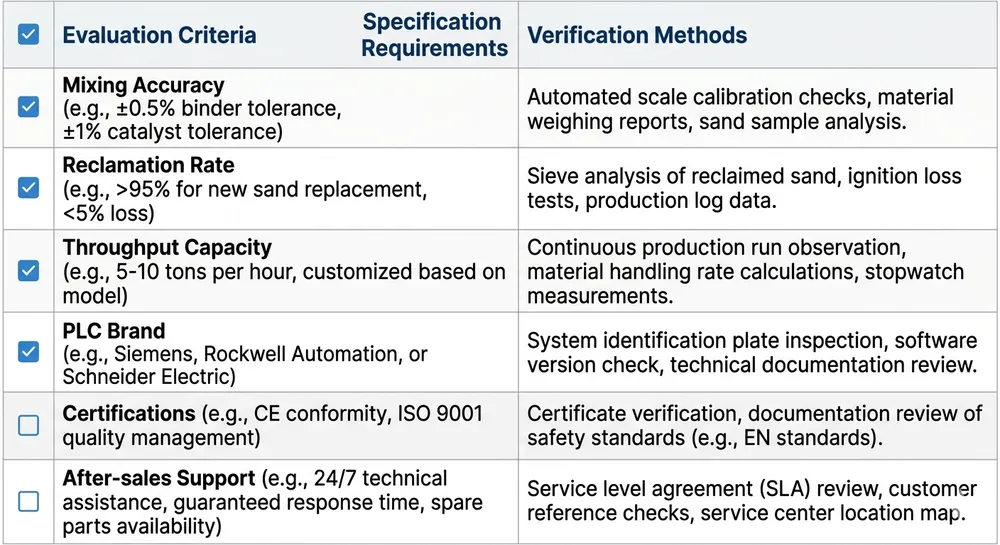
Before you compare supplier names, lock down what you're actually evaluating. Resin sand systems aren't commodity purchases — mixing accuracy, sand reclamation efficiency, and control system reliability directly impact your binder cost per ton and casting reject rate.
Mixing ratio accuracy: Your resin sand mixer should hold ±2% on resin-to-sand ratio across an 8-hour shift. Anything looser and you're either wasting binder (expensive) or producing weak molds (more expensive). Ask for calibration test reports from the specific unit you're buying, not generic spec sheets. We've seen distributors quote "high-precision mixing" without defining what that means — then the equipment arrives with ±5% variance and your furan consumption jumps 15%.
Sand reclamation rate: A mechanical or thermal resin sand reclamation plant should recover ≥95% of usable sand from spent molds. Below 90%, you're buying virgin sand constantly and your waste disposal cost climbs. Verify this with actual throughput data, not marketing claims. The reclamation rate depends on your casting type (iron vs aluminum, furan vs phenolic), so generic "95% recovery" promises mean nothing without context.
Throughput capacity: Match the line's rated tons-per-hour to your actual production schedule, not your peak theoretical demand. If you're running 12 t/h average with occasional 18 t/h surges, spec for 20 t/h continuous capacity. Undersized systems run at 100% constantly, which accelerates wear on mixing blades, conveyor belts, and hydraulic seals. We've commissioned lines where buyers saved 15% on equipment cost by downsizing, then spent double that on maintenance in year two.
PLC and control system: Siemens, Mitsubishi, or Schneider PLCs with English-language HMI interfaces and remote diagnostic capability. Proprietary control systems from unknown brands lock you into a single supplier for troubleshooting and spare parts. Ask whether the PLC program is documented and whether your maintenance team can access ladder logic for minor adjustments — some suppliers encrypt everything and charge $200/hour for remote support calls.
Certification coverage: ISO 9001 proves the manufacturer has a documented quality system. CE certification (for European-standard electrical safety and EMC compliance) matters if you're exporting castings to EU markets and need equipment traceability. SGS or TÜV third-party inspection reports add another verification layer. Distributors often claim "certified equipment" but can't produce the actual certificates — that's a red flag.
After-sales support structure: Who handles commissioning, and where are they based? If your supplier is in Monterrey but their technician flies in from Shanghai, you're not getting nearshore support — you're getting a distributor with no in-house engineering. Ask for the commissioning timeline, what's included (mechanical installation only, or full PLC programming and test runs?), and whether spare parts ship from local inventory or get air-freighted from overseas when something breaks.

The Mexican Resin Sand Equipment Supply Landscape — What You're Actually Buying
Mexico's foundry equipment market splits into three supplier types, and understanding which category you're dealing with changes your cost and risk calculation.
Type 1: Import distributors with local warehousing. These companies stock limited inventory (usually smaller mixers, sand coolers, and magnetic separators) and drop-ship complete production lines from their overseas manufacturing partners. They add value through faster delivery on common components and local Spanish-language support. Expect 20-30% markup over direct factory pricing. Their strength is emergency replacement parts — if your sand cooler motor burns out mid-shift, they can truck a replacement from Querétaro in 24 hours instead of waiting 6 weeks for air freight from China.
Type 2: Engineering firms that design and integrate imported equipment. They don't manufacture mixers or reclamation systems, but they'll design your complete foundry layout, source equipment from multiple suppliers, and manage installation. Useful if you're building a greenfield facility and need someone to coordinate civil work, electrical infrastructure, and equipment commissioning. Their margin sits at 15-25% on equipment plus separate engineering fees. The risk: if the imported mixer underperforms, they'll point you back to the original manufacturer in China or Europe — you're managing a three-party warranty claim across two continents.
Type 3: Machinery resellers and brokers. They maintain websites listing "resin sand production lines" but own no inventory and have no engineering staff. They're matchmaking services connecting you to overseas factories, taking 10-15% commission. Zero value-add beyond initial contact — you're better off sourcing directly and keeping that margin.
The challenge for US buyers: most Mexican "manufacturers" listed in online directories fall into Type 2 or Type 3. Actual domestic production of resin sand mixing and reclamation equipment is limited. You're usually buying imported systems with a local intermediary, which means you're paying for convenience, not avoiding overseas supply chains.
Regional concentration: Foundry equipment suppliers cluster in Monterrey (Nuevo León), Querétaro, and the Bajío region (Guanajuato, Aguascalientes). These areas have established metalworking industries and logistics infrastructure for cross-border shipping to Texas and the Southwest US. If you're evaluating a "Mexican supplier" based in Mexico City or Guadalajara with no physical facility in the industrial corridor, verify their actual operational capacity — they may be a broker, not a distributor with inventory.
USMCA Tariff Benefits vs Total Landed Cost — The Real Math
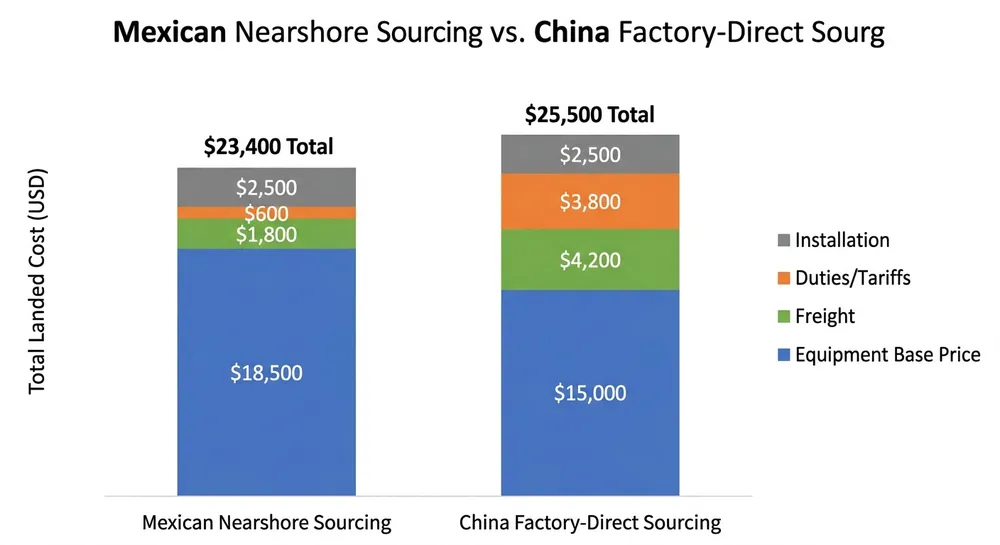
USMCA eliminated tariffs on qualifying Mexican-origin goods, which sounds compelling until you calculate total landed cost. Here's the breakdown for a mid-capacity resin sand production line (15 t/h, including mixer, sand cooler, reclamation system, and controls):
Mexican nearshore route:
- Equipment cost: $180,000 (distributor pricing on imported equipment)
- Freight (Monterrey to Houston): $3,500
- Import duties: $0 (USMCA)
- Installation support: $8,000 (local technician, 5 days)
- Total landed cost: $191,500
Factory-direct China route:
- Equipment cost: $125,000 (manufacturer pricing, same specs)
- Ocean freight (Qingdao to Houston, 40HQ container): $4,200
- Import duties (HS 8474.20, 2.5% rate): $3,125
- Remote commissioning + local contractor: $6,500
- Total landed cost: $138,825
The USMCA tariff savings ($3,125 in this example) don't offset the 44% equipment price premium you're paying the Mexican distributor. Even after freight and duties, factory-direct saves you $52,675 — enough to buy a complete spare parts kit and fund two years of maintenance.
The nearshore advantage shows up in different scenarios: small emergency orders (a replacement mixer drum, not a complete line), projects where 2-week delivery beats 8-week ocean transit, or buyers who need on-site Spanish-language support and can't manage remote commissioning. For repeat-volume procurement or greenfield installations where you're comparing complete systems, factory-direct wins on landed cost.
TZFoundry Factory-Direct Alternative — Modular Systems, Remote Commissioning, Certified Quality
We manufacture complete furan resin sand production lines at our 15,000 m² Qingdao facility — mixing systems, coating equipment, and mechanical/thermal reclamation plants. Since 2010, we've shipped modular resin sand lines to foundries in North America, Europe, and the Middle East. Our systems fit standard 40HQ containers (12.03m length, 2.35m width, 2.69m height), so your freight cost stays predictable and you're not paying for custom crating or oversized cargo surcharges.
Engineering customization without distributor markup: Our 18-engineer team designs resin sand lines to your specific requirements — furan, phenolic, or sodium silicate binder systems, throughput from 5 t/h to 30 t/h, mechanical or thermal reclamation based on your sand type and environmental regulations. Most Mexican distributors resell fixed-configuration equipment with no modification capability. We adjust mixer blade geometry for your sand grain size, program PLC curing timers for your ambient temperature range, and size reclamation crushers for your mold complexity. You're buying factory engineering, not a distributor's catalog.
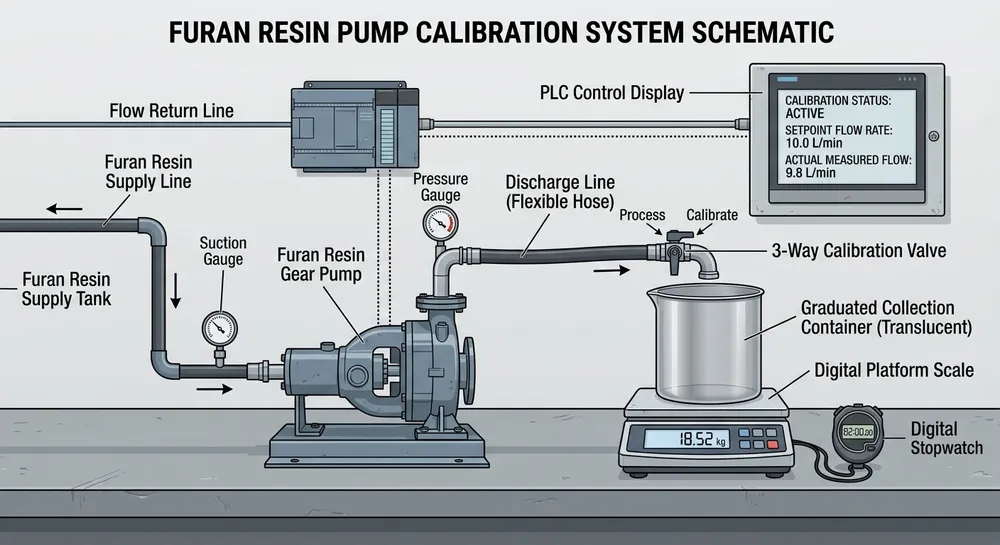
Mixing accuracy that protects your binder cost: Our continuous mixers hold ±1.5% resin-to-sand ratio across 12-hour production runs. That precision comes from volumetric dosing pumps (not gravity-feed systems that drift with hopper level) and real-time weight monitoring with automatic correction. Binder cost is the number everyone watches — but it's the mixing accuracy that decides whether you're wasting resin or wasting castings. A 2% improvement in dosing consistency saves $8,000-12,000 annually on a 15 t/h line running furan resin at $1,200/ton. We calibrate every mixer at the factory and document the test results in your commissioning report — you'll see the actual variance data from your specific unit, not generic marketing specs.
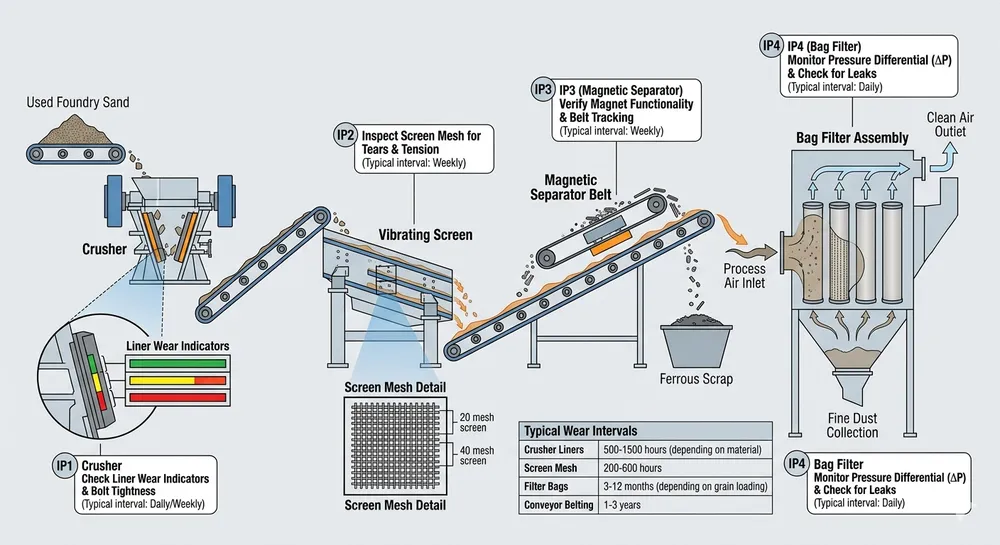
Sand reclamation systems engineered for 95%+ recovery: Our mechanical reclamation plants use three-stage crushing (jaw crusher, impact crusher, vibrating screen) to break down spent molds without fracturing the sand grains themselves. Thermal reclamation systems (for phenolic and furan binders that don't respond to mechanical treatment) run at 650-750°C with controlled residence time to burn off resin films without sintering the sand. We've commissioned reclamation lines processing everything from furan-bonded silica sand for ductile iron to phenolic-coated chromite sand for high-manganese steel — the recovery rate depends on your binder type and casting process, so we test your actual sand samples before finalizing the equipment configuration.
Remote commissioning that works: We've commissioned resin sand lines in 14 countries via video call. Your installation team (local contractor or your own maintenance staff) handles mechanical assembly and electrical connections following our detailed drawings. Our engineer joins by video to guide PLC programming, sensor calibration, and test runs. This works if your team can read hydraulic schematics and use a multimeter — we're not asking them to reverse-engineer the system, just follow documented procedures. Remote commissioning costs $6,500-8,500 depending on line complexity, compared to $15,000-20,000 for on-site visits from Mexican distributors who fly in technicians from overseas anyway.
Certification coverage for export buyers: ISO 9001:2015 quality management, CE electrical safety and EMC compliance, SGS third-party inspection reports. Every production line ships with unit-specific test documentation — mixer calibration data, reclamation efficiency results, PLC program backup, hydraulic pressure test records. If you're casting components for automotive or industrial OEMs who audit your supply chain, you need equipment traceability. We provide it as standard, not as an upcharge.
Spare parts strategy that prevents downtime: Each line ships with a first-year consumables kit: mixer blade sets, conveyor belts, hydraulic seals, proximity sensors, solenoid valves. These are the parts that wear predictably in the first 12-18 months. After that, you're ordering based on actual wear patterns, not guessing. We maintain spare parts inventory in Qingdao with 3-5 day air freight to US destinations for emergency orders. Not as fast as a Mexican distributor's 24-hour truck delivery, but faster than waiting for a European manufacturer to ship from Germany.
When Mexican Nearshore Makes Sense vs When Factory-Direct Wins
Choose Mexican nearshore suppliers when:
- You need emergency replacement parts (motors, gearboxes, sensors) delivered within 24-48 hours
- Your project timeline can't absorb 6-8 weeks ocean transit
- You're buying small-capacity equipment (under 5 t/h) where the absolute dollar difference is minor
- Your team requires on-site Spanish-language commissioning support and can't manage remote installation
- You're adding a single piece of equipment to an existing line and need local integration services
Choose factory-direct China sourcing when:
- You're spec'ing a complete production line (mixer, reclamation, coating, controls) where distributor markup compounds across every component
- Your project is greenfield or planned expansion with 3-6 month lead time
- You need custom engineering (non-standard throughput, specialized binder systems, integration with existing foundry equipment)
- You're comparing total landed cost and can absorb ocean freight and 2.5% import duties
- You want direct access to the manufacturing engineering team for troubleshooting and future modifications
The decision isn't "nearshore vs offshore" — it's "convenience premium vs engineering control and landed cost." For one-off emergency purchases, pay the premium. For repeat procurement or complete system installations, factory-direct delivers better economics and direct engineering support.
Supplier Vetting Checklist — Questions to Ask Before Signing a PO
Use this checklist whether you're evaluating Mexican distributors or factory-direct manufacturers:
Manufacturing and engineering capability:
- Do you manufacture the equipment, or are you a distributor/integrator? (Not a disqualifier, but changes your cost and support expectations)
- Can I visit your production facility or see video documentation of your manufacturing process?
- Who designs custom configurations — in-house engineers or the overseas manufacturer?
- How many resin sand lines have you commissioned in the past 24 months, and in which markets?
Technical specifications and verification:
- What is the mixing ratio accuracy (±% variance), and can you provide calibration test data from the specific unit I'm buying?
- What sand reclamation rate do you guarantee for my binder type (furan/phenolic/sodium silicate) and casting material?
- Which PLC brand and model do you use, and is the program documented and accessible?
- Can you provide ISO 9001, CE, or third-party inspection certificates for the equipment?
Commissioning and support:
- Who performs commissioning — your own technicians or a subcontractor?
- What's included in commissioning (mechanical installation only, or full PLC programming and test runs)?
- Where are spare parts stocked, and what's the typical delivery time for emergency orders?
- Do you offer remote diagnostics, and what's the support response time?
Commercial terms:
- What's the lead time from PO to delivery?
- What warranty coverage do you provide (duration, what's covered, who handles claims)?
- Can you provide references from US foundries running your equipment?
- What's the payment structure (deposit, progress payments, balance on delivery)?
If a supplier can't answer these questions with specifics (not marketing language), keep looking.
Final Sourcing Decision — Protect Your Margin, Not Your Assumptions
Mexican nearshore sourcing works when speed and local support justify the premium. For most US foundries buying complete resin sand production lines, factory-direct China sourcing delivers 30-40% better landed cost even after freight and duties — and you're working directly with the engineering team that designed the equipment, not a distributor reading from a spec sheet.
We've shipped modular resin sand lines to foundries across North America since 2010. Our systems fit standard containers, commission remotely, and come with unit-specific test documentation. If you're comparing Mexican distributor quotes to factory-direct pricing, send us your casting type, target throughput, and available floor space — we'll spec the exact configuration and provide a detailed quote with technical drawings and commissioning plan.

Liu Haoran is the Resin Sand Production Line Technical Manager at TZFoundry. Over 11 years of hands-on work with furan, phenolic, and coated sand systems, he has commissioned 40+ resin sand lines for export buyers and developed binder dosing protocols...