Most foundry buyers ask for a clay sand line price and get a single FOB number. Then the equipment arrives, and the real costs start showing up: foundation work your contractor didn't budget for, a compressed air system that needs upgrading, electrical infrastructure that can't handle the load, and installation supervision that runs three weeks longer than expected. By the time the line is running, you're 40% over the original quote.
A Clay Sand Processing Line isn't a piece of equipment you buy — it's a production system you install and operate. The equipment price is one line item. Total cost of ownership includes freight, site preparation, installation, commissioning, and recurring annual expenses for sand, energy, consumables, and maintenance labor. If you're evaluating suppliers based on FOB price alone, you're comparing the wrong number.
This breakdown covers what you actually pay to get a clay sand line running in your facility and keep it running profitably. The numbers come from 60+ installations we've commissioned across four continents, from 40-mold-per-hour manual lines to fully automated 120+ mold systems.
What Clay Sand Processing Line Cost Actually Includes
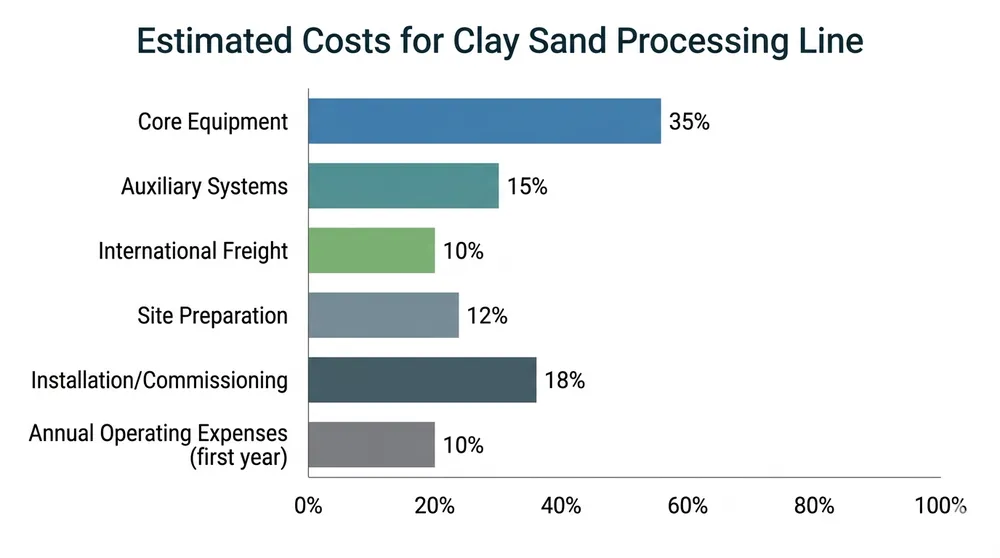
Clay sand processing line cost breaks into six categories: core equipment, auxiliary systems, international freight, site preparation, installation and commissioning, and annual operating expenses. Most buyers focus on the first category and underestimate the other five.
Core equipment covers the production line itself: sand preparation system (crusher, vibrating screen, magnetic separator), clay sand molding line (mixer, molding machine, conveyor), shakeout station, and clay sand reclamation line (crusher, screening, cooling). This is the FOB price you see in most quotations.
Auxiliary systems include dust collection (bag filter or cyclone separator), compressed air supply (screw compressor, air tank, dryer), hydraulic power unit (for molding press and compaction), and electrical control cabinet (PLC, HMI, sensors, wiring). These aren't optional add-ons — the core equipment won't run without them. Some suppliers include auxiliaries in the base quote; others list them separately. Always ask which configuration you're getting.
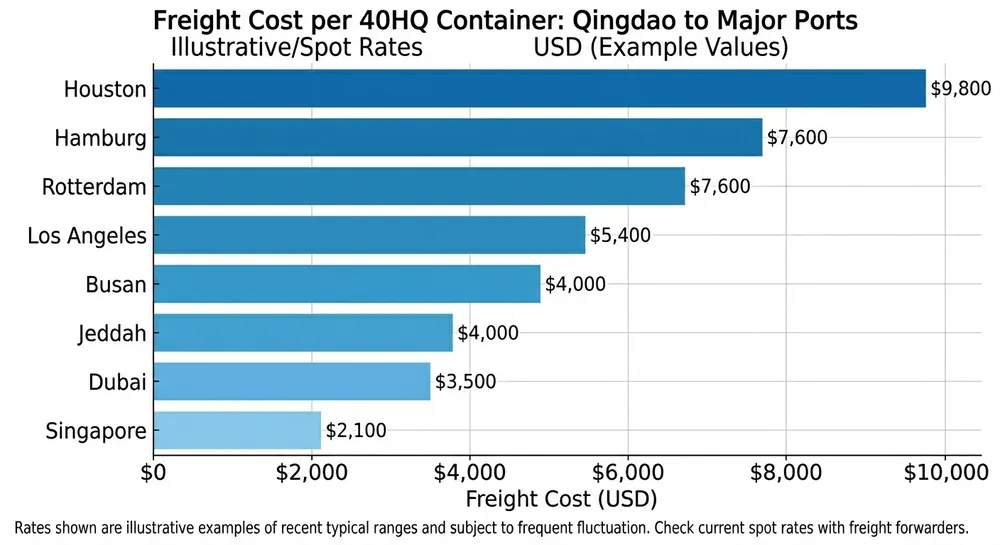
International freight depends on container count and shipping route. A complete clay sand line ships in 2-3 × 40HQ containers for a 40-60 mold/hour system, or 4-5 containers for 80-120 mold/hour capacity. FOB Qingdao to Los Angeles runs $3,500-4,200 per 40HQ container (2024 rates). FOB to Rotterdam: $4,800-5,500. FOB to Dubai: $2,200-2,800. Add 15-20% for CIF if you want the supplier to handle insurance and freight booking.
Site preparation covers foundation work (concrete pad with anchor bolt templates), electrical infrastructure (transformer capacity, cable runs from main panel), compressed air distribution (piping from compressor to equipment stations), and hydraulic fluid supply lines. Your local contractor handles this work, but the equipment supplier should provide the civil engineering drawings and load calculations. We've seen buyers skip this step and then discover their floor slab can't support a 12-ton molding press.
Installation and commissioning includes equipment assembly, hydraulic and electrical connections, control system programming, test runs, and operator training. You can hire the equipment supplier's engineers to supervise on-site (typical cost: $150-200/day plus travel and accommodation), or use remote commissioning via video call if your local team can read hydraulic schematics and wire control panels. Remote commissioning cuts supervision cost by 60-70% but requires competent local labor.
Annual operating expenses cover sand and bentonite consumption, electrical energy, hydraulic fluid and filters, wear parts (mixer blades, screen mesh, conveyor belts, hydraulic seals), and maintenance labor. These recurring costs determine whether your line is profitable at your local casting price. A line that costs $180,000 to buy but burns $95,000/year in operating expenses will lose money faster than a $240,000 line that runs at $62,000/year.

Equipment Cost by Subsystem and Capacity
Clay sand processing equipment cost scales with production capacity and automation level. A 40-mold-per-hour manual line costs $85,000-120,000 FOB. An 80-mold-per-hour semi-automated line: $145,000-195,000. A fully automated 120+ mold-per-hour system: $220,000-310,000. These ranges reflect different subsystem configurations, not just supplier markup.
Sand preparation subsystem handles incoming reclaimed sand and new sand addition. Manual systems use a simple vibrating screen and magnetic separator ($8,000-12,000). Semi-automated lines add a jaw crusher for lump breaking and a bucket elevator for vertical transport ($18,000-24,000). Fully automated preparation includes PLC-controlled dosing, moisture sensors, and automatic reject handling ($32,000-45,000). The automation premium pays off when you're running two shifts — manual dosing drifts by 2-3% moisture content across an 8-hour shift, and that variance shows up as mold defects.
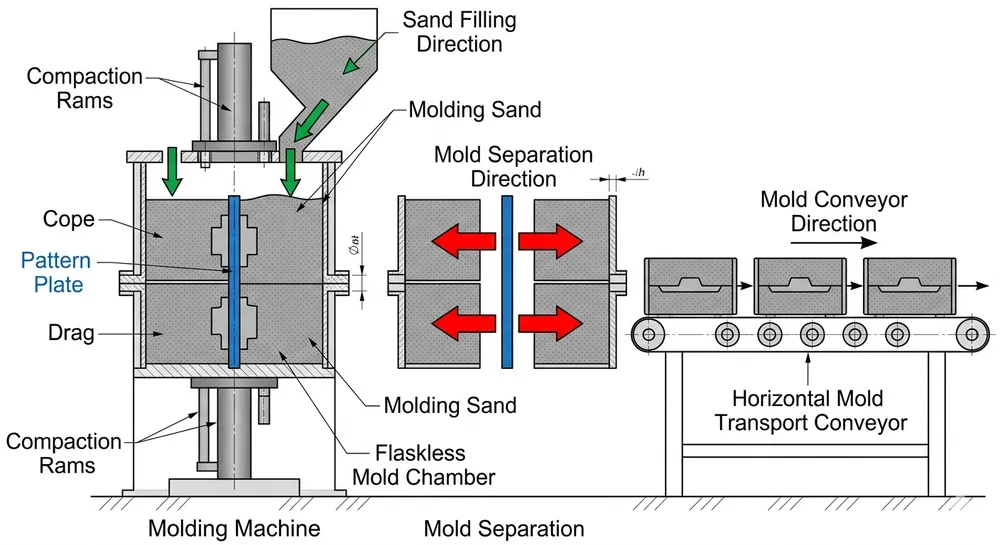
Molding subsystem is the cost center. A manual flask-based molding machine with hand-operated compaction runs $22,000-35,000. A hydraulic flaskless molding machine with programmable compaction pressure: $55,000-78,000. A high-speed automated flaskless line with servo-driven pattern handling and integrated conveyor: $95,000-140,000. The price jump from manual to automated reflects the hydraulic system complexity (150-bar pressure with ±2-bar tolerance requires proportional valves and closed-loop control), the precision machining on guide rails (±0.05mm straightness over 3 meters), and the PLC programming for cycle coordination.
We switched from manual to hydraulic molding in 2015 after a European buyer needed 200 molds per hour at ±0.5mm tolerance. Manual compaction couldn't hold that spec across a 12-hour shift — operator fatigue caused pressure variation, and mold density drifted by 8-12%. The hydraulic system we built maintains ±2-bar compaction pressure for 10,000 cycles without recalibration. That line is still running in their facility.
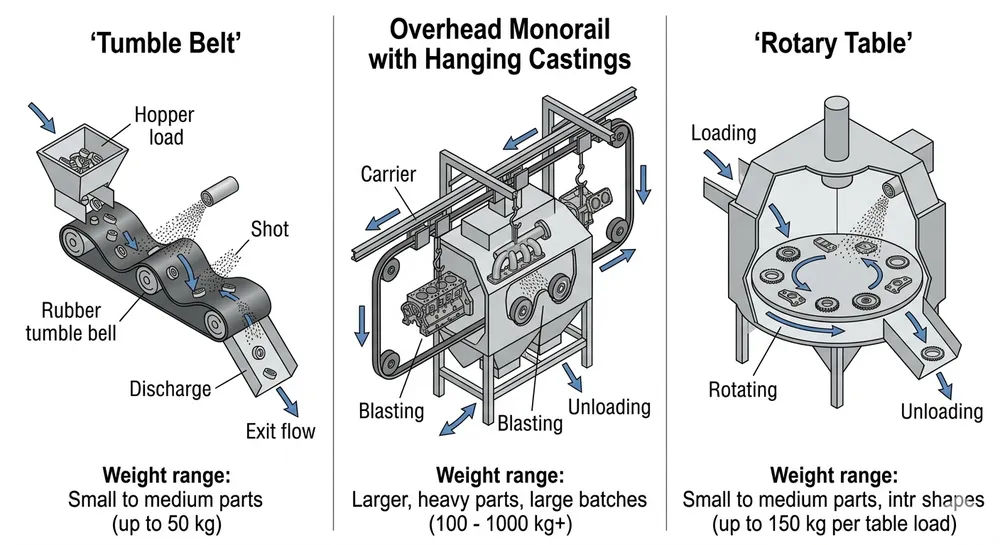
Shakeout and cooling separates castings from sand after solidification. Basic shakeout uses a vibrating grid and manual casting removal ($6,000-9,000). Automated shakeout with pneumatic knockout pins and conveyor discharge: $15,000-22,000. High-capacity systems add a rotary drum cooler to bring sand temperature down from 400°C to 60°C before reclamation ($28,000-38,000). If you're casting ductile iron or steel, you need the cooling stage — feeding 400°C sand back into the mixer destroys bentonite activation and causes mold cracking.
Reclamation subsystem recovers and conditions used sand for reuse. A manual reclamation line with crusher, screen, and magnetic separator costs $18,000-28,000 and recovers 85-90% of sand. A semi-automated line with bucket elevators and dust suppression: $35,000-52,000, recovering 90-94%. A fully automated reclamation plant with thermal treatment (removes organic residue) and PLC-controlled moisture addition: $68,000-95,000, recovering 95-97%. The recovery rate difference matters more than the equipment cost — at $45/ton for new silica sand plus $30/ton for bentonite, every 1% improvement in recovery saves $7,500 annually on a line processing 10,000 tons/year.
Dust collection is legally required in most export markets and operationally necessary everywhere. A basic bag filter handling 3,000 m³/hour airflow costs $12,000-18,000. A cyclone separator plus bag filter for 6,000 m³/hour: $24,000-35,000. High-efficiency pulse-jet bag filters for 10,000+ m³/hour with automatic cleaning: $45,000-62,000. Undersizing dust collection is the most common cost-cutting mistake we see — buyers save $8,000 on the filter and then spend $15,000/year on replacement bags because the system runs overloaded.
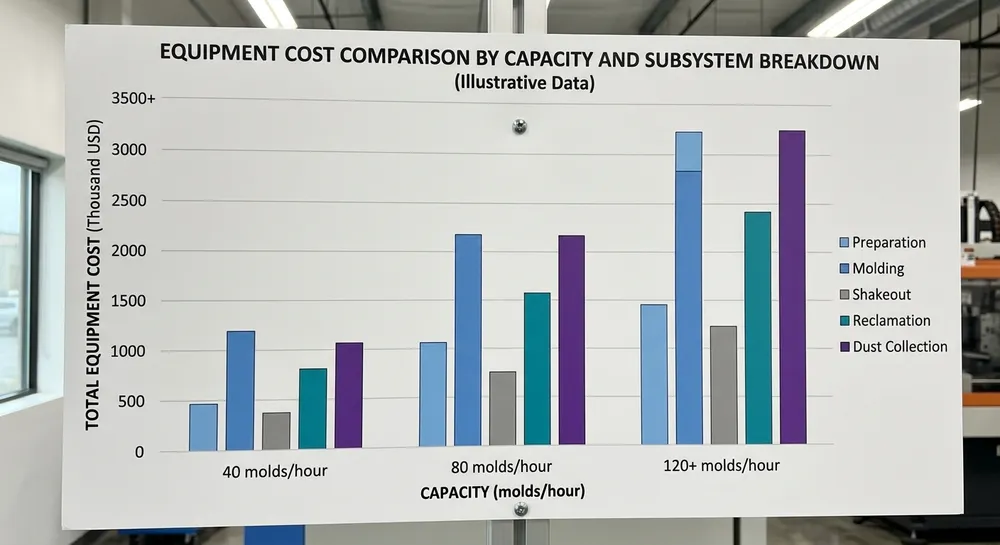
Capacity Tiers and Equipment Investment
Clay sand line capacity determines equipment investment, but the relationship isn't linear. Doubling capacity doesn't double cost — it increases cost by 60-75% because some subsystems scale more efficiently than others.
40-50 molds per hour suits small to mid-size foundries casting 800-1,200 tons annually. Total equipment cost (core + auxiliaries): $95,000-135,000 FOB. This tier typically uses semi-manual operation: automatic sand mixing and molding, but manual pattern handling and casting removal. Cycle time runs 72-90 seconds per mold. Floor space requirement: 180-220 m² including sand storage. Electrical load: 85-110 kW. Compressed air demand: 0.8-1.2 m³/min at 8 bar. This configuration works for job-shop foundries producing 15-30 different casting types per month where setup flexibility matters more than raw throughput.
60-80 molds per hour targets mid-volume production foundries casting 1,500-2,400 tons annually. Total equipment cost: $160,000-220,000 FOB. This tier uses semi-automated operation: PLC-controlled sand preparation, hydraulic molding with programmable compaction, automatic conveyor transport, but manual pattern changeover. Cycle time: 45-60 seconds per mold. Floor space: 240-300 m². Electrical load: 135-175 kW. Compressed air: 1.4-1.9 m³/min at 8 bar. The cost increase from the 40-mold tier comes primarily from the hydraulic system upgrade (proportional valves, servo motors, closed-loop pressure control) and the conveyor automation. This is the most common capacity range for export buyers — it balances throughput with investment and handles both batch production and short-run jobs.
100-120+ molds per hour serves high-volume foundries casting 3,000+ tons annually, typically producing 3-8 standard casting families with minimal changeover. Total equipment cost: $245,000-340,000 FOB. Fully automated operation: robotic pattern handling, servo-driven molding, integrated conveyor system with automatic mold tracking, PLC-coordinated shakeout and reclamation. Cycle time: 30-36 seconds per mold. Floor space: 350-450 m². Electrical load: 210-280 kW. Compressed air: 2.2-3.0 m³/min at 8 bar. The cost premium buys speed and consistency — at 120 molds/hour, a 0.5-second cycle time improvement adds 60 molds per shift, worth $18,000-24,000 annually in additional casting revenue. This tier only makes economic sense if you're running two shifts minimum and your order book supports continuous production.
The capacity decision should match your actual production plan, not your aspirational volume. We've commissioned lines for buyers who specified 100 molds/hour because "we might need it later," then ran the line at 55 molds/hour for three years. They paid for automation they didn't use and couldn't recover the premium when they sold the equipment. Better approach: size the line for 80% of your current confirmed order volume, then add capacity modules (additional molding stations, parallel reclamation lines) when demand actually materializes.
International Freight and Containerization
Clay sand processing lines ship as modular systems in standard 40HQ containers. Container count drives freight cost, and freight cost varies by 40-60% depending on your destination port and shipping season.
A 40-50 mold/hour line fits in 2 × 40HQ containers. Container 1 carries the molding machine frame, hydraulic power unit, and electrical control cabinet. Container 2 carries the sand preparation equipment, reclamation system, and dust collection unit. Total shipping weight: 18-22 tons. Some suppliers split the line across 3 containers to reduce per-container weight and simplify unloading, but that adds one container's freight cost ($3,500-5,500 depending on route).
A 60-80 mold/hour line requires 3-4 × 40HQ containers. The molding subsystem alone occupies 1.5 containers because the hydraulic press frame and compaction cylinder assembly can't be disassembled below a certain size without compromising structural integrity. Add one container for preparation and reclamation, one for auxiliaries and control systems. Total weight: 28-35 tons.
A 100-120+ mold/hour line ships in 4-5 × 40HQ containers. High-speed lines use longer conveyor sections and larger-capacity reclamation equipment that don't fit the smaller container count. Total weight: 42-55 tons.
Freight cost by route (2024 rates, per 40HQ container):
- Qingdao to Los Angeles: $3,500-4,200
- Qingdao to Houston: $4,100-4,800
- Qingdao to Rotterdam: $4,800-5,500
- Qingdao to Hamburg: $4,600-5,300
- Qingdao to Dubai: $2,200-2,800
- Qingdao to Jeddah: $2,600-3,200
- Qingdao to Singapore: $1,800-2,400
These are FOB rates — you arrange and pay for shipping. CIF rates (supplier arranges shipping and insurance) run 15-20% higher. Shipping season affects pricing: rates drop 10-15% during low season (February-April, September-October) and spike 20-30% during peak season (August-September, November-December before Chinese New Year).
Container optimization reduces freight cost. We design equipment frames to fit 40HQ internal dimensions (12.03m length × 2.35m width × 2.69m height) without wasted space. A poorly designed line might need 4 containers where a well-optimized design fits in 3 — that's $10,500-16,500 saved on a Europe-bound shipment. When you're comparing supplier quotes, ask for the container loading plan. If they can't provide one, they haven't actually figured out how to ship the equipment yet.
Customs and import duties vary by destination country. US import duty on foundry equipment (HTS code 8474.20): 0-2.5%. EU: 0-1.7%. Middle East (GCC countries): 5%. India: 7.5%. China-origin equipment may face additional tariffs depending on current trade policy — verify with your customs broker before finalizing the purchase. Customs clearance and port handling typically add $800-1,500 per container.
Site Preparation and Installation Expenses
Site preparation cost runs 15-25% of equipment cost for a standard installation, but it can hit 40% if your facility needs major infrastructure upgrades. Most buyers underestimate this category because the equipment supplier doesn't quote it — your local contractor does, and they're working from incomplete information until the civil engineering drawings arrive.
Foundation work supports the equipment's static and dynamic loads. A clay sand molding press generates 150-bar hydraulic pressure and 8-12 tons of compaction force — that load transfers to the floor slab through four mounting points. Standard industrial floor slabs (150mm reinforced concrete on compacted fill) handle static loads fine but crack under repeated impact loading. Proper foundation uses 300-400mm reinforced concrete with anchor bolt templates positioned to ±2mm tolerance. Foundation cost for a 40-mold/hour line: $4,500-7,500. For an 80-mold/hour line: $8,500-12,000. For a 120-mold/hour line: $14,000-19,000. Add 30-40% if you're installing on a second floor — you'll need structural engineering analysis and possibly column reinforcement.
Electrical infrastructure must supply the equipment's peak load plus 20% safety margin. A 40-mold/hour line draws 85-110 kW. An 80-mold/hour line: 135-175 kW. A 120-mold/hour line: 210-280 kW. If your facility's transformer capacity can't handle the additional load, you'll need an upgrade. Transformer upgrade cost: $8,000-15,000 for 200 kVA capacity, $18,000-28,000 for 500 kVA. Cable runs from the main distribution panel to the equipment location cost $12-18 per meter for 3-phase 400V supply. Budget $3,500-6,500 for electrical installation on a standard 40-mold line, $7,000-11,000 for an 80-mold line, $12,000-18,000 for a 120-mold line. These numbers assume your electrician is working from the supplier's wiring diagrams — if they're figuring it out as they go, add 40% for troubleshooting time.
Compressed air system powers pneumatic cylinders, solenoid valves, and dust collection pulse jets. A 40-mold/hour line needs 0.8-1.2 m³/min at 8 bar. An 80-mold/hour line: 1.4-1.9 m³/min. A 120-mold/hour line: 2.2-3.0 m³/min. If your existing compressor can't supply this demand, you'll need a dedicated unit. Screw compressor cost: $6,500-9,500 for 1.5 m³/min capacity, $11,000-16,000 for 3.0 m³/min. Add an air tank ($1,200-2,200), refrigerated dryer ($1,800-3,200), and distribution piping ($8-14 per meter). Total compressed air system cost: $9,000-15,000 for a small line, $16,000-25,000 for a large line. Don't skip the dryer — moisture in compressed air causes solenoid valve corrosion and ruins your control system within 18 months.
Hydraulic fluid supply feeds the molding press and compaction cylinders. The hydraulic power unit ships with the equipment, but you need to fill it with ISO VG 46 hydraulic oil and install supply/return lines to the molding machine. Hydraulic oil cost: $8-12 per liter, and a 40-mold line needs 180-250 liters, an 80-mold line needs 320-450 liters, a 120-mold line needs 550-750 liters. Hydraulic hose and fitting installation: $1,200-2,400. Total hydraulic setup: $2,800-5,500 depending on line size.
Civil works include equipment positioning, leveling, and anchor bolt installation. The molding machine must sit level within ±0.1mm per meter, or the mold halves won't align and you'll get flash defects. Leveling and grouting cost: $1,500-3,000 for a 40-mold line, $3,200-5,500 for an 80-mold line, $5,500-8,500 for a 120-mold line. If you're installing in an existing building with overhead cranes, add $2,000-4,000 for rigging and positioning. If you don't have a crane, add $3,500-6,500 for mobile crane rental (4-6 hours for a small line, 8-12 hours for a large line).
Total site preparation cost for a 40-mold/hour line: $22,000-38,000. For an 80-mold/hour line: $38,000-62,000. For a 120-mold/hour line: $58,000-88,000. These are typical ranges for a facility with adequate transformer capacity and compressed air. If you need major infrastructure upgrades, double these numbers.
Installation and Commissioning
Installation cost depends on whether you use the equipment supplier's engineers for on-site supervision or handle it with local labor under remote guidance. On-site supervision costs more upfront but reduces commissioning time and eliminates expensive mistakes. Remote commissioning costs less but requires competent local labor who can read hydraulic schematics and wire control panels.
On-site supervision by the supplier's engineers typically costs $150-200 per day per engineer, plus round-trip airfare ($800-2,500 depending on origin and destination), accommodation ($60-120 per night), and meals ($40-70 per day). A 40-mold/hour line needs one engineer for 8-12 days. An 80-mold/hour line: one engineer for 12-16 days, or two engineers for 7-9 days if you want faster commissioning. A 120-mold/hour line: two engineers for 10-14 days. Total on-site supervision cost: $8,500-15,000 for a small line, $14,000-24,000 for a mid-size line, $22,000-35,000 for a large line.
Remote commissioning via video call cuts supervision cost by 60-70%. The supplier's engineer guides your local team through assembly, hydraulic connections, electrical wiring, and test runs using video conferencing and shared screen access to the PLC programming software. This works if your team can handle basic tasks: torque hydraulic fittings to spec, terminate electrical cables, use a multimeter to check voltage and continuity, and follow step-by-step instructions without improvising. Remote commissioning cost: $2,500-4,500 for a small line, $4,500-7,500 for a mid-size line, $7,500-11,000 for a large line. The cost covers the supplier engineer's time (20-35 hours spread over 2-3 weeks) plus any emergency troubleshooting calls.
We've commissioned equipment in 14 countries using remote support. It works well in markets with strong technical labor (North America, Europe, parts of Southeast Asia). It works poorly in markets where local contractors improvise instead of following drawings (we've seen teams reverse hydraulic supply and return lines, wire 3-phase motors incorrectly, and skip the PLC parameter setup entirely). If you're not confident in your local team's technical discipline, pay for on-site supervision — the $12,000 you save on remote commissioning will cost you $30,000 in rework and downtime.
Operator training happens during commissioning. The supplier's engineer (on-site or remote) trains your operators on equipment startup, normal operation, parameter adjustment, routine maintenance, and basic troubleshooting. Training duration: 2-3 days for a simple line, 4-5 days for a complex automated system. Training materials include operation manuals (English, Spanish, Arabic, or Russian), maintenance schedules, spare parts lists, and PLC parameter documentation. If you need formal training certification for your operators, add $1,500-2,500 for documentation and testing.
Test runs and performance verification confirm the equipment meets its rated capacity and quality specs. The commissioning engineer runs the line through 50-100 complete cycles, measures cycle time, checks mold dimensional accuracy, verifies sand recovery rate, and documents the results in a commissioning report. If the line doesn't meet spec, the engineer adjusts PLC parameters, hydraulic pressure settings, or conveyor speeds until it does. Test run duration: 1-2 days for a small line, 2-3 days for a large line. The commissioning report becomes your acceptance document — don't sign off until the line actually produces molds at the rated capacity and quality.
Spare parts kit ships with every line we sell. The kit covers consumables you'll need for the first year: hydraulic seals (10 sets), proximity sensors (6 units), solenoid valves (4 units), PLC I/O modules (2 units), mixer blades (2 sets), screen mesh (2 panels), conveyor belts (1 set), and dust collection filter bags (1 set). Kit value: $3,500-5,500 for a small line, $6,500-9,500 for a large line. This isn't an upsell — it's insurance against downtime. If a proximity sensor fails and you don't have a spare, your line stops until you source a replacement (2-4 weeks for international shipping). The spare parts kit keeps you running while you order replacements.
Annual Operating Costs
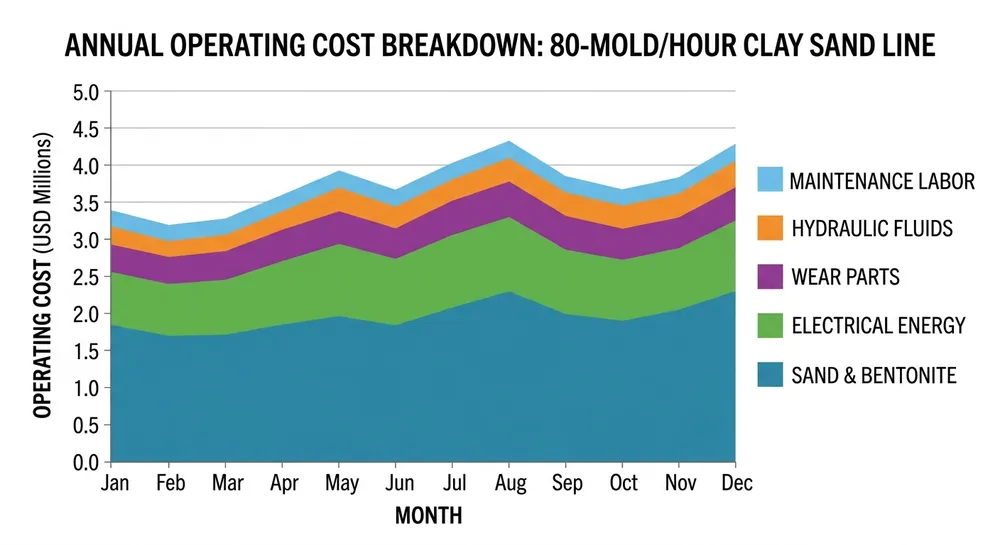
Annual operating cost determines whether your clay sand line is profitable. A line that costs $180,000 to buy but burns $95,000/year in operating expenses will lose money faster than a $240,000 line that runs at $62,000/year. Operating cost breaks into five categories: sand and bentonite consumption, electrical energy, hydraulic fluid and filters, wear parts, and maintenance labor.
Sand and bentonite consumption depends on your reclamation efficiency and casting scrap rate. A line with 90% sand recovery loses 10% of sand per cycle — at 60 molds/hour running 16 hours/day for 250 days/year, that's 240,000 molds annually, consuming 2,400 tons of sand if each mold uses 100 kg. New sand cost: $45-65 per ton depending on your location and silica grade. Bentonite cost: $280-380 per ton, and you need 8-10% bentonite by weight in the sand mix. Total sand and bentonite cost at 90% recovery: $156,000-218,000 annually. At 95% recovery: $78,000-109,000. At 97% recovery: $46,800-65,400. The 5% recovery improvement from a better reclamation system saves $109,200-152,600 annually — that pays for the reclamation equipment upgrade in 8-14 months.
Electrical energy powers the mixer, molding press, conveyors, reclamation crusher, dust collection fans, and compressed air system. A 40-mold/hour line draws 85-110 kW average load. An 80-mold/hour line: 135-175 kW. A 120-mold/hour line: 210-280 kW. At 16 hours/day operation for 250 days/year, a 40-mold line consumes 340,000-440,000 kWh annually. An 80-mold line: 540,000-700,000 kWh. A 120-mold line: 840,000-1,120,000 kWh. Electricity cost varies by market: $0.08-0.12/kWh in China, $0.10-0.15/kWh in the US, $0.15-0.25/kWh in Europe, $0.05-0.09/kWh in the Middle East. Annual energy cost for a 40-mold line: $27,200-66,000. For an 80-mold line: $43,200-175,000. For a 120-mold line: $67,200-280,000. Energy cost scales with local electricity rates more than with equipment efficiency — a line in Germany costs 2.5× more to run than the same line in Saudi Arabia.
Hydraulic fluid and filters require regular replacement. Hydraulic oil degrades from heat cycling and contamination. Change interval: every 2,000 operating hours or 12 months, whichever comes first. A 40-mold line needs 180-250 liters per change. An 80-mold line: 320-450 liters. A 120-mold line: 550-750 liters. Hydraulic oil cost: $8-12 per liter. Hydraulic filter cartridges: $45-75 each, and you need 2-4 filters per system. Annual hydraulic fluid cost: $2,200-4,500 for a small line, $3,800-7,200 for a large line.
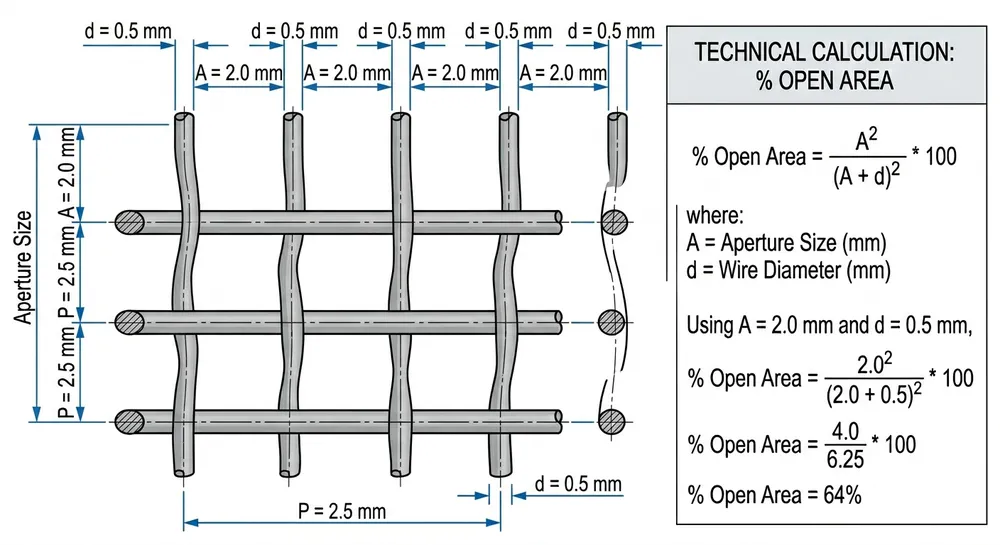
Wear parts include mixer blades (wear from abrasive sand), screen mesh (tears from oversize lumps), conveyor belts (wear from continuous operation), hydraulic seals (degradefrom heat and pressure cycling), dust collection filter bags (clog from fine particulate), and proximity sensors (fail from vibration and contamination). Mixer blades last 8,000-12,000 operating hours and cost $280-420 per set. Screen mesh lasts 6,000-9,000 hours and costs $180-280 per panel. Conveyor belts last 10,000-15,000 hours and cost $450-720 per belt. Hydraulic seals last 12,000-18,000 hours and cost $35-65 per seal (you'll replace 8-12 seals annually). Dust collection bags last 4,000-6,000 hours and cost $85-140 per bag (you need 12-24 bags depending on system size). Proximity sensors fail randomly but average 2-3 failures per year at $45-75 each. Total annual wear parts cost: $4,200-7,800 for a 40-mold line, $6,800-12,500 for an 80-mold line, $9,500-17,500 for a 120-mold line.
Maintenance labor covers routine inspection, lubrication, adjustment, and wear part replacement. A 40-mold line needs 4-6 hours of maintenance per week. An 80-mold line: 6-9 hours per week. A 120-mold line: 9-14 hours per week. Maintenance tasks include hydraulic oil level checks, filter cleaning, belt tension adjustment, sensor calibration, lubrication of moving parts, and visual inspection for leaks or unusual wear. If you have in-house maintenance staff, this is absorbed labor. If you hire external technicians, budget $35-65 per hour depending on your market. Annual maintenance labor cost: $7,280-20,280 for a small line, $10,920-30,420 for a mid-size line, $16,380-47,320 for a large line.
Total annual operating cost for a 40-mold/hour line running 16 hours/day, 250 days/year: $197,000-316,000 (assuming 90% sand recovery and mid-range energy rates). For an 80-mold/hour line: $264,000-425,000. For a 120-mold/hour line: $360,000-562,000. Sand and bentonite consumption accounts for 60-70% of operating cost. Energy accounts for 15-25%. Wear parts, hydraulic fluids, and maintenance labor account for 10-15%. Improving sand recovery from 90% to 95% cuts annual operating cost by $78,000-109,000 — that's the single highest-impact optimization you can make.
Hidden Costs Buyers Miss
Most buyers budget for equipment, freight, and installation, then discover costs they didn't anticipate. These hidden expenses add 12-18% to the total project cost if you don't plan for them.
Foundation rework happens when the civil contractor pours the concrete pad before receiving the anchor bolt template from the equipment supplier. The bolt holes end up 15-30mm off position, and the equipment won't mount. Rework cost: $2,500-4,500 to drill new holes, install chemical anchors, and re-level the equipment. Prevention: don't pour the foundation until you have the supplier's civil engineering drawings in hand, and verify the anchor bolt positions with the equipment frame dimensions before the concrete sets.
Electrical infrastructure upgrades surface when you discover your facility's transformer can't handle the additional load. A 120-mold/hour line draws 210-280 kW, and if your transformer is already running at 75% capacity, you'll trip the main breaker when the line starts. Transformer upgrade cost: $18,000-28,000 plus 3-6 weeks lead time. Prevention: calculate your facility's available transformer capacity before ordering the equipment, and include the upgrade in your project budget if needed.
Compressed air system expansion becomes necessary when your existing compressor can't supply the line's demand plus your other pneumatic equipment. A 120-mold line needs 2.2-3.0 m³/min at 8 bar, and if your current compressor only delivers 1.5 m³/min, you'll see pressure drops that cause solenoid valve malfunctions and inconsistent mold compaction. Additional compressor cost: $11,000-16,000. Prevention: measure your facility's current compressed air consumption and available capacity, then size the new compressor to handle both the existing load and the new line.
Dust collection ductwork connects the equipment's dust extraction ports to the bag filter unit. The equipment supplier provides the bag filter, but you install the ductwork. Ductwork cost: $18-28 per meter for 300mm diameter galvanized steel duct, plus $120-180 per elbow, $85-140 per tee, and $220-350 per blast gate. A typical installation needs 15-25 meters of duct, 4-6 elbows, 2-3 tees, and 3-4 blast gates. Total ductwork cost: $2,800-5,200. Prevention: include ductwork in your site preparation budget, and have your contractor fabricate and install it before the equipment arrives.
Spare parts inventory beyond the first-year kit becomes necessary once you're in production. If a mixer motor fails and you don't have a spare, your line stops for 2-4 weeks while you order and ship a replacement from China. Critical spares to stock: mixer motor (1 unit, $1,200-1,800), hydraulic pump (1 unit, $850-1,400), PLC CPU module (1 unit, $650-950), HMI touchscreen (1 unit, $420-680), main conveyor drive motor (1 unit, $380-620). Total critical spares inventory: $3,500-5,450. Prevention: order critical spares with the initial equipment shipment to avoid emergency air freight charges later.
Operator training gaps show up when the commissioning engineer leaves and your operators can't handle basic troubleshooting. The line stops because a proximity sensor failed, but your operators don't know how to bypass it temporarily or replace it. Downtime cost: $800-1,500 per hour in lost production. Prevention: during commissioning, have your maintenance supervisor shadow the commissioning engineer and document every troubleshooting procedure. Create a troubleshooting flowchart for common faults (sensor failure, hydraulic pressure drop, conveyor jam, mixer overload) and post it at the control panel.
Customs delays occur when your import documentation doesn't match the equipment's actual specifications. The customs inspector sees "foundry equipment" on the commercial invoice but needs detailed HS codes for each subsystem. Your shipment sits at the port for 2-3 weeks while you sort out the paperwork. Port storage cost: $85-140 per container per day. Prevention: work with your customs broker before the equipment ships, provide detailed packing lists with HS codes for each item, and ensure the commercial invoice matches the bill of lading exactly.
Total Cost of Ownership: 5-Year Analysis
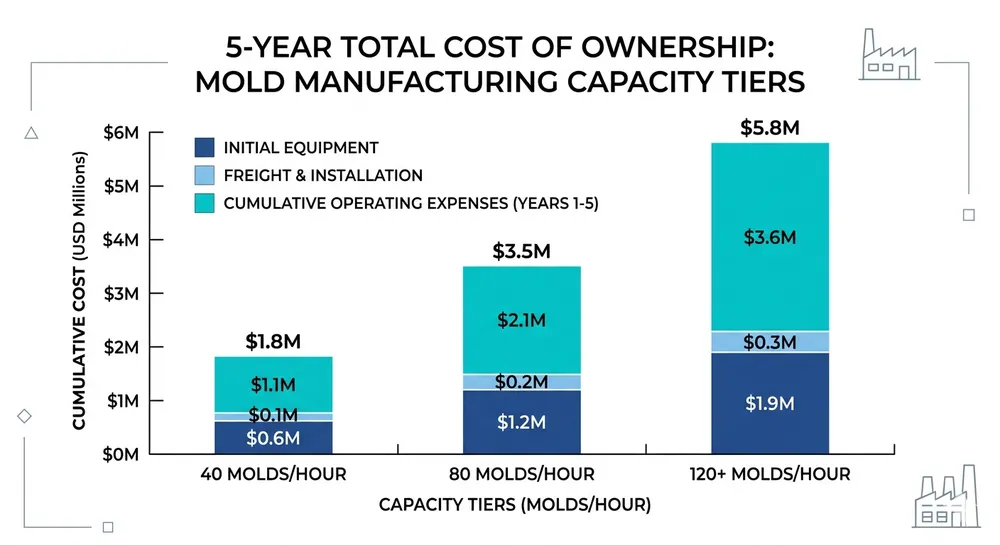
Total cost of ownership over five years includes initial equipment investment, freight, installation, and five years of operating expenses. This is the number you should use to compare suppliers and evaluate ROI.
40-mold/hour line, 5-year TCO:
- Equipment (core + auxiliaries): $95,000-135,000
- Freight (2 containers to US): $7,000-8,400
- Site preparation: $22,000-38,000
- Installation and commissioning: $8,500-15,000
- Year 1-5 operating expenses: $985,000-1,580,000
- Total 5-year cost: $1,117,500-1,776,400
80-mold/hour line, 5-year TCO:
- Equipment (core + auxiliaries): $160,000-220,000
- Freight (3-4 containers to US): $10,500-16,800
- Site preparation: $38,000-62,000
- Installation and commissioning: $14,000-24,000
- Year 1-5 operating expenses: $1,320,000-2,125,000
- Total 5-year cost: $1,542,500-2,447,800
120-mold/hour line, 5-year TCO:
- Equipment (core + auxiliaries): $245,000-340,000
- Freight (4-5 containers to US): $14,000-21,000
- Site preparation: $58,000-88,000
- Installation and commissioning: $22,000-35,000
- Year 1-5 operating expenses: $1,800,000-2,810,000
- Total 5-year cost: $2,139,000-3,294,000
Operating expenses account for 88-89% of 5-year TCO. Equipment cost is 8-11%. Freight, installation, and site preparation combined are 3-5%. This distribution explains why buyers who focus only on equipment price make poor decisions — saving $15,000 on equipment cost is meaningless if you choose a line with 5% lower sand recovery that costs you $109,000 extra per year in consumables.
ROI calculation compares the line's production value against its total cost. A 40-mold/hour line running 16 hours/day for 250 days/year produces 240,000 molds. If your average casting sells for $12 and uses one mold, that's $2,880,000 in annual casting revenue. Subtract $197,000-316,000 in operating expenses and $223,500-355,280 in amortized equipment cost (5-year straight-line depreciation), and you're left with $2,308,220-2,459,500 in annual gross profit. ROI: 206-220% annually. An 80-mold/hour line produces 320,000 molds annually, generating $3,840,000 in casting revenue, $3,267,440-3,351,560 in gross profit, and 212-217% ROI. A 120-mold/hour line produces 480,000 molds, $5,760,000 in revenue, $4,741,200-4,882,200 in gross profit, and 221-228% ROI.
The ROI improves with scale because operating cost per mold decreases as capacity increases. A 40-mold line costs $0.82-1.32 per mold in operating expenses. An 80-mold line: $0.83-1.33 per mold. A 120-mold line: $0.75-1.17 per mold. The efficiency gain comes from better sand recovery (larger reclamation systems recover more sand) and lower energy cost per unit (fixed loads like dust collection and compressed air don't scale linearly with capacity).
Payback period measures how long it takes to recover the initial investment from operating profit. For a 40-mold line with $132,500 initial investment (equipment + freight + installation) and $2,308,220 annual gross profit, payback is 21 days. For an 80-mold line with $222,500 initial investment and $3,267,440 annual profit, payback is 25 days. For a 120-mold line with $339,000 initial investment and $4,741,200 annual profit, payback is 26 days. These calculations assume you have confirmed orders to fill the line's capacity — if you're running at 50% utilization, double the payback period.
Factory-Direct Pricing vs Trading Company Markup
Most foundry equipment reaches export buyers through trading companies that add 18-35% markup. Factory-direct pricing eliminates that layer, but it requires you to handle import logistics and technical communication directly with the manufacturer.
Trading company model works like this: you contact a trading company in your country or a regional hub (Dubai, Singapore, Hong Kong). They source the equipment from a Chinese manufacturer, add their markup, handle export documentation, arrange shipping, and provide local support. Trading company markup ranges from 18% (for standard equipment with minimal customization) to 35% (for complex systems requiring engineering support). On a $160,000 clay sand line, that's $28,800-56,000 in additional cost. What you get for that premium: English-speaking sales and technical support, simplified payment terms (often accepting letters of credit or installment payments), local warranty service, and someone to blame if things go wrong.
Factory-direct model means you work directly with the manufacturer. You negotiate price, specifications, and delivery terms with the factory's export sales team. You arrange your own freight forwarder and customs broker. You handle technical questions through the factory's engineering department (usually via email or video call, often with translation delays). Factory-direct pricing is 18-35% lower than trading company pricing, but you take on more responsibility. This model works well if you have import experience, can read technical drawings, and don't need hand-holding through the process.
We sell both ways. About 60% of our export volume goes through trading partners, 40% goes factory-direct. Trading company buyers typically order standard configurations and value the local support. Factory-direct buyers typically order custom configurations, have in-house technical staff, and prioritize cost over convenience.
Payment terms differ between models. Trading companies often accept letters of credit or 30-50-70 payment schedules (30% deposit, 50% before shipping, 70% after installation). Factory-direct buyers typically pay 30% deposit and 70% before shipping, with no post-installation holdback. If you need flexible payment terms, the trading company route may be worth the markup. If you can pay upfront, factory-direct saves you $28,800-56,000 on a mid-size line.
Warranty and support also differ. Trading companies provide local warranty service — if something breaks, they send a technician from their regional office. Factory-direct buyers get remote support from the manufacturer's engineering team, plus the option to pay for on-site service if needed. Trading company warranty typically covers 12 months parts and labor. Factory-direct warranty covers 12 months parts, with labor charged separately after commissioning. If you have competent in-house maintenance staff, factory-direct support is sufficient. If you don't, the trading company's local service is valuable.
Customization flexibility favors factory-direct. Trading companies prefer standard configurations because custom engineering requires more coordination with the factory. Factory-direct buyers can work directly with the engineering team to modify equipment dimensions, add custom features, or integrate with existing systems. We've built lines with non-standard mold sizes, left-hand vs right-hand conveyor configurations, explosion-proof electrical systems for hazardous environments, and integration with third-party ERP systems — all custom requests that came from factory-direct buyers.
Comparing Manual, Semi-Automated, and Fully Automated Lines
Automation level affects equipment cost, operating cost, and production consistency. The right choice depends on your production volume, labor cost, and quality requirements.
Manual lines use hand-operated molding machines, manual pattern handling, and manual casting removal. Equipment cost: $85,000-120,000 for a 40-mold/hour system. Operating cost: $197,000-316,000 annually. Labor requirement: 6-8 operators per shift (2 for molding, 2 for pattern handling, 2 for shakeout, 2 for sand handling). Cycle time: 72-90 seconds per mold. Mold dimensional consistency: ±1.5-2.5mm. Manual lines work for job-shop foundries producing 15-30 different casting types per month where setup flexibility matters more than throughput. The low equipment cost is offset by high labor cost — at $15/hour labor rate, you're paying $144,000-192,000 annually just for line operators (not including maintenance staff, supervisors, or overhead).
Semi-automated lines use hydraulic molding machines with programmable compaction, automatic conveyor transport, and PLC-controlled sand preparation, but manual pattern changeover. Equipment cost: $145,000-195,000 for a 60-80 mold/hour system. Operating cost: $264,000-425,000 annually. Labor requirement: 3-4 operators per shift (1 for molding supervision, 1 for pattern changeover, 1 for shakeout, 1 for quality inspection). Cycle time: 45-60 seconds per mold. Mold dimensional consistency: ±0.5-1.0mm. Semi-automated lines balance throughput with flexibility — you can change patterns in 8-12 minutes and handle batch sizes from 50 to 5,000 molds economically. Labor cost at $15/hour: $72,000-96,000 annually. The $25,000-75,000 equipment premium over manual lines pays back in 4-9 months through labor savings alone.
Fully automated lines use robotic pattern handling, servo-driven molding, integrated conveyor systems with automatic mold tracking, and PLC-coordinated shakeout and reclamation. Equipment cost: $220,000-310,000 for a 100-120+ mold/hour system. Operating cost: $360,000-562,000 annually. Labor requirement: 2 operators per shift (1 for line supervision, 1 for quality inspection and troubleshooting). Cycle time: 30-36 seconds per mold. Mold dimensional consistency: ±0.2-0.4mm. Fully automated lines suit high-volume production of 3-8 standard casting families with minimal changeover. Labor cost at $15/hour: $48,000 annually. The $75,000-115,000 equipment premium over semi-automated lines pays back in 12-18 months through labor savings plus the additional revenue from higher throughput.
Quality consistency improves with automation because machines don't get tired. Manual compaction pressure varies by 8-12% across an 8-hour shift as operators fatigue. Hydraulic compaction holds ±2-bar pressure for 10,000 cycles. That consistency translates to fewer casting defects — manual lines typically see 4-6% scrap rate from mold-related defects (flash, misalignment, sand inclusion). Semi-automated lines: 2-3% scrap rate. Fully automated lines: 0.8-1.5% scrap rate. On a line producing $2,880,000 in annual casting revenue, reducing scrap from 5% to 1.5% saves $100,800 annually in material and labor waste.
Changeover time increases with automation. Manual lines change patterns in 3-5 minutes (unbolt old pattern, bolt new pattern, adjust compaction pressure). Semi-automated lines: 8-12 minutes (pattern change plus PLC parameter adjustment). Fully automated lines: 15-25 minutes (pattern change, PLC parameters, robotic path programming, test cycles). If you're running batch sizes below 200 molds, the changeover time penalty erases the automation throughput advantage. If you're running batches above 1,000 molds, changeover time is negligible and automation wins.
Cost Optimization Strategies
Five strategies reduce clay sand line total cost of ownership without compromising production capacity or quality.
Improve sand recovery rate from 90% to 95-97%. This requires upgrading the reclamation system with better screening (finer mesh, higher vibration frequency), magnetic separation (stronger magnets, multiple passes), and cooling (rotary drum cooler to bring sand temperature below 60°C before reuse). Reclamation upgrade cost: $18,000-32,000. Annual savings from reduced sand and bentonite consumption: $78,000-109,000. Payback: 2-5 months. This is the highest-ROI optimization available.
Right-size dust collection capacity. Oversized dust collection systems waste energy running fans at higher airflow than needed. Undersized systems run overloaded, causing premature filter bag failure and frequent replacement. Proper sizing matches airflow to the equipment's actual dust generation rate plus 15% safety margin. A 60-mold/hour line generates 4,200-4,800 m³/hour of dust-laden air — size the bag filter for 5,000 m³/hour, not 8,000. Energy savings from right-sizing: $2,400-4,200 annually. Filter bag life extension: 40-60%, saving $1,800-3,200 annually in replacement costs.
Use variable-frequency drives (VFDs) on motors that don't run at constant load. Conveyor motors, dust collection fans, and compressed air compressors spend 30-50% of their operating time at partial load. VFDs reduce motor speed during low-load periods, cutting energy consumption by 20-35%. VFD cost: $380-650 per motor. Energy savings: $1,200-2,400 per motor annually. Payback: 3-6 months. Install VFDs on the three highest-power motors (typically the dust collection fan, main conveyor drive, and reclamation crusher).
Negotiate container consolidation with your freight forwarder. If you're ordering multiple pieces of equipment (clay sand line plus auxiliary equipment or spare parts), consolidate everything into the minimum number of containers. We've reduced shipping from 4 containers to 3 by optimizing the loading plan, saving $3,500-5,500 in freight cost. Container consolidation requires coordination between the equipment supplier and the freight forwarder — provide the forwarder with equipment dimensions and weights 4-6 weeks before the planned shipping date so they can design the optimal loading plan.
Schedule installation during low season. Freight rates drop 10-15% during February-April and September-October. If your production schedule allows, order equipment for delivery during these periods. On a 4-container shipment to Europe, low-season scheduling saves $1,920-3,300 in freight cost. Installation labor rates also drop during low season in some markets — contractors offer 8-12% discounts to fill their schedules during slow periods.
What TZFoundry Delivers
We manufacture clay sand processing lines in our 15,000-square-meter facility in Qingdao. Eight production lines build molding machines, sand preparation systems, reclamation equipment, and auxiliary systems. We've commissioned 60+ complete lines across North America, Europe, the Middle East, and Southeast Asia since 2010.
Our lines ship as modular systems in 2-5 × 40HQ containers depending on capacity. Each system includes core equipment (sand preparation, molding, shakeout, reclamation), auxiliary systems (dust collection, hydraulic power, electrical control), civil engineering drawings (foundation templates, anchor bolt positions, load calculations), electrical schematics (wiring diagrams, PLC programs, HMI screens), and a first-year spare parts kit (hydraulic seals, sensors, valves, mixer blades, screen mesh, filter bags).
We provide remote commissioning via video call for buyers with competent local technical teams, or on-site commissioning supervision for buyers who need hands-on support. Remote commissioning costs $2,500-11,000 depending on line complexity. On-site supervision costs $8,500-35,000 depending on line size and commissioning duration.
Factory-direct pricing eliminates trading company markup. A 60-80 mold/hour semi-automated line costs $160,000-220,000 FOB Qingdao from us, compared to $188,800-297,000 through a trading company. The $28,800-77,000 difference pays for freight, site preparation, and most of your installation cost.
We've built custom configurations for buyers who need non-standard mold sizes (we've done 400×500mm up to 1200×1400mm), left-hand vs right-hand conveyor layouts (to fit existing facility flow), explosion-proof electrical systems (ATEX Zone 2 certification for aluminum foundries), and integration with third-party ERP systems (Modbus TCP, OPC UA, or custom protocols). Custom engineering adds 3-4 weeks to the production schedule but doesn't increase equipment cost unless the modifications require non-standard components.
Our warranty covers 12 months parts from the commissioning date. We stock spare parts in Qingdao with 3-5 day shipping to most export markets. Critical components (PLC modules, HMI screens, hydraulic pumps, motors) ship via DHL or FedEx for 3-day delivery. Consumables (seals, sensors, valves, blades, mesh, bags) ship via sea freight in consolidated shipments every 6-8 weeks.

Baocun Zhu is the Senior Clay Sand Process Engineer at TZFoundry in Qingdao. With over 14 years commissioning clay sand molding, reclamation, and preparation lines for export foundries, he turns floor-space constraints and throughput targets into working production systems. His...