TZFoundry Preview

DNOOO blank theme is active for local preview.

Thermal vs Mechanical Clay Sand Reclamation – Which Method Delivers Better Sand Quality?

Most foundry buyers frame this as a sand quality question. The real question is cost per reclaimed ton versus the quality grade your casting process actually needs. Thermal reclamation burns off binders at 600-800°C and delivers near-virgin sand properties — but you're paying $8-12 per ton in energy and equipment amortization. Mechanical reclamation uses attrition mills and vibrating screens to scrub clay and dead binder from grain surfaces, costing $2-4 per ton with 92-96% recovery rates that work fine for most clay-bonded green sand operations.

Quick verdict: If you're running gray iron or ductile iron with sodium bentonite clay binder, mechanical reclamation handles 95% of your volume at one-third the operating cost. Reserve thermal reclamation for mixed-binder operations, resin-contaminated sand streams, or steel foundries where residual clay above 0.3% causes defects. For high-volume foundries producing 50+ tons of castings daily, a hybrid approach — mechanical primary reclamation for bulk tonnage plus thermal secondary treatment for 10-15% of sand requiring deep cleaning — often delivers the best total cost of ownership.

We've commissioned both types at TZFoundry's facility and installed them across four continents. The decision comes down to three factors: your binder system, your sand cost in the local market, and whether your quality spec actually requires the extra cleanliness thermal delivers.

Head-to-Head: Thermal vs Mechanical Reclamation Performance

Parameter Mechanical Reclamation Thermal Reclamation
Recovery Rate 92-96% (single pass) 97-99% (near-complete)
Residual Clay Content (LOI) 0.5-1.2% 0.1-0.3%
Energy Consumption 8-15 kWh/ton 80-120 kWh/ton
CAPEX (10 t/h system) $120,000-180,000 $450,000-650,000
OPEX per Ton $2-4 $8-12
Footprint 80-120 m² 150-220 m²
Water Requirement 0.2-0.5 m³/ton (wet systems) None (dry process)
Natural Gas / Fuel None 15-25 m³/ton (natural gas)
Flue Gas Treatment Not required Scrubber + baghouse required
Grain Shape Preservation Good (minimal attrition) Excellent (no mechanical stress)
Startup Time 15-30 minutes 2-4 hours (furnace preheat)
Maintenance Interval Screen replacement every 6-8 months Refractory lining every 18-24 months

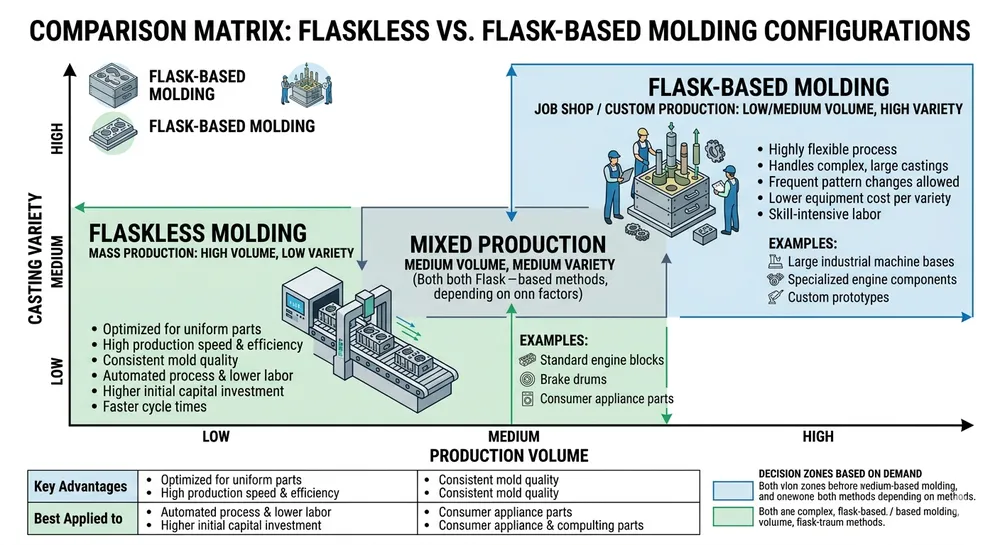
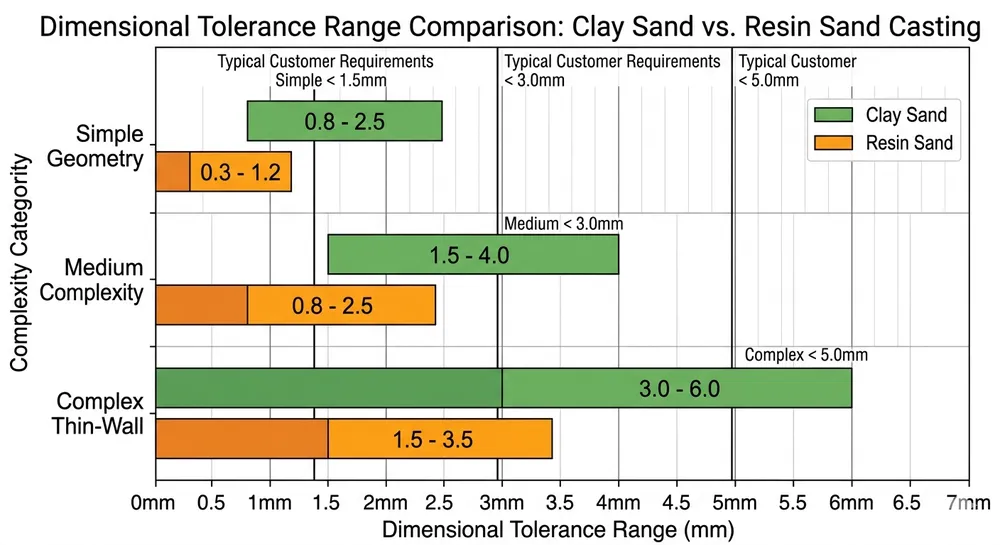
The performance gap narrows when you account for what your molding line actually tolerates. A flaskless molding line running 150 molds per hour with ±0.3 mm tolerance needs consistent sand properties — but "consistent" doesn't mean "virgin." Mechanical reclamation delivers 0.8% residual clay with ±0.15% variation across a shift, and that's tight enough for most gray iron work. Thermal gets you to 0.2% residual clay, but you're spending an extra $6 per ton to remove clay your mold doesn't care about.

Side-by-side comparison chart of thermal and mechanical clay sand reclamation showing recovery rate, energy cost, and residual binder levels

The Hidden Cost Structure — Where Thermal Reclamation Bleeds Money

Energy dominates thermal reclamation economics. You're heating sand to 650-750°C to oxidize organic binders and calcine clay minerals back to inert silicates. That takes 80-120 kWh per ton of reclaimed sand, plus 15-25 cubic meters of natural gas if you're running a rotary kiln system. At $0.12/kWh industrial electricity rates and $0.40/m³ natural gas (typical export market pricing), your energy bill alone hits $6-8 per ton before you touch equipment amortization or maintenance.

Mechanical reclamation runs attrition mills at 8-15 kWh per ton. The energy goes into rotating drums with internal baffles that scrub sand grains against each other, breaking up clay coatings and dead binder films. At the same $0.12/kWh rate, energy cost is $1-1.80 per ton. Add vibrating screen power consumption and magnetic separator drives, and you're still under $2.50 per ton for the complete mechanical process.

Worked example at 10 t/h throughput (single-shift operation, 2,000 hours annually, 20,000 tons reclaimed per year):

Mechanical reclamation total cost per ton:

  • Energy: $1.80
  • Consumables (screen mesh, magnetic separator maintenance): $0.60
  • Labor (1 operator monitoring 3 systems): $0.40
  • Equipment amortization ($150,000 CAPEX / 10-year life / 20,000 tons annually): $0.75
  • Total: $3.55 per ton

Thermal reclamation total cost per ton:

  • Energy (electricity + natural gas): $7.20
  • Consumables (refractory patching, baghouse filters): $1.80
  • Labor (1 operator + periodic refractory maintenance): $0.80
  • Flue gas treatment (scrubber chemicals, baghouse replacement): $1.20
  • Equipment amortization ($550,000 CAPEX / 10-year life / 20,000 tons annually): $2.75
  • Total: $13.75 per ton

The $10.20 per ton difference compounds fast. At 20,000 tons annually, thermal reclamation costs you an extra $204,000 per year in operating expense. That's the price of removing the last 0.5% residual clay that most molding processes don't require.

Environmental compliance adds another layer. Thermal reclamation produces flue gas containing CO₂, NOₓ, and particulate from burned organics. You need a wet scrubber or dry baghouse system to meet emission limits in Europe, North America, and increasingly in Middle Eastern markets. Scrubber installation adds $80,000-120,000 to CAPEX and $15,000-25,000 annually in chemical and filter replacement costs. Mechanical reclamation produces no combustion emissions — dust control is a simple baghouse on the screen discharge, costing $8,000-12,000 installed with $2,000 annual filter replacement.

We switched a Turkish foundry from thermal to mechanical reclamation in 2019 after their natural gas supplier raised rates 40% in six months. Their sand quality spec allowed 0.8% residual clay, but they'd been running thermal because "that's what we always did." The mechanical system paid for itself in 14 months purely from energy savings, and their mold defect rate didn't move — the extra clay removal wasn't helping their casting quality.

When Alloy Type and Binder System Override Cost Logic

Cost per ton matters, but sand chemistry requirements can force your hand. Here's where thermal reclamation justifies its premium:

Steel casting foundries: Steel requires sand temperatures above 1,500°C at metal-mold interface, and any residual clay above 0.3% causes gas defects and surface roughness. Mechanical reclamation struggles to hit 0.3% consistently — you'll see batch-to-batch variation between 0.5-1.0% depending on how much dead clay accumulated in your system sand. Thermal reclamation delivers 0.1-0.2% residual clay with tight control, eliminating the gas defect risk. For steel work, the extra $10 per ton in reclamation cost is cheaper than the scrap rate from gas porosity.

Mixed-binder operations: If you're running both clay-bonded green sand and resin-bonded cores in the same facility, your sand return stream contains sodium bentonite, furan resin, phenolic resin, and whatever else came off the shakeout. Mechanical reclamation can't selectively remove resin films — the attrition process breaks up clay but leaves resin residue on grain surfaces. That contaminated sand goes back into your green sand system and slowly degrades mold strength. Thermal reclamation burns off all organic binders (clay, resin, coal dust additives) and resets the sand to near-virgin condition. You're paying for chemical selectivity, not just physical cleaning.

High-LOI sand streams: Loss on ignition (LOI) measures total organic and volatile content in sand. Virgin silica sand runs 0.1-0.3% LOI. After 20-30 molding cycles with sodium bentonite and coal dust additions, system sand can hit 3-5% LOI. Mechanical reclamation drops LOI to 1.5-2.5% by removing loose clay and carbonaceous fines, but it can't touch the binder films chemically bonded to grain surfaces. If your molding line spec requires sub-1.0% LOI (common for ductile iron with tight dimensional tolerance), mechanical reclamation won't get you there. Thermal reclamation oxidizes everything organic and delivers 0.3-0.5% LOI.

Gray iron and ductile iron with standard clay binder: This is where mechanical reclamation dominates. Sodium bentonite clay at 6-8% addition rate, coal dust at 3-5%, and pouring temperatures around 1,350-1,400°C for gray iron or 1,420-1,480°C for ductile iron. Your sand quality spec typically allows 0.8-1.2% residual clay and 2.0-2.5% LOI. Mechanical reclamation hits those numbers reliably at one-third the cost of thermal. We've installed mechanical systems in 40+ gray iron foundries across North America and Europe, and none of them needed to upgrade to thermal after commissioning — the sand quality held steady for years.

Decision flowchart showing which sand reclamation method suits gray iron, ductile iron, and steel casting based on binder type and quality requirements

Application Showdown — Scenario Winners

Scenario 1: Mid-volume gray iron foundry, 25 tons castings daily, sodium bentonite clay binder, flaskless molding line

  • Sand circulation: ~80 tons per day
  • Required reclamation capacity: 10-12 t/h (sized at 110-120% of molding output to handle peak demand)
  • Quality spec: 0.8% max residual clay, 2.5% max LOI
  • Local sand cost: $45 per ton virgin sand

Winner: Mechanical reclamation

At $3.55 per ton reclamation cost, you're processing 80 tons daily for $284. Virgin sand replacement at $45 per ton would cost $3,600 daily. The mechanical system pays for itself in 530 operating days (about 2 years at single-shift operation). Thermal reclamation at $13.75 per ton costs $1,100 daily — you're spending an extra $816 per day to remove clay your molding line doesn't need. The quality spec allows 0.8% residual clay, and mechanical delivers 0.6-0.9% consistently.

Scenario 2: Steel casting foundry, 15 tons castings daily, mixed clay and resin binder, high gas defect sensitivity

  • Sand circulation: ~50 tons per day
  • Required reclamation capacity: 6-8 t/h
  • Quality spec: 0.3% max residual clay, 0.8% max LOI (tight spec to prevent gas defects)
  • Local sand cost: $50 per ton virgin sand

Winner: Thermal reclamation

Mechanical reclamation can't reliably hit 0.3% residual clay with mixed-binder sand. You'd end up dumping 30-40% of reclaimed sand and replacing it with virgin material because the quality spec fails. At 50 tons daily circulation, dumping 20 tons and buying virgin sand costs $1,000 per day. Thermal reclamation at $13.75 per ton processes all 50 tons for $687.50 daily and delivers 0.2% residual clay with 0.5% LOI. The extra operating cost is cheaper than the virgin sand replacement you'd need with mechanical, and your scrap rate from gas defects drops because the sand chemistry stays tight.

Scenario 3: High-volume ductile iron foundry, 80 tons castings daily, sodium bentonite binder, automated molding

  • Sand circulation: ~250 tons per day
  • Required reclamation capacity: 20-25 t/h
  • Quality spec: 1.0% max residual clay, 2.8% max LOI
  • Local sand cost: $40 per ton virgin sand
  • Environmental regulation: Strict NOₓ and particulate limits

Winner: Hybrid system (mechanical primary + thermal secondary for 10-15% of sand)

Run mechanical reclamation as the primary system, processing 220 tons per day at $3.55 per ton ($781 daily). Divert 30 tons per day (12% of circulation) through a smaller thermal unit for deep cleaning, processing at $13.75 per ton ($412.50 daily). Total reclamation cost: $1,193.50 daily for 250 tons, or $4.77 per ton blended average.

This hybrid approach gives you:

  • Bulk volume processed economically through mechanical
  • A fraction of sand (the highest-LOI material from shakeout) gets thermal treatment and returns to the system as near-virgin quality
  • Blended sand properties stay within spec: 0.7-0.9% residual clay, 1.8-2.2% LOI
  • Lower environmental compliance cost because the thermal unit is 1/3 the size of a full-capacity system

We installed this configuration for a Mexican ductile iron foundry in 2021. They were running 100% thermal reclamation and spending $3,400 daily on energy and maintenance. The hybrid system dropped their reclamation cost to $1,200 daily while maintaining the same mold quality. The mechanical system handles routine cleaning, and the thermal unit acts as a "quality booster" for sand that's been through 40+ cycles and accumulated too much dead clay.

Cost-Per-Ton Breakdown at Two Throughput Levels

10 t/h mechanical reclamation system (20,000 tons annually, single-shift):

  • Equipment CAPEX: $150,000 (attrition mill, vibrating screens, magnetic separator, dust collection, PLC controls)
  • Installation and commissioning: $25,000
  • Total installed cost: $175,000
  • Annual operating cost: $71,000 (energy, consumables, labor, maintenance)
  • Cost per ton: $3.55
  • Payback vs virgin sand at $45/ton: 1.9 years

10 t/h thermal reclamation system (20,000 tons annually, single-shift):

  • Equipment CAPEX: $550,000 (rotary kiln, combustion system, flue gas scrubber, baghouse, PLC controls)
  • Installation and commissioning: $80,000
  • Total installed cost: $630,000
  • Annual operating cost: $275,000 (energy, consumables, labor, maintenance, environmental compliance)
  • Cost per ton: $13.75
  • Payback vs virgin sand at $45/ton: 7.2 years

20 t/h mechanical reclamation system (40,000 tons annually, two-shift):

  • Equipment CAPEX: $240,000 (larger attrition mill, dual vibrating screens, higher-capacity magnetic separator)
  • Installation and commissioning: $35,000
  • Total installed cost: $275,000
  • Annual operating cost: $138,000
  • Cost per ton: $3.45 (economies of scale on labor and fixed costs)
  • Payback vs virgin sand at $45/ton: 1.8 years

20 t/h thermal reclamation system (40,000 tons annually, two-shift):

  • Equipment CAPEX: $820,000 (larger rotary kiln, higher-capacity scrubber and baghouse)
  • Installation and commissioning: $120,000
  • Total installed cost: $940,000
  • Annual operating cost: $520,000
  • Cost per ton: $13.00 (slight improvement from scale, but energy cost dominates)
  • Payback vs virgin sand at $45/ton: 6.8 years

The payback math shifts if your local virgin sand cost is high. In regions where silica sand costs $80-100 per ton (parts of the Middle East, remote areas in North America), both methods pay back faster. But the relative advantage of mechanical over thermal stays consistent — you're still spending 3-4x more per ton for thermal, and that only makes sense if your quality spec demands it.

Decision Framework — Which Method Fits Your Operation

Choose mechanical reclamation when:

  • You're running gray iron or ductile iron with sodium bentonite clay binder (covers 70% of foundries globally)
  • Your quality spec allows 0.8-1.2% residual clay and 2.0-2.8% LOI
  • Your sand circulation is under 150 tons per day and you want the lowest operating cost
  • You're in a region with high energy costs or strict combustion emission limits
  • Your facility has limited floor space (mechanical systems are 40% more compact)
  • You need fast startup and shutdown (mechanical systems reach operating temperature in 15-30 minutes)

Choose thermal reclamation when:

  • You're casting steel and require sub-0.3% residual clay to prevent gas defects
  • You're running mixed-binder operations (clay + resin cores) and need to remove all organic contamination
  • Your quality spec requires sub-1.0% LOI and mechanical reclamation can't hit it consistently
  • Your local virgin sand cost is very high ($80+ per ton) and the payback math justifies thermal's operating cost
  • You're processing sand contaminated with resin, core binder, or other organics that mechanical attrition can't remove

Consider a hybrid system when:

  • You're processing 150+ tons per day and can justify two reclamation lines
  • Your quality spec is tight (0.5-0.8% residual clay) but not extreme
  • You want to minimize total cost while maintaining quality control
  • You can segregate high-LOI sand from shakeout and route it through thermal while bulk sand goes through mechanical
  • Your operation runs multiple alloy types and you need flexibility

Supplier Validation — What to Verify Before You Buy

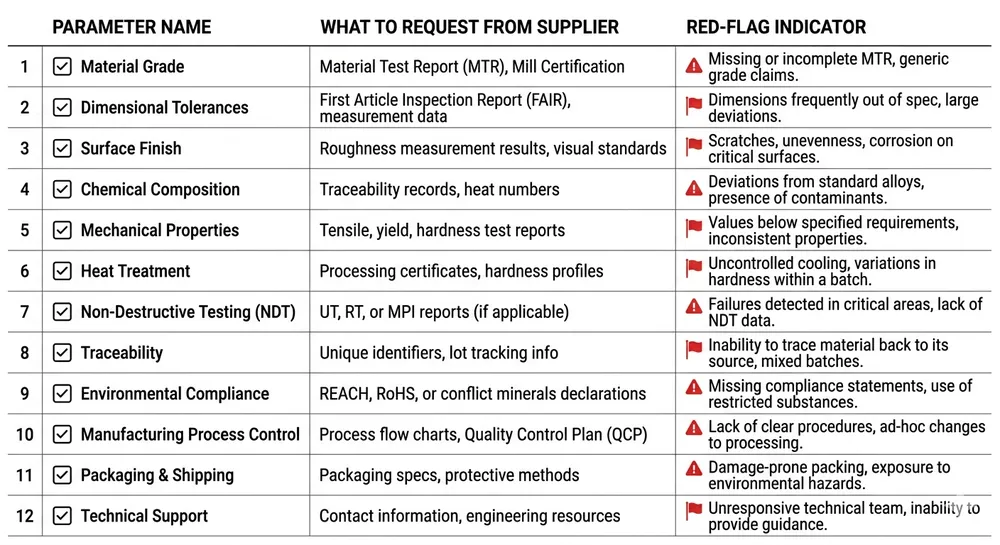
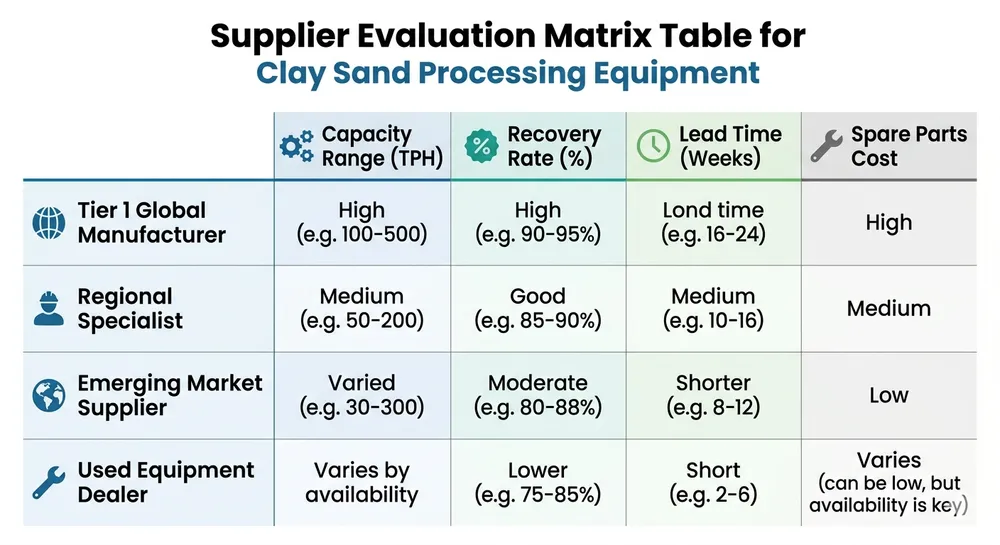
Most reclamation equipment suppliers quote capacity in tons per hour, but that number hides critical details. Here's what to verify:

For mechanical reclamation systems:

  • Actual throughput at your sand grain size distribution: A system rated for 10 t/h assumes 50-70 mesh AFS grain fineness. If you're running finer sand (70-90 mesh), throughput drops 15-20% because screen efficiency decreases. Ask for test data at your specific grain size.
  • Attrition mill liner material and replacement interval: Manganese steel liners last 8-12 months in continuous operation. Cheaper mild steel liners wear out in 4-6 months. Get the liner replacement cost and labor hours in writing.
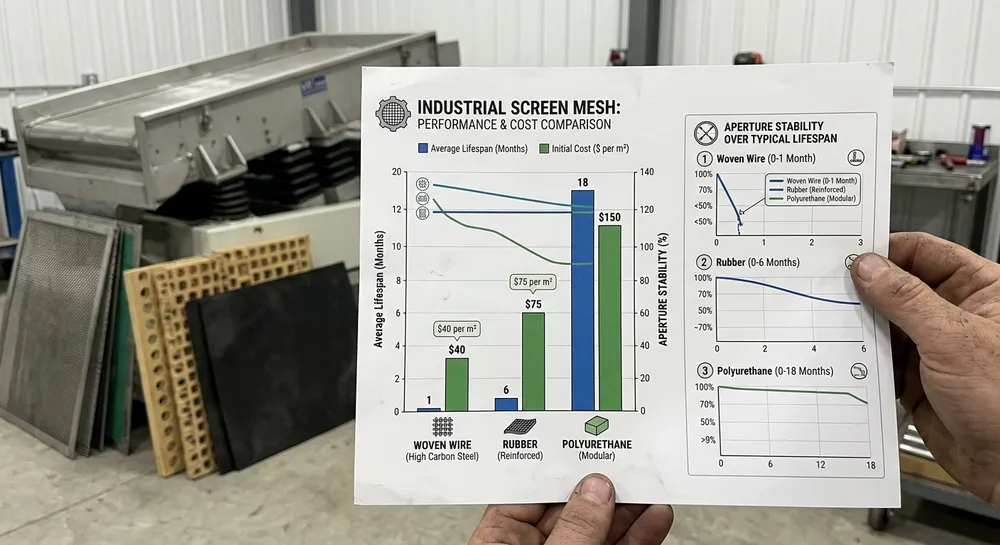
  • Screen mesh specification and availability: Vibrating screens use polyurethane or woven wire mesh. Polyurethane lasts longer but costs more. Verify the mesh size matches your required separation (typically 20-40 mesh for clay removal) and confirm your local distributor stocks replacement mesh.
  • Magnetic separator field strength: Permanent magnet separators (5,000-8,000 gauss) need no power but can't be adjusted. Electromagnetic separators (3,000-6,000 gauss adjustable) consume power but let you tune separation efficiency. Match the separator type to your tramp metal contamination level.

For thermal reclamation systems:

  • Fuel type and consumption rate: Rotary kilns run on natural gas, propane, or fuel oil. Get the BTU input rate and calculate your local fuel cost per ton. Some suppliers quote "energy consumption" without specifying fuel type — that's a red flag.
  • Refractory lining life and replacement cost: Alumina-silica refractory lasts 18-24 months in continuous operation. High-alumina refractory lasts 30-36 months but costs 40% more. Refractory replacement is a $15,000-25,000 maintenance event — factor it into your operating budget.
  • Flue gas treatment system compliance: Verify the scrubber or baghouse meets your local emission limits for NOₓ, CO, and particulate. In Europe, you need to hit 200 mg/Nm³ NOₓ and 20 mg/Nm³ particulate. In North America, limits vary by state but typically require 95%+ particulate removal. Get the emission test report from a similar installation.
  • Startup and shutdown time: Thermal systems need 2-4 hours to preheat the kiln before you can feed sand. If your foundry runs batch production with frequent stops, that startup time kills productivity. Mechanical systems start in 15 minutes.

Common substitution traps:

  • Suppliers quoting "sand reclamation system" without specifying mechanical vs thermal — always clarify the technology
  • Thermal systems sold as "low energy" because they use waste heat from melting furnaces — verify the actual BTU input and whether your furnace exhaust temperature is sufficient (needs 400-500°C minimum)
  • Mechanical systems with undersized attrition mills that can't deliver the claimed residual clay removal — ask for sand quality test data from a running installation, not lab samples

TZFoundry's Mechanical Reclamation Line Configurations

We manufacture mechanical reclamation systems in three capacity ranges, sized to match your molding line output:

3-5 t/h compact system: Fits foundries producing 10-15 tons of castings daily. Single attrition mill, dual-deck vibrating screen, permanent magnet separator. Footprint: 8m × 10m. Typical applications: small gray iron foundries, prototype casting shops, foundries transitioning from 100% virgin sand to reclamation. CAPEX: $95,000-120,000 installed.

8-12 t/h standard system: Matches foundries producing 25-40 tons of castings daily. Dual attrition mills (series configuration for two-stage cleaning), triple-deck vibrating screen, electromagnetic separator with adjustable field strength. Footprint: 10m × 12m. This is our most common export configuration — it handles the majority of gray iron and ductile iron operations globally. CAPEX: $150,000-180,000 installed.

15-20+ t/h high-capacity system: For foundries producing 50-80 tons of castings daily. Parallel attrition mills (redundancy for continuous operation), quad-deck vibrating screens, dual magnetic separators. Footprint: 12m × 15m. Includes PLC-based sand quality monitoring with automatic moisture adjustment. CAPEX: $240,000-290,000 installed.

All systems ship as modular units that fit standard 40HQ containers. We size reclamation capacity at 110-120% of your molding line output to handle peak demand without queuing sand. If your molding line produces 10 t/h of sand circulation, we'll spec a 12 t/h reclamation system so you're never waiting for reclaimed sand during production surges.

Our in-house sand reclamation testing lab runs sample batches through the full process — crushing, attrition, screening, magnetic separation — and measures residual clay content, LOI, grain size distribution, and compaction properties. Send us 50 kg of your system sand and we'll run it through a pilot-scale mechanical reclamation line, then send back the test data showing actual recovery rate and sand quality. That validation happens before you commit to a purchase order, so you know exactly what performance to expect.

For buyers evaluating thermal reclamation, we don't manufacture thermal systems in-house (the environmental compliance and refractory engineering are specialized enough that we refer those projects to thermal equipment specialists). But we'll run your sand through our mechanical system first and show you whether mechanical reclamation meets your quality spec — most buyers discover they don't need thermal once they see the actual residual clay numbers from mechanical processing.

Remote commissioning support runs through video call with our process engineers. Your installation team connects hydraulic lines, wires the PLC, and runs initial test cycles while we guide them through startup procedures. We've commissioned mechanical reclamation systems in 18 countries this way. The system includes a first-year spare parts kit: attrition mill liners, screen mesh, magnetic separator belts, and PLC I/O modules.

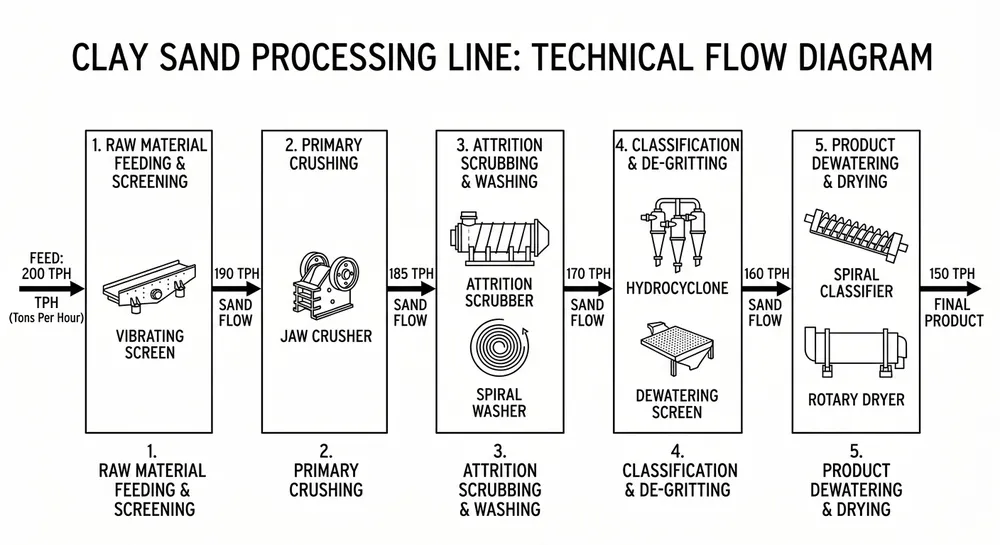
For more details on complete Clay Sand Processing Line configurations or standalone Clay Sand Reclamation Line systems, those pages cover layout planning, capacity matching, and integration with existing molding equipment. If you're also evaluating sand washing and regeneration (a third option that sits between mechanical reclamation and thermal treatment), see Clay Sand Regeneration Line for wet-process systems that deliver 0.4-0.6% residual clay at $5-7 per ton operating cost.

Send your sand analysis report (LOI, clay content, AFS grain fineness number, moisture content) or daily tonnage and alloy type to our engineering team. We'll recommend the reclamation method that fits your quality spec and calculate cost-per-ton projections based on your local energy and sand pricing. If you're on the fence between mechanical and thermal, we'll run your sand through our testing lab and show you the actual quality difference — that data usually settles the decision in one direction or the other.

Clay Sand Reclamation Line ROI – Real Savings on New Sand Costs for Foundries

Most foundries underestimate how much they spend on new sand until they run the actual numbers. A mid-sized operation casting 50 tons per day can burn through $180,000 annually just purchasing replacement sand — before you count disposal fees, trucking, or the labor to handle incoming material. That's the cost of not reclaiming.

A clay sand reclamation line changes the math. You stop buying most of your sand. You stop paying to haul waste off-site. The equipment pays for itself, usually within 18 to 36 months depending on your daily throughput. After that, every ton you reclaim instead of purchase drops straight to your bottom line.

This article breaks down the real ROI: per-ton cost comparison, payback timelines at different production volumes, and the total cost of ownership factors most suppliers leave out of their sales pitch.

What Clay Sand Reclamation Actually Saves You

Sand reclamation isn't about environmental compliance or "going green" — it's about cost control. Every casting cycle consumes sand. Without reclamation, you replace that sand by purchasing new material. With reclamation, you recover 90-95% of the sand you already own and put it back into production.

The savings come from three sources:

New sand purchase elimination. A foundry running 15 tons per day of clay sand molding typically needs 3-4 tons of fresh sand weekly to replace losses. At $60-80 per ton delivered (depending on your region and logistics), that's $9,000-12,000 per year just for replacement sand. A reclamation line with 95% recovery rate cuts that to under $1,500 annually.

Disposal cost reduction. Used sand is industrial waste. Landfill tipping fees run $40-70 per ton in most regions, plus trucking. If you're dumping 3 tons per week, disposal alone costs $6,000-10,000 per year. Reclamation drops your waste volume by 90%, so disposal cost falls to $600-1,000.

Logistics and handling savings. New sand arrives in bulk trucks or supersacks. Someone has to receive it, store it, and move it to your preparation line. Reclaimed sand stays on-site in a closed loop. You eliminate inbound freight, reduce forklift hours, and free up warehouse space. For overseas foundries, this also removes the risk of supply interruptions when your sand supplier has shipping delays.

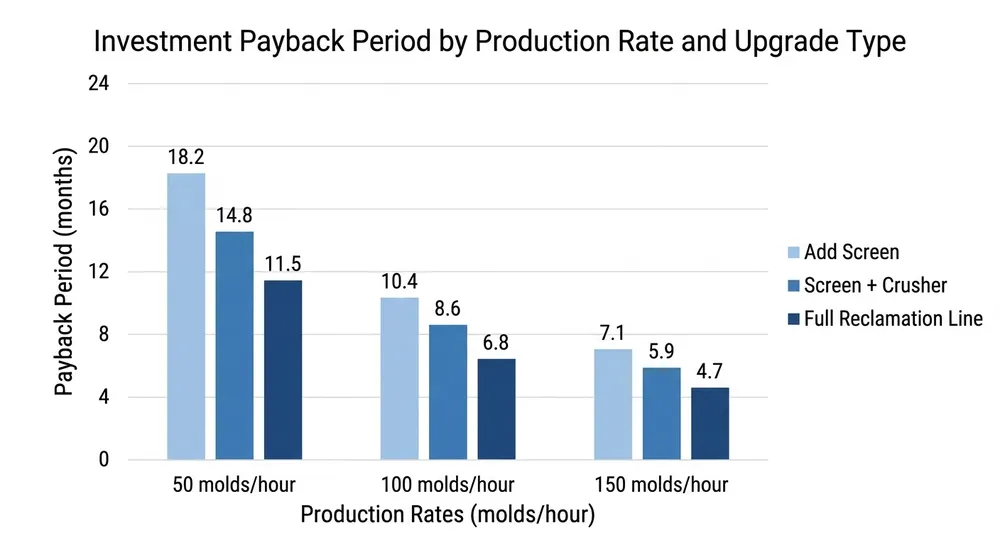
We've commissioned reclamation lines in foundries across four continents. The ones that track costs carefully see payback in 18-30 months at 15+ tons per day throughput. Smaller operations (5-10 tons per day) stretch payback to 30-40 months, but the savings still compound year after year once the line is paid off.

Clay sand reclamation cost savings breakdown showing new sand purchase, disposal fees, and logistics costs comparison

Per-Ton Economics: New Sand vs Reclaimed Sand

The clearest way to understand clay sand reclamation line ROI is to compare the cost per ton of sand in your molds.

New sand cost per ton (delivered):

  • Base material: $45-65 per ton (varies by region and bentonite content)
  • Freight: $10-20 per ton (domestic) or $30-50 per ton (import for overseas foundries)
  • Handling and storage: $3-5 per ton (forklift, labor, warehouse space)
  • Total: $60-120 per ton depending on location

Reclaimed sand cost per ton (operating):

  • Electricity: $1.50-2.50 per ton (based on 15-20 kWh per ton at $0.10/kWh)
  • Wear parts (screens, magnets, cyclone liners): $0.80-1.20 per ton amortized
  • Maintenance labor: $0.50-1.00 per ton
  • Bentonite and water makeup (5% loss): $3-4 per ton
  • Total: $6-9 per ton

The difference is $50-110 per ton. At 15 tons per day, that's $750-1,650 in daily savings, or $270,000-600,000 annually assuming 360 operating days.

This is why foundries that run reclamation lines don't go back. The operating cost is so much lower than purchasing new sand that even a modest recovery rate (85-90%) still delivers massive savings.

(Note: these figures assume you're already running a clay sand molding line. If you're evaluating clay sand vs resin sand systems from scratch, the economics shift — but that's a separate decision. For existing clay sand operations, reclamation is almost always the right move once you hit 10+ tons per day.)

Payback Period by Production Volume

Clay sand reclamation line ROI depends heavily on your daily throughput. Higher volume means faster payback because the per-ton savings multiply across more tons.

Here's the realistic payback timeline based on our commissioning data:

Daily Throughput Annual Sand Savings Typical Line Cost Payback Period
5 tons/day $90,000-180,000 $120,000-150,000 30-40 months
15 tons/day $270,000-540,000 $180,000-220,000 18-24 months
30 tons/day $540,000-1,080,000 $280,000-350,000 12-18 months

These numbers include new sand purchase elimination, disposal cost reduction, and logistics savings. They assume 95% recovery rate, which is what we verify in our in-house testing lab before shipment.

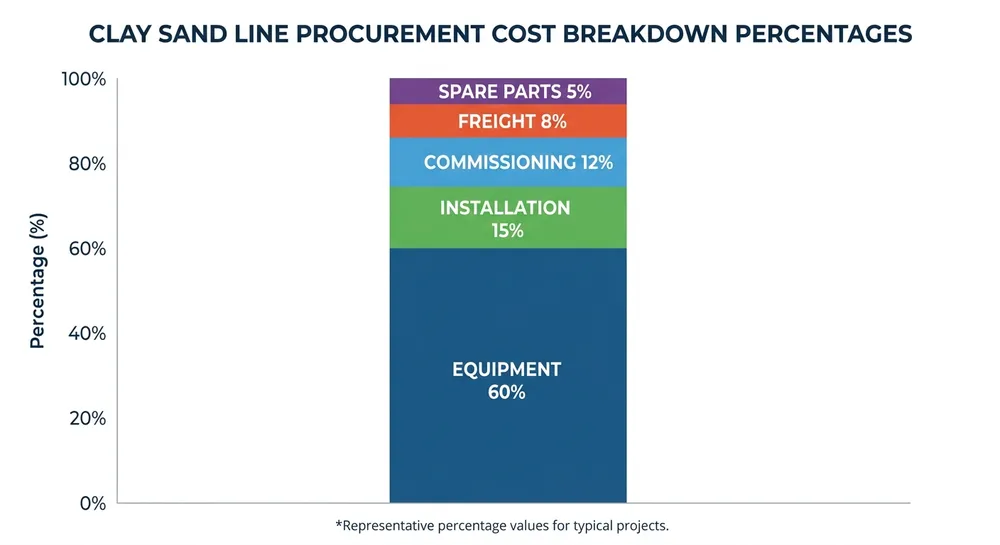
The line cost includes the full reclamation system: magnetic separator, vibrating screen, dust collector, pneumatic conveying, PLC control, and installation hardware. It does not include civil work (foundation, electrical rough-in) or commissioning travel, which vary by site.

Why 15 tons per day is the sweet spot. Below 10 tons per day, payback stretches past three years, and some foundries decide to keep buying new sand rather than invest in equipment. Above 15 tons per day, the savings are so large that the line pays for itself in under two years, making it an easy capital approval. At 30+ tons per day, you're looking at 12-18 month payback, which is faster ROI than most production equipment.

We've installed lines as small as 3 tons per day for foundries with limited floor space or budget, but the business case gets weaker. If you're under 10 tons per day, consider whether you'll scale up in the next 2-3 years. If yes, size the line for future capacity. If no, you might be better off negotiating better pricing on new sand and focusing capital elsewhere.

Clay sand reclamation line payback period comparison chart showing ROI timeline at 5, 15, and 30 tons per day production volumes

Total Cost of Ownership: What Most Suppliers Don't Tell You

The equipment purchase price is only part of clay sand reclamation line ROI. You need to account for ongoing operating costs that eat into your savings.

Electricity consumption. A 15-ton-per-day reclamation line pulls 15-20 kWh per ton processed. At $0.10 per kWh, that's $1.50-2.00 per ton in power cost. Over a year, electricity runs $8,000-11,000. This is already included in the per-ton operating cost above, but it's worth calling out because power rates vary widely. If you're in a region with $0.20/kWh industrial rates, your operating cost doubles.

Wear parts replacement. Vibrating screens, magnetic separator belts, and cyclone liners wear out. Budget $12,000-18,000 per year for a 15-ton line. We ship wear parts kits with 12-month supply included, and most buyers reorder annually. Lead time is 4-6 weeks, so don't wait until you're down to your last screen deck.

Maintenance labor. Plan for 2-3 hours per week of routine maintenance: greasing bearings, checking belt tension, inspecting screen mesh, cleaning dust collector filters. If you have a maintenance crew already, this folds into their schedule. If you're running lean, it's 150 hours per year you need to account for.

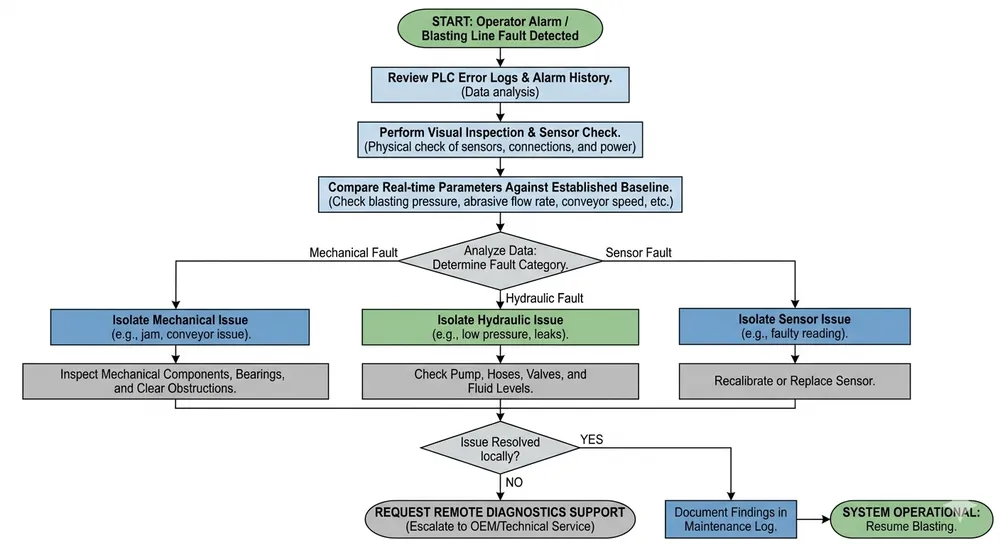
Downtime risk. A reclamation line that's offline means you're back to buying new sand until it's fixed. This is where remote diagnostics matter. Our 4G module lets us troubleshoot from Qingdao without sending a technician to your site. We've resolved 70% of service calls remotely, which keeps your line running and avoids the $3,000-5,000 cost of an on-site visit. Competitors who don't offer remote support leave you waiting 2-3 weeks for a technician, during which you're burning cash on new sand.

Bentonite and water makeup. Even with 95% recovery, you lose 5% of your sand per cycle to dust collection, mold breakage, and carryover. You need to replace that 5% with fresh bentonite and water. At 15 tons per day, that's 0.75 tons per day of makeup material, or $45,000-60,000 per year. This is a real cost, and it's why 95% recovery rate matters more than 90%. That extra 5% is $15,000-20,000 in annual savings.

The total cost of ownership for a 15-ton-per-day line runs $75,000-95,000 per year (electricity, wear parts, maintenance, makeup material). Compare that to $270,000-540,000 in new sand purchase cost, and you're still saving $175,000-445,000 annually after all operating expenses.

Recovery Rate: Why 95% Matters More Than You Think

Most reclamation line suppliers claim 90-95% recovery rate in their brochures. The difference between 90% and 95% sounds small, but it's worth $15,000-20,000 per year on a 15-ton-per-day line.

Here's the math. At 15 tons per day and 360 operating days, you process 5,400 tons annually. At 90% recovery, you lose 540 tons per year. At 95% recovery, you lose 270 tons. That 270-ton difference costs $60-80 per ton to replace with new sand, so the gap is $16,000-21,000 annually.

We verify recovery rate in our in-house sand testing lab before every line ships. The test runs 100 kg of used sand through the full reclamation cycle, then measures compaction strength, moisture content, and particle size distribution on the output. If the reclaimed sand doesn't hit 95% of the original green strength, we adjust screen mesh size or cyclone air velocity until it does. The factory-tested commissioning report documents the actual recovery rate, not catalog specs.

(We learned this the hard way. Early export lines in 2012-2013 hit 88-92% recovery because we were using screen mesh sized for domestic sand, which has different clay content than some overseas sources. After three customers complained about higher-than-expected makeup costs, we started testing with the buyer's actual sand before finalizing the screen specification. Recovery rates jumped to 94-96%, and makeup costs dropped.)

The other reason recovery rate matters: it determines how much waste you still send to landfill. At 90% recovery on a 15-ton line, you dump 1.5 tons per day. At 95%, you dump 0.75 tons per day. Disposal cost is $40-70 per ton, so that's $10,000-18,000 per year in tipping fees you avoid by hitting 95% instead of 90%.

If a supplier quotes you a reclamation line without offering to test your sand first, ask why. Either they don't have a testing lab, or they're not confident their equipment will hit the recovery rate they're claiming. Both are red flags.

Modular Design and Landed Cost Impact on ROI

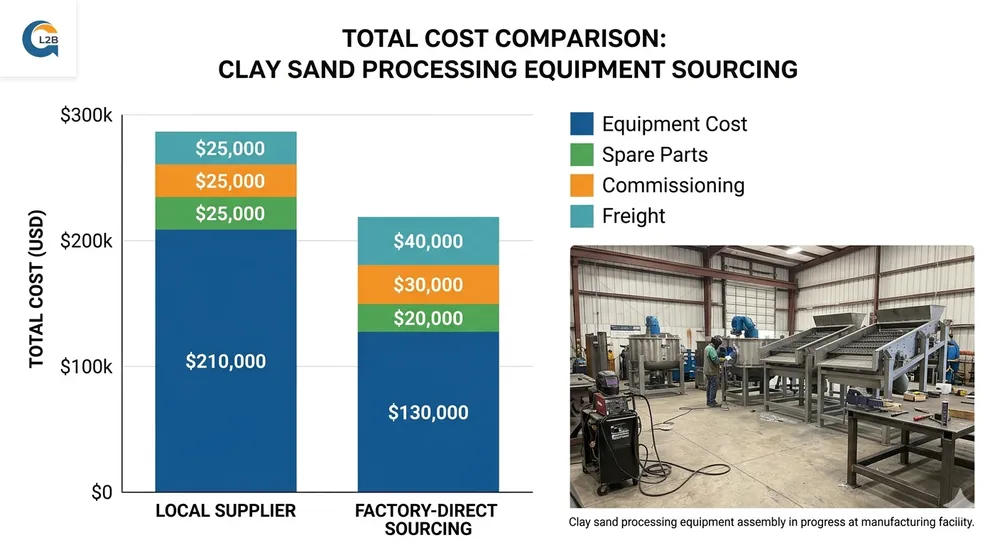
Most buyers focus on the equipment purchase price and forget about shipping. For overseas foundries, freight and import duties can add 25-35% to your landed cost, which directly affects clay sand reclamation line ROI timeline.

Our reclamation lines ship in 2-3 standard containers (20ft or 40ft depending on capacity). Modular design means each major component — magnetic separator, vibrating screen, dust collector, control cabinet — fits container dimensions without custom crating. This cuts your freight cost by 30-40% compared to oversized equipment that requires flat rack containers or break-bulk shipping.

Example: a 15-ton-per-day line ships in two 40ft containers. Ocean freight from Qingdao to Los Angeles runs $4,000-6,000 per container depending on season, so total shipping is $8,000-12,000. A competitor's non-modular line that requires a 40ft flat rack plus one standard container costs $18,000-24,000 to ship the same distance. That $10,000-12,000 difference extends your payback period by 2-3 months.

The modular design also reduces installation time. Each module arrives pre-wired and pre-tested. Your crew bolts the modules together, connects pneumatic lines and power, and you're running sand within 3-5 days. Non-modular systems require field welding, custom ductwork fabrication, and 2-3 weeks of installation labor. Faster installation means you start saving money sooner, which improves ROI.

We've shipped reclamation lines to 40+ countries. The ones that hit their payback timeline are the ones where landed cost stayed within 10-15% of ex-works price. If your freight and duties push landed cost up 30-40%, your payback stretches from 20 months to 28 months. Modular container-optimized design keeps that from happening.

Modular clay sand reclamation line components packed in standard shipping containers showing space efficiency and freight cost reduction

Hidden Costs That Kill ROI: What to Watch For

Some foundries buy a reclamation line expecting 24-month payback and end up at 36 months because they didn't account for these costs:

Inadequate dust collection. Clay sand reclamation generates dust. If your dust collector is undersized or your facility doesn't have adequate ventilation, you'll lose 2-3% more sand to airborne fines than you should. That's $8,000-12,000 per year in extra makeup cost on a 15-ton line. We size dust collectors at 1.5x the minimum CFM requirement specifically to prevent this. Competitors who size at 1.0x minimum save $3,000-4,000 on the dust collector but cost you $10,000+ per year in lost sand.

Poor sand preparation upstream. Reclamation works best when incoming used sand is consistent. If your molding line has moisture control problems or your mixers are drifting, the reclamation line has to work harder to bring sand back to spec. This increases wear part consumption and reduces recovery rate. Fix your preparation line first, then add reclamation. We've seen foundries install reclamation and still only hit 88-90% recovery because their mixer wasn't holding ±0.5% moisture tolerance.

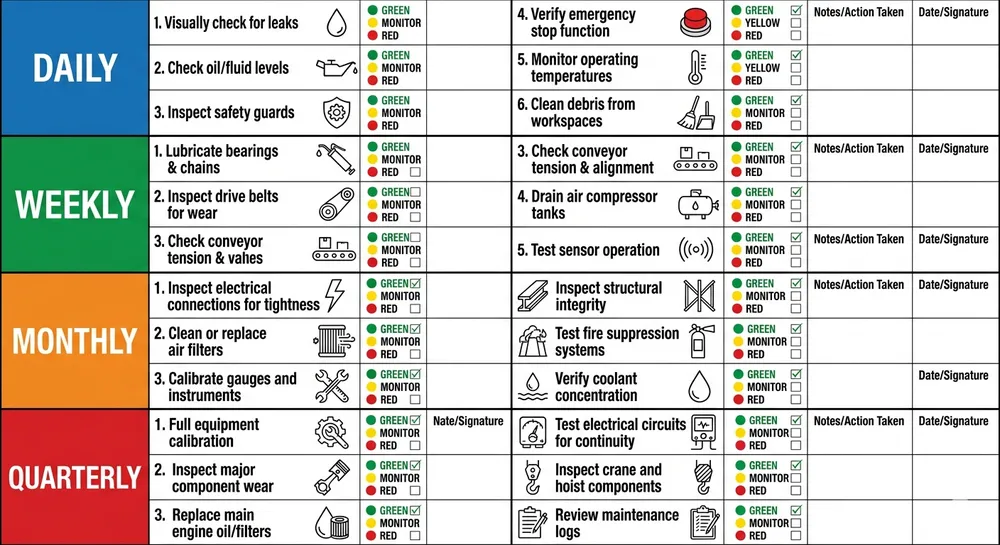
Skipping preventive maintenance. Vibrating screens need tension checks every 200 hours. Magnetic separators need belt alignment every 300 hours. Skip these, and you'll have an unplanned shutdown that costs you 2-3 days of production plus emergency freight on replacement parts. The $500 you saved by skipping maintenance turns into $8,000 in downtime cost and expedited shipping. We include a maintenance schedule with every line. Follow it.

Undersizing for future growth. If you're at 12 tons per day now but expect to hit 18 tons per day in two years, size the line for 20 tons per day. The equipment cost difference is $15,000-20,000, but buying a second line later costs $180,000+ and you lose the compounding savings during the gap years. Most buyers undersize because they're focused on minimizing upfront cost. That's a mistake. Size for where you'll be in 3 years, not where you are today.

When Reclamation Doesn't Make Sense

Clay sand reclamation line ROI is strong for most foundries, but there are cases where it's not the right move:

Very low volume operations. If you're under 5 tons per day and not growing, payback stretches past 4 years. At that point, you're better off negotiating bulk pricing on new sand and using capital for higher-ROI investments like molding automation or quality control equipment.

Inconsistent production schedules. Reclamation lines are designed for continuous operation. If you run 3 days per week or have seasonal production, your annual throughput is too low to justify the equipment cost. The line sits idle 50% of the time, but you still have depreciation and maintenance costs. Stick with new sand purchase unless you can consolidate production into longer continuous runs.

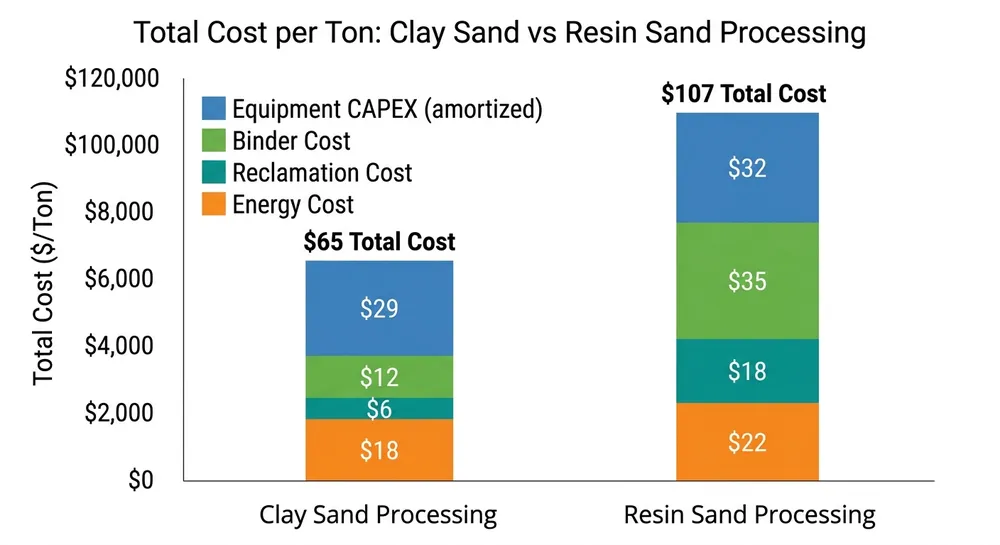
Resin sand or no-bake systems. This article is about clay sand reclamation. Resin sand and no-bake systems have different reclamation economics because you're burning off binder, not just cleaning and re-screening. The equipment cost is higher, recovery rates are lower (70-85%), and energy consumption is 3-4x higher. ROI still works at high volume, but the payback timeline is 30-50 months instead of 18-30 months. If you're running resin sand, contact our engineering team for a separate ROI analysis.

Foundries planning to switch sand systems. If you're considering moving from clay sand to resin sand or lost foam in the next 2-3 years, don't invest in clay sand reclamation. You won't hit payback before the equipment becomes obsolete for your process. Make the sand system decision first, then invest in reclamation for whatever system you land on.

Real-World ROI: What Our Customers Actually See

We track post-installation performance on every line we commission. Here's what buyers report 12-18 months after startup:

A mid-sized foundry in Mexico running 18 tons per day saw $340,000 in first-year savings (new sand purchase, disposal, logistics). Their line cost $195,000 landed. Payback hit at 21 months. They're now in year three, and cumulative savings are over $900,000.

A smaller operation in Poland at 8 tons per day saved $125,000 in year one against a $135,000 equipment cost. Payback took 32 months, slightly longer than our estimate because their power rates were higher than expected. Still, they're saving $120,000+ per year now that the line is paid off.

A high-volume foundry in India at 35 tons per day hit payback in 14 months. Their savings were $680,000 in year one against a $310,000 line cost. They added a second line two years later for a different molding area.

The pattern is consistent: foundries that track costs carefully see payback within 18-36 months depending on volume. After payback, the savings compound year after year. A line with a 10-year service life delivers $2-5 million in cumulative savings over its lifetime, depending on throughput.

The foundries that miss their ROI targets are the ones that didn't account for total cost of ownership (electricity, wear parts, maintenance) or didn't verify recovery rate before purchase. That's why we insist on sand testing and factory commissioning before shipment. It costs us an extra week of engineering time, but it prevents the buyer from discovering problems six months later when they're already committed.

How to Calculate Your Specific ROI

Every foundry's clay sand reclamation line ROI is different because costs vary by region, production volume, and sand source. Here's how to run your own numbers:

Step 1: Calculate your current annual sand cost.

  • Daily sand consumption (tons) × 360 operating days = annual volume
  • Annual volume × delivered cost per ton = total purchase cost
  • Add disposal cost: waste volume × tipping fee per ton
  • Add logistics: inbound freight, handling labor, storage space cost

Step 2: Estimate reclaimed sand operating cost.

  • Annual volume × $6-9 per ton (electricity, wear parts, maintenance, makeup)
  • This is your new annual sand cost with reclamation

Step 3: Calculate annual savings.

  • Current annual cost – reclaimed sand operating cost = annual savings

Step 4: Get equipment pricing.

  • Request a quote for a line sized to your daily throughput
  • Add freight, import duties, installation hardware
  • This is your total investment

Step 5: Divide investment by annual savings.

  • Total investment ÷ annual savings = payback period in years

If your payback is under 30 months, reclamation makes sense. If it's over 40 months, you're either undersized for reclamation or you should negotiate better pricing on new sand and revisit reclamation when your volume grows.

For a detailed ROI analysis specific to your operation, send us your daily throughput, current sand cost, and disposal fees. Our engineering team will run the numbers and send back a breakdown showing payback timeline, annual savings, and total cost of ownership over 10 years. Request an ROI analysis here.

What to Ask Suppliers Before You Buy

Not all clay sand reclamation lines deliver the ROI their sales literature promises. Here's what to verify before you commit:

Ask for factory test data on recovery rate. If they can't show you test results from their own lab using sand similar to yours, they're guessing. We run a 100 kg test batch and provide a commissioning report with actual recovery rate, green strength, and particle size distribution. That report becomes your baseline for ongoing performance.

Ask about remote diagnostics. Downtime kills ROI. If the supplier can't troubleshoot remotely, you're paying $3,000-5,000 for on-site service calls plus 2-3 weeks of downtime waiting for a technician. Our 4G module costs $800 but saves $15,000-20,000 in service costs over the line's lifetime.

Ask about modular shipping. If the equipment doesn't fit standard containers, your freight cost will be 30-40% higher. That extends payback by 2-4 months. Get a container loading plan before you sign the purchase order.

Ask for wear parts pricing and lead time. Some suppliers lowball the equipment price and make it back on expensive wear parts. Get a written quote for a 12-month wear parts kit and confirm lead time. If screens or liners cost 2x what you expected, your operating cost assumptions are wrong and your ROI timeline is wrong.

Ask about total power consumption. Some lines pull 25-30 kWh per ton instead of 15-20 kWh because they're using older motor technology or oversized blowers. That's $5,000-8,000 per year in extra electricity cost on a 15-ton line. Get the nameplate power rating for every motor and calculate total kWh per ton processed.

Making the Decision

Clay sand reclamation line ROI is straightforward: if you're processing 10+ tons per day, the equipment pays for itself in 18-36 months through eliminated sand purchases, reduced disposal costs, and lower logistics expenses. After payback, you're saving $150,000-500,000+ per year depending on volume.

The key is accurate cost accounting. Don't just compare equipment price — calculate total cost of ownership including electricity, wear parts, maintenance, and makeup material. Verify recovery rate with factory testing, not catalog specs. Size the line for where your production will be in 3 years, not where it is today.

For foundries already running clay sand molding lines, reclamation is one of the highest-ROI investments you can make. The savings are immediate, measurable, and compound year after year. The foundries that track costs carefully see payback in under 30 months and cumulative savings in the millions over the equipment's service life.

If you want to run the numbers for your specific operation, send us your daily throughput and current sand costs. We'll calculate your payback timeline and show you exactly what the savings look like over 5 and 10 years. Get your custom ROI analysis.

How to Calibrate a Clay Sand Preparation Line for Uniform Sand Properties Across Batches

Inconsistent sand properties cost you more than scrap molds. When your preparation line drifts out of calibration, you lose compactability control, moisture balance shifts between batches, and green strength varies enough that molds crack during handling or pouring. I've seen foundries run three shifts where the morning batch tests at 45% compactability and the night shift drops to 38% — same recipe, same materials, but the line wasn't calibrated to hold parameters across operator changes and ambient humidity swings.

The real expense shows up downstream: mold defects, casting rejections, rework cycles, and the time your molding line sits idle while you troubleshoot sand that should have been right before it reached the mixer. Calibration isn't a one-time commissioning task. It's the difference between a preparation line that delivers repeatable sand properties and one that forces your QC team to chase problems every shift.

Why Preparation Lines Drift Out of Calibration

Clay sand preparation lines drift because they operate in a changing environment. Ambient humidity affects clay activation, raw sand moisture content varies by supplier batch, and mechanical wear changes mixing intensity over time. The PLC can hold programmed parameters perfectly, but if those parameters were set for 15°C and 40% humidity, they won't produce the same sand properties at 28°C and 70% humidity.

We calibrate preparation lines to compensate for these variables. The goal is to measure actual sand output — compactability, moisture content, green strength, permeability — and adjust mixer water addition, mulling time, and clay feed rate until the sand meets target specs regardless of ambient conditions or shift changes.

Most calibration drift happens in three places: water addition accuracy (nozzles clog or flow meters drift), mulling time consistency (variable-frequency drives lose calibration), and clay dispersion uniformity (worn mixer blades reduce shear). If your sand properties vary batch-to-batch but your PLC logs show stable parameters, the sensors or actuators have drifted, not the control logic.

Pre-Calibration Baseline: What You Need Before You Start

Before adjusting any PLC parameters, establish your current baseline. You can't calibrate toward a target if you don't know where you're starting from.

Run three consecutive batches under normal production conditions and test each batch for:

  • Compactability (AFS standard test, 3 drops from 2 inches)
  • Moisture content (gravimetric method, 105°C oven dry)
  • Green compression strength (standard 2-inch diameter specimen)
  • Permeability (AFS permeability number)

Record ambient temperature and humidity for each batch. If your three baseline batches show variation greater than ±2% on compactability or ±0.3% on moisture, your line needs calibration. Tighter specs (±1% compactability, ±0.2% moisture) are achievable with proper calibration, and that's what you should target for high-speed molding lines where mold consistency directly affects cycle time.

Check your raw materials before blaming the equipment. If your clay supplier changed bentonite sources or your sand reclamation system is returning contaminated sand, calibration won't fix a feedstock problem. We test incoming clay for methylene blue value and raw sand for AFS grain fineness number — if those drift, adjust your recipe before recalibrating the line.

Clay sand preparation line baseline testing workflow showing compactability, moisture, and strength measurements

Step 1: Calibrate Water Addition System

Water addition is the most sensitive parameter in clay sand preparation. A 0.5% moisture error changes compactability by 3-5 points and shifts green strength enough to cause mold handling failures.

Start by verifying your flow meter accuracy. Most preparation lines use magnetic flow meters on the water feed line. Disconnect the line downstream of the meter, run a timed flow test into a calibrated container, and compare actual volume to the PLC reading. If the error exceeds 2%, recalibrate the flow meter or replace it if the sensor has drifted beyond adjustment range.

Check water nozzle condition. Clay particles and mineral deposits clog spray nozzles, reducing flow and creating uneven water distribution inside the mixer. Remove each nozzle, inspect for buildup, and flow-test against the manufacturer's spec. We replace nozzles when flow drops below 95% of rated capacity — partial clogging creates dry pockets in the mix that show up as compactability variation.

Adjust water addition timing. Water should enter the mixer during the initial mulling phase, not dumped all at once. The PLC controls this through solenoid valve timing. For a typical 500 kg batch mixer, we program water addition over 15-20 seconds during the first 30 seconds of mulling. Faster addition doesn't give clay time to hydrate uniformly; slower addition extends cycle time without improving dispersion.

Run a test batch with your corrected water system. Measure moisture content immediately after discharge. Target moisture depends on your clay type and molding process — for sodium bentonite clay sand used in flaskless molding, we typically target 3.0-3.5% moisture. Adjust the PLC water setpoint in 0.1% increments until three consecutive batches hit target ±0.2%.

Step 2: Calibrate Mulling Time and Mixer Speed

Mulling time controls clay dispersion and sand grain coating uniformity. Too short and clay doesn't fully activate; too long and you overheat the sand, driving off moisture and degrading clay performance.

Most preparation line mixers use variable-frequency drives (VFDs) to control rotor speed. Verify actual rotor RPM against the PLC setpoint using a tachometer or strobe light. VFD calibration drifts over time, especially in dusty foundry environments where cooling fans clog and drive electronics overheat. If measured RPM is more than 3% off setpoint, recalibrate the VFD or check for mechanical issues (worn bearings, loose belts).

Standard mulling time for clay sand preparation:

  • Initial mixing phase: 30-45 seconds at full speed (disperse clay and distribute water)
  • Mulling phase: 90-120 seconds at 70-80% speed (activate clay and coat sand grains)
  • Final homogenization: 15-30 seconds at full speed (eliminate lumps)

These times assume a continuous paddle mixer with 500-800 kg batch capacity. Smaller mixers need shorter cycles; larger mixers need longer. The test is sand temperature at discharge — if it exceeds 40°C, you're over-mulling and driving off moisture. If compactability is inconsistent batch-to-batch but moisture is stable, you're under-mulling and clay isn't fully dispersed.

We adjust mulling time based on ambient temperature. In summer (above 25°C), reduce mulling time by 10-15 seconds to prevent overheating. In winter (below 10°C), extend mulling time by 10-15 seconds because clay hydration slows at lower temperatures. The PLC can automate this if you install a temperature sensor in the mixer discharge chute and program seasonal compensation curves.

Step 3: Calibrate Clay Feed Rate and Distribution

Clay feed rate determines bonding strength and sand flowability. Too little clay and molds lack green strength; too much clay and sand becomes sticky, reducing permeability and causing gas defects in castings.

Most preparation lines feed clay through a volumetric screw feeder or belt feeder controlled by the PLC. Calibrate the feeder by running it for a timed interval (60 seconds) and weighing the discharged clay. Compare actual weight to the PLC setpoint. If the error exceeds 3%, adjust the feeder calibration factor in the PLC or check for mechanical issues (worn screw flights, belt slippage, bridging in the hopper).

Clay addition point matters. Clay should enter the mixer before water addition, not after. Adding clay to wet sand creates lumps that don't disperse fully even with extended mulling. We position the clay feed chute to discharge directly onto the mixer rotor, not into the sand stream, so the rotor shear breaks up clay clumps before water activates them.

For sodium bentonite clay, typical addition rates are 8-12% by weight of new sand (not total sand — reclaimed sand already contains residual clay). If you're running 70% reclaimed sand and 30% new sand, your clay addition should be 2.4-3.6% of total batch weight. Adjust based on methylene blue testing of your reclaimed sand — higher residual clay means lower fresh clay addition.

Run three test batches at your calibrated clay feed rate and measure green compression strength. Target values depend on your molding process, but for flaskless molding we typically target 12-16 psi (0.8-1.1 kg/cm²). If strength is low, increase clay addition by 0.5% increments. If strength is high but permeability drops below 100 AFS units, you're over-claying and need to reduce addition or improve clay dispersion.

PLC parameter adjustment screen for clay sand mixer showing water addition, mulling time, and clay feed rate controls

Step 4: Verify Calibration Across Shift Changes and Ambient Conditions

Calibration isn't complete until you've verified that sand properties hold stable across different operators, shifts, and ambient conditions. This is where most preparation lines fail — they calibrate perfectly during commissioning, then drift within weeks because nobody validated performance under real production variability.

Run a 24-hour validation test:

  • Produce batches every hour for 24 hours (or one complete production cycle if you run batch molding)
  • Test every third batch for compactability, moisture, green strength, and permeability
  • Record ambient temperature and humidity for each test batch
  • Log operator changes and any manual adjustments made during the test period

If your sand properties stay within ±2% compactability and ±0.3% moisture across the full 24-hour cycle, your calibration is stable. If properties drift during specific shifts or ambient conditions, you need to add compensation logic to the PLC.

Humidity compensation is critical for clay sand. Sodium bentonite absorbs atmospheric moisture, so your effective clay activity increases in humid conditions and decreases in dry conditions. We program the PLC to reduce water addition by 0.1% for every 10% increase in relative humidity above 50%, and increase water addition by 0.1% for every 10% decrease below 50%. This requires a humidity sensor in the mixing area and a simple compensation algorithm in the PLC — most Siemens and Mitsubishi controllers support this natively.

Temperature compensation affects mulling time. At higher ambient temperatures, clay hydrates faster and sand heats up more during mulling. We reduce mulling time by 5 seconds for every 5°C increase above 20°C baseline. At lower temperatures, extend mulling time by the same increment. This prevents summer batches from overheating and winter batches from under-mulling.

If your validation test shows drift that compensation algorithms don't fix, check for mechanical wear. Worn mixer blades reduce shear intensity, worn feeder screws change clay delivery rate, and clogged water nozzles create uneven moisture distribution. These are maintenance issues, not calibration issues, but they show up as calibration drift.

Calibration Verification Checklist

Use this checklist after completing calibration to confirm your preparation line delivers consistent sand properties:

Water system verification:

  • Flow meter accuracy within ±2% of calibrated volume
  • All spray nozzles flowing at ≥95% rated capacity
  • Water addition timing programmed for 15-20 second delivery during initial mulling
  • Target moisture achieved within ±0.2% across three consecutive batches

Mixer system verification:

  • Rotor speed within ±3% of PLC setpoint at all programmed speeds
  • Mulling time programmed for ambient temperature compensation
  • Discharge temperature below 40°C under normal production conditions
  • Compactability variation less than ±2% across three consecutive batches

Clay feed system verification:

  • Feeder calibration within ±3% of setpoint weight over 60-second test
  • Clay addition point positioned before water addition in mixer sequence
  • Green strength within target range (typically 12-16 psi for flaskless molding)
  • Permeability above 100 AFS units (adjust if clay addition is too high)

Ambient compensation verification:

  • Humidity sensor installed and reading accurately
  • PLC programmed for ±0.1% water adjustment per 10% humidity change
  • Temperature sensor installed in mixing area
  • PLC programmed for ±5 second mulling time adjustment per 5°C temperature change

24-hour stability verification:

  • Sand properties tested every 2-3 hours across full production cycle
  • Compactability variation less than ±2% across all test points
  • Moisture variation less than ±0.3% across all test points
  • No operator-dependent variation between shifts

When Calibration Isn't Enough: Upstream Material Control

If you've calibrated your preparation line correctly but still see batch-to-batch variation, the problem is upstream. Sand properties depend on feedstock quality, and no amount of calibration fixes inconsistent raw materials.

Clay quality variation is the most common upstream issue. Bentonite suppliers blend material from multiple mines, and methylene blue value can vary ±15% batch-to-batch even within the same product grade. We test incoming clay monthly and adjust addition rates when methylene blue value drifts outside ±5% of baseline. If your supplier can't hold tighter consistency, switch suppliers or negotiate for single-source material.

Reclaimed sand contamination shows up as erratic green strength and permeability. If your reclamation system isn't removing fines effectively, you're returning sand with high residual clay content that throws off your preparation line recipe. We target less than 5% fines (below 200 mesh) in reclaimed sand. Higher fines content means you need to reduce fresh clay addition, but that creates a moving target as fines content varies batch-to-batch.

Raw sand moisture content varies seasonally and by storage conditions. Sand stored outdoors absorbs moisture during humid periods and dries out in winter. We store raw sand in covered silos and measure moisture content weekly. If raw sand moisture varies more than ±0.5%, adjust your preparation line water addition setpoint to compensate — the PLC can't measure what's already in the sand before mixing starts.

The preparation line can only work with what you feed it. Calibration controls the mixing process, but material consistency controls the final result. If you're chasing calibration every week, audit your feedstock quality first.

Maintaining Calibration Over Time

Calibration isn't permanent. Mechanical wear, sensor drift, and process changes require periodic recalibration to maintain sand property consistency.

Monthly calibration checks:

  • Flow meter accuracy test (timed volume measurement)
  • Mixer rotor speed verification (tachometer check against PLC setpoint)
  • Clay feeder calibration (60-second weight test)
  • Three-batch sand property test (compactability, moisture, green strength)

Quarterly maintenance tasks:

  • Water nozzle inspection and cleaning (replace if flow drops below 95%)
  • Mixer blade wear measurement (replace when blade height reduces by 10mm)
  • VFD cooling fan cleaning (prevents drive overheating and calibration drift)
  • PLC sensor calibration verification (temperature, humidity, flow meters)

Annual recalibration:

  • Full baseline testing (three-batch property measurement)
  • Complete water system calibration (flow meter, nozzles, timing)
  • Complete mixer system calibration (speed, mulling time, temperature compensation)
  • Complete clay feed system calibration (feeder accuracy, addition rate, distribution)
  • 24-hour validation test (verify stability across shifts and ambient conditions)

We track calibration history in the PLC data logs. If you see gradual drift in water addition or clay feed rate over months, that's normal wear. If you see sudden changes, that's a mechanical failure or sensor fault that needs immediate attention.

How TZFoundry Preparation Lines Simplify Calibration

The preparation lines we ship include pre-loaded calibration profiles for common clay types and molding processes. When you commission a line, you select your clay supplier, target moisture range, and molding line speed, and the PLC loads baseline parameters that get you within 80% of target properties on the first batch. You still need to fine-tune for your specific materials and ambient conditions, but you're not starting from zero.

Our PLC programming includes automatic humidity and temperature compensation. The system reads ambient sensors every batch cycle and adjusts water addition and mulling time without operator intervention. This eliminates the shift-to-shift variation that happens when operators manually adjust parameters based on feel rather than measurement.

The 4G remote diagnostics module lets our engineering team access your PLC data and help troubleshoot calibration drift without a site visit. If your sand properties start varying, we can log in, review your parameter history and sensor readings, and recommend specific adjustments. Most calibration issues resolve within 24 hours this way — faster than waiting for a service technician to fly in.

We test every preparation line in our sand reclamation lab before shipment. We run 20 batch cycles with your specified clay type and measure sand properties across the full run. If the line doesn't hold ±1.5% compactability and ±0.2% moisture across all 20 batches, we recalibrate before shipping. You receive calibration test reports with your equipment documentation, so you know exactly what performance to expect during commissioning.

If you're evaluating preparation line suppliers, ask about calibration support. Equipment that ships with generic PLC programming requires weeks of trial-and-error tuning on your factory floor. Equipment that ships pre-calibrated for your materials and process starts producing good sand on day one. The difference is whether the supplier has a sand testing lab and uses it, or just builds mixers and hopes you figure out the rest.

For preparation line specifications, capacity planning, or calibration support, contact our clay sand process engineering team. We'll review your current sand properties, molding line requirements, and ambient conditions, then recommend the preparation line configuration that delivers the consistency you need.

How to Extend Clay Sand Jaw Crusher Wear Plate Life and Cut Replacement Costs

Jaw crusher wear plates in clay sand reclamation lines fail faster than most buyers expect. A foundry running 8-hour shifts can burn through a set of manganese plates in 4-6 months instead of the 12-18 months the supplier quoted. The replacement cost isn't just the plates — it's the downtime, the labor, and the production backup while your crusher sits offline.

I've commissioned over 60 clay sand processing lines, and wear plate life is one of the first conversations after startup. The problem isn't always the plate material. It's how the sand enters the crusher, how moisture affects abrasion rates, and whether anyone's rotating the plates before they're completely worn through on one side.

Why Clay Sand Crushers Eat Through Plates Faster Than Hard Rock Units

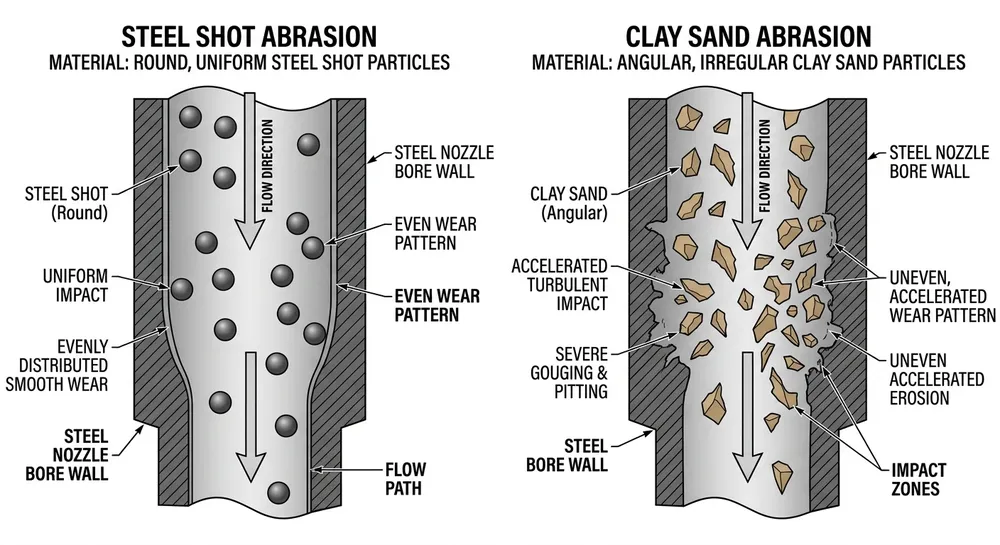
Clay sand creates a different wear pattern than quarry rock. The abrasive mechanism combines three factors: silica particle sharpness, clay binder residue that forms a grinding paste when wet, and the fine particle size distribution that works its way into every gap and bearing surface.

Silica content drives the base wear rate. Most reclaimed clay sand runs 85-92% silica by weight. Those angular quartz particles act like grinding compound. In our sand reclamation testing lab, we've measured wear rates 40% higher on clay-bonded sand compared to clean silica sand at the same feed rate, purely because the clay residue holds moisture and turns the crushing zone into a lapping operation instead of impact fracture.

Moisture amplifies abrasive wear. Dry sand fractures cleanly. Wet sand (anything above 3-4% moisture content) forms a slurry that increases contact time between the abrasive particles and the plate surface. We've seen foundries running reclaimed sand at 6-8% moisture — their plates wear through in half the expected service life because the crusher is essentially running a wet grinding process.

Feed size distribution matters more than peak hardness. A jaw crusher rated for 50mm feed can handle occasional oversize lumps without immediate damage. But if your upstream screening is letting through 30-40% oversize material, the crusher runs in continuous overload. The plates take repeated high-impact hits instead of steady compression cycles, and fatigue cracks start at the mounting bolt holes within 2,000 operating hours.

Clay binder residue is the hidden factor. Even after thermal reclamation, 2-5% clay remains bonded to the sand grains. When that residue gets wet from atmospheric moisture or cooling water carryover, it forms a paste that holds abrasive particles against the wear plate surface during the compression stroke. This is why coastal foundries (higher humidity) report 20-30% shorter plate life than inland facilities running the same equipment and sand type.

Wear Plate Material Selection: High-Mn vs Cr-Mo Alloy vs Martensitic Steel

Not all jaw crusher wear plates are the same material. The three common grades perform differently in clay sand service, and the cost difference only makes sense if you calculate it per ton of sand processed, not per set of plates.

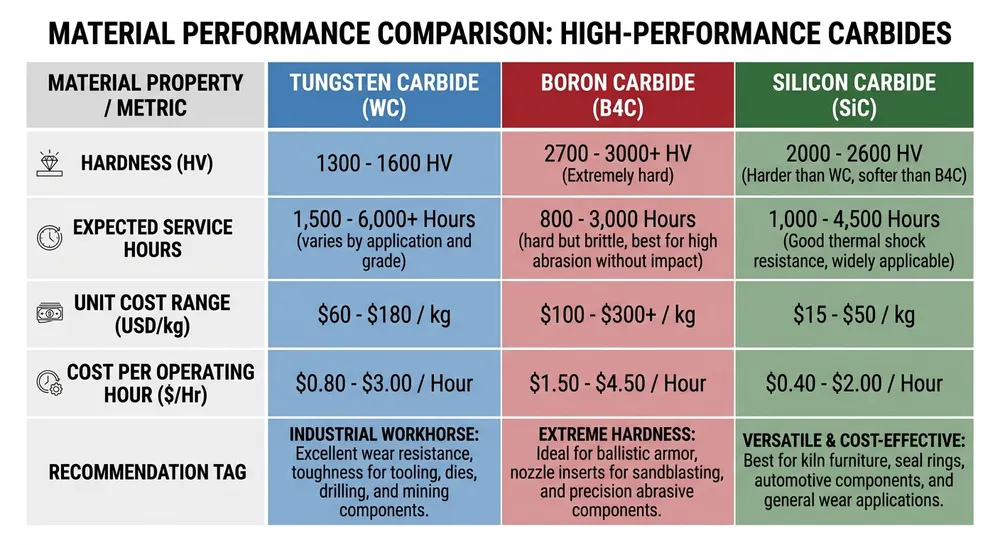
High-manganese steel (Mn13, Mn18) is the standard OEM spec for most jaw crushers. It work-hardens under impact, reaching 450-550 HB surface hardness after break-in. In clean hard rock service, Mn13 plates can run 8,000-12,000 hours. In clay sand reclamation, expect 3,000-5,000 hours because the abrasive wear mechanism doesn't generate enough impact to maintain the work-hardened layer. The surface stays relatively soft (220-280 HB as-cast) and wears by micro-cutting instead of impact deformation.

We've tested Mn13 plates in our sand reclamation lab at 15 tons/hour feed rate with 88% silica clay sand at 4% moisture. Measured wear rate: 0.8-1.2 mm per 1,000 operating hours on the compression face. At that rate, a 40mm thick plate is down to minimum safe thickness (15mm remaining) in 2,500-3,000 hours.

Chromium-molybdenum alloy plates (Cr15Mo3, Cr18Mo2) offer better abrasion resistance through carbide precipitation. These plates run 550-650 HB as-delivered and maintain hardness under abrasive wear. In the same clay sand test conditions, Cr-Mo plates wore at 0.5-0.7 mm per 1,000 hours — roughly 40% slower than Mn13.

The trade-off: Cr-Mo plates cost 60-80% more than Mn13, but if you're processing 50,000 tons annually, the cost per ton processed drops because you're changing plates half as often. For a 250mm x 400mm jaw crusher, Mn13 plates run about $800-1,200 per set. Cr-Mo plates run $1,400-2,000. But Mn13 plates last 3,000 hours (processing ~45,000 tons at 15 tons/hour), while Cr-Mo plates last 5,000 hours (~75,000 tons). Cost per ton: Mn13 = $0.018-0.027, Cr-Mo = $0.019-0.027. The Cr-Mo advantage shows up in reduced downtime and labor, not raw material cost.

Martensitic steel plates (400-450 HB) are the budget option. They're cheaper than Mn13 but wear 50-70% faster in abrasive service. Only use these if your sand volume is low (under 20,000 tons/year) and your labor cost for plate changes is minimal. We don't recommend them for continuous production lines.

Jaw crusher wear plate material comparison chart showing wear rates for high-manganese, chromium-molybdenum, and martensitic steel in clay sand service

The Plate Rotation Protocol That Doubles Service Life

Most foundries run jaw crusher plates until they fail, then replace both sides. That's leaving 40-50% of the plate's usable life on the table. Wear isn't symmetrical — the moving jaw plate wears faster than the fixed plate, and the bottom third of both plates wears faster than the top because that's where the crushing action concentrates.

Rotate plates at 50% wear, not at failure. When the moving plate measures 50% of its original thickness at the maximum wear point (usually 60-80mm from the bottom edge), pull both plates and rotate them 180 degrees vertically. The lightly-worn top section moves to the high-wear bottom position. This gives you another 2,000-3,000 hours before replacement instead of scrapping plates with 15-20mm of usable material still on the top half.

Here's the rotation sequence we recommend for foundries running continuous shifts:

  1. Initial installation — Mark the top edge of each plate with a center punch or paint marker so you can track orientation.
  1. First inspection at 1,000 hours — Measure plate thickness at three points: 100mm from top, center, and 100mm from bottom. Record the measurements. This establishes your wear rate baseline.
  1. Rotation at 50% wear — When the bottom measurement shows 50% thickness loss (typically 2,000-3,000 hours for Mn13 in clay sand), rotate both plates 180 degrees. The old top becomes the new bottom.
  1. Second rotation at 75% total wear — After another 1,500-2,500 hours, the plates are worn 75% through. At this point, flip the moving plate to the fixed position and the fixed plate to the moving position, then rotate both 180 degrees again. This balances the wear between the two plates.
  1. Final replacement — When any section measures less than 15mm remaining thickness, replace both plates. Running below 15mm risks catastrophic failure where the plate cracks through and jams the crusher with broken pieces.

The measurement protocol matters. Use an ultrasonic thickness gauge if you have one — it's faster and more accurate than calipers on installed plates. If you're using calipers, measure from the back mounting surface to the wear face through the mounting bolt holes. Don't guess by visual inspection. A plate that looks "about half worn" might be at 60% or 40%, and that 20% difference is 500-800 operating hours.

Rotation downtime is 2-4 hours depending on crusher size. A 250mm x 400mm jaw crusher takes two people about 3 hours to pull the plates, flip them, and reinstall with new mounting bolts. That's 3 hours of downtime to gain 2,000+ hours of additional service life. The math is obvious.

One caution: always replace the mounting bolts during rotation. Reusing bolts is false economy — they're torqued to 400-600 Nm depending on crusher size, and the threads deform under that load. A $15 bolt that fails lets a 50kg plate come loose inside a running crusher. We've seen the aftermath twice, and the repair cost was 20-30x the cost of new bolts.

Step-by-step jaw crusher wear plate rotation sequence diagram showing 180-degree vertical flip and position swap protocol

Feed Control: The Upstream Fix That Protects Your Plates

Wear plate life starts before the crusher. If your upstream screening is inconsistent, your crusher pays the price in accelerated wear and unplanned downtime.

Screen mesh selection determines what reaches the crusher. Most clay sand jaw crushers are sized for 30-50mm feed. If your vibrating screen is running 40mm mesh but the screen deck is blinded (clogged with clay residue), oversize lumps pass through and the crusher runs in continuous overload. We've measured 30-40% faster plate wear on crushers fed by blinded screens compared to clean screens at the same nominal mesh size.

Check your screen deck every shift. Clay residue builds up on the underside of the mesh and reduces effective opening size. A 40mm square mesh can blind down to 25-30mm effective opening within 8 hours of operation if the sand moisture is above 5%. Use a rubber mallet to tap the screen frame — if you hear a dull thud instead of a metallic ring, the deck is loaded with clay and needs cleaning.

Moisture control before crushing reduces abrasive paste formation. If your reclaimed sand is coming off a thermal reclamation unit, it should be under 2% moisture. If it's coming from a wet reclamation process, you need a dewatering step (vibrating screen with drainage deck or a spin dryer) before the crusher. Running sand at 6-8% moisture through a jaw crusher turns the crushing zone into a grinding mill, and your plates wear 40-50% faster.

We've tested this in controlled conditions: same sand composition, same feed rate, same crusher, only variable was moisture content. At 2% moisture, Mn13 plates wore at 0.9 mm per 1,000 hours. At 7% moisture, wear rate jumped to 1.4 mm per 1,000 hours. The wet sand forms a slurry that holds abrasive particles in contact with the plate surface during the entire compression stroke instead of fracturing and falling away.

Feed rate consistency matters more than peak capacity. A jaw crusher rated for 20 tons/hour can handle brief surges to 25-30 tons without damage. But if your upstream conveyor is dumping material in uneven batches — 10 tons for two minutes, then 35 tons for two minutes — the crusher alternates between underload (plates don't work-harden properly) and overload (excessive impact stress). This cycling accelerates fatigue crack formation at the mounting bolt holes.

Install a feed hopper with a variable-speed belt feeder between your screen and your crusher. The hopper buffers the flow and the belt feeder maintains steady tonnage into the crusher throat. A 2-cubic-meter hopper costs $3,000-5,000 installed and extends plate life by 15-20% by eliminating feed surges. For a foundry processing 100,000 tons annually, that's an extra 6-9 months before plate replacement.

Inspection Checkpoints: Catch Problems Before Plates Fail

Jaw crusher plates don't fail suddenly unless something upstream breaks. They wear gradually, and if you're checking the right indicators, you'll see problems developing 500-1,000 hours before failure.

Thickness measurements every 500 operating hours. Use the three-point measurement protocol: 100mm from top, center, 100mm from bottom on both fixed and moving plates. Record the measurements in a logbook or maintenance software. When the bottom measurement shows 50% wear, schedule the rotation. When any point shows less than 15mm remaining, schedule replacement.

Visual inspection for crack initiation. Pull the crusher guards and inspect the plate surfaces every 1,000 hours. Look for hairline cracks radiating from the mounting bolt holes — these are fatigue cracks from impact stress. If you see cracks longer than 20mm, replace the plate immediately. A cracked plate can fracture completely during operation, and the broken pieces jam the crusher and damage the frame.

Check mounting bolt torque every 250 hours. Jaw crusher plates are held by 4-8 bolts torqued to 400-600 Nm depending on crusher size. Vibration loosens these bolts over time. A loose plate shifts during operation, and the mounting holes elongate. Once the holes are elongated, the plate can't be properly secured even with new bolts. Check torque with a calibrated torque wrench, not by feel. If a bolt has loosened more than 10% from spec, remove it and inspect the mounting hole for elongation or cracking.

Monitor crusher discharge particle size. If your crusher is producing finer material than normal (more -5mm fines in the discharge), the plates are worn and the crushing gap has opened up. This is a secondary indicator — by the time you see it, the plates are already at 60-70% wear. But it's useful for catching unexpected wear acceleration from feed problems or material changes.

Listen for abnormal noise. A jaw crusher running normally has a steady rhythmic impact sound. If you hear metallic scraping, rattling, or irregular impacts, shut down and inspect immediately. Scraping means a plate has shifted or a mounting bolt has failed. Rattling means something is loose in the crushing chamber. Irregular impacts mean oversize material is jamming the crusher or a plate has cracked.

We've seen foundries run crushers with cracked plates for weeks because "it still seemed to be working." The plate finally fractured completely, jammed the crusher, bent the toggle plate, and cracked the crusher frame. Repair cost: $18,000 plus three weeks downtime. A $1,200 plate replacement would have prevented all of it.

Cost-Per-Ton Analysis: When Upgrading Plate Material Pays Off

The decision between Mn13 and Cr-Mo plates isn't about upfront cost. It's about total cost per ton of sand processed, including downtime and labor.

Here's the calculation framework for a 250mm x 400mm jaw crusher processing 50,000 tons of clay sand annually:

Mn13 plates:

  • Plate cost: $1,000 per set
  • Service life: 3,000 hours (45,000 tons at 15 tons/hour)
  • Replacement labor: 4 hours at $50/hour = $200
  • Downtime cost: 4 hours at $300/hour production value = $1,200
  • Total cost per replacement: $2,400
  • Replacements per year: 1.1 sets
  • Annual cost: $2,640
  • Cost per ton: $0.053

Cr-Mo plates:

  • Plate cost: $1,700 per set
  • Service life: 5,000 hours (75,000 tons at 15 tons/hour)
  • Replacement labor: 4 hours at $50/hour = $200
  • Downtime cost: 4 hours at $300/hour production value = $1,200
  • Total cost per replacement: $3,100
  • Replacements per year: 0.67 sets
  • Annual cost: $2,077
  • Cost per ton: $0.042

The Cr-Mo plates cost 70% more per set but deliver 21% lower cost per ton because you're changing them less often. The real savings is in downtime — one fewer plate change per year saves 4 hours of production downtime worth $1,200.

The break-even threshold is around 30,000 tons annually. Below that volume, the downtime savings don't justify the higher plate cost. Above 30,000 tons, Cr-Mo plates pay for themselves within the first year.

For foundries running multiple shifts or high-value casting production, the downtime cost dominates the calculation. If your crusher downtime costs $500-800/hour in lost production, Cr-Mo plates pay for themselves even at lower annual tonnage.

One factor buyers often miss: plate availability and lead time. Mn13 plates are commodity items — most crusher OEMs and aftermarket suppliers stock them. Cr-Mo plates are often made to order with 4-8 week lead times. If you're switching to Cr-Mo, order a spare set when you place your first order. The inventory cost is less than the cost of waiting 6 weeks for plates while your crusher sits idle.

Sourcing Considerations: OEM vs Aftermarket Plates

Jaw crusher wear plates are available from three sources: the crusher OEM, aftermarket casting suppliers, and local fabrication shops. Quality and fit vary significantly.

OEM plates are the safe choice for critical applications. They're cast to the original design specifications, heat-treated to the correct hardness, and machined to fit without modification. The premium is 30-50% over aftermarket plates, but you're paying for dimensional accuracy and material certification. If your crusher is under warranty or you're running a high-throughput line where downtime is expensive, use OEM plates.

Aftermarket casting suppliers offer plates at 40-60% of OEM pricing. Quality varies. The good suppliers use the same material specs (Mn13, Cr-Mo) and provide material test reports. The marginal suppliers use whatever manganese steel they can source cheaply, and the hardness can be 50-100 HB below spec. We've tested aftermarket plates that were supposed to be Mn13 (220-280 HB as-cast) but measured 180-200 HB — they wore through in 60% of expected service life.

If you're buying aftermarket plates, require material test reports showing chemical composition and hardness. Acceptable Mn13 composition: 1.0-1.4% C, 11-14% Mn, <1.0% Si, <0.05% P, <0.03% S. Hardness: 220-280 HB as-cast, 450-550 HB after work-hardening. If the supplier can't provide test reports, don't buy the plates.

Local fabrication shops sometimes offer to make plates from mild steel or low-alloy steel at 30-40% of OEM cost. Don't do this unless you're running a very low-volume operation (under 10,000 tons/year) and you understand you'll be replacing plates 3-4 times as often. Mild steel plates wear at 2-3 mm per 1,000 hours in clay sand service — they're effectively consumable items that need replacement every 800-1,200 hours.

We manufacture jaw crushers as part of our clay sand processing line systems, and we supply matched OEM wear plates for our equipment. If you're running a TZFoundry crusher, our plates are designed for the specific frame geometry and mounting bolt pattern. For other crusher brands, we can manufacture aftermarket plates to your specifications with material test reports and dimensional verification.

What to Do Next

If your jaw crusher plates are wearing faster than expected, start with the upstream factors: check your screen deck for blinding, measure sand moisture content, and verify feed rate consistency. These fixes cost less than $5,000 and can extend plate life by 20-30%.

If you're already controlling feed conditions and still seeing short plate life, calculate your cost per ton processed and compare Mn13 vs Cr-Mo plates using your actual downtime cost. For most foundries processing over 30,000 tons annually, the upgrade pays for itself in the first year.

For foundries planning new clay sand reclamation lines or replacing aging crushers, we can provide equipment recommendations based on your sand volume, moisture content, and available floor space. Our engineering team will calculate the crusher size, plate material, and maintenance intervals for your specific operation. Contact us at sales@tzfoundry.com or WhatsApp +86 13335029477 with your sand processing volume and current plate life — we'll send back a detailed analysis with factory pricing.

How to Troubleshoot Common Clay Sand Regeneration Line Problems Before They Stop Production

A regeneration line that drifts out of spec doesn't announce itself with alarms. It shows up three hours later when your molding line starts producing scrap because the sand moisture climbed from 3.2% to 4.8% and nobody caught it. By then, you've already poured 200 bad molds.

We've commissioned 60+ clay sand systems across four continents, and the pattern is consistent: most regeneration line failures are preventable if you catch the early signs. The expensive failures — complete line stops, contaminated sand batches, downstream mold defects — almost always start as small parameter drifts that maintenance teams miss because they're watching the wrong indicators.

This guide walks through the fault patterns we see most often, the diagnostic steps that actually work on a factory floor, and the baseline parameters you need to prevent small problems from becoming production stops.

Why Regeneration Line Faults Cost More Than You Think

When a regeneration line goes down, the immediate cost is obvious: your molding line stops or switches to virgin sand, which doubles your material cost per casting. But the hidden cost is worse.

Contaminated reclaimed sand that makes it through to the molding line creates defects that don't show up until after pouring. Sand with excessive clay content (above 12% active bentonite) causes mold expansion defects. Sand with moisture drift causes gas porosity. Both problems mean scrap castings, and you don't discover them until the metal is already poured.

We tracked this at a European buyer's facility in 2019. Their regeneration line had a worn attrition mill rotor that nobody noticed because throughput looked normal. Over two weeks, the AFS grain fineness number drifted from 52 to 48 as the mill stopped breaking up clay lumps effectively. The molding line kept running, but their scrap rate climbed from 3% to 11% before they traced it back to the sand quality. The rotor replacement cost €2,400. The scrap castings cost them €47,000.

The lesson: regeneration line problems show up downstream, not at the line itself. Your troubleshooting needs to start before the molding line tells you there's a problem.

The Four Failure Categories You'll Actually See

Clay sand regeneration line problems fall into four groups, and each one has a different diagnostic pattern.

Mechanical wear failures — bearings, rotors, screen meshes, conveyor belts. These show up as noise changes, vibration, throughput drops, or visible damage. They're the easiest to catch if you're listening.

Process parameter drift — temperature, moisture, residence time, attrition intensity. These are silent. The line keeps running, but the sand quality degrades. You only catch them if you're measuring the right outputs.

Hydraulic and pneumatic faults — pressure drops, valve failures, cylinder leaks. These cause intermittent behavior that's hard to reproduce. The line works fine when you're watching it, then fails an hour later.

Control system errors — PLC faults, sensor drift, communication failures. These trigger alarms, but the alarm codes don't always point to the real problem. A "conveyor overload" alarm might actually be a worn bearing creating drag, not an overload.

Most maintenance teams focus on mechanical failures because they're visible. But in our commissioning experience, process parameter drift causes more production loss because it's invisible until the damage is done.

Clay sand regeneration line troubleshooting flowchart showing mechanical, process, hydraulic, and control system fault categories

Mechanical Failures: What to Check First

Start with the attrition mill. It's the highest-wear component in the system, and when it degrades, everything downstream suffers.

Rotor wear — the attrition mill rotor should maintain 0.8-1.2mm clearance from the stator. When that clearance opens up to 2mm or more, the mill stops breaking up clay lumps effectively. You'll see this as a drop in AFS grain fineness number (typically 2-3 points below baseline) and an increase in +40 mesh oversize material.

Check rotor clearance every 500 operating hours. On our TZFoundry lines, we use a feeler gauge through the inspection port with the mill stopped. If you're above 1.5mm clearance, schedule a rotor replacement before it affects sand quality. The rotor swap takes 4-6 hours and costs less than one day of scrap castings.

Screen mesh blinding — the vibrating screen that separates reclaimed sand from clay fines will blind over time as clay particles pack into the mesh openings. This shows up as reduced throughput (you'll see sand backing up on the screen deck) and increased moisture in the reclaimed sand (because wet clay isn't separating properly).

We run a simple flow test: measure the sand throughput rate at the screen discharge. On a standard 1.5m × 3m screen handling 15 tons/hour, if your actual throughput drops below 12 tons/hour, the mesh is probably blinded. Pull the screen deck and inspect — if you can't see light through more than 60% of the mesh openings, replace it. Don't try to clean blinded mesh; the labor cost exceeds the mesh cost.

Conveyor belt tracking — misaligned conveyor belts cause spillage, which contaminates your reclaimed sand with floor debris. Check belt tracking weekly. The belt should run centered on the idlers with no more than 50mm lateral drift. If it's rubbing the frame, stop and realign before it tears.

(We learned this one the hard way — a misaligned belt at a Middle East facility ran for three days before it tore. The replacement belt took 10 days to ship, and they lost €35,000 in production while running on virgin sand only.)

Process Parameter Drift: The Silent Killer

This is where most foundries lose money without realizing it. The regeneration line keeps running, but the sand quality slowly degrades until the molding line starts producing defects.

Moisture content drift — reclaimed sand should exit the cooler at 2.8-3.5% moisture for optimal molding performance. If moisture climbs above 4%, you'll see gas defects in castings. If it drops below 2.5%, the sand won't compact properly and molds will be friable.

Moisture drift has three common causes:

  1. Cooler airflow reduction — dust buildup in the cooler's air intake filters restricts airflow, reducing cooling and moisture removal efficiency. Check and clean filters every 200 operating hours. On our lines, we install differential pressure gauges across the filter bank — when pressure drop exceeds 800 Pa, it's time to clean.
  1. Ambient humidity changes — if your facility doesn't have climate control, seasonal humidity swings will affect your reclaimed sand moisture. We've seen facilities in Southeast Asia where monsoon season pushes reclaimed sand moisture from 3.2% to 4.5% just from ambient conditions. The fix: increase cooler residence time by 15-20% during high-humidity months, or add a secondary drying stage.
  1. Water spray system malfunction — some regeneration lines use water sprays for dust suppression. If a spray nozzle sticks open, it adds moisture to the sand stream. Check spray nozzles weekly and replace any that don't shut off cleanly.

Temperature control — sand exiting the attrition mill should be 60-75°C. If it's running hotter (above 80°C), the attrition intensity is too high and you're over-grinding the sand, which creates excessive fines. If it's running cooler (below 55°C), attrition intensity is too low and clay lumps aren't breaking up.

We measure this with an infrared thermometer at the mill discharge. If temperature is out of range, adjust the mill rotor speed — increase speed by 5% if temperature is low, decrease by 5% if it's high. Make small adjustments and wait 30 minutes for the system to stabilize before measuring again.

AFS grain fineness drift — this is your primary sand quality indicator. Baseline AFS grain fineness for reclaimed clay sand should match your virgin sand spec, typically 50-55 for most foundry applications.

Test AFS grain fineness daily. If you see a 3-point drop (e.g., from 52 to 49), your attrition mill isn't working effectively — check rotor clearance and mill speed. If you see a 3-point increase (e.g., from 52 to 55), you're over-grinding and creating too many fines — reduce mill speed or throughput rate.

Clay sand regeneration line quality control parameters including moisture content, temperature, and AFS grain fineness target ranges

Hydraulic and Pneumatic Troubleshooting

Hydraulic systems on regeneration lines typically control screen vibration intensity and conveyor tensioning. Pneumatic systems control dust collection valves and material flow gates.

Hydraulic pressure drops — the vibrating screen's hydraulic drive should maintain 120-140 bar operating pressure. If pressure drops below 100 bar, screen amplitude decreases and throughput suffers.

Common causes: hydraulic oil contamination (check oil condition every 1,000 hours and change if it's dark or contains visible particles), pump wear (listen for cavitation noise), or external leaks (inspect all hose connections and cylinder seals).

We install pressure gauges at the pump discharge and at each hydraulic actuator. If pump discharge pressure is normal but actuator pressure is low, you have a restriction or leak in the line between them. If pump discharge pressure is low, the pump needs service.

Pneumatic valve failures — dust collection systems use pneumatic pulse valves to clean filter bags. If a valve fails closed, that filter bag stops cleaning and airflow drops. If it fails open, you waste compressed air and the bag over-cleans, shortening its life.

Most regeneration lines use Siemens or Mitsubishi PLCs that log valve cycle counts. Check the PLC's diagnostic screen — if one valve shows significantly fewer cycles than the others, it's probably failed. Replace it before the filter bag blinds completely.

PLC Error Codes and What They Actually Mean

Modern regeneration lines use PLCs for process control and fault monitoring. The error codes help, but they don't always point to the root cause.

Common Siemens S7-1200 codes we see:

  • Error 8501 (Conveyor Overload) — this usually isn't an overload. It's a worn bearing creating drag, a misaligned belt rubbing the frame, or material buildup on the belt. Check mechanical condition before assuming you have a true overload.
  • Error 8502 (Screen Vibration Fault) — hydraulic pressure dropped below setpoint. Check hydraulic oil level first, then pressure at the screen actuator. If pressure is normal but the error persists, the vibration sensor might be faulty.
  • Error 8503 (Temperature Sensor Fault) — the thermocouple at the mill discharge has failed or lost connection. This is a $45 part that takes 20 minutes to replace. Don't run the line without temperature monitoring — you'll over-grind the sand and not know it until the molding line complains.

Common Mitsubishi FX5U codes:

  • Error 6100 (Communication Timeout) — one of the remote I/O modules stopped responding. Check the Ethernet cable connections at the control cabinet. We've seen this caused by loose RJ45 connectors more often than actual module failures.
  • Error 6200 (Analog Input Out of Range) — a sensor is reading outside its calibrated range. This usually means the sensor has drifted or failed, not that the process is actually out of range. Verify with a manual measurement before adjusting process parameters.

On TZFoundry lines with 4G remote diagnostics, we can see these error codes in real-time and often diagnose the problem before your maintenance team even gets to the line. If you're troubleshooting a persistent fault, contact your equipment supplier's technical support — they may be able to see data you can't access locally.

The Baseline Parameters You Need to Know

You can't troubleshoot drift if you don't know what normal looks like. When we commission a regeneration line, we run it for 72 hours and record baseline parameters. You should do the same after any major maintenance.

Record these values during stable operation:

  • Sand throughput rate (tons/hour) at the reclaim discharge
  • Attrition mill rotor speed (RPM) and motor current draw (A)
  • Mill discharge temperature (°C)
  • Cooler discharge temperature (°C) and moisture content (%)
  • Screen vibration amplitude (mm) and frequency (Hz)
  • Hydraulic system pressure (bar) at pump and actuators
  • Dust collector differential pressure (Pa)
  • AFS grain fineness number
  • Active bentonite content (%) — test weekly, not daily

Keep these baseline values posted at the operator station. When something feels wrong, compare current readings to baseline. A 10% deviation in any parameter is your signal to investigate before it becomes a problem.

When the Problem Started Before the Regeneration Line

Sometimes the regeneration line isn't the problem — it's just revealing a problem that started upstream.

Contaminated return sand — if your molding line is returning sand contaminated with metal fines, core sand, or foreign material, the regeneration line can't fix that. Metal fines will damage the attrition mill rotor. Core sand (resin-bonded) won't break down in a clay sand regeneration system and will contaminate your reclaimed sand.

Install a magnetic separator before the regeneration line to catch metal fines. Inspect return sand daily for contamination. If you see core sand chunks, your molding line has a process problem — cores are breaking during mold assembly or shakeout.

Excessive clay addition at the mixer — if your sand mixer is adding too much bentonite to compensate for poor reclaimed sand quality, you're creating a cycle: over-clayed sand goes to the molding line, returns to regeneration, can't be fully reclaimed because there's too much clay, goes back to the mixer, gets more clay added. The clay content spirals upward until the sand is unusable.

We've seen this at facilities where the mixer operator has manual control over bentonite addition. The fix: lock in the bentonite addition rate based on your sand system's design spec (typically 8-10% active bentonite for green sand), and don't let operators adjust it without engineering approval. If reclaimed sand quality is poor, fix the regeneration line — don't mask it with more bentonite.

Practical Troubleshooting Sequence

When you get a call that the regeneration line "isn't working right," follow this sequence:

Step 1: Check sand quality first — measure moisture content and AFS grain fineness at the reclaim discharge. If both are in spec, the line is working fine and the problem is somewhere else (probably at the molding line or mixer). If either is out of spec, continue to Step 2.

Step 2: Check mechanical condition — walk the line and listen. Worn bearings make noise. Misaligned belts squeal. Blinded screens sound different (less vibration noise, more material buildup noise). Look for visible wear, leaks, or damage.

Step 3: Check process parameters — measure temperature at mill discharge and cooler discharge. Check hydraulic pressure at the screen actuator. Verify airflow at the dust collector (check differential pressure gauge).

Step 4: Check PLC diagnostics — review error logs for the past 24 hours. Even if the current error cleared, the log will show you if it's a recurring problem or a one-time event.

Step 5: Compare to baseline — pull out your baseline parameter sheet and compare current readings. Focus on the parameters that are furthest from baseline — that's where your problem is.

This sequence takes 20-30 minutes and catches 80% of regeneration line problems. The other 20% require deeper investigation, and that's when you should call your equipment supplier's technical support.

What to Do Next

If your regeneration line is running but you don't have baseline parameters documented, that's your first priority. Run the line during a stable production period and record the values listed above. Post them at the operator station and train your maintenance team to check them weekly.

If you're experiencing recurring faults that you can't diagnose, document the symptoms: what parameters are out of spec, what error codes appear, when the problem occurs (continuously, intermittently, only during certain production conditions). That documentation helps your equipment supplier's technical team diagnose remotely.

For facilities running TZFoundry regeneration lines, our 4G remote diagnostics can often identify the problem before you schedule a service visit. We see the same sensor data your PLC sees, plus historical trends that show when the drift started. Contact our technical support team with your line's serial number and a description of the symptoms.

If you're evaluating regeneration line suppliers for a new installation or replacement, ask about remote diagnostics capability, baseline commissioning documentation, and local spare parts availability. A regeneration line that's easy to troubleshoot is worth more than one with slightly higher throughput but no diagnostic support. We cover supplier evaluation criteria in our guide to clay sand processing line selection.

What Goes Into a Clay Sand Making Line – Equipment Breakdown for First-Time Buyers

You're comparing quotes for a clay sand line, and every supplier lists different equipment configurations at wildly different prices. One quote includes a "sand preparation system" as a single line item. Another breaks it into six separate machines. A third mentions PLC integration but doesn't specify which stations get automated control.

A clay sand making line is a sequence of interconnected stations that prepare sand, form molds, and reclaim used sand for reuse. The equipment list changes based on your target output (molds per hour), casting size range, and floor space — but the core stations remain consistent. Understanding what each machine does and how capacity requirements drive equipment selection prevents over-specifying (and overpaying) or under-specifying (and bottlenecking your line three months after startup).

We've commissioned 60+ clay sand lines across four continents over the past 14 years. The confusion usually starts when buyers try to match equipment lists across quotes without understanding which stations are capacity-critical and which are support functions. This breakdown walks through every major piece of equipment in sequence, explains what it does, and shows you how to evaluate whether the quoted configuration matches your actual production needs.

Sand Preparation Station – Where Consistency Starts

The sand preparation station controls moisture content, clay distribution, and aggregate sizing before sand enters the molding machine. If preparation drifts, every mold downstream pays the price through compaction inconsistency, surface defects, or dimensional variance.

Core equipment:

Equipment Function Typical Specs Capacity Impact
Vibrating screen Removes oversized lumps and foreign material 2-layer, 5mm + 2mm mesh, 3-5 tons/hour throughput Must match or exceed molding line sand consumption rate
Sand mixer Blends bentonite clay, water, and base sand to target properties 500-2000 kg batch capacity, 3-8 minute cycle Batch size determines buffer capacity between molding cycles
Moisture control system Adds water to hit 3-5% moisture target (typical range for green sand) Spray nozzles or atomizer, ±0.3% accuracy Poor control = compaction pressure drift within 2-3 hours
Conveyor or bucket elevator Moves prepared sand to molding machine hopper 5-15 tons/hour capacity, 3-8 meter lift height Undersized conveyors create molding machine downtime waiting for sand refill

The vibrating screen is the first quality gate. We run dual-deck screens (5mm top layer catches tramp metal and hardened sand clumps, 2mm bottom layer removes fines that cause gas defects). Single-deck screens save $1,200-$1,800 but let oversized particles through, which jam molding machine sand valves and cause unplanned stops.

Sand mixer capacity determines your buffer against molding line demand spikes. If your molding machine consumes 800 kg of sand per hour and your mixer runs 500 kg batches with an 8-minute cycle, you're producing 3,750 kg/hour — enough headroom to build a reserve. Drop to a 300 kg mixer and you're running batch-to-batch with no buffer, so any mixer delay stops the molding line immediately.

Moisture control matters more than most first-time buyers realize. Green sand molding relies on clay-water bonds for mold strength. Drift from 4.0% to 4.8% moisture changes compaction behavior enough that mold halves don't mate cleanly, creating parting line flash on every casting. Automated spray systems with inline moisture sensors cost $3,500-$6,000 more than manual water addition, but they hold ±0.3% moisture across an 8-hour shift. Manual systems drift ±1.2% because operators adjust by feel, not measurement.

Clay sand preparation station equipment flow diagram showing vibrating screen, mixer, moisture control, and conveyor sequence

Molding Station – The Capacity Bottleneck

The molding machine is your line's throughput limiter. Everything upstream feeds it, everything downstream waits for it. Molding capacity is measured in molds per hour, and that number determines which equipment variants you need at every other station.

Molding machine types and capacity ranges:

Machine Type Output Range Typical Application Floor Space Container Shipping
Vertical flaskless 60-120 molds/hour Small to medium castings (0.5-50 kg), high-volume production 8-12 m length × 3-4 m width Ships in 2-3×40HQ containers
Horizontal flaskless 80-200 molds/hour Medium castings (5-100 kg), automotive/machinery parts 15-25 m length × 4-6 m width Ships in 4-6×40HQ containers
Flask-based (manual) 15-40 molds/hour Large castings (50-500 kg), low-volume custom work 6-10 m length × 3-4 m width Ships in 1-2×40HQ containers
Flask-based (automated) 40-80 molds/hour Large castings with moderate volume 12-18 m length × 4-5 m width Ships in 3-4×40HQ containers

Flaskless lines dominate export orders because they eliminate flask handling, reduce labor, and run faster. The trade-off: flaskless molds require tighter sand property control (compaction pressure must stay within ±5 bar or mold strength drops below spec). Flask-based systems are more forgiving of sand property variation but need more floor space for flask circulation and storage.

Compaction pressure is the spec that matters most. Vertical flaskless machines typically run 6-8 bar squeeze pressure for small castings, 10-15 bar for medium work. Hydraulic cylinder bore diameter and stroke length determine maximum squeeze force — a 200mm bore cylinder at 150 bar hydraulic pressure delivers roughly 47 kN squeeze force, suitable for molds up to 600mm × 500mm. Larger molds need 250-300mm bore cylinders or dual-cylinder configurations.

Cycle time breaks down into: sand fill (2-4 seconds), compaction (3-6 seconds), mold ejection (2-3 seconds), and table return (1-2 seconds). A machine rated for 80 molds/hour runs a 45-second cycle. If your actual cycle stretches to 55 seconds because sand flow from the hopper is slow, your real output drops to 65 molds/hour — and suddenly your 8-hour shift target becomes unachievable.

PLC control is standard on lines above 60 molds/hour. We use Siemens S7-1200 or Mitsubishi FX5U (buyer's choice) with 7-inch or 10-inch HMI touchscreens. The PLC manages squeeze pressure, fill time, and cycle sequencing. Remote diagnostics run through a 4G module that lets your maintenance team pull error logs and adjust parameters without flying someone to the site. (We added 4G capability in 2018 after a Middle East customer lost two days of production waiting for a technician to arrive and discover a proximity sensor had shifted 2mm out of position — a parameter adjustment that took 30 seconds once diagnosed.)

Side-by-side comparison of vertical flaskless and flask-based clay sand molding machines showing structural differences and output capacity

Sand Reclamation Station – The Hidden Cost Driver

New sand costs $40-$80 per ton depending on your region. A 100-mold-per-hour line consumes roughly 800 kg of sand per hour if you're not reclaiming. That's $256-$512 per day in raw material cost, plus disposal fees for used sand. A reclamation system pays for itself in 4-8 months on lines above 60 molds/hour.

Reclamation equipment sequence:

Equipment Function Key Spec What Happens If You Skip It
Lump crusher Breaks down used molds into manageable aggregate 50-200 mm output size, 5-10 tons/hour Sand clumps jam screens and mixers, causing unplanned stops
Magnetic separator Removes ferrous contamination (casting flash, tramp metal) 1500-3000 gauss field strength Metal particles damage mixer blades and create mold defects
Vibrating screen (reclaim) Separates reusable sand from oversized waste 2-3 mm mesh, 3-8 tons/hour Oversized particles reduce mold compaction quality
Cooling system (optional) Reduces sand temperature from 60-80°C to 30-40°C Air or water cooling, 20-40°C drop Hot sand changes moisture behavior and compaction properties
Dust collection Captures airborne fines during crushing and screening 3000-8000 m³/hour airflow Workplace dust exposure and equipment contamination

Recovery rate is the metric that determines reclamation system ROI. A well-configured system recovers 92-96% of sand as reusable material. The 4-8% loss comes from fines (particles below 0.1mm that don't compact well) and contamination that can't be separated. If your quoted system shows 85% recovery, either the equipment is undersized or the supplier is being conservative to avoid warranty claims.

We test every reclamation line in our sand lab before shipment. We run 500 kg of used sand (mixed with metal chips and oversized lumps to simulate real conditions) through the crusher, separator, and screen, then measure particle size distribution and contamination levels in the output. The commissioning report shows actual recovery rate and output sand properties from your specific equipment — not generic spec sheet numbers.

Magnetic separation strength matters more than most buyers realize. A 1500-gauss separator catches large ferrous particles (casting gates, risers) but misses fine metal dust from grinding operations. We spec 2500-3000 gauss separators on lines that cast ductile iron or steel, where metal contamination is higher. The cost difference is $800-$1,200, but it prevents mold surface defects that show up as casting scrap three weeks into production.

Cooling systems are optional on lines below 80 molds/hour. Above that output, sand temperature rises enough (65-75°C) that moisture evaporates faster during mixing, making it harder to hold target moisture content. Air cooling (forced-air heat exchangers) costs $2,500-$4,000 and drops sand temperature by 20-25°C. Water cooling (indirect contact, closed-loop) costs $5,500-$8,000 and achieves 30-40°C drops, but it adds maintenance complexity.

Control System Integration – What "PLC-Controlled" Actually Means

Every supplier claims "PLC control," but the scope varies wildly. Some quotes mean the molding machine has a PLC and everything else runs on manual switches. Others mean the entire line — from sand preparation through reclamation — operates from a single HMI with centralized monitoring.

Control system architecture levels:

Level 1 – Standalone machine control: Each major machine (mixer, molding machine, reclamation crusher) has its own PLC and local control panel. Operators start/stop each station manually. No data logging, no remote access. Lowest cost, highest labor requirement.

Level 2 – Centralized monitoring: All machines connect to a central HMI that displays status and alarms. Operators still start/stop each station manually, but they can see the entire line from one screen. Basic data logging (cycle counts, downtime events). This is the most common configuration on export lines in the 60-120 molds/hour range.

Level 3 – Integrated automation: Central PLC coordinates all stations. Sand mixer starts automatically when molding machine hopper level drops below setpoint. Reclamation system adjusts throughput based on molding line demand. Full data logging with production reports (OEE, downtime analysis, sand consumption tracking). Remote diagnostics via 4G or Ethernet. This level adds $8,000-$15,000 to system cost but reduces labor by 1-2 operators per shift on lines above 100 molds/hour.

We offer Siemens or Mitsubishi PLCs because parts availability matters when you're running a line in Mexico, Turkey, or Vietnam. Siemens S7-1200 series is easier to source in Europe and the Americas. Mitsubishi FX5U is more common in Asia and the Middle East. Both support multilingual HMI (English, Spanish, Arabic, Russian) and Modbus TCP for integration with your facility's existing SCADA system.

Remote diagnostics capability depends on your facility's network policy. If your IT department allows outbound 4G connections, we install a cellular modem that lets our engineering team (or your maintenance staff) access the HMI remotely to pull error logs, adjust parameters, and monitor real-time operation. If your network is isolated for security reasons, we provide a USB data logging system that stores 90 days of operation data for offline analysis.

Auxiliary Equipment – The Pieces That Don't Appear in Capacity Calculations

These systems don't directly affect molds-per-hour output, but skipping them creates operational problems that slow your line down within weeks of startup.

Dust collection system: Clay sand generates airborne dust during mixing, screening, and reclamation. A properly sized dust collector (3000-8000 m³/hour airflow depending on line capacity) keeps workplace air quality acceptable and prevents dust buildup on electrical components. Undersized dust collection doesn't cause immediate failure — it causes gradual problems like proximity sensor false triggers (dust blocks the sensor beam) and PLC cooling fan failures (dust clogs the fan intake). We've seen lines lose 2-3 hours per week to nuisance stops caused by inadequate dust collection.

Compressed air system: Pneumatic cylinders, blow-off nozzles, and control valves need clean, dry compressed air at 6-8 bar. A 100-mold-per-hour line consumes roughly 1.2-1.8 m³/min of compressed air. If your facility already has a compressor with spare capacity, you only need a dedicated air filter/dryer unit ($1,200-$2,000). If you're starting from zero, budget for a 2.5-3.0 m³/min screw compressor ($6,000-$9,000) plus air treatment.

Spare parts kit: We ship a first-year consumables kit with every line: hydraulic seals (molding machine cylinders wear after 200,000-300,000 cycles), proximity sensors (the most common electrical failure point), solenoid valves (sand dust causes coil failures), and PLC I/O modules (backup in case of lightning damage or wiring faults). The kit costs 3-5% of total equipment value but prevents 2-4 week lead times waiting for parts shipment when something fails.

Container Shipping and Modular Design – Why This Matters for Export Buyers

A complete clay sand line weighs 15-25 tons depending on capacity. Shipping cost from Qingdao to Los Angeles runs $8,000-$12,000 for a 40HQ container. To Rotterdam: $6,500-$9,500. To Dubai: $3,500-$5,500. The difference between a line that fits in 2 containers versus 3 containers is $3,500-$12,000 in freight cost alone.

We design equipment frames to fit 40HQ container dimensions (12.03m length × 2.35m width × 2.69m height internal) without wasted space. Molding machines ship with the hydraulic power unit and control cabinet detached and crated separately. Sand mixers ship with the motor and gearbox removed. Reclamation crushers ship with the screen deck disassembled. This isn't about making assembly harder — it's about reducing your landed cost by 8-12%.

Knock-down packaging also reduces customs duty in some markets. Fully assembled machinery may be classified as "complete production equipment" with higher duty rates (8-15% in some jurisdictions). Disassembled components shipped as "machinery parts" sometimes qualify for lower rates (3-6%). Your customs broker can confirm whether this applies in your market, but the modular design gives you the option.

Remote commissioning works if your installation team can read hydraulic schematics and use a multimeter. We provide video call support (WhatsApp or Zoom) where our engineer walks your team through hydraulic line connections, electrical wiring, and initial parameter setup. We've commissioned equipment in 14 countries this way. The limitation: if your team has never installed industrial equipment before, remote support won't be enough — budget for on-site commissioning ($3,500-$6,000 for 5-7 days including travel).

Container loading layout diagram showing modular clay sand line equipment packed into 40HQ containers for export shipping

Capacity Planning – Matching Equipment to Your Actual Production Target

The most common sizing mistake: buyers calculate required capacity based on theoretical shift hours without accounting for changeovers, maintenance, and startup/shutdown time. An 8-hour shift delivers 6.5-7 hours of actual molding time on a well-run line.

Capacity calculation example:

Target: 400 castings per day, 2 castings per mold, 8-hour shift

Theoretical requirement: 400 castings ÷ 2 per mold = 200 molds ÷ 8 hours = 25 molds/hour

Actual requirement accounting for 85% OEE: 25 molds/hour ÷ 0.85 = 29.4 molds/hour

Recommended equipment capacity: 35-40 molds/hour (20% headroom for demand growth)

The 85% OEE assumption is realistic for a new line with trained operators. It accounts for: 30 minutes startup/shutdown per shift, 20 minutes planned maintenance (lubrication, inspection), 30 minutes unplanned stops (sand hopper refill delays, minor adjustments), and 20 minutes changeover time if you're running multiple mold patterns.

Headroom matters because adding capacity later is expensive. If you buy a 30-mold-per-hour line and your demand grows to 35 molds/hour within two years, your options are: run overtime shifts (labor cost increase), add a second line (capital cost + floor space), or bottleneck your growth. Buying a 40-mold-per-hour line upfront costs 15-20% more than a 30-mold-per-hour configuration, but it protects your growth path.

Floor space is the other constraint that buyers underestimate. A 60-mold-per-hour vertical flaskless line needs roughly 120-150 m² including sand preparation, molding, and reclamation stations plus walkways for maintenance access. A 100-mold-per-hour horizontal line needs 200-250 m². If your available floor space is 180 m², a 100-mold-per-hour horizontal configuration won't fit — you'd need to specify a vertical configuration or accept lower capacity.

Equipment Selection by Casting Type and Alloy

Sand property requirements change based on what you're casting. Gray iron and aluminum have different pouring temperatures, solidification rates, and gas evolution characteristics — which means the sand preparation and reclamation equipment needs different configurations.

Alloy-specific equipment considerations:

Gray iron and ductile iron (1350-1450°C pouring temperature):

  • Standard bentonite clay content (8-10% by weight)
  • Reclamation cooling system recommended above 80 molds/hour (sand temperature rises faster with high-temp alloys)
  • Magnetic separation critical (ferrous contamination from casting flash)

Aluminum (700-750°C pouring temperature):

  • Lower clay content (6-8%) because aluminum doesn't require as much mold strength
  • Reclamation cooling optional even at 100+ molds/hour (lower pouring temp = less heat transfer to sand)
  • Magnetic separation less critical but still useful for removing steel shot from surface cleaning operations

Steel (1500-1600°C pouring temperature):

  • Higher clay content (10-12%) for mold strength and thermal stability
  • Reclamation cooling mandatory above 60 molds/hour (sand temperature can hit 80-90°C)
  • Heavy-duty lump crusher needed (steel castings create harder, more consolidated used molds)

We configure sand mixers and reclamation systems based on your primary alloy. If you're casting gray iron today but plan to add aluminum work in two years, we'll spec the mixer for 10% clay content (gray iron requirement) but size the reclamation system for the higher throughput you'll need when running both alloys. This costs 8-12% more upfront but avoids a reclamation system upgrade later.

What to Verify Before You Sign the PO

Most export buyers focus on price per mold-per-hour when comparing quotes. That metric hides the differences that matter. Here's what to verify:

Equipment specifications:

  • Molding machine: squeeze pressure (bar), cylinder bore diameter (mm), actual tested cycle time (seconds) — not theoretical
  • Sand mixer: batch capacity (kg), cycle time (minutes), motor power (kW)
  • Reclamation system: throughput (tons/hour), recovery rate (%), magnetic separator field strength (gauss)

Control system scope:

  • Which stations have PLCs? (just molding machine, or entire line?)
  • Is the HMI centralized or distributed?
  • Does remote diagnostics require your facility network access, or does it use cellular?

Container configuration:

  • How many containers? (affects your freight cost directly)
  • What assembly is required on-site? (affects your installation labor cost)
  • Are hydraulic hoses and electrical cables included, or are they "local supply" items?

Commissioning and training:

  • Is commissioning remote or on-site?
  • How many days of training are included?
  • What language is the training conducted in?

Spare parts and warranty:

  • What's included in the first-year spare parts kit?
  • Warranty period and what it covers (parts only, or parts + labor + travel?)
  • Lead time for spare parts orders after warranty expires

We provide unit-specific commissioning reports that show actual tested performance data from your equipment before it ships. If your molding machine is rated for 80 molds/hour, the report shows the cycle time we measured during factory testing. If your reclamation system is rated for 95% recovery, the report shows the particle size distribution and contamination levels we measured when running 500 kg of test sand through your specific equipment. This isn't a generic spec sheet — it's the performance data from the machines you're receiving.

For buyers evaluating clay sand processing line configurations for the first time, the equipment breakdown above covers the core stations and capacity-critical components. If you're comparing quotes and the equipment lists don't match, focus on the specs that affect throughput (molding machine cycle time, sand mixer batch capacity, reclamation system recovery rate) and the specs that affect reliability (PLC brand, hydraulic component pressure ratings, dust collection airflow). Price per mold-per-hour only matters if the underlying equipment can actually deliver that capacity consistently across an 8-hour shift.

Send us your target output rate, casting size range, and available floor space — we'll spec the exact equipment configuration and provide factory pricing with container shipping cost calculated to your port.

How to Achieve 95% Sand Recovery Rate on Your Clay Sand Reclamation Line

A 75% recovery rate on your clay sand reclamation line means you're buying 25% more new sand than necessary. At 500 tons monthly throughput, that's 125 tons of unnecessary sand purchase plus disposal costs for the same volume of waste. Over a year, the gap between 75% and 95% recovery translates to roughly $45,000 in avoidable material costs for a mid-sized foundry — before you factor in the labor cost of handling extra material and the mold property drift that comes from inconsistent sand composition.

Most foundries accept 80-85% recovery as "normal" because that's what their line delivers out of the box. But clay sand reclamation isn't plug-and-play. The equipment ships with generic factory settings that assume average sand composition, average production rates, and average alloy types. Your operation isn't average, and neither should your recovery rate be.

We've commissioned 60+ clay sand reclamation lines across four continents. The gap between a 75% line and a 95% line isn't better equipment — it's correct equipment configuration, systematic validation, and upstream process control. This guide walks through the actual commissioning steps we use to verify 95% recovery before a line ships from our Qingdao facility.

Why Clay Sand Recovery Is Different From Resin Sand

If you've worked with resin sand reclamation, forget most of what you know. Resin sand reclamation is about breaking the resin bond and removing the coating — the sand grains themselves are stable. Clay sand reclamation is about preserving the clay bond while removing metal fines and damaged grains. The clay is both the thing you're trying to save and the thing that makes recovery difficult.

Clay particles are 2-10 microns. They coat the sand grains and provide the green strength your molds need. During casting, some clay burns off. Some gets contaminated with metal oxides. Some migrates into fine dust. A reclamation line that's too aggressive strips away good clay along with the bad. A line that's too gentle leaves contaminated fines in the reclaimed sand, which shows up as mold surface defects three shifts later.

The target isn't 100% recovery. You want to reject the bottom 5% — the fraction that's too contaminated or too fine to contribute useful properties. Chasing 98% recovery usually means you're keeping sand you shouldn't, which degrades your mold consistency. We aim for 95% because that's the point where you're recovering everything worth keeping and rejecting everything that would cause problems downstream.

Step 1: Set Your Crusher Gap Based on Actual Lump Size

Most recovery rate problems start at the crusher. The crusher breaks up the used sand lumps before they hit the screening and magnetic separation stages. If the gap is too wide, you get incomplete lump breakage and lose recoverable sand to the reject stream. If it's too narrow, you fracture good sand grains and create excess fines.

Measure your actual lump size coming off the shakeout. For typical clay sand molding at 6-8% moisture and 8-10% bentonite, you'll see lumps ranging from 20mm to 80mm depending on compaction pressure and cooling time. Set your crusher gap to 8-12mm for this range. We use 10mm as the starting point for most lines.

Run a test batch and check the crusher output with a 2mm screen. You want less than 3% of the crusher output to be retained on the 2mm screen — that's your incomplete breakage fraction. If you're seeing 5-8% retention, close the gap by 1mm and retest. If you're seeing excessive dust generation (more than 12% passing through a 0.15mm screen), open the gap by 1mm.

The crusher gap drifts over time as the crushing surfaces wear. We check it every 200 operating hours and adjust as needed. A 2mm drift in gap setting can drop your recovery rate by 4-6 percentage points before you notice any change in reclaimed sand properties.

Clay sand reclamation crusher gap setting diagram showing lump size measurement and adjustment procedure

Step 2: Configure Screen Mesh Sequence for Clay Retention

The vibrating screen deck separates reclaimed sand from oversized lumps and undersized fines. Most lines ship with a two-deck configuration: top deck at 2.0mm to catch unbroken lumps, bottom deck at 0.15mm to remove clay dust and metal fines. This works for resin sand. For clay sand, you need a three-deck setup.

Add a middle deck at 0.5mm. This captures the clay-rich fine fraction that's too coarse to be pure dust but too fine to have useful green strength. Without this middle deck, that 0.15-0.5mm fraction either goes back into your reclaimed sand (where it causes mold surface roughness) or gets rejected as waste (where it takes 8-12% of your recoverable clay with it).

The 0.5mm deck should route to a separate collection point. Test this fraction for clay content using the methylene blue test. If it's showing 15-20% active clay, you can reintroduce 30-40% of this stream back into the reclaimed sand. If it's showing less than 10% clay (meaning it's mostly fractured sand grains and metal fines), reject it entirely.

Screen mesh tension matters more than most operators realize. A loose mesh reduces separation efficiency by 15-20%. We tension all screens to 180-200 N/cm using a proper tension meter, not by feel. Check tension weekly for the first month, then monthly after the mesh settles in.

Step 3: Optimize Magnetic Separator Intensity for Your Alloy Type

Metal contamination is the silent killer of clay sand recovery rates. Every gram of metal fines you leave in the reclaimed sand is a gram of sand you'll eventually have to reject when the contamination builds up enough to cause casting defects.

Magnetic separators remove ferrous metal particles. The field intensity needs to match your casting alloy. For gray iron and ductile iron, set the separator to 1200-1500 gauss. For steel castings, increase to 1800-2200 gauss because steel generates finer, harder-to-capture metal particles during shakeout.

Run a test: collect 10kg of sand after magnetic separation, spread it in a thin layer, and pass a handheld magnet over it. You should pull out less than 0.5g of metal fines per kilogram of sand. If you're seeing 1-2g/kg, your separator intensity is too low or the belt speed is too fast. Slow the belt by 20% and retest.

For non-ferrous casting (aluminum, brass, bronze), you need an eddy current separator after the magnetic stage. Non-ferrous metal particles don't respond to magnetic fields. An eddy current separator uses a rotating magnetic field to induce currents in conductive particles, which then get repelled. Set the rotor speed to 2800-3200 RPM for aluminum fines.

We've seen foundries run for months with a failed magnetic separator, wondering why their mold surface finish kept degrading. The metal contamination builds slowly — 0.1% per week — until you hit a threshold where every mold has inclusion defects. By then, you've got 500 tons of contaminated sand in your system and no easy way to clean it out except a full system purge.

Step 4: Control Moisture Addition at the Mixer

Clay sand needs 6-8% moisture to develop green strength. After reclamation, the sand is dry (typically 0.5-1.5% residual moisture). You need to add water back in at the mixer. This is where most foundries lose another 3-5% of their recovery rate without realizing it.

The problem: uneven moisture distribution. If you dump water into the mixer too fast or in the wrong location, you get wet clumps and dry pockets. The wet clumps don't mix properly and end up in the reject stream. The dry pockets don't develop proper clay activation and produce weak molds.

Install spray nozzles at three points along the mixer length: 25%, 50%, and 75% of the mixer barrel. Use atomizing nozzles, not stream nozzles. Set the total water addition rate to match your sand throughput — for a 20 ton/hour line, that's roughly 1.2-1.4 tons of water per hour, split across the three injection points.

Measure moisture content after mixing using a moisture analyzer, not by hand feel. Target 6.5-7.0% for most clay sand systems. Run the moisture test every 2 hours during production. A 1% moisture drift changes your mold compaction behavior and your sand flowability, which shows up as dimensional variation in your castings.

We add a moisture sensor at the mixer discharge on all our lines now. It costs $800 and saves that much in rejected sand every month by catching moisture control problems before they compound.

Clay sand mixer moisture injection system showing spray nozzle placement and control points

Step 5: Validate Recovery Rate Using Mass Balance Testing

You can't manage what you don't measure. Most foundries estimate their recovery rate by comparing new sand purchases to production volume. That method has a 10-15% error margin because it doesn't account for sand losses during handling, spillage, and system holdup.

Run a proper mass balance test every quarter. Here's the procedure we use:

Preparation: Mark all sand input and output points. You need to measure: new sand addition, reclaimed sand returning to the system, sand going to castings, and sand going to waste/reject streams.

Test duration: Run for 8 continuous hours of normal production. Shorter tests don't capture the system's steady-state behavior.

Measurement protocol:

  • Weigh all new sand added during the test period
  • Collect and weigh all reject streams (crusher oversize, screen undersize, magnetic separator waste)
  • Calculate sand consumed in castings based on mold weight and casting weight
  • Measure system inventory change (sand level in hoppers and bins at start vs end)

Recovery rate calculation: Recovery Rate = (Sand returned to system) / (Sand input to reclamation) × 100%

Where:

  • Sand returned to system = Total reclaimed sand output from the line
  • Sand input to reclamation = Used sand from shakeout (excluding sand that went into castings)

A properly configured line should show 94-96% recovery on this test. If you're seeing 88-92%, you've got a configuration problem. If you're seeing 85-88%, you've got an equipment problem (worn screens, failed magnetic separator, incorrect crusher gap). Below 85% means you're likely miscalculating the test itself — check your measurement points.

We run this test on every line before it ships. The test report goes in the commissioning documentation with the actual measured recovery rate, not a theoretical number. When a buyer tells us their line is running at 82% recovery six months after installation, we pull the commissioning report and walk through what changed.

Step 6: Monitor Clay Activity to Prevent Overcycling

Clay sand isn't infinitely recyclable. Every time sand goes through a casting cycle, some clay loses its bonding ability. The clay particles get heat-damaged, contaminated with metal oxides, or mechanically degraded. After 8-12 cycles, the clay activity drops below the threshold where it can produce consistent molds.

This is the upstream problem that no amount of reclamation optimization can fix. If you're trying to recycle sand that's already dead, you'll chase recovery rate targets forever and never hit them.

Test clay activity monthly using the methylene blue test. You're measuring the cation exchange capacity of the clay — essentially, how much active bonding surface area remains. Fresh bentonite should test at 25-30 meq/100g. Reclaimed sand should stay above 18-20 meq/100g. Below 15 meq/100g, the sand needs to be purged and replaced.

Calculate your sand turnover rate: (New sand addition per month) / (Total system sand inventory) × 100%. For a well-managed system, this should be 8-12% per month. If you're adding less than 5% new sand monthly, you're overcycling and your clay activity is probably degrading. If you're adding more than 15% monthly, you've got a recovery rate problem or excessive sand losses somewhere in the system.

We've commissioned lines where the foundry was convinced they had an equipment problem — recovery rate stuck at 78%, mold strength inconsistent, surface finish degrading. Ran the clay activity test and found they were at 11 meq/100g. The reclamation line was working fine. The sand was just exhausted. Purged 40% of the system inventory, brought in fresh sand, and recovery rate jumped to 94% within a week.

Common Recovery Rate Problems and Fixes

Problem: Recovery rate drops from 95% to 88% over 3-4 weeks, no obvious equipment changes.

Diagnosis: Crusher gap has drifted due to wear. Measure the gap — it's probably 2-3mm wider than your original setting.

Fix: Adjust crusher gap back to specification. Replace crusher plates if wear exceeds 5mm.

Problem: Recovery rate is 92% but mold surface finish is getting worse.

Diagnosis: You're recovering contaminated fines that should be rejected. The 0.15-0.5mm fraction is going back into the sand.

Fix: Add or reconfigure the middle screen deck to capture and test the fine fraction separately. Reject it if clay activity is below 10%.

Problem: Recovery rate varies by 5-8 percentage points shift to shift.

Diagnosis: Moisture control is inconsistent. Different operators are adding water differently, or your spray nozzles are clogging.

Fix: Install automated moisture control with feedback from a discharge moisture sensor. Clean or replace spray nozzles.

Problem: Recovery rate is 95% in the test but 85% in production.

Diagnosis: Sand spillage and handling losses during normal operation. The test was run under controlled conditions.

Fix: Check conveyor transfer points, hopper loading procedures, and shakeout collection efficiency. Spillage adds up faster than you think.

Equipment Selection Affects Your Recovery Ceiling

If you're specifying a new reclamation line or upgrading an existing one, understand that equipment choices set your recovery rate ceiling. You can optimize configuration and operation, but you can't exceed what the equipment is physically capable of.

Crusher type: Roller crushers give better control over gap setting and produce less fractured grains than hammer mills. For clay sand, specify a double-roller crusher with adjustable gap and hardened surfaces.

Screen type: Linear motion screens separate more efficiently than circular motion screens for clay sand because the linear motion prevents material from bouncing over the mesh. Specify a three-deck linear screen with independent amplitude control for each deck.

Magnetic separator: Permanent magnet separators are cheaper but lose intensity over time (roughly 10% per year). Electromagnetic separators maintain consistent field strength and let you adjust intensity for different alloys. For lines processing multiple alloy types, the electromagnetic option pays back in 18-24 months through better metal removal and higher recovery rates.

Mixer type: Continuous mixers with variable-speed drives and multiple moisture injection points give you the control needed to hit 95% recovery consistently. Batch mixers work, but they're harder to optimize because every batch is a separate tuning exercise.

We spec all our clay sand processing lines with these components as standard because we've seen what happens when buyers try to save $15,000 on equipment and lose $40,000 per year in recovery rate. The math doesn't work.

Remote Monitoring Catches Problems Before They Cost You

Recovery rate problems don't announce themselves. They drift slowly — 1-2 percentage points per month — until you're 10 points below target and wondering what happened. By then, you've bought several months of unnecessary sand and generated several months of excess waste.

Our lines ship with 4G remote monitoring modules that track crusher gap position, screen vibration amplitude, magnetic separator current, and mixer moisture content. The system logs these parameters every 10 minutes and flags deviations from your baseline settings.

When a crusher gap drifts 1.5mm, you get an alert. When screen amplitude drops 15%, you get an alert. When moisture content varies more than 0.8% from target, you get an alert. You fix the problem that week instead of discovering it three months later during your quarterly mass balance test.

The monitoring system costs $3,200 installed. It typically catches 4-6 configuration drift problems per year that would have cost 2-4 percentage points of recovery rate each. At 500 tons monthly throughput, that's $18,000-25,000 in avoided sand costs annually.

What to Do Next

If your clay sand reclamation line is running below 90% recovery, start with the crusher gap and screen configuration. Those two adjustments account for 60-70% of the recovery rate problems we see during commissioning. Measure your actual crusher gap, compare it to the specification, and adjust if needed. Check your screen mesh configuration and add the middle deck if you're running a two-deck setup.

If you're specifying a new line, send us your sand composition data (grain size distribution, clay type, clay content) and your production parameters (throughput rate, alloy type, mold cycle time). Our engineering team will calculate the crusher gap, screen mesh sizes, and magnetic separator intensity for your specific operation and send back a configuration spec with predicted recovery rate. Most buyers in your situation start with a detailed quote that includes commissioning support and the first quarterly mass balance test.

For lines already in operation, we offer remote commissioning support where we review your current settings, walk your team through the optimization procedure via video call, and verify results using your test data. The typical recovery rate improvement is 6-9 percentage points, which pays for the service cost in the first month of operation.

You can reach our clay sand process engineering team through our contact page or request a detailed technical consultation through our RFQ system.

How to Control Moisture in a Clay Sand Making Line: Step-by-Step Guide for Foundry Engineers

A 2% moisture drift in your clay sand preparation line doesn't sound dramatic until you're staring at 40 molds with surface veining and another 15 with gas porosity. That's 55 castings headed for scrap or rework before lunch. The moisture content in green sand sits between 3.5% and 4.5% for most ferrous casting operations — drift below 3.2% and you get friable molds that crack during handling, drift above 5.0% and you're dealing with steam-related defects that show up after pouring.

I've commissioned clay sand lines across four continents, and moisture control failures account for roughly 60% of the startup problems we troubleshoot remotely. The issue isn't that foundries don't measure moisture — it's that they measure it manually every 2 hours while the sand preparation line drifts continuously between checks. By the time your operator catches the problem, you've already produced 300-400 molds with compromised properties.

Why Moisture Drift Destroys Mold Quality

Clay sand molding depends on water as the activation mechanism for bentonite clay. When you mix dry bentonite with silica sand, nothing happens. Add water, and the clay particles swell and coat the sand grains, creating the plasticity and green strength you need for mold handling. The relationship between moisture content and compactability follows a narrow curve — too little water and the clay doesn't activate fully, too much and you dilute the bonding effect while introducing steam generation risk.

The problem compounds in reclaimed sand systems. Your sand reclamation line removes broken clay and fines, but it also removes moisture. Fresh sand coming out of your crusher and magnetic separator typically sits at 0.5-1.2% moisture depending on your cooling method. When that reclaimed sand hits the mixer, you're adding water to bring it back up to the 3.5-4.5% working range. If your water addition system drifts by 10% (common with manual valve control), you're looking at ±0.4% moisture variation — enough to shift compactability by 15-20%.

The casting defects show up predictably. Low moisture (below 3.2%) produces molds with insufficient green strength — they crack during stripping or develop surface erosion when molten metal hits the cavity. High moisture (above 5.0%) traps steam in the mold face, creating gas porosity, blowholes, and surface veining. Both conditions increase your scrap rate, but high moisture is worse because the defects don't show up until after pouring, so you've already invested the metal cost.

Chart showing relationship between clay sand moisture content and common casting defects in foundry molds

Step-by-Step Moisture Control Integration

Here's how we configure moisture control on TZFoundry clay sand lines. This assumes you're running a continuous mixer with reclaimed sand input — if you're batch mixing, the sensor placement changes but the control logic stays the same.

Step 1: Install the moisture sensor at the mixer discharge

Mount your capacitance-type moisture sensor 1.5-2.0 meters downstream from the mixer discharge point. Don't mount it inside the mixer — the turbulence gives you unstable readings. Don't mount it too far downstream either — you want feedback delay under 15 seconds so your PLC can adjust water addition before the next batch enters the mixer. We use a through-belt sensor that reads moisture content as sand passes over the conveyor. Calibrate it against lab oven-dry testing (105°C for 2 hours) when you first install it, then verify calibration weekly for the first month.

Step 2: Connect the sensor to your PLC water control valve

Your water addition system needs a proportional control valve, not an on/off solenoid. We typically spec a 0-10V analog output from the PLC to a motorized ball valve with 0-100% flow range. The PLC reads moisture from the sensor, compares it to your setpoint (usually 4.0% for general iron casting), and adjusts the valve position to bring moisture back into range. Set your control deadband at ±0.15% — tighter than that and you get hunting behavior where the valve oscillates, wider than that and you're not controlling anything useful.

Step 3: Program the PID control loop

Your PLC needs a PID (proportional-integral-derivative) control algorithm. Start with conservative tuning parameters: P=2.0, I=0.5, D=0.1. These values work for most continuous mixers running 8-12 tons per hour. If your line runs faster (15+ tons/hour), increase the integral term to I=0.8 to compensate for the shorter residence time in the mixer. The derivative term prevents overshoot — if moisture drops suddenly (common when you switch from one reclaimed sand hopper to another), the D term slows down the water addition rate so you don't overcorrect.

We pre-program these parameters at our Qingdao facility before shipment, but you'll need to fine-tune them during commissioning based on your specific sand composition and mixer retention time.

Step 4: Set up high/low alarms and automatic line stop

Configure two alarm levels in your PLC. Warning alarms at 3.3% (low) and 4.7% (high) — these trigger a visual indicator on your HMI but don't stop the line. Critical alarms at 3.0% (low) and 5.2% (high) — these stop sand flow to the molding line and alert your operator. The critical alarm prevents you from producing 200 bad molds before someone notices the problem. Some buyers disable the automatic stop because they don't want production interruptions, but that's a false economy — you're trading 5 minutes of downtime for 2 hours of scrap sorting later.

Step 5: Integrate compactability testing as a secondary check

Moisture content is your primary control variable, but compactability is what actually matters for mold quality. Install a compactability tester (we use a standard AFS-style pneumatic rammer) at your quality control station and test every 30 minutes during the first week of operation. Your target compactability range depends on your molding machine — flaskless lines typically need 40-45% compactability, flask-based lines run 35-40%. If your moisture control is working correctly, compactability should stay within ±2% of target. If compactability drifts while moisture stays stable, you've got a clay content problem or a mixer retention time issue, not a moisture problem.

Process flow diagram showing PLC-controlled moisture sensor and water valve integration in clay sand making line

Validation and Troubleshooting

Your moisture control system needs regular validation to catch sensor drift and calibration errors before they affect production. Here's the validation protocol we recommend:

Daily checks (operator level): Compare the PLC moisture reading to a manual moisture test using your lab oven or a handheld moisture meter. Pull a sand sample from the mixer discharge (same location as your sensor), run it through your standard test method, and verify the readings match within ±0.2%. If they don't match, recalibrate the sensor before starting production.

Weekly checks (maintenance level): Inspect the sensor face for clay buildup. Capacitance sensors read moisture by measuring the dielectric constant of the sand, and clay accumulation on the sensor surface throws off the reading. Clean the sensor with compressed air and a soft brush — don't use solvents or abrasive pads because you'll damage the sensor coating. Check the water valve for leaks and verify it's responding correctly to PLC commands by manually adjusting the setpoint and watching the valve position indicator.

Monthly checks (engineering level): Run a full calibration cycle. Set your moisture setpoint to 3.5%, let the system stabilize for 20 minutes, then pull three samples and average the lab results. Repeat at 4.0% and 4.5%. If your sensor reads consistently high or low across all three setpoints, adjust the calibration offset in your PLC. If the error is non-linear (accurate at 4.0% but drifts at the extremes), you need sensor replacement — that's a sign of sensor degradation.

Common troubleshooting scenarios:

If moisture reads stable but molds are still cracking, check your clay content — you might be running below 8% active bentonite, which means even perfect moisture won't give you adequate green strength. If moisture oscillates rapidly (±0.3% every 30 seconds), your PID tuning is too aggressive — reduce the proportional gain from 2.0 to 1.5. If moisture drifts slowly upward over a 4-hour shift, you've got a water valve leak or your reclaimed sand is coming in wetter than expected (check your sand cooler discharge temperature — hot sand holds less moisture, so if your cooler isn't working, you're effectively adding more water than the PLC thinks).

Upstream Prevention: Sand Reclamation and Preparation Quality

Moisture control problems often start before the sand reaches your mixer. Your clay sand processing line includes reclamation, cooling, and screening stages, and each one affects the moisture baseline you're trying to control.

Sand temperature matters. Hot sand (above 60°C) coming out of your shakeout and reclamation system will flash off water faster than your moisture sensor can compensate. We've seen foundries where the morning shift runs fine but the afternoon shift produces dry molds — turns out their sand cooler couldn't keep up with ambient temperature rise, so reclaimed sand temperature climbed from 45°C at 8 AM to 75°C by 2 PM. The moisture control system was working correctly, but the sand was losing water to evaporation between the mixer and the molding machine. Solution: either upgrade your sand cooler capacity or add a secondary moisture sensor at the molding machine hopper to catch the drift.

Fines content affects water demand. Your magnetic separator and vibrating screens remove metal contamination and oversized lumps, but they also remove some clay fines. If your screening is too aggressive (using a finer mesh than necessary), you're stripping out active clay and forcing your system to add more bentonite to maintain green strength. More bentonite means more water demand to activate it, which pushes your moisture setpoint higher. Most iron foundries run 12-16% fines content (material passing 200 mesh) — if you're below 10%, you're probably over-screening.

Bentonite addition consistency. If you're adding fresh bentonite to compensate for clay loss in reclamation, make sure your bentonite feeder is calibrated correctly. We've troubleshot lines where the bentonite screw feeder was delivering 15% less than the setpoint because the screw flights were worn. The foundry kept increasing moisture to compensate for weak molds, not realizing the root cause was insufficient clay. Check your bentonite addition rate monthly by running the feeder for 10 minutes into a collection bucket and weighing the output.

Real-World Performance Data

When we commission a new clay sand line, we run a 72-hour validation test to verify moisture control performance. Here's what the data typically looks like on a properly configured system:

A line running 10 tons per hour with a 4.0% moisture setpoint will hold ±0.12% standard deviation over a 12-hour shift. That translates to compactability variation of ±1.5%, which is tight enough for flaskless molding at 80-100 molds per hour. Scrap rates from moisture-related defects (gas porosity, surface veining, mold cracking) drop from 3-5% on manual control systems to under 0.8% with PLC-integrated moisture feedback.

The payback calculation is straightforward. A 200-mold-per-hour line producing 1,600 molds per shift with 3% moisture-related scrap loses roughly 50 molds daily. At $15-25 per casting in metal and labor cost, that's $750-1,250 per day in avoidable scrap. A PLC moisture control system (sensor, valve, programming) costs $8,000-12,000 installed, so you're looking at 10-15 days to payback on scrap reduction alone. That doesn't count the labor savings from eliminating manual moisture testing every 2 hours.

Bar chart comparing scrap rates between manual and automated moisture control in clay sand foundry operations

What to Do Next

If you're running manual moisture control and seeing inconsistent mold quality, start by logging your current moisture variation. Pull samples every 30 minutes for a full shift and plot the results — if you're seeing ±0.4% or more variation, you're losing money to scrap. Calculate your current moisture-related scrap rate (gas porosity + surface veining + mold cracking) and multiply by your daily production volume to get the cost baseline.

For new line installations, specify PLC moisture control from the beginning. The incremental cost is 6-8% of total line cost, but it eliminates the single biggest source of startup problems we see in clay sand operations. If you're evaluating suppliers, ask whether their moisture control system includes automatic calibration verification and remote diagnostics — we've had buyers catch sensor drift problems via our 4G monitoring system before their operators noticed anything wrong on the shop floor.

For retrofit projects on existing lines, the integration depends on your current mixer configuration. Continuous mixers are straightforward — add the sensor, valve, and PLC module, then tune the control loop during a weekend shutdown. Batch mixers need a different approach because you're controlling water addition per batch rather than continuously, but the same sensor and valve hardware works. Send us your current line layout and production rate, and we'll specify the exact sensor placement and control configuration for your setup. You can reach our engineering team through our contact page or request detailed specifications through our RFQ system.

The difference between a clay sand line that holds tolerance and one that drifts comes down to closing the feedback loop. Manual testing gives you data, but it doesn't give you control. Automated moisture management turns that data into corrective action before the problem reaches your molding machine.

How to Set Up an Automatic Flaskless Clay Sand Processing Line: Layout, PLC Integration & Commissioning Guide

What a bad setup actually costs you

A flaskless line commissioned with misaligned hydraulic cylinders will run — for a while. We've seen it happen: 72 hours into production, the cylinder seals blow under 150-bar cycling pressure because the rod was cocked 0.3mm off axis during installation. The line goes down. Replacement seals cost maybe $400. But the downtime at 200 molds per hour across five days wipes out 8,000 molds of production. The root cause was a 30-minute alignment check that got skipped during a rushed setup.

That scenario plays out in different forms every time a flaskless molding line installation goes sideways — wrong PLC parameters that produce soft molds for the first 500 cycles, undersized foundations that develop vibration cracks within months, sand reclamation circuits that can't keep pace with the molding line's appetite. Each problem is preventable at setup. Each one gets expensive fast once you're running castings.

This guide walks through the complete automatic flaskless clay sand processing line setup sequence: facility prep, container unloading, mechanical assembly, hydraulic testing, PLC integration, sand system hookup, commissioning, and production validation. It follows the same sequence we use when commissioning Automatic Flaskless Clay Sand Processing Line systems — we've done it in 14 countries, mostly via video-guided remote support with the buyer's own installation team.

Facility preparation — floor loading, ceiling clearance, and utility connections

Get this wrong and you're pouring concrete twice. The facility needs to be ready before your containers arrive at port, not after.

Floor loading and foundation:

  • Reinforced concrete pad: minimum 300mm thick, 25 MPa compressive strength. The molding press section concentrates 15+ tons of dynamic load on a footprint of about 6 m².
  • Vibration isolation: pour the pad on a 50mm sand-gravel isolation layer, separated from the main factory slab by an expansion joint. A flaskless line cycling at 200 molds/hour transmits significant vibration — if the molding press pad is monolithic with your floor slab, you'll see tolerance drift within the first few thousand cycles.
  • Anchor bolt pattern: we ship the bolt layout drawing with the equipment. Pre-set M24 anchor bolts into the wet concrete using a drilling template. Do not drill after cure if you can avoid it — post-drilled anchors in a 300mm pad have lower pull-out resistance under vibration loading.

Ceiling clearance:

  • Standard line design assumes 8 meters minimum ceiling height. We've configured lines for 6-meter ceilings (a European buyer needed this in 2019), but it requires a modified sand hopper and a different conveyor routing. If your ceiling is under 8 meters, flag this before ordering — it changes the equipment configuration.
  • You also need overhead crane access for assembly. Minimum 10-ton crane capacity at the installation area, with enough hook height to lift the molding press frame upright.

Utility connections:

Utility Specification
Electrical supply 380V / 3-phase / 50Hz (or 480V/60Hz for North American sites) — 150 kVA minimum
Compressed air 6–8 bar, 3 m³/min continuous supply
Water (if sand cooling used) 2 m³/hour, ambient temperature

Red flag: Insufficient floor loading is the single most common facility prep failure we encounter. A 15-ton molding press cycling under full hydraulic pressure on an undersized slab produces progressive micro-cracking in the concrete. You won't see it for months. By the time the tolerance starts drifting, you're looking at a full foundation replacement with the line dismounted. Get a structural engineer to sign off on the pad before you pour.

Facility layout diagram showing floor loading zones, ceiling clearance, and utility connection points for an automatic flaskless clay sand processing line

Container unloading and modular frame assembly

We design every line to ship in standard 40HQ containers (12.03m × 2.35m × 2.69m internal dimensions). A complete automatic flaskless clay sand processing line typically fills 2–3 containers depending on capacity and options. Each structural section is match-marked at the factory with stamped alignment codes, so your installation crew doesn't have to figure out what connects where.

Unloading sequence:

  1. Structural frames first — these are the heaviest modules (the molding press frame alone is typically 4–6 tons). Unload with an overhead crane or a heavy forklift rated for the weight. Each frame sits on shipping skids with lifting points clearly marked.
  2. Hydraulic power unit — ships on its own skid, crated separately. Keep it upright during unloading. The reservoir is drained for shipping but the internal plumbing is pre-connected.
  3. Control cabinets — last off, first to store in a dry area. These are the most sensitive to moisture and impact. Do not stage them outdoors.

Frame assembly procedure:

  • Lay out all frame sections in assembly order using the match marks. Each section is stamped with a letter-number code (A1, A2, B1, etc.) that corresponds to the assembly drawing.
  • Set frame sections onto the foundation anchor bolts. Do not torque the anchors yet — leave them finger-tight until all sections are aligned.
  • Use a laser level to verify vertical and horizontal alignment across the full line length. Acceptable deviation: ±1mm over any 3-meter span.
  • Once alignment is confirmed, torque anchor bolts to spec (typically 350–400 Nm for M24 Grade 8.8 bolts, but confirm against the assembly drawing for your specific configuration).

Red flag: Do not remove the yellow shipping braces until frame sections are bolted to the foundation and aligned. Those braces hold critical alignment from the factory through ocean transit. I've seen crews strip them off during unloading to "make handling easier" — and then spend two days re-aligning sections that were perfect when they left Qingdao.

Hydraulic system installation and pressure testing

The hydraulic system is what makes a flaskless line hold ±0.5mm mold tolerance at production speed. A loose fitting or a misaligned cylinder here doesn't just leak — it degrades every mold the line produces until someone catches it.

Power unit connection:

  • Mount the hydraulic power unit on its designated pad (marked on the foundation layout). The unit should sit level within ±0.5mm. Shim as needed.
  • Route hydraulic lines from the power unit to the molding press cylinders, squeeze cylinders, and pattern draw mechanisms. We ship the hose assemblies pre-made to length with labeled connectors — match the tags to the schematic.
  • Fill the reservoir with ISO VG 46 hydraulic fluid to the marked level. Run the power unit at low pressure for 15 minutes to circulate fluid and purge air from the lines. (We always ship a small bottle of the exact fluid we used for factory testing — match the spec if you're sourcing locally.)

Pressure testing protocol:

This is the step that would have prevented the scenario at the top of this article. Do not skip it.

  1. Close all circuit valves. Bring system pressure to 75 bar and hold for 10 minutes. Inspect every fitting visually.
  2. Increase to 150 bar (rated operating pressure). Hold for 15 minutes. Acceptable pressure drop: ≤2 bar over 15 minutes.
  3. Increase to 225 bar (1.5× rated capacity). Hold for 10 minutes. This is the proof test. If a fitting is going to fail, it fails here, not at 3 AM during a production run.
  4. Bleed pressure back to zero. Re-inspect all fittings and cylinder seals.

Cylinder alignment check:

With the system at zero pressure, manually cycle each hydraulic cylinder through its full stroke using the manual override on the directional valve. Watch the rod for lateral movement. Any visible side-loading means the cylinder mount is misaligned — loosen, re-shim, re-check. This takes 30 minutes and prevents the exact seal failure mode that kills production uptime.

Red flag: Factory bench testing does not eliminate the need for field pressure testing. Components that passed at our facility have been through container stacking, ocean vibration, and port handling. Fittings that were tight in Qingdao can be finger-loose by the time they reach your floor.

Electrical wiring and PLC integration with existing foundry controls

Clay sand processing line PLC integration is where most installation teams slow down — not because it's complex, but because the wiring sequence matters and skipping steps creates problems that look random once the line is running.

Control cabinet installation:

  • Mount the main control cabinet on the wall or freestanding frame location shown on the layout drawing. Distance from the molding press should not exceed the cable lengths we supply (typically 15–20 meters for sensor runs).
  • Grounding: Run a dedicated ground bus from the cabinet to a ground rod driven at least 2 meters deep. Ground impedance should measure ≤4 ohms. Connect the cabinet ground, all sensor shields, and the HMI enclosure to this bus.

Red flag on grounding: Incorrect or high-impedance grounding is the single hardest commissioning problem to troubleshoot after the fact. It causes phantom sensor readings — proximity sensors triggering when nothing is there, pressure transducers giving erratic values. The symptoms look like sensor failure, but replacing sensors doesn't fix it. We spent three days on a video call with a Southeast Asian buyer debugging this before discovering their ground rod was driven into dry sandy soil with 22 ohms impedance. Drive the rod into moist, clay-heavy soil or add a ground enhancement compound.

PLC platform:

We ship with either Siemens S7-1200/1500 or Mitsubishi Q-series, buyer's choice. The selection depends on what your maintenance team already knows and what's available from local suppliers for replacement parts. If you're in Europe or the Middle East, Siemens parts are easier to source. Southeast Asia tends to stock Mitsubishi. We load the program at the factory and ship a backup on USB.

HMI configuration:

The touchscreen HMI ships pre-loaded with your selected language — English, Spanish, or Arabic. (We added Russian last year after three consecutive orders from Central Asian buyers.) Unit settings (metric vs. imperial, bar vs. PSI) are configurable from the settings screen. Your operators don't need to touch the PLC program for day-to-day adjustments — cycle time, compaction pressure, squeeze dwell time are all adjustable from the HMI.

Sensor network verification:

Before powering the PLC, verify every sensor individually:

  • Proximity sensors (mold position, pattern plate detection): trigger each one manually and confirm the corresponding PLC input LED lights. If it doesn't, check the cable connection and the sensor gap — 2–5mm is typical for the inductive sensors we use.
  • Pressure transducers (hydraulic circuits): with system at zero pressure, confirm 4 mA output. At rated pressure, confirm 20 mA output. A sensor reading 4.2 mA at zero is acceptable. A sensor reading 6 mA at zero is drifting and should be replaced before commissioning.
  • Temperature sensors (sand moisture, hydraulic oil): compare readout against a reference thermometer. Acceptable deviation: ±2°C.

Integration with existing foundry controls:

If the flaskless line needs to talk to your existing sand reclamation system, pouring line, or cooling conveyor, the communication protocol matters. We support Modbus RTU/TCP and Profinet. Modbus is simpler to wire and debug — if you don't have a specific reason to use Profinet, start with Modbus. We provide the register map so your controls integrator can map our outputs to your existing system's inputs.

Remote diagnostics module:

The 4G cellular module mounts inside the control cabinet. Once connected to your local cellular network, it gives our engineers in Qingdao real-time access to PLC error logs, sensor status, and parameter adjustments. This is how we support commissioning remotely — your team handles the physical work on the floor, and we watch the control data in real time.

PLC integration architecture diagram showing Siemens S7 controller connected to HMI, sensor network, and remote diagnostics module for a flaskless clay sand molding line

Sand system hookup — preparation, delivery, and reclamation circuits

The high-volume flaskless molding system can only produce at its rated speed if the sand system keeps up. A molding line rated at 200 molds/hour consumes sand at a pace that exposes any bottleneck in the preparation, delivery, or reclamation circuit within the first shift.

Sand preparation circuit:

Connect the sand mixer output to the molding line's sand hopper via the overhead belt conveyor. The mixer needs to deliver prepared sand at a rate that keeps the hopper above 30% capacity continuously. If the hopper drops below 30%, the PLC will pause the molding cycle — this is a built-in protection against dry molds, but it also means any sand delivery interruption directly cuts your output rate.

Calibrate the moisture control sensor before first production. Target moisture content for clay-bonded sand is typically 3.0–3.8% depending on your clay type and binder ratio. The sensor is a capacitance-type probe mounted in the mixer discharge chute. Calibrate it against three lab-dried samples at known moisture levels. This takes about an hour and prevents the most common first-week quality issue: inconsistent compaction due to moisture drift.

Sand delivery circuit:

  • Belt conveyor from mixer to hopper: verify speed matches consumption rate. At 200 molds/hour with a typical mold sand volume, you need roughly 8–12 tons/hour of prepared sand delivered continuously.
  • Hopper level sensor: confirm the PLC receives the high/low level signals correctly. These signals control the mixer start/stop cycle.

Reclamation circuit:

Connect the shakeout sand return path to your reclamation equipment — typically a magnetic separator, then a screening unit, then back to the preparation mixer. The reclamation circuit needs to recover ≥95% of the sand for the economics to work at this production rate. If the reclamation system can't keep up with 200 molds/hour of spent sand, you're buying virgin sand within days. Size the reclamation capacity to at least 110% of the molding line's consumption rate to maintain a buffer.

(We've had buyers install the molding line first and plan to "add reclamation later." Within two weeks they're spending more on new sand than the reclamation equipment would have cost. Connect the full Clay Sand Processing Line circuit from day one.)

Commissioning sequence and production validation

Pre-commissioning checks first. Do not start the commissioning sequence until every item on this list reads "verified":

System Check Status
Hydraulic Pressure test passed at 225 bar, all fittings re-torqued
Hydraulic Cylinder alignment verified, no side-loading
Electrical Ground impedance ≤4 ohms
PLC Program loaded, backup USB on-site
Sensors All proximity, pressure, and temperature sensors reading correctly
HMI Language, units, and parameter limits configured
Sand system Mixer-to-hopper delivery rate confirmed
Sand system Reclamation circuit connected and flow-tested
Safety All emergency stops tested (every station)
Safety Light curtains and interlocks functional
Remote 4G diagnostics module connected, Qingdao team can see live data
Pre-commissioning checklist for an automatic flaskless clay sand processing line showing hydraulic, electrical, sand system, and safety verification items

Commissioning sequence:

  1. Dry cycle (no sand): Run the molding press through 50 complete cycles without sand. Watch for smooth hydraulic movement, correct pattern plate indexing, proper squeeze stroke travel. Listen for any abnormal hydraulic noise (cavitation sounds like gravel in a pipe). Measure cycle time — it should match the factory test report within ±0.5 seconds.
  1. Wet cycle (sand, no pour): Load sand into the system and run 100 cycles. Inspect the first 10 molds manually for compaction uniformity, surface definition, and parting line accuracy. Measure mold dimensions against the pattern at 5 points. Target: ±0.5mm on all dimensions.
  1. Production validation run: Run the line for 4 continuous hours at target production speed. Log mold count per hour, cycle time per mold, and dimensional checks every 50 molds. You're looking for stability: consistent cycle time, consistent dimensions, no progressive drift.

Your target outputs for a standard automatic clay sand line commissioning:

Parameter Target Acceptable Range
Mold output 200 molds/hour 190–210 molds/hour
Dimensional tolerance ±0.5mm ±0.7mm max during break-in
Cycle time stability ≤±0.3 sec variation ≤±0.5 sec first 500 molds
Hydraulic pressure stability 150 bar ±3 bar 150 bar ±5 bar

Every line we ship includes a factory commissioning report — the test data from your specific unit's trial run at our facility. Use this as your baseline. If your field measurements differ from the factory report by more than 10% on any parameter, something in the installation needs attention before you pour metal.

Red flag: Do not run production castings until you've completed the full 4-hour validation run. Early casting defects from an un-tuned line are extremely expensive to diagnose because the root cause could be hydraulic, electrical, sand preparation, or mechanical — and the defective castings don't tell you which one. Validate the line mechanically first. Then pour.

For detailed rated specifications to benchmark your commissioning results, see the automatic flaskless line specifications.

Remote commissioning — how video-guided installation works across 14 countries

Not every buyer can fly a Chinese engineer to site for commissioning. We designed the remote support process to work without it.

Here's how it runs: one of our process engineers joins your installation team on a live video call — typically through WeChat, WhatsApp, or Teams, whatever works at your location. Your team does the physical work: connecting hoses, torquing bolts, running cable. Our engineer watches via camera, reads the PLC data through the 4G remote module, and calls out each step.

What your team needs:

  • At least two technicians who can read hydraulic schematics and electrical wiring diagrams
  • A multimeter and basic hydraulic tooling (torque wrench, pressure gauge, fitting wrenches)
  • Overhead crane access for frame assembly
  • Stable internet for video calling and remote PLC access

We've commissioned lines this way in Turkey, Mexico, Indonesia, Saudi Arabia, Egypt, Nigeria, Poland, and eight other countries. It works well when your team has mechanical and electrical competence — they don't need experience with this specific equipment, because we provide the experience remotely.

When doesn't it work? If your installation crew can't identify a solenoid valve from a sight photo or doesn't own a multimeter, remote commissioning will be frustrating for everyone. In those cases, we send an engineer on-site. We'll tell you honestly which scenario fits your situation.

First-year spare parts kit:

Every line ships with a consumable kit covering the first 12 months of operation: hydraulic seals (full set for all cylinders), proximity sensors (2 spares per station), solenoid valves (1 per circuit), and PLC I/O modules (1 spare of each type). This kit means your maintenance team doesn't wait 6 weeks for sea freight when a $30 proximity sensor dies at 2 AM. (We sized the kit based on failure rate data across our installed base — the quantities aren't arbitrary.)

If you're evaluating whether a Vertical Flaskless Clay Sand Processing Line might be a better fit for low-ceiling facilities, that's a configuration question to settle before ordering — the setup sequence is similar, but the facility requirements differ.

Setup mistakes that cost production time

These are the errors we see repeatedly across installations. Most are covered in the step-by-step sections above, but consolidating them here makes it easier for your installation lead to brief the crew before starting.

1. Misaligned hydraulic cylinders What happens: Seal failure within 48–72 hours of production under 150-bar cycling pressure. Line down for seal replacement. Prevention: The cylinder alignment check in the hydraulic section. 30 minutes.

2. Incorrect PLC parameters What happens: Cycle time too fast (incomplete compaction → soft molds), squeeze pressure too low (dimensional drift), or dwell time too short (pattern release damage). First 500 molds go to scrap before someone catches it. Prevention: Load the factory program without modification for initial commissioning. Make parameter adjustments only after validating the baseline.

3. Insufficient sand reclamation capacity What happens: Reclamation system can't process spent sand as fast as the molding line consumes it. Sand supply runs out mid-shift. You're buying truckloads of virgin sand. Prevention: Size reclamation at 110% of molding line consumption rate. Connect the full circuit before first production.

4. Skipping the dry cycle What happens: Mechanical issues (binding, misalignment, hydraulic sequencing errors) get discovered only when sand is in the system. Troubleshooting with sand in the line is slow and messy. Prevention: Run 50 dry cycles and resolve all mechanical issues before introducing sand.

5. Poor electrical grounding What happens: Phantom sensor readings cause intermittent PLC faults. Mold defects appear randomly. Sensor replacement doesn't help. The problem looks electrical but the root cause is in the ground path. Prevention: Measure ground impedance before connecting any sensors. Target ≤4 ohms. If you're on sandy or rocky soil, use a ground enhancement compound around the rod.

If you're weighing the complexity of a fully automatic line against your team's capabilities, the comparison between automatic vs semi-automatic flaskless lines covers the practical trade-offs.

FAQ

How much floor space does an automatic flaskless clay sand processing line need?

A typical line for 200 molds/hour occupies roughly 25–35 meters in length and 8–12 meters in width, depending on whether the sand reclamation circuit runs inline or parallel. Ceiling clearance needs 8 meters minimum for the standard configuration. We've built lines for 6-meter ceilings, but the hopper and conveyor routing change — specify your actual ceiling height when requesting a layout.

Can I integrate a new flaskless line with my existing foundry control system?

Yes, as long as your existing system supports Modbus RTU/TCP or Profinet. We provide the I/O register map so your controls integrator can map signals between systems. Most integrations involve connecting the flaskless line's production status outputs (cycle complete, fault, mold count) to your existing SCADA or supervisory system. If you're running an older hardwired system with no fieldbus capability, we can add relay outputs for basic status signals.

What's the typical timeline from container delivery to first production mold?

With a prepared facility and an experienced installation crew, 10–14 working days is realistic. That breaks down to roughly 2 days for unloading and frame assembly, 3 days for hydraulic and electrical installation, 2 days for sand system hookup, and 3–5 days for commissioning and validation. If the facility isn't ready (foundation not poured, utilities not run), add the prep time — that's usually the variable that stretches the schedule.

Do I need a Siemens or Mitsubishi PLC?

Pick whichever platform your maintenance staff knows and your local market stocks. Both run the same program logic for the molding line. Siemens parts are easier to source in Europe, the Middle East, and Africa. Mitsubishi has stronger distribution in Southeast Asia and parts of South America. If your team has no preference, we default to Siemens S7-1200 for standard lines and S7-1500 for larger configurations with more I/O points.

What if my team has never installed a flaskless molding line before?

That's the normal case for most of our overseas installations. Your team needs mechanical and electrical competence — reading schematics, using a torque wrench, operating a multimeter — but they don't need prior flaskless line experience. We provide the experience through remote video-guided commissioning. If the skill gap is too wide for remote support, we'll recommend sending an engineer to your site and quote that service separately.

How to Prevent Clay Sand Vibrating Screen Blinding and Maintain Throughput

Screen blinding costs you throughput. A vibrating screen rated for 15 tons per hour drops to 8-10 tons when mesh openings clog with clay fines and binder residue. Your reclamation line backs up, sand storage bins run low, and molding operations wait for material. I've commissioned over 60 clay sand processing lines, and blinding is the most common preventable bottleneck in sand preparation systems.

The problem isn't the screen itself — it's how clay sand behaves differently from aggregate or mining materials. Clay particles under 0.1mm stick to mesh wires when moisture content exceeds 3.5-4%. Bentonite binder residue forms a tacky film that traps near-size particles. Foundry sand reclamation introduces crushed lump material with irregular grain shapes that wedge into square apertures. Generic vibrating screen designs don't account for these conditions.

This article walks through the blinding mechanism specific to foundry clay sand, then covers the prevention strategies that actually work: mesh specification matched to your grain distribution, anti-blinding design features built into the screen deck, operating parameter adjustments, and a maintenance schedule that catches problems before throughput drops.

Why Clay Sand Blinds Vibrating Screens Faster Than Other Materials

Clay sand blinding happens when three conditions overlap: moisture content above 3.5%, clay fines below 0.1mm, and near-size particles that fit 80-95% of the mesh aperture. Each factor alone causes minor clogging. Together, they create a sticky matrix that progressively blocks mesh openings.

Moisture and clay interaction: Bentonite clay absorbs water and forms a gel-like coating on sand grains. When wet clay particles contact mesh wires, surface tension holds them in place. Vibration energy isn't enough to dislodge them once the moisture film bonds to the wire. We've measured this in our sand reclamation testing lab — at 2.5% moisture, clay particles bounce off the mesh. At 4% moisture, they stick on first contact.

Binder residue accumulation: Used clay sand from shakeout contains partially burned bentonite and coal dust. This residue is tacky even after mechanical reclamation. It acts as an adhesive layer on mesh wires, trapping subsequent particles. The problem compounds over each screening cycle — the first hour of operation shows 90% throughput, but by hour four, you're down to 60% as residue builds up.

Near-size particle wedging: Clay sand grain distribution typically runs 40-70 mesh (0.25-0.42mm) with a tail of fines down to 100 mesh (0.15mm). If your screen aperture is 0.30mm, particles in the 0.25-0.28mm range wedge into openings without passing through. They don't bounce off like oversize material, and they don't fall through like undersize — they lodge in the aperture and stay there. This is why aperture selection matters more for clay sand than for crushed aggregate.

Diagram showing how moisture, clay fines, and near-size particles combine to cause vibrating screen mesh blinding in foundry applications

How to Diagnose Blinding Before Throughput Drops

Blinding doesn't announce itself with an alarm. It shows up as gradual throughput loss that operators attribute to "normal variation." By the time you notice the problem, you've already lost 20-30% capacity. These four checkpoints catch blinding early:

1. Discharge pattern inspection: Walk to the screen discharge end and watch the material flow. Uniform discharge across the full screen width means the mesh is open. If material concentrates in the center third of the screen width, the outer zones are blinding. If discharge pulses instead of flowing steadily, multiple sections are clogged.

2. Undersize fraction measurement: Weigh the undersize material (what passes through the screen) over a 10-minute interval. Compare it to your baseline throughput from commissioning or the first week of operation. A 15% drop in undersize output means blinding has started, even if the feed rate hasn't changed.

3. Motor current monitoring: Vibrating screen motors draw consistent current under normal load. When the mesh blinds, material accumulates on the deck, increasing the vibrating mass. Motor current rises 10-15% above baseline. If your screen motor normally pulls 18 amps and you're seeing 20-21 amps, check the mesh.

4. Visual mesh inspection during shutdown: Stop the screen and inspect the mesh surface. Blinding shows as dark patches where clay residue has built up, or as a "glazed" appearance where moisture has formed a film. Run your hand across the mesh — if you feel a tacky coating, binder residue is accumulating. If particles are wedged in apertures, you'll see them as raised bumps on the mesh surface.

We recommend checking these four points at the start of each shift for the first two weeks after commissioning a new Clay Sand Reclamation Line. Once you establish baseline behavior, weekly checks are sufficient unless you change sand suppliers or adjust moisture control settings.

Mesh Selection: Matching Aperture and Wire Diameter to Clay Sand Grain Distribution

Most blinding problems start with the wrong mesh specification. Buyers often select aperture size based only on the target separation point, ignoring wire diameter and open area percentage. For clay sand screening, you need to optimize all three parameters together.

Aperture sizing rule: Your screen aperture should be 1.3-1.5x the median grain size of the material you want to pass through. If your clay sand grain distribution centers around 0.30mm (50 mesh), specify a 0.40-0.45mm aperture. This oversizing reduces near-size particle wedging. The trade-off is that some slightly oversize particles will pass through, but that's acceptable — blinding costs you more throughput than a small amount of oversize contamination.

Wire diameter selection: Thinner wire increases open area percentage, which improves throughput and reduces blinding tendency. But wire that's too thin loses tension and sags under load. For clay sand applications, we use 0.7-0.9mm wire diameter for apertures in the 0.35-0.50mm range. This gives 35-40% open area, which is the sweet spot for balancing throughput and structural integrity.

Mesh material: Stainless steel (304 or 316) resists corrosion from moisture and prevents rust particles from contaminating your sand. High-carbon steel wire is cheaper but rusts within 6-12 months in humid foundry environments. The rust forms a rough surface that accelerates clay adhesion. We've seen high-carbon mesh blind 40% faster than stainless in the same application.

Woven vs. welded construction: Woven wire mesh flexes under vibration, which helps dislodge stuck particles. Welded mesh is stiffer and more durable but doesn't self-clean as effectively. For clay sand with moisture content above 3%, woven mesh performs better. For dry sand reclamation (below 2% moisture), welded mesh lasts longer.

Here's a practical selection table based on typical clay sand grain distributions:

Median Grain Size Recommended Aperture Wire Diameter Open Area Mesh Material
0.25mm (60 mesh) 0.35-0.40mm 0.7mm 38-42% 304 SS woven
0.30mm (50 mesh) 0.40-0.45mm 0.8mm 36-40% 304 SS woven
0.35mm (45 mesh) 0.50-0.55mm 0.9mm 35-38% 304 SS woven
0.40mm (40 mesh) 0.55-0.60mm 1.0mm 34-37% 316 SS woven

Send us your sand grain distribution curve (sieve analysis results) and target throughput — we'll calculate the exact aperture and wire diameter that minimizes blinding for your specific material.

Chart showing relationship between clay sand grain size, screen aperture, and blinding risk for foundry vibrating screens

Anti-Blinding Design Features That Work in Clay Sand Applications

Mesh selection controls what can blind the screen. Anti-blinding design features control how quickly blinding happens and how easily you can reverse it. These four features make the biggest difference in clay sand applications:

Ball tray decks: A ball tray sits below the mesh and holds rubber or silicone balls (typically 25-40mm diameter) that bounce against the underside of the screen as it vibrates. The impact dislodges stuck particles and breaks up clay accumulation. Ball trays work well for moisture content up to 4.5% and reduce blinding by 60-70% compared to bare mesh. The downside is noise — ball trays add 5-8 dB to screen operation. We install them on every Clay Sand Vibrating Screen we ship to humid climates.

Self-cleaning tensioned screens: Instead of a rigid mesh panel, these systems use a flexible mesh sheet tensioned across the screen frame. The mesh vibrates independently from the frame, creating a "ripple" effect that prevents particles from settling into apertures. Tensioned screens handle higher moisture content (up to 5%) but require more frequent tension adjustment — check and re-tension every 200 operating hours.

Ultrasonic anti-blinding systems: Ultrasonic transducers mounted to the screen frame generate high-frequency vibrations (20-40 kHz) that prevent clay particles from bonding to mesh wires. These systems work well for fine mesh (below 0.30mm aperture) where mechanical cleaning methods are less effective. The trade-off is cost — ultrasonic systems add $3,000-5,000 to screen price. We recommend them only for high-value applications where throughput loss is more expensive than the equipment investment.

Heated screen panels: For extremely wet clay sand (above 5% moisture), heated panels reduce surface moisture and prevent clay adhesion. Heating elements embedded in the screen frame maintain mesh temperature at 40-50°C, which evaporates the moisture film before particles stick. This approach uses 2-3 kW of power per square meter of screen area, so operating cost is significant. We've installed heated panels for foundries in tropical climates where ambient humidity keeps sand moisture above 4% year-round.

Most buyers don't need all four features. Ball trays handle 80% of clay sand blinding problems. Add tensioned screens if your moisture content exceeds 4%. Reserve ultrasonic and heated systems for extreme conditions or when throughput loss costs more than $200 per hour.

Operating Parameter Adjustments to Reduce Blinding Tendency

Even with the right mesh and anti-blinding features, operating parameters determine how well your screen performs. These five adjustments reduce blinding without requiring equipment changes:

Feed rate control: Overloading the screen increases material depth on the deck, which traps moisture and prevents effective vibration cleaning. Keep material depth below 30-40mm on the screen surface. If your screen is 1.2 meters wide and 3 meters long, limit feed rate to 12-15 tons per hour for clay sand with 3-4% moisture. Higher feed rates work for drier material, but wet clay sand needs more residence time on the deck to allow moisture to drain.

Screen angle adjustment: Most vibrating screens ship with a 15-20° deck angle. For clay sand, reduce the angle to 12-15°. Shallower angles increase residence time, giving particles more opportunity to pass through the mesh before reaching the discharge end. The trade-off is slightly lower throughput (5-8% reduction), but you gain 15-20% improvement in blinding resistance.

Vibration amplitude tuning: Amplitude controls how far the screen deck moves during each vibration cycle. Higher amplitude (6-8mm) throws material higher off the deck, which helps dislodge stuck particles. Lower amplitude (3-5mm) is gentler and reduces mesh wear. For clay sand with blinding tendency, run at the higher end of your screen's amplitude range. Check your equipment manual for the adjustment procedure — most screens use eccentric weights that you can reposition to change amplitude.

Vibration frequency optimization: Frequency (measured in Hz or RPM) determines how many times per second the screen vibrates. Clay sand screens typically run at 900-1200 RPM (15-20 Hz). If you're experiencing blinding, increase frequency by 50-100 RPM. Higher frequency improves particle stratification and reduces the time clay particles spend in contact with mesh wires. Don't exceed the manufacturer's maximum frequency rating — excessive vibration causes premature bearing failure.

Moisture control upstream: The most effective blinding prevention happens before material reaches the screen. If your clay sand enters the screen at 5% moisture, no amount of parameter adjustment will prevent blinding. Install moisture monitoring at the Clay Sand Jaw Crusher discharge and adjust your reclamation process to deliver sand at 2.5-3.5% moisture. This single change eliminates 70-80% of blinding problems.

We set these parameters during commissioning based on your specific sand properties and production rate. The settings aren't universal — what works for one foundry's clay sand may cause problems for another. Document your baseline parameters and adjust incrementally (one parameter at a time) so you can identify what actually improves performance.

Maintenance Schedule: Catching Blinding Before It Costs You Throughput

Blinding prevention is 60% maintenance discipline and 40% equipment design. Even the best anti-blinding screen will blind if you don't maintain it. This schedule keeps screens running at 90%+ of rated throughput:

Daily checks (5 minutes at shift start):

  • Visual inspection of discharge pattern — confirm uniform flow across screen width
  • Motor current reading — compare to baseline and investigate if current rises above 110% of normal
  • Listen for abnormal noise — rattling or grinding indicates loose mesh or worn bearings

Weekly maintenance (30 minutes):

  • Mesh surface cleaning — use compressed air (6-8 bar) to blow out accumulated clay from the underside of the mesh
  • Tension check on tensioned screens — measure mesh deflection at center point and re-tension if deflection exceeds 10mm under hand pressure
  • Ball tray inspection — confirm all balls are present and not damaged (replace cracked or flattened balls immediately)
  • Bearing lubrication check — verify grease level in vibration motor bearings

Monthly deep inspection (2 hours, requires shutdown):

  • Remove mesh panels and inspect for wear, tears, or permanent deformation
  • Check mesh tensioning hardware for looseness or corrosion
  • Inspect screen frame for cracks, especially at weld joints near vibration motor mounts
  • Measure vibration amplitude with a dial indicator — confirm it matches your target setting
  • Clean ball tray thoroughly and inspect rubber balls for wear (replace if diameter has reduced by more than 10%)

Quarterly replacement planning:

  • Measure mesh wire diameter at 5-10 points across the screen surface — if wire has worn below 80% of original diameter, schedule mesh replacement
  • Inspect vibration motor bearings for play or noise — replace if you detect any looseness
  • Review throughput logs and compare current performance to commissioning baseline — if throughput has dropped more than 15%, schedule a full screen overhaul

Mesh replacement frequency depends on your sand abrasiveness and operating hours. For typical clay sand with 3-4% moisture, expect 2,000-3,000 hours of service life from stainless steel woven mesh. High-silica sand or sand with metallic contamination wears mesh faster — plan for 1,200-1,500 hours in those applications.

We ship spare mesh panels with every screen order because lead time for custom mesh fabrication is 4-6 weeks. Keep at least one spare panel in stock so you can swap it during scheduled maintenance without waiting for delivery.

Common Mistakes That Accelerate Blinding

I've troubleshot blinding problems at dozens of foundries, and the same mistakes show up repeatedly. Avoid these and you'll prevent 80% of premature blinding issues:

Mistake 1: Running the screen continuously without cleaning cycles. Clay residue accumulates gradually. If you run the screen for 8-10 hours straight, residue builds to the point where even ball trays can't dislodge it. Schedule 5-minute cleaning breaks every 2-3 hours — stop the feed, let the screen run empty, and use compressed air to blow off accumulated material. This simple practice extends time between deep cleanings by 40-50%.

Mistake 2: Using the wrong mesh material to save cost. High-carbon steel mesh costs 30-40% less than stainless steel, but it rusts within months in foundry environments. The rust creates a rough surface that traps clay particles. We've measured this — rusted mesh blinds at 1.6x the rate of stainless steel mesh in the same application. The cost savings disappear when you replace mesh twice as often.

Mistake 3: Ignoring moisture control upstream. Buyers often treat the vibrating screen as a standalone piece of equipment and don't consider how upstream processes affect screen performance. If your sand cooler isn't working properly and sand enters the screen at 6% moisture, no screen design will prevent blinding. Fix the moisture problem at the source — don't expect the screen to compensate for poor process control.

Mistake 4: Overloading the screen to increase throughput. When production pressure increases, operators raise feed rates beyond screen capacity. Material depth on the deck increases, residence time decreases, and blinding accelerates. If you need more throughput, add a second screen in parallel or upgrade to a larger screen. Overloading a screen doesn't increase output — it just causes blinding and reduces actual throughput below rated capacity.

Mistake 5: Delaying mesh replacement to extend service life. Worn mesh with thin wire diameter has reduced open area and loses tension. It blinds faster than new mesh even if it hasn't torn yet. Replace mesh when wire diameter drops to 80% of original specification, not when it tears. The throughput loss from worn mesh costs more than the replacement mesh.

Mistake 6: Installing the screen in a location with poor access for maintenance. I've seen screens installed in tight spaces where operators can't reach the mesh panels for cleaning or inspection. Maintenance gets skipped because it's too difficult, and blinding problems compound. Plan for 1 meter of clearance on all sides of the screen for access. If floor space is limited, install the screen on a raised platform with access from below.

How to Spec a Vibrating Screen That Resists Blinding

When you're evaluating vibrating screen suppliers or preparing an RFQ, these specifications determine whether the screen will handle clay sand without chronic blinding:

Screen dimensions and capacity: Specify your target throughput in tons per hour and your clay sand grain distribution. Ask the supplier to calculate the required screen area based on 30-40mm material depth. Undersized screens blind faster because operators overload them to meet production targets.

Mesh specification: Request stainless steel woven mesh (304 or 316 grade) with aperture sized at 1.3-1.5x your median grain size. Specify wire diameter and minimum open area percentage (35% minimum for clay sand). Ask for mesh tensioning hardware that allows field adjustment without removing the entire panel.

Anti-blinding features: For clay sand with 3-4% moisture, specify ball tray decks as standard. For moisture above 4%, add self-cleaning tensioned screens. Request ultrasonic systems only if you're screening fine material (below 0.30mm aperture) or if throughput loss costs more than $200 per hour.

Vibration system: Specify adjustable amplitude (3-8mm range) and frequency (900-1200 RPM range). Ask for vibration motors with IP65 or higher protection rating for foundry dust environments. Request motor current monitoring as standard — this is the easiest way to detect blinding before throughput drops.

Frame construction and access: Specify welded steel frame with reinforcement at vibration motor mounts. Request hinged or quick-release mesh panels for tool-free removal during maintenance. Specify 1 meter minimum clearance on all sides for access.

Spare parts and documentation: Request two spare mesh panels, one complete set of ball tray balls, and bearing grease specifications with your initial order. Ask for English-language operation and maintenance manuals with troubleshooting guides specific to clay sand applications.

Factory testing and commissioning data: Request factory test data showing actual throughput with material similar to your clay sand. Ask for commissioning support — either on-site or remote video assistance — to verify proper installation and parameter settings.

TZFoundry's Clay Sand Processing Line systems include vibrating screens configured specifically for foundry applications. We size the screen based on your grain distribution and moisture content, install anti-blinding features matched to your conditions, and provide commissioning data from factory testing with your specific sand properties. Request a quote with your sand sieve analysis and target throughput — we'll recommend the exact screen configuration that prevents blinding in your application.