What a single unplanned stop actually costs on a clay sand blasting line
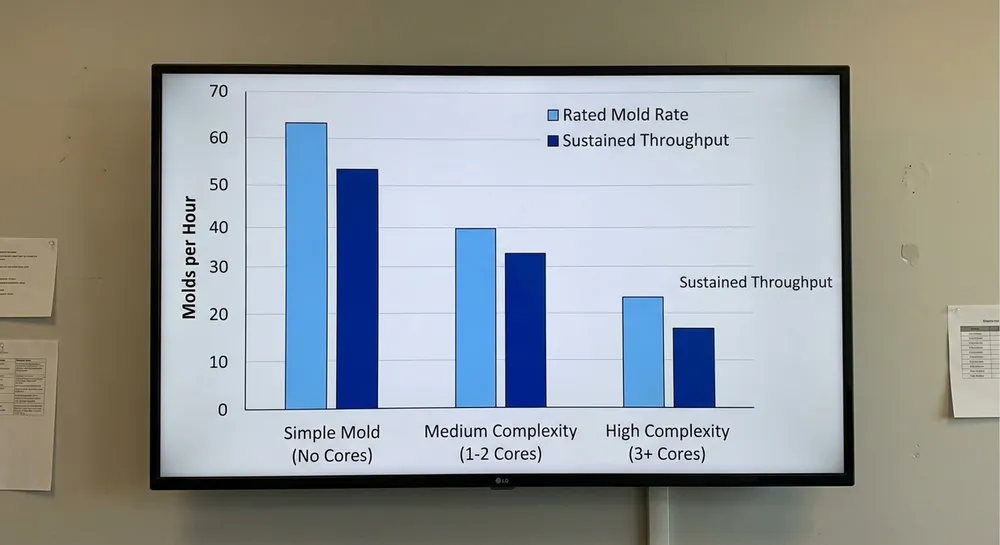
A blasting line stoppage doesn't just idle one machine. On an integrated clay sand line, the blasting station sits between reclamation and finishing — so when it stops, the upstream reclamation loop backs up within minutes, and your downstream finishing queue runs dry. A 4-hour unplanned stop on a line running 60 castings per hour wipes out 240 castings worth of throughput. That's the direct loss.
The indirect costs are worse. Sand accumulates in the reclamation circuit with no outlet. Your finishing crew stands around waiting. And castings that sit partially blasted through a cold restart often come out with inconsistent surface profiles — not rejected outright, but enough to trigger re-blasting or customer complaints on cosmetic grades.
We've commissioned over 60 clay sand lines across four continents, and the pattern is consistent: most unplanned stops trace back to three preventable failure categories — nozzle wear past tolerance, hydraulic seal failure, and sensor/control drift. All three respond to a structured maintenance schedule, which is what the rest of this article covers.
Why clay sand wears blasting equipment differently than steel shot
If your maintenance approach is based on generic shot blasting guides — the kind written for steel shot or clean silica — your replacement intervals will be wrong. Clay sand coming out of a reclamation loop is a different abrasive than manufactured media, and it causes different wear patterns.
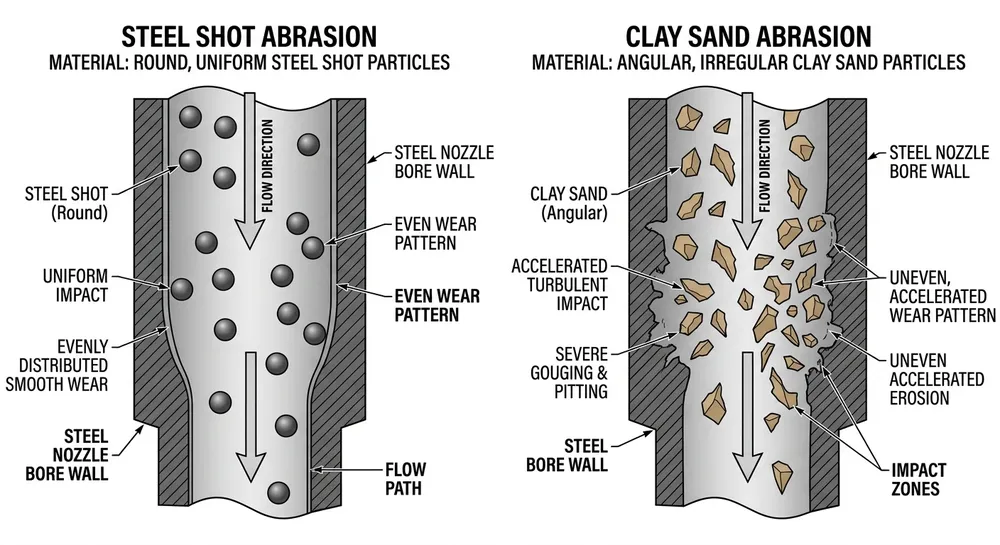
Particle geometry. Reclaimed clay sand goes through a jaw crusher and screening process. The resulting particles have angular, irregular fracture surfaces, not the round, uniform profile of manufactured steel shot. Angular particles concentrate impact energy on smaller contact areas, so they cut nozzle bores faster and less predictably. Where steel shot produces even, concentric bore erosion, clay sand creates irregular grooves and one-sided wear that changes the blast pattern before the nozzle diameter reaches its nominal replacement threshold.
Moisture content. Clay-bonded sand retains 3–5% moisture even after reclamation. Wet particles cluster instead of flowing as discrete grains through the nozzle. These clusters hit the bore wall as a heavier aggregate mass, accelerating erosion in specific zones. Moisture also attacks hydraulic seals and blast wheel bearings — any vapor that enters the hydraulic circuit degrades the fluid and accelerates seal swelling.
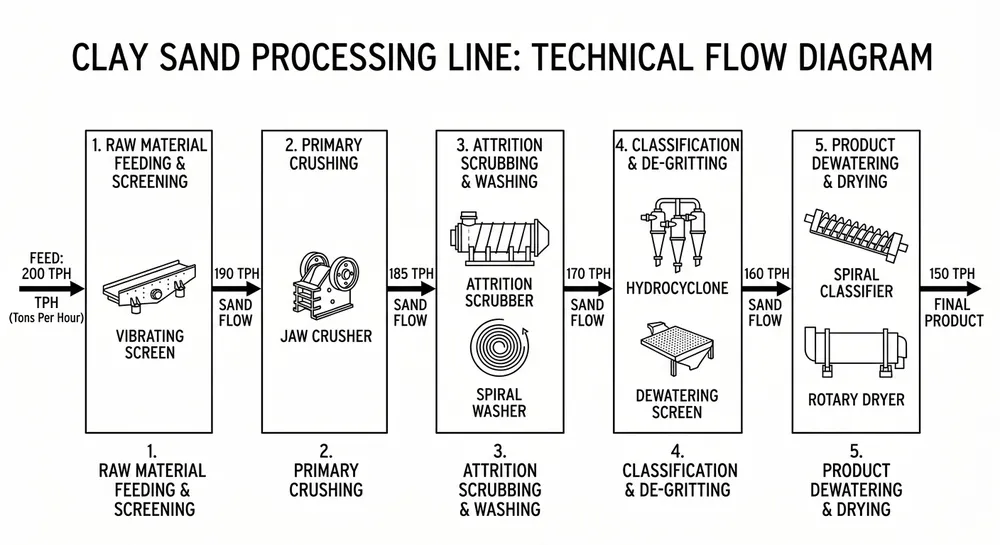
Reclamation loop drift. Each cycle through your Clay Sand Reclamation Line changes the particle size distribution. If the vibrating screen mesh starts blinding or the crusher gap drifts, you get a wider spread of particle sizes hitting the blasting nozzles. Oversized particles hammer the bore; fines clog dust collectors and reduce airflow through the blast cabinet. The blasting line and the reclamation line share a sand quality feedback loop, so deferred maintenance on one system shows up as accelerated wear on the other.
(We keep a reclamation testing lab in our Qingdao facility specifically for this — running sample batches through crushing and screening to verify equipment performance before shipment. If the sand quality entering your blasting line isn't within spec, no amount of nozzle upgrades will fix the wear rate.)

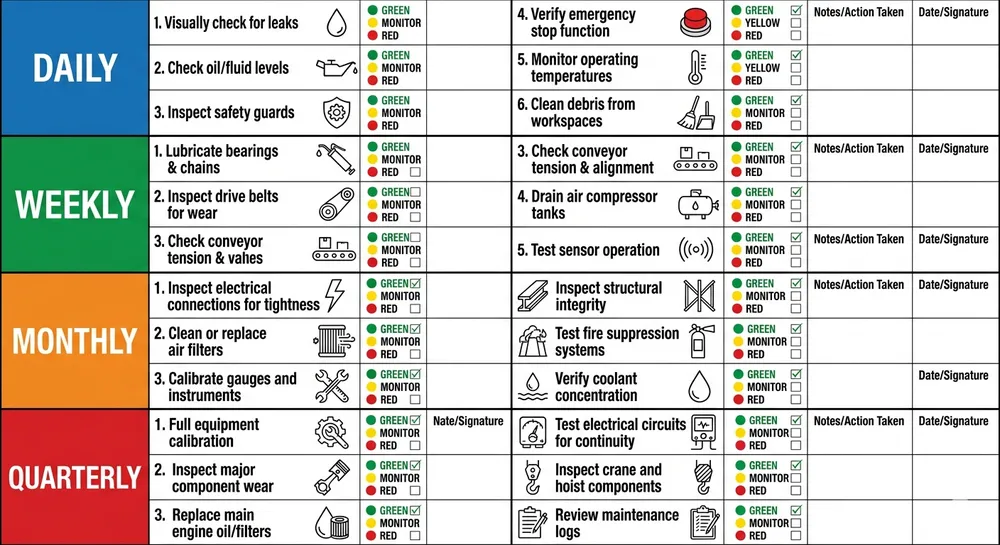
Preventive maintenance schedule for clay sand blasting lines
This schedule assumes a single-shift operation on an integrated clay sand blasting line with reclamation. If you're running two or three shifts, compress the weekly tasks to every 3 days and the monthly tasks to every 2 weeks. Adjust based on your sand condition — dirtier reclamation output means tighter intervals on nozzle and dust collector checks.
Daily (pre-shift, 10–15 minutes)
- Nozzle visual check — look for visible grooves, chipping, or bore elongation. If you can see daylight around the edges of the blast pattern on a test piece, the nozzle is past tolerance
- Blast pressure gauge — compare to baseline. A drop of more than 0.3 bar from your set point indicates a nozzle bore opening up or an upstream air supply issue
- Dust collector differential pressure — read the gauge or HMI display. Rising ΔP means filter loading or bag damage
- Conveyor belt tracking — check for lateral drift. Sand buildup on return rollers is the usual cause
- Sand hopper level and moisture — grab a handful from the hopper. If it clumps when you squeeze it, moisture content is high enough to cause clustering in the nozzle
Weekly
- Nozzle bore measurement — use a go/no-go gauge. Replace when the bore diameter exceeds the manufacturer's limit (typically 20–25% over nominal). Don't wait for the blast pattern to visibly degrade
- Proximity sensor function test — trigger each blast cabinet door interlock manually. Confirm the PLC registers the open/close state change. Clean any clay dust off sensor faces
- Hydraulic pressure readings — check at blast wheel drive actuators and nozzle traverse cylinders. Compare to the baseline values noted during commissioning
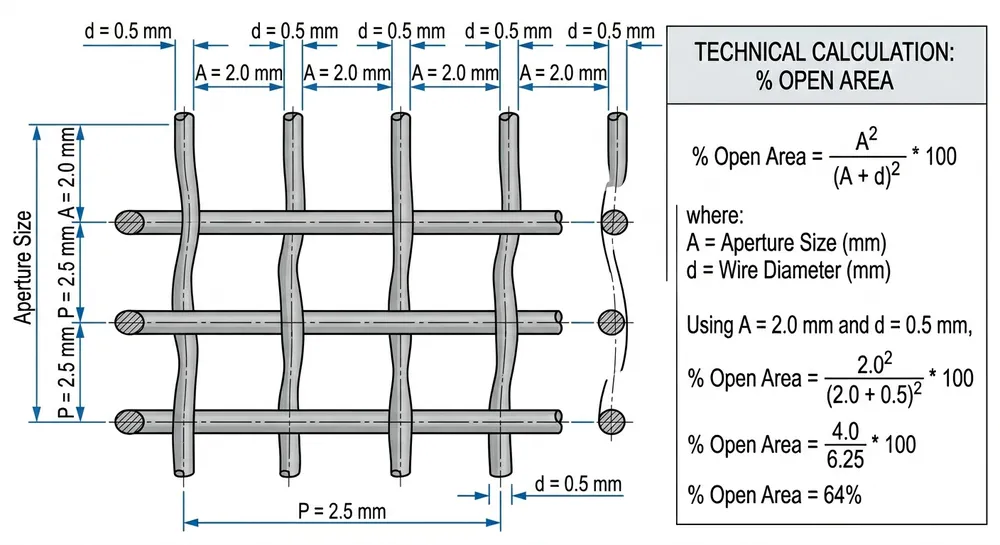
- Vibrating screen mesh inspection — check for tears, blinding, or sagging. A damaged screen lets oversized particles through to the blasting line
Monthly
- Hydraulic seal visual inspection — check blast wheel drive and nozzle traverse cylinders for weeping, drips, or external contamination at rod seals
- Solenoid valve response test — cycle each valve from the HMI and listen for sluggish or delayed actuation
- PLC error log review — download or review on-screen. Clear nuisance faults, but flag any code that recurred more than twice. Recurring intermittent faults are pre-failure warnings
- Dust collector bag/cartridge condition — inspect for holes, tears, and powder coating on bag surfaces. Check that the pulse-jet cleaning cycle is firing on schedule
- Sand sample from reclamation output — pull a sample and run a grain size distribution check. Compare to your baseline spec. Drift here will show up as changed wear rates in the blasting line within weeks
Quarterly
- Hydraulic fluid analysis — send a sample for particle count (target NAS 1638 Class 8 or better), moisture content, and viscosity. Contaminated fluid is the leading cause of premature seal failure
- Cylinder rod inspection — check for scoring, pitting, or corrosion. A scored rod destroys the new seal you just installed
- Blast wheel blade wear measurement — measure blade thickness at three points. Replace the full set when any blade falls below minimum thickness to avoid imbalance
- Complete sensor calibration — pressure transducers, flow sensors, and proximity switches. Drift is gradual and invisible until something trips
- Conveyor roller bearing check — listen for noise, feel for heat, check for play. Failed bearings cause belt misalignment that compounds fast
Nozzle material selection: the procurement decision that sets your maintenance budget
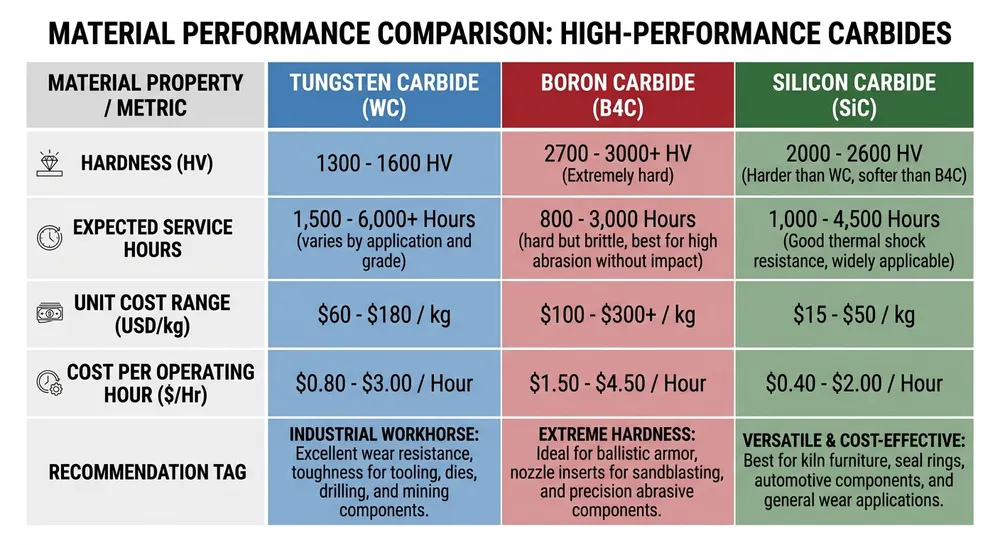
Most blasting line buyers pick nozzle material as an afterthought — whatever ships with the standard configuration. That's a mistake. The nozzle material you specify at the ordering stage determines your consumable cost and replacement frequency for the first 3 years of operation. In clay sand service specifically, the differences between materials are larger than what generic shot blasting guides suggest.
| Property | Tungsten carbide | Boron carbide | Silicon carbide |
|---|---|---|---|
| Hardness (HV) | ~1,600 | ~2,800 | ~2,400 |
| Typical service life in clay sand (hours) | 300–500 | 1,200–1,800 | 600–900 |
| Relative unit cost | 1× | 3–4× | 1.5–2× |
| Approximate cost per operating hour | Highest | Lowest on 2+ shift lines | Mid-range |
| Brittleness risk | Low | Low | High — sensitive to oversized particles |
| Best fit | Low-utilization or single-shift lines | High-utilization, 2–3 shift operations | Clean sand with tight screening |
Tungsten carbide is the default on most lines. Adequate hardness, good impact resistance, lowest purchase price. But in clay sand service with angular reclaimed particles, bore erosion runs 40–60% faster than the manufacturer's published life based on steel shot. On a high-utilization line, you'll burn through tungsten carbide nozzles fast enough that the replacement labor becomes a cost factor on its own.
Boron carbide costs 3–4× per nozzle but lasts 3–4× longer in clay sand — often longer, because it resists the irregular wear patterns that force early replacement of softer materials. On a two-shift line, boron carbide typically delivers the lowest cost-per-operating-hour despite the higher upfront price. This is the material to specify if you're running high-volume production.
Silicon carbide sits in between on hardness but has a brittleness problem. If your reclamation screening isn't tight and oversized particles reach the nozzle, silicon carbide chips. It works well with clean, consistently screened sand. If your reclamation line holds its screening spec reliably, silicon carbide gives you good life at moderate cost. If it doesn't, you'll get random fracture failures that are worse than gradual wear.
When you configure a Clay Sand Blasting Line, the nozzle material should match your planned shift pattern and your reclamation line's screening consistency. We include nozzle sets in the first-year spare parts kit that ships with every line — the material grade is specified at order time, not discovered during the first replacement.
Five failure modes that cause unplanned stops — and how to prevent each
1. Nozzle bore erosion beyond tolerance
Red flag: Blast pattern widens, surface finish becomes inconsistent across the casting, blast pressure drops without an air supply change.
The wear mechanism is covered above. The prevention focus here is detection: don't wait for the operator to notice poor surface finish. Use the weekly go/no-go gauge check from the maintenance schedule. On clay sand lines, bore diameter can jump from acceptable to out-of-spec within a single shift if a batch of poorly screened sand passes through. Measure, don't estimate.
Prevention: Weekly bore measurement. Replace at 20–25% diameter increase. Keep a spare nozzle set on the shelf at all times — a 15-minute nozzle swap is cheap compared to a 2-hour scramble to find the right size in stock.
2. Hydraulic seal blowout on blast wheel drive or traverse cylinders
Red flag: Oil weeping at cylinder rod seals, hydraulic pressure fluctuations on the HMI, increased motor current draw on the blast wheel drive.
These seals operate under 150-bar working pressure with thermal cycling from ambient to 60–70°C during continuous operation. Clay sand dust is the accelerant — fine particles migrate past rod wipers and contaminate the seal interface. The combination of high pressure, heat cycling, and abrasive contamination shortens seal life well below what you'd see in a clean hydraulic application.
Prevention:
- Specify Viton (FKM) seals at the procurement stage — they handle higher temperatures and resist clay dust contamination better than standard NBR seals
- Maintain hydraulic fluid cleanliness at NAS 1638 Class 8 or better — quarterly fluid analysis catches contamination before it damages seals
- Inspect rod seals monthly as outlined in the maintenance schedule
(We bench-test every hydraulic assembly at 1.5× rated capacity before it ships. That means 225 bar on a 150-bar rated system. Early-life seal failures from manufacturing defects get caught in our facility, not yours.)
3. Proximity sensor drift on blast cabinet door interlocks
Red flag: Intermittent line stops with door interlock fault codes, or — more dangerously — the blast cycle starting with a door not fully seated.
Clay sand dust builds up on inductive proximity sensor faces and changes the sensing distance. Over weeks, the detection range drifts until the sensor either false-trips (nuisance stops) or fails to detect (safety risk). The failure mode is gradual, which makes it easy to ignore until a shift loses 30 minutes to repeated false alarms.
Prevention: Weekly function test and sensor face cleaning. Replace sensors from the spare parts kit when response becomes inconsistent even after cleaning. These are inexpensive parts — don't try to extend their life past the point of reliable detection.
4. Conveyor misalignment and belt tracking drift
Red flag: Castings positioned unevenly in the blast stream, inconsistent surface finish from side to side, visible belt edge fraying.
Sand accumulates on return rollers unevenly, especially when the dust collection airflow drops. The roller diameter changes on one side, the belt drifts, and castings enter the blast zone off-center. The result is one side blasted correctly, the other side under-blasted. On cosmetic grades, this is a rejection. On functional grades, it's rework.
Prevention: Daily visual check on belt tracking. Clean return rollers weekly. Address dust collector performance issues before they cascade into belt problems.
5. Dust collector differential pressure rise and bag failure
Red flag: Rising ΔP reading on the dust collector gauge, visible dust leakage around the collector housing, reduced airflow through the blast cabinet.
When bags fail or load up past the pulse-jet cleaning capacity, airflow drops through the entire blast cabinet. Reduced airflow means abrasive doesn't recirculate properly — recovery drops, sand accumulates in the cabinet, and the blast pattern suffers. If the ΔP rises high enough, you also create a negative pressure issue that pulls unfiltered air backward through the system.
Prevention: Daily ΔP check. Monthly visual bag inspection. Replace bags on a condition basis, not a calendar basis — a line running dirty reclaimed sand may need bag replacement at 6 months, while a line with clean sand might go 12–18 months.
Using PLC diagnostics and remote monitoring to catch problems early
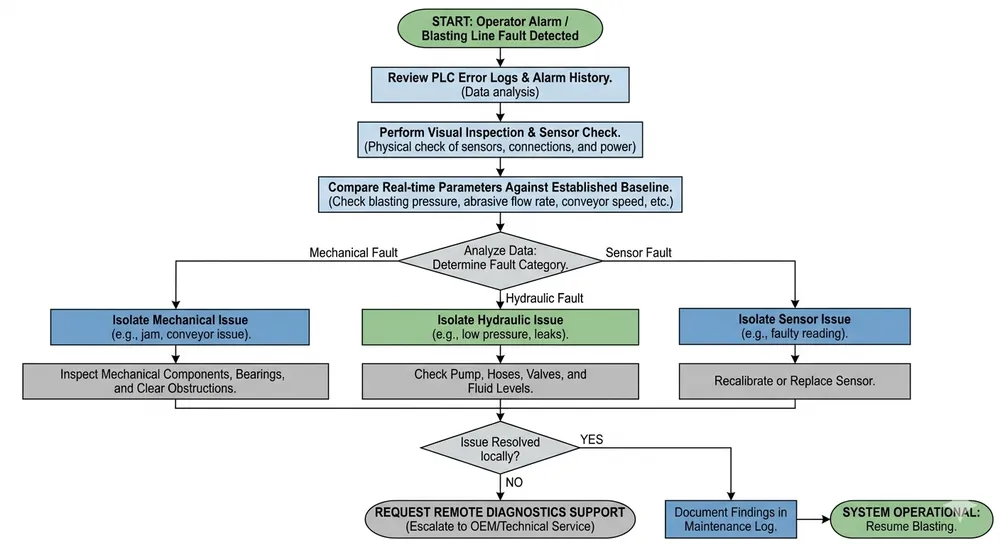
Your blasting line's PLC logs every fault code, sensor reading, and alarm event. Most maintenance teams clear faults from the HMI screen and move on. That's a missed opportunity. The pattern in those logs tells you what's about to fail — not just what already did.
What to look for in the error log:
- Recurring intermittent sensor faults. A proximity sensor that throws a fault code three times in one week isn't having random bad luck. It's drifting toward failure. Replace it now during a planned stop, or replace it later during an unplanned one.
- Hydraulic pressure warnings. A single warning after a cold start is normal. Warnings that appear mid-shift, especially on blast wheel drive or traverse cylinders, indicate seal degradation or fluid contamination. Check the seals and pull a fluid sample.
- Motor overload trips on the blast wheel drive. If the motor trips on overload, the first thing to check is blade wear — an unbalanced wheel draws more current. The second thing to check is bearing condition. The PLC log will show whether the overload is sudden (bearing seizure) or gradual (progressive imbalance from uneven blade wear).
Baseline comparison on the HMI:
Most Siemens and Mitsubishi PLCs store analog sensor trends on the HMI. Your commissioning report includes baseline values for blast pressure, hydraulic pressure, dust collector ΔP, and motor current. Use the HMI trending function to compare current readings against those baselines. Gradual drift — 5–10% over a month — is the early warning that preventive maintenance needs to catch. A sudden 20% shift means something already failed.
Our lines ship with a 4G remote diagnostics module. Your maintenance team handles the day-to-day log reviews, but if a fault pattern doesn't match anything in the troubleshooting manual, we can pull the error log remotely from Qingdao and review the sensor data without anyone booking a flight. The HMI runs in English, Spanish, or Arabic, so your crew reads fault descriptions in their working language instead of trying to decode untranslated error codes.
First-year spare parts planning: what to stock and how much
Every Clay Sand Processing Line we ship includes a first-year consumable kit. The table below shows what's in it and how to plan quantities based on your shift pattern.
| Component | Single-shift (12 months) | Two-shift (12 months) | Replacement trigger |
|---|---|---|---|
| Blasting nozzles | 4–6 (tungsten carbide) or 2–3 (boron carbide) | 8–12 (TC) or 4–6 (BC) | Bore diameter exceeds 20–25% over nominal |
| Hydraulic seals (blast wheel drive + traverse) | 2 complete sets | 3–4 complete sets | Visual weeping, pressure fluctuation, or at quarterly fluid analysis |
| Proximity sensors (cabinet doors + conveyor) | 4–6 units | 8–10 units | Inconsistent response after cleaning, or recurring PLC fault codes |
| Solenoid valves (hydraulic + pneumatic) | 2–3 units | 4–5 units | Sluggish actuation on monthly response test |
| Dust collector bags/cartridges | 1 full replacement set | 1–2 full sets | ΔP exceeding set point after pulse-jet cleaning cycle, or visible holes |
| Conveyor belt splice kit | 1 kit | 1 kit | Belt edge fraying or splice separation |
| Vibrating screen mesh panels | 2–3 panels | 4–6 panels | Tears, blinding, or sagging on weekly inspection |
The kit ships with the line — these aren't extra-cost add-ons. If you're running a shift pattern heavier than single-shift, let us know at the ordering stage so we can adjust quantities. Having the right spares on the shelf turns a 15-minute planned replacement into exactly that, instead of a 3-week wait for parts from overseas.
(The nozzle quantities assume the material grade from the comparison table above. If you specified boron carbide, you need fewer spares but each one costs more. The total consumable budget lands in roughly the same range either way — the difference is how often your maintenance crew has to swap them.)
Specifying maintenance into the line at procurement
Half of your long-term maintenance burden is determined before the blasting line ever reaches your facility. These are the configuration decisions that pay off over years, not months:
- Nozzle material grade. Don't accept the default. If you're running two or more shifts, specify boron carbide at order time. The cost difference per nozzle is paid back within the first year through reduced replacement labor and downtime.
- Hydraulic seal material. Standard NBR seals work in moderate temperatures. If your blasting line will operate in ambient temperatures above 35°C, or if continuous operation pushes cylinder temperatures past 60°C, specify Viton (FKM) seals. The cost difference is negligible compared to one seal blowout.
- PLC brand. Siemens or Mitsubishi — both run our blasting line control software equivalently. Choose based on what your maintenance electricians already know. If they've been programming Siemens S7 for 10 years, don't make them learn Mitsubishi GX Works to troubleshoot a blasting line at midnight.
- Remote diagnostics module (4G). Adds a small amount to the line cost. Worth it if your facility is more than a day's travel from Qingdao, or if you run a lean maintenance team. When a fault pattern stumps your crew, the alternative to remote diagnostics is flying an engineer in — that's a week of downtime plus travel cost.
- First-year spare parts kit. Verify that the kit quantities match your planned shift pattern before the line ships. Adding spares to a follow-up order is possible, but lead time for international shipping means 4–8 weeks without the part you need.
If you're evaluating a Clay Sand Blasting Line or planning a spare parts order for an existing line, send your specs — capacity, casting alloy, current nozzle material, and shift pattern — and we can build a maintenance schedule with pricing for the correct consumable package. Request a quote and include your line configuration details.
Frequently asked questions
How often should blasting nozzles be replaced on a clay sand line?
It depends on nozzle material and shift pattern. Tungsten carbide nozzles in single-shift clay sand service typically last 300–500 operating hours. Boron carbide extends that to 1,200–1,800 hours. Don't rely on time-based replacement — use the weekly bore diameter measurement to catch the actual wear point, since clay sand particle quality varies and affects nozzle life run-to-run.
Can I use the same maintenance schedule for steel shot blasting and clay sand blasting?
No. Clay sand wears blasting equipment differently in two ways: the angular particle geometry from reclamation causes faster and less predictable nozzle erosion, and residual moisture accelerates seal degradation. A schedule designed for steel shot will under-inspect nozzles and seals while over-inspecting components that aren't under the same stress. Use a clay sand–specific schedule with tighter nozzle and seal intervals.
What PLC error codes signal an impending hydraulic seal failure?
Watch for three patterns: rising hydraulic pressure warnings during normal operation (not cold-start), motor overload trips on the blast wheel drive that appear mid-shift, and increasing cylinder travel time on traverse actuators. Any of these appearing more than twice in a week means the seals or fluid condition need immediate inspection. Pull a hydraulic fluid sample and check the rod seals visually.
Does TZFoundry include spare parts with the blasting line?
Yes. Every blasting line ships with a first-year consumable kit covering nozzles, hydraulic seals, proximity sensors, solenoid valves, dust collector bags, splice kits, and screen mesh. The kit quantities are based on single-shift operation — if you're running heavier, specify the shift pattern at order time so we can adjust the quantities before the line ships.

Baocun Zhu is the Senior Clay Sand Process Engineer at TZFoundry in Qingdao. With over 14 years commissioning clay sand molding, reclamation, and preparation lines for export foundries, he turns floor-space constraints and throughput targets into working production systems. His...