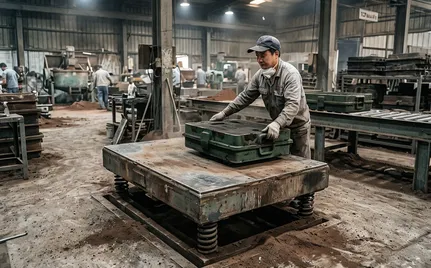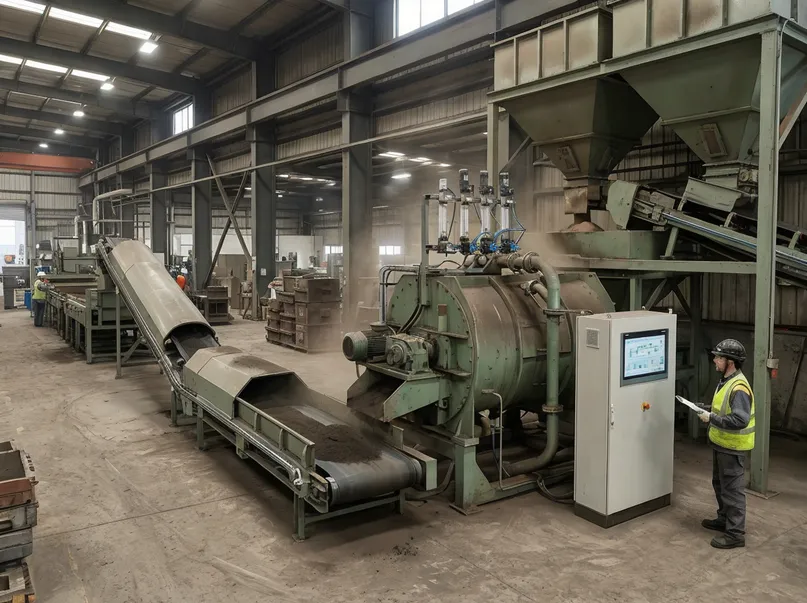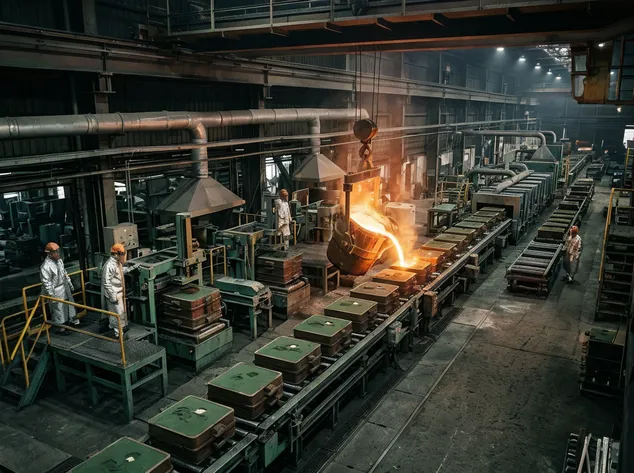
You collect four quotations for an automatic flaskless clay sand processing line. Each datasheet uses a different format. One lists mold rate at 120/hour, another says 100/hour, a third gives cycle time in seconds instead. The compaction pressures are measured at different points. The sand reclamation rates are tested under different conditions. You can't compare them.
This is where most procurement mistakes start — not from choosing the wrong supplier, but from comparing numbers that aren't measuring the same thing.
I've commissioned over 60 clay sand lines across four continents, and the specs that cause problems after installation are rarely the ones buyers spend the most time evaluating. A line rated at 120 molds/hour that sustains only 80 under real production conditions delivers 33% less output than your ROI model assumed. That gap doesn't show up until month three, when the production targets start missing.
These 12 parameters are the ones that actually determine whether an automatic flaskless line matches your foundry's output, tolerance, and facility requirements. I've grouped them the way an engineer evaluates a datasheet: mold geometry first, then performance, then control systems, then integration and shipping.
Mold size range — the spec that filters your shortlist first
Parameter 1: Mold size range (mm)
If your pattern plate exceeds the machine's maximum mold dimensions, nothing else on the datasheet matters. This is your first filter.
Common automatic flaskless lines cover a range from roughly 500×400mm up to 700×600mm, though custom configurations go wider. The number you need to verify is the usable pattern area, not the maximum flask dimension. Some datasheets show the outer flask size. The actual usable area is smaller — subtract wall thickness on each side, and you lose 20-40mm in both directions.
Why this matters for throughput: if your usable mold area forces single-cavity layouts on a part that could run multi-cavity, you're producing one casting per cycle instead of two or four. On a line running 80 molds/hour, that's the difference between 80 parts/hour and 320. Ask for both the outer flask dimension and the usable pattern area. If a supplier only provides one number, ask which one it is.
Mold rate and compaction pressure — rated speed vs. what your shift actually produces
Parameter 2: Mold rate (molds/hour)
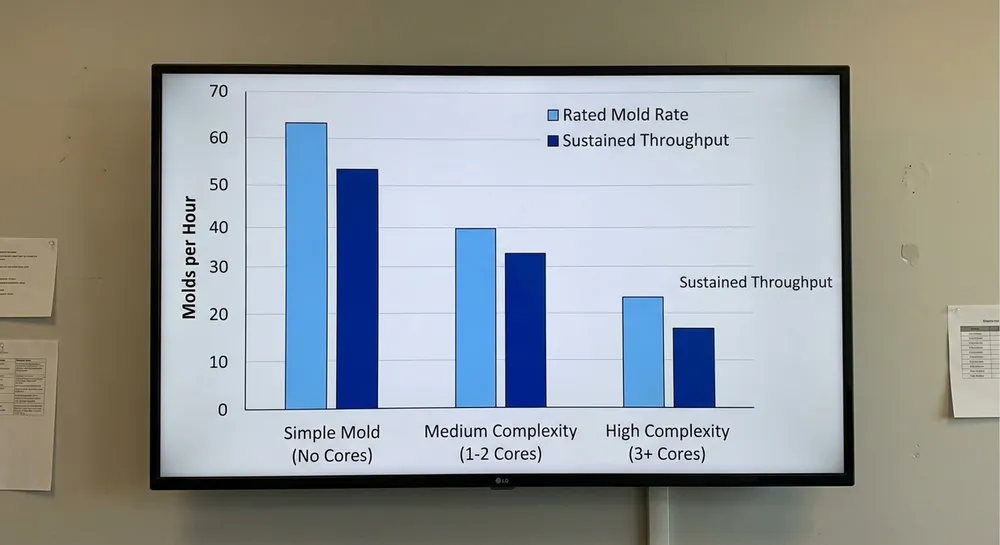
This is the number buyers look at first, and it's the most commonly misunderstood. Every flaskless molding line specification sheet has a mold rate. Most list the rated peak — the maximum mechanical speed with no delays for sand filling variation, core setting, or mold transport indexing.
Sustained throughput over a full shift typically runs 70-85% of that rated number. The gap depends on mold complexity, number of cores, and how consistent your sand properties stay across 8-12 hours.
The better way to request this spec: ask for cycle time per mold in seconds, measured under defined conditions. Those conditions need to include sand temperature range, compactability target, and core setting method (manual vs. automatic). A cycle time of 30 seconds per mold gives you 120/hour theoretical — but add 6 seconds for core setting and 4 seconds for transport indexing, and your real cycle is 40 seconds, or 90 molds/hour.
Parameter 3: Compaction pressure (bar or MPa)
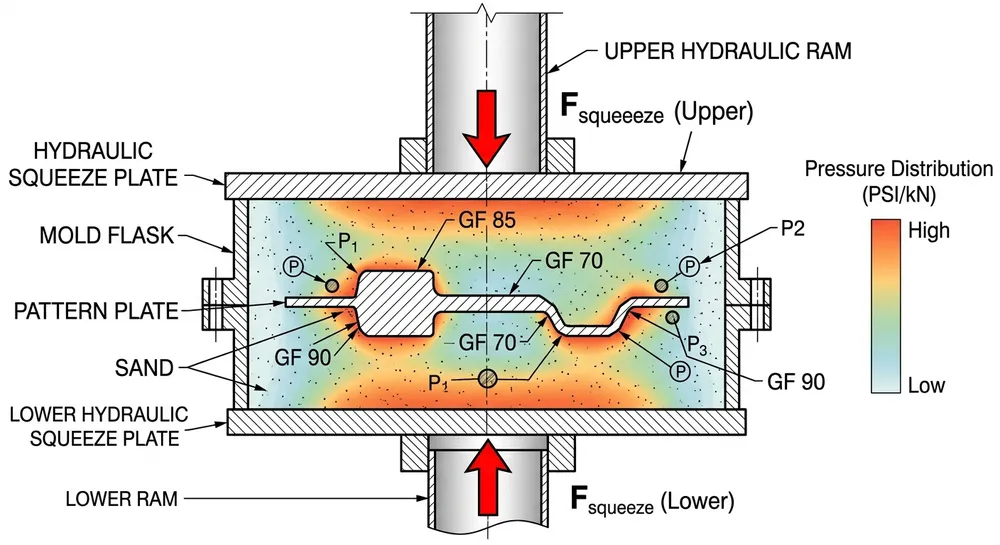
Compaction pressure sits right next to mold rate because the two are directly linked. Higher pressure produces a denser mold with better surface definition, but it also means longer squeeze time and faster hydraulic seal wear.
Typical working pressure for automatic flaskless lines runs 100-150 bar at the compaction cylinder. For gray iron drain covers and similar low-precision castings, 100-120 bar is usually sufficient. Ductile iron parts with tighter machining allowances — valve bodies, pump housings — need the higher end of that range to hold consistent mold density across the entire mold face.
The trade-off: pushing compaction pressure from 120 to 150 bar can add 2-3 seconds per cycle. On a 10-hour shift at 80 molds/hour, that's 160-240 fewer molds. Make sure the pressure spec matches your actual casting requirements, not the maximum the machine can deliver.

Dimensional tolerance and mold hardness — where rejection rates hide
Parameter 4: Dimensional tolerance (mm)
Automatic flaskless lines typically hold ±0.3mm to ±0.5mm dimensional tolerance on the mold. That range looks tight on paper, but the real question is whether the line holds it consistently across a full shift as sand properties drift.
Sand moisture increases with ambient temperature. Compactability changes. Bentonite activation varies batch to batch. A line that starts the shift at ±0.3mm and drifts to ±0.8mm by hour ten will push your scrap rate above 5% on precision castings. On ductile iron parts destined for CNC machining, that tolerance drift eats directly into your machining allowance and may produce parts that can't be finished to spec.
Ask for tolerance data measured over time, not just at peak performance. If a supplier can show you tolerance consistency across an 8-hour test run, that tells you far more than a single best-case number.
Parameter 5: Mold hardness (GF or B-scale)
Mold hardness uniformity matters more than peak hardness. A good automatic line produces molds in the 85-90 GF range across the entire face. The corners and edges are where hardness drops, and that's where sand inclusion defects appear on flanged castings.
When we run factory commissioning tests, we measure hardness at five points across the mold face — center, four corners. If the spread exceeds 5 GF, we adjust the compaction sequence before signing off. (This is one of those specs that nobody asks about during quotation, and then it becomes the root cause of every defect investigation three months into production.)
Our commissioning reports include measured tolerance and hardness data from your specific unit's factory test run. These aren't catalog numbers — they're the actual performance of the equipment you're receiving.
Sand system specifications — reclamation rate and sand-to-metal ratio
Parameter 6: Sand reclamation rate (%)
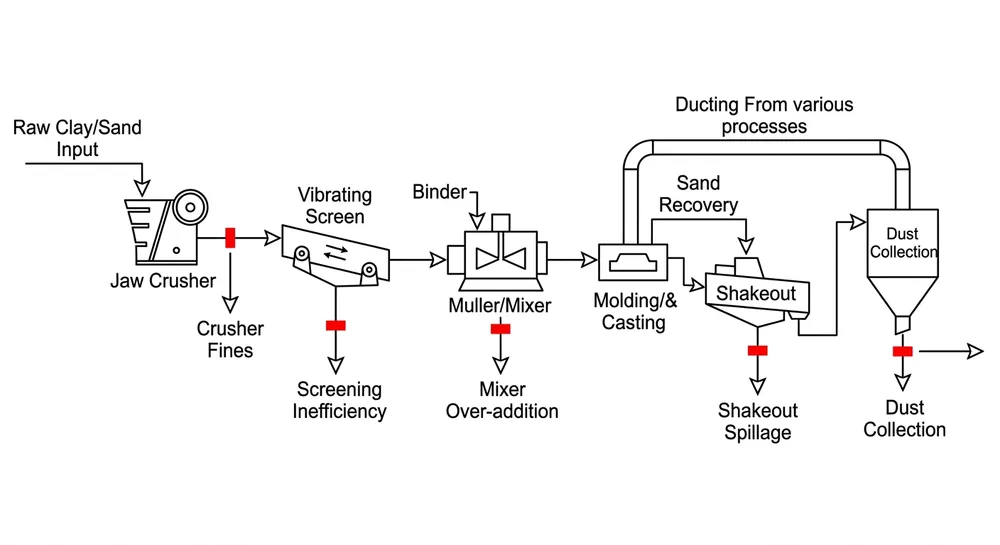
The reclamation rate tells you what percentage of used sand gets recovered and returned to the system. The difference between 92% and 96% sounds small until you run the numbers on a line processing 50 tons of sand per day. That 4% gap is 2 tons of new sand you need to buy and 2 tons of spent sand you need to dispose of — every day.
Over a year, that's roughly 700 tons of sand purchase cost plus disposal fees. On a clay sand processing line running high volumes, reclamation rate directly sets your sand operating cost.
The trap: reclamation rates tested on fresh sand look better than rates measured after 50+ cycles, when fines accumulate and clay content shifts. Ask whether the test was performed on fresh sand or on sand that has been through multiple production cycles.
Parameter 7: Sand-to-metal ratio (kg/kg)
This ratio — kilograms of sand consumed per kilogram of castings produced — is the single best proxy for overall line efficiency. It captures mold size, sand density, reclamation losses, and spillage in one number. Lower ratio means less sand handling, less energy for mixing and transport, and less waste.
Typical ratios for automatic flaskless lines running gray iron range from 4:1 to 6:1. Aluminum castings need careful attention here because lower pouring temperatures affect sand behavior differently — binder burn-out patterns change, and the reclamation system has to handle finer particles without losing recovery rate.
Control system and power — the specifications that set your 10-year operating cost
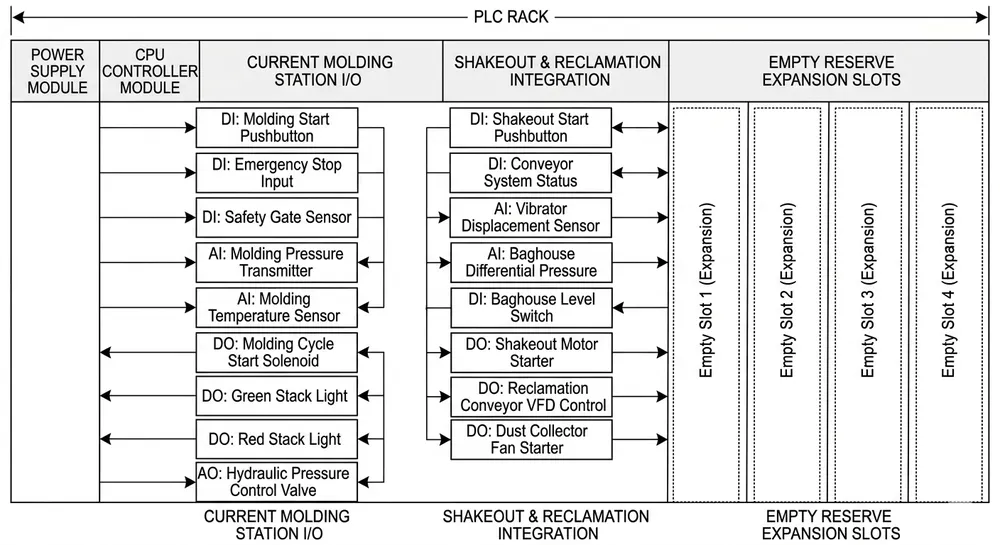
Parameter 8: PLC brand, model, and I/O capacity
The PLC is the decision center of your line, and it's also a 10-year commitment to a service ecosystem. Siemens S7-1200/1500 and Mitsubishi FX5U/iQ-R are the two platforms most common in export markets. Both support standard communication protocols (Profinet, EtherNet/IP), which means your local electricians can troubleshoot without calling the equipment manufacturer.
Locked-vendor systems — where the PLC uses proprietary communication and the programming software requires a specific license — force you to buy spare I/O modules and programming services from a single source. That vendor lock shows up as cost for every expansion, every program change, every spare module for the next decade.
I/O capacity determines whether you can expand later. If you plan to add a second molding station or integrate automatic shakeout equipment, the PLC needs reserve I/O slots from day one. Retrofitting a PLC rack is expensive and usually means a multi-day shutdown. Ask for the I/O allocation list: how many inputs and outputs are used, how many are spare.
We configure Siemens or Mitsubishi PLCs based on buyer preference, with 4G remote diagnostic modules standard. The HMI supports English, Spanish, and Arabic interfaces. Remote diagnostics let your maintenance team pull error logs and adjust parameters through a phone connection, which eliminates the travel cost for software-level troubleshooting. (We started offering 4G modules in 2018 after too many buyers in the Middle East and South America were waiting weeks for an engineer visit to fix problems that took 20 minutes to diagnose remotely.)
Parameter 9: Hydraulic system pressure rating (bar)
Two numbers matter here: rated pressure (the relief valve setting, typically 160-200 bar) and working pressure (what the system holds during compaction, typically 100-150 bar). The gap between them is your safety margin.
Some datasheets show hydraulic pressure measured at the pump outlet. By the time that pressure reaches the compaction cylinder, it has dropped 10-15% across hoses, fittings, and valves — more on systems with long hydraulic runs. Ask where the pressure is measured. If it's pump-side, reduce the number by 10-15% to estimate cylinder-side pressure.
Parameter 10: Total power consumption (kW)
Two numbers again: connected load (the sum of all motor and heater ratings) and average running load (what the system actually draws during steady-state production). Connected load determines your transformer and cable sizing. Average running load determines your energy cost per mold.
A typical automatic flaskless line draws 75-120 kW connected load depending on configuration. Average running load usually falls to 50-70% of connected because not every motor runs at full power simultaneously. Ask for both numbers — the first decides your electrical infrastructure investment, the second decides your monthly energy bill.
Footprint, ceiling clearance, and container shipping dimensions
Parameter 11: Footprint and ceiling height requirements
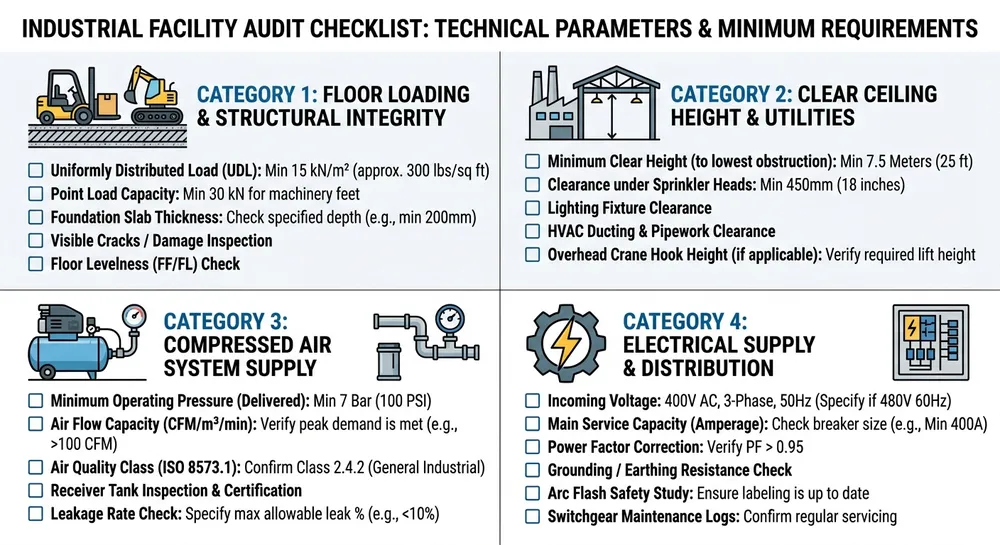
Floor loading is the spec people forget until the civil engineer sends a foundation reinforcement quote. A molding station with its hydraulic power unit and sand hopper can concentrate 8-12 tons on a 4m² footprint. If your existing slab wasn't designed for that point load, you're looking at foundation reinforcement before installation — and that cost wasn't in anyone's budget.
Ceiling clearance is the other fast filter. Vertical flaskless clay sand processing lines typically need 7-8m clear height. Horizontal configurations can work under 5m. If your building has 6m ceilings, half the automatic flaskless clay sand processing line specifications on your desk just became irrelevant.
Request the full installation drawing with dimensions, not just the machine footprint. You need clearance for maintenance access, sand hopper refilling, and hydraulic hose routing above and beside the machine.
Parameter 12: Container shipping dimensions
How the line breaks down for 40HQ container loading (12.03m × 2.35m × 2.69m internal dimensions) directly affects your landed cost. A line that ships in 2 containers instead of 3 saves $4,000-8,000 in ocean freight depending on the route — and that's before port handling and inland transport.
We engineer our equipment frames to fit 40HQ dimensions without wasted container volume. A complete automatic flaskless clay sand processing line typically ships in 2-3 containers depending on configuration. Hydraulic power units and control cabinets ship separately from structural frames to prevent damage and simplify customs clearance.
This is a spec most buyers don't ask about during quotation, but it changes the landed cost comparison between suppliers. Two lines priced identically FOB Qingdao can differ by $8,000-15,000 at your door if one needs an extra container.
How to spot inflated specs on supplier datasheets
The three automatic clay sand molding line parameters most commonly inflated on datasheets:
- Mold rate — tested with an empty mold, no cores, no sand property variation. Real production with cores and variable sand will run 15-30% lower.
- Sand reclamation rate — measured on fresh sand in a controlled batch, not after 50 production cycles when fines accumulate. Real-world recovery drops 2-4% from the test number.
- Compaction pressure — reported at the pump, not at the compaction cylinder. The 10-15% pressure drop through the hydraulic circuit means your actual compaction force is lower than the datasheet suggests.
What to request beyond the standard clay sand processing line spec sheet:
- Commissioning test report with measured data — cycle time, compaction pressure at the cylinder, mold hardness readings, dimensional tolerance over a multi-hour run
- Hydraulic schematic with pressure gauge locations marked, so you can see where the reported pressures were measured
- PLC I/O list showing allocated inputs/outputs vs. total capacity, so you can confirm expansion headroom
- Container loading plan showing how the equipment breaks down for shipping
Red flags: every spec on the sheet is a round number (120 molds/hour, 95% recovery, ±0.3mm) with no mention of test conditions or measurement methodology. Real test data has odd numbers and ranges because real equipment doesn't produce perfectly round results.
Every unit we ship includes a commissioning report documenting the measured performance data from your specific machine's factory test run. This is built into our ISO 9001:2015 three-stage QC process: incoming material inspection, in-process dimensional and pressure verification, and pre-shipment full-system commissioning. The report shows what your equipment actually delivered during testing — not what the catalog says it should deliver.
How spec priorities shift by casting alloy
Not all 12 parameters carry equal weight for every alloy. Here's where to focus your verification effort based on what you're pouring:
| Alloy | Top 3 spec priorities | Typical acceptable range |
|---|---|---|
| Gray iron | Mold rate, sand reclamation rate, power consumption | 80-120 molds/hr sustained, ≥94% recovery, 55-80 kW avg |
| Ductile iron | Dimensional tolerance, mold hardness uniformity, compaction pressure | ±0.3mm sustained, ≤5 GF spread, 130-150 bar working |
| Aluminum | Sand-to-metal ratio, reclamation rate, mold surface finish | 3:1-5:1, ≥95% recovery, mold hardness 88-92 GF |
Gray iron is the most forgiving. Standard compaction and tolerance specs handle most applications, so your evaluation should focus on throughput and operating cost — mold rate and sand recovery are what drive your cost per casting.
Ductile iron tightens the tolerance requirements because dimensional accuracy directly affects machining allowance on finished parts. Ask specifically about mold hardness uniformity data — not just the average reading, but the spread across the mold face.
Aluminum changes sand behavior entirely. Lower pouring temperatures mean different binder burn-out characteristics, and the reclamation system spec needs to account for handling finer particles without choking recovery rate. If you're evaluating a flaskless clay sand processing line for aluminum work, sand-to-metal ratio and surface finish specs become your primary filters.
Frequently asked questions
What is the typical lead time for a custom-configured automatic flaskless line?
Standard configurations ship within 45-60 days from order confirmation. Custom mold sizes, non-standard PLC configurations, or special hydraulic ratings can extend that to 75-90 days. If your timeline is tight, request a quote early — we can often accelerate production scheduling if we know your delivery window upfront.
Can I upgrade the PLC to a higher-capacity model after installation?
Yes, if the original cabinet has physical space for additional I/O racks and the power supply can handle the load. This is why I/O reserve capacity matters at the quotation stage. Retrofitting a PLC rack that was sized exactly to the initial configuration usually means a new cabinet, new power supply, and 3-5 days of downtime for rewiring. Specifying 20-30% reserve I/O capacity upfront adds minimal cost and avoids that problem entirely.
How do I verify sand reclamation rate claims before placing an order?
Ask for the test protocol: what sand condition was used (fresh vs. cycled), how many cycles the test ran, and what the measurement method was. Any supplier running a real test can provide this. We test reclamation rate on sand that has been through at least 30 production cycles, not on fresh sand, because that's what your system will actually process. The commissioning report for your unit documents the measured rate from your specific equipment's test run.
What happens to specifications if I change casting alloy after the line is installed?
Most automatic clay sand molding line parameters are adjustable through PLC programming and mechanical setup — compaction pressure, squeeze sequence, cycle timing. Switching from gray iron to ductile iron usually requires adjusting compaction pressure upward and tightening the sand property targets in the mixer. Switching to aluminum may require sand system modifications because of different thermal behavior and binder requirements. The PLC program handles the molding parameter changes; the sand preparation system may need physical adjustment.
Do automatic flaskless lines need a dedicated foundation?
It depends on your floor loading. If your existing slab can handle 3-4 tons per square meter of point load, a standard concrete floor works. The molding station and hydraulic unit are the heaviest concentrated loads — we provide a floor loading diagram with every quotation so your civil engineer can verify before you commit. If reinforcement is needed, it's cheaper to know before the equipment ships than after.
What spare parts should I stock for the first year?
Hydraulic seals, proximity sensors, solenoid valves, and PLC I/O modules. These are the items that wear or fail first under normal operating conditions. We ship a first-year spare parts kit with every line, sized based on your expected production hours. For a line running two shifts, that typically covers 2 sets of hydraulic cylinder seals, 6-8 proximity sensors, 4-6 solenoid valves, and 2 spare I/O modules.

Baocun Zhu is the Senior Clay Sand Process Engineer at TZFoundry in Qingdao. With over 14 years commissioning clay sand molding, reclamation, and preparation lines for export foundries, he turns floor-space constraints and throughput targets into working production systems. His...