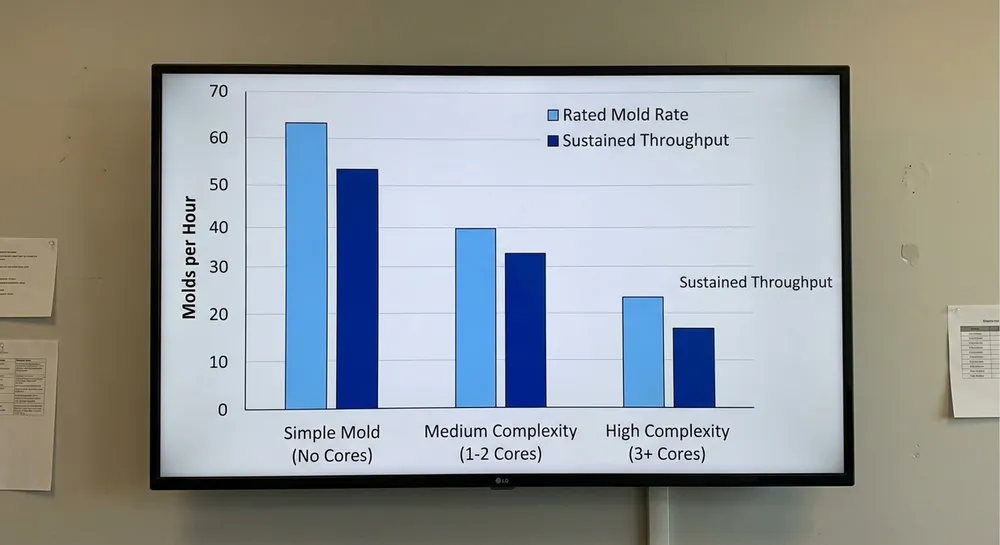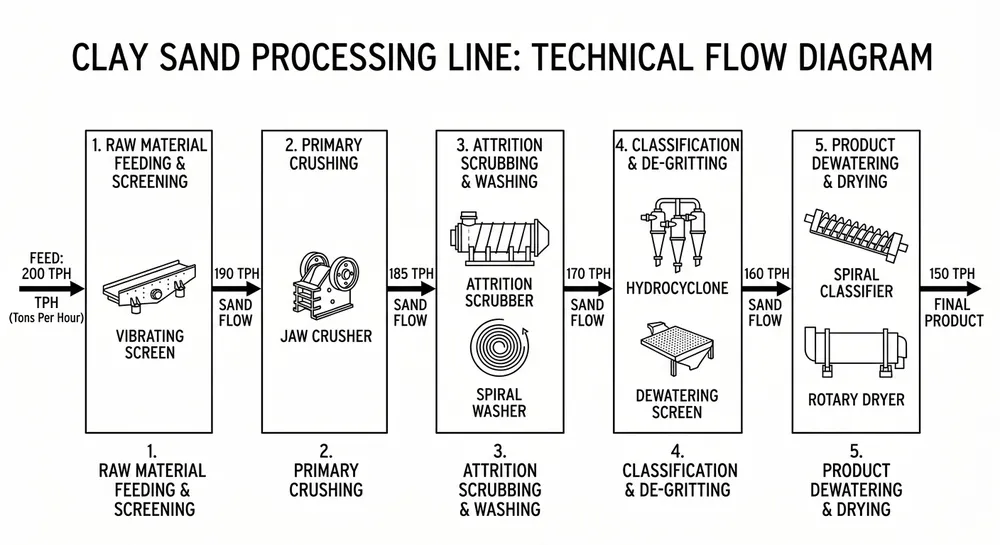
Most foundry equipment RFQs I review ask for a "clay sand molding line" when what they actually need is a complete integrated system. The molding machine is 40% of the story. The other 60% — sand preparation, reclamation, screening, material handling — determines whether your line runs at rated capacity or spends half the shift troubleshooting sand quality drift.
A complete clay sand processing line connects five subsystems: molding, sand preparation, reclamation, screening, and material handling. Each subsystem has to match the others in throughput and sand quality specs, or you create a bottleneck. This guide walks through the evaluation framework we use when engineering lines for export buyers — from defining your output requirements to vetting supplier capabilities and planning container logistics.
What a Complete Clay Sand Processing Line Actually Includes
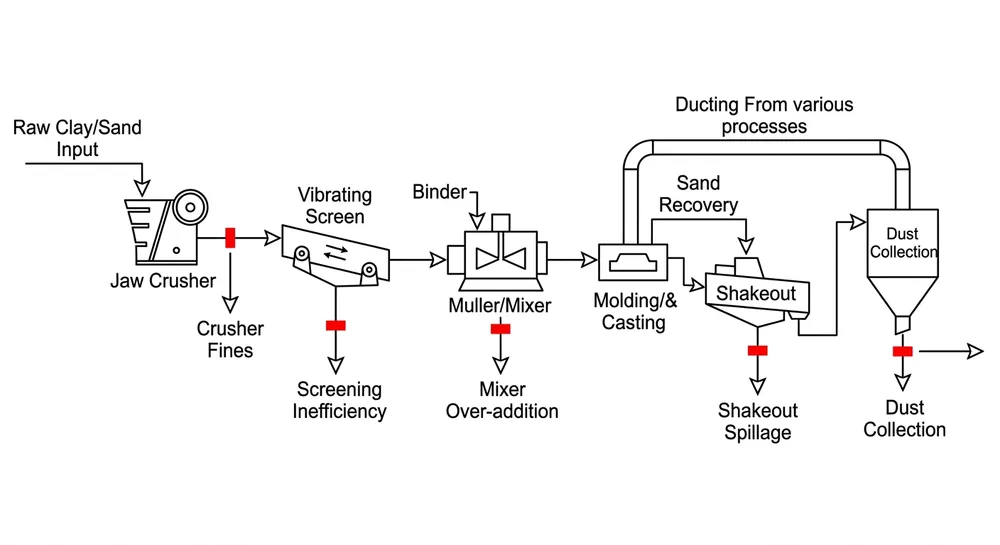
A turnkey clay sand system isn't a single machine. It's an integrated production line where sand flows in a closed loop: fresh sand enters the preparation stage, gets mixed with bentonite and water to target moisture content (typically 3.0-3.5% for green sand molding), moves to the molding machine for compaction, returns as used sand after shakeout, passes through reclamation to remove fines and metal contamination, and cycles back to preparation.
Here's the subsystem breakdown:
| Subsystem | Function | Key Specs to Define |
|---|---|---|
| Molding Line | Forms molds from prepared sand under hydraulic pressure | Mold size (mm), molds per hour, compaction pressure (bar), flask or flaskless |
| Sand Preparation | Mixes reclaimed sand with fresh sand, bentonite, water to target properties | Mixer capacity (tons/hour), moisture control accuracy (±0.2%), batch or continuous |
| Reclamation System | Removes fines, metal particles, burnt clay from used sand | Recovery rate (%), throughput (tons/hour), magnetic separation strength |
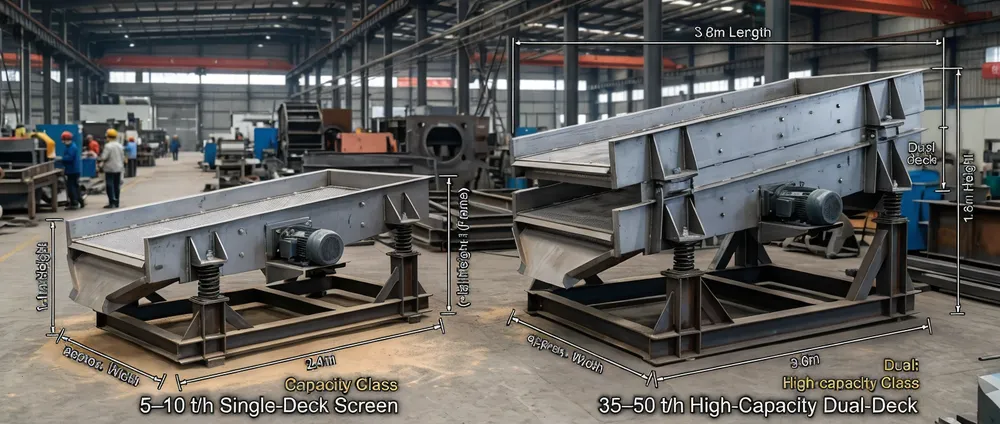
| Vibrating Screen | Separates oversized lumps and metal debris before reclamation | Screen mesh size, throughput capacity, vibration frequency |
| Material Handling | Conveyors, elevators, hoppers connecting subsystems | Belt speed, hopper capacity, dust collection integration |
The most common procurement mistake: specifying a clay sand molding line at 120 molds/hour but pairing it with a reclamation system rated for 80 molds/hour equivalent sand throughput. The reclamation bottleneck forces you to add fresh sand continuously, which drives up material cost and creates disposal problems for the excess used sand.

Define Your Requirements Before Requesting Quotes
We've commissioned lines where the buyer specified "100 molds per hour" without defining mold dimensions, casting weight range, or available floor space. That's like asking for a truck without saying whether you're hauling 2 tons or 20 tons. The supplier either over-specs (you pay for capacity you don't need) or under-specs (the line can't handle your actual production mix).
Start with these six parameters:
1. Target mold output (molds per hour) This is your primary capacity spec, but it only means something when paired with mold size. A line rated for 150 molds/hour at 500×400×200 mm is not the same as 150 molds/hour at 800×600×300 mm. Larger molds require longer compaction cycles and higher hydraulic pressure.
2. Mold dimensions (length × width × height in mm) Standard sizes run from 400×300×150 mm (small castings, high-volume production) up to 1200×1000×400 mm (large castings, lower volume). If you're running multiple mold sizes, specify the range — the molding machine needs adjustable pattern plates and the material handling system needs to accommodate the largest size.
3. Casting alloy and weight range Gray iron, ductile iron, and aluminum have different sand-to-metal ratios and shakeout characteristics. Gray iron typically runs 3:1 to 4:1 sand-to-metal ratio. Ductile iron runs hotter and requires higher bentonite content (8-10% vs 6-8% for gray iron) to maintain mold strength. Your clay sand preparation line needs mixing capacity and bentonite dosing accuracy to match your alloy.
4. Available floor space and ceiling height A flaskless clay sand processing line running 120 molds/hour typically needs 25-30 meters of linear floor space plus 8-10 meters width for sand handling equipment. Ceiling height matters for bucket elevators and dust collection ductwork — standard designs assume 8 meters minimum. If your facility has 6-meter ceilings, the supplier needs to redesign the vertical conveyors.
5. Sand recovery target (%) Most buyers target 90-95% sand recovery, meaning 5-10% fresh sand makeup per cycle. Higher recovery rates (above 95%) require more aggressive reclamation with finer screening and stronger magnetic separation, which increases equipment cost and power consumption. Lower recovery (below 90%) reduces equipment cost but increases your ongoing sand purchase and disposal expenses.
6. Existing equipment integration requirements If you're adding a clay sand line to a facility that already has core making equipment, pouring stations, or cooling conveyors, the new line's control system needs to interface with your existing PLCs. Specify your current PLC brand (Siemens, Mitsubishi, Allen-Bradley) and communication protocol (Profibus, Ethernet/IP, Modbus) so the supplier can match it.
We run these six parameters through a capacity calculation that accounts for cycle time, sand circulation rate, and system losses. For a 100 molds/hour line with 600×500×250 mm molds running gray iron, you're looking at roughly 12-15 tons/hour sand circulation, which drives the sizing for your mixer, reclamation unit, and conveyors.
Molding Line Configuration: Flaskless vs Flask-Based, Vertical vs Horizontal
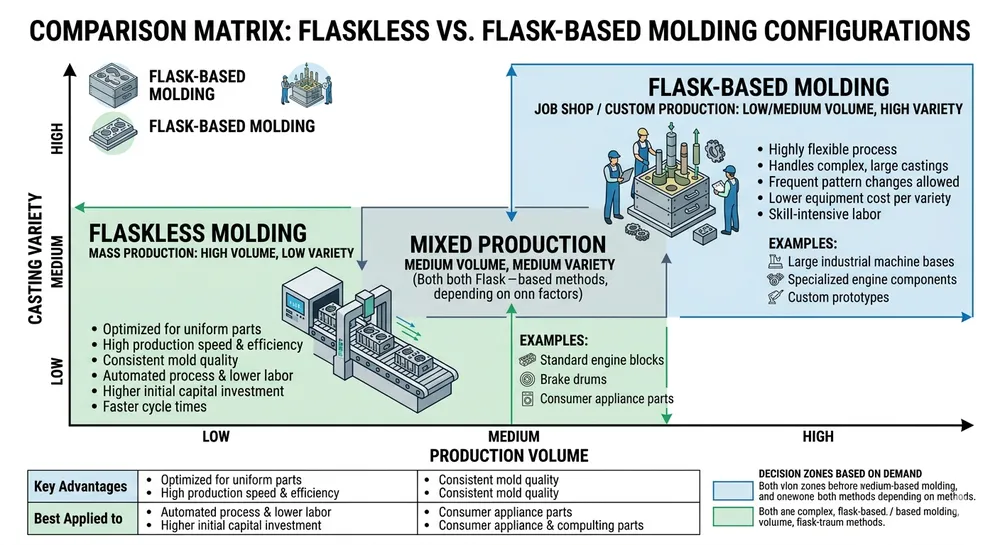
The molding machine is the most visible part of the line, but configuration choices here ripple through the entire system. Two main decision points: flask or flaskless, and vertical or horizontal compaction.
Flaskless molding lines produce molds without metal flasks by compacting sand between pattern plates, then extracting the mold as a free-standing block. Advantages: faster cycle times (no flask handling), lower weight (no flasks to move), better for high-volume production above 80 molds/hour. Disadvantages: requires more precise sand properties (moisture and compactability must stay within ±0.2% or molds collapse), needs stronger mold handling conveyors, and pattern changes take longer because you're swapping entire pattern plate assemblies.
Flask-based molding lines compact sand inside reusable metal flasks. Advantages: more forgiving of sand property variation (the flask holds the mold together even if compaction is slightly off), easier pattern changes (swap patterns without changing flasks), better for job-shop foundries running multiple casting types. Disadvantages: slower cycle times (flask handling adds 15-20 seconds per cycle), higher maintenance (flask wear and alignment), and you need a flask inventory (typically 1.5× your line capacity to account for flasks in circulation).
We typically recommend flaskless for production foundries running the same casting family at volumes above 100 molds/hour. Flask-based makes more sense for job shops running 20-50 different casting types per month where pattern change frequency matters more than cycle time.
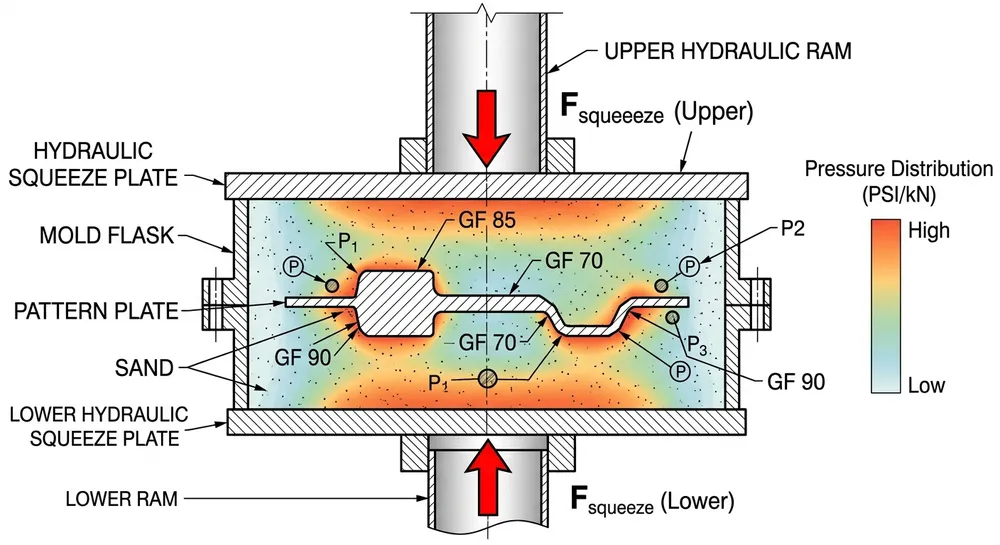
Vertical vs horizontal compaction affects floor space and mold quality. Vertical squeeze molding machines compact sand from above using a hydraulic ram. They need less floor space (the machine footprint is roughly 3×4 meters for a 600×500 mm mold size) but require higher ceiling clearance for the ram stroke. Horizontal molding machines compact sand from the side, which works better in low-ceiling facilities but needs more linear floor space (8-10 meters for the same mold size).
Compaction pressure specs matter more than most buyers realize. Standard green sand molding runs 100-150 bar hydraulic pressure. If you're casting ductile iron or running thin-wall castings that need high mold density, specify 180-200 bar. The hydraulic system cost difference is about 15%, but under-spec'd pressure causes mold defects (sand expansion, metal penetration) that cost far more in scrap.
Sand Reclamation and Preparation: Where Quality Control Happens
Sand properties drift during production. Fresh green sand starts at 3.2% moisture, 7.5% bentonite, 85% compactability. After 10 cycles through molding and shakeout, moisture drops to 2.8%, bentonite degrades to 6.2%, compactability falls to 78%. If your clay sand reclamation line doesn't remove the degraded fines and your preparation line doesn't add back the right amount of bentonite and water, mold quality deteriorates and you start seeing defects.
Reclamation system components:
A complete reclamation line includes crushing (breaks up large sand lumps from shakeout), screening (removes oversized particles and metal debris), magnetic separation (pulls out ferrous contamination), and pneumatic classification (removes fine dust and burnt clay). The clay sand vibrating screen is the first stage — it typically runs dual-deck screens with 6 mm top mesh (removes large metal pieces) and 1.5 mm bottom mesh (removes fine dust).
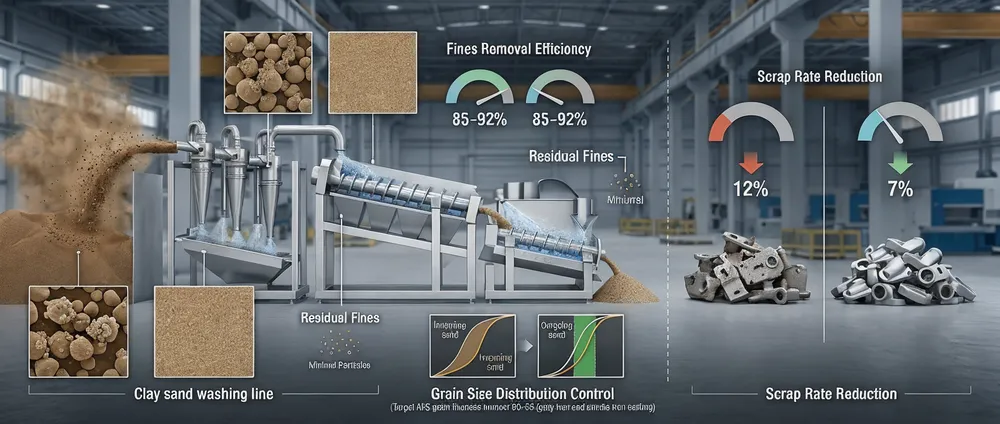
Recovery rate depends on how aggressively you screen and classify. A basic reclamation system with single-stage screening and magnetic separation achieves 85-90% recovery. Add pneumatic classification and you reach 92-95%. Push beyond 95% and you need thermal reclamation (heating sand to 600-800°C to burn off organic binders), which adds significant equipment cost and energy consumption.
We run sand samples through our in-house testing lab before shipping reclamation equipment. If you're buying a line rated for 95% recovery, we'll show you the test data from your specific unit running a sample of your actual sand. This isn't catalog performance — it's measured recovery rate on the equipment you're receiving.
Preparation line accuracy:
The mixer is where you control final sand properties. Batch mixers (1-2 ton capacity, 3-5 minute cycle) give better property control because you can adjust bentonite and water dosing per batch based on lab tests. Continuous mixers (5-10 ton/hour throughput) cost less and need less floor space but have slower response to property drift.
Moisture control accuracy matters. ±0.5% moisture variation is acceptable for flask-based molding. Flaskless lines need ±0.2% or tighter, which requires automated water dosing with flow meters and feedback control. We use Siemens or Mitsubishi PLCs with 4-20mA analog inputs from moisture sensors — the control system adjusts water valve position every 30 seconds to hold target moisture.
Bentonite dosing accuracy should be ±2% of target addition rate. If you're adding 0.5% fresh bentonite per cycle (to replace degraded bentonite), the dosing system needs to deliver 0.49-0.51% consistently. Screw feeders with load cells work better than volumetric feeders because bentonite bulk density varies with humidity.
Evaluating Supplier Manufacturing Capability
Not all foundry equipment manufacturers can hold the tolerances and quality standards needed for export-grade clay sand lines. Here's what to check during supplier evaluation:
CNC machining capability for precision components: Mold plates, guide rails, and hydraulic cylinder bodies need ±0.02 mm tolerance on critical dimensions. A molding line operates under 150-bar hydraulic pressure with 50-100 ton compaction force — any misalignment causes seal failure and oil leaks. Ask the supplier about their CNC machining centers and inspection equipment. We use coordinate measuring machines (CMM) to verify dimensional accuracy on every mold plate before assembly.
Hydraulic system testing: Every hydraulic power unit should be pressure-tested at 1.5× rated capacity before installation. We learned this in 2012 when a batch of cylinder seals failed at a customer site because we skipped the overload test. Now every hydraulic component gets bench-tested under load before it leaves our assembly area. Ask suppliers for their hydraulic testing protocol and whether they provide test data with each unit.
Weld quality for structural frames: Clay sand mixers and reclamation units operate under continuous vibration stress. Manual welding creates porosity issues that show up as cracks after 6 months of operation. We switched to robotic welding for all structural frames because it gives consistent penetration depth and eliminates the weld defects that cause premature failure. Check whether the supplier uses automated welding and what NDT (non-destructive testing) methods they apply — dye penetrant inspection should be standard for all structural welds.
Control system integration: The PLC system ties all subsystems together. We offer Siemens or Mitsubishi PLCs with multilingual HMI (English, Spanish, Arabic, Russian) and 4G remote diagnostics. Remote diagnostics matter for export buyers — your maintenance team can pull error logs and adjust parameters without flying an engineer to the site. Ask about PLC brand options, HMI language support, and whether the supplier provides remote commissioning support.
Quality certifications: ISO 9001:2015 covers quality management from incoming inspection through final commissioning. CE certification applies to equipment exported to European markets — the supplier should maintain technical files with risk assessments, EMC testing reports, and machinery directive compliance documentation. SGS or TÜV third-party audits add another verification layer. Request copies of current certificates and ask whether pre-shipment inspection is available.
Total Landed Cost: Equipment, Freight, Installation, Commissioning
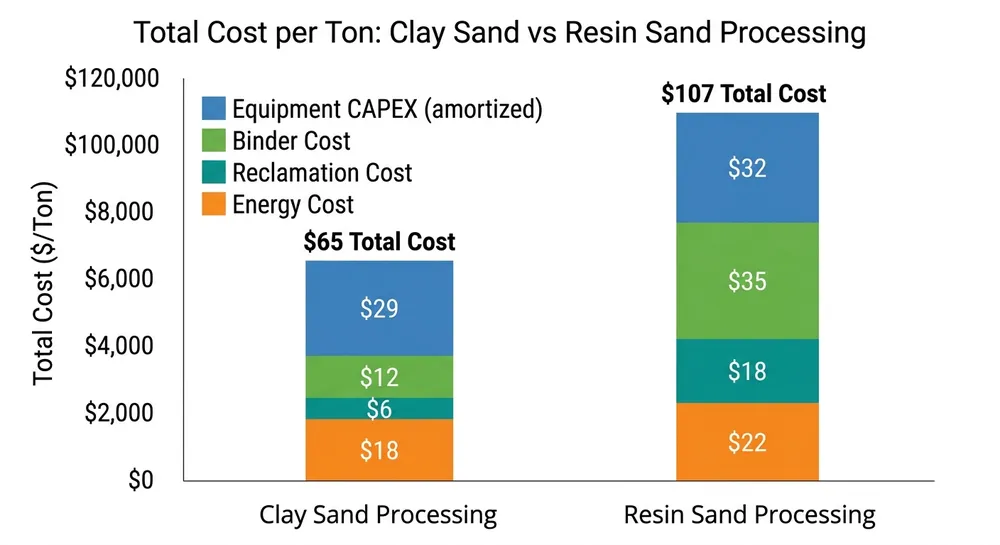
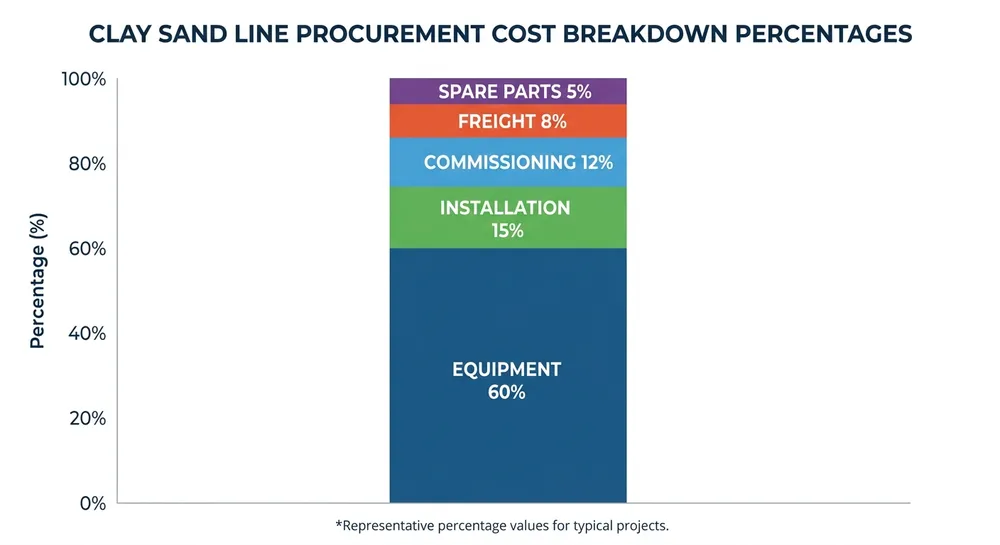
The equipment price is 60-70% of your total landed cost. The other 30-40% covers ocean freight, installation, commissioning, and first-year spare parts. Most buyers focus only on the equipment quote and get surprised by logistics costs.
Equipment pricing breakdown for a 100 molds/hour line:
- Molding machine (flaskless, vertical, 600×500 mm): $85,000-$120,000
- Sand preparation line (batch mixer, 2 ton capacity): $35,000-$50,000
- Reclamation system (screening, magnetic separation, 95% recovery): $45,000-$65,000
- Material handling (conveyors, elevators, hoppers): $25,000-$35,000
- Control system (PLC, HMI, sensors, wiring): $15,000-$25,000
- Total equipment cost: $205,000-$295,000
Ocean freight and logistics: A complete 100 molds/hour clay sand line ships in 2-3 × 40HQ containers depending on configuration. We design equipment frames to fit 40HQ dimensions (12.03m length × 2.35m width × 2.69m height) without wasted space. Container freight from Qingdao to major ports runs $3,000-$5,000 per 40HQ container depending on destination and shipping season. Add $2,000-$4,000 for customs clearance, port handling, and inland transport to your facility.
Installation and commissioning: Installation labor depends on your local rates and whether you're using your own crew or hiring contractors. Budget 3-4 weeks for mechanical installation (equipment positioning, foundation bolts, alignment) plus 1-2 weeks for electrical and hydraulic connections. Commissioning takes another 1-2 weeks to run test cycles, calibrate sensors, and train operators.
We provide remote commissioning via video call — your installation team follows our engineer's instructions to connect hydraulic lines, wire control panels, and run initial test cycles. We've commissioned equipment in 14 countries this way. It works as long as your team can read hydraulic schematics and use a multimeter. Remote commissioning costs $3,000-$5,000 vs $15,000-$25,000 for on-site commissioning (engineer travel, accommodation, per diem for 2-3 weeks).
First-year spare parts: Every line ships with a spare parts kit covering consumables for the first year: hydraulic seals, proximity sensors, solenoid valves, PLC I/O modules. Budget $8,000-$12,000 for the initial spare parts kit. After year one, annual spare parts consumption typically runs 3-5% of equipment cost.
Total landed cost example (100 molds/hour line to North America):
- Equipment: $250,000
- Ocean freight (3 × 40HQ): $12,000
- Customs and inland transport: $6,000
- Installation labor (local contractors): $25,000
- Remote commissioning: $4,000
- First-year spare parts: $10,000
- Total: $307,000
For a detailed breakdown of cost factors and how to optimize your budget, see our cost breakdown guide.
Logistics and Installation Planning: Container Optimization and Modular Design
Export buyers often underestimate how much equipment design affects shipping cost. A poorly designed line that needs 5 containers instead of 3 adds $6,000-$10,000 to your freight bill. We engineer equipment frames to fit container dimensions from the start.
Modular frame design for container fit: A 12-meter flaskless molding line breaks down into three sections: pattern plate assembly (3.5m), compaction unit (4.5m), and mold extraction conveyor (4m). Each section fits lengthwise in a 40HQ container (12.03m internal length). Hydraulic power units and control cabinets ship separately in the same container using the remaining width. This modular approach means your line arrives in 2 containers instead of 4.
Knock-down packaging: Structural frames ship fully welded (disassembling and re-welding on site creates alignment problems). Hydraulic cylinders, motors, and electrical components ship separately in protective crates. The control cabinet ships as a complete unit with all wiring terminated — your electrician just needs to connect power supply and field devices.
Foundation and utility requirements: Most clay sand lines need a reinforced concrete foundation 200-300 mm thick to handle vibration loads. We provide foundation drawings showing bolt hole locations, anchor bolt specifications, and floor loading (typically 800-1200 kg/m² for the molding machine area). Utility requirements: 380V three-phase power (check your local voltage and frequency), compressed air at 6-8 bar (for pneumatic valves and cylinders), and water supply for dust suppression (if required by local regulations).
Installation sequence: Position the molding machine first and level it to ±0.5 mm (use precision levels and shim plates). Install the sand preparation and reclamation equipment next, working backward from the molding machine to maintain proper material flow. Connect conveyors and elevators last. Hydraulic lines use quick-disconnect fittings — no welding or threading required. Electrical connections follow standard industrial practices (terminal blocks, cable glands, conduit).
For facility layout planning and space optimization strategies, see our layout planning guide.
Supplier Evaluation Checklist: What to Verify Before Signing
Use this checklist when comparing suppliers:
Manufacturing verification:
- [ ] Factory audit available (in-person or video tour)
- [ ] CNC machining centers for precision components
- [ ] Hydraulic testing protocol (1.5× rated pressure minimum)
- [ ] Robotic welding for structural frames
- [ ] NDT inspection for critical welds (dye penetrant or ultrasonic)
Quality documentation:
- [ ] ISO 9001:2015 certificate (current, not expired)
- [ ] CE certification for European export (if applicable)
- [ ] SGS or TÜV third-party audit reports
- [ ] Unit-specific commissioning data (actual measured performance, not catalog specs)
- [ ] Material certificates for steel plate and hydraulic components
Technical capability:
- [ ] PLC brand options (Siemens, Mitsubishi, or equivalent)
- [ ] Multilingual HMI (specify required languages)
- [ ] Remote diagnostics capability (4G or Ethernet)
- [ ] Custom capacity configuration (not just standard models)
- [ ] Integration with existing equipment (specify your current PLC brand)
Export and logistics:
- [ ] Container-optimized modular design
- [ ] Knock-down packaging for overseas shipping
- [ ] Foundation drawings and utility requirements provided
- [ ] Installation manual with hydraulic and electrical schematics
- [ ] Remote commissioning support available
After-sales support:
- [ ] First-year spare parts kit included
- [ ] Spare parts availability (lead time for common consumables)
- [ ] Technical support response time (email, phone, video call)
- [ ] Warranty terms (typically 12 months from commissioning)
- [ ] Training materials (operation manual, maintenance procedures, troubleshooting guide)
References and track record:
- [ ] Export installations in your target market
- [ ] Reference customers you can contact
- [ ] Years in business manufacturing clay sand equipment
- [ ] Annual production capacity (indicates whether they can meet your delivery schedule)
When you're ready to request detailed specifications and factory pricing, submit your requirements through our Request Quote page with your target mold output, mold dimensions, casting alloy, available floor space, and ceiling height.
Frequently Asked Questions
What is the typical lead time for a complete clay sand processing line?
Lead time depends on configuration complexity and current production schedule. Standard configurations (flaskless molding line, batch mixer, basic reclamation) typically ship in 8-12 weeks from deposit. Custom configurations with special mold sizes or non-standard capacity requirements add 2-4 weeks for engineering and fabrication. We maintain component inventory for common subsystems (hydraulic cylinders, PLC panels, motors) to reduce lead time, but long-lead items like custom mold plates or large structural frames need the full manufacturing cycle.
How do I calculate the required sand reclamation capacity to match my molding line output?
Sand circulation rate equals mold volume × molds per hour × sand bulk density. For a 100 molds/hour line with 600×500×250 mm molds, that's 0.075 m³ per mold × 100 molds/hour × 1.6 ton/m³ = 12 tons/hour sand circulation. Your reclamation system needs to process 12 tons/hour to keep up. Add 15-20% margin for system losses and maintenance downtime, so specify 14-15 tons/hour reclamation capacity. Under-sizing the reclamation system forces you to add fresh sand continuously, which increases material cost and creates disposal problems.
What causes clay sand mold quality to drift during production, and how do I prevent it?
Mold quality drift comes from three sources: moisture loss (evaporation during molding and handling), bentonite degradation (thermal breakdown during casting), and fines accumulation (sand particles breaking down through repeated compaction cycles). Moisture typically drops 0.3-0.5% per cycle. Bentonite loses 0.2-0.3% active clay content per cycle. Fines (particles below 0.1 mm) increase from 8% to 15% after 10 cycles. Your preparation line needs automated moisture control (±0.2% accuracy) and bentonite dosing (±2% accuracy) to compensate. The reclamation system removes fines through pneumatic classification. Without active control, compactability drops from 85% to 75% within 4-6 hours, causing mold defects.
Should I choose a flaskless or flask-based molding line for my foundry?
Flaskless makes sense for production foundries running the same casting family at volumes above 100 molds/hour. You get faster cycle times (no flask handling) and lower operating cost (no flask maintenance). But flaskless requires tighter sand property control (±0.2% moisture, ±1% compactability) because there's no flask to hold the mold together if compaction is slightly off. Flask-based works better for job shops running 20-50 different casting types per month where pattern change frequency matters more than cycle time. Flask-based is more forgiving of sand property variation and pattern changes are faster (swap patterns without changing the entire pattern plate assembly).
What PLC and control system options are available for export buyers?
We offer Siemens or Mitsubishi PLCs depending on your preference and existing equipment. Siemens S7-1200 series is common for European and North American buyers. Mitsubishi FX5 series is popular in Asian and Middle Eastern markets. Both support multilingual HMI (English, Spanish, Arabic, Russian, Chinese) and 4G remote diagnostics. If you have existing foundry equipment with a specific PLC brand, we can match it so your maintenance team doesn't need to learn multiple programming environments. The control system includes all sensors (proximity switches, pressure transducers, moisture sensors), wiring, and a touchscreen HMI with recipe management for different mold sizes.
How does remote commissioning work, and is it reliable for overseas installations?
Remote commissioning uses video call (typically WeChat, WhatsApp, or Zoom) where our engineer guides your installation team through startup procedures. Your team needs basic skills: read hydraulic schematics, use a multimeter for electrical checks, and follow step-by-step instructions. The process takes 3-5 days: Day 1 covers hydraulic system pressure testing and leak checks. Day 2 covers electrical connections and PLC power-up. Day 3-4 cover sensor calibration and first test cycles. Day 5 covers parameter adjustment and operator training. We've commissioned equipment in 14 countries this way with a 95% success rate (5% needed on-site follow-up for issues that couldn't be diagnosed remotely). Remote commissioning costs $3,000-$5,000 vs $15,000-$25,000 for on-site commissioning.
What is the typical sand recovery rate I should target, and how does it affect operating cost?
Most foundries target 90-95% sand recovery, meaning 5-10% fresh sand makeup per cycle. Higher recovery (above 95%) requires more aggressive reclamation equipment (thermal reclamation, fine screening, multiple-stage magnetic separation) which increases capital cost by 30-40% and energy consumption by 50-60%. Lower recovery (below 90%) reduces equipment cost but increases ongoing sand purchase and disposal expenses. For a 100 molds/hour line running 2 shifts, 90% recovery means 1.2 tons/day fresh sand makeup. At $50/ton sand cost, that's $60/day or $15,000/year. Pushing to 95% recovery saves $7,500/year in sand cost but adds $25,000-$35,000 to equipment cost. Payback period is 3-5 years, so 95% recovery makes sense if you're running high volume (above 150 molds/hour) or if sand disposal cost is high in your region.

Baocun Zhu is the Senior Clay Sand Process Engineer at TZFoundry in Qingdao. With over 14 years commissioning clay sand molding, reclamation, and preparation lines for export foundries, he turns floor-space constraints and throughput targets into working production systems. His...