Wrong mesh specification on your vibrating screen means oversized lumps jam your sand mixer, undersized particles bypass reclamation, and you're replacing torn screens every three weeks instead of every six months. I've watched foundries lose 8-12% of their sand to waste bins because the mesh opening didn't match their AFS grain fineness number.
Vibrating screen mesh selection is the process of matching screen aperture size, wire diameter, and material type to your clay sand's grain distribution, moisture content, and production throughput. Get it right and your sand flows clean into the mixer at 95%+ recovery. Get it wrong and you're either blocking flow or passing contamination downstream.
Mesh Parameters That Control Sand Quality
Three specifications determine whether your screen actually separates what you need it to separate.
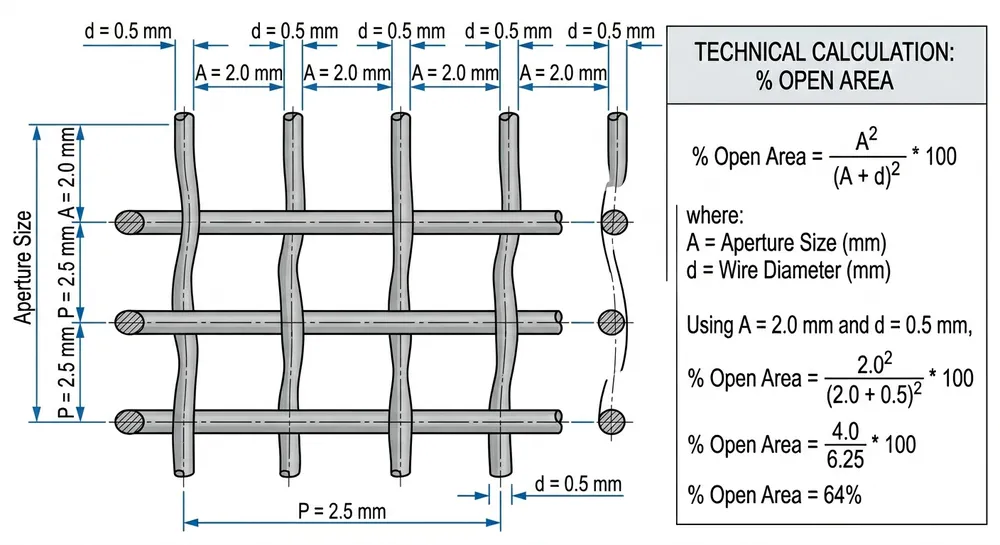
Aperture size (also called mesh opening or hole size) is the clear space between wires, measured in millimeters or mesh count. A 2.0mm aperture passes particles smaller than 2.0mm and retains everything larger. Mesh count works inversely — 10 mesh means 10 openings per linear inch, which translates to roughly 2.0mm aperture. For clay sand screening, we work in millimeters because AFS grain fineness numbers map directly to particle size ranges.
Wire diameter affects open area percentage and screen lifespan. Thicker wire (1.6mm vs 1.2mm) reduces the percentage of open screening area but survives abrasive clay sand longer. A 2.0mm aperture screen with 1.6mm wire has about 38% open area. The same aperture with 1.2mm wire gives you 48% open area — better throughput, shorter life. We run 1.4-1.6mm wire diameter on our Clay Sand Vibrating Screen units because the wear life justifies the slightly lower flow rate.
Open area percentage is the ratio of hole area to total screen surface. Higher open area means better throughput but faster wear. For clay sand with 4-6% moisture and clay content, 40-45% open area keeps material moving without blinding the screen. Below 35% open area, damp sand starts to bridge across the surface instead of falling through.

Matching Mesh Aperture to AFS Grain Fineness Number
AFS grain fineness number tells you the average particle size in your sand sample. The mesh aperture needs to sit just above your target particle range to remove oversize contamination without losing usable sand.
Here's the selection table we use in our sand reclamation testing lab at TZFoundry's Qingdao facility:
| Casting Application | Target AFS Number | Dominant Particle Size (mm) | Recommended Mesh Aperture (mm) | Wire Diameter (mm) | Open Area (%) |
|---|---|---|---|---|---|
| Gray iron (small parts, <5kg) | 55-65 | 0.20-0.30 | 1.0-1.5 | 1.0-1.2 | 42-48 |
| Gray iron (medium parts, 5-50kg) | 50-60 | 0.25-0.35 | 1.5-2.0 | 1.2-1.4 | 40-45 |
| Ductile iron (general) | 50-60 | 0.25-0.35 | 1.5-2.0 | 1.4-1.6 | 38-42 |
| Steel casting (carbon steel) | 45-55 | 0.30-0.40 | 2.0-2.5 | 1.4-1.6 | 40-44 |
| Aluminum casting (sand cast) | 60-70 | 0.18-0.28 | 1.0-1.5 | 1.0-1.2 | 45-50 |
The aperture sits 3-5x larger than your dominant particle size because you're removing agglomerated lumps and foreign material, not filtering individual grains. A foundry running AFS 55 sand (0.25mm average particle) uses 1.5mm mesh to catch clay balls and rust scale while passing the bulk sand fraction.
We tested this in our lab with samples from a ductile iron foundry in Poland. Their reclaimed sand measured AFS 52 with 5.2% clay content. A 1.5mm mesh passed 94% of usable sand and retained the oversize fraction (mostly clay agglomerates and broken mold pieces). When they tried 1.0mm mesh to "be safe," throughput dropped 35% and the screen blinded within 90 minutes of continuous operation.
Woven Wire vs Polyurethane vs Rubber Screen Media
Material choice determines replacement frequency and total cost per ton of screened sand.
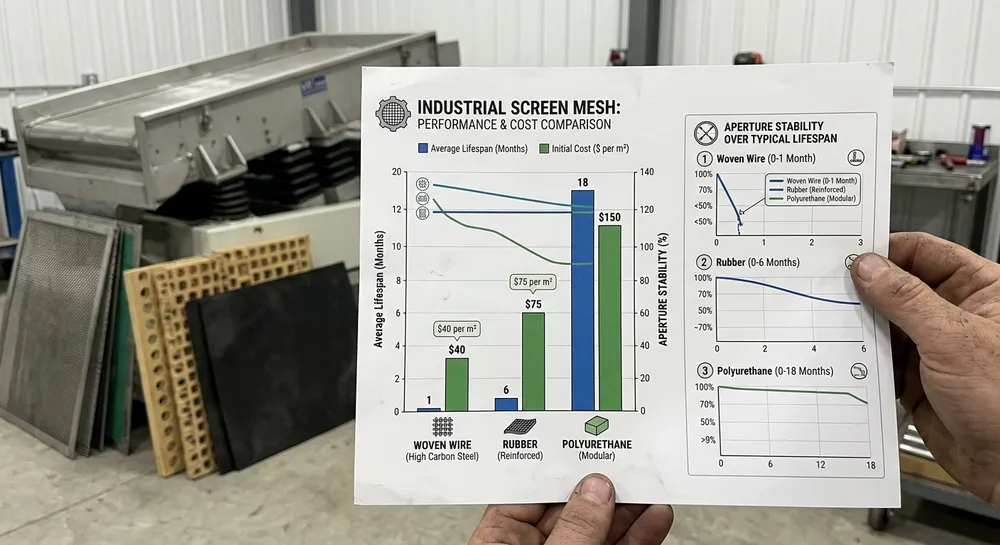
Woven steel wire mesh (typically high-carbon spring steel or stainless steel) handles abrasive silica sand and survives temperatures up to 200°C if you're screening hot reclaimed sand. Lifespan runs 4-6 months at 20 tons/hour throughput with 5% clay content. Wire mesh costs $180-$280 per square meter depending on aperture and wire diameter, but it's the only option that maintains precise aperture size under load. We use woven wire on all our standard Clay Sand Processing Line installations because dimensional stability matters more than initial cost when you're targeting AFS ±2 tolerance.
Polyurethane screen panels last 8-12 months under the same conditions because the material flexes instead of abrading. Cost runs $320-$450 per square meter. The trade-off: aperture size drifts as the material wears. A 2.0mm polyurethane opening can stretch to 2.3-2.4mm after 6 months, which means you're passing larger particles than your spec allows. This works fine for coarse screening (removing tramp metal, wood debris) but causes problems when you need consistent AFS number control for precision casting.
Rubber screen media (natural or synthetic rubber with fabric reinforcement) handles high moisture content better than wire or polyurethane. If your sand comes off the shakeout conveyor at 8-10% moisture, rubber won't blind as quickly. Lifespan sits between wire and polyurethane (6-9 months), cost runs $240-$360 per square meter. The limitation: rubber screens work best at apertures above 3.0mm. Below that size, the material thickness required for structural integrity reduces open area too much.
For standard clay sand reclamation where you're controlling AFS number and feeding a mixer that's sensitive to oversize particles, woven wire mesh gives you the most predictable performance. The shorter replacement interval is offset by lower cost per screen and consistent aperture dimensions.
How Sand Moisture and Clay Content Affect Mesh Performance
Dry sand (2-3% moisture) flows freely through any properly sized mesh. Clay-bonded green sand at 4-6% moisture starts to behave differently.
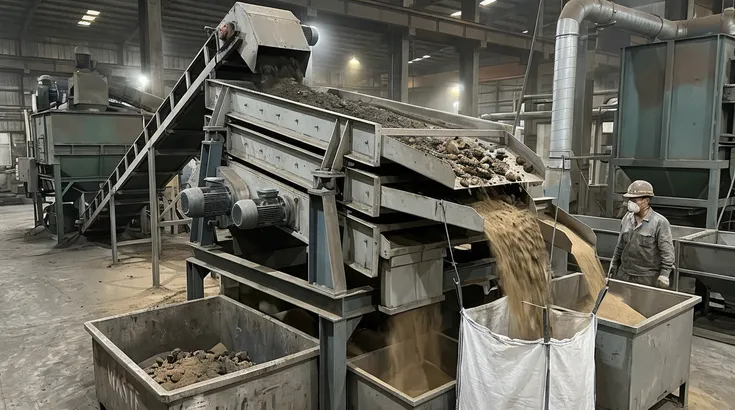
Moisture content above 5% causes fine particles to stick together and bridge across mesh openings. A 1.5mm aperture screen that handles dry sand at 25 tons/hour drops to 18-20 tons/hour when moisture hits 6%. The sand doesn't fall through cleanly — it forms temporary dams on the screen surface that break up under vibration, then reform. This is why screen decks on Clay Sand Reclamation Line systems run at 15-18mm amplitude instead of the 8-10mm you'd use for dry aggregate screening. Higher amplitude breaks up the moisture bridges.
Clay content above 6% means you're dealing with more agglomerated lumps. These lumps are softer than silica grains, so they deform slightly as they hit the screen surface. A 2.0mm clay ball can squeeze through a 1.8mm opening if the screen tension is too loose. We tension our screens to 180-200 N/cm (measured with a tension meter across the short axis) to prevent this. Loose screens let contamination through. Over-tensioned screens (above 220 N/cm) crack the wire at crimp points.
The practical result: if your sand runs consistently above 5.5% moisture or 6.5% clay, move up one aperture size from the table above and accept slightly lower separation efficiency. A 2.0mm screen that stays productive is better than a 1.5mm screen that blinds every 45 minutes.
Mesh Replacement Intervals and Total Cost of Ownership
Replacement frequency depends on three factors: throughput tonnage, sand abrasiveness, and screen tension maintenance.
At 20 tons/hour continuous operation (160 tons per 8-hour shift), woven wire mesh lasts approximately:
- 4-5 months with AFS 45-50 sand (coarser, less abrasive)
- 3-4 months with AFS 55-60 sand (finer, more abrasive surface area)
- 2-3 months with AFS 65+ sand (very fine, maximum abrasive contact)
The wear pattern shows up as elongated apertures in the high-impact zone (center third of the screen deck where material first contacts the surface). When aperture size drifts more than 15% from specification, separation efficiency drops and you start passing oversize into your mixer. We recommend measuring aperture size with pin gauges every 500 operating hours — if a 2.0mm mesh is passing a 2.3mm pin, it's time to replace.
Total cost per ton of screened sand:
- Woven wire: $0.08-$0.12 per ton (based on $220/m² screen cost, 4-month life, 20 tons/hour)
- Polyurethane: $0.06-$0.09 per ton (based on $380/m² screen cost, 9-month life, 20 tons/hour)
- Rubber: $0.07-$0.10 per ton (based on $300/m² screen cost, 7-month life, 20 tons/hour)
Polyurethane looks cheaper per ton, but only if aperture drift doesn't cause downstream problems. For foundries running tight mold tolerance work (±0.3mm or better), the dimensional stability of wire mesh justifies the slightly higher operating cost.
When you order a vibrating screen from us, we include two spare mesh panels in the shipment. Overseas buyers appreciate this because it eliminates the 6-8 week lead time for replacement screens. The spare panels ship flat in the same container as the main equipment, and your maintenance team can swap a worn screen in about 90 minutes using the tensioning clamps we provide.
Integration with Upstream Crushers and Downstream Mixers
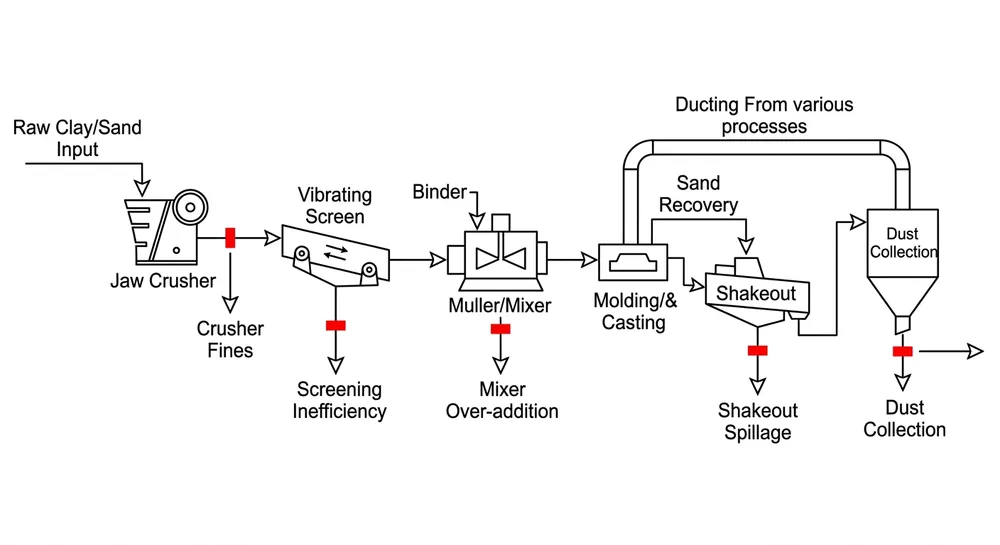
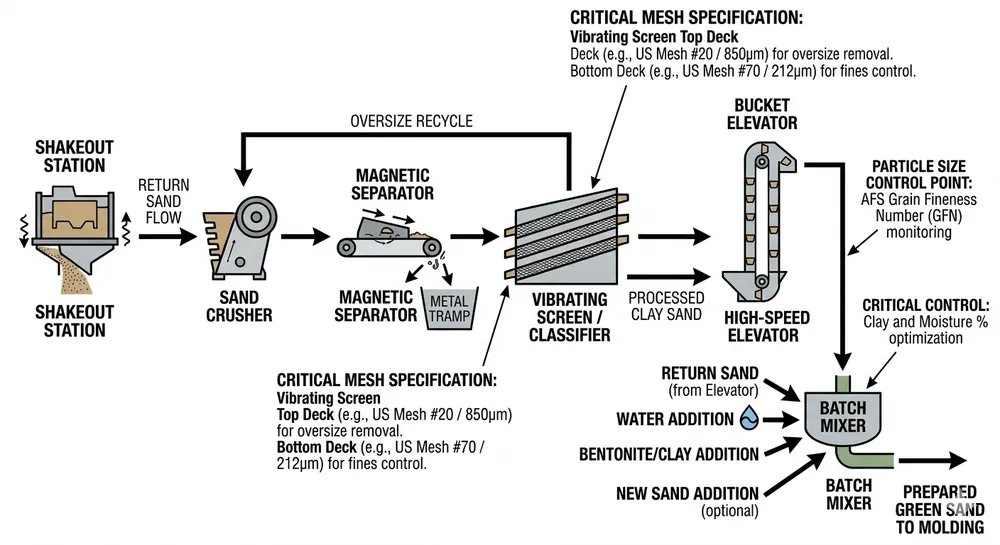
Mesh selection doesn't happen in isolation — it's part of a material flow sequence that starts at your shakeout conveyor and ends at your molding machine.
Upstream from the screen: If you're running a lump crusher or hammer mill before the vibrating screen, the crusher gap setting determines the maximum particle size hitting your mesh. Set the crusher gap to 1.5-2.0x your mesh aperture. A 2.0mm screen should see maximum 3.0-4.0mm lumps from the crusher. Larger gaps mean the screen does more work (and wears faster). Smaller gaps mean you're over-crushing and generating excess fines that lower your AFS number.
Downstream from the screen: Your sand mixer has a maximum acceptable particle size, usually defined by the smallest passage in the mixer paddle assembly or discharge gate. If your mixer can't handle particles above 3.0mm without jamming, your screen aperture needs to guarantee nothing larger passes through. This is where aperture stability matters — a worn polyurethane screen that's drifted from 2.0mm to 2.5mm might start passing particles that jam your mixer discharge.
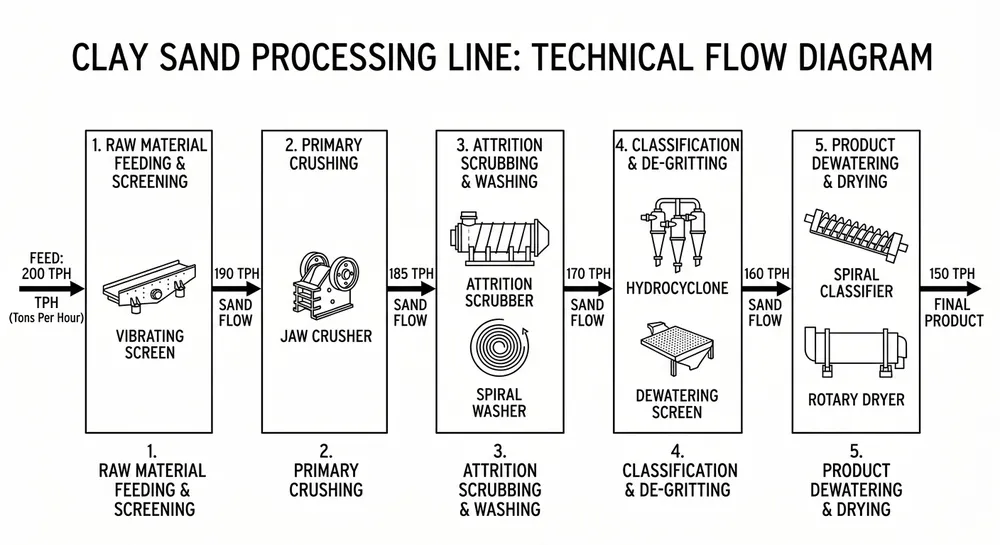
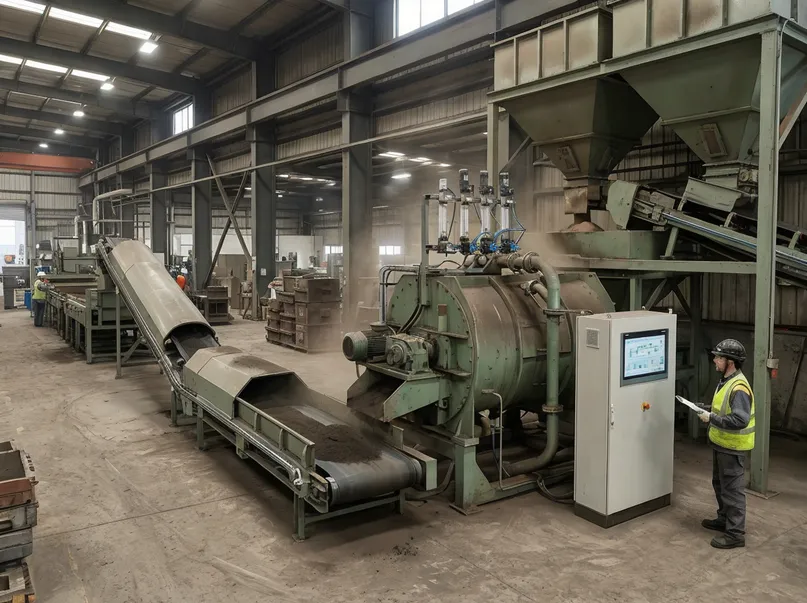
We've integrated clay sand processing lines where the screen sits between a magnetic separator (removes tramp metal) and a bucket elevator (feeds the overhead storage silo). In that configuration, the screen protects the elevator from oversize lumps that would jam the buckets. The mesh aperture gets sized to the elevator bucket throat opening, not just the sand grain distribution. This is the kind of system-level thinking that prevents expensive downtime — and it's why we ask for your complete process flow diagram before recommending screen specifications.
Common Mesh Selection Mistakes That Cost You Money
Mistake 1: Specifying mesh by count instead of aperture size. A "10 mesh" screen from one supplier might have 2.0mm openings, while another supplier's "10 mesh" measures 1.8mm because they're using different wire diameters. Always specify aperture size in millimeters and wire diameter separately. Our equipment drawings call out both dimensions so there's no confusion during replacement orders.
Mistake 2: Choosing aperture based only on AFS number without considering clay content. High clay content (above 6%) forms larger agglomerates that need a bigger aperture to clear the screen efficiently. A foundry running AFS 55 sand with 7% clay needs 2.0mm mesh, not the 1.5mm that the AFS number alone would suggest.
Mistake 3: Under-tensioning the screen to extend wire life. Loose screens let particles bounce instead of passing through cleanly, which actually increases wear from repeated impacts. Proper tension (180-200 N/cm) makes the screen act like a rigid surface that particles slide across. We've seen screens last 40% longer just from correct tensioning.
Mistake 4: Ordering replacement screens without measuring the worn aperture first. If your "2.0mm" screen has worn to 2.4mm and you've been running production successfully, ordering a fresh 2.0mm screen will reduce throughput and might cause blinding. Measure the worn screen, document what's actually working, then decide whether to match the worn size or return to original spec.
Mistake 5: Ignoring screen deck angle. Most vibrating screens run at 5-8° inclination to move material across the deck. Steeper angles (above 10°) reduce residence time and lower separation efficiency. Shallower angles (below 3°) cause material to pool instead of flowing. If you're having throughput problems, check the deck angle before blaming the mesh.
Choosing the Right Mesh for Your Casting Operation
Your casting alloy and production rate determine which mesh specification makes sense.
For gray iron foundries running small to medium parts (under 50kg casting weight), AFS 50-60 sand with 1.5-2.0mm woven wire mesh handles most applications. If you're producing cylinder blocks or machine tool castings where surface finish matters, stay at the finer end (1.5mm aperture, AFS 55-60). For general industrial castings where some surface roughness is acceptable, 2.0mm aperture with AFS 50-55 gives you better throughput and longer screen life.
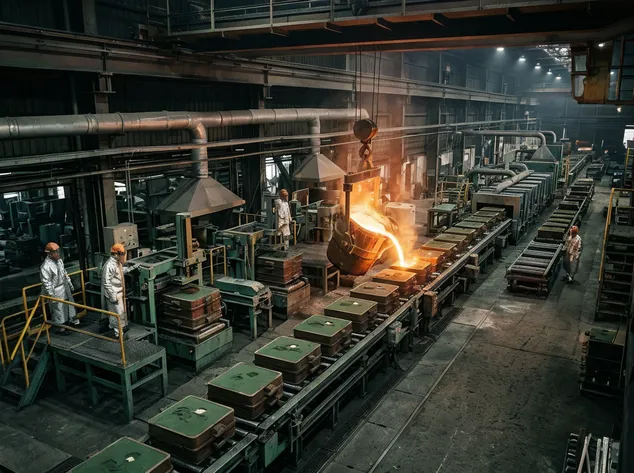
For ductile iron foundries, the higher pouring temperatures and longer shakeout times mean your reclaimed sand comes off the line hotter (often 80-120°C). Woven wire mesh is the only practical choice because polyurethane and rubber degrade above 90°C. Use 1.5-2.0mm aperture with 1.4-1.6mm wire diameter for durability. The heavier wire survives the thermal cycling better.
For steel foundries, you're dealing with coarser sand (AFS 45-55) and higher abrasion from the alloy composition. Move to 2.0-2.5mm aperture with 1.6mm wire diameter. Screen life will be shorter (2-3 months instead of 4-5 months) but trying to extend life by using thicker wire just reduces open area and kills your throughput.
For aluminum foundries, finer sand (AFS 60-70) and lower pouring temperatures mean you can use smaller apertures (1.0-1.5mm) with thinner wire (1.0-1.2mm). The reduced abrasion from aluminum oxide compared to iron oxide means screens last 6-8 months even with the finer mesh.
If you're running multiple alloys through the same reclamation system, size the mesh for your most demanding application (usually the finest AFS number you need to maintain). You'll sacrifice some throughput on coarser sand runs, but you'll avoid the downtime and cost of swapping screens between production campaigns.
Getting the Specification Right Before You Order
Send us three pieces of information and we'll recommend the exact mesh specification for your operation:
- Sand grain distribution report — either an AFS grain fineness number or a sieve analysis showing percentage retained on each screen size. If you don't have lab data, send us a 2kg sand sample and we'll run it through our testing lab in Qingdao.
- Target throughput rate — tons per hour you need to process. This determines screen deck area and whether you need a single-deck or double-deck configuration.
- Clay content and moisture range — typical values from your sand system. If these vary seasonally or between casting campaigns, give us the range so we can size for worst-case conditions.
Our engineering team will calculate the required screen area, recommend aperture size and wire diameter, and provide a mesh replacement schedule based on your throughput. We'll also specify the spare mesh panels you should order with your initial equipment purchase — they ship flat in the same container, and having them on hand eliminates the 6-8 week lead time when you need a replacement.
Request a Quote with your sand parameters and we'll send back a complete specification package including mesh details, screen dimensions, and factory pricing for both the vibrating screen unit and spare mesh inventory.

Baocun Zhu is the Senior Clay Sand Process Engineer at TZFoundry in Qingdao. With over 14 years commissioning clay sand molding, reclamation, and preparation lines for export foundries, he turns floor-space constraints and throughput targets into working production systems. His...