The real problem: one line, five casting sizes, zero tolerance for bottlenecks
Most foundries don't pour a single part size all day. You run brake drums at 8 kg in the morning, pump housings at 45 kg before lunch, and valve bodies at 200 kg on the afternoon shift. Your blasting line has to clean all of them — same day, same equipment footprint, no four-hour changeovers between batches.
Pick the wrong blasting configuration and the penalty is immediate. Undersized chambers choke on heavy castings. Oversized tumble belts damage small parts. A conveyor rated for one weight class either leaves residual sand on the next class or beats the surface finish out of it. Every mismatch becomes scrap, rework, or a throughput bottleneck that ripples back to your molding line.
A clay sand blasting line strips residual molding sand, scale, and flash from castings after shakeout. It sits between your shakeout station and your inspection/finishing area. The selection variables that matter most are conveyor type, blast wheel count and placement, chamber dimensions, and media flow rate — and how all four respond when your casting mix changes mid-shift.
This guide covers each of those variables from a production-planning perspective, with throughput examples and a configuration matrix for foundries running mixed-size castings on a single line.
How conveyor type locks in your weight range and changeover speed
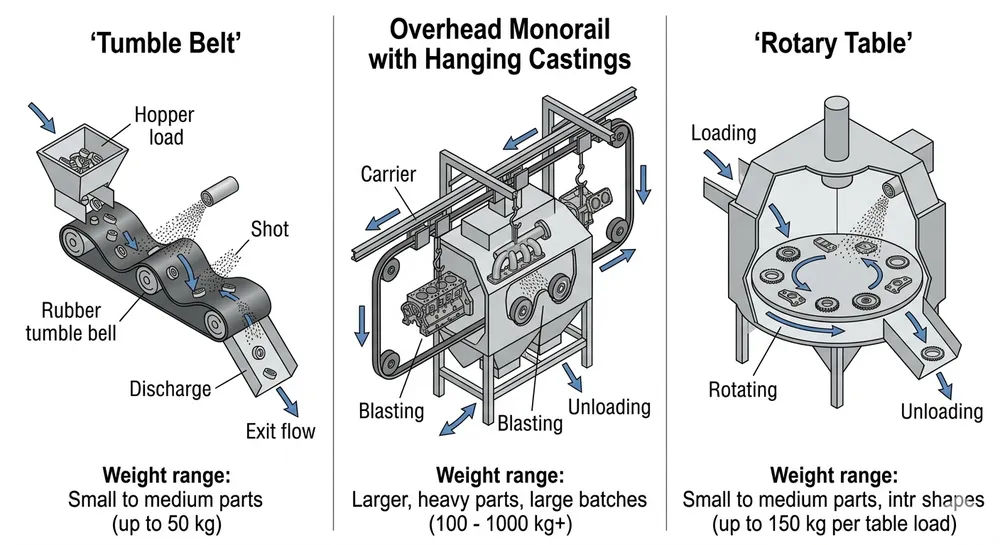
The conveyor isn't just a transport mechanism. It determines the casting weight range, the blast exposure pattern, and how much time you lose switching between part families. Three conveyor types cover the vast majority of clay sand foundry blasting:
| Conveyor type | Practical weight range | Best for | Changeover between part sizes |
|---|---|---|---|
| Tumble belt (rubber or steel) | 0.5–80 kg | High-volume small and mid-size castings | Minimal — load the next batch and run |
| Overhead monorail (hanger) | 10–500 kg+ | Heavy or complex-geometry castings needing 360° exposure | Moderate — may need different hooks/fixtures per part family |
| Rotary table (single or multi-station) | 5–300 kg | Medium batches of mid-to-heavy castings with specific blast angle requirements | Low-to-moderate — fixture changes between families |
Tumble belt lines work by tumbling castings inside a rubber or manganese-steel belt while blast wheels fire media from above. The tumbling action rotates parts continuously, so every surface gets hit without fixtures. The trade-off: parts collide with each other. For ductile iron brake drums or gray iron housings under 80 kg, that's fine — the material can take it. For thin-wall aluminum or castings with machined faces, tumble belts cause dings. We see this problem at commissioning more than you'd expect, usually because someone spec'd a tumble belt for a casting mix that includes a few fragile part numbers.
Overhead monorail lines hang castings from hooks or fixtures on a continuous rail that passes through the blast chamber. Each casting rides through individually, so there's no part-on-part contact. Blast wheels (typically 4–8 units) are positioned around the chamber to cover all angles. The downside is throughput per hour drops compared to tumble belts, and you need hooks or fixtures matched to each casting family. If you run five different part geometries in a shift, that's five sets of fixtures — plan the storage and the changeover time.
Rotary table systems sit the casting on a rotating platform inside the chamber. Good blast angle control, good for heavier parts, but lower throughput than either belt or monorail options. We typically recommend these for foundries with a narrower part mix (2–3 families) where blast angle precision matters more than hourly volume.

If your casting mix spans 0.5 kg to 200 kg and you need to run them on the same line within a single shift, the realistic answer is usually an overhead monorail with interchangeable fixture sets — or a modular layout where a tumble belt handles everything under 80 kg and a separate monorail or table station handles the heavy pieces. We build both configurations. The single-line monorail approach costs more upfront but uses less floor space. The dual-station approach gives you higher throughput on the small parts but needs a wider footprint and a second set of blast wheels.
Blast wheel count and placement: where the cleaning actually happens
The blast wheel is the engine of an airless blasting line. It throws steel shot or grit at the casting surface at 60–80 m/s. The number of wheels, their position relative to the casting, and their individual power rating determine whether you get full coverage on a complex casting or leave blind spots that send parts back for a second pass.
For mixed-size foundries, here's the relationship between wheel count and coverage:
| Blast wheel count | Typical power per wheel | Coverage pattern | Suited for |
|---|---|---|---|
| 2–4 wheels | 7.5–15 kW each | Top and side coverage | Simple geometries, small castings in tumble belt |
| 4–6 wheels | 11–15 kW each | Full surround coverage | Mid-complexity castings on monorail or table |
| 6–8 wheels | 11–22 kW each | Full 360° coverage including recesses | Complex, heavy castings with deep pockets, ribs, or internal passages |
More wheels doesn't automatically mean better cleaning. What matters is angular positioning. Four well-placed 15 kW wheels that cover the top, both sides, and bottom of the blast path will outperform six poorly positioned wheels every time. When we commission a line, we map the blast coverage pattern against the buyer's actual casting geometries — not just the heaviest part, but the full mix. A pump housing has external ribs that create shadows; a flywheel is mostly flat. They need different wheel angles.
(This is where generic catalog specifications mislead buyers most often. A spec sheet might say "6 × 11 kW blast wheels" and look fine on paper, but if the wheel angles were designed for plate-type parts and you're blasting castings with deep pockets, you'll get inconsistent cleaning that only shows up after your first production run.)
PLC-controlled wheel speed matters here. When you switch from a batch of 8 kg brake drums to 200 kg pump bodies, the blast intensity needs to change. Too much energy on light parts causes pitting; too little on heavy parts leaves sand in recesses. With PLC-controlled blast wheels, you adjust wheel RPM and media flow rate from the control panel per batch — no mechanical changeover, no stopping the line to swap components. We configure this as a standard feature because most of our buyers run at least three casting families on one line.
Throughput sizing for mixed-casting production shifts
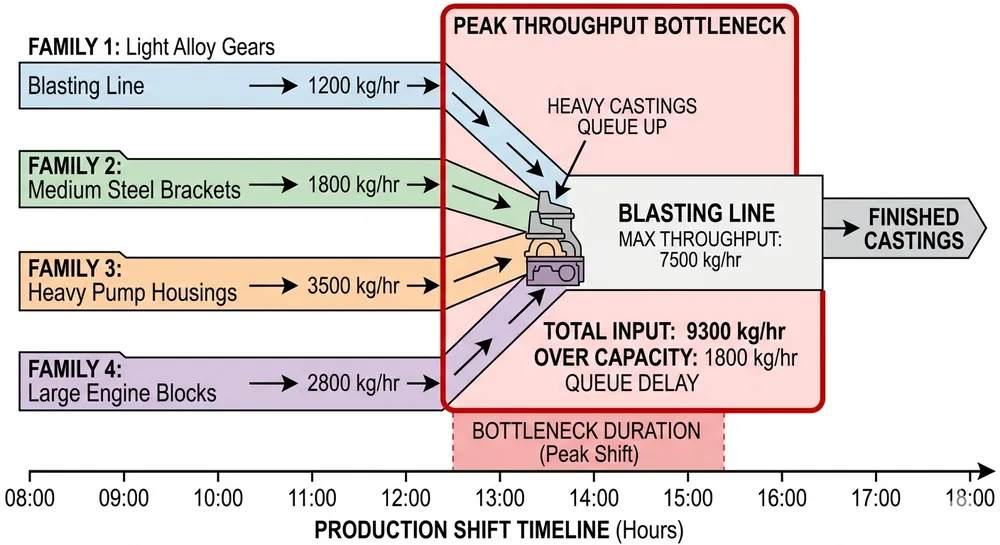
Undersizing a blasting line is expensive. Parts queue up after shakeout, your molding line has to slow down, and you've created a bottleneck that cuts your daily output. Oversizing is also expensive — you're paying for chamber size, wheel motors, and media consumption you don't use.
The basic throughput calculation for a blasting line:
Required throughput (kg/hr) = Total castings per shift (kg) ÷ Available blasting hours per shift
But for mixed-size foundries, one number isn't enough. You need to account for the cycle time difference between your smallest and largest parts.
Here's a realistic example. Say your production shift looks like this:
| Casting family | Part weight | Batch size per shift | Total weight | Estimated blast cycle time |
|---|---|---|---|---|
| Brake drums | 8 kg | 300 pcs | 2,400 kg | 4 min per batch of 20 (tumble belt) |
| Pump housings | 45 kg | 80 pcs | 3,600 kg | 6 min per batch of 8 (monorail) |
| Valve bodies | 120 kg | 30 pcs | 3,600 kg | 8 min per piece (monorail) |
| Flywheel blanks | 200 kg | 15 pcs | 3,000 kg | 10 min per piece (monorail) |
Total shift load: 12,600 kg across 4 casting families.
On an 8-hour shift with 7 effective blasting hours (after startup, changeover, and end-of-shift cleanup), you need an average throughput of roughly 1,800 kg/hr. But the brake drums run through fast on a tumble belt while the flywheel blanks need individual monorail hangers and longer exposure. Your peak demand isn't the average — it's the hour when the shakeout line dumps 200 kg flywheels at you every 10 minutes while you're still finishing pump housings from the previous batch.
Size the blasting line for the peak bottleneck, not the daily average. Add 15–20% capacity margin. In this example, you'd spec a line rated for 2,100–2,200 kg/hr minimum.
Airless wheel blasting vs. air-blast nozzle systems for clay sand residue
Two blasting technologies get compared in this context, and the difference matters for your operating cost and cleaning quality on clay sand castings.
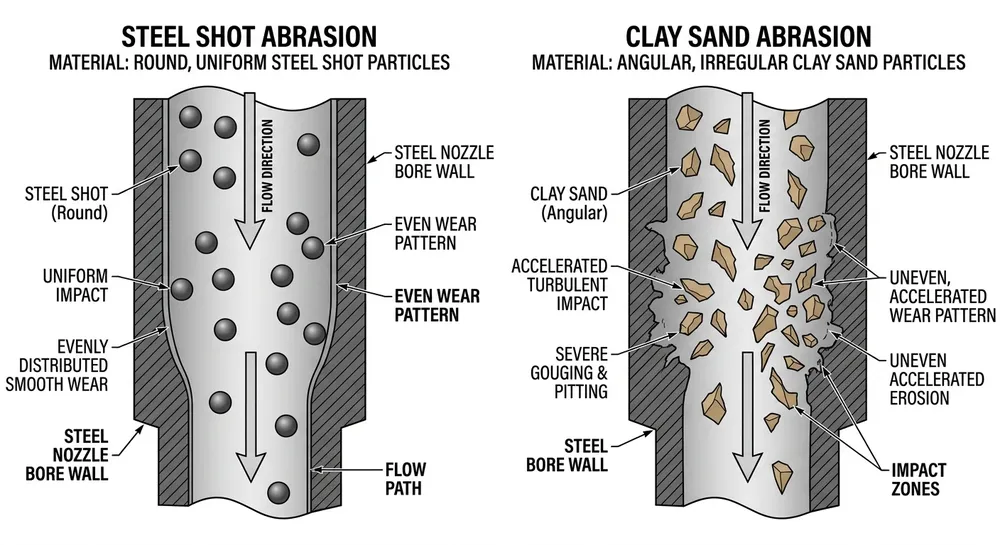
Airless (wheel) blasting uses centrifugal force to throw media. It's the standard for production-volume foundry blasting because it moves more media per minute at lower operating cost. Typical media flow rates: 150–300 kg/min per wheel. Operating cost is dominated by media consumption and wheel liner wear, not energy. For clay sand residue — which is relatively soft compared to resin sand — airless wheel systems break it loose efficiently.
Air-blast (nozzle) systems use compressed air to accelerate media through a nozzle. Precise, directable, and excellent for reaching internal passages or complex recesses. But compressed air is expensive to generate — roughly 3–5x the energy cost per kg of media thrown compared to wheel blasting. We see air-blast nozzles used as a secondary station for castings that have internal cavities the wheel blast can't reach, not as the primary blasting method for full-production clay sand lines.
For most foundries running clay sand castings, the practical setup is: wheel blasting as the primary system, with an optional air-blast nozzle station downstream for castings that need internal cleaning. If your casting mix is entirely external surfaces (no deep internal passages), you can skip the air-blast station entirely and reduce your equipment cost and compressed air demand.
(One note from commissioning experience: buyers sometimes spec air-blast nozzle systems because their previous line used them. That's often a legacy choice from when their production volume was lower. Once you're above 500 kg/hr, the energy cost difference between air-blast and wheel-blast becomes significant — it's worth re-evaluating during the selection process.)
Connecting the blasting line to sand reclamation and inspection
A blasting line doesn't operate in isolation. The media and sand residue coming off castings flow into your reclamation system. The cleaned castings flow to visual inspection, dimensional checking, and finishing. How well these connections work determines whether your blasting line is a smooth throughput point or a production island that creates handling steps.
Upstream integration (from shakeout to blasting):
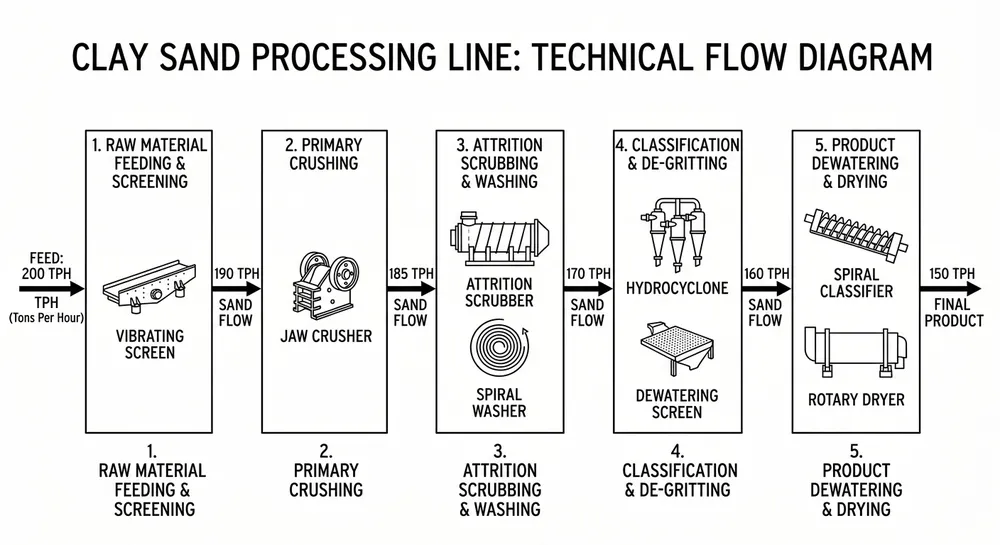
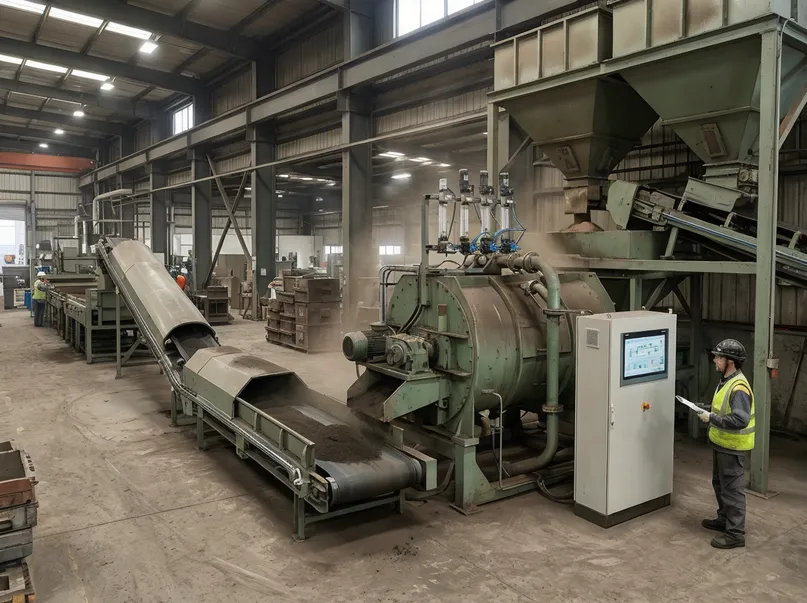
Your shakeout station dumps castings with adhered clay sand, risers (if not already removed), and loose sand. A vibratory conveyor or apron feeder usually moves castings from shakeout to the blasting line infeed. The critical design point: matching the shakeout discharge rate to the blasting infeed rate. If your shakeout runs faster than the blasting line can accept castings, you need a buffer zone — a staging conveyor or accumulation table — to prevent pile-ups. We design the infeed conveyor length and speed as part of the overall Clay Sand Processing Line layout, not as an afterthought.
Downstream integration (blasting to inspection/reclamation):
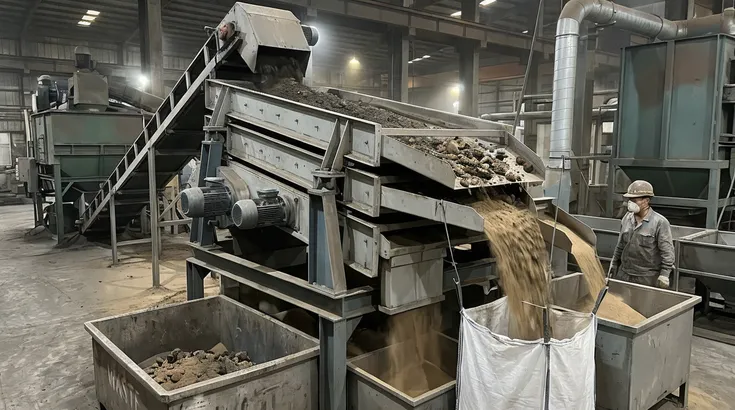
Spent blast media and stripped sand fall through the blast chamber floor grating into a screw conveyor and bucket elevator that feeds the media separator. The separator removes broken media and fine sand particles, recirculates usable media back to the blast wheels, and routes waste sand to your Clay Sand Blasting Line reclamation circuit. A well-designed separator keeps your media operating mix consistent, which directly affects blast quality and media consumption cost. If the separator can't keep up with your media flow rate, you end up blasting with a degraded media mix — more fines, less cleaning force, higher consumption.
Cleaned castings exit on a discharge conveyor to an inspection station. For mixed-casting operations, this is where having consistent blast quality across all part sizes pays off — your inspectors aren't sending 20% of castings back for re-blasting because the 8 kg parts got cleaned but the 120 kg parts still have sand in the ribs.
The specification mistakes that cost you a second purchase
After commissioning 60+ blasting systems across four continents, I've seen the same specification errors repeat. Each one leads to either buying a second machine, expensive retrofits, or living with a throughput bottleneck for the life of the equipment.
Mistake 1: Sizing the chamber for your average casting, not your largest. The blast chamber's internal height, width, and length must accommodate your largest casting with clearance for media throw angle. If you size it for your most common 45 kg casting and then try to run a 200 kg piece, it physically won't fit — or it fits but the wheels can't achieve the right blast angle because the casting fills the chamber. Always spec the chamber for the largest casting you'll run in the next 5 years, not just today's product mix.
Mistake 2: Ignoring fixture and hook inventory for monorail systems. Buyers quote the blasting machine but forget that an overhead monorail system needs hooks or fixtures for every casting family. Five casting families means five sets of hooks, plus spares. The hooks themselves aren't expensive, but if you don't order them with the machine, you'll spend weeks designing and sourcing them after installation — while your line sits idle.
Mistake 3: Specifying blast wheel power without specifying wheel count and angle. "Total installed blast power: 90 kW" tells you nothing about coverage. Is that 6 × 15 kW wheels positioned for 360° coverage, or 4 × 22.5 kW wheels aimed at the top and sides only? The coverage map matters more than the total kilowatt number. Ask for the wheel position diagram relative to the blast path — any manufacturer who won't provide one doesn't have a real engineering process behind their line.
Mistake 4: Not accounting for media consumption rate in operating cost calculations. Buyers compare equipment price, but the real cost of a blasting line is media consumption over its operating life. A 6-wheel line throwing S280 steel shot at 250 kg/min consumes roughly 0.3–0.5 kg of media per ton of castings cleaned (the rest is recirculated). Multiply by your annual tonnage and that's a significant operating cost line item. The separator efficiency directly controls this number. A poorly designed separator lets good media escape into the waste stream, so you're constantly topping up.
Mistake 5: Buying the blasting line separate from the overall line layout. If your blasting line vendor doesn't know your shakeout discharge rate, your reclamation system capacity, and your floor space constraints, they're selling you a standalone machine, not a production solution. The blasting line needs to mate with what's upstream and downstream. When the whole Clay Sand Processing Line comes from one source, the interface points — conveyor speeds, discharge heights, electrical integration — are engineered together, not jury-rigged on site.
Configuring a blasting line for mixed-size foundry operations
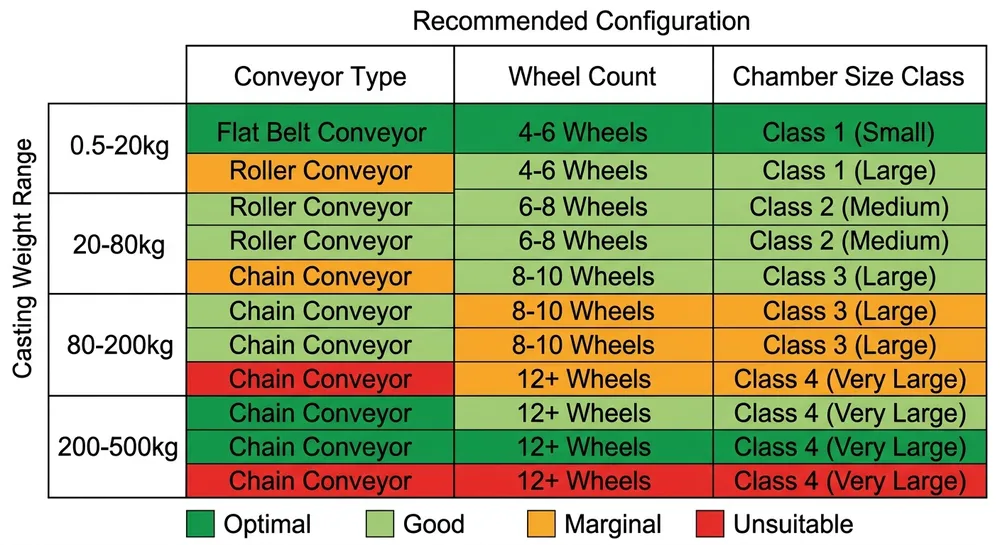
When your casting mix spans a wide weight range, the line configuration has to balance flexibility against throughput. Here's how we approach it at TZFoundry.
We build modular blasting lines that handle castings from 0.5 kg to 500 kg on the same conveyor layout. "Modular" means the blast chamber, conveyor section, and media handling system are designed as separate units that bolt together on your floor — you can start with a 4-wheel tumble belt configuration and add a monorail chamber section later as your product mix grows. The PLC ties everything together, so blast wheel speed and media flow rate adjust per batch from a single touchscreen. No manual changeover, no stopping the line to swap out mechanical components.
For a typical mixed-casting foundry, the configuration conversation starts with three numbers: your heaviest casting, your target hourly throughput, and how many casting families run in a single shift. From there, we calculate the chamber dimensions, select the conveyor type (or combination), position the blast wheels for your specific geometries, and size the media separator and reclamation interface.
We run commissioning tests with your actual casting samples before the line ships. The commissioning report shows real blast coverage photos, measured cycle times per casting family, and media consumption data for your specific mix — not catalog numbers from a generic test piece. If you're evaluating competing proposals, this is the document to ask every supplier for. The ones who can't provide commissioning data for your casting mix are quoting from a catalog, not engineering a line.
A complete blasting line ships in 1–2 × 40HQ containers depending on the configuration. We design the frame sections to fit 40HQ dimensions (12.03 m × 2.35 m × 2.69 m) without wasted container space, so your landed cost stays manageable. The PLC cabinet and blast wheels ship in the same containers, pre-wired to terminal blocks — your installation team connects power and compressed air, runs the startup sequence, and the line is operational.
If you're planning a blasting line for a mixed-casting operation and want to compare configurations, send us your casting weight range and shift output targets — we'll come back with a layout drawing, throughput calculation, and factory pricing for the specific line you need.
Frequently asked questions
What blast media works best for cleaning clay sand residue off castings?
Steel shot (S280 or S330) is the standard for clay sand foundry blasting. Clay sand residue is softer than resin sand residue, so you don't need aggressive angular grit to break it loose. Steel shot gives you a clean surface with a uniform finish suitable for painting or coating. If your castings have thin flash or small fins that need knocking off during blasting, mixing 10–15% steel grit into the shot charge helps — but too much grit accelerates wear on your wheel liners and chamber walls.
Can one blasting line handle both small and large castings without two separate machines?
Yes, but the solution depends on the weight range gap. If your smallest casting is 5 kg and your largest is 200 kg, an overhead monorail with interchangeable fixtures handles both on one line. If the gap is 0.5 kg to 300 kg, a combined layout — tumble belt for parts under 60–80 kg, monorail for heavier parts — usually gives better throughput than forcing everything through a single conveyor type. The PLC adjusts blast intensity per batch either way.
How long does a typical clay sand blasting cycle take per casting?
Cycle time depends on casting weight, geometry complexity, and residual sand adhesion. Rough ranges for clay sand castings using airless wheel blasting: under 20 kg in a tumble belt, 3–5 minutes per batch of 15–25 pieces. 50–100 kg on a monorail, 5–8 minutes per piece. Over 200 kg on a monorail or table, 8–12 minutes per piece. These are effective blast times — loading and unloading add to the total cycle. The numbers tighten when PLC-controlled media flow and wheel speed are optimized for your specific casting geometry rather than running on generic factory defaults.
What maintenance should I plan for on a foundry blasting line?
Blast wheel liners and blades are the primary wear items — expect replacement every 400–800 operating hours depending on media type and flow rate. Chamber liners (manganese steel) last 2,000–4,000 hours typically. Media separator screens need periodic inspection for blinding. And the rubber tumble belt (if you use one) wears based on casting weight and throughput — budget for replacement every 12–18 months on a two-shift operation. For a deeper look at wear schedules and spare parts planning, see our blasting line maintenance guide.
How do I evaluate competing blasting line proposals from different manufacturers?
Compare these five items: (1) wheel position diagram showing blast angles relative to the casting path — not just wheel count, (2) throughput rating tested on your casting sizes, not a generic test block, (3) media separator type and recirculation efficiency percentage, (4) chamber dimensions versus your largest casting with clearance for blast angle, and (5) commissioning data from a comparable installation. If a supplier only provides catalog specifications without a layout drawing for your facility, they're selling a machine, not engineering a solution for your production.

Baocun Zhu is the Senior Clay Sand Process Engineer at TZFoundry in Qingdao. With over 14 years commissioning clay sand molding, reclamation, and preparation lines for export foundries, he turns floor-space constraints and throughput targets into working production systems. His...