I've seen foundries buy the wrong molding line configuration three times in the past two years. One ordered a vertical flaskless system for manhole covers — the mold height-to-width ratio didn't work, and they ended up with 12% scrap from cope/drag misalignment. Another tried to run brake discs on a flask-based line and couldn't hit the cycle rate their contract required. Both situations cost six figures to fix.
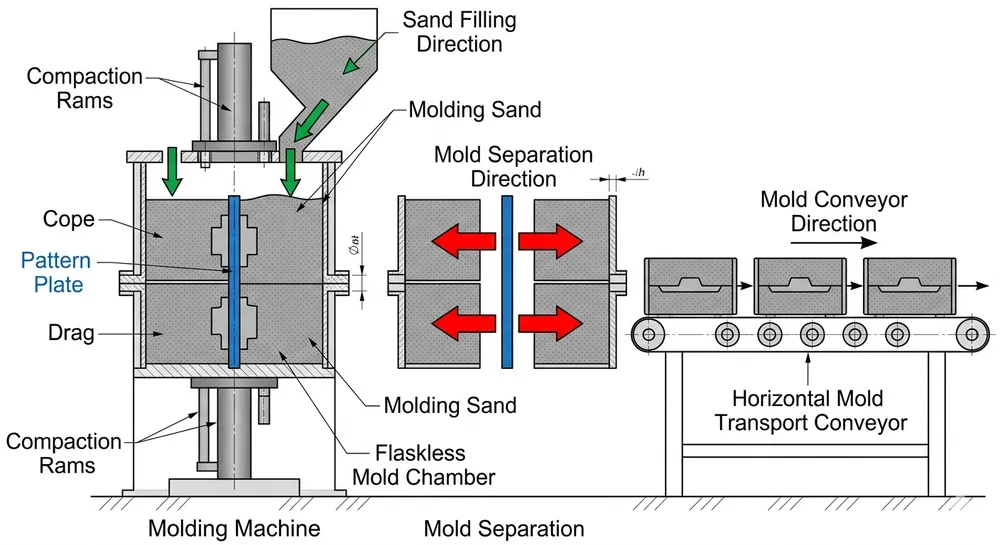
A horizontal flaskless clay sand processing line uses a horizontal parting plane to form cope and drag molds without flasks. The system compacts sand around patterns mounted on a horizontal table, separates the mold halves horizontally, and indexes them through pouring and cooling stations. For large flat castings — parts where the diameter or width significantly exceeds the height — this configuration delivers better mold stability, faster cycle rates, and lower per-casting sand consumption than vertical flaskless or flask-based alternatives.
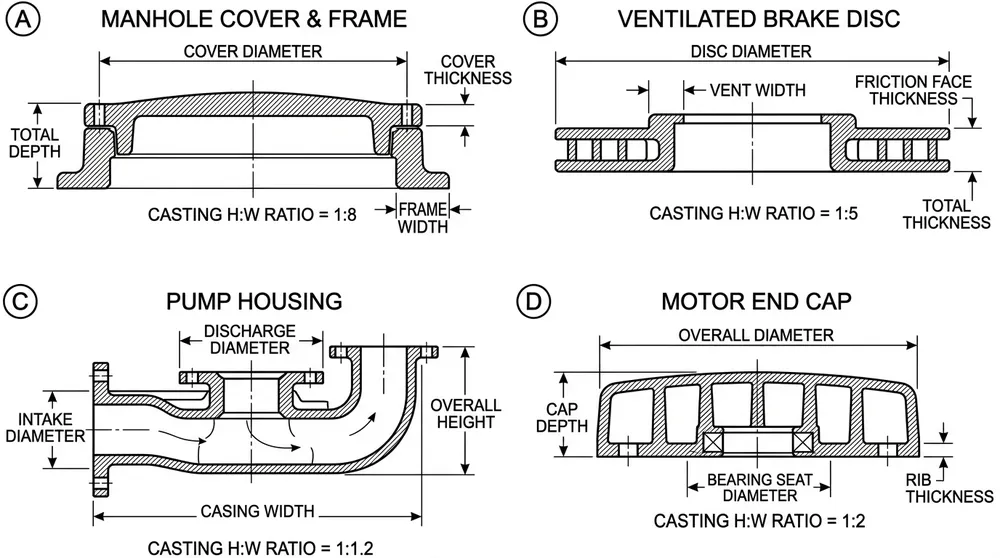
The decision comes down to part geometry. If your casting profile is flat (manhole covers, brake discs, motor end caps, pump housings, valve plates), horizontal flaskless makes sense. If your parts are tall or complex (engine blocks, transmission housings), you need a different approach.
What Horizontal Parting Means for Mold Stability
Horizontal flaskless systems form molds on a horizontal plane, so the cope (top half) and drag (bottom half) separate along a horizontal line. The pattern plate mounts horizontally, sand gets compacted from above and below, and the finished mold halves move horizontally through the production line.
This matters for large flat castings because the mold's center of gravity stays low and stable during transport. A 600mm-diameter manhole cover mold weighs 80-120 kg depending on sand density. When that mold moves horizontally on a conveyor, the weight distributes evenly across the mold base. The same mold moving vertically (as in a vertical flaskless line) creates tipping moments that require heavier mold walls and slower transport speeds.
We run compaction pressure at 0.6-0.8 MPa for standard ductile iron flat castings. That pressure, applied uniformly across a horizontal surface, produces consistent mold density from edge to center. Vertical compaction on the same part geometry tends to create density gradients — the bottom of the mold compacts harder than the top, which shows up as dimensional variation after shakeout.
The horizontal parting plane also simplifies core setting for flat parts. Cores drop into the drag by gravity, seat against locating pins, and stay put during cope closure. Vertical systems require core supports or adhesives to hold cores in position during mold assembly, adding cycle time and failure points.

Casting Applications Where Horizontal Flaskless Outperforms Other Configurations
Horizontal flaskless lines work best for parts with a height-to-width ratio below 0.4:1. Above that ratio, vertical flaskless or flask-based systems handle the geometry better.
Manhole covers and frames: 600-900mm diameter, 50-80mm height, ductile iron. These are the ideal horizontal flaskless application. Mold cycle rates hit 120-150 molds per hour on automated lines. The flat profile means minimal sand-to-metal ratio (typically 8:1 to 12:1), so your sand reclamation system processes less volume per casting.
Brake discs and drums: 250-400mm diameter, 40-100mm height, gray iron or ductile iron. High-volume production (200+ molds per hour) with tight dimensional tolerances (±0.3mm on critical surfaces). Horizontal systems maintain consistent compaction pressure across the disc face, which controls warpage better than vertical compaction.
Motor end caps and housings: 300-600mm diameter, 60-120mm height, aluminum or gray iron. These parts often include mounting bosses and bolt holes that require cores. Horizontal drag placement makes core setting faster and more repeatable than vertical core insertion.
Pump housings and valve bodies: 200-500mm diameter, 80-150mm height, ductile iron or bronze. Medium-volume production (80-120 molds per hour) with internal passages that need sand cores. Horizontal mold transport reduces core shift during pouring, which cuts machining scrap from misaligned passages.
Valve plates and flanges: 150-400mm diameter, 30-80mm height, carbon steel or stainless steel. These parts have thin cross-sections that require uniform mold density to prevent metal penetration. Horizontal compaction delivers that uniformity better than vertical squeeze.
Parts outside these profiles don't benefit from horizontal flaskless. Engine blocks, transmission cases, and other tall castings need vertical parting to avoid excessive mold height and sand consumption. Small intricate parts (under 150mm) usually run more economically on vertical tight-flask or shell molding lines.
Horizontal vs Vertical vs Flask-Based: Decision Matrix for Flat Casting Profiles
The table below shows where each molding configuration makes sense for flat casting production. These thresholds come from commissioning data across 60+ clay sand lines we've installed since 2010.
| Factor | Horizontal Flaskless | Vertical Flaskless | Flask-Based (Horizontal) |
|---|---|---|---|
| Ideal part height-to-width ratio | 0.15:1 to 0.4:1 | 0.4:1 to 1.2:1 | 0.2:1 to 0.8:1 |
| Mold size range (L×W×H mm) | 400×400×150 to 1200×1000×300 | 300×300×200 to 800×800×600 | 300×300×100 to 1000×800×400 |
| Typical cycle rate (molds/hour) | 80-150 | 100-200 | 40-80 |
| Sand-to-metal ratio | 8:1 to 12:1 | 10:1 to 15:1 | 12:1 to 18:1 |
| Mold density uniformity | ±3% across mold face | ±5% top to bottom | ±4% across mold face |
| Core setting complexity | Simple (gravity drop) | Moderate (requires supports) | Simple (gravity drop) |
| Floor space per mold station | 12-18 m² | 8-12 m² | 15-25 m² |
| Best for casting types | Manhole covers, brake discs, motor end caps, pump housings | Valve bodies, small gearboxes, cylinder heads | Custom low-volume flat parts, prototype work |
Horizontal flaskless wins on cycle rate and sand efficiency for large flat parts. Vertical flaskless handles taller geometries and smaller footprints. Flask-based systems offer flexibility for mixed production but can't match the throughput of flaskless configurations.
The crossover point is around 0.4:1 height-to-width ratio. Below that, horizontal flaskless delivers lower cost per casting. Above that, vertical flaskless or flask-based systems avoid the excessive mold width that drives up sand consumption and floor space.
We switched a Middle East buyer from flask-based to horizontal flaskless for 700mm manhole covers in 2019. Their cycle time dropped from 90 seconds per mold to 45 seconds, and sand consumption fell 22% because the flaskless mold walls are thinner. The payback period on the line upgrade was 14 months based on their production volume.
Key System Specifications B2B Buyers Should Evaluate
When you're sourcing a Horizontal Flaskless Clay Sand Processing Line, these specs determine whether the line matches your casting requirements and production targets.
Mold dimensions: Specify the maximum mold box size your parts require. Standard horizontal flaskless lines handle 500×500×200mm to 1000×800×300mm (L×W×H). Larger custom configurations exist but add cost and shipping complexity. If your largest part fits in 800×700×250mm, don't over-specify to 1200×1000×300mm — you'll pay for capacity you don't use.
Compaction pressure range: Look for 0.4-1.0 MPa adjustable pressure with PLC control. Lower pressures (0.4-0.6 MPa) suit aluminum and thin-wall gray iron. Higher pressures (0.7-1.0 MPa) are needed for ductile iron and steel castings to prevent metal penetration. Fixed-pressure systems can't adapt to different alloys or mold complexity.
Mold rate per hour: Calculate your required throughput including scrap allowance and downtime. If you need 10,000 good castings per month running two shifts (320 hours), that's 31 molds per hour minimum. Specify a line rated for 40-50 molds per hour to leave margin for maintenance stops and startup losses. Over-specifying to 120 molds per hour when you need 40 wastes money on faster actuators and controls you won't use.
Pattern plate mounting system: Hydraulic or pneumatic quick-change systems cut changeover time from 45 minutes (manual bolting) to 8-12 minutes (quick-clamp). This matters if you run multiple part numbers on the same line. Single-product lines can use fixed bolt-on pattern mounting and save the cost of quick-change hardware.
PLC control options: Siemens S7-1200 or Mitsubishi FX5U are the standard export options. Both support English/Spanish/Arabic HMI interfaces and remote diagnostics via 4G module. Siemens parts availability is better in Europe and North America. Mitsubishi is more common in Southeast Asia and the Middle East. Specify the PLC brand that matches your region's service network.
Sand reclamation compatibility: Horizontal flaskless lines generate 8-12 kg of sand per kg of casting. That sand needs to go somewhere. Verify that the line integrates with a mechanical or thermal reclamation system rated for your sand throughput. A 100-mold-per-hour line producing 50 kg castings generates 40-60 tons of sand per shift. Your reclamation system must handle that volume at 90-95% recovery rate, or you'll run out of prepared sand mid-shift.
Dimensional tolerance capability: Standard horizontal flaskless lines hold ±0.5mm on flat surfaces and ±0.8mm on vertical features for castings up to 600mm diameter. Tighter tolerances (±0.3mm) require precision pattern plates, temperature-controlled sand preparation, and closed-loop compaction pressure feedback. That adds 15-20% to line cost but cuts machining allowance, which can justify the investment for high-volume brake disc or motor housing production.
TZFoundry ships each line with a commissioning report showing the actual mold rate and dimensional tolerance results from factory testing. That's not a spec sheet — it's measured data from your specific equipment running test molds. If the report shows 85 molds per hour and you ordered a 100-mold-per-hour line, we'll explain the gap and adjust before shipment.
Production Line Integration: Connecting Molding to Sand Prep, Pouring, and Reclamation
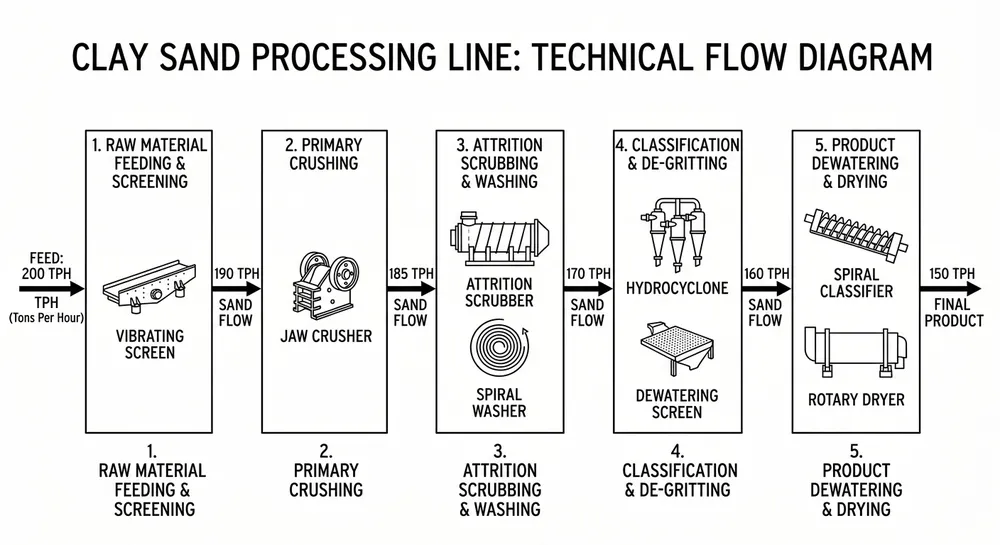
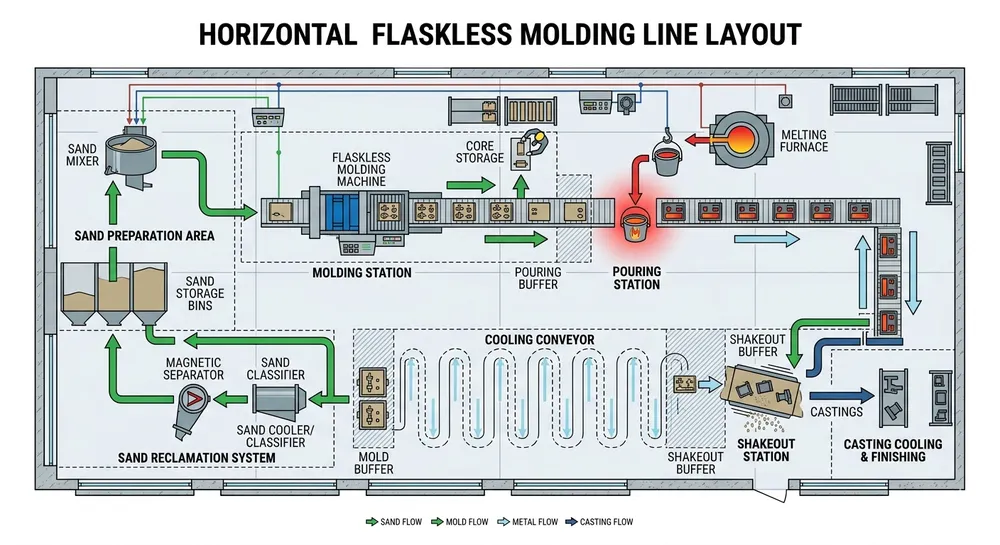
A horizontal flaskless molding station is one component in a complete Clay Sand Processing Line. The system only works when sand preparation, pouring, cooling, shakeout, and reclamation subsystems match the molding station's throughput and sand quality requirements.
Sand preparation upstream: The molding station needs prepared sand at 3.0-3.5% moisture content, 40-50% clay content (active bentonite), and consistent grain size distribution. A 100-mold-per-hour line consumes 4-6 tons of prepared sand per hour. Your sand mixer, muller, and tempering system must deliver that volume continuously. If the mixer can only produce 3 tons per hour, the molding line will starve and stop.
We size the sand preparation system at 120-130% of the molding line's rated consumption. That margin covers startup waste, mold rejects, and cleaning cycles. A 100-mold-per-hour line gets paired with a 5-6 ton-per-hour sand preparation system, not a 4-ton system running at maximum capacity.
Pouring station downstream: Molds exit the molding station and index to a pouring station where metal gets ladled or auto-poured into the cope. Pouring cycle time must match or exceed mold production rate. If your molding line produces one mold every 36 seconds (100 molds per hour), your pouring station needs to fill and move to the next mold in under 36 seconds. Manual ladle pouring typically maxes out at 60-80 molds per hour. Above that rate, you need automatic pouring equipment.
Cooling and shakeout: After pouring, molds move through a cooling conveyor (typically 10-20 meters long depending on alloy and section thickness) before reaching the shakeout station. Ductile iron manhole covers need 8-12 minutes cooling time before shakeout. Gray iron brake discs cool in 5-8 minutes. The cooling conveyor must be long enough to provide that dwell time at the line's cycle rate.
Shakeout separates the casting from the sand. Vibrating shakeout grids work for most flat castings. The sand falls through the grid into a hopper that feeds the reclamation system. Castings move to a separate conveyor for fettling and inspection.
Sand reclamation loop: Used sand from shakeout goes to a mechanical reclamation system (crushing, screening, magnetic separation) or thermal reclamation (calcining to remove dead clay and carbonaceous residue). Mechanical reclamation recovers 90-93% of the sand. Thermal reclamation hits 95-97% but costs more to operate.
The reclaimed sand returns to the sand preparation system where it gets re-tempered with water and fresh bentonite to restore molding properties. A closed-loop system minimizes fresh sand consumption — typically 5-8% makeup sand per cycle to replace fines lost in dust collection and sand that sticks to castings.
We commission the complete line as an integrated system, not as separate machines. Each subsystem's cycle time, buffer capacity, and control logic gets tuned so the molding station runs continuously without waiting for upstream sand or downstream pouring capacity. That's the difference between a 100-mold-per-hour rated line that actually produces 100 molds per hour versus one that produces 70 because of bottlenecks.
Sourcing Considerations: Container Shipping, Commissioning, and Spare Parts
Horizontal flaskless lines ship in 2-3 standard 40HQ containers depending on mold size and automation level. We design the structural frames, hydraulic units, and control cabinets to break down into container-friendly modules. A complete 100-mold-per-hour line with sand preparation and reclamation typically ships in 3 containers: one for the molding station frame and pattern mounting hardware, one for hydraulic power units and pneumatic controls, one for the PLC cabinet, HMI, sensors, and electrical components.
Modular design cuts your landed cost. Shipping a 15-ton molding line in three 40HQ containers costs $8,000-12,000 depending on origin and destination ports. Shipping the same equipment as oversized breakbulk cargo costs $25,000-35,000 plus port handling fees. The difference pays for a lot of assembly labor at your facility.
Factory acceptance testing: Each line runs a full commissioning cycle at our Qingdao facility before shipment. We mount test patterns, run 50-100 molds, measure cycle time and dimensional accuracy, and document the results. You get a commissioning report with actual mold rate, compaction pressure profiles, and tolerance measurements from your specific equipment. If the line doesn't meet the specified performance, we adjust before crating.
Some buyers send their own engineers to witness factory testing. That's useful if you're buying your first automated line and want hands-on training before installation. We run the test cycle with your team operating the controls under our supervision. They learn the startup sequence, parameter adjustment, and basic troubleshooting before the equipment leaves China.
Remote commissioning support: After the line arrives at your facility, your installation team connects hydraulic lines, wires control panels, and runs initial test cycles following our installation manual. We provide remote support via video call — your team shows us the equipment, we guide them through hydraulic pressure checks, sensor calibration, and PLC parameter setup. This works for buyers with basic hydraulic and electrical capability. If your team can read hydraulic schematics and use a multimeter, remote commissioning gets the line running in 3-5 days.
On-site commissioning is available for buyers who need it, but it adds $8,000-15,000 for engineer travel, accommodation, and time. Most export buyers choose remote commissioning and save that cost.
Spare parts availability: Each line ships with a first-year spare parts kit covering consumables you'll need: hydraulic seals (cylinder seals, valve seals), proximity sensors (mold position detection, pattern plate alignment), solenoid valves (sand filling, compaction control), and PLC I/O modules (backup for sensor inputs and actuator outputs). The kit costs 3-5% of the line price and prevents downtime waiting for parts shipment.
After the first year, you order spare parts as needed. Standard hydraulic and pneumatic components (cylinders, valves, fittings) are available globally from Parker, Bosch Rexroth, or SMC distributors. Custom parts (pattern mounting hardware, mold box frames) ship from our facility with 2-3 week lead time. We maintain drawings and part numbers for every line we've built since 2010, so you can order replacement components 10 years after installation.
The biggest sourcing mistake is buying a molding station without the sand preparation and reclamation subsystems. A horizontal flaskless molding line by itself is useless — it needs prepared sand coming in and a place for used sand to go. When you request a quote, specify whether you need the complete system or just the molding station to integrate with existing sand handling equipment. That determines the scope and price.
When Horizontal Flaskless Makes Sense for Your Foundry
Choose horizontal flaskless if your production fits these conditions:
Part geometry: Height-to-width ratio below 0.4:1, diameter or width 300-1000mm, height 50-250mm. Manhole covers, brake discs, motor end caps, pump housings, valve plates, flanges.
Production volume: 50,000+ castings per year minimum. Below that volume, the capital cost of an automated flaskless line doesn't justify the per-casting savings versus flask-based molding. Above 200,000 castings per year, horizontal flaskless delivers the lowest cost per casting in the industry for flat profiles.
Alloy type: Gray iron, ductile iron, aluminum, bronze, carbon steel. These alloys work well with clay sand molding. Stainless steel and high-alloy steels often require resin sand or shell molding for surface finish and dimensional control.
Floor space availability: 150-250 m² for a complete line including sand preparation, molding, pouring, cooling, shakeout, and reclamation. Horizontal systems need more floor space than vertical flaskless but less than flask-based lines with flask handling equipment.
Quality requirements: ±0.5mm dimensional tolerance on flat surfaces, Ra 12.5-25 μm surface finish after shakeout. Tighter tolerances require precision pattern plates and closed-loop compaction control, which adds cost. If your parts need ±0.1mm tolerance or Ra 6.3 μm finish, consider resin sand or shell molding instead.
Don't choose horizontal flaskless if your parts are tall (height-to-width ratio above 0.5:1), small (under 200mm diameter), or require frequent pattern changes (more than 5 different part numbers per shift). Vertical flaskless handles tall parts better. Small parts run more economically on vertical tight-flask lines. Frequent pattern changes favor flask-based systems with quick-change flask mounting.
If you're comparing Vertical Flaskless Clay Sand Processing Line versus horizontal for a specific part, send us the casting drawing. We'll calculate the sand-to-metal ratio, estimate cycle time, and recommend the configuration that delivers the lowest cost per casting for your geometry and volume.
For buyers sourcing a complete system, Request a Quote with your casting drawings, alloy grade, target annual volume, and available floor space. TZFoundry's engineering team will spec the right line configuration, provide factory pricing, and include commissioning data from similar installations.

Baocun Zhu is the Senior Clay Sand Process Engineer at TZFoundry in Qingdao. With over 14 years commissioning clay sand molding, reclamation, and preparation lines for export foundries, he turns floor-space constraints and throughput targets into working production systems. His...