We've commissioned lost foam lines in 14 countries, and the most expensive mistakes happen before the equipment ships. A buyer orders a line rated for "cast iron," runs their first batch of brake discs or pipe elbows, and gets porosity at 15% scrap rate because the vacuum system was sized for aluminum, the coating permeability was wrong for 1,400°C iron, or the sand cooling couldn't handle the thermal load. The line works — it just doesn't work for cast iron at production volume.
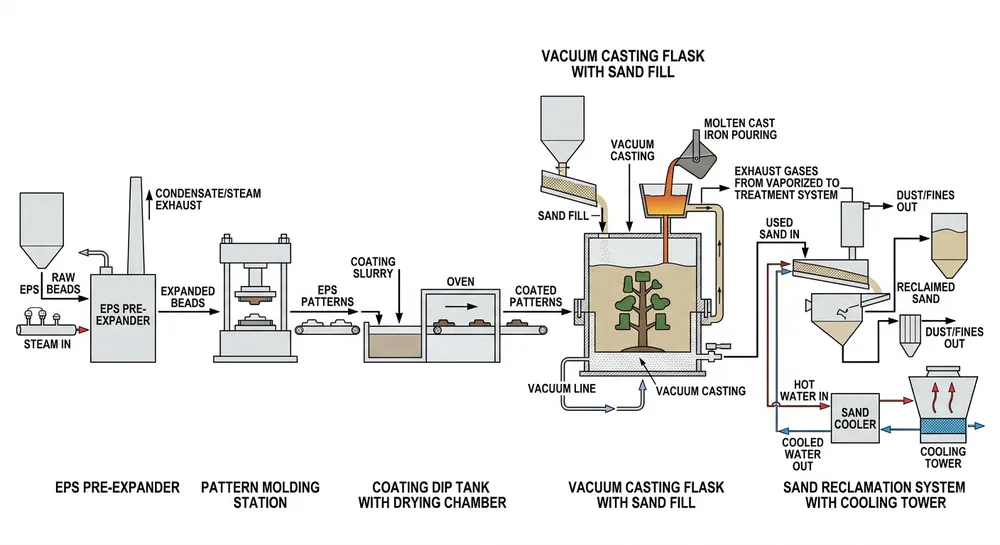
A cast iron lost foam casting production line is a complete system that replaces traditional sand molding with EPS foam patterns buried in unbonded sand under vacuum. The pattern vaporizes during pouring, and the molten iron fills the cavity. For cast iron specifically, you need higher vacuum capacity (the decomposition gas volume from EPS is 1,000x the pattern volume), refractory coatings that survive 1,380-1,450°C pouring temperatures without cracking, and sand reclamation systems that handle the carbon residue left by foam pyrolysis. If any of these three components is under-spec'd, your casting yield drops and your cost-per-part climbs.
This guide walks through the selection criteria that matter when you're buying a line for gray iron (FC250/HT250) or ductile iron (QT450/GGG40) castings in automotive or pipe fitting applications. We'll cover the equipment specifications that prevent defects, the capacity planning that matches your output targets, and the total cost of ownership factors that determine whether the line pays back in 18 months or 36.
What a Cast Iron Lost Foam Line Actually Includes
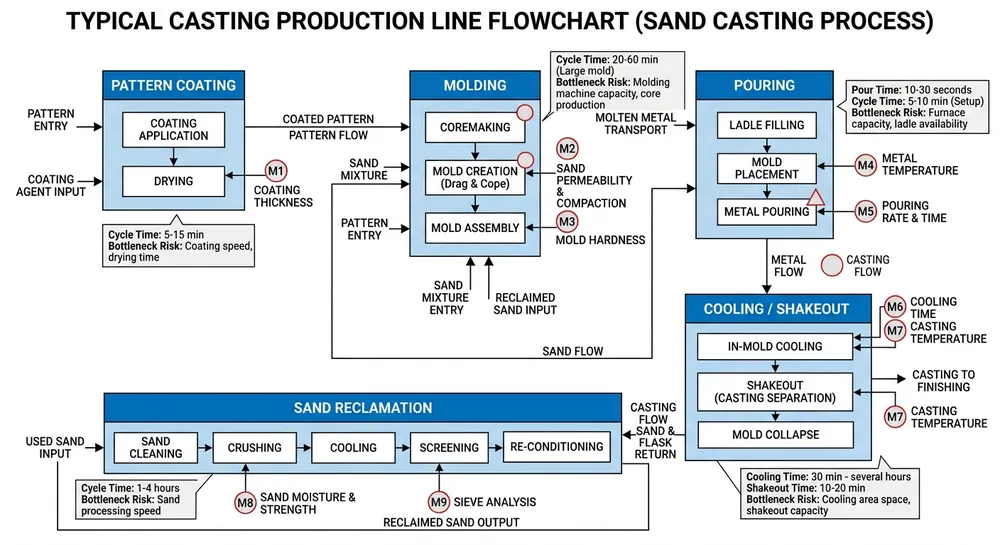
A complete production line has five integrated modules. Buyers sometimes price-shop individual components and miss the fact that lost foam is a system — if the coating dryer can't keep up with the pattern output, your entire line bottlenecks.
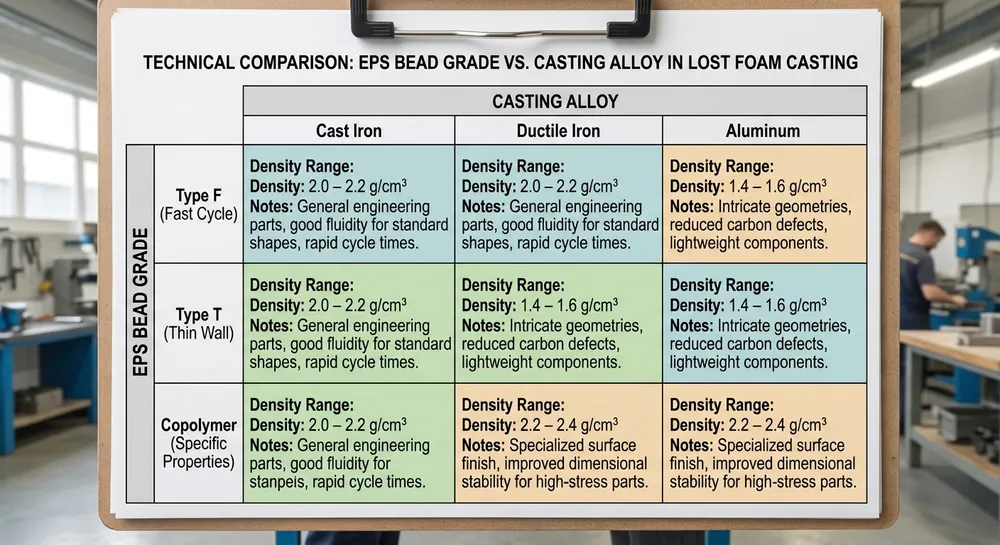
EPS pre-expander and molding equipment produces the foam patterns. For cast iron, you're typically running 18-22 kg/m³ bead density for thin-wall parts (pipe fittings, manifolds) and 22-28 kg/m³ for heavy-section castings (brake discs, valve bodies). Lower density gives you faster vaporization and less gas pressure during pouring, but the pattern is more fragile during handling and coating. We run our pre-expander at 0.8-1.2 bar steam pressure with 12-24 hour aging time to stabilize bead expansion before molding.
Coating application and drying system applies the refractory barrier that controls gas permeability and prevents metal penetration into the sand. Cast iron coatings need alumina or zircon-based slurries with 1.2-1.8mm wet thickness (dries to 0.8-1.2mm) to survive the pouring temperature and thermal shock. Drying happens in forced-air chambers at 50-70°C for 4-8 hours depending on coating thickness and part geometry. Automotive parts with complex internal passages need longer drying cycles to prevent moisture pockets that cause steam blows during pouring.
Pattern assembly and cluster tooling groups individual patterns into a casting tree that maximizes sand flask utilization. A brake disc cluster might hold 4-6 discs per flask, while pipe fittings can pack 12-20 pieces depending on size. The gating system design matters more in lost foam than green sand molding because you can't vent the mold — all decomposition gases exit through the coating, so gate placement controls gas flow direction and prevents backpressure that causes misruns.
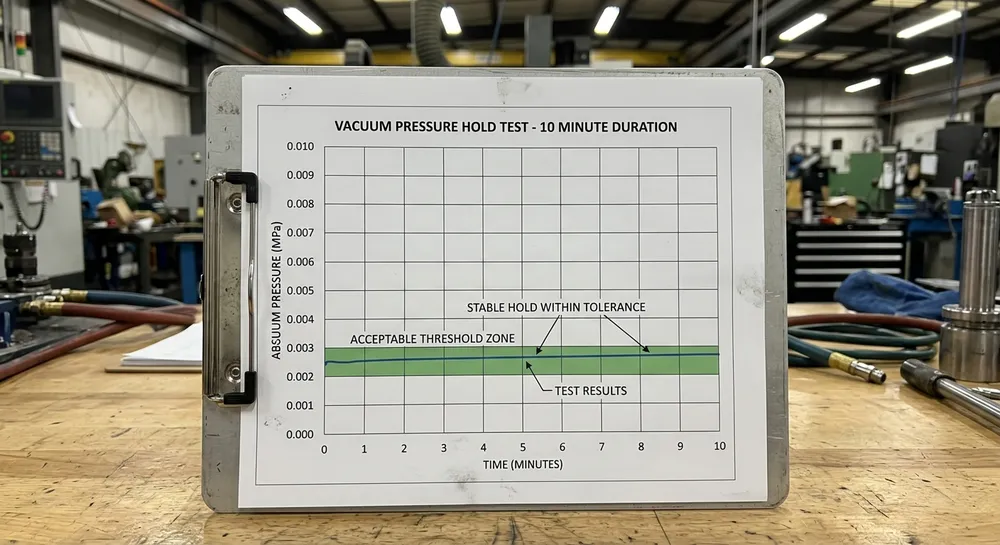
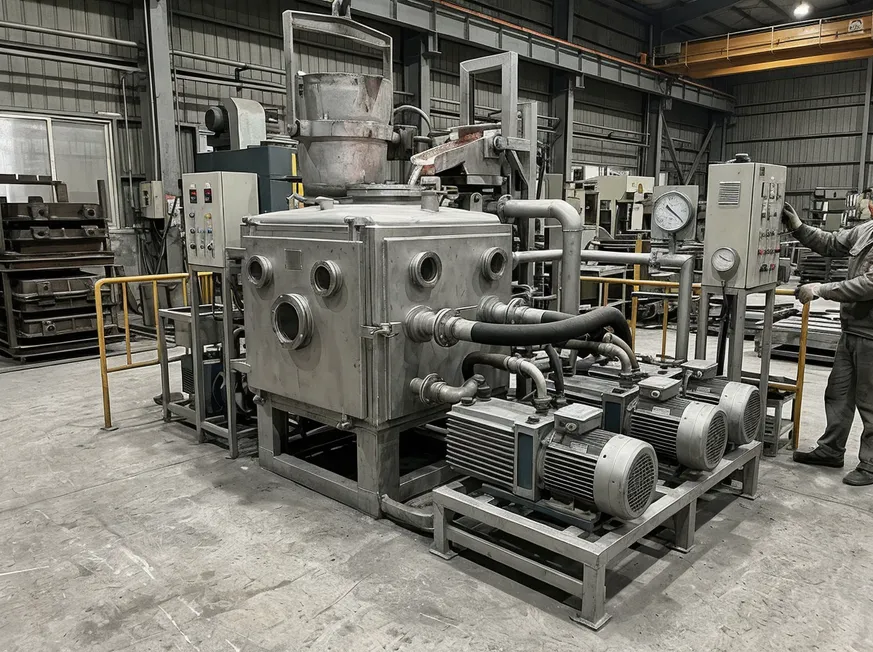
Vacuum casting chamber and sand handling is where the actual pouring happens. The pattern cluster sits in a steel flask filled with dry silica sand (no binder), and a vacuum pump pulls 0.04-0.06 MPa negative pressure to compact the sand and extract vaporization gases during pouring. For cast iron, vacuum capacity needs to be 1.5-2.0 m³/min per ton of metal poured because the gas generation rate is higher than aluminum or steel. Sand temperature at pouring should stay below 50°C — if it climbs above 60°C, you start getting sand expansion defects and the vacuum seal degrades.
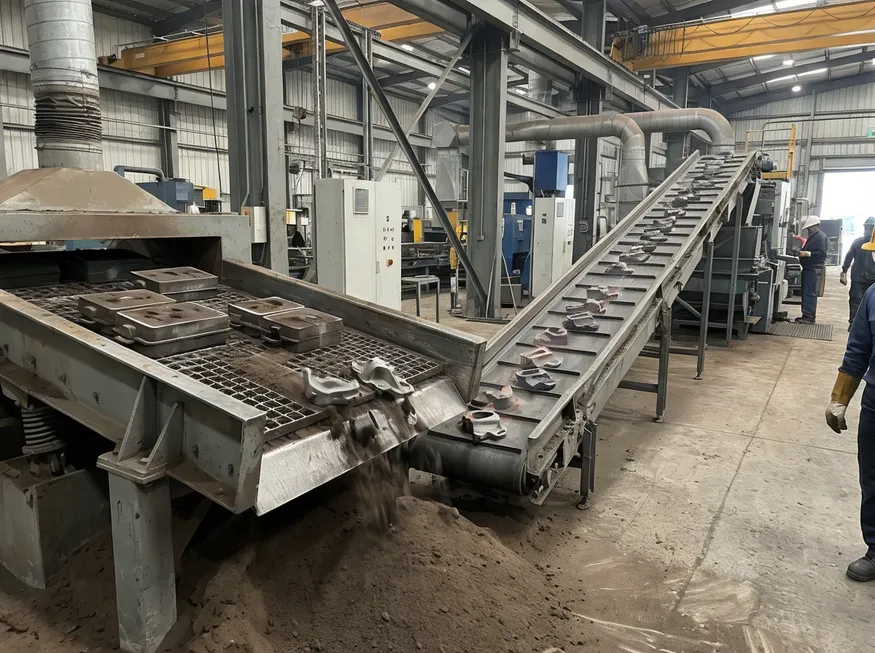
Sand reclamation and cooling system recovers the sand after shakeout, removes carbon residue from foam pyrolysis, and cools it back to 30-40°C for reuse. Cast iron lost foam generates 2-3% carbon contamination by weight, so you need mechanical attrition (sand-on-sand scrubbing) plus pneumatic separation to hit 95%+ reclamation rates. Without effective reclamation, your sand consumption runs 1.5-2.0 tons per ton of castings instead of 0.3-0.5 tons, and that cost difference kills your margin on high-volume production.

The Cast Iron Challenge: Why Generic Lost Foam Lines Fail
Cast iron creates three process demands that aluminum and steel don't. If your line supplier doesn't account for these, you'll spend the first six months troubleshooting instead of producing.
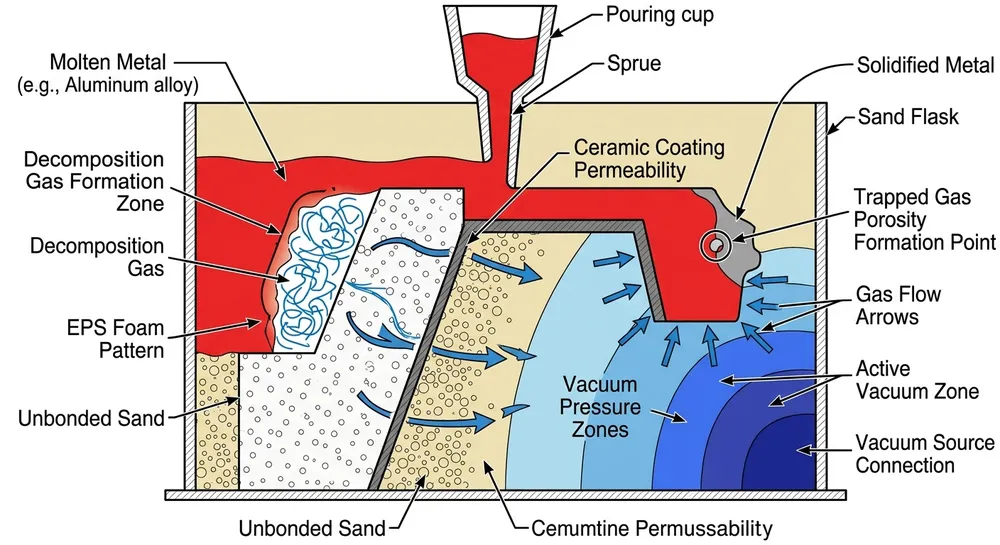
Pouring temperature is 200-300°C higher than aluminum. Gray iron pours at 1,380-1,420°C, ductile iron at 1,400-1,450°C. Aluminum lost foam runs at 700-750°C. That temperature difference means your coating must survive thermal shock without spalling (the refractory layer cracking and falling into the mold), and your sand must stay thermally stable without sintering. We've seen buyers use aluminum-grade coatings on cast iron and get metal penetration defects because the coating permeability collapsed under thermal load. The correct coating for cast iron uses alumina or zircon with 40-60% refractory solids content and a permeability rating of 150-250 (measured in cm³/cm²/min at 2 kPa pressure differential). Aluminum coatings run 80-120 permeability and can't exhaust the gas volume fast enough.
EPS decomposition gas volume scales with pouring temperature. When molten iron contacts the foam pattern, the polystyrene decomposes into styrene monomer vapor, carbon residue, and combustion gases. At 1,400°C, you generate roughly 1,000 liters of gas per liter of foam pattern. That gas has to escape through the coating into the sand, then get pulled out by the vacuum system before it creates backpressure that stops the metal flow. If your vacuum pump is sized for aluminum (where gas generation is lower because pouring temperature is lower), you'll get incomplete fills and cold shuts on thin-wall sections. We spec vacuum capacity at 1.5-2.0 m³/min per ton of iron poured, compared to 0.8-1.2 m³/min for aluminum.
Carbon contamination from foam pyrolysis affects sand reusability. Lost foam leaves carbon residue in the sand — about 2-3% by weight for cast iron because the higher pouring temperature causes more complete combustion of the EPS. If you don't remove this carbon, it builds up over multiple casting cycles and starts causing surface defects (carbon inclusions, rough finish, gas porosity from trapped organics). Sand reclamation for cast iron needs mechanical attrition to break up carbon agglomerates, pneumatic classification to separate fine carbon particles, and magnetic separation if you're casting ductile iron with residual nodularizing alloy contamination. A reclamation system that hits 95% sand recovery will cut your sand cost from $40-60 per ton of castings to $8-12 per ton.
Selection Criteria by Application: Automotive vs Pipe Fittings
The part geometry and production volume in your target market determine which line configuration makes sense. We've built lines for both sectors, and the equipment priorities are different.
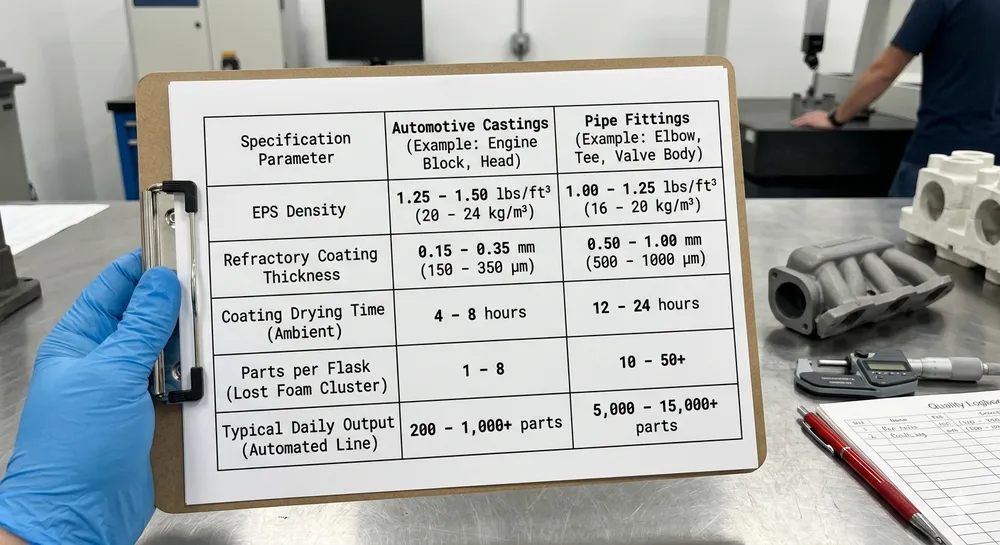
Automotive castings — brake discs, exhaust manifolds, turbo housings, engine blocks — typically have complex internal passages, thin-wall sections (3-6mm), and tight dimensional tolerances (±0.5mm on critical features). These parts need:
- Higher EPS density (24-28 kg/m³) to maintain pattern rigidity during coating and handling. A brake disc pattern with internal cooling vanes will collapse during dip coating if the foam density is too low.
- Thicker coating application (1.5-1.8mm wet thickness) to prevent metal penetration into thin-wall sections where the sand backing is minimal.
- Longer drying cycles (6-8 hours) because internal passages trap moisture that causes steam blows during pouring.
- Tighter cluster design with 4-6 parts per flask to maximize output while maintaining gate velocity control. Automotive buyers usually want 200-500 castings per day, which translates to 40-80 flasks per 8-hour shift.
Pipe fittings — elbows, tees, reducers, valve bodies — have simpler geometry, heavier wall sections (8-15mm), and looser tolerances (±1.0mm is acceptable for most applications). These parts allow:
- Lower EPS density (18-22 kg/m³) because the pattern geometry is self-supporting and wall thickness is forgiving.
- Standard coating thickness (1.2-1.5mm wet) since metal penetration risk is lower with thicker walls.
- Faster drying (4-6 hours) due to simpler geometry and better air circulation.
- Higher cluster density with 12-20 parts per flask, which improves sand utilization and reduces per-part cost. Pipe fitting buyers often target 500-1,000 pieces per day, running 60-100 flasks per shift.
The cost difference between these two configurations is 20-30% of total line investment. An automotive-spec line with high-density EPS capability, extended drying chambers, and precision cluster tooling runs $180,000-240,000 for a 2-ton/day capacity. A pipe fitting line optimized for simpler geometry and higher throughput runs $140,000-180,000 for the same metal output. If you're entering both markets, start with the automotive-spec line — you can always run pipe fittings on it, but you can't run complex automotive parts on a pipe fitting line without yield problems.
Critical Equipment Specifications to Evaluate
When you're comparing supplier quotes, these five specifications determine whether the line will hit your target yield and cost-per-part. Most buyers focus on headline capacity (tons per day) and miss the subsystem specs that control defect rates.
Vacuum pump capacity is the single most important number for cast iron. You need 1.5-2.0 m³/min of vacuum flow per ton of metal poured to extract decomposition gases fast enough to prevent backpressure. A line rated for "2 tons per day" should have a vacuum system delivering 3.0-4.0 m³/min at 0.04-0.06 MPa negative pressure. We use rotary vane pumps or liquid ring pumps — rotary vane gives you better ultimate vacuum (0.05 MPa vs 0.04 MPa for liquid ring) but requires more maintenance because carbon dust from foam pyrolysis contaminates the oil. Liquid ring pumps tolerate dirty gas streams better and run 8,000-10,000 hours between overhauls instead of 4,000-6,000 for rotary vane.
Sand temperature control prevents thermal expansion defects and maintains vacuum seal integrity. After pouring and shakeout, sand temperature climbs to 200-300°C. You need to cool it back to 30-40°C before reuse, which requires either a fluidized bed cooler (faster, more expensive) or a rotary drum cooler (slower, cheaper). For production rates above 1.5 tons per day, fluidized bed cooling is necessary because drum coolers can't handle the thermal load — your sand temperature will creep up over a shift and you'll start seeing dimensional growth and vacuum leaks. We spec cooling capacity at 15-20°C temperature drop per minute of residence time.
EPS pre-expander density range determines what part types you can run. A pre-expander rated for 18-28 kg/m³ gives you flexibility to handle both pipe fittings (low density, fast vaporization) and automotive parts (high density, pattern rigidity). The density control comes from steam pressure (0.6-1.4 bar) and residence time (30-90 seconds in the expansion chamber). Cheaper pre-expanders lock you into a narrow density range (20-24 kg/m³), which limits your market options. We built our system with variable steam injection and adjustable residence time so buyers can switch between product types without retooling.
Coating drying system type affects cycle time and energy cost. Forced-air drying chambers run at 50-70°C with 2-4 air changes per minute, giving you 4-8 hour drying cycles depending on coating thickness. Infrared drying cuts cycle time to 2-4 hours but costs 40% more in equipment and uses 30% more energy per part. For high-volume automotive production (500+ parts per day), infrared drying pays back in 12-18 months through faster throughput. For pipe fittings at lower volume (200-300 parts per day), forced-air drying is more economical. The decision point is around 400 parts per day — above that, infrared starts making sense.
Sand reclamation rate determines your operating cost per ton of castings. A reclamation system hitting 95% recovery means you're adding 0.05 tons of fresh sand per ton of castings produced. At $150-200 per ton for silica sand (delivered price in most export markets), that's $7.50-10.00 per ton in sand cost. A poorly designed reclamation system running at 85% recovery doubles your sand cost to $15-20 per ton. The difference comes from mechanical attrition intensity (sand-on-sand scrubbing to break up carbon agglomerates) and pneumatic classification efficiency (air stream velocity to separate fine carbon particles). We run our reclamation system at 1,200 RPM attrition speed with 8-10 m/s air velocity in the classifier, which consistently delivers 95-96% recovery on gray iron and 93-95% on ductile iron (ductile is slightly lower because nodularizing alloy residue contaminates the sand).
Gray Iron vs Ductile Iron: Line Configuration Differences
If you're running both alloy types, you need to understand where the line specs diverge. Most buyers assume "cast iron is cast iron," but gray and ductile iron have different process requirements that affect equipment selection.
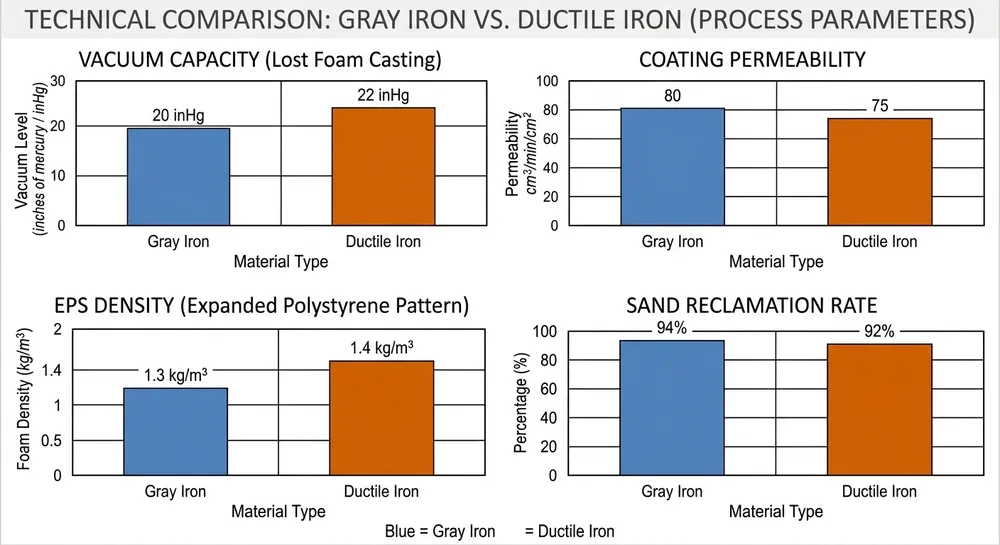
| Parameter | Gray Iron (FC250/HT250) | Ductile Iron (QT450/GGG40) |
|---|---|---|
| Pouring Temperature | 1,380-1,420°C | 1,400-1,450°C |
| Coating Permeability | 180-220 cm³/cm²/min | 200-250 cm³/cm²/min |
| Vacuum Capacity | 1.5-1.8 m³/min per ton | 1.8-2.0 m³/min per ton |
| EPS Density Range | 18-24 kg/m³ | 22-28 kg/m³ |
| Sand Reclamation Rate | 95-96% | 93-95% |
| Typical Scrap Rate | 3-5% (porosity, misruns) | 5-8% (porosity, shrinkage) |
Ductile iron runs hotter and generates more gas. The 20-30°C higher pouring temperature increases EPS decomposition rate, which means you need higher vacuum capacity and more permeable coatings to prevent backpressure. If your line is sized for gray iron and you switch to ductile, you'll see your scrap rate climb from 3-5% to 8-12% because the vacuum system can't keep up. We've commissioned lines where the buyer planned to run "mostly gray iron with occasional ductile," then shifted to 60% ductile production and had to retrofit a larger vacuum pump six months later. Size the vacuum system for ductile iron specs even if gray iron is your primary volume — the 15-20% cost premium on the vacuum pump is cheaper than retrofitting later.
Ductile iron needs higher EPS density for dimensional control. The nodular graphite structure in ductile iron causes more solidification shrinkage than the flake graphite in gray iron (1.8-2.2% linear shrinkage for ductile vs 0.8-1.2% for gray). To compensate, you need denser foam patterns (24-28 kg/m³) that maintain dimensional stability during coating and provide better support for the molten metal during solidification. Running ductile iron with low-density patterns (18-22 kg/m³) gives you pattern distortion during handling and shrinkage defects after casting.
Sand reclamation is harder with ductile iron. The magnesium and rare earth nodularizing alloys leave residue in the sand that interferes with reclamation. You need magnetic separation (for ferrosilicon inoculant particles) and more aggressive attrition (to break up magnesium oxide deposits) to hit 93-95% recovery. Gray iron reclamation is simpler because there's no nodularizing alloy contamination — mechanical attrition and pneumatic classification are sufficient to reach 95-96% recovery.
If you're buying a line for both alloy types, specify it as a Ductile Cast Iron Lost Foam Casting Production Line and run gray iron on it when needed. The reverse doesn't work — a gray iron line will underperform on ductile iron and you'll fight defects.
Capacity Planning: Matching Line Size to Your Output Target
Buyers often ask for "a 2-ton-per-day line" without connecting that number to their actual part mix and shift schedule. Capacity planning for lost foam is more complex than green sand molding because cycle time includes pattern production, coating, drying, and sand reclamation — not just pouring and shakeout.
Start with your target annual output and work backward. If you need 100,000 brake discs per year at 4.5 kg per casting, that's 450 tons of finished castings annually. Assuming 5% scrap rate, you need to pour 473 tons per year. At 250 working days per year, that's 1.9 tons per day. But "tons per day" assumes 100% equipment utilization, which never happens in real production. Factor in pattern changeovers, coating batch mixing, maintenance downtime, and shift breaks — realistic utilization is 75-80% for a well-run foundry. So your 1.9 tons per day target requires a line rated for 2.4-2.5 tons per day nominal capacity.
Casting weight range affects flask utilization. A line rated for "2 tons per day" might have 600mm x 800mm x 600mm flasks. If you're casting 2.0 kg pipe elbows, you can pack 16 pieces per flask at 32 kg total metal weight. If you're casting 8.0 kg valve bodies, you can only fit 4 pieces per flask at 32 kg total weight. The line capacity is the same (2 tons per day), but your parts-per-day output is 4x higher for the smaller castings. When you're evaluating line capacity, ask the supplier for flask dimensions and calculate how many of YOUR specific parts fit per flask — don't rely on the headline tonnage number.
Drying cycle time is the usual bottleneck. Pattern molding takes 2-5 minutes per piece, coating application takes 1-2 minutes, pouring and shakeout take 10-15 minutes per flask. But coating drying takes 4-8 hours. If your drying chamber holds 6 flasks and your drying cycle is 6 hours, you can only process 24 flasks per day (6 flasks x 4 drying cycles per 24 hours). At 30 kg metal per flask, that's 720 kg per day — well below the "2 tons per day" rating of the pouring and sand handling equipment. The solution is either a larger drying chamber (holds 12-16 flasks instead of 6) or infrared drying (cuts cycle time to 3-4 hours). We've seen buyers order a line based on pouring capacity and then discover their drying chamber can't keep up — they end up running two shifts on pattern production and coating, then batch-drying overnight, which kills labor efficiency.
Decision matrix for line sizing:
| Target Annual Output | Casting Weight Range | Recommended Line Capacity | Typical Investment Range |
|---|---|---|---|
| 200-400 tons/year | 1-5 kg (pipe fittings) | 1.5-2.0 tons/day | $120,000-160,000 |
| 400-800 tons/year | 3-8 kg (automotive parts) | 2.0-3.0 tons/day | $180,000-240,000 |
| 800-1,500 tons/year | 5-15 kg (valve bodies, manifolds) | 3.0-5.0 tons/day | $280,000-380,000 |
| 1,500+ tons/year | 10-30 kg (engine blocks, large fittings) | 5.0-8.0 tons/day | $450,000-650,000 |
These investment ranges include the complete system (EPS equipment, coating, vacuum casting, sand reclamation) with PLC controls, remote diagnostics, and first-year spare parts. They assume modular container-optimized design for export shipping. Custom engineering (non-standard flask sizes, specialized coating systems, integrated heat treatment) adds 15-25% to the base price.
Total Cost of Ownership: Beyond the Purchase Price
The line purchase price is 40-50% of your total cost over a 10-year operating life. The other 50-60% comes from sand consumption, pattern tooling, energy, and maintenance. Buyers who optimize only for upfront cost end up with higher operating expenses that kill margin.
Sand reclamation economics — A line producing 500 tons of castings per year at 95% sand reclamation uses 25 tons of fresh sand annually (500 tons x 0.05 makeup rate). At $180 per ton delivered, that's $4,500 per year in sand cost. The same line at 85% reclamation uses 75 tons of fresh sand annually, costing $13,500 per year. Over 10 years, the difference is $90,000. A high-efficiency reclamation system costs $25,000-35,000 more than a basic system, so it pays back in 3-4 years. We run mechanical attrition at 1,200 RPM with pneumatic classification at 8-10 m/s air velocity, which consistently delivers 95%+ recovery. Cheaper reclamation systems run at 800-1,000 RPM attrition and 5-7 m/s air velocity, and they struggle to break up carbon agglomerates — you end up at 85-88% recovery and higher sand cost.
Pattern tooling amortization — EPS molding dies cost $8,000-15,000 per cavity depending on part complexity. A brake disc die with internal cooling vanes runs $12,000-14,000. If you're producing 50,000 discs per year and the die lasts 200,000 cycles, you're amortizing $3,000 per year in tooling cost, or $0.06 per casting. For high-volume production (100,000+ parts per year), aluminum dies are more economical than steel dies because they have better thermal conductivity and faster cycle times, even though they wear out sooner (150,000 cycles vs 300,000 for steel). For low-volume production (10,000-30,000 parts per year), steel dies make sense because the longer life offsets the higher upfront cost.
Energy consumption per ton of castings — Lost foam uses more energy than green sand molding because of EPS pre-expansion (steam generation), coating drying (forced air or infrared heating), and sand cooling (fluidized bed or rotary drum). A 2-ton-per-day line typically consumes 800-1,200 kWh per ton of castings produced, compared to 400-600 kWh per ton for green sand molding. At $0.12 per kWh (typical industrial rate in export markets), that's $96-144 per ton in energy cost for lost foam vs $48-72 per ton for green sand. The energy cost difference is $50-70 per ton, but lost foam eliminates binder cost ($30-40 per ton for resin or clay binder in green sand) and reduces machining cost (better surface finish and dimensional accuracy mean less stock removal). The net operating cost difference is $20-30 per ton in favor of green sand, but lost foam gives you design flexibility (complex internal passages, thin walls, near-net-shape casting) that green sand can't match. The decision depends on your part geometry — if you're casting simple shapes, green sand is cheaper; if you're casting complex geometry, lost foam saves money on machining and secondary operations.
Maintenance intervals and spare parts cost — Vacuum pumps need oil changes every 500-1,000 hours (rotary vane) or water changes every 2,000-3,000 hours (liquid ring). Coating pumps and mixers need seal replacement every 6-12 months. Sand reclamation attrition mills need liner replacement every 12-18 months. Budget $8,000-12,000 per year in routine maintenance parts for a 2-ton-per-day line. Major overhauls (vacuum pump rebuild, reclamation mill refurbishment) happen every 3-5 years at $15,000-25,000 per event. We ship first-year spare parts kits with every line (vacuum pump oil, coating pump seals, proximity sensors, solenoid valves, PLC I/O modules) so you're not waiting for parts shipments from China during the commissioning period.
Common Selection Mistakes and How to Avoid Them
We've commissioned enough lines to see the same mistakes repeated across different buyers. These are the ones that cost the most to fix after installation.
Undersized vacuum systems — Buyers see "2 tons per day" in the spec sheet and assume the vacuum pump is correctly sized. Then they start production and discover the pump can't extract decomposition gases fast enough, causing backpressure that creates misruns and incomplete fills. The scrap rate sits at 12-15% instead of the 3-5% they expected. The fix is retrofitting a larger vacuum pump, which costs $18,000-25,000 plus downtime for installation. The root cause is suppliers quoting vacuum capacity based on aluminum lost foam (0.8-1.2 m³/min per ton) instead of cast iron (1.5-2.0 m³/min per ton). When you're evaluating quotes, ask for vacuum pump model number and flow rate at operating pressure (0.04-0.06 MPa), then calculate m³/min per ton of metal poured. If it's below 1.5 for gray iron or 1.8 for ductile iron, the system is undersized.
Wrong coating permeability for iron pouring temperatures — Aluminum lost foam coatings run 80-120 permeability, which is too low for cast iron. At 1,400°C pouring temperature, the gas generation rate overwhelms the coating's ability to exhaust gases, causing backpressure and porosity. Cast iron needs 180-250 permeability coatings with alumina or zircon refractory base. The coating supplier should provide permeability test data measured at 2 kPa pressure differential — if they can't produce that data, they're not testing their coatings properly. We've seen buyers use generic "high-temperature coating" without verifying permeability, then spend six months troubleshooting porosity issues before switching to a properly formulated cast iron coating. The coating cost difference isminimal — $2-3 per liter for aluminum-grade coating vs $3-4 per liter for cast iron coating — but the yield improvement from using the correct coating saves 8-10% in scrap cost.
Inadequate sand cooling capacity — Sand temperature management is invisible until it becomes a problem. After pouring and shakeout, sand temperature climbs to 200-300°C. If your cooling system can't bring it back to 30-40°C before reuse, the sand temperature creeps up over a production shift. By hour 6, your sand is running at 70-80°C, which causes thermal expansion defects, vacuum seal leaks, and pattern distortion during flask filling. The fix is adding cooling capacity (larger fluidized bed or additional rotary drum coolers), which costs $15,000-30,000 and requires production downtime for installation. The prevention is specifying cooling capacity at 15-20°C temperature drop per minute of residence time during the initial line design. For production rates above 1.5 tons per day, fluidized bed cooling is necessary — drum coolers can't handle the thermal load.
Drying chamber bottlenecks — Pattern production and coating application are fast (3-7 minutes per part), but drying takes 4-8 hours. If your drying chamber can't hold enough flasks to match your pattern output, you'll accumulate wet-coated patterns waiting for dryer space. The usual symptom is running two shifts on pattern production, then batch-drying overnight, which wastes labor and limits daily output. The solution is sizing the drying chamber to hold 1.5-2.0x the number of flasks you'll pour per shift. For a line targeting 40 flasks per 8-hour shift, you need drying capacity for 60-80 flasks (assuming 6-hour drying cycles with staggered loading). Buyers often undersize the dryer to save upfront cost ($8,000-12,000 for a larger chamber), then lose $30,000-50,000 per year in reduced throughput and inefficient labor utilization.
Ignoring container dimensions for export shipping — A line that doesn't fit standard 20-foot or 40-foot containers costs 40-60% more to ship. We design our equipment in modular sections that pack into containers without disassembly: vacuum chambers fit 2 per 40-foot container, sand reclamation systems fit 1 per 20-foot container, coating tanks and dryers fit 3-4 per 40-foot container. Non-modular designs require custom crating, flat-rack containers, or break-bulk shipping, which adds $15,000-35,000 to your landed cost. When you're comparing quotes, ask whether the equipment ships in standard containers and how many containers the complete line requires. Our 2-ton-per-day system ships in 3x 40-foot containers plus 1x 20-foot container, with total shipping cost of $8,000-12,000 to most export markets (North America, Europe, Middle East).
What TZFoundry Brings to Cast Iron Lost Foam Line Selection
We've built lost foam lines since 2015, starting with a European automotive buyer who needed 200 brake discs per hour with ±0.5mm tolerance. That project taught us what export buyers actually need: equipment that works for cast iron specifically (not generic lost foam), modular design that ships economically, and remote diagnostics so you're not waiting for a technician to fly from China when something stops working.
Our engineering team runs an in-house sand reclamation testing lab where we validate recovery rates on actual cast iron samples before we finalize the reclamation system design. We don't quote generic "95% recovery" — we test your sand type and your alloy composition, measure carbon contamination levels, and size the attrition mill and pneumatic classifier to hit the recovery target. That testing happens before you place the order, so there are no surprises during commissioning.
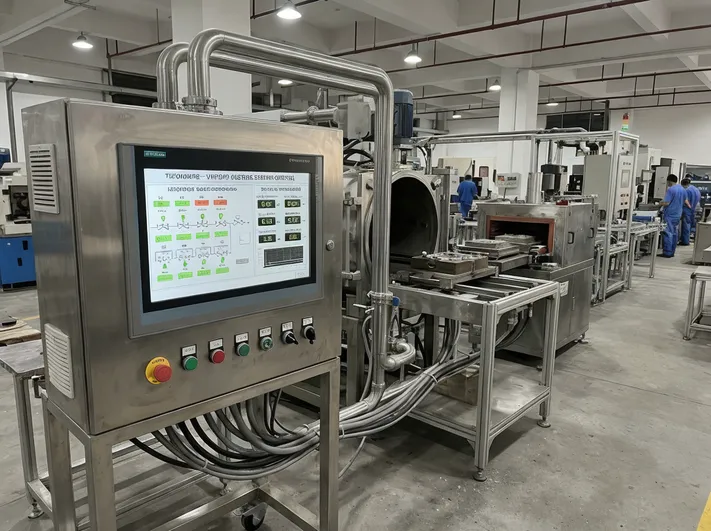
The vacuum systems we spec use liquid ring pumps rated at 1.8-2.0 m³/min per ton for cast iron, with 4G remote monitoring that tracks vacuum level, pump temperature, and seal water flow in real time. If the vacuum drops below 0.04 MPa or the pump temperature climbs above 70°C, you get an alert on your phone before it causes casting defects. We've had buyers catch vacuum leaks and pump seal failures 2-3 hours before they would have affected production, which prevents scrap and downtime.
Our EPS pre-expanders run 18-28 kg/m³ density range with PLC-controlled steam injection, so you can switch between pipe fitting patterns (low density, fast vaporization) and automotive patterns (high density, rigidity) without manual adjustments. The density control is ±1.5 kg/m³ across a production batch, which keeps your casting quality consistent and reduces the trial-and-error during pattern development.
We ship complete systems in container-optimized modules: 3x 40-foot containers plus 1x 20-foot container for a 2-ton-per-day line, with installation drawings and commissioning support included. The first-year spare parts kit ships with the line (vacuum pump oil, coating pump seals, sensors, valves, PLC modules), so you're not waiting for parts from China during startup. Remote commissioning happens over video call with our engineering team walking your operators through the startup sequence, parameter tuning, and first-article inspection.
The total investment for a 2-ton-per-day cast iron lost foam line (complete system, PLC controls, remote diagnostics, spare parts, commissioning support) runs $180,000-240,000 depending on whether you're optimizing for automotive parts (higher EPS density, extended drying, precision tooling) or pipe fittings (simpler geometry, higher throughput). That price includes shipping to most export markets and assumes modular container-optimized design. Custom engineering (non-standard flask sizes, specialized coatings, integrated heat treatment) adds 15-25%.
Making the Selection Decision
Start with your part geometry and annual output target. If you're casting automotive parts with complex internal passages and thin walls, you need automotive-spec equipment (24-28 kg/m³ EPS density, 1.5-1.8mm coating thickness, extended drying chambers). If you're casting pipe fittings with simpler geometry and heavier walls, pipe fitting-spec equipment (18-22 kg/m³ EPS density, 1.2-1.5mm coating, standard drying) costs 20-30% less and gives you higher throughput.
Size the vacuum system for ductile iron specs (1.8-2.0 m³/min per ton) even if gray iron is your primary volume. The 15-20% cost premium on the vacuum pump is cheaper than retrofitting later, and it gives you flexibility to run both alloy types without yield problems.
Calculate your realistic daily capacity by working backward from annual output, factoring in 75-80% equipment utilization and your specific casting weight range. Don't rely on headline "tons per day" ratings — ask for flask dimensions and calculate how many of your parts fit per flask.
Evaluate total cost of ownership over 10 years, not just purchase price. A line with 95% sand reclamation saves $9,000 per year in sand cost compared to 85% reclamation, paying back the $25,000-35,000 premium on the reclamation system in 3-4 years. High-efficiency vacuum pumps, properly sized cooling systems, and adequate drying capacity prevent the operating cost creep that kills margin on high-volume production.
Verify that the equipment ships in standard containers and ask for the total container count. Non-modular designs add $15,000-35,000 to your landed cost through custom shipping.
Request vacuum pump model numbers, flow rates at operating pressure, coating permeability test data, and sand reclamation recovery rates measured on cast iron samples. Suppliers who can't provide this data are quoting generic lost foam equipment, not cast iron-specific systems.
The line you select determines your casting yield, operating cost per ton, and ability to serve automotive vs pipe fitting markets for the next 10-15 years. Get the vacuum capacity, sand cooling, and reclamation system right during initial selection — retrofitting after installation costs 3-5x more than specifying correctly from the start.

Zhang Peng leads lost foam casting systems at TZFoundry, where he has spent over 12 years engineering vacuum casting lines, coating systems, and foam pattern equipment for export foundries. He specializes in defect prevention and yield optimization across cast iron...