Lost Foam Casting Equipment Buyer’s Checklist – 12 Points to Verify Before Placing an Order
Most lost foam casting defects don't start in the casting chamber. They start at the purchase order stage when buyers skip verification steps that would have caught mismatched specs, incomplete documentation, or equipment that can't handle their actual production requirements.
I've commissioned lost foam lines remotely in 14 countries. The buyers who avoid expensive surprises are the ones who verify specific parameters before the deposit clears, not after the containers arrive. This checklist covers the 12 verification points that separate a smooth installation from a six-month troubleshooting cycle.
1. Vacuum System Pressure Range and Leak Rate
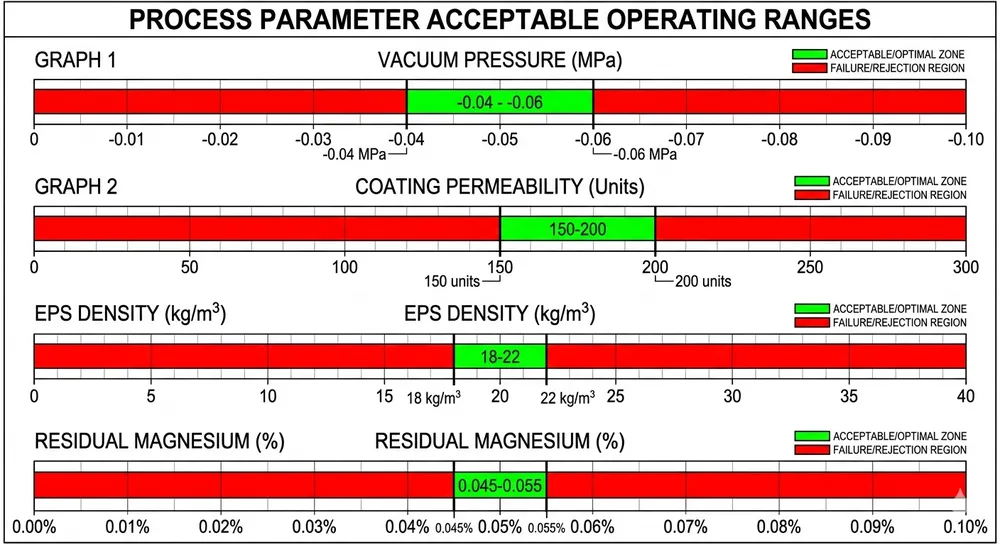
Your vacuum system needs to pull and hold specific pressure levels for the alloys you're casting. For gray iron and ductile iron, you need -0.04 to -0.06 MPa sustained vacuum. Aluminum requires tighter control at -0.05 to -0.08 MPa because gas porosity shows up faster.
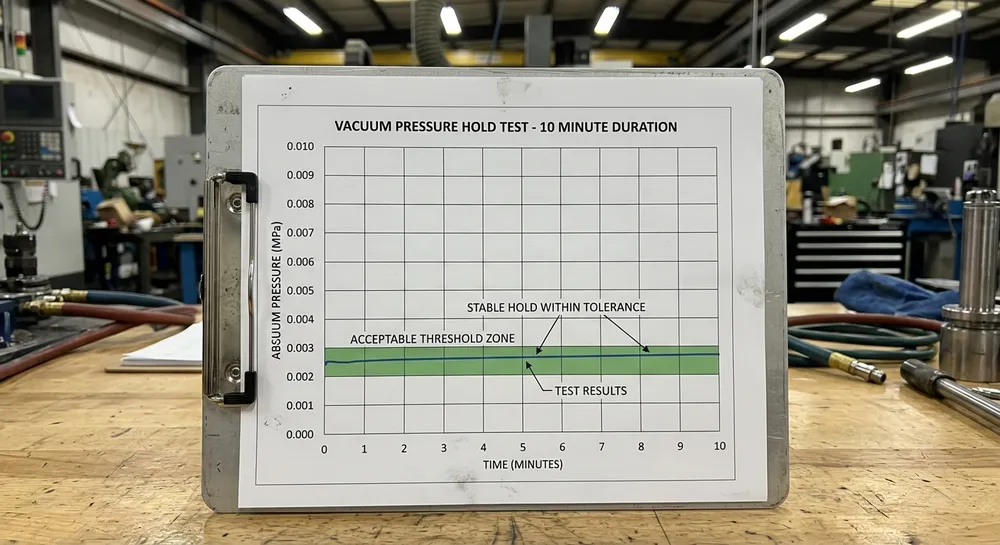
Ask the supplier for the vacuum pump's rated capacity in m³/h and the chamber's leak rate specification. A production-grade system should hold vacuum drop below 5% over 10 minutes with the chamber sealed. If the supplier can't provide leak rate data, that's a red flag — it means they're not testing systems before shipment.
We run every vacuum chamber through a 30-minute hold test and include the pressure curve in the commissioning report. You should demand the same from any supplier you're evaluating.
2. EPS Pattern Density Compatibility Range
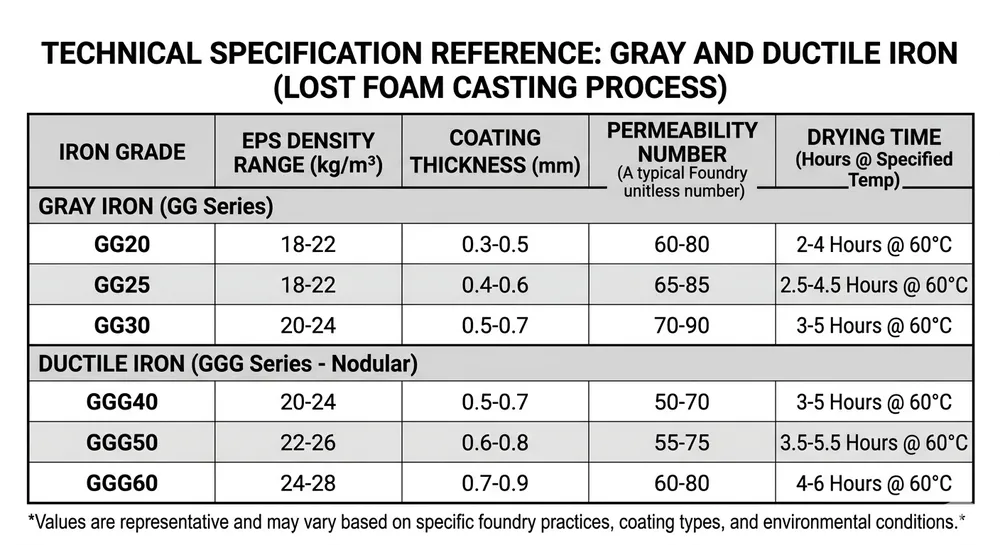
Lost foam equipment needs to handle the EPS bead density range your patterns require. Standard automotive and machinery castings use 18-22 kg/m³ density foam. Complex thin-wall castings need denser foam at 24-28 kg/m³ for better dimensional stability.
Verify that the coating equipment and pattern handling system can process your density range without adjustment. Some coating dip tanks are calibrated for narrow density windows — if your patterns fall outside that range, the coating thickness becomes inconsistent and you'll see carbon defects in the castings.
The pattern handling conveyors also matter. Low-density foam (below 20 kg/m³) is fragile and needs gentler handling with wider support surfaces. Ask for the conveyor belt material spec and support spacing.
3. Coating System Capacity and Drying Time
Your coating line needs to match your production volume, not just your peak capacity. Calculate your daily pattern throughput, then verify the coating tank capacity and drying chamber cycle time.
A 500-liter coating tank with a 4-pattern-per-minute dip rate sounds adequate until you factor in the 2-4 hour drying time per batch. If your drying chamber only holds 50 patterns, you're bottlenecked at the dryer, not the dip tank.
Ask for the complete coating cycle specification: dip time, drain time, drying temperature range, and drying chamber capacity. We've seen buyers order coating systems that could dip 200 patterns per hour but only dry 40 patterns per hour. The line sat idle 75% of the time.
4. Modular Breakdown Dimensions for Container Shipping
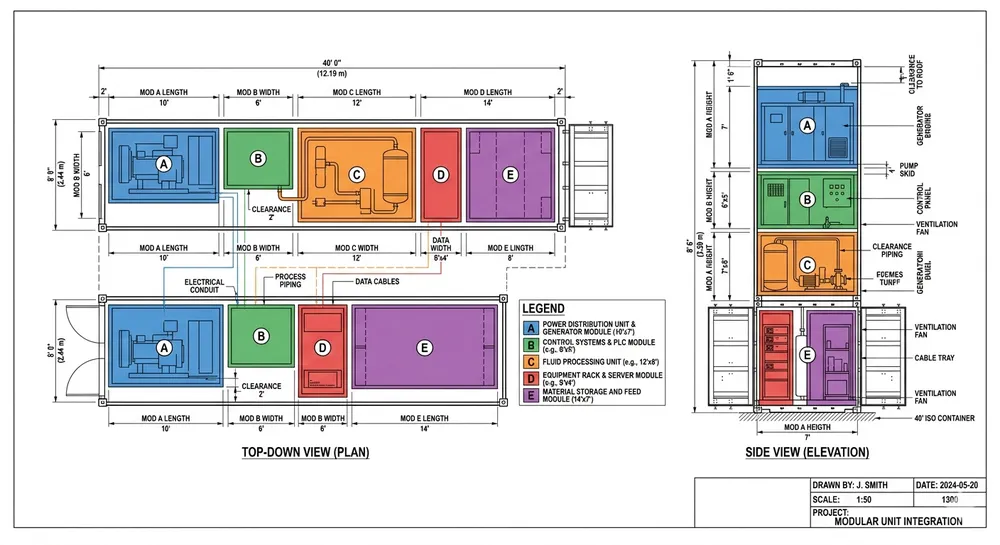
Lost foam production lines ship in modules, and those modules need to fit standard container dimensions. A 40-foot high-cube container is 12.03m long × 2.35m wide × 2.69m high internally. If any module exceeds those dimensions, you're paying for break-bulk shipping or custom crating.
Request the modular breakdown drawing with dimensions for every major component: vacuum chamber base, coating tank frame, pattern conveyor sections, sand reclamation unit. Verify that the heaviest module doesn't exceed your port's crane capacity (usually 25-30 tons for standard container terminals).
We design our vacuum chambers to split into three modules, each under 2.3m width. That keeps shipping costs predictable and eliminates the need for special handling at most ports.
5. PLC Control System Brand and Programming Access
The PLC controls your vacuum timing, coating dip cycles, and sand reclamation sequences. You need to know the brand, model, and whether you'll have programming access for adjustments.
Siemens, Mitsubishi, and Omron are standard industrial PLCs with global support networks. If the supplier uses a proprietary or regional-only PLC brand, you'll struggle to find technicians who can troubleshoot it. Ask for the PLC model number and confirm that replacement modules are available in your region.
Also verify whether the supplier provides the PLC program source code or just a locked runtime. Locked programs mean you can't adjust timing parameters without calling the supplier every time. We provide full source code and a parameter adjustment guide so your team can optimize cycle times after commissioning.
6. Sand Reclamation System Throughput and Dust Control
Your sand reclamation system needs to process the sand volume your casting line generates, plus handle the dust from burned foam residue. A 500 kg/hour casting line produces roughly 400 kg/hour of sand that needs reclamation.
Ask for the reclamation system's rated throughput in kg/hour and the dust collection system's air volume in m³/h. Undersized dust collectors create a health hazard and contaminate the reclaimed sand with fine carbon particles.
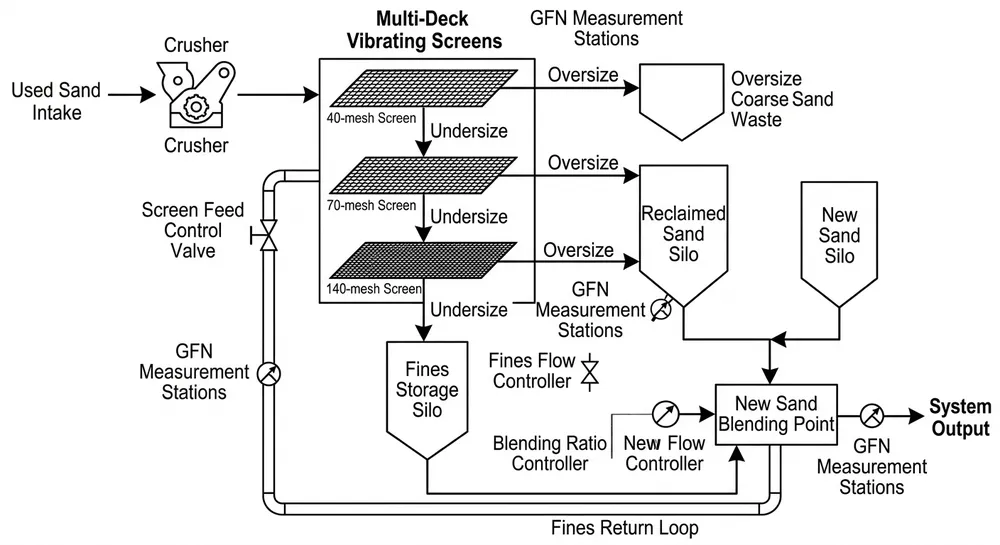
The reclamation system should include magnetic separation for ferrous contamination and screening for oversized debris. Request the screen mesh size specification — 20-40 mesh is standard for lost foam sand reclamation.
7. Electrical Specifications and Voltage Compatibility
Lost foam equipment runs on three-phase power, but voltage and frequency vary by region. North America uses 480V/60Hz, Europe uses 400V/50Hz, and some Middle East countries use 380V/50Hz.
Verify that the equipment is built for your local voltage and frequency, not just fitted with a transformer. Transformers add cost, create a failure point, and reduce motor efficiency. The motor nameplates should match your local standard.
Also check the total connected load in kW. Your facility needs adequate electrical capacity, and you'll need this number for your electrician to size the supply circuit and breakers. A typical 500 kg/hour lost foam line draws 80-120 kW total connected load.
8. Spare Parts Kit Contents and Lead Time
Equipment breaks. The question is whether you have the parts on hand to fix it in hours instead of weeks. Request a recommended spare parts list with part numbers and unit prices.
Critical spares for lost foam lines include: vacuum pump vanes or rotors, coating pump seals, PLC input/output modules, proximity sensors, and conveyor drive belts. These are the components that fail most often in the first two years.
Also ask for the lead time to ship additional spare parts after installation. If the supplier quotes 8-12 weeks for a vacuum pump rebuild kit, you need to stock that part locally. We ship a starter spare parts kit with every line that covers the first year of operation.
9. Commissioning Support Method and Duration
Commissioning is where equipment specs meet your actual production conditions. You need to know whether the supplier sends a technician on-site, provides remote video support, or just ships a manual.
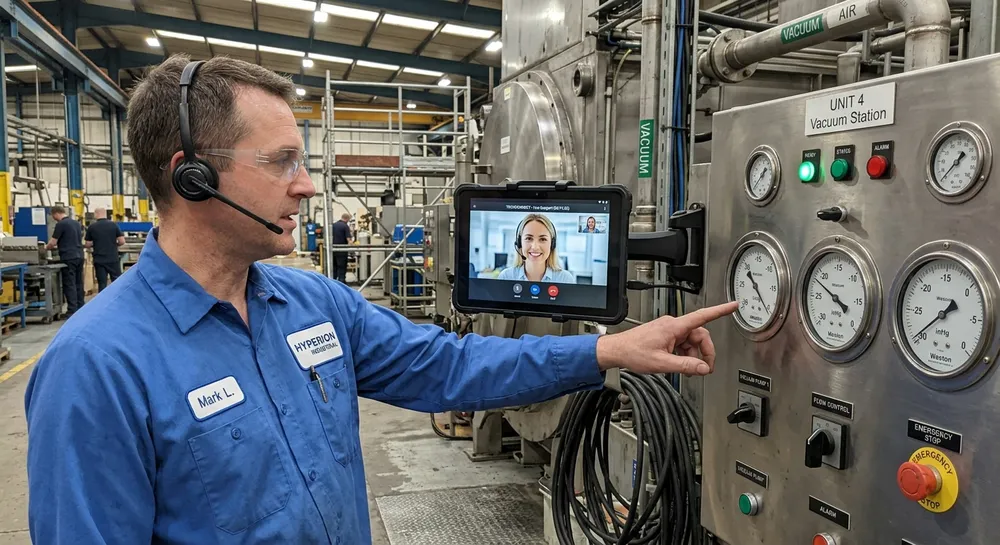
On-site commissioning is ideal but expensive for international orders. Remote commissioning via video call works if the supplier has done it before and your team can follow technical instructions. Pure manual-based commissioning rarely succeeds for complex equipment.
Ask for the commissioning timeline in days and what's included: mechanical installation guidance, electrical connection verification, PLC parameter setup, trial casting runs, and operator training. A complete lost foam line commissioning typically takes 5-7 days on-site or 10-14 days remote.
We've commissioned 40+ lines remotely using 4G video modules mounted on the equipment. Your installation team follows our technician's instructions in real-time, and we can see the vacuum gauges and PLC screen through the camera.
10. Quality Certifications and Inspection Reports
ISO 9001:2015 certification means the supplier has documented quality processes. CE marking is required for equipment sold into Europe. SGS or TUV inspection reports provide third-party verification of build quality.
Request copies of current certifications — not expired ones from five years ago. Also ask whether the supplier provides equipment-specific test reports: vacuum chamber pressure test, coating tank capacity verification, electrical safety test, and dimensional inspection.
We include a commissioning report with every line that documents the actual test results from your specific equipment, not generic spec sheets. That report becomes your baseline for future maintenance and troubleshooting.
11. Warranty Terms and Exclusions
Standard warranty for industrial casting equipment is 12 months from commissioning date or 18 months from shipment date, whichever comes first. Read the exclusions carefully — most warranties don't cover wear parts like pump vanes, seals, and belts.
Also check whether the warranty covers labor and shipping for replacement parts, or just the parts themselves. International shipping for a 50 kg vacuum pump can cost more than the pump.
Ask about extended warranty options and what they cost. A second-year warranty extension typically adds 3-5% to the equipment price but can be worth it if you're running high-volume production.
12. Post-Sale Technical Support Availability
Equipment problems don't respect business hours or time zones. You need to know how to reach technical support when your vacuum system loses pressure at 2 AM or your coating line stops mid-batch.
Ask for the support contact methods (phone, email, WhatsApp, WeChat), response time commitment, and whether support is available in your language. Also verify the time zone coverage — a supplier in China with 9-5 support hours can't help a North American buyer during their production shift.
We provide WhatsApp and email support with 4-hour response time during business hours and 24-hour response for urgent production-down issues. Our technical team includes English-speaking engineers who've commissioned equipment in your region and understand the common installation challenges.
Verification Checklist Summary
Print this list and use it during supplier evaluation calls:
[ ] Vacuum system pressure range and leak rate specification
[ ] EPS pattern density compatibility (18-28 kg/m³ range)
[ ] Coating system capacity and complete drying cycle time
[ ] Modular dimensions for 40-foot container shipping
[ ] PLC brand, model, and programming access level
[ ] Sand reclamation throughput and dust collection capacity
[ ] Electrical voltage, frequency, and total connected load
[ ] Spare parts kit contents and reorder lead time
[ ] Commissioning method, duration, and what's included
[ ] Current quality certifications and equipment test reports
[ ] Warranty period, exclusions, and parts/labor coverage
[ ] Technical support contact methods and response time
The suppliers who can answer these questions with specific numbers and documentation are the ones who've actually built and commissioned equipment before. The ones who give vague answers or promise to "provide details later" are the ones who'll create problems after your deposit clears.
If you're evaluating lost foam casting equipment suppliers and need help interpreting technical specifications or comparing proposals, our engineering team can review your requirements and recommend the configuration that matches your production needs. Contact our technical team with your casting volume, alloy types, and pattern complexity — we'll send back a detailed specification and quote within 48 hours.
How to Reduce Defects in Lost Foam Casting: Porosity, Carbon Inclusions & Misruns
A 15% scrap rate on a lost foam line running 200 castings per shift costs you 30 rejected parts daily. At $40 per casting in material and labor, that's $1,200 lost per shift before you count rework time or customer complaints. Most of that scrap traces back to three defects: porosity, carbon inclusions, and misruns.
The pattern I see across foundries is consistent — the defect you find in the finished casting started two steps earlier, either at the foam pattern or in the coating booth. Fix the root cause there, and your yield climbs above 90% without adding inspection labor.
This guide walks through each defect's mechanism, the specific equipment parameters that control it, and the production line design choices that prevent recurrence.
Why Lost Foam Defects Cost More Than Other Casting Methods
Lost foam casting eliminates the need for cores and parting lines, but it introduces failure modes you don't see in green sand or permanent mold work. The EPS pattern must decompose cleanly during metal pour, the coating must let gas escape without trapping carbon residue, and the vacuum system must pull decomposition gases out of the sand fast enough to prevent porosity.
When any of these three systems — pattern, coating, vacuum — operates outside its control range, you get defects. The problem is that most foundries treat these as separate processes instead of recognizing them as an integrated defect-prevention system.
We've commissioned lost foam casting production lines in 14 countries, and the defect patterns are identical regardless of location. Porosity shows up when vacuum pressure drops below 0.04 MPa. Carbon inclusions appear when coating permeability falls below 120 units or EPS density exceeds 26 kg/m³. Misruns happen when pouring temperature drops 50°C below the alloy's recommended range or when gating design forces metal to travel more than 400mm horizontally before filling the mold cavity.
The parameters are predictable. The fixes are mechanical, not mysterious.
Defect 1: Porosity — Trapped Gas That Never Escaped
Porosity in lost foam castings looks like small round voids scattered through the cross-section, typically 1-5mm in diameter. You'll see it most often in thick sections, at the top of vertical castings, or near gates where metal flow slows down.
Root Cause: Gas Evacuation Failure
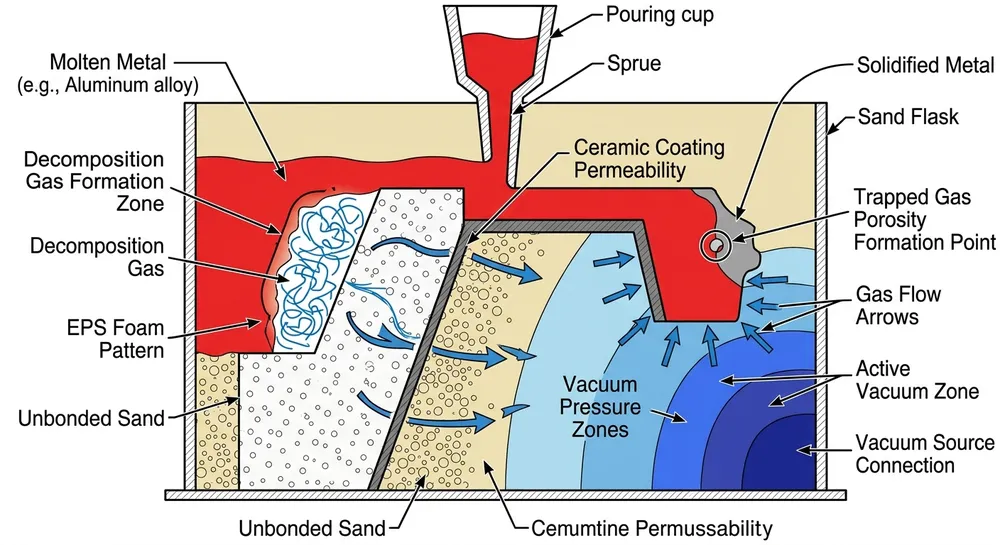
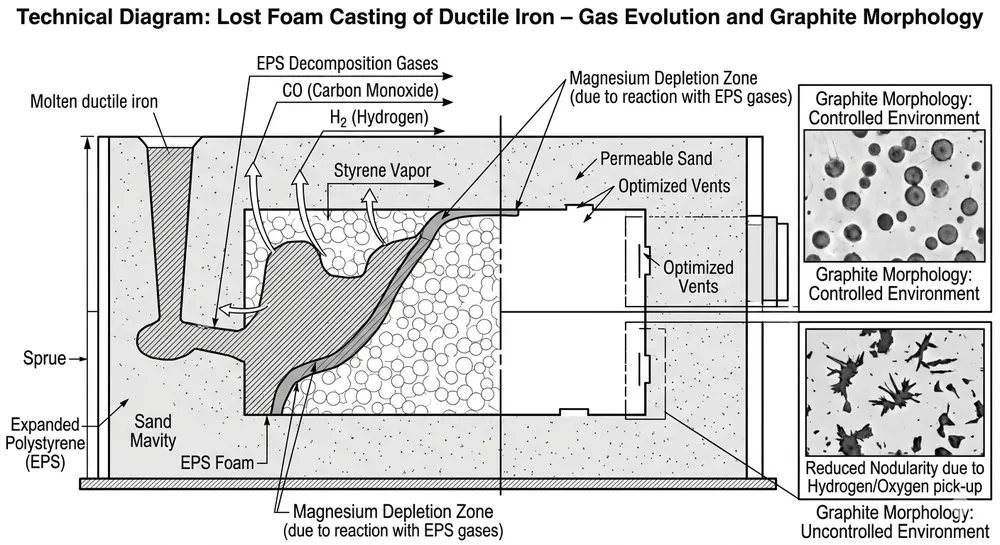
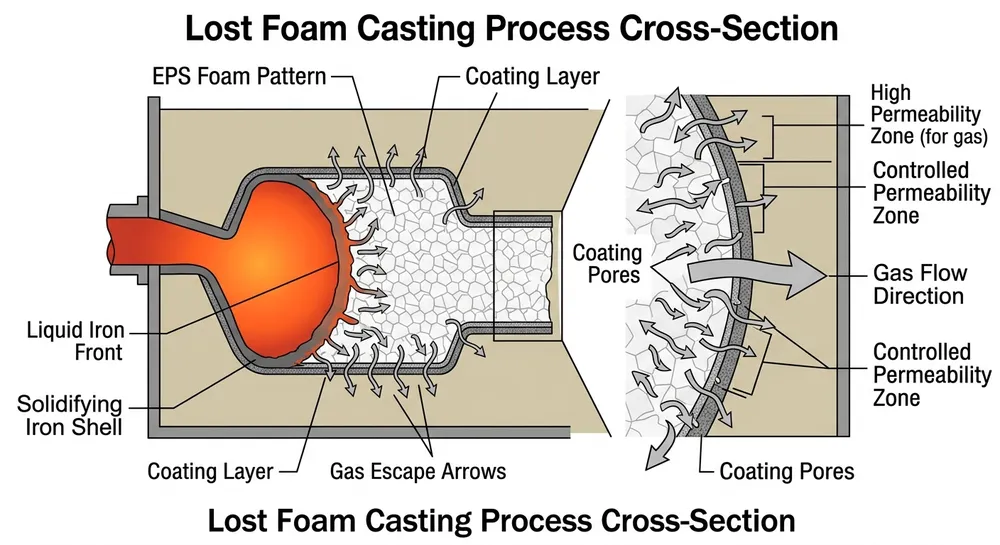
When molten metal contacts the EPS pattern, the foam decomposes into gas. That gas has to escape through the coating, into the surrounding sand, and out through the vacuum system. If any part of that path restricts flow, gas gets trapped in the solidifying metal.
Three conditions cause porosity:
Insufficient vacuum pressure. The vacuum system must maintain 0.04-0.06 MPa during pour. Below 0.04 MPa, gas evacuation slows and pockets form in thick sections. We test vacuum integrity before every commissioning — if the system can't hold 0.05 MPa with all ports sealed, there's a leak in the chamber gaskets or sand compaction isn't uniform.
Moisture in the sand. Dry sand is permeable. Wet sand blocks gas flow. If your sand moisture content exceeds 0.5%, the gas can't escape fast enough and you'll see porosity in every casting. This happens when sand storage isn't covered or when humidity in the plant exceeds 70% without dehumidification.
Coating permeability too low. The coating must be porous enough to let decomposition gases pass through while still preventing metal penetration. If coating viscosity is too high or if you apply too many layers trying to fix surface finish problems, permeability drops and gas gets trapped at the pattern-coating interface.
Parameter Adjustments to Eliminate Porosity
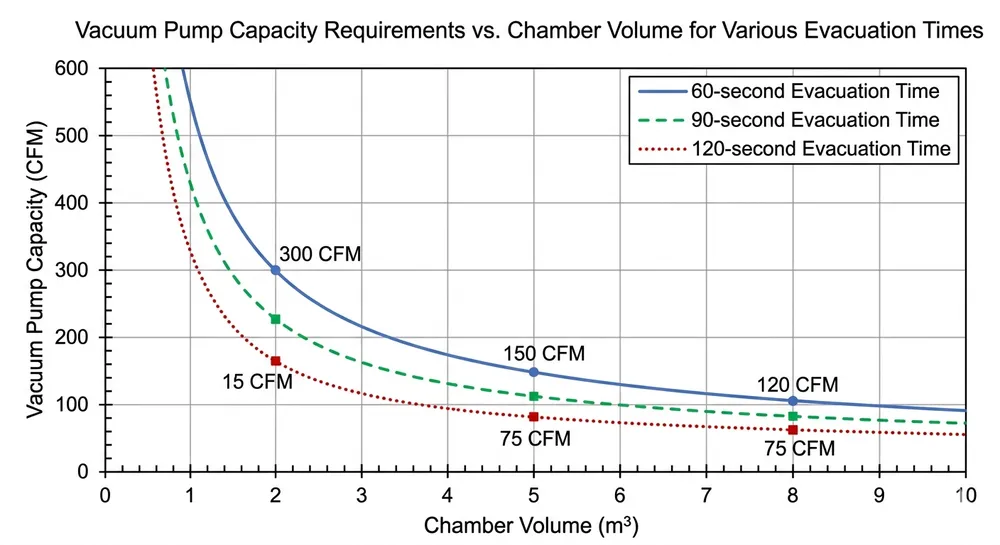
Vacuum system settings. Set vacuum pressure to 0.05 MPa minimum during pour. Monitor pressure continuously — if it drops during the pour, you have a leak or your vacuum pump capacity is undersized for the flask volume. For a 1000mm × 800mm × 600mm flask, you need a vacuum pump rated for at least 150 m³/hr to maintain stable pressure.
Sand moisture control. Keep sand moisture below 0.3%. We run moisture tests every shift using a moisture analyzer — takes 3 minutes and prevents an entire shift of scrap. If moisture creeps above 0.5%, run the sand through a fluidized bed dryer before reuse.
Coating permeability optimization. Target coating permeability of 120-180 units (measured by standard permeability tester). If you're applying more than 3 coats to get acceptable surface finish, your coating viscosity is wrong. We run coating at 18-22 seconds (Ford cup #4) — thick enough to prevent metal penetration, thin enough to maintain gas permeability.
Pouring speed control. Pour fast enough to keep the metal front moving (prevents premature solidification) but not so fast that turbulence traps gas. For ductile iron, we pour at 8-12 kg/second for castings under 50 kg. Faster than that and you get turbulence-induced porosity even with perfect vacuum.
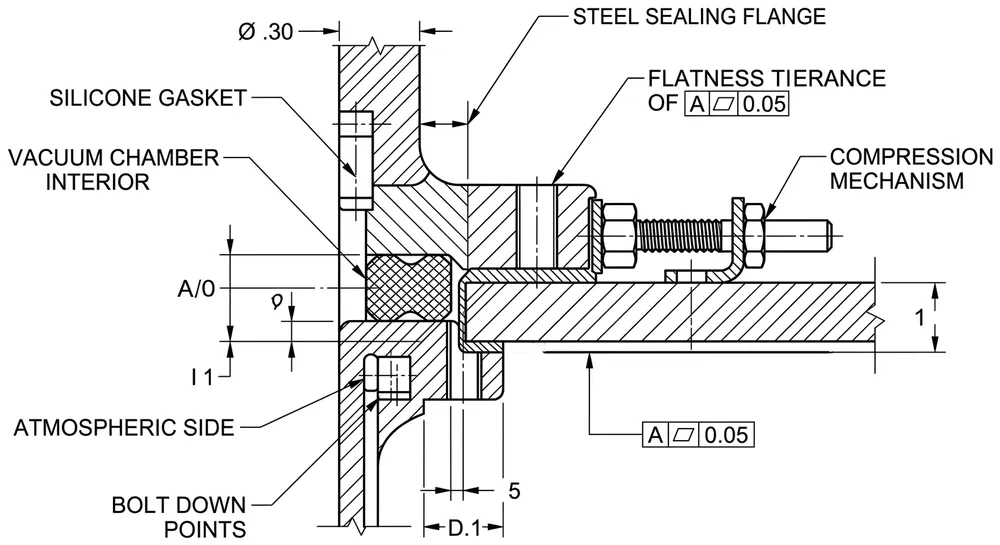
Vacuum chamber sealing. The flask must seal against the chamber gasket with uniform pressure around the entire perimeter. We use silicone gaskets rated for 200°C because rubber gaskets degrade after 6 months of thermal cycling and start leaking. Check gasket condition monthly — a 2mm gap anywhere on the seal will drop your vacuum pressure by 30%.
Sand compaction uniformity. Uneven sand compaction creates preferential gas flow paths — gas escapes easily in loose areas and gets trapped in dense areas. Automated sand filling with vibration compaction gives you ±5% density variation across the flask. Manual filling gives you ±20% variation, and that's where porosity clusters appear.
Vacuum pump sizing. Undersized pumps can't maintain pressure when gas generation peaks during the pour. Size your pump for 2x the theoretical gas volume from complete EPS decomposition. For a 10 kg EPS pattern (density 20 kg/m³), complete decomposition generates roughly 0.5 m³ of gas. You need a pump that can evacuate 1.0 m³ in under 30 seconds while maintaining 0.05 MPa.
Carbon inclusions look like black spots or streaks on the casting surface or embedded in the cross-section. They're residual carbon from incomplete EPS decomposition — the foam didn't burn cleanly, and carbon particles got trapped in the solidifying metal.
This defect is more common in ductile iron than gray iron because ductile iron's higher carbon content makes it easier to mistake carbon inclusions for normal graphite nodules until you machine the casting and find the inclusions concentrated near the surface.
Root Cause: Thermal and Permeability Mismatch
Carbon inclusions form when the EPS pattern decomposes into solid carbon particles instead of gasifying completely. Two conditions cause this:
EPS density too high. Higher-density foam (above 26 kg/m³) contains more material per unit volume. When metal contacts it, the outer layer decomposes but the inner layer doesn't have enough time or heat to gasify before the metal solidifies. You're left with carbon particles suspended in the casting.
We've tested EPS densities from 18 to 28 kg/m³. Below 22 kg/m³, patterns are too fragile for handling and coating. Above 26 kg/m³, carbon inclusions appear in every casting regardless of coating or pouring temperature. The sweet spot is 22-24 kg/m³ for most cast iron applications.
Coating permeability too low. Even if the EPS gasifies completely, the gas must escape through the coating. If coating permeability is too low (below 100 units), decomposition gases can't escape fast enough. Pressure builds up at the pattern-coating interface, forcing incomplete decomposition and leaving carbon residue.
This is the same permeability problem that causes porosity, but the symptom is different. Porosity is trapped gas. Carbon inclusions are trapped solid particles.
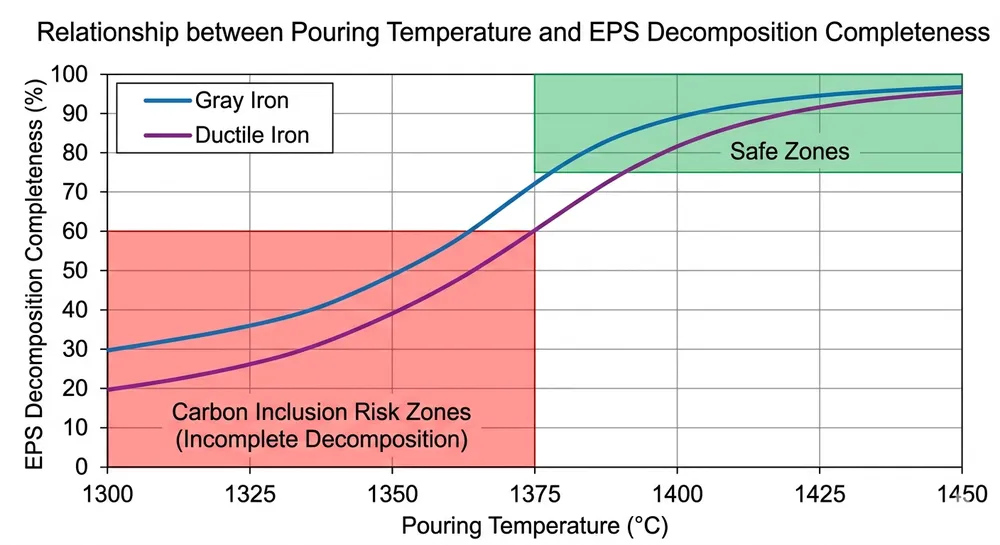
Pouring temperature too low. EPS decomposition is endothermic — it absorbs heat from the molten metal. If pouring temperature is too low, the metal doesn't have enough thermal energy to completely gasify the foam. For gray iron, pour at 1380-1420°C. For ductile iron, pour at 1340-1380°C. Drop 30°C below these ranges and carbon inclusions start appearing.
Parameter Adjustments to Eliminate Carbon Inclusions
EPS pattern density control. Specify 22-24 kg/m³ for lost foam casting EPS patterns. Test density on every batch — we use a simple water displacement method that takes 5 minutes. If your pattern supplier ships foam outside this range, reject the batch. Trying to compensate with coating or temperature adjustments doesn't work reliably.
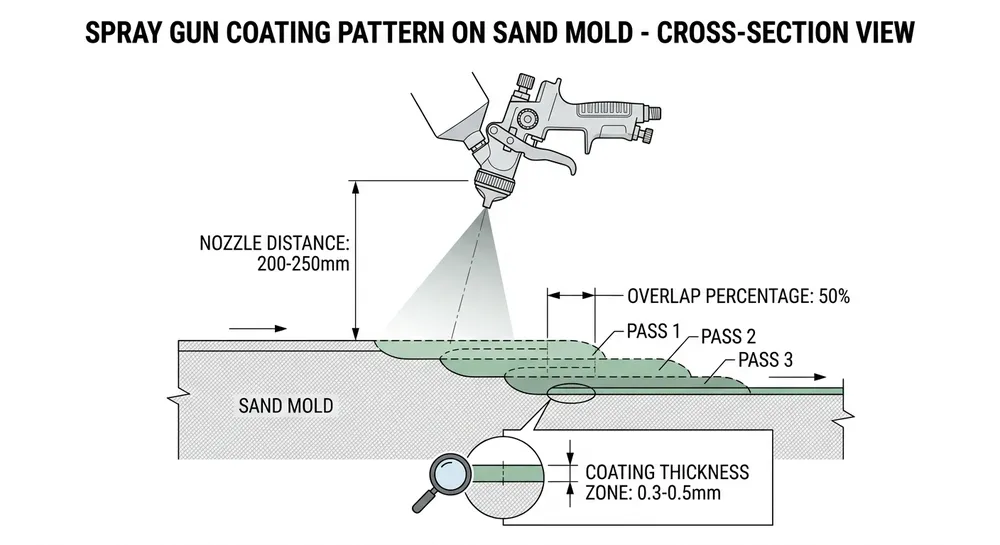
Coating system optimization. Use lost foam coating equipment that can maintain coating thickness at 0.8-1.2mm with permeability above 120 units. We run a two-stage coating process: first coat at 20 seconds viscosity (Ford cup #4) for permeability, second coat at 24 seconds for surface finish. Total dry thickness stays under 1.2mm.
Pouring temperature monitoring. Install thermocouples in your pouring ladle and verify temperature before every pour. For ductile iron, we pour at 1360°C ±10°C. Temperature drops during transfer from furnace to mold — if your transfer time exceeds 90 seconds, you'll lose 20-30°C and risk carbon inclusions in the last castings poured from that ladle.
Gating design for thermal management. Design your gating system to deliver metal to thick sections first while it's hottest. Thin sections can tolerate slightly lower temperatures because they have less EPS mass to decompose. If you're getting carbon inclusions in thick sections but not thin sections, your gating sequence is backwards.
Equipment Design Factors
Coating viscosity control system. Manual coating dip tanks can't maintain consistent viscosity across a production shift. As solvent evaporates, viscosity increases and permeability drops. Automated coating systems with viscosity sensors and automatic solvent addition keep coating in the 18-22 second range continuously. This eliminated 80% of our carbon inclusion problems when we switched from manual to automated coating in 2018.
Pattern handling to prevent density variation. Rough handling compresses EPS foam and increases local density. If your pattern handling system drops patterns or stacks them under load, you'll get density variation within the same pattern — some areas at 22 kg/m³, others compressed to 28 kg/m³. The compressed areas will show carbon inclusions. Use vacuum lifting or soft-grip handling for all pattern transfer operations.
Defect 3: Misruns — Metal Solidification Before Complete Fill
A misrun is an incomplete casting — the metal solidified before filling the entire mold cavity. You'll see it as missing sections, typically at thin walls, far from the gate, or at the top of vertical castings.
Misruns are expensive because you've consumed the pattern, coating, sand, metal, and labor but produced zero usable output. A 5% misrun rate on a 200-casting shift means 10 complete losses per shift.
Root Cause: Thermal and Flow Management Failure
Metal solidifies when it loses heat faster than it flows. In lost foam casting, three factors accelerate heat loss and cause misruns:
Pouring temperature too low. This is the same parameter that causes carbon inclusions, but the symptom is different. Low temperature gives you less time to fill the mold before solidification starts. For thin-wall castings (under 6mm), you need the metal at the high end of the temperature range — 1410°C for gray iron, 1370°C for ductile iron.
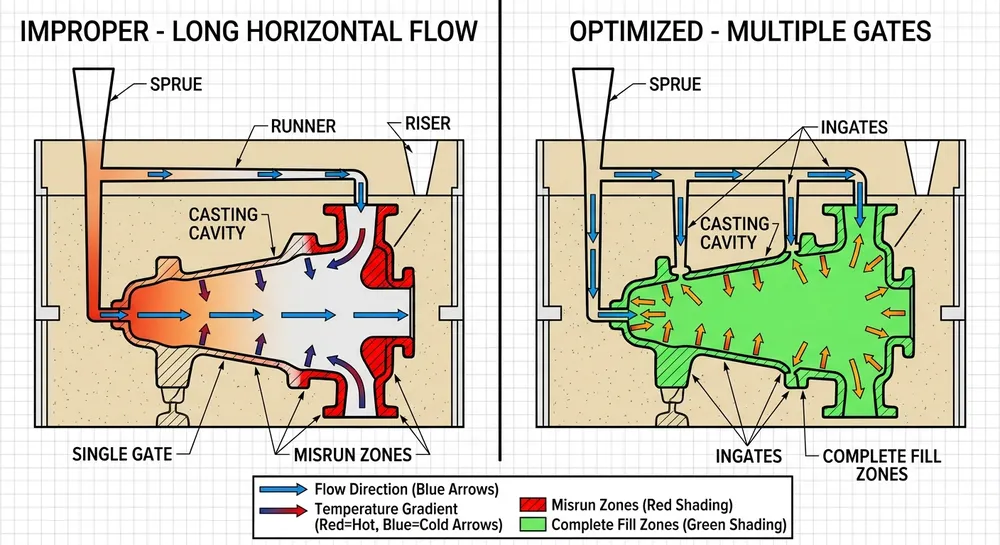
Gating design forces excessive horizontal flow. Metal loses heat faster when flowing horizontally through sand than when flowing vertically under gravity. If your gating design requires metal to travel more than 400mm horizontally to reach a thin section, you'll get misruns. We redesign gating to minimize horizontal runs and use multiple gates for large castings.
Vacuum pressure too high. This sounds counterintuitive, but excessive vacuum (above 0.07 MPa) can pull heat out of the metal too quickly through the sand. We've seen foundries crank vacuum up to 0.08-0.09 MPa trying to eliminate porosity, then start getting misruns in thin sections. The correct vacuum range is 0.04-0.06 MPa — high enough to evacuate gas, low enough to avoid excessive heat extraction.
Pattern cluster design creates flow restrictions. If you're clustering multiple patterns in one flask to improve productivity, the gating between patterns can create flow restrictions. Metal has to fill the first pattern, then flow through a narrow gate to the second pattern. By the time it reaches the third pattern, temperature has dropped 40-60°C and you get misruns.
Parameter Adjustments to Eliminate Misruns
Pouring temperature optimization by section thickness. Thin sections need hotter metal. For castings with wall thickness under 8mm, pour gray iron at 1400-1420°C. For sections above 15mm, you can pour at 1380-1400°C. If you're casting both thin and thick sections in the same mold, pour at the temperature required for the thinnest section.
Pouring speed increase for thin sections. Pour thin-wall castings faster to minimize the time metal spends losing heat in the gating system. We pour thin-wall gray iron castings at 12-15 kg/second compared to 8-10 kg/second for thick sections. Faster pouring reduces the temperature drop during fill.
Vacuum pressure calibration. Set vacuum to 0.05 MPa and verify it's stable during the pour. If you're getting both porosity and misruns, the problem isn't vacuum pressure — it's coating permeability or sand moisture. Don't try to fix coating problems by adjusting vacuum.
Gating redesign for thermal efficiency. Place gates to minimize horizontal flow distance. For castings longer than 600mm, use multiple gates instead of trying to fill from one end. We use thermal modeling software to verify that metal temperature stays above solidification temperature throughout the fill sequence.
Equipment Design Factors
Automated pouring system for temperature consistency. Manual ladle pouring introduces 30-50°C temperature variation between the first and last casting in a batch. Automated pouring systems maintain ±10°C consistency because pour rate and timing are controlled. This alone reduced our misrun rate from 8% to 2% on thin-wall castings.
Pattern cluster layout optimization. If you're running multiple patterns per flask, the production line design should include pattern layout software that calculates fill sequence and temperature drop. We position patterns so the thinnest sections fill first while metal is hottest, and thick sections fill last when temperature has dropped but there's still enough thermal mass to complete solidification.
Quick Troubleshooting: Match the Symptom to the Root Cause
When you find defects in production, use this diagnostic sequence to identify the root cause quickly:
Porosity in thick sections, top of casting, or near gates:
Check vacuum pressure — should be 0.04-0.06 MPa during pour
Test sand moisture — should be below 0.3%
Verify coating permeability — should be 120-180 units
Confirm pouring speed isn't too fast (causing turbulence)
Carbon inclusions on surface or in cross-section:
Test EPS pattern density — should be 22-24 kg/m³
Check pouring temperature — gray iron 1380-1420°C, ductile iron 1340-1380°C
Verify coating permeability — should be above 120 units
Inspect coating thickness — should be 0.8-1.2mm total
Misruns in thin sections or far from gate:
Verify pouring temperature — should be at high end of range for thin walls
Check gating design — horizontal flow should be under 400mm
Confirm vacuum pressure isn't excessive — should be 0.04-0.06 MPa, not above 0.07 MPa
Review pattern cluster layout — thin sections should fill first
Multiple defect types in the same casting:
This usually indicates coating permeability is too low
Test coating viscosity and permeability
Check for moisture contamination in coating or sand
Verify coating equipment is maintaining consistent viscosity
The pattern we see most often: a foundry gets porosity, tries to fix it by increasing coating thickness, which drops permeability and causes carbon inclusions, then they increase vacuum pressure to compensate and start getting misruns. The correct fix is to go back to baseline coating permeability and vacuum pressure, then address the original porosity cause (usually sand moisture or vacuum leaks).
How Production Line Design Prevents Defects at the System Level
Individual parameter adjustments fix immediate problems. Production line design prevents defects from recurring by building process control into the equipment itself.
Integrated coating and drying system. Our Lost Foam Casting Production Line includes automated coating application with viscosity monitoring and controlled drying chambers. Coating viscosity stays within ±2 seconds across an entire shift, and drying time is consistent regardless of ambient humidity. This eliminates the coating permeability variation that causes both porosity and carbon inclusions.
Vacuum system with leak detection. The vacuum chamber includes pressure sensors at 4 points around the flask perimeter. If pressure drops at any sensor during the pour, the system flags a leak location immediately. We've commissioned lines where operators spent weeks chasing intermittent porosity problems that turned out to be a 3mm gap in one corner of the gasket seal.
Sand moisture control and reclamation. The sand handling system includes moisture monitoring and automatic drying when moisture exceeds 0.3%. Sand recirculates through a fluidized bed dryer before returning to the flask filling station. This prevents the moisture-induced porosity that shows up on humid days or after weekend shutdowns.
Pattern density verification station. Before coating, patterns pass through a density check station that weighs each pattern and compares it to the target weight for that geometry. Patterns outside the 22-24 kg/m³ range get rejected before coating and pouring. This catches density problems from the pattern supplier before they become carbon inclusions in finished castings.
Automated pouring with temperature feedback. The pouring system monitors ladle temperature continuously and adjusts pour rate to maintain target temperature at the mold. If temperature drops below the minimum for the casting being poured, the system alerts the operator before pouring starts. This prevents the misruns that happen when operators pour from a cooling ladle without checking temperature.
These aren't optional upgrades. They're the difference between a 75% yield line that requires constant operator intervention and a 92% yield line that runs consistently across shifts.
The Real Cost of Defect Prevention vs. Defect Correction
Fixing defects after they appear costs 5-10x more than preventing them with correct equipment parameters.
A porosity defect found after machining means you've spent material cost, pattern cost, coating cost, pouring labor, cooling time, shakeout labor, and machining time on a part you can't ship. If that casting is worth $40 in material and $30 in labor, you've lost $70 plus the cost of making a replacement.
Preventing that same defect by maintaining sand moisture below 0.3% costs you a $3,000 moisture analyzer (one-time) and 3 minutes of testing per shift. At 200 castings per shift, preventing just one porosity defect per shift pays for the analyzer in 43 shifts — about 2 months of production.
The same math applies to carbon inclusions and misruns. An automated coating system that maintains consistent viscosity costs $15,000-25,000 depending on line capacity. If it prevents 5 carbon inclusion defects per shift at $70 per defect, it pays for itself in 85-140 shifts — 4-7 months.
The foundries we work with that run above 90% yield all made the same decision: invest in process control equipment that prevents defects rather than hiring more inspectors to catch them after pouring.
When you're evaluating lost foam casting equipment, the question isn't "what's the lowest equipment price?" The question is "what's the total cost per good casting including scrap, rework, and inspection labor?" A production line that costs 20% more but delivers 15% higher yield pays for itself in the first year.
If you're running a lost foam line now and fighting defect rates above 10%, the problem is almost always in one of three systems: coating permeability control, vacuum system integrity, or pattern density consistency. Fix those three and yield climbs to 90%+ without changing your pouring practice or alloy composition.
Send your current defect rate, casting type, and production volume — we'll identify which of the three systems is causing your yield loss and recommend the specific equipment upgrade that fixes it. Request a Quote with your defect photos and process parameters, and we'll provide a defect-reduction plan with ROI calculation based on your current scrap cost.
How to Scale a Metal Casting Production Line from Prototype to Full Production | Capacity Planning & Equipment Guide
Scaling a casting line from 50 molds per shift to 500 sounds straightforward until you hit the first bottleneck. The sand reclamation system that worked fine during prototype runs can't keep up. Cooling zones that gave you acceptable cycle times at low volume now create a 40-minute queue. Your defect rate, which sat at 3% during validation, climbs to 12% because the coating system wasn't designed for continuous operation.
We've commissioned lines in 14 countries, and the pattern repeats: buyers validate their process parameters on a small manual line, then try to multiply throughput by adding more molding stations without addressing the upstream and downstream constraints. The result is wasted capital, extended commissioning time, and castings that don't match the quality you achieved during prototype runs.
This guide walks through the technical and commercial decisions that determine whether your scale-up succeeds or stalls. We'll cover capacity calculation methodology, equipment upgrade paths, facility layout constraints, and the modular line architecture that lets you expand in phases without shutting down production.
Why Prototype-Validated Parameters Break Down at Higher Throughput
Your prototype line ran at 8 molds per hour with acceptable dimensional tolerance and minimal porosity. You validated foam density, coating thickness, vacuum pressure, and pouring temperature. The castings passed inspection. Then you scale to 80 molds per hour, and suddenly you're seeing carbon inclusions, misruns, and dimensional drift.
The process didn't change — the process dynamics changed. At low throughput, you have time buffers between every operation. Coating has 20 minutes to dry before the next pattern arrives. Sand temperature stays stable because you're only pouring 2 tons per hour. Operators can visually inspect every mold before it enters the pouring line.
At 10x throughput, those buffers disappear. Coating must dry in 4 minutes or the line backs up. Sand reclamation can't cool fast enough, so mold temperature creeps up and affects dimensional accuracy. Visual inspection becomes statistical sampling, and defects slip through.
The failure modes we see most often:
Coating system undersized for continuous operation — Your prototype line used a manual dip-and-drain coating station. At 80 molds/hour, you need automated spray coating with forced-air drying and real-time thickness measurement. The capital cost jumps from $15,000 to $120,000, but without it, coating inconsistency becomes your primary defect source.
Sand reclamation bottleneck — Prototype runs consume virgin sand because reclamation throughput doesn't matter. At full production, if your reclamation system can only process 3 tons/hour but your line consumes 5 tons/hour, you're buying makeup sand continuously and your per-part material cost stays high. We've seen buyers spend $200,000 on molding automation while running a $30,000 reclamation system that can't support the line.
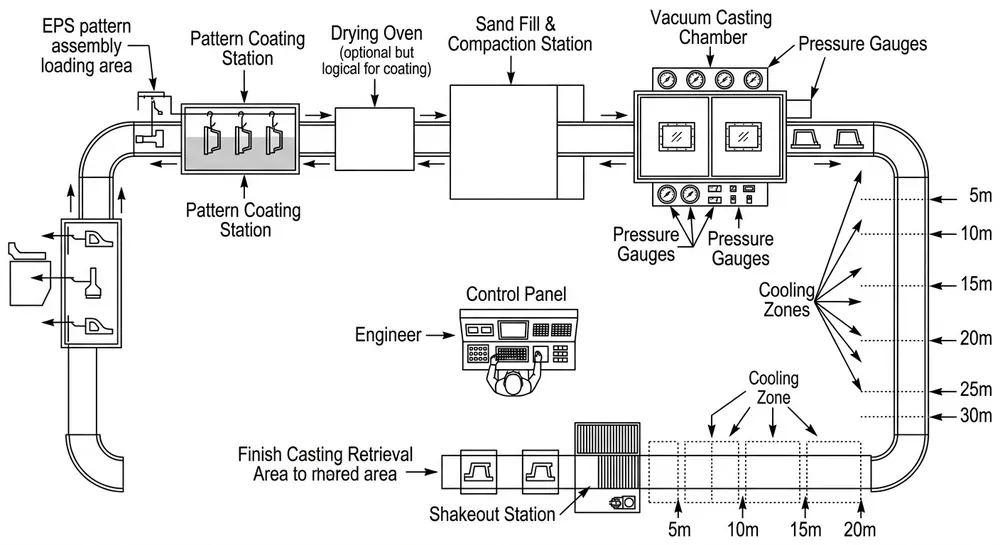
Cooling zone length insufficient — Lost foam castings need controlled cooling to prevent thermal shock cracking. At low volume, castings can sit on the shakeout conveyor for 15 minutes. At high volume, if your cooling conveyor is only 6 meters long and runs at 2 meters/minute, castings get 3 minutes of cooling time. You'll see cracks in thin-wall sections and residual stress that shows up during machining at your customer's facility.
Control system can't coordinate multi-station operation — Manual lines rely on operator judgment to sequence operations. Automated lines need PLC control with sensor feedback from every station. If molding, coating, drying, and pouring aren't synchronized, you get queue buildup at one station and idle time at another. Throughput becomes limited by the slowest uncoordinated step, not by equipment capacity.
The lesson: prototype validation proves your metallurgical parameters work. It doesn't prove your production system can sustain those parameters at volume.
Audit Your Current Line: Identify Bottlenecks Before You Buy Equipment
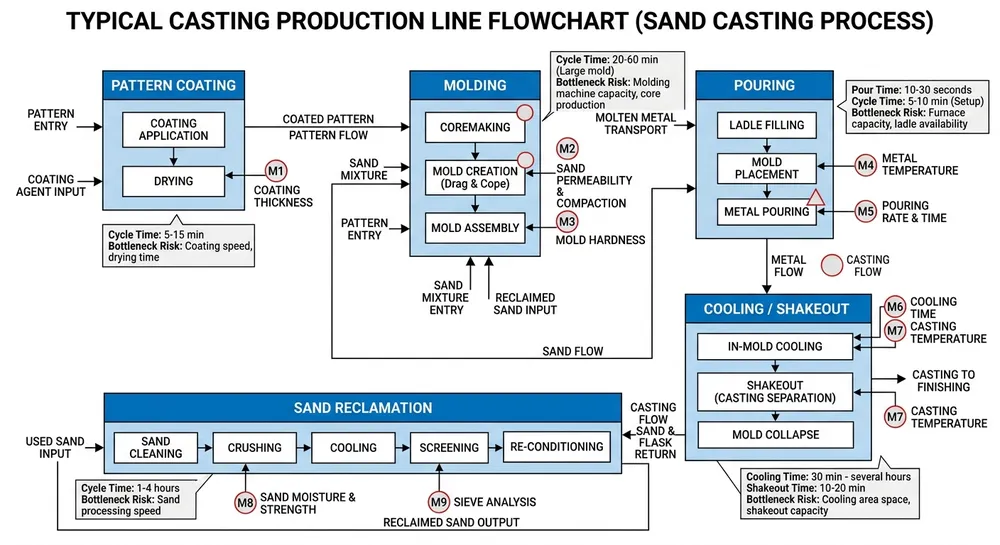
Before specifying new equipment, map your current process and measure actual cycle times at each stage. Most buyers skip this step and buy based on target output rate, then discover the bottleneck was three stations upstream from where they added capacity.
Run your existing line at the highest sustainable rate for one full shift. Record:
Molding station cycle time — Time from sand fill to mold ejection. Include setup time if you're running multiple part configurations. If you're averaging 6 minutes per mold but the equipment spec says 3 minutes, find out why. Common causes: manual sand loading, inconsistent compaction pressure, operator waiting for upstream coating to finish.
Pattern handling and coating throughput — Time from pattern arrival to coated pattern ready for molding. Include drying time. If coating is manual, measure how many patterns one operator can process per hour under sustained operation, not peak burst rate. We've seen buyers spec molding capacity for 100 molds/hour while their coating station maxes out at 40 patterns/hour.
Pouring line capacity — Molds per hour your pouring system can handle, including ladle return time and temperature management. If you're pouring ductile iron, your ladle needs reheating every 15-20 minutes depending on ambient temperature. That downtime counts against your effective throughput.
Shakeout and cooling — Time from pour to casting removal, plus cooling time before castings can be handled safely. Measure conveyor length and speed. If castings are stacking up at shakeout because cooling takes longer than your cycle time allows, you need a longer cooling zone or slower line speed.
Sand reclamation and return — Tons per hour your reclamation system can process, and the time lag between shakeout and reclaimed sand returning to the molding station. If reclamation can't keep pace with consumption, you're either buying makeup sand continuously or you're running the molding line slower than its rated capacity.
The bottleneck is whichever stage has the longest cycle time or lowest throughput capacity. Adding molding capacity when coating is your bottleneck just creates expensive idle equipment.
Step-by-Step Capacity Calculation: Match Target Output to Equipment Specs
Once you know your bottleneck, calculate the equipment capacity needed to hit your target output rate. Work backwards from your production goal.
Define your target in tons per shift, not molds per hour — Mold count is meaningless without part weight. A line running 100 molds/hour of 2 kg castings produces 200 kg/hour. The same line running 20 kg castings produces 2,000 kg/hour. Your equipment sizing, sand consumption, and pouring capacity all depend on metal tonnage, not mold count.
Start with your target: "We need 8 tons of ductile iron castings per 8-hour shift." That's 1 ton/hour average output.
Calculate required molding throughput — Divide target tonnage by average casting weight. If your typical part weighs 5 kg and you need 1 ton/hour output, you need 200 castings/hour, which means 200 molds/hour if you're running one casting per mold. Add 15-20% buffer for scrap rate and line downtime. Target becomes 230-240 molds/hour.
Size your sand system — Lost foam and sand casting lines consume 8-12 kg of sand per kg of casting, depending on mold size and sand-to-metal ratio. For 1 ton/hour of castings, you're circulating 8-12 tons/hour of sand. Your reclamation system must process that volume continuously. If reclamation throughput is lower, you'll need a larger sand inventory buffer or you'll be buying makeup sand.
Calculate pouring capacity — 1 ton/hour of castings means 1 ton/hour of molten metal. If you're using 100 kg ladles and each pour cycle (fill ladle, pour molds, return) takes 6 minutes, you can complete 10 cycles per hour, which gives you 1 ton/hour capacity. That's your theoretical max — in practice, ladle reheating and temperature management reduce effective capacity to 0.7-0.8 tons/hour. You need a second ladle or a larger furnace with faster melt rate.
Determine cooling and shakeout requirements — If castings need 10 minutes of cooling time before shakeout, and you're producing 240 molds/hour (4 molds/minute), you need a cooling conveyor that can hold 40 molds simultaneously. At 1 meter spacing, that's a 40-meter conveyor. Most facilities don't have that floor space, so you either slow the line, reduce cooling time (and accept higher defect risk), or design a multi-level cooling system.
Factor in changeover time — If you're running multiple part numbers, calculate how much production time you lose to mold changes, pattern swaps, and process parameter adjustments. A line that can theoretically run 240 molds/hour but spends 45 minutes per shift on changeovers delivers 210 molds/hour effective output.
This math tells you whether your target is achievable with one line or whether you need parallel lines running lower individual throughput. We've seen buyers try to force 500 molds/hour through a single line when two 250-mold/hour lines would have been more reliable and easier to commission.
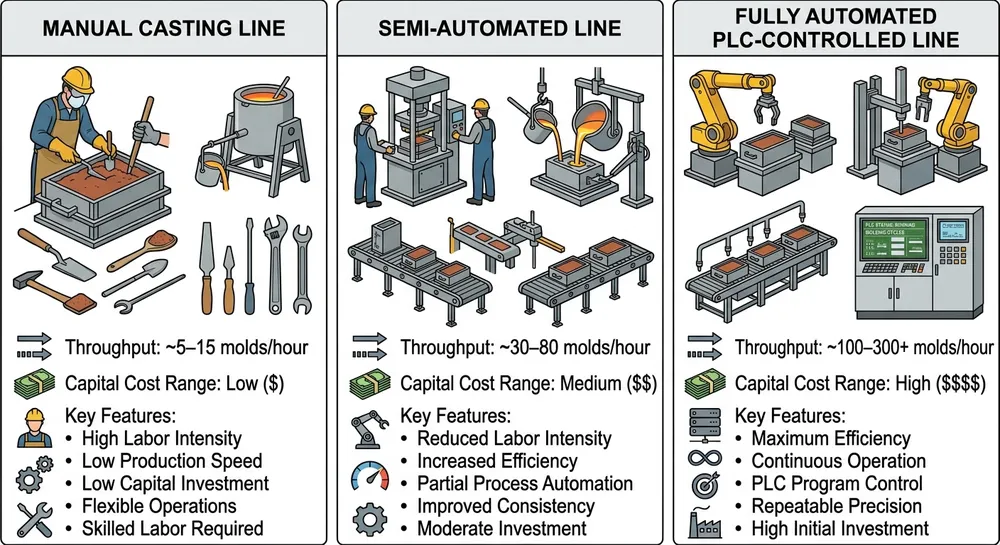
Scaling doesn't mean replacing your entire line at once. The capital-efficient path is phased automation, where you upgrade the bottleneck station first, validate the improvement, then move to the next constraint.
Stage 1: Manual line with process control upgrades — Your existing manual line can often reach 2-3x throughput just by adding process monitoring and reducing variability. Install digital coating thickness gauges so operators can see real-time measurements instead of guessing. Add temperature sensors to your sand system so you catch thermal drift before it affects mold quality. Upgrade to PLC-controlled vacuum pressure with automatic leak detection. These upgrades cost $20,000-$40,000 total and often deliver 30-50% throughput improvement because you're eliminating the variability that forced you to run slow for safety margin.
Stage 2: Automate the bottleneck station — If coating is your constraint, replace manual dip coating with an automated spray booth and forced-air drying tunnel. If molding is the bottleneck, upgrade to a hydraulic molding press with automatic sand fill and compaction control. If sand reclamation can't keep up, add a secondary crusher and screening system. This stage typically costs $80,000-$150,000 depending on which station you're upgrading. You're still running a hybrid line — some manual, some automated — but you've removed the primary capacity constraint.
Stage 3: Full line integration with PLC control — Once individual stations are automated, the next bottleneck becomes coordination between stations. You need a master PLC that sequences operations, manages material flow, and prevents queue buildup. This includes conveyor systems between stations, automatic mold transfer, and sensor feedback at every handoff point. Full integration costs $200,000-$400,000 depending on line length and complexity, but it's the step that takes you from 80 molds/hour with frequent stops to 200 molds/hour sustained operation.
The mistake we see: buyers jump straight to Stage 3 without validating their process at Stage 1 and 2. They spend $500,000 on a fully automated line, then discover their coating parameters don't scale, or their sand chemistry isn't stable enough for continuous operation. Now they're troubleshooting process problems on an expensive automated system instead of fixing them on a simpler manual line where adjustments are easier.
Our recommendation: if you're currently running a manual line below 50 molds/hour, start with Stage 1 process control upgrades. Prove you can hit 80-100 molds/hour with consistent quality. Then automate the bottleneck (Stage 2). Only move to full integration (Stage 3) once you've validated that your process parameters are stable at higher throughput.
Facility Layout Planning: Floor Space, Ceiling Height, and Utility Loads That Block Scaling
Equipment specs tell you throughput capacity. Facility constraints tell you whether you can actually install and operate that equipment. We've quoted lines that looked perfect on paper, then discovered the buyer's facility couldn't support them.
Floor loading capacity — A complete Metal Casting Production Line with sand storage, molding equipment, and pouring stations can put 800-1,200 kg/m² on your floor when fully loaded with sand inventory. Most industrial facilities are rated for 500-750 kg/m². If your floor can't handle the load, you need structural reinforcement before equipment installation, which adds 4-6 weeks and $30,000-$80,000 to your project timeline. Check your facility's structural drawings before you finalize equipment specs.
Ceiling height for overhead conveyors — Automated lines use overhead conveyors to move molds from coating to molding to pouring. Standard conveyor systems need 4.5-5 meters of clear height. If your facility has 4-meter ceilings, you're either running floor-level conveyors (which consume more floor space and create forklift traffic conflicts) or you're modifying the line design for low-clearance operation (which costs 15-20% more). We've designed vertical flaskless molding lines for 6-meter ceiling heights when the standard configuration assumes 8 meters, but it requires custom engineering.
Electrical capacity for induction furnaces and hydraulic systems — A 2-ton induction melting furnace draws 150-200 kW. Hydraulic molding presses add another 30-50 kW. Coating drying systems, conveyors, and control systems add 40-60 kW. Total electrical load for a 200-mold/hour line runs 250-350 kW. If your facility's transformer capacity is 200 kW and you're already using 150 kW for existing operations, you need a utility upgrade before commissioning. Lead time for transformer upgrades can be 8-12 weeks depending on your location.
Compressed air for pneumatic controls — PLC-controlled lines use pneumatic actuators for valves, clamps, and ejection systems. You need 6-8 bar pressure with 2-3 m³/min flow capacity for a standard automated line. If your existing compressor is sized for hand tools and spray guns, it won't support automated equipment. Budget $15,000-$25,000 for a dedicated compressor and air treatment system (dryer, filter, pressure regulation).
Material flow and forklift access — Sand delivery, pattern storage, and finished casting removal all require forklift access. If your line layout blocks the main aisle, you'll create traffic bottlenecks that slow production. We design lines with sand silos positioned near exterior walls for direct truck delivery, and finished casting staging areas adjacent to shipping docks. The goal is to minimize forklift travel distance and eliminate cross-traffic between material delivery and production flow.
Ventilation for fume extraction — Pouring operations generate fumes from molten metal and burning foam (in lost foam casting). You need local exhaust ventilation at pouring stations with 2,000-3,000 m³/hour extraction capacity per station. If your facility doesn't have adequate ventilation, you're either installing a dedicated fume extraction system ($40,000-$70,000) or you're violating occupational health regulations.
The facility audit should happen before you finalize equipment specs, not after. Send your manufacturer a facility layout drawing with floor loading ratings, ceiling heights, utility capacities, and door dimensions. We'll design the line to fit your constraints, or we'll tell you which facility upgrades are required before installation.
Modular Line Architecture: How Container-Optimized Design Supports Phased Capital Investment
The traditional approach to scaling is buying a complete production line sized for your target capacity. The problem: if your target is 500 molds/hour but you're currently selling 200 molds/hour worth of castings, you're paying for 300 molds/hour of idle capacity while you grow into the equipment.
Modular line design solves this by breaking the production system into container-sized modules that you can install in phases as demand grows. Each module is a functional production unit that integrates with your existing equipment, so you're adding capacity incrementally instead of making a single large capital commitment.
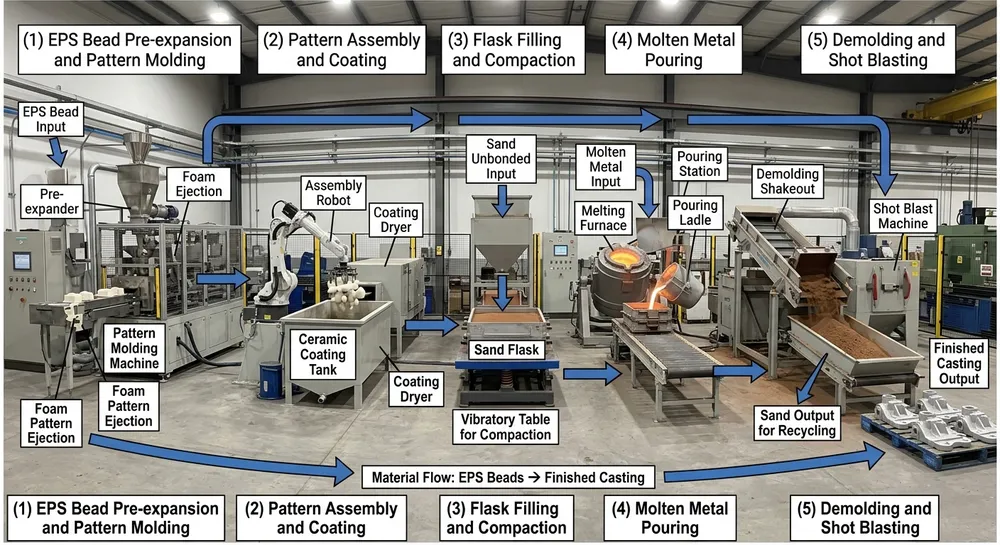
How modular architecture works — Instead of one integrated 500-mold/hour line, you install two 250-mold/hour modules, or five 100-mold/hour modules. Each module includes molding, coating, and control systems sized for its rated capacity. Modules share common infrastructure (sand reclamation, melting furnace, utilities) but operate independently for production scheduling.
We design modules to fit 40HQ container dimensions (12.03m length × 2.35m width × 2.69m height). A complete 100-mold/hour Lost Foam Casting Production Line module ships in 2-3 containers. You can install and commission one module in 3-4 weeks, validate production quality, then add the next module when order volume justifies the investment.
Capital efficiency of phased expansion — Compare two scenarios:
Scenario A: Single 500-mold/hour line — Capital cost: $800,000. Installation time: 8-10 weeks. You're paying for full capacity from day one, but you're only running at 40% utilization for the first 18 months while you ramp up sales. Your equipment ROI is delayed because most of the line sits idle.
Scenario B: Modular 5×100-mold/hour configuration — Module 1 cost: $180,000. Install and commission in 4 weeks. Run at 80-90% utilization immediately because capacity matches current demand. Add Module 2 ($180,000) six months later when orders increase. Add Modules 3-5 over the next 18 months as you grow. Total capital cost is similar ($900,000 vs $800,000 due to modular premium), but you're spreading the investment over 24 months and each module generates ROI before you buy the next one.
Operational advantages — Modular lines give you production flexibility that integrated lines don't. If one module goes down for maintenance, you're still running at 80% capacity. If you're producing multiple part families with different cycle times, you can dedicate modules to specific products instead of running changeovers on a shared line. If you're serving customers in different regions with different quality standards, you can run export-grade production on one module and domestic-grade on another without cross-contamination risk.
Integration with existing equipment — Most buyers aren't starting from zero — you have existing molding equipment, a melting furnace, maybe a manual coating station. Modular design lets you integrate new automated capacity with your current setup. We'll design the new module to pull from your existing sand reclamation system and feed into your existing pouring line, so you're only replacing the bottleneck station instead of scrapping functional equipment.
The modular approach works best when you're scaling from 100-200 molds/hour to 400-600 molds/hour over 18-36 months. If you need to go from 50 to 500 molds/hour in 3 months, a single integrated line is faster to commission. But if you're growing incrementally and want to minimize capital risk, modular architecture matches your investment pace to your revenue growth.
Quality Control at Scale: Maintaining Dimensional Tolerance and Defect Rates as Volume Increases
The quality standard you achieved during prototype runs becomes harder to maintain at 5x or 10x throughput. Not because the process changes, but because the statistical probability of variation increases with volume, and the time available for inspection decreases.
Dimensional tolerance control — Your prototype castings held ±0.5mm on critical dimensions. At low volume, you could measure every part. At 200 castings/hour, you're measuring 1,600 parts per shift. Full inspection isn't practical, so you move to statistical sampling — measure 1 in 20 parts, or 1 in 50, depending on your quality requirements.
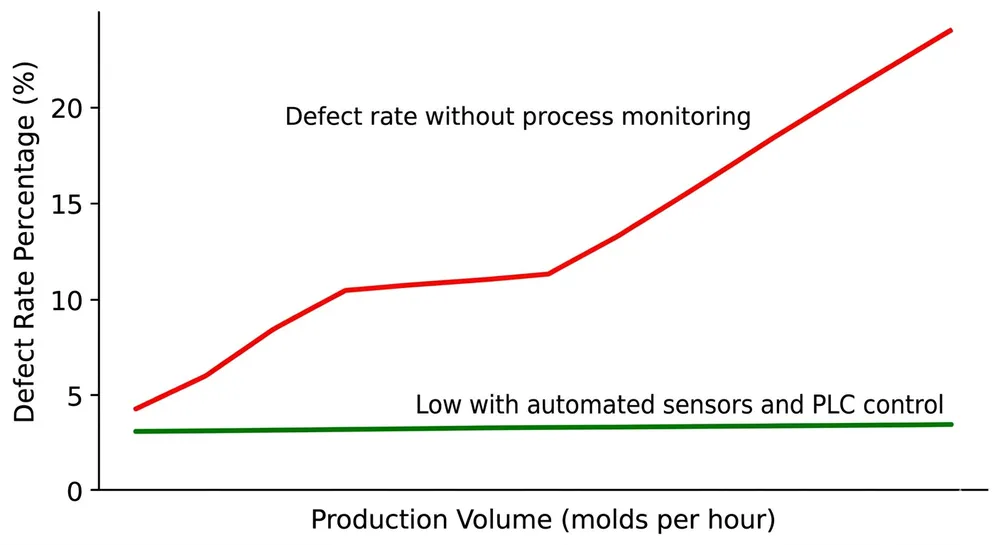
The risk: if your process drifts out of tolerance, you might produce 100-200 defective castings before the next sample catches the problem. The solution is real-time process monitoring instead of post-production inspection. Install position sensors on molding presses to verify compaction depth. Use laser measurement on mold dimensions before pouring. Monitor sand temperature and moisture content continuously. These sensors cost $15,000-$30,000 to add to an automated line, but they catch process drift before it produces scrap.
Defect rate management — Prototype runs often show 2-3% defect rates (porosity, inclusions, misruns). At full production, if you're running 2,000 castings per shift, a 3% defect rate means 60 scrap castings per shift. At $8-$15 per casting in material and labor cost, that's $480-$900 per shift in scrap cost, or $125,000-$235,000 annually.
The defects you see at high volume often weren't visible during prototype runs because they're caused by process instability that only appears under sustained operation. Common examples:
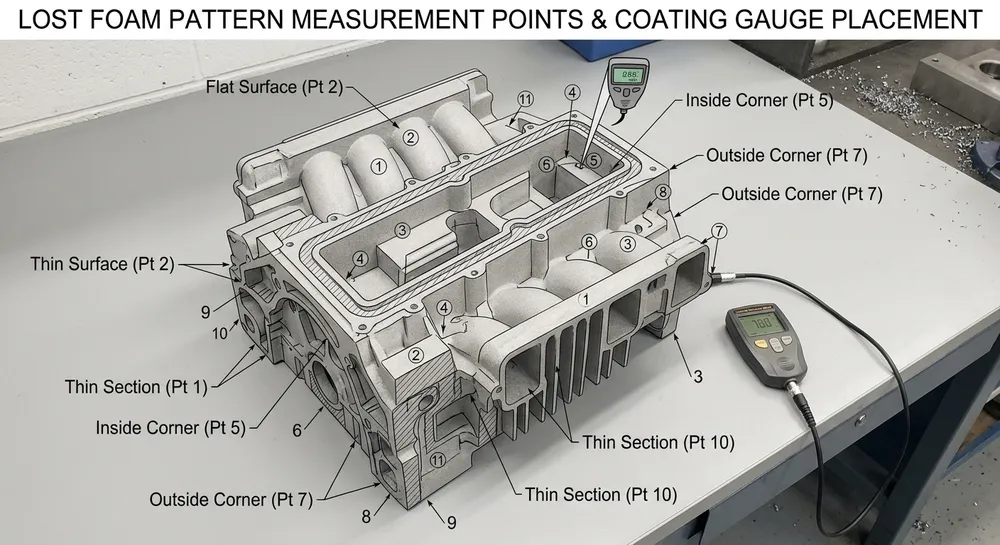
Coating thickness variation — Manual coating during prototypes gave you 1.5-2.0mm thickness with ±0.3mm variation. Automated spray coating at high speed can drift to 1.2-2.5mm range if nozzle pressure isn't controlled. Thin spots cause metal penetration into the foam, thick spots cause gas entrapment. Install inline coating thickness measurement (ultrasonic or eddy current sensors) and link it to your PLC so the system auto-adjusts spray parameters.
Sand temperature creep — At low volume, sand cools between cycles. At high volume, continuous recirculation heats the sand from 25°C to 45-50°C over a 4-hour run. Hot sand reduces mold strength and increases gas generation during pouring. Add a sand cooler to your reclamation loop (fluidized bed or water-jacketed screw conveyor) to maintain 25-30°C sand temperature.
Vacuum pressure inconsistency — Lost foam casting relies on 0.04-0.06 MPa vacuum pressure during pouring. If your vacuum pump can't maintain pressure under continuous duty, you'll see pressure drop to 0.03 MPa after 2-3 hours of operation, which causes incomplete foam evacuation and carbon defects. Size your vacuum system for continuous operation at peak demand, not intermittent prototype use. That usually means 50-80% larger pump capacity than your initial calculation suggests.
Process documentation and operator training — At prototype scale, one experienced operator can manage the entire line and make real-time adjustments based on visual inspection. At production scale, you need 3-4 operators per shift, and they can't all have the same experience level. Document your validated process parameters (coating thickness, vacuum pressure, pouring temperature, cooling time) and program them into the PLC as setpoints with alarm limits. Train operators to respond to alarms, not to make independent process adjustments. Variability comes from operators "improving" the process based on intuition instead of following the validated parameters.
Quality at scale requires shifting from inspection-based quality control (measure the output, scrap the defects) to process-based quality control (monitor the inputs, prevent the defects). The equipment cost is higher, but the scrap cost is lower.
Common Scaling Mistakes: Undersized Sand Systems, Insufficient Cooling Zones, and Control System Bottlenecks
Most scaling failures follow predictable patterns. We've commissioned enough lines to recognize the mistakes before they happen.
Mistake 1: Sizing equipment for peak capacity instead of sustained operation — A molding press rated for 120 molds/hour sounds like it can support your 100-mold/hour target with 20% safety margin. But that 120-mold/hour rating assumes perfect conditions: no mold changes, no parameter adjustments, no material delays. In actual production, you'll average 80-90 molds/hour on that same press due to normal operational interruptions. If you need sustained 100-mold/hour output, spec equipment rated for 130-140 molds/hour.
Mistake 2: Undersizing sand reclamation relative to molding capacity — Buyers focus capital on molding and coating equipment because that's where throughput is measured. Sand reclamation gets treated as a support system and sized for "adequate" capacity. Then production starts, and reclamation can't keep up with sand consumption. You're either buying makeup sand continuously (which kills your per-part cost) or you're running the molding line slower than its rated capacity because you're waiting for reclaimed sand.
The rule: sand reclamation capacity should be 120-150% of your peak sand consumption rate. If your line consumes 10 tons/hour of sand at full throughput, your reclamation system should process 12-15 tons/hour. The extra capacity gives you buffer for maintenance downtime and lets you build up reclaimed sand inventory during shift changes.
Mistake 3: Insufficient cooling conveyor length — Cooling time is determined by casting section thickness and alloy type. A 10mm wall ductile iron casting needs 8-10 minutes of cooling before shakeout to prevent thermal shock cracking. If you're producing 200 molds/hour (3.3 molds/minute) and each mold needs 10 minutes of cooling, you need a conveyor that holds 33 molds simultaneously. At 1.2-meter spacing, that's a 40-meter conveyor.
Most buyers underestimate this and install a 15-20 meter conveyor, then discover they're either running the line slower than planned or they're pulling castings early and seeing crack defects. Extending a conveyor after installation costs 2-3x more than sizing it correctly during initial design because you're modifying structural supports and rerouting utilities.
Mistake 4: Single-point-of-failure control architecture — Automated lines rely on PLC control for sequencing and coordination. If you're running one master PLC that controls molding, coating, pouring, and material handling, a single PLC failure shuts down the entire line. We design systems with distributed control — each major station has its own PLC, and they communicate through a supervisory controller. If the coating PLC fails, molding and pouring can continue running on buffered inventory while you swap the failed module.
Mistake 5: Ignoring spare parts inventory and local service availability — You're buying equipment from an overseas manufacturer. When a hydraulic seal fails or a proximity sensor burns out, can you get a replacement part in 24-48 hours, or are you waiting 2-3 weeks for international shipping? We ship a first-year spare parts kit with every line (hydraulic seals, sensors, solenoid valves, PLC I/O modules) specifically because local availability of specialized casting equipment parts is poor in most markets. Budget $8,000-$15,000 for spare parts inventory as part of your initial capital investment.
Mistake 6: Commissioning without process validation — Buyers want to start production immediately after equipment installation. We recommend a 1-2 week commissioning period where you run the line at 50-70% capacity, measure process parameters at every station, and validate that quality matches your prototype results before ramping to full throughput. Skipping this step means you're troubleshooting process problems while trying to meet customer delivery deadlines, which creates pressure to ship marginal-quality castings instead of fixing the root cause.
These mistakes are avoidable if you involve your equipment manufacturer in capacity planning before you finalize the purchase order. Send us your target output rate, current facility constraints, and quality requirements. We'll design the line to avoid these failure modes, or we'll tell you which constraints need to be addressed before installation.
ROI Framework: Comparing Capital Cost of New Capacity Against Per-Unit Production Cost Reduction
Scaling decisions are ultimately financial decisions. The question isn't "can we produce more castings?" — it's "does higher throughput improve our unit economics enough to justify the capital investment?"
Calculate your current per-unit production cost — Start with your actual cost per casting at current production volume. Include:
Material cost (metal, sand, coatings, consumables)
Example: You're producing 50,000 castings per year on a manual line. Material cost is $4.50 per casting. Labor is $2.80 per casting (3 operators at $25/hour producing 27 castings/hour). Utilities are $0.60 per casting. Maintenance is $0.40 per casting. Allocated overhead is $1.70 per casting. Total cost: $10.00 per casting.
Project your per-unit cost at higher volume with automated equipment — Automation reduces labor cost per unit and often reduces material cost through better process control (lower scrap rate, more efficient sand reclamation). But it increases capital depreciation and maintenance cost.
Same example: You're scaling to 200,000 castings per year with a semi-automated line. Material cost drops to $4.20 per casting (better sand reclamation reduces makeup sand purchases). Labor drops to $1.20 per casting (2 operators producing 100 castings/hour). Utilities increase to $0.75 per casting (higher electrical load for automated equipment). Maintenance increases to $0.70 per casting (more complex equipment). Allocated overhead drops to $0.90 per casting (fixed costs spread over 4x volume). Capital depreciation adds $1.25 per casting ($250,000 equipment cost depreciated over 7 years, 200,000 units/year). Total cost: $9.00 per casting.
You're saving $1.00 per casting at 200,000 units/year = $200,000 annual cost reduction. Capital investment is $250,000. Simple payback period is 15 months.
Factor in revenue impact of higher capacity — Cost reduction is only part of the ROI calculation. If you're currently turning down orders because you can't meet delivery schedules, higher capacity means revenue growth, not just cost reduction.
Example: You're currently producing 50,000 castings/year at $18 selling price = $900,000 revenue. You have inquiries for another 80,000 units/year that you can't fulfill. Scaling to 200,000 units/year capacity lets you capture that demand = $1,440,000 additional revenue. At $9.00 production cost and $18.00 selling price, your gross margin is $9.00 per casting × 130,000 additional units = $1,170,000 additional gross profit annually. Capital investment of $250,000 pays back in 2.6 months from revenue growth alone.
Account for working capital requirements — Higher production volume means higher inventory (raw materials, work-in-process, finished goods) and higher accounts receivable if you're extending payment terms to customers. If you're scaling from 50,000 to 200,000 castings/year, your sand inventory might increase from 20 tons to 60 tons ($15,000 additional working capital). Your finished goods inventory might increase from 2,000 units to 6,000 units ($36,000 additional working capital at $9.00 cost per unit). Total working capital increase: $51,000. This is a one-time cash requirement that should be included in your total project cost.
Compare automation investment against labor cost over equipment lifetime — A semi-automated line costs $250,000 but reduces labor from 3 operators to 2 operators. Labor savings: 1 operator × $25/hour × 2,000 hours/year = $50,000/year. Over a 7-year equipment life, that's $350,000 in labor cost avoided, which exceeds the $250,000 capital cost by $100,000. Even without considering the throughput increase or material cost savings, automation pays for itself through labor reduction alone.
Risk-adjusted ROI for modular vs. integrated lines — Modular lines have 10-15% higher capital cost per unit of capacity compared to integrated lines, but they reduce financial risk by letting you scale incrementally. If demand doesn't materialize as projected, you've only invested in the capacity you're actually using. If you're uncertain about demand growth, the modular premium is worth paying for the flexibility.
The ROI calculation should drive your equipment specification, not the other way around. If the numbers don't support full automation, start with semi-automated hybrid lines and upgrade later when volume justifies it.
Real Project Example: 100 to 400 Molds/Hour Scale-Up for Automotive Component Foundry
A European buyer came to us in 2019 producing aluminum automotive suspension components on a manual lost foam line. They were running 100 molds/hour across two shifts (1,600 molds/day) with 4 operators per shift. Their customer (Tier 1 automotive supplier) wanted to double order volume over 18 months, with potential for another 2x increase if the component was selected for a new vehicle platform.
Initial capacity audit — We measured their existing line and found three bottlenecks:
Pattern coating was manual dip-and-drain, maxing out at 90 patterns/hour with 2 operators
Sand reclamation could only process 4 tons/hour, but 100 molds/hour consumed 5.5 tons/hour, so they were buying 1.5 tons/hour of makeup sand
Cooling conveyor was 12 meters long, giving only 4 minutes of cooling time, which caused occasional thermal cracking in thin-wall sections
Their molding equipment (hydraulic press, vacuum system, pouring line) could handle 150 molds/hour, so molding wasn't the constraint.
Phase 1 upgrade: Automate coating and expand sand reclamation — We installed an automated spray coating booth with forced-air drying (capacity: 180 patterns/hour) and upgraded their sand reclamation system from 4 tons/hour to 8 tons/hour. Capital cost: $145,000. Installation time: 3 weeks. Result: Line throughput increased to 140 molds/hour sustained operation. Labor reduced from 4 operators to 3 operators per shift. Makeup sand consumption dropped from 1.5 tons/hour to 0.2 tons/hour, saving $180/day in material cost.
Phase 2 upgrade: Extend cooling zone and add PLC coordination — Six months later, after validating quality at 140 molds/hour, we extended the cooling conveyor from 12 meters to 28 meters and installed a master PLC to coordinate coating, molding, and pouring sequences. Capital cost: $95,000. Installation time: 2 weeks (installed during annual shutdown). Result: Line throughput increased to 200 molds/hour with thermal cracking defects eliminated. Defect rate dropped from 4.2% to 1.8% because PLC coordination eliminated the queue backups that were causing operators to rush molds through coating.
Phase 3 upgrade: Add parallel molding module — Twelve months after Phase 2, their customer confirmed the new vehicle platform order. They needed 400 molds/hour capacity. Instead of replacing the existing line, we installed a second 200-mold/hour molding module that shared the same sand reclamation system and melting furnace. Capital cost: $220,000. Installation time: 4 weeks. Result: Total facility capacity reached 400 molds/hour across two independent production modules. If one module goes down for maintenance, they still have 200 molds/hour capacity to meet minimum delivery commitments.
Total project cost and ROI — Combined capital investment over 18 months: $460,000. Production capacity increased from 100 to 400 molds/hour (4x). Labor per unit decreased by 55% (from 4 operators producing 100 molds/hour to 5 operators producing 400 molds/hour). Material cost per casting decreased by $0.85 due to better sand reclamation. Annual cost savings: $340,000. Additional revenue from new orders: $2.1 million/year. Payback period: 2.8 months.
The phased approach let them validate each upgrade before committing to the next investment, and it kept the line running during most of the installation work. Total downtime over 18 months: 6 weeks. If they'd tried to install a complete 400-mold/hour line in one project, downtime would have been 10-12 weeks and they would have lost production revenue during that period.
When to Scale Vertically (Higher Throughput per Line) vs. Horizontally (Multiple Parallel Lines)
The decision between one high-capacity line and multiple lower-capacity lines depends on your product mix, facility constraints, and risk tolerance.
Vertical scaling (single high-throughput line) works best when:
You're producing high-volume, low-mix products (1-3 part numbers representing 80%+ of volume)
Your facility has the floor space and ceiling height for a large integrated line
You have experienced maintenance staff who can troubleshoot complex automated systems
Downtime risk is acceptable because you have inventory buffers or flexible delivery schedules
Capital efficiency is the priority (cost per unit of capacity is 15-20% lower for large integrated lines)
Example: You're producing 500,000 units/year of a single automotive casting. A 250-mold/hour integrated line costs $650,000 and requires 180 square meters of floor space. It runs two shifts and produces your annual volume with 20% capacity buffer. This is the most capital-efficient solution.
Horizontal scaling (multiple parallel lines) works best when:
You're producing medium-volume, high-mix products (10+ part numbers with frequent changeovers)
Your facility has space constraints that make one large line impractical
You need production redundancy (if one line goes down, others continue operating)
You're scaling incrementally and want to match capital investment to demand growth
You serve multiple customer segments with different quality requirements or delivery schedules
Example: You're producing 300,000 units/year across 15 different part numbers for 8 customers. Three 100-mold/hour modular lines cost $540,000 total (vs. $500,000 for one 300-mold/hour integrated line). The modular approach costs 8% more, but you can dedicate one line to high-precision export orders, one line to domestic standard-grade orders, and one line to prototype and low-volume specialty parts. Changeover time decreases because each line runs fewer part numbers. If one line goes down, you're still operating at 67% capacity instead of zero.
Hybrid approach: Modular lines with shared infrastructure — The most flexible configuration is multiple modular production lines (molding, coating, pattern handling) sharing common infrastructure (sand reclamation, melting furnace, utilities, control room). Each module operates independently for production scheduling, but you're not duplicating expensive support systems.
We've installed 2×200-mold/hour modular lines sharing one 12-ton/hour sand reclamation system and one 4-ton melting furnace. Total cost: $720,000. If they'd bought two completely independent 200-mold/hour lines, cost would have been $920,000. The shared infrastructure saves $200,000 while preserving the operational flexibility of parallel production.
The decision framework: if your product mix is stable and volume is predictable, vertical scaling is more capital-efficient. If your product mix is changing or you're uncertain about demand growth, horizontal scaling reduces risk.
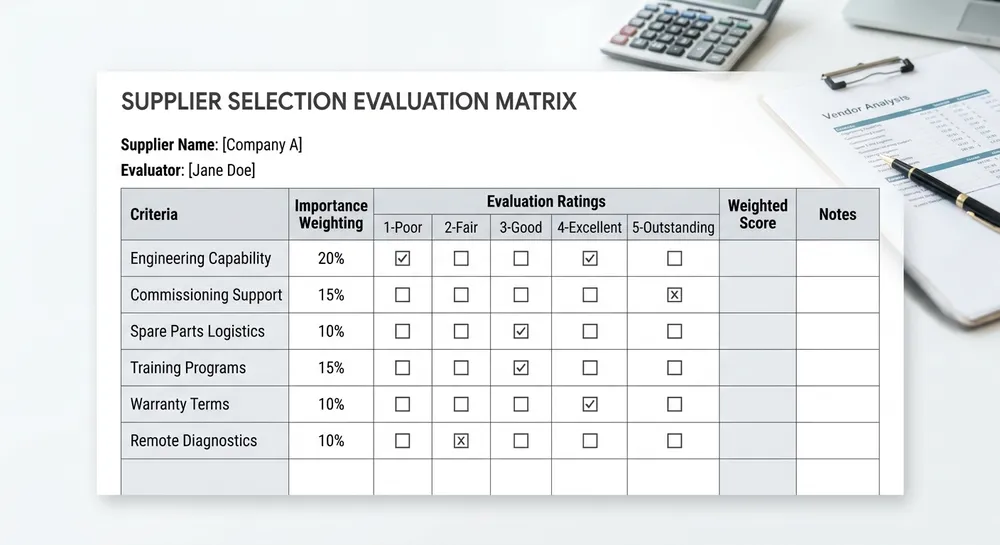
Supplier Selection Criteria: Engineering Support, Commissioning Capability, and Spare Parts Logistics
Scaling a production line isn't just buying equipment — it's a 12-18 month relationship with your supplier that includes design, installation, commissioning, training, and ongoing technical support. The supplier selection criteria that matter most:
In-house engineering capability for custom capacity configuration — Standard catalog equipment rarely matches your exact throughput requirements, facility constraints, or process parameters. You need a supplier with engineering staff who can modify line design for your specific application. We maintain an 18-person engineering team (mechanical, electrical, process engineers) who customize every line we build. If a supplier can only offer fixed configurations, you'll be forced to compromise on capacity, footprint, or functionality.
Track record with similar scale-up projects — Ask for reference projects where the supplier helped a customer scale from prototype to production. Get contact information for those customers and ask about commissioning time, whether the line met throughput targets, and how responsive the supplier was during troubleshooting. A supplier who's only built prototype lines won't understand the process stability requirements for sustained high-volume operation.
Remote commissioning and diagnostic capability — If you're buying from an overseas supplier, can they commission the line remotely using video calls and PLC remote access, or do they require on-site presence for every adjustment? We've commissioned lines in 14 countries using remote support for 70-80% of the process, with on-site visits only for mechanical installation verification and final validation. This reduces commissioning time from 8-10 weeks to 4-5 weeks and cuts your commissioning cost by 40-50%.
Spare parts inventory and logistics — When a critical component fails, can you get a replacement in 48 hours or are you waiting 3-4 weeks for international shipping? We stock common wear parts (hydraulic seals, sensors, solenoid valves, PLC modules) at regional distribution points and ship via express courier. We also provide detailed spare parts documentation with manufacturer part numbers so you can source commodity components locally instead of waiting for factory shipment.
Training program for operators and maintenance staff — Automated lines require different skills than manual lines. Your supplier should provide structured training that covers normal operation, parameter adjustment, routine maintenance, and basic troubleshooting. We deliver 3-day on-site training during commissioning, plus video training modules and technical manuals in English. If your operators can't troubleshoot common issues independently, you'll be calling for support constantly and your effective uptime will be poor.
PLC programming and HMI customization — Standard PLC programs work for standard applications. If you need custom process sequences, alarm logic, or data logging, can your supplier modify the control system? We provide PLC source code and HMI project files so your in-house controls engineers can make adjustments without waiting for factory support. Some suppliers lock the PLC program and charge for every modification, which creates dependency and delays.
Warranty terms and response time commitments — Standard equipment warranties cover defects in materials and workmanship, but they don't cover process performance or throughput guarantees. Get written commitments on line capacity (molds/hour at specified cycle time), defect rates, and uptime targets. Our warranties include performance guarantees: if the line doesn't meet the contracted throughput within 30 days of commissioning, we'll modify equipment at our cost until it does.
The lowest equipment price rarely delivers the lowest total cost of ownership. A supplier who charges 15% more but provides better engineering support, faster commissioning, and reliable spare parts logistics will save you money over the equipment lifetime.
Next Steps: Capacity Audit, Equipment Specification, and Installation Timeline
If you're planning to scale your casting line, start with a systematic capacity audit before you contact equipment suppliers. Document your current throughput at each production stage, identify bottlenecks, and calculate the equipment capacity needed to hit your target output rate.
Send your equipment manufacturer:
Current production volume (molds/hour, tons/shift) and target volume
Facility layout drawing with floor loading ratings, ceiling heights, and utility capacities
Process parameters you've validated during prototype runs (coating thickness, vacuum pressure, pouring temperature, cooling time)
We'll design a line configuration that matches your capacity requirements and facility constraints, provide capital cost estimates for phased vs. integrated installation, and project your per-unit production cost at higher volume.
Typical project timeline from initial inquiry to production start:
Weeks 1-2: Capacity audit and equipment specification
Weeks 3-4: Detailed engineering and quotation
Weeks 5-8: Contract negotiation and deposit payment
Weeks 9-20: Equipment manufacturing (12 weeks for modular lines, 16-18 weeks for large integrated lines)
Weeks 21-24: Shipping and customs clearance
Weeks 25-28: Installation and mechanical commissioning
Weeks 29-32: Process validation and operator training
Week 33+: Production ramp-up to target capacity
Total timeline: 7-9 months from initial contact to sustained production at target throughput. Modular lines can be installed in phases, which extends the total timeline but reduces production downtime during installation.
We've commissioned casting lines in 14 countries and scaled production from prototype runs to sustained high-volume operation. The technical challenges are predictable, and the solutions are proven. The difference between successful scale-up and expensive failure is systematic planning, phased validation, and choosing a supplier who understands production system integration, not just equipment sales.
Polystyrene Foam Casting Production Line Setup – EPS Bead Selection, Pre-Expansion Parameters & Density Control
Most lost foam casting defects trace back to the pattern, not the pour. Carbon inclusions, misruns, and porosity often start with wrong EPS bead selection or poorly tuned pre-expansion parameters. Your polystyrene foam casting production line setup determines whether your patterns burn clean or leave residue that ruins the casting.
A polystyrene foam casting production line produces the EPS foam patterns that get coated, assembled into clusters, and buried in sand for lost foam casting. The line handles raw EPS beads through pre-expansion, aging, molding, and pattern finishing. The critical control point is pre-expansion — this is where you set the foam density that determines pattern rigidity, coating adhesion, and burn-out behavior during metal pouring.
EPS Bead Grade Selection — Match the Alloy and Wall Thickness
Raw EPS beads come in three main grades, and your choice affects everything downstream. We've commissioned lines for cast iron, ductile iron, and aluminum foundries across 14 countries — the bead grade decision is the first place buyers get it wrong.
Type F (Fast-expansion) — Standard pentane-blown beads with 40-50x expansion ratio. Use this for cast iron and ductile iron patterns where you need 20-24 kg/m³ density. Fast expansion gives you consistent cell structure and clean burn-out at iron pouring temperatures (1350-1450°C). Most of our Middle East and Southeast Asian buyers run Type F because their foundries cast valve bodies, pump housings, and engine blocks in gray iron.
Type T (Thermal-stable) — Modified beads with higher softening point, designed for aluminum casting where pouring temperatures are lower (700-750°C) but pattern handling is rougher. Type T holds shape better during coating application and cluster assembly. If your buyers cast aluminum automotive parts or aerospace components, specify Type T — the extra cost (about 8% over Type F) pays back in reduced pattern breakage during handling.
Copolymer beads — Styrene-butadiene or styrene-acrylonitrile blends for thin-wall patterns (under 3mm section thickness) where standard EPS collapses during coating. We see copolymer specs from buyers casting aluminum heat exchangers, thin-wall housings, and intricate art castings. The trade-off: copolymer costs 25-30% more than Type F and requires tighter pre-expansion control because the expansion window is narrower.
Your bead supplier will ask for target pattern density and casting alloy. Give them both — the expansion ratio calculation depends on knowing where you're landing. For a Lost Foam Casting Production Line running mixed alloys, stock two bead grades and switch based on the job.
Pre-Expansion Machine Setup — Steam Pressure, Expansion Ratio, and Aging Time
Pre-expansion is where raw beads expand from 1-2mm diameter to 4-8mm foam pellets. You're injecting steam to soften the bead shell, letting the pentane blowing agent expand the cell structure, then cooling and stabilizing. Get the parameters wrong and you'll see collapsed cells (pattern too soft), incomplete expansion (pattern too dense and brittle), or moisture retention (coating adhesion failure).
Steam pressure — We set pre-expanders at 0.15-0.25 MPa steam pressure for Type F beads targeting 20-24 kg/m³ final density. Higher pressure (0.25-0.30 MPa) for Type T beads because the higher softening point needs more thermal energy to trigger expansion. Lower pressure (0.12-0.18 MPa) for copolymer beads to avoid over-expansion and cell rupture.
The steam pressure gauge on your pre-expander is the most important instrument on the line. We've seen buyers run for months with a faulty gauge, wondering why their pattern density drifts. Calibrate it every 3 months or whenever you switch bead grades.
Expansion ratio — This is the volume increase from raw bead to expanded pellet, typically 40-50x for Type F. You control expansion ratio by adjusting steam injection time (residence time in the pre-expander chamber). Longer residence = more expansion = lower final density. We tune this during commissioning by running test batches and measuring bulk density of the expanded beads.
Target bulk density after pre-expansion should be 15-20% lower than your final pattern density because the beads will compress slightly during molding. If you want 22 kg/m³ patterns, pre-expand to 18-19 kg/m³ bulk density. (Note: this compression factor varies with mold cavity geometry — deep narrow cavities compress more than shallow wide ones.)
Aging time — Expanded beads must age in a ventilated silo for 12-24 hours before molding. During aging, residual pentane off-gases and moisture content stabilizes. Skip this step and your patterns will shrink 2-3% over the next 48 hours, throwing off dimensional accuracy. We've commissioned lines where buyers tried to mold fresh beads straight from the pre-expander to save time — every pattern failed coating adhesion tests because trapped moisture prevented the refractory slurry from wetting the surface.
Aging silos should have perforated floors and gentle air circulation (not forced ventilation, which dries the beads too fast and causes surface cracking). Most of our export lines include a 3-stage silo system so you can run continuous production: one silo filling, one aging, one feeding the molding machine.
Density Control — The 18-28 kg/m³ Range and What It Means for Casting Quality
Pattern density is the single variable that affects the most downstream outcomes: pattern rigidity during handling, coating adhesion, vacuum hold during pouring, and burn-out residue in the casting. Standard lost foam lines target 20-24 kg/m³ because this range works for most cast iron applications. We engineer our Polystyrene Foam Casting Production Line to handle 18-28 kg/m³ because buyers cast everything from thin-wall aluminum (needs 18-20 kg/m³ for clean burn-out) to heavy-section ductile iron (needs 24-28 kg/m³ for pattern rigidity).
18-20 kg/m³ (low density) — Use this for aluminum casting and thin-wall patterns (under 5mm section). Lower density means less polymer mass to burn off, so you get cleaner metal with fewer carbon inclusions. The trade-off: patterns are fragile. You'll need gentler handling during coating and cluster assembly, and your coating must be thinner (0.5-0.8mm) to avoid crushing the pattern under slurry weight.
We shipped a line to a Turkish buyer casting aluminum automotive parts at 19 kg/m³ pattern density. Their defect rate dropped from 12% to 3% after switching from 22 kg/m³ patterns — the lower density eliminated the carbon film that was causing porosity in thin sections. But they had to add foam padding to their pattern transport racks because breakage during handling went up.
20-24 kg/m³ (standard density) — This is the sweet spot for cast iron and ductile iron. Patterns are rigid enough to survive coating (1.0-1.5mm refractory slurry), cluster assembly, and sand compaction. Burn-out is clean at iron pouring temperatures. Most of our buyers land here because it balances pattern durability with casting quality.
24-28 kg/m³ (high density) — Use this for heavy-section castings (over 50mm wall thickness) or when pattern geometry is complex with thin ribs and deep pockets that need structural support. Higher density means more polymer to burn off, so you'll see longer burn-out times and slightly higher risk of carbon residue if your vacuum system isn't pulling hard enough during the pour.
A buyer in Egypt runs 26 kg/m³ patterns for large pump housings (80-120mm wall sections) because the patterns must survive a 2.5mm coating layer and rough handling by the molding crew. Their vacuum system pulls 0.04 MPa during pouring to evacuate the burn-out gases — at that vacuum level, the higher density doesn't cause defects.
The density you choose sets the requirements for every other piece of equipment on your line. Low-density patterns need lighter coating formulations and gentler handling systems. High-density patterns need stronger vacuum pumps and longer burn-out cycles. Tell your equipment supplier the density range you plan to run — it affects molding machine steam pressure, coating mixer specifications, and vacuum chamber sizing.
Complete Process Flow — From Raw Bead to Finished Pattern
Here's how material moves through a complete polystyrene foam casting production line. We've built this sequence into modular systems that ship in 40HQ containers and commission in 7-10 days on-site.
Stage 1: Raw bead storage and feeding — Bulk EPS beads arrive in 25kg bags or bulk sacks. You need climate-controlled storage (under 25°C) because beads exposed to heat will pre-expand in the bag. Pneumatic conveying feeds beads to the pre-expander hopper. We use low-velocity air transport (under 15 m/s) to avoid generating static that causes beads to clump.
Stage 2: Pre-expansion — Beads enter a jacketed chamber where steam injection heats them to 90-100°C (for Type F) or 100-110°C (for Type T). Residence time is 3-8 minutes depending on target density. Expanded beads discharge into a cooling conveyor where ambient air drops the temperature to 30-40°C before silo storage.
Stage 3: Aging and stabilization — Expanded beads rest in ventilated silos for 12-24 hours. Pentane off-gassing happens here — your facility needs ventilation to exhaust the hydrocarbon vapor (pentane is flammable). Moisture content stabilizes at 8-12% by weight, which is ideal for molding and coating adhesion.
Stage 4: Pattern molding — Aged beads feed into aluminum molds (CNC-machined to pattern geometry). Steam injection at 0.3-0.5 MPa fuses the beads into a solid pattern. Cooling water circulates through the mold jacket to set the foam structure. Cycle time is 30-90 seconds depending on pattern size and complexity.
Stage 5: Pattern finishing — Demolded patterns go through dimensional inspection, surface defect checks, and density verification (we use water displacement testing — weigh the pattern in air and in water, calculate volume, divide mass by volume). Patterns that pass QC move to coating application. Rejects get shredded and recycled (you can blend up to 10% recycled EPS into raw bead feed without affecting pattern quality).
The entire line from bead intake to finished pattern occupies 200-300 m² floor space for a mid-capacity system (500-1000 patterns per 8-hour shift). We design the layout to minimize material handling — beads flow by gravity and pneumatic conveying, patterns move on roller conveyors. Less handling means fewer opportunities for pattern damage.
Pre-Expansion Parameter Reference — Settings by Alloy and Density Target
Use this table as a starting point during commissioning. Your specific settings will vary based on bead supplier, local steam quality, and pattern geometry, but these ranges work for 80% of installations we've commissioned.
Casting Alloy
Target Pattern Density
EPS Bead Grade
Steam Pressure (MPa)
Residence Time (min)
Aging Time (hrs)
Molding Steam Pressure (MPa)
Aluminum
18-20 kg/m³
Type T
0.12-0.18
4-6
12-18
0.30-0.40
Cast Iron
20-22 kg/m³
Type F
0.15-0.22
3-5
12-24
0.35-0.45
Ductile Iron
22-24 kg/m³
Type F
0.18-0.25
3-5
12-24
0.40-0.50
Heavy Section (>50mm)
24-28 kg/m³
Type F or Type T
0.20-0.28
2-4
18-24
0.45-0.55
Thin Wall (<3mm)
18-20 kg/m³
Copolymer
0.10-0.15
5-7
18-24
0.28-0.38
These parameters assume you're using industrial-grade steam at 95-98% dryness. Wet steam (below 90% dryness) will flood your beads with condensate and ruin the batch — install a steam separator upstream of the pre-expander if your boiler produces wet steam.
How Pattern Density Affects Coating Adhesion and Vacuum Casting Performance
The density you set during pre-expansion determines how your patterns behave in the next two process steps: coating application and vacuum casting. We've analyzed defect data from 40+ foundries running our equipment — here's what the numbers show.
Coating adhesion — Refractory coating must wet the EPS surface and penetrate 0.2-0.3mm into the foam structure to create a mechanical bond. Low-density patterns (18-20 kg/m³) have larger cell openings, so coating penetrates easily but the pattern can't support thick coating layers without compression. High-density patterns (24-28 kg/m³) have smaller cell openings, so coating sits on the surface unless you reduce slurry viscosity or add surfactants.
The failure mode we see most often: buyers run 24 kg/m³ patterns with a coating formulation designed for 20 kg/m³. The coating doesn't penetrate, adhesion is weak, and the coating shell cracks during sand compaction. Then metal leaks through the cracks during pouring. Fix this by matching coating viscosity to pattern density — your coating supplier should provide viscosity specs for different density ranges.
Vacuum casting performance — During metal pouring, the EPS pattern decomposes into styrene vapor and carbon residue. Your vacuum system must pull this decomposition gas out through the coating shell and sand mold before the metal front arrives. Low-density patterns decompose faster (less polymer mass) but produce more gas volume per unit time, so you need higher vacuum flow rate (CFM). High-density patterns decompose slower but leave more carbon residue, so you need higher vacuum pressure (inches Hg) to pull the residue through the coating.
A buyer in Vietnam was getting carbon inclusions in their ductile iron castings. They were running 26 kg/m³ patterns with a vacuum system sized for 22 kg/m³. We recalculated the gas generation rate and upgraded their vacuum pump from 150 CFM to 220 CFM. Defect rate dropped from 18% to 4%. The pattern density wasn't wrong — the vacuum system just wasn't matched to it.
If you're specifying a complete Lost Foam Casting Equipment package, give your supplier the pattern density range you plan to run. Vacuum pump sizing, coating mixer capacity, and pattern handling systems all scale with density.
What to Specify in Your RFQ — Density Range, Bead Type, and Production Rate
When you request a quote for a polystyrene foam casting production line, these are the parameters that determine equipment configuration and pricing. Missing any of these means your supplier will quote a generic system that might not fit your casting requirements.
Target pattern density range — Specify the low and high end (e.g., "18-24 kg/m³" or "22-28 kg/m³"). This sets pre-expander steam capacity, molding machine pressure rating, and aging silo volume. A line designed for 18-22 kg/m³ can't reliably produce 26 kg/m³ patterns without equipment modifications.
Casting alloy and pouring temperature — Tell us whether you're casting aluminum (700-750°C), cast iron (1350-1450°C), or ductile iron (1380-1480°C). This determines EPS bead grade recommendations and affects coating system specifications. Aluminum lines need different coating formulations than iron lines.
Pattern size range and complexity — Provide the smallest and largest pattern dimensions, plus typical wall thickness. A line optimized for small intricate patterns (under 500mm, thin walls) uses different molding machines than a line for large simple patterns (over 1000mm, heavy sections). If you have CAD files or photos of typical patterns, send them — we'll recommend mold configurations and handling systems based on actual geometry.
Production rate — Specify patterns per shift or patterns per day. This determines whether you need a single molding machine or multiple machines, and it sizes the pre-expander capacity and aging silo volume. A 500-pattern-per-shift line has different equipment than a 2000-pattern-per-shift line, even if the pattern size is the same.
Floor space and ceiling height — Lost foam lines need vertical space for aging silos (typically 4-6 meters tall) and horizontal space for material flow. If you're installing in an existing building, send us the floor plan with dimensions and ceiling height. We'll design the layout to fit, or tell you if the space won't work.
Utility availability — Pre-expansion and molding require steam (0.5-1.0 MPa supply pressure, 200-500 kg/hr consumption depending on line capacity). If you don't have a boiler, we can include an electric steam generator in the package, but it adds cost and power consumption. Also specify your electrical supply (voltage, phase, frequency) and compressed air availability (0.6-0.8 MPa, 50-100 CFM).
We configure every line to match your specific requirements — there's no such thing as a "standard" polystyrene foam casting production line because every foundry casts different parts. The more detail you provide in your RFQ, the more accurate our equipment recommendations and pricing will be. Send your casting specs to our engineering team and we'll send back a line configuration with capacity calculations, floor layout, and commissioning timeline.
Common Setup Mistakes and How to Avoid Them
We've commissioned 40+ polystyrene foam casting lines across four continents. These are the setup errors that cause the most production problems in the first 6 months.
Running fresh beads without aging — Buyers try to skip the 12-24 hour aging step to speed up production. The patterns look fine when demolded, but they shrink 2-3% over the next 48 hours as residual pentane off-gases. By the time the pattern reaches coating, dimensional accuracy is gone. Worse, trapped pentane interferes with coating adhesion — the refractory slurry won't wet a surface that's still off-gassing hydrocarbon vapor. Install the aging silos, use them, and plan your production schedule around the aging time.
Ignoring steam quality — Wet steam (below 90% dryness) floods EPS beads with condensate during pre-expansion. The beads expand unevenly, cell structure is inconsistent, and moisture content is too high for molding. We've seen buyers struggle with pattern quality for months before checking steam dryness and discovering their boiler was producing 75% dry steam. Install a steam separator and trap upstream of the pre-expander, and check steam dryness monthly with a calorimeter.
Mismatching coating viscosity to pattern density — Standard refractory coating formulations are designed for 20-22 kg/m³ patterns. If you run 18 kg/m³ patterns, the coating is too thick and crushes the foam. If you run 26 kg/m³ patterns, the coating doesn't penetrate and adhesion fails. Work with your coating supplier to adjust slurry viscosity, solids content, and surfactant levels for your actual pattern density. Don't assume the standard formulation will work.
Undersizing the vacuum system — Vacuum pump capacity must match your pattern density and casting alloy. Higher density patterns generate more decomposition gas during pouring, and higher pouring temperatures accelerate gas generation. A vacuum system sized for 20 kg/m³ aluminum patterns will fail when you switch to 24 kg/m³ ductile iron patterns. Calculate required vacuum flow rate (CFM) based on your actual pattern mass and pouring temperature, then add 20% safety margin.
Skipping density verification — Pattern density should be checked daily using water displacement testing. Weigh a sample pattern in air, weigh it submerged in water, calculate volume from the buoyancy difference, divide mass by volume. This takes 5 minutes and catches pre-expansion drift before you produce a full shift of bad patterns. We've seen foundries run for weeks with pattern density 15% off target because they assumed the pre-expander settings were still correct.
Frequently Asked Questions
What causes EPS patterns to collapse during coating application?
Pattern collapse during coating happens when pattern density is too low for the coating weight, or when coating viscosity is too high. If you're running 18-20 kg/m³ patterns, limit coating thickness to 0.5-0.8mm and reduce slurry viscosity to 15-20 seconds (Ford cup #4). For patterns that must carry thicker coating (1.0-1.5mm), increase pattern density to 22-24 kg/m³. The other common cause is coating patterns before aging is complete — patterns still off-gassing pentane have weak cell structure and compress under coating weight.
How do I prevent carbon inclusions in aluminum castings when using lost foam patterns?
Carbon inclusions in aluminum come from incomplete EPS burn-out during pouring. Lower your pattern density to 18-20 kg/m³ to reduce polymer mass. Verify your vacuum system is pulling at least 0.03 MPa (9 inches Hg) during the pour — aluminum's lower pouring temperature (700-750°C) means slower pattern decomposition, so you need stronger vacuum to evacuate the gases. Check your coating permeability — if the refractory shell is too dense, decomposition gases can't escape and they get trapped in the metal. Switch to a more permeable coating formulation or reduce coating thickness to 0.6-0.8mm.
What's the difference between Type F and Type T EPS beads for lost foam casting?
Type F (fast-expansion) beads are standard pentane-blown polystyrene with 40-50x expansion ratio, designed for cast iron and ductile iron where pouring temperatures are 1350-1480°C. Type T (thermal-stable) beads have higher softening point and better dimensional stability, designed for aluminum casting (700-750°C pouring temperature) where patterns must survive rougher handling during coating and cluster assembly. Type T costs about 8% more than Type F. Use Type F unless you're casting aluminum or your patterns are breaking during handling — then switch to Type T.
Can I run multiple pattern densities on the same production line?
Yes, but you need to re-tune the pre-expander settings and run a new batch through aging before switching. Going from 22 kg/m³ to 24 kg/m³ requires increasing steam pressure by 0.03-0.05 MPa and reducing residence time by 30-60 seconds. After adjusting settings, run test batches and verify density by water displacement before resuming production. Most buyers who run multiple densities dedicate separate aging silos to each density range so they can switch production without waiting for a new batch to age. If you're planning to run wide density ranges (e.g., 18 kg/m³ and 26 kg/m³), tell your equipment supplier during the RFQ stage — you'll need larger steam capacity and more silo volume.
How often should I calibrate the pre-expander steam pressure gauge?
Calibrate every 3 months or whenever you switch EPS bead grades. Steam pressure is the primary control variable for pattern density — a gauge that's off by 0.02 MPa will shift your density by 1-2 kg/m³, which is enough to cause coating adhesion problems or vacuum casting defects. Use a deadweight tester or send the gauge to a calibration lab. Keep a backup gauge on hand so you can swap it in during calibration without stopping production. We've seen foundries run for 6-12 months with faulty gauges, wondering why their pattern quality drifted — the pre-expander settings were correct, but the gauge was lying about actual steam pressure.
What's the minimum aging time for EPS beads after pre-expansion?
12 hours minimum, 24 hours recommended. During aging, residual pentane off-gases from the expanded beads and moisture content stabilizes at 8-12% by weight. Patterns molded from beads aged less than 12 hours will shrink 2-3% over the next 48 hours as pentane continues to escape, throwing off dimensional accuracy. Coating adhesion also suffers because trapped pentane prevents the refractory slurry from wetting the foam surface. If you're running continuous production, install a 3-stage aging silo system so one silo is always feeding the molding machine while the other two are filling and aging. Don't try to shortcut aging time — the dimensional and coating problems will cost you more than the time you save.
Vacuum Casting Production Line Specifications: Pump Capacity, Chamber Size & Seal Integrity Requirements
Undersized vacuum pumps cause porosity. Oversized chambers waste floor space and capital. Degraded seals let air infiltrate during pouring, and you don't see the problem until the casting comes out of shakeout with carbon inclusions running through the cross-section.
Vacuum casting production line specifications aren't three separate decisions — they're an integrated system where pump capacity, chamber size, and seal integrity determine whether your lost foam line produces 92% yield or 68% yield. Most buyers evaluate these specs in isolation, then wonder why their vacuum levels fluctuate during high-volume shifts or why seal replacement becomes a monthly maintenance item instead of an annual one.
A vacuum casting production line specification starts with your production rate (molds per hour), casting weight range, and alloy type. From there, pump capacity must deliver the CFM needed to pull your target vacuum level across the entire chamber volume within your cycle time. Chamber size must accommodate your largest mold flask with clearance for vacuum distribution, and seal materials must survive the thermal cycling and mechanical stress of continuous operation. Get one wrong, and the other two can't compensate.
Pump Capacity Requirements for Lost Foam Vacuum Casting
Pump capacity determines how fast you reach target vacuum and whether you can hold it during the pour. Lost foam casting typically requires 50-100 mbar absolute pressure (roughly 29.5-29.9 inHg vacuum) to prevent gas entrapment as the EPS pattern vaporizes. The pump must evacuate the chamber volume, plus the sand bed volume, plus compensate for continuous air infiltration through the sand permeability.
The sizing calculation starts with chamber volume. A 2m × 1.5m × 1.2m chamber holds 3.6 cubic meters of air. Add the sand bed (typically 40-60% of chamber volume by displacement), and you're evacuating roughly 5-6 cubic meters of gas mixture. To pull from atmospheric pressure (1013 mbar) down to 50 mbar in under 90 seconds, you need a pump rated for at least 200-250 CFM (340-425 m³/h) at the target vacuum level.
Most buyers make the mistake of checking pump CFM at atmospheric pressure. A rotary vane pump rated for 400 CFM at 1 bar might only deliver 180 CFM at 50 mbar. Always verify pump performance curves at your operating vacuum range — the manufacturer's datasheet should show CFM output across the full pressure spectrum from atmospheric down to ultimate vacuum.
We run dual-stage rotary vane pumps on our vacuum casting lines because single-stage pumps lose efficiency below 100 mbar. The first stage does the bulk evacuation from atmospheric to 200 mbar, then the second stage pulls down to 50 mbar and holds it during the pour. This configuration also gives you redundancy — if one stage develops a problem, you can still run the line at reduced capacity while you source replacement vanes.
Pump capacity also determines how well you handle air infiltration during the pour. Sand permeability allows continuous air ingress — typically 5-15 CFM depending on sand grain size and compaction. If your pump can't supply enough CFM to offset this infiltration while maintaining vacuum, pressure will creep up during the pour and you'll get porosity in the upper sections of the casting. This is why we spec pumps with 20-30% overcapacity beyond the theoretical minimum — it's insurance against sand permeability variation and seal wear over time.
For production lines running ductile iron or steel castings (where pouring takes 3-5 minutes per mold), continuous pumping capacity matters more than initial evacuation speed. Your pump runs under load for the entire pour cycle, and if it can't sustain CFM output at 50 mbar for 5 minutes straight without overheating, you'll see vacuum drift. We hydraulic-test every pump at 1.5x rated capacity before installation to catch thermal performance issues that don't show up in short-duration bench tests.
Chamber Size and Volume Specifications
Chamber size must fit your largest mold flask with enough clearance for vacuum distribution piping and sand compaction tooling. A common sizing error is measuring the flask dimensions and ordering a chamber that's only 100-150mm larger per side — this leaves no room for vacuum manifold placement or flask handling, and your operators end up fighting the geometry on every mold cycle.
Standard chamber sizing adds 300-400mm to flask length and width, plus 200-300mm to height. A 1200mm × 800mm × 600mm flask needs a chamber around 1600mm × 1200mm × 900mm internal dimensions. This gives you space to run vacuum distribution pipes along the chamber walls and allows the flask to sit on a perforated support plate with 100-150mm clearance underneath for even vacuum draw through the sand bed.
Chamber volume directly affects pump capacity requirements and evacuation time. Larger chambers need bigger pumps, but they also give you flexibility to run multiple smaller flasks simultaneously or handle occasional oversized castings without line reconfiguration. We've seen buyers order minimum-size chambers to save on capital cost, then realize six months later that they can't quote on larger castings without replacing the entire vacuum system.
Chamber Internal Dimensions
Typical Flask Capacity
Recommended Pump Capacity
Evacuation Time to 50 mbar
1200mm × 1000mm × 800mm
Single flask up to 800mm × 700mm
150-200 CFM
60-90 seconds
1600mm × 1200mm × 900mm
Single flask up to 1200mm × 900mm
200-280 CFM
75-105 seconds
2000mm × 1500mm × 1200mm
Single flask up to 1600mm × 1200mm or dual small flasks
280-350 CFM
90-120 seconds
2500mm × 2000mm × 1500mm
Multiple flasks or castings up to 800kg
400-500 CFM
105-150 seconds
Chamber wall thickness affects both structural integrity and thermal performance. We build chambers from 8-10mm steel plate with internal stiffening ribs every 600mm because vacuum load creates significant inward pressure — roughly 10 tons per square meter at full vacuum. Undersized chambers flex under load, which stresses the seal perimeter and causes premature seal failure. Robotic welding gives us consistent penetration depth across all seam welds, eliminating the porosity issues that show up in manual welds after 6-12 months of thermal cycling and vibration stress.
Chamber door design determines seal reliability and operator cycle time. Top-loading chambers with hydraulic lift doors are faster for high-volume production (under 3 seconds to open/close), but they need overhead clearance and cost 30-40% more than front-loading designs. Front-loading chambers work better in facilities with low ceilings, but door weight becomes an issue above 1.5m width — you need counterbalance springs or pneumatic assists to keep the door manageable for operators working 8-hour shifts.
Seal Integrity and Material Selection
Seal integrity determines whether you can hold vacuum during the pour. A chamber that pulls down to 50 mbar in 90 seconds but leaks back to 200 mbar during a 4-minute pour is useless — you'll get porosity, carbon inclusions, and misruns. Seal material must handle thermal cycling from ambient to 80-100°C (from radiant heat off the molten metal), resist compression set over thousands of cycles, and maintain elasticity in the presence of sand dust and occasional hydraulic oil contamination.
Silicone rubber seals (60-70 Shore A durometer) are standard for lost foam vacuum chambers because they handle the temperature range and maintain compression recovery better than nitrile or EPDM. We run 15mm × 20mm cross-section seals on chambers up to 2m width, and 20mm × 25mm seals on larger chambers where door weight creates higher compression loads. The seal sits in a machined groove with 25-30% compression when the door closes — less compression and you get leaks, more compression and the seal takes a permanent set within 3-6 months.
Sealing surface flatness is critical. The door flange and chamber rim must be flat within 0.3mm across the entire perimeter, or you'll have localized gaps where air infiltrates. We machine both surfaces on a CNC mill after welding because weld shrinkage distorts the flange geometry. Most seal failures we see in the field trace back to poor flange flatness — the seal material is fine, but it can't bridge a 0.8mm gap caused by weld distortion or impact damage from flask handling.
Seal replacement intervals depend on production intensity and maintenance practices. A well-designed seal running 8 hours per day with proper compression should last 12-18 months before compression set reduces sealing effectiveness. High-volume lines running 16-hour shifts might need replacement every 8-10 months. The warning sign is vacuum level drift — if your chamber used to pull 50 mbar in 90 seconds and now takes 120 seconds to reach 80 mbar, the seal is leaking or the pump is losing capacity.
We include a leak detection port on every chamber — a small valve fitting that lets you connect a helium leak detector or vacuum gauge to measure actual leak rate. Target leak rate is under 5 mbar·L/s for chambers up to 5 cubic meters. Above that rate, you're fighting continuous air infiltration and your pump runs harder than it should, which shortens pump oil life and increases maintenance cost.
Integrated System Specification: Matching Pump, Chamber, and Seals to Production Rate
Vacuum casting line specifications work as a system. You can't spec a 400 CFM pump with a 10 cubic meter chamber and expect 60-second evacuation times. You can't run a 2-meter chamber door with a 10mm seal and expect leak-free operation after 6 months. The specs must match your production rate, casting weight range, and alloy pour time.
Start with production rate. If you're running 15 molds per hour with an average 4-minute pour time per mold, your chamber must evacuate, load, pour, and unload within 4 minutes total cycle time. That means evacuation time can't exceed 90 seconds, which sets your minimum pump capacity based on chamber volume. Add 20% margin for seal wear and sand permeability variation, and you have your pump spec.
Chamber size follows from your largest casting. Measure the flask dimensions, add 300-400mm per side for vacuum distribution and handling clearance, and that's your chamber internal dimension. Calculate chamber volume, then cross-check against your pump capacity — if the volume requires a pump bigger than your budget allows, you need to either reduce chamber size or accept longer evacuation times and lower production rates.
Seal specification depends on chamber size and door design. Chambers up to 1.5m width can use 15mm × 20mm silicone seals with manual door latches. Larger chambers need 20mm × 25mm seals and hydraulic or pneumatic door clamps to achieve uniform compression across the perimeter. Budget for seal replacement every 12-18 months and include that in your operating cost model — seals are a consumable, not a one-time purchase.
For buyers evaluating supplier quotes, ask for the complete system specification: pump CFM at operating vacuum (not at atmospheric pressure), chamber volume and wall thickness, seal material and cross-section, and expected evacuation time with a full sand load. If the supplier only provides pump horsepower and chamber dimensions without performance data, you're buying blind. Request a factory acceptance test with vacuum level measurement during a simulated production cycle — that's the only way to verify the system meets spec before it ships.
Our lost foam casting production line systems integrate vacuum chamber sizing with pump selection and PLC-controlled evacuation sequencing, so you get consistent vacuum levels across every mold cycle. The 18-engineer team handles custom chamber sizing for facilities with ceiling height restrictions or floor loading limits, and we provide remote diagnostics via 4G so your maintenance team can monitor vacuum performance and pump health without on-site instrumentation.
Common Specification Errors and How to Avoid Them
The most expensive specification error is undersizing the pump to save capital cost. A pump that's 30% undersized might pull adequate vacuum on the first shift when seals are new and sand is fresh, but six months later when seals have compression set and sand permeability increases from fines accumulation, vacuum levels drop and porosity rates climb. The cost of scrap castings from inadequate vacuum will exceed the pump price difference within 3-4 months of production.
Oversizing the chamber is less catastrophic but still wasteful. A chamber that's 50% larger than your largest flask costs more to build, takes longer to evacuate, and occupies floor space you could use for other equipment. Size the chamber for your largest planned casting plus one size increment for future growth — that's usually 20-30% larger than current maximum flask dimensions. Going beyond that is speculative and ties up capital in unused capacity.
Ignoring seal material specifications leads to frequent replacement cycles and production downtime. Nitrile seals cost 40% less than silicone but degrade rapidly above 70°C and lose elasticity after 6 months in a casting environment. EPDM handles temperature better than nitrile but doesn't recover from compression as well as silicone. For lost foam vacuum casting where chamber temperature can hit 90°C from radiant heat during pouring, silicone is the only material that delivers 12+ month service life.
Failing to specify flange flatness tolerance is another common gap. The chamber and door sealing surfaces must be machined flat within 0.3mm, and the specification should state this explicitly. If the supplier welds the chamber and door without post-weld machining, you'll have flatness errors from weld shrinkage and the seal won't hold vacuum reliably. This isn't something you can fix in the field — the flanges need to be machined on a large-bed mill, which means shipping the chamber back to the factory or hiring a mobile machining service.
Not accounting for sand permeability in pump capacity calculations causes vacuum drift during production. Sand permeability allows 5-15 CFM of air infiltration depending on grain size and moisture content. Your pump must supply enough CFM to offset this infiltration while maintaining target vacuum level. If you size the pump based only on chamber evacuation time without the permeability margin, vacuum will drop during the pour and you'll get porosity in the casting.
Specification Checklist for Buyer Evaluation
When evaluating vacuum casting line quotes, verify these specifications are documented:
Pump specifications:
CFM rating at 50 mbar and 100 mbar (not just at atmospheric pressure)
Motor horsepower and electrical requirements (voltage, phase, frequency)
Pump type (single-stage vs dual-stage rotary vane)
Ultimate vacuum capability (should be 10 mbar or lower)
Continuous duty rating and thermal protection
Chamber specifications:
Internal dimensions (length × width × height in mm)
Wall thickness and material grade (minimum 8mm steel plate)
Door type (top-loading vs front-loading) and actuation method
Sealing flange flatness tolerance (0.3mm maximum deviation)
Vacuum distribution manifold design and port locations
Seal specifications:
Material type (silicone, nitrile, EPDM) and Shore A durometer
Cross-section dimensions (width × height in mm)
Compression percentage when door is closed
Expected service life under continuous operation
Replacement procedure and spare seal availability
System performance:
Evacuation time from atmospheric to 50 mbar with full sand load
Maximum leak rate (mbar·L/s) with door closed and sealed
Vacuum level stability during a 5-minute simulated pour cycle
Recovery time after door opening and closing
Control and monitoring:
Vacuum gauge type and accuracy (±5 mbar or better)
PLC integration for automated evacuation sequencing
Alarm thresholds for low vacuum or pump failure
Remote monitoring capability (optional but valuable for multi-shift operations)
If a supplier's quote doesn't include these specifications, request them before placing an order. The difference between a vacuum casting line that runs at 92% yield and one that struggles to hit 75% yield usually comes down to these details — and you can't fix them after the equipment arrives.
For technical consultation on vacuum system sizing for your specific production requirements, contact our engineering team with your casting weight range, production rate target, and facility constraints. We'll provide chamber dimensions, pump capacity recommendations, and evacuation time projections based on your actual operating conditions.
How to Reduce Die Wear and Extend Mold Life on Your Die Casting Production Line
Die replacement costs hit harder than most buyers expect. An H13 die for a mid-size aluminum housing runs $15,000-$25,000, and if you're replacing it at 60,000 shots instead of 100,000, you've just added $0.10-$0.15 to every part's tooling amortization. Multiply that across a 500,000-unit annual run, and premature die wear becomes a $50,000-$75,000 problem.
The wear pattern tells you where the problem started. Erosion at the gate means your shot velocity is too high. Cracking at parting lines means thermal cycling is uncontrolled. Soldering on core pins means your die temperature spiked above the aluminum's liquidus point. Most of these failures trace back to production line configuration issues that were locked in during equipment selection, not die steel quality.
Why Dies Wear Faster Than Expected
Die wear happens through three mechanisms, and they compound each other.
Thermal fatigue comes from repeated heating and cooling cycles. Molten aluminum at 650-700°C hits the die surface, then the die gets sprayed with water-based release agent at 40-60°C. That 600°C temperature swing happens every 45-90 seconds. After 20,000-30,000 cycles, you start seeing heat checking — the fine surface cracks that propagate into the die body. Once cracks reach 0.5-1.0mm depth, they trap molten metal and accelerate erosion.
Mechanical stress from clamping force and injection pressure creates compressive and tensile loads. If your machine's clamping force isn't calibrated correctly, you get uneven pressure distribution across the parting line. High spots take excessive load, low spots allow flash. The high-stress zones develop plastic deformation over time, changing the die's shut height and creating new leak paths.
Erosion and soldering happen when molten metal velocity exceeds the die coating's protective capacity. Aluminum alloys flowing at 40-60 m/s through a 3mm gate create shear forces that strip away the nitride layer on H13 steel. Once bare steel is exposed, aluminum solders directly to the iron matrix. You'll see this first at gates, runners, and any sharp corners where flow accelerates.
The production line's role in all three mechanisms is bigger than most buyers realize. A machine with poor shot-end velocity control will erode gates 30-40% faster than a machine with programmable deceleration. A line without PLC-based thermal management will cycle die temperature ±50°C across a shift, doubling the thermal fatigue rate.
Machine-Side Factors That Control Die Life
Clamping force calibration matters more than clamping tonnage. A 650-ton machine with poorly calibrated platens will damage dies faster than a properly set-up 500-ton machine. The issue is pressure distribution across the parting surface.
Check your machine's platen parallelism. Spec should be within 0.05mm across the full platen area when measured under clamping load. If one corner of the die sees 120% of nominal pressure while the opposite corner sees 80%, you'll get uneven wear, premature cracking in the high-load zone, and flash in the low-load zone. We've seen dies pulled at 40,000 shots with severe cracking on one half and minimal wear on the other — that's a platen alignment problem, not a die steel problem.
Shot-end velocity control is where most generic production lines fail. The last 10-20% of the injection stroke determines gate erosion rate. If your machine can't decelerate smoothly from 4.5 m/s fill velocity down to 0.5-1.0 m/s for the final gate freeze-off, you're hammering molten aluminum through the gate at full velocity. That's 8-10x the erosive force compared to controlled deceleration.
Hydraulic machines with proportional valves can manage this if the control system is programmed correctly. Servo-electric machines handle it better because velocity control is inherent to the motor drive. But many buyers spec machines based on tonnage and shot capacity without asking about shot-end velocity resolution. That decision costs you 20,000-30,000 shots of die life.
Thermal management on the production line side means consistent die temperature across the entire production shift. Dies perform best in a narrow temperature window: 200-250°C for aluminum die casting, 300-350°C for zinc. Outside that range, you get either soldering (too hot) or premature solidification and cold shuts (too cold).
Manual spray time control can't hold that window. Operator adjusts spray duration based on feel, die temperature drifts ±30-50°C across the shift, and you're cycling between soldering risk and fill problems. PLC-based thermal management uses thermocouples embedded in the die to measure actual temperature and adjusts spray time automatically. We've seen this extend die life from 75,000 shots to 110,000 shots on the same die design, same alloy, same part geometry — the only variable was consistent temperature control.
Step-by-Step Die Wear Reduction Protocol
Start with baseline documentation before you change anything. Measure and record:
Current die life in shot count to first major repair
Die temperature range across a production shift (use contact thermometer or IR camera)
Actual clamping force at each corner of the platen (use pressure-sensitive film or load cells)
Shot velocity profile, especially the last 20% of stroke
Step 1: Calibrate clamping force distribution
Set your machine to 80% of rated tonnage (most aluminum parts don't need full tonnage). Place pressure-sensitive film across the parting line and take an impression. You're looking for uniform color intensity across the entire die perimeter. If you see hot spots or dead zones, adjust platen parallelism using the machine's leveling bolts or shims. Repeat until pressure variation is within ±10% across the die face.
This takes 2-3 hours but prevents months of uneven die wear.
Step 2: Program shot-end velocity deceleration
If your machine has programmable injection control, set up a three-stage velocity profile:
Stage 1: Fast fill at 3.5-4.5 m/s for bulk cavity filling
Stage 2: Deceleration zone starting at 80-85% of stroke, ramping down to 1.0-1.5 m/s
Stage 3: Final gate freeze at 0.5-1.0 m/s for the last 5-10mm of stroke
The exact transition points depend on your part geometry and gate location. Run test shots and measure gate erosion depth after 5,000 cycles. Adjust deceleration timing until erosion rate drops to acceptable levels.
Step 3: Implement temperature monitoring and control
Install thermocouples in the die at three locations: near the gate (hottest zone), at the core (highest thermal cycling), and at the parting line (reference point). Connect to your machine's PLC or a standalone temperature controller.
Set target temperature based on your alloy:
A380 aluminum: 220-240°C
ADC12 aluminum: 210-230°C
Zamak 3 zinc: 180-220°C
Program the controller to adjust spray time automatically. Start with 3-5 seconds spray time and let the system learn the correct duration to hold target temperature ±10°C.
Step 4: Optimize die lubrication and release agent application
Excessive release agent causes two problems: it cools the die too aggressively (thermal shock), and it leaves residue that interferes with heat transfer. Insufficient release agent causes soldering.
Use a dilution ratio of 1:40 to 1:60 (release agent to water) for aluminum. Apply in a fine mist, not a heavy spray. Total spray time should be 3-6 seconds for a typical mid-size die. If you're spraying for 10-15 seconds, you're overcooling the die and wasting material.
Automated spray systems with programmable nozzle patterns work better than manual spray because they're consistent shot-to-shot. Inconsistent spray is one of the top three causes of temperature cycling problems.
Step 5: Establish die maintenance intervals
Don't wait for visible damage. Set inspection intervals based on shot count:
Every 5,000 shots: Visual inspection for soldering, flash, and surface defects
Every 40,000-50,000 shots: Full die inspection, re-polish critical surfaces, re-apply PVD coating if used
Gate erosion depth is your leading indicator. Measure with a depth gauge at the same location each time. If erosion rate exceeds 0.02mm per 1,000 shots, your shot velocity or die temperature is wrong.
Production Line Design Factors That Affect Die Longevity
If you're evaluating production lines for a new facility or expansion, die life should be part of your total cost of ownership calculation. A machine that costs $50,000 less but shortens die life by 25% will cost you more over a 5-year run.
Hydraulic clamping precision varies significantly between manufacturers. Look for machines with:
Four-point clamping force monitoring (load cells at each tie bar)
Automatic platen parallelism adjustment
Clamping force resolution better than ±2% of setpoint
Generic hydraulic machines often have ±5-8% clamping force variation, which translates directly to uneven die wear.
Injection system design determines how well you can control shot-end velocity. Servo-electric machines give you better velocity control than standard hydraulic systems, but they cost 30-40% more. If your parts have thin walls or long flow lengths (high gate velocity), the servo-electric premium pays back through extended die life.
For hydraulic machines, ask about proportional valve response time and velocity control resolution. You want velocity adjustable in 0.1 m/s increments, not 0.5 m/s steps.
Thermal management systems on better production lines include:
Multi-zone die temperature control (separate circuits for cores, cavity, slides)
PLC integration with automatic spray time adjustment
Die temperature trending and alarm functions
These features add $8,000-$15,000 to machine cost but can extend die life by 30-50%. On a $20,000 die running 100,000 shots per year, that's $6,000-$10,000 annual savings in tooling cost.
TZFoundry production lines use PLC-based thermal management with programmable shot-end control as standard features, not options. We've tracked die life data from customer installations — properly configured lines consistently hit 100,000-120,000 shots on H13 dies for aluminum housing parts, compared to 70,000-85,000 shots on generic machines running the same parts.
Die Material Selection and Heat Treatment Verification
H13 tool steel is standard for aluminum and zinc die casting, but not all H13 is equal. Die life depends on heat treatment quality, not just chemistry.
Hardness specification for aluminum die casting should be 44-48 HRC. Below 44 HRC, the die is too soft and you'll get erosion and plastic deformation. Above 48 HRC, the die becomes brittle and prone to cracking. For zinc die casting, you can run slightly softer at 42-46 HRC because zinc's lower casting temperature reduces thermal stress.
Ask your die supplier for heat treatment certification. You want to see:
Austenitizing temperature and hold time
Quench method (oil, gas, or vacuum)
Tempering temperature and number of cycles
Final hardness measurement (minimum 5 points across the die)
We've seen dies fail at 30,000 shots because the heat treatment was rushed — insufficient tempering cycles left residual stress that turned into cracks under thermal cycling.
Premium tool steels like H11, H19, or powder metallurgy grades (Uddeholm QRO 90, Bohler W360) can extend die life 50-100% compared to standard H13, but they cost 2-3x more. The economics work when:
Your part has high production volume (500,000+ shots per year)
Die replacement downtime is expensive (automotive, high-volume consumer products)
Your alloy or process is particularly aggressive (high silicon aluminum, long cycle times)
For most mid-volume production (100,000-300,000 shots per year), standard H13 with proper heat treatment and good production line control gives you the best cost per part.
Surface treatments like nitriding or PVD coating add 10,000-20,000 shots of life by reducing soldering and erosion. Nitriding creates a hard case 0.1-0.3mm deep that resists aluminum adhesion. PVD coatings (TiN, CrN, AlTiN) provide even better release properties but cost more and require re-coating after 40,000-60,000 shots.
The decision depends on your gate design. If you have small gates (under 2mm) with high velocity, PVD coating pays back quickly. For larger gates with moderate velocity, nitriding is usually sufficient.
Upstream Prevention: What to Control Before the Die Reaches Your Line
Die life problems often start before the die arrives at your facility. If your die supplier doesn't control these factors, you'll fight wear issues no matter how well you run the machine.
Die steel traceability matters because chemistry variations affect heat treatment response. Sulfur content above 0.03% makes H13 prone to hot cracking. Silicon below 0.8% reduces high-temperature strength. Ask for mill certificates with full chemistry analysis, not just a statement that the steel "meets H13 spec."
Stress relief after machining is skipped by some die makers to save time. EDM and hard milling both introduce residual stress into the die surface. Without stress relief (4-6 hours at 540-580°C), that stress turns into cracks after 15,000-25,000 thermal cycles. If your dies are cracking prematurely and the heat checking pattern follows EDM'd features, insufficient stress relief is the likely cause.
Gate and runner design determines erosion rate more than any machine setting. Sharp corners and abrupt flow direction changes accelerate erosion. A 90-degree turn in the runner creates a high-velocity impact zone that will erode 3-4x faster than a smooth radius transition.
Work with your die designer to:
Use minimum 2mm radius at all flow direction changes
Keep gate velocity under 40 m/s for aluminum (calculate from gate area and injection speed)
Avoid thin gates (under 1.5mm) unless absolutely required for part quality
If your current dies are wearing out at gates, the next die should have larger gate area or relocated gate position. Trying to solve a design problem with machine settings rarely works.
Practical Recommendations for Extending Die Life
If you're running existing equipment, focus on the three highest-impact changes first:
Calibrate clamping force distribution — this costs you 2-3 hours of downtime but prevents months of uneven wear
Install die temperature monitoring — even a basic three-point thermocouple system with manual spray adjustment will cut temperature variation in half
Document your current die life baseline — you can't improve what you don't measure
If you're specifying new production lines, die life should be part of your total cost of ownership analysis. A machine with precision clamping control, programmable shot-end velocity, and integrated thermal management will cost $40,000-$60,000 more than a basic hydraulic machine. But if it extends your die life from 70,000 shots to 110,000 shots, you're saving $0.06-$0.09 per part in tooling cost. On a 500,000-unit annual run, that's $30,000-$45,000 per year — the premium pays back in 12-18 months.
For buyers evaluating die casting production line equipment, ask suppliers for commissioning data showing actual die life from customer installations. Generic spec sheets list tonnage and shot capacity but rarely mention the process control features that determine die longevity.
TZFoundry production lines include PLC-based thermal management and four-point clamping force monitoring as standard features. We track die life data from customer installations because it's the clearest measure of whether our process control systems actually work. If you're replacing dies more often than expected, send us your current die life data and production parameters — our engineering team will identify which machine-side factors are shortening your die life and recommend specific fixes.
Ready to reduce your tooling cost per part? Contact our engineering team with your current die life data, part specifications, and annual volume. We'll provide a detailed analysis of how production line configuration affects your die replacement frequency and calculate the ROI of upgrading to precision process control.
Lost Foam Casting Production Line Buyer’s Guide – Process, Equipment, and What to Verify Before Ordering
You're comparing lost foam casting line quotes, and the spec sheets all look similar — vacuum pumps, coating tanks, vibration tables. But three months after installation, one line produces 92% yield with minimal porosity, while another struggles at 78% with carbon inclusions you can't trace. The difference isn't in the brochure. It's in the equipment verification you didn't do before the container shipped.
A lost foam casting production line (also called EPC or Expendable Pattern Casting line) replaces traditional sand molds with foam patterns that vaporize during pouring. The process eliminates draft angles, reduces machining allowances, and handles complex geometries that would require multi-part molds in green sand. But the quality of your castings depends entirely on five interconnected subsystems working within tight tolerances — and most buyers don't know which parameters to verify until they're troubleshooting defects six months later.
What a Complete Lost Foam Casting Line Actually Includes
A functional lost foam line isn't a single machine. It's five subsystems that must operate in sequence, and a bottleneck in any one stage kills your throughput.
Pre-foaming and pattern molding equipment expands polystyrene beads to the target density (typically 18-28 kg/m³ depending on alloy and section thickness), then steam-molds them into pattern sections. The pre-expander controls bead size distribution — tighter distribution means fewer voids in the final pattern, which translates to fewer gas-related defects during pouring.
Pattern assembly stations bond individual foam sections into complete patterns using hot-melt adhesive. This is where gating and riser design gets locked in. We've commissioned lines where the assembly jigs were built to the wrong tolerance, and patterns arrived at coating with ±2mm dimensional error — that variance compounds through every downstream step.
Refractory coating systems apply a ceramic slurry to the foam pattern surface, then dry it to form a permeable shell. Coating thickness (typically 0.8-1.5mm) and permeability determine how fast the vaporized foam escapes during pouring. Too thick and you trap gas; too thin and molten metal penetrates the coating, causing surface defects. The coating line must maintain viscosity within ±5% across an 8-hour shift, which requires temperature control and continuous mixing.
Sand filling and vibration compaction equipment surrounds the coated pattern with unbonded dry sand, then vibrates the flask to achieve uniform compaction. Vibration frequency (typically 50-60 Hz) and amplitude (3-5mm) control sand density around the pattern. Uneven compaction creates pressure differentials during pouring, which deforms thin-wall sections.
Vacuum pouring and cooling systems pull vacuum through the sand (typically -0.04 to -0.06 MPa) to hold the mold rigid during pouring, then maintain vacuum while the casting solidifies. Vacuum pump capacity must match your flask volume and sand permeability — undersized pumps lose vacuum pressure when you open the pouring gate, and the mold collapses.
The integration between these subsystems is where most piecemeal procurement fails. If your coating line produces 40 patterns per hour but your vibration table only handles 25 flasks per hour, you're paying for coating capacity you can't use.
Five Core Subsystems — Specs That Determine Casting Quality
Pre-Foaming and Pattern Equipment: Bead Density Control
EPS bead density directly affects pattern dimensional stability and gas permeability. Lower density (18-22 kg/m³) gives faster vaporization and works for thin-wall castings, but the pattern is fragile and prone to damage during coating. Higher density (24-28 kg/m³) produces robust patterns for heavy-section castings, but vaporization is slower and you risk incomplete gas evacuation in thick sections.
Your pre-expander must hit the target density within ±1 kg/m³ across the batch. We test this by weighing pattern sections from the same molding cycle — if you see more than 2 kg/m³ variation, the steam pressure control or bead feed system isn't consistent. That variation shows up as uneven shrinkage during pouring, which throws your dimensional tolerance.
Pattern molding cycle time determines your line throughput. A typical automotive cylinder head pattern (3-4 kg foam weight) requires 60-90 seconds molding time plus 30-40 seconds cooling. If your target output is 50 castings per hour, your pattern molding capacity must match or exceed that rate — and you need spare mold tooling because steam erosion degrades the aluminum mold surface after 8,000-10,000 cycles.
Pattern Assembly: Adhesive Application and Jig Tolerance
Hot-melt adhesive bonds pattern sections without adding moisture (water-based adhesives create steam pockets during pouring). The adhesive must melt at 80-100°C and set within 10-15 seconds so assembly doesn't bottleneck your line. We've seen buyers use construction-grade hot glue to save cost, then spend six months troubleshooting porosity at bond lines because the adhesive outgassed during pouring.
Assembly jig tolerance controls pattern dimensional accuracy. If your casting spec is ±0.5mm, your jig must hold ±0.2mm because you'll lose another 0.2-0.3mm during coating and pouring. Check jig wear every 2,000 cycles — aluminum jigs deform under repeated clamping pressure, and a worn jig produces patterns that won't meet your customer's machining datum requirements.
Coating System: Viscosity Stability and Drying Uniformity
Coating viscosity (measured in seconds using a #4 Ford cup, typically 18-25 seconds for lost foam refractories) determines application thickness. The coating tank must maintain temperature at 20-25°C with continuous agitation — if the slurry sits still for more than 30 minutes, heavy particles settle and you get thin spots on the pattern surface.
Drying time depends on coating thickness, ambient humidity, and airflow. A 1.0mm coating on a 5 kg pattern typically requires 4-6 hours drying at 25-30°C with 40-50% relative humidity. Forced-air drying chambers with humidity control cut this to 2-3 hours, but you need enough chamber capacity to buffer your coating throughput. If your coating line produces 40 patterns per hour and each pattern needs 3 hours drying, you need 120 pattern positions in your drying system.
Coating permeability (measured in cm³/cm²/min at standard pressure, typically 15-30 for lost foam applications) determines how fast vaporized foam escapes through the shell. We test this by cutting a 50mm disc from a dried coating sample and measuring airflow through it under controlled pressure. If permeability drops below 12, you'll trap gas and create porosity; above 35 and molten metal penetrates the coating, causing rough surface finish.
Sand Filling and Vibration: Compaction Uniformity
Dry sand grain size (typically 40-70 mesh for cast iron, 50-100 mesh for aluminum) affects compaction density and surface finish. Finer sand gives better surface detail but requires higher vibration energy to achieve uniform compaction. Coarser sand compacts easily but leaves visible grain texture on the casting surface.
Vibration frequency and amplitude must match your flask size and sand type. A 600mm × 800mm flask filled with 50-70 mesh sand typically requires 55 Hz frequency at 4mm amplitude for 60-90 seconds to reach 1.45-1.50 g/cm³ compaction density. Undercompaction (below 1.40 g/cm³) allows sand movement during pouring, which deforms thin walls; overcompaction (above 1.55 g/cm³) reduces permeability and traps gas.
We measure compaction by pulling sand cores from different flask locations after vibration and weighing them in a fixed-volume cylinder. If you see more than 0.05 g/cm³ variation between top, middle, and bottom samples, your vibration table isn't distributing energy evenly — usually because the mounting springs are worn or the table isn't level.
Vacuum Pouring System: Pump Capacity and Leak Rate
Vacuum pump capacity (measured in m³/hour) must exceed your flask volume by at least 3:1 to compensate for sand permeability and system leaks. A 0.5 m³ flask requires minimum 1.5 m³/hour pump capacity, but we typically spec 2.0-2.5 m³/hour because sand permeability drops as the casting solidifies and gas flow increases.
Vacuum hold during pouring is the critical test. Pull vacuum to -0.05 MPa, close the valve, and measure pressure drop over 60 seconds. If you lose more than 0.005 MPa per minute, you have leaks in the flask seal, vacuum lines, or pump connections. During actual pouring, you'll lose vacuum when the metal stream disrupts the sand surface, and an undersized or leaky system won't recover fast enough to prevent mold collapse.
Vacuum pump type matters for maintenance cost. Rotary vane pumps (common on budget lines) require oil changes every 500 hours and vane replacement every 2,000 hours. Liquid ring pumps use water as the sealant, which eliminates oil maintenance but adds water treatment cost. We spec rotary vane for lines under 30 flasks per day; liquid ring for higher-volume operations where downtime cost exceeds maintenance cost.
Equipment Parameters That Directly Affect Your Casting Yield
The spec sheet lists equipment capabilities. The commissioning report shows whether your specific units actually deliver those capabilities under production conditions.
EPS bead density range determines which alloys and section thicknesses you can cast. A line rated for 18-28 kg/m³ handles everything from thin-wall aluminum (18-20 kg/m³) to heavy-section ductile iron (26-28 kg/m³). Lines with narrower ranges (20-24 kg/m³) work fine for single-alloy production but limit your market flexibility. We've shipped lines to buyers who later wanted to add aluminum casting to their ductile iron operation, and the pre-expander couldn't go below 22 kg/m³ — they had to buy a second pre-foaming system.
Coating system throughput must match your target production rate with buffer capacity for rework. If you're targeting 40 castings per hour and your coating reject rate is 5%, you need coating capacity for 42 patterns per hour minimum. The coating line cycle time includes dip time (30-60 seconds), drain time (60-90 seconds), and transfer time (20-30 seconds) — total 110-180 seconds per pattern, which means you need 2-3 coating stations to hit 40 patterns per hour.
Vibration table frequency and amplitude adjustability lets you optimize compaction for different sand types and flask sizes. Fixed-frequency tables (typically 50 Hz only) work if you're running one sand spec and one flask size forever. Variable-frequency tables (40-70 Hz range) cost 15-20% more but let you switch between aluminum (finer sand, higher frequency) and iron (coarser sand, lower frequency) production without changing equipment.
Vacuum pump capacity and recovery time determine how fast you can pour consecutive flasks. After pouring, the pump must pull the flask back to -0.05 MPa within 30-45 seconds so the next flask can start pouring. Undersized pumps take 90-120 seconds to recover, which adds idle time between pours and kills your throughput.
Sand reclamation system capacity affects your operating cost. Lost foam uses unbonded dry sand that can be reclaimed and reused indefinitely if you remove the coating dust and metal fines. A reclamation system with magnetic separation and pneumatic classification recovers 95-98% of the sand, reducing your sand consumption to 2-5 kg per ton of castings. Without reclamation, you're dumping 100% of the sand after each pour — that's 200-300 kg per ton of castings at $50-80 per ton sand cost.
Subsystem
Critical Parameter
Typical Range
Impact on Casting Quality
Pre-foaming
EPS bead density
18-28 kg/m³
Controls pattern strength and vaporization speed
Pattern molding
Cycle time
60-120 seconds
Determines line throughput capacity
Coating
Viscosity stability
18-25 seconds (Ford #4)
Affects coating thickness uniformity
Coating
Permeability
15-30 cm³/cm²/min
Balances gas evacuation vs metal penetration
Vibration
Compaction density
1.45-1.50 g/cm³
Controls mold rigidity and dimensional accuracy
Vibration
Frequency range
40-70 Hz
Must match sand type and flask size
Vacuum
Pump capacity
3-5× flask volume
Prevents mold collapse during pouring
Vacuum
Leak rate
<0.005 MPa/min
Maintains vacuum hold under production conditions
Pre-Order Verification Checklist — What to Test Before the Container Ships
Factory acceptance testing (FAT) is your last chance to verify equipment performance before it leaves the manufacturer's facility. Most buyers skip this or send someone who checks that the machine turns on. That's not testing — that's watching a demo.
PLC brand and programming access determine whether your maintenance team can troubleshoot without flying in the manufacturer's technician. Siemens and Mitsubishi PLCs have global service networks and English documentation; lesser-known Chinese brands save 10-15% on equipment cost but add 3-5 days lead time for every service call. Ask for the PLC program source code and HMI screen files — if the manufacturer won't provide them, you don't own the equipment, you're renting it.
Hydraulic system pressure test verifies that cylinders, valves, and seals can hold rated pressure under load. Run the pattern molding press through 50 consecutive cycles at maximum clamping force (typically 150-200 tons) and check for pressure drop, oil leaks, or seal weeping. We've seen presses that passed a 5-cycle demo test but developed seal leaks after 30 cycles because the cylinder bore finish was rough.
Coating viscosity stability test runs the coating system for 4 hours with periodic viscosity measurements. Fill the tank, set temperature to 23°C, start agitation, and measure viscosity every 30 minutes using a Ford #4 cup. If viscosity drifts more than ±2 seconds over 4 hours, the temperature control or agitation system isn't adequate for production use.
Vibration table compaction uniformity test fills a flask with sand, runs the vibration cycle, then pulls sand cores from 9 locations (3 depths × 3 horizontal positions) and measures density. All 9 samples should fall within ±0.03 g/cm³ of the target density. If corner samples are consistently lower than center samples, the table mounting or spring system is unbalanced.
Vacuum pump capacity and leak test connects the pump to a sealed test flask, pulls vacuum to -0.06 MPa, closes the valve, and measures pressure drop over 5 minutes. Acceptable leak rate is under 0.005 MPa per minute. Then open the valve and measure how long the pump takes to recover from -0.03 MPa back to -0.06 MPa — should be under 45 seconds for a properly sized pump.
Commissioning report contents should include actual test data from your specific equipment units, not generic spec sheet values. The report must show:
Pre-expander: bead density measurements from 10 consecutive batches
Pattern press: cycle time and dimensional accuracy from 20 consecutive patterns
Coating system: viscosity readings over 4-hour test period
Vibration table: compaction density from 9-point flask sampling
Vacuum pump: capacity test results and leak rate measurement
We ship commissioning reports with every line because buyers use them to train operators and establish baseline performance. If a pump starts losing capacity after 6 months, you compare current test results against the commissioning baseline to determine whether it's normal wear or a defect.
Container Shipping and Installation Planning — Logistics That Affect Your Landed Cost
A complete lost foam line weighs 15-25 tons depending on capacity and configuration. How it's packaged determines your freight cost, customs clearance complexity, and installation timeline.
Modular dimensioning for 40HQ containers reduces freight cost by 20-30% compared to break-bulk shipping. A 40-foot high-cube container holds 12.03m length × 2.35m width × 2.69m height internal dimensions. We design equipment frames to fit these dimensions without wasted space — a typical 40-flask-per-hour line ships in 3-4 containers with all structural components, hydraulic units, and control cabinets packed efficiently.
Equipment that doesn't fit container dimensions requires break-bulk shipping (flat rack or open-top containers), which costs 40-60% more per cubic meter and adds 2-3 weeks to transit time because it can't use standard container vessels. If a supplier quotes you a line that needs 5 standard containers plus 2 flat racks, ask why — either the design isn't optimized for export or they're padding the freight cost.
Knock-down packaging separates heavy structural frames from precision components. Frames ship bolted together in sections that your installation team can reassemble on-site using standard hand tools. Hydraulic units, control cabinets, and vacuum pumps ship in separate crates with shock-absorbing packaging. This reduces damage risk during handling and lets you stage installation — frames go in first to establish floor layout, then precision components get installed and aligned.
Remote commissioning feasibility depends on your installation team's capabilities and the manufacturer's support infrastructure. We've commissioned lines in 14 countries via video call, but it requires your team to have basic skills: read hydraulic schematics, use a multimeter, follow PLC diagnostic procedures. The manufacturer should provide commissioning checklists, wiring diagrams, and hydraulic circuit drawings in your language — if they only offer Chinese documentation, budget for an on-site commissioning visit.
Spare parts kit contents should cover consumables for the first 12 months of operation. Typical kit includes:
Hydraulic seals and O-rings for all cylinders
Proximity sensors and limit switches (2× installed quantity)
Solenoid valves for critical circuits
PLC I/O modules (1× spare for each type installed)
Vacuum pump vanes or seals (depending on pump type)
Coating system filter elements
We ship spare kits with every line because overseas buyers can't afford 3-4 week lead times for a $15 proximity sensor that stops production. The kit costs 3-5% of equipment price but prevents 90% of the "line down waiting for parts" calls we get.
Installation timeline from container arrival to first production run typically runs 4-6 weeks for a complete line:
Week 1: Unload containers, position structural frames, level and anchor equipment
Week 4: System integration, PLC programming verification, subsystem testing
Weeks 5-6: Full-line commissioning, operator training, first-article production
Buyers who try to compress this to 2-3 weeks usually skip the subsystem testing phase, then spend the next 6 months troubleshooting integration issues that would have been caught during proper commissioning.
Complete Integrated Line vs Sourcing Individual Machines — Total Cost Comparison
You can buy a pre-expander from Supplier A, a coating system from Supplier B, and a vacuum chamber from Supplier C. The equipment cost might be 10-15% lower than a complete line from one manufacturer. But the integration cost, warranty complexity, and commissioning risk usually wipe out that savings.
Integration engineering cost covers the work to make five subsystems from different suppliers operate as a coordinated line. You need someone to:
Design material flow between stations
Specify conveyor speeds and buffer capacity
Program PLC communication between subsystems
Size electrical service and hydraulic power units
Coordinate installation sequence
If you're sourcing piecemeal, this engineering work falls on you. Either you hire a consultant (typically $8,000-15,000 for a lost foam line integration project) or you figure it out during installation, which adds 3-6 weeks to your timeline and usually requires equipment modifications that void warranties.
Single-point warranty vs multi-vendor finger-pointing becomes critical when something goes wrong. If your coating system can't keep up with your pattern molding output, and they're from different suppliers, Supplier A says their equipment meets spec and Supplier B says the patterns are arriving too fast. You're stuck mediating a technical dispute while your line sits idle.
With a complete integrated line, the manufacturer owns the entire system performance. If coating throughput doesn't match pattern output, it's their problem to fix — they can't blame another supplier because they built both subsystems.
Installation coordination and commissioning complexity multiplies with each additional supplier. A complete line from one manufacturer typically requires one commissioning visit (1-2 weeks on-site). Piecemeal procurement requires coordinating 3-5 different commissioning teams, and they won't overlap their schedules because each wants to test their equipment in isolation before the next supplier arrives. Total commissioning time stretches to 6-8 weeks, and you're paying for accommodation and per diem for multiple technicians.
Spare parts inventory and supplier relationships get more complex with multiple vendors. Instead of one spare parts catalog and one technical support contact, you're managing 3-5 different suppliers with different lead times, payment terms, and support responsiveness. When a coating pump fails at 2 AM, you need to remember which supplier provided it, find their contact information, and hope they have parts in stock.
Procurement Approach
Equipment Cost
Integration Cost
Commissioning Time
Warranty Complexity
Spare Parts Management
Complete integrated line
Baseline
Included
4-6 weeks
Single point of contact
One supplier, one catalog
Piecemeal from 3-5 suppliers
10-15% lower
$8,000-15,000 external
6-8 weeks
Multi-vendor disputes
3-5 suppliers, multiple lead times
The math usually favors the complete line unless you have in-house integration engineering capability and enough production volume to justify the complexity. For buyers producing under 100 tons of castings per month, the complete line is almost always the lower total cost of ownership.
What to Send When You Request a Quote
Lost foam line configuration depends on four variables: casting alloy, target output rate, available floor space, and ceiling height. Generic RFQs ("quote me a lost foam line") get generic responses that don't match your actual requirements.
Casting alloy and typical part weight range determine EPS density, coating formulation, and vacuum pump capacity. Gray iron and ductile iron (the most common lost foam applications) use 24-26 kg/m³ foam density and high-permeability coatings. Aluminum alloys use 18-22 kg/m³ density and lower-permeability coatings to prevent metal penetration. Steel castings require 26-28 kg/m³ density and specialized coatings that can handle 1,500-1,600°C pouring temperatures.
Part weight affects flask size and handling equipment. Castings under 5 kg can use manual flask handling; 5-20 kg requires roller conveyors; above 20 kg needs overhead cranes or automated guided vehicles. If you're casting automotive cylinder heads (3-5 kg) and industrial pump housings (15-25 kg) on the same line, we'll spec the handling system for the heavier parts.
Target output rate in castings per hour or tons per month determines line capacity and level of automation. A line producing 20 castings per hour can use semi-automatic coating and manual flask handling. At 50 castings per hour, you need automated coating with multi-station drying and powered conveyor systems. Above 80 castings per hour, you're looking at fully automated lines with robotic pattern handling and integrated sand reclamation.
Output rate also affects buffer capacity between subsystems. If your coating line produces 40 patterns per hour but your pouring operation only handles 35 flasks per hour (because you're running multiple alloys with different pouring temperatures), you need pattern storage racks to buffer the difference — otherwise your coating line sits idle waiting for pouring capacity.
Available floor space and ceiling height constrain equipment layout and handling systems. A 40-flask-per-hour line typically requires 800-1,200 m² floor space depending on configuration (linear flow vs U-shaped layout). Ceiling height affects overhead crane capacity and vacuum system routing — if you have 4-meter ceilings, we can't use overhead cranes for flask handling and must design around floor-level conveyors instead.
Send us a floor plan with column locations, electrical service entry points, and any existing equipment that must stay in place. We'll return a layout drawing showing equipment positions, material flow, and utility connection points before we quote pricing.
Existing equipment that must integrate with the new line affects control system design and material handling interfaces. If you're adding lost foam capacity to a facility that already has induction furnaces and a sand reclamation system, we need to know the control system brand (so PLC communication protocols match) and conveyor heights (so material transfer points align).
The more specific your RFQ, the more accurate the quote. "Quote me a lost foam line for ductile iron cylinder heads, 40 castings per hour, 1,000 m² floor space, 6-meter ceiling height, must integrate with existing ABB induction furnace" gets you a detailed proposal with layout drawings and commissioning timeline. "Quote me a lost foam line" gets you a generic brochure.
Common Sourcing Mistakes That Show Up Six Months Later
Buying based on equipment cost without calculating operating cost per ton of castings. A line with cheap vacuum pumps saves $8,000 on purchase price but uses 30% more electricity and requires seal replacement every 1,000 hours instead of 2,000 hours. Over 3 years of operation, the "cheap" line costs $15,000-20,000 more in energy and maintenance.
Skipping factory acceptance testing to save travel cost. A $2,000 plane ticket and 3 days of your time seems expensive until you're troubleshooting a coating system that can't maintain viscosity and the manufacturer says "it worked fine when it left our factory." FAT gives you documented proof of equipment performance before it ships — without it, you're arguing from a weak position.
Undersizing buffer capacity between subsystems to save floor space. If your coating line produces 45 patterns per hour and your pouring operation handles 40 flasks per hour, you need storage for at least 20-30 coated patterns to buffer the difference. Without buffer capacity, your coating line stops every time pouring falls behind, and you lose the throughput you paid for.
Ordering a line without spare parts kit to reduce initial cost. The first time a $25 proximity sensor fails and your line sits idle for 3 weeks waiting for a replacement to ship from China, you'll realize the $2,000 spare parts kit was the best money you could have spent.
Choosing a supplier based on lowest price without verifying commissioning support capability. Equipment that arrives without proper documentation, commissioning checklists, or remote support infrastructure costs you 4-8 weeks of lost production while you figure out how to make it work. The $15,000 you saved on equipment price gets eaten by 2 months of idle capacity.
In lost foam, the defect you see in the casting started two steps earlier — at the pattern or the coating. The same principle applies to equipment procurement: the problems you face six months after installation started with the verification you didn't do before the container shipped.
Frequently Asked Questions
What's the minimum production volume that justifies a complete lost foam line vs outsourcing castings?
Break-even typically occurs at 50-80 tons per month depending on casting complexity and local foundry pricing. Below 50 tons monthly, outsourcing usually costs less than owning the equipment. Above 100 tons monthly, in-house production gives you better margin control and shorter lead times. Between 50-100 tons, the decision depends on whether you need design flexibility and IP protection (favors in-house) or want to minimize capital investment (favors outsourcing).
Can I start with a basic line and add automation later as volume grows?
Yes, but plan the layout for future expansion from day one. A semi-automatic line that produces 25 castings per hour can typically be upgraded to 40-50castings per hour by adding automated coating stations, powered conveyors, and larger drying chambers — but only if you left space for them in the original floor plan. Retrofitting automation into a cramped layout costs 40-60% more than building it in from the start because you're working around existing equipment instead of designing an optimal flow.
How do I verify that the EPS bead density range in the spec sheet is actually achievable?
During factory acceptance testing, run the pre-expander through the full density range with actual measurements. Start at the minimum rated density (e.g., 18 kg/m³), mold 10 pattern sections, weigh them, and calculate density. Then adjust to maximum rated density (e.g., 28 kg/m³) and repeat. If the equipment can't hit the full range within ±1 kg/m³, either the spec sheet is optimistic or the pre-expander needs calibration before it ships.
What's the typical power consumption for a 40-flask-per-hour lost foam line?
Total connected load runs 180-250 kW depending on configuration: pattern molding presses (60-80 kW), coating system pumps and heaters (25-35 kW), vibration tables (15-20 kW), vacuum pumps (40-60 kW), sand handling and reclamation (30-40 kW), compressed air system (10-15 kW). Actual operating consumption is 60-70% of connected load because not all equipment runs simultaneously. Budget for 120-175 kW average draw during production hours.
Should I specify Siemens or Mitsubishi PLC, or does the brand not matter?
Brand matters for long-term support and programming access. Siemens and Mitsubishi have global service networks, English documentation, and widely available programming software. If your maintenance team has experience with one brand, specify it — retraining costs and troubleshooting delays outweigh any equipment cost difference. Lesser-known PLC brands save 8-12% on equipment cost but add 3-5 days lead time every time you need technical support or replacement modules.
What's the realistic first-year yield rate for a new lost foam line?
Expect 75-82% yield during the first 3-6 months while your team learns process control, then 85-92% yield once coating formulation, vibration parameters, and pouring procedures are optimized. Lines that stay below 80% yield after 6 months usually have equipment issues (vacuum leaks, inconsistent coating, uneven vibration) or process control gaps (EPS density variation, coating thickness inconsistency). The commissioning report baseline data helps you distinguish between normal learning curve and equipment defects.
How often does a lost foam line need major maintenance or component replacement?
Vacuum pump seals or vanes: every 2,000-3,000 hours (6-9 months at single-shift operation). Hydraulic cylinder seals: every 8,000-12,000 cycles (12-18 months for pattern presses). Vibration table springs and isolators: every 15,000-20,000 cycles (18-24 months). PLC and electrical components: 5-8 years typical lifespan. Coating tank pumps and agitators: 3-5 years depending on slurry abrasiveness. Budget 3-5% of equipment cost annually for preventive maintenance and consumables.
Can I use the same lost foam line for both ferrous and non-ferrous castings?
Yes, but you'll need different coating formulations and EPS densities for each alloy family. Ferrous castings (iron, steel) use 24-28 kg/m³ foam density and high-permeability coatings; non-ferrous (aluminum, copper alloys) use 18-22 kg/m³ density and lower-permeability coatings. Switching between alloy families requires cleaning the coating system and changing foam density settings — plan for 4-6 hours changeover time. If you're running both alloy types regularly, consider separate coating tanks so you can switch without cleaning delays.
What documentation should I receive with the equipment?
Minimum required: electrical schematics with wire numbers and terminal designations, hydraulic circuit diagrams with component part numbers, PLC program source code and HMI screen files, equipment operation manual in your language, maintenance schedule with recommended spare parts, commissioning report with actual test data from your specific equipment units. Optional but valuable: troubleshooting flowcharts, operator training videos, recommended coating formulations for common alloys, dimensional inspection procedures for pattern tooling.
How do I calculate the return on investment timeline for a lost foam line?
Compare your current casting cost (outsourced or from existing green sand line) against lost foam operating cost per ton. Lost foam typically reduces machining allowances by 40-60% and eliminates draft angles, which lowers your total part cost even if raw casting cost is similar. For complex geometries that require multi-part molds in green sand, lost foam often cuts mold cost by 50-70%. Most buyers see 18-30 month ROI at 80+ tons monthly production volume, faster if you're currently paying premium prices for complex castings from outside foundries.
How TZFoundry Approaches Lost Foam Line Configuration
We've built lost foam lines for ductile iron pump housings in Germany, aluminum automotive components in Mexico, and steel valve bodies in Turkey. The process requirements are similar, but the equipment configuration changes based on your production volume, floor space, and integration needs.
Our standard approach starts with your casting samples or drawings. We calculate foam pattern volume, estimate coating surface area, and determine flask size based on gating requirements. That gives us the core equipment specs — pre-expander capacity, pattern press tonnage, coating tank volume, vibration table size, vacuum pump capacity.
Then we look at your facility constraints. If you have 800 m² floor space, we design a U-shaped layout that minimizes material handling distance. If you have 1,500 m² and plan to expand capacity later, we use a linear flow layout with space reserved for additional coating stations and drying chambers.
Control system design depends on your maintenance team's capabilities. If you have PLC programming experience, we provide full source code access and detailed documentation so you can modify parameters and troubleshoot independently. If you're new to automated equipment, we lock the core program and provide a simplified HMI with only the parameters operators need to adjust (coating viscosity setpoint, vibration time, vacuum pressure target).
We ship every line with commissioning reports that show actual test data from your specific equipment units — not generic spec sheet values. The reports include pre-expander density measurements from 10 consecutive batches, pattern press cycle times from 20 consecutive patterns, coating viscosity readings over a 4-hour test period, vibration table compaction density from 9-point flask sampling, and vacuum pump capacity test results. You use these baseline measurements to train operators and establish normal operating ranges.
Modular packaging fits 40HQ container dimensions to minimize freight cost. A typical 40-flask-per-hour line ships in 3-4 containers with structural frames, hydraulic units, control cabinets, and vacuum systems packed for minimal handling damage. We provide container loading photos and packing lists so your receiving team knows what to expect when containers arrive.
Remote commissioning works for buyers with basic technical capabilities — your team must be able to read hydraulic schematics, use a multimeter, and follow PLC diagnostic procedures. We provide commissioning checklists, wiring diagrams, and hydraulic circuit drawings in English, Spanish, or Russian depending on your location. Video call support covers system integration, parameter optimization, and first-article troubleshooting. On-site commissioning visits are available for buyers who prefer hands-on support or have complex integration requirements.
The spare parts kit ships with every line and covers consumables for 12 months of operation: hydraulic seals, proximity sensors, solenoid valves, PLC I/O modules, vacuum pump components, and coating system filters. The kit costs 3-5% of equipment price but prevents 90% of the "line down waiting for parts" situations that kill your production schedule.
We don't sell equipment and disappear. Technical support continues through email, phone, and video call for the life of the equipment. Most questions get answered within 24 hours; parts orders ship within 3-5 business days. After 15 years building foundry equipment for export markets, we've learned that long-term support matters more than initial equipment cost — buyers remember how fast you responded when their line went down, not whether you were 5% cheaper than the next supplier.
How to Achieve Consistent Nodularity in Ductile Iron Lost Foam Casting Production
—
title: "How to Achieve Consistent Nodularity in Ductile Iron Lost Foam Casting Production | TZFoundry" description: "Practical guide to controlling nodularity in ductile iron lost foam casting. Learn how vacuum pressure, EPS decomposition gases, and magnesium treatment timing affect graphite morphology and casting yield." keywords: "ductile iron lost foam casting nodularity, ductile iron nodularity control, lost foam casting ductile iron quality, nodular graphite consistency casting, spheroidal graphite iron lost foam, ductile iron magnesium treatment lost foam" page: "lost-foam-casting-production-line/blog/ductile-iron-lost-foam-casting-nodularity" type: blog-post
Nodularity below 80% means your ductile iron casting fails inspection. The part gets scrapped, your yield drops, and you're explaining to the buyer why their order is delayed. In lost foam casting, this problem shows up more often than in green sand or shell mold processes because EPS decomposition gases interfere with magnesium nodularization if you don't control three variables: vacuum pressure, coating permeability, and treatment timing.
We've run ductile iron on lost foam lines for 12 years at TZFoundry. The defect you see in the casting — low nodularity, degenerated graphite, carbides at thin sections — started two steps earlier, at the pattern coating or the vacuum chamber. This guide walks through the process controls that keep nodularity above 85% across production runs.
Why Nodularity Drops in Lost Foam Ductile Iron Casting
Ductile iron nodularity depends on magnesium staying active in the melt long enough to form spheroidal graphite during solidification. In lost foam casting, EPS foam decomposes into carbon monoxide, hydrogen, and styrene vapor when molten metal fills the mold cavity. These gases create a reducing atmosphere that can strip magnesium from the melt before graphite nucleation happens.
The mechanism: magnesium reacts with oxygen and sulfur to form MgO and MgS inclusions, which float out or get trapped in the casting. If decomposition gases reduce the oxygen partial pressure too aggressively, magnesium stays dissolved but doesn't nucleate graphite spheroids — you get flake graphite or compacted graphite instead. If the gases carry residual sulfur from low-grade EPS beads, they directly consume magnesium through MgS formation.
Green sand and shell mold processes don't have this problem because the mold doesn't generate reducing gases during fill. Lost foam is the only casting method where you're managing gas chemistry and magnesium activity simultaneously.
The Five Process Variables That Control Nodularity in Lost Foam Ductile Iron
You can't fix nodularity problems at the ladle. The controls happen before metal enters the mold.
1. Vacuum pressure during fill
Negative pressure pulls decomposition gases out of the mold cavity before they react with magnesium. We run ductile iron lost foam lines at -0.04 to -0.06 MPa vacuum pressure. Below -0.04 MPa, gas removal is incomplete and you see nodularity drop in thick sections where gas accumulates. Above -0.06 MPa, you risk pulling liquid metal into the vacuum system if the coating has pinholes.
Our vacuum chambers use PLC-controlled pressure regulation with ±0.005 MPa stability. Manual vacuum systems drift during long production runs, and nodularity follows the drift.
2. Coating permeability
The refractory coating on the EPS pattern must let decomposition gases escape without letting metal penetrate. For ductile iron, we use coatings with 150-200 permeability units (measured by the AFS standard test). Lower permeability traps gases against the metal surface. Higher permeability risks metal penetration and surface defects.
Coating thickness matters: 0.8-1.2mm for ductile iron patterns. Thinner coatings don't provide enough gas path length. Thicker coatings crack during drying and create gas pockets.
3. EPS pattern density
Pattern density controls how much gas you generate per unit volume. We specify 18-22 kg/m³ EPS density for ductile iron castings. Lower density (below 18 kg/m³) generates excessive gas volume that overwhelms the vacuum system. Higher density (above 22 kg/m³) increases pattern cost without improving nodularity — the gas volume is already manageable at 20 kg/m³.
This is different from aluminum or gray iron lost foam, where you can run 24-28 kg/m³ patterns because those alloys tolerate higher gas loads.
4. Magnesium treatment timing and residual level
Treat the iron to 0.045-0.055% residual magnesium immediately before pouring. Ductile iron loses magnesium through oxidation and MgS formation at about 0.008-0.012% per minute after treatment. If you treat the ladle and then wait 10 minutes to pour, your residual magnesium drops from 0.050% to 0.030%, and nodularity falls below 70%.
Lost foam requires tighter timing than green sand because you're also losing magnesium to gas reactions during fill. We configure conveyor speeds on our production lines to keep ladle-to-pour time under 4 minutes.
5. Sulfur content in base iron
Start with base iron below 0.015% sulfur. Every 0.01% sulfur consumes roughly 0.008% magnesium to form MgS. If your base iron runs 0.025% sulfur, you need to add extra magnesium to compensate, which increases dross formation and inclusion risk.
We've seen buyers try to run ductile iron lost foam with 0.030% sulfur base iron. It doesn't work — you either under-treat and get low nodularity, or over-treat and get excessive MgO inclusions that cause machining problems.
Step-by-Step Process for Consistent Nodularity
Here's the execution sequence we use on TZFoundry lost foam lines running ductile iron.
Step 1: Pattern preparation and coating
Use EPS patterns with 18-22 kg/m³ bead density, verified by weight-per-volume measurement before coating
Apply refractory coating to 0.8-1.2mm thickness using dip or spray method
Dry coated patterns at 40-50°C for 8-12 hours — forced drying above 60°C causes surface cracking
Check coating permeability on sample patterns using AFS permeability tester (target: 150-200 units)
Step 2: Mold assembly and vacuum setup
Assemble coated patterns in flask with sand compaction
Connect vacuum system and verify chamber pressure reaches -0.06 MPa with no load
Check for vacuum leaks using pressure decay test: pressure should not rise more than 0.005 MPa over 60 seconds with the chamber sealed
Step 3: Magnesium treatment
Melt base iron to 1480-1520°C (ductile iron pouring temperature range)
Verify base iron sulfur content below 0.015% using spectrometer
Add magnesium using sandwich method or wire injection to achieve 0.045-0.055% residual
Skim dross immediately after treatment — MgO dross forms within 30 seconds
Step 4: Pouring under vacuum
Start vacuum system and stabilize at -0.04 to -0.06 MPa before pouring
Pour within 4 minutes of magnesium treatment to minimize oxidation loss
Maintain vacuum pressure throughout fill and for 30-60 seconds after fill completes
Monitor vacuum gauge during pour — pressure drop indicates gas generation rate
Step 5: Shakeout timing
Allow castings to cool to below 400°C before shakeout (ductile iron is brittle above this temperature)
For our production lines, this means 8-12 minute conveyor cycle time depending on section thickness
Early shakeout risks cracking. Late shakeout wastes cycle time.
We program these parameters into the PLC control system on TZFoundry lost foam lines, so your operators don't need to manually adjust vacuum pressure or conveyor speed for each batch.
How to Verify Nodularity and Diagnose Problems
Nodularity testing happens on sample coupons cast with each batch. The standard method is metallographic examination per ASTM A247 or ISO 945.
Sampling procedure:
Cast a 25mm diameter test bar alongside production castings
Section the bar, polish to 1μm finish, and etch with 2% nital
Count nodules under 100x magnification in at least 5 fields
Target: ≥85% nodularity for most ductile iron applications. Some buyers specify ≥90% for high-ductility parts.
Diagnostic patterns:
Nodularity 60-75% with flake graphite present: Magnesium residual too low. Check treatment timing and base iron sulfur content.
Nodularity 70-80% with compacted graphite: Decomposition gases interfering with nucleation. Increase vacuum pressure or reduce EPS density.
Nodularity varies by section thickness: Coating permeability too low. Thick sections trap more gas and show worse nodularity.
Nodularity drops across production shift: Vacuum system leak or pressure drift. Check seals and recalibrate pressure controller.
We include remote diagnostics on TZFoundry vacuum systems — your maintenance team can pull vacuum pressure logs and correlate them with nodularity test results to find the exact point where process drift started.
Equipment Configuration That Supports Nodularity Control
Lost foam production line design directly affects your ability to hold nodularity targets. Three equipment features matter:
Vacuum system with closed-loop pressure control
Manual vacuum valves can't maintain ±0.005 MPa stability. We use PLC-controlled vacuum pumps with pressure feedback sensors that adjust pump speed in real time. This keeps vacuum pressure in the -0.04 to -0.06 MPa window even when gas generation rate changes between castings.
Conveyor speed adjustment for cooling time
Ductile iron needs 8-12 minutes from pour to shakeout depending on section thickness. Our conveyor systems let you program cooling zone length and speed to match your casting geometry. If you're running thin-wall ductile iron (5-8mm sections), you can speed up the line. If you're running heavy sections (30-50mm), you extend the cooling time.
Fixed-speed conveyors force you to either shake out too early (cracking risk) or too late (wasted capacity).
Coating system for controlled permeability
We modified our coating dip tanks to handle the 150-200 permeability range ductile iron requires. Standard lost foam coating systems are designed for aluminum (250-350 permeability), and the coating formulation doesn't work for ductile iron — you get either metal penetration or gas entrapment.
Our coating system includes viscosity control and drying chambers calibrated for refractory coatings, not just graphite-based aluminum coatings.
When Nodularity Problems Start Before the Casting Line
Low nodularity isn't always a casting process problem. Sometimes the issue starts with pattern material or base iron quality.
EPS bead contamination
Low-grade EPS beads contain residual styrene monomer and flame retardants that increase sulfur content in decomposition gases. We've tested EPS from three suppliers — sulfur content in decomposition gases ranged from 0.008% to 0.035% depending on bead grade. The high-sulfur beads consumed an extra 0.015% magnesium during fill, dropping nodularity from 88% to 72%.
Specify virgin EPS beads with <0.01% residual monomer for ductile iron patterns. Recycled EPS often contains contaminants that affect nodularity.
Base iron chemistry drift
If your melting operation uses variable scrap sources, sulfur content can drift from 0.012% to 0.025% between heats. This changes your magnesium treatment requirement by 0.010%, which is enough to move nodularity from 90% to 75%.
We recommend spectrometer testing on every heat before treatment, not just daily spot checks. The test takes 30 seconds and prevents an entire batch from failing nodularity inspection.
Magnesium alloy storage
FeSiMg alloy absorbs moisture during storage, which reduces magnesium yield during treatment. Alloy stored in open containers for more than 3 months can lose 15-20% of its magnesium content to oxidation. You add the calculated amount, but actual residual magnesium comes in low.
Store FeSiMg in sealed containers with desiccant. We've seen buyers fix nodularity problems just by switching to fresh alloy.
Practical Recommendations for Ductile Iron Lost Foam Production
If you're setting up ductile iron lost foam casting or troubleshooting nodularity problems, start here:
For new production lines:
Specify vacuum systems with PLC pressure control and data logging. Manual systems can't hold the ±0.005 MPa stability ductile iron requires. The cost difference is about 8% of total line cost, but it's the difference between 85% nodularity and 75% nodularity across shifts.
Configure conveyor cooling zones for 8-12 minute cycle time. If your current line runs aluminum or gray iron, the cooling time is too short for ductile iron — you'll crack castings during shakeout.
For existing lines with nodularity problems:
Pull vacuum pressure logs and correlate them with nodularity test results by batch. If nodularity drops when vacuum pressure drifts below -0.04 MPa, your vacuum system needs recalibration or seal replacement.
Test EPS bead sulfur content. Send samples to a lab for combustion analysis. If sulfur is above 0.015%, switch suppliers — you can't fix this with process adjustments.
Check magnesium treatment timing. If ladle-to-pour time exceeds 5 minutes, you're losing too much magnesium to oxidation. Reconfigure your material flow to reduce handling time.
For buyers evaluating lost foam equipment:
Ask the equipment supplier how their vacuum system maintains pressure stability. If the answer is "manual valve adjustment," the system can't support ductile iron production at scale.
Ask about coating system permeability range. If the supplier only mentions aluminum coating formulations, their system isn't configured for ductile iron.
Ask about remote diagnostics and process data logging. You need vacuum pressure, conveyor speed, and cycle time data to troubleshoot nodularity problems — without data logging, you're guessing.
TZFoundry's lost foam production lines include all three features as standard configuration for ductile iron applications. We've commissioned these systems in foundries running 200-500 tons of ductile iron castings per month, and nodularity holds above 85% across production shifts.
If you're planning a ductile iron lost foam line or need to improve nodularity on an existing system, send us your casting specifications and current process parameters. Our engineering team will review your setup and recommend the equipment configuration or process adjustments that get nodularity back into spec. You can reach us at sales@tzfoundry.com or review our complete lost foam casting production line capabilities.
How to Improve Surface Finish on a Sand Casting Production Line Without Adding Post-Processing
Post-processing eats 15-30% of your casting margin. Grinding, shot blasting, and machining turn a $12 as-cast part into a $16 finished part, and that gap comes straight out of your profit. Worse, it adds 2-3 days to your lead time and creates a bottleneck when order volume spikes.
The real problem isn't that sand castings have rough surfaces. It's that most production lines aren't configured to control the variables that determine surface finish in the first place. You're fixing at the grinding station what should have been prevented at the molding machine.
We've commissioned sand casting lines where buyers hit Ra 6.3-12.5 μm on gray iron without touching a grinder. The difference isn't exotic sand or special coatings — it's tuning five production-line parameters that most foundries leave at factory default settings.
Why Surface Finish Degrades on the Production Line
Surface roughness comes from three mechanisms, and all three happen before the metal hits the mold.
Sand grain penetration — When compaction pressure is too low or sand grain size is inconsistent, molten metal pushes into the gaps between sand particles. You get a rough, grainy surface with Ra values above 25 μm. This is the most common failure mode we see on lines running reclaimed sand without proper screening.
Gas porosity at the mold-metal interface — Moisture in the sand or incomplete coating coverage creates steam pockets during pouring. The casting surface ends up with pinholes and rough patches. Ductile iron is especially sensitive because the higher pouring temperature (1380-1420°C versus 1260-1320°C for gray iron) generates more gas.
Mold erosion during pouring — If your pouring temperature is 50°C above the minimum required for fluidity, the metal stream erodes the mold cavity surface and picks up sand particles. You'll see embedded sand grains on the casting surface, and Ra values jump to 20-30 μm even with fine-grain sand.
The cost breakdown: grinding a 5 kg gray iron casting from Ra 25 μm down to Ra 6.3 μm takes 8-12 minutes of labor plus consumables. At 200 castings per shift, that's 26-40 hours of grinding time. If you're paying $15/hour for grinding labor, you're spending $390-600 per shift on a problem that starts at the sand reclamation system.
The Five Production-Line Variables That Control Surface Finish
Surface finish is a function of equipment configuration, not luck. These five parameters determine whether you're grinding every part or shipping as-cast.
1. Sand Grain Fineness Number (GFN)
GFN measures the average grain size of your molding sand. Higher GFN means finer grains and smoother mold surfaces.
For gray iron castings targeting Ra 6.3-12.5 μm, you need GFN 55-70. For aluminum (which shows surface defects more visibly), push to GFN 65-80. Ductile iron sits in between at GFN 60-75.
The problem: reclaimed sand loses fines during thermal cycling. After 15-20 cycles, your GFN drops from 65 to 50 even if you started with properly graded new sand. Most foundries don't measure GFN weekly, so they don't catch the drift until surface finish complaints start coming in.
How to control it on the line: Your clay sand reclamation line needs a multi-deck vibrating screen with 40-mesh, 70-mesh, and 140-mesh screens. The 40-mesh removes oversize particles, the 70-mesh and 140-mesh separate the fines. You're targeting a grain distribution where 85-90% of particles fall between 40 and 140 mesh.
We run GFN tests on reclaimed sand every Monday morning. If GFN drops below 60, we blend in 10-15% new sand to bring the average back up. The new sand cost ($40-60 per ton) is cheaper than the grinding labor you'd spend fixing rough castings.
2. Compaction Pressure and Mold Hardness
Compaction pressure determines how tightly sand grains pack together. Higher pressure gives you a denser mold surface with smaller gaps between grains, so molten metal can't penetrate.
Target mold hardness: 85-92 on the B-scale hardness tester for gray iron, 90-95 for ductile iron and aluminum. Below 85, you'll see metal penetration and rough surfaces. Above 95, the mold becomes brittle and cracks during handling.
How to tune it: Modern molding machines use PLC-controlled hydraulic rams with adjustable compaction pressure. We set gray iron lines to 0.8-1.0 MPa squeeze pressure, ductile iron to 0.9-1.1 MPa, aluminum to 1.0-1.2 MPa.
The catch: compaction pressure needs to match your sand's clay content and moisture level. If you're running 8% bentonite clay with 3.5% moisture, 0.8 MPa gives you 88-90 hardness. Drop the moisture to 3.0%, and the same pressure only gets you 82-84 hardness. You need to re-tune compaction when you adjust sand conditioning.
We've seen lines where the operator changed the sand mixer moisture setpoint from 3.5% to 3.0% (trying to reduce mold drying time) without telling anyone. Mold hardness dropped from 90 to 80, surface finish went from Ra 10 μm to Ra 22 μm, and the buyer spent two weeks grinding parts before they figured out the root cause.
3. Mold Coating Thickness and Coverage
Mold coating creates a barrier between sand and metal. It fills the micro-gaps between sand grains and provides a smooth surface for the casting.
For gray iron, you need 0.3-0.5 mm coating thickness. Ductile iron requires 0.4-0.6 mm because the higher pouring temperature increases mold-metal reaction. Aluminum needs 0.2-0.4 mm — thicker coatings can crack and flake off during pouring.
Application method matters: Spray coating gives better coverage than brush or dip coating, but only if your spray pressure and nozzle distance are correct. We run spray guns at 0.3-0.4 MPa air pressure, 200-250 mm from the mold surface, with 50% overlap between passes.
Uneven coating is worse than no coating. If one section of the mold has 0.6 mm coating and another has 0.2 mm, the thin section will have rough finish while the thick section might trap gas and create porosity. You need consistent application, which means either automated spray stations or well-trained operators with process discipline.
4. Pouring Temperature Control
Every alloy has a minimum pouring temperature for complete mold filling. Pour 30-50°C above that minimum, and you get good fluidity without excessive mold erosion. Pour 80-100°C above minimum, and the metal stream starts eating into the mold surface.
The problem: most foundries measure pouring temperature with a handheld pyrometer at the ladle, but temperature drops 20-40°C between the ladle and the mold cavity (depending on pouring time and ladle design). If you're targeting 1300°C at the ladle for gray iron, you might be pouring at 1260°C into the mold — right at the edge of cold shut risk. Operators compensate by increasing ladle temperature to 1340-1360°C, which gives good filling but erodes the mold surface.
Better approach: Measure temperature at the pouring basin, not the ladle. Install a continuous temperature monitoring system on your Sand Casting Production Line that logs every pour. You'll see the actual mold-entry temperature and can tune your ladle temperature to hit the target without overshooting.
We switched a buyer's gray iron line from ladle measurement to basin measurement and dropped their average pouring temperature from 1350°C to 1310°C. Surface finish improved from Ra 18 μm to Ra 9 μm, and they stopped seeing embedded sand grains on the casting surface.
5. Shakeout Timing and Cooling Rate
Shakeout timing affects how the casting separates from the mold. Shake out too early (while the casting is still above 400°C for gray iron), and thermal shock can crack the mold surface, leaving sand particles stuck to the casting. Shake out too late, and the sand sinters onto the casting surface.
The timing depends on casting section thickness. A 10 mm wall section cools faster than a 40 mm section, so you can't use the same shakeout time for all parts. Automated lines with PLC control can adjust shakeout conveyor speed based on part geometry, but manual lines need operator judgment.
Detection method: If you're seeing sand particles sintered onto the casting surface (especially in thick sections), you're shaking out too late. If you're seeing mold cracking and sand embedment in thin sections, you're shaking out too early. The fix is to measure actual casting surface temperature with an infrared thermometer at shakeout and adjust timing until you're consistently in the 350-450°C range for gray iron.
Step-by-Step: Tuning Your Sand Reclamation System for Surface Finish
Most surface finish problems start at the sand reclamation system, not the molding machine. Here's how to tune your reclamation line to maintain consistent GFN.
Step 1: Baseline your current sand quality
Pull three sand samples from different locations in your sand storage hopper. Run GFN tests on all three. If the spread is more than 5 GFN points (e.g., 58, 62, 67), your sand mixing isn't uniform and you'll get inconsistent surface finish across different molds.
Also run a clay content test (methylene blue method) and moisture test. Target 8-10% active clay content and 3.0-3.5% moisture for green sand systems.
Step 2: Check your vibrating screen mesh condition
Worn screen mesh lets oversize particles through and loses fines. Inspect the 70-mesh and 140-mesh screens — if you see holes or stretched areas, replace them. Screen mesh costs $80-150 per deck, but worn screens cost you 10-15 GFN points and turn into grinding labor downstream.
We replace vibrating screen mesh every 6 months on lines running 2 shifts per day. High-volume lines (3 shifts, 7 days) need replacement every 3-4 months.
Step 3: Adjust your fines return ratio
The clay sand vibrating screen separates sand into three streams: oversize (rejected), mid-size (returned to the system), and fines (either returned or partially rejected depending on your setup).
If your GFN is dropping over time, you're losing too many fines. Increase the fines return ratio from 80% to 90-95%. If your GFN is climbing and you're seeing excessive dust, you're returning too many fines — drop the return ratio to 70-80%.
The adjustment is usually a gate valve or adjustable chute at the fines discharge point. Small changes (10-15% adjustment) make a big difference in GFN.
Step 4: Blend in new sand when GFN drops below target
Even with optimized screening, reclaimed sand gradually loses fines. When your GFN drops 5 points below target, blend in 10-15% new sand. Mix it thoroughly in your sand mixer before sending it to the molding line.
New sand cost: $40-60 per ton. If you're molding 50 tons of sand per day and adding 10% new sand weekly, that's $140-210 per week. Compare that to grinding labor: 200 castings per shift × 10 minutes per casting × $15/hour = $500 per shift. The new sand pays for itself in one day.
Step-by-Step: Optimizing Molding Machine Compaction for Target Ra Values
Once your sand quality is consistent, you can tune compaction parameters to hit specific surface finish targets.
Step 1: Measure your current mold hardness
Use a B-scale mold hardness tester. Take readings at 5 locations on the mold surface: center, four corners. Average the readings. If the spread is more than 5 points (e.g., 82, 87, 91, 85, 89), your compaction pressure distribution is uneven.
Uneven compaction usually means worn squeeze plates or misaligned hydraulic rams. Check the squeeze plate surface for wear patterns and measure ram alignment with a dial indicator.
Step 2: Set target compaction pressure based on alloy
Start at the low end of the range and increase in 0.05 MPa increments until you hit your target mold hardness (85-92 for gray iron, 90-95 for ductile iron and aluminum).
Step 3: Run test castings and measure surface finish
Pour 10 test castings at your new compaction setting. Measure Ra values at 3 locations on each casting using a portable surface roughness tester. Average the results.
Expected Ra values with optimized compaction and GFN 60-70:
Gray iron: 8-12 μm
Ductile iron: 10-14 μm
Aluminum: 6-10 μm
If you're not hitting these targets, check your mold coating thickness and pouring temperature before adjusting compaction further. Over-compaction (mold hardness above 95) causes mold cracking and doesn't improve surface finish.
Step 4: Lock in the parameters and train operators
Once you've found the compaction pressure that delivers target Ra values, lock the PLC setpoint and document it in your process control plan. Train all operators on the target mold hardness range and how to check it with the B-scale tester.
We've seen lines where one operator ran at 0.9 MPa (hitting Ra 9 μm) and another ran at 0.7 MPa (getting Ra 18 μm) because nobody documented the correct setting. Process discipline matters as much as equipment capability.
Common Mistakes That Destroy Surface Finish
These four mistakes show up on almost every line we commission. They're easy to fix once you know what to look for.
Mistake 1: Over-reclaimed sand with degraded clay
Reclaimed sand loses active clay content through thermal degradation. After 20-30 cycles, your clay content drops from 9% to 6-7%, and the remaining clay has reduced bonding strength. The sand won't compact properly even at high squeeze pressure.
How to detect it: Run a methylene blue test on your reclaimed sand. If active clay content is below 7%, you need to add new bentonite. Target 8-10% active clay for consistent compaction.
The fix: Add 1-2% fresh bentonite clay to your sand mixer. Mix thoroughly for 3-5 minutes before sending sand to the molding line. Bentonite costs $200-300 per ton, but you only need 10-20 kg per ton of sand.
Mistake 2: Inconsistent mold coating thickness
Manual spray coating produces 0.2-0.7 mm thickness variation depending on operator technique. The thin spots give you rough surface finish, the thick spots trap gas and create porosity.
How to detect it: Cut a coated mold in half and measure coating thickness at 10 locations with a micrometer. If the range is more than 0.2 mm (e.g., 0.3-0.6 mm), your application process needs work.
The fix: Install an automated coating station with PLC-controlled spray guns, or train operators to use a consistent spray pattern (50% overlap, 200-250 mm distance, 3-4 passes). Check coating thickness weekly until you see consistent results.
Mistake 3: Wrong sand-to-binder ratio
Too much binder (clay + water) makes the sand sticky and hard to compact evenly. Too little binder gives you weak molds that erode during pouring.
How to detect it: Your sand should feel slightly damp and hold its shape when squeezed, but crumble easily when poked. If it's sticky or muddy, you have too much moisture. If it's dry and won't hold shape, you need more moisture or clay.
The fix: Run a moisture test (oven drying method) and adjust your sand mixer water addition. Target 3.0-3.5% moisture for green sand. If moisture is correct but the sand still won't compact, check clay content — you might need to add bentonite.
Mistake 4: Pouring temperature 80-100°C above minimum
Operators often pour hot to avoid cold shuts and misruns, but excessive temperature erodes the mold surface and embeds sand grains in the casting.
How to detect it: If you're seeing embedded sand grains on the casting surface (especially near the gate and riser), your pouring temperature is too high. Measure temperature at the pouring basin, not the ladle.
The fix: Drop pouring temperature in 20°C increments until you're 30-50°C above the minimum for complete filling. Run test castings at each temperature and check for cold shuts. Once you find the minimum safe temperature, lock it in and train operators to hit that target consistently.
Surface Finish by Alloy Type: What's Achievable at the Line Level
Different alloys behave differently in sand molds. Here's what you can realistically achieve with optimized line parameters versus typical unoptimized results.
Alloy Type
Unoptimized Ra (μm)
Optimized Ra (μm)
Key Variables
Gray Iron (Class 30)
20-30
8-12
GFN 60-70, compaction 0.8-1.0 MPa, coating 0.3-0.5 mm
Ductile Iron
25-35
10-14
GFN 65-75, compaction 0.9-1.1 MPa, coating 0.4-0.6 mm
Aluminum A356
15-25
6-10
GFN 70-80, compaction 1.0-1.2 MPa, coating 0.2-0.4 mm
Carbon Steel
30-40
12-18
GFN 60-70, compaction 0.9-1.1 MPa, coating 0.5-0.7 mm
Why the differences: Aluminum has lower pouring temperature (720-750°C versus 1280-1320°C for gray iron), so there's less mold-metal reaction and less gas generation. You can achieve smoother finish with the same sand quality.
Ductile iron is harder to control because the high pouring temperature (1380-1420°C) increases mold erosion risk and gas generation. You need finer sand (higher GFN) and thicker coating to compensate.
Carbon steel is the most challenging — high pouring temperature (1540-1580°C) plus high reactivity with sand means you'll always have rougher surface finish than gray iron or aluminum. Even with optimized parameters, Ra 12-18 μm is about the best you can do without post-processing.
How TZFoundry Production Lines Address Surface Finish Variables
When we configure a Sand Casting Production Line, surface finish control is built into the equipment specification, not added later as an afterthought.
Sand reclamation system: Multi-deck vibrating screens with 40-mesh, 70-mesh, and 140-mesh decks maintain GFN 55-75 depending on your target alloy. Adjustable fines return gates let you tune the grain distribution without changing screen mesh. Magnetic separators remove tramp iron that would damage molding machine patterns.
PLC-controlled compaction: Hydraulic molding machines with closed-loop pressure control hold ±0.02 MPa squeeze pressure across the entire production run. You set the target pressure based on alloy type (0.8-1.2 MPa range), and the PLC adjusts ram position to compensate for sand density variation. Mold hardness stays within ±2 points instead of the ±5-8 point variation you get with manual pressure control.
Automated coating stations: Optional spray coating systems apply 0.3-0.6 mm uniform coating thickness with ±0.05 mm variation. Six-axis spray arms cover complex mold geometries that manual operators can't reach consistently. Coating thickness is adjustable through the HMI — you can switch from 0.4 mm (gray iron) to 0.6 mm (ductile iron) without retraining operators.
Temperature monitoring: Continuous pyrometer systems log pouring temperature for every mold. Data exports to your quality management system so you can correlate surface finish defects with temperature excursions. If an operator pours at 1360°C instead of the target 1310°C, you'll see it in the log and can pull those castings for inspection before they ship.
The modular design means you can add surface-finish upgrades without replacing the entire line. If you're currently running basic reclamation without fine screening, we can add a 140-mesh deck and fines return system to your existing equipment. If you're doing manual coating, we can retrofit an automated spray station. You're not locked into your initial configuration.
When Post-Processing Is Still Justified
Line-level improvements don't eliminate post-processing for every application. Here's when grinding and machining still make economic sense.
Machined surfaces and tight tolerances: If your casting has machined bearing surfaces or bolt holes with ±0.05 mm tolerance, you're machining those features anyway. The as-cast surface finish on non-machined areas matters, but the machined areas will be cut to final dimension regardless of starting Ra value.
High-value castings with complex geometry: A $200 casting with internal passages and thin-wall sections might need shot blasting to remove sand from hard-to-reach areas even if the external surface finish is acceptable. The post-processing cost is 5-8% of part value, which is tolerable for high-margin products.
Cosmetic applications: If your casting gets powder coated or painted and the customer spec calls for Ra 3.2 μm or better, you'll need to grind even an optimized as-cast surface (Ra 8-12 μm). The line-level improvements reduce grinding time from 12 minutes to 4-5 minutes per part, but you're still grinding.
When line-level improvement is the better investment: If you're casting 500-2000 parts per day with similar geometry and alloy type, and 80%+ of the surface area is non-machined, optimizing your production line parameters will cut post-processing cost by 60-80%. The payback period is typically 3-6 months.
A buyer running gray iron valve bodies (1200 parts/day, 70% non-machined surface area) was spending $450/shift on grinding labor to hit Ra 12.5 μm. We tuned their sand reclamation system (added 140-mesh screen, adjusted fines return), increased molding compaction from 0.75 MPa to 0.95 MPa, and installed automated coating. As-cast Ra dropped from 24 μm to 10 μm. They still grind the machined surfaces, but the non-machined areas ship as-cast. Grinding labor dropped to $120/shift, saving $330/day. The equipment upgrades cost $45,000 and paid back in 4.5 months.
What to Do Next
Surface finish problems don't fix themselves. If you're grinding 30-50% of your casting surface area to meet customer specs, you're paying for a production line problem with post-processing labor.
Start with sand quality. Pull samples from your reclamation system and run GFN tests. If you're below 55 GFN for gray iron or below 65 for aluminum, your sand system needs attention before you touch anything else. Check your vibrating screen mesh condition and fines return ratio.
Then measure mold hardness at your molding machine. If you're below 85 on the B-scale for gray iron, increase compaction pressure in 0.05 MPa increments until you hit 88-92 hardness. Run test castings and measure Ra values to confirm improvement.
If you're already hitting GFN 60-70 and mold hardness 88-92 but still seeing rough surface finish, check your mold coating thickness and pouring temperature. Inconsistent coating or excessive pouring temperature will destroy surface finish even with perfect sand and compaction.
For line configuration questions — whether to add fine screening to your existing reclamation system, upgrade to PLC-controlled compaction, or install automated coating — send your current casting specs and target Ra values to our engineering team. We'll recommend the specific equipment changes that address your surface finish variables and calculate payback based on your production volume. Request a quote with your alloy type, current Ra values, target Ra values, and daily production rate.
How to Control Porosity in Cast Iron Lost Foam Casting by Optimizing Coating Thickness
Porosity in cast iron lost foam castings costs you more than scrap. A batch of ductile iron valve bodies with subsurface porosity makes it through visual inspection, gets machined, then fails leak testing at your customer's facility. Now you're paying for rework, expedited shipping, and the next order goes to a competitor. The root cause traces back two steps: coating thickness was wrong for the EPS density and the iron grade.
We've run defect analysis on lost foam lines across 14 installations. Porosity accounts for 60-70% of rejection in cast iron applications, and coating permeability is the variable that matters most. Get the coating thickness right for your foam density and alloy, and your porosity rate drops below 2%. Get it wrong, and you're running 15-20% scrap with no clear fix.
Why Coating Thickness Controls Porosity in Cast Iron Lost Foam
Lost foam casting burns the EPS pattern inside the mold. That decomposition releases styrene vapor and carbon residue — roughly 40 liters of gas per kilogram of foam. The coating layer on the pattern surface has one job: let gas escape fast enough that it doesn't get trapped in the solidifying iron.
If the coating is too thin or too permeable, liquid iron penetrates the coating before the foam fully decomposes. You get carbon pickup, rough surfaces, and metal-mold reactions. If the coating is too thick or too dense, gas can't escape. It gets trapped as the iron solidifies, forming subsurface porosity that shows up during machining or pressure testing.
Cast iron makes this worse than aluminum. Gray iron and ductile iron pour at 1380-1450°C, about 400°C hotter than aluminum alloys. Higher pouring temperature means faster foam decomposition and higher gas generation rate. The coating has less time to vent the gas before the iron starts to freeze.
The Coating Thickness-Permeability Balance for Cast Iron
Coating thickness and permeability work together. A 1.5mm coating with high permeability (permeability number 80-100) can vent gas as effectively as a 1.0mm coating with medium permeability (permeability number 50-70). But the thicker coating gives you better surface finish and dimensional accuracy.
For cast iron lost foam, we target these ranges:
Gray Iron (GG20, GG25, GG30)
Coating thickness: 0.8-1.2mm
Permeability number: 60-80
EPS density: 20-24 kg/m³
Drying time: 6-8 hours at 60°C
Ductile Iron (GGG40, GGG50, GGG60)
Coating thickness: 1.0-1.5mm
Permeability number: 70-90
EPS density: 22-26 kg/m³
Drying time: 8-10 hours at 60°C
Ductile iron needs thicker coating because the spheroidal graphite structure makes the iron more fluid during solidification. Thinner coating risks metal penetration. Higher permeability compensates for the extra thickness so gas can still escape.
EPS density matters because denser foam generates more gas per unit volume. If you're running 26 kg/m³ foam instead of 20 kg/m³, you need either higher permeability or longer drying time to maintain the same gas escape rate.
Step-by-Step Coating Application Protocol
This is the sequence we use when commissioning lost foam casting production lines for cast iron applications. It's designed to hit the target thickness range consistently across a production shift.
1. Verify foam pattern density and surface condition
Weigh a sample pattern and calculate density. If your patterns are supposed to be 22 kg/m³ but you're measuring 25 kg/m³, adjust your coating parameters before you start. Check pattern surface for bead fusion quality — poorly fused beads create surface irregularities that cause uneven coating thickness.
2. Mix coating to working viscosity
Target viscosity: 18-22 seconds (Ford cup #4) for dip coating, 25-30 seconds for flow coating. We use a Brookfield viscometer on production lines, but a Ford cup works for batch operations. Add water slowly — coating viscosity drops fast, and you can't reverse it without adding more powder.
3. Apply coating in controlled passes
Dip coating: 2-3 dips with 30-60 second drain time between passes. First dip builds base layer, second and third dips bring you to target thickness. Rotate the pattern during draining to prevent pooling in recesses.
Flow coating: Single pass with controlled flow rate. Our automated coating systems run at 2-3 liters per minute for medium-sized patterns (5-15 kg). Flow coating gives more uniform thickness than dip coating but requires equipment investment.
4. Measure wet coating thickness
Use a wet film thickness gauge immediately after the final coating pass. Target wet thickness is 1.5-2.0x your target dry thickness (coating shrinks 30-40% during drying). If you're targeting 1.2mm dry, measure 1.8-2.0mm wet. Mark patterns that fall outside range for re-coating or scrapping.
5. Dry coating under controlled conditions
Drying temperature: 60-70°C for refractory-based coatings. Higher temperature causes surface cracking. Lower temperature extends drying time and risks incomplete solvent removal. Drying time depends on coating thickness and humidity — 6-10 hours for cast iron applications.
We run forced-air drying ovens with circulation fans. Still-air drying takes 2-3x longer and gives inconsistent results because the coating surface dries faster than the inner layer.
6. Verify dry coating thickness and permeability
Measure dry thickness with a coating thickness gauge (electromagnetic or ultrasonic). Check permeability on sample coated plates using a permeability tester. If your production coating reads 20% below target permeability, you've either over-dried (surface sealed) or used incorrect refractory particle size in the coating mix.
Validation: How to Confirm Your Coating Parameters Work
You can't wait until castings come out of shakeout to know if your coating is right. Run these checks during process setup and periodically during production.
Coating adhesion test: Score the dried coating with a knife in a crosshatch pattern, apply tape, and pull. If more than 10% of coating pulls off, your pattern surface prep or coating binder ratio is wrong.
Permeability verification: Cut a 50mm x 50mm sample from a coated pattern. Mount it in a permeability tester and measure airflow at standard pressure (typically 10 kPa). Compare to your target range. We keep a log of permeability readings for each coating batch — if a batch reads 15% low, we adjust viscosity or drying time before coating production patterns.
Trial casting inspection: Pour 5-10 trial castings and section them. Look for subsurface porosity within 3-5mm of the casting surface. If you see porosity concentrated near gates or heavy sections, gas isn't escaping fast enough — increase permeability or reduce coating thickness. If you see metal penetration or carbon pickup, coating is too permeable or too thin.
Ultrasonic testing catches subsurface porosity without sectioning. We use UT on ductile iron castings where porosity below 2mm depth won't show up in visual inspection but will cause failures in service.
Equipment-Level Coating Control: What Your Production Line Should Handle
Manual coating works for prototype runs, but production volume requires equipment that controls the variables automatically. TZFoundry's lost foam coating systems handle EPS densities from 18-28 kg/m³ because different casting applications need different foam specs.
The coating system controls four parameters that directly affect porosity outcomes:
Viscosity control: Automated mixing with real-time viscosity monitoring. The system adds water or powder to hold viscosity within ±2 seconds of target. Manual mixing drifts 10-15% across a shift, which translates to 0.2-0.3mm thickness variation.
Application consistency: Flow coating heads with programmable flow rate and pattern rotation speed. Consistent application means consistent thickness, which means consistent permeability across your entire pattern surface.
Drying uniformity: Forced-air ovens with temperature zones and circulation control. We run three-zone drying: 50°C preheat, 65°C main drying, 55°C cooldown. This prevents surface cracking while ensuring complete solvent removal.
Thickness verification: Inline coating thickness measurement using eddy current sensors. The system flags patterns outside tolerance before they go to molding. Catching a thin-coated pattern before pouring saves you the cost of a scrapped casting plus the mold sand.
Remote diagnostics via 4G module lets you adjust coating parameters from your office. If your morning shift is running 0.1mm thick on coating, you can dial in a viscosity correction without stopping the line. (We added this feature after a Middle East customer lost half a shift troubleshooting a coating pump that was running 5% slow — now the system alerts you before thickness drifts out of spec.)
Upstream Prevention: When Porosity Problems Start Before Coating
Not all porosity comes from coating thickness. Sometimes the problem starts at foam pattern production or sand handling.
EPS bead fusion quality: Poorly fused beads create surface voids that trap gas during decomposition. The coating bridges over these voids instead of sealing them. When iron fills the mold, gas trapped in the voids can't escape and forms porosity. Check your pattern density uniformity — if density varies more than ±1 kg/m³ across the pattern, your steam cycle or cooling time needs adjustment.
Pattern storage and handling: EPS patterns absorb moisture from air. A pattern that sat in 80% humidity for three days holds 2-3% water by weight. That water turns to steam during pouring and adds to the gas load your coating has to vent. Store patterns in climate-controlled space (below 60% humidity) and coat within 48 hours of production.
Sand permeability and compaction: The sand surrounding the coated pattern provides the final gas escape path. If your sand is too fine or too compacted, gas can't escape even if the coating permeability is correct. We target sand permeability of 80-120 (AFS permeability number) for cast iron lost foam. Below 80, you're restricting gas flow. Above 120, you risk sand penetration into the coating.
Vacuum system integrity: Lost foam casting uses vacuum to pull gas through the sand and out of the mold. If your vacuum system leaks or can't maintain 0.04-0.06 MPa during pouring, gas backs up into the casting. Check vacuum level at the flask, not just at the pump — a 20% pressure drop between pump and flask means your plumbing or flask seals are leaking.
What to Do Next
If you're running above 5% porosity rejection on cast iron lost foam castings, start with coating thickness measurement. Pull 10 patterns from your current production batch and measure dry coating thickness at 5 points per pattern. If you're seeing ±0.3mm variation, your coating application process needs tightening.
For new lost foam line installations or process optimization, send us your casting specifications and current porosity rates. Our engineering team will review your EPS density, coating parameters, and vacuum system setup. We'll recommend specific equipment configurations or process adjustments based on what we've seen work across similar applications.
Most buyers in this segment start with a coating system audit — we review your current equipment, measure actual coating thickness and permeability, and provide a parameter optimization report. If equipment upgrades are needed, we'll spec the exact coating system capacity and control features for your production volume. Request a technical consultation with your casting specs and current defect rates.