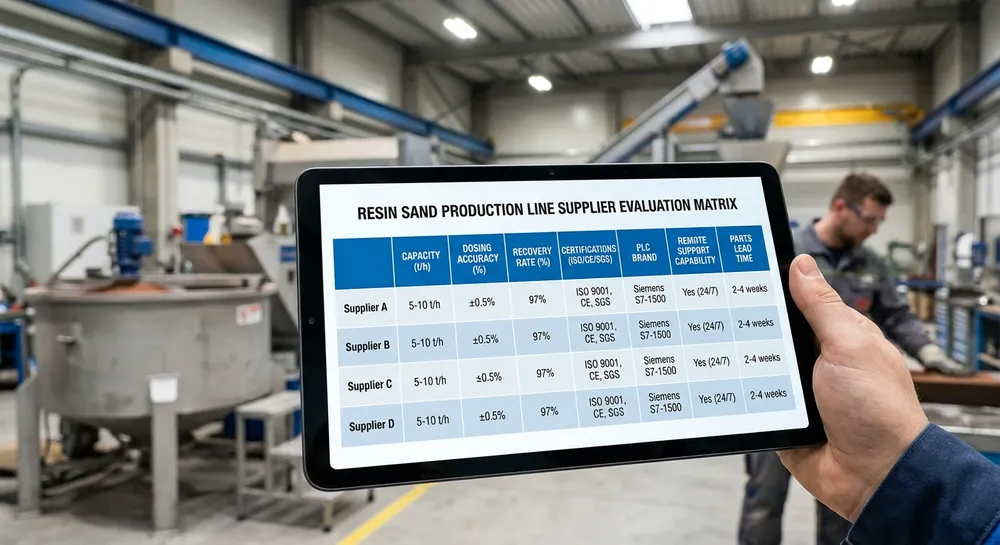
Indian foundries consumed 2.8 million tons of resin-bonded sand in 2025, and that number keeps climbing as automotive and heavy machinery casting demand grows. If you're screening local suppliers for a Resin Sand Production Line, you're likely weighing three factors: lead time, landed cost, and whether the equipment can actually hold ±2% binder dosing accuracy across an 8-hour shift.
Most buyers start with Indian manufacturers because the logic seems obvious — shorter shipping distance, easier communication, faster emergency support. That's true for small orders and urgent replacements. But when you're committing to a 5-10 ton/hour production line that'll run for the next decade, the decision gets more complex. Binder cost is the number everyone watches, but it's the mixing accuracy that decides whether you're wasting resin or wasting castings.
This article ranks 10 Indian resin sand equipment manufacturers based on capacity, certifications, export track record, and technical support infrastructure. Then we'll show you where factory-direct China sourcing changes the economics — not to dismiss local suppliers, but to help you protect margin on repeat-volume orders.
How to Evaluate Resin Sand Production Line Suppliers
Before we look at specific manufacturers, here's what actually matters when you're comparing datasheets and quotes:
Mixer capacity and binder dosing accuracy — A 5 t/h mixer means nothing if the resin-to-sand ratio drifts by 5% between batches. Look for ±1-2% dosing accuracy with automatic calibration. We've commissioned lines where buyers chose the cheapest mixer, then spent 12% more on resin annually because the dosing pump couldn't hold tolerance.
Sand reclamation recovery rate — Mechanical reclamation should hit 90-92% recovery, thermal reclamation 95%+. Anything below 85% means you're buying fresh sand constantly. Ask for test data from the supplier's own lab, not just spec sheet claims.
PLC brand and remote diagnostics — Siemens, Mitsubishi, or Schneider PLCs with 4G connectivity let your team troubleshoot sensor failures without flying someone to the plant. Proprietary control systems lock you into the supplier's service network forever.
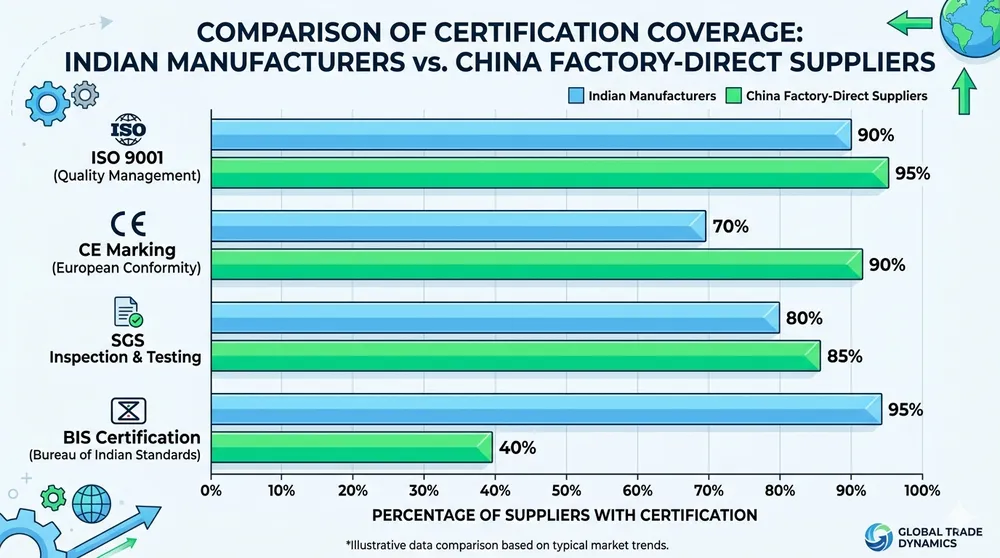
Certification coverage — ISO 9001 is baseline. CE marking matters if you're exporting castings to Europe (your buyers will ask about equipment compliance). SGS pre-shipment inspection adds third-party verification that the equipment actually performs to spec before it leaves the factory.
After-sales parts availability — Hydraulic seals, proximity sensors, and solenoid valves fail. Can the supplier ship replacement parts within 72 hours, or will your line sit idle for 3 weeks waiting on a $40 sensor from overseas?
Container-optimized design — If you're importing equipment, modular frames that fit 40HQ dimensions (12.03m × 2.35m × 2.69m) cut your freight cost by 20-30% compared to oversized cargo that needs flat racks.

The Indian Resin Sand Equipment Landscape
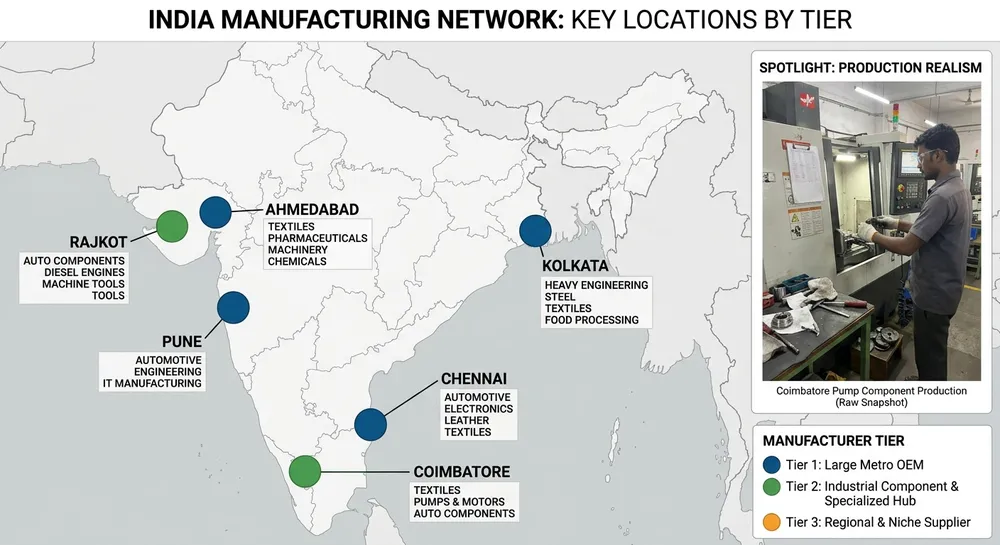
India's foundry equipment sector splits into three tiers: established manufacturers with export experience, mid-tier domestic suppliers serving regional foundries, and small fabricators building custom one-off systems. Here's where the serious capacity sits.
1. Omega Foundry Machinery (Rajkot, Gujarat)
Omega builds complete resin sand molding lines from their Rajkot facility, serving automotive and pump casting foundries across western India. Their equipment range covers furan and phenolic resin systems with mixer capacities from 2-8 t/h. They've supplied lines to foundries in Gujarat, Maharashtra, and Tamil Nadu.
Strengths: Regional service network, experience with Indian casting grades, local spare parts inventory.
Limitations: CE certification status unclear for export markets, limited English-language technical documentation, remote diagnostics capability not standard across all models.
2. Inductotherm Group India (Chennai, Tamil Nadu)
Inductotherm India operates as the local arm of the global Inductotherm Group, primarily known for induction melting equipment but also offering sand processing systems. Their resin sand equipment integrates with their melting furnace installations for turnkey foundry projects.
Strengths: Multinational backing, established quality systems, technical support from global engineering team.
Limitations: Higher pricing than domestic-only manufacturers, equipment often specified as part of larger melting system packages rather than standalone sand lines.
3. Kelsons Engineers (Ahmedabad, Gujarat)
Kelsons manufactures sand mixers, reclamation plants, and material handling systems for foundries. They've been operating since the 1990s and supply equipment to foundries across India and select Middle East markets.
Strengths: Decades of manufacturing experience, custom capacity configurations, established domestic customer base.
Limitations: Export documentation and certification coverage varies by project, lead times extend during peak domestic demand periods.
4. DISA India (Pune, Maharashtra)
DISA India represents the Danish DISA Group's local assembly and service operations. They offer vertical flaskless molding systems and associated sand processing equipment, primarily targeting large-scale automotive foundries.
Strengths: Global technology platform, comprehensive training programs, strong after-sales support network.
Limitations: Premium pricing tier, minimum capacity thresholds may not suit smaller foundries, equipment designed for high-volume automotive applications.
5. Saverglass Equipments (Coimbatore, Tamil Nadu)
Saverglass builds sand mixers, continuous mixers, and sand reclamation systems for resin sand applications. They serve foundries in southern India and have supplied equipment to Sri Lanka and Bangladesh.
Strengths: Competitive pricing for domestic market, flexible MOQ, experience with both batch and continuous mixing systems.
Limitations: Limited international certification documentation, remote commissioning capability not standard, English technical support availability varies.
6. Vulcan Engineering (Kolkata, West Bengal)
Vulcan manufactures foundry equipment including resin sand mixers, core shooters, and sand handling systems. They've supplied equipment to foundries in eastern India and have some export experience to Southeast Asian markets.
Strengths: Regional presence in eastern India, custom engineering for space-constrained facilities, local service response.
Limitations: Smaller production capacity than western India manufacturers, export packaging and documentation less standardized.
7. Primech Engineering (Rajkot, Gujarat)
Primech builds sand mixers, reclamation plants, and material handling systems from their Gujarat facility. They focus on mid-capacity equipment (3-6 t/h) for general engineering foundries.
Strengths: Mid-market pricing, experience with both furan and phenolic systems, regional spare parts availability.
Limitations: CE certification not standard, PLC brands vary by project, remote diagnostics require custom specification.
8. Foseco India (Multiple Locations)
Foseco India, part of Vesuvius Group, primarily supplies foundry consumables (coatings, binders, refractories) but also offers technical consulting and equipment recommendations for resin sand systems. They partner with equipment manufacturers for complete line installations.
Strengths: Deep metallurgical expertise, global technical resources, strong relationships with major Indian foundries.
Limitations: Not a direct equipment manufacturer, equipment sourcing through third-party partnerships, pricing includes consulting and consumables bundling.
9. Rösler India (Pune, Maharashtra)
Rösler India manufactures surface finishing equipment and also offers sand reclamation systems as part of their foundry equipment portfolio. They're the Indian subsidiary of the German Rösler Group.
Strengths: German engineering standards, focus on reclamation efficiency, established quality management systems.
Limitations: Reclamation-focused rather than complete production lines, premium pricing, minimum order values may be higher than domestic-only suppliers.
10. Fenix Foundry Equipment (Ahmedabad, Gujarat)
Fenix builds sand mixers, continuous mixers, and sand cooling systems for resin sand applications. They serve foundries across western and northern India with equipment in the 2-7 t/h capacity range.
Strengths: Competitive domestic pricing, custom capacity configurations, experience with high-temperature sand cooling requirements.
Limitations: Export certification coverage unclear, technical documentation primarily in Hindi/Gujarati with English translations available on request, remote support infrastructure limited.
Pricing Reality: What Indian Resin Sand Lines Actually Cost
Here's what you'll actually pay for a complete resin sand production line from Indian manufacturers, based on 2025-2026 market rates:
3-5 t/h capacity line (mixer, sand cooler, reclamation system, material handling): ₹45-75 lakh ($54,000-$90,000 USD) from domestic manufacturers. Multinational subsidiaries (DISA, Inductotherm) price 30-40% higher.
5-8 t/h capacity line: ₹75-1.2 crore ($90,000-$145,000 USD) depending on automation level and PLC brand selection.
8-12 t/h capacity line: ₹1.2-2 crore ($145,000-$240,000 USD) for fully automated systems with Siemens/Mitsubishi controls.
These prices typically include basic commissioning support but exclude:
- International shipping and customs duties (if exporting equipment)
- Foundation engineering and civil work
- Operator training beyond initial startup
- First-year spare parts kits
- Extended warranty or annual maintenance contracts
The hidden cost: Binder consumption variance. A mixer with ±5% dosing accuracy costs ₹8 lakh less upfront than a ±1% accuracy system, but wastes ₹12-15 lakh annually in excess resin on a 5 t/h line running 16 hours/day. We've seen buyers choose the cheaper mixer, then spend three years trying to calibrate it manually.
Where Indian Manufacturers Excel
Local sourcing makes commercial sense in specific scenarios, and it's worth understanding where Indian manufacturers genuinely add value:
Emergency equipment replacement — If your existing mixer fails and you need a replacement within 4-6 weeks, Indian manufacturers can fabricate and deliver faster than overseas suppliers. Domestic logistics cut 8-10 weeks off the timeline.
Small-batch custom configurations — Need a 3.5 t/h mixer with specific hopper dimensions to fit under a 5-meter ceiling? Indian fabricators handle one-off custom builds more flexibly than factory-direct suppliers optimized for standard configurations.
Regional service response — When a hydraulic seal fails or a sensor needs replacement, having the supplier's service team 4 hours away instead of 4,000 km away matters. Local manufacturers maintain spare parts inventory in-country.
Domestic payment terms — Indian buyers avoid forex risk and can negotiate payment schedules in rupees with domestic suppliers. Letter of credit requirements and international wire transfer fees disappear.
Familiar communication — Technical discussions happen in Hindi, Gujarati, or Tamil with engineers who understand Indian foundry practices, alloy grades, and production constraints.
These advantages are real. For urgent small orders, local convenience often outweighs the cost premium.
The Certification and Quality Gap
Here's where Indian manufacturers commonly fall short compared to international suppliers, and why it matters for your business:
CE marking coverage — Most Indian manufacturers don't maintain CE technical files or conduct EMC testing required for European market compliance. If you're exporting castings to Europe and your buyer audits your equipment certifications, missing CE documentation creates compliance risk.
Dosing accuracy verification — Spec sheets claim ±2% accuracy, but few Indian suppliers provide calibration test data from your specific unit before shipment. You discover the actual tolerance after installation, when it's too late to negotiate.
PLC and HMI standardization — Equipment often ships with whatever PLC brand the manufacturer sourced that month. Mixing Siemens, Schneider, and Delta PLCs across your facility means your maintenance team needs three different programming environments and spare parts inventories.
Remote diagnostics infrastructure — 4G-connected PLCs with VPN access for remote troubleshooting aren't standard. When a sensor fails at 2 AM, your team can't pull error logs remotely — you wait for the supplier's technician to arrive the next day.
English technical documentation — Operation manuals and electrical schematics often exist primarily in regional languages with English translations added later. Wiring diagrams with mixed-language labels slow down troubleshooting.
Sand reclamation test data — Suppliers claim 95% recovery rates but rarely provide lab test results from your specific sand type and binder system. You're buying based on theoretical performance, not verified data.
None of these gaps are insurmountable — you can specify CE compliance, demand calibration reports, and require Siemens PLCs in your RFQ. But it adds negotiation complexity and often pushes pricing closer to international suppliers who include these features as standard.
Factory-Direct China Alternative: Where the Economics Shift
We manufacture resin sand production lines at our 15,000 m² Qingdao facility, and we're not pretending to be an Indian supplier. But here's where factory-direct sourcing changes the cost-quality equation for buyers who can plan 12-16 weeks ahead:
Triple certification as standard — ISO 9001:2015 + CE + SGS certification comes with every line we ship. CE technical files include EMC testing reports and machinery directive compliance documentation. SGS conducts pre-shipment inspection and provides third-party performance verification before the equipment leaves our facility.
Verified dosing accuracy — Every Resin Sand Mixer goes through calibration testing at our facility. We run your specified resin-to-sand ratio through 20 batch cycles and document the actual dosing variance. The commissioning report shows measured performance from your specific unit, not generic spec sheet claims.
Sand reclamation testing lab — Send us a 50 kg sample of your foundry sand and we'll run it through mechanical or thermal reclamation to verify recovery rate before you commit to the order. We've tested sand from 14 countries and can show you exactly what 95% recovery looks like with your material.
Standardized PLC platform — Siemens or Mitsubishi PLCs (your choice) with multilingual HMI in English, Spanish, Arabic, or Russian. 4G connectivity module included for remote diagnostics — your maintenance team can pull error logs, adjust parameters, and troubleshoot sensor failures without waiting for an on-site visit.
Container-optimized modular design — Our engineering team designs equipment frames to fit 40HQ container dimensions (12.03m × 2.35m × 2.69m) without wasted space. A complete 5 t/h line ships in 2 containers, an 8 t/h line in 3 containers. That's 20-30% lower freight cost compared to oversized equipment that needs flat rack shipping.
Remote commissioning support — We've commissioned equipment in 14 countries via video call. Your installation team follows our engineer's instructions to connect hydraulic lines, wire control panels, and run initial test cycles. As long as your team can read hydraulic schematics and use a multimeter, remote commissioning works. (We learned this during COVID lockdowns when flying engineers became impossible — turned out remote support was faster anyway.)
First-year spare parts kit included — Every line ships with hydraulic seals, proximity sensors, solenoid valves, and PLC I/O modules you'll need for the first year. No waiting 3 weeks for a $40 sensor to arrive from overseas.
Pricing comparison — Our 5 t/h resin sand production line with mechanical reclamation, sand cooling, and Siemens PLC: $78,000-$92,000 FOB Qingdao. That's competitive with mid-tier Indian manufacturers, but includes CE certification, calibration test data, and remote diagnostics as standard rather than optional add-ons.
The trade-off: 12-16 week lead time from order to shipment, compared to 6-8 weeks from Indian domestic suppliers. If you're planning capacity expansion 6 months out, the timeline works. If your existing mixer failed yesterday, local sourcing is faster.
Decision Framework: When to Source Locally vs Factory-Direct
Here's how to decide which sourcing route protects your margin:
Choose Indian local suppliers when:
- You need equipment delivered within 6-8 weeks for urgent capacity expansion or replacement
- Order size is small (single mixer or reclamation unit under $30,000) where import logistics don't make economic sense
- Your facility requires extensive custom modifications that benefit from on-site engineering visits
- You're a first-time foundry buyer who values face-to-face technical support during startup
- Domestic payment terms in rupees eliminate forex risk for your business
Choose factory-direct China sourcing when:
- You're ordering a complete production line ($75,000+) where certification coverage and dosing accuracy directly impact your operating costs
- You're exporting castings to Europe or North America and need CE-compliant equipment documentation
- You can plan 12-16 weeks ahead and prioritize landed cost over delivery speed
- You want standardized PLC platforms and remote diagnostics to reduce long-term maintenance costs
- You need verified sand reclamation test data from your specific sand type before committing to the purchase
The hybrid approach: Some buyers source mixers and core equipment from China factory-direct for certification coverage and dosing accuracy, then purchase material handling systems and auxiliary equipment from Indian suppliers for faster delivery and easier customization. This splits the risk and optimizes cost across different equipment categories.
What to Ask Before You Commit
Whether you're sourcing from India or China, here are the questions that separate serious suppliers from spec-sheet optimists:
For dosing accuracy: "Can you provide calibration test data from my specific unit before shipment, showing actual resin-to-sand ratio variance across 20 consecutive batches?"
For reclamation performance: "Will you run a test batch of my foundry sand through your reclamation system and document the recovery rate before I place the order?"
For certification: "Can you provide the CE technical file including EMC testing reports and machinery directive compliance documentation, not just a CE declaration of conformity?"
For remote support: "What PLC brand and communication protocol do you use, and can your system connect via 4G/VPN for remote diagnostics?"
For spare parts: "What's your guaranteed lead time for shipping replacement hydraulic seals, sensors, and solenoid valves to my location?"
For container optimization: "How many 40HQ containers does this line require, and can you provide the packing list showing how equipment modules fit container dimensions?"
The suppliers who answer these questions with specific data and test reports are the ones who'll actually deliver what they promise. The ones who deflect to "we'll discuss during installation" are the ones who'll leave you troubleshooting dosing accuracy problems six months after commissioning.
Frequently Asked Questions
What is the typical lead time for a resin sand production line from Indian manufacturers?
6-8 weeks for standard capacity configurations (3-5 t/h) from domestic Indian manufacturers, 8-12 weeks for custom builds or higher capacities. Multinational subsidiaries (DISA, Inductotherm) often quote 10-14 weeks. Factory-direct China sourcing typically requires 12-16 weeks from order to shipment. Add 3-4 weeks for ocean freight and customs clearance if importing.
Do Indian resin sand equipment manufacturers provide CE certification?
CE certification is not standard across most Indian manufacturers. DISA India and Inductotherm India typically provide CE documentation due to their multinational parent companies. Domestic manufacturers like Omega, Kelsons, and others can pursue CE marking if specified in the RFQ, but it adds 4-6 weeks to lead time and increases cost by 8-12%. Always request the complete CE technical file, not just a declaration of conformity.
What is the price difference between Indian and China factory-direct resin sand lines?
For a 5 t/h complete line, Indian domestic manufacturers quote ₹45-75 lakh ($54,000-$90,000), while China factory-direct pricing sits at $78,000-$92,000 FOB. The overlap zone is significant. The difference comes in what's included as standard: China factory-direct typically includes CE certification, calibration test data, Siemens/Mitsubishi PLCs, and remote diagnostics without upcharge. Indian manufacturers often quote these as optional add-ons.
How do I verify sand reclamation recovery rate claims before purchasing?
Request lab test data from your specific sand type and binder system. Serious suppliers will run a test batch (you provide 50 kg of your foundry sand) through their reclamation system and document the recovery rate, residual binder content, and sand grain size distribution after reclamation. Spec sheet claims of "95% recovery" mean nothing without test data from your material. We run these tests at our Qingdao facility before shipment — it's the only way to verify performance.
What PLC brands do Indian manufacturers typically use?
It varies by manufacturer and often by individual project. You'll see Siemens, Schneider, Delta, Mitsubishi, Allen-Bradley, and sometimes Indian brands like Xylem or L&T. This inconsistency creates maintenance headaches if you're running multiple lines — your team needs different programming software and spare parts inventory for each PLC brand. Always specify the PLC brand in your RFQ and confirm it's a firm commitment, not a "subject to availability" clause.
Can Indian manufacturers provide remote commissioning support?
Remote commissioning capability varies significantly. Multinational subsidiaries (DISA, Inductotherm) typically offer remote support with 4G-connected PLCs and VPN access. Domestic manufacturers often require on-site commissioning visits, though some have added video call support since 2020. If remote diagnostics matter for your operation, specify 4G connectivity and VPN access in your RFQ and confirm the supplier has successfully commissioned equipment remotely before.
What is the minimum order quantity for resin sand production lines?
Most manufacturers will sell individual components (single mixer, single reclamation unit) without MOQ restrictions. For complete production lines, there's no formal MOQ, but economic viability starts around $50,000-$75,000 total order value when importing from China. Below that threshold, domestic Indian sourcing often makes more sense due to logistics costs. We've shipped single 3 t/h mixers to buyers who needed to match existing equipment, but complete line orders are more common.
If you're comparing quotes and need factory-direct pricing with CE certification and verified dosing accuracy, send your casting type, required capacity (t/h), and facility dimensions to sales@tzfoundry.com. We'll provide a detailed proposal with FOB pricing, lead time, and commissioning support options. For buyers who want to see sand reclamation test data before committing, we can run your sand sample through our lab and send you the results within 2 weeks.

Liu Haoran is the Resin Sand Production Line Technical Manager at TZFoundry. Over 11 years of hands-on work with furan, phenolic, and coated sand systems, he has commissioned 40+ resin sand lines for export buyers and developed binder dosing protocols...