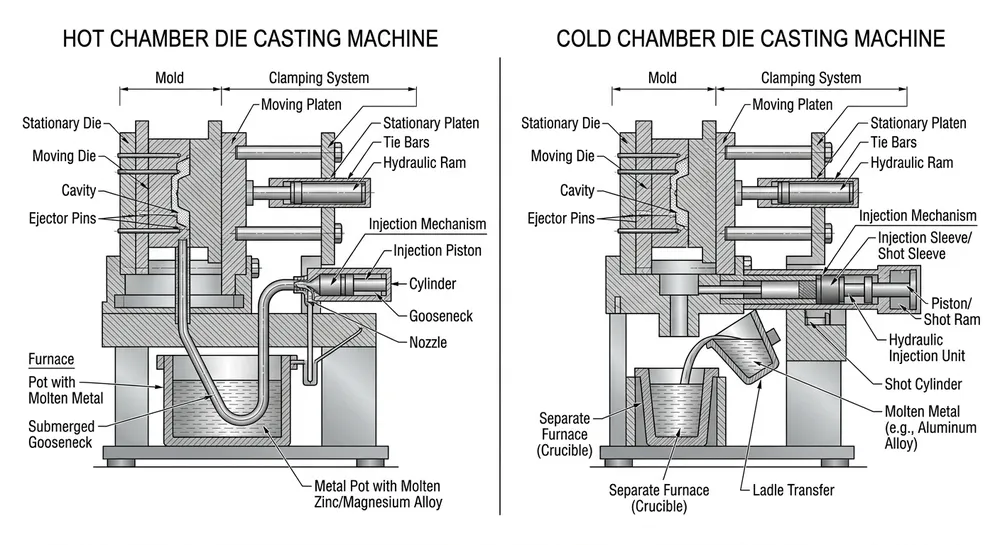
Your die casting line decision comes down to one physical constraint: alloy melting point. If you're running zinc, magnesium, or low-melting alloys below 420°C, hot chamber machines give you 2-3 second cycle times with the gooseneck submerged directly in molten metal. If you're casting aluminum, brass, or copper alloys above 660°C, you need cold chamber systems where a ladle feeds each shot separately — slower cycles (15-30 seconds), but the injection system survives the heat.
Quick verdict: Hot chamber lines cost 30-40% less upfront and run 5-8x faster cycles, but you're locked into zinc-family alloys. Cold chamber lines handle the full aluminum and copper alloy range your buyers actually want, justify the premium through part complexity and surface finish, and dominate 70% of the die casting equipment market for good reason. Most foundries buying their first production line should spec cold chamber unless they have a locked-in zinc component contract.
System Architecture: Gooseneck vs Ladle Injection
The core difference isn't just speed — it's whether the injection mechanism can survive continuous contact with molten metal.
Hot chamber die casting machines use a gooseneck (a submerged injection cylinder) that sits inside the furnace holding tank. The plunger draws molten metal directly from the bath and injects it into the die in one motion. The entire injection system — cylinder, plunger, seals — operates at melt temperature continuously. This works because zinc alloys melt at 380-420°C, low enough that steel components don't degrade rapidly. Cycle time runs 2-3 seconds from shot to ejection because there's no manual metal transfer step.
Cold chamber die casting machines separate the injection cylinder from the furnace. An operator or automated ladle pours a measured shot of molten metal into the injection sleeve, then the hydraulic ram pushes it into the die. The injection system only contacts molten metal for 15-30 seconds per cycle, then cools between shots. This prevents the rapid erosion and thermal fatigue that would destroy the cylinder if it sat in 660°C aluminum melt continuously. The trade-off: every cycle includes a metal transfer step, adding 10-20 seconds.
We've built both configurations at our Qingdao facility since 2010. Hot chamber lines ship as compact units (one 40HQ container for a complete 250-ton system), while cold chamber lines require separate furnace modules and larger floor space. The architectural difference drives everything downstream — maintenance schedules, energy consumption, operator training, and total cost of ownership.

Head-to-Head Specification Matrix
| Parameter | Hot Chamber Die Casting | Cold Chamber Die Casting |
|---|---|---|
| Alloy Compatibility | Zinc, magnesium, low-melting alloys (<420°C) | Aluminum, brass, copper alloys (>660°C) |
| Cycle Time | 2-3 seconds | 15-30 seconds |
| Injection Pressure | 7-14 MPa (1,000-2,000 psi) | 35-140 MPa (5,000-20,000 psi) |
| Typical Machine Tonnage | 50-400 tons | 160-4,000 tons |
| Part Weight Range | 10g-5kg (mostly <1kg) | 50g-50kg (commonly 0.5-10kg) |
| Wall Thickness Capability | 0.6-3mm (excellent thin-wall) | 1.0-6mm (limited by cooling) |
| Surface Finish | Ra 0.8-1.6μm (good) | Ra 0.4-0.8μm (excellent) |
| Production Line Cost | $80,000-$250,000 | $150,000-$800,000 |
| Energy Consumption | 15-25 kWh per 1,000 shots | 40-80 kWh per 1,000 shots |
| Maintenance Interval | Gooseneck replacement every 80,000-120,000 shots | Injection sleeve replacement every 50,000-100,000 shots |
The pressure difference matters more than the numbers suggest. Aluminum's higher melting point means it starts solidifying the instant it contacts the cooler die surface. You need 35+ MPa injection pressure to force the metal into thin sections and complex geometries before it freezes. Zinc stays fluid longer at lower temperatures, so 7-14 MPa handles most part designs. This is why cold chamber machines require heavier hydraulic systems and stronger die clamping — the injection force is 3-5x higher.
The Hidden Cost Analysis: Where Your Budget Actually Goes
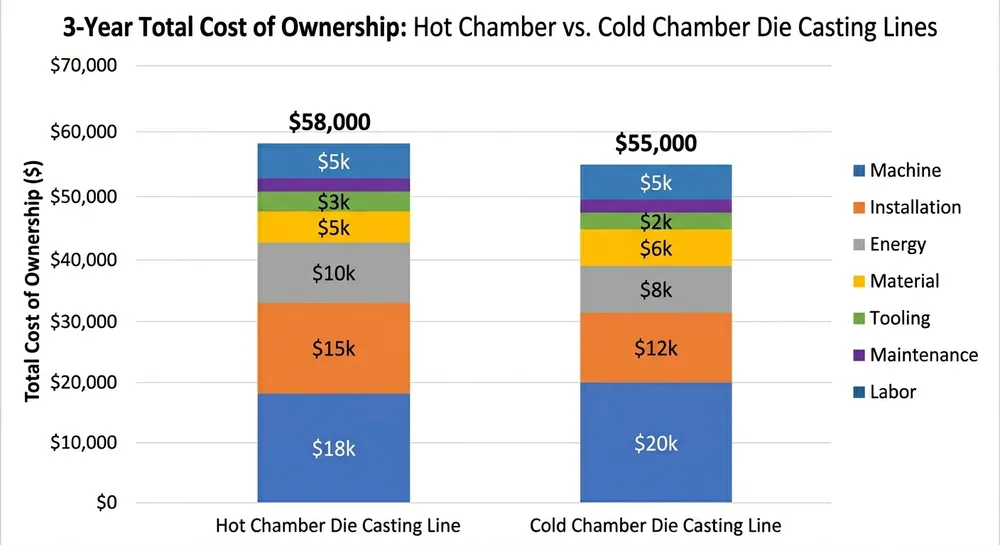
Machine purchase price is 40-50% of your total production line investment. The rest shows up in installation, tooling, energy, labor, and maintenance over the first three years.
Hot chamber hidden costs:
Energy efficiency looks attractive on paper (15-25 kWh per 1,000 shots), but zinc alloy costs $2.80-$3.50/kg versus aluminum at $2.20-$2.80/kg. If you're running 500,000 shots annually at 200g average part weight, that's $280,000-$350,000 in zinc versus $220,000-$280,000 in aluminum — a $60,000-$70,000 annual material cost penalty. Your buyers pay this through higher piece prices, which limits your market to applications where zinc's corrosion resistance or dimensional stability justifies the premium.
Gooseneck replacement runs $3,000-$8,000 per unit and happens every 80,000-120,000 shots. At 500,000 shots per year, you're replacing it 4-6 times annually — $12,000-$48,000 in parts alone, plus 4-8 hours downtime per replacement. We've seen foundries try to stretch gooseneck life past 120,000 shots to save money, then deal with porosity defects from eroded plunger seals that cost more in scrap than the replacement part.
Cold chamber hidden costs:
The ladle transfer step adds labor. Manual ladling requires a dedicated operator per machine, adding $25,000-$40,000 annual labor cost depending on your region. Automated ladling systems (robotic or tilt-pour) cost $40,000-$80,000 upfront but eliminate the operator and improve shot consistency. Most buyers installing 2+ cold chamber lines should spec automated ladling from day one — the payback period is 18-30 months.
Injection sleeve replacement costs $2,000-$6,000 and happens every 50,000-100,000 shots. The sleeve erodes faster than a hot chamber gooseneck because aluminum's higher temperature accelerates wear, but the part is cheaper and easier to swap (2-3 hours versus 4-8 hours for a gooseneck). At 500,000 shots annually, budget $10,000-$30,000 for sleeves plus 10-15 hours total downtime.
Die life differs significantly. Zinc's lower operating temperature (380-420°C) means dies last 150,000-300,000 shots before thermal fatigue cracks appear. Aluminum dies (operating at 660-700°C) crack at 80,000-150,000 shots. If your part requires a $15,000 die, hot chamber gives you $0.05-$0.10 per part die amortization versus $0.10-$0.19 for cold chamber. Over 500,000 annual shots, that's $25,000-$50,000 versus $50,000-$95,000 in die costs.
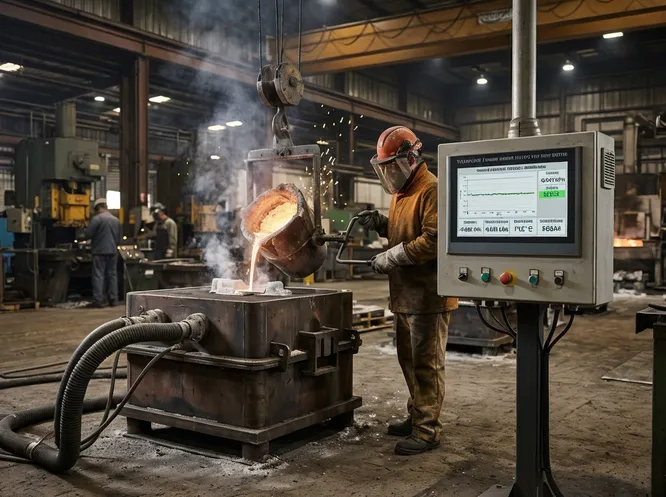
(We learned the die life lesson in 2016 when a Middle East buyer ran aluminum in a cold chamber line without proper die preheating — thermal shock cracked three $18,000 dies in the first 40,000 shots. Now we include PLC-controlled die temperature monitoring as standard on all cold chamber systems we ship.)
Alloy Compatibility: The Real Constraint
The melting point cutoff isn't arbitrary — it's driven by what steel injection components can survive.
Hot chamber alloys (all below 420°C melting point):
- Zinc alloys (Zamak 3, 5, 7): 380-386°C melting point, excellent fluidity, tight tolerances (±0.05mm achievable), good corrosion resistance. Dominates automotive interior trim, consumer electronics housings, plumbing fixtures, and small hardware.
- Magnesium alloys (AZ91D, AM60B): 595-630°C melting point but castable in hot chamber systems due to lower reactivity with steel at these temperatures. Lightest structural metal (1.8 g/cm³ versus zinc's 6.6 g/cm³), used in automotive steering wheels, power tool housings, and aerospace components where weight matters.
Cold chamber alloys (all above 660°C melting point):
- Aluminum alloys (A380, ADC12, AlSi9Cu3): 660-730°C melting point, excellent strength-to-weight ratio (2.7 g/cm³), superior thermal conductivity. Dominates automotive engine blocks, transmission housings, heat sinks, and structural components.
- Brass and copper alloys: 900-1,085°C melting point, high electrical and thermal conductivity, used in electrical connectors, valve bodies, and marine hardware. Requires specialized cold chamber machines with ceramic-coated injection sleeves.
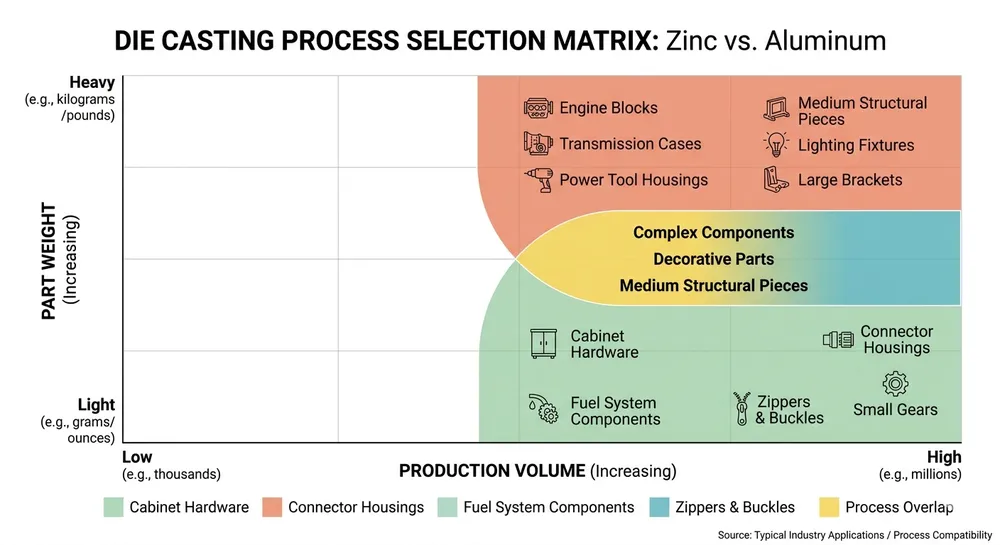
The market reality: aluminum die casting represents 70% of global die casting production volume because automotive, aerospace, and industrial buyers demand the strength-to-weight ratio. Zinc holds 20% (mostly small precision parts), magnesium 8%, and copper alloys 2%. If you're building a foundry to serve export markets, cold chamber capability opens more customer segments.
One exception: if you have a locked contract for high-volume zinc components (automotive door handles, consumer electronics bezels, plumbing fittings), hot chamber's 5-8x faster cycle time can justify the alloy limitation. We've shipped hot chamber lines to buyers with 5-year supply agreements for zinc parts where the cycle time advantage delivers 40-50% lower cost-per-part despite higher material costs.
Application Showdown: Which System Wins Where
Scenario 1: Automotive structural components (engine brackets, transmission housings, suspension parts)
Winner: Cold chamber (aluminum alloys)
Aluminum A380 or ADC12 delivers 320 MPa tensile strength at 2.7 g/cm³ density — zinc Zamak 5 only reaches 328 MPa at 6.6 g/cm³. For a 2kg engine bracket, aluminum saves 1.5kg per part. At 50,000 parts annually, that's 75 tons less weight in vehicles, translating to fuel efficiency gains your automotive buyers can market. Cold chamber's higher injection pressure (35-70 MPa) fills complex geometries with thin ribs and bosses that structural parts require. Cycle time penalty (20-25 seconds versus 3 seconds for hot chamber) doesn't matter because die complexity and cooling time dominate — you're not ejecting an aluminum engine bracket in 3 seconds regardless of injection speed.
Scenario 2: Consumer electronics housings (smartphone frames, laptop hinges, camera bodies)
Winner: Hot chamber (zinc alloys)
Zinc Zamak 3 holds ±0.05mm tolerances across 100,000+ shot runs without die wear issues, critical for parts with threaded inserts, snap-fit features, and tight assembly clearances. The 2-3 second cycle time means a single 250-ton hot chamber machine produces 10,000-12,000 parts per 8-hour shift versus 1,500-2,000 parts from a cold chamber aluminum line. For consumer electronics with 6-12 month product lifecycles, you need to hit 500,000-unit production runs in 8-12 weeks — hot chamber's throughput advantage is decisive. Surface finish (Ra 0.8-1.6μm) accepts powder coating or chrome plating without secondary polishing.
Scenario 3: Heat sinks and thermal management components
Winner: Cold chamber (aluminum alloys)
Aluminum's thermal conductivity (205 W/m·K) is 4x higher than zinc's 113 W/m·K. For LED heat sinks, power supply housings, or motor controller enclosures, aluminum dissipates heat fast enough to prevent component failure. Cold chamber's higher injection pressure forces aluminum into the thin fins (1.0-1.5mm) and complex pin arrays that maximize surface area. We've shipped cold chamber lines to buyers producing LED heat sinks with 40+ fins at 1.2mm thickness — hot chamber zinc couldn't fill those geometries even if the thermal performance was acceptable.
Scenario 4: High-volume small hardware (door handles, cabinet pulls, plumbing fittings)
Winner: Hot chamber (zinc alloys)
Zinc's corrosion resistance (chromate conversion coating provides 500+ hour salt spray protection) suits plumbing and outdoor hardware. The 2-3 second cycle time produces 1.2-1.5 million parts annually from a single machine running two shifts — cold chamber aluminum would need 5-6 machines to match that throughput. For parts under 200g where strength isn't critical, hot chamber's lower capital cost ($80,000-$150,000 per machine versus $200,000-$400,000 for cold chamber) and faster ROI (12-18 months versus 24-36 months) make the business case clear.
Production Line Configuration: What You're Actually Buying
A complete die casting production line includes more than the machine. Here's what separates a functional system from a machine that sits idle waiting for supporting equipment.
Hot chamber production line (complete system):
- Hot chamber die casting machine (50-400 tons)
- Holding furnace with temperature control (±3°C stability required)
- Die spray system (automated or manual)
- Part extraction robot or pick-and-place system
- Trim press or deflashing station
- Conveyor and cooling system
- PLC control panel with HMI touchscreen
Total investment: $120,000-$350,000 depending on tonnage and automation level. Fits in 1-2 standard 40HQ containers for export. Floor space: 40-80 m² including material staging.
Cold chamber production line (complete system):
- Cold chamber die casting machine (160-4,000 tons)
- Melting furnace (gas or electric, 500-2,000 kg capacity)
- Holding furnace with automated or manual ladling system
- Die spray system (automated)
- Part extraction robot (manual extraction not viable at aluminum temperatures)
- Trim press or CNC deflashing
- Conveyor, quench tank, and cooling system
- PLC control panel with die temperature monitoring
- Hydraulic power unit (often separate from machine)
Total investment: $280,000-$1,200,000 depending on tonnage and automation level. Ships in 3-5 containers. Floor space: 120-250 m² including furnace area and material handling.
The automation decision matters more for cold chamber lines. Manual ladling adds $25,000-$40,000 annual labor cost and introduces shot weight variation (±5-10% versus ±2% for automated systems). That variation shows up as porosity defects in 3-8% of parts. We recommend automated ladling for any cold chamber line running over 200,000 shots annually — the scrap reduction alone pays for the system in 18-24 months.
(Our engineering team designs both configurations with Siemens or Mitsubishi PLCs depending on buyer preference. Siemens costs 15-20% more but your maintenance team can source replacement I/O modules locally in most export markets. Mitsubishi has better diagnostic software but parts availability outside Asia can delay repairs by 2-3 weeks.)
Cycle Time Reality: Throughput vs Part Complexity
The spec sheet cycle time (2-3 seconds for hot chamber, 15-30 seconds for cold chamber) assumes simple geometry and thin walls. Real production adds time.
Hot chamber actual cycle breakdown:
- Injection: 0.3-0.5 seconds
- Cooling in die: 1-2 seconds (zinc solidifies quickly)
- Die open and part ejection: 0.5-1 second
- Die spray and close: 0.5-1 second
- Total: 2.3-4.5 seconds for simple parts
For complex parts with thick sections (>3mm), cooling time extends to 3-5 seconds, pushing total cycle to 5-8 seconds. Still 3-5x faster than cold chamber, but the advantage shrinks as part complexity increases.
Cold chamber actual cycle breakdown:
- Ladle transfer (manual): 3-5 seconds
- Ladle transfer (automated): 1-2 seconds
- Injection: 0.5-1 second
- Cooling in die: 10-20 seconds (aluminum requires longer solidification)
- Die open and part ejection: 1-2 seconds
- Die spray and close: 2-4 seconds
- Total: 17-32 seconds with automated ladling, 20-35 seconds manual
Thick-section aluminum parts (>4mm) need 25-35 seconds cooling time, pushing total cycle to 35-50 seconds. At this point, cycle time stops being the constraint — die temperature management and part quality become the focus.
The throughput math: A hot chamber line running 3-second cycles produces 1,200 parts per hour (9,600 per 8-hour shift). A cold chamber line at 25-second cycles produces 144 parts per hour (1,152 per shift). To match hot chamber throughput, you need 8-10 cold chamber machines — but you're also producing aluminum parts that command 30-50% higher selling prices due to superior mechanical properties and lighter weight.
Supplier Validation: What to Verify Before You Buy
Die casting equipment sourcing has three common failure modes: undersized hydraulic systems that can't maintain injection pressure, control systems without proper die temperature monitoring, and machines shipped without commissioning support.
Machine specification verification:
Request hydraulic system test reports showing injection pressure stability across 100 consecutive shots. The pressure should hold within ±5% of rated capacity. We test every cold chamber machine at 1.5x rated injection pressure (if it's rated for 70 MPa, we test at 105 MPa) to verify seal integrity and cylinder strength. Suppliers who skip this test ship machines that lose pressure after 20,000-30,000 shots when seals start leaking.
Check die platen parallelism spec — it should be within 0.05mm across the full platen surface. Poor parallelism causes uneven die clamping, leading to flash (excess material leaking at the parting line) and premature die wear. Ask for the measurement protocol and actual test data from your specific machine, not generic spec sheets.
Verify PLC brand and model. Siemens S7-1200 or Mitsubishi FX5U are standard for export equipment — both have English interfaces and global service networks. Avoid proprietary Chinese PLCs unless you're comfortable with limited documentation and parts availability. The PLC controls injection timing, die spray cycles, and safety interlocks — it's not a place to save $2,000.
Alloy-specific configuration:
For cold chamber aluminum lines, confirm the injection sleeve material. Standard H13 tool steel works for A380 and ADC12 alloys, but high-silicon alloys (AlSi12, AlSi9Cu3) require nitrided sleeves or ceramic coatings to prevent erosion. Sleeve life drops from 80,000 shots to 30,000 shots if the material isn't matched to your alloy chemistry.
For hot chamber zinc lines, ask about gooseneck material and coating. Standard goosenecks use H13 steel with a protective coating — some suppliers use lower-grade materials that erode in 40,000-60,000 shots instead of the expected 80,000-120,000. Request material certifications and coating thickness data.
Commissioning and training:
Confirm whether commissioning is on-site or remote. On-site commissioning costs $5,000-$12,000 (engineer travel, accommodation, 5-7 days) but ensures proper installation. Remote commissioning via video call works if your installation team can read hydraulic schematics and has basic PLC troubleshooting skills — we've commissioned equipment in 14 countries this way. The supplier should provide a commissioning checklist covering hydraulic connections, electrical wiring, die installation, and first-shot verification.
Training should cover die changeover procedures, injection parameter adjustment, routine maintenance schedules, and common troubleshooting. Budget 2-3 days for operator training and 1-2 days for maintenance team training. Suppliers who offer only a user manual without hands-on training leave you with a machine your team can't optimize.
Spare parts and support:
Request a recommended spare parts list for the first year. It should include hydraulic seals, injection sleeve or gooseneck, proximity sensors, solenoid valves, and PLC I/O modules. Budget $8,000-$15,000 for hot chamber spares, $12,000-$25,000 for cold chamber. Suppliers who don't provide this list either don't know their own equipment failure modes or don't want you to see the maintenance cost.
Check spare parts lead time and shipping terms. Critical components (injection sleeve, gooseneck, hydraulic cylinders) should be available within 2-3 weeks. If the supplier quotes 8-12 weeks, you'll lose 2-3 months of production when a component fails. We stock common wear parts at our Qingdao facility and ship via DHL/FedEx for 5-7 day delivery to most export markets.
RFQ Specification Language: What to Request
When requesting quotes for die casting production lines, provide these details to get accurate pricing and avoid mismatched equipment:
Alloy and part specifications:
- Primary alloy family (zinc, aluminum, magnesium, brass)
- Specific alloy grades if known (A380, ADC12, Zamak 3, etc.)
- Part weight range (minimum and maximum)
- Typical wall thickness (minimum section)
- Annual production volume (shots per year)
- Required surface finish (Ra value or visual standard)
Machine requirements:
- Clamping force range (tons) — calculate as projected part area × 4-6 tons per square inch for aluminum, 2-3 tons per square inch for zinc
- Injection pressure requirement (if known from part simulation)
- Die size and weight
- Automation level (manual, semi-automatic, fully automatic)
- PLC brand preference (Siemens, Mitsubishi, or open)
Production line scope:
- Complete turnkey line or machine only
- Furnace capacity and type (gas/electric preference)
- Automated or manual ladling (cold chamber only)
- Robotic part extraction or manual
- Trim press or deflashing equipment included
- Conveyor and cooling system requirements
Site and logistics:
- Available floor space (length × width × ceiling height)
- Power supply (voltage, phase, frequency)
- Compressed air availability (pressure and flow rate)
- Container delivery constraints (standard 40HQ acceptable or special requirements)
- Installation support needed (on-site or remote commissioning)
Commercial terms:
- Target delivery timeline
- Payment terms (typical is 30% deposit, 60% before shipment, 10% after commissioning)
- Warranty coverage (standard is 12 months from commissioning)
- Training requirements (operator and maintenance)
- Spare parts package for first year
Suppliers who can't provide detailed responses to these points either don't manufacture the equipment themselves (they're trading companies) or don't have engineering depth to support your installation.

Zhang Peng leads lost foam casting systems at TZFoundry, where he has spent over 12 years engineering vacuum casting lines, coating systems, and foam pattern equipment for export foundries. He specializes in defect prevention and yield optimization across cast iron...