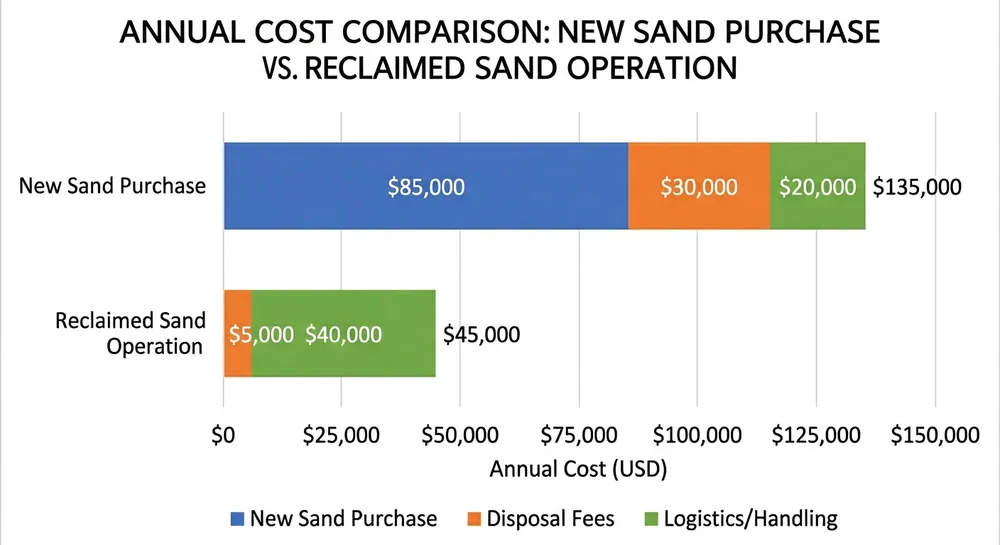
Most foundries underestimate how much they spend on new sand until they run the actual numbers. A mid-sized operation casting 50 tons per day can burn through $180,000 annually just purchasing replacement sand — before you count disposal fees, trucking, or the labor to handle incoming material. That's the cost of not reclaiming.
A clay sand reclamation line changes the math. You stop buying most of your sand. You stop paying to haul waste off-site. The equipment pays for itself, usually within 18 to 36 months depending on your daily throughput. After that, every ton you reclaim instead of purchase drops straight to your bottom line.
This article breaks down the real ROI: per-ton cost comparison, payback timelines at different production volumes, and the total cost of ownership factors most suppliers leave out of their sales pitch.
What Clay Sand Reclamation Actually Saves You
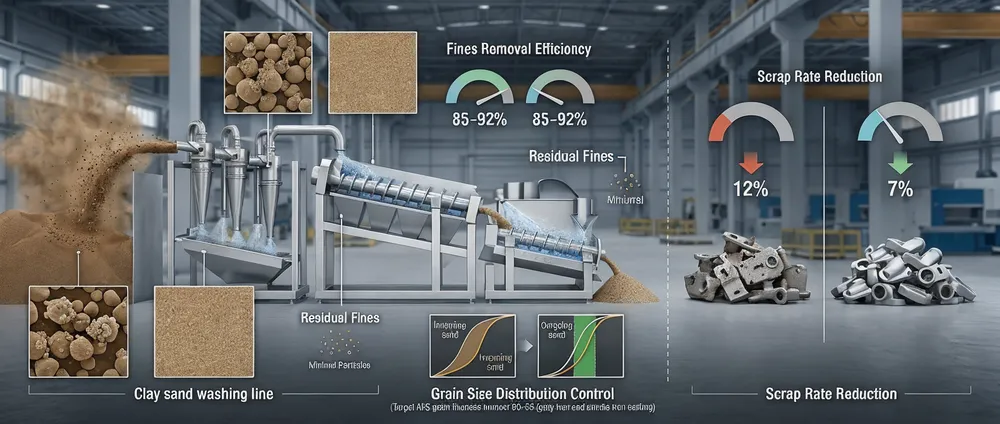
Sand reclamation isn't about environmental compliance or "going green" — it's about cost control. Every casting cycle consumes sand. Without reclamation, you replace that sand by purchasing new material. With reclamation, you recover 90-95% of the sand you already own and put it back into production.
The savings come from three sources:
New sand purchase elimination. A foundry running 15 tons per day of clay sand molding typically needs 3-4 tons of fresh sand weekly to replace losses. At $60-80 per ton delivered (depending on your region and logistics), that's $9,000-12,000 per year just for replacement sand. A reclamation line with 95% recovery rate cuts that to under $1,500 annually.
Disposal cost reduction. Used sand is industrial waste. Landfill tipping fees run $40-70 per ton in most regions, plus trucking. If you're dumping 3 tons per week, disposal alone costs $6,000-10,000 per year. Reclamation drops your waste volume by 90%, so disposal cost falls to $600-1,000.
Logistics and handling savings. New sand arrives in bulk trucks or supersacks. Someone has to receive it, store it, and move it to your preparation line. Reclaimed sand stays on-site in a closed loop. You eliminate inbound freight, reduce forklift hours, and free up warehouse space. For overseas foundries, this also removes the risk of supply interruptions when your sand supplier has shipping delays.
We've commissioned reclamation lines in foundries across four continents. The ones that track costs carefully see payback in 18-30 months at 15+ tons per day throughput. Smaller operations (5-10 tons per day) stretch payback to 30-40 months, but the savings still compound year after year once the line is paid off.

Per-Ton Economics: New Sand vs Reclaimed Sand
The clearest way to understand clay sand reclamation line ROI is to compare the cost per ton of sand in your molds.
New sand cost per ton (delivered):
- Base material: $45-65 per ton (varies by region and bentonite content)
- Freight: $10-20 per ton (domestic) or $30-50 per ton (import for overseas foundries)
- Handling and storage: $3-5 per ton (forklift, labor, warehouse space)
- Total: $60-120 per ton depending on location
Reclaimed sand cost per ton (operating):
- Electricity: $1.50-2.50 per ton (based on 15-20 kWh per ton at $0.10/kWh)
- Wear parts (screens, magnets, cyclone liners): $0.80-1.20 per ton amortized
- Maintenance labor: $0.50-1.00 per ton
- Bentonite and water makeup (5% loss): $3-4 per ton
- Total: $6-9 per ton
The difference is $50-110 per ton. At 15 tons per day, that's $750-1,650 in daily savings, or $270,000-600,000 annually assuming 360 operating days.
This is why foundries that run reclamation lines don't go back. The operating cost is so much lower than purchasing new sand that even a modest recovery rate (85-90%) still delivers massive savings.
(Note: these figures assume you're already running a clay sand molding line. If you're evaluating clay sand vs resin sand systems from scratch, the economics shift — but that's a separate decision. For existing clay sand operations, reclamation is almost always the right move once you hit 10+ tons per day.)
Payback Period by Production Volume
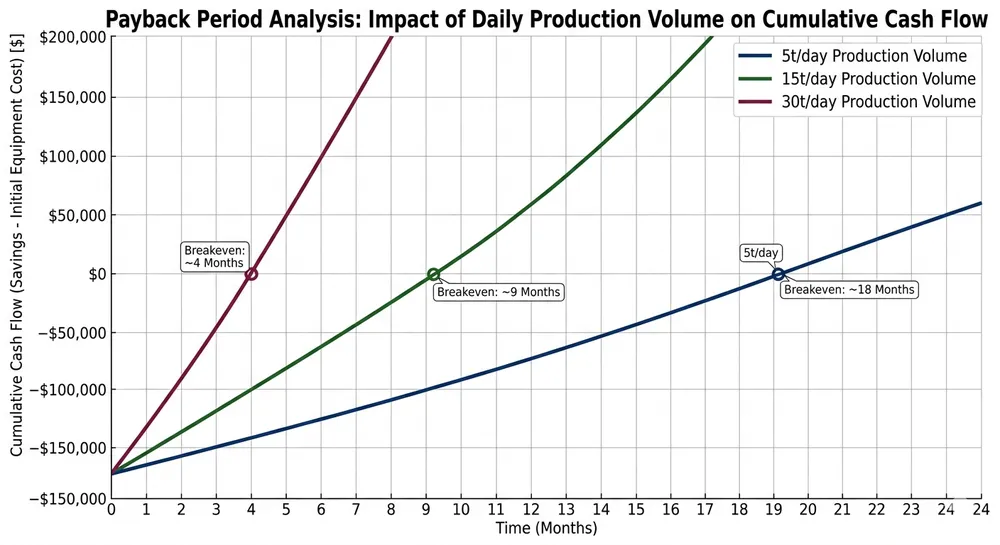
Clay sand reclamation line ROI depends heavily on your daily throughput. Higher volume means faster payback because the per-ton savings multiply across more tons.
Here's the realistic payback timeline based on our commissioning data:
| Daily Throughput | Annual Sand Savings | Typical Line Cost | Payback Period |
|---|---|---|---|
| 5 tons/day | $90,000-180,000 | $120,000-150,000 | 30-40 months |
| 15 tons/day | $270,000-540,000 | $180,000-220,000 | 18-24 months |
| 30 tons/day | $540,000-1,080,000 | $280,000-350,000 | 12-18 months |
These numbers include new sand purchase elimination, disposal cost reduction, and logistics savings. They assume 95% recovery rate, which is what we verify in our in-house testing lab before shipment.
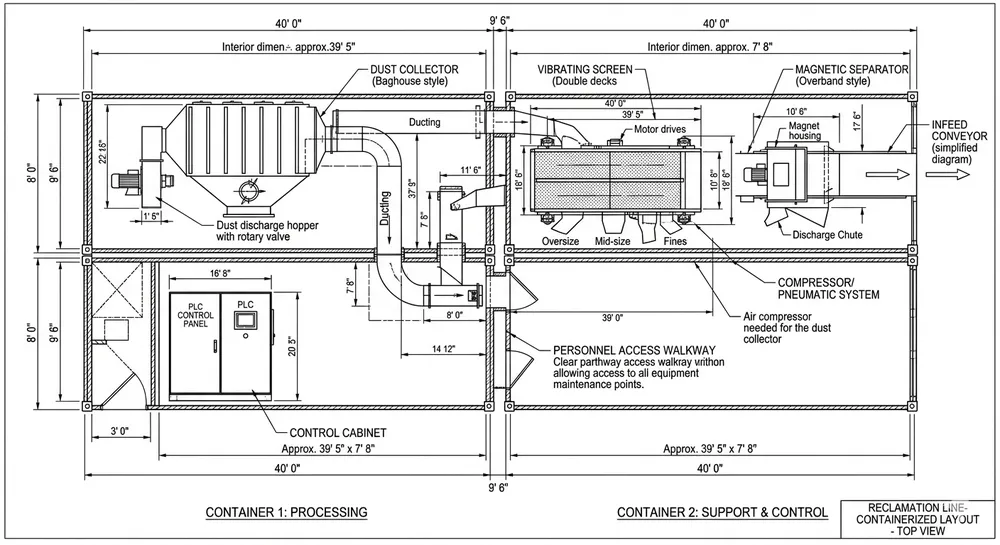
The line cost includes the full reclamation system: magnetic separator, vibrating screen, dust collector, pneumatic conveying, PLC control, and installation hardware. It does not include civil work (foundation, electrical rough-in) or commissioning travel, which vary by site.
Why 15 tons per day is the sweet spot. Below 10 tons per day, payback stretches past three years, and some foundries decide to keep buying new sand rather than invest in equipment. Above 15 tons per day, the savings are so large that the line pays for itself in under two years, making it an easy capital approval. At 30+ tons per day, you're looking at 12-18 month payback, which is faster ROI than most production equipment.
We've installed lines as small as 3 tons per day for foundries with limited floor space or budget, but the business case gets weaker. If you're under 10 tons per day, consider whether you'll scale up in the next 2-3 years. If yes, size the line for future capacity. If no, you might be better off negotiating better pricing on new sand and focusing capital elsewhere.
Total Cost of Ownership: What Most Suppliers Don't Tell You
The equipment purchase price is only part of clay sand reclamation line ROI. You need to account for ongoing operating costs that eat into your savings.
Electricity consumption. A 15-ton-per-day reclamation line pulls 15-20 kWh per ton processed. At $0.10 per kWh, that's $1.50-2.00 per ton in power cost. Over a year, electricity runs $8,000-11,000. This is already included in the per-ton operating cost above, but it's worth calling out because power rates vary widely. If you're in a region with $0.20/kWh industrial rates, your operating cost doubles.
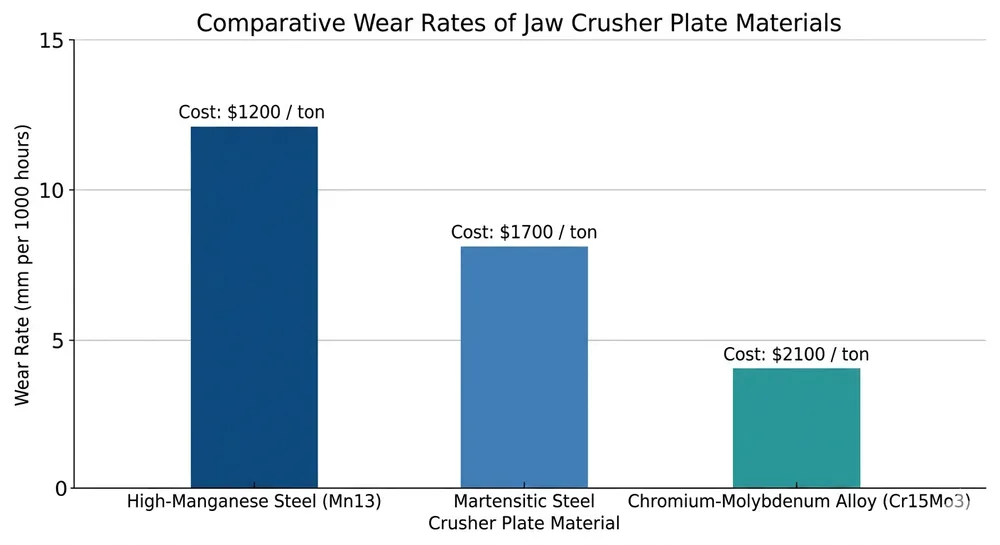
Wear parts replacement. Vibrating screens, magnetic separator belts, and cyclone liners wear out. Budget $12,000-18,000 per year for a 15-ton line. We ship wear parts kits with 12-month supply included, and most buyers reorder annually. Lead time is 4-6 weeks, so don't wait until you're down to your last screen deck.
Maintenance labor. Plan for 2-3 hours per week of routine maintenance: greasing bearings, checking belt tension, inspecting screen mesh, cleaning dust collector filters. If you have a maintenance crew already, this folds into their schedule. If you're running lean, it's 150 hours per year you need to account for.
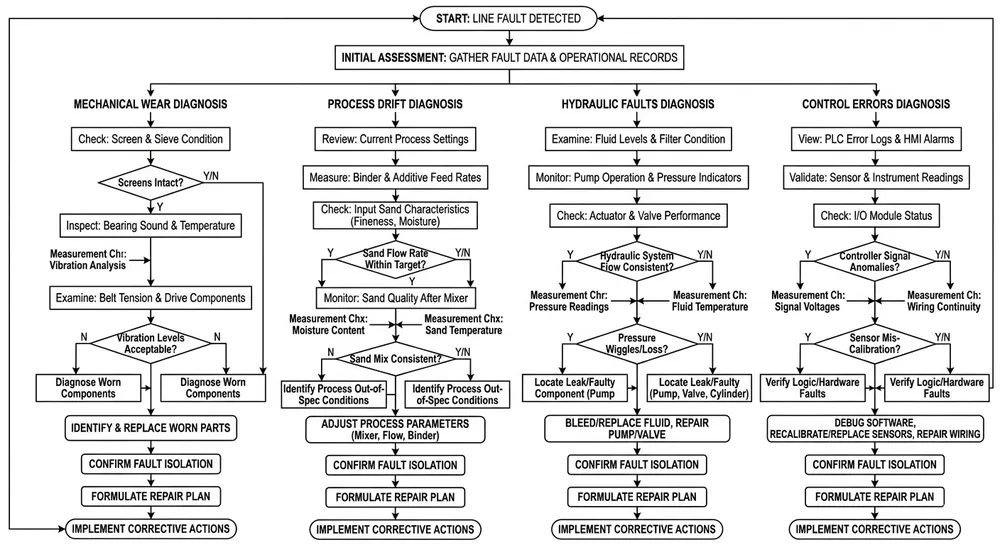
Downtime risk. A reclamation line that's offline means you're back to buying new sand until it's fixed. This is where remote diagnostics matter. Our 4G module lets us troubleshoot from Qingdao without sending a technician to your site. We've resolved 70% of service calls remotely, which keeps your line running and avoids the $3,000-5,000 cost of an on-site visit. Competitors who don't offer remote support leave you waiting 2-3 weeks for a technician, during which you're burning cash on new sand.
Bentonite and water makeup. Even with 95% recovery, you lose 5% of your sand per cycle to dust collection, mold breakage, and carryover. You need to replace that 5% with fresh bentonite and water. At 15 tons per day, that's 0.75 tons per day of makeup material, or $45,000-60,000 per year. This is a real cost, and it's why 95% recovery rate matters more than 90%. That extra 5% is $15,000-20,000 in annual savings.
The total cost of ownership for a 15-ton-per-day line runs $75,000-95,000 per year (electricity, wear parts, maintenance, makeup material). Compare that to $270,000-540,000 in new sand purchase cost, and you're still saving $175,000-445,000 annually after all operating expenses.
Recovery Rate: Why 95% Matters More Than You Think
Most reclamation line suppliers claim 90-95% recovery rate in their brochures. The difference between 90% and 95% sounds small, but it's worth $15,000-20,000 per year on a 15-ton-per-day line.
Here's the math. At 15 tons per day and 360 operating days, you process 5,400 tons annually. At 90% recovery, you lose 540 tons per year. At 95% recovery, you lose 270 tons. That 270-ton difference costs $60-80 per ton to replace with new sand, so the gap is $16,000-21,000 annually.
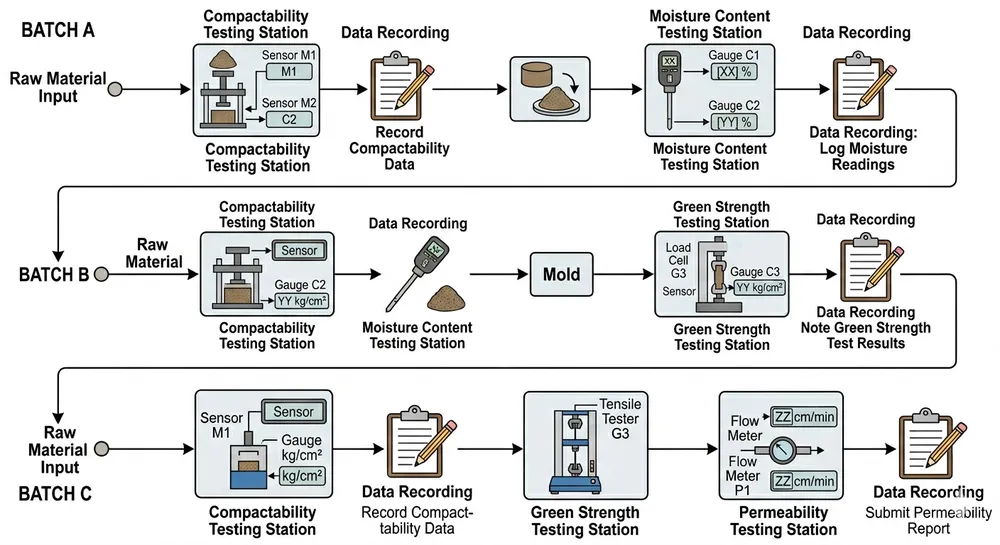
We verify recovery rate in our in-house sand testing lab before every line ships. The test runs 100 kg of used sand through the full reclamation cycle, then measures compaction strength, moisture content, and particle size distribution on the output. If the reclaimed sand doesn't hit 95% of the original green strength, we adjust screen mesh size or cyclone air velocity until it does. The factory-tested commissioning report documents the actual recovery rate, not catalog specs.
(We learned this the hard way. Early export lines in 2012-2013 hit 88-92% recovery because we were using screen mesh sized for domestic sand, which has different clay content than some overseas sources. After three customers complained about higher-than-expected makeup costs, we started testing with the buyer's actual sand before finalizing the screen specification. Recovery rates jumped to 94-96%, and makeup costs dropped.)
The other reason recovery rate matters: it determines how much waste you still send to landfill. At 90% recovery on a 15-ton line, you dump 1.5 tons per day. At 95%, you dump 0.75 tons per day. Disposal cost is $40-70 per ton, so that's $10,000-18,000 per year in tipping fees you avoid by hitting 95% instead of 90%.
If a supplier quotes you a reclamation line without offering to test your sand first, ask why. Either they don't have a testing lab, or they're not confident their equipment will hit the recovery rate they're claiming. Both are red flags.
Modular Design and Landed Cost Impact on ROI
Most buyers focus on the equipment purchase price and forget about shipping. For overseas foundries, freight and import duties can add 25-35% to your landed cost, which directly affects clay sand reclamation line ROI timeline.
Our reclamation lines ship in 2-3 standard containers (20ft or 40ft depending on capacity). Modular design means each major component — magnetic separator, vibrating screen, dust collector, control cabinet — fits container dimensions without custom crating. This cuts your freight cost by 30-40% compared to oversized equipment that requires flat rack containers or break-bulk shipping.
Example: a 15-ton-per-day line ships in two 40ft containers. Ocean freight from Qingdao to Los Angeles runs $4,000-6,000 per container depending on season, so total shipping is $8,000-12,000. A competitor's non-modular line that requires a 40ft flat rack plus one standard container costs $18,000-24,000 to ship the same distance. That $10,000-12,000 difference extends your payback period by 2-3 months.
The modular design also reduces installation time. Each module arrives pre-wired and pre-tested. Your crew bolts the modules together, connects pneumatic lines and power, and you're running sand within 3-5 days. Non-modular systems require field welding, custom ductwork fabrication, and 2-3 weeks of installation labor. Faster installation means you start saving money sooner, which improves ROI.
We've shipped reclamation lines to 40+ countries. The ones that hit their payback timeline are the ones where landed cost stayed within 10-15% of ex-works price. If your freight and duties push landed cost up 30-40%, your payback stretches from 20 months to 28 months. Modular container-optimized design keeps that from happening.
Hidden Costs That Kill ROI: What to Watch For
Some foundries buy a reclamation line expecting 24-month payback and end up at 36 months because they didn't account for these costs:
Inadequate dust collection. Clay sand reclamation generates dust. If your dust collector is undersized or your facility doesn't have adequate ventilation, you'll lose 2-3% more sand to airborne fines than you should. That's $8,000-12,000 per year in extra makeup cost on a 15-ton line. We size dust collectors at 1.5x the minimum CFM requirement specifically to prevent this. Competitors who size at 1.0x minimum save $3,000-4,000 on the dust collector but cost you $10,000+ per year in lost sand.
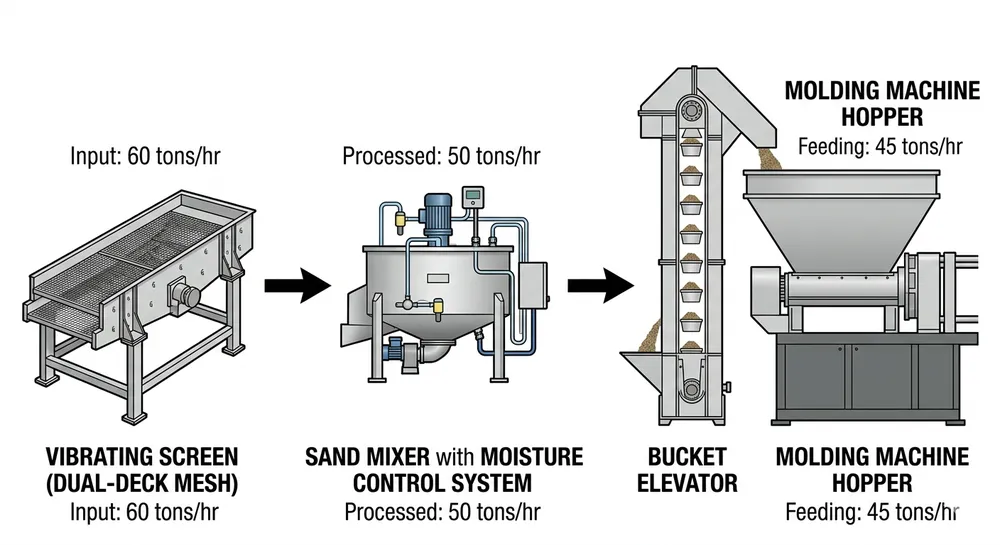
Poor sand preparation upstream. Reclamation works best when incoming used sand is consistent. If your molding line has moisture control problems or your mixers are drifting, the reclamation line has to work harder to bring sand back to spec. This increases wear part consumption and reduces recovery rate. Fix your preparation line first, then add reclamation. We've seen foundries install reclamation and still only hit 88-90% recovery because their mixer wasn't holding ±0.5% moisture tolerance.
Skipping preventive maintenance. Vibrating screens need tension checks every 200 hours. Magnetic separators need belt alignment every 300 hours. Skip these, and you'll have an unplanned shutdown that costs you 2-3 days of production plus emergency freight on replacement parts. The $500 you saved by skipping maintenance turns into $8,000 in downtime cost and expedited shipping. We include a maintenance schedule with every line. Follow it.
Undersizing for future growth. If you're at 12 tons per day now but expect to hit 18 tons per day in two years, size the line for 20 tons per day. The equipment cost difference is $15,000-20,000, but buying a second line later costs $180,000+ and you lose the compounding savings during the gap years. Most buyers undersize because they're focused on minimizing upfront cost. That's a mistake. Size for where you'll be in 3 years, not where you are today.
When Reclamation Doesn't Make Sense
Clay sand reclamation line ROI is strong for most foundries, but there are cases where it's not the right move:
Very low volume operations. If you're under 5 tons per day and not growing, payback stretches past 4 years. At that point, you're better off negotiating bulk pricing on new sand and using capital for higher-ROI investments like molding automation or quality control equipment.
Inconsistent production schedules. Reclamation lines are designed for continuous operation. If you run 3 days per week or have seasonal production, your annual throughput is too low to justify the equipment cost. The line sits idle 50% of the time, but you still have depreciation and maintenance costs. Stick with new sand purchase unless you can consolidate production into longer continuous runs.
Resin sand or no-bake systems. This article is about clay sand reclamation. Resin sand and no-bake systems have different reclamation economics because you're burning off binder, not just cleaning and re-screening. The equipment cost is higher, recovery rates are lower (70-85%), and energy consumption is 3-4x higher. ROI still works at high volume, but the payback timeline is 30-50 months instead of 18-30 months. If you're running resin sand, contact our engineering team for a separate ROI analysis.
Foundries planning to switch sand systems. If you're considering moving from clay sand to resin sand or lost foam in the next 2-3 years, don't invest in clay sand reclamation. You won't hit payback before the equipment becomes obsolete for your process. Make the sand system decision first, then invest in reclamation for whatever system you land on.
Real-World ROI: What Our Customers Actually See
We track post-installation performance on every line we commission. Here's what buyers report 12-18 months after startup:
A mid-sized foundry in Mexico running 18 tons per day saw $340,000 in first-year savings (new sand purchase, disposal, logistics). Their line cost $195,000 landed. Payback hit at 21 months. They're now in year three, and cumulative savings are over $900,000.
A smaller operation in Poland at 8 tons per day saved $125,000 in year one against a $135,000 equipment cost. Payback took 32 months, slightly longer than our estimate because their power rates were higher than expected. Still, they're saving $120,000+ per year now that the line is paid off.
A high-volume foundry in India at 35 tons per day hit payback in 14 months. Their savings were $680,000 in year one against a $310,000 line cost. They added a second line two years later for a different molding area.
The pattern is consistent: foundries that track costs carefully see payback within 18-36 months depending on volume. After payback, the savings compound year after year. A line with a 10-year service life delivers $2-5 million in cumulative savings over its lifetime, depending on throughput.
The foundries that miss their ROI targets are the ones that didn't account for total cost of ownership (electricity, wear parts, maintenance) or didn't verify recovery rate before purchase. That's why we insist on sand testing and factory commissioning before shipment. It costs us an extra week of engineering time, but it prevents the buyer from discovering problems six months later when they're already committed.
How to Calculate Your Specific ROI
Every foundry's clay sand reclamation line ROI is different because costs vary by region, production volume, and sand source. Here's how to run your own numbers:
Step 1: Calculate your current annual sand cost.
- Daily sand consumption (tons) × 360 operating days = annual volume
- Annual volume × delivered cost per ton = total purchase cost
- Add disposal cost: waste volume × tipping fee per ton
- Add logistics: inbound freight, handling labor, storage space cost
Step 2: Estimate reclaimed sand operating cost.
- Annual volume × $6-9 per ton (electricity, wear parts, maintenance, makeup)
- This is your new annual sand cost with reclamation
Step 3: Calculate annual savings.
- Current annual cost – reclaimed sand operating cost = annual savings
Step 4: Get equipment pricing.
- Request a quote for a line sized to your daily throughput
- Add freight, import duties, installation hardware
- This is your total investment
Step 5: Divide investment by annual savings.
- Total investment ÷ annual savings = payback period in years
If your payback is under 30 months, reclamation makes sense. If it's over 40 months, you're either undersized for reclamation or you should negotiate better pricing on new sand and revisit reclamation when your volume grows.
For a detailed ROI analysis specific to your operation, send us your daily throughput, current sand cost, and disposal fees. Our engineering team will run the numbers and send back a breakdown showing payback timeline, annual savings, and total cost of ownership over 10 years. Request an ROI analysis here.
What to Ask Suppliers Before You Buy
Not all clay sand reclamation lines deliver the ROI their sales literature promises. Here's what to verify before you commit:
Ask for factory test data on recovery rate. If they can't show you test results from their own lab using sand similar to yours, they're guessing. We run a 100 kg test batch and provide a commissioning report with actual recovery rate, green strength, and particle size distribution. That report becomes your baseline for ongoing performance.
Ask about remote diagnostics. Downtime kills ROI. If the supplier can't troubleshoot remotely, you're paying $3,000-5,000 for on-site service calls plus 2-3 weeks of downtime waiting for a technician. Our 4G module costs $800 but saves $15,000-20,000 in service costs over the line's lifetime.
Ask about modular shipping. If the equipment doesn't fit standard containers, your freight cost will be 30-40% higher. That extends payback by 2-4 months. Get a container loading plan before you sign the purchase order.
Ask for wear parts pricing and lead time. Some suppliers lowball the equipment price and make it back on expensive wear parts. Get a written quote for a 12-month wear parts kit and confirm lead time. If screens or liners cost 2x what you expected, your operating cost assumptions are wrong and your ROI timeline is wrong.
Ask about total power consumption. Some lines pull 25-30 kWh per ton instead of 15-20 kWh because they're using older motor technology or oversized blowers. That's $5,000-8,000 per year in extra electricity cost on a 15-ton line. Get the nameplate power rating for every motor and calculate total kWh per ton processed.
Making the Decision
Clay sand reclamation line ROI is straightforward: if you're processing 10+ tons per day, the equipment pays for itself in 18-36 months through eliminated sand purchases, reduced disposal costs, and lower logistics expenses. After payback, you're saving $150,000-500,000+ per year depending on volume.
The key is accurate cost accounting. Don't just compare equipment price — calculate total cost of ownership including electricity, wear parts, maintenance, and makeup material. Verify recovery rate with factory testing, not catalog specs. Size the line for where your production will be in 3 years, not where it is today.
For foundries already running clay sand molding lines, reclamation is one of the highest-ROI investments you can make. The savings are immediate, measurable, and compound year after year. The foundries that track costs carefully see payback in under 30 months and cumulative savings in the millions over the equipment's service life.
If you want to run the numbers for your specific operation, send us your daily throughput and current sand costs. We'll calculate your payback timeline and show you exactly what the savings look like over 5 and 10 years. Get your custom ROI analysis.

Baocun Zhu is the Senior Clay Sand Process Engineer at TZFoundry in Qingdao. With over 14 years commissioning clay sand molding, reclamation, and preparation lines for export foundries, he turns floor-space constraints and throughput targets into working production systems. His...