Sand Preparation Systems

Clay Sand Making Line — The Mixing Stage That Determines Mold Quality

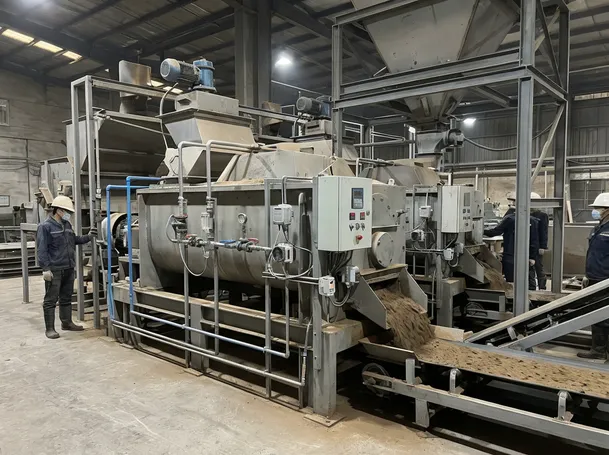
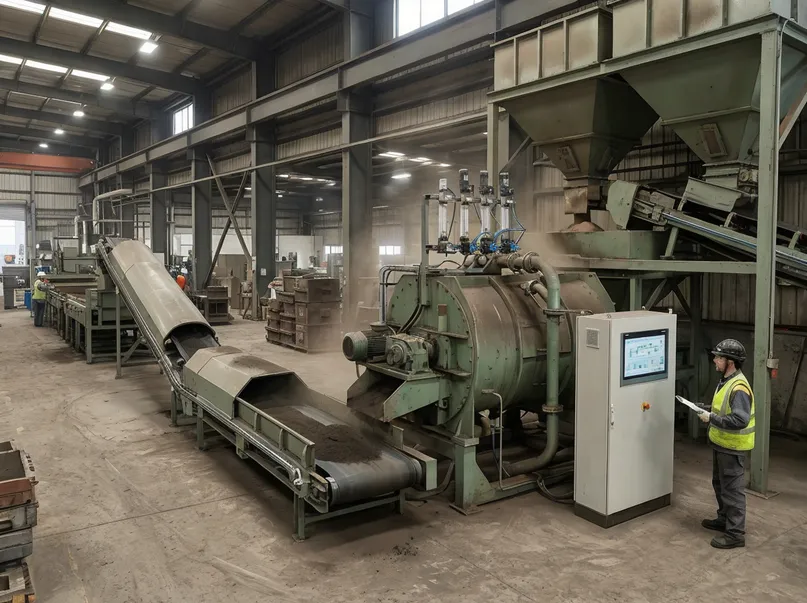
A clay sand making line is the preparation module that combines base sand, bentonite clay, water, and additives into production-ready molding sand. This is the upstream stage in your foundry's production chain — the mixing precision here determines clay activation quality, which directly controls mold strength and permeability downstream. When you order this equipment from us, you're specifying a sand preparation system that either integrates with your existing molding equipment or serves as the foundation for a new production line.

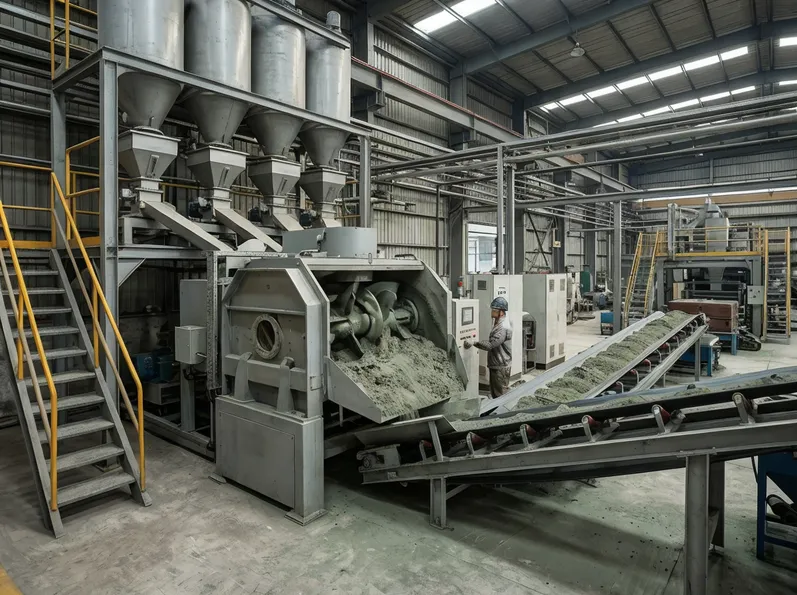
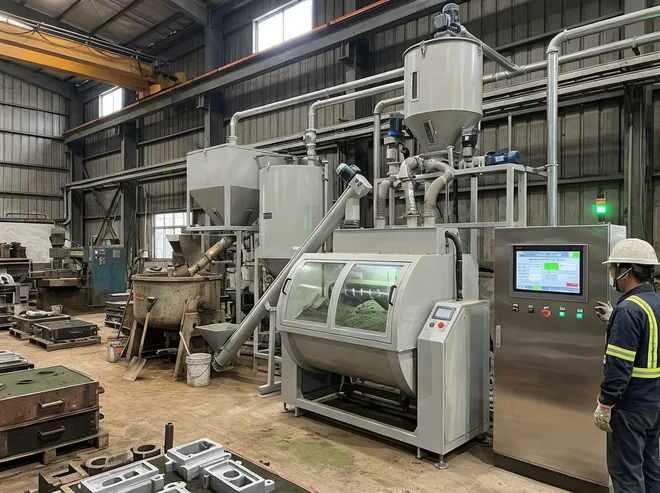
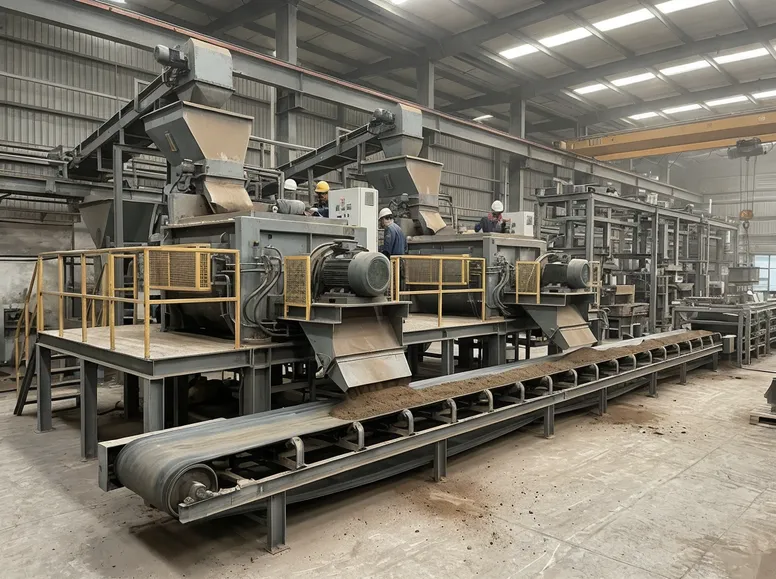
TZFoundry clay sand making line — complete sand preparation system with dosing station, mixer unit, and discharge conveyor

Core System Components

The core system includes three components that work in sequence from raw material intake through prepared-sand discharge.

Dosing Station

Meters clay, water, and additives to target ratios. Accommodates both bulk pneumatic delivery and manual bag addition of clay — no forklift-dependent workflow required.

Mixer Unit

Paddle mixer design disperses clay uniformly through the sand mass. Holds clay distribution to within 5% variation across batch samples, measured by density testing at six points in the discharge stream.

Discharge Conveyor

Moves prepared sand to your molding station or storage hopper. Output height matches standard molding machine input for direct integration without custom transfer systems.

Optional Modules

Add-on modules for foundries that need tighter process control, multi-alloy flexibility, or inline quality verification before sand reaches the molding stage.

PLC-Based Recipe Storage

For foundries running multiple alloy types that need different sand formulations. Store and recall recipes by job number — eliminates manual re-calibration between production runs.

Real-Time Moisture Sensors

Auto-correct water dosing to hold ±0.5% moisture tolerance. Closed-loop control removes operator guesswork from moisture adjustment during ambient temperature and humidity shifts.

Inline Clay Analyzers

Verify clay content before sand reaches the molding stage. Catches dosing drift or raw-material variation before it becomes a casting defect.

Full-Line Integration

We design every system to integrate with standard foundry equipment — our discharge conveyors match the input height of most molding machines, and the dosing hoppers accommodate both bulk pneumatic delivery and manual bag addition of clay.

If you're building a complete clay sand processing line, this mixing module feeds directly into our molding systems and receives reclaimed sand from our washing equipment. If you're upgrading an existing foundry, we'll configure the system to work with your current molding machines and reclamation loops.

Why Mixing Consistency Matters

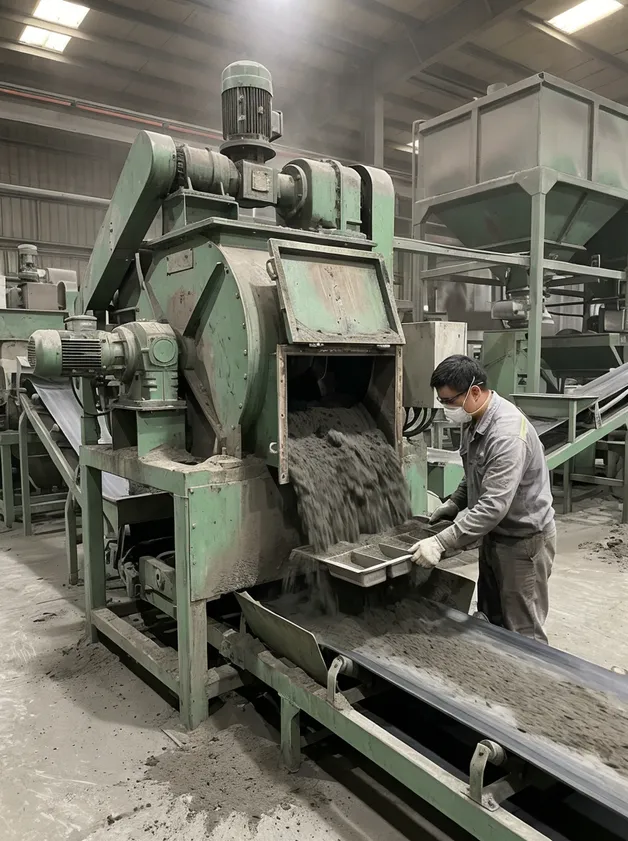
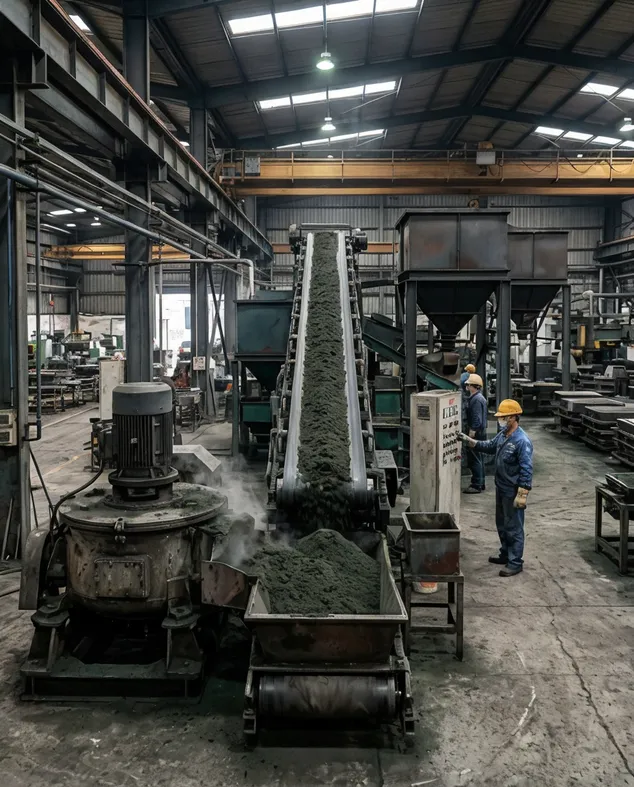
Inconsistent mixing creates inconsistent castings. When clay distribution varies by more than 10% across a sand batch, you get molds with weak spots that crack during handling or pouring — which means scrap castings and rework costs. Our paddle mixer design holds clay distribution to within 5% variation across batch samples (measured by density testing at six points in the discharge stream), which translates to consistent mold properties shift after shift.

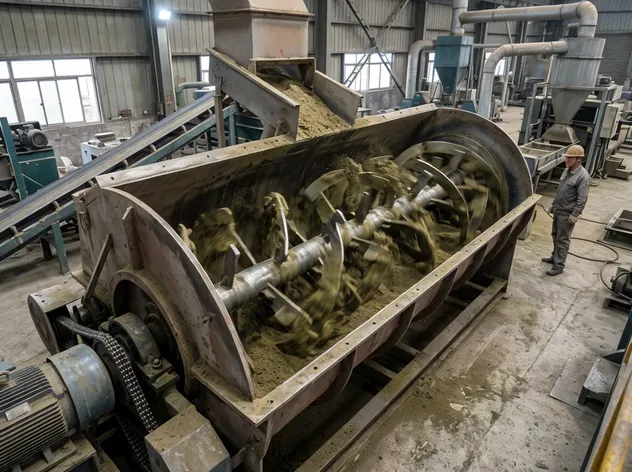
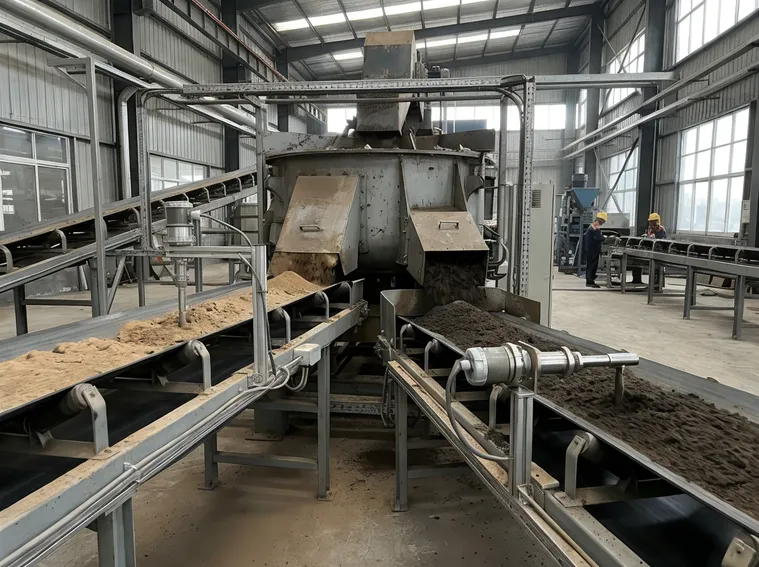
Paddle mixer unit showing clay distribution testing across discharge stream

45–60

Days Lead Time

Deposit to factory departure

≤10

Days On-Site Commissioning

Two technicians through first production shift

±0.5%

Moisture Tolerance

With real-time sensor module

≤5%

Clay Distribution Variation

Six-point density testing at discharge

We build to order because every buyer's mixing capacity target and integration requirements differ. Commissioning happens within 10 days of equipment arrival at your facility — we send two technicians who stay until your first production shift runs at target output with stable batch quality.

System Configurations

System Configurations by Mixing Capacity

Clay sand making lines scale across three capacity ranges, and the equipment differences between them aren't just about throughput — they're about dosing precision, automation level, and recipe flexibility. A 3–5 tons-per-hour system uses volumetric dosing and manual recipe changes. An 8–12 tons-per-hour line adds gravimetric dosing and PLC control with stored recipes. A 15–20+ tons-per-hour system runs continuous mixing with real-time parameter adjustment and zero-operator dosing intervention.

Configuration

Small-Batch Configuration

3–5 Tons/Hour

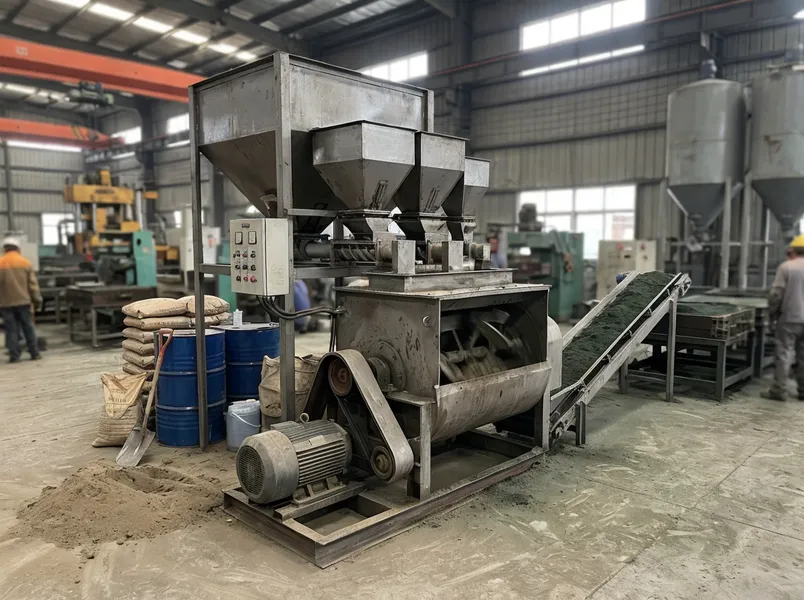
This setup works for foundries running 1–2 shifts with frequent product changeovers. The dosing station uses volumetric feeders — you set the clay hopper gate opening and water valve position manually based on your target formulation, then the system delivers those volumes for each batch cycle. Mixing happens in a 500-liter paddle mixer with a 90-second dwell time, which produces sand with less than 8% density variation across the batch.

Power Requirement 22 kW total
System Footprint 6m × 4m
Mixer Capacity 500 L paddle mixer
Dwell Time 90 sec per batch cycle

Operator requirement: One operator per shift to manage dosing adjustments, monitor batch quality, and handle recipe changes when switching between product types.

This configuration makes sense when your casting volumes don't justify continuous production, or when you're running a wide product mix that requires different sand formulations — higher clay content for thin-wall castings, lower clay for heavy sections. This setup is common in job shops and prototype foundries where flexibility beats throughput.

Small-batch clay sand making line configuration with 500-liter paddle mixer and volumetric dosing station, 3-5 tons per hour capacity

Trade-Off: Volumetric Dosing Precision

Batch-to-batch consistency drops slightly because volumetric dosing doesn't compensate for clay bulk density variations. Bentonite clay can vary ±10% in bulk density depending on moisture content and particle size distribution.

Decision threshold: If your castings tolerate ±2% variation in mold properties, this system is sufficient. If not, step up to the mid-volume system with gravimetric dosing.

Molding Throughput & Recipe Changeover

Mixing capacity of 3–5 tons per hour supports molding operations running 50–80 molds per hour (assuming 40–60 kg of sand per mold). If you're casting smaller parts or running lower production volumes, this system provides enough capacity with room for peak-period buffer.

Recipe Change Time: 5–8 Minutes

The operator drains the current batch, adjusts the dosing gates and water valve to new settings, and runs a test batch to verify the formulation before resuming production.

Supported Mold Rate 50–80 molds/hour at 40–60 kg sand per mold

Mid-Volume Configuration (8–12 Tons/Hour)

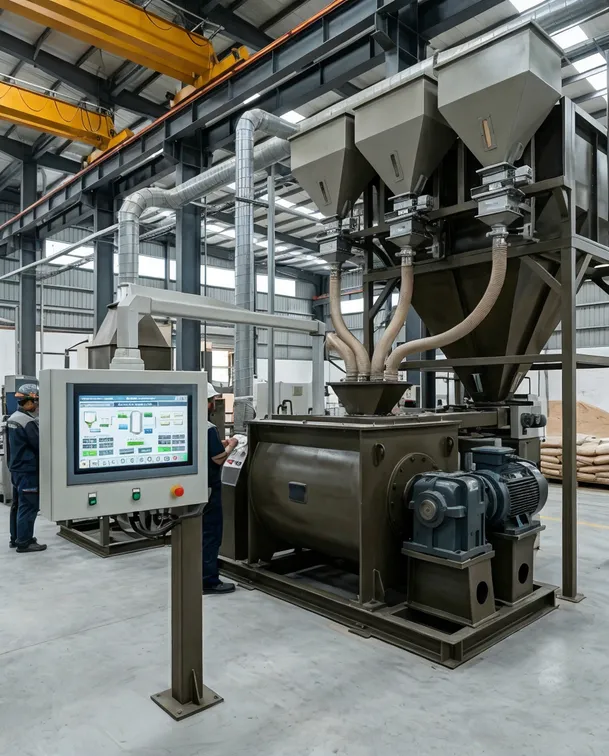
Gravimetric dosing enters at this tier — the system weighs clay and sand inputs in real time and adjusts feed rates to hit target ratios regardless of bulk density variations. The PLC stores up to 20 different sand recipes (each with specific clay percentage, moisture content, and additive dosing rates), and you recall them with a touchscreen tap — no manual gate adjustments, no test batches to verify settings. The mixer upgrades to a 1,200-liter intensive paddle design with variable-speed drive, so you can adjust mixing intensity based on clay type and target dispersion quality.

10m × 6m Footprint
45 kW Power Demand
1 Operator Per Shift
20 Recipes PLC Storage

Footprint expands to 10m × 6m, and power demand hits 45 kW. You'll still run one operator per shift, but their role shifts from manual dosing control to exception handling — they intervene only when the PLC flags an out-of-spec condition (clay hopper running low, moisture reading outside tolerance, mixer motor current spike indicating overload). This configuration suits foundries running 2–3 shifts with moderate product variety (5–10 core sand formulations). The PLC's batch tracking integrates with ISO 9001 quality systems, which matters if you're exporting castings to buyers who audit your production records.

Mid-volume clay sand making line configuration with gravimetric dosing system, 1200-liter intensive paddle mixer, and PLC touchscreen control panel

Mid-volume configuration with gravimetric dosing and PLC recipe management — 8–12 tons/hour throughput.

Gravimetric Dosing — Clay Waste Reduction

Gravimetric dosing cuts clay waste by 15–20% compared to volumetric systems because you're not overfeeding to compensate for bulk density uncertainty. On a foundry processing 50 tons of sand per week, that's 150–200 kg of clay saved weekly — which adds up to $1,500–2,000 annually at typical bentonite prices.

ROI math: The equipment premium for gravimetric dosing (about 40% more than the base volumetric system) pays back within 18–24 months through reduced clay purchasing and improved batch consistency (fewer rejected molds due to strength variations).

Real-Time Moisture Control

Real-time moisture control is standard in this configuration. Capacitance sensors measure sand moisture at the mixer discharge, and the PLC adjusts water injection on the next batch cycle to hold ±0.5% of target.

If you're targeting 4% moisture and the sensor reads 4.6%, the system reduces water dosing by the calculated amount to bring the next batch back to spec. This auto-correction eliminates the manual moisture testing and adjustment cycle that volumetric systems require — which typically involves pulling samples every 2–3 hours, oven-drying them to measure moisture, then tweaking the water valve setting.

High-Volume Configuration (15–20+ Tons/Hour)

Continuous mixing replaces batch operation — sand flows through the system in a steady stream, with clay and water injected at metered rates to maintain target formulation. This setup is for foundries running 24/7 production with narrow product ranges (1–3 sand formulations that rarely change).

System Architecture

  • Dual paddle mixers in series — first stage disperses clay, second stage homogenizes moisture
  • Predictive maintenance sensors on all rotating equipment — 48-hour advance warning before a bearing or motor fails
  • Closed-loop moisture control — PLC adjusts water injection in real time based on continuous moisture measurement, not batch-to-batch correction

14m × 8m

Footprint

75 kW

Power Demand

≤3%

Clay Variation

1 Operator

Per Shift

The operator's role is primarily monitoring — the system runs autonomously, and intervention happens only for recipe changes, raw material replenishment, or alarm conditions. Continuous mixing holds clay distribution to within 3% variation across the sand stream, tighter than batch systems because there are no start/stop transients that create concentration spikes.

High-volume continuous clay sand mixing configuration with dual paddle mixers and closed-loop moisture control — 15 to 20+ tons per hour capacity

Cost & Production Match

This configuration costs roughly 2.2× the small-batch system, but it's the only option that supports molding operations above 200 molds per hour without building up sand inventory between mixing and molding.

The continuous output matches continuous molding demand — no cycling through fill-wait-discharge sequences that create production rhythm mismatches.

Field-Proven at Scale

TZFoundry built one of these continuous mixing systems for a North American buyer in 2018 — it's still running at their facility, feeding a high-speed molding line that produces 240 molds per hour with consistent sand properties across 12-hour shifts.

Upgrade Path — Scale Without Starting Over

If you start with a small-batch system and later need more capacity, you can retrofit gravimetric dosing and PLC control without replacing the core mixer — assuming the mixer has sufficient volume for your new throughput target. The upgrade takes about one week of downtime and costs 35–40% of a new mid-volume system.

Important: Batch → Continuous Is Not a Retrofit

We don't recommend trying to upgrade a batch system to continuous operation. The structural differences — continuous feeders, dual mixers, real-time control loops — require a ground-up rebuild. If you need to double capacity, it's more cost-effective to add a second batch system in parallel rather than attempting a conversion.

35–40%

Retrofit cost vs. new mid-volume system

~1 Week

Typical upgrade downtime

Parallel

Recommended path for 2× capacity

Mixing Precision & Clay Activation Chemistry

Horizontal Paddle Mixer — Three-Dimensional Tumbling Geometry

Our paddle mixer design uses a horizontal shaft with angled paddles arranged in a helical pattern — this geometry creates both radial mixing (paddles throw sand outward against the chamber wall) and axial mixing (the helical arrangement moves sand along the shaft length). The combination produces three-dimensional tumbling that disperses clay particles uniformly through the sand mass in 90 seconds of dwell time.

Competing designs often use vertical-shaft mixers with flat paddles, which create good radial mixing but poor axial flow — you get clay concentration gradients along the mixer height that show up as strength variations in your molds.

Horizontal paddle mixer with helical paddle arrangement showing radial and axial mixing flow paths in TZFoundry clay sand making line

Why Paddle Geometry Controls Clay Activation

Paddle geometry matters because clay activation depends on mechanical shearing. Bentonite clay particles are platelets roughly 1 micron thick and 10–50 microns in diameter. When dry clay contacts water in the mixer, the platelets absorb moisture and swell — but they don't automatically disperse through the sand. You need shear force to break up clay agglomerates and coat individual sand grains with clay films.

Paddle-Sand Shear

Shear force generated at the paddle-sand interface, where sand slides along the paddle surface, breaks up bentonite agglomerates and disperses clay films onto individual sand grains.

Sand-Wall Shear

Additional shear at the sand-wall interface, where the paddle throws sand against the chamber lining, provides a second dispersion mechanism for complete clay activation.

Insufficient shear risk: Clay clumps left in the mix create weak spots in molds — those areas have excess clay (too much binder, poor permeability) while surrounding areas have deficient clay (insufficient strength).

Manganese Steel Chamber Lining

Mixer chamber lining uses manganese steel plate, not mild steel or rubber. Manganese steel work-hardens under impact, so the lining actually gets more wear-resistant over time as sand particles strike the surface.

Mild steel linings wear through in 6–12 months of continuous operation.

Rubber linings (used by some manufacturers to reduce noise) create a soft impact surface that reduces shear intensity — mixing quality degrades.

Our manganese steel linings run 3–5 years before replacement. Wear pattern is predictable (most wear in the discharge zone where sand velocity is highest), allowing planned replacement during scheduled maintenance windows.

Paddle Wear & Replacement

Paddle wear intervals run 12–18 months in typical foundry service (processing silica sand with 8% bentonite clay). The paddles are bolt-on replacements — you don't need to remove the mixer shaft or disassemble the chamber.

Detail Value
Cost per paddle $80–$120
Paddles per set 12–16 (varies by capacity)
Replacement time ~4 hours
Spare sets included 2 sets shipped with every system

You'll see the need for replacement as a gradual increase in mixing time needed to achieve target dispersion quality.

Real-Time Moisture Control

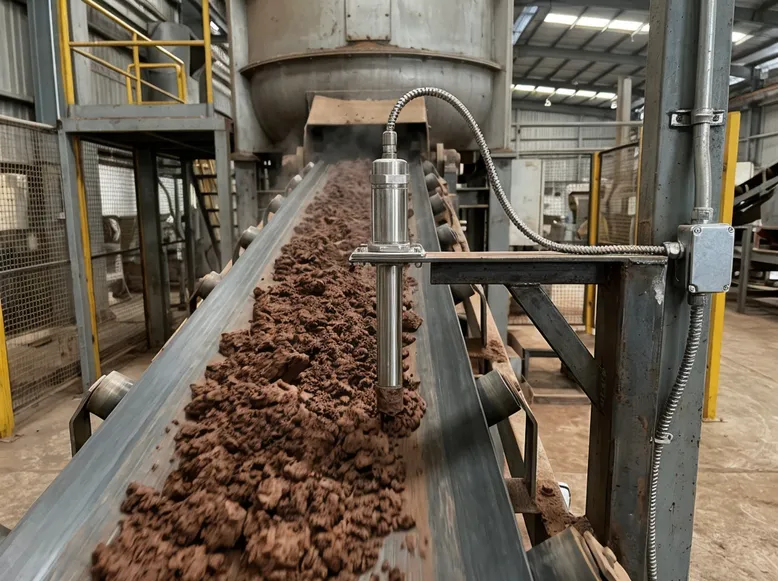
Moisture control uses capacitance sensors mounted in the discharge conveyor, positioned to measure sand moisture as it exits the mixer. The sensor generates an electrical field through the sand stream, and moisture content affects the field's capacitance — water has a much higher dielectric constant than sand or clay. The PLC reads capacitance every 2 seconds and converts it to moisture percentage using a calibration curve specific to your sand type.

Target moisture range for most clay sand systems is 3–5% by weight. Too low and the clay doesn't activate fully, producing weak molds. Too high and the sand becomes sticky and difficult to handle — clogging conveyors and sticking to patterns.

Correction Speed

  • Batch systems: Adjustment applies on the next batch cycle. Moisture returns within ±0.5% of target within 2–3 batch cycles.
  • Continuous systems: Adjustment within 10–15 seconds. Correction achieved in 30–45 seconds.
Capacitance moisture sensor mounted on discharge conveyor measuring clay sand moisture in real time

How Real-Time Adjustment Works

Automated correction vs. manual testing cycle

Automated (PLC)

If the sensor reads 5.3% moisture when targeting 4.5%, the PLC calculates the water reduction needed based on sand flow rate and current water injection rate, then adjusts the water valve accordingly. Correction returns moisture within ±0.5% of target within 2–3 batch cycles or 30–45 seconds for continuous systems.

Manual (No Sensors)

Pull a sample every 2 hours. Oven-dry it for 30 minutes to measure moisture. Adjust the water valve manually and hope the correction was accurate. This cycle repeats with no feedback loop between measurements.

Clay Dosing Accuracy — Gravimetric Systems

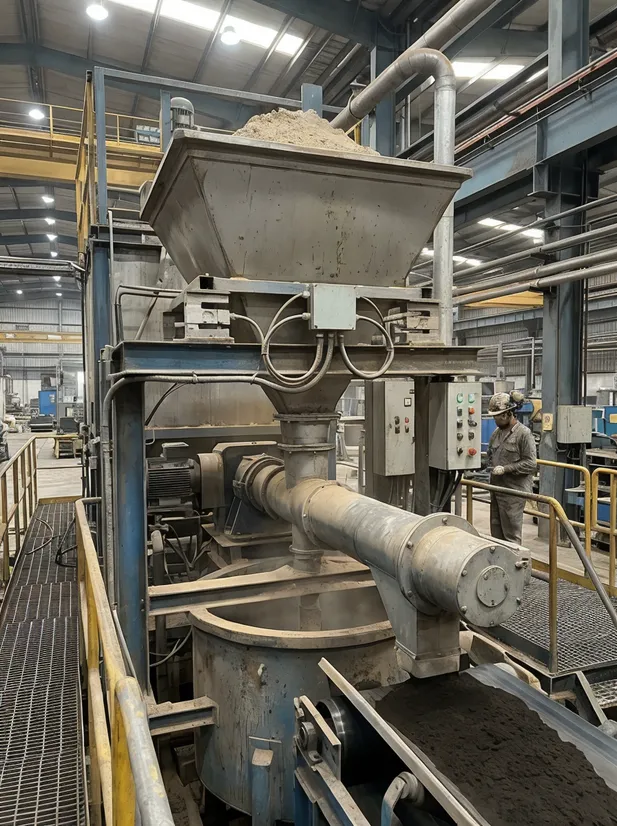
Clay dosing accuracy in gravimetric systems runs ±1.5% of target weight. If you're targeting 8% clay content (80 kg of clay per 1,000 kg of sand), the system delivers 78.8–81.2 kg per batch. That tolerance accounts for feeder response time — the screw feeder or belt feeder takes 1–2 seconds to start and stop, during which some clay continues to flow — and scale resolution, where most industrial scales read to ±0.1% of capacity.

Tighter tolerance (±1%) is possible with high-resolution load cells and faster feeder shutoff valves, but the equipment cost increases by 20–25% and the practical benefit is minimal. Mold property variation from other sources — sand grain size distribution, compaction pressure variation, ambient temperature effects — typically exceeds ±1% anyway.

Dosing Tolerance Trade-Off
Parameter Standard (±1.5%) High-Precision (±1%)
Delivery per 1,000 kg sand (8% target) 78.8–81.2 kg 79.2–80.8 kg
Load cell resolution Standard (±0.1% capacity) High-resolution
Feeder shutoff Standard valve Fast shutoff valve
Equipment cost impact Baseline +20–25%

Practical benefit of tighter tolerance is limited because mold property variation from sand grain size distribution, compaction pressure, and ambient temperature typically exceeds ±1%.

Gravimetric clay dosing system with screw feeder and load cell scale on clay sand making line

Mixing Uniformity Testing Protocol

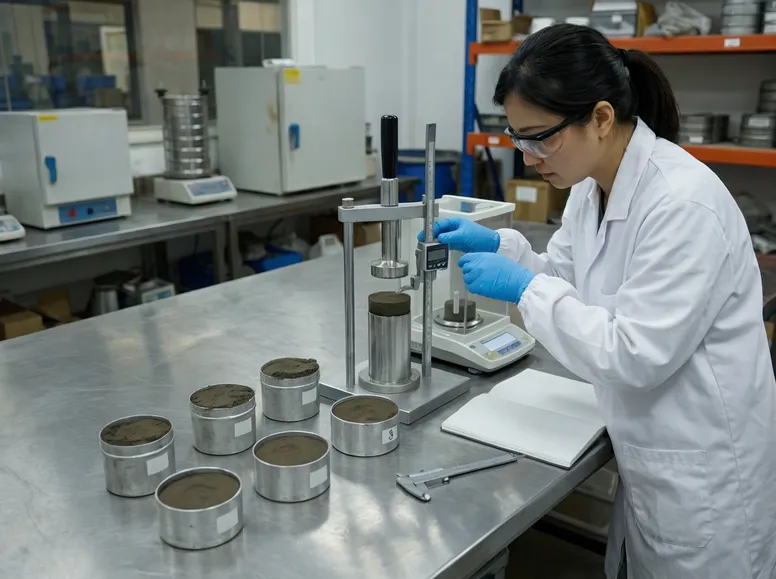
Mixing uniformity testing involves pulling six samples from different points in a batch (or from a 60-second window in continuous operation) and measuring their density. Each sample is compacted in a standard cylinder under controlled pressure, then weighed and measured for volume to calculate bulk density. Density variation reflects clay distribution — areas with more clay compact to higher density, areas with less clay compact to lower density.

Our systems produce sand with less than 5% density variation across the six samples — meaning if the average density is 1.60 g/cm³, all samples fall between 1.52–1.68 g/cm³. That's sufficient for most gray iron and ductile iron castings.

For aluminum or bronze work where surface finish drives your pricing, consider the high-shear mixer option — it cuts density variation to under 3% but adds 8 kW to your power consumption and increases paddle wear rate by 30–40%.

Clay sand mixing uniformity density testing — six-sample batch protocol showing compaction cylinder and measurement setup

Common Mixing Failures — Engineered Out

These aren't theoretical problems — they're issues observed in early systems and resolved through design iteration.

Clay Clumping

Cause: Adding dry clay directly to wet sand.

Solution: Water and clay are injected simultaneously so they contact each other before contacting the sand mass — preventing clump formation at the source.

Moisture Stratification

Cause: Adding all water at one point in the mixer.

Solution: Multiple injection nozzles distributed along the mixer length ensure even moisture distribution throughout the entire sand volume.

Incomplete Discharge

Cause: Sand buildup in mixer corners creating dead zones.

Solution: Chamber design uses radiused corners and a steep discharge angle that prevents dead zones and ensures complete batch evacuation.

Field Case: European Foundry, 2016

A European buyer reported 15% of their batches had clay clumps visible in the molded surface. The root cause was a single-point water injection system. After redesigning their water injection to use three nozzles instead of one, the clumping problem was completely eliminated.

Cost & Efficiency Analysis

Operational Cost & Efficiency

Energy Consumption Per Ton of Mixed Sand

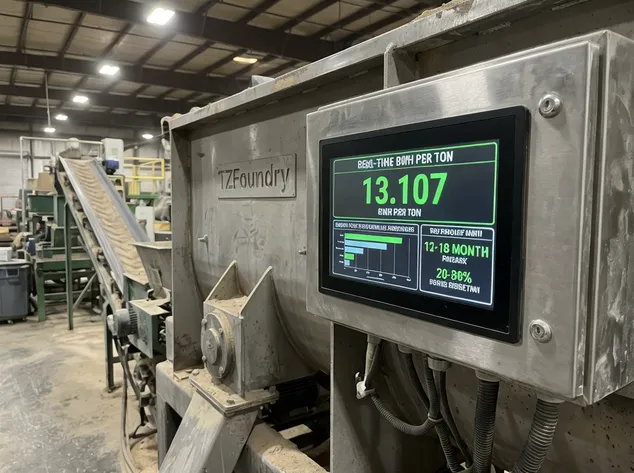
Energy consumption per ton of mixed sand runs 8–12 kWh in mid-volume batch systems and 6–8 kWh in high-volume continuous systems. The efficiency gain at higher volumes comes from eliminating start/stop cycles — batch systems waste energy accelerating the mixer to operating speed and decelerating between batches, while continuous systems run at constant speed.

A mid-volume line processing 50 tons per day consumes roughly 400–600 kWh daily. At $0.12 per kWh (typical industrial rate in export markets), that's $48–72 per day or $1,440–2,160 per month in electricity cost.

Energy Load Breakdown by Component

Mixer Motor 60%
Dosing Feeders 25%
Conveyor Motors 15%
Energy consumption monitoring panel on a TZFoundry clay sand making line mixer showing real-time kWh per ton metrics

VSD Payback Math

If energy cost is a major concern, focus on mixer efficiency — variable-speed drives let you reduce mixing intensity for easy-to-disperse clay types (sodium bentonite activates faster than calcium bentonite), cutting power draw by 20–30% without sacrificing batch quality.

VSD premium over fixed-speed ~$2,000
Payback period (multi-shift) 12–18 months

Clay Additive Consumption: Fresh Sand vs. Reclaimed Sand

Clay additive consumption depends on your target clay content and whether you're mixing fresh sand or reclaimed sand. For most ferrous castings, the target clay content is typically 8–10% by weight. The difference in operating cost between fresh-sand and closed-loop reclamation systems is dramatic.

Fresh Sand System

No reclamation loop — you're adding the full target clay content (8–10% by weight) on every batch.

Daily clay usage (50 t/day line)

4–5 tons of clay per day

Monthly clay usage

120–150 tons per month

Monthly clay cost

$24,000–$45,000/month (at $200–300/ton delivered)

Note: Bentonite clay costs vary by region and grade. Budget $200–300 per ton delivered for planning purposes.

Recommended

Closed-Loop Reclamation

Reusing 80–85% of sand. You only replace the clay lost in waste fines and contaminated sand (the 20% waste stream).

Clay addition rate

~1.6 kg of fresh clay per ton of processed sand

Daily clay usage (50 t/day line)

80 kg of clay per day

Monthly clay usage

2.4 tons per month

Monthly clay cost

$480–$720/month

98% reduction in clay cost vs. fresh sand operation. Reclamation adds 40–50% to total system cost but clay savings alone pay back the investment within 6–12 months.

Need a cost model for your specific throughput and market?

Our engineers can build a detailed energy and materials cost projection based on your production schedule, local utility rates, and clay sourcing options — including ROI analysis for reclamation upgrades.

Explore Reclamation Lines

Water Consumption

Water usage runs 20–40 liters per ton of mixed sand, depending on target moisture content and incoming moisture of your base sand. Reclaimed sand typically arrives at 1–2% moisture (residual from the washing process), so you're adding 2–3% additional moisture to reach the 4–5% target. Fresh sand arrives bone-dry (0% moisture), requiring the full 4–5% addition.

Example — 50 ton/day line: 1,000–2,000 liters daily. On municipal water, that's approximately $50–100 per month — negligible cost.

If you're trucking water or operating in a water-scarce region, consider the closed-loop water recycling option. It captures moisture from the reclamation system's washing stage and returns it to the mixing stage, cutting makeup water needs to 5–10 liters per ton (only replacing evaporation losses).

Filter Replacement Intervals

Filter replacement intervals depend on dust generation from clay handling. Two filters to track:

1

Dosing Hopper Dust Collector Filter

Replace every 4–6 months (more often with fine-grind bentonite generating more airborne dust during transfer). Cost: $150–200 each. Swap time: ~30 minutes — slide-out cartridge design, no tools required.

2

Mixer Vent Filter

Captures moisture vapor during mixing. Lasts 12–18 months. Cost: $80–120 each.

Annual budget: $600–800 for filter replacements on a mid-volume system.

Maintenance Schedule — Tiered Approach

Daily

5–10 Minutes

Production Operators

  • Lubricate mixer shaft bearings
  • Check belt tension on conveyors
  • Verify sensor readings against manual samples
Weekly

1–2 Hours

Maintenance Technician

  • Check mixer paddle wear
  • Inspect feeder drive chains
  • Test emergency stops and interlocks
Quarterly

6–8 Hours

Production Shutdown Required

  • Change gearbox oil
  • Inspect electrical connections
  • Calibrate load cells & moisture sensors
  • Download PLC logs for trend analysis

Schedule during low-volume periods or between shifts.

Spare Parts Availability for Export Installations

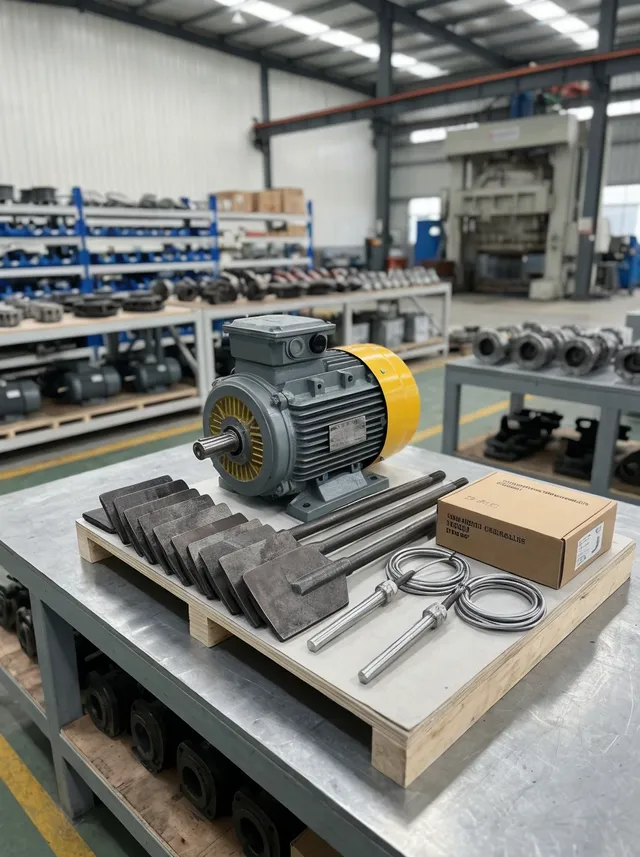
Spare parts availability is critical for export installations because shipping delays can idle your molding operation. TZFoundry stocks high-wear components — mixer paddles, conveyor belts, feeder screws, sensor modules — at the Qingdao facility and ships via DHL or FedEx for 5–7 day delivery to most export markets.

For longer-lead items (motors, gearboxes, PLC controllers), keeping one spare on-site is recommended. The cost is 5–8% of the original equipment price, but it eliminates the risk of a 2–3 week production shutdown waiting for a replacement part to clear customs.

Critical Spares Kit — Mid-Volume System

  • One mixer motor
  • One set of paddles
  • Two moisture sensors
  • One PLC backup

~$3,500

Covers most likely failure modes for 3–5 years

Request spares list
TZFoundry clay sand making line critical spare parts kit including mixer motor, paddles, moisture sensors, and PLC backup module

Labor Requirements & Operator Skill Levels

All configurations — small-batch, mid-volume, and high-volume — require one operator per shift. The distinction lies in the operator's role at each automation tier:

Small-Batch Systems

Manual dosing adjustment and recipe changes. Requires foundry experience but no specialized training — TZFoundry provides 2–3 days of on-site instruction during commissioning.

Mid-Volume (PLC-Controlled) Systems

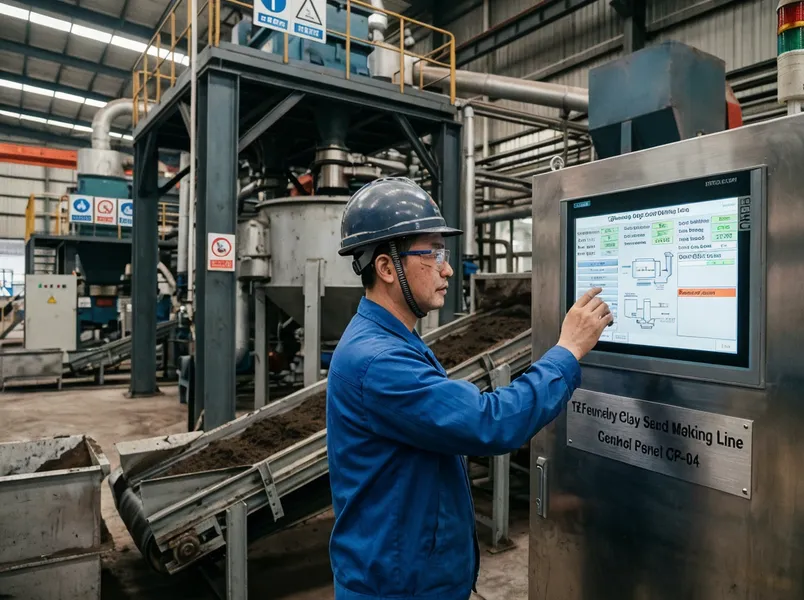
Exception handling and quality monitoring. Operators need the ability to navigate touchscreen interfaces and interpret alarm codes — not advanced programming, just reading error messages and following troubleshooting procedures. Plan for an extra 2–3 days of training if your team lacks this background.

High-Volume Continuous Systems

Primarily oversight. The automation handles dosing, mixing cycles, and quality checks. The operator monitors system status and responds only to flagged exceptions.

Operator using PLC touchscreen interface on TZFoundry clay sand making line

Clay Efficiency & Raw Material Cost Impact

Clay efficiency is the largest operational variable you control. Moving from a fresh sand system (100% clay addition) to a closed-loop system with 80% reclamation delivers transformative savings.

Clay Purchasing Reduction

98%

Closed-loop reclamation cuts clay purchasing by 98% compared to fresh sand systems.

Monthly Clay Savings (50 t/day)

$23K–$44K

Per month in clay cost savings alone on a 50-ton-per-day operation.

Equipment Payback

2–4 mo

Reclamation and washing equipment investment of $80,000–$120,000 pays back in 2–4 months through clay savings alone.

Additional savings from reduced sand purchasing and waste disposal costs are not included in the payback calculation above — actual ROI timeline is often shorter.

Retrofit & Integration

Integration with Existing Foundry Equipment

Scenario 1: Upgrading from Manual Mixing

Job shops & 1–2 shift operations

You're currently mixing sand in a muller or paddle mixer with manual clay and water addition, which means batch consistency depends on operator skill and attention. Every shift change introduces variation because different operators have different pouring techniques and timing. Automated dosing eliminates that human variable — the system delivers the same clay weight and water volume for every batch, regardless of who's running the equipment.

The Commercial Value: Reduced Mold Rejection Rates

Manual mixing typically produces ±10–15% variation in mold strength across a production day (measured by green compression testing). Automated systems hold ±3–5% variation.

If you're currently rejecting 8–10% of molds due to strength defects (cracks during handling, breakage during pouring), automated mixing cuts that to 2–3%.

TZFoundry clay sand making line replacing manual muller mixing in a job-shop foundry — automated dosing upgrade

Scrap Reduction ROI — Annual Savings Math

Weekly Mold Savings

25–35

fewer rejected molds per week on a 500-mold/week foundry

Annual Casting Savings

1,300–1,800

fewer rejected castings per year

Dollar Impact

$19,500–$90,000

annual savings at $15–50 per casting (size-dependent)

PLC Recipe Storage Speeds Changeovers

Manual systems require the operator to reference a recipe card, adjust clay and water dosing by hand, mix a test batch, pull samples for strength testing, adjust again if needed, then resume production — typically 15–25 minutes per changeover.

PLC systems recall stored recipes instantly (one touchscreen tap), and the first production batch meets spec because the dosing parameters are exactly what you validated during recipe development. Changeover time drops to 3–5 minutes (just the time to drain the previous batch and start the new recipe).

Daily recovery: With 3–4 changeovers per shift, you recover 36–80 minutes of production time daily — enough to produce 15–30 additional molds per shift depending on your molding cycle time.

Integration Requirements

Our discharge conveyor needs to match your molding machine's input height (typically 800–1,200 mm above floor level — tell us your dimension and we'll configure accordingly). If you're feeding a hopper instead of direct-to-molding, we'll extend the conveyor or add a chute to reach your hopper inlet.

Electrical integration is straightforward — the mixing line runs independently, no control signals needed from your molding equipment.

Optional interlock logic: Mixing line stops when the molding hopper is full, restarts when it drops below a setpoint. Ultrasonic level sensors wired to both PLCs — $800–$1,200 additional cost.

Scenario 2: Adding Capacity to Existing Lines

For high-volume foundries running a mixing line maxed out at 8–10 tons per hour while molding capacity sits at 12–15 tons per hour, the mismatch forces a costly choice: slow down molding (wasting capacity you've already paid for) or build up sand inventory during off-shifts — which demands floor space and creates material handling complexity. Adding a second mixing line in parallel eliminates the bottleneck entirely.

Parallel configuration means both mixing lines discharge to a common conveyor feeding your molding operation. TZFoundry sizes the second line to complement your existing capacity — if you have 8 tons/hour now and need 15 tons/hour total, we spec a 7–8 ton/hour unit so both lines run at similar utilization. This is fundamentally better than installing a single 15 ton/hour line and idling your existing 8 ton/hour unit. The lines operate independently: if one goes down for maintenance, the other continues at reduced total output rather than shutting down your entire molding operation.

Parallel clay sand mixing line configuration with dual discharge to common conveyor for high-volume foundry capacity expansion

Shared Reclamation Loop Integration

If you're running a closed-loop system, both mixing lines can draw from the same reclaimed sand supply and the same clay storage. TZFoundry upsizes the reclaimed sand conveyor (if needed) to handle the combined mixing capacity, and adds a second clay dosing hopper to the new line that taps into your existing bulk clay silo.

This approach minimizes capital cost because you're not duplicating the entire material handling infrastructure — just the mixing and dosing equipment. Your existing conveyor runs, storage silos, and reclamation circuits remain shared assets across both lines.

The Commercial Value: Throughput Matching

Revenue impact of eliminating the mixing-to-molding bottleneck

$50,000

Molding line daily casting value

$35,000

Mixing-limited daily output

$15,000

Daily revenue left on the table

Unrealized Monthly Revenue

$15,000/day × 30 days = $450,000/month in lost production capacity that your molding line is ready to handle.

Second Mixing Line Payback

A second mixing line costs $40,000–$60,000 depending on capacity — paying back in 3–4 months through additional molding output. After payback, incremental profit drops straight to your bottom line.

Scenario 3: Greenfield Installations (New Foundries)

You're building a foundry from scratch and need to spec the complete sand system. Starting with the mixing line as your foundation makes sense because mixing capacity determines your maximum molding throughput — you can't mold faster than you can prepare sand. We'll size the mixing line to match your target molding capacity with 10–15% buffer (so you're not running the mixer at 100% utilization, which leaves no margin for maintenance downtime or peak-period demand spikes).

System Integration Sequence

Mixing line → molding line → reclamation line → washing line, with conveyors connecting each stage. We design the layout to minimize floor space and material transport distance.

Mixing & Molding

Equipment arranged in a line — sand flows horizontally from mixer discharge to molding hopper.

Reclamation

Positioned below or beside the molding line — used sand drops by gravity from the molding area into the reclamation hopper.

Washing

Adjacent to reclamation with a short conveyor between them.

Return Loop

Washed sand returns to the mixing line's input hopper, completing the closed-loop cycle.

Total footprint for a 10-ton-per-hour integrated system: roughly 25m × 12m

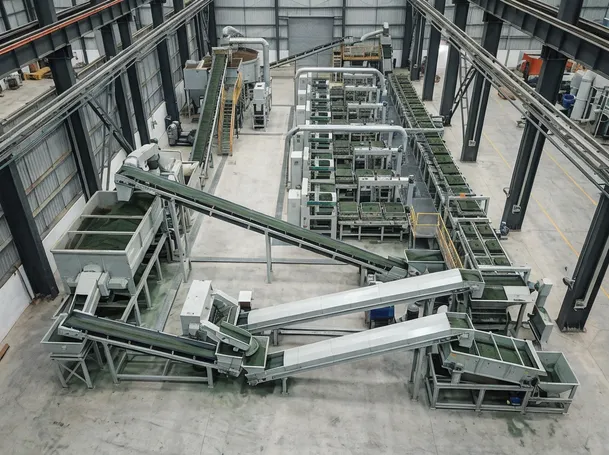
Greenfield foundry installation layout showing mixing line, molding line, reclamation, and washing stages connected by conveyors in a 25m × 12m footprint

Layout Flexibility & Quotation Support

We'll provide a layout drawing during the quotation phase showing equipment positions, conveyor routing, utility connection points, and material flow paths. If your building dimensions or column spacing create constraints, we'll adapt the layout — equipment can be arranged in an L-shape or U-shape instead of a straight line, and conveyors can include elevation changes or horizontal turns to route around obstacles.

The goal is to fit the system into your available space while maintaining efficient material flow: minimal conveyor length, gravity-assisted transfers where possible, and accessible maintenance zones around each equipment piece.

The Commercial Value: Single-Source Integration

Integrated system design eliminates interface problems.

Multi-Vendor Approach

When you buy mixing equipment from one supplier, molding from another, and reclamation from a third, you're responsible for making sure:

  • Discharge height of Unit A matches input height of Unit B
  • Conveyor capacity handles peak flow rates between stages
  • Control systems communicate for automated start/stop sequencing

Buyers often spend 2–3 months troubleshooting interface issues after installation because suppliers each designed equipment in isolation.

TZFoundry Single-Source

When you buy the complete system from us, we own those interfaces:

  • Pre-matched equipment heights and conveyor capacities
  • Integrated PLC control across all stages
  • One point of accountability for every interface

If something doesn't fit or doesn't work, it's our problem to fix — not yours to coordinate between multiple vendors.

Real-Time Process Intelligence

Quality Control & Process Monitoring

Continuous measurement, automatic correction, and operator-level transparency — built into every TZFoundry clay sand making line.

Real-time monitoring points in our clay sand making lines track three parameters that directly affect sand quality: moisture content, clay dosing weight, and mixer motor current. Each parameter gets measured continuously, logged to the PLC's internal memory, and compared against your preset tolerance bands.

When a reading drifts outside tolerance, the system either auto-corrects (moisture and clay weight) or flags an operator alert (mixer current, which indicates mechanical problems rather than process variations).

Monitored Parameters

  • Moisture Content Auto-corrects via water injection
  • Clay Dosing Weight Auto-corrects via gravimetric feeder
  • Mixer Motor Current Operator alert — mechanical flag

Dual-Point Moisture Sensing

Moisture sensors sit at two locations: pre-mixing (measuring the incoming sand moisture before water addition) and post-mixing (measuring the final sand moisture after mixing is complete).

The pre-mixing sensor lets the PLC calculate how much water to add based on the incoming moisture level — if reclaimed sand arrives at 2.5% moisture instead of the expected 1.5%, the system reduces water injection by 1% to hit the same final target.

The post-mixing sensor verifies that the target was achieved and provides feedback for the next batch cycle. Both sensors use capacitance measurement, which responds in under 2 seconds and doesn't require consumable test strips or calibration chemicals.

Dual-point moisture sensing locations in TZFoundry clay sand making line — pre-mixing and post-mixing capacitance sensors
< 2s Sensor Response Time
2 Measurement Points

Moisture Auto-Correction Cycle

Target Range & Tolerance

Target moisture range 3–5% by weight
Tolerance band ±0.5%
Correction convergence 2–3 batch cycles

If post-mixing moisture reads 5.3% when you're targeting 4.5%, the PLC reduces water injection on the next batch cycle by the calculated amount (based on batch size and current injection rate). The correction typically brings moisture back within tolerance within 2–3 batch cycles.

What It Replaces

This auto-correction eliminates the manual testing and adjustment cycle that foundries without real-time sensors have to run:

  1. Pull sand samples every 2 hours
  2. Oven-dry samples for 30 minutes to measure moisture
  3. Adjust the water valve manually
  4. Hope the correction was accurate

Real-time closed-loop control replaces this entire manual workflow.

Clay Dosing Weight Monitoring

Clay dosing weight monitoring happens at the gravimetric feeder's load cell, which measures the cumulative weight of clay delivered during each batch cycle. The PLC compares the actual weight against the target weight — calculated from your recipe's clay percentage and the batch size — and flags any deviation beyond ±1.5%.

If you're targeting 80 kg of clay per batch and the system delivers 76 kg, an alarm triggers and the operator investigates.

Common Causes of Dosing Deviation

Clay Bridging in Hopper

Material stops flowing even though the feeder is running.

Feeder Drive Belt Slippage

The feeder runs but delivers less material than expected.

Dosing Specs

Measurement Method Gravimetric Load Cell
Tolerance Threshold ±1.5%
Example Target 80 kg clay / batch
Alert Type Operator Alarm

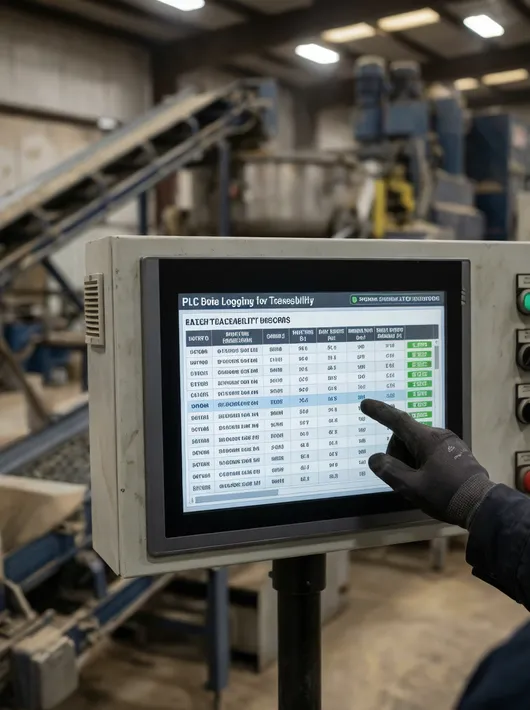
PLC Data Logging for Traceability

PLC data logging for traceability creates a permanent record of every batch's process parameters, timestamped and linked to your production order numbers. This matters for ISO 9001 compliance and for customer audits — if a casting fails in service and the buyer wants to trace it back to the sand batch, you can pull up the exact moisture content, clay weight, mixing time, and mixer motor current from the day that batch was made.

Storage Capacity

The PLC stores 12 months of data internally (approximately 1.5 GB), with export capability to CSV or PDF for long-term archival.

Warranty Defense

Foundries use this data to defend against warranty claims — proving that sand formulation was within spec when the casting was made, establishing that any failure occurred downstream in the customer's machining or assembly process.

PLC data logging interface showing batch traceability records with timestamped process parameters on a clay sand making line

Remote Diagnostics Capability

Remote diagnostics capability means our technicians can log into your PLC via VPN and see the same data your operators see on the factory floor. When you report a problem — say, inconsistent sand strength — we can review the last 48 hours of process data, identify the parameter drift, and walk your team through the fix over a phone call.

This cuts troubleshooting time from days (waiting for a technician to fly to your facility) to hours.

Common Remote Diagnoses

  • Moisture creeping up due to a partially clogged water valve
  • Clay weight dropping due to hopper bridging

Security Protocol

VPN connection is read-only by default — we can view data and download logs, but cannot change setpoints or control equipment unless you grant write access.

Sensor Calibration Intervals

Calibration intervals for sensors follow the manufacturer's specifications. Calibration takes 1–2 hours per sensor and requires reference standards. We provide a calibration kit with each clay sand making line system and include the full procedures in your operations manual.

Every 6 Months

Moisture Sensors

Testing against known-moisture reference samples and adjusting the PLC's calibration curve if needed.

Annually

Load Cells

Using certified calibration weights to verify accuracy across the full measurement range.

Every 2 Years

Motor Current Sensors

Comparing against a clamp-on ammeter to verify the built-in sensor reads correctly.

If you prefer to outsource calibration, most industrial instrumentation service companies can handle it — all sensors use standard 4–20 mA output signals, not proprietary protocols.

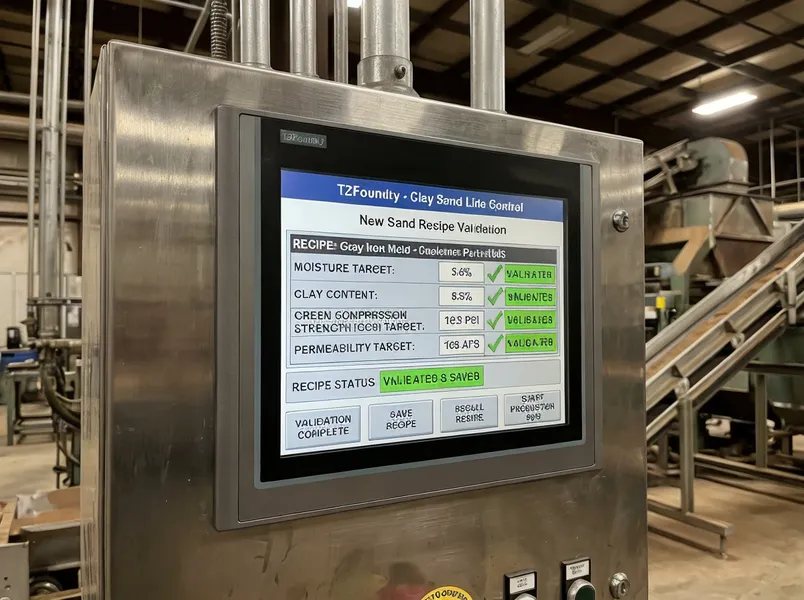
New Sand Recipe Validation

When setting up a different product that requires different clay content or moisture targets, validation follows a structured procedure:

  1. Run 5–10 test batches at your target parameters during a scheduled maintenance window or low-volume shift — not during a production run.
  2. Pull samples from each batch and measure green compression strength, permeability, and moisture content by oven drying.
  3. Adjust PLC setpoints iteratively until all measured properties fall within your quality targets.
  4. Save the validated recipe to PLC memory with a descriptive name — customer part number, alloy type, mold size — so operators can recall it instantly when that order returns.
PLC touchscreen displaying saved clay sand recipe parameters with validation status indicators

Off-Spec Batch Handling Protocol

When the system detects a parameter violation — moisture outside ±0.5% tolerance, clay weight outside ±1.5% tolerance, or mixer motor current 20% above normal — it marks that batch in the PLC log and triggers an operator alert. The PLC does not make the disposition decision; it flags the problem and waits for operator input.

Option 1: Rework

Send the batch back through the mixer with adjusted water or clay addition. Best for minor violations within 10% of target where correction is straightforward and economical.

Option 2: Non-Critical Use

Divert to internal test castings or prototype work where dimensional tolerance is less stringent. Recovers material value without risking production-grade molds.

Option 3: Dump as Waste

For major violations beyond 10% of target, discard the batch entirely. Attempting to salvage severely off-spec sand risks casting defects that cost far more than the wasted material.

Common Foundry Practice

Most foundries configure a simple tolerance threshold in their SOPs: minor violations (within 10% of target) get reworked through the mixer, while major violations (beyond 10%) are dumped immediately. This binary rule eliminates operator hesitation and keeps the line moving.

Proven Partnership

Why Foundries Choose TZFoundry Clay Sand Making Lines

Built on Real Export Experience Since 2010

We've been building clay sand equipment since 2010, and the shift from standalone mixers to integrated preparation systems happened because export buyers needed equipment that delivered consistent results without constant operator intervention.

The first automated mixing line we built for export went to a Middle Eastern foundry in 2017 — they were struggling with 12–15% batch-to-batch variation in mold strength because their manual mixing process depended entirely on operator skill. Our gravimetric dosing system cut that variation to under 5%, and their mold rejection rate dropped from 9% to 3% within the first month of operation. That line is still running, same core equipment, same output quality.

<5%
Batch Variation
9%→3%
Rejection Rate Drop
TZFoundry automated clay sand making line in operation at an export foundry facility

In-House R&D — No Outsourced Design Work

Our in-house R&D team handles custom configurations without outsourcing design work to third-party engineering firms. When you need a non-standard mixer capacity, a different discharge height to match your existing molding equipment, or integration with unusual material handling systems, we're modifying our own designs — not coordinating between multiple vendors who each have their own lead times and compatibility issues.

This matters most when you're retrofitting a mixing line into an existing foundry layout with space constraints or utility limitations.

Compact Footprint

Systems built for 8m × 5m floor spaces where the standard spec calls for 10m × 6m.

Flexible Power

Systems configured for 380V three-phase instead of standard 415V — matched to your facility's supply.

Certified Manufacturing with Full Traceability

ISO 9001:2015

Annual third-party audits verify documented procedures for material sourcing, fabrication, assembly, and testing.

CE Certified

Equipment meets European conformity requirements for safety, health, and environmental protection standards.

SGS Inspected

Independent verification of manufacturing quality that satisfies downstream supplier traceability requirements.

The certifications themselves don't make the equipment better, but they create a paper trail that satisfies your own quality audits and customer requirements. If you're selling castings to automotive or aerospace buyers who require supplier traceability, you'll need to show that your foundry equipment came from a certified manufacturer. We provide the complete documentation package — material certs, test reports, and calibration records — with every system shipment.

Flexible Customization Services — What Costs Extra and What Doesn't

No Engineering Fee

Standard modifications included at no additional cost:

  • Different motor voltages
  • Metric-to-imperial fastener conversions
  • PLC interface language changes
  • Custom paint colors

Paid Customizations

Modifications that require additional engineering work:

  • Non-standard mixer capacities — different chamber dimensions require new fabrication tooling
  • Special materials for corrosive environments — stainless steel instead of carbon steel for coastal installations where salt air accelerates corrosion
  • Third-party component integration — specific PLC or sensor brands not in our standard inventory

Engineering fee for paid customizations: typically 5–8% of base equipment cost, compared to 15–20% charged by job-shop manufacturers.

Professional Export Experience

We handle documentation, shipping logistics, and customs coordination as part of the standard service — you're not hiring a separate freight forwarder and hoping the paperwork matches up.

  • Shipped to 40+ countries — we know which markets require specific certifications (CE for Europe, GOST for Russia, SASO for Saudi Arabia)
  • Every system ships with an English-language operations manual, electrical schematics, spare parts list, and maintenance schedule
  • We know what information customs officials need on commercial invoices and how to pack equipment to survive ocean freight without damage
  • Documentation translation available for non-English markets — adds 1–2 weeks to delivery, costs $400–600 depending on language and document length

After-Sales Support Structure

Most buyers never need an on-site visit after initial commissioning. Our three-tier support model resolves the majority of issues remotely:

1

Remote Troubleshooting via PLC VPN Access

Diagnoses 70–80% of issues without a site visit. Real-time PLC access lets our engineers see exactly what your system sees.

2

Spare Parts from Qingdao Facility

Parts stocked and shipped within 5–7 days to most export markets. No waiting on third-party suppliers.

3

On-Site Service When Needed

Available if remote support doesn't resolve the problem. You cover travel costs, we cover labor. Typically reserved for major component replacement (mixer gearbox rebuild, PLC upgrade) or capacity modifications — not routine troubleshooting.

Operator Training + Documentation + Remote Diagnostics

The combination handles the majority of post-commissioning issues — no on-site visit required.

Project Planning & Deployment

Getting Started — Specification & Installation

Information We Need for an Accurate Quotation

To quote your clay sand making line accurately, we need the following from your team:

  • Target mixing capacity — tons per hour your production schedule demands
  • Integration scope — whether you're connecting to existing equipment or building a completely new line
  • Available floor space — length × width, plus ceiling height if you have overhead material handling
  • Electrical supply specs — voltage, phase, and available amperage
  • Typical sand formulation — clay percentage, moisture content, any special additives
  • Current setup issues — if you're replacing an older mixing system, tell us what's not working. That helps us avoid specifying the same bottlenecks into the new line.
Clay sand making line quotation planning checklist for foundry specification

Site Preparation Requirements

Foundation Specifications

Clay sand making lines generate vibration from the mixer's rotating shaft and paddles, so you need a reinforced concrete slab at least 150 mm thick with rebar reinforcement.

If you're installing on an upper floor, check your building's load rating — a mid-volume system weighs 3–5 tons fully loaded with sand, and dynamic loads during mixing can spike to 1.3× static weight.

We provide foundation drawings with anchor bolt locations and load distribution maps as part of the pre-shipment documentation package.

Ventilation Requirements

Clay handling generates dust even with enclosed hoppers and dust collectors. Plan for 1,000–1,500 m³/hr of exhaust airflow to keep your facility's air quality within occupational health limits.

The dust collector we provide with each system handles the immediate capture at the clay dosing hopper, but you'll need general facility ventilation to manage the ambient dust that escapes during bag handling or bulk delivery connections.

Utility Requirements by System Size

Utility Small-Batch Mid-Volume High-Volume
Electrical Power (Rated) 22 kW 45 kW 75 kW
Recommended Overhead +20% for startup surge current
Water Supply Pressure 0.2–0.4 MPa
Water Flow Rate 10–30 L/min (varies by capacity & target moisture)
Compressed Air (Pneumatic Actuators) 0.6–0.8 MPa supply pressure @ 0.5–1.0 m³/min

Most buyers install a dedicated circuit breaker for the mixing line rather than tapping into existing foundry power — it simplifies troubleshooting and prevents voltage sags from affecting other equipment.

Shipping & Installation Timeline

Total elapsed time from order to first production batch: 65–100 days. Here's the breakdown:

1

45–60 Days

Production time from deposit to factory departure

2

15–30 Days

Ocean freight (depends on destination port)

3

3–5 Days

Customs clearance & inland transport

4

2–3 Days

On-site assembly

5

2–3 Days

Commissioning & operator training

Need faster delivery? Air freight is possible for small-batch configurations only — cuts shipping time to 5–7 days but costs 4–5× more than ocean freight.

Training & Documentation

We provide 2–3 days of on-site training during commissioning, covering startup procedures, normal operation, recipe creation and storage, parameter adjustment, routine maintenance, and basic troubleshooting. Training is hands-on — your operators run the equipment under our technician's supervision until they're comfortable with all normal and exception scenarios.

Documentation Package Includes

  • Operations manual (80–120 pages)
  • Electrical schematics
  • PLC program backup
  • Spare parts catalog with part numbers and supplier contacts
  • Maintenance schedule

All documents ship in English. Other languages available on request for additional cost.

After-Sales Support

Remote Diagnostics via VPN

We can log into your PLC and review process data when you report an issue — no waiting for a site visit to begin troubleshooting.

Spare Parts Ordering

Order through email or WhatsApp — we'll quote price and lead time within 24 hours.

On-Site Service

Available if remote support doesn't resolve the problem.

Response Times

During China Business Hours (UTC+8)

4–8 hours

Outside Business Hours

12–24 hours

Urgent production issues: Contact us via WhatsApp at +86 13335029477 — that number reaches our technical team directly, not a general customer service queue.

Request a Specification & Quote

Contact us at sales@tzfoundry.com with your mixing capacity requirements and integration needs.

Include photos of your existing foundry layout if you're retrofitting — helps us spot potential installation issues before the quotation is finalized.

We'll respond within 24 hours with preliminary specs and pricing.

Detailed proposal follows within 3–5 business days after we've clarified any technical questions.

Get Factory Quote