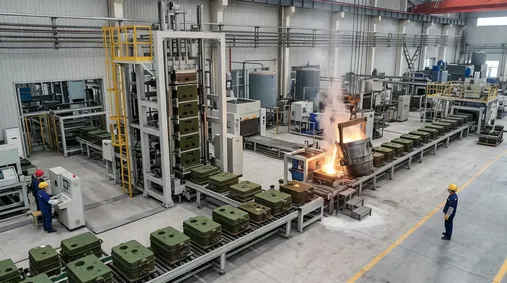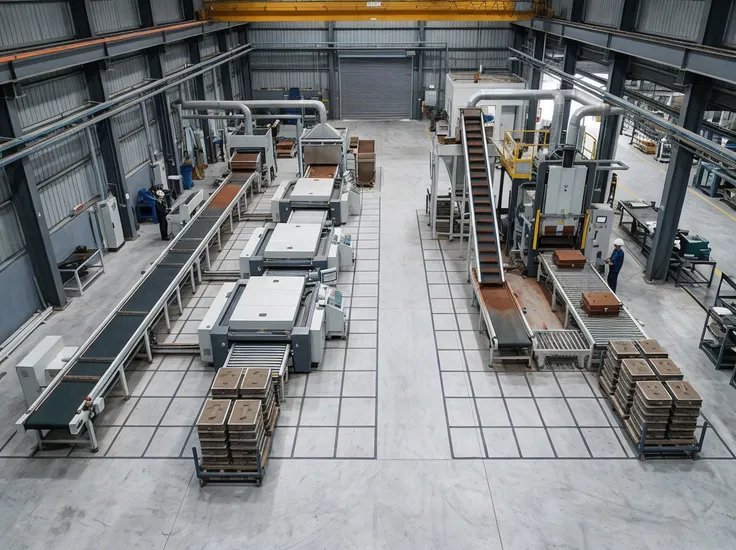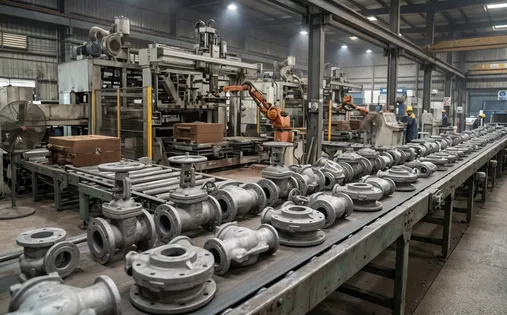
India's foundry equipment sector supplies clay sand processing lines to domestic foundries and regional export markets, but the landscape splits between small-scale fabricators and a handful of automation-capable manufacturers. If you're screening Indian suppliers for a 60-120 molds/hour line, you'll find competitive pricing on manual and semi-automated systems — but capacity data, PLC integration specs, and after-sales support documentation are inconsistent across the supplier base.
The real sourcing question isn't "which Indian manufacturer ranks #1" — it's whether local convenience justifies the trade-offs on automation tier, remote diagnostics, and total cost of ownership when your production volume crosses 150,000 molds annually.
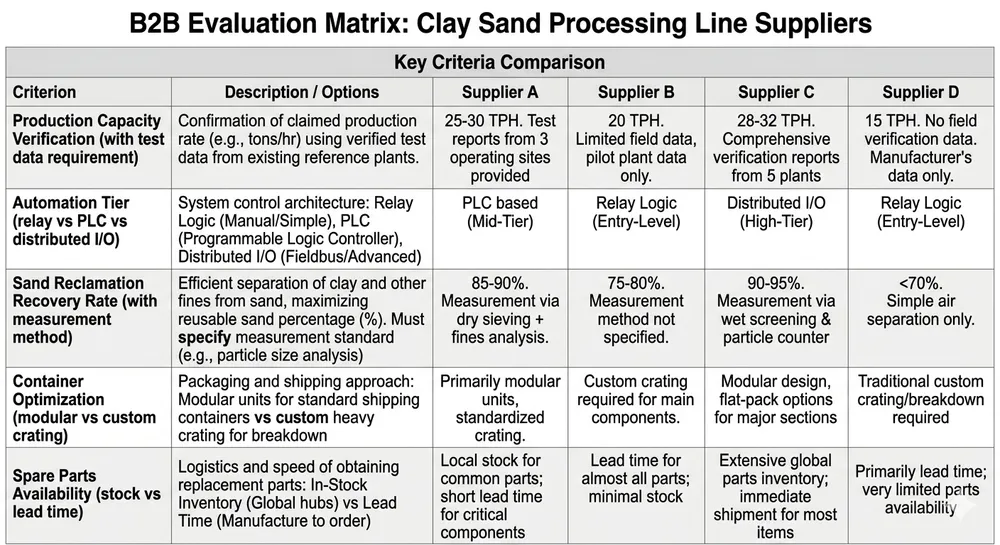
How to Evaluate Clay Sand Processing Line Suppliers — The Commercial Criteria That Matter
Most buyer checklists focus on upfront price and lead time. Those matter, but they don't predict whether your line holds ±0.5mm tolerance after 6 months or whether you're waiting 3 weeks for a replacement PLC module.
Production capacity verification: Ask for rated molds per hour AND the test data that proves it. We've commissioned lines where the supplier claimed 100 molds/hour but the hydraulic system couldn't sustain that cycle time past 4 hours of continuous operation. Request commissioning reports from recent installations, not just spec sheets.
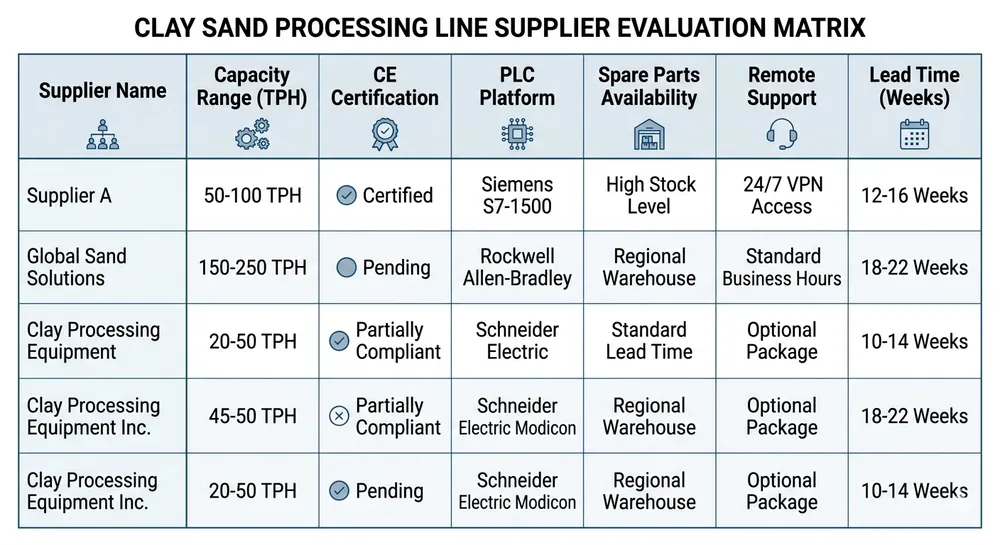
Automation tier clarity: "PLC-controlled" means different things. Entry-level systems use basic relay logic with a touchscreen bolted on. Mid-tier uses programmable controllers (Siemens S7-200, Mitsubishi FX series) with limited I/O expansion. Full automation includes distributed I/O, remote diagnostics via 4G, and recipe management for multiple sand formulations. Your supplier should specify the exact PLC model, I/O count, and whether remote access is included or requires a separate module purchase.
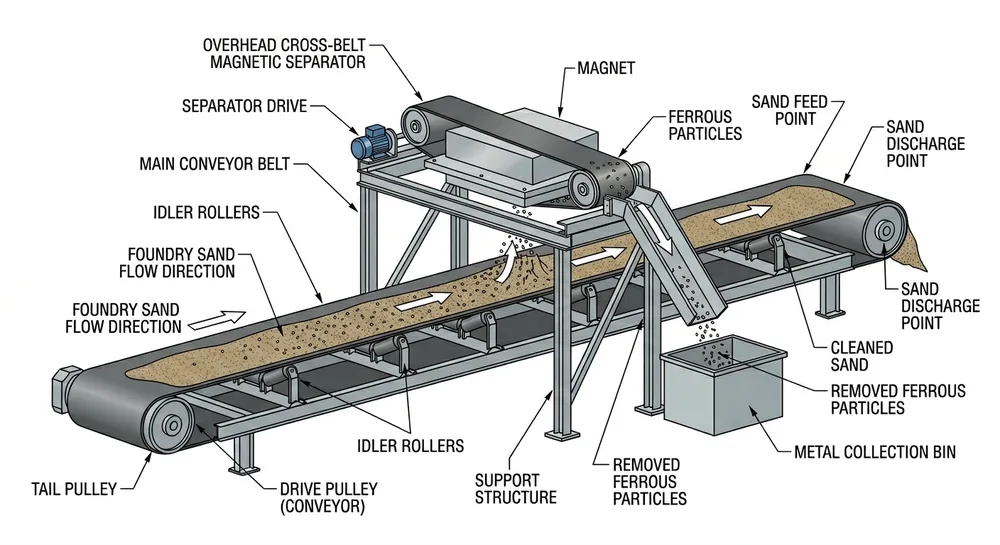
Sand reclamation recovery rate: If the line includes reclamation, ask for verified recovery percentages per unit. We test every reclamation system in our sand lab before shipment — crushing efficiency, magnetic separation performance, and final grain size distribution. Most suppliers quote "90-95% recovery" without defining whether that's by weight, by usable grain size, or under what moisture conditions.
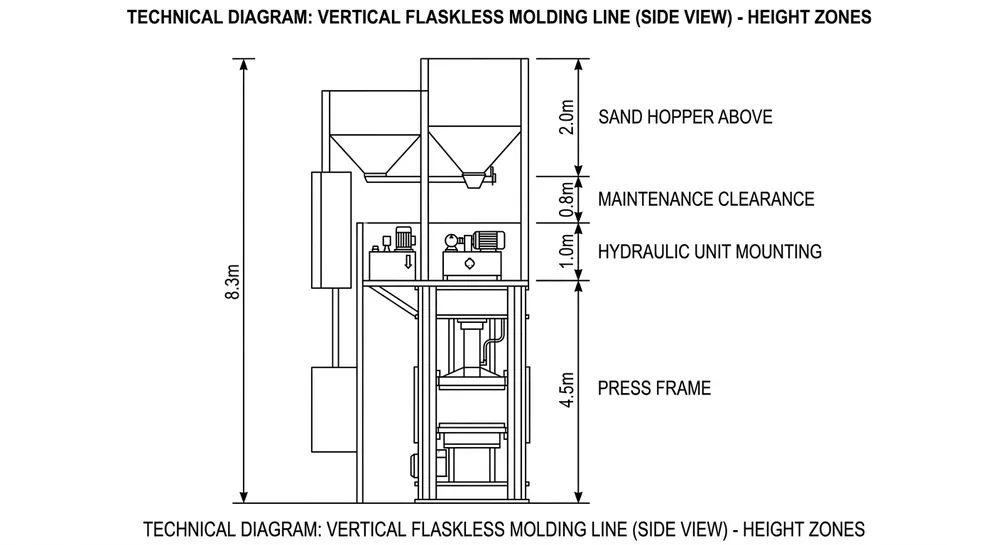
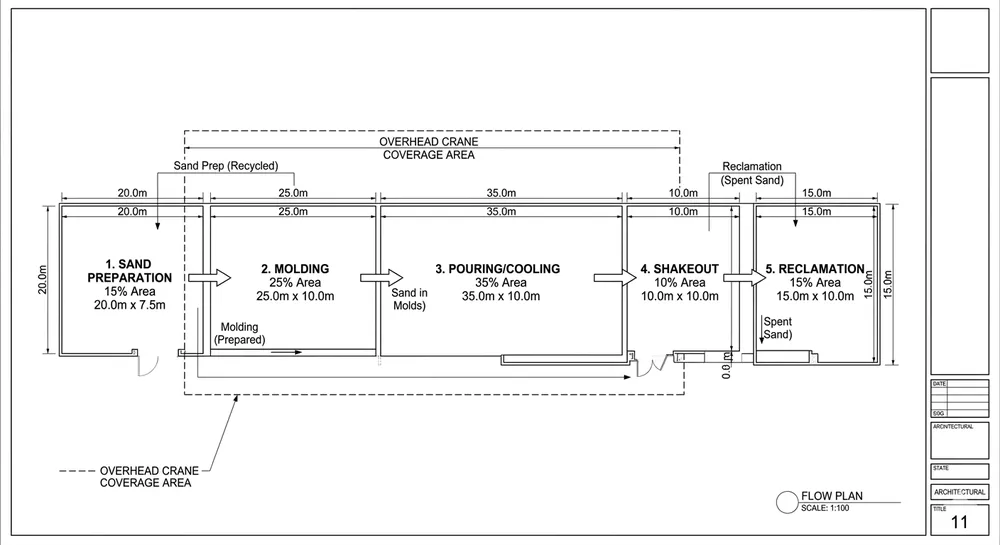
Container-optimized design: A 12-meter molding line that requires custom crating and LCL shipping adds 20-30% to your landed cost compared to a modular design that fits three 40HQ containers. Indian manufacturers building primarily for domestic markets often don't optimize for export container dimensions, which matters if you're comparing FOB pricing against a China-origin alternative.
Spare parts availability and lead time: The mixer gearbox, hydraulic seals, and proximity sensors are your consumables. Ask whether spares ship from local stock or require 45-day manufacturing lead time. We include a first-year spares kit with every line because a $200 sensor failure shouldn't stop a $180,000 production line for three weeks.

The Indian Clay Sand Equipment Supply Landscape — What You'll Actually Find
India's foundry equipment sector concentrates in Gujarat, Maharashtra, and Tamil Nadu, with supplier models ranging from job-shop fabricators to integrated manufacturers. The market serves domestic foundries producing automotive castings, pump housings, and valve bodies — mostly gray iron and ductile iron applications where clay sand remains the dominant molding process.
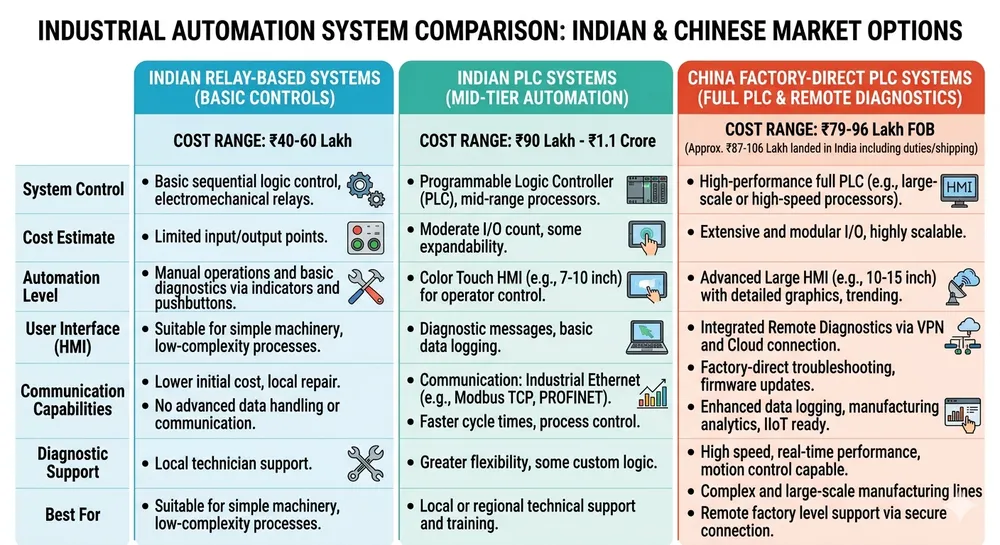
Small-scale fabricators (20-40 suppliers nationally): These shops build manual and semi-automated molding machines, sand mixers, and basic reclamation equipment. Typical capacity: 20-60 molds/hour for flask-based systems. Automation level: relay-based controls with manual parameter adjustment. Lead time: 60-90 days for standard configurations. Pricing: ₹25-45 lakh ($30,000-$54,000 USD) for a basic molding line without reclamation. Strength: low upfront cost, local service availability. Limitation: no remote diagnostics, limited capacity for export documentation (CE certification, technical files), and inconsistent tolerance control on high-speed operation.
Mid-tier integrated manufacturers (8-12 suppliers): These companies handle design, fabrication, and assembly in-house. Capacity range: 60-120 molds/hour for flaskless and flask-based lines. Automation: Siemens or Mitsubishi PLC with HMI touchscreen, but remote diagnostics usually require add-on modules. Lead time: 90-120 days. Pricing: ₹60 lakh-₹1.2 crore ($72,000-$144,000 USD) for a complete line including sand preparation and reclamation. Strength: better process documentation, some export experience to Middle East and Southeast Asia. Limitation: after-sales support relies on local service teams — if you're installing in Africa or South America, remote troubleshooting capability is limited.
Automation-capable manufacturers (3-5 suppliers): These are the Indian suppliers competing on full PLC integration, distributed I/O, and export-ready documentation. Capacity: 120-200+ molds/hour. Automation: Siemens S7-1200/1500 or equivalent with SCADA integration options. Pricing: ₹1.5-2.5 crore ($180,000-$300,000 USD) for high-capacity lines. Strength: comparable automation to China-origin equipment, faster local commissioning for Indian buyers. Limitation: production capacity constraints — most run 2-3 lines simultaneously, so large orders (3+ complete systems) extend lead time to 5-6 months.
The pricing spread reflects automation tier more than capacity. A 100 molds/hour relay-controlled line costs ₹50-60 lakh. The same capacity with full PLC control, remote diagnostics, and CE certification costs ₹90 lakh-₹1.1 crore. If your foundry operates in a market requiring CE compliance (Europe, parts of Middle East), verify that the Indian supplier maintains technical files and can provide Declaration of Conformity — not all mid-tier manufacturers have this documentation ready.
Where Indian Local Supply Makes Sense — And Where It Compresses Your Margin
Local sourcing from Indian manufacturers offers real advantages for specific buyer profiles. If you're operating a foundry in India or neighboring markets (Bangladesh, Sri Lanka, Nepal), domestic supply gives you faster commissioning, easier warranty service, and no import duty burden. Emergency spare parts ship in days, not weeks. Your maintenance team can call the supplier's engineer and get a site visit within 48 hours.
For small foundries producing 50,000-100,000 molds annually, the lower upfront cost of Indian relay-based or basic PLC systems makes economic sense. You're not running three-shift continuous operation, so remote diagnostics and advanced automation don't justify the price premium. A ₹40 lakh manual line that your team can maintain with basic hydraulic and electrical skills fits your cost structure better than a ₹1.2 crore fully automated system.
But the local convenience premium shows up in three places:
Automation tier vs. price: Indian mid-tier suppliers charge ₹90 lakh-₹1.1 crore for PLC-controlled lines that Chinese manufacturers price at $95,000-$115,000 FOB (₹79-96 lakh before duties). The gap narrows after import duties and logistics, but for buyers outside India, the landed cost comparison often favors factory-direct China sourcing on high-capacity lines.
Capacity constraints on repeat orders: If you're a distributor or project contractor needing 5-8 complete lines annually, Indian manufacturers with 2-3 simultaneous production slots create scheduling friction. We run 8 production lines at our Qingdao facility, so a 6-line order ships in 4-5 months without queuing behind other customers.
Remote diagnostics and multilingual support: Most Indian suppliers provide English documentation and local-language support (Hindi, Gujarati, Tamil). If your installation is in India, that's perfect. If you're installing in Brazil, Nigeria, or Indonesia, you need Spanish, Portuguese, or remote video commissioning in English — capabilities that only the top-tier Indian manufacturers offer consistently. We've commissioned clay sand lines in 14 countries via video call because our control systems include 4G remote access as standard, not as an add-on module.
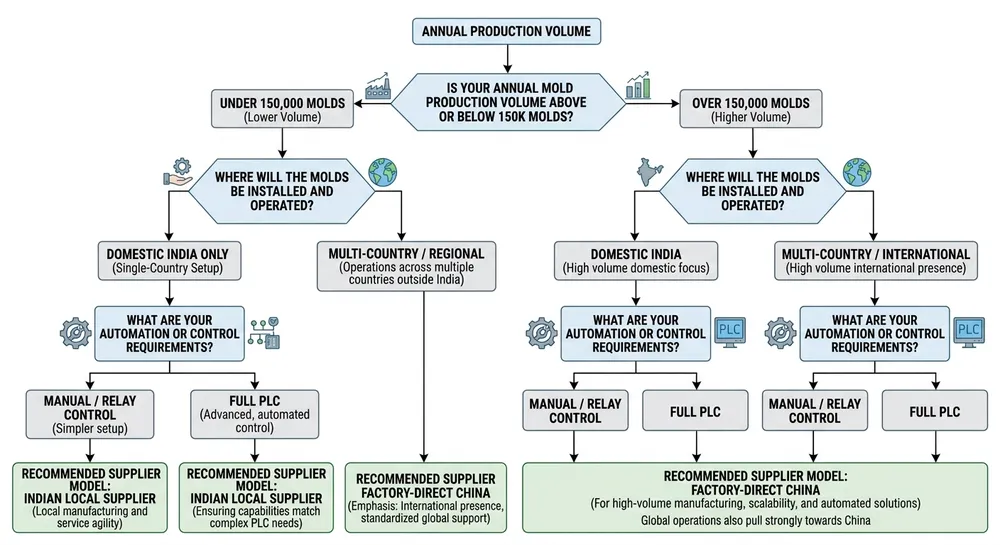
The honest trade-off: Indian local supply optimizes for domestic and near-regional markets. If that's your geography and your volume stays under 150,000 molds/year, local sourcing makes sense. If you're buying for multi-country deployment, need remote diagnostics as standard, or operate above 200 molds/hour sustained capacity, the factory-direct China alternative deserves a landed-cost comparison.
Factory-Direct China Alternative — When Container Economics and Automation Tier Shift the Calculation
TZFoundry manufactures clay sand processing lines at our 15,000 m² Qingdao facility — molding systems, sand preparation lines, and reclamation equipment for foundries in North America, Europe, Middle East, and Southeast Asia. We're not competing with Indian suppliers on local convenience. We're the alternative when your production volume, automation requirements, or multi-site deployment make factory-direct sourcing economically smarter.
Capacity and automation tier: Our standard clay sand molding lines run 80-200 molds/hour depending on flask size and mold complexity. Control systems use Siemens S7-1200 or Mitsubishi FX5U PLCs (buyer's choice) with distributed I/O, HMI touchscreen in English/Spanish/Arabic, and 4G remote diagnostics as standard. Remote access isn't an add-on — it's how we commission equipment and troubleshoot sensor drift without flying engineers to your site. We've adjusted compaction pressure parameters and conveyor speeds via remote login for foundries in Mexico, Turkey, and Vietnam.
Sand reclamation verification: Every reclamation system runs through our in-house sand lab before shipment. We test crushing efficiency, magnetic separation performance, and grain size distribution with your specified sand type (if you send samples) or with representative bentonite-bonded sand. The commissioning report documents actual recovery rate by weight and usable grain percentage — not a spec sheet estimate. If we rate a system at 95% recovery, that's the measured result from your specific unit.
Container-optimized modular design: A complete 120 molds/hour line ships in 2-3 × 40HQ containers. Structural frames, hydraulic units, and control cabinets break down into container-friendly sections, then reassemble on-site following our installation manual. This matters because container optimization directly affects your landed cost — a modular design that fits standard containers costs 20-30% less to ship than equipment requiring custom crating and LCL freight.
Multilingual documentation and remote commissioning: Operation manuals ship in English, Spanish, Arabic, or Russian. Installation happens via video call — your team connects hydraulic lines, wires control panels, and runs initial test cycles while our engineer guides them through each step. We've commissioned equipment in 14 countries this way. It works as long as your installation team can read hydraulic schematics and use a multimeter. First-year spare parts kit ships with every order: hydraulic seals, proximity sensors, solenoid valves, PLC I/O modules.
Pricing structure: FOB Qingdao pricing for a 100 molds/hour PLC-controlled flaskless line with sand preparation and reclamation: $105,000-$125,000 USD depending on configuration. That's ₹87-104 lakh before import duties and logistics. Add 15-20% for duties and freight to Indian ports, and your landed cost sits at ₹100-125 lakh — comparable to Indian mid-tier PLC systems but with full remote diagnostics, verified reclamation data, and container-optimized shipping.
The factory-direct calculation shifts in your favor when:
- Your annual volume exceeds 150,000 molds: At this production level, the cost-per-mold difference between relay-based and full PLC automation pays back in 18-24 months through reduced downtime and faster troubleshooting.
- You're installing across multiple countries: Remote diagnostics and multilingual support become critical when your maintenance team is in three time zones. Indian suppliers optimize for domestic service; we optimize for remote commissioning and distributed spare parts logistics.
- You need verified performance data: If your foundry supplies automotive or industrial OEMs with strict quality requirements, commissioning reports with actual test data (not spec sheet claims) reduce your qualification risk.
- You're comparing landed cost, not just FOB price: Indian domestic pricing looks attractive until you add export documentation, CE certification (if required), and the cost of flying in a commissioning engineer for 2-3 weeks. Our remote commissioning model and container-optimized design often close the total-cost gap.
We're not the right choice for every buyer. If you need a 40 molds/hour manual line for a small domestic foundry, Indian local supply makes more sense. If you're buying one system for installation in India with local service priority, domestic manufacturers offer faster on-site support. But if you're a distributor, project contractor, or multi-site foundry operator comparing automation tier, remote diagnostics, and landed cost on 100+ molds/hour systems, the factory-direct alternative deserves a detailed quote comparison.
Sourcing Decision Framework — Matching Supplier Model to Your Commercial Reality
The right supplier choice depends on your production volume, installation geography, and automation requirements — not on a generic "best manufacturer" ranking.
Choose Indian local supply when:
- Your foundry operates in India or near-regional markets (Bangladesh, Sri Lanka, Nepal)
- Annual production stays under 100,000 molds and you're running single-shift or two-shift operation
- Your maintenance team prefers local-language support and on-site service visits
- Upfront cost minimization matters more than remote diagnostics or advanced automation
- You need emergency spare parts delivery within 48 hours from domestic stock
Choose factory-direct China sourcing when:
- Annual production exceeds 150,000 molds and you're running continuous three-shift operation
- You're installing across multiple countries and need remote commissioning capability
- Your foundry supplies OEM customers requiring verified performance data and CE certification
- You're comparing landed cost (FOB + duties + logistics + commissioning) rather than just upfront price
- You need PLC-controlled systems with distributed I/O and 4G remote diagnostics as standard, not add-ons
Hybrid approach for distributors and contractors:
- Source manual and semi-automated lines (20-60 molds/hour) from Indian suppliers for price-sensitive domestic projects
- Source PLC-controlled high-capacity lines (100-200 molds/hour) factory-direct for export projects and automation-critical installations
- Maintain relationships with both supplier types to match equipment tier to project economics
The mistake most buyers make is choosing based on supplier location rather than total cost of ownership. A ₹40 lakh Indian manual line that requires ₹8 lakh in annual maintenance and downtime costs more over 5 years than a ₹1.1 crore PLC-controlled line (Indian or China-origin) with ₹2 lakh annual maintenance. Run the 5-year TCO calculation based on your actual production volume, not just the upfront invoice.
What to Ask Before You Commit to Any Supplier
These questions separate serious manufacturers from equipment brokers and help you verify capability claims before deposit payment:
For capacity verification: "Can you provide commissioning reports from your three most recent installations showing actual molds-per-hour performance during factory testing?" If the supplier only offers spec sheets, ask why test data isn't available.
For automation tier: "What specific PLC model and I/O count does your standard system include, and is remote diagnostics via 4G/Ethernet included or an add-on module?" This forces clarity on whether "PLC-controlled" means basic relay logic with a touchscreen or genuine programmable automation.
For sand reclamation: "What recovery rate do you guarantee by weight and by usable grain size, and will you provide lab test data from my specific unit before shipment?" Generic "90-95%" claims without measurement methodology are meaningless.
For spare parts logistics: "Do you stock consumable spares (hydraulic seals, sensors, solenoid valves) locally, or do they require manufacturing lead time? What's the typical delivery time for a replacement PLC I/O module?" This reveals whether a $200 sensor failure stops your line for 3 days or 3 weeks.
For export capability (if installing outside India): "How many international installations have you commissioned in the past 24 months, and do you offer remote video commissioning or require on-site engineer visits?" Suppliers with limited export experience often underestimate documentation, crating, and remote support requirements.
For container optimization (if importing): "How many 40HQ containers does a complete [X] molds/hour line require, and is the design modular or does it need custom crating?" This directly affects your landed cost comparison.
Send these questions to 3-4 suppliers and compare the specificity of their answers. Vague responses ("we can customize," "it depends on your requirements") signal limited technical depth. Specific answers with model numbers, test data, and lead times signal manufacturing capability.
Moving from Supplier Screening to Landed-Cost Comparison
You've identified 2-3 credible suppliers — Indian local or factory-direct China. Now run the actual cost comparison that protects your margin:
Build the full landed-cost model:
- FOB or ex-works price
- Import duties (if applicable)
- Freight and logistics (container vs LCL, port charges, inland transport)
- Commissioning cost (on-site engineer visit vs remote video support)
- First-year spare parts (included vs separate purchase)
- Warranty terms (12 months standard, or longer with conditions)
Calculate 5-year total cost of ownership:
- Upfront equipment cost (from landed-cost model above)
- Annual maintenance and consumables (hydraulic seals, sensors, wear parts)
- Estimated downtime cost (hours per year × your cost per hour of lost production)
- Spare parts lead time risk (local stock vs 45-day manufacturing)
Compare automation tier honestly:
- Does the lower-priced option actually meet your tolerance and cycle-time requirements under continuous operation?
- Will relay-based controls force manual parameter adjustment that adds labor cost and quality variation?
- Does the higher-priced PLC system include remote diagnostics that reduce your troubleshooting cost, or is that an add-on?
Most buyers discover that the lowest FOB price rarely delivers the lowest 5-year TCO once you factor in downtime, spare parts logistics, and commissioning support. A ₹20 lakh price difference sounds significant until you calculate that 2% additional downtime costs you ₹35 lakh in lost production over 5 years.
If you're comparing Indian local supply against our factory-direct pricing, send us your production requirements (casting type, molds per hour, available floor space, installation country) and we'll provide a detailed quote with container count, commissioning plan, and first-year spares list. Most buyers find that the landed-cost gap is smaller than the FOB price difference suggests — and the automation tier difference is larger than spec sheets reveal.

Baocun Zhu is the Senior Clay Sand Process Engineer at TZFoundry in Qingdao. With over 14 years commissioning clay sand molding, reclamation, and preparation lines for export foundries, he turns floor-space constraints and throughput targets into working production systems. His...