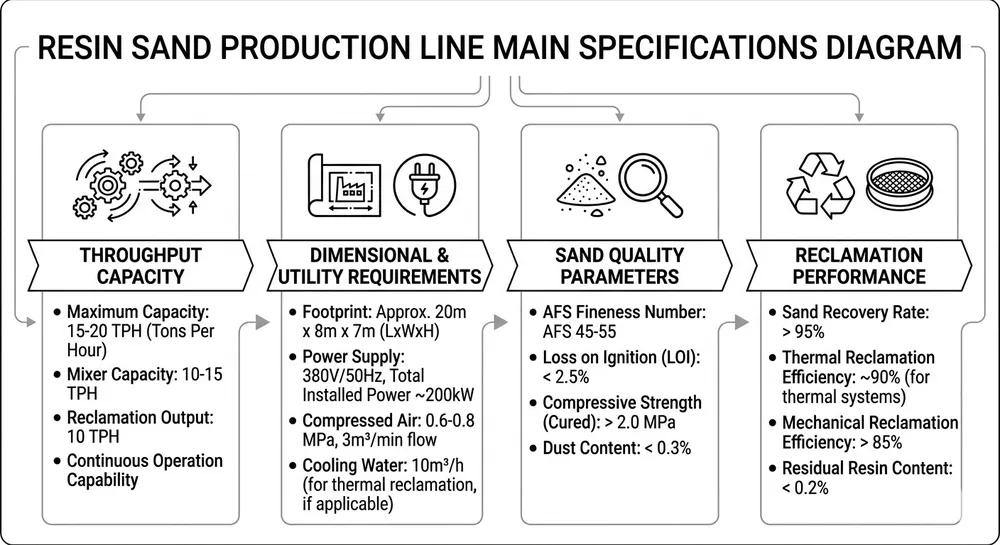
A procurement manager in Ohio sent us a competitor's datasheet last month with a single question circled in red: "95% reclamation rate — is this real?" The answer depends on what the supplier measured. Sand recovery by weight? By grain count? At what temperature? With which binder system? We've commissioned 40+ Resin Sand Production Line systems, and the gap between catalog specs and shop-floor reality comes down to understanding what each number actually controls.
Most resin sand line datasheets list 15-20 specifications. Three of them determine your binder cost per ton of castings. Two control whether the line fits your building and your electrical service. One tells you if the reclamation plant will pay for itself. The rest are either standard across the industry or negotiable during engineering review. This guide walks through each specification category, explains what drives the number, and shows you which values to verify before you sign.
What a Resin Sand Production Line Specification Sheet Actually Tells You
A resin sand line datasheet is the technical contract between what the supplier promises and what your foundry floor receives. It defines capacity (how much sand the system processes per hour), quality (the consistency and strength of mixed sand), footprint (whether it fits your building), and operating cost (power, compressed air, binder consumption).
We structure our spec sheets around four decision layers: throughput capacity (can it keep up with your molding line?), dimensional and utility requirements (does it fit your space and power supply?), sand quality parameters (will it produce the surface finish your castings need?), and reclamation performance (how much of your sand cost comes back as reusable material?). Every other specification on the sheet supports one of these four.
The confusion starts when suppliers list test-condition specs without explaining the conditions. A mixer rated at "5 t/h capacity" might mean 5 tons of dry sand, or 5 tons of coated sand including resin and catalyst, or 5 tons under continuous operation, or 5 tons in batch mode with cooling intervals. We measure mixer throughput as coated sand output in continuous operation because that's what feeds your molding line — the number that matters is how many molds per hour you can pour, not how fast the mixer spins when empty.

Mixer Throughput, Sand-to-Binder Ratio, and Reclamation Rate — The Three Numbers That Control Your Operating Cost
Mixer Throughput (t/h)
Mixer capacity appears as tons per hour (t/h) or kilograms per batch. The number tells you the maximum coated sand output under continuous operation. A 3 t/h mixer feeding a molding line that consumes 2.8 t/h of sand runs comfortably. The same mixer feeding a 3.5 t/h molding line creates a bottleneck — your molding crew waits for sand, and your casting output drops.
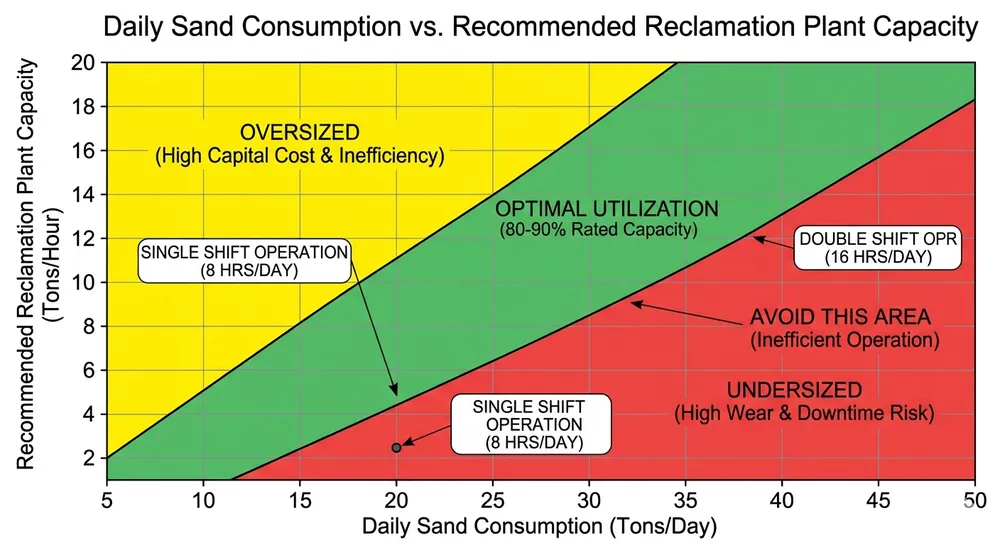
We calculate required mixer capacity as: (molding line sand consumption × 1.15) + reclaim system input rate. The 1.15 multiplier accounts for spillage, rejected batches, and the fact that mixers don't run at 100% rated capacity for 8-hour shifts. If your molding line uses 4 tons of sand per hour and your reclamation plant feeds back 1.5 t/h of reclaimed sand, you need a mixer rated for at least (4 × 1.15) + 1.5 = 6.1 t/h to avoid production delays.
The cost implication: undersized mixers force you to run overtime shifts or accept lower casting output. A 5 t/h mixer costs about 18% less than a 7 t/h mixer, but if it limits your daily output by 12%, you lose more in foregone revenue than you saved on equipment. Most buyers who come back to us for capacity upgrades within two years initially chose mixer capacity based on current production, not planned growth.
Sand-to-Binder Ratio (%)
This specification defines how much resin and catalyst the mixer adds to each batch of sand, typically expressed as a percentage by weight. Furan resin systems usually run 1.2-1.8% resin plus 0.4-0.6% catalyst. Phenolic systems run slightly higher at 1.5-2.2% resin. The ratio directly controls two things: mold strength (higher resin = stronger molds) and your monthly resin bill (higher resin = higher cost).
The mixer's binder dosing accuracy matters more than the target ratio. A mixer with ±0.1% dosing accuracy wastes less resin than one with ±0.3% accuracy, even if both target the same 1.5% ratio. We developed TZFoundry's binder calibration protocol after seeing too many foundries run 1.8% resin to compensate for inconsistent mixing — they were paying for extra resin to cover the mixer's poor accuracy.
Here's the cost math: a foundry using 50 tons of sand per day at 1.5% resin consumes 750 kg of resin daily. If poor mixer accuracy forces you to run 1.8% resin for safety margin, you're now using 900 kg per day — an extra 150 kg. At $3.20/kg for furan resin, that's $480 per day or $12,500 per month in wasted binder. A Resin Sand Mixer with ±0.08% dosing accuracy costs about $8,000 more than a ±0.25% accuracy mixer, but it pays for itself in 16 days of operation.
Reclamation Rate (%)
Reclamation rate tells you what percentage of used sand the reclamation plant returns as reusable material. A 92% reclamation rate means 92 kg of every 100 kg of used sand comes back clean enough to remix with fresh sand and resin. The remaining 8 kg is dust, resin residue, and fines that get filtered out.
The number only means something if you know the test conditions. We measure reclamation rate as: (weight of reclaimed sand meeting AFS grain fineness spec) ÷ (weight of used sand input) × 100. Some suppliers measure total sand output including fines and dust, which inflates the number by 5-8 percentage points but gives you unusable material.
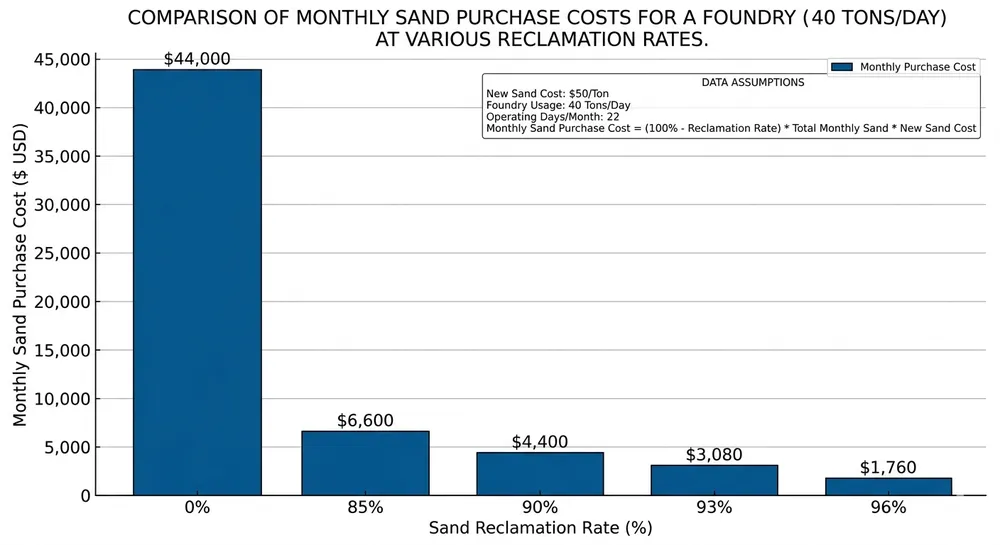
The financial impact is direct. If you consume 40 tons of new sand per day and your reclamation plant recovers 90% of used sand, you're buying 4 tons of makeup sand daily instead of 40 tons. At $85/ton for silica sand, that's $340/day instead of $3,400/day — a $95,000 monthly saving. A Resin Sand Reclamation Plant with mechanical reclamation (90-93% recovery) costs $45,000-$65,000. Thermal reclamation (95-97% recovery) costs $85,000-$120,000 but delivers an extra 2-4 percentage points of recovery, which matters when you're processing 200+ tons of sand per week.
Footprint, Power Draw, and Compressed Air — The Specs That Determine If the Line Fits Your Building
Floor Space and Layout Dimensions
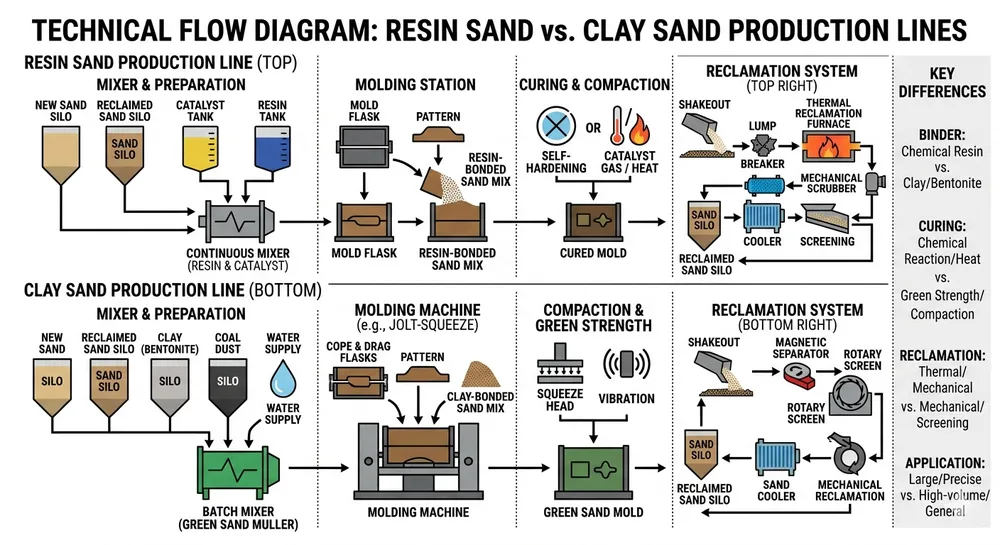
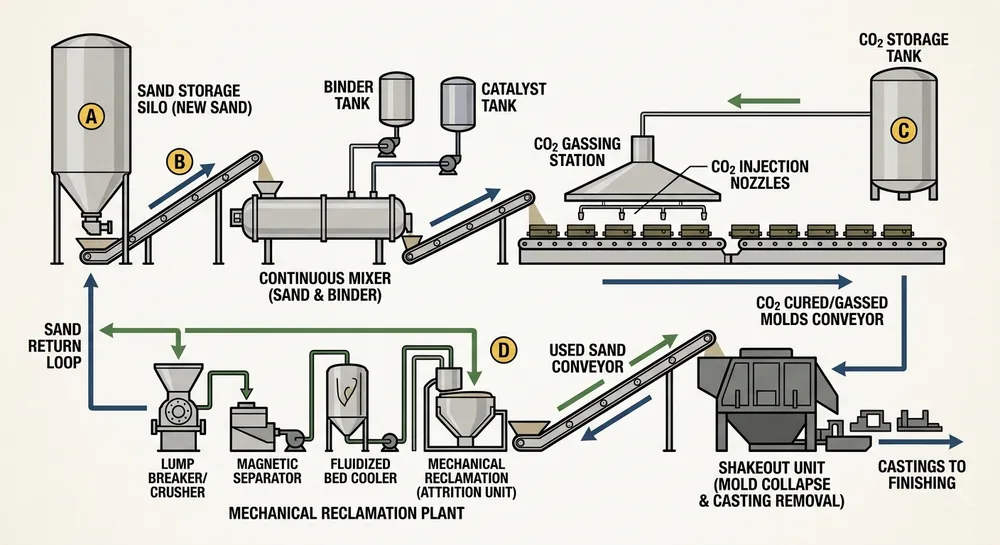
Resin sand production lines ship as modular sections: mixer unit, sand storage silos, reclamation plant, dust collection system, and control cabinet. The datasheet lists overall dimensions, but the actual floor space requirement includes access clearances for maintenance, forklift paths for sand delivery, and overhead clearance for dust collection ductwork.
A typical 5 t/h furan line occupies 18m × 12m of floor space in an L-shaped configuration. The mixer needs 4m × 3m, the reclamation plant takes 8m × 6m, and sand silos require 3m × 3m each. Add 1.5m clearance on all sides for maintenance access, and you're at 22m × 15m minimum. We've seen buyers order systems that fit the catalog dimensions but couldn't install them because the building's column spacing didn't allow the reclamation plant's 6-meter length to fit between supports.
Before you finalize capacity, send us your building layout with column locations, overhead crane coverage, and electrical service entry points. We'll generate a CAD layout showing equipment placement, material flow paths, and utility connection points. This catches installation problems during the quote stage, not after the equipment arrives at your dock.
Electrical Power Requirements
Power consumption appears as total connected load (kW) and operating load (kW). Connected load is the sum of all motor nameplates if every component ran simultaneously at full power. Operating load is the realistic average draw during production, typically 60-75% of connected load.
A 5 t/h resin sand line lists 180 kW connected load: mixer motor (45 kW), reclamation plant (75 kW), dust collector fans (35 kW), conveyors and elevators (25 kW). Actual operating load runs 110-130 kW because not all motors run at full load simultaneously. Your electrical service needs to supply the connected load for startup surges, but your monthly power bill reflects operating load.
The cost trap: some suppliers quote low equipment prices but spec undersized motors that can't sustain rated capacity. A 5 t/h mixer with a 37 kW motor instead of 45 kW costs $3,200 less but overheats after 90 minutes of continuous operation, forcing you to run batch cycles with cooling breaks. You paid for a 5 t/h mixer but you're getting 3.8 t/h effective capacity. We size motors for continuous-duty operation at rated capacity plus 15% margin — it costs more upfront but delivers the throughput you paid for.
Compressed Air Supply
Resin sand lines use compressed air for pneumatic valves, binder dosing pumps, and dust collection pulse-jet cleaning. The datasheet specifies required pressure (bar or psi) and consumption rate (m³/min or cfm). A 5 t/h line typically needs 0.8-1.2 m³/min at 6-8 bar.
If your facility's existing air compressor runs at 85% capacity, adding a resin sand line that needs 1.0 m³/min will overload the system. Compressed air starvation causes binder dosing errors (the resin pump can't maintain pressure) and dust collector failures (pulse-jet cleaning stops working). We include a dedicated air receiver tank (500-1000L) with each line to buffer short-term demand spikes, but you still need adequate compressor capacity for sustained operation.
Sand Grain Fineness, Tensile Strength, and LOI — The Quality Specs That Control Casting Surface Finish
AFS Grain Fineness Number (GFN)
AFS grain fineness number measures the average grain size of your sand. Higher numbers mean finer sand: AFS 50-60 is coarse sand for large iron castings, AFS 60-70 is medium sand for general steel and iron work, AFS 70-85 is fine sand for aluminum and thin-wall castings. The number directly affects casting surface finish — finer sand produces smoother casting surfaces but costs more and requires tighter process control.
The mixer and reclamation plant must maintain the target GFN throughout the sand's lifecycle. Fresh silica sand enters at AFS 65. After 8-10 reclamation cycles, mechanical attrition breaks some grains into fines, shifting the distribution toward AFS 68-70. If your reclamation plant's screening system doesn't remove fines effectively, the sand gradually becomes finer and your mold permeability drops, causing gas defects in castings.
We test sand samples at intake, after mixing, and after reclamation to track GFN drift. A well-designed reclamation plant holds GFN within ±3 points of target across 15-20 reclamation cycles. If the datasheet doesn't specify GFN stability over multiple cycles, ask for it — that's where you'll see if the reclamation system actually works or just moves sand around.
Tensile Strength (MPa)
Tensile strength measures how much force the cured sand mold can withstand before cracking. Furan resin molds typically achieve 1.8-2.5 MPa tensile strength, phenolic molds reach 2.0-3.0 MPa. Higher strength allows thinner mold sections and reduces mold breakage during handling, but it requires precise binder ratio control and consistent mixing.
The mixer's job is to deliver consistent tensile strength batch after batch. We test every 10th batch during commissioning and expect ±0.15 MPa variation. A mixer that produces 2.2 MPa on batch 1, 1.9 MPa on batch 2, and 2.4 MPa on batch 3 has a mixing uniformity problem — either the binder dosing is inconsistent or the mixing blades aren't distributing resin evenly.
Inconsistent tensile strength shows up as random mold cracking during pouring. You can't predict which molds will fail, so you either accept 3-5% scrap rate or increase binder ratio across all batches to compensate for the weak ones. Both options cost money. A mixer with documented ±0.1 MPa tensile strength consistency eliminates this waste.
Loss on Ignition (LOI %)
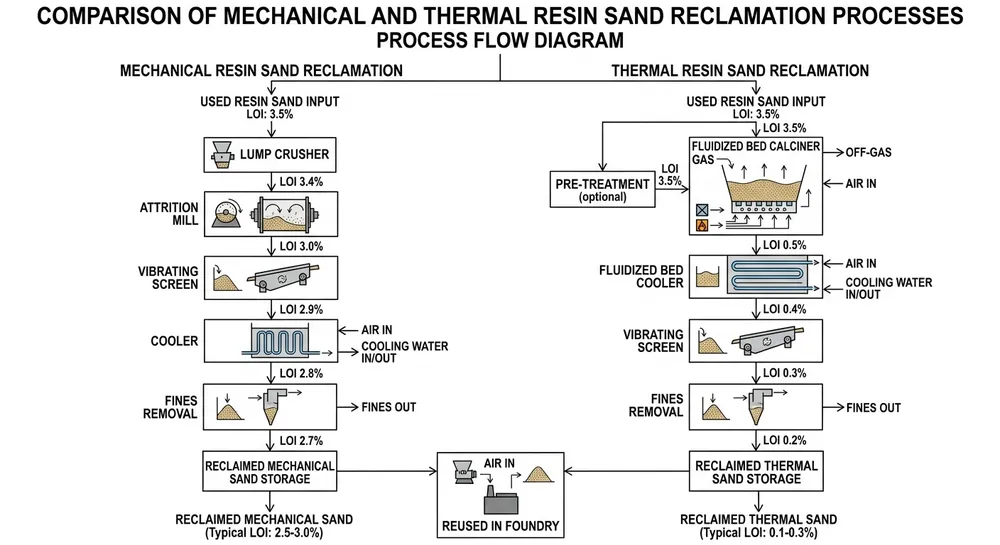
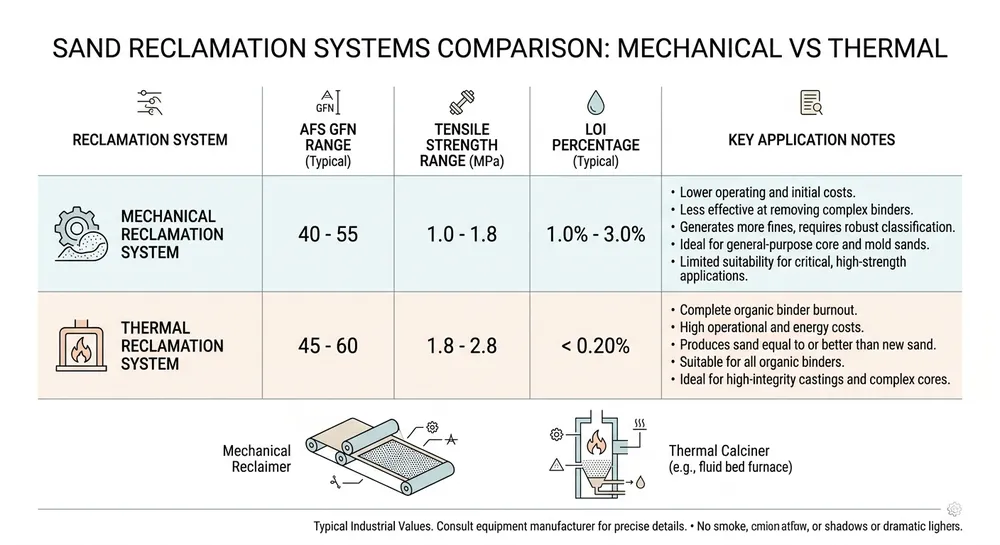
LOI measures the percentage of organic material (resin residue, carbon, volatiles) remaining in reclaimed sand. Fresh sand has 0% LOI. After one use cycle, sand carries 0.3-0.8% LOI depending on binder type and reclamation method. Mechanical reclamation typically leaves 0.5-0.8% LOI, thermal reclamation reduces it to 0.1-0.3%.
High LOI causes two problems: it reduces the effective sand-to-binder ratio (you're coating sand that already has resin residue on it) and it generates more gas during pouring, increasing the risk of porosity defects. Most foundries target <0.6% LOI for mechanical reclamation and <0.3% for thermal reclamation.
The reclamation plant's LOI performance determines how much fresh sand you need to add as makeup. If your reclamation plant delivers 0.8% LOI and your process requires <0.5% LOI, you'll dilute reclaimed sand with 30-40% fresh sand to bring the average LOI down. That cuts your effective reclamation rate from 92% to 55-60% because you're discarding reclaimed sand to meet quality targets. A thermal reclamation system costs $40,000 more than mechanical but delivers 0.2% LOI, letting you run 95%+ reclaimed sand without quality issues.
How to Compare Datasheets Across Suppliers — Red Flags, Test Conditions, and What to Verify Before Signing
Test Condition Assumptions
The biggest datasheet trap is comparing specs that weren't measured the same way. Supplier A lists "5 t/h mixer capacity" measured as dry sand input. Supplier B lists "5 t/h mixer capacity" measured as coated sand output. Supplier B's mixer is actually 8-10% larger because coated sand weighs more than dry sand. You think you're comparing equivalent systems, but you're not.
Ask every supplier: "How did you measure this specification?" For mixer capacity, ask if it's dry sand or coated sand, batch mode or continuous operation, and at what binder ratio. For reclamation rate, ask if it includes fines and dust or only reusable sand meeting AFS spec. For tensile strength, ask what cure time and temperature the test used — a sample cured for 24 hours at 25°C will test stronger than one cured for 2 hours at 20°C, but the 2-hour number is what matters on your production floor.
We ship commissioning reports with every line showing actual measured performance during the 72-hour acceptance test: mixer throughput logged every 30 minutes, tensile strength tested every 2 hours, reclamation rate calculated from weighed input and output over 8-hour shifts. The report includes ambient temperature, binder batch numbers, and sand source so you can replicate the test conditions. If a supplier won't commit to measured performance data, they're selling catalog specs, not guaranteed capability.
Red-Flag Specification Combinations
Some datasheet combinations don't make technical sense. A 3 t/h mixer paired with a 1.5 t/h reclamation plant means half your used sand has nowhere to go — you'll need external sand disposal, which adds $15-25 per ton in waste hauling costs. A 5 t/h line with 90 kW total power draw is underpowered — either the motors are undersized or the reclamation plant is a simple screening system, not a true reclamation unit.
Watch for reclamation rates above 96% on mechanical systems. Mechanical reclamation (attrition scrubbing, pneumatic separation) physically can't exceed 94-95% recovery while maintaining AFS grain fineness spec. If the datasheet claims 97% mechanical reclamation, they're either measuring total sand output including unusable fines, or the number is marketing fiction. Thermal reclamation can hit 96-98% because it burns off resin residue completely, but thermal systems cost 60-80% more than mechanical.
Another red flag: datasheets that list capacity and dimensions but omit power consumption, compressed air requirements, or cooling water needs. Those are the specs that determine your operating cost. A supplier who won't disclose operating costs is hiding something — usually that the system is inefficient or requires expensive utilities.
What to Request During Technical Review
Before you sign, request three documents: a dimensioned layout drawing showing equipment placement in your facility with utility connection points marked, a commissioning test protocol defining exactly what performance metrics will be measured and what acceptance criteria must be met, and a spare parts list with lead times for consumable components like mixer blades, screen meshes, and dust collector filter bags.
The commissioning protocol is your leverage. It should specify: mixer throughput measured as coated sand output over 4-hour continuous operation, tensile strength tested on samples taken every hour with ±0.15 MPa maximum variation, reclamation rate calculated from weighed sand input and output meeting AFS spec, and power consumption logged at operating load. If the system doesn't meet these numbers during commissioning, you have documented grounds to reject delivery or negotiate a price reduction.
We include a 72-hour witnessed acceptance test in every contract. Your team or a third-party inspector can be present while we run the line at rated capacity and log all performance data. The test uses your specified binder system and sand type, not our lab conditions. This eliminates the "it worked fine in our factory" problem when the equipment arrives at your facility and doesn't perform.
Quick-Reference Specification Table — What Each Number Controls and What to Ask
| Specification | Unit | Typical Range | What It Controls | What to Verify |
|---|---|---|---|---|
| Mixer Throughput | t/h | 2-10 | Maximum molding line speed | Dry sand or coated sand? Batch or continuous? |
| Sand-to-Binder Ratio | % | 1.2-2.2 | Mold strength and resin cost | Dosing accuracy (±%)? Calibration protocol? |
| Reclamation Rate | % | 88-97 | Makeup sand cost | Includes fines? Measured over how many cycles? |
| AFS Grain Fineness | GFN | 50-85 | Casting surface finish | Stability over reclamation cycles (±GFN)? |
| Tensile Strength | MPa | 1.8-3.0 | Mold handling durability | Batch-to-batch variation (±MPa)? Cure time? |
| LOI | % | 0.1-0.8 | Gas defect risk | Mechanical or thermal reclamation? |
| Floor Space | m² | 150-300 | Installation feasibility | Includes maintenance clearance? Column spacing? |
| Connected Power | kW | 120-250 | Electrical service sizing | Operating load vs. connected load? |
| Compressed Air | m³/min | 0.6-1.5 | Auxiliary equipment cost | Pressure requirement (bar)? Peak or average? |
This table covers the specifications that drive 90% of your purchasing decision. The remaining datasheet entries — control voltage, noise level, paint color — are either standardized across the industry or cosmetic. Focus your technical review on these nine specifications, verify the test conditions for each, and you'll avoid the expensive surprises that show up six months after installation.
Getting a Spec Sheet That Matches Your Foundry's Actual Requirements
Generic datasheets assume average conditions: 8-hour shifts, moderate ambient temperature, standard furan resin, and general iron casting work. Your foundry probably doesn't match all those assumptions. If you're running 12-hour shifts, the mixer needs better cooling. If you're in a hot climate, the binder dosing system needs temperature compensation. If you're casting aluminum, you need finer sand and tighter LOI control.
Send us three pieces of information: your casting alloy and typical weight range, your target daily output in tons of castings, and your available floor space with a simple sketch showing column locations and overhead crane coverage. We'll configure a system spec'd for your actual operating conditions, not catalog averages. The quote includes a commissioning test protocol with acceptance criteria based on your alloy and production rate.
Our 18-engineer team has commissioned Furan Resin Sand Production Line systems for ductile iron foundries running 200 tons per week and aluminum foundries producing 15 tons per week. The equipment architecture is similar, but the mixer blade design, reclamation plant screening configuration, and dust collection sizing are different because the applications are different. A datasheet that doesn't account for your specific alloy and production rate is a starting point for negotiation, not a final specification.
If you're comparing multiple suppliers, send the same three-question brief to each and compare the responses. The supplier who asks follow-up questions about your binder preference, mold complexity, and quality targets is engineering a solution. The supplier who sends a standard datasheet with your requested capacity circled in red is selling from inventory. Both approaches work, but they deliver different results when the equipment is running on your floor.
Request a quote with your casting details and production targets — we'll return a specification sheet configured to your project with measured performance data from our testing lab, not catalog estimates.

Liu Haoran is the Resin Sand Production Line Technical Manager at TZFoundry. Over 11 years of hands-on work with furan, phenolic, and coated sand systems, he has commissioned 40+ resin sand lines for export buyers and developed binder dosing protocols...