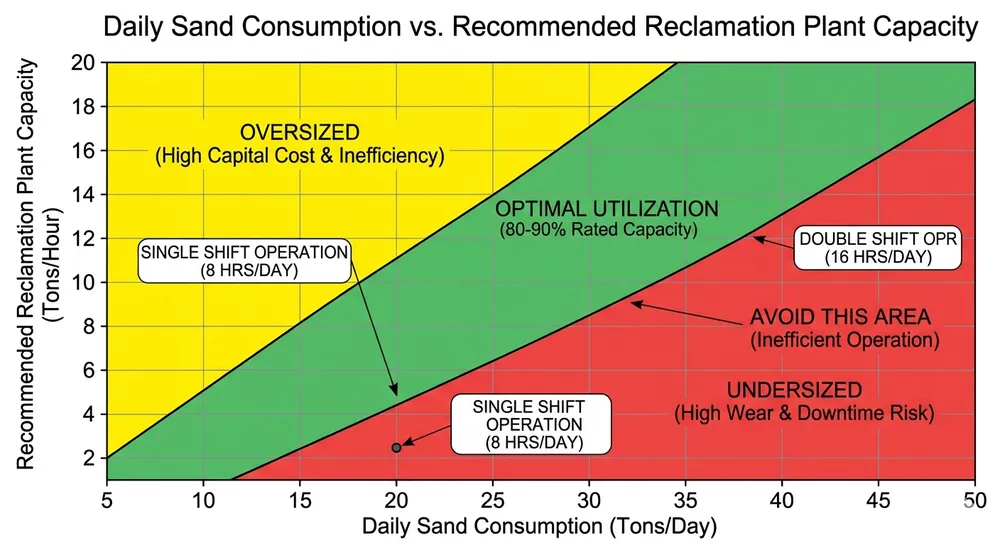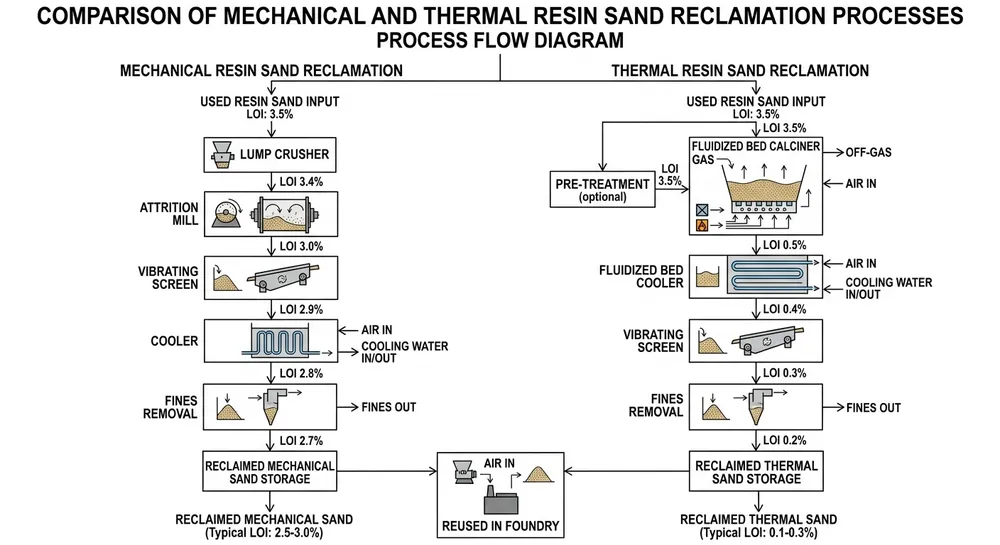
You're comparing mechanical and thermal resin sand reclamation because your binder cost is climbing and you need to decide whether burning off residual resin justifies the extra capital spend. The short answer: if you're running furan or phenolic resin above 15 tons of sand per day and your new sand costs more than $45 per ton delivered, thermal reclamation pays back within 18-24 months through lower binder consumption and higher sand recovery rates. Below that threshold, mechanical reclamation with good screening gives you acceptable LOI at half the equipment cost.
The decision hinges on three numbers: your daily sand throughput, your target loss-on-ignition (LOI) after reclamation, and your delivered cost for new sand plus binder. We've commissioned both types across 40+ installations, and the breakeven point is clearer than most suppliers admit.
What Each Process Actually Does to the Sand Grain
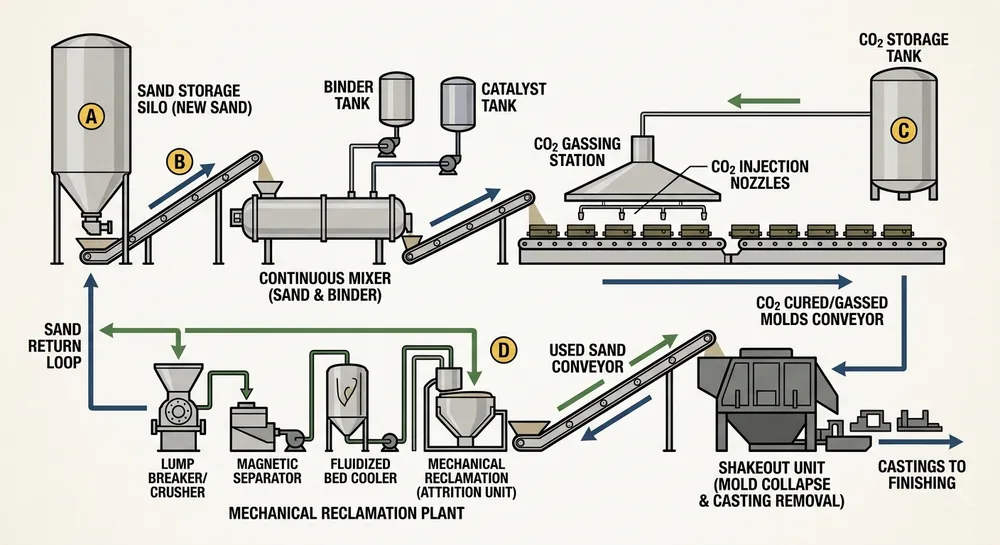
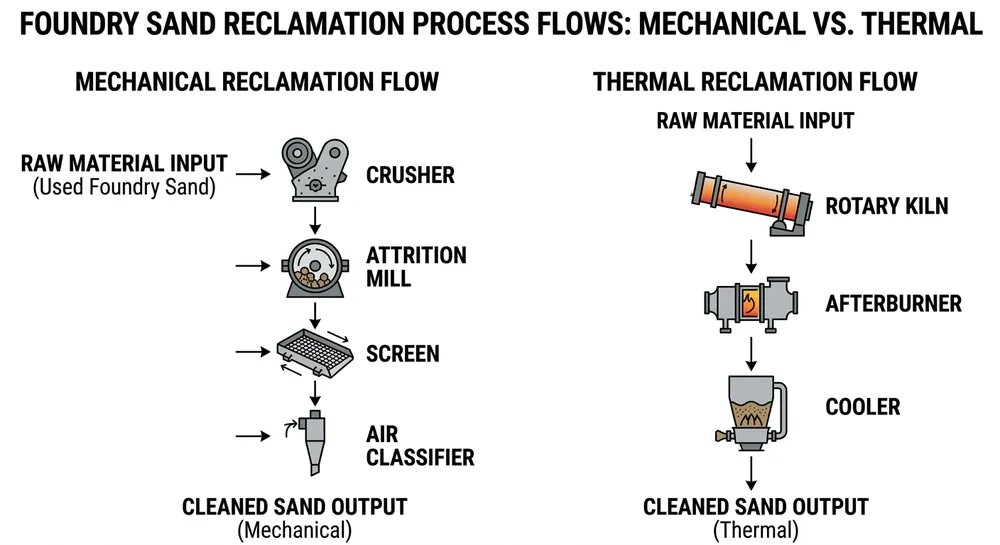
Mechanical reclamation uses attrition mills, scrubbers, and vibrating screens to crush and remove the resin film coating each sand grain. You're physically abrading the binder layer off through grain-on-grain friction, then screening out the dust and fines. The sand comes out clean enough to reuse, but you'll still see 2.0-3.5% LOI depending on your resin type and how aggressive you run the attrition cycle.
Thermal reclamation adds a calcination step — you're heating the sand to 650-850°C in a fluidized bed or rotary kiln to burn off the residual organic binder completely. The sand exits at below 0.5% LOI, sometimes as low as 0.2% for phenolic systems. You still need mechanical pre-cleaning to remove large resin chunks before thermal treatment, so most thermal plants are actually hybrid lines with mechanical crushing upstream.
The LOI difference matters because every 1% of residual binder on your reclaimed sand means you need to add less fresh binder to hit your target mix ratio — but only if that residual binder is still active and evenly distributed. Past 3% LOI, the residual resin is degraded and inconsistent, so you end up adding full binder dosage anyway and just dealing with higher reject rates from weak spots in the mold.

Head-to-Head Performance and Cost Comparison
Here's the commercial reality across the dimensions that affect your operating cost:
| Dimension | Mechanical Reclamation | Thermal Reclamation |
|---|---|---|
| Sand Recovery Rate | 85-92% (depends on screening efficiency) | 93-97% (higher because fines are minimized) |
| LOI After Treatment | 2.0-3.5% (furan), 2.5-4.0% (phenolic) | 0.2-0.5% (both resin types) |
| Energy Consumption | 8-12 kWh per ton of sand | 45-65 kWh per ton (calcination is energy-intensive) |
| Equipment Footprint | 80-120 m² for 20 TPH line | 150-200 m² (includes thermal unit and cooling) |
| Capital Cost Range | $85,000-$140,000 for 20 TPH | $220,000-$320,000 for 20 TPH |
| Maintenance Complexity | Medium (attrition mill liners wear, screen replacement) | Higher (refractory maintenance, burner service, thermal monitoring) |
| Binder Savings vs New Sand | 15-25% binder reduction possible | 40-55% binder reduction achievable |
The capital cost difference is real — thermal costs 2.5-3× more upfront. But the binder savings compound daily. If you're consuming 800 kg of furan resin per day at $3.20/kg and thermal reclamation cuts that by 45%, you're saving $1,152 per day in binder cost alone. That's $34,560 per month, which pays back a $180,000 capital premium in 5.2 months of operation.
The energy cost increase is the hidden line item most buyers miss during initial evaluation. At $0.12/kWh industrial rate, mechanical reclamation costs $0.96-$1.44 per ton of sand processed. Thermal jumps to $5.40-$7.80 per ton. On a 20-ton-per-day operation, that's an extra $90-$127 per day in electricity — but still far below the binder savings if your resin cost is high.
When Mechanical Reclamation Is the Right Call
Mechanical-only reclamation makes commercial sense in three scenarios we see repeatedly:
Low-volume or batch production foundries running below 10 tons of sand per day. Your annual binder spend isn't large enough to justify the thermal capital premium and the added maintenance complexity. A well-configured mechanical line with dual-stage screening will get you to 2.5% LOI, which is acceptable for most furan applications if you're not chasing mirror-finish castings.
Sodium silicate (waterglass) binder systems where the inorganic binder doesn't burn off cleanly in thermal reclamation anyway. Mechanical attrition works better for waterglass because you're breaking the silicate bond mechanically rather than trying to calcinate an inorganic compound. We've tested this in our sand reclamation lab — thermal treatment on sodium silicate sand doesn't improve LOI enough to justify the energy cost.
Foundries with cheap local sand supply and moderate binder costs. If your delivered sand cost is below $35/ton and you're running lower-cost resin formulations, the total cost of just buying more new sand and running mechanical reclamation at 88% recovery beats the thermal equipment and energy spend. This is common in regions near silica quarries where sand logistics cost is minimal.
One note from our commissioning experience: mechanical reclamation performance depends heavily on how you tune the attrition cycle time and screen mesh selection. We've seen buyers run the attrition mill too gently to avoid sand grain breakage, then complain about high LOI. You need 4-6 minutes of attrition time for furan resin and 6-8 minutes for phenolic to actually strip the binder film — shorter cycles leave too much residual resin, longer cycles start fracturing the sand grains and generating excess fines.
When Thermal Reclamation Justifies the Premium
Thermal reclamation becomes the better ROI decision when three conditions align:
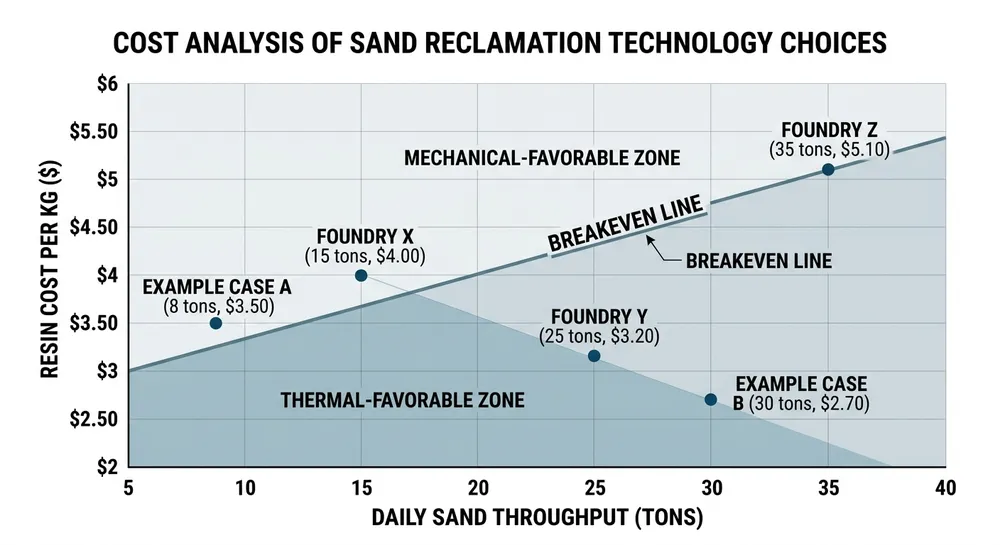
High daily sand throughput — above 15-20 tons per day. At this volume, the binder savings from sub-0.5% LOI compound fast enough to pay back the capital premium within two years. Below 15 TPD, the payback stretches past 36 months and you're better off with mechanical-only unless your resin cost is exceptionally high.
Expensive resin systems or tight binder cost pressure. If you're running phenolic urethane cold-box resin at $4.50-$5.50/kg or furan no-bake above $3.50/kg, every percentage point of LOI reduction translates directly to binder savings. Thermal reclamation at 0.3% LOI means you can cut fresh binder addition by 45-50% compared to mechanical reclamation at 3.0% LOI, and that margin improvement shows up immediately in your per-casting cost.
High-quality casting requirements where mold strength consistency matters more than equipment cost. Aerospace, automotive, and pump housing castings often spec tight dimensional tolerances that require stable mold strength across the entire production run. Thermal reclamation gives you sand with predictable, near-zero residual binder, so your fresh binder dosage is consistent batch-to-batch. Mechanical reclamation leaves variable LOI (2.8% one batch, 3.4% the next), which means your effective binder ratio drifts and you see more reject castings from weak mold sections.
We've also seen thermal reclamation pay off faster in markets where environmental regulations penalize VOC emissions from binder curing. Lower binder consumption means lower fume extraction requirements and lower compliance cost — that's a secondary benefit that doesn't show up in the equipment ROI calculation but matters for your operating permit.
The Hybrid Configuration Most Buyers Don't Consider
The mechanical-plus-thermal hybrid approach is the middle path that solves the capital constraint problem while preserving the thermal upgrade option. You start with a mechanical reclamation line designed with enough floor space and utility capacity to add a thermal module later without reworking the entire layout.
This is how we configure most of our modular Resin Sand Reclamation Plant installations for buyers who expect production volume to grow but can't justify full thermal investment at startup. The mechanical section handles 100% of your reclamation initially, getting you to 2.5-3.0% LOI. When your daily throughput crosses 15-18 tons or your binder cost increases enough to justify the thermal add-on, you retrofit the calcination unit downstream of the existing mechanical line without shutting down production for more than 2-3 days.
The hybrid configuration also lets you run partial thermal treatment — you can route 60-70% of your reclaimed sand through thermal and blend it with 30-40% mechanical-only sand to hit a target 1.5% LOI if that's sufficient for your casting quality. This cuts your thermal energy cost while still improving binder savings compared to mechanical-only operation.
From a maintenance perspective, the hybrid setup means you're not dependent on the thermal unit staying online 100% of the time. If the calciner needs refractory repair or burner service, you can fall back to mechanical-only reclamation temporarily and accept the higher LOI for a few days rather than halting production completely. That operational flexibility has real value for foundries without backup reclamation capacity.
Energy Cost Reality Check
The energy consumption difference between mechanical and thermal reclamation is the second-largest operating cost after binder savings, and it's where buyers often underestimate the thermal system's true cost.
Mechanical reclamation at 10 kWh per ton on a 20-ton-per-day line consumes 200 kWh daily. At $0.12/kWh, that's $24 per day or $720 per month in electricity.
Thermal reclamation at 55 kWh per ton on the same throughput consumes 1,100 kWh daily — $132 per day or $3,960 per month. The delta is $3,240 per month in added energy cost.
But if thermal reclamation is saving you $34,560 per month in binder cost (from the earlier example), the net monthly benefit is still $31,320 even after accounting for the higher electricity spend. The energy cost is real but it doesn't flip the ROI decision unless your local industrial power rate is exceptionally high (above $0.20/kWh) or your binder cost is low enough that the savings don't cover the energy premium.
One operational detail: thermal reclamation systems need 15-25 minutes of preheat time at startup and shouldn't be cycled on-off frequently because thermal shock damages the refractory lining. If you're running single-shift or intermittent production, the thermal unit stays hot between batches, which adds idle energy consumption. Mechanical systems can be stopped and restarted instantly with no warm-up penalty — that's a practical advantage for foundries with variable daily schedules.
LOI Thresholds and Binder Performance
The reason LOI matters isn't just about binder cost — it's about whether the residual binder on your reclaimed sand is still chemically active or just inert contamination.
Fresh resin-coated sand starts at 1.5-2.0% binder by weight. After molding and shakeout, the sand has been partially cured and thermally degraded. Mechanical reclamation removes the loose resin film but leaves a thin layer of degraded binder that shows up as LOI when you test the reclaimed sand.
At 2.0-2.5% LOI, about 60-70% of that residual binder is still reactive enough to contribute to mold strength when you add fresh binder. You can reduce your fresh binder addition by 15-20% and still hit target mold hardness.
At 3.0-3.5% LOI, only 30-40% of the residual binder is active — the rest is carbonized resin that doesn't bond. You're carrying dead weight that interferes with fresh binder distribution but doesn't add strength. At this point, most foundries just dose full fresh binder and accept the higher cost because trying to optimize the mix ratio becomes unreliable.
Above 4.0% LOI, the reclaimed sand performs worse than new sand even with full binder addition, because the degraded resin layer blocks the fresh binder from coating the grain surface properly. You start seeing mold defects — weak spots, gas porosity, surface finish problems — that cost more in scrap castings than you saved by reclaiming the sand.
Thermal reclamation at 0.3-0.5% LOI eliminates this entire problem. The sand behaves like new sand with a small amount of residual silica dust, so your binder dosage is predictable and your mold strength is consistent. That's why high-volume foundries running tight quality specs end up choosing thermal even when the capital cost hurts — the reject rate reduction alone often justifies the investment.
Resin Type Matters More Than Most Datasheets Admit
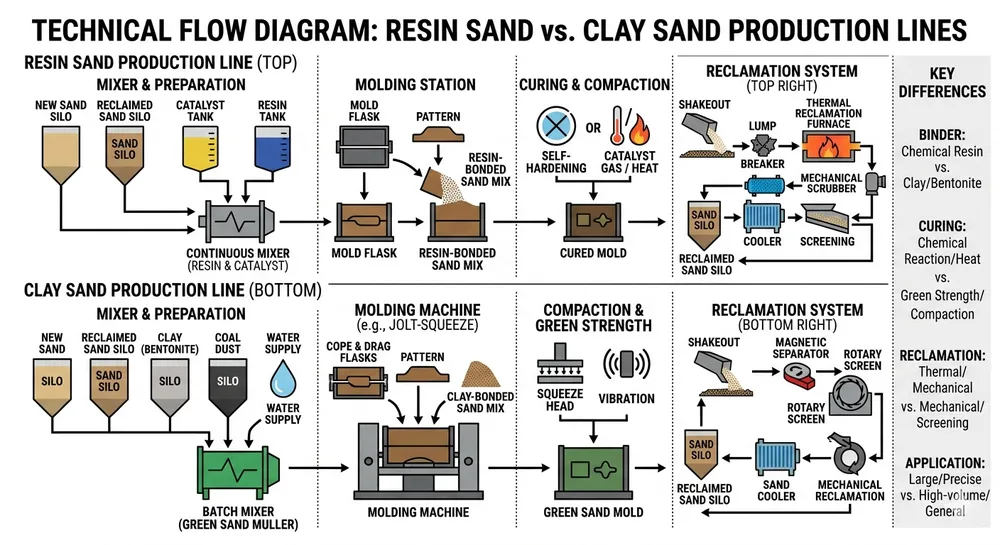
Furan no-bake resin reclaims cleaner with mechanical methods than phenolic urethane cold-box resin does. Furan is a thermosetting resin that cures through acid catalysis, and the cured resin is more brittle and easier to fracture off the sand grain during attrition. We typically see 2.0-2.8% LOI on mechanically reclaimed furan sand with 5-6 minutes of attrition time.
Phenolic urethane cold-box resin cures through amine gas catalysis and forms a tougher, more elastic film that resists mechanical abrasion. Mechanical reclamation on phenolic sand often leaves 3.0-4.0% LOI even with extended attrition cycles, because the resin film stretches rather than fractures. Thermal reclamation is more effective for phenolic systems — the organic binder burns off completely at 700-750°C regardless of how tough the cured film is.
Alkaline phenolic resin (used in hot-box and warm-box processes) falls between furan and cold-box phenolic in terms of mechanical reclaimability. You'll see 2.5-3.2% LOI with mechanical reclamation, which is acceptable for most applications but still benefits from thermal treatment if you're chasing sub-1% LOI for precision casting work.
If you're running a Furan Resin Sand Production Line, mechanical reclamation is often sufficient unless your daily volume or binder cost pushes you toward thermal. If you're running phenolic cold-box, thermal reclamation becomes cost-effective at lower throughput thresholds because the mechanical-only LOI is higher and less consistent.
What to Verify When Sourcing Either System
Most reclamation equipment datasheets list sand recovery rate and energy consumption, but they don't tell you the three numbers that actually determine your operating cost:
Actual LOI after treatment with your specific resin system. Don't accept generic "below 3% LOI" claims. Ask the supplier to run a sample batch of your used sand (send them 50 kg from your shakeout) through their test line and provide certified LOI results. We do this in our sand reclamation testing lab for every new buyer because the LOI you achieve depends on your resin type, your core curing temperature, and how long the sand sat in the mold before shakeout. A supplier who won't test your actual sand is guessing.
Screen mesh configuration and fines removal efficiency. The sand recovery rate is meaningless if the supplier is counting fines and dust as "recovered sand." Ask for the particle size distribution of the reclaimed sand output — you want 85%+ of the sand in the 50-140 mesh range (AFS 50-70 grain fineness). If the reclaimed sand has more than 8% fines below 200 mesh, you'll see permeability problems and gas defects in your molds even if the LOI is acceptable.
Thermal unit refractory life and replacement cost. For thermal reclamation systems, the fluidized bed or rotary kiln refractory lining lasts 18-24 months under continuous operation, then needs partial or full replacement. That's a $12,000-$18,000 maintenance event that should be in your TCO calculation. Mechanical systems have attrition mill liner wear (replace every 8-12 months, $2,500-$4,000 cost) but no refractory expense.
One sourcing trap we see repeatedly: buyers compare a low-cost mechanical reclamation system from one supplier against a high-spec thermal system from another supplier and conclude that thermal is "too expensive" without realizing they're comparing different throughput capacities or build quality levels. Compare equivalent-capacity systems from the same supplier or get detailed BoM breakdowns so you're evaluating the actual mechanical-vs-thermal cost delta, not supplier-vs-supplier pricing differences.
Decision Framework: Match Your Situation to the Right System
Here's the selection logic we use when buyers send us their sand throughput, resin type, and target LOI:
Choose mechanical-only reclamation if:
- Daily sand throughput is below 12 tons
- You're running sodium silicate or other inorganic binder systems
- Delivered new sand cost is below $35/ton and binder cost is below $3.00/kg
- Your casting quality specs accept 2.5-3.0% LOI and you're not chasing mirror-finish surface requirements
- Capital budget is constrained and you need to minimize upfront equipment spend
Choose thermal reclamation (or hybrid mechanical-thermal) if:
- Daily sand throughput is above 15 tons and growing
- You're running phenolic cold-box resin or high-cost furan formulations above $3.50/kg
- Your delivered new sand cost is above $45/ton or you're in a region with sand supply constraints
- Casting quality requirements demand consistent mold strength and low reject rates
- You can justify the 2.5-3× capital premium based on binder savings payback within 24 months
Choose the modular hybrid configuration if:
- You're starting below 15 TPD but expect volume growth within 18-24 months
- You want to preserve the thermal upgrade path without committing full capital now
- You need operational flexibility to fall back to mechanical-only during thermal unit maintenance
- Your floor space and utility infrastructure can accommodate the future thermal add-on
The decision isn't about which technology is "better" in the abstract — it's about which system gives you the lowest total cost per ton of reclaimed sand over a 5-year operating period given your specific throughput, resin cost, and quality requirements.
Remote Monitoring and Efficiency Tracking
One operational advantage that's become standard on our newer reclamation installations: remote diagnostics for tracking sand recovery rate and LOI trends over time. The system logs daily throughput, energy consumption per ton, screen efficiency, and periodic LOI test results, then flags when performance starts drifting outside normal range.
This matters because reclamation efficiency degrades gradually — attrition mill liners wear down, screen mesh stretches, thermal unit combustion efficiency drops as refractory ages. Most foundries don't notice the decline until their binder consumption has crept up 15-20% over six months and they're wondering why their sand cost is higher than it should be.
The remote monitoring setup sends weekly performance reports and alerts you when key parameters hit maintenance thresholds: attrition mill liner thickness below spec, screen blinding above 15%, thermal unit exit temperature variance indicating burner tuning needed. You can address the maintenance issue before it costs you money in higher binder consumption or lower sand recovery.
For buyers managing multiple foundry locations or working with contract casting suppliers, the remote diagnostics also give you visibility into whether your reclamation system is actually running at the efficiency the supplier promised. We've had buyers discover that their contract foundry was running the attrition cycle too short to save electricity, which left high LOI and forced higher binder dosage — the foundry was saving $40/day in power cost but costing the buyer $300/day in excess binder consumption.
What to Send When You Request a Quote
When you're ready to get factory pricing and a specific reclamation line recommendation, send us these parameters so we can spec the right configuration:
- Daily sand throughput (tons per day, or molds per hour if you know your sand-to-casting ratio)
- Resin type and supplier (furan, phenolic urethane, alkaline phenolic, sodium silicate, or other)
- Current delivered cost for new sand and binder ($/ton and $/kg)
- Target LOI after reclamation if you have a spec, or current LOI if you're already running reclamation
- Available floor space and whether you need a compact or standard-footprint configuration
- Utility availability: electrical supply capacity, natural gas or LPG for thermal units if considering thermal reclamation
If you're comparing mechanical versus thermal or evaluating the hybrid staged approach, tell us your expected production volume growth over the next 2-3 years — that changes the ROI calculation and might push you toward the modular configuration even if your current throughput doesn't justify full thermal investment yet.
Most buyers in your situation start with a sample sand test (send us 50 kg of your used sand from shakeout) so we can run it through both mechanical and thermal reclamation in our testing lab and give you certified LOI results and binder savings projections based on your actual sand, not generic estimates. That test costs nothing and gives you the real data you need to make the capital decision with confidence.
You can review our full Resin Sand Production Line equipment range or go directly to Request a Quote with your sand throughput and resin system details — we'll send back a detailed reclamation line recommendation with ROI analysis and factory pricing within 48 hours.

Liu Haoran is the Resin Sand Production Line Technical Manager at TZFoundry. Over 11 years of hands-on work with furan, phenolic, and coated sand systems, he has commissioned 40+ resin sand lines for export buyers and developed binder dosing protocols...