Undersized mixers create bottlenecks that idle your molding line. Oversized mixers waste capital and floor space while your binder costs climb from extended residence time. The gap between nameplate capacity and actual throughput — especially when you factor in binder type, curing window, and line synchronization — is where most first-time resin sand equipment buyers lose money.
Resin sand mixer capacity selection is the process of matching mixer throughput (measured in tons per hour) to your foundry's mold production rate, accounting for binder system chemistry, mixing cycle time, and whether your operation runs continuous or batch production. Get it right and your sand arrives at the molding station with 90-120 seconds of working time remaining. Get it wrong and you're either starving the line or dumping hardened sand back into reclamation.
Throughput Reality: Nameplate Capacity vs Production-Matched Sizing
Mixer datasheets list capacity in t/h, but that number assumes ideal conditions — consistent feed rate, zero downtime, and instantaneous discharge. Real foundry production adds three layers of friction.
Binder working time dictates your usable throughput. A 10 t/h continuous mixer running furan resin (3-5 minute working time) can feed a molding line directly. The same mixer running phenolic urethane (8-12 minute working time) becomes a 6-7 t/h effective capacity because you're forced to slow the feed rate to prevent sand from hardening in the discharge hopper. We've commissioned lines where buyers spec'd mixer capacity based on mold weight alone, then discovered their actual throughput was 40% below nameplate because the binder chemistry wasn't factored in.
Batch vs continuous architecture changes your sizing math. Batch mixers discharge the entire load at once — your molding line either absorbs that surge or you need buffer capacity. Continuous mixers feed steadily, but they can't easily adjust output mid-shift if your molding line slows down. Most buyers assume continuous is always better for high-volume work, but we've seen 15 t/h operations run more efficiently on three synchronized 5 t/h batch mixers because they could stage production around core-making schedules.
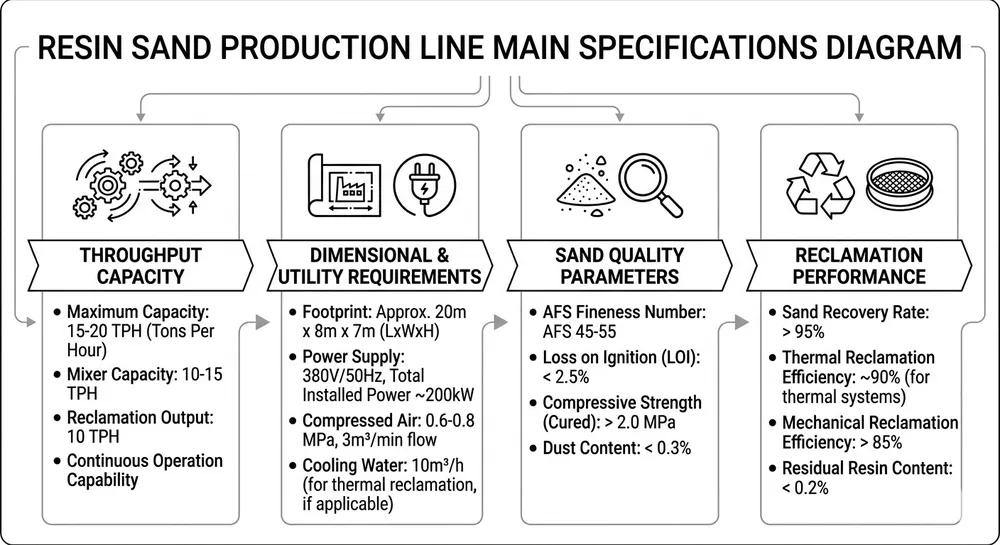
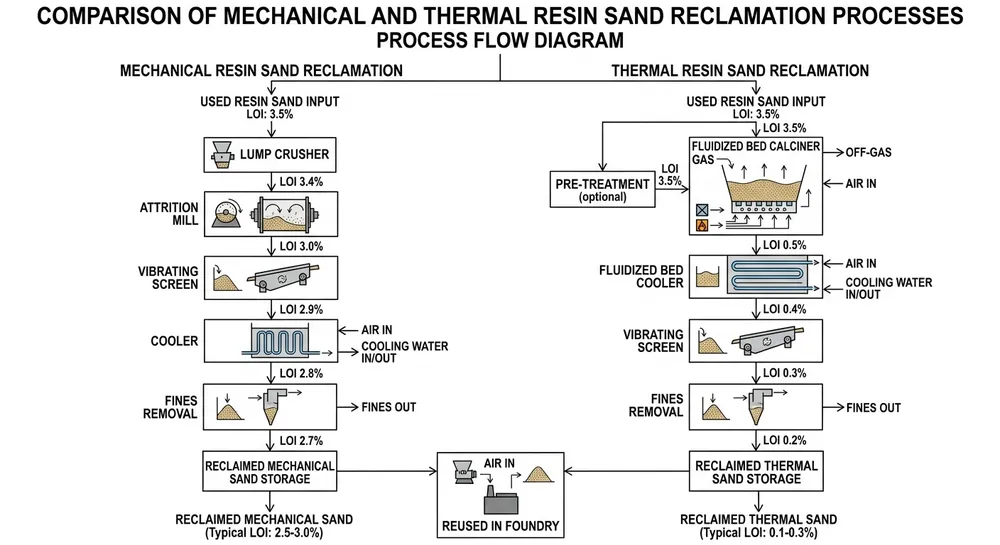
Reclamation return rate affects net mixer demand. If you're running 95% sand recovery with mechanical reclamation, your mixer only needs to supply 5% virgin sand plus binder. A 20 t/h molding line might only need an 8 t/h mixer because the bulk of your sand is coming back from reclaim. Buyers who size mixers to match gross mold output without accounting for reclamation end up with double the capacity they need.

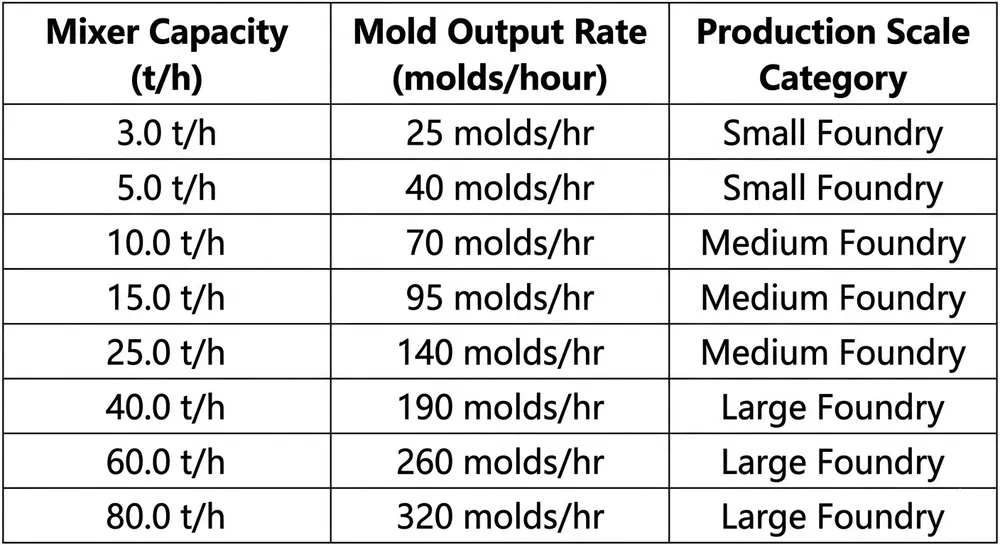
Here's the capacity-to-production mapping we use when sizing lines for export buyers:
| Mixer Throughput (t/h) | Mold Output Rate (molds/hour) | Typical Foundry Scale | Binder System Compatibility |
|---|---|---|---|
| 3-5 t/h | 40-80 molds/hour | Small batch foundry (1-2 molding lines) | Furan, phenolic, alkaline phenolic |
| 8-10 t/h | 100-150 molds/hour | Medium production foundry (2-3 molding lines) | Furan, phenolic (continuous feed required) |
| 15-20 t/h | 200-300 molds/hour | Large continuous foundry (3-5 molding lines) | Furan only (phenolic requires staged batch mixing) |
| 25+ t/h | 350+ molds/hour | High-volume automotive/pipe foundry | Furan with automated dosing, PLC-controlled feed rate |
This assumes 20-30 kg average mold weight and 90-95% sand reclamation return. If you're running lower recovery rates or heavier molds, shift up one capacity tier.
Continuous vs Batch Mixer Economics: Where the Break-Even Point Actually Sits
The standard advice is "batch for flexibility, continuous for volume." That's true at the extremes, but the middle ground — 8-15 t/h production — is where most buyers make expensive mistakes because the total cost of ownership calculation isn't obvious from equipment pricing alone.
Capital cost favors batch mixers until you hit 12-15 t/h. A single 10 t/h continuous mixer costs 40-50% more than two 5 t/h batch mixers with the same combined throughput. The continuous mixer needs variable-frequency drive controls, continuous binder dosing pumps, and a more complex discharge system. For a 10 t/h operation, you're paying $35,000-$45,000 for a continuous system vs $25,000-$30,000 for dual batch mixers. The break-even happens around 15 t/h, where the cost of adding a third batch mixer exceeds the premium for a single continuous unit.
Operating cost tilts toward continuous mixers if your binder consumption is high. Batch mixers over-mix by 8-12% because you need to ensure complete resin distribution across the entire load. Continuous mixers meter binder in real-time as sand flows through, so you're dosing exactly what's needed. On a 10 t/h line running furan resin at $1,200/ton, that 10% over-mix costs you $14,000 annually. We developed a binder dosing calibration protocol in 2018 that brought our continuous mixer resin waste down to 3-4%, and that's become the standard we ship. (Note: batch mixers can hit similar efficiency with load-cell-based dosing, but you're adding $8,000-$12,000 in controls to get there.)
Maintenance and downtime costs favor batch mixers for the first 3-5 years. Continuous mixers have more wear points — auger flights, seals, and dosing pump components that run constantly. A batch mixer's mixing blades and discharge gate are the only high-wear items, and they're cheaper to replace. We track warranty claims across both architectures: continuous mixers average 2.5 service calls per year in the first 36 months vs 1.2 calls for batch mixers. After year five, the numbers converge because batch mixer gearboxes start needing overhauls.
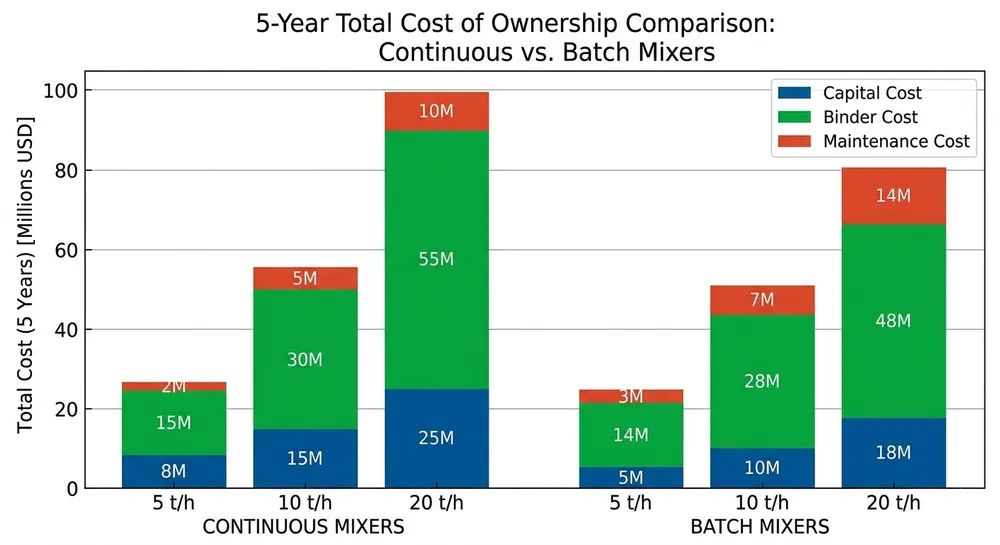
Here's the TCO breakdown we give buyers who are deciding between architectures:
5 t/h Production Scale (Small Foundry)
- Batch mixer: $18,000 capital + $42,000 binder (5 years) + $6,000 maintenance = $66,000 total
- Continuous mixer: $28,000 capital + $38,000 binder (5 years) + $11,000 maintenance = $77,000 total
- Verdict: Batch wins by $11,000 over five years
10 t/h Production Scale (Medium Foundry)
- Dual batch mixers: $30,000 capital + $84,000 binder (5 years) + $12,000 maintenance = $126,000 total
- Single continuous mixer: $42,000 capital + $76,000 binder (5 years) + $18,000 maintenance = $136,000 total
- Verdict: Batch still wins, but margin narrows to $10,000
20 t/h Production Scale (Large Foundry)
- Triple batch mixers: $52,000 capital + $168,000 binder (5 years) + $22,000 maintenance = $242,000 total
- Single continuous mixer: $68,000 capital + $152,000 binder (5 years) + $28,000 maintenance = $248,000 total
- Verdict: Continuous mixer becomes competitive; binder savings offset higher capital and maintenance
This assumes furan resin at $1,200/ton, 10% over-mix on batch systems, 4% on continuous systems, and standard maintenance intervals. If you're running phenolic resin (higher cost per ton), the continuous mixer break-even drops to 12-15 t/h.
Binder Chemistry and Mixing Speed: Why Your Resin Type Determines Mixer Configuration
Most capacity selection guides ignore binder chemistry. That works fine if you're only running furan, but phenolic and alkaline phenolic resins have different curing kinetics that directly affect how fast you can push sand through a mixer.
Furan resin tolerates high mixing speeds because curing is acid-catalyzed and relatively slow. Working time is 3-5 minutes after catalyst addition, so you can run a continuous mixer at full rated speed (10-12 t/h) and still have 90-120 seconds of workable sand at the molding station. We set our Siemens PLC controls to 85-90% rated speed on furan lines because that gives you buffer time if the molding line slows down temporarily. Push it to 100% and you're fine, but you lose flexibility.
Phenolic urethane resin forces you to slow down or switch to batch mixing. Working time is 8-12 minutes, which sounds like more margin, but the curing reaction accelerates with temperature. If you're running a continuous mixer at high speed, the mechanical mixing action generates enough heat to shorten working time by 30-40%. We've seen buyers try to run phenolic through a 15 t/h continuous mixer at full speed and end up with sand that's already setting up in the discharge chute. The fix is either to slow the mixer to 60-70% rated speed (which drops your effective capacity to 9-10 t/h) or switch to batch mixing where each load cools slightly between cycles.
Alkaline phenolic (sodium silicate CO₂-cured) needs batch mixing unless you're running very high volumes. Working time is 15-20 minutes, but the binder is moisture-sensitive and you need precise CO₂ gassing after molding. Continuous mixers work, but you need a buffer hopper between the mixer and molding line to prevent sand from sitting too long. Most buyers in this segment run batch mixers because the longer working time makes the batch cycle penalty irrelevant — you're not losing throughput by waiting 45-60 seconds for the next batch to discharge.
Here's the mixing speed and residence time we recommend for each binder system:
| Binder System | Recommended Mixing Speed | Residence Time in Mixer | Working Time After Discharge | Preferred Mixer Type |
|---|---|---|---|---|
| Furan (acid-catalyzed) | 85-100% rated speed | 30-45 seconds | 3-5 minutes | Continuous (high volume) or batch (flexibility) |
| Phenolic urethane | 60-75% rated speed | 45-60 seconds | 8-12 minutes | Batch preferred; continuous only if slowed |
| Alkaline phenolic (CO₂) | 70-85% rated speed | 40-50 seconds | 15-20 minutes | Batch preferred; continuous requires buffer hopper |
| Cold-box (polyurethane) | 80-90% rated speed | 35-50 seconds | 5-8 minutes | Continuous (amine gassing at mold) |
If you're running multiple binder systems in the same foundry, you need either separate mixers for each chemistry or a batch mixer with quick-changeover dosing pumps. We've built dual-binder lines for buyers who run furan for high-volume work and phenolic for complex cores, but trying to switch binder types on a single continuous mixer mid-shift is a recipe for contamination and scrap.
Modular Line Design: Matching Mixer Capacity to Existing Reclamation and Molding Equipment
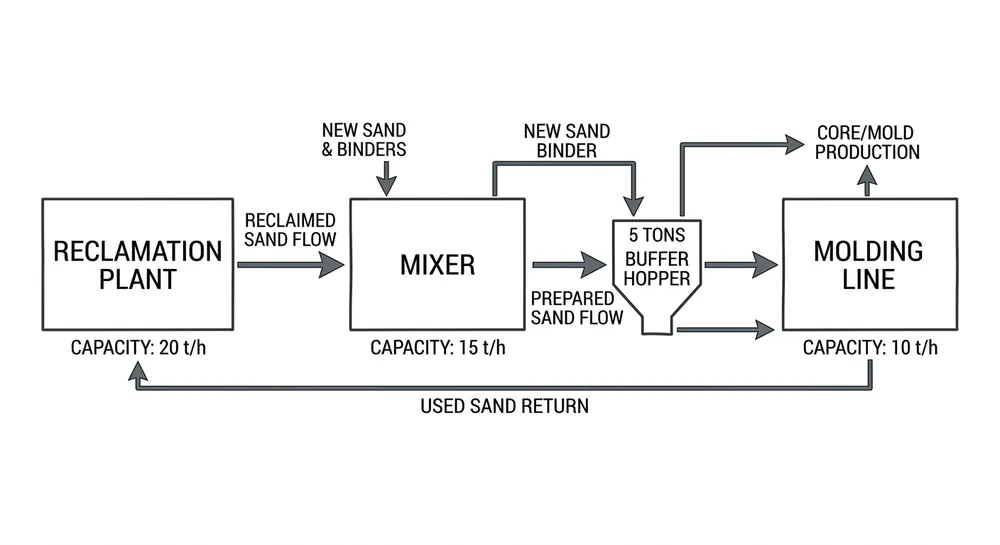
The most common sizing mistake we see: buyers spec a new mixer in isolation, then discover it doesn't synchronize with their existing reclamation plant or molding line. Mixer capacity isn't a standalone decision — it's the middle node in a three-part system.
Your reclamation plant sets the floor for mixer capacity. If you're running a 12 t/h mechanical reclamation system with 95% recovery, you're returning 11.4 t/h of reclaimed sand. Your mixer only needs to supply 0.6 t/h of virgin sand plus binder to maintain a 12 t/h molding line. But if your reclamation plant can only process 8 t/h, you need a mixer that can supply the 4 t/h shortfall plus the virgin sand makeup. We size mixers after we know the reclamation plant's actual throughput, not its nameplate capacity — most mechanical reclaim systems run at 75-85% of rated capacity in real production because of screen blinding and dust collection downtime.
Your molding line's cycle time determines whether you need buffer capacity between the mixer and molds. Fast-cycle molding machines (15-20 seconds per mold) pull sand in surges. If you're feeding them with a continuous mixer, you need a 500-1000 kg buffer hopper to smooth out the demand spikes. Batch mixers naturally provide this buffer because each discharge is a discrete load. We've shipped lines where the buyer insisted on a continuous mixer for a fast-cycle molding line, then had to add a $12,000 buffer hopper and level sensors after commissioning because the mixer couldn't respond fast enough to demand changes.
PLC integration allows post-installation capacity adjustments without hardware changes. Our Siemens and Mitsubishi PLC systems let you adjust mixer speed, binder dosing rate, and discharge timing remotely. If your molding line throughput increases six months after installation, you can dial up the mixer speed by 10-15% without replacing motors or gearboxes (assuming you didn't originally spec at 100% capacity). This is where modular line design pays off — you're not locked into the capacity you bought on day one. (We learned this from a buyer in Poland who expanded from 8 t/h to 11 t/h production 18 months after installation. Because we'd spec'd the mixer with a 15% overhead margin and VFD controls, they adjusted it themselves via the HMI without flying us back for a retrofit.)
If you're building a new line from scratch, the sizing sequence is: molding line output → reclamation plant capacity → mixer throughput. If you're adding a mixer to an existing line, the sequence reverses: measure actual reclamation throughput → calculate virgin sand makeup requirement → size mixer to fill the gap. Most buyers get this backwards and end up with mismatched capacity at one end of the system.
In-House Testing Lab: Validating Mixer Performance with Your Specific Sand and Resin Combination
Datasheet capacity numbers assume standard silica sand (AFS 50-60) and generic furan resin. If you're running chromite sand, olivine sand, or a proprietary binder formulation, those numbers don't apply. We run validation tests in our sand reclamation lab before shipping to confirm the mixer will hit target throughput with your actual materials.
Sand grain shape affects mixing efficiency and residence time. Round silica sand flows easily and mixes in 30-35 seconds. Angular chromite sand takes 45-50 seconds to achieve the same resin distribution because the particles interlock and resist tumbling. If you're switching from silica to chromite sand, your effective mixer capacity drops by 15-20% unless you extend the mixing cycle. We test this by running 50 kg batches of your sand with your specified binder, then measuring resin distribution uniformity with a loss-on-ignition test. If we're seeing more than 5% variation in resin content across the batch, we adjust paddle configuration or mixing speed before the mixer ships.
Binder viscosity changes with temperature and affects dosing accuracy. Furan resin at 15°C is 40% more viscous than the same resin at 25°C. If your foundry runs in a cold climate and you're using standard gear pumps for binder dosing, you'll under-dose in winter and over-dose in summer. Our PLC systems compensate for this with temperature-corrected dosing curves, but we need to know your ambient temperature range during the design phase. We've shipped mixers to Canada and Saudi Arabia in the same year — the dosing pump specifications were completely different because of the 50°C temperature swing between the two environments.
Catalyst-to-resin ratio testing prevents mold cracking and weak spots. The standard furan ratio is 40-60 parts catalyst per 100 parts resin, but that's a starting point, not a universal spec. High-humidity environments need more catalyst to compensate for moisture interference. High-temperature pouring (cast iron above 1400°C) needs less catalyst because the mold heats up and accelerates curing. We run trial molds in our lab with your alloy pouring temperature and ambient humidity, then adjust the catalyst ratio until we're hitting 24-hour tensile strength of 1.8-2.2 MPa. That validated ratio gets programmed into the PLC before the mixer ships, so you're not troubleshooting binder chemistry during commissioning.
If you're a first-time resin sand equipment buyer, the testing lab is the most valuable part of the purchase. You're not just buying a mixer — you're buying a validated process recipe that works with your specific sand, binder, and production environment. We charge separately for lab testing (usually $1,500-$2,500 depending on how many material combinations you want to validate), but it eliminates 90% of the commissioning problems we used to see before we started offering this service.
Specification Interpretation: What Mixer Datasheets Don't Tell You About Real Throughput
Mixer datasheets list capacity, motor power, and mixing cycle time. What they don't list: how much of that capacity you'll actually use in production, what happens when you run below 50% rated capacity, and how the numbers change when you switch binder types mid-shift.
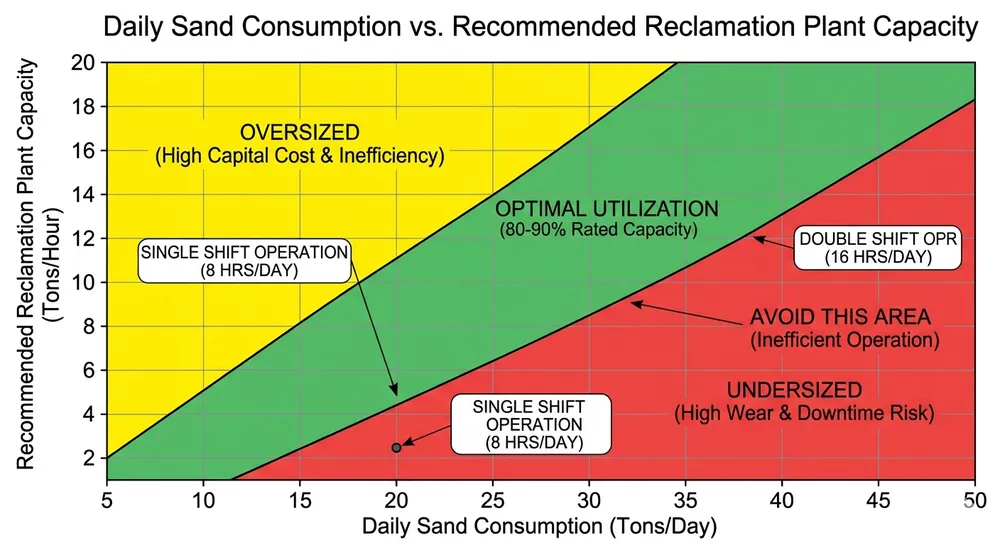
Rated capacity assumes 100% duty cycle, which no foundry achieves. A 10 t/h continuous mixer running 16 hours per day at 85% average utilization delivers 136 tons per day, not the 160 tons the datasheet implies. Batch mixers are worse — a 5 t/h batch mixer with a 3-minute cycle time (including load, mix, and discharge) delivers 4.2 t/h in real production, not 5 t/h. When we quote mixer capacity to buyers, we use "effective throughput" numbers that account for realistic duty cycles. If a buyer tells us they need 10 t/h, we spec a 12 t/h mixer so they actually get 10 t/h in production.
Minimum stable throughput matters more than maximum capacity for flexible operations. Continuous mixers can't run below 40-50% rated speed without losing mixing uniformity. If you spec a 20 t/h mixer for a line that sometimes runs at 8 t/h (night shift or low-demand periods), you'll get poorly mixed sand during those slow periods. Batch mixers handle variable throughput better because each batch is a discrete mixing event — you just run fewer batches per hour. This is why we recommend batch mixers for job-shop foundries that produce 50-200 different part numbers per month with widely varying production rates.
Motor power and mixing intensity aren't the same thing. A 15 kW motor on a 10 t/h mixer sounds more powerful than a 12 kW motor on the same capacity, but motor power includes drive losses, gearbox friction, and discharge mechanism load. What matters is specific mixing energy — kW per ton of sand. We target 1.2-1.5 kW per ton for furan resin and 1.5-1.8 kW per ton for phenolic resin. If a datasheet shows a 10 t/h mixer with a 10 kW motor (1.0 kW/ton), it's under-powered for phenolic resin and you'll see incomplete mixing or extended cycle times.
Here's the datasheet translation guide we give to procurement teams who are comparing mixer quotes:
| Datasheet Claim | What It Actually Means | What to Ask the Supplier |
|---|---|---|
| "10 t/h capacity" | Maximum throughput under ideal conditions | "What's the effective throughput at 85% duty cycle with furan resin?" |
| "3-minute mixing cycle" | Time from load to discharge, not including wait time between batches | "What's the actual batches-per-hour rate in continuous production?" |
| "15 kW motor" | Total installed power, not mixing energy | "What's the specific mixing energy (kW per ton)?" |
| "PLC control system" | Could be anything from basic relay logic to full SCADA integration | "Which PLC brand? Can I adjust dosing rates remotely? Is there a data logging function?" |
| "Suitable for all resin types" | Tested with furan; other resins may require speed/dosing adjustments | "Have you validated this mixer with [my specific binder system]? Can I see test data?" |
If a supplier can't answer these questions with specific numbers, they're selling you a mixer based on theoretical capacity, not real-world performance. We include effective throughput curves in our quotations because buyers need to know what they're actually getting, not what the motor nameplate says.
Common Sizing Mistakes and How to Avoid Them
Mistake 1: Sizing the mixer to match mold weight without accounting for reclamation return. A buyer running 20 kg molds at 100 molds/hour calculates 2,000 kg/hour (2 t/h) and specs a 3 t/h mixer. But if they're running 90% sand recovery, they only need 0.2 t/h of virgin sand plus binder. They've over-spec'd by 10x and wasted $15,000 on excess capacity. The fix: calculate net sand demand (mold output minus reclamation return) before sizing the mixer.
Mistake 2: Assuming continuous mixers are always better for high-volume production. Continuous mixers excel at steady-state production, but if your molding line runs multiple part numbers with different sand requirements, you're constantly adjusting mixer speed and binder dosing. Batch mixers let you change recipes between batches without flushing the system. We've seen 15 t/h job-shop foundries run more efficiently on batch mixers than continuous mixers because recipe changeover time was the real bottleneck, not mixing capacity.
Mistake 3: Ignoring binder working time when selecting mixer speed. A buyer specs a 12 t/h continuous mixer for a phenolic resin line, then discovers the sand is half-cured by the time it reaches the molding station because the mixer is running too fast. The fix: match mixer throughput to binder working time, not just mold output rate. For phenolic resin, slow the mixer to 60-70% rated speed or add buffer capacity to reduce residence time.
Mistake 4: Buying a mixer without confirming PLC compatibility with existing equipment. A buyer adds a new mixer to an existing line, then discovers the Siemens PLC on the mixer can't communicate with the Allen-Bradley PLC on the molding line. They end up running the mixer in manual mode, which defeats the purpose of automated dosing. The fix: specify PLC brand and communication protocol during the RFQ stage. We offer Siemens, Mitsubishi, and Allen-Bradley PLC options specifically to avoid this problem.
Mistake 5: Under-spec'ing mixer capacity to save capital cost, then losing money on binder waste. A buyer chooses a 5 t/h mixer instead of a 7 t/h mixer to save $8,000 upfront. The smaller mixer runs at 100% capacity continuously, which means no overhead for speed adjustments when binder working time varies. They end up over-dosing resin by 15% to ensure complete mixing, which costs them $12,000 per year in wasted binder. The fix: spec 15-20% overhead capacity so you can adjust mixer speed and dosing rate without compromising mixing quality.
If you're evaluating mixer quotes and the pricing spread is more than 30% between suppliers, the lower-cost option is almost certainly under-spec'd on motor power, PLC controls, or dosing accuracy. We've rebuilt three mixers in the last two years for buyers who went with the cheapest quote, then discovered the mixer couldn't hold ±2% dosing accuracy or run below 70% rated speed without losing mixing uniformity.
FAQ
What is the best mixer capacity for a 10 t/h resin sand molding line with 90% sand reclamation?
You need a mixer that supplies 1 t/h of virgin sand plus binder to make up the 10% loss from reclamation. Spec a 2-3 t/h mixer to give yourself overhead for dosing adjustments and maintenance downtime. If you're running furan resin, a 2.5 t/h continuous mixer works well. For phenolic resin, go with a 3 t/h batch mixer because the longer working time makes batch cycling more efficient than slowing down a continuous mixer.
How do I prevent resin sand from hardening in the mixer discharge chute?
This happens when mixer throughput is too slow for the binder working time, or when the discharge chute has dead zones where sand accumulates. For furan resin (3-5 minute working time), keep mixer cycle time under 60 seconds and use a steep discharge chute (minimum 60° angle) with a vibrator to prevent bridging. For phenolic resin, add a buffer hopper between the mixer and molding line so sand doesn't sit in the chute. We install pneumatic vibrators on all discharge chutes as standard because even well-designed chutes can bridge with damp sand or high-resin-content mixes.
Continuous vs batch mixer: which is better for a foundry running both furan and phenolic resin?
Batch mixer, unless you're running very high volumes (20+ t/h). Switching binder types on a continuous mixer requires flushing the system, which wastes 50-100 kg of sand and 15-20 minutes of production time. Batch mixers let you change binder recipes between batches with no flushing — just adjust the dosing pump settings on the PLC. If you're running furan 70% of the time and phenolic 30% of the time, a batch mixer with quick-changeover dosing pumps is the most flexible option.
What causes inconsistent binder dosing in resin sand mixers?
Three main causes: binder temperature variation (viscosity changes with temperature), worn dosing pump gears (creates pulsing flow), and air entrainment in the binder supply line (causes dosing spikes). We solve the first problem with temperature-compensated dosing curves in the PLC. The second requires regular pump maintenance — inspect gear clearances every 6 months and replace pumps when clearance exceeds 0.3 mm. The third requires proper binder tank venting and supply line routing to prevent siphoning. If you're seeing ±5% or more variation in binder content across batches, check these three items in order.
How often should a resin sand mixer be calibrated?
Every 3 months for the first year, then every 6 months after that if dosing accuracy stays within ±2%. Calibration involves running test batches with known sand weight, measuring actual binder consumption, and adjusting the PLC dosing parameters to match target resin content. We include a calibration protocol with every mixer that walks you through the process — it takes about 2 hours and requires a scale accurate to ±0.1 kg. Most buyers skip calibration until they start seeing mold defects, but by then you've wasted months of binder. Set a calendar reminder and do it on schedule.
What mixer capacity do I need for a new foundry producing 5,000 molds per month?
Depends on mold weight and production schedule. If you're running 20 kg molds over 20 working days (250 molds/day), that's 5,000 kg/day or 625 kg/hour over an 8-hour shift. With 90% sand reclamation, you need 62.5 kg/hour of virgin sand plus binder. A 1-2 t/h batch mixer is sufficient. But if you're running 10-hour shifts or planning to grow production, spec a 3 t/h mixer so you have overhead. For a new foundry, we usually recommend starting with a batch mixer because it's more forgiving during the learning curve — you can adjust recipes between batches without the pressure of continuous production.
Can I increase mixer capacity later without replacing the entire unit?
Depends on how much overhead capacity you spec'd initially. If you bought a 10 t/h mixer and you're running it at 60-70% capacity, you can increase throughput by 20-30% just by adjusting PLC speed settings and confirming motor and gearbox ratings. If you're already running at 90-100% capacity, you need a motor upgrade or a second mixer. This is why we recommend spec'ing 15-20% overhead capacity on day one — it gives you growth room without hardware changes. Our VFD-controlled mixers can be dialed up remotely as long as you're withinthe motor and gearbox thermal limits — we publish those limits in the commissioning manual so you know exactly how much headroom you have.
What's the difference between mixer throughput and effective capacity?
Mixer throughput is the nameplate rating (t/h) under ideal conditions — continuous feed, zero downtime, optimal binder viscosity. Effective capacity is what you actually get in production after accounting for duty cycle, binder type, and line synchronization delays. A 10 t/h continuous mixer typically delivers 8-8.5 t/h effective capacity in real foundry production. A 5 t/h batch mixer with a 3-minute cycle delivers 4-4.2 t/h effective capacity because you lose time during load and discharge. When we quote mixer capacity, we always specify both numbers so buyers know what to expect. If a supplier only gives you throughput without effective capacity, ask them to clarify — that's where the gap between expectation and reality lives.
How do I match mixer speed to resin curing time?
Calculate backwards from your molding station. If you're running furan resin with 4 minutes of working time and your mixer-to-mold distance is 15 meters with a 30-second conveyor transit time, you have 3.5 minutes of usable working time at the mold. Subtract 60 seconds for the mixing cycle and 30 seconds for discharge, and you're left with 2 minutes of buffer time. That's comfortable. If you're running phenolic resin with 10 minutes of working time, you have much more margin and can slow the mixer to 60-70% speed to reduce binder waste. The PLC should have adjustable speed presets for each binder type — we program these during commissioning based on your actual plant layout and measured transit times.
What causes sand bridging in the mixer discharge hopper?
Three main causes: hopper angle too shallow (needs to be 60° minimum for resin-coated sand), moisture content above 0.3% (makes sand sticky), or discharge gate opening too small (creates back-pressure). We design discharge hoppers with 65° walls and pneumatic vibrators to prevent bridging, but if you're still seeing problems, check sand moisture first — even 0.5% moisture can cause furan-coated sand to clump. If moisture is under control, increase the discharge gate opening by 20-30% or add a second vibrator on the opposite hopper wall. Most bridging problems are moisture-related, not mechanical.
Should I size my mixer based on peak production or average production?
Average production plus 20% overhead. If you size for peak production, you'll have excess capacity 70-80% of the time, which wastes capital and increases per-ton operating cost. If you size for average production with no overhead, you'll bottleneck during peak periods and either idle the molding line or run the mixer at 100% capacity with no room for adjustments. The 20% overhead gives you flexibility for growth, maintenance downtime, and binder recipe changes without forcing you to buy capacity you'll rarely use. We've commissioned lines where buyers insisted on sizing for peak production, then regretted it 18 months later when they realized they'd spent $25,000 on capacity they used two weeks per year.

Liu Haoran is the Resin Sand Production Line Technical Manager at TZFoundry. Over 11 years of hands-on work with furan, phenolic, and coated sand systems, he has commissioned 40+ resin sand lines for export buyers and developed binder dosing protocols...