Your foundry runs 180 molds per shift, but your current batch mixer can't keep up with the pour schedule. You're looking at continuous mixers, but the price jump makes you hesitate. Or maybe you're running 40 molds a day across three different alloys, and someone told you continuous mixers waste resin during changeovers.
Here's the decision tension: batch mixers give you flexibility and lower upfront cost, but continuous mixers eliminate the queue bottleneck and cut labor. The wrong choice doesn't just cost you the equipment price difference — it costs you in resin waste, operator time, or production delays that ripple through your entire casting schedule.
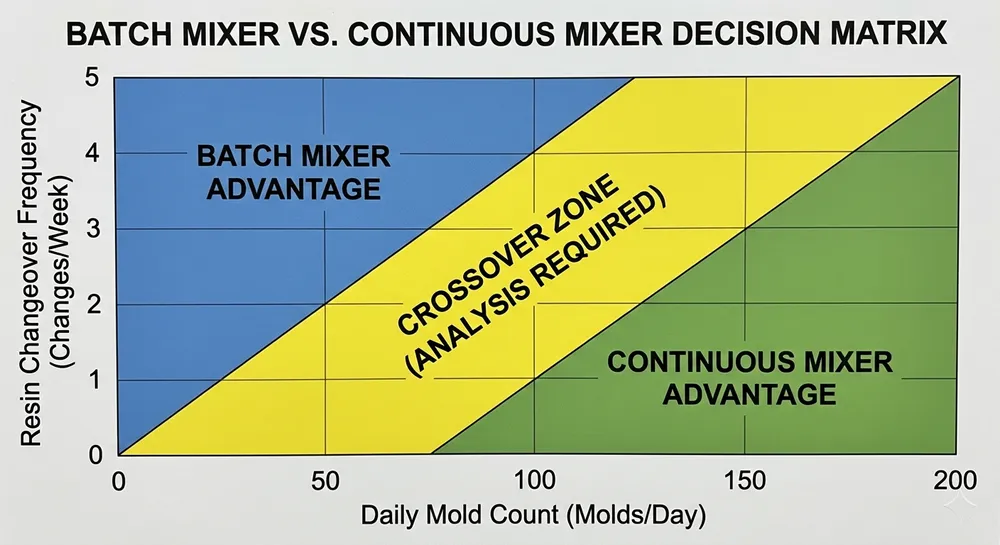
Quick verdict: If you're running 120+ molds per shift on a consistent pour schedule, continuous mixers pay back their premium in 8-14 months through labor savings and resin accuracy. Below 80 molds per day or running frequent alloy changes, batch mixers give you better economics. The crossover zone (80-120 molds/day) depends on your resin system and shift pattern — we'll map that out below.
Operating Principle: How Each Type Handles Sand Flow and Resin Dosing
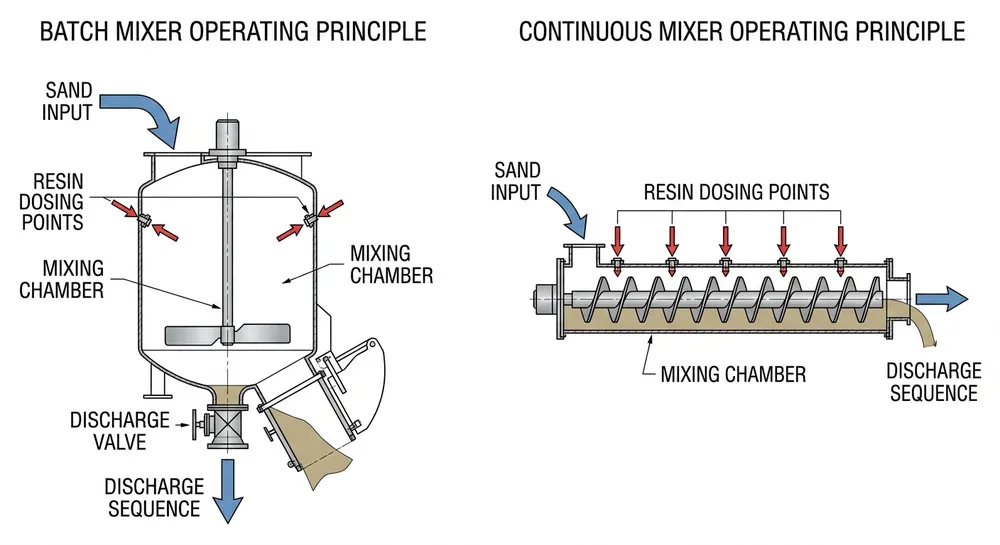
Batch mixers load a fixed volume of sand (typically 50-300 kg per batch), inject resin and catalyst in a timed sequence, mix for 60-90 seconds, then discharge the complete batch. The mixer sits empty between cycles while the operator loads the next batch. Resin dosing happens through volumetric or gravimetric pumps that fire during the mixing cycle.
Continuous mixers feed sand, resin, and catalyst simultaneously through a screw conveyor or paddle system. Sand enters at a constant rate (controlled by a belt feeder or vibratory hopper), resin pumps meter binder proportionally to sand flow, and mixed sand discharges continuously at the other end. There's no empty cycle — the mixer runs as long as you're feeding sand.
The mechanical difference creates the economic difference. Batch mixers give you natural break points (between batches) to change resin systems, adjust ratios, or pause production. Continuous mixers eliminate the load-mix-discharge cycle time, but they need a steady sand supply and a downstream process that can absorb continuous output.

Head-to-Head Specification Matrix
| Dimension | Batch Mixer | Continuous Mixer | Commercial Impact |
|---|---|---|---|
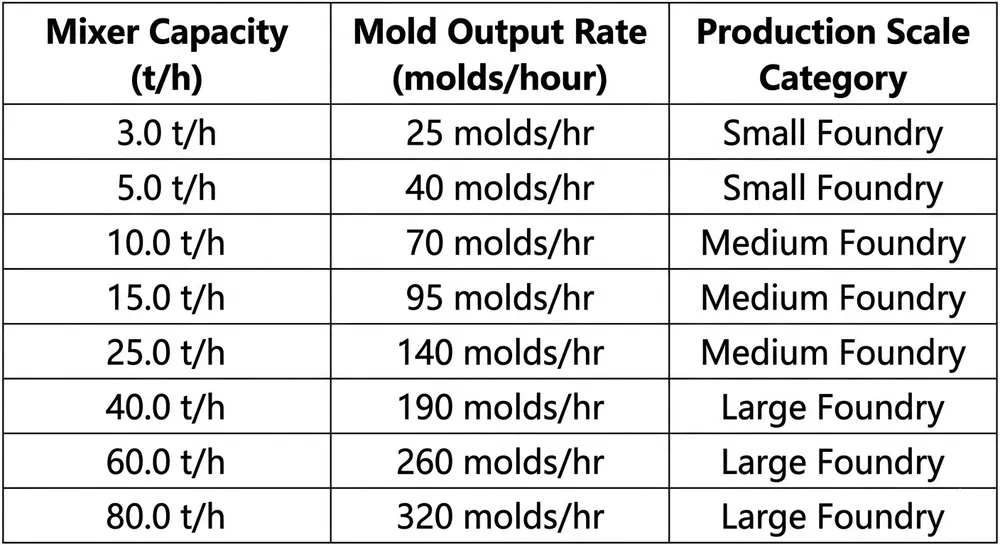
| Throughput capacity | 1-4 batches/minute (50-300 kg/batch) = 3-12 tons/hour | 5-20 tons/hour continuous output | Continuous mixers eliminate queue time when your molding line runs faster than 8-10 molds/hour |
| Resin dosing accuracy | ±3-5% batch-to-batch variation (volumetric pumps), ±1-2% with gravimetric systems | ±1-2% continuous accuracy with closed-loop flow control | Tighter accuracy = 8-12% resin savings on high-volume runs — this is where continuous mixers pay back their premium |
| Changeover time | 5-10 minutes to flush and switch resin systems | 15-25 minutes to purge lines and stabilize new resin ratio | Batch mixers win if you're switching between furan/phenolic/sodium silicate multiple times per shift |
| Mixed sand shelf life | 20-40 minutes (furan), 60-90 minutes (phenolic) — same for both types | Same — shelf life is resin chemistry, not mixer type | No advantage either way, but continuous mixers force you to manage downstream flow to avoid sand aging in hoppers |
| Operator labor | 1 operator per mixer (loading, batch sequencing, ratio adjustments) | 0.3-0.5 operator per mixer (monitoring only, sand feed is automated) | Labor cost difference: 15-20 hours/week saved on continuous systems running 2-shift operations |
| Floor space | 8-12 m² (mixer + sand hopper + resin tanks) | 12-18 m² (longer conveyor path, larger sand buffer hopper) | Batch mixers fit tighter layouts — matters if you're retrofitting into existing floor space |
| Resin system compatibility | All types (furan, phenolic, sodium silicate, alkaline phenolic) | Best with furan and phenolic; sodium silicate requires modified screw design to prevent premature hardening | Batch mixers handle sodium silicate more reliably — continuous mixers need heated screws or faster discharge rates |
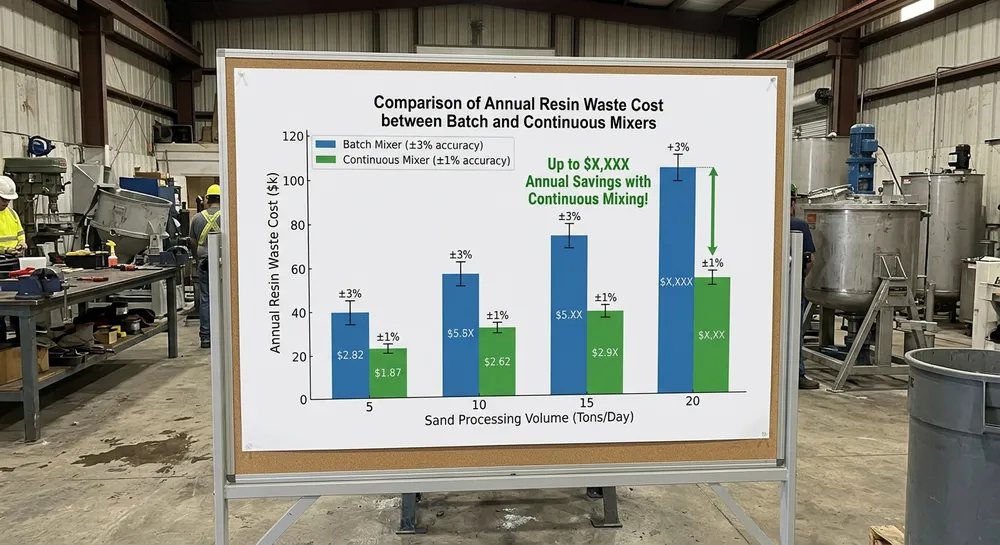
The accuracy row is the hidden cost driver. A 3% resin overdose on a foundry running 5 tons of sand per day costs you $180-240/day in wasted binder (assuming $1.20-1.60/kg furan resin). Over a year, that's $45,000-60,000 — enough to justify the continuous mixer premium if your volume supports it.
The Hidden Cost Analysis: Where the Real Money Moves
Resin Waste from Dosing Inaccuracy
Batch mixers using volumetric pumps typically run 2-4% over the target resin ratio because operators set the pump timer conservatively to avoid weak molds. We've seen foundries running 2.2% actual resin addition when their process spec calls for 1.8% — they're paying for 22% extra resin without realizing it.
Continuous mixers with gravimetric dosing and closed-loop flow control hold ±1% accuracy across the shift. The resin pump adjusts in real-time based on sand flow rate, so you're not guessing. On a 10-ton/day operation, tightening accuracy from 2.2% to 1.9% saves 300 kg of resin per day — that's $360-480/day, or $90,000-120,000 annually.
(We developed TZFoundry's binder dosing calibration protocol after watching a customer waste $8,000/month on resin overdosing with an older batch mixer. The continuous mixer we installed cut their resin cost by 14% in the first quarter.)
Labor Cost and Queue Bottlenecks
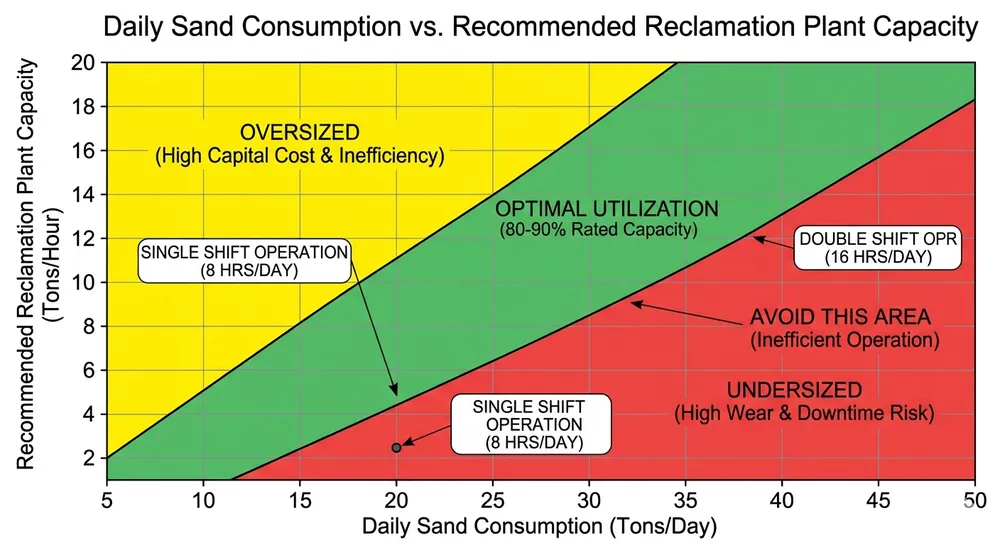
Batch mixers need an operator to load sand, trigger the cycle, and monitor discharge. On a 2-shift operation, that's 1 full-time operator per mixer. Continuous mixers run on automated sand feed — the operator monitors the HMI and adjusts ratios, but they're not tied to the machine. One operator can supervise 2-3 continuous mixers if the sand reclamation system feeds them automatically.
Labor cost difference: $35,000-50,000/year per mixer (depending on regional wages). For a single-mixer operation, this might not justify the equipment premium. For a 2-3 mixer facility, the labor savings compound quickly.
The queue bottleneck is subtler. If your molding line runs 12 molds/hour but your batch mixer only delivers 8-9 batches/hour (because of load and discharge time), your molding line sits idle 25% of the shift. You're paying for molding capacity you can't use. Continuous mixers eliminate the batch cycle gap — mixed sand is always available as long as the reclamation system keeps feeding.
Maintenance Intervals and Downtime
Batch mixers have fewer moving parts — a single mixing paddle or ribbon blade, a discharge gate, and resin pumps. Typical maintenance: blade wear inspection every 3 months, pump seal replacement every 6-12 months, gearbox oil change annually. Downtime: 2-4 hours per quarter.
Continuous mixers add a screw conveyor or paddle chain, a belt feeder or vibratory hopper, and more complex resin distribution manifolds. Maintenance intervals are similar, but the parts count is higher. Downtime: 4-6 hours per quarter. The trade-off: continuous mixers spread wear across more components, so catastrophic failures are less common (a worn batch mixer blade can crack and jam the entire mixer mid-shift).
Resin System Changeover Cost
If you're running furan resin for ductile iron in the morning and switching to phenolic for steel castings in the afternoon, batch mixers give you a 5-10 minute changeover. Flush the mixer with dry sand, swap the resin drum connection, adjust the pump timer, done.
Continuous mixers need 15-25 minutes to purge the screw conveyor and stabilize the new resin ratio. You'll waste 50-100 kg of sand during the transition (the mixed sand coming out during the first few minutes won't meet spec). For foundries running 2+ resin system changes per day, this waste adds up — 200-400 kg/day of off-spec sand that either goes to reclamation or gets scrapped.
Decision rule: If you're changing resin systems more than once per shift, batch mixers save you 30-60 minutes of downtime and 1-2 tons of transition waste per week.
Application Showdown: Which Mixer Wins for Your Pour Schedule
Scenario 1: High-Volume Single-Alloy Foundry (150+ Molds/Shift)
Profile: Ductile iron pipe foundry, 180 molds per 8-hour shift, furan resin sand, consistent pour schedule, 2-shift operation.
Winner: Continuous mixer
Why: Your molding line runs 22-23 molds/hour. A batch mixer (even a large 200 kg/batch unit running 3 batches/minute) can only deliver 15-18 molds/hour worth of sand. You'd need 2 batch mixers to keep up, which costs more than 1 continuous mixer and doubles your operator labor.
The resin accuracy advantage pays back fast at this volume. You're running 12-15 tons of sand per day — tightening resin dosing from 2.0% to 1.8% saves $150-200/day, or $36,000-48,000/year. The continuous mixer premium ($25,000-35,000 over a comparable batch system) pays back in 8-10 months.
You're not changing resin systems, so the changeover disadvantage doesn't apply. The labor savings (1 operator instead of 2) adds another $35,000-45,000/year. Total annual advantage: $70,000-90,000.
Scenario 2: Job Shop Foundry with Mixed Batch Sizes (40-80 Molds/Day)
Profile: Steel and aluminum casting job shop, 40-80 molds per day depending on order mix, switching between furan (steel) and sodium silicate (aluminum) 2-3 times per week, single-shift operation.
Winner: Batch mixer
Why: Your daily volume doesn't justify the continuous mixer premium. At 60 molds/day average (6-8 tons of sand), the resin accuracy savings are only $60-80/day, or $15,000-20,000/year. The continuous mixer costs $30,000-40,000 more than a batch system, so payback stretches to 18-24 months.
The changeover penalty kills the continuous mixer economics. You're switching resin systems 2-3 times per week — that's 100-150 kg of transition waste per changeover, or 5-8 tons per year. At $1.40/kg resin cost (assuming 2% resin ratio), you're wasting $140-220 per year just on changeover sand. Add the extra 15-20 minutes of downtime per changeover (10 hours/year), and the continuous mixer's advantages evaporate.
Sodium silicate compatibility is the final nail. Continuous mixers need heated screws or modified discharge designs to prevent premature hardening in the conveyor. Batch mixers handle sodium silicate with no modifications. Batch mixer saves you $15,000-20,000 in upfront cost and avoids $8,000-12,000/year in changeover waste and downtime.
Scenario 3: Mid-Volume Foundry at the Crossover Zone (100-120 Molds/Shift)
Profile: Gray iron automotive component foundry, 110 molds per 8-hour shift, furan resin sand, occasional phenolic resin for high-temperature cores, 2-shift operation.
Winner: Depends on your resin changeover frequency
Why: This is the zone where both options pencil out, and the decision hinges on your specific operation.
If you're running furan 90%+ of the time (phenolic only for specialty cores once or twice per week): Continuous mixer wins. Your daily volume (10-12 tons of sand) generates $100-140/day in resin accuracy savings ($25,000-35,000/year). Labor savings add another $35,000-45,000/year. The occasional phenolic changeover costs you 2-3 hours per month in downtime and transition waste ($3,000-5,000/year), but you're still ahead by $55,000-75,000/year. Payback: 10-14 months.
If you're switching between furan and phenolic daily or multiple times per week: Batch mixer wins. The changeover penalty (20 minutes + 100 kg waste per switch) adds up to 15-20 hours of downtime per month and 1.5-2 tons of transition waste. That's $18,000-25,000/year in lost productivity and wasted resin. The continuous mixer's advantages shrink to $20,000-30,000/year, pushing payback beyond 18 months. Batch mixer is the safer bet.
(We've installed both types in this volume range. The foundries that regret choosing continuous mixers are the ones who underestimated how often they'd need to change resin systems. The foundries that regret choosing batch mixers are the ones who added a second shift later and realized they needed 2 batch mixers to keep up.)
Supplier Validation and RFQ Logic: What to Verify Before You Buy
Resin Dosing System Specification
Don't accept "automatic resin dosing" as a spec. Ask for the dosing method and accuracy guarantee:
For batch mixers: Volumetric pumps are standard but give ±3-5% accuracy. Gravimetric systems (load cells under the resin tank) cost $3,000-5,000 more but deliver ±1-2% accuracy. If you're running high resin volumes, the gravimetric upgrade pays back in 6-12 months.
For continuous mixers: Closed-loop flow control is mandatory. The system should measure sand flow rate (via belt scale or volumetric feeder) and adjust resin pump speed in real-time. Ask for the control loop response time — good systems adjust within 2-3 seconds. Cheap systems use open-loop control (fixed pump speed) and can't compensate for sand flow variations.
RFQ language: "Specify resin dosing method (volumetric/gravimetric), accuracy guarantee (±X%), and control loop type (open-loop/closed-loop). Provide calibration procedure and expected drift over 3 months of operation."
Mixer Capacity vs Actual Throughput
Suppliers rate mixer capacity in tons/hour, but that's theoretical maximum with zero downtime. Actual throughput depends on:
For batch mixers: Batch size × batches per minute × operating efficiency. A "6 ton/hour" batch mixer (100 kg/batch, 1 batch/minute) only delivers 4.5-5 tons/hour in real operation because of load time, discharge delays, and operator breaks.
For continuous mixers: Rated capacity × operating efficiency. A "10 ton/hour" continuous mixer delivers 8-9 tons/hour in practice because sand feed isn't perfectly steady and you'll have brief stops for hopper refills or ratio adjustments.
RFQ language: "Provide actual throughput data from a reference installation running similar resin system and shift pattern. Include cycle time breakdown (for batch mixers) or typical operating efficiency (for continuous mixers)."
Changeover and Cleaning Procedure
Ask for the documented changeover procedure and typical waste volume:
For batch mixers: Should be 5-10 minutes with 10-20 kg of flush sand. If the supplier quotes 20+ minutes, the mixer design has dead zones where resin accumulates (common problem with ribbon blade designs that don't fully sweep the mixer walls).
For continuous mixers: Should be 15-25 minutes with 50-100 kg of transition sand. If the supplier quotes 30+ minutes or 150+ kg waste, the screw conveyor is too long or the resin distribution manifold has poor purge design.
RFQ language: "Provide step-by-step changeover procedure with time and waste sand estimates for switching from furan to phenolic resin. Include cleaning requirements for end-of-shift shutdown."
Resin System Compatibility and Modifications
Not all mixers handle all resin types equally:
Sodium silicate: Requires fast mixing and discharge to prevent premature hardening. Batch mixers handle this naturally (60-90 second mix cycle, immediate discharge). Continuous mixers need heated screws (adds $5,000-8,000) or high-speed discharge conveyors to prevent buildup.
Alkaline phenolic: Requires corrosion-resistant resin pumps and stainless steel resin lines (standard pumps and carbon steel lines degrade in 6-12 months). Ask if the quoted price includes alkaline-compatible components or if that's an upcharge.
RFQ language: "Confirm mixer compatibility with [your resin types]. Specify any required modifications, lead time impact, and cost for alkaline phenolic or sodium silicate operation."
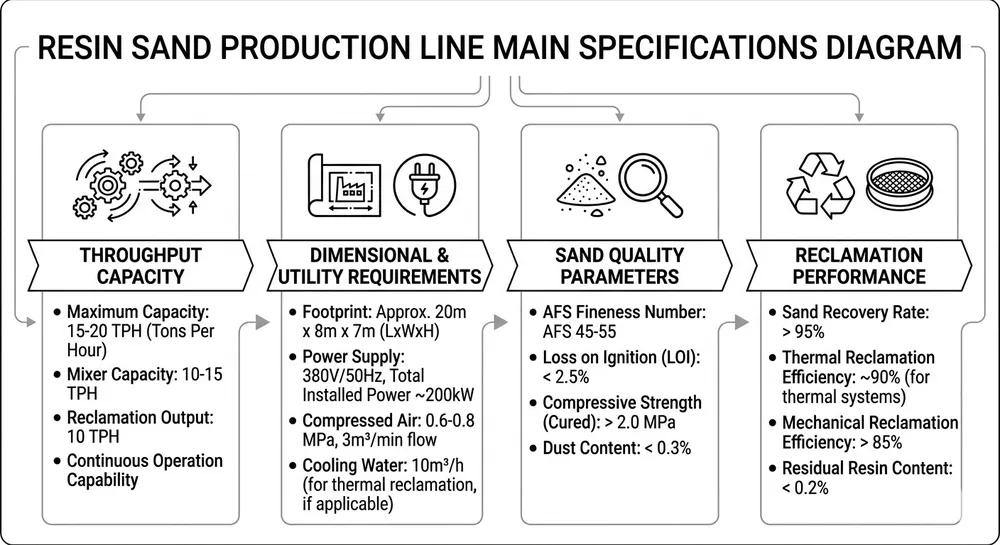
Footprint and Utility Requirements
Continuous mixers need more floor space and higher electrical capacity:
Floor space: Batch mixers: 8-12 m² (mixer + hopper + resin tanks). Continuous mixers: 12-18 m² (longer conveyor, larger buffer hopper, more complex resin distribution).
Electrical: Batch mixers: 5-10 kW (mixer motor + resin pumps). Continuous mixers: 10-18 kW (mixer motor + screw conveyor + belt feeder + resin pumps + control system).
Compressed air: Both types need 6-8 bar air for resin pumps and control valves. Continuous mixers may need higher flow rates (150-200 L/min vs 80-120 L/min for batch mixers) because of more pneumatic actuators.
RFQ language: "Provide foundation drawing with anchor bolt locations, floor loading requirements (kg/m²), electrical specifications (voltage, phase, kW), and compressed air requirements (pressure, flow rate). Include utility connection points for installation planning."
Making the Call: Send Your Pour Schedule for a Sizing Recommendation
The continuous vs batch decision isn't about which technology is "better" — it's about which one matches your production economics. If you're running 120+ molds per shift on a consistent schedule, continuous mixers pay back their premium through resin accuracy and labor savings. Below 80 molds per day or running frequent resin changes, batch mixers give you better flexibility and lower total cost.
The crossover zone (80-120 molds/day) requires actual cost modeling with your resin prices, labor rates, and changeover frequency. We've built both types at TZFoundry's Qingdao facility — 8 production lines running batch and continuous systems for different buyer applications. Our engineering team can size either type and show you the 3-year cost comparison based on your specific operation.
Send us your daily mold count, shift pattern, resin type, and available floor space. We'll recommend the mixer configuration that minimizes your total cost of ownership and provide factory pricing with commissioning support. Most buyers in the 100-120 mold/day range start with a detailed cost model before deciding — we'll build that for you based on your actual numbers, not generic assumptions.
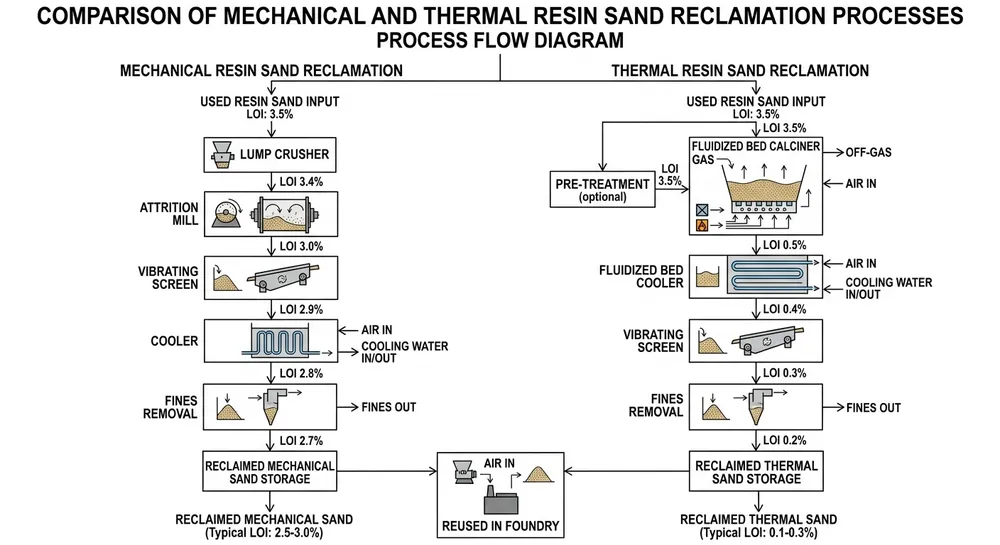
For more context on resin sand production systems, see our Resin Sand Production Line overview or the detailed Resin Sand Mixer product page. If you're evaluating complete systems including sand reclamation, the Foundry Sand Reclamation Production Line page covers mechanical and thermal recovery options that feed both mixer types. For furan-specific applications, our Furan Resin Sand Production Line guide addresses binder system selection and curing parameters.

Liu Haoran is the Resin Sand Production Line Technical Manager at TZFoundry. Over 11 years of hands-on work with furan, phenolic, and coated sand systems, he has commissioned 40+ resin sand lines for export buyers and developed binder dosing protocols...